Café St-Michel (Montreal)
Café St-Michel was one of the most significant nightlife venues in downtown Montreal during the 1940s and early 1950s. Located at 770 Mountain Street, just south of Saint-Antoine Street, the establishment functioned as a cabaret, dance hall, and jazz venue closely associated with Harlem-style revues, African American performers, and the emergence of modern jazz in Montreal. Operating within a heavily regulated moral and legal environment, the Café St-Michel became a key site where Black American musical traditions, local musicians, and Montreal audiences intersected.
Origins of the site (1934–1939)
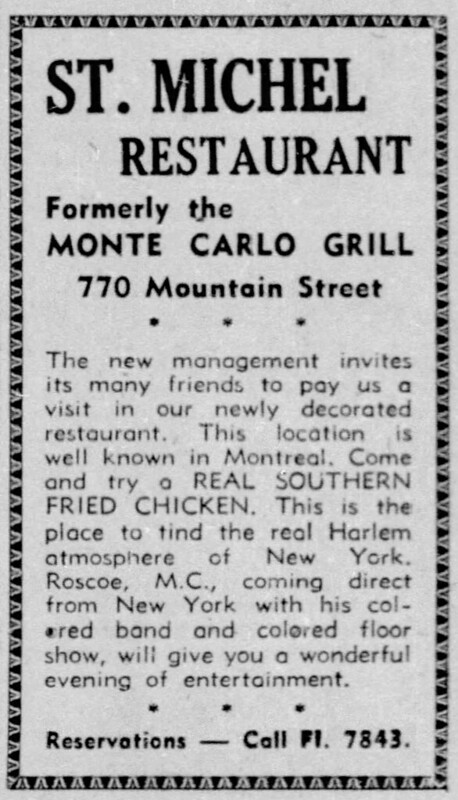
According to the Lovell Directory of Montreal, the address 770 Mountain Street first appears as a nightlife establishment under the name Monte Carlo between 1934 and 1938. Advertisements from the mid-1930s describe the venue as offering “the real Harlem atmosphere,” with multiple nightly shows, dance music, and alcohol service. The Monte Carlo Grill was operated by the company Monte Carlo Grill, Inc., incorporated on May 25, 1934, by Hormidas Benoit, Cléophas Champagne, and Émile Trottier, all of Montreal.
In 1938–1939, the site was briefly rebranded as Ideal Garden. The establishment was owned by Egille Lord and operated under the management of Dave Bernier. Press advertisements from La Patrie confirm the continuation of cabaret-style programming, including swing orchestras, dance numbers, and amateur contests. This phase represents a transition rather than a rupture: the function of the site as a nightlife and performance venue remained intact.
1940–1945: Establishment and wartime years
The name Café St-Michel appears in the Lovell directories starting in 1940. During the Second World War, Montreal experienced an unprecedented boom in nightlife, driven by military presence, industrial labor, and tourism.
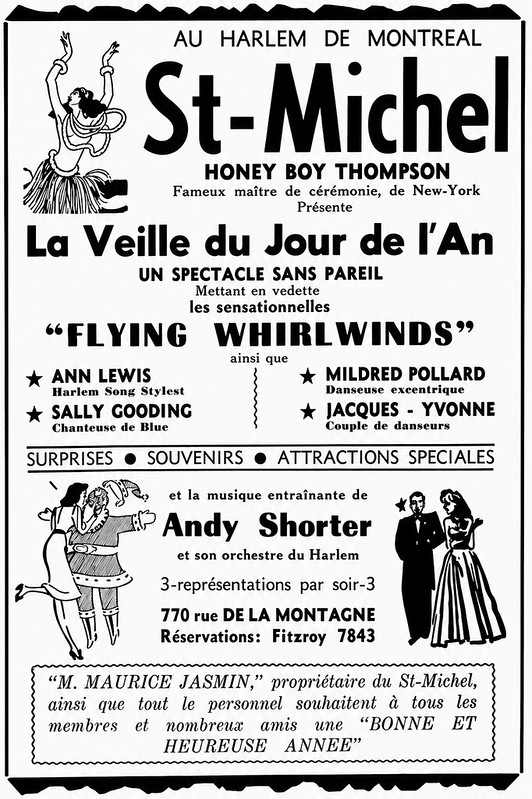
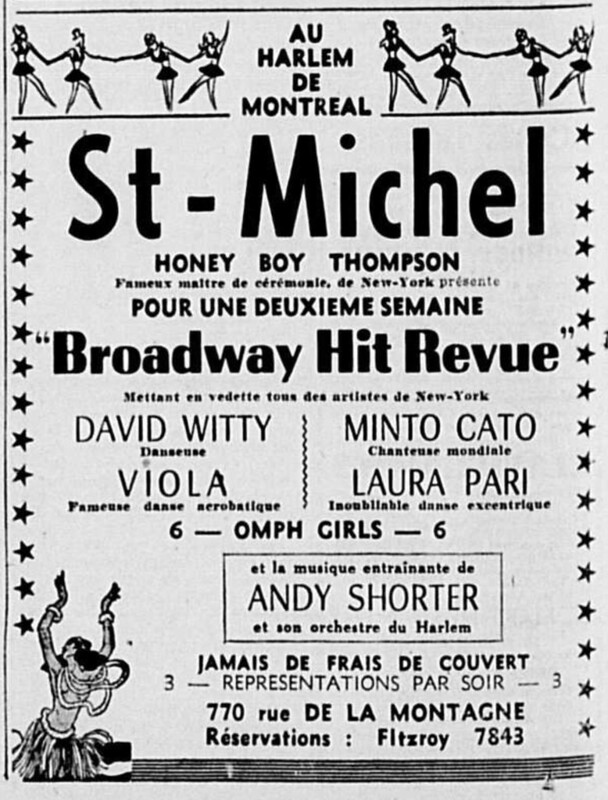
Within this context, the Café St-Michel positioned itself as a downtown cabaret offering revues, dance, and music inspired by African American performance traditions. Advertisements from the early 1940s frequently emphasize Sunday openings, late-night shows, and the presence of performers associated with New York’s Harlem clubs.
During the early years of operation (1940–circa 1946), the Café St-Michel was administered directly by its owner, Maurice Jasmin.
1946: Incorporation and reorganization
From 1946 onward, the Café St-Michel was legally operated by the company Café St-Michel Ltd., incorporated by Lucien Jobin, Armand Côté, and Clément-R. Thibault. Day-to-day operations were initially handled during a transitional phase (1946–1947), and were then entrusted on a stable basis to Omer Lapierre, who became the venue’s effective manager-operator from 1947–1948 onward.
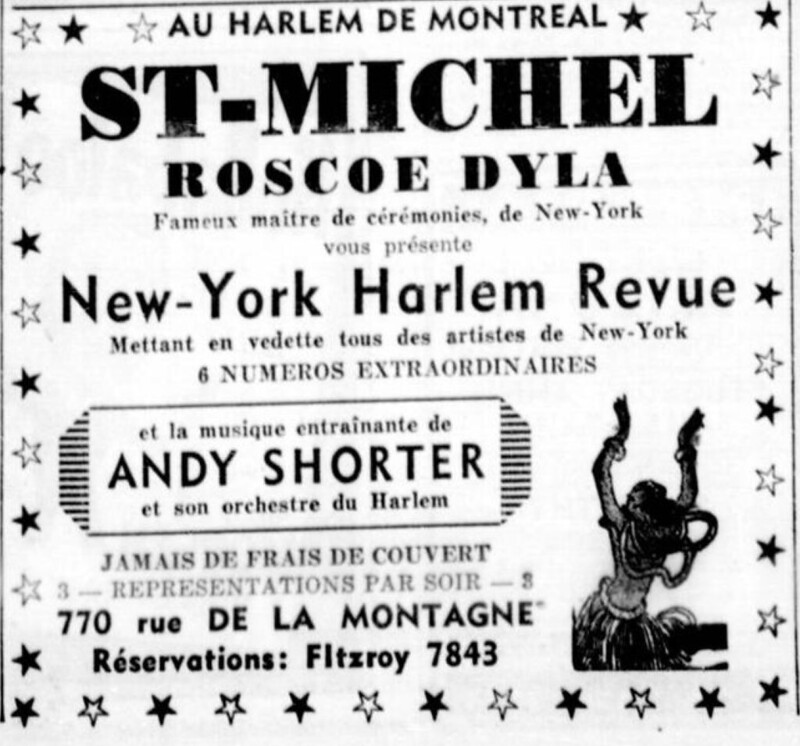
Newspaper advertisements from the same year announce large-scale productions marketed explicitly as Harlem Revues, often promoted as appearing in Montreal “for the first time.” This moment marks the consolidation of the venue’s identity as a Harlem-style cabaret.
Harlem revues and racialized spectacle
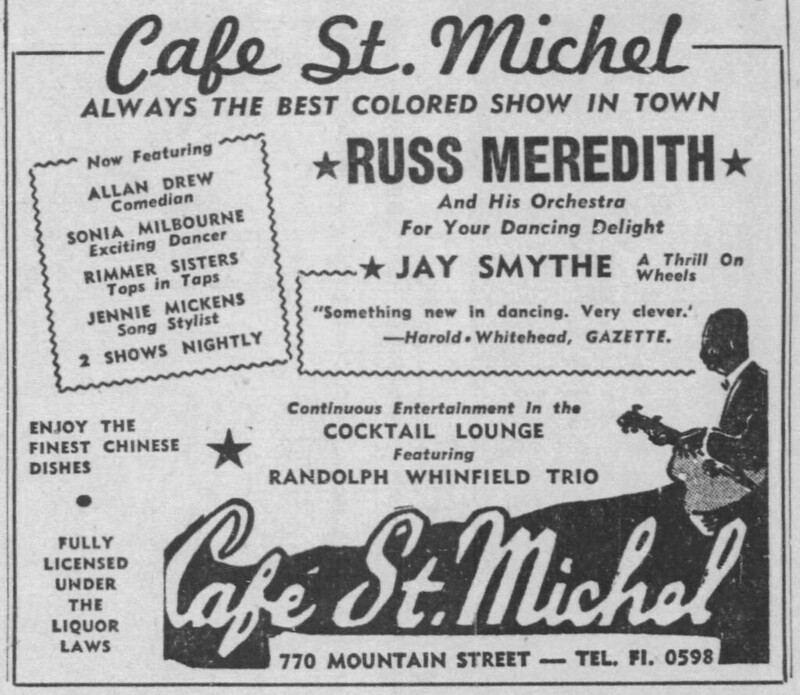
Throughout the 1940s, the Café St-Michel repeatedly described itself as the “Harlem of Montreal.” The programming relied on racialized imagery common to North American cabaret culture: chorus lines, exotic dance numbers, blues singers, comedians, and master of ceremonies.
While this framing reflected the stereotypes of the era, it also created a rare space for African American performers to work consistently in Montreal. The Café St-Michel thus occupied an ambiguous position, simultaneously reinforcing and enabling Black performance culture within a predominantly white urban environment.
Jazz, Louis Metcalf, and modern listening
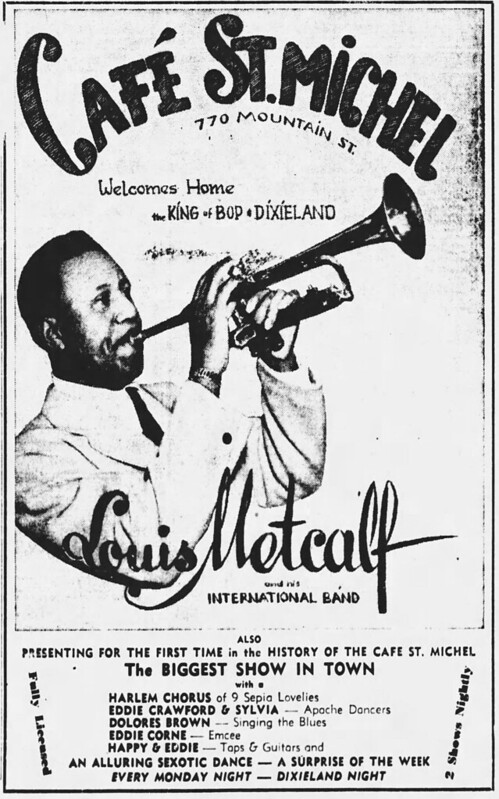
The musical history of the Café St-Michel is inseparable from that of Louis Metcalf, an African American trumpeter and former associate of Duke Ellington. During the mid-1940s, Metcalf led an International Band at the venue, providing musical continuity beyond the rotating revues.
According to jazz historian John Gilmore, the Café St-Michel became one of the first places in Montreal where audiences came specifically to listen to jazz, rather than merely dance to it. This shift contributed to the emergence of modern jazz and early bebop practices within the city.
Policing, morality, and regulation
Like many Montreal nightclubs of the era, the Café St-Michel operated under constant surveillance. Newspaper archives document numerous fines, court appearances, and license disputes related to alcohol service, Sunday dancing, and opening hours.
These regulatory pressures form an essential part of the venue’s historical record, revealing how nightlife establishments generated extensive “administrative traces” alongside their cultural impact.
1950–1955: Final years and closure
At the beginning of the 1950s, the Café St-Michel was operated under the direction of Marcel Clark, identified in advertisements as proprietor (prop.). In this capacity, he acted as the establishment’s principal operator and public figure, responsible for programming and the conception of revues. Day-to-day management was handled by Ernest Hébert, manager, as indicated in contemporary advertisements. Although the venue remained legally owned by Café St-Michel Ltée, the term proprietor here refers to a commercial and artistic function, rather than to legal ownership. The Café St-Michel continued to advertise large-scale revues and dance evenings, but the model faced increasing challenges. Changing entertainment habits, intensified regulation, and shifts in downtown nightlife contributed to a gradual decline.
The closure of Café St-Michel in 1953 resulted from a combination of regulatory and police pressures, instability linked to the liquor permit, the economic weakening of the large-scale revue model, and a profound shift in Montreal’s nighttime cultural practices in the early 1950s. Like many comparable cabarets of the period, the establishment gradually became non-viable in a context of heightened surveillance and a transforming urban entertainment landscape.
Legacy
Although largely absent from popular memory, the Café St-Michel occupies a crucial place in Montreal’s cultural history. It functioned as a bridge between Harlem-inspired cabaret culture and the emergence of modern jazz listening practices.
Alongside venues such as Rockhead’s Paradise, the Café St-Michel contributed to shaping Montreal’s reputation as a North American jazz city, particularly during the wartime and immediate postwar years.
Notes & sources
-
LOVELL DIRECTORY OF MONTREAL, 1934–1956 —
listings for 770 de la Montagne Street / 770 Mountain Street
(Monte Carlo, 1934–1938; Ideal Garden, 1938–1939; Café St-Michel, 1940–1955; vacant in 1956).
MCPA use: longitudinal documentation of occupancy at 770 de la Montagne Street, identification of successive venues, confirmation of continuity and breaks in use from the mid-1930s to the mid-1950s. -
LE PETIT JOURNAL, August 2, 1936 — advertisement
“Monte Carlo Grill,” 770 de la Montagne Street.
MCPA use: early documentation of the Monte Carlo Grill, marketing language (“genuine Harlem atmosphere”), frequency of shows (three performances per evening), and positioning within Montreal’s nightlife scene of the mid-1930s. -
LA PATRIE, September 4, 1938 — advertisement
“Cabaret Ideal Garden,” 770 de la Montagne Street.
MCPA use: identification of the Ideal Garden cabaret, geographic description (“just south of St-Antoine”), outline of programming, and presence of amateur contests as part of audience engagement strategies. -
LE DEVOIR, January 2, 1940 — notice relating to
the transition to Café St-Michel.
MCPA use: documentation of the change of venue name and management context at the turn of 1940, including the appearance of Maurice Jasmin and the broader reorientation of the site’s activities. -
GAZETTE OFFICIELLE DU QUÉBEC, February 23, 1946
(no. 8) — incorporation notice for
“Café St-Michel Ltée” (dated January 9, 1946).
MCPA use: legal documentation of the incorporation of Café St-Michel Ltée; identification of founders (Lucien Jobin, Armand Côté, Clément-R. Thibault) and declared share capital ($45,000). -
THE GAZETTE, January 21, 1946 — advertisement
“Harlem Revue” (Café St-Michel).
MCPA use: confirmation of ownership (L. Jobin & A. Côté), identification of management (P. Letang), number of nightly shows (two), and promotional discourse (“first time in Montreal”). -
THE GAZETTE, 1942–1953 — corpus of advertisements,
columns, and court reports relating to Café St-Michel.
MCPA use: documentation of programming, revues, and regulatory framework, including alcohol service, Sunday laws, and opening hours; insight into the operational constraints of Montreal nightclubs during the period. -
MONTRÉAL-MATIN, November 27, 1950 — article /
advertisement relating to a revue (“Carnival in Cuba”).
MCPA use: evidence of large-scale revue production at Café St-Michel, identification of management (Omer Lapierre), artistic personnel (Marcel Clark), attendance figures, and the presence of a resident orchestra. -
GILMORE, John, 2009 —
Une histoire du jazz à Montréal, Montreal, Éditions Lux.
MCPA use: secondary historical source on Café St-Michel’s role in Montreal’s jazz scene, including references to Louis Metcalf, stylistic transitions (swing to bebop), listening cultures, and musicians’ career trajectories. -
MARRELLI, Nancy, 2004 —
Stepping Out: The Golden Age of Montreal Night Clubs, Véhicule Press.
MCPA use: contextual framework for Montreal’s nightclub ecosystem (1925–1955), situating Café St-Michel within the broader history of nightlife, entertainment circuits, and urban leisure culture.