Venue profile — Downtown — Red Light District
Les Foufounes Électriques (Montreal)
Les Foufounes Électriques are a concert venue and alternative bar founded in 1983 at 87–97 Sainte-Catherine Street East, which have become a landmark of Montreal’s underground culture, continuing the legacy of Clochards Célestes and the Zoobar.
⏱ Reading time: 15 minutes
1. Clochards Célestes (1980–1982)
The Clochards Célestes, through their name, history, and location, positioned themselves as a cultural meeting place for Montreal’s “scene.” “We want to attract punks, straights, or transvestites like those already among our clientele. Everyone is welcome, regardless of how they dress or their attitude toward life,” explained founder Michel Perreault to La Presse in 1981 [1].
In Montreal, as elsewhere in Quebec, many performance venues emerge and disappear. Places such as El Casino (1977–1979) and Pretzel Enchaîné (1979–1982) came and went. Others took over: since the Outremont stopped presenting shows, the Théâtre St-Denis has been more in demand. The Club Montréal (future Spectrum) and the Arlequin (future Olympia) also appeared as mid-sized venues, while the Atelier continu closed its doors. It was, however, in smaller venues that experimentation flourished, thanks to flexible formats blending theatre, music, and variety acts. In this context, spaces such as the Bijou, the Transit, and, in 1980, the Clochards Célestes on Sainte-Catherine Street emerged, reflecting the vitality of the cultural scene [2].
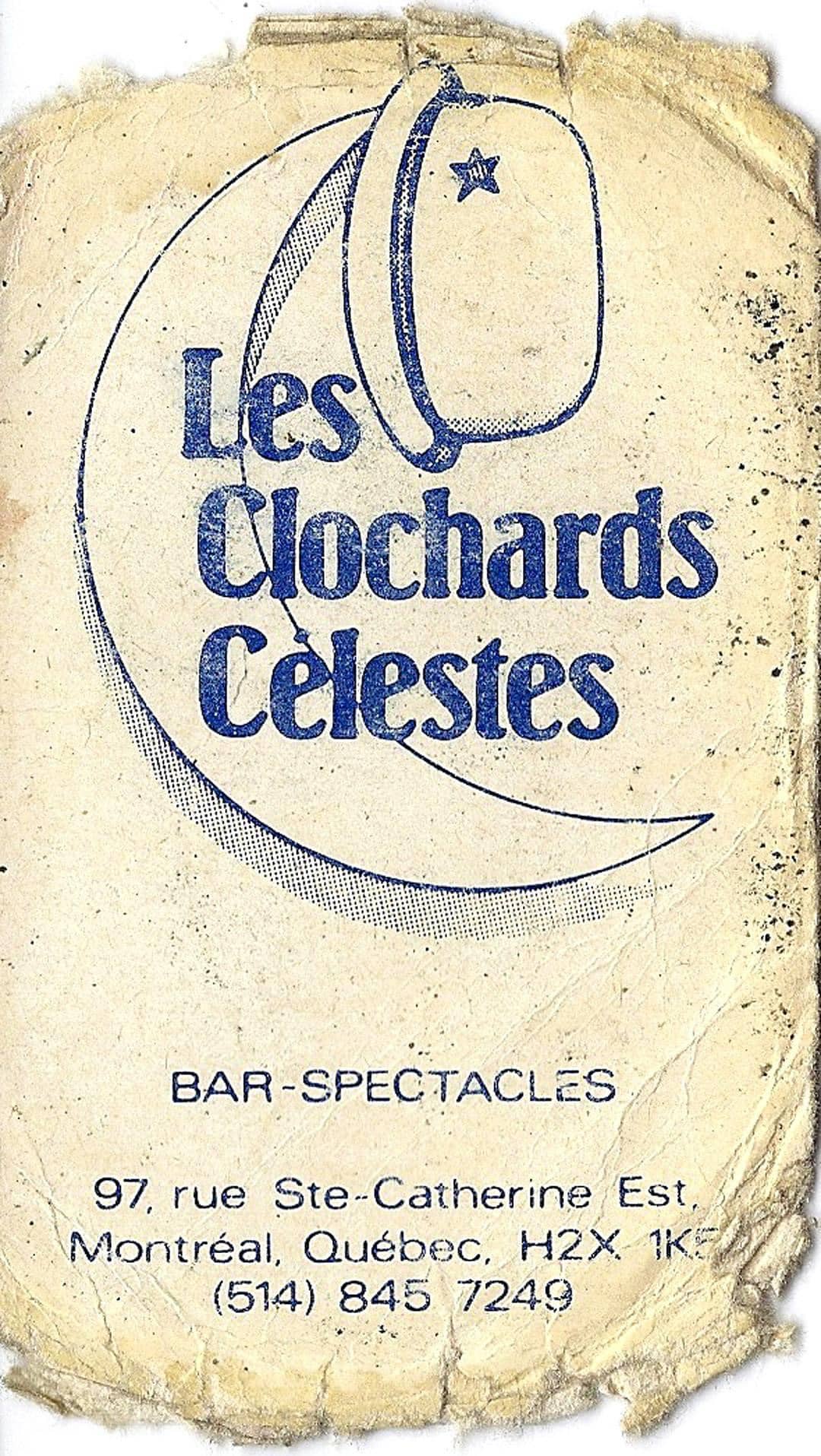
In January 1981, Michel Perreault, leader of the band Bâton Rouge, greeted the crowd and announced a Chuck Berry song. It was the group’s first booking at the Clochards Célestes, and it showed—but the energy was there. The 211 seated patrons permitted by regulation seemed satisfied. There was no cover charge, and $1 beer drew crowds. As Perreault explained, this new bar-venue offered an affordable alternative to establishments on Saint-Denis Street, where beer cost $1.75. The venue’s name was taken from a novel by Jack Kerouac. The space occupied the former Café Pal (1950s–1960s), then the Café Vic, associated with Vic Cotroni. Closed since 1970, the site was revived by Perreault and a group of young people, notably involved in Saint-Jean celebrations [3].
“You wouldn’t believe how dirty it was when we got in,” Perreault recalled, “there were dead pigeons everywhere.” Cleaning began in mid-September 1980, and the Clochards Célestes served their first beer on December 26, 1980. The second floor, however, remained under construction. Perreault hoped to occupy the entire 9,600-square-foot building by spring [3].
“We want something happening seven days a week, from 2 p.m. until closing,” Perreault explained. Initially centered on Bâton Rouge and other bands, the programming was expected to expand to theatre, fashion shows, and visual arts. “Any form of cultural expression. There are so many artists in Montreal!” [3]
On March 14, 1981, La Presse confirmed that the Clochards Célestes were “moving into shows.” Located at 97 Sainte-Catherine Street East, the venue began shifting toward structured programming, notably with Nion et compagnie. Perreault reaffirmed his desire to attract “Montreal’s scene” and to make the space a multidisciplinary venue open to all forms of expression [1].
But $1 beer was not enough to attract major stars—and Perreault did not really want that: “It could become a hangout for the rejected, but a place where something happens,” he said, contrasting it with more stagnant areas. His goal remained simple: fill the room [3].
In January 1981, the clientele—around 20 years old—largely came from the Faubourg. Perreault hoped, however, to attract neighborhood residents. “Local transvestites started coming early in the evening… then came back later, especially for the pinball machines” [3].
He also highlighted support from the neighborhood: a population of rooming-house tenants, often in precarious situations, contributed to the project, sometimes on a volunteer basis, helping bring the place to life [3].
The choice of Sainte-Catherine Street, near the Main, was deliberate: “Because we come from this neighborhood, and things are happening here that need to be seen. We need to stop thinking of it as a pigsty.” [3]

In March 1981, La Presse noted the emergence of small venues in the East End, particularly around Papineau and Sainte-Catherine. This movement reflected a generational desire to create alternative spaces, outside established circuits—a context in which the Clochards Célestes fit [43].
This proliferation, however, revealed a fragile economic model, where passion and improvisation often made up for a lack of resources [43].
On May 2, 1981, La Presse returned to the Clochards Célestes. The show Transport Mental, associated with François “Yo” Gourd, blended humor, poetry, and stage experimentation. The article highlighted an approach where “anything can be said with humor and tenderness,” reflecting a desire to go beyond the simple alternative bar toward a broader artistic vision [42].
2. Zoobar (1982–1983)
In March 1982, before disappearing for good, “after seven years of existence and two and a half years of absence,” the bar La Grande Passe, on Ontario Street, joined forces with the Clochards Célestes to create a new venue: the Zoobar, located at 97 Sainte-Catherine Street East. The press explicitly presented this opening as a merger, bringing together the strengths of two vanished venues [4].
The Zoobar was then run by a dozen worker-members grouped within the Société de développement des arts, a non-profit organization bringing together the organizers of the two previous venues. This collective structure reflected a desire for cultural continuity, rather than a simple change of name [4].

Opened in March 1982 by the jazz group G.U.M. (Grande Urchestre de Montréal), the Zoobar immediately presented an open-ended program: exhibitions, openings, happenings, dance performances, film screenings (with Mondays reserved for film lovers), and even a week devoted to women’s creative work. “We have not set a performance policy and we do not want to limit ourselves to one form,” the article stated, confirming the venue’s multidisciplinary ambitions [4].
Musically, G.U.M., a group of ten musicians using the big band format, embodied this desire for accessibility: music that was “more popular, more rhythmic, less cerebral” than that of E.M.I.M., with a strong brass section and a deliberate sense of showmanship [4].
In Le Devoir, however, Nathalie Petrowski offered a more ironic view of this new club, referring to it as playing “music for mutants”— a phrase that captured both the venue’s marginal aesthetic and its deliberately offbeat stance. In this way, the Zoobar positioned itself outside dominant cultural circuits, embracing an alternative identity that was as appealing as it was unsettling [25].
By April 1982, the group Abbittibbi was announced, and there was hope that the Zoobar would become a launching pad for emerging Quebec talent. The article also recalled that the Clochards Célestes had helped introduce Transport Mental Illimité and Nion, while La Grande Passe had contributed to the rise of the Orchestre Sympathique. The Zoobar thus became part of a genuine chain of artistic transmission [4].
Described bluntly as “not too expensive, not very comfortable, but promising,” the Zoobar appeared as an experimental space, relying on closeness, flexibility, and the energy of the scene rather than on comfort or prestige [4].
3. Foufounes Électriques (since 1983)
In the spring of 1983, the space at 97 Sainte-Catherine Street East entered a transitional phase. On April 20, 1983, Le Devoir published an article by Nathalie Petrowski devoted to the collective Montréal Transport Limité, presented “at the former Zoobar” until April 30. The piece describes a performance blending political satire, burlesque, media collage, and absurdist aesthetics, confirming that the venue remained an active hub of Montreal’s experimental scene [44][45].
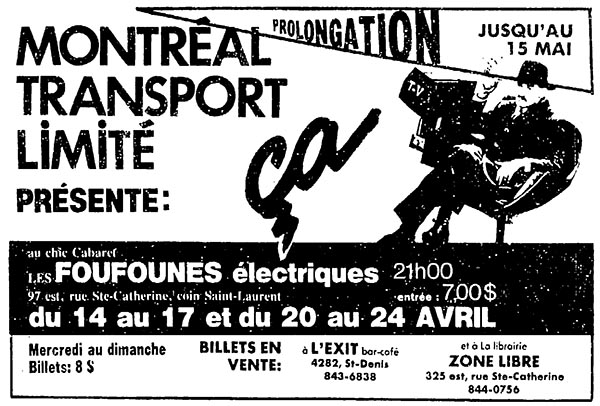
At the same time, however, the show advertisement already identifies the address under the name Foufounes Électriques (97 Sainte-Catherine Street East). This coexistence of names indicates that the transition took place precisely during the spring of 1983, at a pivotal moment when the former Zoobar officially gave way to the Foufounes Électriques.
The establishment had previously operated under the names Clochards Célestes (inspired by Jack Kerouac), then Zoobar. The adoption of the name “Foufounes Électriques”—which can be translated as “Electric Buttocks”—marked a more radical assertion of identity. The name originated from a performative practice by the founders, who displayed their painted buttocks and printed them onto old television screens, embedding from the outset a provocative and carnivalesque aesthetic [8], [9], [10].
Over the years, the venue went through several phases of expansion. The ground-floor terrace, for example, was built on a former vacant lot, reflecting the site’s gradual growth [11]. The building is owned by Amiri Habibollah (Habib Amiri), whose real estate presence played a key role in the club’s later history.
From an administrative standpoint, a university source (2008) indicates that Normand Boileau remained a minority shareholder and participated in management alongside the principal owner, Habib Amiri [8].
Key Figures
Founders, owners, and structural figures
François “Yo” Gourd — A figure associated with the early years and performative aesthetic of the Foufounes, notably through Montréal Transport Limité and projects blending humor, poetry, and experimentation.

Normand Boileau — Minority shareholder, involved in management alongside the principal owner during key phases of growth.
Bernard Paquet — Co-founder of the Foufounes Électriques, alongside Normand Boileau and François Gourd. Coming from the underground artistic and musical theatre scene, he contributed to shaping the venue’s original concept, at the intersection of alternative music and visual arts.
Habib Amiri (also listed as Amiri Habibollah) — Owner of the building, a decisive figure in the venue’s history, particularly through his real estate and financial role in sustaining and relaunching the club.

Programming, production, and artistic direction
Dan Webster — Booker and key figure behind the Foufounes’ international reputation, associated with ambitious alternative programming and phases of renovation and repositioning of the venue.
Sylvain Houde — DJ, musical director, and spokesperson, involved in the cultural life of the venue and during moments of crisis (public mobilization, institutional survival). Also linked to event production through Productions Goliath (1980s–1990s).
Sylvain Lafrenière (“Captain Rock”) — A figure associated with the reception of the venue and generational shifts in its audience, particularly around the Black Mondays.

Visual identity, iconography, and counterculture
Henriette Valium (Patrick Henley) — A major figure of the counterculture, associated with a radical DIY aesthetic often linked to the venue’s provocative visual identity.
Nancy Beaulieu — Foufs employee and assistant booker, known for handcrafting concert posters (including the Nirvana show poster in 1991) and for her DIY graphic work (collage, marker, photocopy).
Cozmik Kay — Graphic designer associated with the bar’s visual identity and the Foufounes’ graphic imagination.
Internal Team, Memory, and the Venue’s “Characters”
Michel Larouche (“le Gros Michel”) — An iconic pillar: doorman and later daytime bar manager, a protective figure deeply tied to the sense of belonging of the early decades. A communications graduate, active in bars from the age of 17, he worked both here and in the United States and Europe. A motorcycle enthusiast, marked by several accidents, he carried in his body the traces of an intense life.

He also worked as a bodyguard for touring bands, including the Rolling Stones, Pink Floyd, Emerson, Lake & Palmer, and Bérurier Noir. He regularly hosted artists performing at the Foufounes Électriques in his apartment in the Faubourg à m’lasse. A larger-than-life character, he embodied a reassuring presence, almost a “nanny” of the alternative scene [18].
He died on August 21, 1991 of cardiac arrest. In addition to his role at the Foufs, Michel Larouche was a founding member of the World Anti-Fascist League (L.A.M.) and involved in the Rassemblement pour l’Amitié mondiale (R.A.M.), where he served as an administrator [19].
Rumors later suggested more troubling circumstances surrounding his death, though no evidence ever confirmed them [20].
“The idea that Michel’s death could have been the result of a settling of scores seems absurd,” explains Sylvain Binette, a close friend. “Le Gros Michel already had heart problems, and those who knew him understood that he lived intensely. For me, the Foufounes Électriques are practically the house Michel built. He was that unifying force that gave the Foufs their sense of belonging. He loved and hated with the same passion, and his friends formed a group of rare loyalty.”
Shantal Arroyo — Coordination of special events (e.g., Cabarets Kaboom and themed nights) and contributions to the animation of the local scene.
Risa Roumeliotakis — Figure associated with internal organization and the venue’s day-to-day life, often mentioned alongside Shantal Arroyo in team portraits.
Figures Recalled in Early Memory (Reception and Imaginary)
René-sens — A notable regular associated with the early period and the bar’s founding mythology.
1984 — Artistic Laboratory

As early as the spring of 1984, the Foufounes Électriques established themselves as a true artistic laboratory with the “Peinture 3 x 4” evenings, where around twenty artists created works live in front of an audience before they were auctioned off the same night. Presented as an “art auction with a difference” by The Gazette, the format transformed the space at 97 Sainte-Catherine Street East into a charged collective studio: about 150 spectators surrounded the painters, who had one hour to complete their canvases. Bids started at $5, some works reached $90, and a record of $455 was even set. François Gourd, then co-owner and host, acted as master of ceremonies, orchestrating this fusion of performance, art market, and underground culture. The event already revealed the Foufs’ signature: interdisciplinarity (music, visual arts, performance), alternative economics, and the staging of a young, punk, and new wave community, where creation and spectacle merged [30].
1989 — Renovations, Balcony, and Repositioning
In January 1989, The Gazette reported major renovations at the Foufounes Électriques. Under the direction of booker Dan Webster, the stage was moved to face Sainte-Catherine Street, and a C-shaped balcony was installed to improve previously poor sightlines. The venue’s capacity was increased to 400 people [29].
The same clipping notes that the Nick Cave show (February 13, 1989) was moved to the Rialto Theatre, as demand exceeded the Foufounes’ capacity— a sign that the venue was already attracting a rapidly rising international lineup [29].
Institutionalization and Expansion (1990)

Seven years after their founding, the Foufounes Électriques were no longer simply an underground bar, but a well-established cultural institution within Montreal’s landscape. Unlike many alternative venues of the time, the establishment operated without government subsidies, relying primarily on bar revenues and support from the Labatt brewery [17].
By the late 1980s, annual revenues reached approximately $1.5 million. The business employed nearly forty people, half of whom were from the Saguenay–Lac-Saint-Jean region. Capacity increased from 250 to 750 people thanks to a major expansion and the installation of a sophisticated lighting system [17].
Programming was intense: up to 300 productions per year, including the famous live painting nights, which became profitable after initially sparking controversy. The Foufounes also began distributing records, signaling a more professional organizational structure [17].

The venue also consolidated its role as an international launching pad: artists such as Marianne Faithfull, Front 242, The Young Gods, Lydia Lunch, and William Burroughs performed there, anchoring the Foufounes within both the North American and European alternative networks [17].
This growth, however, revealed an ongoing tension: preserving a marginal spirit while ensuring economic survival. As Normand Boileau put it, expansion was a necessity: “It was either that or die” [17].
Among the defining moments of its most experimental period, the study highlights the emergence of deliberately provocative performances, particularly during festival-style events such as Shockart in the late 1980s. “Disturbing” art was embraced as an aesthetic meant to shock and challenge norms, helping to firmly establish the Foufs’ image as a laboratory of Montreal’s underground culture [8].
1991 — Eight Years “on the Fringe,” Public Image, and Expansion
In May 1991, The Gazette portrayed the Foufounes Électriques as a club “far from Crescent” — both geographically and culturally — located on the red-light strip of Sainte-Catherine Street, east of Saint-Laurent Boulevard. The article emphasized the contrast between the colorful murals on the façade and an interior described as “Batcave-Gothic,” dark and at times intimidating for first-time visitors [22].
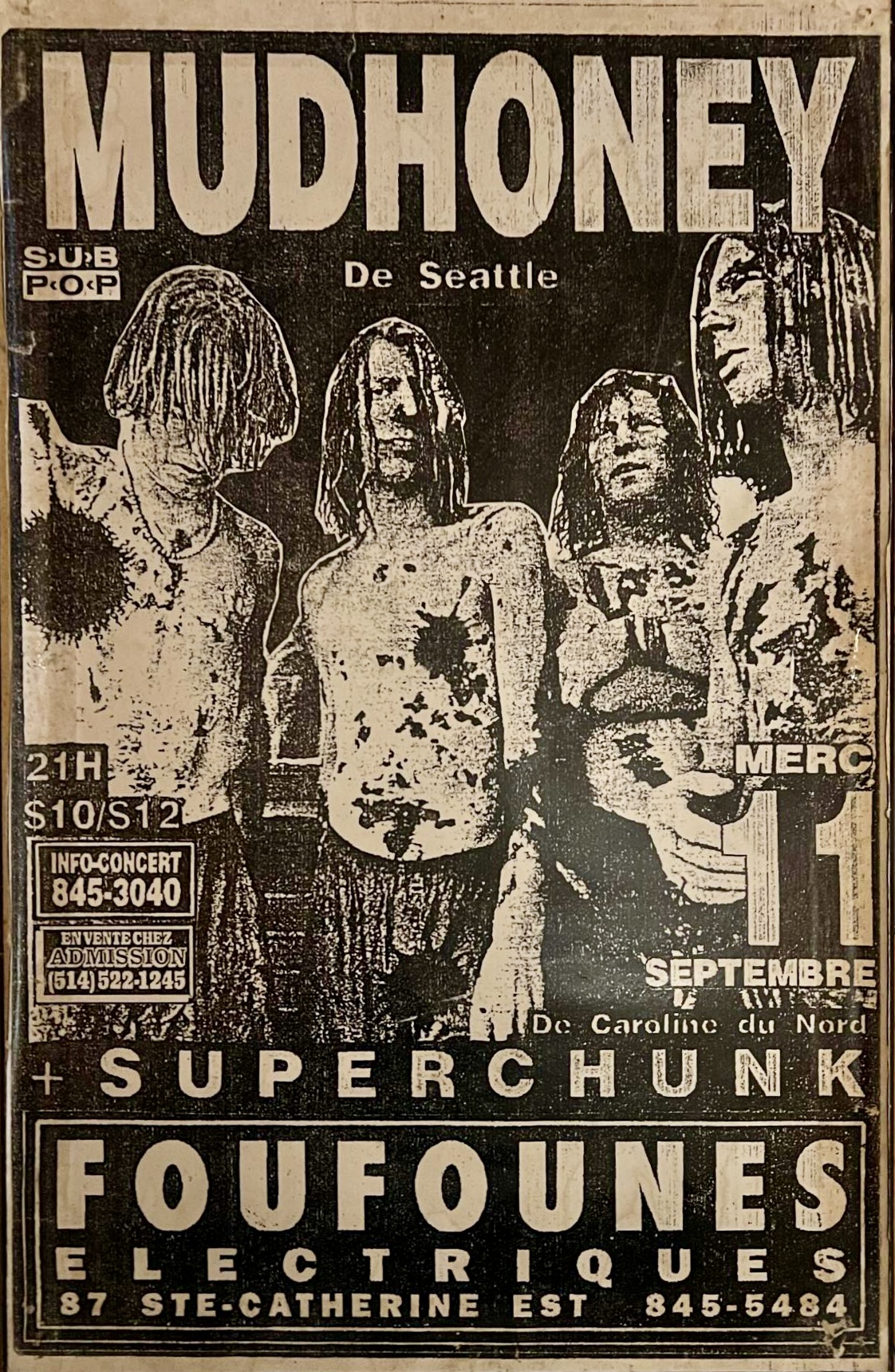
The clientele is described as mixed — “from bike couriers to bureaucrats” — and mostly local, drawn from within a radius of about ten blocks: artists, musicians, bike couriers, and workers mingled there [22].
Presented as programmer, Dan Webster stated that the club “had not bent its ideals” in order to join the mainstream, while also referring to major expansion: the space had reportedly been tripled “without compromise,” and the opening of a second bar / terrace was announced. These developments coincided with a week of celebrations marking the venue’s longevity [22].
Musically, the article mentions performances of offbeat rock, often little played on local radio, by groups such as Jesus Lizard, KMFDM, and Groovy Aardvark [22].
1992 — 9th Anniversary, “Living Room of the Underground,” and Programming Diversity
In the early 1990s, the Foufounes’ notorious reputation began to shift. In December 1992, Le Devoir noted that, despite the venue’s lingering image as a “rough” bar, its clientele had become considerably calmer. The Black Mondays, which had become a fixture, drew up to 1,500 people in a single evening. The audience, now more diverse, was described as relatively peaceful, with certain extremist symbols being refused at the door. Programming relied on a mix of rock, rap, and hard rock, helping stabilize the venue’s sonic identity. This moment marked a turning point: the Foufounes Électriques moved from being a marginal den to becoming a well-established alternative institution [31].

In June 1992, The Gazette presented the club as an unusual downtown “underground” venue whose longevity — as it approached its 9th anniversary — contrasted with the fragility of other halls. Despite a reputation that could sometimes seem intimidating, the place was described as a space of belonging, a kind of underground “living room” [23].
The article ties the venue’s artistic operations to Dan Webster (identified as production manager) and highlights programming marked by diversity, ranging from punk and industrial to alternative rock. Among the artists mentioned: Nirvana, k.d. lang, Hole, Concrete Blonde, Marianne Faithfull, Meat Puppets, Pantera, Butthole Surfers, Skinny Puppy, Front 242, Smashing Pumpkins, SNFU, Bérurier Noir, and Killing Joke [23].
The article also preserves field details: a dark atmosphere with a gothic (“batcave”) aesthetic, a power outage in 1989 that turned the venue into a candlelit space, and a “cutting-edge” anniversary lineup, with low-priced shows including Senseless Things and Disposable Heroes of Hiphoprisy [23].
1993 — Bankruptcy, Seals, and Financial Crisis
In January 1993, the situation deteriorated rapidly at the Foufounes Électriques. The Gazette reported that the club temporarily suspended live concerts in order to refocus on a techno-dance direction, in what was presented as a local “restructuring.” The financial burden of productions, combined with ticket prices between $6 and $12 and sometimes insufficient attendance, weakened the economic model. A few weeks later, Le Devoir reported that the bar at 97 Sainte-Catherine Street East had declared bankruptcy and that seals had been placed on the door by bailiffs in mid-afternoon. This sequence corresponds to the final phase of a financial crisis that would open the way to a relaunch under new management [33][28].
1993 — The Foufs’ “Techno Sundays”
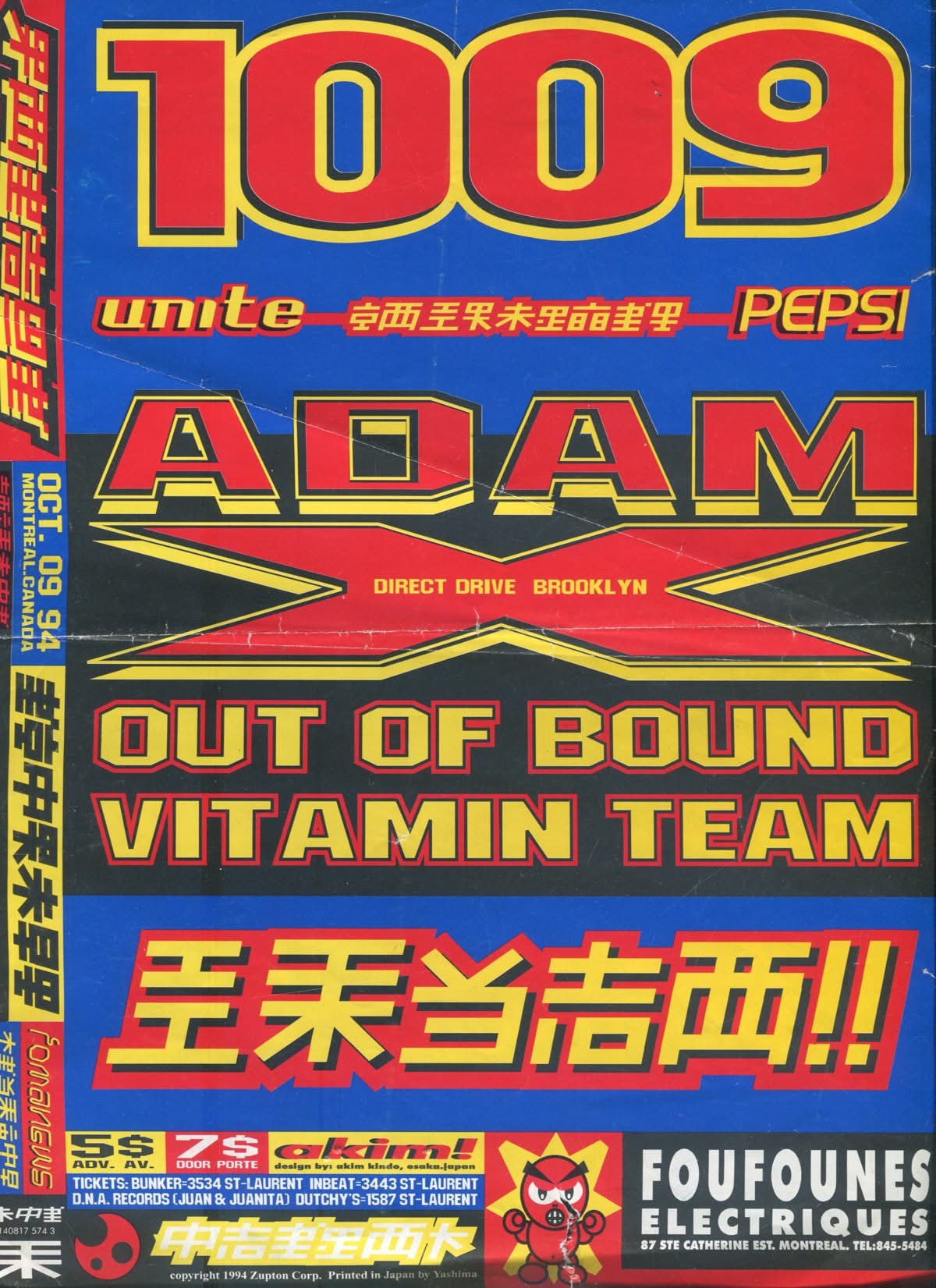
In the early 1990s, the Foufounes Électriques also established themselves as a key venue in the emergence of Montreal’s electronic culture. In a retrospective article published in May 2003, La Presse explicitly mentions the “legendary Foufs Techno Sundays,” recontextualized within the birth of rave culture in Montreal. The piece associates this period with the activity of the Vitamin DJ Team and scene figures such as Sylvain Houde (Vitamin S) and Sylvain Ferland (Cozmik Kay), while specifying that these events continued until 1995. In the memory of the local scene, they are also described as a launching pad for artists and producers now widely recognized — including DJ Champion, DJ Maus, Akufen, and Misstress Barbara — as well as a laboratory that helped foster the emergence of projects and aesthetics associated with Synergie and Hybrid Structure [51].
According to musical director Sylvain Houde, the 1993 closure can be explained both by a difficult economic context, a decline in part of the audience, government inertia toward small independent producers, and above all by accumulated deficits linked to the shows presented at the Foufounes. The debt reportedly stood at around $600,000 [28].
The same source recalls that in the previous years, the bar had undergone major expansion — across several floors and with a terrace — which may have contributed to weakening its financial balance. Productions Goliath and the Foufounes Électriques then employed as many as one hundred people, divided between the bar, administration, production, maintenance, and security [28].
Despite the crisis, the text insists on the venue’s central role in Quebec’s alternative scene, evoking appearances by major artists — including Marianne Faithfull, the Pixies, and Nirvana — as well as the Montreal beginnings of artists who would later mark the local scene. The closure thus appeared as a shock to Montreal’s underground, as the Foufounes had become a point of passage between Europe and America [28].
1993 — Announced Closure and Shockwave Through the Underground
In February 1993, the announcement of the closure of the Foufounes Électriques caused a real shockwave in Montreal’s alternative scene. La Presse described it as a “monument” that many had believed untouchable, a symbol of an underground scene capable of surviving economic cycles and controversy [26].
The article places the situation within a broader context: a multiplication of venues, increased competition on Sainte-Catherine East, public budget constraints, and the chronic fragility of independent spaces. The crisis was therefore not only that of a single bar, but of an alternative ecosystem under strong economic pressure in the early 1990s [26].

Media coverage also raised a question of identity: can an underground institution survive without losing its marginal spirit? The debate opposed the idea of a venue that had become too institutionalized to that of a space still essential to Montreal’s cultural vitality [26].
Beyond the closure itself, what emerges is the fear of a culturally sanitized Montreal. For many observers, the disappearance of the Foufounes Électriques would symbolize the loss of a space of freedom, friction, and artistic experimentation [26].
Only a month after the bankruptcy, the Foufounes Électriques were reborn. In February 1993, The Gazette announced the takeover of the club by Georges Guart, owner of Suk Kwan Design Inc., who acquired the name as well as the sound, lighting, and bar equipment, without assuming the estimated $600,000 debt left by Normand Boileau. Guart now leased the premises and promised more disciplined management, balancing finances and culture. Part of the staff was rehired, and themed nights, especially the Black Mondays, were to be revived. This reopening marked a turning point: the alternative institution survived its first major financial crisis and entered a new phase of professionalization [32].

In June 1994, the Foufounes Électriques became the center of a public mobilization. Following police raids and administrative pressure related to their liquor permit, about one hundred supporters organized a concert-demonstration in front of the Montreal courthouse. A petition bearing 13,351 signatures was submitted in defense of the institution, already recognized among the 50 best clubs in North America. The episode revealed the persistent tension between alternative culture and municipal authorities, as management argued that police should not dictate the aesthetic or cultural codes of the underground scene [34] [36].
Over the course of the summer of 1994, the mobilization grew. By July 28, more than 35,000 signatures had been collected in support of keeping the Foufounes Électriques open. Management emphasized the venue’s multidisciplinary nature — concerts, exhibitions, performances — and noted that the establishment employed around fifty people, whose average age was 25. In an electoral context, those in charge even approached local candidates in order to defend what they described as an essential alternative cultural hub in downtown Montreal [37].

In December 1994, the crisis reached its peak when the Régie des alcools, des courses et des jeux (RACJ) officially revoked the liquor license of the Foufounes Électriques, citing 66 counts, mainly related to drug use and trafficking as well as disturbing the peace. On December 8, 1994, the closure became effective: police officers arrived without warning and seized all of the alcohol. Unlike the 24-hour delay usually granted, the intervention was immediate. The establishment had reportedly been subjected to more than 400 police visits in one year.
Management immediately announced its intention to challenge the decision in Superior Court, raising in particular the alleged unconstitutionality of the RACJ. Despite the loss of the permit, the club temporarily remained open by serving only non-alcoholic beverages, while Sylvain Houde and owner Samuel Turcotte denounced what they considered a disproportionate sanction. They recalled that the establishment employed 50 people, paid more than $550,000 annually in wages, and about $100,000 to the bands performing there. The episode drew support from political figures and members of the music industry, who emphasized the importance of the Foufounes within Montreal’s cultural ecosystem [35], [38].

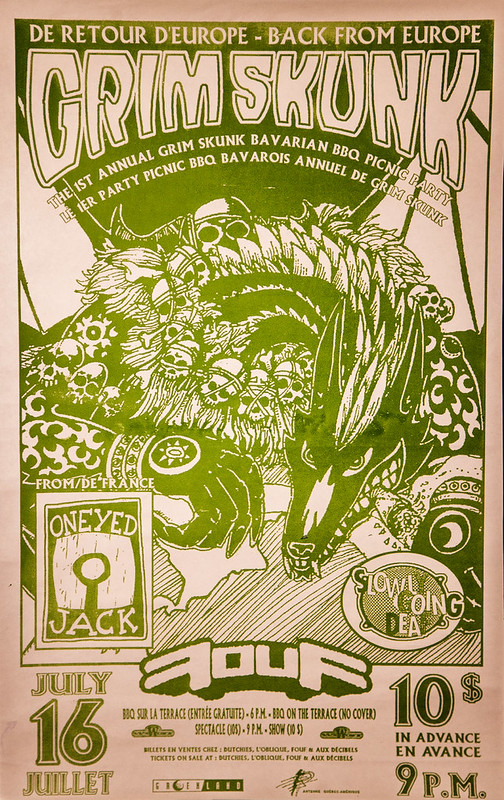
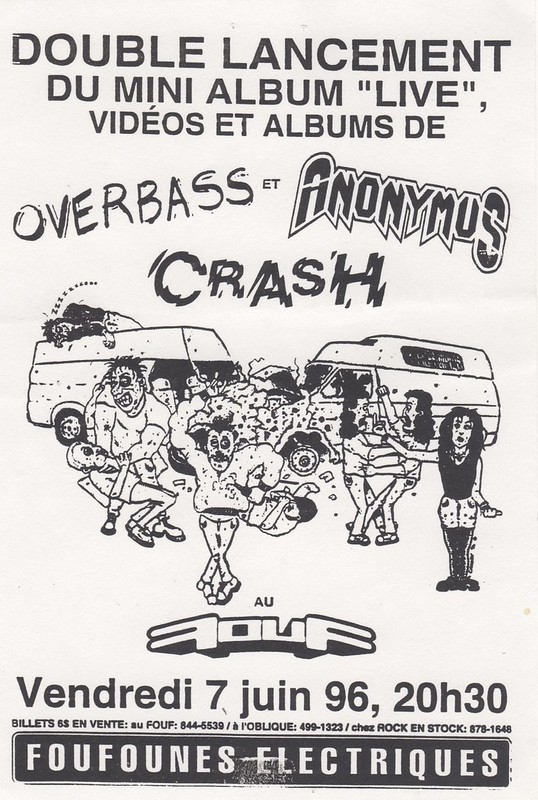
Since its opening, the bar had established itself as an epicenter of punk, gothic, and alternative culture in Montreal. Renowned artists such as Nirvana, Marianne Faithfull, Green Day, and Queens of the Stone Age performed there, at times inviting comparisons with the legendary New York club CBGB. The venue also served as a launching pad for Quebec and Canadian acts such as Grim Skunk, Groovy Aardvark, BARF, Overbass, The Tragically Hip, Cowboy Junkies, Rock et Belles Oreilles, and Jean Leloup [14].
Originally, the bar occupied a single floor, with one counter and a small stage. Over time, the Foufounes Électriques expanded across four levels (basement, ground floor, first, and second floor), including a mezzanine and administrative offices. The establishment now had several bars, two stages, and an affiliated restaurant [9].
The venue’s culture passed through several generations: beatniks, hippies, new wave, punks, grunge, skinheads, goths, ravers, and emos followed one another there, contributing to an identity in constant evolution [9].
With the contribution of Sylvain Houde and Dan Webster, the Foufounes Électriques gradually established themselves as one of Canada’s leading alternative venues [9].
1995 — Permit Revoked and Premises Sealed

In January 1995, inspector Michel Sarrazin, from station 33, testified before the liquor board that relations between the management of the Foufounes Électriques and the police had improved in the months leading up to the revocation of the permits. Meetings had taken place between August and December in order to address problems related to noise and drug trafficking. Outside the courtroom, Sylvain Houde stated that the sanction imposed remained “too severe given the facts” and argued that concrete improvements had been put in place [40].
In February 1995, Le Devoir reported that the Foufounes Électriques had been forced into bankruptcy following the revocation of their liquor license by the Régie des alcools, des courses et des jeux (RACJ), on December 6, 1994 [15].
The owner of the building, Amiri Habibollah, then claimed nearly $45,000 for three months of unpaid rent. The bar was placed under seal, and a bankruptcy petition was filed [15].
The article specifies that the owner of the bar at that time was Samuel Turcotte, who was then seeking a buyer. According to spokesperson Alain Dufour, several parties were interested in taking over the establishment, either in the same premises or elsewhere [15].

The bar was briefly forced to close for nearly four months, from February 14 to June 15, 1995, following the loss of its liquor license, an accumulation of debt, as well as harassment and distrust from municipal authorities. The documentation mentions 78 infractions, ranging from nighttime noise to the presence of firearms. This closure caused an uproar among patrons and many local artists. A new investor ultimately allowed the bar to resume operations. The episode belongs to a broader context of strong police pressure exerted on the venue during the 1990s: “Back then, the Foufs had the police on their backs” [11], [12], [13], [16], [17].
After four months of closure, the establishment announced its reopening for June 15, 1995 under new management. Habib Amiri, now the owner, and spokesperson Sylvain Houde presented a club that was “kinder, gentler,” relying on better communication with the police and monthly meetings with station 33. Around $200,000 was invested in renovations, certain controversial artworks were removed, and a new ground-floor pub — the Electric Cafe — was fitted out. The new management claimed that “the problem was not the venue, but the previous management” [39].
On June 8, 1995, The Gazette officially announced the club’s return, six months after its closure. Temporarily renamed “Fouf,” the establishment was to reopen on June 15 under the direction of the building owner, Habib Amiri, who had contacted Sylvain Houde as early as March to explore a relaunch. Meetings with the police and the liquor board led to several adjustments, including the hiring of new security staff and the modification of certain murals deemed too provocative. “The Fouf maintains continuity with the past but buys the place a new passport,” Houde summed up, emphasizing the desire to preserve the spirit of the venue while giving it a new administrative legitimacy [41].
1997 — Multidisciplinary Complex, Team, and Internal Life
In 1997, La Presse described the Foufounes Électriques as a small club that had become a complex — concert hall, café, gallery, and terrace, even a tattoo parlour — capable of welcoming up to 1,400 people in summer. The article emphasizes the diversity of the forms presented — concerts, but also cinema, dance, painting, and cabaret — as well as the idea of a place that had almost become a “religion” for part of the urban scene [6].
The clipping also documents the internal organization and some of the venue’s familiar faces: the photograph identifies François Durand, Shantal Arroyo, Normand Boileau, Risa Roumeliotakis, and accountant Maurice Moyal. In the article, Shantal Arroyo coordinates special events — including the Cabarets Kaboom and “medieval” evenings — as well as shows from the local scene, while Risa and Shantal form a tandem energizing a team of about 40 employees [6].
The same source also mentions figures tied to the cultural identity of the Foufs: graphic designer Cozmik Kay, associated with the bar’s visual identity, and Joe BÉbel, who organized painting exhibitions with an opening every first Sunday of the month [6].
Evolution of the audience
The article also reports a reading in terms of “generational change” attributed to “Captain Rock” (Sylvain Lafrenière, music director of CIBL and former DJ of the Black Mondays): an alternative crowd that now came “for the reputation,” more passive than before, whereas earlier audiences had “lived the event” [6].
The research of Marianne Palardy also highlights a structural tension in the bar’s trajectory: on the one hand, a logic of risk-taking aimed at cultural recognition — programming, experimentation, atypical events — ; on the other, a logic of short-term profitability seeking to reduce economic uncertainty. This duality, common in independent venues, offers a useful framework for understanding certain shifts in programming and positioning over the years [8].
1998 — “The Place for Others”: 15 Years of Underground Culture
In May 1998, on the occasion of the 15th anniversary of the Foufounes Électriques, La Presse published a lengthy portrait of the venue under the title “Les Foufs, ‘the place for others,’ are 15 years old.” The expression became emblematic: the Foufs were described as “a bit the place for others instead of Place des Arts,” asserting an alternative status in contrast to official cultural institutions [27].
The text returns to the beginnings in 1983, when François Gourd and his associates took over the space after the Zoobar era. The first patrons are described as an unlikely mix: punks with green hair, students, outsiders, musicians, and neighborhood regulars. The identity of the venue was then shaped in a deliberately anarchic and inclusive spirit [27].

The article also recalls appearances by bands that later became legendary. Nirvana’s performance is mentioned, as is the presence of Kurt Cobain in the DJ booth and links with Billy Corgan (Smashing Pumpkins) and Hole. These anecdotes help inscribe the Foufs within the international history of alternative rock [27].
Although the faces changed over time, the spirit remained. The article emphasizes this symbolic continuity: the Foufounes Électriques still carried the alternative torch, even as the founding generation had evolved [27].
2003 — 20th Anniversary: Memory, Mutation, and Survival
In January 2003, on the occasion of the 20th anniversary of the Foufounes Électriques, Le Devoir offered a reading that was both retrospective and concrete of how the venue functioned, reminding readers that behind the mythology of the “great nights,” the balance of a bar on the Main first rested on a simple economic reality [12].
The article quotes a phrase that became emblematic: some concerts, even historic ones, were not necessarily profitable. The logic is stated plainly: “We lost money on Nirvana”; “Shows don’t pay. Beer keeps us alive.” This remark nuances the idea of a venue sustained by programming alone: the scene matters, but audience loyalty and consumption remain at the heart of the model [12].
The same text also recalls the venue’s community dimension and capacity for mobilization: in June 1994, regulars took to the streets with signs to protest the threat of closure hanging over their favorite bar — a sign that beyond its reputation, the place functioned as a true point of belonging [12].
Finally, after twenty years of existence, Le Devoir observes a generational transformation: although “the faces are no longer the same,” the spirit remains. The Foufounes Électriques continue to welcome a form of cultural marginality, while paradoxically becoming a durable institution within Montreal’s nightlife landscape [12].
Key phrase
“Les Foufounes, c’est un peu la place des autres au lieu de la Place des Arts.” [12]
2003 — Foufounes Gets on Board: Skate Culture Takes Over the Second Floor
On August 14, 2003, The Gazette devoted an article to the Foufounes Électriques under the title “Foufounes gets on board.” The report describes the transformation of the club into a haven for skateboarders on Wednesday nights, with the installation of a half-pipe on the second floor [47].
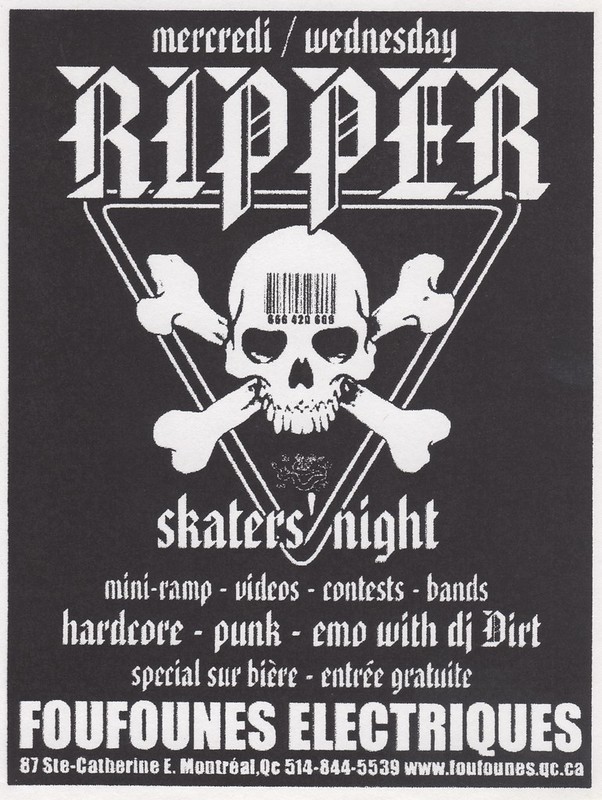
The evening, called “Ripper”, functioned without formal competition: no prizes, no special cover, but a community-driven logic in which participants showed off their tricks one after another. Skateboarders struck the edge of the ramp with their boards when an impressive trick was landed, creating a dynamic of collective recognition.
The article emphasizes the inclusive character of the event. The crowd was no longer exclusively gothic or punk: it is described as broader, ranging “from punk to prep,” reflecting a generational shift in the venue’s audience.
Musically, the programming remained faithful to the alternative spirit: DJ Dirt and DJ Orion provided a soundtrack mixing punk, hip-hop, and underground culture, reinforcing the image of a club capable of integrating new urban subcultures without denying its historic identity.
This initiative confirms the Foufounes’ adaptability in the early 2000s: after establishing itself as a major stage for international alternative music, the venue also became a hybrid space combining music, performance, and skate culture, extending its tradition of multidisciplinary experimentation [47].
2003 — “The Bar Where Nirvana Played”
In September 2003, The Gazette devoted a feature to the Foufounes Électriques under the evocative title “The bar where Nirvana played”. The article underlines the transformation of the venue: while the grunge and alternative aesthetic remained, the clientele had broadened, “from punk to prep,” and the establishment was no longer perceived as intimidating. “No one is scared to come here anymore,” DJ Dirt said.

The text also recalls the venue’s musical evolution — from punk to metal, through hip-hop and electronic music — as well as original initiatives, such as the installation of an indoor half-pipe for skate nights. Twenty years after its founding, the Foufounes now appeared as a stabilized alternative institution, whose legend rested as much on its past as on its capacity for adaptation [46].
2008 — From Underground to Overground
According to the master’s thesis of Marianne Palardy (UQAM), the Foufounes Électriques moved from an underground subculture to an “overground” form: initially marginal, the venue gradually emerged from obscurity to reach a broader public. Long frequented mainly by alternative milieus, the bar now opened itself to a more diverse clientele, without discrimination [8].
In 2008, the establishment could accommodate more than 2,000 people [9].
2015 — Iconography and Wall Culture
Over the decades, the Foufounes Électriques developed an immediately recognizable visual identity, marked by the accumulation of graffiti, signatures, layered posters, and spontaneous painted interventions. The walls — especially those in the washrooms — became surfaces of expression in their own right, extending the venue’s punk aesthetic and DIY spirit.

This iconographic dimension goes beyond simple décor. It contributes to the construction of a collective imaginary, in which the club presents itself as a permissive, dense, and trace-saturated space. In 2015, The Gazette noted that “The washrooms at Les Foufounes Électriques are known for their graffiti,” confirming that this characteristic had become a constitutive element of the establishment’s public reputation [48].
The photographs published on that occasion show surfaces almost entirely covered in inscriptions, revealing the continuity of a practice that began in the early years. Far from being erased or normalized, this visual accumulation is part of the persistence of an underground aesthetic that, paradoxically, now contributes to the venue’s informal heritage status.
4. 1899 — Early 20th Century
Long before the construction of the buildings that now house the Foufounes Électriques and the Vietnamese restaurant Pho Thanh Long, at the corner of Sainte-Catherine and De Bullion streets (formerly Cadieux Street), stood Montreal’s first French-style Parisian café-concert: the Eldorado Café-Concert (1899–1901), followed by the Théâtre de l’Opéra Comique (1901) and then the Théâtre des Nouveautés (1902–1916), establishments whose premises occupied part of the site now incorporated into the Foufounes Électriques, with a main entrance then located on Cadieux Street (now De Bullion Street), before the theatre was completely destroyed by fire in 1920.

Cadieux Street (renamed De Bullion Street) had a distinctive reputation. When American actress Mae West undertook, in 1926, to write a play set in the world of prostitution, it was in Montreal — more precisely on “Caidoux” Street — that she chose to set the action. This choice was far from accidental.
This “Caidoux Street” in fact refers to Cadieux Street, then at the heart of Montreal’s Red Light district. Its population and uses had given it a particularly marked character.
After Mae West’s arrest on Broadway because of the allegedly obscene content of her play Sex, the City of Montreal decided to rename the street “De Bullion” in 1927. In the early 20th century, nearly every door on the street housed a brothel: at least 26 south of Sainte-Catherine Street are recorded, and as many, if not more, to the north [21], [22].
Notes & sources
-
LA PRESSE, March 14, 1981 — p. 23 —
“Les Clochards Célestes passent au spectacle,” Denis Lavoie.
Confirmation of the address at 97 Sainte-Catherine Street East. Transition of the venue from an alternative bar to a structured performance space. Mention of Nion et compagnie and the desire to attract a multidisciplinary “scene.” -
LA PRESSE, March 7, 1981 —
“La ronde des salles,” Denis Lavoie.
Context of the multiplication of small Montreal venues (El Casino, Pretzel Enchaîné, Club Montréal, Arlequin). Places the Clochards Célestes within this movement. -
LA PRESSE, January 12, 1981 —
“Les Clochards Célestes : pour redorer le blason de la ‘Main’,” Paul Roy.
Opening data: $1 beer, capacity of 211 seats, first Bâton Rouge booking. Mention of the site’s earlier history (Café Pal, Café Vic). -
LA PRESSE, March 6, 1982 —
“Une nouvelle boîte à Montréal,” Denis Lavoie.
Announcement of the birth of the Zoobar after the merger. Managed by the Société de développement des arts (non-profit organization). Multidisciplinary programming. -
LA PRESSE, May 16, 1998 — p. D2 —
“Les Foufs, ‘la place des autres’, ont 15 ans,” Richard Labbé.
Anniversary portrait retracing the 1983 founding and the phrase “the place for others.” -
LA PRESSE, March 6, 1997 — (Sortir) —
“Pétées, les Foufounes!,” Nora Ben Saadoune.
Description of the venue as a multidisciplinary complex. Mentions key members of the team. -
THE GAZETTE, May 17, 1991 — p. 19 —
“A long way from Crescent St.,” Brendan Kelly.
Portrait of the club, “Batcave-Gothic” interior description, mention of expansion. -
Marianne Palardy, Les Foufounes Électriques : de l’underground à l’overground, academic thesis, 2008.
Sociological analysis and administrative data. -
THE GUARDIAN, 2008 —
“Can M for Montreal predict pop’s future?,” Ian Gittins.
International mention of the Foufounes. -
24H MONTRÉAL, February 27, 2013 —
“Un phare de la scène alternative à Montréal : 30 ans des Foufounes électriques,” Emmanuel Delacour. -
LE DEVOIR, May 4, 2007 —
“Attaque locale aux Foufs,” Philippe Papineau.
Mention of the physical expansions and terrace. -
LE DEVOIR, January 24, 2003 — Section B —
“Histoire de fesses — Les Foufounes Électriques ont 20 ans,” Jean-Yves Girard.
Economic reality of the venue (“Shows don’t pay. Beer keeps us alive.”). - Quartier des spectacles — institutional profile devoted to the Foufounes Électriques.
- RADIO-CANADA — television report devoted to the history of the Foufounes Électriques.
-
LE DEVOIR, February 17, 1995 —
“Les Foufs en faillite.”
Premises sealed and liquor permit revoked. -
LE DEVOIR, June 2, 1995 —
“Tour du proprio aux Foufs.”
New management and renovations. -
LA PRESSE, 1990 —
“Les Foufounes électriques, 7 ans plus tard : la même belle folie,” Jocelyne Lepage.
Financial data: $1.5 million, 300 productions/year, 40 employees. -
LA PRESSE, August 24, 1991 —
“Adieu, Gros Michel.”
Obituary of Michel Larouche. -
LA PRESSE, August 24, 1991 —
Supplementary coverage on Michel Larouche’s affiliations (L.A.M., R.A.M.). -
COOLOPOLIS, September 21, 2012 —
“Legendary bouncer Gros Michel: How he died,” Sylvain Binette. -
LE DEVOIR, June 19, 2014 —
“Petite histoire des maisons de passe,” Caroline Montpetit. -
THE GAZETTE, May 17, 1991 — p. 19 —
“A long way from Crescent St. — Foufounes marks eight cheeky years on club fringes,” Brendan Kelly. -
THE GAZETTE, June 4, 1992 — p. 53 —
“Foufounes an unlikely success story,” Mark Lepage. -
THE GAZETTE, January 16, 1993 —
“This month’s loss of La Brique and Les Foufounes won’t kill the Montreal live-music scene.” -
LE DEVOIR, February 24, 1982 —
“Musique pour mutants au Zoobar,” Nathalie Petrowski. -
LA PRESSE, February 4, 1993 —
“L’underground atterré,” Julie Vaillancourt. -
LA PRESSE, May 16, 1998 —
“Les Foufs, ‘la place des autres’, ont 15 ans,” Richard Labbé. -
LE DEVOIR, January 20, 1993 —
“Les Foufounes sous scellés,” Caroline Montpetit. -
THE GAZETTE, January 26, 1989 —
Mention of major renovations (C-shaped balcony, reoriented stage) and the relocation of the Nick Cave show. -
THE GAZETTE, March 17, 1984 —
“Paint flies at art auction with a difference,” Ian Ferrier. -
LE DEVOIR, December 4, 1992 —
“Les lundis des Foufounes Électriques,” Julie Vaillancourt. -
THE GAZETTE, February 18, 1993 —
“Foufounes Électriques to rise from the dead,” Mark Lepage. -
THE GAZETTE, January 1993 —
Article announcing the temporary abandonment of live concerts in favor of a techno-dance orientation. -
THE GAZETTE, June 1994 —
Report on the concert-demonstration in front of the courthouse. -
THE GAZETTE, December 1994 —
Official revocation of the liquor permit by the RACJ. -
THE GAZETTE, June 1994 —
Coverage of the 78 complaints filed against the establishment. -
THE GAZETTE, July 28, 1994 —
Mention of the collection of approximately 35,000 signatures. -
THE GAZETTE, December 8, 1994 —
Report on the seizure of alcohol stocks and the filing of 66 charges. -
THE GAZETTE, June 2, 1995 —
Article on the investments preceding the reopening. -
THE GAZETTE, January 1995 —
Account of the testimony before the liquor board. -
THE GAZETTE, June 8, 1995 — p. 14 —
“Electricity may be missing, but Fouf is back as live venue,” Mark Lepage. -
LA PRESSE, May 2, 1981 —
Article devoted to the show Transport Mental. -
LA PRESSE, March 1981 —
Mention of the multiplication of small venues in Montreal’s East End. -
LE DEVOIR, April 20, 1983 — p. 14 —
“Le tilt de quelques saltimbanques,” Nathalie Petrowski.
Article devoted to Montréal Transport Limité, presented at the former Zoobar. -
LE DEVOIR, April 20, 1983 — p. 14 —
Show advertisement identifying the address under the name “FOUFOUNES ÉLECTRIQUES,” confirming the change of name. -
THE GAZETTE, September 20, 2003 — p. D14 —
“The bar where Nirvana played,” Brendan Kelly. -
THE GAZETTE, August 14, 2003, p. D10 —
“Foufounes gets on board,” T’Cha Dunlevy.
Article documenting the transformation of the Foufounes Électriques into a skateboarding venue on Wednesday nights (“Ripper”), with the installation of a half-pipe on the second floor. Description of the scene, community atmosphere, absence of traditional media coverage, and confirmation of the address: 87 Sainte-Catherine Street East. -
THE GAZETTE, February 21, 2015 —
“Flushing Out the Odd Loos,” Roberto Rocha.
Lifestyle article mentioning the washrooms of the Foufounes Électriques as being “known for their graffiti,” confirming the public recognition of the venue’s wall-based aesthetic. -
URBANIA, June 25, 2021 —
“Nirvana aux Foufs : celle qui a fabriqué l’affiche du show mythique de 1991, c’est elle,” Hugo Meunier.
Article retracing the role of Nancy Beaulieu at the Foufounes Électriques, notably the handcrafted design of the original poster for the Nirvana concert (September 21, 1991) and her involvement in the venue’s programming and visual production. -
LA PRESSE, December 7, 2023 —
“La lente redécouverte d’Henriette Valium,” Chantal Guy.
Article devoted to the exhibition Henriette Valium, sans ordonnance (Centre d’art Diane-Dufresne), recalling the major influence of Henriette Valium (Patrick Henley) on Montreal counterculture and on the visual identity of the Foufounes Électriques. -
LA PRESSE, May 10, 2003 — Section A —
“Petite histoire d’une révolution,” Philippe Renaud.
Retrospective on the rave explosion in Montreal (“10 years ago”) explicitly mentioning the “legendary Foufs Techno Sundays,” and noting that they lasted until 1995. The article notably cites the Vitamin DJ Team and scene actors associated with it (including Sylvain Houde / “Vitamin S” and Cozmik Kay).