Academy of Music (Montreal)
The first major permanent opera and concert hall in Montreal, the Academy of Music was the city’s most prestigious auditorium in the late 19th century, embodying the cultural ambitions of Montreal’s bourgeoisie while serving as one of the principal Canadian relays within the North American theatrical system dominated by New York.
1. Overview
From its official inauguration on November 15, 1875 until the end of the 19th century, the Academy of Music was one of the two institutional pillars of Montreal theatre, alongside the Theatre Royal. It played a defining role in the shift from resident stock companies to the large commercial touring system of North America. Considered one of the most modern auditoriums in Canada when it opened, the Academy quickly became associated with the cultural aspirations of the city’s anglophone elite.
2. Foundation and Initial Prestige
Founded by a consortium led by businessman Hugh Allan, the Academy of Music was conceived as a prestigious venue for major operatic and dramatic productions. A 1912 retrospective article explains that the hall was operated by a joint-stock company in which Allan and merchant Roswell Fisher served as principal promoters, respectively president and treasurer, and leased exclusively to E. A. McDowell, who became its managing director. The same source attributes the building’s plans to architect A. B. Taft.
Contemporary descriptions highlight the building’s decidedly modern character. A programme from opening night—still preserved in 1912—noted the gas lighting system and a spectacular prismatic chandelier designed especially for the hall by A. L. Bogart of New York, as well as the stage machinery installed by machinist Henry Rough, formerly of New York’s Fifth Avenue Theatre. The seats were produced by a Montreal firm manufacturing patented folding opera chairs, which allowed the capacity to be increased on special occasions.
The interior layout was designed to maximize visibility: the plan printed in the press described a regular capacity of about 1,100 seats, expandable to around 2,500 places with additional chairs. The very steep rake of the parquet, extending the balcony’s slope across the auditorium, was presented as an innovation ensuring unobstructed views. The stage itself measured 57 feet wide (17.5 m) by 44 feet deep (13.4 m), with a proscenium opening of 28 × 35 feet— remarkable dimensions for Montreal in 1875.
The opening night of November 15, 1875 is well documented. The curtain rose at 8:00 p.m. on the entire troupe gathered on stage, followed by a prologue written by journalist and poet Dr John Reade and read to the audience by E. A. McDowell (actress Gertrude Kellogg, who was to deliver it, being indisposed). The national anthem was then sung solo by Mrs Stoddart. The chosen play, the popular melodrama Rosedale, or The Rifle Ball, achieved a triumph: critics noted curtain calls after each act and a final tableau encored three times. The 1912 article remarks that the house was “filled to capacity,” with spectators crowding into the aisles.
The cast of Rosedale reflected the system of large Anglo-American touring companies: Charles Loveday as Colonel Cavendish May, Fred O. Smith as Dr Mathew Leigh, E. A. McDowell as Elliot Grey, John B. Swinbourne as Myles McKenna, Felix J. Morris as Bunberry Cobb, and actresses Affie Weaver (Lady Florence May), Fanny Reeves (Rosa Leigh), and Florence Vincent (Miss Tabitha Stork). A child performer, Little Selina Rough, daughter of machinist Henry Rough, appeared as Sir Arthur May, a wink to the familial nature of the touring troupe.
Reviews also mention a very concrete detail of opening night: the crowd was so large that traffic around the theatre became chaotic. The Gazette columnist recommended that cab drivers drop passengers at the Academy with their horses’ heads facing Sherbrooke Street, and upon returning, circle toward the Crystal Palace on Sainte-Catherine Street to ease congestion.
Very quickly, the Academy attracted an anglophone bourgeois clientele and became a marker of cultural refinement in a rapidly growing city, even though its operation depended heavily on external theatrical networks.
3. Theatrical Organization in Montreal around 1880
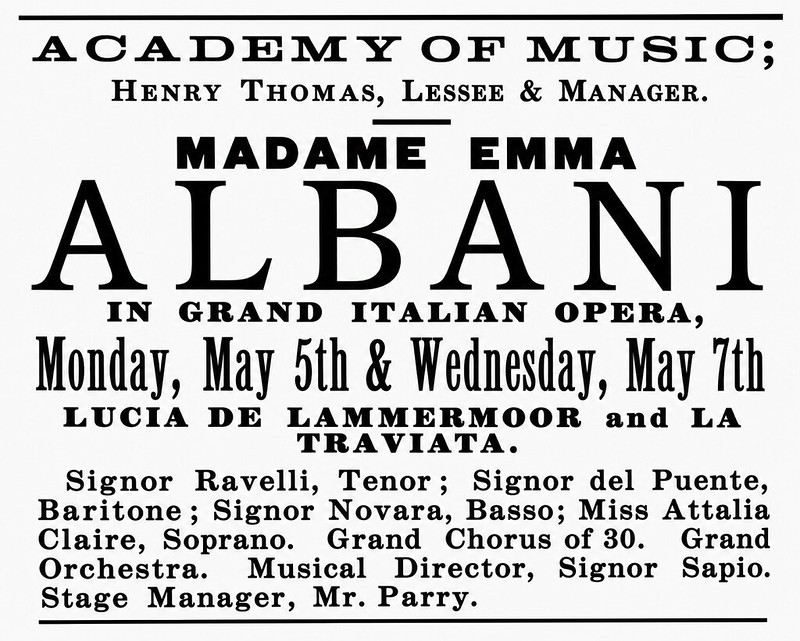
Beginning in 1880, the Academy of Music was directed, for regular programming, by Henry Thomas, its former treasurer, who became managing director and lessee. His role coincided with a pivotal moment in which Montreal—despite its population of 140,000—lacked a stable professional resident theatre company.
The Academy functioned as a strategic relay within the vast New York–dominated touring circuit. Between 1880 and 1883, nearly 90 % of theatrical productions presented in Montreal originated in the American metropolis. The hall was thus fully integrated into the network of tours controlled by New York booking agents, who dictated artistic standards, stars, and economic models.
This system placed the Academy primarily in the role of presenter rather than cultural producer. The lack of durable francophone theatrical structures highlighted the dependence of Montreal theatre on outside circuits and illustrated the fragility of local cultural autonomy at the time. The trajectories of several artists from the Rosedale premiere illustrate this continental movement: E. A. McDowell went on to a major career and married actress Fanny Reeves in a lavish Montreal ceremony presided over by Sir Hugh Allan, while Florence Vincent was still considered in 1912 one of the best performers of “old lady” roles on the American stage.
The Academy’s operation must also be understood within a context where the few attempts to establish durable francophone dramatic troupes consistently failed. At the turn of the 20th century, groups such as the Soirées de famille, an ambitious amateur troupe active in Montreal, exemplified the structural challenges of the local milieu: intense activity, repertoire largely imported from Paris, limited financial means, and the absence of institutional support comparable to that enjoyed by major Anglo-American touring productions hosted by the Academy.
4. Programming and Influence
The Academy hosted prestigious international tours, notably those of Sarah Bernhardt. During her February 1896 engagement with Izeyl, the Montreal press described a memorable evening: critics emphasized the emotional power of her performance, the complexity of the role, and the near-total command she exercised over the stage. According to the Gazette, the Academy “has seldom held a larger or more enthusiastic audience,” confirming the hall’s ability to attract major European stars.
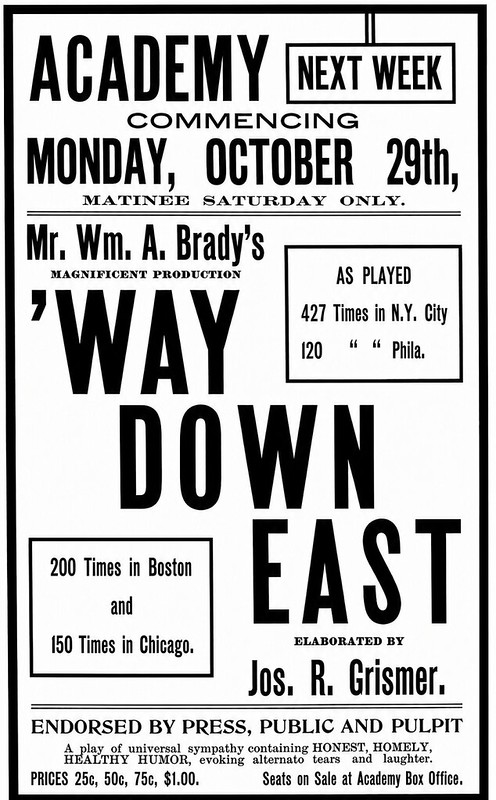
Programming, however, remained dominated by large commercial productions circulating between New York, Boston, Chicago, and major Canadian cities. In September 1896, after reconstruction, the “new” Academy reopened with De Wolf Hopper and his company performing John Philip Sousa’s operetta El Capitan. Critics emphasized the scale of the production (sets, machinery, large troupe) and noted that it rivaled the production mounted at New York’s Broadway Theatre.
The Academy also presented artists such as Emma Albani and James O’Neill, reinforcing its status as an essential stop for major European and North American stars. Nonetheless, its programming remained shaped by commercial logic, with profitability outweighing local cultural development—unlike what would later emerge in francophone institutions.
In the francophone sphere, the Academy also served as a venue for the Soirées de famille, who presented, between 1898 and 1901, a significant portion of their 73 productions over 86 evenings. Their repertoire, largely borrowed from French bourgeois theatre, frequently featured authors such as Eugène Labiche (with some seasons showing his plays as much as one-third of all works performed), Alexandre Bisson, Georges Feydeau, Adolphe d’Ennery, Octave Feuillet, and Georges Ohnet. These selections reflected the taste of part of the Montreal audience for a respectable, “proper” comedy of manners.
The Soirées de famille also used the Academy to introduce several local premieres of contemporary French plays to Montreal, including works by Adolphe Belot (Le Testament de César Girodot), François Coppée (Le Passant), and Grenet-Dancourt (Les Noces de mademoiselle Loriquet, Trois femmes pour un mari). Though their staging remained traditional, a set designed by the young Raoul Barré for Le Gendre de Monsieur Poirier in 1899 was praised for realism and elegance; it stands among the earliest Montreal attempts to modernize scenography in a hall like the Academy.
5. Public and Cultural Reception
Although Montreal’s population was mostly francophone, interest in professional theatre was limited at the end of the 19th century. French Canadians invested little—financially or culturally—in this industry, while the anglophone audience remained small and fragmented.
This linguistic and cultural duality partly explains the eclecticism of the Academy’s programming, unable to anchor itself to a clearly defined public and oscillating between international prestige, popular entertainment, and the absence of a durable local base. Retrospective articles emphasize the building’s “memorial” status: in 1912, the Gazette described the Academy as “now a memory,” noting that its past triumphs had given way to the “human drama” of department-store bargain days.
The brief but intense experience of the Soirées de famille illustrates this fragmentation well: their activities, split between the Academy, the Monument National, and a few other halls, struggled to mobilize a francophone public willing to offer ongoing financial support for a permanent institution. The Academy thus sat at the crossroads of two competing dynamics—an international theatre strongly structured by New York touring circuits, and a local francophone theatre seeking professionalization—without fully reconciling them.
6. Modernity and Innovations
With its roughly 2,000 seats, modern lighting, and machinery imported from New York, the Academy stood out from its opening in 1875 for its exceptional comfort. The combination of a gas-lit prismatic chandelier, a sophisticated stage-machinery system, and patented folding opera chairs placed it among the best-equipped theatres on the continent, according to contemporary press. Critics emphasized good circulation in the aisles, excellent sightlines, and the stage’s capacity to accommodate operas, realistic dramas, and large pantomimes.
A new phase of modernization began in 1896, when the Academy, declared unsafe in the early 1890s, underwent a near-complete reconstruction. The works, entrusted to New York’s McElfatrick & Sons, sought to bring the interior “to the level of the most modern theatres on the continent”: rebuilt auditorium, improved exits, renewed sets and stage installations. Contemporary articles claimed the Academy would be “hard to distinguish from an entirely new theatre” upon reopening.
Folding theatre seats began to spread across North America in the 1870s–1880s, especially in opera houses in Ontario and the Maritimes. In Montreal, firm documentary evidence of their installation appears mainly in the major reconstruction projects of the 1890s, notably at the Academy of Music, His Majesty’s Theatre (1898), and the Théâtre Français (1890), all equipped with “opera chair”-type folding seats.
When it reopened in fall 1896, the new Academy appeared “practically entirely new,” with enhanced comfort and technical features comparable to major houses in New York or Chicago. This modernization campaign was part of a broader movement among Montreal theatres in the late 19th century, as older venues attempted to adapt to rapidly evolving safety and comfort standards.
7. Decline and Transformation
Despite these modernization efforts, the Academy faced increasing competition in the late 19th century from new venues, popular variety houses, and eventually cinemas. The 1896 reconstruction extended the building’s life by roughly a decade, but did not stop the gradual decline in attendance.
A Gazette retrospective from November 1912, titled “Academy of Music, now a memory,” recalled that the hall had enjoyed “a life of varying success” until “a few years earlier,” when a performance of La Tosca in French marked its final closure. The Victoria Street site, formerly home to many triumphs, had been “wiped away” and replaced by a department store in which clerks and customers now enacted the “human drama of bargain days.”
A Montreal Star article from January 12, 1910 had already announced the end of the Academy as a venue. It reported that the building—described as Montreal’s oldest theatre after the Theatre Royal—had just been sold by the Sparrow Amusement Company to the A. E. Rea Company, Limited for $150,000, covering land and “four walls” only. Sparrow retained ownership of all interior furnishings—sets, seats, lighting systems—and reserved the right to remove them before the deadline. The article concluded that at the end of April 1910, the Academy would “cease to exist as an entertainment enterprise,” sealing its disappearance in favor of a purely real-estate project.
The demolition of the building around 1910 and its replacement with a commercial complex symbolized the shift of downtown Montreal toward a modern consumer economy. In Montreal’s cultural memory, the Academy of Music survives mainly through spectators’ recollections, artists’ testimonies, a handful of photographs, and later historical studies emphasizing its role as the city’s first major permanent “lyric temple.”
8. Location and Legacy
Located at 6 Victoria Street, just steps from Sainte-Catherine Street, the Academy of Music occupied a strategic position at the heart of Montreal’s commercial center in the 1870s–1890s. It stands as a cornerstone of the city’s theatrical history, marking the transition to a modern stage culture integrated into continental networks. The site is now occupied by the Complexe Les Ailes de la mode, but the hall continues to haunt the imagination of theatre historians for its role as a gateway for major North American and European tours.
In historical syntheses, the Academy appears as a counterpoint to contemporary francophone experiences: while amateur groups such as the Soirées de famille struggled to create a truly national dramaturgy, the Academy illustrated Montreal’s deep integration into international touring circuits. It occupies a pivotal place in the transition toward a theatrical system shared between local francophone institutions (such as the future Théâtre National) and major North American commercial circuits.
9. Notes & Sources
-
LARRUE, Jean-Marc.
The Organization of Theatre in Montreal from 1880 to 1883: Three Crucial Years,
Études théâtrales, Université du Québec à Montréal (UQAM), pp. 139–148.
Key reference for structural context: Montreal’s position within the North American network, the Academy’s role in New-York-led touring systems, Henry Thomas’s management, the absence of a resident company, and public fragmentation. -
HISTORYPIN – “Theatre in Montreal 1825–1930 – Academy of Music”.
Iconographic and historical dossier including brief notices on the Academy’s foundation, initial prestige, Victoria Street location, decline, and early 20th-century demolition. Supports chronology (opened 1875, demolished ~1910), capacity estimate (~2,000), and site identification. -
Press Archives (Montreal Star, La Presse, The Gazette), 1870s–1890s.
Advertisements, reviews, and society columns used through secondary bibliographies (notably Larrue) and MCPA internal cross-verification. Confirm international touring stars (Sarah Bernhardt, Emma Albani, James O’Neill, De Wolf Hopper, etc.), programming evolution (shift toward vaudeville/burlesque in the 1890s), and the venue’s status as an “elite” anglophone venue. -
BANQ numérique – “Académie de musique” (Montreal).
Brief historical description, key dates (construction, use, demolition), and digitized visuals. -
The Montreal Star, November 6, 1875, p. 3 — advertisement:
“Academy of Music – Grand Inaugural Performance”.
Detailed public notice announcing the November 15 opening with Rosedale, specially made scenery, and the promise to use “all the resources of this magnificent establishment.” -
The Montreal Star, November 15, 1875, p. 4 — article:
“The Academy of Music”.
Full description of the building: façade and vestibule dimensions, entrance organization, regular capacity (1,100 seats) expandable to nearly 2,500, stage dimensions (57 × 44 ft), ceiling height (58 ft), gas lighting system, prismatic chandelier operation, and mention of Montreal-made folding opera chairs. -
The Gazette, November 16, 1875, p. 2 — review:
“The Academy of Music – Opening Night”.
Account of opening night: prologue by Dr John Reade read by E. A. McDowell, national anthem by Mrs Stoddart, enthusiastic reception of Rosedale, multiple curtain calls, and praise for stage machinery and décor. Highlights the “event-like” atmosphere. -
The Gazette, April 20, 1896 and May 21, 1896 — articles:
“Academy of Music – The Old House to be Entirely Reconstructed” and “The New Academy”.
Confirm the hall’s temporary closure for safety reasons, the decision to rebuild the interior almost completely under McElfatrick & Sons, and the plan to reopen in early September 1896 with a fully modernized theatre. -
The Montreal Star, July 10, 1896 and September 5, 1896 — reports on the 1896 season and reopening.
Confirm the reopening with De Wolf Hopper’s company in El Capitan, noting the production’s scale and critics’ enthusiasm for the theatre’s new technical capacities. -
The Gazette, February 27, 1896 — review:
“Sarah Bernhardt – Splendid Performance”.
Analysis of Izeyl at the Academy: Bernhardt’s acting, staging, décor, and audience reaction. Notes the hall was filled to capacity and that the Academy “has seldom held a larger or more appreciative audience.” -
The Gazette, November 16, 1912 — retrospective:
“Academy of Music, now a memory, opened 37 years ago last night”.
Key article for historical reconstruction: recalls the 1875 opening, cites an original programme mentioning Bogart’s prismatic chandelier, Rough’s stage machinery, and patented folding chairs; attributes plans to A. B. Taft; describes Rosedale cast; recounts the traffic anecdote; and states the hall closed “a few years earlier” after La Tosca. -
The Montreal Star, January 12, 1910 — “Academy of Music Sold to the Rea Co.”.
Announces the sale of the Academy by the Sparrow Amusement Company to the A. E. Rea Company for $150,000. Notes Sparrow would retain and remove all interior furnishings and that by late April 1910 the Academy would cease to exist as an entertainment business. -
The Gazette, August 25, 1896 — “The New Academy – Comfort and Coziness”.
Essential description of the near-complete 1896 reconstruction: rebuilt rear and side walls, tripled lobby, removal of partitions, new circulation (arches, stairways), velvet seats, enlarged orchestra (170 → 250), added boxes, thousands of incandescent lights, hot-water/steam heating, modernized emergency exits, and a white-gold-pink decorative scheme.