American Spaghetti House (Montreal)
The American Spaghetti House, opened on 13 June 1941 at 64 East Sainte-Catherine Street, is one of the most emblematic restaurants in Montreal’s history. A true 24-hour pasta machine, described in the press as “the largest spaghetti establishment in the world,” it popularized spaghetti with a broad public, served as a 24/7 canteen for the Red Light, and stood at the crossroads of popular dining, cabarets and underworld circles, before being destroyed by a tragic fire on 23 February 1959.
1. Overview
In the heart of Montreal’s Red Light, at the corner of Sainte-Catherine East and Saint-Dominique streets, the American Spaghetti House quickly became one of the busiest addresses in the popular downtown. In an environment dominated by cabarets, dance halls, taverns and brothels, the restaurant held a special place: that of a 24/7 food landmark open to both working-class families and night owls.
Its identity rested on a simple trio: low-priced spaghetti, round-the-clock service and a quasi-industrial organization of the kitchen. At a time when modern fast food did not yet exist, the American Spaghetti House anticipated several aspects of the contemporary restaurant: huge service volumes, massive advertising campaigns and a carefully staged owner figure, Angelo Bisante, presented as the “king of spaghetti.”
2. Context & origins of the Bisante family
The history of the American Spaghetti House is inseparable from that of its owners, Angelo Bisante and Rose-Marie-Lucie “Lucy” Delicato. As early as the 1920s–1930s, Angelo’s name appears in Montreal newspapers in connection with cafés, restaurants and licensed premises around Saint-Laurent Boulevard. He is repeatedly shown applying for permits, contesting refusals, answering to minor municipal or liquor infractions, and slowly building up the profile of a well-known downtown restaurateur.
His wife, Lucy Delicato, is associated with rooming houses and brothels in the same sector. French- and English-language sources present her as an influential madam of the Red Light: she runs several properties on De Bullion Street and nearby streets, which appear again and again in reports of morality raids and court proceedings for “bawdy houses.”
It is on this base – a mix of experience in food service, management of night establishments and a long familiarity with the grey zones of urban life – that the couple launched, in 1941, a project of quite another scale: a huge spaghetti restaurant, fully legal, highly visible on Sainte-Catherine East.
3. Founding of the American Spaghetti House (1941)
The American Spaghetti House officially opened its doors on 13 June 1941. Retrospective advertisements recall that the restaurant began by serving 51 customers on the first night with a staff of only six to eight employees. From the outset, the concept was clearly defined:
- a restaurant specializing in “Italian-style” spaghetti and pasta;
- round-the-clock service, catering both to families and to the night-time crowd;
- an ambitious positioning, boasting “the best sauce in the world.”
The name American Spaghetti House combined the promise of modern, fast service – inspired by American diners and spaghetti houses – with the Italian imaginary of a family sauce simmered for hours. The restaurant thus played on a typical Italo-American double identity in 1940s Montreal.
4. Expansion & operations
Within just a few years, the American Spaghetti House experienced spectacular growth. By 1944, newspapers were showing an establishment with a large modern kitchen and staff of about 70 employees. In 1947, for the restaurant’s 6th anniversary, full-page ads highlighted the business’s success; the house was presented as a textbook example of commercial prosperity.
At the turn of the 1950s, some ads mention up to 200–260 employees and claim that more than one million customers passed annually “under the marquee” of the American Spaghetti House. The iconic vertical sign – a stylized cook atop a column carrying the restaurant’s name – became one of the most recognizable visual symbols of Sainte-Catherine East.
Operations were based on a quasi-industrial setup: specialized kitchen brigades, strong division of labour among cooks, helpers, waitresses and managers, and very high table turnover to maintain volume. The restaurant served both walk-in customers and organized groups, especially during peak periods and the holiday season.
6. Marketing, image & orphans
The American Spaghetti House was one of the most heavily advertised Montreal establishments in the illustrated press of the 1940s and 1950s. Advertising campaigns showcased Angelo Bisante himself, billed as the “king of spaghetti”, posing behind his desk or surrounded by large groups of employees, waitresses and cooks.
A key element of this image-making was a series of spaghetti banquets for orphans. Many photographs show Bisante and his wife in press coverage feeding children from various Montreal-area institutions, often described as “royal feasts.” Numbers vary from year to year – a hundred or, in some cases, more than 150 children – but the media impact was constant: the owner was portrayed as generous, jovial and paternal.
These events had a double effect: they strengthened the restaurant’s name recognition around Montreal and provided the Bisante family with a philanthropic public image, in contrast with the darker reputation of the Red Light and the brothels of the area.
7. Angelo Bisante, Lucy Delicato & legal troubles
Alongside the spectacular success of the American Spaghetti House, the trajectories of Angelo Bisante and Lucy Delicato were marked by a long series of encounters with the law. Archives from The Gazette, the Montreal Star, Le Devoir, La Presse, Le Petit Journal and other newspapers document numerous arrests, court appearances and trials spread over several decades.
In the 1930s–1940s, they appear throughout the court columns for a wide range of infractions related to bawdy houses, liquor licences and public morality. Some cases result in hefty fines, others in acquittals or technical dismissals. The couple is frequently described in the press as one of those “well-known keepers” who seem, for a time, to operate in a context of unofficial tolerance.
The decisive turning point comes around 1950–1951, when Montreal enters a period of moral crusade. Newspapers follow almost day by day a series of high-profile trials targeting the Red Light’s pleasure houses. Angelo and Lucy are at centre stage: charged with running bawdy houses, conspiracy, violations of various sections of the Criminal Code, repeated raids, seizure of furniture and testimony from morality police officers and investigators.
The judgments laid bare the tensions of the era. On the one hand, judges stressed the seriousness of the facts, the notorious character of the establishments and the need to “clean up” the district. On the other, the sentences – steep fines, suspended sentences, relatively short prison terms – fuelled ongoing debate about the leniency of the justice system and the depth of the links between keepers, police and politicians. Some decisions were appealed, partially overturned and retried, making the Bisante–Delicato couple a textbook case of the grey zones between tolerance and repression.
When the Caron Commission (also known as the Plante–Drapeau inquiry) later investigated, in the late 1950s, organized crime and police corruption, Mrs. Angelo Bisante’s name appeared among the emblematic madams of the Red Light. Hearings and press coverage situate the American Spaghetti House and Lucy Delicato’s houses within a larger system in which prostitution, gambling, night-time dining and municipal politics were tightly intertwined.
Right up to their deaths – Angelo in 1961, Lucy in 1966 – their obituaries and death notices continued to evoke this dual image: on one side, the prosperous restaurateur and “king of spaghetti,” former owner of the American Spaghetti House and co-owner of the Casa Loma; on the other, the famous madam of a neighbourhood that moral reformers portrayed as a giant “amusement park of vice.”
8. The Red Light & the Montreal underworld
Like many establishments in the district, the American Spaghetti House was not isolated from the broader context of the Red Light. The morality campaigns of the 1950s – notably the Caron Commission (or Plante–Drapeau inquiry) – and the memoirs of Pacifique “Pax” Plante show the Bisante–Delicato couple as part of a network of brothels, bookmakers and restaurateurs clustered around Saint-Laurent Boulevard.
In these accounts, Lucy Delicato is described as one of the district’s influential madams, associated with addresses that have since become famous in the historiography of the Red Light. The American Spaghetti House, meanwhile, stands as the couple’s “respectable” showcase, where ordinary customers, performers, police officers, city employees, gamblers and members of the Montreal underworld all crossed paths.
In his writings on Sainte-Catherine East, author William Weintraub mentions the American Spaghetti House as a restaurant appreciated by sex workers who would eat there and meet after work, confirming the double identity – both popular and interlope – of the establishment.
9. Architecture & building
The building at 64 East Sainte-Catherine Street was a typical early 20th-century downtown commercial structure: masonry façade, large display windows on the ground floor, upper floors punctuated by regular windows. A broad marquee occupied the entire width of the façade, surmounted by the restaurant’s monumental vertical sign.
Inside, the layout included at least a large dining room densely filled with tables, a service counter, a main kitchen occupying the rear of the ground floor, and storage areas. Successive expansions mentioned in the press suggest that the establishment gradually absorbed adjoining premises to increase its capacity.
After the 1959 fire, the ruins were demolished and the site converted into a surface parking lot. In the 1970s, municipal disputes over this parking lot – involving a Bisante descendant as tenant – show that the former restaurant site remained at the heart of urban planning issues, before being integrated into later redevelopment of the area.
10. The 23 February 1959 fire
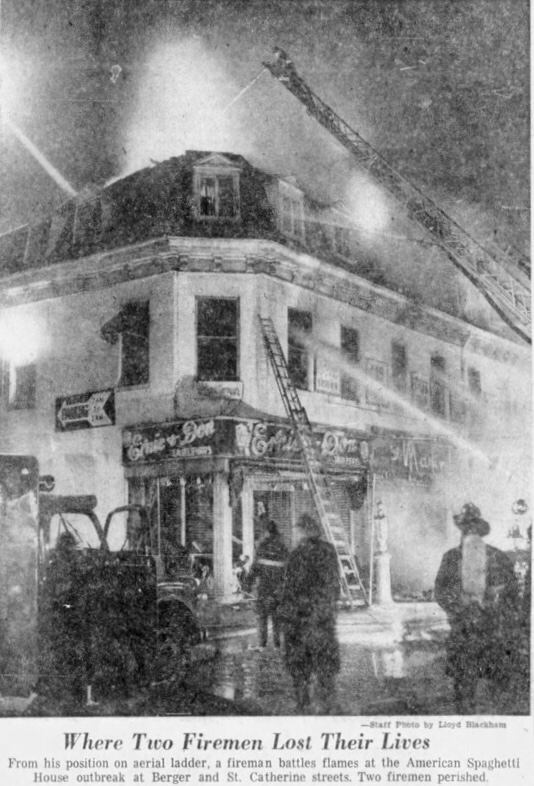
On the evening of 23 February 1959, a major fire broke out at the American Spaghetti House. The Gazette, The Montreal Star and Le Devoir quickly put the story on their front pages. The blaze, a five-alarm fire, mobilized firefighters from more than a dozen stations.
The flames ravaged the three-storey building fronting on Sainte-Catherine East. In bitter cold, crews climbed to the roof to ventilate the building and try to contain the fire. A particularly dramatic detail is often recalled: a safety rope linking men on the roof to teams below suddenly snapped, leaving part of the crew isolated.
Shortly afterwards the roof collapsed, bringing down part of the structure. Two firefighters were killed: Assistant Chief Edward Normoyle, 53, and firefighter Hubert Daudelin. Fire chiefs later explained that they had tried for more than two hours to reach the victims, without success. Their funerals gave rise to large official ceremonies, widely covered by the press.
In the days that followed, authorities received anonymous calls suggesting a possible wave of arson in the district and reporting two suspicious men near the building shortly before the fire. However, the head of the arson squad, Det. Capt. Cecil Rowe, stated that there was no conclusive evidence of arson: the hypotheses remained at the level of rumor and the case was ultimately classified as a fire of undetermined origin.
11. Memory & legacy
From the 1990s onward, the American Spaghetti House regularly reappeared in urban memory columns. Articles in La Presse, notably by Guy Pinard, retraced the restaurant’s history, its 24/7 operations, its role in the Red Light and the context of the 1959 fire.
The Gazette published commemorative pieces on the fire and on firefighters Normoyle and Daudelin, sometimes linked to artistic events such as Walls of Fire, an outdoor show recreating the blaze with archival projections and the participation of retired firefighters.
Within the Bisante family, testimonies from Dandy Bisante and other relatives recall with nostalgia the time when “the American Spaghetti House was a real institution.” Angelo Bisante died in December 1961, described in his obituary as former owner of the American Spaghetti House and co-owner of the Casa Loma club. Lucy Delicato died in 1966, remembered as one of the key figures of the city’s “gay Montreal” nightlife of the 1940s (in the sense of lively and festive).
Today, the American Spaghetti House holds a special place in the historiography of the Montreal Red Light: both a symbol of immigrant commercial success and a case study of the grey zones between popular dining, cabarets, brothels and criminal networks, it illustrates how a simple spaghetti restaurant could, for nearly twenty years, become one of the beating hearts of Montreal’s night life.
12. Timeline
- 1920s–1930s – First mentions of Angelo Bisante and Mrs. Angelo Bisante in the press, linked to cafés, restaurants and morality cases.
- 1930s–1940s – Series of proceedings for bawdy houses, liquor licences and morality offences in the Saint-Laurent / De Bullion sector.
- 13 June 1941 – Official opening of the American Spaghetti House at 64 East Sainte-Catherine Street. About six to eight employees.
- 1944 – Ads show a large modern kitchen and about 70 employees.
- 1947 – 6th anniversary: full-page ads highlighting the house’s success; staff group photos.
- 1947–1951 – Retrospective advertising mentioning 200–260 employees and over one million customers per year.
- 1940s–1950s – Regular spaghetti banquets for orphans, widely covered in the illustrated press.
- 1950–1951 – Highly publicized trials against Angelo Bisante and Lucy Delicato for bawdy houses and morality offences; heavy fines and appeals.
- 23 February 1959 – Major fire; roof collapse; firefighters Edward Normoyle and Hubert Daudelin killed.
- 1959–1960 – Demolition of the ruins; site converted to a surface parking lot.
- December 1961 – Death of Angelo Bisante, “former owner of the American Spaghetti House and co-owner of the Casa Loma.”
- 1966 – Death of Rose-Marie-Lucie Delicato (Mrs. Angelo Bisante).
- 1970s – Municipal disputes concerning the parking lot on the former restaurant site.
- 1990s–2000s – Retrospective articles, re-creations of the fire, testimonies from firefighters and members of the Bisante family.
13. Sources
-
French-language press (La Presse, La Patrie, Le Canada, Le Devoir, Le Petit Journal, Photo-Journal, Le Front Ouvrier)
Ads, reports and photos (1941–1951) on the opening, expansions, modern kitchens, staff numbers (70 then 200–260 employees), orphan banquets, restaurant anniversaries and the death notices of Angelo Bisante and Lucy Delicato. -
English-language press (The Gazette, The Montreal Star)
Detailed coverage of the 23 February 1959 fire, portraits of firefighters Edward Normoyle and Hubert Daudelin, descriptions of rescue operations and arson rumors; later pieces on historical re-enactments and testimonies from retired firefighters. -
Court coverage in the press (1920–1958)
Accounts of arrests, trials and appeals involving Angelo Bisante and Lucy Delicato for running bawdy houses, morality offences and liquor infractions, in The Gazette, The Montreal Star, Le Devoir, La Presse, Le Petit Journal, etc. -
PINARD, Guy. “L’American Spaghetti House,” La Presse, 16 June 1991, and related columns (1991, 1993).
Retrospective articles retracing the restaurant’s history, its 24/7 operations, its place in the Red Light and the context of the 1959 fire. -
Pacifique Plante (“Pax”) – Memoirs and columns on “gay Montreal” and the Red Light.
References to Lucy Delicato (Mrs. Angelo Bisante) as one of the important madams of the district, context for prostitution houses and networks of cabaret and restaurant keepers. -
William Weintraub. Writings on downtown and the Montreal Red Light.
Mentions of the American Spaghetti House as a favourite spot for sex workers, and descriptions of the atmosphere on Sainte-Catherine East at the time. -
Municipal documents and urban-planning coverage
Press reports on the parking lot built on the former restaurant site, disputes with the City of Montreal and discussions surrounding the gradual disappearance of physical traces of the establishment in the urban fabric. -
MCPA internal documentation
Press clippings files, reproductions of ads, archival photographs (façade, marquee, orphan banquets, kitchens) and research notes allowing cross-checking of information from multiple sources and reconstruction of the American Spaghetti House’s evolution between 1941 and 1959, as well as the legal troubles of Angelo Bisante and Lucy Delicato.