Bellevue Casino (Montreal)
Formerly the Roseland Ballroom, the Bellevue Casino (1949–1961), located at 375 Ontario Street West, established itself as the largest cabaret-theatre in Canada during the 1950s. Founded by Harry Holmok and operated with his brother-in-law Jack Suz, it embodied the golden age of large-scale music-hall-style revues, combining lavish productions, international stars, and popular accessibility — summed up by its famous slogan “50 ¢ admission, 50 ¢ beer.” A true entertainment machine, the Bellevue drew thousands of spectators each week and remains one of the most striking symbols of Montreal nightlife before its disappearance in the early 1960s. [1], [2], [10]
1. Overview
Founded in 1949 by Harry Holmok on the site of the former Auditorium and Roseland Ballroom, the Bellevue Casino quickly became one of the most important cabarets in Montreal during the 1950s [79], [80]. From its earliest years of operation, the establishment benefited from experienced management, joined by Jack Suz at the beginning of the decade, before he became co-owner in 1956 [10].
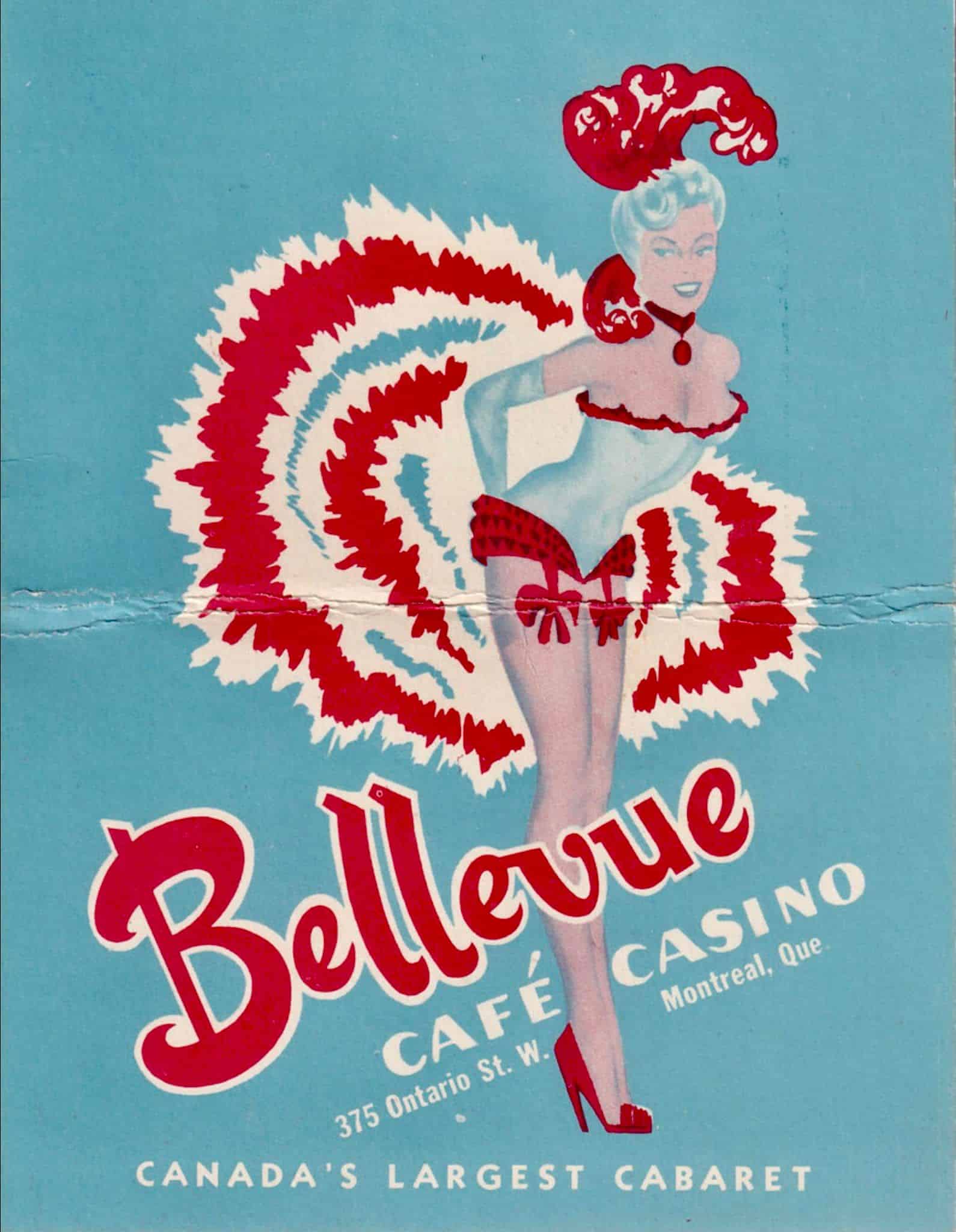
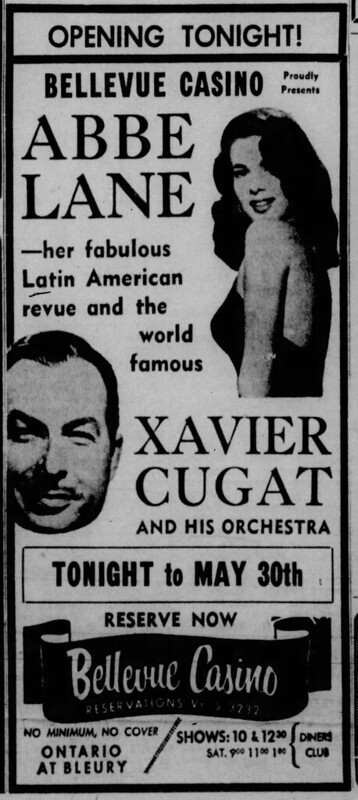
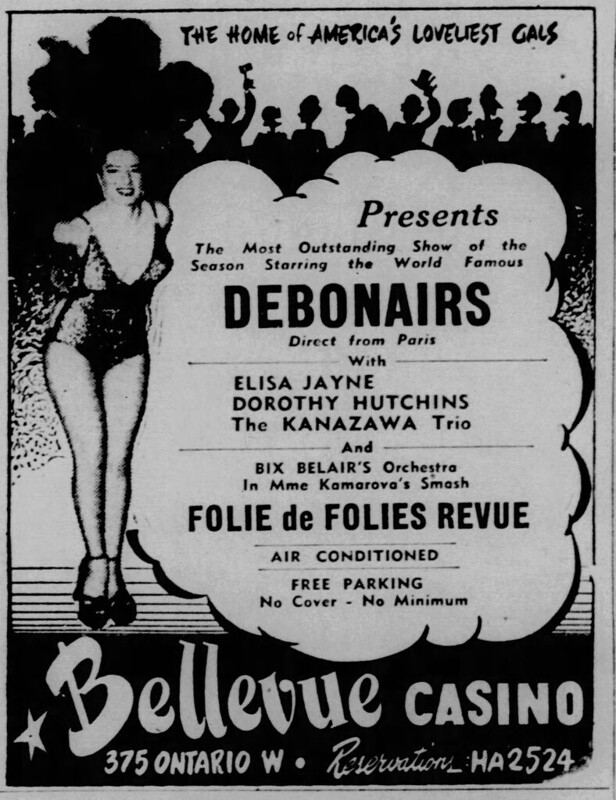
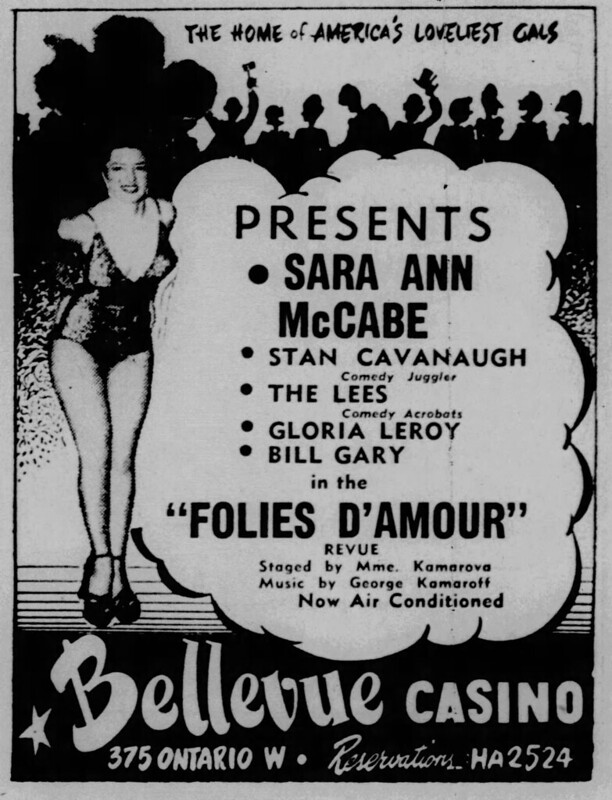
The cabaret specialized in large music-hall-style revues, combining dance, music, and variety entertainment. The productions, often inspired by New York and Paris models, were notably staged by Natalie Kamarova and George Kamarov, while the house orchestra, led by Bix Belair, accompanied the performances. Programming relied on the alternation of chorus girls, guest performers, and live musical groups, within a structured dinner-show format.
With a capacity of about 700 seats, the Bellevue attracted a diverse clientele thanks to an accessible pricing policy — “50 cents admission, 50 cents beer” — while also presenting internationally renowned artists such as Édith Piaf, Sammy Davis Jr and Sam Cooke [54], [59]. This programming helped place the venue on the North American touring circuit and reinforced its role in postwar Montreal nightlife.
After the death of Harry Holmok in the late 1950s, Jack Suz ensured continuity of operations in a context marked by the gradual decline of cabarets, linked in particular to the moral reform measures introduced after 1954, increased competition, and changing public habits. The Bellevue Casino closed its doors in the early 1960s and was demolished in 1962 as part of the widening of Ontario Street [10], [80].
Today, the Bellevue Casino remains associated with the golden age of Montreal cabarets, a period during which the city asserted itself as a major centre for live entertainment in North America.
2. Origins of the site: from ballroom to Roseland
Long before becoming the Bellevue Casino, the building at 375 Ontario Street West belonged to a long tradition of venues devoted to entertainment and public gatherings. As early as 1908, Montreal newspapers announced the construction of a vast hall known as “The Auditorium”, erected at 15–17 Berthelet Street — formerly a specific section of Ontario Street. Designed by architect Dalbé Viau and built by James H. Maher, the building was described as a monumental three-storey classical stone structure, equipped with particularly elaborate features [13].
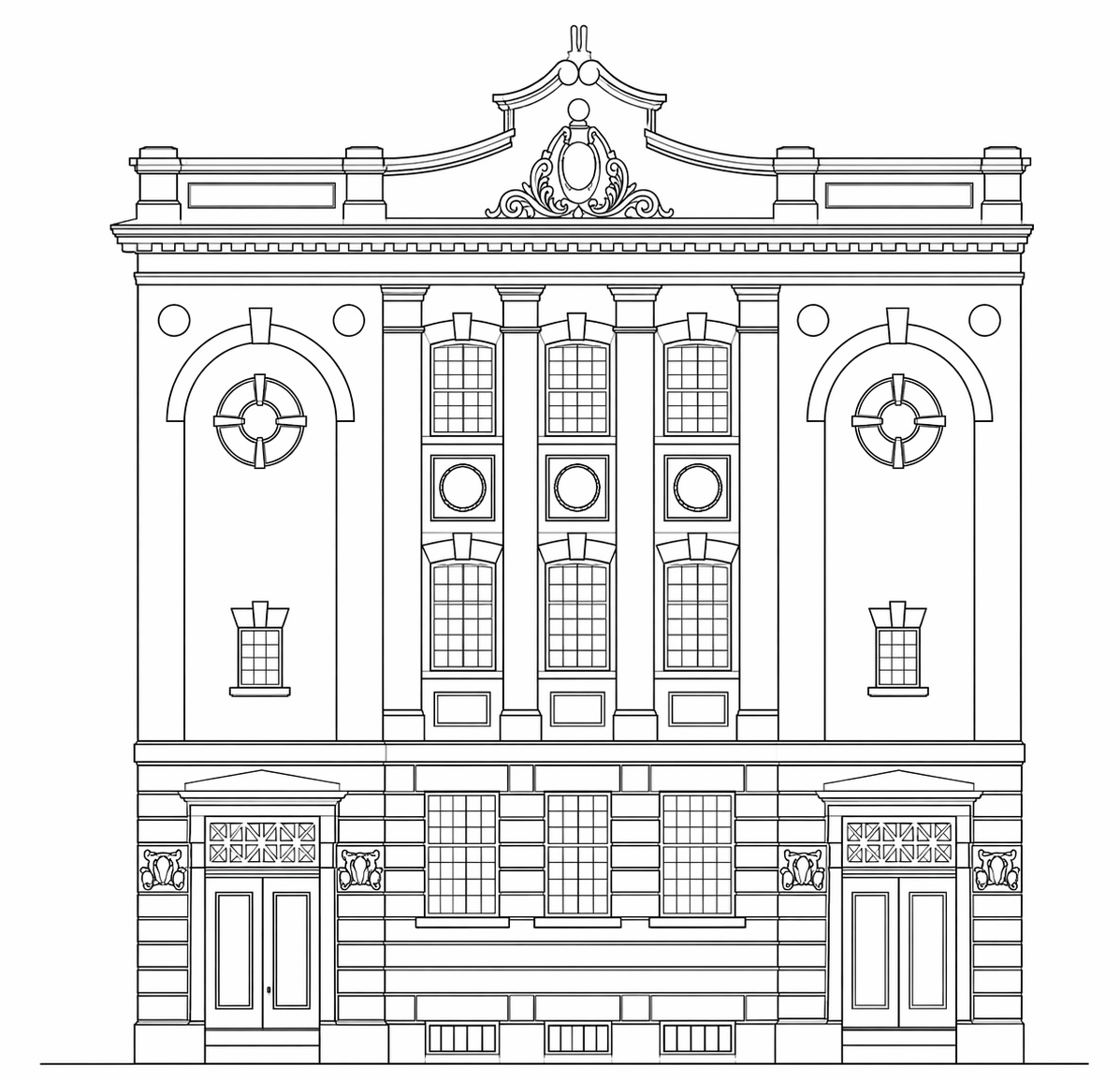
Conceived as a multipurpose venue, the establishment included a large dance hall measuring 115 by 50 feet, able to accommodate about 1,500 people, as well as several lounges and reception areas. The presence of an integrated stage allowed the hall to be quickly transformed into a theatre — a flexibility that was still rare at the time [13].
From its opening in December 1908, confirmed by the press, the Auditorium established itself as a major centre of Montreal social life. Balls, meetings, and performances followed one another there, while dance lessons were offered as early as 1909, quickly anchoring the venue in the city’s urban cultural life [14], [15], [63].
In the early 1910s, the hall evolved and modernized. In 1912, it was renovated and associated with the Ontario West address, marking its lasting identification with the present site [64]. During the 1920s, it hosted major events, including dances animated by jazz orchestras, while continuing to play an important role in Montreal community life [65].
By the late 1930s, now known as the New Auditorium Ballroom, the venue had become one of the city’s main dance halls. Evenings hosted by orchestras such as that of Irving Laing, accompanied by dance lessons and competitions, testify to its adaptation to the new trends of swing [66], [67].
On the eve of the 1940s, the venue entered a transitional phase marked by renovations and new management. Renamed the Auditorium Dance Palace, it adopted more structured programming, featuring Stan Wood and guest performers, confirming its evolution into an organized performance hall [68], [69].
This transformation reached a peak in the early 1940s, when the hall welcomed major figures of jazz and swing, including Gene Krupa and Louis Armstrong. Press coverage described a packed hall and an enthusiastic audience, establishing the venue as a true crossroads on the international circuit of major North American tours [70], [71], [72].
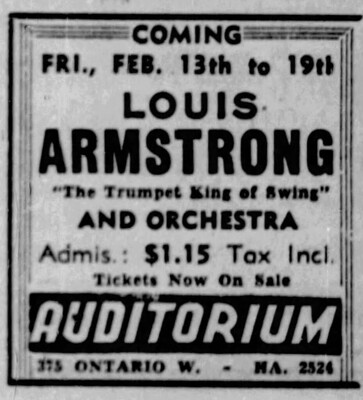
In 1943, this momentum continued with the appearance of Jack Teagarden and the organization of “battles of swing” pitting orchestras such as those of Bert Niosi and Stan Wood against each other, illustrating the venue’s role as a crossroads between local and international scenes [73], [74].
In the mid-1940s, the hall remained very active, notably through regular programming featuring rising artists such as Maynard Ferguson, confirming its central place in Montreal nightlife [75].
At the end of the Second World War, the venue was transformed into the Roseland Ballroom, inaugurated in 1946 before more than 1,000 couples. Modernized and repositioned, it moved away from the traditional dance-hall model to adopt a formula more oriented toward stage entertainment [76], [77].
This transformation formed part of a broader reorganization with which Harry Holmok became associated. As early as 1943, he took an interest in the Ontario Street West sector and acquired a strategic parcel including numbers 371 to 375, as reported by The Gazette [84]. For several years, he observed and refined his vision for a large-scale cabaret. His intervention took shape with the takeover of the Roseland Ballroom, which he gradually transformed, preparing the creation of a much larger establishment.
At the beginning of 1949, the transformation of the Roseland into the Bellevue Café Casino was announced as the creation of the “largest establishment of its kind in Canada.” Inspired by the great European revues, the project marked the culmination of an evolution begun more than forty years earlier [20], [21].
Evolution of the Bellevue Casino site
3. Transformation into Bellevue Casino and opening (1949)
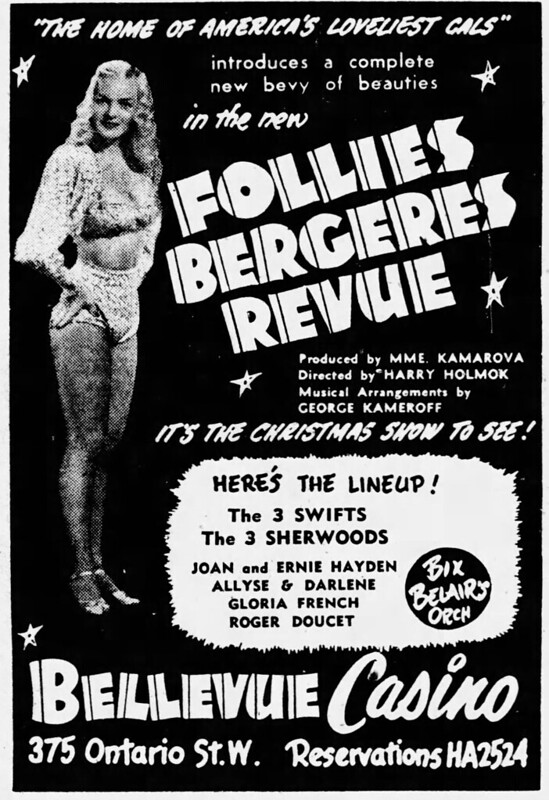
On April 21, 1949, the Bellevue Café Casino officially opened its doors to the public, as announced and later confirmed in the pages of The Gazette, which described the establishment as one of the “largest and most attractive” cabarets in Canada [1], [2], [16], [17]. To mark the occasion, management presented a large-scale production inspired by major European revues, entrusted to Natalie Kamarova and George Kamarov, both associated with the famed Folies Bergères in Paris. The opening show, titled Folie parisienne, featured a cast of approximately 22 performers on stage, including singers, dancers, and comedians, as well as a chorus of about 12 to 18 dancers performing a can-can number designed to create a colorful and spectacular visual setting.
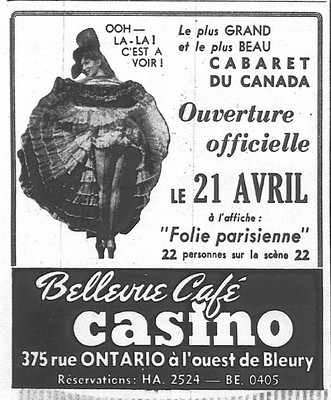
Among the announced headliners were veteran songwriter Joe Howard, then 80 years old and author of more than 525 songs, comedian Billy Wells, the group Four Fays, as well as singer Ruth Brown — not to be confused with the legendary R&B singer of the same name — and Patricia Adair, both from the Latin Quarter cabaret in New York, along with singer-dancer Jack Stanton, Ben Beri, and the comedy trio The 3 Wiles. Advertising also emphasized the venue’s popular positioning, with admission priced at 50 cents on weekdays and 1 dollar on Saturdays, no cover charge or minimum, and the presence of two orchestras and two shows per night.
Only days after opening, an article in the Montreal Star already highlighted the success of the Bellevue Casino, which attracted large audiences thanks to the size of its hall and the quality of its programming. The article emphasized the performance of Joe Howard, whose stage presence and energy impressed audiences despite his age, as well as the diversity of acts presented, ranging from singing and dancing to comedy and acrobatics. The production Folie parisienne stood out as the central element of the show, confirming the cabaret’s spectacular and international character [19].
Through this ambitious and decidedly international programming, the Bellevue Casino positioned itself from its opening within the tradition of major revue-style cabarets, combining music, dance, and visual spectacle to attract an audience eager for modern and sophisticated entertainment in postwar Montreal.
Biographical note
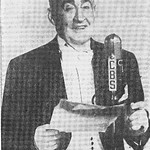
JOE HOWARD (1870 – 1961)
A leading figure of American vaudeville, Joe Howard was a singer, composer, and stage performer whose career spanned more than half a century. He rose to prominence in the late 19th century and became the author of numerous popular hits, including the famous song “I Wonder Who’s Kissing Her Now”, performed across several generations. [39], [40]
Beginning in the 1950s, at over 80 years old, Howard experienced a notable stage comeback, particularly at the Bellevue Casino in Montreal. He became a key figure in the cabaret’s anniversary shows, regularly participating in productions organized by Harry Holmok and Jack Suz. His presence attracted a loyal audience and contributed to the venue’s identity as a major stage for international variety entertainment [38].
Known for his showmanship, Howard often ended his performances with interactive numbers, inviting the audience to sing along to songs he had written himself. This closeness with the audience, inherited from vaudeville tradition, consistently generated enthusiasm and allowed the venue to fill simply by announcing his presence [39].
His career ended dramatically on May 19, 1961, when he collapsed on stage during a benefit performance in Chicago, in front of an audience of more than 3,000 spectators. His death during a performance was widely reported in the press, which emphasized the symbolic nature of dying “on stage,” faithful to a life devoted to entertainment [39], [40].
Tributes published after his death described Howard as a “vaudevillian at heart”, whose accessible and sentimental style left a mark on generations of spectators. His career illustrates the direct link between the vaudeville tradition and the world of mid-20th-century North American cabarets, of which the Bellevue Casino stands as one of the last major examples [41].
4. Operations, management, and business model
In his book Montreal Confidential, columnist Al Palmer describes the opening of the Bellevue Casino as a turning point in the history of Montreal nightlife. At a time when the famous El Morocco was beginning to decline, entrepreneur Harry Holmok seized the opportunity to launch what he envisioned as the largest cabaret in the country. After studying the market for several years, he acquired the Roseland Dancehall on Ontario Street and set out to transform it into a large-scale venue, despite widespread skepticism from his contemporaries, who considered the location too large and poorly situated [83].
“When the Bellevue Casino opened its doors in April 1949, all the cabaret insiders in Montreal said: ‘It will last six months at most, and Harry Holmok, the owner, will lose his shirt.’ Harry Holmok did not lose his shirt. On the contrary, he can now afford to wear $20 or $30 shirts.”
Against all expectations, success was immediate. From opening night, an impressive crowd gathered outside the Bellevue Casino, stretching across several city blocks. Inside, tables were quickly filled, and staff struggled to keep up with demand due to the sheer volume of patrons. This rapid success confirmed Holmok’s intuition, who simply stated that giving “the public what it wants” was enough to ensure a cabaret’s success. From that point on, the Bellevue Casino remained consistently full and quickly became one of the most frequented venues in the city [83].
Biographical note

HARRY GUSTAV HOLMOK (December 25, 1898 – September 2, 1959)
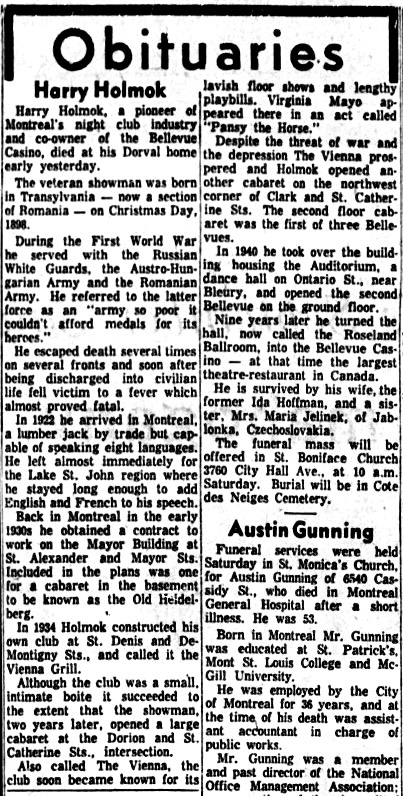
Born in Transylvania on December 25, 1898 (then part of the Austro-Hungarian Empire, now Romania), Harry Gustav Holmok would become one of the dominant figures in Montreal’s cabaret industry. A veteran of the First World War — having served successively in the Austro-Hungarian, Romanian, and Russian White Guard forces — he survived several European fronts before emigrating to Canada in 1922.
Upon arrival, he worked as a lumberjack in northern Quebec, particularly in the Lake Saint-Jean region, where he perfected both his French and English (he reportedly spoke eight languages). Back in Montreal, he first worked as a cabinetmaker, then became a general contractor, contributing to the construction of several buildings in the city.
From the Vienna to the Bellevue
In the early 1930s, Holmok turned to the entertainment industry. In 1934, he built his own club at the corner of Saint-Denis and De Montigny (now De Maisonneuve), the VIENNA GRILL. He later opened a second Vienna on Sainte-Catherine East, then renamed the Cabaret Montmartre — not to be confused with the Café Montmartre on Saint-Laurent Boulevard — as the BELLEVUE GRILL, beginning a series of establishments that would make his reputation.
A notice published in Le Devoir in 1939 confirms that he was already active in Montreal’s nightclub scene, notably through the American Club, in association with Joseph Krassler [33].
At the turn of the 1940s, Holmok became interested in the large hall at 375 Ontario Street West, then known as the Auditorium Ballroom. As early as 1943, he acquired a group of strategic properties along this stretch of Ontario Street West — including numbers 371 to 375 — as reported by The Gazette [84]. This real estate operation marked a decisive step in his project: it allowed him to consolidate control of the site and plan a large-scale transformation. He then became involved in the management and gradual reconfiguration of the venue, which became the ROSELAND BALLROOM in 1946, before being converted on April 21, 1949 into the BELLEVUE CASINO.
The Bellevue Casino: peak of an empire
Operated with his partner and brother-in-law Jack Suz, the BELLEVUE CASINO was considered the most important dinner-theatre in Canada. Spread over three floors, the venue could accommodate more than 700 seated guests and employed nearly 100 people full-time. The shows represented a weekly investment of $8,000 to $10,000 — equivalent to roughly $110,000 to $135,000 in 2026 dollars —, attracting up to 2,000 customers on Saturday nights.
Nicknamed by the American press “Canada’s Mr. Ziegfeld”, Holmok focused on lavish productions, choreographed revues, and international stars. Artistic direction, notably entrusted to Natalie Kamarova, contributed significantly to the venue’s prestige. His popular slogan summed up his business philosophy: “Fifty cents to get in, fifty cents for a beer.”
Casa Loma and the decline of major cabarets
In 1951, Holmok partnered with Thomas Steppan to open the CASA LOMA on Sainte-Catherine East, which he sold the following year. From the mid-1950s onward, new municipal regulations restricting alcohol sales, combined with urban transformations and expropriations, weakened the economic model of large cabarets. The Bellevue Casino itself underwent partial expropriation before its closure and demolition in 1962.
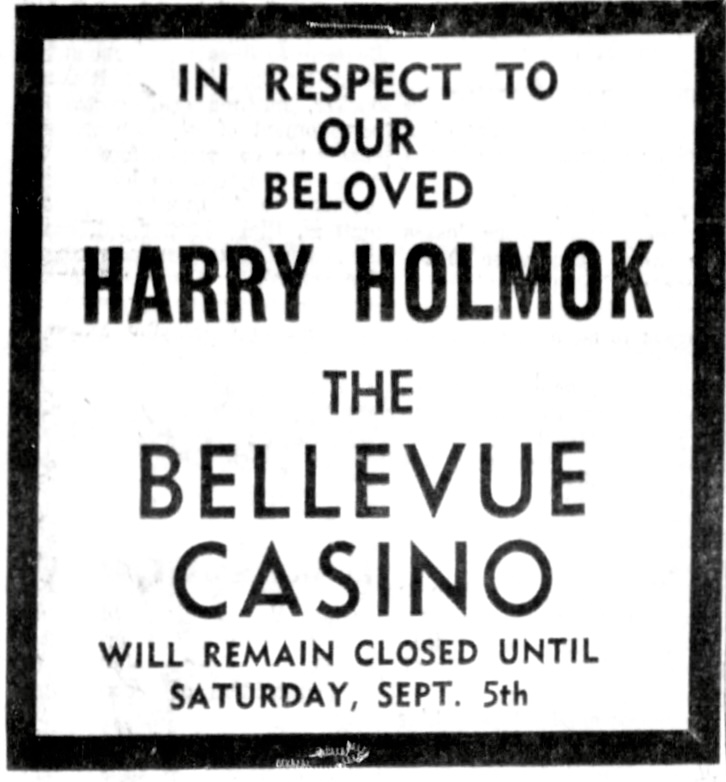
Harry Gustav Holmok died on September 2, 1959 at his home in Dorval, following a heart attack. His career illustrates the rise, peak, and decline of Montreal’s great cabarets, of which he was one of the principal architects during the golden age of entertainment in the city.
As noted by journalist John Gilmore, the Bellevue Casino was part of the peak of Montreal’s nightclub industry in the late 1940s and early 1950s, a time when such venues functioned as true “entertainment factories” [82]. Spread across multiple levels, with orchestras, shows, and large crowds, the cabaret relied on a model based on volume, audience turnover, and live music, distinguishing itself from more intimate venues such as the El Morocco [83].
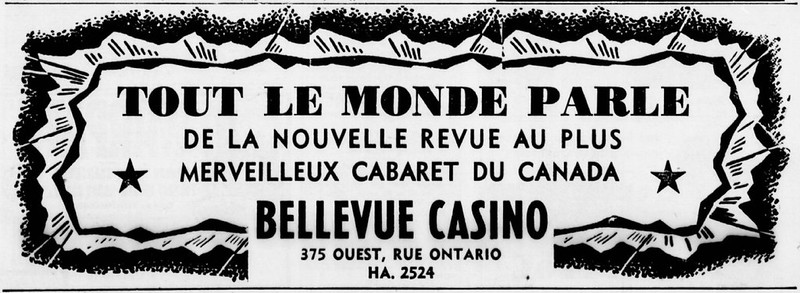
A report published in February 1955 in the Photo-Journal offers a rare look behind the scenes of this operation. Under the direction of Natalie Kamarova, productions were designed with remarkable rigor: intensive rehearsals, rapid transitions, and highly visual staging. In collaboration with George Kamarov, responsible for musical arrangements, she ensured a tight integration between dance, music, and rhythm, while figures such as Lola Sully, captain of the chorus girls, supervised performers and maintained a high level of execution [6].
Biographical note
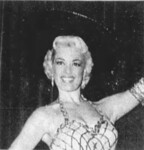
LOLA SULLY (Consuelo Myers, 1923 – 2010)
A leading figure of postwar Montreal revue productions, Lola Sully became one of the most famous cabaret dancers in Canada. Active for more than two decades on Montreal stages, she embodied the golden age of large chorus girl ensembles, notably at the El Morocco and later at the Bellevue Casino, where she remained for more than ten years and rose to the rank of line captain [47].
A star of the Bellevue Casino
Known for her energy, technique, and charisma, Lola Sully quickly stood out within the Bellevue Casino’s large choreographed productions. She was described as “the most remarkable line dancer in Canada,” capable of lighting up an entire room with her presence alone [50]. Her longevity allowed her to span the cabaret’s peak years, participating in hundreds of performances within a demanding environment marked by daily shows [49].
She worked in a field largely dominated by American dancers, yet managed to establish herself as one of the few Canadians to reach the highest levels of professional recognition. Her style, blending technical precision and expressiveness, helped define the aesthetic of Montreal’s grand revue productions of the era [47].
An international career
Throughout her career, Lola Sully also performed outside Canada, notably in New York, the Caribbean, and Florida, before regularly returning to Montreal, where she remained closely associated with the local scene [47]. She also worked as a choreographer and mentored new generations of dancers.
Even after the decline of major cabarets in the 1960s, her name remained strongly associated with that golden era. In retrospectives and reunions, she was described as the “queen of the chorus girls” and a survivor of Montreal’s great entertainment years [48].
Legacy
Lola Sully passed away on October 31, 2010 at the age of 87, leaving behind the memory of an artist who made a lasting impact on Montreal’s cabaret history. Her career illustrates both the rigor, glamour, and discipline of revue dancing in the 20th century. True to the spirit of the stage, her legacy remains tied to a phrase that defines an entire era: “The show must go on.” [51].
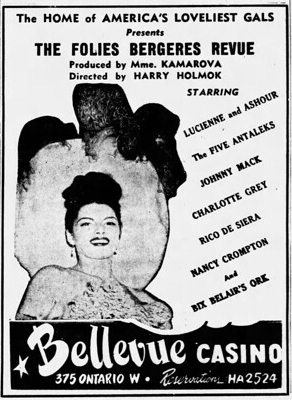
Behind the glamour, the Bellevue Casino relied on a disciplined and carefully orchestrated organization. This success, however, was far from guaranteed. As recalled in an article published during the cabaret’s fourth anniversary in L’Autorité, many observers initially doubted the viability of such a massive venue. Four years later, the conclusion was undeniable: the Bellevue Casino had established itself as one of the most frequented venues in Montreal, and even one of the most prominent in North America [5].
The article largely attributes this success to Natalie Kamarova, the principal architect of the venue’s artistic success. Drawing on international experience gained in Europe and New York, she designed fast-paced, spectacular shows without unnecessary length, perfectly suited to audience tastes. Her work, closely tied to that of George Kamarov, was based on a methodical structure in which choreography, music, and staging formed a coherent whole [5].
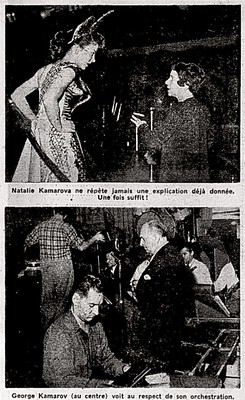
Biographical note
NATALIE KAMAROVA & GEORGE KAMAROV
The duo formed by Natalie Kamarova and her husband George Kamarov was one of the artistic pillars of the Bellevue Casino during its early years. Responsible for show design, choreography, and musical orchestration, they played a direct role in establishing the venue as one of the most renowned cabarets in Montreal in the early 1950s [5].
A signature from Europe
Born in Russia, Natalie Kamarova trained on major European stages before performing in Paris, notably at the Folies-Bergère. There, she developed a spectacular approach inspired by grand Parisian revues, which she later adapted for North American audiences. After settling in New York, she was invited to design shows within the cabaret circuit before becoming associated with the Bellevue Casino in Montreal [5].
A demanding and imaginative choreographer, she favored fast-paced, visually striking productions, constantly seeking to capture audience attention. Her ability to direct large groups of dancers helped establish the cabaret’s distinctive style [5].
A close collaboration
George Kamarov, a musician and arranger, complemented this work by overseeing the musical direction of the revues. Together, they formed a highly coordinated team, in which music, dance, and staging were conceived as a unified whole. Their close collaboration achieved a level of quality rarely matched in Montreal cabarets of the time [6].
They also supervised rehearsals and guided performers, including the chorus girls led by Lola Sully, helping to professionalize a demanding and highly competitive environment [6].
End of an era
After about six years at the head of the Bellevue Casino’s productions, the couple announced their resignation in June 1955, citing financial constraints that limited their ability to create shows matching their ambitions. Their final production was presented on July 14, 1955, marking the end of a foundational period for the cabaret [7][9].
Their departure symbolized the end of a major artistic cycle in the history of the Bellevue Casino, whose identity and prestige they had largely shaped during its most prosperous years.
This transition was confirmed with the appointment of Claude Blanchard as manager in 1956 [12]. Coming from vaudeville and the world of live entertainment, he embodied a new generation bridging the era of grand music-hall revues and emerging media. Although the Bellevue Casino remained a major venue, these changes already signaled the gradual decline of the traditional Montreal cabaret model.
A testimony published in 1956 illustrates the direct role played by Harry Holmok in mentoring his artists. Present backstage during premieres, he did not hesitate to intervene to reassure performers and boost their confidence. In the case of singer Dorothy Moreau, he comforted her after her first performance and encouraged her by promising further opportunities to perform solo. This approach, both paternal and strategic, reflects the attention he gave to artist development and the overall success of his productions [31].
5. Programming and featured performers
From its earliest years, the Bellevue Casino stood out for the richness and diversity of its revues, combining international stars, dancers, acrobats, and choreographed numbers. An article published in 1952, on the occasion of the cabaret’s third anniversary, already highlighted the scale of these productions as well as the recurring presence of performers, illustrating a strategy aimed at retaining headliners and ensuring continuity in the programming [32].
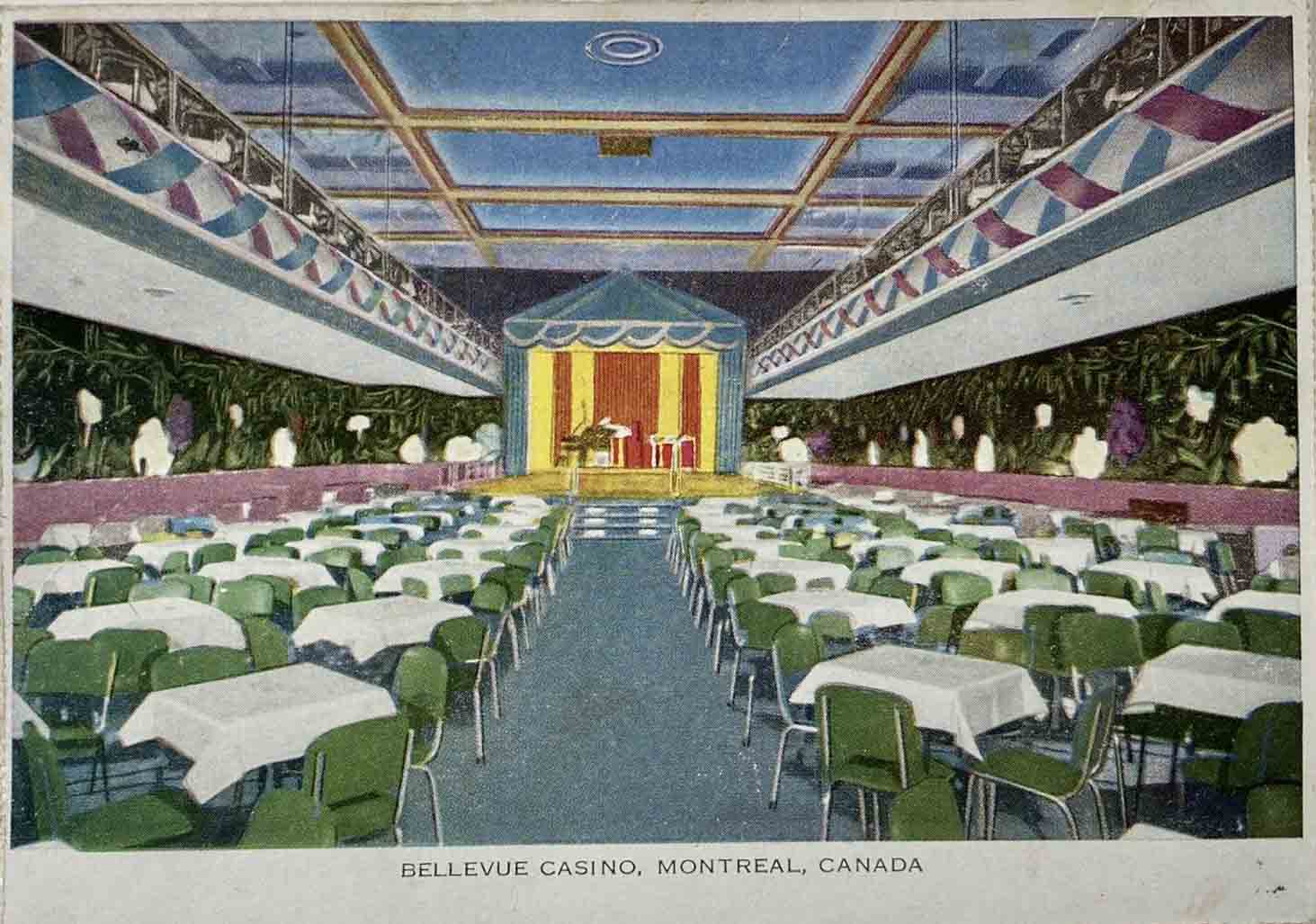
By the mid-1950s, this formula reached its full development. In an article published in Photo-Journal in May 1955, marking its sixth anniversary, the Bellevue Casino is described as one of the most frequented and dynamic venues in the city, reflecting the popular enthusiasm for large variety halls [23]. The article emphasizes the cabaret’s ability to attract artists from the international music-hall circuit, a success largely attributed to the showmanship of Harry Holmok.
This recognition extended beyond the local scene. By implicitly comparing the Bellevue Casino to major North American institutions such as the Latin Quarter in Miami, the Copacabana in New York, or the Town Casino in Buffalo, the press positioned the venue within the international entertainment circuit, highlighting its ability to rival major American stages both in the scale of its productions and the quality of its performers.
This stability was also built on the loyalty of certain stars. An article published in 1957 highlights the special relationship between Joe Howard and the Bellevue Casino, where he performed regularly since its opening, particularly during the cabaret’s anniversary celebrations. This continuity reflects the operating model developed by Harry Holmok and Jack Suz, based on recurring appearances by popular artists and consistency in programming [38].
Biographical note
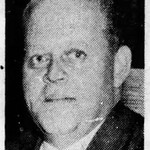
JACK EDWARD SUZ (1929 – September 29, 1962)
Born in Windsor, Ontario in 1929 and raised in Montreal, Jack Suz was one of the key figures of the final years of Montreal’s great cabarets. He became associated with the Bellevue Casino in the early 1950s, when the venue was managed by his brother-in-law Harry Holmok, and became an official partner in 1956 [24], [26].
The Bellevue Casino and large-scale productions
At the Bellevue Casino, Suz played an active role in managing and programming one of Canada’s most important cabarets. He helped attract international stars such as Sammy Davis Jr. and Liberace, within ambitious and costly productions based on a model combining popular accessibility with large-scale entertainment [35], [53].
Following the death of Harry Holmok in 1959, Suz ensured the continuation of the cabaret’s operations in an increasingly difficult context, marked by regulatory pressures and urban transformations affecting downtown Montreal [26].
Decline and closure of the Bellevue
Suz is directly associated with the closure of the Bellevue Casino on December 2, 1961, as well as the auction sale of its contents in 1962, resulting from the expropriation of the site for the widening of Ontario Street. He thus oversaw the final stages of the cabaret’s existence, marking the end of an era in Montreal nightlife [26], [46].
After the Bellevue
After the cabaret’s closure, Suz remained active in the entertainment and hospitality industries. He was notably associated with La Regence at the Hotel Dorchester, where he attempted to recreate part of the atmosphere of Montreal’s great clubs for a loyal clientele [52].
Death
Jack Suz died suddenly on September 29, 1962 in Montreal at the age of 33. His death occurred only months after that of the Bellevue Casino, to which he remained closely linked. His career embodies the transition between the golden age of major cabarets and their decline in the early 1960s [24], [27].
Liberace at the Bellevue Casino (April 1958)
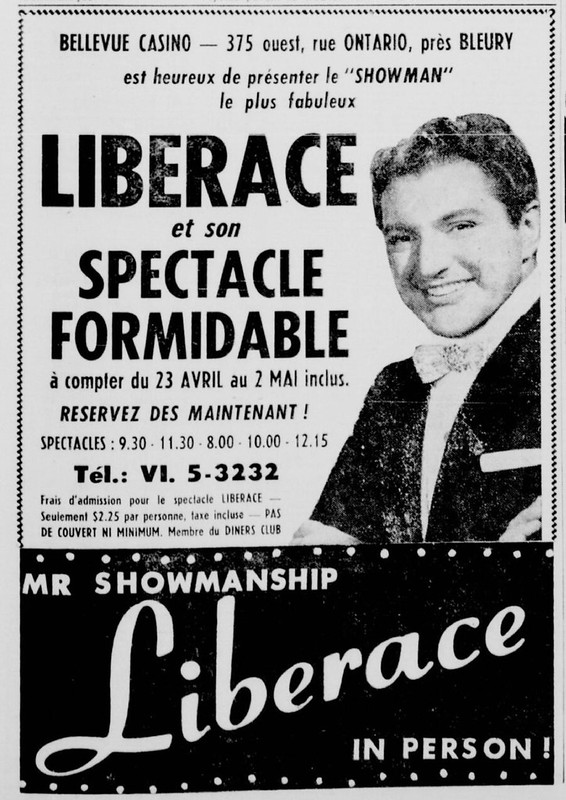
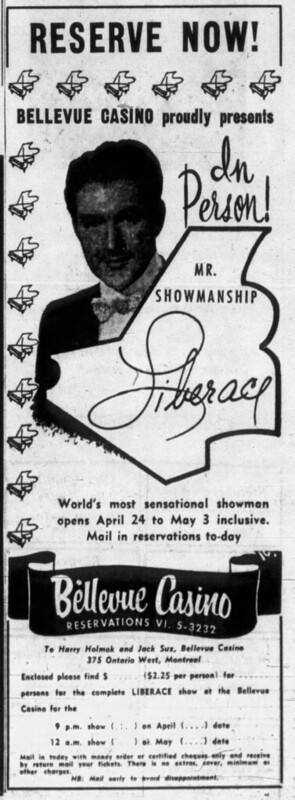
In 1958, the signing of a $31,000 contract (approximately $342,860 in 2026 value) for the appearance of Liberace at the Bellevue Casino reflects the scale of the investments made by Harry Holmok and Jack Suz to present world-class entertainment [35].
An advertisement published in 1958 for Liberace’s engagement, presented at the Bellevue Casino from April 24 to May 3, 1958, indicates an admission price of about $2.25 (approximately $25 in 2026 value). This series of performances, scheduled over several days with two shows per night, illustrates the scale of the productions and the strong demand for international stars in Montreal [37].
Édith Piaf at the Bellevue Casino (June 1959)
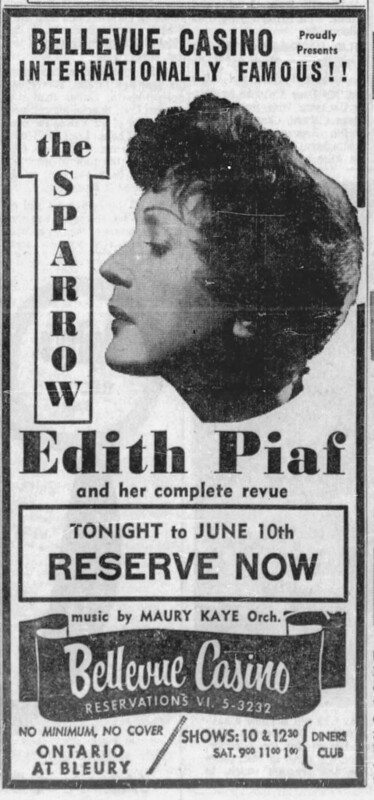
In June 1959, the Bellevue Casino welcomed one of the greatest voices of French chanson, Édith Piaf, presented in contemporary advertisements as an “internationally renowned star” [54]. Her engagement, scheduled from June 4 to 10, drew large crowds, confirming the Bellevue’s status as one of Montreal’s premier entertainment venues.
Critical reception was unanimous: despite her fragile appearance, Piaf commanded a striking stage presence. Her voice, described as powerful and deeply moving, filled the vast hall, creating a striking contrast between her physical frailty and the intensity of her performance [56]. Audiences were swept into an emotional world of love, solitude, and fate — themes central to her repertoire.
Yet behind this artistic strength lay a more fragile reality. Visiting Montreal shortly after surgery, Piaf appeared weakened but refused to slow down. She stated with disarming clarity that singing was a vital necessity, continuing her performances with courage and determination [58].
Her stay at the Bellevue Casino extended beyond the stage. She also frequented Montreal’s artistic circles and attended an intimate gathering at Bozo’s, bringing together about thirty guests. Among them were key figures of Quebec chanson, including Clémence DesRochers, Jean-Pierre Ferland, Claude Léveillée, Blanche Boudreau, Hervé Brousseau, and André Gagnon. In this intimate setting, Piaf expressed admiration for DesRochers, even suggesting she could succeed in Paris, illustrating her influence on emerging artists and her commitment to French-language song [57].
Contemporary accounts also emphasize Piaf’s authenticity. Her simplicity, sincerity, and deep connection with the audience enhanced the impact of her performances. On stage, she did not aim merely to entertain, but to convey a raw, almost painful emotion that left a lasting impression [55].
At the Bellevue Casino, accompanied by the orchestra of Maury Kaye, Piaf delivered a series of performances considered among the most memorable in the cabaret’s late-1950s programming. Her appearance confirmed both her immense popularity and Montreal’s ability to attract the greatest figures of the international stage [56].
Sam Cooke at the Bellevue Casino (September 1959)
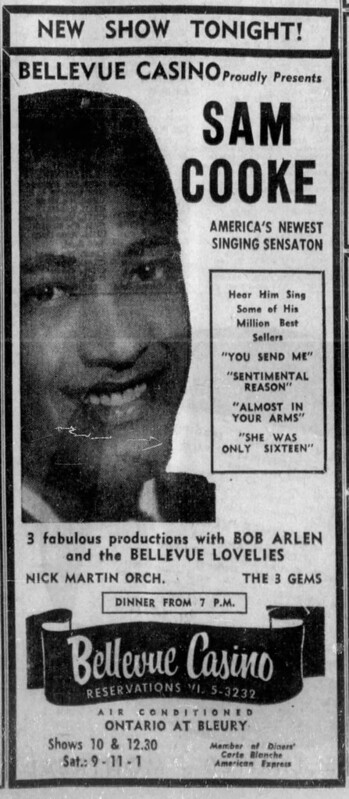
In the fall of 1959, the Bellevue Casino welcomed a rising star of American music: Sam Cooke, then presented as “America’s newest singing sensation” [59]. This first visit to Montreal marked the arrival of an artist already known for numerous hits, including “You Send Me,” which appealed to an ever-growing audience.
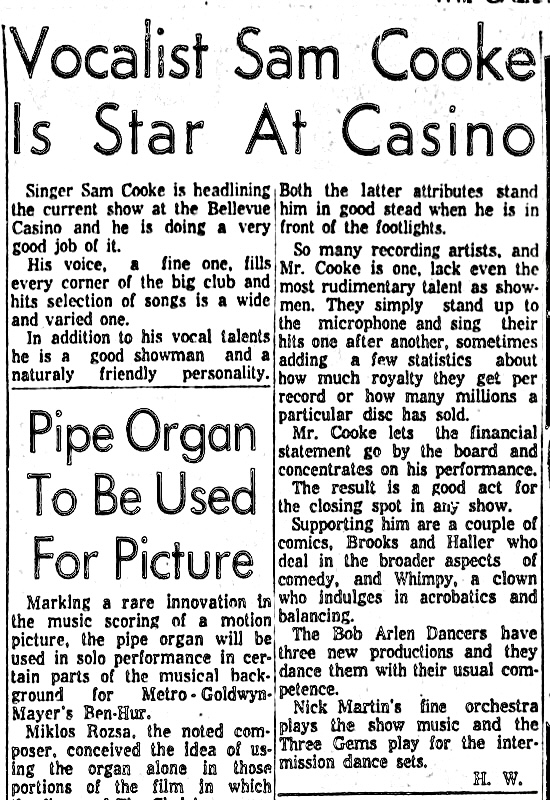
From the opening of the show, Cooke established himself as a true headliner. Reviews highlighted the exceptional quality of his voice, capable of filling the entire venue, as well as the breadth of his repertoire, making him a remarkably versatile performer [61]. Beyond his vocal abilities, it was his charisma and stage presence that stood out: Cooke was described as a refined performer, a natural showman with a warm and accessible personality.
Unlike many recording artists, often less comfortable on stage, Cooke demonstrated a genuine sense of showmanship. He knew how to captivate the audience, vary his interpretations, and deliver a performance that went beyond simply reproducing his recordings. This ability to combine vocal talent and stage presence made him an ideal performer for large cabaret venues such as the Bellevue Casino [61].
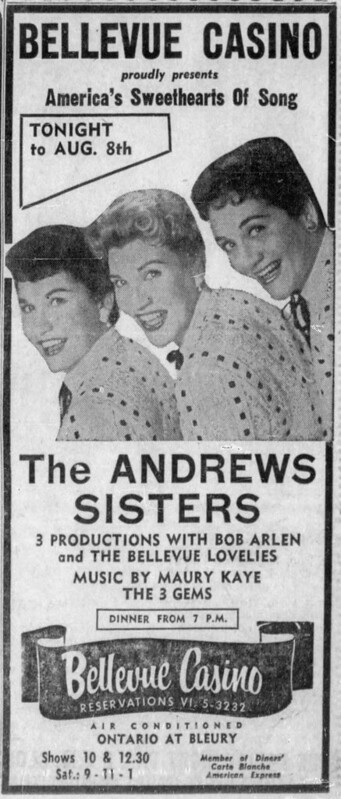
The accompanying program also reflected the grandeur of Bellevue Casino productions. It included the comedy duo Brooks and Haller, the acrobatic clown Whimpy, the dancers of the Bellevue Lovelies, and productions by Bob Arlen, supported by the orchestra of Nick Martin and musical performances by The Three Gems [59], [61]. Altogether, it formed a complete show typical of large cabaret revues of the era.
An interview published in Le Petit Journal also offers insight into the singer’s personality. At only 24 years old, Cooke appeared as a humble and disciplined artist, deeply connected to his gospel roots and committed to remaining true to his audience. He emphasized the importance of sincerity in performance and stated that he sang primarily out of passion, rather than for fame or money. He also mentioned future ambitions, including an interest in cinema, suggesting a career in rapid expansion [62].
His appearance at the Bellevue Casino thus confirmed not only his rising stardom, but also Montreal’s openness to major figures of North American popular music. Through his performances, Sam Cooke embodied a new generation of artists capable of crossing boundaries between recording, live performance, and popular culture, leaving a strong impression on Montreal audiences [60].
Sammy Davis Jr. at the Bellevue Casino (October 1959)
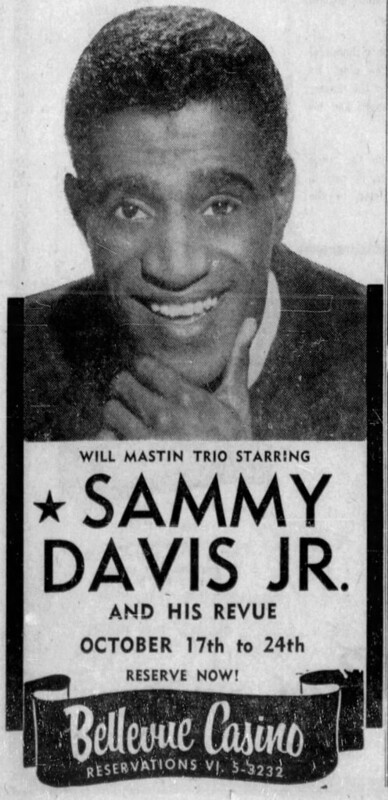
In October 1959, Sammy Davis Jr. was booked by Jack Suz to perform at the Bellevue Casino, marking a return to Montreal where he had previously performed in the 1930s. Early in his career, he earned about $500 per week alongside his father and uncle, but for this engagement, his fee was now nearly 40 times higher, illustrating the scale of his rise [53].
Johnny Howard at the Bellevue Casino (November 1961)
Contemporary sources indicate that Johnny Howard was the last major headliner to perform at the Bellevue Casino before its closure in 1961.
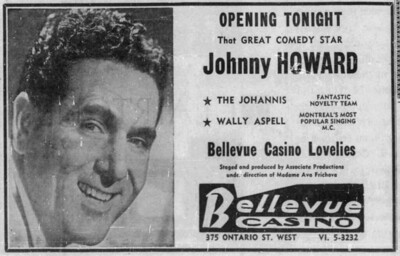
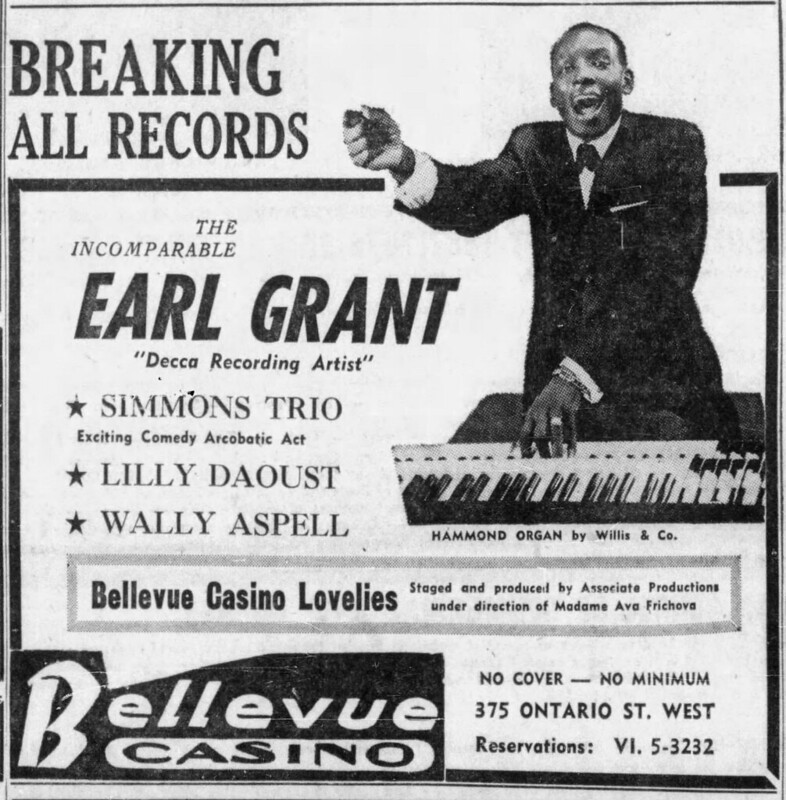
Toward the end of the cabaret’s operation, several documents confirm his presence as the featured attraction. An advertisement notably promotes his show as the main act, alongside The Johannis, master of ceremonies Wally Aspell, and the Bellevue Casino Lovelies, illustrating the typical format of the venue’s grand revue productions [43]. A review published in The Gazette also confirms that he was the headliner at the time, highlighting his enduring popularity with Montreal audiences and his ability to engage the crowd through humor rooted in local references [44].
This role as the “final performer” is reinforced by a column from Al Palmer, who describes Johnny Howard as an entertainer capable of “closing” major cabaret venues, noting that he was among the last to perform in several iconic Montreal nightlife establishments, including the Bellevue Casino [42].
Finally, a The Gazette column on the closure of the cabaret emphasizes that it marked the disappearance of one of Montreal’s largest entertainment venues, directly linking the final performances of the Bellevue Casino to the presence of Johnny Howard, thereby reinforcing his role in concluding the venue’s history [45].
6. Decline: regulation, expropriation, and closure
An article published in Le Canada on October 31, 1950, in the context of the morality police inquiry in Montreal, sheds light on the environment in which the Bellevue Casino operated at the turn of the 1950s. The debates focused on the management of entertainment-related establishments and on the possible existence of organized “systems,” with authorities attempting to determine whether these were formal structures or more diffuse practices that were difficult to regulate legally.
In this context, the testimony of Harry Holmok, owner of buildings located at 371 and 375 Ontario Street West, highlights the diversity of uses associated with the site. Some premises were rented for various commercial purposes — reception halls, meetings, or cabaret-related activities — notably by Arthur Davidson, a well-known figure in Montreal nightlife. This multiplicity of functions illustrates the difficulty of classifying these spaces between legitimate entertainment and regulatory gray areas.
Judicial discussions thus reveal the limits of the investigation: despite a certain implicit tolerance of these practices, their organization remained difficult to prove. The Bellevue Casino existed within this ambiguous context, at the intersection of public perception and legal reality, in a Montreal where a rapidly expanding entertainment industry coexisted with increased institutional oversight [25].
By the late 1950s, these tensions were compounded by growing real estate pressures. A reference from 1958 indicates that Harry Holmok and Jack Suz sold land adjacent to the Bellevue Casino, a sign of the urban transformations that would eventually lead to the site’s disappearance [36].
7. Auction sale and demolition
A legal notice published in The Gazette in January 1961 confirms that Jack Suz and Ida Hoffman, widow of Harry Holmok, were then jointly operating the Bellevue Casino as a partnership. The establishment was therefore still in operation at that time, despite growing financial and legal challenges [29].
The following year, a brief published on May 14, 1962, announced the imminent demolition of the Ontario Street building, marking the forthcoming disappearance of a landmark of Montreal nightlife. The idea of organizing a “wake” in another cabaret — to bring together regular patrons and figures associated with the Bellevue — reflects the strong attachment within the community and the symbolic weight of its closure [28].

The disappearance of the cabaret became a reality in September 1962, following its expropriation. A notice dated September 15 confirms the imminent demolition and the complete liquidation of the Bellevue Casino’s contents. The auction, held on-site on September 18 and 19, included furniture, kitchen equipment, stage installations, musical instruments, and numerous production-related items. This public dismantling transformed the cabaret into a collection of dispersed souvenirs, marking the material disappearance of one of Montreal’s most important dinner-theatres [46].
In an article published on September 19, 1962, journalist Al Palmer reflected on the event, emphasizing its symbolic significance. The auction appeared as the “final act” of the Bellevue Casino, where glasses, tables, curtains, and stage elements were dispersed, bringing to an end a period defined by ambitious productions and strong attendance. Palmer also pointed to the causes of decline: regulatory constraints, including the prohibition of Sunday performances, and urban changes such as the widening of Ontario Street, which contributed to the building’s disappearance [11].
A few years later, in a retrospective article published in 1969, Palmer placed the Bellevue Casino among Montreal’s great vanished cabarets, alongside the Frolics and the El Morocco. He evoked a bygone era characterized by spectacular revues, orchestras, and international programming that made the city a major entertainment hub in North America [10].
Through this reflection, the disappearance of the Bellevue Casino appears not only as the end of a single establishment, but as the end of a cabaret model based on large-scale productions and the glamour of Montreal nightlife. Its demolition and the dispersal of its remnants thus embody the transition to a new era of urban entertainment, marked by more modern and diversified forms.
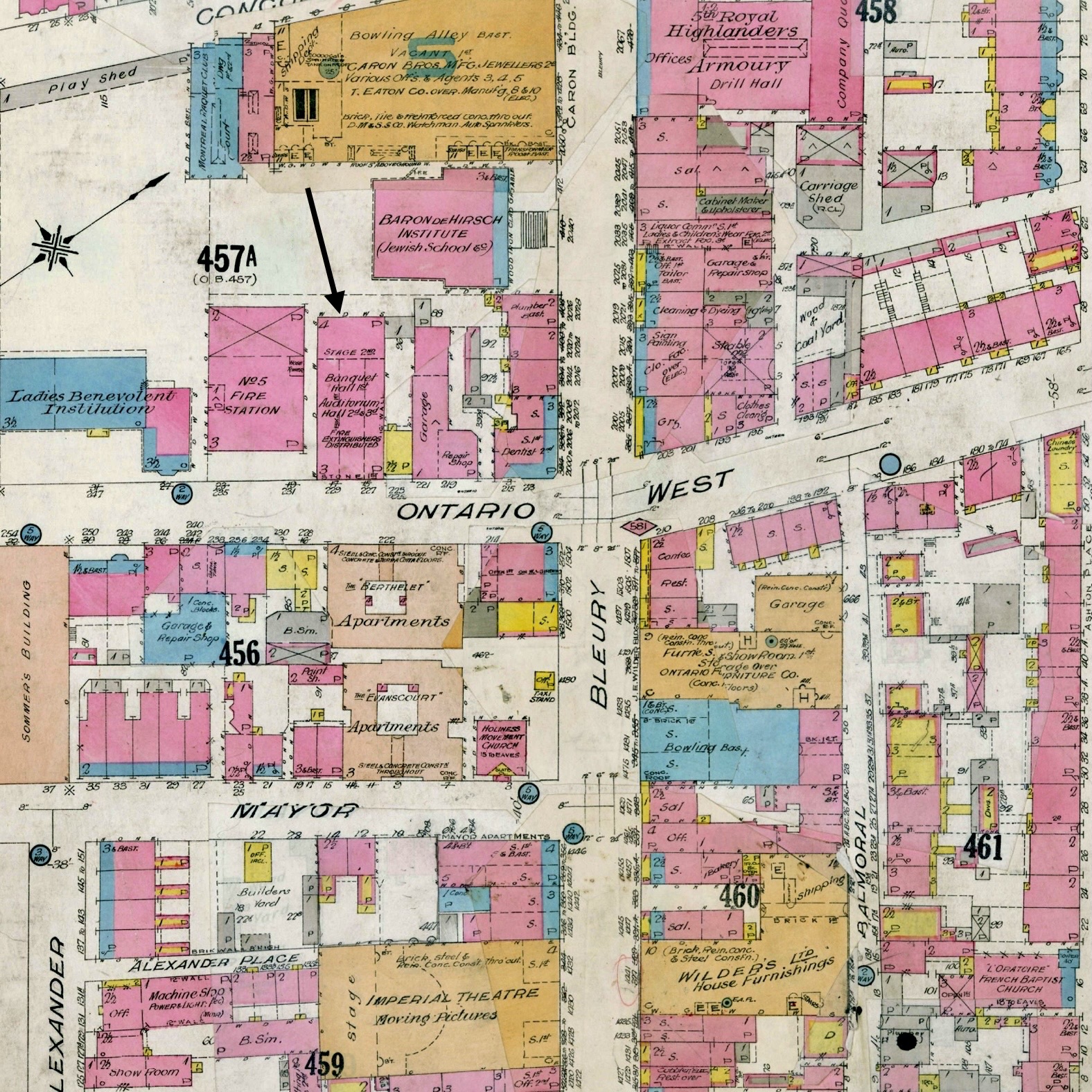
The GOAD fire insurance plan index map of Montreal and the Lovell's Montreal directory make it possible to trace the civic evolution of the site occupied by the Auditorium. Over time, the establishment was listed under the following addresses: 17 Berthelet Street (before 1912), 229–227 Ontario Street (1912–1928), and later 375–371 Ontario Street (from 1928 onward).
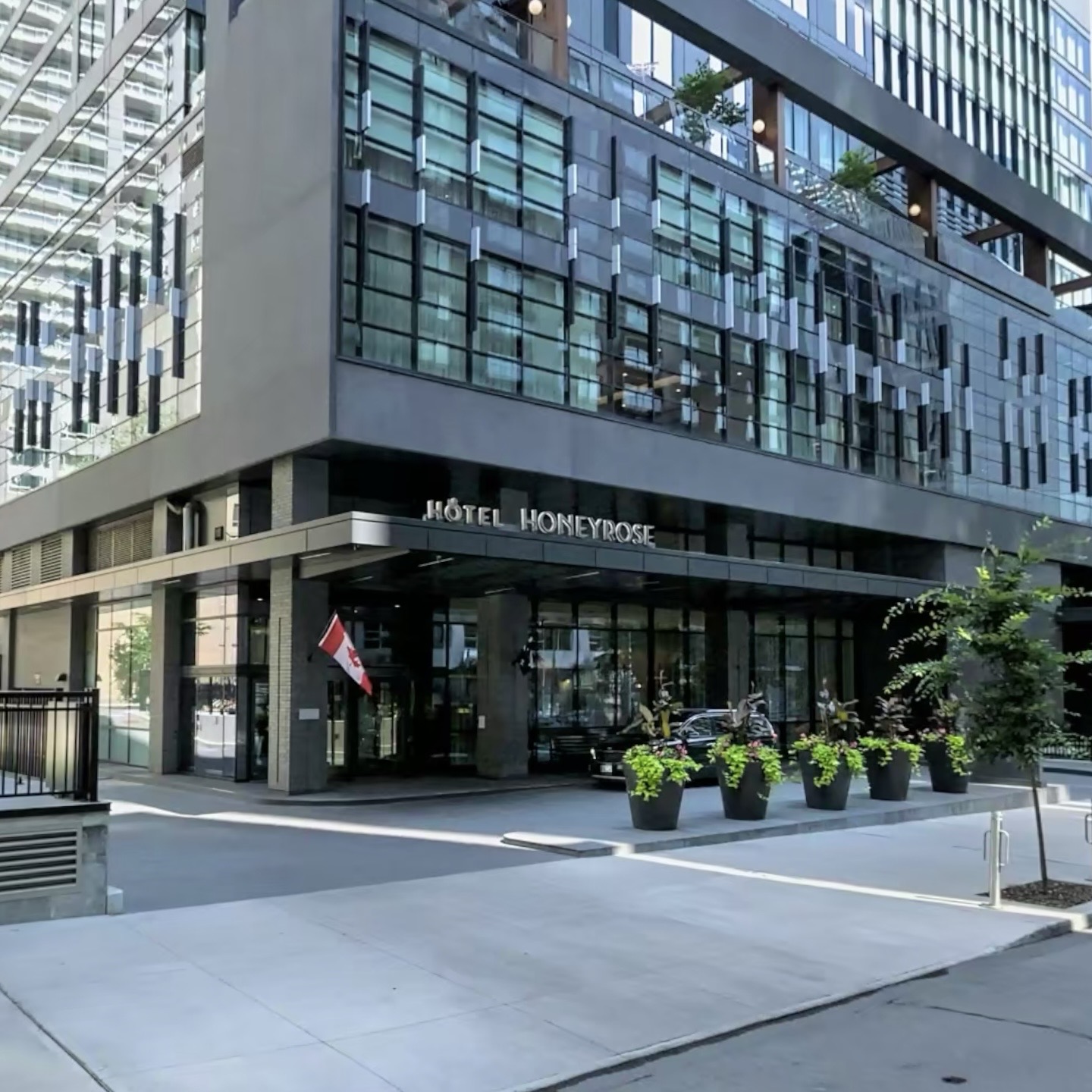
In the mid-1960s, as part of the redevelopment of downtown Montreal ahead of Expo 67, this section of Ontario Street was incorporated into the new route of De Maisonneuve Boulevard.
8. Notes & sources
-
THE GAZETTE, April 21, 1949, p. 6.
“Latest Night Club Makes Debut Tonight”.
Article announcing the official opening of the Bellevue Casino, presented as one of the largest and most attractive cabarets in Canada. The opening night features a production directed by Madame Kamarova and George Kameroff, associated with the Folies Bergères of Paris, with a cast of approximately 22 performers on stage.
Among the headliners are Joe Howard, Billy Wells and the Four Fays, as well as singer Ruth Brown and Patricia Adair, both from the Latin Quarter in New York, and singer-dancer Jack Stanton.
The article also highlights the presence of a chorus of 18 dancers and the presentation of a can-can number, illustrating the scale and spectacular character of this new Montreal venue. -
THE GAZETTE, April 14, 1949, p. 6.
“Cafe Casino to Open Thursday, April 21”.
Article announcing the upcoming opening of the Cafe Casino Bellevue at 375 Ontario Street West, scheduled for April 21, 1949. The newspaper presents the establishment as one of the “largest and most attractive cafés in Canada,” emphasizing the scale and ambition of the project.
The opening night was to feature a revue directed by Madame Kamarova and George Kameroff, associated with the Folies Bergères of Paris, with a cast of approximately 25 performers.
Among the announced stars were Joe Howard, described as an octogenarian composer with more than 525 songs, as well as Billy Wells, the Four Fays, singer Ruth Brown and Patricia Adair (from the Latin Quarter in New York), and singer-dancer Jack Stanton.
The article also mentions a chorus of approximately 12 dancers and a can-can number, designed to create a spectacular visual atmosphere for the opening night. -
THE GAZETTE, September 3, 1959 — Obituaries section.
“Harry Holmok”.
Obituary noting his birth in Transylvania on December 25, 1898, his military service during the First World War (Austro-Hungarian, Romanian and Russian White Guard forces), his arrival in Montreal in 1922, his early work as a lumberjack and cabinetmaker, the founding of the Vienna Grill (1934), the development of the Bellevue establishments, as well as the transformation of the Roseland Ballroom into the Bellevue Casino (1949). It also mentions his death in Dorval on September 2, 1959. -
JACQUES, Louis. Bellevue Casino showgirls, 1951.
Photograph taken for Weekend Magazine. Held at Library and Archives Canada, reference e005477036. -
L’AUTORITÉ, April 25, 1953.
CÔTÉ, Roland. “The casino held its ground…”.
Article published on the occasion of the fourth anniversary of the Bellevue Casino, recalling the doubts surrounding its opening in 1949 and emphasizing that it had since become one of the most popular cabarets in Montreal, and even in North America.
The text attributes much of this success to Madame Natalie Kamarova, choreographer and artistic director, presented as the principal architect of the venue’s productions. The article traces her international career — from Russia to Paris, then to New York — and emphasizes her discipline, sense of rhythm, ability to adapt shows to audience tastes, as well as her close collaboration with her husband, a musician responsible for arrangements.
Roland Côté also highlights the decisive role of Harry Holmok, owner of the Bellevue Casino, who agreed to support Kamarova’s artistic ambitions financially, particularly when she requested higher production budgets. The article shows that the Bellevue’s success rested on the combination of strong artistic direction and a managerial commitment to ever more ambitious productions. -
PHOTO-JOURNAL: ALL THROUGH THE IMAGE, February 19, 1955.
LEBEAU, Roland. “A (night) show comes to life?”.
Report devoted to the behind-the-scenes operations of the Bellevue Casino, highlighting the preparation of major revues directed by Natalie Kamarova. The article describes in detail rehearsals, organization of acts, and the central role of the choreographer, known for her rigor, high standards, and sense of spectacle.
It also notes the involvement of her husband, George Kamarov, responsible for arrangements and orchestration, as well as the participation of the cabaret dancers, including Lola Sully, then line captain, who supervised new recruits.
The report emphasizes the scale of work required to stage Bellevue productions — intensive rehearsals, coordination between music and choreography, and attention to detail — revealing the hidden structure behind a cabaret where every show was carefully crafted to captivate audiences. -
LE PETIT JOURNAL, June 19, 1955.
“Resignation of Madame Natalie Kamarova”.
Announcement of the resignation of Natalie Kamarova and her husband George Kamarov, responsible for the conception, staging, and production of shows at the Bellevue Casino since its opening.
The couple stated they were leaving due to financial constraints, as owner Harry Holmok could no longer support the budgets required for their productions. They specified, however, that they would present one final show in July before their departure.
The article also highlights the negative impact of unfavorable publicity surrounding nightclubs, which contributed to declining attendance, with some even mistakenly believing that the Bellevue Casino had already closed. -
CHAS. E. GOAD CO. Insurance Plan of the City of Montreal, Quebec, Canada, Volume II. Montreal [etc.]: Chas. E. Goad Co., 1915.
Fire insurance atlas at a scale of 1:600, providing detailed mapping of buildings, including their materials, massing, and uses.
For the site corresponding to the future 375 Ontario Street West, the plan reveals the presence of a large building occupying a significant portion of the block, with a structure primarily in brick and differentiated sections suggesting distinct functional spaces. Its elongated configuration and footprint indicate a large-capacity gathering place, consistent with public halls or entertainment venues.
The technical annotations — characteristic of Goad plans — make it possible to identify entrances, internal divisions, and fire safety features, offering valuable insight into the physical organization of the site prior to the major transformations of the mid-20th century.
These documents constitute an essential source for reconstructing the evolution of the site, from the Auditorium Halls to the Roseland Ballroom, and later the Bellevue Casino.
Collection: Quebec towns and villages plans collection, Bibliothèque et Archives nationales du Québec.
Detailed record: 0000179182.
Available online: BAnQ. -
PHOTO-JOURNAL: ALL THROUGH THE IMAGE, July 16, 1955.
“The midnight round”.
Brief announcing the departure of Natalie Kamarova and George Kamarov from the Bellevue Casino, where they presented their final show on July 14, 1955.
The text recalls that the couple, associated with Harry Holmok, had greatly contributed to the cabaret’s success. Their departure occurred within a broader context of tensions affecting the Montreal cabaret industry, with Kamarova stating that it had become impossible to produce high-quality shows under existing conditions.
The article also notes that choreographer Jeanne Hacket, from New York, was expected to take over artistic direction. -
PALMER, Al. “Once upon a time, we had stars over Ourtown…”,
The Saturday Gazette, September 20, 1969.
Retrospective article on the golden age of Montreal cabarets, describing the Bellevue Casino as one of the city’s major nightlife landmarks.
Palmer recalls the era of spectacular revues, chorus lines, and international stars, while emphasizing the gradual disappearance of these venues, symbolized by the demolition of the Bellevue Casino and its final public auction. -
THE GAZETTE, September 19, 1962, p. 21.
“Bellevue’s Last Show—An Auction”, by Al Palmer.
Article describing the auction of the equipment and furnishings of the Bellevue Casino following its closure. The text recounts the dispersal of emblematic elements of the cabaret — including glasses, tables, curtains, photographs, and even kitchen equipment — marking the end of an establishment once considered one of Montreal’s most important nightclubs.
The article also reflects on the role of Harry Holmok, credited with transforming the venue into a large-scale entertainment space, as well as the Bellevue’s reputation as a major destination in Montreal nightlife during previous decades.
It further highlights the factors contributing to its decline, including changing public tastes, regulatory constraints — particularly the prohibition of Sunday performances — and urban redevelopment projects that ultimately led to the demolition of the building. -
HUSTAK, Alan. “Music Hall star sang for mob boss”,
The Gazette, August 21, 2006, p. 15.
Obituary devoted to Claude Blanchard (1932–2006), a Quebec performer and cabaret owner, notably known for the television series Music Hall. The article traces his career in Montreal’s entertainment scene, from his beginnings in vaudeville to his success on television and stage.
It also highlights his role as manager of the Bellevue Casino in 1956, as well as his involvement in Montreal’s cabaret circuit, where he stood out as a comedian, host, and key figure of the city’s nightlife.
The article further notes that he performed at the wedding of a member of the Hells Angels, illustrating some of the more controversial aspects of his career. -
THE MONTREAL STAR, August 1, 1908, p. 10.
Article titled “Montreal’s New Concert Hall, ‘The Auditorium’” presenting the plans and construction of a new performance hall located at 15–17 Berthelet Street (now Clark Street). The building, designed by architect Dalbé Viau and built by James H. Maher, is described as a monumental three-storey stone structure in classical style, featuring elaborate interior fittings.
The establishment, known as “The Auditorium”, included a large dance hall measuring 115 by 50 feet, with a gallery capable of accommodating approximately 1,500 people, as well as several lounges, reception rooms, and spaces intended for societies and events. A notable feature was the presence of a stage allowing the hall to be quickly converted into a theatre.
This article constitutes a fundamental source for tracing the origin of the site that would later house the Bellevue Casino, illustrating the evolution of the building from a multifunctional early 20th-century hall into a major cabaret venue. -
THE MONTREAL STAR, October 17, 1908, p. 10.
“Montreal’s Newest Halls!”. Advertisement announcing the opening of the Auditorium Halls at 15–17 Berthelet Street (corner Bleury), described as the largest and most modern halls of their kind in Montreal.
The advertisement mentions a capacity of approximately 1,400 people for the main hall, as well as several secondary rooms, all equipped with stages, dressing rooms, kitchens, and ticket offices, intended for concerts, dances, and meetings. -
THE MONTREAL STAR, December 3, 1908, p. 4.
Advertisement titled “Grand Opening Assembly” announcing the official opening of the New Auditorium Hall, located at 15–17 Berthelet Street.
The inaugural event was scheduled for December 4, 1908 at 8:30 p.m., with orchestra and refreshments, confirming the venue’s entry into operation. -
THE GAZETTE, April 20, 1949, p. 6.
Advertisement announcing the opening night of the Bellevue Cafe Casino at 375 Ontario Street West, scheduled for April 21, 1949.
The ad promotes the revue “Folies Bergere Revue”, produced by Madame Kamarova with music by George Kameroff.
It highlights the presence of 22 performers on stage and a chorus of 18 dancers, illustrating the scale and visual spectacle of the production.
Featured performers include Joe Howard, Ruth Brown, Patricia Adair, Jack Stanton, Ben Beri, and the comedy trio The 3 Wiles. -
THE GAZETTE, April 20, 1949, p. 6.
Advertisement announcing the opening of the Bellevue Cafe Casino (375 Ontario Street West) with the revue “Folies Bergere”, produced by Madame Kamarova and George Kameroff.
The ad mentions 22 performers on stage and 18 dancers, along with headliners such as Joe Howard, Ruth Brown, Patricia Adair, and Jack Stanton. -
THE MONTREAL STAR, April 26, 1949, p. 28.
“Bellevue Cafe Casino Attracts”.
Article highlighting the success of the early performances at the Bellevue Cafe Casino, which drew large crowds thanks to its sizeable capacity.
Joe Howard, then in his eighties, is presented as headliner, alongside performers such as Ben Beri, the trio The Three Wiles, Jack Stanton, and Patricia Adair.
The revue “Folie Bergere” also included a chorus of approximately 10 dancers and can-can numbers. -
THE MONTREAL STAR, April 26, 1949, p. 28.
“Bellevue Cafe Casino Attracts”.
Article describing the early success of the Bellevue Casino, presented as one of Montreal’s major new cabaret attractions.
It highlights Joe Howard, aged 80, who led the show with his own compositions and a tap-dance number, receiving enthusiastic audience response.
The program also included variety acts such as Ben Bert, the Three Wiles, and the duo Jack Stanton and Patricia Adair, within a production titled Folie Bergere, accompanied by a chorus line performing a can-can number.
The article also confirms the participation of Ruth Brown and staging by Madame Kamarova and George Kameroff, emphasizing the international character of the program. -
MONTRÉAL-MATIN, April 5, 1949, p. 8.
“Le Bellevue Café Casino”.
Brief announcing the transformation of the former dance hall Roseland Ballroom into a cabaret under the name Bellevue Café Casino.
The article states that the official opening was scheduled for April 21, 1949 and emphasizes that the establishment would be “the largest of its kind in Canada.”
Located at 375 Ontario Street West, the venue was already open to visitors at the time of publication, although the musical programming had not yet been fully confirmed. -
MONTRÉAL-MATIN, April 9, 1949, p. 8.
“Vedettes et Cabarets”, by Don D’Amico.
Column announcing the upcoming opening of the Bellevue Café Casino, scheduled for April 21, 1949, and presenting it as “the largest and most beautiful cabaret in Canada.”
The article confirms the involvement of Madame Kamarova and George Kameroff, formerly of the Folies-Bergère in Paris, responsible for staging and orchestration of the opening show titled Follie-Bergère.
The program includes Joe Howard, Billy Wells, the Four Fays, singer Ruth Brown, Patricia Adair, and singer-dancer Jack Stanton, along with a group of dancers performing a can-can number.
The article emphasizes the scale of the production and the intention to offer Montreal an international-calibre show inspired by major Parisian revues. -
NEWSDAY (Nassau Edition), September 4, 1959, p. 119.
“Harry G. Holmok, 61, Canada’s ‘Ziegfeld’”.
Article confirming his full name (Harry Gustav Holmok), his death from a heart attack at his home in Dorval, his partnership with Jack Suz at the Bellevue Casino, his earlier career as a cabinetmaker and general contractor, as well as his nickname “Canada’s Mr. Ziegfeld.”
The article notes that he was 61 years old at the time of his death. -
PHOTO-JOURNAL, May 14, 1955, p. 45.
“Anniversaries of Ruby Foo’s and the Bellevue Casino”, by Roland Lebeau.
Article published on the occasion of the sixth anniversary of the Bellevue Casino, offering insight into the venue’s place in Montreal nightlife in the mid-1950s.
The text highlights the sustained popularity of the cabaret and the quality of its programming, which allowed it to host a wide range of performers from the international music-hall circuit.
It particularly emphasizes the role of its director Harry Holmok, presented as a key figure in the development of the venue, notably due to his ability to select diverse productions and attract well-known stars.
The article also underscores the dynamism and prestige of the Bellevue Casino, implicitly comparing it to major North American venues, confirming its position as one of Montreal’s leading entertainment destinations during this period. -
LA PRESSE, October 1, 1962.
Obituary of Mr. Jack Suz, identified as one of the owners of the Bellevue Casino.
The text specifies that Suz was born in Windsor, Ontario in 1929 and moved to Montreal in childhood.
He became co-owner of the Bellevue Casino in 1956 with his brother-in-law Harry Holmok, while already being involved in the management of the venue since 1950.
The notice also indicates that he continued his cabaret-related activities until Holmok’s death in December 1961, and mentions his interests in the Hotel Dorchester as well as a hotel establishment in Sept-Îles.
This notice provides key information regarding the ownership structure and management of the Bellevue Casino during the 1950s and early 1960s. -
LE CANADA, October 31, 1950, p. 2 and 14.
Articles related to the morality police inquiry in Montreal mentioning the Bellevue Casino within debates on the existence of “systems” organizing vice and gambling in the city.
The testimony of Harry Holmok, owner of buildings located at 371 and 375 Ontario Street West, states that certain premises were used for commercial and entertainment purposes, including cabaret-related activities.
The hearings also addressed the issue of “apartments” and associated activities, while emphasizing the limits of the evidence presented and the difficulty of proving the existence of a structured system within these establishments. -
THE MONTREAL STAR, October 1, 1962, p. 23.
“Jack Suz” (obituary).
Obituary of Jack Edward Suz, former partner and operator of the Bellevue Casino. The article states that he became associated with the establishment in the early 1950s, when it was operated by his brother-in-law Harry Holmok, and that he officially became a partner in 1956. Following Holmok’s death in 1959, Suz continued operating the nightclub until its closure on December 2, 1961, followed by the auction of its contents. The closure of the cabaret is linked to the expropriation of the site by the City of Montreal as part of the widening of Ontario Street. The article also mentions his interests in other establishments, including the Hotel Dorchester in Montreal and the Senterre Hotel in Sept-Îles. -
THE GAZETTE, October 1, 1962, p. 33.
“Jack Suz Dies At 33, Operated Old Bellevue”.
Obituary of Jack Edward Suz, former operator of the Bellevue Casino, who died suddenly at the age of 33. The article specifies that he had been associated with the establishment since the early 1950s, when it was operated by his brother-in-law Harry Holmok, and that he became a partner in 1956. Following Holmok’s death in 1959, Suz continued operating the cabaret until its closure on December 2, 1961, before overseeing the auction of the furniture and equipment. The text also mentions his interests in the Hotel Dorchester in Montreal and the Senterre Hotel in Sept-Îles, as well as his real estate holdings in the city. -
THE GAZETTE, May 14, 1962, p. 4.
“Show Business” column.
Brief announcing the imminent demolition of the building that housed the Bellevue Casino on Ontario Street, as well as the proposed organization of a commemorative “wake” bringing together regular patrons and figures associated with the cabaret. The text notably mentions Harry Holmok — already deceased at that time —, Joe Krassler, Jack Suz, as well as Lola Sully, evoking key figures linked to the history of the venue and highlighting the nostalgic dimension surrounding its disappearance. -
THE GAZETTE, January 14, 1961, p. 35.
Legal notice published under the authority of the Superior Court, Province of Quebec, District of Montreal (file no. 515,089).
The document identifies Jack Suz, restaurateur, and Ida Hoffman, unmarried widow of Harry Holmok, both residents of Montreal, as plaintiffs operating jointly under the name of the Bellevue Casino.
They initiated proceedings against the Hilton Credit Corporation, an incorporated company headquartered in Los Angeles (California).
By order of the Court, the defendant was required to appear within one month.
The document is dated January 12, 1961 and signed by Maurice Caron, Deputy-Prothonotary.
The plaintiffs’ attorneys were Spiegel, Shriar & Polak, located at 455 Craig Street West, Suite 502, Montreal. -
THE MONTREAL STAR, September 3, 1959, p. 31.
“Harry G. Holmok” (Obituaries section).
Obituary announcing the death of Harry Gustav Holmok, Montreal cabaret owner, at his summer home in Dorval at the age of 61.
Born in Transylvania, Holmok immigrated to Canada after serving during the First World War in several European armies.
Arriving in Montreal in 1922, he first worked as a lumberjack in northern Quebec, before returning to practice his trade as a cabinetmaker and later becoming a general contractor.
While working on the construction of the Mayor Building on St. Alexander Street, he became interested in the cabaret industry, eventually deciding to open his first establishment.
In 1934, he founded the Vienna Grill, followed by several other clubs, then acquired the Auditorium Ballroom in 1940, which he transformed into the Bellevue Grill.
In 1949, he inaugurated the Bellevue Casino, presented as one of the most important cabarets in Canada, offering large-scale productions that earned him the nickname “Canada’s Ziegfeld”.
The article also notes that he was survived by his wife Ida Hoffman, and specifies that his funeral took place at St. Boniface Church, with burial at Côte-des-Neiges Cemetery. -
LE PETIT JOURNAL, May 6, 1956.
Article on singer Dorothy Moreau recounting her debut at the Bellevue Casino in November 1954.
She describes her stage fright during opening night, in the presence of Madame Kamarova and Harry Holmok, who reassured and encouraged her backstage.
She performed there for six weeks before continuing her career. -
LE CANADA, April 21, 1952.
“Dazzling third anniversary revue at the Bellevue Casino”, by Roland Côté.
Article highlighting the success of the third anniversary show of the Bellevue Casino. The text emphasizes the presence of Joe Howard, regularly invited by Harry Holmok, as well as the quality of the variety acts, including dancers, acrobats, and choreographed productions directed by Natalie Kamarova.
The article insists on the spectacular and fast-paced nature of the revue, confirming the Bellevue’s reputation as one of Montreal’s leading cabarets. -
LE DEVOIR, December 9, 1939.
“New corporate registrations” column announcing recently registered companies.
Mentions The American Club, associated with Harry Holmok and Joseph Krassler, both identified as operators in Montreal.
This notice confirms Holmok’s involvement in the entertainment business as early as the late 1930s. -
THE GAZETTE, September 3, 1959, p. 4.
“Show Business” column mentioning the death of Harry Holmok, presented as the man who conceived and developed the Bellevue Casino, described as one of the most successful nightclubs in Montreal’s west end for many years.
The text highlights his vision of accessible entertainment for the masses, as well as his experience gained in smaller establishments, including the Vienna Grill, before creating the Bellevue.
It also notes that his methods and philosophy would be continued by Jack Suz. -
THE GAZETTE, March 24, 1958, p. 4.
“Signs $31,000 Contract for Bellevue Show”.
Article announcing the signing of a record $31,000 contract for the appearance of pianist and showman Liberace at the Bellevue Casino, marking the venue’s ninth anniversary.
The text specifies that Harry Holmok and Jack Suz concluded the agreement with MCA, highlighting both the financial scale and prestige of the engagement.
Liberace’s arrival, directly from Australia, illustrates the Bellevue’s ability to attract top-tier international performers. -
THE GAZETTE, October 2, 1958, p. 4.
“Quotable Quotes” column referencing a real estate transaction involving Harry Holmok and Jack Suz of the Bellevue Casino.
The article notes the sale of an adjacent parking lot of approximately 9,000 square feet in the Bleury–Ontario area, at roughly $20 per square foot.
It specifies that the new owners would continue operating the site for five years pending redevelopment, reflecting the growing real estate pressures affecting the Bellevue at the end of the 1950s. -
THE GAZETTE, April 4, 1958, p. 9.
Advertisement for the Bellevue Casino announcing the appearance of Liberace, presented as “Mr. Showmanship”.
The notice invites the public to reserve for performances scheduled from April 24 to May 3, 1958, with admission priced at approximately $2.25 (about $25 in 2026 value).
It also specifies showtimes at 9:00 p.m. and midnight, illustrating the scale and demand surrounding the event.
The advertisement mentions Harry Holmok and Jack Suz, as well as the address at 375 Ontario Street West. -
THE GAZETTE, April 29, 1957, p. 4.
“Show Business” column noting that Joe Howard was scheduled to make one of his final appearances at the Bellevue Casino.
The article recalls that he had inaugurated the venue years earlier and remained associated with its anniversary celebrations.
Presented as one of the oldest performers in the business, Howard is described as a loyal and emblematic figure of the Bellevue. -
THE GAZETTE, May 22, 1961, p. 22.
Article announcing the death of singer and composer Joe Howard, who died at the age of 82 after collapsing on stage during a benefit performance in Chicago.
The text highlights his long career in vaudeville and recalls his popularity in Montreal, where he regularly performed at the Bellevue Casino, particularly during anniversary celebrations.
Howard is described as a central figure in the cabaret’s success, known for engaging audiences with his own compositions, including “I Wonder Who’s Kissing Her Now”, “Hello My Baby”, and “Goodbye My Lady Luck”. -
THE MONTREAL STAR, May 20, 1961, p. 28.
“Famed Joe Howard Collapses, Dies on Stage”.
Article reporting the death of Joe Howard, aged 82, following a stage collapse in Chicago.
The text retraces his long career in vaudeville and notes his popularity in Montreal, where he appeared in several nightclubs during the 1950s, including the Bellevue Casino.
Howard is described as a prolific composer of more than 500 songs, including major hits such as “I Wonder Who’s Kissing Her Now” and “Hello My Baby”. -
THE MONTREAL STAR, May 23, 1961, p. 10.
Article published following the death of Joe Howard, portraying him as a defining figure of North American popular theatre.
Though not considered a “great” star in the traditional sense, he is described as having deeply influenced generations of audiences.
The article emphasizes that he died on stage during a performance — a fitting end for a lifelong entertainer — and describes him as a “vaudevillian at heart”, known for his accessible and sentimental style. -
THE GAZETTE, “Our Town” column by Al Palmer, c. mid-1960s.
Article devoted to Johnny Howard, presented as a key figure of Montreal’s cabaret era.
The text highlights his performances at venues such as the El Morocco, where his humor and vocal performances attracted large audiences.
Palmer situates Howard within the broader decline of Montreal nightclubs, describing him as one of the last performers to appear at major venues including the Bellevue Casino, symbolically “closing” them. -
THE GAZETTE, advertisement, early 1960s.
Promotion for the show “Opening Tonight” featuring comedian Johnny Howard at the Bellevue Casino.
The advertisement presents Howard as the main attraction, alongside The Johannis, master of ceremonies Wally Aspell, and the Bellevue Casino Lovelies, under the direction of Madame Ava Frichova.
This reflects the typical revue format combining comedy, music, and dance. -
THE GAZETTE, review, early 1960s.
Article describing Johnny Howard’s performance at the Bellevue Casino, emphasizing his popularity and ability to engage audiences through humor and local references.
The program also included The Johannis, Wally Aspell, the Bellevue chorus line, and musical accompaniment by Don Fiorito. -
THE GAZETTE, “Show Business” column, 1961.
Article announcing the closure of the Bellevue Casino, described as the disappearance of one of Montreal’s most important nightlife venues.
The text links its closure to urban redevelopment and places it alongside other major establishments such as the El Morocco and the Frolics.
It highlights the role of performers like Joe Howard and Johnny Howard in marking the beginning and end of the venue’s history. -
THE MONTREAL STAR, September 15, 1962, p. 51.
“Auction Notice — Bellevue Casino Expropriated”.
Official notice announcing the public auction of the entire contents of the Bellevue Casino following its expropriation.
The sale, held on-site on September 18, 1962 (and continuing September 19 if necessary), included furniture, kitchen equipment, stage lighting, pianos, and barware.
This notice documents the final dismantling of the cabaret following urban redevelopment. -
THE MONTREAL STAR, November 17, 1962.
JOHNSTONE, Ken. “Everybody Loves Lola”.
Article devoted to dancer Lola Sully, tracing her career from the Esquire Club to the El Morocco and the Bellevue Casino, where she spent more than ten years as a line captain.
The text highlights her importance in large-scale productions and her status as a leading figure among Montreal chorus dancers. -
THE GAZETTE, May 30, 1980, p. 21.
FITZGERALD, John. “Years peel away as Lola’s back in town”.
Article recounting the return of Lola Sully to Montreal and reflecting on her career during the golden age of cabarets, particularly at the Bellevue Casino, where she was known as the “Queen of chorines.” -
THE GAZETTE, August 6, 1952.
MEEMAN, Hilda. “Serious Minded Chorus Girls Replace ‘Red-hot Mamas’ of 20’s”.
Article describing the evolution of chorus dancers at the Bellevue Casino, highlighting a new generation of disciplined and professional performers.
It emphasizes the demanding work of dancers such as Lola Sully and their central role in the success of cabaret productions. -
THE GAZETTE, 1966.
PALMER, Al. “Our Town — Town Topics”.
Column recalling the memory of the Bellevue Casino after its demolition, with particular emphasis on the importance of the cabaret’s chorus line dancers. Lola Sully is described as the most remarkable among them, capable of “lighting up the entire club” and considered one of the finest chorines in Canada. The article also recalls her role as line captain and highlights both her stage presence and her popularity during the Bellevue’s golden age. -
THE GAZETTE, November 6, 2010.
Obituary of Consuelo Myers (known by her stage name Lola Sully) (1923–2010). The notice states that she died on October 31, 2010 at the age of 87, following a long illness (Alzheimer’s disease). She is survived by her daughter Nancy Stefanik and her grandchildren Chloe and Dimitri. The text also highlights the affection of her loved ones and concludes with a phrase emblematic of her career: “The show must go on.” -
THE GAZETTE, May 12, 1962, p. 19.
Column announcing the return of Jack Suz to the Montreal cabaret scene with La Regence at the Hotel Dorchester (1484 Dorchester Street).
The article notes that the venue became a gathering place for the loyal clientele of Suz’s former establishments, evoking his well-known style of service. The room is described as elegant and well-appointed, with fast, discreet, and efficient service. The musical programming features the Gypsy Baron Trio, presented nightly for both dancing and listening, whose musicians are described as excellent both individually and as an ensemble. -
THE GAZETTE, October 16, 1959.
Announcement of the engagement of Sammy Davis Jr. at the Bellevue Casino, signed by Jack Suz.
The article recalls that the artist had performed in Montreal in the 1930s for approximately $500 per week, whereas he now receives a fee nearly 40 times higher for this new series of performances.
It highlights his exceptional work pace — spanning film, television, theatre, and cabaret — as well as annual earnings exceeding $1,500,000. Davis is presented as a major entertainment star, comparable in popularity to Frank Sinatra, particularly following his success in Porgy and Bess. -
LE PETIT JOURNAL, May 31, 1959.
Advertisement for the Bellevue Casino featuring Édith Piaf, described as an “internationally renowned star,” accompanied by her full revue.
Performances are scheduled from June 4 to 10, 1959, with music by the orchestra of Maury Kaye. The notice invites advance reservations and specifies daily shows in a dinner-club format, with no minimum charge. -
PHOTO-JOURNAL, June 20, 1959.
Review of Édith Piaf’s appearance at the Bellevue Casino. The article emphasizes the contrast between the singer’s apparent fragility and the power of her voice, particularly in her performance of La Foule.
The critic highlights the emotional intensity of her songs, described as deeply marked by suffering, loneliness, and lost love. Piaf’s performance is portrayed as an almost physical experience, capable of overwhelming and “projecting the audience outside themselves,” beyond simple artistic admiration. -
THE GAZETTE, June 6, 1959, p. 27.
Article highlighting the presence of Édith Piaf at the Bellevue Casino, described as “the most famous of French singers.”
The text emphasizes the power of her voice, capable of filling the vast hall, as well as the emotional intensity of her songs inspired by love and Paris. It also notes the quality of the production and the musical accompaniment by Maury Kaye’s orchestra, contributing to the success of the show. -
LE PETIT JOURNAL, June 14, 1959, p. 21.
Article recounting an intimate evening at Bozo’s, where Clémence DesRochers performed before a small circle of regulars, in the presence of Édith Piaf.
The article describes an intimate and spontaneous atmosphere in which Piaf, impressed by DesRochers’ talent, warmly encouraged and congratulated her, suggesting that she could succeed in Paris.
The scene highlights the closeness between artists and reflects Piaf’s cultural influence in Montreal during her engagement at the Bellevue Casino. -
LE PETIT JOURNAL, June 7, 1959, p. 14.
Interview with Édith Piaf published during her engagement at the Bellevue Casino.
Despite fragile health and recent surgery, the singer affirms her determination to continue performing, stating: “If I stopped singing, I would stop living.”
The article highlights the emotional power of her performance, her connection with the audience, and her ability to continue working despite illness. A photograph taken at the casino shows her weakened but still active.
The text also notes that her stay in Montreal was brief before returning to engagements in the United States and France. -
THE GAZETTE, September 2, 1959, p. 12.
Advertisement announcing the arrival of American singer Sam Cooke at the Bellevue Casino, presented as “America’s newest singing sensation”.
The notice highlights several of his popular hits, including “You Send Me”, “Sentimental Reason”, “Almost in Your Arms” and “Sixteen”.
The show also includes three productions with the Bellevue Lovelies, the orchestra of Nick Martin, and the group The 3 Gems. Performances are scheduled at 10:00 p.m. and 12:30 a.m., with dinner service beginning at 7:00 p.m.. -
THE GAZETTE, September 5, 1959, p. 17.
Article announcing the opening of Sam Cooke’s show at the Bellevue Casino.
Presented as a major recording star, this marked his first appearance in the Montreal venue. The article emphasizes the quality of his performance, his extensive repertoire, and his ease on stage as both singer and entertainer.
The program also includes the comedy duo Brooks and Haller, the Bellevue chorus girls, and the orchestra of Nick Martin. -
THE GAZETTE, September 10, 1959, p. 11.
Review of Sam Cooke’s performance at the Bellevue Casino, where he is presented as the headliner.
The article highlights the quality of his voice, capable of filling the entire hall, as well as the breadth and variety of his repertoire.
Cooke is described as a complete artist, both an accomplished singer and an excellent stage performer with a warm personality. Unlike many recording artists, he is noted for his strong sense of showmanship.
The program also included Brooks and Haller, the acrobatic clown Whimpy, dancers from Bob Arlen, the orchestra of Nick Martin, and the group The Three Gems. -
LE PETIT JOURNAL, September 13, 1959, p. 110.
Interview with Sam Cooke, then performing at the Bellevue Casino, presented as a promising 24-year-old artist.
The article highlights his natural talent, simplicity, and stage presence, as well as his beginnings in a gospel choir in Chicago.
Cooke emphasizes sincerity in performance, stating that his goal is to please the audience rather than pursue fame or wealth.
He also discusses his repertoire, including hits such as “You Send Me”, and expresses interest in pursuing a career in film. -
THE MONTREAL STAR, January 2, 1909, p. 12.
Advertisement announcing dance lessons for beginners at the New Auditorium Hall, located at 15–17 Berthelet Street (corner Bleury), under the direction of Wm. E. Norman.
Classes are offered on Mondays and Thursdays, including sessions for children and private lessons, confirming the hall’s continued use for social and educational activities shortly after its opening. -
THE MONTREAL STAR, August 23, 1912, p. 2.
Advertisement announcing that the Auditorium Hall, located at 17 Berthelet Street (also identified as 229 Ontario Street West), had been completely renovated, including the installation of a new dance floor.
The venue is presented as one of the largest dance halls in the city, with dance classes resuming under the direction of Prof. S. Laing. -
THE MONTREAL STAR, December 31, 1920, p. 30.
Advertisement announcing a New Year’s masked ball held on January 1, 1921 at the Auditorium Hall, located at 229 Ontario Street West.
The event included a ball and bazaar with a jazz orchestra, organized in support of the Peretz School, illustrating the venue’s role in cultural and community life. -
THE MONTREAL STAR, October 20, 1937, p. 8.
Advertisement announcing dance evenings at the New Auditorium Ballroom, located at the corner of Ontario and Bleury Streets.
The notice features Irving Laing and his orchestra, as well as free swing dance lessons (Big Apple, Truckin’, Suzi-Q), confirming the venue’s integration into popular dance culture of the 1930s. -
THE MONTREAL STAR, December 8, 1937, p. 14.
Advertisement announcing a “Social Dance” at the New Auditorium Ballroom, located at 375 Ontario Street West.
The event marks the 20th anniversary of Prof. Vachon’s dance school, with competitions and demonstrations, accompanied by Irving Laing and his musicians. -
THE MONTREAL STAR, December 31, 1940, p. 5.
Advertisement announcing a New Year’s Eve dance at the Auditorium Ballroom, located at 375 Ontario Street West.
The notice mentions a “new management” and a dance event running from 9:00 p.m. to 5:00 a.m., confirming the venue’s continued activity on the eve of the 1940s. -
THE MONTREAL DAILY STAR, September 5, 1941.
“Wood’s Orchestra At Auditorium”.
Article announcing the seasonal reopening of the Auditorium Dance Palace, located at 375 Ontario Street West, near Bleury Street.
The venue had undergone significant renovations and was now operated under new management. Described as a “popular dance emporium,” it reopened with a musical program featuring Stan Wood and his orchestra, along with vocalist Russ Titus.
The article also mentions additional attractions for opening night, confirming the venue’s importance in Montreal’s dance scene in the early 1940s. -
THE MONTREAL DAILY STAR, January 31, 1942.
Article titled “Louis Armstrong Coming Here” announcing the arrival of trumpeter and bandleader Louis Armstrong and his orchestra at the Auditorium Dance Palace, located on Ontario Street West, near Bleury Street.
The text states that the management aimed to offer Montreal audiences access to the great jazz bands heard on radio and records, presenting the venue as a true “rendez-vous of the jitterbugs.”
It mentions that renowned orchestras such as Gene Krupa and Jan Savitt had already performed there, and announces a week-long engagement of Louis Armstrong and his Famous Orchestra, from February 13 to 19, 1942.
Armstrong, nicknamed “Satchmo,” is described as one of the greatest jazz artists in the world, whose popularity was further enhanced by his appearances in several recent films.
This announcement confirms the Auditorium Dance Palace as a major venue on the international jazz circuit in the early 1940s. -
THE GAZETTE, February 14, 1942.
Article by Tracy S. Ludington titled “Armstrong, Here at Auditorium, Serves Up Jazz That Doesn’t Jar”, reporting on the performance of Louis Armstrong and his orchestra at the Auditorium Dance Palace on Ontario Street.
The text describes a packed house of “jitterbugs” and highlights the enthusiastic reception of a style of jazz that was both energetic and accessible.
The critic emphasizes the musical quality of the ensemble, particularly the brass section, the saxophones, and the rhythm section led by drummer Sid Catlett, as well as the presence of musicians such as Louis Russell on piano and Joe Garland on saxophone.
Armstrong is presented as a major figure of jazz, capable of combining technical virtuosity with broad popular appeal.
The article also underscores the authenticity of New Orleans influences in his playing and the enthusiasm of Montreal audiences.
This coverage confirms both the importance of the event and the status of the Auditorium Dance Palace as a key venue for international jazz in Montreal in the early 1940s. -
THE MONTREAL STAR, November 13, 1941, p. 14.
Article titled “Gene Krupa At Auditorium” reporting on the performance of American drummer and bandleader Gene Krupa at the Auditorium on Ontario Street West.
The text highlights the enthusiasm of Montreal audiences, including many “jitterbugs,” who came to witness one of the most popular swing orchestras in the United States.
The critic emphasizes Krupa’s virtuosity, presenting him as one of the greatest drummers of his time, as well as the spectacular impact of his performance, to the point that spectators sometimes preferred watching rather than dancing.
The article also mentions the presence of singer Anita O’Day, a major swing figure, and describes an electric atmosphere where music and staging combined to create a memorable event.
This coverage confirms the Auditorium’s ability to attract leading American bands, reinforcing its status as a major swing and jazz venue in Montreal in the early 1940s. -
THE GAZETTE, October 11, 1943.
Advertisement announcing a “Battle of Swing” at the Auditorium Dance Palace, featuring the orchestra of Bert Niosi, presented as Toronto’s “King of Swing,” and that of Stan Wood, described as a leading figure of Montreal’s “hot rhythm.”
Presented as a one-night event, it illustrates the popularity of musical showdowns between major dance bands during the swing era, as well as the venue’s role as a crossroads of the Canadian music scene in the early 1940s. -
THE MONTREAL DAILY STAR, February 22, 1943.
Advertisement announcing the appearance of American trombonist Jack Teagarden, nicknamed the “King of the Blues Trombone,” at the Auditorium Dance Palace, located at 375 Ontario Street West.
The notice specifies that he performed with his orchestra for a single evening, alongside the local ensemble of Stan Wood.
This programming illustrates the regular presence of major jazz and swing artists at the Auditorium in the early 1940s and confirms the venue’s integration into the North American touring circuit. -
THE MONTREAL DAILY STAR, February 8, 1946.
Advertisement announcing weekend dance evenings at the Auditorium Ballroom, located at 375 Ontario Street West.
The notice highlights trumpeter Maynard Ferguson and his 16-piece orchestra, and also mentions the presence of a dance studio associated with the venue.
It reflects the continued vitality of the establishment in the immediate postwar period, combining social activities, training, and musical programming. -
THE MONTREAL DAILY STAR, October 31, 1946.
Article titled “Hallowe’en Dance At Roseland” announcing a special event at the Roseland Ballroom, identified as formerly the Auditorium Dance Palace.
The text specifies that the venue had recently been redecorated and renovated and was a popular gathering place for dance enthusiasts.
The orchestra of Hal Hartley, already associated with major venues such as the El Morocco, provided the regular programming.
This reference confirms the rebranding of the venue in the immediate postwar years and marks a key step in its evolution toward major Montreal cabarets. -
LE CANADA, September 17, 1946.
Article titled “Opening of the Roseland Ballroom” describing the official inauguration of the venue in Montreal.
The text reports a large turnout, with more than 1,000 couples attending the opening night, dancing to the orchestra conducted by Hal Hartley.
Presented as a modern entertainment venue aimed at Montreal youth, the Roseland Ballroom is described as richly decorated and animated by a festive atmosphere.
This opening confirms the transformation of the former Auditorium Dance Palace into a renewed ballroom adapted to postwar tastes. -
LE DEVOIR, January 11, 1947.
“New corporate registrations” column announcing the registration of several businesses in Montreal, including Roseland Ballroom Reg’d under the name of Harry Holmok, as well as the Bellevue Café registered by Harry Holmok and Adrien St-Onge.
This notice confirms Holmok’s direct involvement in the operation of the Roseland Ballroom and establishes a formal link between it and the future creation of the Bellevue, marking a key step in the transition toward the postwar cabaret. -
WEINTRAUB, William. City Unique: Montreal Days and Nights in the 1940s and ’50s.
Toronto: McClelland & Stewart, 1996, p. 124–125.
William Weintraub describes the Bellevue Casino, founded in 1949 by Harry Holmok, as the largest and most popular cabaret in Montreal, with a capacity of approximately 700 people.
Its shows, produced by Natalie and George Komarov, were inspired by the great revues of New York and Paris and contributed to its success.
The establishment also stood out for its accessible formula — “Fifty cents to get in, and fifty cents for a beer” — attracting a broad clientele and contributing to the festive and spending culture of Montreal at the time. -
MARRELLI, Nancy. Stepping Out: The Golden Age of Montreal Night Clubs, 1925–1955.
Montreal: Véhicule Press, 2004, p. 104.
Nancy Marrelli notes that the Bellevue Casino, opened in 1949 by Harry Holmok on the site of the former Auditorium and Roseland Ballroom, was a large three-floor cabaret offering frequent shows with American stars, chorus lines, and an orchestra led by Bix Belair.
Highly popular and affordable, the venue enjoyed great success before declining after mid-1950s moral regulations, eventually closing and being demolished in 1962. -
GILMORE, John. A History of Jazz in Montreal.
Montreal: Lux Éditeur, 2009, p. 150–151.
John Gilmore emphasizes that Montreal’s large dance halls, including the Auditorium, played a central role in the dissemination of jazz in the 1930s and 1940s.
These venues, where orchestras and big bands performed, were the direct predecessors of postwar cabarets.
The Auditorium would later be transformed into a nightclub, becoming the Bellevue Casino, illustrating the continuity between the era of dance halls and that of Montreal cabarets. -
GILMORE, John. A History of Jazz in Montreal.
Montreal: Lux Éditeur, 2009, p. 216–217.
The author describes the Bellevue Casino as one of Montreal’s major postwar nightclubs, organized as a high-volume enterprise spread across multiple floors and attracting hundreds of customers weekly.
He highlights the importance of orchestras and live music, provided by various ensembles responsible for accompanying shows and maintaining a continuous atmosphere, making the cabaret a central element of Montreal nightlife. -
PALMER, Al. Montreal Confidential.
Montreal: Véhicule Press, 2009 (original ed. 1950), p. 59–60.
In the chapter “Casino De Whoopee”, Al Palmer recounts the opening of the Bellevue Casino by Harry Holmok, who transformed the former Roseland Dancehall into one of the largest nightclubs in Canada.
Despite initial skepticism — many considered the venue too large and poorly located — the success was immediate: on opening night, crowds stretched across several blocks, and the cabaret remained packed thereafter.
Palmer emphasizes the spectacular nature of the productions, composed of varied acts (dancers, acrobats, attractions), as well as Holmok’s ability to meet public expectations.
He also notes that, although less intimate than the El Morocco, the Bellevue quickly drew part of its clientele and performers. -
THE GAZETTE, July 5, 1943, p. 19.
“Real Estate Sales” section reporting a property transaction involving H. Holmok et al., concerning a site located on Ontario Street West, identified as numbers 371 to 375 in the St. Lawrence district.
The lot, measuring approximately 47 by 115½ feet, included existing buildings and was sold for $29,050.
This acquisition corresponds to the site that would later house the Roseland Ballroom, and subsequently the Bellevue Casino, confirming the early involvement of Harry Holmok in the development of the location.