Black Bottom (Montreal)
A legendary Montreal jazz club, active from 1957 to 1976, first in the heart of Little Burgundy and later in Old Montreal. Renowned for its fabled after-hours, the incandescent playing of resident guitarist Nelson Symonds, and an adventurous program blending jazz and soul, it welcomed major figures, including Miles Davis, Thelonious Monk, and Art Blakey & The Jazz Messengers.
1. Overview
A light that only goes out at daybreak
In 1957, at 1350 Saint-Antoine Street West in Little Burgundy, Charlie Burke lit a spark that would not go out until morning. The Black Bottom was born in the basement of a thriving Black neighborhood, at a time when Montreal still pulsed to the rhythm of trains, the port, and nights that ran long. Very quickly, the venue established itself as one of the city’s liveliest clubs: affordable prices, jams after official hours, and a door that always seemed slightly ajar for visiting musicians.
Rail as the venue’s sonic memory
Before becoming a club owner, Charlie Burke worked for many years in the railway world, notably at CN. That rail memory never left him. When the Black Bottom moved to Saint-Paul Street East, the back of the club opened directly onto the port: cars being shunted in the night, convoys groaning, distant whistles. The comings and goings of trains slipped into the venue’s soundscape, blending with swing and improvisation the industrial breath of Old Montreal, as if the city itself were accompanying the music. [7]
2. Origins & character of the venue
A survival economy, a lived-in atmosphere
When Charlie Burke opened the Black Bottom in 1957, he had only $200 and stubborn conviction. The club took root in a worn-out basement, barely tamed: wobbly tables, folding chairs, objects salvaged from the Salvation Army, frescoes painted in haste to hide cracks and damp walls. Nothing was luxurious; everything was necessary. And yet, out of that material poverty came a dense, warm atmosphere—already inhabited, as if the room breathed before the music even began. [1]
A simple room, deliberate closeness
The room itself remained intentionally straightforward: round tables, sturdy chairs, and an assumed proximity between stage and audience. Capacity is estimated at about 150 seats, but on the busiest nights the space seemed to contract, as if bodies, sound, and heat claimed every square inch. [7]
Listening with the body
Several accounts describe a musical experience felt less through the ear than through the body. Smoke suspended in the air, sonic density, vibrations in the floor underfoot, and percussion turned listening into physical sensation. At the Black Bottom, jazz and blues were not only heard—they were felt, in chest and legs, carrying the night well beyond the final chord. [11]
A name, a lineage, and word of mouth
The name Black Bottom was not chosen by accident. It echoes a popular dance from the 1930s, asserting a lineage broader than the then-dominant bebop, associated with the tutelary figure of Charlie Parker. At the first address on Saint-Antoine, the club rested on two inseparable pillars: music and food. The early days were hampered by an unfavorable context: some advertisements were reportedly refused by newspapers, deemed inappropriate for a so-called “family” readership. Word of mouth then became the main vehicle of publicity. [7]
No alcohol—food as an anchor
The menu directly reflected the venue’s Afro-Caribbean roots: chicken wings, rice, black-eyed peas, and Creole sauce prepared by a chef named Roméo. The Black Bottom did not serve alcohol: people drank scalding coffee, and for one dollar, could hear jazz until morning. Night became something to move through slowly, without urgency. [2]
A nocturnal hub—and a refuge
The club quickly became a weekend magnet in the neighborhood. Lines formed at the door, drawn by the promise of extended jams and an atmosphere found nowhere else. The Black Bottom became a point of convergence, a refuge for those unwilling to let the night end too soon.
The relationship with the neighborhood remained distinctive. Nights stretched to dawn, music seeped through walls, and silence was rare. Yet in this area, largely made up of Black residents, the effervescence was tolerated—sometimes even protected. The Black Bottom was perceived as a space to breathe, a place where daily fatigue gave way to a kind of shared freedom. [1]
On Saint-Paul East: the table becomes an extension of the stage
At the second address on Saint-Paul Street East, food remained a defining pillar. The Black Bottom was described as one of the first Montreal establishments to offer fully self-asserted soul food: ribs, chicken, cornbread, and sweet-potato desserts. Portions were generous, prices modest, and the table became a natural extension of the stage. [13]
A “today’s jazz”: refusing nostalgia
Charles “King” Burke conceived his club as a living organism, attentive to shifts in Black North American music. Believing bebop now belonged to the past, he gradually steered the program toward a more direct jazz, infused with soul and contemporary rhythms. That capacity to adapt—refusing nostalgia without abandoning improvisation—became one of the Black Bottom’s signatures. [16]
Food fully belonged to that total experience. Inspired by the U.S. South and prepared on site, it made the Black Bottom a place one came to as much to eat as to listen. That dual vocation—feeding body and spirit—strengthened its role as a true community space, anchored in Montreal nightlife well beyond the idea of a simple performance venue. [17]
3. Second address — 22 Saint-Paul Street East (1968–1976)
Expropriation, then a turning point
In late 1967, the Black Bottom was forced to leave Saint-Antoine Street, a casualty of urban renewal programs reshaping Little Burgundy. Far from seeing an ending, Charlie Burke recognized a turning point. In 1968, the club reopened at 22 Saint-Paul Street East in Old Montreal, in a district still marked by the port, warehouses, and long winters. [1]
Leaving the rail, choosing the club
The move marked a decisive choice. Unable to keep living a double life between the railroad and the club, Charles Lovince Burke left his railway job to devote himself entirely to the Black Bottom. The new space—an old 19th-century Sam’s Café—met a concrete need: a larger, more comfortable room, properly heated, able to host musicians and audiences without compromise, while preserving the spirit of closeness and improvisation that made the venue’s reputation. [12]
Setting: stone, brick, and soft light
On Saint-Paul Street East, the Black Bottom changed scale without losing its soul. The room opened up; exposed stone and red brick conversed with rough wood. Stained glass diffused gentle light across the ceiling, illuminating heavy trestle tables, while the bar—bathed in Tiffany-style lamps—anchored the whole in a warm, distinctly handcrafted atmosphere. The place seemed designed to hold the night. [13]
Continuity: closeness, improvisation, community
Burke renovated the former Sam’s Café without betraying the essentials: proximity between stage and room, improvisation as engine, and community as backbone. In this new setting, the program broadened in scale and reach, opening to exceptional bookings and to aesthetics more directly rooted in soul, blues, and contemporary rhythms—an evolution detailed in chapter 4. [1]
Musical shift: from bebop to soul-jazz
In the late 1960s, the Black Bottom followed a broader shift. The club gradually moved away from cerebral bebop toward a music fed by jazz, blues, and rock ’n’ roll. This direction—often associated with soul-jazz—reflected the energy and aspirations of Black North American culture at the time. Even major jazz figures adapted their language to this new sensibility, more direct and embodied. [1]
Closure, then Nuit Magique
In the mid-1970s, the Black Bottom closed its doors. The space later became the bar Nuit Magique, run by Bobby Di Salvio and Keith Du Mouchel. If the name disappeared, the imprint left by the Black Bottom on Saint-Paul Street East—and on the nocturnal history of Montreal— remained deeply embedded in the site’s memory. [4]
4. Programming & artists
After the gigs: the night begins again
At the Black Bottom, programming revolved around modern jazz and soul, paced by residencies, themed nights, and jams that ran until morning. The club functioned as a destination: after their engagements elsewhere in the city, many musicians carried on into the night on Saint-Paul Street East, drawn by the promise of one last set without constraints.
Around three or four in the morning, the stage changed. Instruments underarm, musicians poured in—sometimes more numerous than the listeners. The jam session became a common language, a space of exchange where one played as much to answer as to be heard. The Black Bottom asserted itself as a place designed first for musicians, even before it was a show. [1]
A point of anchorage: Nelson Symonds
In this nocturnal ecosystem, the regular presence of Nelson Symonds, described as playing several nights a week, acted as an anchor. His constancy stabilized the bandstand and naturally attracted visiting musicians, eager to measure themselves against the guitarist’s playing and test their language in the informal arena of the jams. [8]
Notable visits and the local scene
In the late 1960s and into the early 1970s, the Black Bottom hosted major visiting figures, including Woody Herman, Roland Kirk, Tony Williams, and Miles Davis. The stage nonetheless remained open to local groups, some made up of musicians who would later grow in renown. During this period, Charlie Burke himself took the stage, playing drums with the trio Spirit & Truth, presented as a regular group at the club. [7]
1968: Miles Davis at the Black Bottom
One of the most striking episodes in the Black Bottom’s history remains the engagement of Miles Davis in late 1968. Despite his status as a major international figure, Davis accepted a residency at the Old Montreal club after a direct phone call from his manager to Charles “King” Burke. The offer—a ten-day engagement for a total fee of $10,000—surprised Burke by its scale as much as by the simplicity of the gesture: bringing one of the most influential groups of the moment into a club still deeply rooted in a local, community-based economy. [18]
The lineup assembled for the occasion was remarkable. Alongside Miles Davis were musicians who would redefine the language of modern jazz, including Tony Williams on drums and Herbie Hancock on piano. Burke would later recount his disbelief at seeing such a group arrive at his venue: an international scene concentrated, for a few nights, in the smoky intimacy of the Black Bottom. [18]
Over the course of the residency, the relationship between the musicians and the venue went beyond the professional. The Black Bottom’s kitchen—ribs, black-eyed peas, soul-food dishes—became a daily gathering point for the band, which shared meals in an atmosphere of rare familiarity for a tour at that level. When it came time to settle the bill, Burke flatly refused to charge Davis, insisting that feeding his idol was a privilege rather than a service rendered. [19]
Moved by such hospitality, Miles Davis told Burke that in all his years in show business, no club had ever welcomed them with that kind of respect. He then personally invited Burke to look him up in New York, sealing a bond founded on mutual recognition between artist and host. The episode powerfully captures the Black Bottom’s singularity: a place where music, the table, and the dignity of welcome formed an inseparable whole. [18]
Monk, Blakey, Waters: the room as a laboratory
Among the notable bookings at the Old Montreal address was a group associated with Thelonious Monk, featuring Paul Jeffrey on tenor sax, Larry Ridley on bass, and Thelonious Monk Jr. on drums. Ridley was praised for the power of his swing, while Jeffrey—an energetic tenor—stood at the center of several striking choruses. [9]
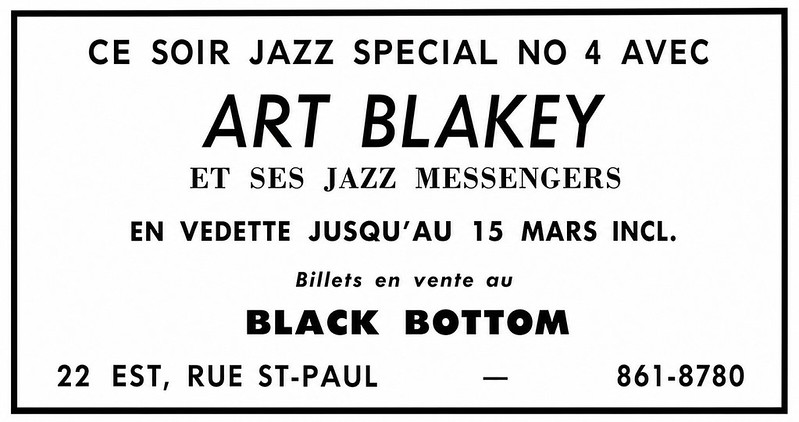
Another top-tier group was led by Art Blakey, with Woody Shaw on trumpet, Billy Harper on tenor sax, George Cables on piano, and Scotty Holt on bass. The collective playing—taut and energetic—sat firmly in the hard-bop tradition while retaining a freshness that held the audience’s attention across the set. [10]
The Black Bottom claimed a “jazz of today,” where modern language conversed with rock and R&B influences, as well as more experimental textures sometimes described as a “space sound.” Authenticity mattered more than prestige: the most sought-after quality in musicians was sincerity. [7]
The Black Bottom’s openness to jazz-adjacent forms was also reflected in the appearance of Muddy Waters. Associated with Chicago blues, his full band—guitar, piano, bass, drums, and harmonica—was described as an intensely sensory experience, with the music’s energy traveling from the floor into the audience’s body, erasing distance between stage and room. [11]
5. Nelson Symonds & the jams
A presence that set the standard
The Black Bottom’s reputation rests in large part on one presence: Nelson Symonds. Resident guitarist for more than five years, he embodied the venue’s musical soul. His incandescent playing drew Montreal musicians and visiting players night after night, prolonging the evening until dawn in the informal arena of jam sessions.
From the club’s earliest days, Symonds became far more than a resident musician. He shaped the venue’s identity to the point of becoming its living emblem. Described by peers as extraordinary, he gave the Black Bottom a particular aura, made of respect, anticipation, and rigor. His later departure for New York would be seen as the natural outcome of an artistic stature too large to remain confined to a single local stage. [12]
Night mechanics: three nights a week
In the era of the first address on Saint-Antoine Street, Nelson Symonds occupied a central place in the club’s daily life. He played there regularly—up to three nights a week— and remained at the heart of the late-night jams. Those nights drew visiting musicians in Montreal, described as “jazz greats” who came to “dig the scene,” joining the sessions spontaneously and reinforcing the Black Bottom’s reputation as a nocturnal musical crossroads. [8]
An atypical path
Symonds’s trajectory stands out for its atypical character. He devoted himself fully to jazz only in the early 1950s, after experiences in other musical circuits. Upon arriving in Montreal, he chose immersion over a mapped-out career, privileging the continuity of playing, the bandstand, and encounters over notoriety or systematic recording. [8]
Africville → Montreal: learning through the scene
Born in Africville (Halifax), Nelson Symonds arrived in Montreal in the 1950s and built his reputation through direct contact with musicians and local stages. Self-taught, he refined his musical language in the orbit of major modern-jazz figures, including Art Farmer, Benny Golson, and Pepper Adams, frequenting the city’s clubs as places of apprenticeship. [14]
“The Oscar Peterson of the guitar”
The Black Bottom’s longevity and popularity are inseparable from that presence. Symonds’s playing—recognized for impeccable technique and powerful inspiration—earned comparisons to an Oscar Peterson of the guitar. Courted by leading American jazz figures and invited to join their groups on U.S. tours, he nevertheless chose to remain in Montreal. His solos drew jazz lovers from far and wide to the Black Bottom, consolidating the club’s reputation as a place of excellence as much as freedom. [1]
6. Afterlife & legacy
After closure: a chapter that ends in Vancouver
In the early 1970s, the Black Bottom carried on at its Saint-Paul Street East address, faithful to its nocturnal rhythm and audience, before gradually disappearing from Montreal’s landscape and giving way to Nuit Magique. After the club closed, Charles Burke left Montreal and moved to Vancouver, where he worked as a carpenter, quietly closing a major chapter in Montreal nightlife. [5]
Continuity: same musicians, same spirit
The move to Old Montreal did not mark an ideological rupture. Burke explicitly rejected sensationalism and claimed continuity grounded in music, musicians, and audience. The clientele from Saint-Antoine Street naturally followed the Black Bottom to its second address, precisely because the spirit remained intact: the same standards, the same warmth, the same refusal of artifice. [12]
A hybrid place: practical rules, lived reality
The Black Bottom is also described as a space where nocturnal life ran long, overflowing official constraints. Although the kitchen closed at 11 p.m., the bar atmosphere—open into the small hours— remained conducive to improvised late meals, in an environment saturated with music, smoke, and conversation. This constant tension between practical rules and lived reality illustrates the venue’s hybrid character. [13]
Burke: a club as a living organism
Charles Burke’s life followed a trajectory marked by modest origins. From Saint-Henri, he left school very young and worked as a baggage porter to help support his family. Proud of his Afro-Caribbean heritage and of emancipated Jamaican ancestors, Burke conceived the Black Bottom as an establishment deeply anchored in its time. For him, jazz was never fixed: it evolved in step with Afro-American consciousness and the social transformations that accompanied it. [1]
A network of Black nightlife entrepreneurs
His approach also belonged to a wider network of Black entrepreneurs in Montreal nightlife. Burke expressed explicit respect for Rufus Rockhead (Rockhead’s Paradise), a model of a durable and principled business. The ideal claimed was that of a “correct” establishment: a reliable place where a lost wallet would be returned, where the welcome was steady, and where sensationalism was avoided. This ethic helps explain why the clientele of the first address continued to frequent the second on Saint-Paul Street East without rupture. [7]
Symonds: music before career
Despite opportunities to work outside the country, Nelson Symonds remained deeply rooted in Montreal. His refusal to pursue an international career at the expense of the music itself clarifies his role at the Black Bottom: that of a present, constant musician, more concerned with playing than with recognition. [14]
Context: from a club network to institutions
The Black Bottom’s decline also fits into a broader transformation of Montreal’s jazz scene. After the golden age of the 1950s, marked by an exceptional concentration of clubs and a flourishing nightlife, later decades saw jazz become more specialized, more professionalized, and increasingly displaced toward festivals, larger halls, and cultural institutions. This shift weakened the network of permanent clubs, confronted with higher fees, a shrinking regular audience, and changing tastes. [15]
The Black Bottom nevertheless remains a foundational place in the history of Montreal jazz: an incubator of talent, a community space, a nocturnal laboratory of improvisation, and a refuge for musicians. More than a club, it endures as living memory, inscribed in bodies, stories, and the city’s nights.
7. Notes & sources
-
“Rendez-vous des grands du jazz”, La Presse, Perspectives section,
March 29, 1969, pp. 12–14, text by Pol Chantraine.
In-depth feature on the Black Bottom at the end of its most influential period. Core source for understanding the venue: material conditions of its opening, nocturnal operation, the club’s role as an after-hours spot frequented by musicians, description of the Little Burgundy neighborhood, the 1967 expropriation, reopening on Saint-Paul Street East, stylistic evolution toward soul-jazz, and the decisive importance of Nelson Symonds. The piece is also one of the rare detailed portraits of Charles Burke published in Montreal’s press at the time. -
John Gilmore, Une histoire du jazz à Montréal, Montreal, Éditions du Trécarré,
1988.
Reference work tracing the establishment and development of jazz in Montreal. Used here to corroborate general characteristics of the Black Bottom: lack of a liquor license, modest admission price, importance of jam sessions, and the club’s role in Montreal’s Black community and in the nocturnal ecosystem of professional musicians. -
“La plus vieille boîte de jazz déménage…,” Le Petit Journal,
April 14, 1968.
Article announcing the forced closure of the Black Bottom on Saint-Antoine Street West and its imminent relocation to Old Montreal. Used to confirm the chronology of the expropriation tied to Little Burgundy’s urban renewal programs and the continuity of activities at a new address. -
“The Night Crowd’s Inn,” The Montreal Star, May 27, 1978.
English-language piece documenting the site’s transformation after the Black Bottom closed and its later operation under the name Nuit Magique. Used to establish spatial continuity and the site’s persistence as a place of nocturnal sociability in Old Montreal. -
“Charles Burke and the Black Bottom,” Boppin.com,
published April 2006.
Retrospective secondary account focused on Charles Burke after the Black Bottom’s definitive closure. Used cautiously to document Burke’s later activities (move to Vancouver, work as a carpenter), as a complement to contemporary sources. -
Wes Montgomery, filmed testimony (interview), YouTube.
Audiovisual source often cited in Montreal jazz oral historiography. Montgomery’s statement contributes to Nelson Symonds’s posthumous reputation and illustrates the informal recognition the guitarist enjoyed among top American musicians. Watch the interview. - Herbert Aronoff, “Charlie Burke’s going for broke—the nice way”, The Gazette (Montreal), Saturday June 20, 1970, p. 39. Profile/report on Charles Burke and the Black Bottom (Saint-Paul Street East), documenting capacity (~150 seats), musical orientation (jazz, rock, R&B), artists mentioned (including Woody Herman, Roland Kirk, Tony Williams), Burke’s onstage presence (drums; the trio Spirit & Truth), the club’s claimed business ethic, and ties to Rufus Rockhead.
- Marilyn Beker, “Nelson Symonds, jazzman: it’s the playing that counts”, The Gazette (Montreal), Saturday March 20, 1971, p. 42 (photo: Earl Kowall). Profile of Nelson Symonds (then associated with La Bohème on Guy Street) including elements on his place at the Black Bottom (regular performances, jam sessions with visiting musicians), and a quotation attributed to John Coltrane.
- Herbert Aronoff, “True genius at work”, The Gazette (Montreal), December 30, 1971. Chronicle/review of a Thelonious Monk engagement at the Black Bottom (Saint-Paul Street East, Old Montreal), mentioning a six-day run, three sets per night (sold out), and describing the lineup (Paul Jeffrey, Larry Ridley, Thelonious Monk Jr.).
- Herbert Aronoff, “Art Blakey spreads the jazz message”, The Gazette (Montreal), Wednesday March 12, 1969, p. 45. Review of the opening night of an Art Blakey & The Jazz Messengers engagement at the Black Bottom (22 St. Paul Street East), describing the room’s atmosphere, repertoire, and lineup (Woody Shaw, Billy Harper, George Cables, Scotty Holt), as well as the announced duration of the concert series.
- Dick MacDonald, “Experiencing animal vitality in blues performance”, The Gazette (Montreal), June 11, 1969. Review of a Muddy Waters engagement at the Black Bottom (Saint-Paul Street), describing the club atmosphere, the audience’s sensory experience, and the accompanying lineup (including Paul Oscher on harmonica).
- Jean-Claude Germain, “La plus vieille boîte de jazz déménage dans l’East Side : ‘Adieu rue Saint-Antoine !’”, Le Petit Journal (Montreal), week of April 14, 1968. Transition article documenting the closure of the first Black Bottom address, the move to Saint-Paul Street East, Charles Lovince Burke’s ideological stance, and Nelson Symonds’s central role in the club’s musical identity.
- “Le Black Bottom — 22 St. Paul Street East”, The Gazette (Montreal), restaurant column, [date to be specified]. Review of the Black Bottom restaurant describing interior decor, hours, soul-food cuisine, prices, and the venue’s nocturnal use at the second address.
- Marie-Claude Ducas, “Carte-souvenirs — Nelson Symonds, le guitariste de l’ombre”, La Presse (Montreal), June 1, 1987, MTL section. Biographical profile retracing Symonds’s origins, Montreal trajectory, places frequented (including the Black Bottom), and artistic posture.
- “De l’âge d’or des années 50 aux fatales années 70”, La Presse Plus, La Presse (Montreal), June 9, 1984. Synthesis article tracing jazz in Montreal from the postwar period to the late 1970s, analyzing structural causes behind the decline of jazz clubs.
- Elizabeth Francis, “He’s the King. King Burke”, The Montreal Star, Saturday May 10, 1969. In-depth profile of Charles “King” Burke retracing his trajectory, his vision of jazz, the Saint-Antoine expropriation, the opening of the Black Bottom on Saint-Paul Street East in February 1968, and the club’s aesthetic evolution toward contemporary musical forms.
- Anna Stephens, “Cooking Soul takes heart”, The Gazette (Montreal), Monday February 24, 1969. Report on the soul food served at the Black Bottom, documenting the role of the restaurant in the venue’s social identity and daily life.
- Testimony by Charles “King” Burke in a video interview retracing Miles Davis’s engagement at the Black Bottom (Montreal, 1968), including contract terms, the band’s lineup, and the relationship between the musicians and the club owner. Audiovisual source: YouTube, consulted in 2026.
- Elizabeth Francis, “He’s the King. King Burke”, The Montreal Star (Montreal), Saturday May 10, 1969, p. 108. (Quote attributed to Charles Burke regarding bringing Miles Davis into his club.)
All information presented in this entry is based on contemporary journalistic sources, reference histories, and cross-checked retrospective testimonies. Descriptions of atmosphere, musical practices, and the Black Bottom’s social role are part of a heritage-oriented approach, aimed at restoring the venue’s place in the history of Montreal jazz and the city’s Black community.