Venue Profile — Downtown — Red Light District
Café Canasta (Montreal)
A nightlife cabaret and performance venue on Saint-Laurent Boulevard, commonly known as the “Main,” the Café Canasta occupied a prominent address for over two decades within a district long associated with Montreal’s Red Light district. Situated at the intersection of entertainment and urban transformation, the venue reflects the complexity of mid-20th-century Montreal nightlife, where popular culture, commercial activity, and more ambiguous social realities converged. As both a site of performance and everyday sociability, the Canasta exemplifies a category of establishments that played a central role in shaping the identity of the boulevard, while continually adapting to shifting cultural, economic, and tourism-driven dynamics leading into the early 1970s.
⏱ Reading time: 10 minutes
1. Overview
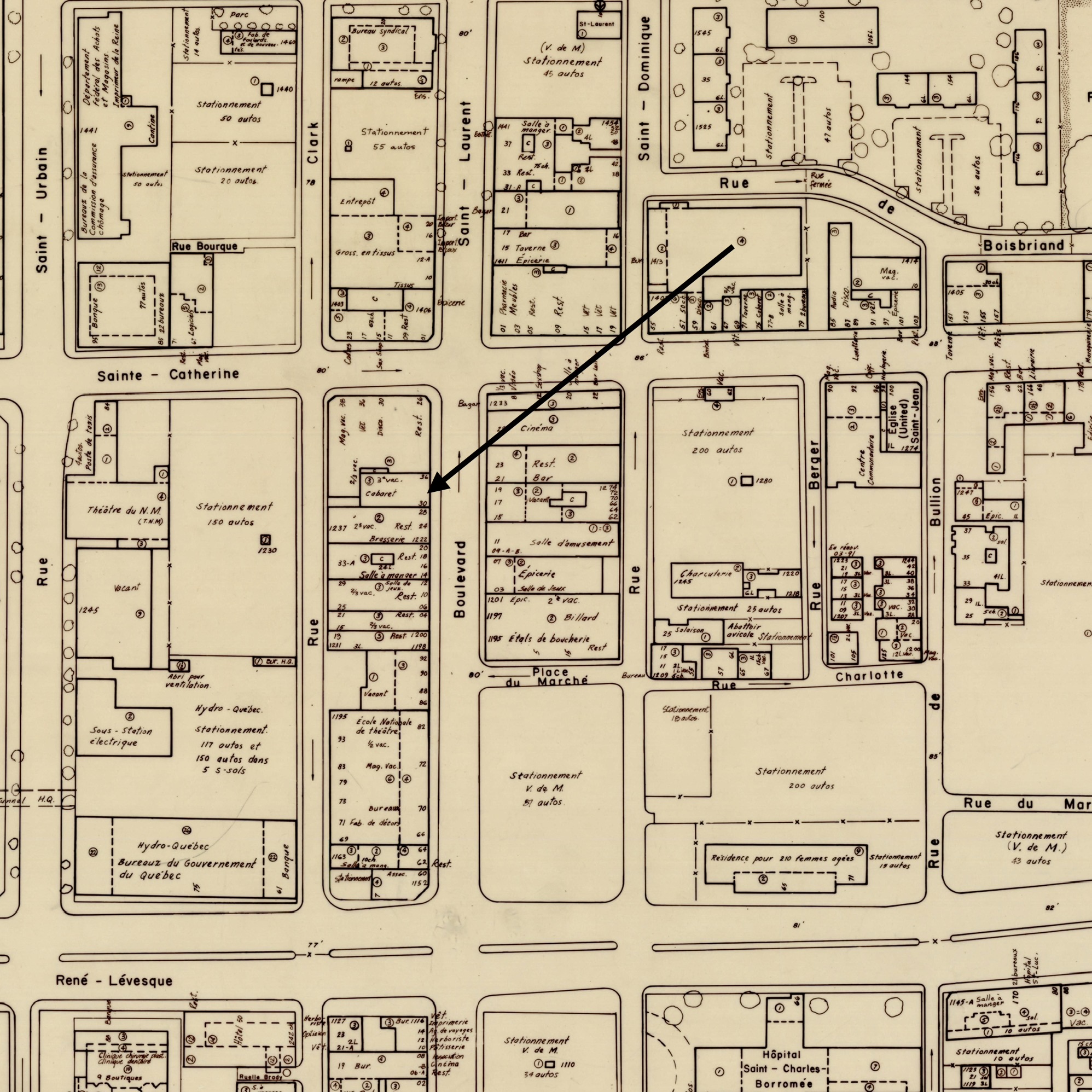
Located at 1230 Saint-Laurent Boulevard, the Café Canasta formed part of one of the most emblematic — and contested — areas of Montreal nightlife during the mid-20th century. Positioned in the heart of the “Main,” within a district historically associated with the Red Light district, the venue belonged to an urban environment where entertainment, marginal economies, and social life intersected.
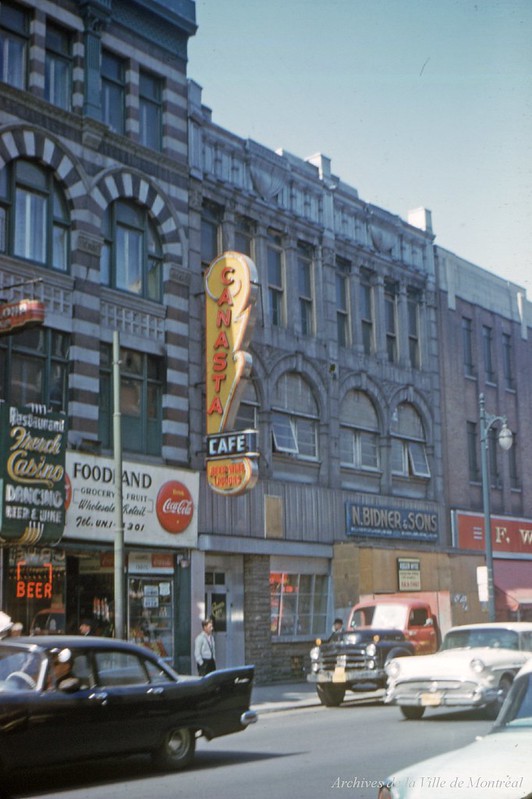
Active from the 1950s to the early 1970s, the Canasta operated within a dynamic environment shaped both by the vitality of Montreal’s cabaret scene and by the regulatory and social tensions that defined it. At the intersection of these forces, it functioned as a popular entertainment venue embedded in the rhythms of the city, while remaining exposed to the constraints and ambiguities of the period.
The history of the Café Canasta extends beyond its own lifespan, forming part of a broader continuity tied to the evolution of the site it occupied — a space in continuous transformation since the late 19th century. This continuity is carried forward through subsequent establishments, most notably the Café Cléopâtre, making 1230 Saint-Laurent a particularly revealing vantage point for understanding the evolving landscape of Montreal nightlife.
2. History
The segment at 1230–1238 Saint-Laurent Boulevard, part of the stretch known as the “Main,” offers a revealing example of the evolution of commercial and cultural uses along the boulevard over more than a century [33]. As early as the late 19th century, the building housed utilitarian functions — notably the office of the Montreal Telegraph — as well as various trades related to image-making and personal services, including photographers, photogravers, and barbers, reflecting an urban fabric still in formation.
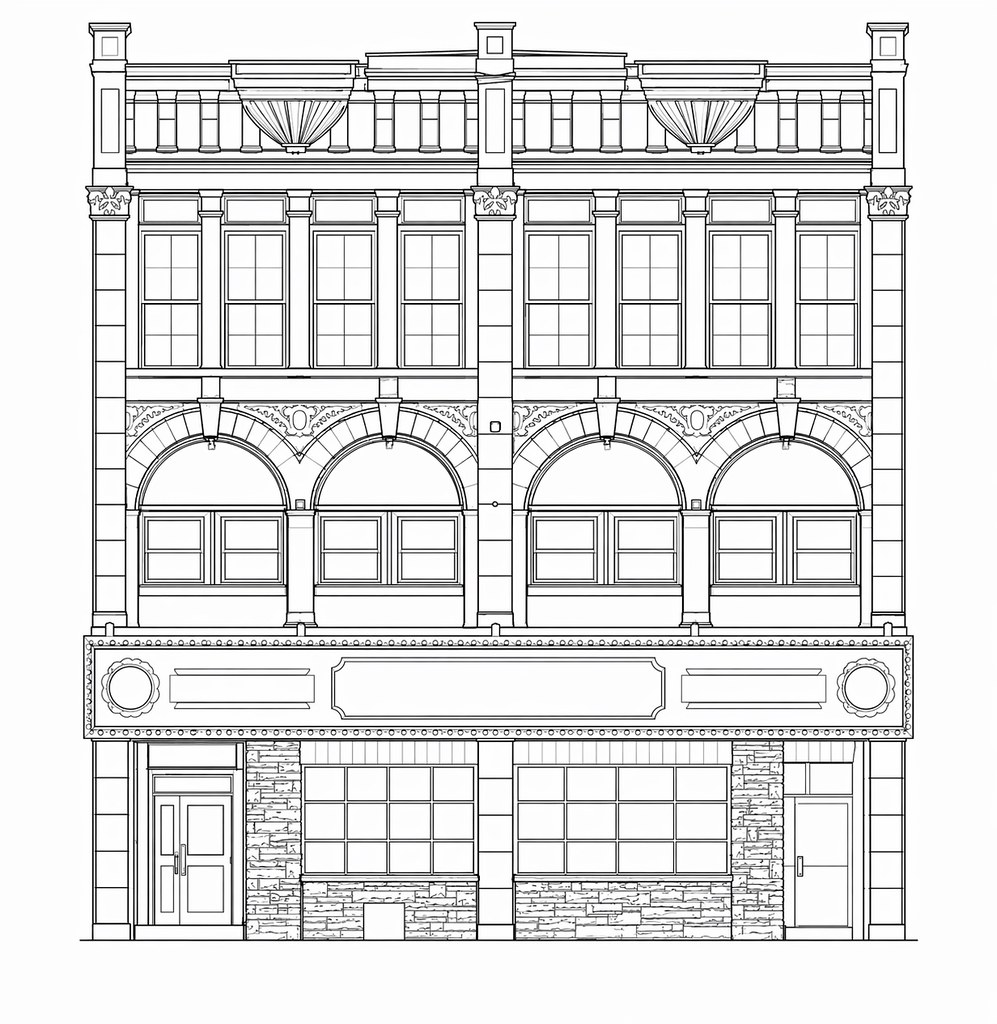
At the turn of the 20th century, the site gradually became integrated into the boulevard’s nightlife with the emergence of bars and hotels, including the Central Union Bar and the Balmoral Hotel. This transition marked a shift toward an economy centered on leisure and sociability. From the 1920s onward, the function of the site stabilized around high-turnover cafés and restaurants — Café Québec, Sailor’s Dining Room, Club Alhambra, Café Maryland — illustrating the dynamism and cultural diversity of the area.
The following decades confirmed this specialization: the site successively housed the Café Colorado, the Café Parthénon, and the Café Albion, before the emergence of more structured establishments such as the Riviera Grill and the Café Sierra in the 1940s. The arrival of the Café Canasta in 1950 thus forms part of a direct continuity, inheriting a space already firmly embedded in the circuits of dining and entertainment.
This commercial layering, marked by a rapid succession of establishments and uses, reflects the adaptability of Saint-Laurent Boulevard to Montreal’s social, cultural, and economic transformations. After the closure of the Canasta in the early 1970s, the site continued this trajectory with the establishment of the Café Cléopâtre, extending the venue’s nightlife and performance-oriented function to the present day.
The analysis of the evolution of 1230–1236 Saint-Laurent Boulevard relies in large part on a rigorous methodology for reconstructing addresses and uses, as presented in Les nuits de la “Main” [37]. Due to numerous changes in street numbering, demolitions, and reconstructions, tracking a single site over time requires the use of cadastral records and commercial directories — the only tools that allow for a reliable continuity to be established.
This approach highlights the remarkable functional fluidity of Saint-Laurent Boulevard, where a single building may undergo successive transformations — shifting from residential or artisanal uses to commercial functions, and eventually to entertainment venues. The case of the site occupied by the Café Canasta, and later the Café Cléopâtre, fully reflects this logic: their presence does not represent a rupture, but rather the culmination of a long series of transformations characteristic of the history of the “Main.”
By structuring their research by building and clearly distinguishing performance venues from the individuals associated with them, the authors make it possible to trace not only the evolution of establishments, but also the human and economic networks that supported them. This reading reveals an urban landscape in constant recomposition, where the continuity of places depends less on their function than on their capacity to adapt to Montreal’s cultural and social transformations.
3. Urban context
The Gazette officielle du Québec of June 3, 1950 announces the incorporation of Canasta Café Inc., authorized on April 11, 1950, by Louis-Philippe Gagnon, Françoise Savard and Marcel Landry, to operate a restaurant and café business in Montreal, with a share capital of $40,000 and a head office located at 123 Saint-Jacques Street West, office 322[1].
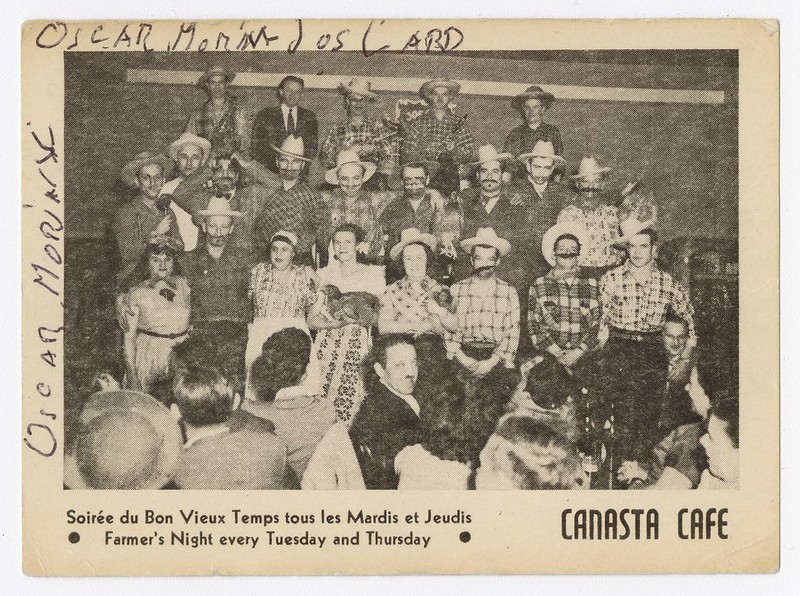
In the early 1950s, the Café Canasta Inc., located at 1230 Saint-Laurent Boulevard, initially formed part of Montreal’s regular entertainment circuit. A photograph published in the Photo-Journal on April 26, 1951 features bandleader Jos Card, then headlining at the Canasta, where he performed regularly, illustrating the central role of house orchestras in Montreal cabarets of the period [3]. A notice published in Le Canada on June 11, 1954 highlights singer Lise France, appearing at the Café Canasta, presented as a young interpreter of chanson réaliste trained under Léo Lesieur [8]. These references show that before being associated with the tensions of the “Main,” the Canasta fully participated in Montreal’s variety cabaret scene, with regular musical programming and clearly identified performers.
Behind this entertainment activity, however, the Saint-Laurent Boulevard sector remained marked by a more unstable climate. A press article already reports the arrest of five young men for possession of offensive weapons, including a bayonet and two knives, illustrating the presence of illicit activity in the environment surrounding Montreal cabarets [4]. This tension is also reflected in municipal policy. On June 8, 1955, the executive committee of the City of Montreal, following a police report, published a list of 25 clubs and cafés whose license renewals were refused for the current year, including the Casa Loma and the Canasta Café [5]. In practice, however, the enforcement of these decisions remained uneven: contemporary sources indicate that several targeted establishments continued operating regardless, and that at that time the police did not resort to force to impose their closure [5][9]. The Canasta thus evolved within this grey zone characteristic of mid-1950s Montreal nightlife, at once monitored, tolerated, and deeply integrated into downtown nightlife.
Several articles from The Montreal Star also attest to a growing climate of violence in the area during the mid-1950s, particularly in and around the Canasta Café, where altercations involving knives, beatings and serious assaults led to severe injuries, and in some cases death [6][7]. By the end of the decade, municipal oversight tightened further. A photograph published in The Gazette in 1958 shows police director J. Albert Langlois meeting with several club owners — including Harry Holmok and Jack Suz of the Bellevue Casino, as well as operators associated with the Canasta Cafe — to deliver directives aimed at organizing a coordinated crackdown on so-called “all-girl shows” [9]. This meeting illustrates the close ties between municipal authorities, police and the entertainment industry at a time when cabarets had become a central regulatory issue.
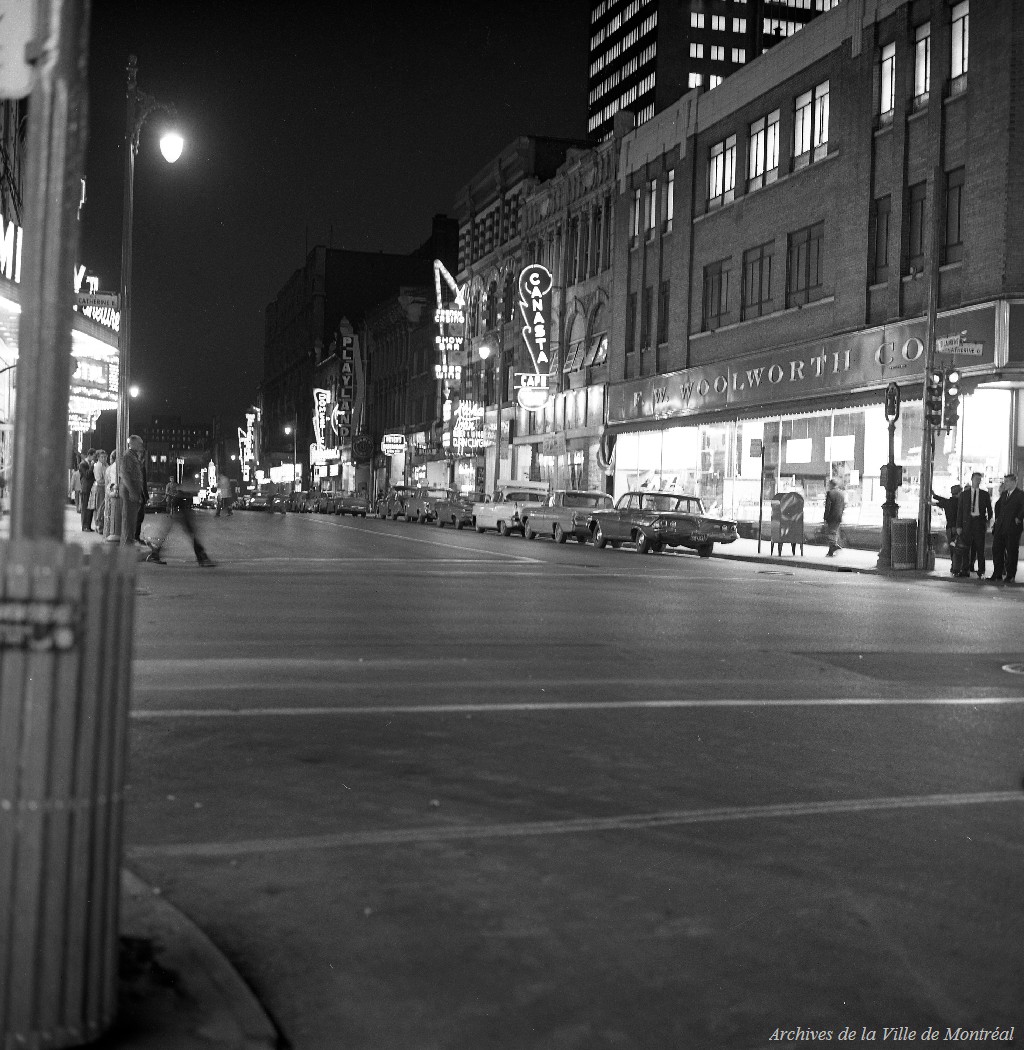
During the 1950s, Saint-Laurent Boulevard underwent a major transformation of its nightlife landscape, marked by the decline of traditional cabarets and the emergence of strip-tease clubs [36]. The arrival of television, combined with the rise of rock music, gradually diverted audiences away from variety venues, weakening established models of jazz and vaudeville. Deprived of their clientele and confronted with unprecedented media competition, many establishments were forced to reinvent themselves to survive. It was in this context that striptease emerged as the dominant new form of entertainment on the “Main.” Derived from burlesque traditions and major European revues, the practice adapted to local realities: simpler shows, relying on a limited number of performers and modest technical means, but offering increased profitability in smaller spaces. Initially suggestive, performances evolved toward more explicit forms, without relying on elaborate choreography, but rather on the progressive staging of the body. Establishments such as the Café Canasta fully participated in this transition, contributing to the lasting establishment of this new entertainment economy. The evolution of the site — later occupied by the Café Cléopâtre — thus illustrates the shift from a traditional cabaret model to a more flexible format, adapted to the cultural and economic transformations of postwar Montreal.
The year 1960 marked a particularly brutal turning point. During the summer, several sources describe a series of coordinated attacks against downtown cafés and clubs, attributed to criminal groups linked to “protection” rackets. Armed with clubs, iron bars and sometimes firearms, groups of men entered certain establishments, vandalized furniture, destroyed equipment and assaulted both staff and customers [14]. The Canasta Cafe appears among the venues repeatedly mentioned in this wave of violence, with accounts referring to pressure, demanded payments, intimidation and attempts by owners to organize collectively against racketeers [14].
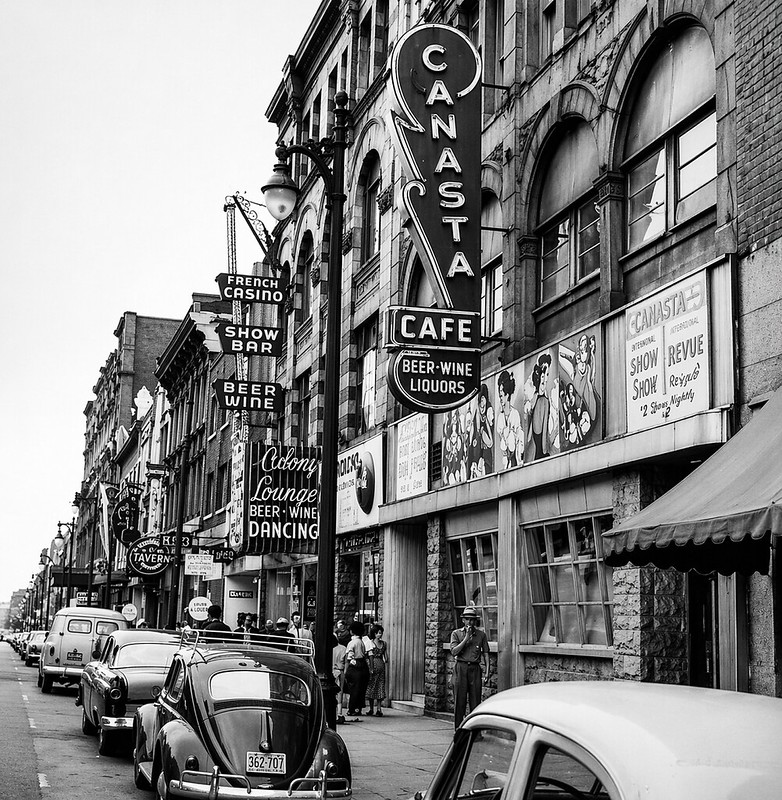
The most documented case remains the violent altercation that occurred during the night of June 30, 1960 at the Canasta Cafe. Published on July 1, 1960, the Gazette article entitled “Two Shot, One Stabbed In Night Club” reports that a fight involving several men escalated into an armed confrontation shortly before 2 a.m. inside the club [21]. Two men were shot, a third was stabbed, and several employees were among the victims. George Ouimet, wounded in the abdomen, was transported to St. Luke’s Hospital; Roland Jacques Poirier was also hospitalized after being shot, while Jean-Paul Carpentier received treatment for stab wounds [21]. Witnesses stated that a group of about six men had entered the establishment before the situation escalated, possibly following a dispute related to “protection” payments [21].
Other accounts of the same episode emphasize the extreme confusion inside the club: gunshots, chairs used as improvised weapons, customers attempting to flee, assailants quickly leaving the scene and no weapons found by police upon arrival [21][22]. The events of June 30, 1960 at the Canasta Club quickly became emblematic of the tensions affecting the “Main,” where violence functioned as an informal means of regulating a nightlife environment shaped by economic rivalries, intimidation and racketeering [21][22].
The following months extended this crisis into the judicial arena. On August 16, 1960, The Gazette reported a major development in the Canasta case linked to the June 30 altercation, describing the charges brought against Maurice Bouchard, alias Poirier, in a case associated with the “protection racket” targeting nightlife establishments in the area [10]. During the summer, other articles mention the release on bail of several accused individuals, including Reginald Georges “Nanane” Ouimet, as well as the concrete consequences of the fight for several victims hospitalized with gunshot or stab wounds [18][20].
In the fall of 1960, the Canasta remained associated with a persistent climate of intimidation. Testimonies still referred to direct threats against those refusing to cooperate with “protection” networks, while police interventions and judicial proceedings multiplied [15][11][12]. A Montreal Star article reports a shooting near the Canasta Cafe following an altercation between customers and employees, while another case led to perjury charges and the imprisonment of several individuals, revealing the entanglement between certain entertainment venues and criminal dynamics of the period [16][13]. The authorities’ response now also unfolded in court: in a widely publicized case, an individual linked to protection networks was convicted, with the judge emphasizing the seriousness of the violence associated with such activities [17]. During one hearing, tensions were so high that the judge ordered the courtroom cleared after witnesses reported receiving death threats [19].
On November 6, 1961, Montréal-Matin reported that a shooting had occurred the previous day at the Rodeo café, involving several individuals connected to establishments on Saint-Laurent Boulevard, including employees of the Canasta café [31]. A Canasta waiter, Robert Beaulieu, was struck by several bullets, while the case, set against tensions between groups and references to a “protection racket,” led Judge J.-A. Fontaine to state that he was “deeply impressed” by the seriousness of the events [31].
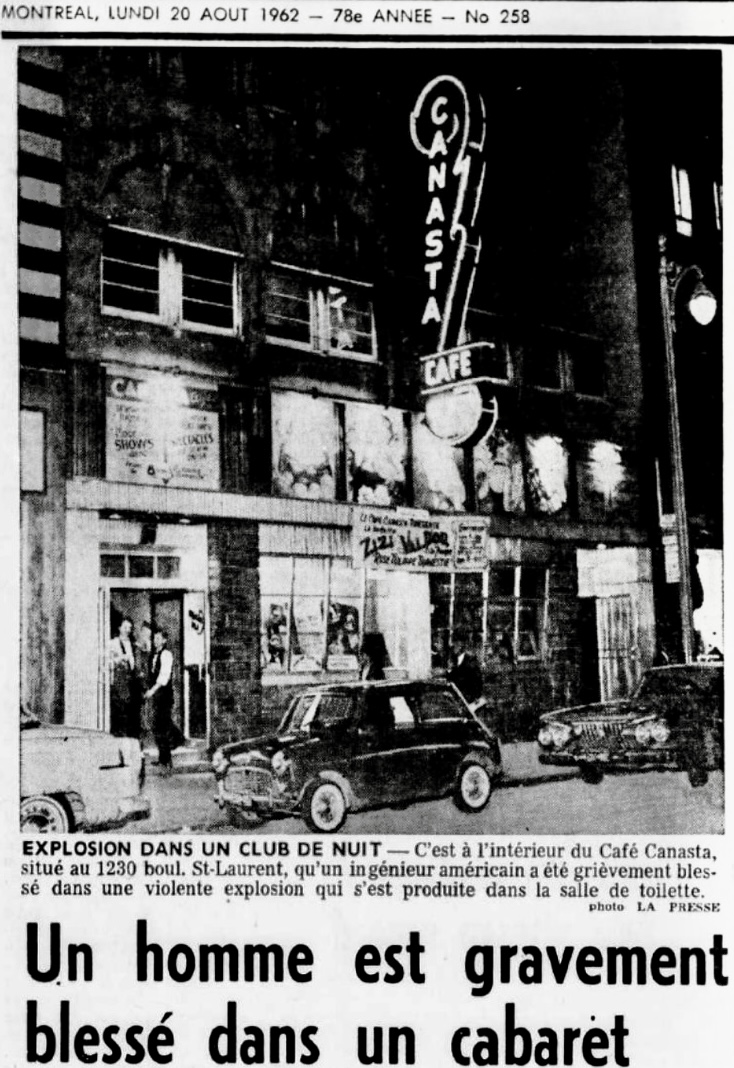
On August 20, 1962, another dramatic episode shook the Café Canasta. La Presse reported that a violent explosion occurred in the restroom of the establishment, seriously injuring an American engineer who had just entered [29]. Another account specifies that a device hidden in a toilet bowl exploded around 9:30 p.m., while approximately one hundred customers were present in the cabaret, causing panic and a rapid evacuation of the premises [23]. The victim, Werner Prillwitz, 32, from New York, was transported to St. Luke’s Hospital, while the explosion shattered the porcelain and severely damaged the stall without causing a fire [23]. Authorities, including Detective Leo Plouffe, ruled out a sophisticated device or organized operation and instead favored the hypothesis of an isolated act, described as an “amateurish crank” [23][24].
In 1963, the Canasta once again found itself at the intersection of police pressure, municipal control and criminal violence. On May 11, 1963, La Presse reported that the City of Montreal had refused, “yesterday,” to grant new municipal licenses to a first series of establishments on Saint-Laurent Boulevard, including the Canasta Cafe Inc., condemning them to closure “in the more or less near future” as part of an intervention announced by Lucien Saulnier [28]. On May 15, 1963, another list further expanded the municipal campaign against several cafés and clubs deemed problematic, while the Canasta was among those already targeted during the previous intervention [25].
A few weeks later, on July 18, 1963, La Presse reported that Jean-Guy Mercier, 19, employed as a waiter at the Café Canasta, was hospitalized at Maisonneuve Hospital after being struck by three bullets on the LeGardeur Bridge, in an attack that police associated with underworld reprisals linked to the “protection racket” case then being uncovered [30]. Wounded in the leg, arm and hip, and covered in bruises, Mercier remained silent about the circumstances; according to investigators, he had jumped from a moving vehicle before managing to crawl to a house in Repentigny, from where the Provincial Police transported him to hospital [30]. Finally, on November 1, 1963, several establishments on Saint-Laurent Boulevard — including the Canasta Cafe Inc. — suffered a judicial setback after the municipal court confirmed the City’s authority to prosecute operators accused of operating without permits [20].
By the mid-1960s, Saint-Laurent Boulevard oscillated between two opposing narratives: that of an announced decline and that of a vitality refusing to disappear. A report published on March 20, 1966 in La Patrie describes a “Main” weakened by police intervention, the repression of illegal activities and a reputation marked by violence, yet still capable of attracting a diverse clientele and sustaining strong economic activity around its cabarets and performance venues [50]. Behind this image, often amplified by the press, the boulevard remained a space of work and sociability, where operators, artists and regulars maintained an active nightlife through constant adaptation. In this context, Expo 67 appeared as a promise of renewal, likely to redefine the image of the district. Far from disappearing, the “Main” thus emerges as a territory in transition, where continuity and transformation intertwine.
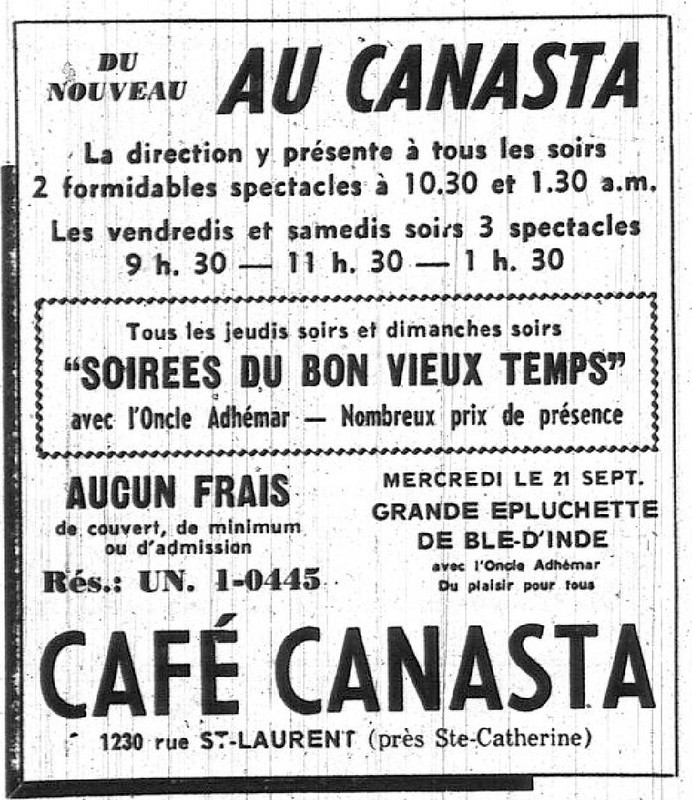
On the eve of Expo 67, the Café Canasta took part in a broader reorientation of Montreal cabarets, which were called upon to adapt their programming to both local and international audiences. An advertisement published on September 16, 1966 announces a new formula based on multiple shows — up to three per evening on weekends — combined with “old-time evenings” hosted by Oncle Adhémar and festive events inspired by popular traditions, such as corn roasts [49]. The absence of admission fees and the multiplication of promotional activities reflect a strategy aimed at broadening and retaining clientele in a convivial and accessible setting.
This transformation forms part of a broader movement, highlighted in an article dated September 24, 1966, in which several establishments moved away from programming dominated by go-go dancers and imported styles in favor of content emphasizing folklore, music and a so-called “truly Canadian” identity [47]. The Café Canasta, then undergoing redecoration, fully participated in this transition by seeking to reposition its image within a changing nightlife landscape. Through these adjustments, it stands as a revealing example of the strategies adopted by cabarets on the “Main,” where tourism imperatives, commercial logic and the staging of cultural identity converged on the eve of Expo 67.
On November 19, 1966, a notice published in The Gazette announces the judicial sale of the assets of Canasta Cafe Inc., still located at 1230 Saint-Laurent Boulevard, as part of a seizure process scheduled for the end of the month [26]. Despite these financial difficulties, the establishment did not disappear and remained part of Montreal’s nightlife landscape.
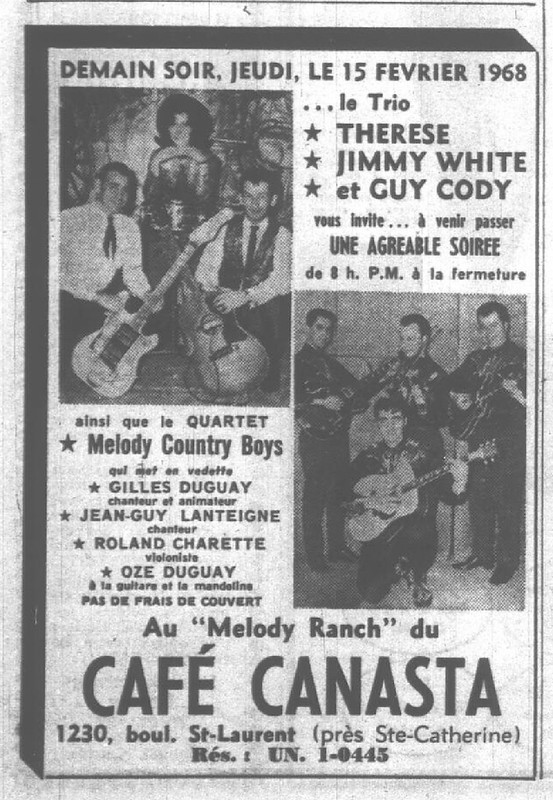
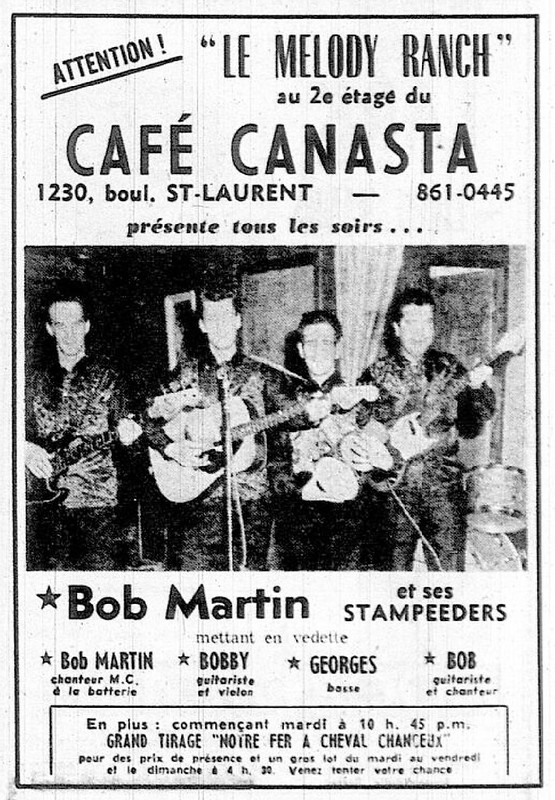
An advertisement published on April 7, 1967 announces performances at the “Melody Ranch,” located on the second floor of the Café Canasta, confirming the adoption of a country and western-inspired program in the context of the reorientation of Montreal cabarets on the eve of Expo 67 [48]. The ad features Bob Martin and his Stampeders, a group of singer-musicians — guitar, fiddle, bass and drums — illustrating a continuous live music format. The presence of parallel activities, including a weekly promotional draw (“Our lucky horseshoe”), reflects strategies aimed at building customer loyalty. Located in the heart of the “Main,” the Canasta thus appears as a representative example of establishments that, while maintaining their role as popular entertainment venues, adapted their offerings by incorporating musical forms associated with a more “traditional” North American identity, in line with the cultural and tourism expectations of the time.
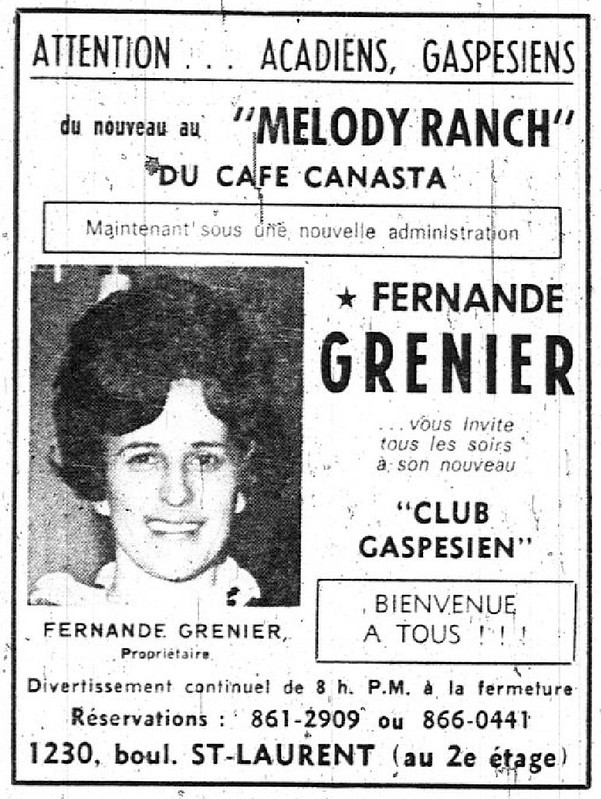
By the late 1960s, the second floor of the Café Canasta formed part of a broader reconfiguration of nightlife on the “Main,” marked by the emergence of venues structured around regional affiliation networks. An advertisement published on August 28, 1969 announces the establishment of a “Gaspesian Club” under the direction of Fernande Grenier, offering continuous entertainment and explicitly targeting Acadian and Gaspesian clientele [46]. At the same time, a report published in La Patrie on February 9, 1969 describes a “Casino Gaspésien” (future El Casino), also managed by Grenier, where highly attended evenings centered on jigging, square dancing and call dances were held [52]. This latter establishment, however, was located on Sainte-Catherine Street West and was distinct from the Canasta, although it belonged to the same cultural milieu and community networks.
Bringing these sources together allows for a clearer understanding of Grenier’s role, who emerges as an active figure in the animation of several festive spaces linked to Gaspesian communities in Montreal. Her involvement at the Canasta does not represent a creation ex nihilo, but rather forms part of the continuity of a program already oriented toward folklore — notably with the “Melody Ranch” established on the same floor — which she helped reorganize and anchor more explicitly within an identity-based framework. This phenomenon more broadly illustrates how certain establishments on Saint-Laurent Boulevard adapted to the social transformations of the period by becoming spaces of sociability for specific regional groups, where musical traditions, festive practices and internal migration networks contributed to redefining the contours of Montreal nightlife on the eve of the 1970s.
On July 24, 1971, The Gazette reports that scenes from a documentary on Montreal country music were filmed in several downtown cafés, including the Canasta, in order to capture both the artists and their audience [27]. This late reference confirms that the establishment was still active at a moment when the site was about to enter a new phase in its history.
4. Le Colibri
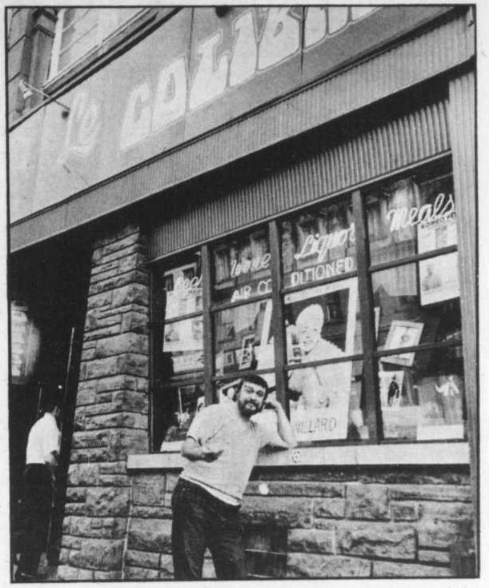
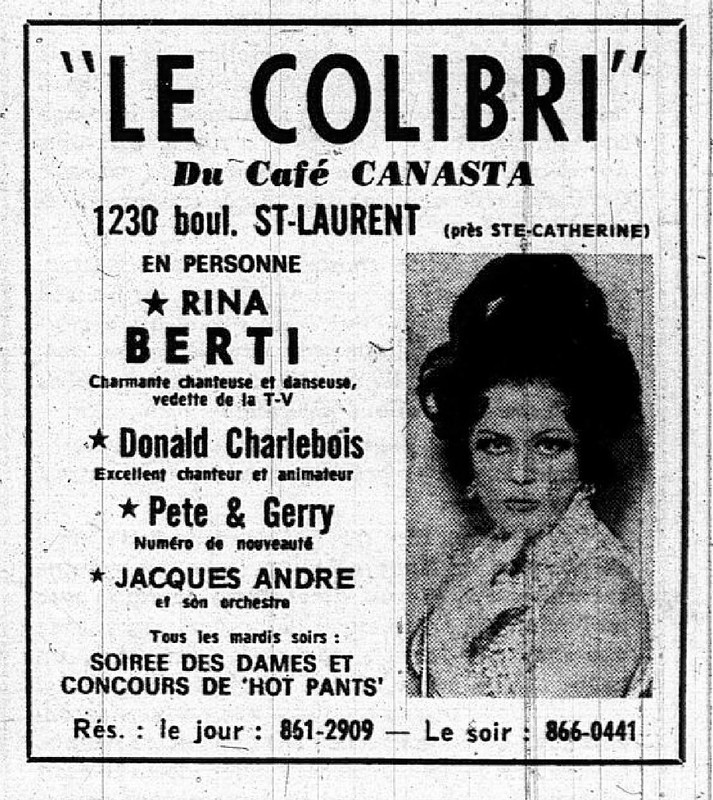
In the summer of 1971, 1230 Saint-Laurent Boulevard reappears under the banner of the Le Colibri cabaret, within a context of reconfiguration of Montreal nightlife. An article published on May 29, 1971 notes that a performance by Muriel Millard was scheduled there, while Roméo Pérusse is identified as the manager of the establishment [39].
A few weeks later, a source dated July 17, 1971 indicates that Roméo Pérusse was in the process of acquiring the cabaret, confirming his central role in its development and operation [41]. An advertisement subsequently specifies the official opening of Le Colibri on September 14, 1971, highlighting a “continuous show” format and its integration into professional performance networks [40].
This structuring is also confirmed at the administrative level. A notice published on June 15, 1973 in Le Devoir indicates that an application for a liquor license was filed for the establishment under the corporate name “Le Gai Colibri inc.”, initiated by Alfred E. Boivin, for an operation classified as a “dining room – bar” at 1230 Saint-Laurent Boulevard [42]. This reference confirms the continuity of the Colibri’s activities as well as its integration into a structured legal and commercial framework.
On November 17, 1975, a fire ravaged the interior of the Colibri, requiring the intervention of firefighters, two of whom were injured, in a context of rapid transformation of the site [35].
At the same time, the address entered a new phase with the emergence of the Café Cléopâtre. A notice published on July 12, 1975 indicates that a permit was filed for the operation of two cabarets at the same address [34], marking a reconfiguration of the space toward a more formalized model.
5. Café Cléopâtre
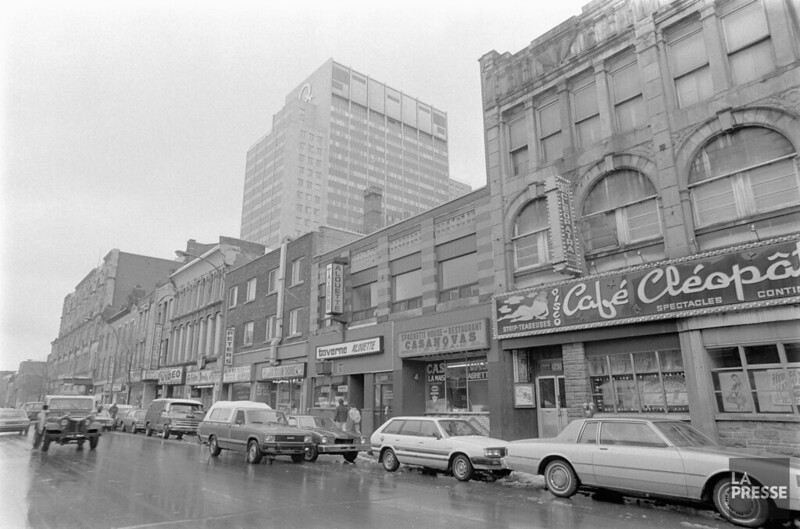
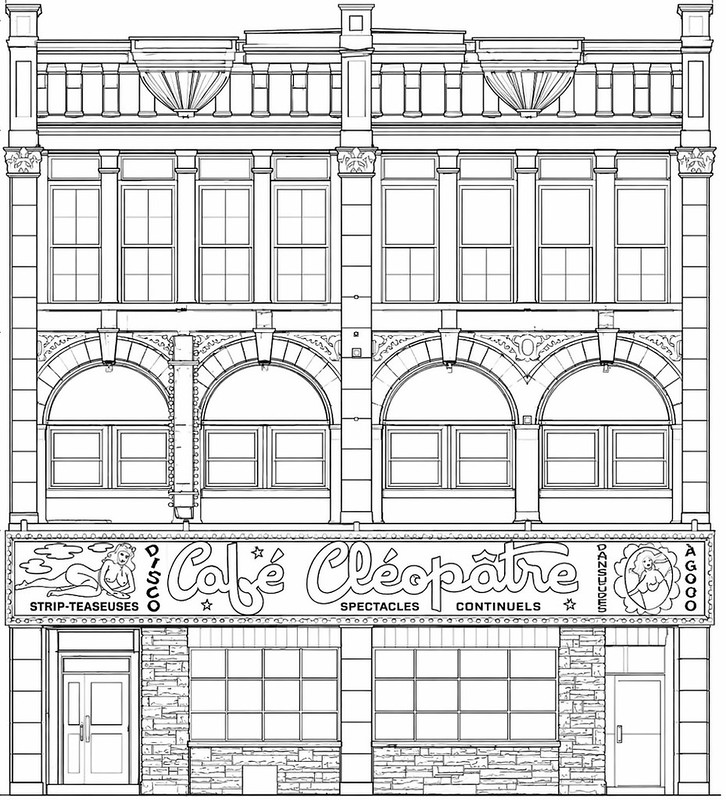
From the mid-1970s onward, the site at 1230 Saint-Laurent Boulevard entered a new phase in its history with the establishment of the Café Cléopâtre, extending a long-standing tradition of nightlife entertainment at this address [38]. Far from representing a rupture, this transformation follows directly from the Café Canasta, inheriting both its performative function and its roots in the popular culture of the “Main.”
Active in the establishment since 1976, Johnny Zoumboulakis embodies this transition by gradually becoming a central figure of the venue, contributing to shaping its identity over the decades. Organized across multiple levels, the Café Cléopâtre adopts a spatial layout reminiscent of earlier cabaret operations: on the ground floor, a dancers’ bar — whose deliberately unconventional recruitment breaks with traditional standards — perpetuates a certain form of popular spectacle, while upstairs, a cabaret hosts renewed forms of performance ranging from comedy to drag shows, as well as events connected to the LGBTQ+ community.
This hybrid configuration reflects a remarkable capacity for adaptation, characteristic of Saint-Laurent Boulevard, where venues transform without entirely disappearing. From variety cabaret to nightlife venue shaped by tension, then to an alternative and inclusive performance space, the address at 1230 illustrates a functional continuity based less on stability than on constant reinvention.
The trajectory of the Café Canasta thus sheds light on that of the Café Cléopâtre: both belong to the same ecosystem where performance, marginality, informal economy and municipal regulation intersect. If the Canasta was associated with the more brutal dynamics of the Main in the 1950s and 1960s — violence, racketeering, police pressure — the Cléopâtre represents a transformation of that legacy, integrating it into a more structured model, yet still operating on the margins of dominant cultural circuits.
This continuity takes on particular significance in the context of recent urban transformations. Threatened with relocation during the development of the Quartier des spectacles, the Café Cléopâtre managed to remain at its original location, thereby asserting the heritage value of a place long perceived as peripheral. Through this resistance, the establishment becomes not only a witness, but also an active agent in preserving the living memory of Saint-Laurent Boulevard.
In this sense, the Canasta and the Cléopâtre should not be understood as separate entities, but as different phases of a single site, whose history reflects the profound transformations of Montreal nightlife. From classic cabaret to contemporary alternative space, 1230 Saint-Laurent embodies the “Main’s” ability to absorb, transform and continually redefine its forms of culture and sociability.
Notes & sources
-
OFFICIAL GAZETTE OF QUÉBEC / QUEBEC OFFICIAL GAZETTE, June 3, 1950, vol. 82, no. 22, p. 2709.
Legal notice announcing the incorporation of Canasta Café Inc., authorized on April 11, 1950 under the Companies Act (Part I). The company is founded by Louis-Philippe Gagnon, Françoise Savard and Marcel Landry, with the purpose of operating a food service and beverage establishment, including café and related services. The authorized share capital is set at $40,000, divided into common shares. The head office is established at 123 Saint-Jacques Street West, office 322, in Montreal. The notice is signed by Assistant Attorney General L. Désilets, confirming the official registration of the company and its commencement of operations in the context of the development of entertainment and restaurant establishments in Montreal at the turn of the 1950s. -
LA PATRIE, November 12, 1950, final edition.
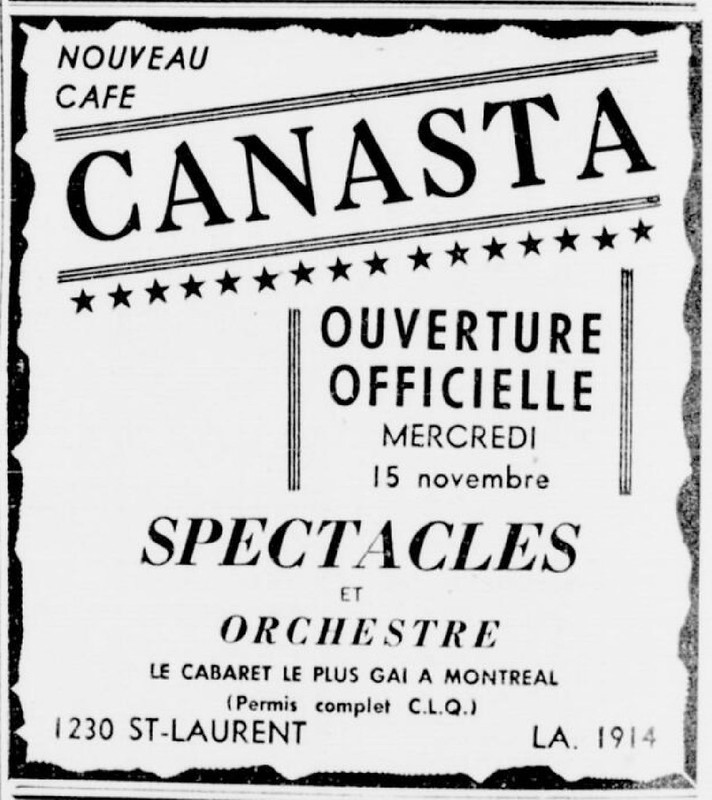
An advertisement announces the official opening of the Canasta on Wednesday, November 15, 1950 at 1230 Saint-Laurent Boulevard, presenting it as a new café offering shows and orchestra, with a full C.L.Q. permit, and as “the gayest cabaret in Montreal.” -
PHOTO-JOURNAL, April 26, 1951.
Photograph of Jos Card, orchestra leader featured at the Café Canasta Inc., where he performs every night, illustrating the importance of house orchestras in the programming of Montreal cabarets in the early 1950s. -
LA PRESSE, November 28, 1951,
Article entitled “Accused of possession of 3 offensive weapons” reporting the arrest of five young men — Jean-Paul Servant, Gregor Larocque, Marcel Servant, Frank Perreault and Roland Belleville — charged with possession of prohibited weapons, including a bayonet and two knives. According to testimony from detectives of the municipal police night squad, the suspects were apprehended around 5 a.m. on October 19, 1951 while at the Café Canasta, located at 1230 Saint-Laurent Boulevard. The article specifies that the weapons were allegedly found on site, some having been thrown to the ground during the police intervention. This source reflects the climate of surveillance and weapon-related incidents in nightlife establishments on the “Main” in the early 1950s. -
THE MONTREAL STAR, June 8, 1955, p. 3.
Article entitled “Deny Permit — 25 Clubs On Ban Listed” announcing the list of 25 Montreal clubs and cafés whose permit renewals were refused by the police service, including the Casa Loma (94 Sainte-Catherine Street East) and the Canasta Café (1230 Saint-Laurent Boulevard), reflecting the tightening of regulations targeting nightlife establishments in the mid-1950s. -
THE MONTREAL STAR, November 29, 1956, p. 3.
Article entitled “Man Stabbed In City Street” reporting that André Gosselin, 32, was seriously injured in a knife attack on Saint-Laurent Boulevard, in front of the Canasta Café (1230 Saint-Laurent Blvd.), around 6:30 a.m. The article specifies that the attacker fled after stabbing the victim in the abdomen, illustrating the sometimes violent climate surrounding certain Montreal nightlife venues in the mid-1950s. -
THE MONTREAL STAR, n.d. (1950s).
Article recounting an altercation that occurred in a café on Saint-Laurent Boulevard during which an individual was violently assaulted, receiving several blows before succumbing to peritonitis a few days later at St. Luke’s Hospital, illustrating the sometimes brutal climate associated with certain nightlife establishments in the sector. -
LE CANADA, June 11, 1954.
Notice devoted to singer Lise France, announced this week at the Canasta café, presenting her as a young performer born in Paris, settled in Canada for seven years, trained in singing with Léo Lesieur and specializing in realist chanson. -
THE GAZETTE, January 9, 1958, p. 1 (Gazette Photo Service).
Photograph published under the title “Director Gives The Score” showing police director J. Albert Langlois addressing several Montreal club owners as part of an operation aimed at regulating and cleaning up “all-girl shows.” The caption identifies, in the front row, several figures from the nightlife scene, including Harry Holmok and Jack Suz, co-owners of the Bellevue Casino, as well as operators associated with other establishments such as the Canasta Cafe. This document illustrates the close relationship between municipal authorities and cabaret operators in the late 1950s, in a context of increased surveillance of downtown Montreal entertainment venues [9]. -
THE GAZETTE, August 16, 1960, p. 15.
Article entitled “Assault On Girl Charged In Cafe Case” concerning a court case related to a series of violent acts that occurred at the Canasta Cafe, on Saint-Laurent Boulevard. The text reports the arrest of Maurice Bouchard, alias Poirier, charged with assault and aggravated assault in the context of “protection racket” activities targeting downtown nightlife establishments. The case is linked to the violent altercation of June 30, 1960, during which several café employees, including Jean-Paul Carpentier and Patrick Letourneau, were injured in a confrontation involving blows, bladed weapons and projectiles. The article also mentions ongoing judicial proceedings, bail requests, and the climate of tension surrounding witnesses and the accused in this case. -
THE GAZETTE, August 16, 1960, p. 15.
Article entitled “Assault On Girl Charged In Cafe Case”, by Russell Gilliece, reporting a court case related to a violent assault that occurred in a café identified as the Canasta Cafe. The text describes an episode involving gunfire, stabbings and assaults, against the backdrop of an investigation into a “protection racket” network targeting certain downtown nightlife establishments. Several individuals are charged with conspiracy and serious assault, while the case highlights the tensions and forms of criminality surrounding the Montreal club and café scene in the late 1950s and early 1960s. -
THE GAZETTE, July 9, 1960, p. 3.
Article entitled “Gang Raid Described” reporting a police operation carried out as part of investigations into criminal activities associated with certain downtown Montreal establishments. The text notably refers to interventions in cafés and clubs linked to “protection” networks and episodes of violence, within a broader context of increased surveillance of the nightlife scene at the turn of the 1960s. This source illustrates the intensification of police and judicial actions targeting entertainment venues considered sensitive. -
THE MONTREAL STAR, October 15, 1960, p. 3.
Article entitled “‘Main’ Gang Blamed For Perjury” reporting a court case related to a “protection racket” network operating on Saint-Laurent Street. The text explicitly mentions the Canasta Club Cafe, located on Saint-Laurent Boulevard, in connection with an incident that occurred on June 30, 1960, involving a violent raid during which gunfire and clashes reportedly broke out. The testimony of a café employee, central to the case, led to perjury charges and contributed to the imprisonment of several members of the “Poirier” gang. This source illustrates the links between certain nightlife establishments and criminal networks active in the area at the time, as well as the role of the courts in repressing these activities. -
THE MONTREAL STAR, July 7, 1960, pp. 1–2.
Article entitled “Night Club Owners Open Drive Against Hoodlums” reporting a series of violent attacks carried out by organized groups against downtown Montreal nightlife establishments, notably on Sainte-Catherine Street East. The text describes raids involving around twenty men armed with sticks and iron bars, causing significant material damage and injuring several patrons. The investigation highlights the existence of a “protection racket” network targeting club owners, with some employees subjected to pressure to cooperate. The Canasta Cafe, located on Saint-Laurent Boulevard, is explicitly mentioned as one of the establishments affected by these tensions, particularly following an incident involving gunfire and assaults that occurred in late June 1960. This source illustrates the scale of criminal activity linked to the nightlife scene as well as the organized response of operators and police authorities. -
THE GAZETTE, October 19, 1960, p. 40.
Article mentioning the Canasta Cafe in the context of investigations into “protection racket” networks active in downtown Montreal. The text refers notably to threats made against club operators and employees who refused to comply with the financial demands of these groups, including explicit statements such as “If you talk, you’ll die,” reflecting the climate of intimidation prevailing in the nightlife scene. This source highlights the persistence of pressures exerted by criminal organizations on establishments such as the Canasta Cafe in the fall of 1960, despite ongoing police and judicial interventions. -
THE MONTREAL STAR, October 17, 1960, p. 3.
Article entitled “Three Held After Alley Gun Battle” reporting a shooting that occurred in an alley in downtown Montreal, near nightlife establishments on Saint-André Street and Saint-Laurent Boulevard. The text explicitly mentions the Canasta Cafe, where an altercation between customers and employees reportedly escalated, triggering a series of gunshots and violent clashes outside the establishment. Authorities link these events to the activities of “protection racket” networks targeting clubs and cafés in the area. This source illustrates the frequency of armed incidents associated with the Montreal nightlife scene in the fall of 1960, as well as the intensification of police investigations aimed at containing this violence. -
THE MONTREAL STAR, October 1960, p. 3.
Article entitled “Protection Racket Goon Draws Stiff Sentence”, by Stewart Nebbs, dealing with a court case related to an attempt to establish a “protection racket” network on Saint-Laurent Street (“the Main”). The text refers to a series of violent events — including shootings and stabbings — that occurred in nightlife establishments in the area, leading to criminal prosecutions and the imposition of severe sentences. This source reflects the judicial response to organized crime targeting Montreal cafés and clubs in the early 1960s, in a context of increased repression of racketeering activities. -
THE GAZETTE, August 3, 1960, p. 16.
Article entitled “‘Nanane’ Out On Bail” reporting the release on bail of Reginald Georges “Nanane” Ouimet, one of the individuals charged in connection with a violent altercation at the Canasta Cafe. The text specifies that the incident — involving gunfire and attacks with bladed weapons — occurred in the context of a “protection racket” operation targeting establishments in the east-central sector of Montreal. Ouimet, charged notably with conspiracy and aggravated assault, is released pending further court proceedings. This source illustrates the progression of judicial proceedings surrounding the violent events associated with the Canasta Cafe in the summer of 1960. -
THE GAZETTE, September 15, 1960, p. 35.
Article entitled “Judge Clears Court” concerning a hearing related to the violent events that occurred on June 30, 1960 at the Canasta Cafe. The text reports that Judge Omer Legrand ordered the courtroom cleared after the Crown indicated that several witnesses had received death threats and were subject to intimidation. The case notably involves Roland Jacques Poirier, charged with assault against café employees, in the context of an altercation involving gunfire and violence with bladed weapons. Conflicting testimonies are presented, with some witnesses admitting to having altered their statements under pressure. This source illustrates the extent of tensions surrounding judicial proceedings related to the Canasta Cafe, as well as the climate of intimidation surrounding these cases in the fall of 1960. -
THE MONTREAL STAR, November 1st, 1963, p. 4.
In the article “Clubs Lose Round On Permits” by Norman Williams, it is reported that approximately 18 Montreal nightlife establishments suffered a legal setback after two Municipal Court judges upheld the City’s right to initiate proceedings for operating without permits. The text specifies that these establishments, mostly located in the lower Saint-Laurent Boulevard sector, had been refused renewal of their restaurant permits the previous spring. Among the venues mentioned are the Capitol Cafe Inc. (1106 Saint-Laurent Blvd.), the Canasta Cafe Inc. (1230 Saint-Laurent Blvd.) and the Panhellinion restaurant (1214 Saint-Laurent Blvd.). This source illustrates the judicial pressure exerted on several cafés and clubs on the “Main” in the early 1960s. -
THE GAZETTE, July 1, 1960, p. 3.
Article entitled “Two Shot, One Stabbed In Night Club” reporting a violent altercation at the Canasta Cafe, 1230 Saint-Laurent Boulevard, during which two men were shot and a third stabbed. Among the victims were George Ouimet, Roland Jacques Poirier and Jean-Paul Carpentier. The incident, which occurred around 2 a.m., involved a group of approximately six individuals and was reportedly linked to a dispute over “protection” payments. No weapon was recovered at the scene, although a vehicle associated with the suspects was seized by police. -
THE MONTREAL STAR, June 30, 1960, p. 3.
Article entitled “Three Men Wounded In Fracas”, by Larry Conroy, reporting a shooting and stabbing incident at the Canasta Club, located at 1230 Saint-Laurent Boulevard. Three men — including two waiters — were injured in the altercation, linked to a dispute over “protection” payments. Among the victims were George Ouimet, shot, Jean-Paul Carpentier, stabbed, and Roland Jacques Poirier, also hospitalized. Witnesses indicated that a group of five to six men entered the club before the situation escalated into gunfire. No weapons were recovered, but a vehicle associated with the suspects was seized by police. This source constitutes one of the earliest contemporary accounts of the June 30, 1960 incident linked to the Canasta Club. -
THE GAZETTE, August 20, 1962, p. 3.
Article entitled “Blast Rocks Cafe: One Injured”, by Don Johnson, reporting an explosion in the men’s restroom of the Canasta Cafe, located at 1230 Saint-Laurent Boulevard. The incident, which occurred late in the evening, resulted in at least one serious injury — an American tourist thrown into the air by the blast and transported to St. Luke’s Hospital. The explosion caused significant material damage, notably the destruction of sanitary installations and adjacent partitions. Initial police findings suggested an explosive device placed under a toilet, possibly dynamite-based, though no definitive conclusion was immediately reached. The event forms part of a broader context of violent incidents affecting downtown Montreal nightlife establishments in the early 1960s, where authorities considered possible links to criminal activities, although no suspect was arrested at the time. -
THE GAZETTE, August 21, 1962, p. 17.
Article entitled “Bomb Plant Was ‘Amateurish Crank’” reporting that an explosion occurred in the restroom of the Canasta Café, located at 1231 Saint-Laurent Boulevard. The device, concealed in a toilet bowl, almost completely pulverized the porcelain. Around one hundred customers were evacuated, and an American tourist was slightly injured. Detective Leo Plouffe indicated that the explosion was not caused by a timed device but by a rudimentary explosive, likely triggered in an improvised manner. Police ruled out organized crime and favored the hypothesis of an isolated individual (“amateurish crank”) seeking revenge against the establishment. -
THE MONTREAL STAR, May 15, 1963, p. 4.
Article entitled “Rejected By City” concerning the refusal to renew municipal permits for several clubs and cafés located mainly on Saint-Laurent Boulevard. The text, linked to the campaign carried out under the Drapeau administration and the executive committee chaired by Lucien Saulnier, notably mentions the Café Metro (949 Saint-Laurent Blvd.), the St. John’s Cafe (984 Saint-Laurent Blvd.), the Main Cafe (1203 Saint-Laurent Blvd.) and the Café Carillon (757 Saint-Laurent Blvd.). This source illustrates the tightening of municipal policies targeting nightlife venues in the early 1960s. -
THE GAZETTE, November 19, 1966, p. 40.
Judicial notice published in the Provincial Court of the District of Montreal concerning Canasta Cafe Inc., located at 1230 Saint-Laurent Boulevard. The document announces the sale by authority of justice of the establishment’s assets as part of a garnishment procedure, scheduled for November 30, 1966, including notably furniture and equipment. This source reflects the financial difficulties and legal proceedings affecting certain establishments on Saint-Laurent Boulevard in the mid-1960s. -
THE GAZETTE, July 24, 1971, p. 36.
Article by Jay Newquist entitled “Montreal’s country side subject of new film” concerning the production of a documentary film devoted to the Montreal country and western scene. The text mentions that certain sequences were filmed in downtown establishments, notably cafés such as the Canasta and the Blue Angel, in order to capture both the music and the audience. This source reflects the integration of these venues into Montreal’s cultural life in the early 1970s. -
LA PRESSE, May 11, 1963, p. 3.
Article announcing that the City of Montreal refuses to grant new municipal permits to several establishments — including six nightclubs, a tavern, a restaurant and a private club — forcing them to close their doors in the short term. Among the establishments mentioned is Canasta Cafe Inc., located at 1230 Saint-Laurent Boulevard. This source reflects the first closure measures taken by the municipal administration as part of its campaign targeting certain entertainment venues in the early 1960s. -
LA PRESSE, August 20, 1962, p. 3.
Article entitled “A man is seriously injured in a cabaret” reporting an explosion that occurred inside the Café Canasta, located at 1230 Saint-Laurent Boulevard. The incident, which took place in a restroom of the establishment, caused serious injuries to an American engineer, who was rushed to the hospital. The text also mentions a context of threats targeting certain nightclubs in the area, suggesting a climate of tension surrounding establishments on Saint-Laurent Boulevard in the early 1960s. This source documents a violent episode associated with the Café Canasta and illustrates the security issues affecting entertainment venues on the “Main” during this period. -
LA PRESSE, July 18, 1963, p. 3.
Article entitled “Police stand guard near a man injured in an attack” reporting that a 19-year-old man, identified as Jean-Guy Mercier, employed as a busboy at the Café Canasta on Saint-Laurent Street, was injured under circumstances related to an attack. The text indicates that police maintained close surveillance around the victim, while the circumstances of the event suggest a targeted act of violence. This source reflects the climate of tension and violent incidents associated with certain establishments on Saint-Laurent Boulevard in the early 1960s. -
MONTRÉAL-MATIN, November 6, 1961, p. 5.
Article by Roger Guilbault reporting a shooting that occurred “on the evening of November 5” at the café Rodéo, on Mercier Street. The text describes an altercation involving seven men, during which gunshots were fired and several people were injured. The preliminary investigation mentions that employees from different establishments were involved, notably from the café Canasta and the café Arlequin. Among the charges, René Bigeau is accused of attempted murder for shooting Robert Beaulieu, a busboy at the Canasta café, who was struck by several bullets. The testimony of Gérard Roger is retained by the Court, while other witnesses refer to a context of tensions and violence between groups, including references to a “protection racket.” Judge J.-A. Fontaine, stating that he was “deeply impressed” by the seriousness of the facts, orders the continuation of judicial proceedings. This source documents an episode of armed violence directly involving employees connected to the Canasta café and illustrates the tensions surrounding the Montreal café scene in the early 1960s. -
QUÉBEC ROCK, March 1st, 1984, p. 94.
Article entitled “Topless bars” dealing with the evolution of establishments on Saint-Laurent Boulevard and the rise of erotic entertainment in Montreal nightlife. The text notably mentions emblematic venues in the area, including the Canasta and the Cléopatre, as well as establishments such as the Sex-Tup, situating them within a broader transformation from former cafés and cabarets toward an entertainment economy based on exhibition and “the pleasure of the eyes.” The article adopts a critical and analytical tone, describing audience practices and the staging of the female body, while the iconography — photographs of dancers in bar settings — reinforces this interpretation of a cultural shift on the “Main.” This source reflects the evolution of Montreal’s nightlife landscape at the turn of the 1980s, marking the transition from a cabaret culture to a topless bar culture. -
BOURASSA, André-G. and LARRUE, Jean-Marc, Les nuits de la « Main » : Cent ans de spectacles sur le boulevard Saint-Laurent (1891–1991), Montreal, VLB éditeur, 1993, pp. 224–225.
The work traces the occupation of the 1230–1236 Saint-Laurent Boulevard segment since the late 19th century, revealing a continuous succession of commercial uses and places of sociability. The site initially housed utilitarian functions — notably the Montreal Telegraph office (1876–1879), followed by various trades related to image-making and personal services, including L.-H. Gingras, photographer (1887), Jacques Brûlé, photogravure specialist (1887–1890) and Joseph Ponton, barber and wigmaker (1889). At the beginning of the 20th century, the sector shifted toward drinking establishments and lodging, with the Central Union Bar (1907–1913) and the Hôtel Balmoral (1917), marking the site’s integration into the nightlife of the Main. The 1920s–1930s saw a succession of festive or food-related establishments — Café Québec (1922–1924), Sailor’s Dining Room (1923–1924), Club Alhambra (1925), Café Maryland (1926), Café Colorado (1930–1936), Café Parthénon (1932) and Café Albion (1937–1939) — illustrating the high commercial turnover characteristic of the boulevard. In the 1940s, the site hosted more structured establishments such as the Riviera Grill (1941–1945) followed by the Café Sierra (1946–1950), before the arrival of the Café Canasta (1954–1971), which fits into this continuity while marking a more stable phase in the site’s operation. The transformation of the sector continued with the establishment of the Café Cléopâtre (circa 1979–), reflecting the evolution of entertainment forms on the Main. -
THE GAZETTE, July 12, 1975, p. 53.
Notice published by the Quebec Liquor Permit Control Commission announcing a permit application filed by Ilias Kanavaros for Café Cleopatra Inc., located at 1230 Saint-Laurent Street, Montreal. The notice specifies the operation of two cabarets at this address, confirming the transformation of the site following the period of the Café Canasta and its integration into a new phase of structured nightlife activities in the mid-1970s. -
THE MONTREAL STAR, November 17, 1975, p. 29.
Article entitled “Five firemen injured fighting two fires” reporting that a fire destroyed the interior of the Colibri night club, located at 1230 Saint-Laurent Boulevard. Two firefighters were injured during the intervention — one suffering from smoke inhalation, the other sustaining a cut to the hand. The incident is part of a series of fires that occurred the same day in Montreal, causing significant material damage. -
BOURASSA, André-G. and LARRUE, Jean-Marc, Les nuits de la « Main » : Cent ans de spectacles sur le boulevard Saint-Laurent (1891–1991), Montreal, VLB éditeur, 1993, pp. 128–129.
The authors describe the emergence and establishment of strip-tease venues on Saint-Laurent Boulevard during the 1950s, in a context of profound transformation of Montreal’s performance landscape. The rise of rock and especially the arrival of television — which directly competed with variety theatres and cabarets — led to a rapid decline of traditional forms of entertainment, notably jazz and vaudeville. Unable to compete with the means of distribution and fees offered by television, many artists and establishments abandoned these circuits. In this context, the nightclubs of the “Main” shifted toward a more economical and adaptable formula: strip-tease. Inherited from burlesque traditions and the Folies Bergère, this practice evolved from suggestive undressing to more explicit forms, while adapting to the constraints of small venues. Unlike large choreographed stages, Montreal strip-tease relied on a minimal format — a dancer, a small orchestra or reduced accompaniment — allowing for profitable operation in limited spaces. The authors emphasize that dancers on the “Main” were not necessarily drawn from major professional stages: unlike stars such as Lili St-Cyr, the emphasis was placed on stage presence, appearance, and the ability to capture attention in an intimate setting. The performance relied less on elaborate choreography than on a succession of poses and a visual progression from the suggestive to the explicit. This transformation marks a new phase in the history of Saint-Laurent Boulevard, where establishments such as the Café Canasta — later replaced by the Café Cléopâtre — contributed to the lasting establishment of this nighttime entertainment economy, characterized by a high turnover of performers and constant adaptation to audience expectations. -
BOURASSA, André-G. and LARRUE, Jean-Marc, Les nuits de la « Main » : Cent ans de spectacles sur le boulevard Saint-Laurent (1891–1991), Montreal, VLB éditeur, 1993, pp. 204–205.
The authors set out here the methodology used to reconstruct the evolution of performance venues on Saint-Laurent Boulevard. Their directory is organized by building, indicating first the current address, followed — in parentheses — by former cadastral numbers and historical addresses (notably those from 1842 to 1905 in italics, then those from 1906 to 1926 in Roman numerals). This approach makes it possible to trace the transformations of a single site through changes in numbering and urban redevelopment. The authors emphasize that recourse to cadastral records is often the only reliable method for tracing the continuity of a site, due to frequent address changes, demolitions and reconstructions. They also indicate that they prioritized the current address in the notes, or its equivalent when the building no longer exists. The directory distinguishes functions typographically: performance venues are presented in bold type, while persons and institutions associated with them appear in italics, facilitating the identification of uses and actors. Certain corporate designations (“inc.”, “cie”, “ltée”) were deliberately omitted due to documentary variations and uncertainties related to administrative sources. The authors specify that they relied on a vast corpus of sources — maps, monographs, newspapers and commercial directories (notably Lovell, Mackay and Bell) — while acknowledging the limitations inherent in these documents, including transcription errors and linguistic variations. Whenever possible, they restored the French names of establishments, even when the sources listed them in English. This methodology makes it possible not only to trace the lineage of venues, but also to highlight the transformation of uses: a single building could successively function as a hotel, a workshop, then a restaurant, a cabaret, a theatre or a cinema, illustrating the great functional fluidity characteristic of Saint-Laurent Boulevard. -
LELIÈVRE, Benoît, « Le Jules César du Café Cléopâtre », URBANIA, February 5, 2024.
Portrait of Johnny Zoumboulakis, a central figure of the Café Cléopâtre, active in the establishment since 1976, where he gradually rose through the ranks to become its owner. The article highlights the internal organization of the venue — spread over several floors — as well as its role in the evolution of Montreal nightlife. The first floor is described as a dancers’ bar with deliberately atypical recruitment, challenging traditional beauty standards, while the second floor houses a cabaret historically linked to the LGBTQ+ community and to various forms of performance (comedy, drag, burlesque). The text also emphasizes the importance of the Café Cléopâtre as an inclusive and resilient space, having resisted real estate pressures associated with the development of the Quartier des spectacles, and as an emblematic venue of the cultural and social diversity of Saint-Laurent Boulevard [38]. -
TÉLÉ-RADIOMONDE, May 29, 1971.
Article entitled “The end of Muriel Millard?” indicating that the singer was scheduled to perform at the cabaret Le Colibri, located at 1230 Saint-Laurent Boulevard, in Montreal, before cancelling due to a collapse linked to a nervous breakdown. The text explicitly mentions the Colibri as a “new cabaret” and identifies Roméo Pérusse as the manager of the establishment. This source confirms the active operation of the Colibri at this address in the early 1970s, in continuity with the performance venues that succeeded the Café Canasta. -
TÉLÉ-RADIOMONDE, September 25, 1971.
Advertisement by Agents de spectacles Unis Enrg. announcing their contest “Les futures vedettes du Québec” and identifying the Café Colibri, located at 1230 Saint-Laurent Boulevard, as a venue representing the contest. The announcement specifies the opening of the establishment on September 14, 1971 and mentions a “continuous show” format. This document confirms not only the activation of the Colibri at this address, but also its immediate integration into professional programming and artistic distribution networks in Quebec. -
TÉLÉ-RADIOMONDE, July 17, 1971.
Article entitled “Roméo Pérusse wants to become owner of a cabaret” indicating that Roméo Pérusse was in the process of acquiring the Le Colibri cabaret, located on Saint-Laurent Street in Montreal. The text specifies that he was then in the process of becoming the owner of the establishment, while continuing his professional activities in the entertainment industry. This source confirms his central role in the transition and management of the Colibri at the time of its opening in 1971. -
LE DEVOIR, October 20, 1972.
Notice from the Quebec Liquor Permit Control Commission indicating that Alfred E. Boivin, for “Le Gai Colibri inc.”, submitted a permit application for an establishment located at 1230 Saint-Laurent Boulevard, in Montreal, in the category “dining room – bar”. This source confirms the legal and commercial existence of the Colibri at this address in the early 1970s, as well as its incorporation and operation under a distinct corporate name. -
MONTRÉAL-MATIN, Monday, January 16, 1956.
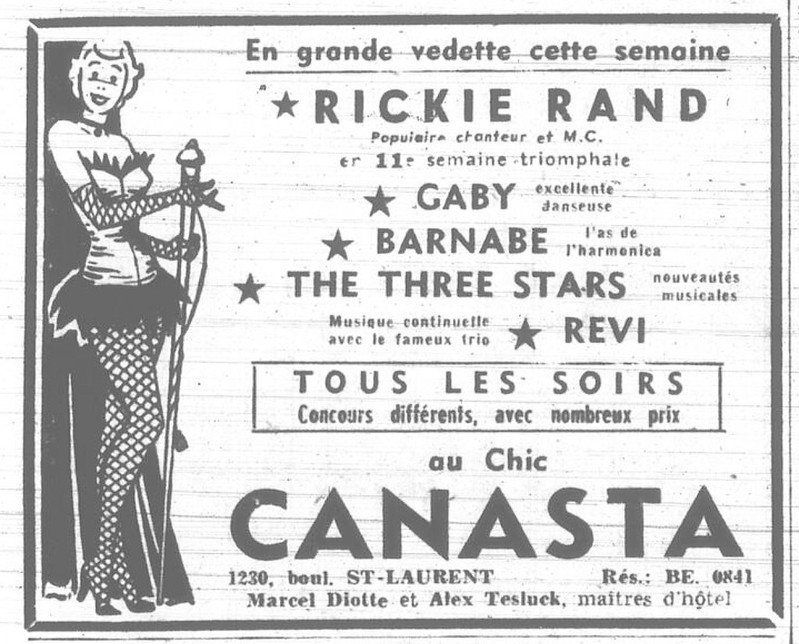
Advertisement for the Café Canasta (1230 Saint-Laurent Blvd.) announcing a varied cabaret program, featuring singer and master of ceremonies Rickie Rand, accompanied notably by dancer Gaby, Barnabé on harmonica, and the musical trio The Three Stars. The announcement highlights a continuous music format and daily performances, as well as contests with prizes, illustrating the positioning of the Canasta as a popular entertainment venue with sustained programming in the mid-1950s. -
MONTRÉAL-MATIN, Wednesday, February 14, 1968.
Advertisement for the Café Canasta (1230 Saint-Laurent Blvd.) announcing a “Melody Ranch” evening scheduled for February 15, 1968, featuring the trio composed of Thérèse, Jimmy White and Guy Cody, as well as the quartet Melody Country Boys (Gilles Duguay, Jean-Guy Lanteigne, Roland Charrette and Oze Duguay). The announcement highlights a program focused on country music, presented without cover charge, from 8 p.m. until closing. -
MONTRÉAL-MATIN, Monday, June 7, 1971.
Advertisement announcing the “Colibri” of the Café Canasta (1230 Saint-Laurent Blvd.), featuring Rina Berti, singer and dancer presented as a television star, as well as Donald Charlebois, Pete & Gerry and Jacques André and his orchestra. The announcement highlights a cabaret program with themed evenings, including a “ladies’ night” accompanied by a “hot pants” contest, reflecting the evolution toward a more contemporary entertainment offering in the early 1970s. -
MONTRÉAL-MATIN, Thursday, August 28, 1969.
An advertisement announces the opening of the “Melody Ranch” at the Café Canasta, located at 1230 Saint-Laurent Boulevard, then “under new management” led by Fernande Grenier, identified as the owner. The advertisement explicitly targets the “Acadian” and “Gaspesian” communities, revealing a targeted programming strategy and the existence of an active regional cultural network on the Main in the late 1960s. Grenier also presents a “Gaspesian Club,” suggesting a reconfiguration of the venue toward a format with a specific cultural identity, distinct from the traditional cabaret. The advertisement specifies an offering of “continuous entertainment from 8 p.m. until closing,” indicating an intensive operating model typical of nightlife establishments of the period. The explicit mention of the “2nd floor” further confirms the vertical use of the building, where different programs could coexist within the same location. This notice thus reflects a transitional phase of the Café Canasta, marked by a change in management, a diversification of audiences, and an adaptation to the social and cultural dynamics of the Main on the eve of the 1970s. -
TÉLÉ-RADIOMONDE, September 24, 1966.
In an article entitled “À l’approche de l’Expo : Nos cabarets changent de style”, journalist P. Daignault observes a transformation of Montreal nightlife establishments in anticipation of Expo 67, marked by the gradual abandonment of imported styles — notably go-go dancers and certain formats inspired by American cabarets — in favor of programming highlighting folklore and a “truly Canadian” identity. The text explicitly mentions the Café Canasta, then undergoing redecoration to adopt this new positioning, with the objective of offering foreign visitors a distinct cultural experience rooted in local musical traditions. This source reflects a shared desire among Main operators to adapt their offerings to the tourist and cultural stakes of Expo, redefining the image of the Montreal cabaret on the eve of this international event. -
MONTRÉAL-MATIN, April 7, 1967, n.p.
Advertisement announcing the shows of the “Melody Ranch”, located on the 2nd floor of the Café Canasta (1230 Saint-Laurent Boulevard). The announcement features Bob Martin and his Stampeders, a country music ensemble (vocals, guitar, violin, bass, drums), and specifies that performances are held continuously. It also mentions promotional activities, including a weekly draw (“Our lucky horseshoe”), illustrating the entertainment strategies typical of Main cabarets at that time. This source confirms the integration of country and western programming at the Canasta in the context of transformations in Montreal nightlife leading up to Expo 67. -
MONTRÉAL-MATIN, September 16, 1966, n.p.
Advertisement announcing new programming at the Café Canasta (1230 Saint-Laurent Street), highlighting a multiple-show format (two performances daily, up to three on Fridays and Saturdays). The announcement emphasizes the presentation of “Soirées du bon vieux temps” hosted by Oncle Adhémar, as well as the organization of special events (notably a corn roast) and the absence of admission fees. It reflects a shift toward programming inspired by folklore and popular traditions, in the context of transformations in Montreal nightlife on the eve of Expo 67. -
LA PATRIE — L’HEBDO DES CANADIENS-FRANÇAIS, March 20, 1966, pp. 8–9.
In a long report entitled “La ‘Main’ refuse de mourir et soupire après l’Expo”, journalist Pierre Léger paints a contrasted portrait of Saint-Laurent Boulevard in the mid-1960s, at a time when many observers predicted its decline ahead of Expo 67. The article insists on the persistence of intense nightlife, despite police crackdowns, moral campaigns, and the sector’s criminal reputation. Léger recalls that in the early 1960s the street had been heavily affected by investigations into protection rackets, police raids, and pressure exerted on cabarets, but maintains that the “Main” remained alive, populated by customers, passersby, industry workers, and proprietors who continued to conduct business there. The report stages an interlocutor from the cabaret world, presented as a man intimately familiar with Saint-Laurent Street, its recent transformations, its relations with the police, its forms of violence, and its economic logic. He asserts that, although organized crime had lost some of its grip since the days of Roger Poirier and his brothers, the “Main” remained a place where one could still earn a living, including in nightclubs. He describes a world where former figures of the scene, dancers, restaurateurs, regular customers, journalists, lawyers, engineers, undertakers, and visitors coexisted, highlighting the social diversity of the clientele and actors gravitating around these establishments. The article also contrasts two images of the “Main”: on one hand, a dangerous place marked by scores settled, blackmail, prostitution, and violence that had tarnished its reputation; on the other, a popular, lively space still capable of reinventing itself. Léger reports that, according to his interlocutor, newspapers had contributed to darkening the boulevard’s image by constantly reducing the street to its most sensational episodes. The text nevertheless insists that many cabarets continued to operate, that proprietors adapted, and that certain forms of entertainment — notably strip clubs and atmosphere bars — remained profitable, even in a context of heightened surveillance. The report finally evokes the expected impact of Expo 67, perceived as a potential lifeline for the sector. Many industry figures believed that the arrival of tourists and foreign visitors could revive business on the “Main,” whose appeal lay precisely in its interlope, spectacular character distinct from the rest of the city. In this perspective, the article constitutes a valuable testimony on the imaginary of Saint-Laurent Boulevard on the eve of Expo: a place deemed moribund by some, yet still perceived by those who inhabited and operated it as a territory of survival, adaptation, and nighttime commerce. -
BIBLIOTHÈQUE ET ARCHIVES NATIONALES DU QUÉBEC (BAnQ),
« Canasta café : soirée du bon vieux temps tous les mardis et jeudis = Farmer’s Night every Tuesday and Thursday »,
promotional postcard, [Quebec (Province)?] : [publisher unidentified], [between 1950 and 1959?],
1 postcard (black and white; 10 × 13 cm), notice no. 0005012670, held at the National Library (Rosemont site),
collections.banq.qc.ca/ark:/52327/2723494.
This promotional postcard announces the “old-time evenings” (or Farmer’s Night) held at the Café Canasta, highlighting a regular program focused on a festive atmosphere inspired by folklore and popular traditions. The presence of a bilingual title suggests an intention to attract both French- and English-speaking clientele, and possibly tourists, as early as the 1950s. This document testifies to the early anchoring of this type of programming at the Canasta, well before the transformations observed in the 1960s, and illustrates the continuity of certain animation strategies based on conviviality, the weekly repetition of events, and the staging of a so-called “traditional” culture. -
LA PATRIE, week of February 9, 1969.
Article by Claude-Lyse Gagnon entitled “C’est presque la danse à St-Dilon au nouveau casino des Gaspésiens”, describing the atmosphere of the “Gaspesian casino” established on Saint-Laurent Street, where Fernande Grenier acts as manager. The text highlights programming centered on traditional dances — jig, square sets, and called dances — performed in a festive setting bringing together primarily members of Gaspesian and Acadian communities settled in Montreal. The article emphasizes the communal nature of the venue, the strong public participation, and the living transmission of a folkloric repertoire, while also noting the popularity of these evenings, capable of attracting large crowds and turning customers away. This source testifies to the integration, in the late 1960s, of a cultural offering explicitly rooted in regional traditions within the nightlife of the “Main,” as well as the role of Fernande Grenier in animating and structuring these festive spaces. -
CITY OF MONTREAL. ARCHIVES SECTION,
« VM94-A0031-007 », photograph, level of description: item,
Montreal, [n.d.], fonds of the Institutional Affairs Service (1992–1994),
archivesdemontreal.ica-atom.org.
This nighttime photograph of Saint-Laurent Boulevard, taken in the mid-20th century, shows a row of illuminated commercial façades, including the vertical sign of the Café Canasta visible among other establishments of the “Main.” The image illustrates the intensity of nightlife in the area, characterized by the concentration of cabarets, bars, and performance venues, as well as by coexistence with retail businesses such as the Woolworth store. It testifies to the role of the boulevard as a major axis of Montreal entertainment, where illuminated signage, automobile traffic, and the presence of pedestrians contribute to a dynamic urban staging typical of the Red Light district of the period. -
GOUPIL, Jean, La Presse, April 2, 1985.
Photograph showing a segment of Saint-Laurent Boulevard between Dorchester Boulevard (now René-Lévesque) and Sainte-Catherine Street, where the Café Cléopâtre, the Taverne Alouette, and the Restaurant Casanovas can be seen. The image documents the state of the area in the mid-1980s, illustrating the continuity of commercial and nightlife activity within a transforming urban landscape. This photograph, preserved in the Fonds La Presse (ref. P833,S5,D1985-0147), testifies to the persistence of emblematic venues of the “Main” after the disappearance of classic cabarets, in a context of the gradual redefinition of Saint-Laurent Boulevard. - CITY OF MONTREAL, HOUSING AND URBAN PLANNING DEPARTMENT, Land Use, City of Montreal, scale 1:1,000, [Montreal], the Department, 1975–1990. 1 map in multiple sheets: diazo copy; each 77 × 92 cm. Scale 1:1,000. Specific genre: geographic maps. Subject: land use. Detailed record no. 0000024747, Bibliothèque et Archives nationales du Québec, collections.banq.qc.ca/ark:/52327/2243892.