Venue profile — Downtown
Chez Maurice (Montreal)
Founded at the turn of the 1930s under the impetus of Phil Maurice, Chez Maurice quickly established itself as one of Montreal’s most prestigious cabarets. A true temple of the dinner show, it embodies the golden age of a city then nicknamed the “Paris of America”, where major jazz stars, Broadway-inspired revues, and a fashionable clientele in search of luxury and modernity converged.
⏱ Reading time: 15 minutes
1. Overview
Chez Maurice was a high-end cabaret-restaurant founded in 1930 by Montreal impresario Phil Maurice. Conceived from the outset as a complete entertainment venue, it combined dining, cabaret floor shows, and a large dance floor, following a model inspired by the most fashionable establishments in New York.
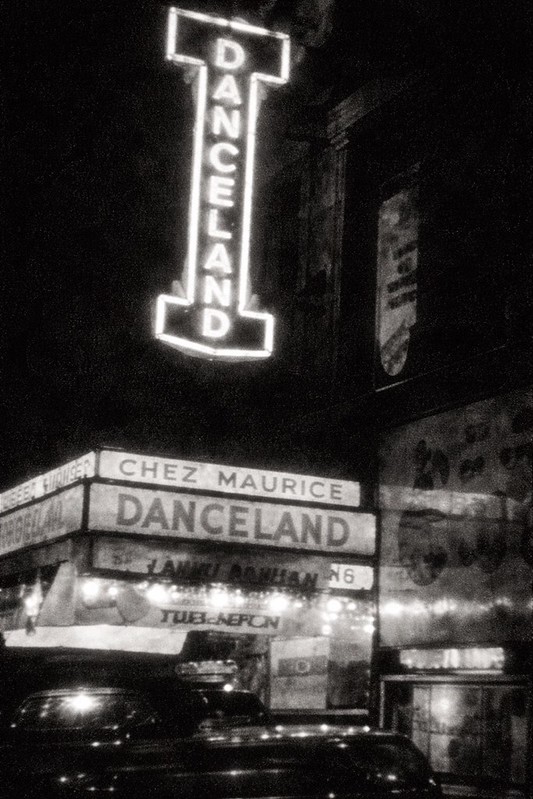
Chez Maurice Danceland appears briefly (0:53–0:59), offering a rare visual record of its location on Sainte-Catherine Street West at the time. [80].
Initially located on St-Alexandre Street, in continuity with the Old Heidelberg Patio, the cabaret quickly became one of the most sought-after venues in Montreal nightlife before relocating in 1932 to 1244 Sainte-Catherine Street West.
At its peak, Chez Maurice attracted a large and elegant clientele, with opening nights drawing impressive crowds eager to attend ambitious productions and performances by leading artists. The establishment thus ranked among the most prestigious cabarets in the country, contributing to Montreal’s reputation as a North American entertainment capital in the 1930s and 1940s.
Through its programming combining dinner shows, dancing, and international stars, Chez Maurice fully embodies the golden age of Montreal cabarets, a period during which the city attracted major jazz and American stage performers and established itself as a leading cultural and nightlife center.
2. Origins: from the Old Heidelberg to the Patio, then to Chez Maurice (1927–1932)
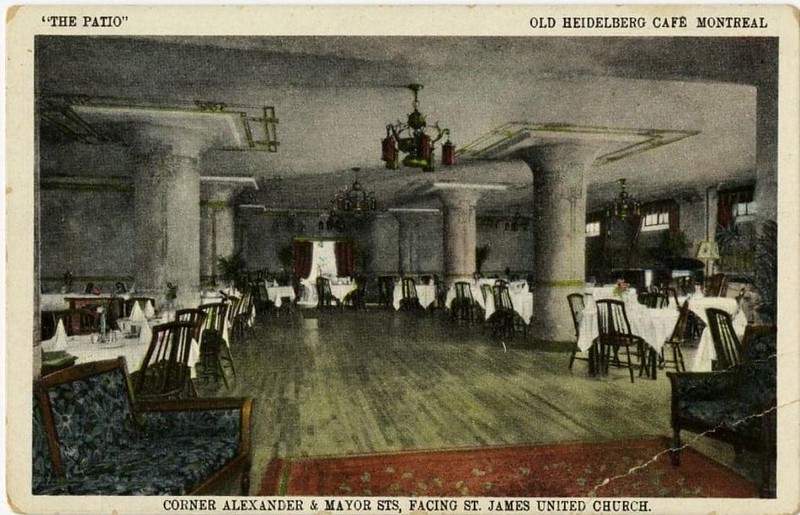
The origins of Chez Maurice go back to the creation of Old Heidelberg Cafe, Limited, whose letters patent were published in the Gazette officielle du Québec on December 17, 1927 [27]. Incorporated on November 23, 1927, the company brought together John Tinhof, Frederick Everett Partridge, Hugo Wellein, Lorne Muir Coughtry, and Elsie Chappell. Its share capital and the broad range of authorized activities — restaurants, taverns, hotels, bakeries, and food businesses — show that this was, from the outset, an ambitious and solidly structured commercial venture.
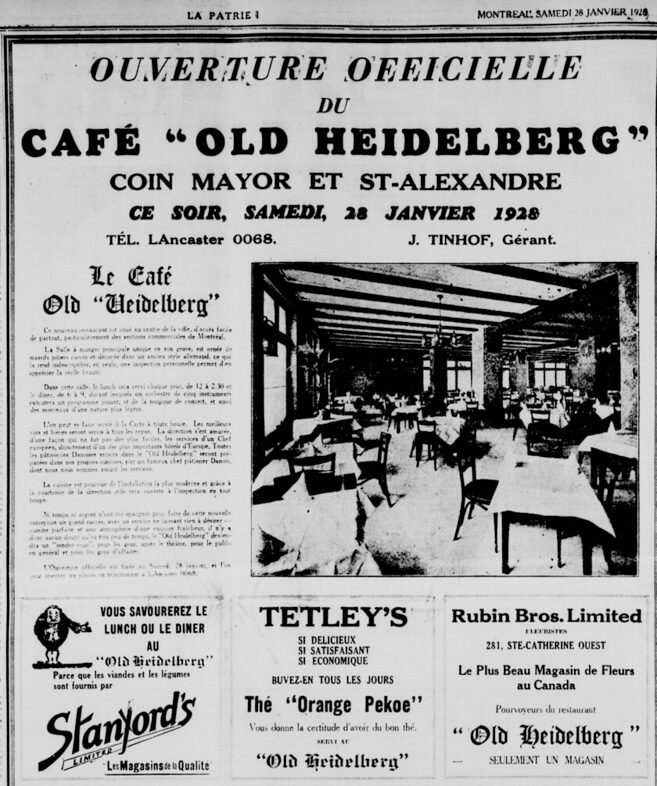
The official opening of the Old Heidelberg, announced in La Patrie on January 28, 1928, placed the restaurant at the corner of Mayor and Saint-Alexandre streets, in the heart of downtown Montreal [25]. The venue was presented as a major establishment: a vast dining room with an old-world décor featuring massive carved beams, continuous service, modern cuisine, a European chef, house pastries, and a clientele targeted equally toward business, leisure, and after-theatre crowds. In the days that followed, the press emphasized the large turnout for the opening night, the role of manager John G. Tinhof, and the important place of music, provided by a five-piece orchestra [26]. A few weeks later, The Gazette even described the establishment as “Montreal’s Largest Restaurant”, highlighting its formula of food, drinks, and music within a framework of urban sociability [33].
Over the course of 1928, the establishment gradually evolved toward a more distinctly nocturnal formula. An advertisement published in The Gazette on September 18, 1928 already presented the Patio as a space for “Supper Dance De Luxe”, associated with elegance, dancing, and a fashionable clientele [32]. This transformation was confirmed on November 2, 1928, when the Montreal Daily Star announced the “Grand Opening” of the Patio for the winter season, with dance music until closing [31]. Within a few months, the Old Heidelberg was no longer simply a large restaurant: it had also become a structured venue for nighttime entertainment.
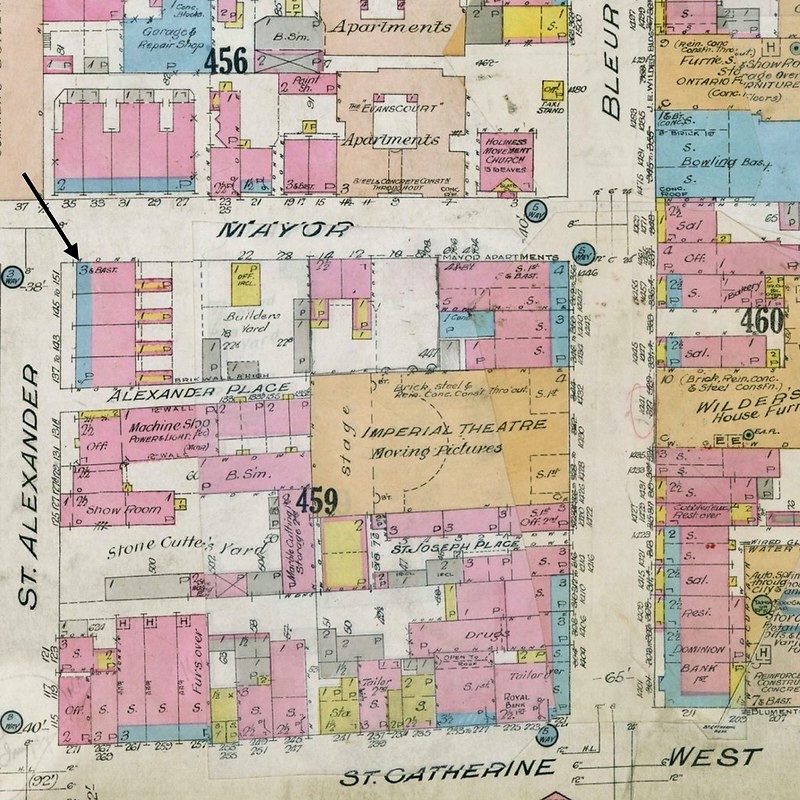
The real turning point came in the summer of 1929, when the Patio came under the new management of Phil Maurice. An advertisement in the Montreal Daily Star of July 4, 1929 now described the venue as a restaurant cabaret, with dinner dances, a full revue, and a cabaret program running until closing [2]. The presence of the Ambassadors and a Broadway Revue marked a change of register: where the Old Heidelberg had combined dining, music, and atmosphere, the Patio under Maurice became an integrated show venue. This reorientation is also visible in its growing prominence: in October 1929, a “Patio Midnight Revue” was presented at the Forum, while in November, Phil Maurice was mentioned as secretary-treasurer of the Aero Club of Canada, revealing his insertion into networks of modernity and prestige [37], [38].
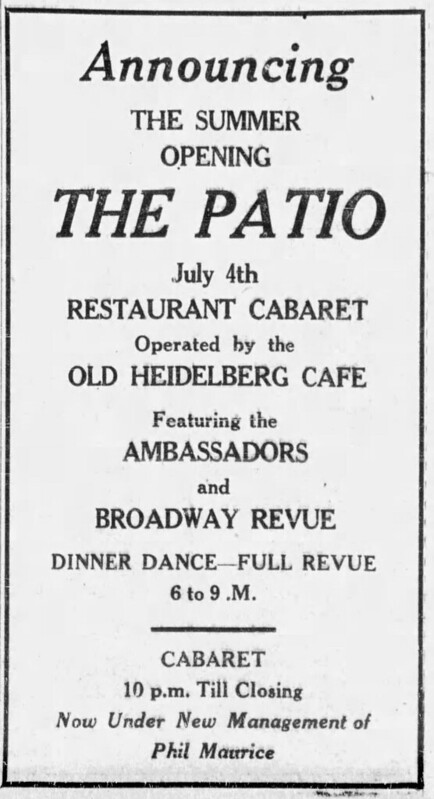
Advertisement announcing the opening of the Patio at the Old Heidelberg Cafe under the management of Phil Maurice, marking its transformation into a restaurant-cabaret with a revue and a Broadway-inspired program. [2].
By the end of 1929, the Patio was no longer merely a restaurant: it had become a performance venue. The press celebrated it as “Montreal’s Smartest Cabaret” and “The Only Dinner Show in Town”, emphasizing the elegance of its décor, the quality of its table, and the ambition of its programming. The gala of December 31, 1929, combining dinner, revue, and dancing, crystallized this transformation: the venue had now entered the world of the fashionable cabaret, a space of distinction as much as entertainment [36], [35].
The year 1930 marked a decisive shift. The establishment, successively known as the Old Heidelberg and then the Patio, definitively adopted the name Chez Maurice, asserting a new identity that was both more ambitious and more coherent. This change was not merely cosmetic: it was accompanied by a deep reorganization. While Old Heidelberg Cafe, Limited began surrendering its charter [34], a new entity emerged. On January 28, 1930, Philip Maurice and John-George Tinhof, assisted by accountant Abraham Arbess, founded “Maurice Enterprises, Limited”, made official in the Gazette officielle du Québec a few weeks later [121].
With share capital of $10,000, this company stood out for the scale of its ambitions. It was not limited to operating restaurants or cafés: its mission was to organize shows, produce theatrical performances, manage entertainment venues, and invest in related businesses. Through this versatility, it outlined the contours of a true integrated entertainment economy, in which stage, venue, and financial structure all formed part of the same project.
Very quickly, the model took hold. By the spring, Phil Maurice was providing entertainment for a supper dance of the Ramblers Aero Club at Chez Maurice [39]. In the fall of 1930, an advertisement described the establishment unambiguously as a cabaret-restaurant on St. Alexander Street, offering a table d’hôte dinner, revue, and orchestra [40]. The dinner-show principle first developed at the Patio had now been fully realized. It was no longer simply a place where one ate or danced, but a space in which, night after night, a certain idea of Montreal modernity was staged.
In 1931, Chez Maurice crossed a new threshold. The cabaret now went beyond its entertainment function to become a true site of urban sociability, where artists, businesspeople, political figures, and visiting guests crossed paths. The press continued to present it as “The Only Dinner Show in Town” [46], but the phrase no longer referred merely to a commercial innovation: it now designated a space of social interaction, where the show extended into the relationships it made possible. Banquets, receptions, and visits by foreign delegations confirmed this new centrality [48], [45], [47], [49].
This growing prominence called for a change of scale. In February 1932, an advertisement stated that the establishment was leaving St. Alexander Street to move to the site of the Venetian Gardens, on Sainte-Catherine Street West [50]. This was not a simple move: it marked the transition from an already influential cabaret to a site located at the heart of the city’s main commercial and nightlife artery, opening the way to a new phase of development.

Retrospective sources, viewed with hindsight, lend full coherence to this trajectory. In Montreal Confidential, published in 1950, Al Palmer identifies the Old Heidelberg as the first establishment independently operated by Phil Maurice and notes that he was also responsible for the name Chez Maurice [41]. The career of John G. Tinhof, first manager of the Old Heidelberg, likewise points to the deep continuity between dining and cabaret in Montreal during the first half of the twentieth century [28], [29], [30].
From this perspective, the history of the Old Heidelberg, the Patio, and Chez Maurice appears less as a succession of separate venues than as a continuous transformation: that of a downtown restaurant which, within a few years, became a laboratory for a new form of nightlife. Through it emerged a hybrid model — at once gastronomic, spectacular, and fashionable — that would make a lasting contribution to the identity of the Montreal cabaret.
An article published in The Gazette in April 1932 announced a major transformation of Chez Maurice, whose space was repurposed to house the cabaret Maxime, directed by Joe Lightstone and John Tinhof [117]. It also corresponds to the moment when Chez Maurice moved to Sainte-Catherine Street West, initiating a new phase in its history, during which the cabaret would enjoy its golden age at that address until 1950.
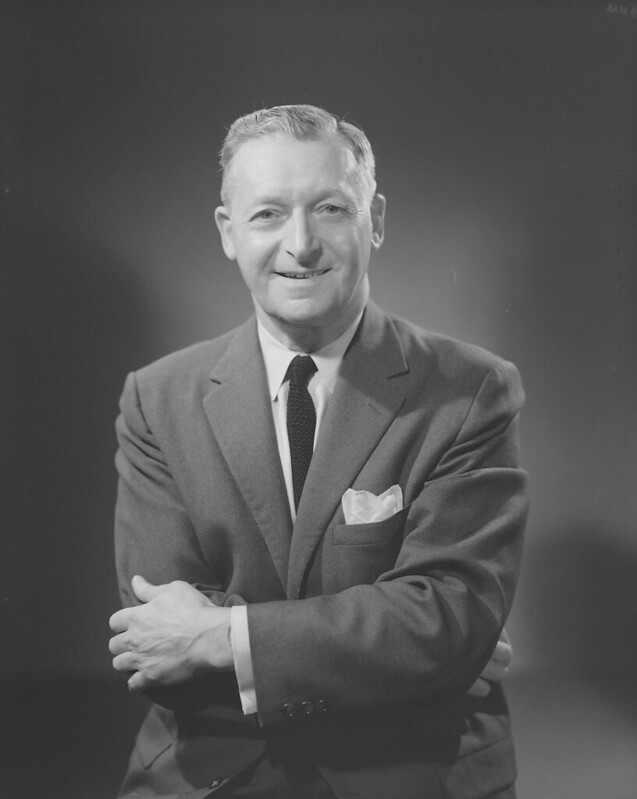
Phil Maurice (c. 1901–1983)
Active in Montreal from the late 1920s onward, Phil Maurice emerged as one of the principal architects of the golden age of Montreal cabarets. An impresario and operator, he played a decisive role in the transformation of nightlife by structuring a true network of interconnected cabarets, notably including the Stanley Grill, the Embassy Terrace, the Lido, and the Golden Dome, through which he circulated performers drawn mainly from the circuits of New York and Broadway [21].
Contemporary sources emphasize that Maurice was among the first to introduce to Montreal a formula combining dining and entertainment, often described as café entertainment, as early as the late 1920s. This approach, which brought together meals, music, and live performance in a single venue, helped durably transform the practices of Montreal nightlife and established a model later adopted by many other establishments [97].
This organization allowed him to position Montreal as a major stop on North American touring circuits. The opening of Chez Maurice at the beginning of the 1930s marked the high point of this activity: the cabaret, first located on Saint-Alexandre Street and later relocated to Sainte-Catherine Street West, was then regarded as one of the most prestigious in the country, presenting large-scale revues and international stars such as Helen Morgan, Harry Richman, and Mickey Alpert [1].
In the spring of 1933, Maurice simultaneously expanded his activities with the opening of the Villa Maurice, located at 1224 Stanley Street, presented as a more intimate, modern, and refined cabaret. There he introduced new forms of entertainment, relying on dynamic productions inspired by American models, including comic and musical numbers, in a clear effort to renew the experience of nightlife entertainment [9], [91].
Beyond his own establishments, Maurice helped bring numerous major figures of theatre and entertainment to Montreal, including Marlene Dietrich, Katharine Cornell, Charles Boyer, Charles Laughton, Olivia de Havilland, Alfred Lunt, Lynn Fontanne, and Joseph Cotten, confirming the city’s integration into international cultural circuits [1][10].
In the mid-1930s, Phil Maurice pursued his career within the Consolidated Theatres network, while expanding his activities beyond the cabaret world alone. He was notably appointed manager of the Loew’s Theatre, which he directed between 1938 and 1949, a period during which the venue combined first-run films and vaudeville performances, consolidating its place within the major North American entertainment circuits [8], [89], [90].
At the same time, Maurice participated in the organization of benefit events and social initiatives, notably connected to the Canadian Progress Club Milk Fund, intended to support underprivileged children in Montreal, illustrating his civic involvement beyond the sole domain of entertainment [89].
He remained active in Montreal’s cultural milieu for several decades, and was still mentioned in the 1950s and 1960s as an influential figure in the entertainment and theatre industries.
He died on January 15, 1983, in Palm Springs, California. Through his activities, Phil Maurice emerges as a structuring figure in Montreal entertainment, having helped forge lasting links between local scenes and the major North American performance circuits.
3. The 1932 Move & Golden Age
The move of Chez Maurice to 1244 Sainte-Catherine Street West, at the end of April 1932, marked a decisive stage in the history of the cabaret. Even before opening, the press presented the event as “The Event of the Season,” announcing a 25-performer revue led by Helen Morgan, star of the Ziegfeld Follies, with Sam Walsh as master of ceremonies and Hal White as musical director [53]. The advertisements also highlighted a sophisticated pricing structure, combining different dinner and show options, a sign of an already well-defined commercial model. In La Presse, the new establishment, fitted out in the former Venetian Gardens premises, was presented as a completely transformed cabaret, immediately built around an international headliner [4].

The opening immediately confirmed these ambitions. An article in La Presse reports that more than 800 people attended the inaugural evening, in a fashionable and festive atmosphere [51]. The room, described as elegant, featured tones of blue, orange, soft gray, and gold, while the crowd quickly filled the venue to the point that no seats were available around 11:30 p.m.. Guests danced to the orchestra of Al White, and the performance by Helen Morgan, positioned in the center of the room, drew enthusiastic applause. This turnout shows that Chez Maurice was then clearly changing scale and establishing itself on Sainte-Catherine Street West.
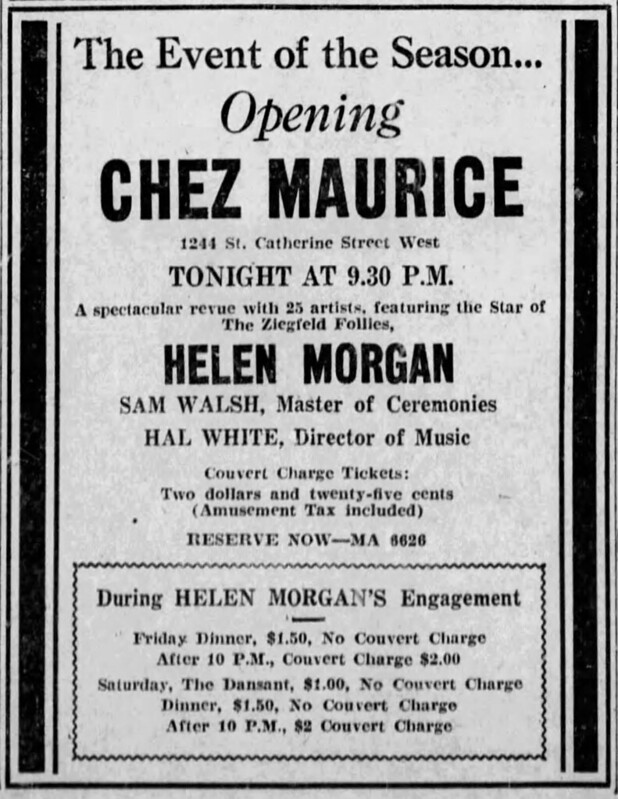
Reviews published in the days that followed emphasized the spectacular nature of this opening. The Montreal Star described the evening as one of the most brilliant seen in Montreal since the rise of the modern cabarets, noting that the former Venetian Gardens had become “literally unrecognizable” under the direction of Phil Maurice [3]. The décor, lighting, and spatial organization all played a full part in this staging: the orchestra occupied a central position, the performers entered behind it before moving onto the floor, and the whole arrangement created an atmosphere that was both elegant and immersive.
The programming itself was designed according to the standards of the major North American cabarets. Around Helen Morgan, the cast included Helen Manning, Olive Fay, Marion Young, as well as the duo Pepita and Rhoda, while a large chorus line completed the revue [3], [52]. A portrait published in The Gazette on April 30, 1932 further placed Morgan within a broader trajectory, from her modest beginnings in Montreal to her international consecration, notably through Show Boat [52]. Her return to Chez Maurice therefore carried strong symbolic weight: it linked the new cabaret to an artist whose career connected Montreal, Broadway, and the great North American stages.
Taken together, these accounts show that in the spring of 1932, Chez Maurice immediately reached a high level of professionalization. By bringing together an international star, a large troupe, ambitious staging, and a carefully structured economic model, the establishment asserted itself from the moment of its opening as one of the major centers of Montreal entertainment.
In the winter of 1932, Phil Maurice also intervened in the debates surrounding the regulation of Montreal cabarets. In a statement reported by the press, he criticized the restrictions imposed on opening hours, stressing that a midnight closing time made the operation of an establishment such as Chez Maurice economically untenable and could result in the loss of many jobs. This position illustrates his active role in the tensions between municipal authorities and the entertainment industry, at the heart of so-called “open city” Montreal [98].
“With all due respect to the chief of police, if these measures are enforced, we might as well hand over the keys to the door. It is obvious that a café such as Chez Maurice cannot operate with a midnight closing. People leave the theatre at 11 o’clock, and if we have to close an hour later, there is nothing left to do but shut down entirely. Do they want to turn Montreal into a city like Toronto?”
4. New Management (1933) & Villa Maurice
The year 1933 marks a decisive phase of reorganization, consolidation, and expansion for Chez Maurice. From the very beginning of the year, several prosecutions brought against Montreal cabarets — notably for dancing after midnight or violations of municipal by-laws — reflected the climate of tension surrounding nightlife [54], [55], [56]. Chez Maurice was among the establishments targeted, but a large portion of the charges was dismissed, particularly because of legal distinctions between a cabaret license and a dance hall license, or because the prosecutions were aimed at individuals rather than companies. This sequence illustrates the limits of a regulatory framework still poorly adapted to the rise of Montreal cabarets.

At the same time, the establishment was becoming more structured on the administrative level. A notice published in The Gazette on March 21, 1933 confirms the incorporation of Chez Maurice, Inc., attesting to its transition into a fully organized business [60].
This professionalization was accompanied by a sustained renewal of the programming. By late February 1933, the seventh edition of the Chez Maurice Revue, staged by Jack Pomeroy, launched a series of Broadway-inspired productions bringing together singers, dancers, chorus girls, and masters of ceremonies [57], [5], [58]. Extended into a fifth week, the revue confirmed the cabaret’s ability to build and retain a large audience [61].
The spring then saw the succession of the eighth and ninth editions, which further aligned Chez Maurice with North American standards [62], [63], [64], [65], [66]. Performers such as Joe Herbert, Selma King, Bobby Gillette, Shirley Richards, and Billy Munro played an important role, while an advertisement dated March 3, 1933 also reveals that the stage was opened to amateur performers, underscoring an active role in artistic scouting [59].
In the spring of 1933, Phil Maurice also expanded his activities with the opening of the Villa Maurice, at 1224 Stanley Street (future Esquire from 1940 onward), conceived as a more intimate, modern, and refined cabaret [6], [67], [68]. The press emphasized the quality of the décor, lighting, and layout, as well as the continuity of personnel, notably with John Tinhof [69], [70].
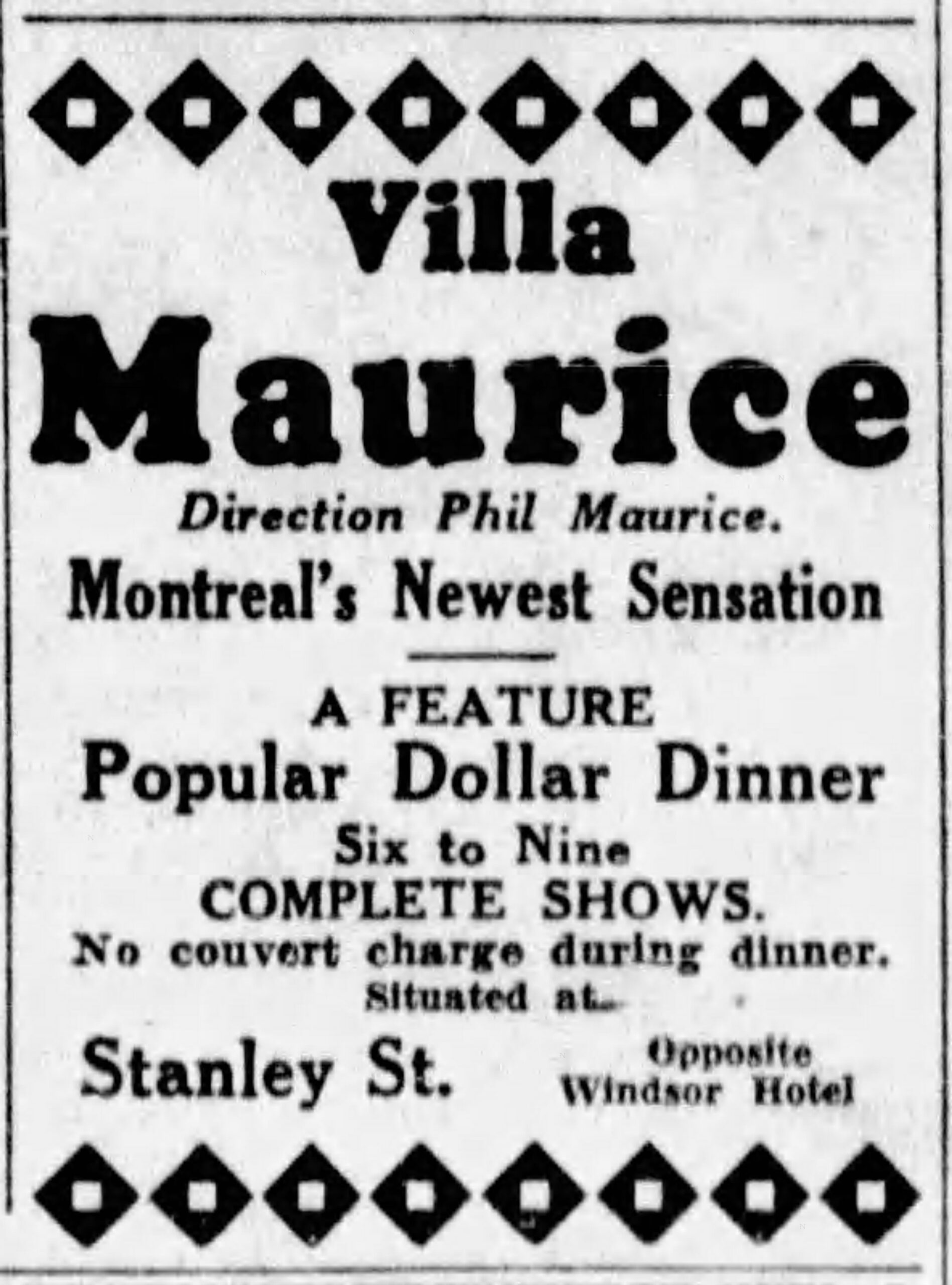
By summer, Maurice had introduced a renewed floor show formula there, inspired by Broadway models, combining humor, music, and variety acts. Performers such as Wynne Wayne and Bob Brandies took part in these productions, which favored rhythmic and accessible entertainment in the tradition of American vaudeville [9]. Success came quickly, although an armed robbery in November served as a reminder of the vulnerability of these heavily frequented establishments [71].
Meanwhile, Chez Maurice experienced one of its most notable moments with the triumph of Nan Blakstone during the summer and fall of 1933. Her extended engagement drew exceptional crowds and set new attendance records, surpassing several recent stars [72], [73], [74], [75]. After her departure for New York, the programming diversified with new revues and the introduction of Sunday dinner concerts at the end of the year [76], [77].
Taken as a whole, the year 1933 saw Chez Maurice consolidate its position at the heart of Montreal nightlife, while broadening its reach through the Villa Maurice. Between professionalization, the rapid renewal of revues, and the success of stars such as Nan Blakstone, this period corresponds to one of the most fully realized moments in the development of Phil Maurice’s world.
5. 1934: Development and Consolidation
In 1934, Chez Maurice continued its upward trajectory and confirmed the success of its spectacular formulas. An article in The Montreal Daily Star notably emphasized the growing popularity of the midnight shows, to the point that management considered adding a third daily performance [113]. This formula relied on a constant renewal of programming, attracting a clientele in search of sustained, high-quality entertainment.
Among the notable performers, Nan Blakstone stood out through an act combining singing and comedy, praised for its comic effectiveness and audience interaction. Around her revolved several dance and variety acts — including Adair and Stewart, the Three Redheads, the Stewart Sisters, and Arthur Ball — confirming the richness and diversity of the cabaret’s artistic offering in 1930s Montreal [113].

This dynamic fits within a broader model, also observable in other Montreal establishments such as the Club Lido, founded by Lou Dettner on Stanley Street and opened the same year. This venue, which would later become the Tic Toc and then the Chez Parée, reflects the continuity of certain key sites in Montreal nightlife through different phases of operation and rebranding. Within this emerging network, Phil Maurice does not appear as an owner, but rather as a strategic intermediary, responsible for programming and booking artists—a role he shared with other figures in the industry, including Roy Cooper, an impresario and talent agent active on North American circuits, who was also involved in programming at the Lido. Together, these individuals helped ensure the circulation of shows between various venues, gradually structuring a true entertainment network at the scale of the city. A retrospective account published in The Montreal Star in 1977, written by a former employee, provides valuable insight into the operations and atmosphere of these cabarets [79].
It describes a formula built around an elaborate revue, including a chorus line of a dozen dancers, accompanied by an orchestra led by Charlie Kramer, as well as a succession of acts sustaining a brisk pace throughout the evening. The whole was part of a carefully staged production, in which lighting, the movement of the performers, and the organization of the room all contributed to an immersive experience characteristic of the dinner show model.
The account also emphasizes the upscale positioning of these establishments, frequented by a clientele described as particularly wealthy. This dimension was reflected notably in conspicuous consumption, including the sale of champagne (Mumm’s) at $12 a bottle (roughly $260 to $300 in current value), an exceptionally high price for the period. This contrast with the context of the Great Depression underscores the role of cabarets as privileged spaces of sociability for an urban elite.
The author also evokes the behind-the-scenes workings of the cabaret — the labor of technical crews, the preparation of the shows, and the logistics of the performances — offering a rare glimpse into the daily operation of these venues. He also mentions the presence of performers who would later enjoy major careers, including Red Skelton, seen early on, as well as the role of figures such as Roy Cooper and Harry Feldman in organization and programming.
Although published several decades after the events, this testimony confirms the spectacular, structured, and resolutely modern nature of the cabarets linked to Phil Maurice. The model — combining revue, dance, music, and luxury — fully aligned with North American standards of nighttime entertainment in the 1930s and, by extension, sheds light on the success of Chez Maurice during this same period.

Roy Cooper (1908–1996)
A major figure in Montreal show business, Roy Cooper was active for more than seven decades and was described in the press as the “dean of Canadian impresarios.” Born in Montreal and trained in the American vaudeville circuit, notably in New York and the Catskills, he developed a wide-reaching network linking the Quebec metropolis to the major North American artistic centers.
From the 1930s onward, his name appears in the programming of downtown cabarets, including the Club Lido on Stanley Street, where he took part in booking performers. Like Phil Maurice, he acted less as an owner than as an agent and programmer, playing a key role in the circulation of shows between different establishments.
Over the course of his career, Cooper helped bring many leading international figures to Montreal, including Louis Armstrong, Billie Holiday, Count Basie, Duke Ellington, Sammy Davis Jr., Tony Bennett, and Édith Piaf. His name is also associated with attempts to book Elvis Presley, illustrating the extent of his networks within the entertainment industry.
In the 1950s and 1960s, Cooper played a structuring role in the circulation of jazz artists in Montreal, notably through venues such as the Jazz Hot at Casa Loma, helping to anchor the city within the North American circuit of major tours.
Recognized for his professionalism and his ability to maintain lasting relationships with performers, Roy Cooper embodies the transition between the golden age of cabarets, the rise of major international productions, and the transformations of Montreal nightlife from the 1960s onward.
6. Reopening and Transformation (1935)
The year 1935 marks a major turning point in the history of Chez Maurice. An advertisement published in The Montreal Star on April 18, 1935, ahead of the reopening scheduled for April 22, Easter Monday, presents the event as a central moment in Montreal nightlife [99]. The establishment, located at 1244 Sainte-Catherine Street West, is then described as the “Showplace of the Empire”, underscoring its ambition to rival the great stages of North American entertainment.
This reopening followed three weeks of intensive transformations, carried out day and night in order to completely metamorphose the cabaret [99]. The room was entirely redesigned, with a raised dance floor, a semi-circular layout, and elaborate lighting, all intended to improve visibility and the audience’s immersive experience. The orchestra, installed in a lighted alcove, played a full part in this staging.
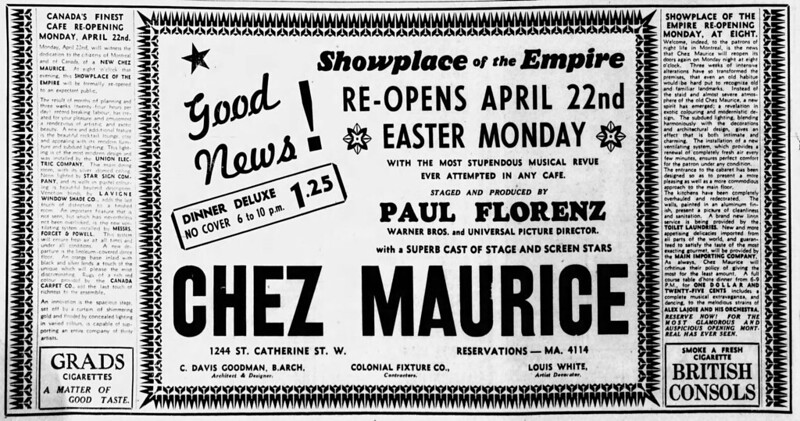
The interior combined decorative modernism, exotic colors, and luxurious comfort, while the new cocktail lounge — with its domed silver ceiling, pastel walls, and indirect lighting — became a central element of the overall design.
The advertisement also highlights major technical improvements: a modern ventilation system, a redesigned entrance, reorganized kitchens, and new service equipment [99]. This overall transformation reflects careful thought about the operation of the cabaret as an upscale entertainment business.
The new revue was entrusted to Paul Florenz, associated with Warner Bros. and Universal, and involved around thirty performers. Among them were Woods and Bray, The Eight Ambassadors, Mary Lee, and Frances Stevens, under the musical direction of Alex Lajoie [114].
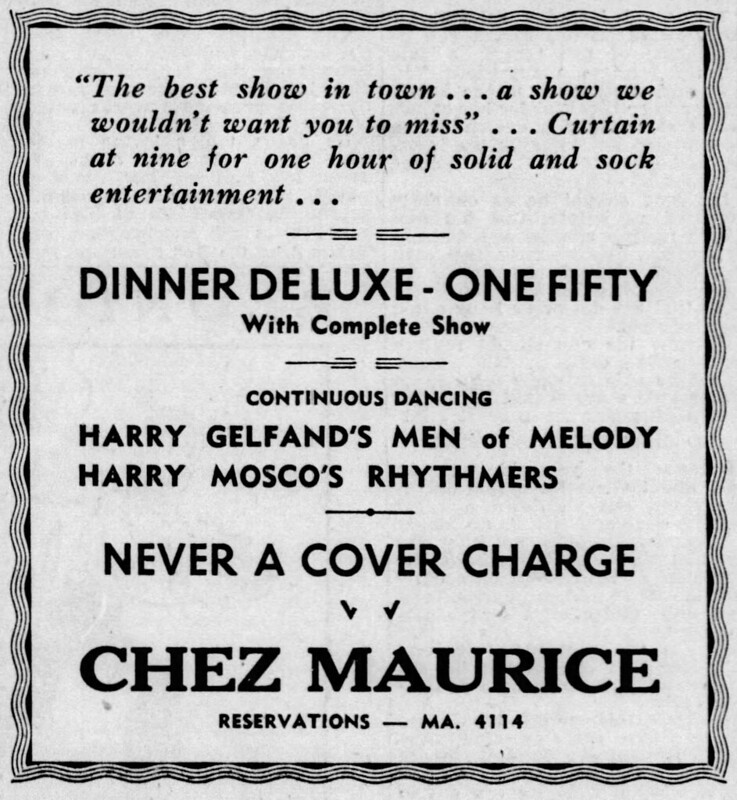
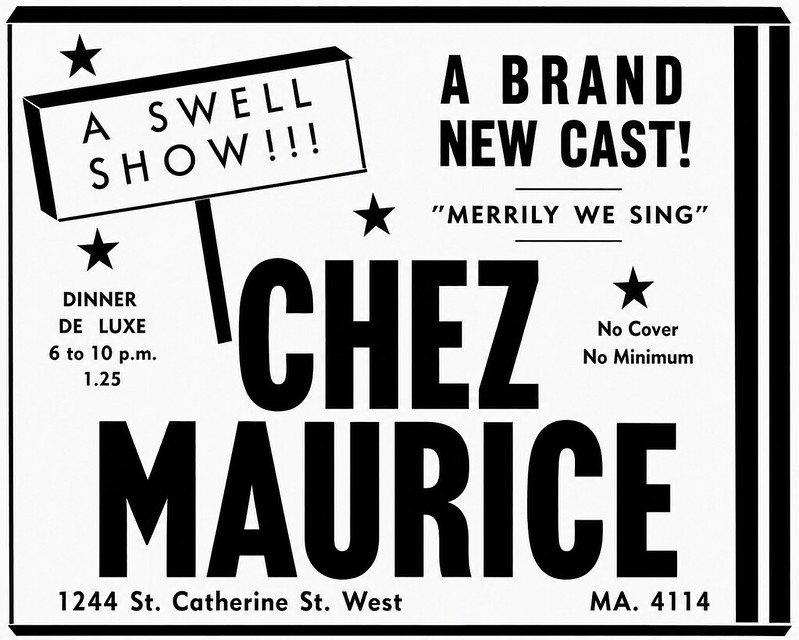
The dinner-show model was fully embraced, with a Dinner Deluxe offered at $1.25, with no cover charge between 6 p.m. and 10 p.m. [99]. Chez Maurice thus asserted itself as a complete venue, combining dining, entertainment, and sociability.
7. Modernization and Diversification (1937)
In 1937, Chez Maurice continued its modernization with a new reopening that drew a large crowd from the very first evening [92], [14]. The opening production, created by Boots McKenna and staged by Sydney Tapley, offered a richly costumed and carefully staged revue.
Featured performers included Don Loper, Beth Hayes, Billy Steele, and Lou Hoffman, while the musical entertainment was provided by the orchestras of Alex Lajoie and Charles Kramer.
This period also saw the creation of the Club Deauville, designed as a more intimate cocktail bar within the complex. Unlike the main room, centered on dinner and revues, the Deauville offered a more subdued atmosphere, focused on cocktails and the new social practices of Montreal nightlife.
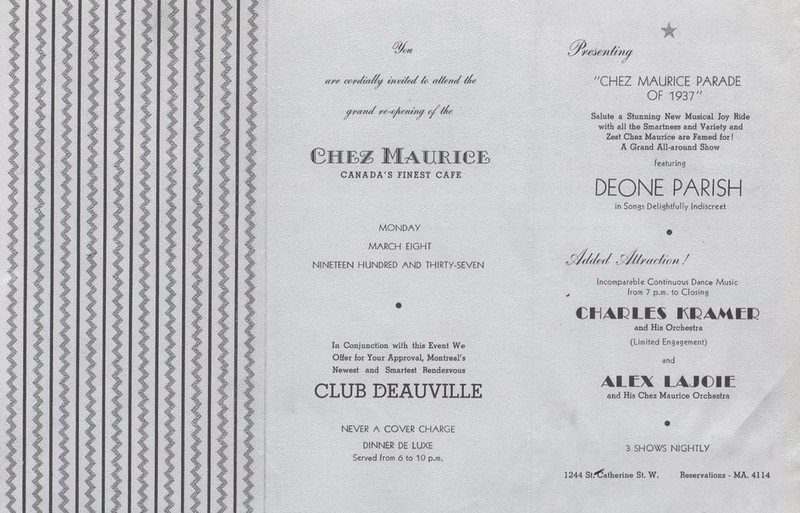
This diversification reflects Chez Maurice’s adaptation to North American trends, as major cabarets increasingly tended to divide themselves into different spaces offering complementary experiences.
An article in The Montreal Daily Star also emphasizes the social importance of this phase, marked by the presence of political and public figures such as Maurice Duplessis and Adhémar Raynault, confirming the cabaret’s central role in Montreal social life [112].
8. Toward the Major Venues: Loew’s Theatre and Expansion (1938–1939)
Beginning in 1938, Phil Maurice expanded his influence beyond the cabaret world. His appointment as manager of the Loew’s Theatre, part of the Consolidated Theatres Ltd. network, marked an important stage in his career [8].

He oversaw the reopening of this major venue after significant renovation work, representing an investment of more than $75,000. The theatre adopted a hybrid program combining vaudeville and first-run films, accompanied by an orchestra led by Jerry Shea.
This transition reflects a strategic repositioning: Maurice was no longer confined to cabarets, but was now participating in the major North American entertainment circuits.
He nevertheless maintained ties with his establishments, as shown by a benefit performance organized in 1939 with the Chez Maurice and the Tic Toc, in support of the Canadian Progress Club Milk Fund [89].
A retrospective article published in 1976 further recalls his role at the head of the Loew’s Theatre between 1939 and 1949, highlighting the continuity between his activities in cabarets and his involvement in major entertainment venues [90].
9. Transition, Modernization, and Growing Fragility (1940–1942)
The years 1940 to 1942 correspond to an important transitional phase in the history of Chez Maurice, marked both by a desire for modernization and by growing signs of financial fragility. An article in The Montreal Star first announces the appointment of Leslie F. Hall as general manager effective February 26, 1940, under the presidency of John St. John, signaling the introduction of a new administrative direction [81], [82].
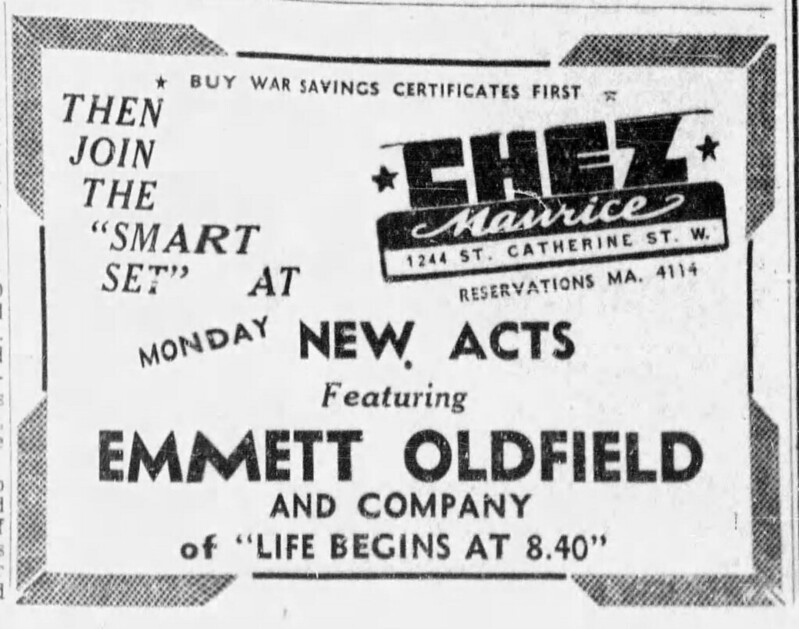
In the wake of this, the press highlighted a renovated cocktail lounge with a Hawaiian atmosphere and emphasized a complete change in management, ownership, and policy, presented as the starting point of an ambitious repositioning. The stated objective was to restore the establishment’s prestige and ensure its North American standing. In the midst of the Second World War, another advertisement adopted a more solemn tone in the form of a “Declaration and a Pledge”, affirming both the ambition to make the cabaret the “Best Club in North America” and the commitment of the staff to the war effort, notably through the purchase of War Savings Certificates [81], [82].
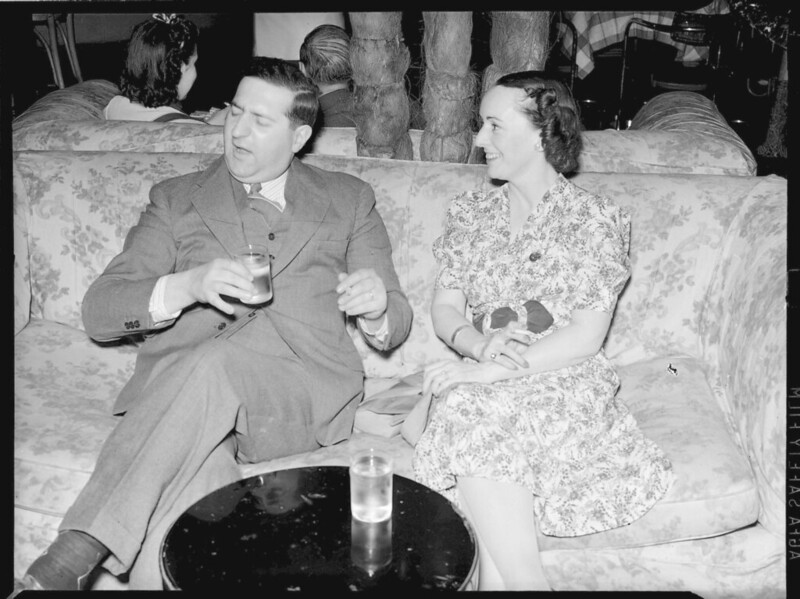
This dynamic of renewal culminated in the reopening announced on April 23, 1942, after significant modernization work. Chez Maurice then presented itself with a completely redesigned décor, characterized by a purple and gold color palette, a raised dance floor, and new lighting effects. The opening revue featured Dixie Dunbar, surrounded by a variety cast staged by Gene Snyder of the Radio City Music Hall, confirming the desire to maintain a high level of entertainment [93], [94].
However, a few months later, a notice published in Le Canada on July 1, 1942 revealed that Chez Maurice Inc. was subject to an authorized assignment under the Bankruptcy Act. Creditors were summoned to a meeting at the Montreal courthouse to rule on claims and the distribution of assets, reflecting the economic difficulties encountered by the establishment in the wartime context [88].
Signed notably by president John St. John, these various interventions thus illustrate the tensions that marked the evolution of Chez Maurice in the early 1940s: on the one hand, a clear desire for modernization and repositioning; on the other, a financial fragility that foreshadowed the deeper transformations to come [81], [82], [88], [93], [94].
10. The Danceland Turn and the Swing Era (1943)
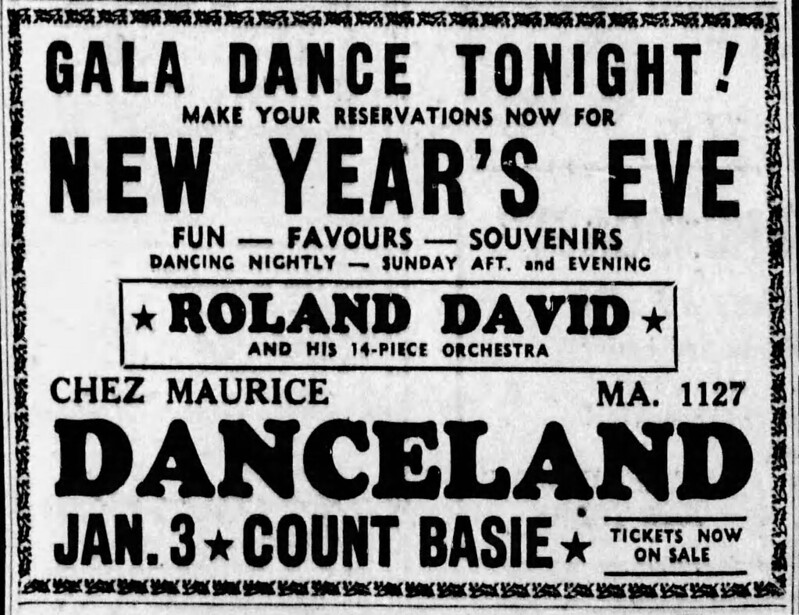
Between September and December 1943, Chez Maurice entered a new phase with its transformation into Chez Maurice Danceland, a development that marked a renewed focus on dancing, big bands, and programming more clearly oriented toward swing. The opening of this new formula on Sainte-Catherine Street West was accompanied by the hiring of bandleader Roland David, at the head of a 14-piece orchestra including Donat Gariepy, Joe Burton, Al Kane, and singer Rita Gail [83], [84], [85].
The program, offered every evening as well as on Sunday afternoons, was built around a repertoire ranging from sweet to hot, within a relatively accessible pricing structure, generally between 35 and 75 cents. A notice published in the Gazette officielle du Québec confirms the incorporation of the Chez Maurice Danceland Corporation on November 9, 1943, with Roland David, Harry Feldman, and Louis E. Dettner, and capital of $20,000, illustrating the commercial structuring of this new stage [86], [87].
According to columnist Al Palmer, Sam Cleaver — founder of the Esquire Club and holder of interests in establishments such as the Tic Toc and the Palais d’Or, an important figure in the world of bookmakers and nightclubs — may also have held a stake in Chez Maurice, a hypothesis consistent with the interconnected operating networks brought to light by Pax Plante’s investigations in the late 1940s.
Sam Cleaver and the operating networks of Montreal cabarets
Sam Cleaver was an important figure in Montreal’s gambling and nightclub world in the 1930s and 1940s. Identified in journalistic investigations as a real operator working behind front men, he was notably associated with the operation of the 1212 Peel as well as with various downtown bookmakers’ networks. His name appears frequently in articles denouncing the links between cabarets, illegal betting, and organized crime in Montreal [131].
The question of his involvement in Chez Maurice must be understood within this broader context of opaque structures, where the ownership of establishments was often fragmented and concealed. The investigations carried out by Pax Plante in Le Devoir in 1949 brought these mechanisms to light, identifying Cleaver as a central actor in this interconnected operating system [131].
In this context, the hypothesis that Cleaver may have held interests in certain cabarets, including Chez Maurice, appears historically plausible, although difficult to document formally because of the very nature of these financial arrangements. Columnist Al Palmer, who was close to the cabaret world, explicitly advanced this possibility, offering a firsthand testimony which, while not constituting legal proof, remains consistent with the practices described in contemporary sources [132].
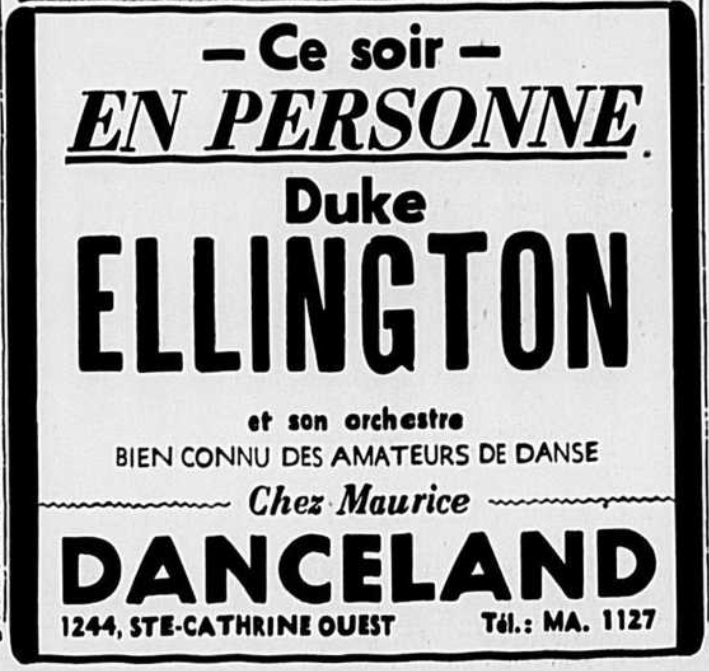
The Chez Maurice Danceland quickly established itself as one of Montreal’s major jazz venues. In the fall of 1943, the establishment hosted the orchestra of Duke Ellington for a one-night engagement before a packed house. The dance floor, quickly overcrowded, gave way to an atmosphere that often resembled a concert more than a dance, as a young and attentive audience gathered to listen to highly sophisticated arrangements [11].
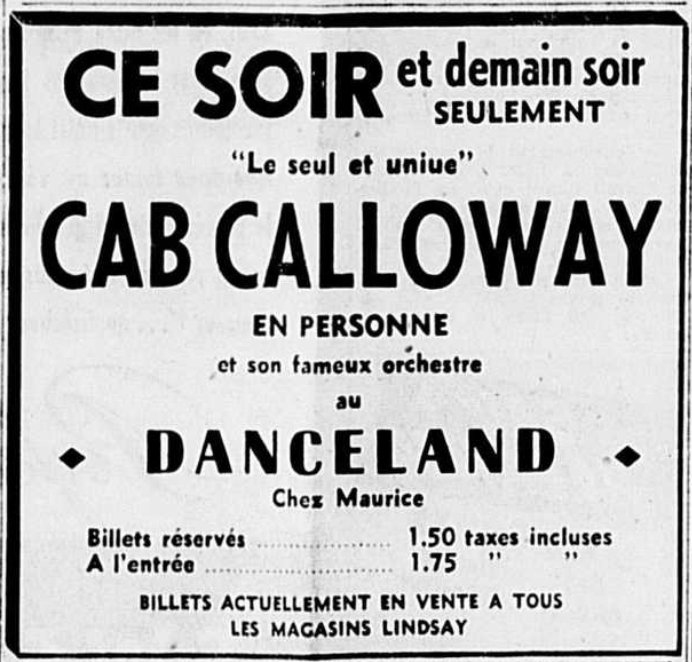
A few weeks later, at the end of November 1943, Chez Maurice further strengthened this position by welcoming Cab Calloway and his orchestra associated with the Cotton Club, beginning on November 29. A major figure in jazz and North American entertainment, Calloway received extensive media coverage and took part in numerous promotional activities, including a public appearance at Lindsay’s on Sainte-Catherine Street, on the occasion of the release of the film Stormy Weather [105], [106].
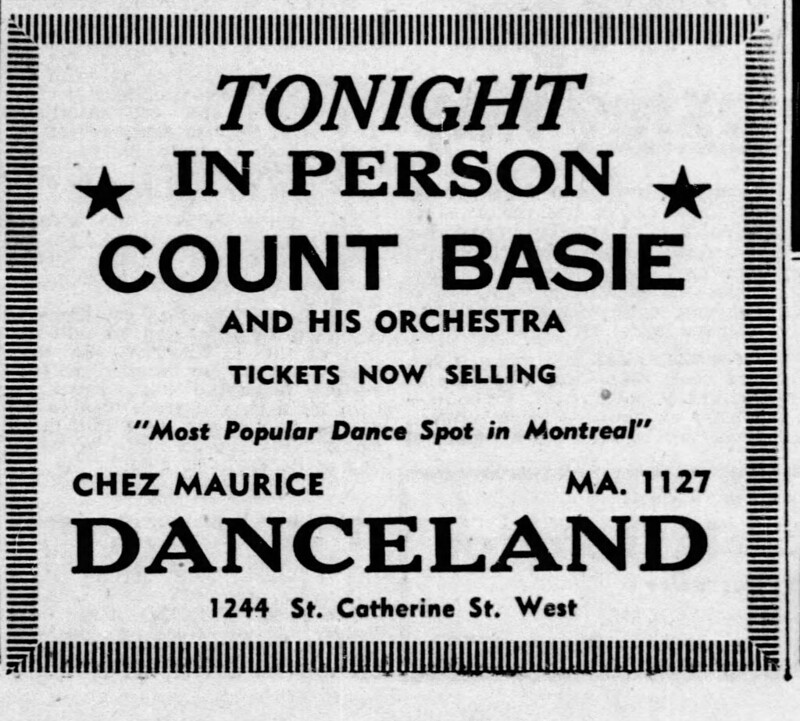
At the turn of 1943–1944, this momentum continued with the arrival of Count Basie and his orchestra, presented in the press as a major attraction at the “Most Popular Dance Spot in Montreal” [12]. These successive engagements — Ellington, Calloway, Basie — confirm Montreal’s integration into the international jazz circuits, even in the midst of war, and made Chez Maurice Danceland a central site of Montreal nightlife [11], [12], [105], [106].

Al Palmer (c. 1913–1971)
A notable figure in twentieth-century Montreal journalism, Al Palmer emerged as one of the columnists most closely associated with the city’s nightlife, cultural, and social life. Active from the 1920s onward, he began his career at the Montreal Herald before working as a correspondent for The Canadian Press, and later continuing his career at The Gazette and the Sunday Express, covering several decades of urban and cultural transformation [103], [104].
A versatile journalist, Palmer distinguished himself especially in crime reporting, a field in which he developed a vast network of contacts and a reputation built on trust, discretion, and an intimate knowledge of the milieus he covered. His reporting, often tied to crimes, fires, and local incidents, reflects a Montreal in full ferment, particularly in the 1940s and 1950s [102].
Alongside this fieldwork, he became an important voice in urban commentary through his columns, including “Man About Town” in the Montreal Herald and especially “Ourtown” in The Gazette, in which he offered a personal reading of the city, attentive to its inhabitants, its neighborhoods, and their transformations. His writings, widely followed by a varied public — ranging from judges to taxi drivers — helped shape a living memory of Montreal, especially of the downtown and eastern districts he particularly cherished [102], [104].
A privileged observer of the nightlife scene, Palmer moved within and documented the worlds of entertainment, cabarets, and performance venues, at the crossroads of artistic, journalistic, and police circles. His name is associated with a generation of columnists who helped define the image of a vibrant Montreal, both fashionable and marginal, whose figures and atmospheres he captured with sensitivity [100].
Beyond his journalistic work, Palmer was also recognized for his human qualities: described as a respectful, generous man deeply attached to people, he served as a mentor to many younger colleagues. His approach to the profession rested on a sincere attentiveness to individuals, considering that journalism consisted above all in telling the stories of people, their actions, and their realities [102].
His death in March 1971, at the age of 57, following a cerebral hemorrhage, caused a strong emotional reaction in Montreal’s journalistic and cultural circles. The funeral brought together a crowd particularly revealing of the breadth of his network and influence: journalists, police officers, figures from the cabaret world, press agents, and personalities from Montreal nightlife mingled there, evoking a scene worthy of a Damon Runyon story. Among those present were Phil Maurice, Solly Silver, Toe Blake, Andy Cobetto, as well as the Hill brothers, all figures associated with Montreal’s nightlife, sports, and media worlds, illustrating Palmer’s central role as a point of convergence between these different circles and the esteem in which he was held by his peers [100], [101].
Through his career and the tributes that followed his death, Al Palmer appears as a privileged witness and an essential chronicler of a Montreal that has now disappeared, whose voices, places, and characters he captured with rare accuracy.
11. From the Postwar Years to Bebop: Continuities and Transformations (1944–1948)
In the spring of 1944, the Chez Maurice Danceland confirmed its central role in the diffusion of major American swing bands by announcing the arrival of leading bandleaders, including Johnny Long and Jimmie Lunceford. This programming formed part of a formula clearly oriented toward dancing, also marked by the organization of jive contests accompanied by the orchestra of Roland David [22], [23].
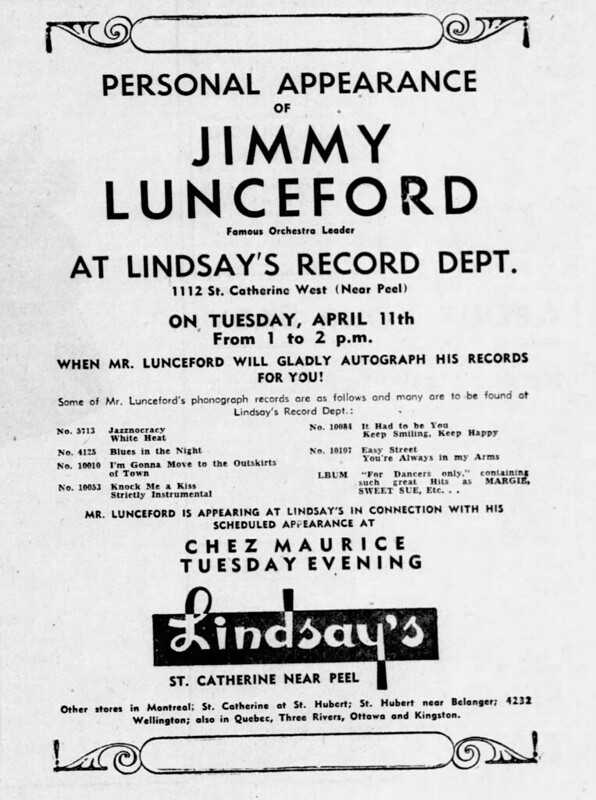
Jimmie Lunceford’s presence gave rise to sustained promotional activity, notably through a public appearance at Lindsay’s on Sainte-Catherine Street, where he met his admirers and signed autographs on the very day of his performance. This type of initiative illustrates the integration of Chez Maurice into North American swing circuits, where in-house performances, commercial promotion, and direct interaction with the public were closely intertwined [22], [23].
After the war, the Danceland remained a major venue for dancing and big bands. In March 1946, an article in The Montreal Star highlighted the popularity of singer Russ Vanelli, presented as a new sensation on the Montreal scene. Accompanied by Roland David and his 16-piece orchestra, Vanelli drew large crowds of dancers every evening [108].
In October 1946, the Chez Maurice Danceland recorded one of the largest turnouts in its history with Johnny Holmes, whose performances attracted more than 2,000 people in the evening. According to the press, this exceptional attendance even surpassed that generally associated with major American bands passing through Montreal, testifying to the vitality of the local audience and the establishment’s central role in postwar nightlife.
The programming continued in 1947 with the presence of trumpeter Maynard Ferguson, leading an 18-piece orchestra, as well as singer Henry Scott, illustrating the importance of vocalists in the big jazz bands of the period [111]. In December 1947, the celebrated drummer Gene Krupa and his orchestra also performed there, confirming the Danceland’s place within North American swing circuits [20].

By the late 1940s, however, the programming of the Chez Maurice Danceland reflected a broader transformation in the North American jazz landscape. After having been dominated through the first half of the decade by swing big bands, the establishment gradually opened itself to the emerging forms of bebop, embodied in particular by the appearance of trumpeter Dizzy Gillespie in 1948 [13].
A leading figure of this new movement, Gillespie introduced a more complex musical language, marked by fast tempos, daring harmonies, and a virtuoso approach to improvisation, breaking with the more accessible codes of swing intended for dancing. His presence at Chez Maurice testifies to the evolution of audiences and expectations, as attentive listening gradually tended to supplant the primary function of the dance floor.
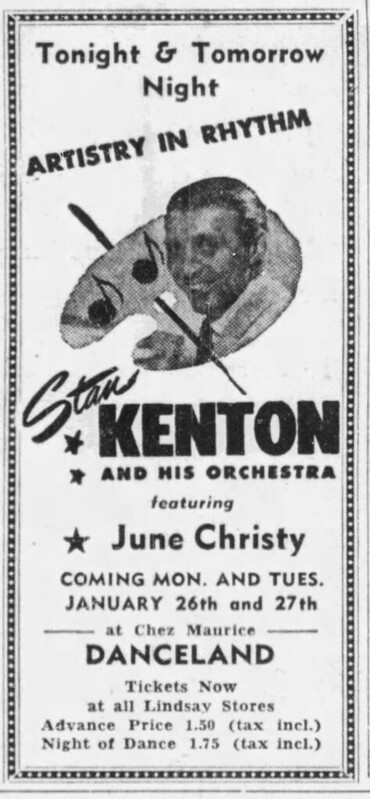
This transition was confirmed by the arrival of Stan Kenton in 1948. An article in The Montreal Star reported the strong turnout at the Chez Maurice Danceland, where his orchestra of about 20 musicians impressed audiences through the power of its brass section, the boldness of its arrangements, and its energy. The evening notably featured singer June Christy, as well as musicians such as Eddie Safranski and Shelly Manne. An advertisement also announced a “Coke Party” and a personal appearance by Kenton at Lindsay, tied to his recordings for Capitol Records [109], [110].
Despite the emergence of bebop, the Danceland continued to welcome major swing figures. In October 1948, bandleader Jimmy Dorsey performed there as part of a broad North American tour. Still immensely popular, he embodied a more accessible and dance-oriented style, in continuity with the swing of the preceding years [15].
This coexistence between swing big bands and bebop innovations illustrates a pivotal moment in the history of Chez Maurice, where two musical generations overlapped: one still deeply tied to dancing and popular entertainment, the other oriented toward listening, virtuosity, and artistic exploration [13], [15], [20], [109], [110], [111].
12. 1949: Renewed Prestige and the Great Voices of Jazz
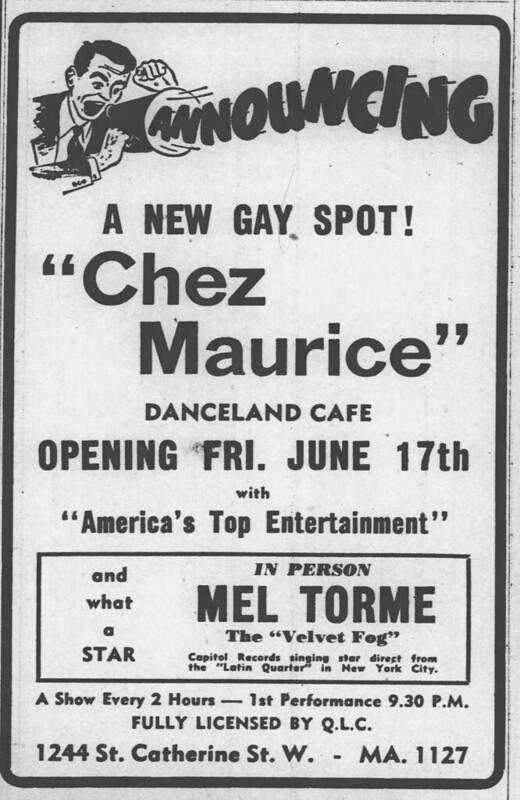
In 1949, the Chez Maurice Danceland Café continued to present itself as one of the major venues of Montreal entertainment. An advertisement published in The Gazette in June 1949 described it as a “new gay spot” — an expression then used to designate a festive, lively, and modern place — and highlighted a program inspired by the great American stages [107].

The opening scheduled for Friday, June 17 was announced as an exceptional event, with a show titled “America’s Top Entertainment”, expressing the cabaret’s desire to align its image with the great centers of North American entertainment. This orientation was confirmed by the presence of Mel Tormé as headliner, a Capitol Records star presented as arriving directly from New York’s Latin Quarter [107].
The program planned performances at regular intervals, with one show every two hours and a first presentation at 9:30 p.m., reflecting an intensive operating model aimed at maximizing attendance and extending activity across the whole evening. The advertisement also insisted that the establishment was “fully licensed by Q.L.C.”, emphasizing its regulatory compliance in a context where cabarets remained closely monitored [107].

In the summer of 1949, Chez Maurice welcomed American singer Sarah Vaughan, then at the height of her popularity and an emblematic figure of vocal bebop. Presented as the “Bop Girl” and recipient of the Esquire award for “Singer of the Year”, she performed alongside Paul Rich and the orchestra of Wally Newman, in a continuous-performance format. Her engagement was accompanied by strong media visibility, including a public appearance at Lindsay’s store [16], [17].
In December 1949, Chez Maurice also welcomed Ella Fitzgerald, whose presence was emphasized by both the press and a major advertising campaign. Presented as the “First Lady of Song”, she gave a performance praised for her vocal mastery, stage ease, and ability to captivate the audience through a repertoire combining standards and popular numbers [18], [19].
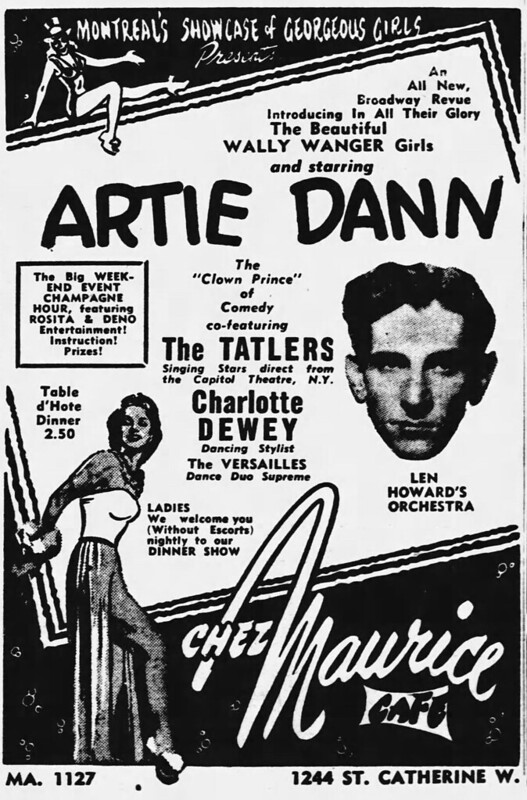
Her appearance formed part of a full Broadway-style revue, including the Wally Wanger Girls as well as various variety acts, within a formula combining dinner and show characteristic of Montreal cabaret at the time. On the eve of the 1950s, Chez Maurice thus retained its prestige as a privileged venue for the presentation of the great voices of jazz and North American entertainment [18], [19], [107].
13. 1950: Transformation of the Site
At the turn of the 1950s, the site of Chez Maurice underwent a significant transformation that reflects a broader shift in Montreal entertainment practices. The opening of Leone’s in 1950 marked the gradual abandonment of the large-scale cabaret model in favor of a formula centered on gastronomy and a subdued atmosphere, in which music became an accompanying element rather than the main attraction. Described as a venue entirely reimagined, both in its décor and in its offerings, Leone’s provided an Italy-inspired experience, with an elegant setting, discreet musical programming, and a strong emphasis on service and cuisine [115], [116]. This evolution illustrates the shift from a culture of spectacular entertainment toward a form of more intimate and fashionable entertainment, characteristic of Montreal nightlife in the early 1950s.
A notice published in the Gazette officielle du Québec in 1952 indicates that Leone’s Restaurant Inc. adopted the name Wonderbar Ltd., confirming a new transformation of the site formerly occupied by Chez Maurice. This succession of corporate changes illustrates the rapid evolution of the venue in the early 1950s, as the establishment continually adapted to new trends in Montreal nightlife [119].
A notice published in the Gazette officielle du Québec in 1953 confirms that the company operating the former Chez Maurice adopted the name Sans Souci Café Inc., after having successively been known as Leone’s Restaurant Inc. and Wonderbar Ltd.. This corporate continuity highlights the rapid and repeated transformation of the site in the early 1950s, reflecting the changes in Montreal nightlife [120].
Chez Maurice — Corporate Evolution (1930–1953)
14. Legacy and the End of an Era
An article published in The Gazette on May 28, 1963, announcing the closure of Her Majesty’s Theatre, symbolically marks the end of an era for Montreal entertainment. The text returns to the historical importance of the venue and evokes the role of several notable figures in the field, including Phil Maurice, who still appears as an active player in Montreal’s cultural landscape more than thirty years after his beginnings in the cabaret world [95].
The article emphasizes that Maurice remained involved in the organization and promotion of shows, notably through his ties to theatrical networks and the city’s cultural institutions. This late presence testifies to the longevity of his career and to his capacity to adapt to the evolution of the entertainment world, moving from the cabaret and vaudeville of the 1930s to the more institutionalized forms of performance in the 1950s and 1960s.

The closure of Her Majesty’s Theatre, with which Phil Maurice was also associated at different moments in his career, highlights the gradual decline of the major traditional venues in favor of new models of cultural presentation. In this context, his trajectory illustrates that of a key intermediary between two eras: the golden age of Montreal cabarets and the modern reorganization of the entertainment industry in Quebec [95].
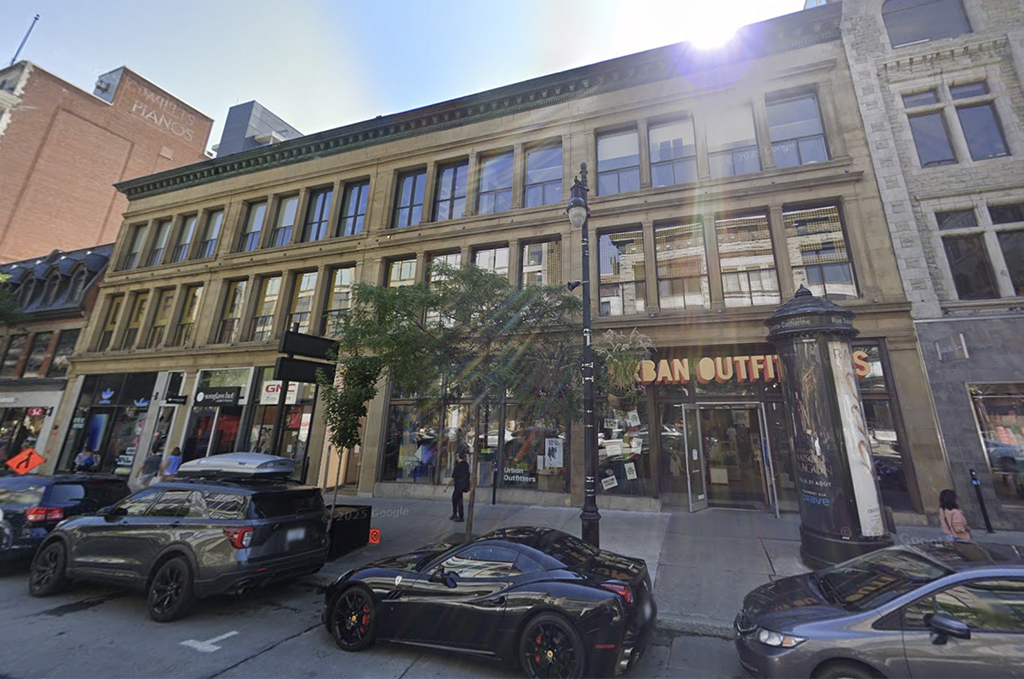
Through his sense of spectacle, his work as a promoter, and his theatrical networks, Phil Maurice ranks among the figures who helped shape Montreal’s reputation as the “Paris of America”. The historic premises of the Chez Maurice Danceland now correspond to the upper floor of the Urban Outfitters store on Sainte-Catherine Street, a discreet reminder of the location once occupied by one of the high places of Montreal entertainment [22], [14].
15. Conclusion
The history of Chez Maurice lies at the heart of the transformation of Montreal nightlife in the twentieth century. Born in the late 1920s in the wake of the Old Heidelberg, the cabaret became, under the impetus of Phil Maurice, one of the most emblematic venues of the golden age of urban entertainment, where gastronomy, performance, and fashionable sociability converged.
From St. Alexandre Street to Sainte-Catherine Street West, Chez Maurice both accompanied and embodied the major transformations of the milieu: the rise of the dinner show, the growth of grand revues, the triumph of swing orchestras, and then the transition toward new musical and cultural forms. Through its programming and its reach, it helped place Montreal within North American entertainment circuits, to the point of making it, for a time, a genuine center of international entertainment.
Its disappearance at the turn of the 1950s, followed by the rapid transformation of the site, did not simply mark the end of an establishment, but the end of a model. The shift from the spectacular cabaret to more intimate venues reflects a profound change in cultural practices and public expectations, in a context where the city itself was being redefined.
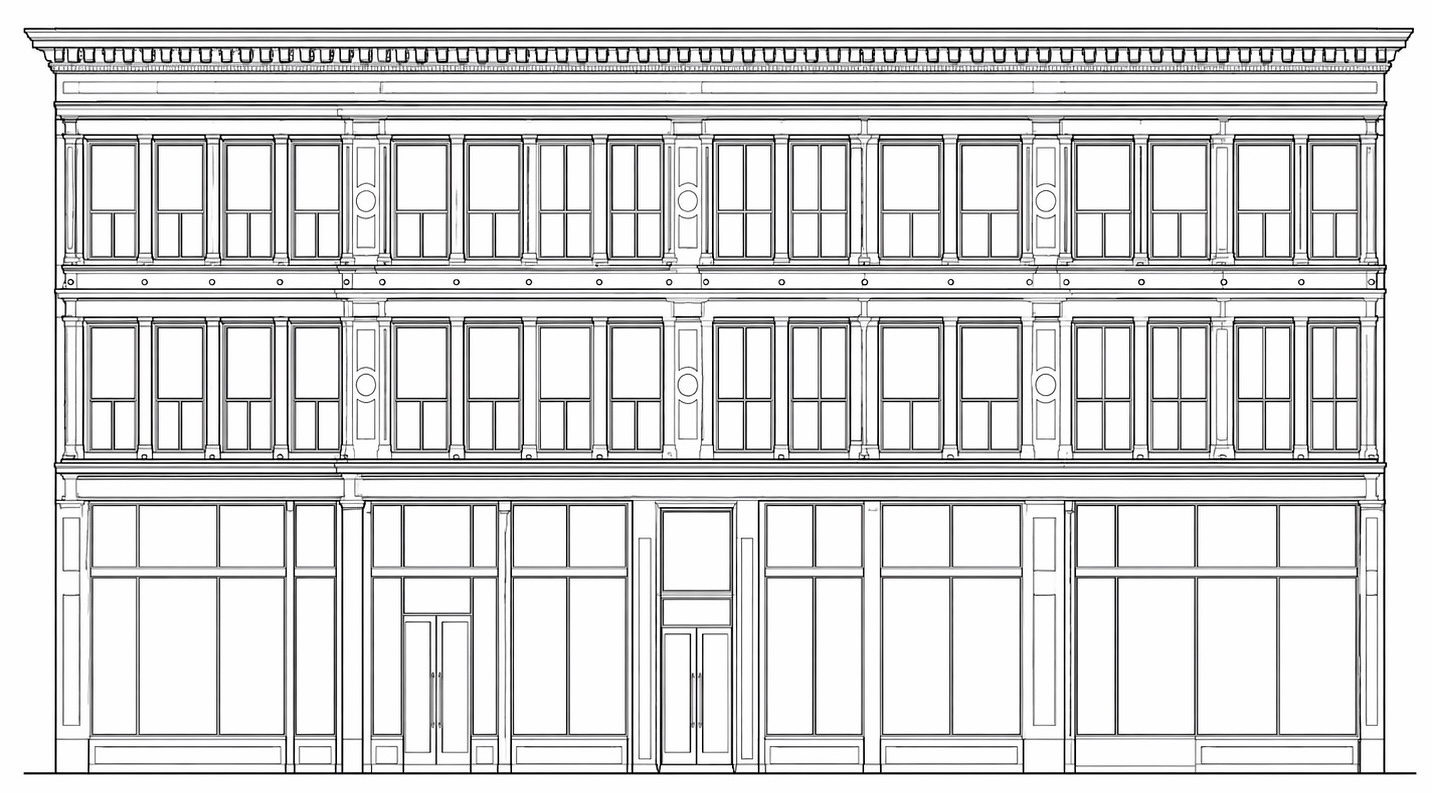
Today, all that remains of Chez Maurice is an anonymous commercial space integrated into the contemporary landscape of Sainte-Catherine Street. Yet behind this ordinary façade lies the imprint of a place that, for nearly two decades, helped shape the Montreal nighttime imagination. Through its history, an entire chapter of the city’s cultural memory comes into view — that of a vibrant, fashionable Montreal, deeply connected to the great stages of the world.
16. Notes & sources
-
THE GAZETTE, January 20, 1983.
Obituary article titled “City showman Phil Maurice dead at 82”. The text retraces the career of Phil Maurice, impresario and cabaret owner, considered one of the notable figures of Montreal entertainment in the twentieth century. He is presented as a key player in the golden age of live entertainment in Montreal, having brought numerous international stars to the city, including Marlene Dietrich, Katharine Cornell, Charles Laughton and Olivia de Havilland. The article notably highlights the opening of the Chez Maurice Cabaret on Sainte-Catherine Street in the early 1930s, described as one of the most luxurious establishments in the country, as well as his role in presenting Broadway productions in Montreal, including Fiddler on the Roof, Man of La Mancha and Mame. The text also mentions his activities within the Montreal Convention and Visitors Bureau, as well as his involvement in various cultural and sporting organizations. A photograph accompanies the article, showing Maurice holding posters for shows presented at Salle Wilfrid-Pelletier at Place des Arts. This document constitutes an important retrospective source on Maurice’s career and on the role of impresarios in the development of Montreal nightlife and cultural life. -
THE MONTREAL DAILY STAR, July 4, 1929.
Advertisement titled “Announcing the Summer Opening — The Patio”, announcing the summer opening of the “Patio” of the Old Heidelberg Cafe, presented as a restaurant cabaret. The advertisement specifies that the establishment is now operated under a new management, that of Phil Maurice. The program includes dinner dances accompanied by a full revue between 6 p.m. and 9 p.m., followed by an evening cabaret program from 10 p.m. until closing. The poster features the Ambassadors as well as a Broadway Revue, indicating an orientation toward shows inspired by New York productions. This document marks an important stage in the evolution of the Old Heidelberg, attesting to its transformation into a structured cabaret-style entertainment venue and to its integration into the show circuits directed by Phil Maurice, a major figure in Montreal nightlife in the late 1920s. -
THE MONTREAL STAR, April 29, 1932, p. 6.
Detailed account of the opening night of the new Chez Maurice, presented as one of the most brilliant openings seen in Montreal since the rise of modern cabarets. The article emphasizes the complete transformation of the former Venetian Gardens, “literally unrecognizable,” redesigned by Phil Maurice with an elegant décor in bold colors and carefully planned lighting, creating an atmosphere that is both refined and immersive. The spatial organization of the venue is also described in detail: the orchestra is placed centrally so as to be visible to all, while the performers make their entrance behind it and descend a few steps to reach the floor, a device that visually structures the show and reinforces its theatrical character. The dance hall, packed to capacity, is animated by a continuous festive atmosphere, the article emphasizing that gaiety reigns from beginning to end of the evening. The program brings together a substantial cast of performers, offering a show judged comparable to the standards of the great New York cabarets. Singer Helen Morgan, presented as ever charming and expressive, performs several of her best-known numbers, accompanied on the piano, and receives enthusiastic applause from the audience, which even joins in on the refrains. Among the other performers mentioned are Helen Manning, Olive Faye, described as a versatile artist who sings and dances, Marion Young, as well as the duo Pepita and Rhoda, whose dance numbers — notably a tango and a waltz — are praised for their grace and precision. The entire program is presented as exceptional, confirming that Chez Maurice established itself from its opening as a leading cabaret in Montreal nightlife. -
LA PRESSE, April 27, 1932, p. 8.
Article announcing the opening of the new cabaret Chez Maurice, set up in the former premises of the Venetian Gardens, entirely redesigned for the occasion. The text highlights the American singer Helen Morgan, presented as a star of the Ziegfeld Follies and of the cinema, recently engaged at the Mayfair Club in Boston, and announced as the main attraction from the opening. The article emphasizes Morgan’s reputation, known for her style of interpretation combining dramatic intensity, simplicity, and melancholy, as well as for a repertoire that included several popular songs she helped make famous in New York. Her presence confirms the ambition of Chez Maurice to offer programming of a high level, as part of the international entertainment circuits. The text also insists on the complete transformation of the venue, marking the transition to a new phase in the history of the establishment. -
THE MONTREAL STAR, February 25, 1933, p. 21.
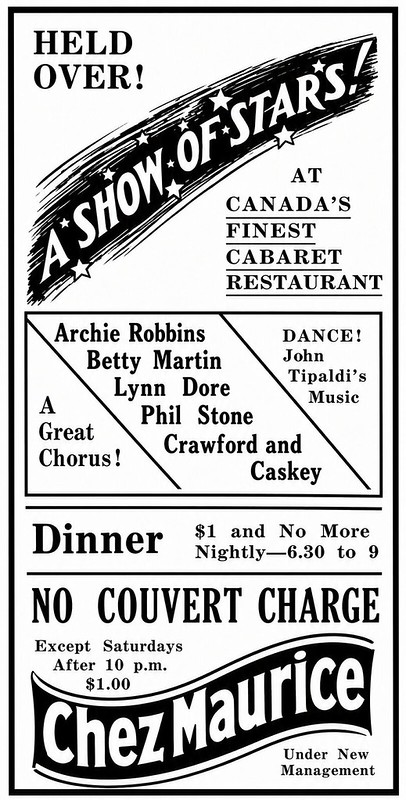
Advertisement presenting the Chez Maurice and the seventh edition of the “Chez Maurice Revue”, produced by Jack Pomeroy and inaugurated during a gala evening on Monday at 7:30 p.m.. The cast includes, among others, Archie Robbins, Crawford and Canley, Lynn Dore, Betty Martin and Phil Stone, accompanied by a group of chorus girls described as “the loveliest girls Montreal has ever beheld.” The music is provided by John Tipaldi and his orchestra. The advertisement also highlights an attractive commercial policy, with no cover charge (except on Saturdays) and no minimum, underscoring the establishment’s desire to attract a broad audience. -
THE GAZETTE, May 9, 1933, p. 2.
An article announces the upcoming opening of the Villa Maurice, a new cabaret-restaurant founded by Phil Maurice on Stanley Street. Presented as an establishment intended to enrich Montreal nightlife, the venue continues the reputation acquired by Maurice, described as one of the principal architects of Montreal’s image as the “Paris of America.” The Villa Maurice is conceived as a more intimate space, aimed at a nighttime clientele in search of an atmosphere that is at once “cosy, warm and friendly.” The article emphasizes the quality of the layout, décor and lighting, as well as the presence of a dance orchestra and cabaret shows featuring top-level performers. Maurice expresses his intention to create an elegant yet accessible place, offering a combination of dining, dancing and entertainment in a refined setting, intended as much for visitors as for Montreal clientele. -
THE GAZETTE, February 24, 1934, p. 4.
Article titled “Police Move Again to Curb Violation of Cabaret Laws”. The text reports a new series of interventions by the Montreal Police Service targeting several cabarets and nightclubs accused of violating regulations, particularly with regard to curfew and Sunday laws. The Villa Maurice, an establishment on Stanley Street operated by Phil Maurice, is among the venues targeted by these proceedings. However, the 26 charges filed are ultimately dismissed for technical reasons, as the prosecutions had been brought against an incorrect legal entity (Maurice Amusement Corporation Ltd.) rather than against the actual operators. The article nonetheless underscores the determination of municipal authorities to strengthen their control over Montreal nightlife, in a context marked by tensions between regulation, public morality and cabaret activities. -
THE GAZETTE, September 17, 1938, p. 11.
Article announcing the appointment of Phil Maurice as manager of the Loew’s Theatre by Consolidated Theatres Ltd., in the context of the integration of this venue into the network of first-run cinemas in Montreal. The text emphasizes the importance of the renovation work undertaken in the theatre, including major improvements to the hall, as well as an investment of more than 75,000 dollars. The reopening is planned with a new program combining vaudeville acts and first-run films, accompanied by an orchestra led by Jerry Shea. -
THE MONTREAL STAR, August 19, 1933, p. 19.
Article announcing the introduction of a new entertainment formula at the Villa Maurice, under the impetus of Phil Maurice. The text highlights a new floor show presented as an innovation in the Montreal cabaret scene, combining humor, music and variety acts. The cast includes, notably, singer Wynne Wayne and comedian Bob Brandies, whose style draws inspiration from major American vaudeville figures such as Dan Healy, Phil Baker and Jack Benny. The article also mentions the popularity of the number “Hollywood Horse,” incorporated into the new production. -
THE GAZETTE, October 6, 1971, p. 9.
Article highlighting the tribute paid to Montreal impresario Phil Maurice by the Canadian Motion Picture Pioneers. The text recalls his active role from 1938 onward within Famous Players, as well as his involvement in presenting Broadway productions in Montreal, including Fiddler on the Roof, Man of La Mancha and Mame. The article also stresses his contribution to bringing major international show-business figures to Montreal, including Marlene Dietrich, Anne Baxter, Katharine Cornell, Charles Boyer, Helen Morgan, Sir Cedric Hardwicke, Charles Laughton, Olivia de Havilland, Alfred Lunt, Lynn Fontanne and Joseph Cotten. -
THE GAZETTE, November 17, 1943, p. 3.
Article recounting the appearance of Duke Ellington and his orchestra at the Chez Maurice Danceland for a one-night engagement, before a packed house. The dance floor quickly became saturated at the beginning of the evening, as the orchestra took over from local bandleader Rolland David. The report emphasizes that the event resembled a concert more than a dance, the audience — composed largely of young spectators — remaining attentive, silent and admiring before the sophistication of Ellington’s arrangements. Several numbers nevertheless triggered bursts of enthusiasm, provoking spontaneous applause and gatherings around the orchestra stand. Although dancing was relatively limited, certain jive demonstrations attracted attention and created crowds, testifying to the cultural impact of this music on Montreal audiences. The article also specifies that Ellington’s engagement constituted the second appearance of a major American orchestra in this series, after that of Jan Savitt, confirming the strategy of the Danceland to position Montreal as a stop on the tours of major North American jazz orchestras in the midst of the Second World War. -
THE GAZETTE, January 3, 1944, p. 3.
Advertisement announcing the performance of American bandleader Count Basie and his orchestra at the Chez Maurice Danceland, presented as the “Most Popular Dance Spot in Montreal.” The advertisement highlights the exceptional popularity of the establishment as well as the arrival of another major first-rank American jazz orchestra, in continuity with the recent engagements of prestigious ensembles. Basie’s presence, as a major figure of swing and the international jazz circuits, confirms the role of Chez Maurice as a privileged venue for the presentation of major North American tours in Montreal during the Second World War, while also underscoring the importance of the Danceland as a central space of the dancing and musical culture of the period. -
THE GAZETTE, April 15, 1948, p. 6.
Article announcing the appearance of American trumpeter Dizzy Gillespie and his orchestra at the Chez Maurice Danceland for engagements on April 20 and 21, 1948. Presented as the leader of a “new musical current,” Gillespie was then associated with the emergence of bebop, described as a radical evolution of jazz, marked by innovative interpretations and revolutionary instrumental techniques. The article emphasizes the scale of his influence, evoking hundreds of thousands of followers of his style, while insisting on the inimitable character of his playing. This booking testifies to the adaptation of Chez Maurice to the new trends of postwar jazz and to its role in introducing modern forms of the genre to Montreal, beyond the swing that had dominated in previous years. -
MARRELLI, Nancy, Stepping Out: The Golden Age of Montreal Night Clubs, 1925–1955, Montreal, Véhicule Press, 2004, p. 36.
The book presents the Club Deauville as a new cocktail bar created within the Chez Maurice during the reopening of the establishment in the spring of 1937. More intimate than the main hall, the Deauville is described as a distinct space dedicated to cocktails, while the rest of the cabaret continues to offer meals, dancing and floor shows. The text also emphasizes the connections between Chez Maurice, the Club Lido and other Montreal establishments through the career of musician Joe Bell, whose archives were later deposited in the Concordia University Archives. -
THE MONTREAL STAR, October 12, 1948, p. 26.
Advertisement and article recounting the appearance of American bandleader Jimmy Dorsey and his orchestra at the Chez Maurice Danceland for a performance on October 18, 1948. Presented as one of the most popular bandleaders of his era, Dorsey was returning from a West Coast tour and continuing a circuit of major vaudeville houses and prestigious hotels throughout North America, including New York, Chicago and Hollywood. The article emphasizes the quality of his orchestra, composed of musicians drawn from radio and recording studios, as well as the presence of prominent vocalists, including Larry Noble and Dottie O’Brien. This booking confirms the continued importance of Chez Maurice as a major stop on American tours, even at a time when musical styles were evolving and swing coexisted with emerging forms of modern jazz. -
THE MONTREAL STAR, July 15, 1949, p. 10.
Show advertisement at Chez Maurice (Danceland) featuring Sarah Vaughan, presented as the “Bop Girl” and winner of the Esquire award for “Singer of the Year.” She is accompanied by Paul Rich and the orchestra of Wally Newman, with continuous shows beginning at 9:30 p.m.. This advertisement illustrates the evolution of the programming toward a more modern jazz, marked by the emergence of bebop, and confirms the role of Chez Maurice as a venue welcoming major jazz figures at the end of the 1940s. -
THE MONTREAL STAR, July 18, 1949, p. 11.
Advertisement confirming the presence of Sarah Vaughan, an artist of Columbia Records, at Chez Maurice, as well as a public appearance at Lindsay’s, located at the corner of Sainte-Catherine and Peel streets, on July 19, 1949 at 3 p.m.. This promotional activity testifies to the media importance of her visit to Montreal and to the integration of the cabaret into the commercial and cultural circuits of downtown [17]. -
THE GAZETTE, December 7, 1949, p. 12.
Article announcing the appearance of Ella Fitzgerald at Chez Maurice, described as a renowned singer endowed with a “satin voice.” The text emphasizes the quality of her performance, her stage ease, and the enthusiastic reception of the audience, notably through a repertoire including Robin’s Nest, I Can Dream, Can’t I and Don’t Cry Joe. Her ability to captivate the audience, as well as her noted imitation of Louis Armstrong, are highlighted. The article also mentions the presence of other acts on the bill, including the skating team Woody and Bobby, as well as the orchestra of Len Howard, illustrating the diversity of the shows presented at Chez Maurice at the end of the 1940s [18]. -
THE GAZETTE, December 5, 1949, p. 12.
Advertising notice for Chez Maurice featuring Ella Fitzgerald, presented as the “First Lady of Song” and an artist associated with Decca Records and the NBC network. The show forms part of a Broadway-style revue including the Wally Wanger Girls, as well as several variety acts, including Woody & Bobby (skating), Charles Julian (singing and dancing) and Ralph Lewis as master of ceremonies. The advertisement also highlights a formula combining dinner and show, with a main performance at 8:45 p.m., illustrating the integrated entertainment model of the cabaret at the end of the 1940s [19]. -
THE GAZETTE, December 1, 1947, p. 10.
Advertisement for the Chez Maurice Danceland featuring American drummer Gene Krupa and his orchestra for a series of two evenings on December 3 and 4, 1947. The program also includes Buddy Hughes, Dolores Hawkins and a jazz trio, while the advertisement highlights a regular program of music and dancing, with different orchestras depending on the day of the week. This advertisement illustrates the importance of the Danceland as a venue for major North American swing figures at the end of the 1940s, within a formula centered on dancing and touring orchestras [20]. -
THE GAZETTE, June 3, 1978, p. 114.
Article by David Sherman devoted to Phil Maurice, looking back on the opening of Chez Maurice in 1930, presented as one of the most elegant cabarets in Canada. The establishment, with a capacity of about 400 people, offered ambitious programming featuring first-rank artists, sometimes engaged at $10,000 a week, including Helen Morgan and Harry Richman. The text also emphasizes the decisive role of Roy Cooper, Maurice’s associate, with whom he formed an influential duo in Montreal nightlife. Their booking activity helped feed a vast network of cabarets, including the Stanley Grill, the Embassy Terrace, the Lido and the Golden Dome. The article finally mentions the presence of emerging performers such as Red Skelton, engaged early in his career, confirming the role of Chez Maurice in the development of the modern cabaret in Montreal. -
THE MONTREAL STAR, March 24, 1944, p. 15.
Advertisement for the Chez Maurice Danceland presenting a series of shows featuring renowned orchestras, including Johnny Long (April 7, 1944) and Jimmie Lunceford (April 11, 1944), two important figures of American swing. The advertisement also emphasizes the holding of a jive contest with cash prizes, accompanied by the participation of Roland David and his 14-piece orchestra. This advertisement testifies to the role of the Danceland as a space dedicated to dancing and to big swing bands, combining concerts, competitions and regular programming in a formula of popular entertainment at the heart of 1940s Montreal [22]. -
THE MONTREAL STAR, April 10, 1944, p. 6.
Advertisement announcing a public appearance by bandleader Jimmie Lunceford at Lindsay’s, located on Sainte-Catherine Street West, on April 11, 1944, where he meets the public and signs autographs. This activity is presented as being directly connected with his engagement at Chez Maurice the same evening. The advertisement highlights the importance of promotional strategies associated with the tours of major American orchestras, combining media presence, record retailing and in-house performances in 1940s Montreal [23]. -
THE GAZETTE, October 22, 1946, p. 3.
An article reports that bandleader Johnny Holmes and his orchestra set an attendance record at the Chez Maurice Danceland, attracting an exceptional crowd. The afternoon session, beginning at 2:30 p.m., drew a strong attendance that continued to grow into the evening, when the crowd exceeded 2,000 people, a peak for this dance hall. The press emphasizes that this performance even surpassed the results achieved by several renowned American orchestras, confirming Holmes’s popularity with Montreal audiences and the role of the Danceland as a major gathering place for lovers of music and dancing in the postwar period. -
LA PATRIE, January 28, 1928.
Advertisement titled “Official opening of the ‘Old Heidelberg’ Café”, announcing the inauguration of the establishment located at the corner of Mayor and Saint-Alexandre streets. The text presents the restaurant as a new downtown Montreal space, highlighting a main dining room described as “unique of its kind,” adorned with massive beams and decorated in an old-world style. The advertisement specifies the service arrangements, including lunch served from 12 p.m. to 2:30 p.m. and dinner in the evening, accompanied by a five-piece orchestra. It also emphasizes the quality of the cuisine, the presence of a European chef, pastries prepared on site, as well as the modernity of the facilities. A photograph included in the publication shows a large and elegant dining room, testifying to the scale of the establishment. The whole positions the Old Heidelberg as a venue intended for an urban clientele, notably as an after-theatre rendezvous and a place for the business community. -
LA PATRIE, January 30, 1928.
Article titled “Brilliant opening of the Old Heidelberg Restaurant”, reporting on the official inauguration of the establishment located at the corner of Mayor and Saint-Alexandre streets. The text describes an opening marked by strong attendance and a favorable reception, highlighting the enthusiasm of the public from the very first evening. The article emphasizes the role of manager J. Tinhof, whose management is presented as efficient and promising for the future of the restaurant. It also stresses the quality of the musical offering, provided by a five-piece orchestra described as “first-rate,” as well as the announced presence of regular concerts including both classical pieces and a more varied repertoire. This report confirms the positioning of the Old Heidelberg as an ambitious establishment combining dining and musical programming, and intended to establish itself durably within Montreal nightlife at the end of the 1920s. -
GAZETTE OFFICIELLE DU QUÉBEC, December 17, 1927, no. 50, p. 3856.
Publication of the letters patent incorporating the company “Old Heidelberg Cafe, Limited”, incorporated on November 23, 1927 under the Quebec Companies Act. The document identifies the principal founding members, all residing in Montreal, including John Tinhof (restaurant manager), Frederick Everett Partridge (manufacturer), Hugo Wellein and Lorne Muir Coughtry (accountants), as well as Elsie Chappell, secretary. The company’s share capital is set at 250 cumulative preferred shares at 7%, with a nominal value of 100 dollars each, and 2,500 common shares without par value. The preferred shares benefit from priority rights in the event of liquidation, are redeemable at their nominal value, and include specific provisions regarding dividend payments and voting rights. The letters patent define a broad scope of activities, authorizing the company to operate taverns, restaurants, hotels, bakeries, delicatessen businesses, grocery stores and provision shops, as well as to invest in, acquire and manage securities. The company’s head office is established in Montreal. This document constitutes a fundamental source for understanding the legal and financial structure of the project behind the Old Heidelberg, confirming that from its inception it was an organized and capitalized enterprise operating within an expanded commercial framework. -
THE GAZETTE, August 18, 1943.
Obituary article titled “J. G. Tinhof, 62, Dies”, devoted to John George Tinhof, a well-known Montreal restaurateur. The text indicates that he died at the Montreal General Hospital after a two-week illness, at the age of 62. Born in Vienna in 1881, Tinhof immigrated to Canada around 1912 and worked almost continuously in the restaurant industry from the time of his arrival. He became particularly known as a manager for Frank De Rice Inc., a company associated with curb-service establishments on Décarie Boulevard. The article also recounts a striking episode from his personal life: a few years earlier, he narrowly escaped drowning in the St. Lawrence River at Caughnawaga, while two of his companions perished after their boat capsized. On the family side, he is survived by his wife, née Ella Thomson, as well as their three children: Hubert, Jack and Nora. The funeral was to take place at the chapel of Wm. Wray Inc., on University Street, followed by burial at Mount Royal Cemetery. This document constitutes an essential source for tracing the life of J. G. Tinhof, identified as manager of the Old Heidelberg at the time of its opening in 1928, and helps to better situate his role within the Montreal restaurant scene during the first half of the twentieth century. -
THE GAZETTE, July 1, 1940.
Article titled “Two Men Drowned, One Rescued As Boat Tips Off Caughnawaga”, reporting an accident on the St. Lawrence River, near Caughnawaga (Kahnawake). The text reports that a boat carrying three men capsized following a maneuver involving the anchor, under the force of the current. Two of the occupants, identified as Bertram Strong, age 45, and Barney Segal, age 35, were swept away by the current and drowned, despite their attempts to reach shore. The third man, John G. Tinhof, then 53 years old and described as manager of the Norgate Club, survived by clinging to the overturned boat. According to the reported testimony, the accident occurred shortly after 1:30 p.m., when one of the occupants stood up to retrieve the anchor, causing the boat to tip under the combined pressure of the current and the tension exerted on the rope. All three men were thrown into the water; Tinhof initially attempted to swim toward shore with his companions, then chose to return to the boat, to which he clung until help arrived. The rescue was carried out by two men on shore, described as Indigenous, who reached the wreck by boat and brought Tinhof to safety. The bodies of the two victims were not immediately recovered due to the strength of the current, and the search was suspended until the following day. This document constitutes a detailed contemporary source of the accident later mentioned in Tinhof’s obituary [28], and clarifies the exact circumstances of this significant event in his life. -
THE MONTREAL DAILY STAR, August 17, 1943.
Obituary notice titled “J. G. Tinhof, Dies; De Rice Manager”, concerning John George Tinhof, a Montreal restaurateur who died at the age of 62 following a short illness. The article specifies that he resided at 4456 Beaconsfield Avenue and held the position of manager within the Frank De Rice Company. The text indicates that Tinhof had previously been associated with several establishments in the Montreal cabaret scene, having notably served as manager of the Chez Maurice, the Norgate and the Villa Maurice. This information confirms his direct involvement in the operation of venues linked to nightlife and entertainment in Montreal during the first half of the twentieth century. The notice also provides funeral details, scheduled at the chapel of William Wray, on University Street. On the family side, Tinhof is survived by his wife, née Ella Thompson, their daughter Nora, and their two sons, Jack and Hubert, both members of the Royal Canadian Air Force. It is specified that Jack had been serving overseas for more than a year, while Hubert was completing pilot training at Saint-Hubert. This document complements the available biographical information on J. G. Tinhof by detailing his career in the Montreal cabaret scene and confirming his roles within several establishments associated with the city’s nightlife. -
THE MONTREAL DAILY STAR, November 2, 1928.
Advertisement titled “Grand Opening” announcing the opening for the winter season of the “Patio” of the Old Heidelberg Cafe, located at the corner of Alexandre and Mayor streets. The advertisement features Mr. Millway and his orchestra, presented as well known to Montreal audiences, performing the latest hits in dance music. The musical program is announced from 10 p.m. until closing, in a setting described as warm, combining music, dining and a convivial atmosphere. The text also specifies the absence of a cover charge (no cover charge) and invites patrons to reserve in advance. The mention of J. G. Tinhof as manager confirms his role in the operation of the establishment at this time and testifies to the development of a structured offering combining dining and musical entertainment at the Old Heidelberg. -
THE GAZETTE, September 18, 1928.
Promotional advertisement titled “Old Heidelberg Cafe”, presenting the establishment located at the corner of St. Alexander and Mayor streets, described as an “oasis for epicureans.” The text details a structured dining and entertainment offering, including a Business Men’s Lunch at 75 cents and a plate lunch in tavern at 50 cents, as well as à la carte service available throughout the day. Dinners, served from 6 p.m. to 9 p.m., are accompanied by an orchestra for a price of $1.25, while evenings feature “Supper Dance De Luxe” in the Patio. The advertisement highlights the elegant character of the establishment, presented as a meeting place for a clientele seeking fashion and refinement. The musical program is provided by an orchestra led by Mr. Katz, described as enjoying international renown. The absence of a cover charge (no cover charge) is also emphasized, as is the mention of J. G. Tinhof as manager. This document illustrates the positioning of the Old Heidelberg as an establishment combining dining, music and dancing, fully integrated into the social and entertainment practices of downtown Montreal at the end of the 1920s. -
THE GAZETTE, February 14, 1928.
Promotional advertisement titled “Old Heidelberg Cafe — Montreal’s Largest Restaurant”, presenting the establishment located at the corner of St. Alexander and Mayor streets. The text highlights the capacity and importance of the venue, described as the largest restaurant in Montreal. The advertisement details the food offering, including a Businessmen’s Lunch at 75 cents and a plate dinner at 50 cents, as well as à la carte service. It also emphasizes the availability of light and dark draft beer, as well as imported products, including pilseners and Munich beers. A Special Sunday Dinner is offered at a price of $1.25, while a full orchestra performs daily from 6 p.m. to 9 p.m., confirming the integration of live music into the experience offered. The mention of J. G. Tinhof as manager confirms his role in the operation of the establishment from the earliest weeks following its opening. This advertisement illustrates the positioning of the Old Heidelberg as a large-capacity establishment, combining dining, beverages and musical entertainment in downtown Montreal. -
THE MONTREAL DAILY STAR, June 9, 1930.
Legal notice titled “Old Heidelberg Cafe Limited”, announcing that the company Old Heidelberg Cafe, Limited had undertaken proceedings under the Quebec Companies Act to obtain authorization to surrender its charter. The document specifies that the request is addressed to the Lieutenant-Governor of the province, in accordance with applicable legal provisions. The notice is dated May 30, 1930 in Montreal and is signed by Ernest C. Cole, secretary of the company. It indicates that the dissolution of the corporation would take effect at a later date determined by the authorities. This document constitutes evidence of the cessation of activities of the company Old Heidelberg Cafe, Limited, less than three years after its incorporation in 1927, and marks an important stage in the evolution of the site occupied by the establishment. -
THE MONTREAL STAR, December 27, 1929, p. 2.
Illustrated advertisement titled “Gala New Year’s Eve Celebration at The Patio”, presenting a special New Year’s Eve event at the Patio of the Old Heidelberg Cafe, under the direction of Phil Maurice. The advertisement describes a gala evening featuring an elaborate program including a full revue directed by Petite Randall, as well as musical accompaniment by the orchestra of Al Wagner. The program highlights a continuous experience combining dancing, entertainment and animation, with an invitation to arrive early and extend the evening into the early hours of the morning. The text specifies that souvenirs will be offered to participants and that a club breakfast will be served at 5:30 a.m., underscoring the exceptional duration of the event. Admission is set at $7.50 per person, and patrons are invited to reserve in advance due to anticipated high demand. The mention of Phil Maurice as manager confirms his role in the operation of the venue at this time and testifies to the positioning of the Patio as a structured cabaret-style performance space, integrated into major social celebrations in Montreal at the end of the 1920s. -
THE MONTREAL STAR, December 13, 1929, p. 52.
Promotional advertisement titled “Ask Old Man Experience — He Will Tell You — the Patio”, presenting the Patio of the Old Heidelberg Cafe as “Montreal’s Smartest Cabaret.” The text highlights a structured entertainment offering including a revue directed by Petite Randall, accompanied by the orchestra of Al Gagnon. The advertisement emphasizes a table d’hôte dinner served from 6 p.m. to 9 p.m., with no cover charge (no cover charge), followed by a program including dancing and a full revue. The venue is presented as “The Only Dinner Show in Town,” asserting its distinctive character within Montreal’s entertainment landscape. The mention of Phil Maurice as manager confirms his role in the operation of the venue at this time. The advertisement invites patrons to reserve in advance for New Year’s celebrations, indicating strong anticipated demand. This document illustrates the positioning of the Patio as a leading cabaret in Montreal at the end of the 1920s, combining dining, performance and dancing in an integrated format inspired by major North American stages. -
THE GAZETTE, October 5, 1929, p. 25.
Advertisement related to a six-day bicycle race (“Continuous 6-Day Bicycle Race”) presented at the Forum in Montreal, mentioning in addition a show titled “The Patio Midnight Revue”, presented by Phil Maurice. The program announces a nighttime performance at 2 a.m., featuring Broadway-style entertainment accompanied by Al Gagnon’s orchestra. The event is presented as an extension of the Patio of the Old Heidelberg Cafe, transposing its cabaret model into the context of a large public venue. Prices are listed by section, including general admission at 50 cents, as well as amphitheater and box seating, demonstrating large-scale structured organization. This document illustrates the expansion of the Patio’s activities beyond its original location, confirming its integration into major Montreal entertainment circuits and its ability to produce shows in large venues such as the Forum at the end of the 1920s. -
THE GAZETTE, November 20, 1929, p. 10.
Article titled “Aero Club Formed”, announcing the creation of the Aero Club of Canada in Montreal, intended to bring together aviation enthusiasts and to develop an urban institution dedicated to the field. The text specifies that the club was formed following the Hangar Club and aims to offer more substantial facilities to aviation enthusiasts and professionals. Among the founding members and officers mentioned is Phil Maurice, identified as secretary-treasurer, alongside several officers, including former military aviation members. The article also notes that the club plans to hold its first general meeting in December and to undertake steps to secure permanent facilities, as well as affiliation with the Royal Aero Club of Great Britain. This document attests to the involvement of Phil Maurice in social and institutional networks beyond the entertainment field, and illustrates his integration into circles associated with innovation, modernity and urban elites in Montreal at the end of the 1920s. -
THE GAZETTE, April 21, 1930, p. 4.
Article announcing a “supper dance” organized by the Ramblers Aero Club, in collaboration with Curtiss-Reid Flying Services, to be held at the Chez Maurice. The text specifies that the event will take place in the evening and that a program of cabaret entertainment will be provided through the contribution of Phil Maurice. This mention highlights Maurice’s role as a provider or organizer of shows beyond his own establishments. This document illustrates the links between the worlds of entertainment and aviation in Montreal at the turn of the 1930s, as well as the involvement of Phil Maurice in social events bringing together elite networks. It also confirms the circulation of performers and cabaret programs between different venues, notably between the Old Heidelberg and the Chez Maurice. -
THE MONTREAL STAR, October 3, 1930, p. 21.
Advertisement for the Chez Maurice, presented as a cabaret-restaurant located on St. Alexander Street, above Ste. Catherine. The text highlights a table d’hôte dinner priced at $1.50, with no cover charge (no cover charge), indicating a model in which the show is included with the meal rather than charged separately. The program includes the Harry Hart Revue, accompanied by the orchestra of Alec Lajoie, confirming an entertainment offering combining music and stage acts in the North American cabaret tradition. The advertisement also emphasizes the appeal of the establishment for visiting clientele (“those out of town friends”), suggesting a positioning aimed at both visitors and local customers. This document illustrates the consolidation of the dinner-show model at Chez Maurice in the early 1930s, as well as its role in Montreal’s entertainment landscape. - PALMER, Al, Montreal Confidential, Montreal, Véhicule Press, modern edition of a work originally published in 1950. Passage devoted to the emergence of the first Montreal nightclubs, tracing the development of venues such as the Parisian, the St. Regis Cabaret, the Blue Bird (later Claridge) and the Motorists’ Inn. The book indicates that the Motorists’ Inn was operated by a trio composed of Phil Maurice, Billy Cohen and Sam Vineberg, before their separation. It specifies that Phil Maurice then pursued an independent career in cabaret operation and opened his first establishment, the Old Heidelberg, located at the corner of St. Alexander and Mayor streets. The text also notes that Maurice was behind the name Chez Maurice, highlighting his influence in the development of Montreal’s nightlife landscape.
-
CHAS. E. GOAD CO. / UNDERWRITERS’ SURVEY BUREAU,
Insurance Plan of City of Montreal, Quebec, Canada, volume II,
Montreal, Chas. E. Goad Co., 1915, atlas, scale 1:600.
Fire insurance plan preserved in the Plans de villes et villages du Québec at Bibliothèque et Archives nationales du Québec (record 0000179182). The map shows the corner of St. Alexandre and Mayor streets, the site where the Old Heidelberg Cafe would later operate. This cartographic document makes it possible to precisely locate the site within the urban fabric of downtown Montreal in the early twentieth century, before the opening of the establishment, and constitutes a useful source for documenting the occupancy of the lot and its earlier built environment. - NOVELTY MFG. & ART CO., The Patio, Old Heidelberg Café, Montreal, corner Alexander & Mayor Sts, facing St. James United Church, Montreal, [1928–1930], color postcard (9 × 14 cm). Copy from the Pierre Monette collection, preserved at the Bibliothèque nationale du Québec (Rosemont site), record 0004357995. This postcard depicts the Patio of the Old Heidelberg Cafe, visually confirming the location of the establishment at the corner of St. Alexandre and Mayor streets, facing St. James United Church, and testifying to the public image of the venue at the end of the 1920s.
-
DESMARAIS, Gabriel (Gaby),
Phil Maurice, January 1961, photograph.
Gabriel Desmarais (Gaby) fonds, Archives nationales à Montréal, reference P795,S1,D10773. Photographic portrait of Phil Maurice taken in the early 1960s, providing a late visual record of this important figure in Montreal’s entertainment scene. -
THE GAZETTE, October 17, 1931, p. 5.
Article titled “Charles Taschereau Feted on Eve of Marriage” reporting a banquet held at the Chez Maurice in honor of Charles Taschereau, engineer and son of Quebec Premier L. A. Taschereau. Organized on the eve of his marriage to Camille Leduc, the event gathered more than 200 guests from political, professional and social circles in Montreal. The text notes that a high-quality cabaret show is presented by the management of the establishment, while several guests also contribute to the evening’s entertainment, creating a festive and distinguished atmosphere. The list of attendees includes notable political and public figures, confirming the venue’s status as a meeting place for urban elites. By its scale, the nature of its guests and the presence of an integrated entertainment program, this event illustrates the role of the Chez Maurice as a prestigious reception venue, capable of hosting major social functions beyond its regular cabaret programming. -
THE MONTREAL STAR, June 2, 1931, p. 6.
Advertisement for the Chez Maurice, located at the corner of St. Alexander and St. Catherine streets, presenting the establishment as offering “The Only Dinner Show in Town.” The advertisement highlights a popular supper at $1.00, accompanied by a dinner revue beginning at 7:45 p.m., in a format combining meal and show, with no cover charge (no cover charge). The program includes three revues per evening, confirming a sustained rhythm and structured entertainment offering characteristic of Montreal cabarets of the period. This organization into multiple successive shows demonstrates a desire to maximize attendance and offer a continuous experience to patrons. The advertisement also specifies that on June 3, 1931, the establishment would be entirely reserved to host approximately 150 members of the Schenectady Chamber of Commerce Goodfellowship Cruise, in the presence of Montreal Mayor Camillien Houde and other civic authorities. This mention illustrates the role of the Chez Maurice as an official reception venue and space of representation for major events, beyond its regular programming. -
THE GAZETTE, November 14, 1931, p. 14.
Article concerning the activities of aviation clubs in Montreal, in which it is mentioned that a cabaret show is presented thanks to the efforts of Phil Maurice, described as an enthusiastic member of the club and owner of Chez Maurice. The event, organized as part of a social gathering linked to the Montreal Light Aeroplane Club, also includes a varied program featuring film screenings and aviation-related presentations. This mention confirms the role of Phil Maurice as a figure involved both in the entertainment field and in broader social networks, notably those associated with aviation, and highlights the contribution of his cabaret productions to institutional and social events. -
THE MONTREAL STAR, June 4, 1931, p. 3.
Article concerning the visit to Montreal of approximately 100 members of the Schenectady Chamber of Commerce Goodfellowship Cruise, describing their stay in the city as part of a program of visits and activities organized by local authorities. The text specifies that, in the evening, the group gathered at the Chez Maurice for a cabaret dinner and entertainment, confirming the role of the establishment as a venue for hosting foreign delegations and official events. Among the participants are several personalities, including Henry C. Fagal, mayor of Schenectady, as well as representatives of commerce and public authorities, illustrating the positioning of the Chez Maurice as a social space frequented by business and diplomatic circles. -
THE MONTREAL STAR, December 28, 1931, p. 6.
Article concerning a benefit performance held at the His Majesty’s Theatre for unemployment relief funds, bringing together performers from several cabarets and entertainment venues in Montreal. The text mentions the participation of Maurice, of Chez Maurice, who acts as assistant master of ceremonies, contributing to the evening’s animation alongside Larry Vincent. The event brings together performers from various establishments, illustrating the existence of an interconnected network within the Montreal nightlife scene. This mention confirms the recognition of Phil Maurice as an active figure in the entertainment field, involved in major public and charitable events. -
THE MONTREAL STAR, February 17, 1932, p. 4.
Advertisement for the Chez Maurice Cabaret announcing a “Dollar Dinner” with no cover charge (no cover), accompanied by a notice indicating that the establishment planned to relocate no later than May 1, 1932 to a new site, namely the location formerly known as the Venetian Gardens, situated on Sainte-Catherine Street West. This notice constitutes contemporary evidence of the transfer of the Chez Maurice from its location on St. Alexander Street to the Sainte-Catherine area, marking an important stage in the evolution of the cabaret. -
LA PRESSE, April 29, 1932, p. 16.
Article reporting on the opening of the new Chez Maurice cabaret at its new location, which attracts more than 800 people on its very first evening. The text emphasizes the exceptional attendance and the social prestige of the event, where “all the regular patrons of the house” are in attendance. The room is described as newly renovated, featuring a décor in shades of blue, orange, soft grey, and gold, creating an elegant and harmonious atmosphere. The evening begins around 10:00 PM, and by 11:30 PM, no seats remain available, a clear sign of immediate success. Guests dance to the orchestra of Al White, while the various acts are warmly received by the audience. The article notably highlights the performance of pianist Helen Morgan, positioned at the center of the room, whose interpretation is met with enthusiastic applause. Overall, the event is presented as a successful opening, confirming the popularity and prestige of Chez Maurice within Montreal’s nightlife landscape. -
THE GAZETTE, April 30, 1932, p. 16.
Article devoted to Helen Morgan, star of the opening show at the new Chez Maurice, retracing her journey from modest beginnings in Montreal to international recognition. The text notably recounts her rapid rise after moving to New York, her participation in the musical Show Boat, and her success in theatre and film, which earned her a leading reputation. The article highlights the symbolic nature of her return to Montreal, a city associated with her difficult beginnings, and describes her performance at Chez Maurice as a defining moment in her career. The opening night is presented as an ambitious production, featuring a chorus of approximately 20 dancers, elaborate numbers, and refined staging. Several performers are mentioned, including Olive Fay, Marion Young, and the duo Pepita and Rhoda, while music is provided by Hal White and his orchestra, with Billy Dawson as assistant director. The text also emphasizes the quality of the new cabaret’s layout, described as spacious yet intimate, as well as the originality of its lighting and décor. Overall, the article attests to the high level of production achieved from the very opening of the new Chez Maurice on Sainte-Catherine Street, confirming its immediate position among the major establishments of Montreal nightlife. -
THE GAZETTE, April 28, 1932.
Announcement of the opening of Chez Maurice at 1244 Sainte-Catherine Street West, presented as “The Event of the Season.” The document announces a spectacular revue featuring 25 performers, headlined by Helen Morgan, star of the Ziegfeld Follies, with Sam Walsh as master of ceremonies and Hal White as musical director. The announcement also specifies pricing details, including an admission fee of $2.25 (tax included), as well as various dinner-and-show packages during Morgan’s engagement, illustrating the structured dinner-show model adopted by the establishment from its opening. -
THE MONTREAL STAR, January 24, 1933, p. 3.
Article recounting a series of legal proceedings involving several Montreal cabaret operators in a conflict with authorities regarding the legality of performances and dancing after midnight. The text notably mentions Phil Maurice, owner of Chez Maurice, targeted by several charges related to violations of municipal regulations, including cases of dancing after midnight and breaches of Sunday laws. These proceedings occur within a broader context of tensions between the nightlife entertainment industry and police regulation in the early 1930s. -
THE MONTREAL STAR, February 7, 1933, p. 3.
Article titled “Recorders Dismiss Cabaret Summonses” reporting the dismissal of several prosecutions brought against Montreal cabaret operators under midnight curfew enforcement. The text specifies that several cases involving Phillip Maurice, manager of Chez Maurice, were dismissed after it was demonstrated that the establishment operated under a cabaret license rather than a dance hall license, and that the accused were not the direct owners but managers. This decision highlights the limits of enforcing municipal regulations on cabarets in the early 1930s. -
THE GAZETTE, February 8, 1933, p. 4.
Article titled “Night Clubs Score Over Police Again” reporting the dismissal by the Recorder’s Court of numerous prosecutions against Montreal cabarets related to curfew enforcement. The text emphasizes that charges against establishments such as Chez Maurice and the Grand Garden were based on procedural errors, as the businesses were incorporated entities while charges had been filed against individuals. The court concluded that the actions were improperly directed and confirmed the dismissal of the cases, highlighting the difficulties authorities faced in regulating cabarets in the early 1930s. -
THE GAZETTE, February 25, 1933, p. 11.
Article titled “Offering New Show — 7th Edition of Chez Maurice Revue Opens Monday” announcing the launch of a new revue at Chez Maurice. The text specifies that a floor show, inspired by major New York cabarets, is prepared by a troupe of approximately 25 performers under the direction of Jack Pomeroy. It mentions several cast members, including Archie Robbins, Crawford and Cashey, Lynn Dore, Betty Martin, and Phil Stone, as well as the presence of a group of chorus girls. The article concludes that this production marks a new phase in the cabaret’s evolution, presented as renewed under new management. -
THE GAZETTE, February 28, 1933, p. 3.
Article titled “Chez Maurice Has Attractive Revue” reporting on the premiere of the seventh edition of the Chez Maurice revue, presented before a full house. The text highlights the quality of the staging, described as elaborate, as well as the richness of the program, including several choreographed numbers designed by Josephine Earle. It also emphasizes the performance of master of ceremonies Archie Robbins, praised by the audience, and underscores the role of this new production within a new direction for the cabaret, marking a phase of renewal in its development. -
THE MONTREAL STAR, March 3, 1933, p. 24.
Announcement indicating that Chez Maurice invites amateur performers — singers, dancers, and musicians — to appear weekly at the cabaret. Candidates are invited to present themselves between 2:00 PM and 3:00 PM at 1244 Sainte-Catherine Street West. This announcement reflects the establishment’s openness to new talent and its role as a space for experimentation and recruitment within Montreal’s entertainment scene. -
THE GAZETTE, March 21, 1933, p. 18.
Notice of the incorporation of Chez Maurice, Inc. among a list of new companies registered in Quebec during the week. The article specifies that these businesses, headquartered in Montreal, are part of a group with a combined capital totaling $1,253,000. This registration confirms the legal formalization of Chez Maurice as an incorporated company, establishing its status as a structured enterprise within Montreal’s entertainment sector. -
THE GAZETTE, March 25, 1933, p. 7.
An article announces that the seventh edition of the Chez Maurice Revue, presented as one of the most spectacular musical shows then offered in Montreal, is entering its fifth week of performances at the cabaret on Sainte-Catherine Street. Initially scheduled for a two-week run, the production — staged by Jack Pomeroy and described as a Broadway-inspired revue — achieves such success that management is compelled to extend the engagement week by week. The article highlights the popularity of the show, notably due to the performances of the dance duo Crawford and Caskey, as well as Betty Martin, Phil Stone, and a chorus line of dancers. The continued presence of Archie Robbins as master of ceremonies, already engaged for several weeks, confirms the stability and sustained success of programming at Chez Maurice in early 1933. -
THE GAZETTE, April 15, 1933, p. 4.
An article announces the presentation of the eighth edition of the Chez Maurice Revue, featuring Joe Herbert, singer and master of ceremonies, described as one of the main attractions of the show. The article notes that the production, which opened a few days earlier before a large audience, has received a favorable public response. Among the other featured performers is Selma King, a blues singer associated with Broadway stages. The cast also includes a diverse group of performers, including Pasquale and Ledore as a dance duo, Frankie Maye leading the chorus, and Charles Dane in vocal numbers. The revue is produced by the organization of Jack Pomeroy, known for its shows inspired by the New York model, and features a chorus of dancers from Broadway. The article also mentions the organization of a gala evening intended to boost attendance after a slightly reduced turnout at opening, due to the Lenten season. -
THE GAZETTE, April 22, 1933, p. 11.
An article highlights the rapid success of Joe Herbert at Chez Maurice, where he performs as part of the eighth edition of the Chez Maurice Revue. Presented as a relatively unknown performer upon arrival in Montreal, Herbert achieves immediate success from his first performances, attracting attention from both audiences and radio and theatrical circles. The text compares his vocal style to that of Harry Richman and recalls his experience in New York productions, notably under the direction of Lew Leslie. He is accompanied on stage by singer Selma King, as well as other performers already associated with the revue, including the dance duo Pasquale and Ledore and Frankie Maye. The ensemble is completed by a versatile chorus and a production signed by the organization of Jack Pomeroy, while music is provided by Everett Stevens and his Canadians. The article emphasizes the ability of Chez Maurice to quickly discover and establish new talent through its revues. -
THE GAZETTE, May 13, 1933, p. 7.
An article announces the opening of the ninth edition of the Chez Maurice Revue, presented as one of the most ambitious floor shows imported from Broadway to Montreal. The premiere takes place on a Monday evening at 7:30 PM at the cabaret on Sainte-Catherine Street, as part of a gala event. The occasion coincides with the arrival of Billy Munro and his orchestra, one of the most popular dance bands in Canada, whose engagement aligns with the launch of the revue. The production brings together a large cast composed of performers and dancers from well-known New York clubs, including the Paradise and the Hollywood, and prepared over several weeks of rehearsals. Among the performers are Bobby Gillette, master of ceremonies, Ramon and Ruth as a dance duo, Patricia Preece, a blues singer, as well as Shirley Richards, Jean Mona, and Marion Mitchell. The article emphasizes the scale of the production and the combination of a Broadway-style revue with a top-tier orchestra, marking a new stage in the development of Chez Maurice. -
THE GAZETTE, May 15, 1933, p. 5.
An article announces the official opening of the ninth edition of the Chez Maurice Revue, presented during an inaugural evening at the cabaret on Sainte-Catherine Street. The show is associated with the launch of the engagement of Billy Munro and his orchestra, then considered one of the most popular dance bands in Canada. The revue, produced by the organization of Jack Pomeroy and conceived in its Broadway studios, features a cast including Bobby Gillette, Shirley Richards, Patricia Pryce, Jean Mona, Ramon and Ruth, and Betty Bayne, accompanied by a chorus line of dancers from New York productions. The article emphasizes the spectacular nature of the production and the scale of the artistic resources mobilized for this new revue. -
THE GAZETTE, May 20, 1933, p. 10.
An article confirms the continued success of the ninth edition of the Chez Maurice Revue, still playing a few days after its premiere. The production is described as a show capable of rivaling major New York attractions, featuring approximately 25 Broadway performers, including a large chorus line of dancers, accompanied by the orchestra of Billy Munro. The cast is led by Bobby Gillette, master of ceremonies, and Shirley Richards, while performers such as Jean Mona, Ramon and Ruth, and Patricia Pryce occupy prominent roles in the acts. The entire production is conceived and staged in New York by the organization of Jack Pomeroy, confirming Chez Maurice’s alignment with the standards of major North American revues. -
THE GAZETTE, May 9, 1933, p. 12.
An advertisement announces the official opening of the Villa Maurice, presented as a “Gala Opening” under the personal direction of Phil Maurice. The establishment is described as Montreal’s newest nighttime attraction (“Montreal’s Newest Night-time Sensation”), highlighting a show described as a “startling show”, a top-tier orchestra, and an elegant atmosphere. The opening is scheduled for Thursday, May 11, 1933. The advertisement also mentions culinary direction by John Tinhof, confirming continuity with the professional network associated with Maurice’s previous establishments. Overall, the text emphasizes the positioning of the Villa Maurice as a modern entertainment venue combining gastronomy, music, and cabaret in a refined setting. -
THE MONTREAL STAR, May 10, 1933, p. 6.
An article announces the imminent opening of the Villa Maurice, presented as an “intimate cabaret” under the personal direction of Phil Maurice. Located on Stanley Street, opposite the Windsor Hotel, the establishment is set to open on May 11, 1933. The text highlights the intention to offer a large-scale cabaret program accompanied by an expanded dance orchestra, while emphasizing modern comfort, notably through the installation of a ventilation and air-conditioning system. Particular attention is also given to the layout of the room, designed to optimize the arrangement of the dance floor and tables, confirming the positioning of the Villa Maurice as a modern, intimate, and carefully designed cabaret. -
THE MONTREAL STAR, May 12, 1933, p. 14.
A review published the day after the opening of the Villa Maurice describes the establishment as “tastefully decorated”, emphasizing the quality of its interior design and attention to detail. The article highlights a modern décor featuring pastel-colored panels, carefully designed indirect lighting, as well as an efficient ventilation system and a table arrangement designed to facilitate movement toward the dance floor. The floor itself is described as slightly elevated, smooth, and illuminated with colored lighting effects. Artistically, the opening revue is presented as refined and well executed, featuring singer Lois Revelle, master of ceremonies Jackie Beckman, and several dance acts, including DeAndra and Donaldson and tap dancer Joe Altee. The overall production is praised for maintaining a level of good taste consistent with the reputation of Phil Maurice. -
THE GAZETTE, May 15, 1933, p. 10.
An article highlights the immediate success of the Villa Maurice, where large crowds gather in the first days of operation, confirming public interest in establishments associated with Phil Maurice. The text emphasizes the quality of the offering, describing “first-rate” cuisine, a remarkable floor revue, and a dance orchestra praised for its balance and smoothness. Among the distinctive features of the venue is a one-dollar dinner served between 6:00 PM and 9:00 PM, including the full presentation of the show, with no cover charge, illustrating a formula combining accessibility with high-quality entertainment. -
THE GAZETTE, November 7, 1933, p. 6.
An article reports an armed robbery at the Villa Maurice, located at 1224 Stanley Street, where two individuals stole approximately $1,500 in evening receipts. The hold-up takes place in the morning, as the night watchman and secretary open the cabaret’s safe. At gunpoint, the assailants force the employees to hand over the money before fleeing. The article specifies that a third accomplice waited outside in an automobile, facilitating their escape. Despite a rapid police response and the mobilization of detectives, no suspects are arrested. The text also notes that the two men spoke English with an Italian accent. -
THE GAZETTE, August 8, 1933, p. 8.
An article highlights the success achieved by Nan Blakstone upon her return to Montreal at Chez Maurice, where she performs before an exceptional crowd, described as the largest ever assembled at the establishment on Sainte-Catherine Street. Her performance, marked by strong stage presence and an emotional interpretation of popular songs, generates immediate enthusiasm from the audience, punctuated by sustained applause. The accompanying revue includes a large ensemble of dancers and performers, with elaborate numbers and carefully designed costumes, confirming the high production standards of the cabaret. The article also emphasizes Blakstone’s ability to alternate between comic moments and more dramatic passages, reinforcing her reputation as a complete performer and contributing to the lasting success of her engagement. -
THE GAZETTE, August 19, 1933, p. 6.
An article highlights the exceptional success of Nan Blakstone at Chez Maurice, whose engagement is extended for a third week due to record attendance. The text states that she draws more spectators than any recent cabaret star, surpassing artists such as Helen Morgan, Harry Richman, and Hannah Williams. Presented as the most popular performer on the recent Montreal scene, Blakstone is accompanied by a revue featuring multiple performers and dancers, with music provided notably by Billy Munro and his orchestra. Her repertoire, including highly requested numbers such as “Isabella the Queen”, “Good Girl”, “Lazy Gal”, and “You Are Too Beautiful”, generates continuous audience enthusiasm and contributes to the extension of her engagement. -
THE GAZETTE, September 9, 1933, p. 6.
An article announces the upcoming end of Nan Blakstone’s engagement at Chez Maurice, scheduled for September 16, 1933, after a series of performances that achieved exceptional success. Cabaret management indicates that it attempted to extend her stay for a seventh week, unsuccessfully due to prior commitments in New York. The text emphasizes that her revue set attendance records and helped establish her as a particularly popular figure among Montreal audiences. The article also mentions the composition of the troupe, including Jimmy and Nora Bell, the Sunshine Sisters, as well as a group of Broadway dancers, with music provided by Billy Munro and his orchestra. -
THE GAZETTE, October 7, 1933, p. 11.
An article announces the end of Nan Blakstone’s engagement at Chez Maurice, following an exceptional run lasting approximately ten weeks. Presented as a record in both duration and popularity, her presence at the cabaret attracted a considerable number of spectators. Her departure, scheduled for October 14, 1933, is due to new engagements in New York and is to be marked by a farewell evening. The article also highlights the continuation of programming with the Riviera Revue, featuring several performers and a large ensemble of Broadway dancers, accompanied notably by Billy Munro and his orchestra. -
THE GAZETTE, October 28, 1933, p. 11.
An article announces the opening of the winter season at the Chez Maurice with a major new revue presented as one of the most ambitious productions ever mounted by the establishment. Prepared over several weeks with the collaboration of the cabaret’s New York offices, the production brings together approximately 25 performers, including dancers, musicians, and stage-effects specialists. Among the principal performers are the comedy duo Sis and Bud Roberts, the dance team Mauritz and Diaz, as well as the English singer Nora Kingsley. The artist Gene Vee, star of the Riviera Revue, is also retained on the bill. The article emphasizes the scale of the resources deployed — costumes, lighting, and staging — in order to make full use of the cabaret’s vast hall. Music is provided by Billy Munro and his orchestra, while a special Halloween event is planned to mark the launch of this new season. -
THE GAZETTE, December 9, 1933, p. 11.
An article announces the continuation of the revue Eskimo Revels at the Chez Maurice, now in its second week, and highlights a new direction in the cabaret’s programming. On this occasion, management introduces Sunday concert dinners, bringing together vocal and instrumental performers accompanied by an orchestra, which are added to the Saturday luncheons with matinees already in place. The revue, presented three times each evening during the week, is directed by Yvonne Cyr, while Sid Tomack serves as master of ceremonies. The show also includes the dance duo Zanette and Manon as well as a chorus ensemble directed by Rosalie Roy. The production is associated with the stage designs of Boots McKenna, and the music is provided by Billy Munro and his British Consols Orchestra, confirming the growing sophistication of the revues presented at the cabaret. - BIBLIOTHÈQUE ET ARCHIVES NATIONALES DU QUÉBEC, Chez Maurice, Canada’s finest and largest cabaret-restaurant, St. Catherine St. West, Montreal, black-and-white postcard, [Montreal?], [publisher unidentified], [between 1930 and 1932?], 9 x 14 cm, Pierre Monette Collection, record 0004388032, Bibliothèque nationale (Rosemont site). This promotional postcard presents the Chez Maurice as the “largest and finest cabaret-restaurant in Canada,” confirming the prestigious positioning adopted by the establishment in the early 1930s and its place within a visual culture of promoting Montreal entertainment [online].
-
THE MONTREAL STAR, January 8, 1977, p. 87.
Letter by Joe Frackel recalling his memories of the Club Lido and of the early days of Phil Maurice on Stanley Street in the 1930s. The text notably describes the atmosphere of the cabarets of the period, including the presence of a chorus line of 12 dancers (“line of 12 lovelies”), an orchestra led by Charlie Kramer, and the sale of champagne (Mumm’s) at $12 a bottle. This retrospective testimony, although published several decades later, offers a vivid glimpse of the revue culture and entertainment model associated with the establishments run by or frequented by Phil Maurice in the early 1930s. -
National Film Board of Canada, Montreal by Night,
documentary film, c. 1930s–1940s.
Video available online: Montreal by Night (excerpt).
The Chez Maurice appears briefly in the sequence (0:53 to 0:59), offering a rare visual record of the establishment on Sainte-Catherine Street West. Its sign can notably be seen, as well as its integration into the commercial fabric of downtown, confirming its presence at the heart of Montreal’s main entertainment artery during the golden age of cabarets. -
THE MONTREAL STAR, February 26, 1940, p. 8.
Advertisement inviting the public to frequent the Chez Maurice, highlighting a recently renovated cocktail lounge with a Hawaiian atmosphere, while also announcing a complete change of management, ownership, and policy under the responsibility of Leslie F. Hall, with the objective of enhancing the prestige of the establishment and ensuring its prominence in Canada and the United States; the advertisement is signed by John St. John, president. -
THE MONTREAL STAR, February 22, 1941, p. 22.
Advertisement titled “A Declaration and a Pledge” published by Chez Maurice Inc., presenting the establishment as one of the most modern and efficient clubs in Canada and asserting the ambition of becoming the “Best Club in North America.” The text especially emphasizes the patriotic commitment of its staff in the context of the Second World War, notably through the purchase of War Savings Certificates, each employee (with the exception of the busboys) devoting a portion of his salary to that effort. The advertisement also stresses the principle that “the customer is always right” and thanks the public for its support. It is signed by John St. Jean, president. -
THE MONTREAL STAR, September 29, 1943, p. 15.
Article announcing the opening of a new dance hall at the Chez Maurice, now designated under the name Chez Maurice Danceland, located on Sainte-Catherine Street West. The establishment engages the orchestra of Roland David, accompanied by an ensemble of 14 musicians, including notably Donat Gariepy on drums, Rita Gail as singer, Al Kane on trumpet, and Joe Burton on piano. The announcement specifies that the Danceland will be open every evening as well as on Sunday afternoons, marking a new phase in the evolution of the cabaret. -
THE MONTREAL STAR, October 1, 1943, p. 19.
Article devoted to Roland David, saxophonist and bandleader, presented as one of the leaders of the great dance bands in Canada. The text highlights his popularity with Montreal audiences as well as the success of his orchestra, recently in residence at the Verdun Pavilion. It also announces his engagement at the Chez Maurice Danceland, where his 14-piece ensemble is to perform every evening and on Sunday afternoons, with artists such as Donat Gariepy, Joe Burton, Al Kane, and Rita Gail. -
THE MONTREAL STAR, September 30, 1943, p. 18.
Article announcing the opening of the Chez Maurice Danceland, presented as a new stage in the career of bandleader Roland David. Building on the success of his summer season at the Verdun Pavilion, David leads an expanded 14-piece orchestra there for the winter season. The text emphasizes his musical versatility as well as the quality of his performers, notably Donat Gariepy, hailed as one of the best drummers in Canada, and singer Rita Gail, confirmed as the ensemble’s vocalist. The orchestra is to perform every evening as well as on Sunday afternoons. -
THE GAZETTE, October 9, 1943, p. 11.
Advertisement for the Chez Maurice Danceland featuring Roland David and his 14-piece orchestra, with a dance program offered throughout the week. The announcement details the pricing structure of the establishment, with prices varying according to the days and sessions (afternoon and evening), generally ranging between 35 cents and 75 cents, taxes included, with distinct pricing for ladies and gentlemen. The address is given as 1244 Sainte-Catherine Street West, confirming the operation of the site under its new name, Danceland. -
GAZETTE OFFICIELLE DU QUÉBEC, December 4, 1943, p. [page number to be specified].
Notice of incorporation of the company “Chez Maurice Danceland Corporation”, dated November 9, 1943, confirming the incorporation of Roland David, musician, as well as restaurateurs Harry Feldman and Louis E. Dettner, all of Montreal. The document specifies the intended activities of the company, including the operation of a hotel, dance hall, restaurant, café and other entertainment services, as well as the trade in beverages and related products. The share capital is set at 20,000 dollars, divided into 400 shares of 50 dollars, and the head office is established in Montreal. -
THE MONTREAL STAR, February 24, 1940, p. 22.
Article announcing the appointment of Leslie F. Hall as general manager of the Chez Maurice, effective February 26, 1940, under the presidency of John St. John. Former manager and secretary-treasurer of the company since 1937, Hall is charged with implementing a new management policy, marking an important change in the administration of the establishment. The text emphasizes his long-standing involvement within the cabaret and his ability to ensure its direction. -
THE GAZETTE, January 20, 1939, p. 3.
Article mentioning Phil Maurice in connection with the organization of a benefit performance at the Loew’s Theatre, held in collaboration with the Chez Maurice and the Tic Toc. The event, presented at midnight in the form of a revue, formed part of a campaign by the Canadian Progress Club Milk Fund aimed at supporting underprivileged children in Montreal. The text emphasizes the role of Maurice in coordinating the event and highlights the links between the cabaret, theatre, and charitable worlds. -
THE MONTREAL STAR, December 18, 1976, p. 43.
Article by Charles Lazarus on the transformation of the Loew’s Theatre into a multiplex cinema complex, while also evoking its history as a major performance venue. The text recalls the role of Phil Maurice, who served as its manager between 1939 and 1949, a period during which the Loew’s notably presented vaudeville shows and large orchestras. The article also emphasizes the partial preservation of the original décor despite renovations and places in perspective the evolution of the venue in the context of the changes in Montreal’s entertainment industry. -
THE MONTREAL STAR, June 10, 1933, p. 33.
Advertisement for the Villa Maurice, under the direction of Phil Maurice, presented as a new attraction in Montreal. The establishment highlights a formula combining a one-dollar dinner (served from six to nine o’clock) and full-scale entertainment, with no cover charge during the meal. Located on Stanley Street, opposite the Windsor Hotel. -
THE GAZETTE, March 9, 1937, p. 10.
Article announcing the reopening of the Chez Maurice after renovation work, attracting a large crowd on opening night. The text highlights the transformation of the lounge into the Club Deauville as well as the addition of new decorative elements. The production, signed by Boots McKenna and staged by Sydney Tapley, notably features the dancers Don Loper and Beth Hayes, master of ceremonies Billy Steele, and juggler Lou Hoffman. The musical entertainment is provided by Alex Lajoie and Charles Kramer, confirming the positioning of the cabaret as a major venue of Montreal entertainment. -
THE MONTREAL STAR, April 23, 1942, p. 8.
Article announcing the reopening of the Chez Maurice under a new management, after renovation work including interior redecoration, the addition of a new raised dance floor, and new lighting effects. Opening night is marked by a revue featuring Dixie Dunbar, accompanied by artists such as Lester Cole, the Knight Sisters, and Robert Neller, with staging by Gene Snyder. -
LE CANADA, July 1, 1942, p. 5.
Legal notice published under the Bankruptcy Act concerning Chez Maurice Inc., cabaret located at 1244 Sainte-Catherine Street West, announcing an authorized assignment dated June 29, 1942. The document summons creditors to a first meeting scheduled for July 9, 1942 at the Montreal Courthouse and specifies the procedures for filing claims. The notice is signed by Georges Duclos, custodian. -
THE GAZETTE, May 28, 1963, p. 21.
Article announcing the closure of Her Majesty’s Theatre, presented as the end of an era for Montreal entertainment. The text emphasizes the role of Phil Maurice in the history of the theatre, notably as an impresario and active promoter in the presentation of major shows and events, while also evoking the evolution of the cultural landscape toward new formats of presentation. -
L’ILLUSTRATION, May 4, 1934, p. [page number to be specified].
Article reporting the conviction of Phil Maurice, owner of the Villa Maurice, to a fine of $159 for violations of municipal regulations, notably for allowing dancing after midnight and Sunday operation. The text belongs to the context of a campaign by the municipal police to tighten enforcement of the laws governing Montreal cabarets. -
THE WESTMOUNT EXAMINER, July 25, 1958, p. 6.
Article evoking the role of Phil Maurice in the development of entertainment in Montreal, emphasizing that he introduced, as early as the late 1920s and early 1930s, a formula combining dining and performance (café entertainment) in his establishments. The text also mentions his contribution to bringing international artists such as Helen Morgan and Harry Richman, and presents him as a figure who helped give structure to this trend in the city. -
THE GAZETTE, December 22, 1932, p. 11.
Article titled “Phil Maurice’s Views Will Have to Shut Up Show If Orders Carried Through”. Interviewed by the newspaper, Phil Maurice, then manager of the Chez Maurice, reacts to the restrictions envisaged by the municipal authorities concerning cabaret closing hours. He states that a midnight closing would make the operation of the establishment impossible, since theatre patrons leave around 11 p.m., which would leave insufficient time for nighttime activity. Maurice also emphasizes that the strict application of these measures would result in the complete closure of the cabaret and the loss of approximately 100 jobs. In a critical statement, he compares the situation to that of Toronto and questions whether the authorities wish to restrict the cultural vitality of Montreal, while reminding readers that the establishments are already licensed and under supervision. -
THE MONTREAL STAR, April 18, 1935, p. 16.
Large illustrated advertisement announcing the reopening of the Chez Maurice on April 22, 1935 (Easter Monday), presented as the “Showplace of the Empire.” The establishment, located at 1244 Sainte-Catherine Street West, is described as having undergone three weeks of intensive renovations aimed at modernizing its décor, lighting, and general atmosphere. The opening program is entrusted to Paul Florenz, associated with the studios Warner Bros. and Universal, with a revue announced as one of the most spectacular ever presented in a café. The advertisement also highlights a formula combining dinner and show, including a “Dinner Deluxe” with no cover charge between 6 p.m. and 10 p.m., illustrating the positioning of the cabaret as an upscale establishment aimed at a broad and sophisticated clientele. -
THE MONTREAL STAR, March 31, 1971, p. 94.
Article by Charles Lazarus titled “Ourtowners pay last respects to Al Palmer”. The text evokes the funeral of journalist Al Palmer and brings together numerous notable figures of Montreal nightlife and media from the middle of the twentieth century. Among the personalities associated with that world are notably agents, club owners, and entertainment figures, including Phil Maurice, mentioned alongside Roy Cooper as one of the representatives of the theatre and show-business worlds. The article testifies to the importance of the social and professional networks surrounding cabarets and nightclubs, as well as to the enduring memory of that culture in postwar Montreal. -
THE MONTREAL STAR, March 29, 1971, p. 5.
Article titled “Ourtown loses her most ardent fan — Al Palmer”, written by Charles Lazarus and published following the death of journalist Al Palmer. The text offers a detailed portrait of this emblematic figure of the Montreal scene, described as being deeply connected to the downtown districts, notably around Peel and Sainte-Catherine streets. It emphasizes his role as a columnist and reporter, notably at the Montreal Herald (column “Man About Town”) and at The Gazette, where he distinguished himself as a crime reporter (“police beat”), recognized for the quality of his contacts and his ability to move through different circles without betraying the trust of his sources. The article also highlights his importance within Montreal’s cultural memory, as a privileged observer of nightlife, the cabaret milieu, and entertainment, as well as the emotion aroused by his death within those networks. -
THE GAZETTE, March 30, 1971, p. 8.
Tribute article titled “Al Palmer (A tribute)” retracing the career and personality of journalist Al Palmer. The text insists on his deep attachment to people, whom he considered to be at the heart of the reporter’s profession, as well as on his reputation as a respected and well-liked journalist, notably within Montreal police reporting (“police beat”). It also emphasizes his role as a mentor to younger colleagues and his method based on the rigorous collection of facts. The article mentions his column “Ourtown” published in The Gazette, described as a personal and sensitive vision of Montreal, especially of the city’s eastern districts and “Old Montreal.” Finally, it evokes several notable initiatives, including a campaign that succeeded in finding homes for horses auctioned off by the Montreal police, as well as the enduring esteem in which he was held by his peers, who describe him as a generous, respectful, and deeply humane man. -
LA PRESSE, March 29, 1971, section B (Sports).
Short obituary notice announcing the death of Montreal journalist Al Palmer, described as one of the city’s best-known English-language journalists. The article indicates that he died as a result of a cerebral hemorrhage that had occurred a few days earlier. It also recalls the major stages of his career: his beginnings in the 1920s at the Montreal Herald, his service as a correspondent for the military newspaper La Feuille d’érable during the war, then his move to The Gazette following the disappearance of the Herald, before ending his career at the Sunday Express. -
LE DEVOIR, March 30, 1971, p. 14.
Obituary article devoted to journalist Al Palmer, presenting him as a former sports journalist who became a notable figure in Montreal journalism. The text recalls his beginnings in the 1930s at The Monitor of Notre-Dame-de-Grâce, as well as his role as a correspondent for La Presse Canadienne in the 1920s, where he worked alongside several journalists at the beginning of their careers. It then emphasizes his time at the Montreal Herald, and later at The Gazette, where he distinguished himself through his reporting, particularly in the criminal field, as well as through his columns “Man About Town” and “Ourtown”, which were very popular with the public. The article also highlights his engaging personality and his importance in the Montreal journalistic landscape, while also mentioning the circumstances of his death at the age of 57. -
THE MONTREAL STAR, November 25, 1943, p. 14.
Article announcing the appearance of American bandleader and singer Cab Calloway at the Chez Maurice Danceland, scheduled for November 29, 1943, accompanied by his Cotton Club orchestra. The text briefly retraces his career, from his beginnings as a master of ceremonies in Chicago clubs to the formation of his own orchestra, Cab Calloway and his Alabamians, and his rapid rise to fame through his performances in New York and on the radio. The article also highlights his association with manager Irving Mills, who helped propel his career on a national scale. This announcement testifies to the ability of the Chez Maurice to attract major stars from the American circuit and to integrate itself into the international entertainment networks of the 1940s. -
THE GAZETTE, November 29, 1943, p. 3.
Advertising notice announcing the presence of American bandleader and singer Cab Calloway in Montreal that very day for an autograph session at Lindsay’s store, located on Sainte-Catherine Street near Peel. The advertisement specifies that Calloway has just appeared in the film Stormy Weather, underscoring his popularity both on stage and on screen. This advertisement testifies to the importance of his visit to Montreal within the framework of his artistic engagements, notably at the Chez Maurice Danceland, and to the media attention surrounding his appearance. -
THE GAZETTE, June 13, 1949, p. 12.
Advertisement titled “A New Gay Spot! ‘Chez Maurice’ Danceland Café” announcing the opening of Chez Maurice on June 17, 1949 at 1244 Sainte-Catherine Street West. The establishment is presented there as a new lively entertainment venue, offering “America’s Top Entertainment,” headlined by Mel Tormé, a Capitol Records singer coming from the Latin Quarter in New York. The advertisement specifies an intensive schedule with a show every two hours beginning at 9:30 p.m., and emphasizes that the cabaret is fully licensed by the Quebec Liquor Commission (Q.L.C.), highlighting both its upscale positioning and its compliance with the regulations in force. -
THE MONTREAL STAR, March 15, 1946, p. 16.
Article announcing the presence of singer Russ Vanelli at the Danceland on Sainte-Catherine Street West, where he is presented as a new Montreal sensation drawing a large crowd of dancers around the orchestra. He performs there every evening alongside Roland David and his 16-piece orchestra. Russ Vanelli is also known as the father of singer Gino Vanelli, a major figure in Canadian pop music. -
THE MONTREAL STAR, January 28, 1948, p. 27.
Article recounting the performance of Stan Kenton’s orchestra at the Chez Maurice Danceland, which attracted a large and enthusiastic crowd. The text emphasizes the power and originality of the ensemble, composed of about 20 musicians, including a substantial brass section, as well as the quality of its interpretation. Also mentioned are singer June Christy and musicians Eddie Safranski and Shelly Manne, notable figures of this emblematic modern jazz formation. -
THE MONTREAL STAR, September 11, 1948, p. 8.
Advertisement announcing a “Coke Party” and a personal appearance by Stan Kenton at Lindsay store (Record Auditorium), located at the corner of Sainte-Catherine and Peel streets. The event, held on September 13 at 5 p.m., allows the public to meet the artist, obtain autographs, and receive a free drink as part of the promotion of his records on Capitol Records. The advertisement also highlights the sale of tickets for a Stan Kenton concert and dance evening at the Montreal Forum, illustrating the importance of his presence in the city at the end of the 1940s. -
THE MONTREAL STAR, February 14, 1947, p. 17.
Advertisement announcing the presence of trumpeter Maynard Ferguson and his 18-piece orchestra at the Chez Maurice Danceland, where he performs every evening, including performances on Sunday afternoon and evening. The advertisement also features singer Henry Scott, underscoring the important place given to large jazz ensembles and vocalists in the cabaret’s programming at the end of the 1940s. -
THE MONTREAL DAILY STAR, March 4, 1937.
Article announcing the reopening of the Chez Maurice with a gala marking a new phase in the history of the establishment. The text emphasizes the scale of the event, attended notably by political and cultural personalities, including Premier Maurice Duplessis and Mayor Adhémar Raynault. Among the transformations introduced are the conversion of the lounge into the Club Deauville, the installation of a modern air-conditioning system, and the introduction of a movable bandstand, allowing better visibility of the orchestra. The opening revue features Bill Steele and Deone Parish, accompanied by the orchestras of Alex Lajoie and Charlie Kramer, illustrating the desire to renew the cabaret’s artistic offering and strengthen its prestige within Montreal’s nightlife landscape. -
THE MONTREAL DAILY STAR, July 19, 1934.
Article highlighting the success of the midnight shows at the Chez Maurice, whose popularity pushes management to experiment with the addition of a third performance each evening. The text features singer and comedienne Nan Blakstone, whose humorous and musical act is particularly well received by the public. Also mentioned are several artists and variety acts, including Adair and Stewart, The Three Redheads, The Stewart Sisters, as well as Arthur Ball and the Beauty Parade, illustrating the diversity and richness of the cabaret’s programming in the mid-1930s. -
THE GAZETTE, April 23, 1935.
Article describing the reopening of the Chez Maurice in a completely renewed décor, presented as modern and at the cutting edge of contemporary trends. The text emphasizes the scale of the transformations, including a new raised dance floor, elaborate lighting, a hall arranged in a semi-circle, and an orchestra installed in a lighted alcove. The establishment, now considered one of the most elegant cabarets in Canada, opens before a full house with a revue produced by Paul Florenz, featuring artists such as Woods and Bray, The Eight Ambassadors, Mary Lee, Frances Stevens, and master of ceremonies Harry Spears, accompanied by the orchestra led by Alex Lajoie. -
THE GAZETTE, October 3, 1950.
Announcement of the grand opening of the restaurant Leone’s, located at 1244 Sainte-Catherine Street West, highlighting a new Italian establishment offering Italian and French cuisine, including steaks, chops, and seafood, as well as a luxurious cocktail lounge. The musical programming is provided under the direction of Harry Sloane, and the advertisement specifies the possibility of reserving through head waiter Victor. This advertisement testifies to a phase of transformation of the site formerly occupied by the Chez Maurice, now reoriented toward an upscale restaurant formula. -
THE GAZETTE, October 6, 1950.
Article announcing the opening of the restaurant Leone’s in the former premises of the Chez Maurice at 1244 Sainte-Catherine Street West. The text emphasizes a complete transformation of the establishment, now oriented toward a refined dining formula inspired by Italy, with a more subdued atmosphere and discreet musical programming. The article highlights the elaborate Italian-themed décor, the presence of strolling violinists, as well as the musical direction of Harry Sloane. It also emphasizes the role of head waiter Victor and the desire to reposition the venue as a leading gastronomic destination in Montreal nightlife. -
THE GAZETTE, April 16, 1932.
Article announcing the opening of the cabaret “Maxime”, scheduled for May 2, 1932 in the Mayor Building, then occupied by the Chez Maurice. The establishment is to be managed by Joe Lightstone, a theatrical manager, and John Tinhof, a figure already well established in North American club circuits. The article emphasizes the ambition of presenting in Montreal one of the largest floor shows seen in several years, with a program inspired by the great New York stages and the importation of orchestras and performers from the United States. This announcement testifies to a desire to renew the venue through an increased spectacular offering and an even deeper integration into international entertainment circuits. -
GAZETTE OFFICIELLE DU QUÉBEC, August 19, 1950.
Legal notice announcing the change of name of the company “Chez Maurice Danceland Corporation”, incorporated on November 9, 1943, to “Leone’s Restaurant Inc.”, by virtue of supplementary letters patent issued on June 23, 1950. This document officially confirms the corporate restructuring associated with the transformation of the Chez Maurice site into a restaurant establishment. -
GAZETTE OFFICIELLE DU QUÉBEC, April 26, 1952.
Legal notice announcing the change of name of the company “Leone’s Restaurant Inc.” to “Wonderbar Ltd.”, by virtue of supplementary letters patent dated March 28, 1952. The document recalls that the company, initially incorporated on November 9, 1943 under the name “Chez Maurice Danceland Corporation”, thus underwent a further corporate transformation, marking an additional stage in the evolution of the site at 1244 Sainte-Catherine Street West. -
GAZETTE OFFICIELLE DU QUÉBEC, March 14, 1953.
Legal notice announcing the change of name of the company “Wonderbar Ltd.” to “Sans Souci Café Inc.”, by virtue of supplementary letters patent dated January 17, 1953. The document also traces the corporate evolution of the company, initially incorporated on November 9, 1943 under the name “Chez Maurice Danceland Corporation”, which became Leone’s Restaurant Inc. in 1950, then Wonderbar Ltd. in 1952. This notice confirms a further transformation of the site at 1244 Sainte-Catherine Street West. -
GAZETTE OFFICIELLE DU QUÉBEC, February 22, 1930, no. 8, p. 762–763.
Notice of incorporation of the company “Maurice Enterprises, Limited”, incorporated on January 28, 1930 by Philip Maurice and John-George Tinhof, Montreal restaurateurs, with the participation of accountant Abraham Arbess. Endowed with an initial capital of $10,000, the company is authorized to operate restaurants, cafés, dining rooms, and hotels, but also to organize shows, theatrical performances, and entertainments, as well as to acquire, manage, and finance various businesses related to those activities. By the breadth of its powers — including property management, the issuing of securities, and the operation of public venues — this company constitutes the first known corporate structure associated with Phil Maurice’s activities in Montreal, foreshadowing the establishment of an integrated network of cabarets and entertainment venues in the early 1930s. -
BIBLIOTHÈQUE ET ARCHIVES NATIONALES DU QUÉBEC (BAnQ).
Venetian Gardens, 602 St. Catherine St. West, Montreal: cabaret and dance auditorium, color postcard, published by Novelty Mfg. & Art Co., Ltd., [1920 or 1921]. Iconographic document illustrating the Venetian Gardens, a cabaret and dance hall located at 602 Sainte-Catherine Street West, testifying to the existence and prestige of this establishment in the early 1920s, before its integration into the history of the site later occupied by the Chez Maurice. Copy preserved in the Pierre Monette Collection, BAnQ (Rosemont site), record no. 0005850788. -
GOOGLE EARTH, satellite view, 2026.
Georeferenced image showing the building at 1246 Sainte-Catherine Street West in Montreal, currently occupied by the Urban Outfitters store, located on the site of the former Chez Maurice, whose cabaret occupied the second floor. This contemporary visualization makes it possible to locate the historic site precisely within the current urban landscape [123]. -
PAGEAU, Pierre, Les Salles de cinéma au Québec,
Montreal, Éditions GID, 2009, p. 47.
Photograph showing the façade of the Loews Theatre, illustrating the role of single-screen cinemas in Quebec’s urban landscape before the arrival of television. -
POIRIER, Conrad, “Social. At the Chez Maurice,”
July 6, 1940, photograph, Fonds Conrad Poirier,
Archives nationales à Montréal (BAnQ), ref. P48,S1,P5874.
Photograph showing a couple having a drink at the restaurant Chez Maurice (1244 Sainte-Catherine Street West), seated on a sofa, in a scene illustrating the intimate and fashionable atmosphere of the cabaret, where sociability, the consumption of beverages, and interactions among patrons mingle within a comfortable décor typical of Montreal night establishments of the period [125]. -
LE CANADA, November 15, 1943.
Advertising notice announcing the performance of Duke Ellington and his orchestra at the Chez Maurice (Danceland), illustrating the presence of major figures of international jazz in Montreal cabarets during the 1940s. -
LE CANADA, March 8, 1948.
Advertising notice announcing the performance of Cab Calloway and his famous orchestra at the Danceland of the Chez Maurice, presented as an exceptional “in person” engagement for two nights only; the announcement specifies admission arrangements, including reserved tickets and tickets on sale in Lindsay stores, and highlights the prestigious character of the event, testifying to the appeal of major international jazz stars in Montreal’s postwar cabarets. -
THE MONTREAL DAILY STAR, December 24, 1943.
Advertising notice promoting a New Year’s dance gala at the Danceland of the Chez Maurice, inviting the public to reserve for a festive evening including entertainment, souvenirs, and continuous dancing; the program features the orchestra of Roland David, while also announcing the upcoming appearance of Count Basie (January 3), illustrating the role of the cabaret as a major place of celebration and of jazz presentation in Montreal during the 1940s. -
THE GAZETTE, April 12, 1948.
Advertising notice announcing the performance of Dizzy Gillespie and his orchestra at the Danceland of the Chez Maurice on April 20 and 21, highlighting the emergence of bebop and the presence of major figures of modern jazz in Montreal. -
Google Earth, satellite view of the Concordia University sector (consulted online).
Location of the site corresponding to the former Her Majesty’s Theatre, an important Montreal performance venue active from 1898 to 1963, today incorporated into the Concordia University campus [130]. -
LE DEVOIR, December 1949 (series of articles by Pax Plante).
Journalistic investigation exposing gambling and nightclub networks in Montreal, identifying Sam Cleaver as the real operator associated with the 1212 Peel (Esquire Club) and with bookmakers’ activities, and describing the use of front men and opaque operating structures. - PALMER, Al, Montreal Confidential, Montreal, 1950s, p. 147. A chronicle recounting the behind-the-scenes world of Montreal cabarets, in which the author states that Sam Cleaver held interests in several establishments, including the Chez Maurice, testifying to the interconnected networks of the milieu.