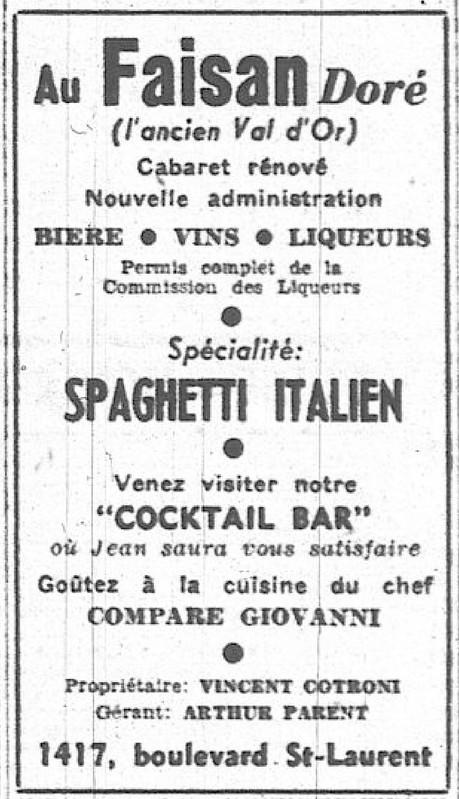
Au Faisan Doré
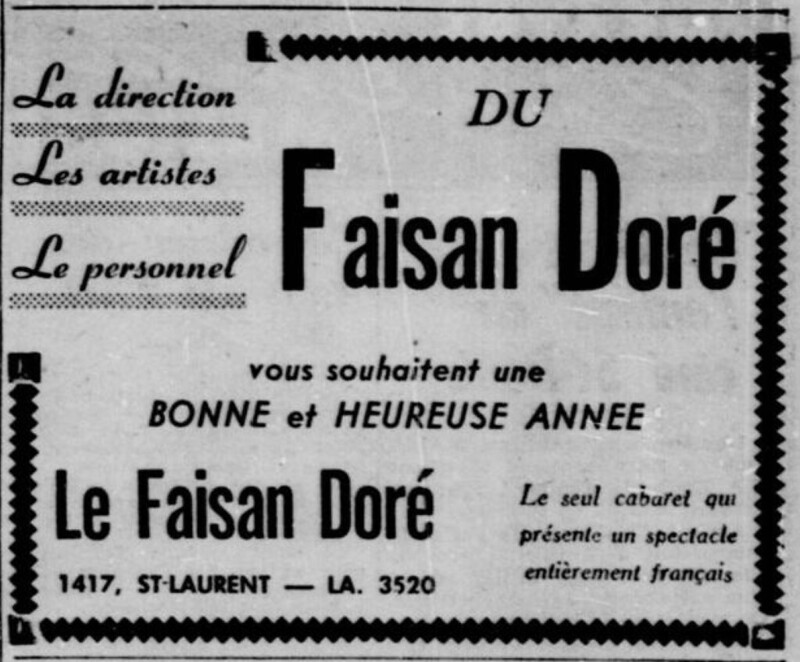
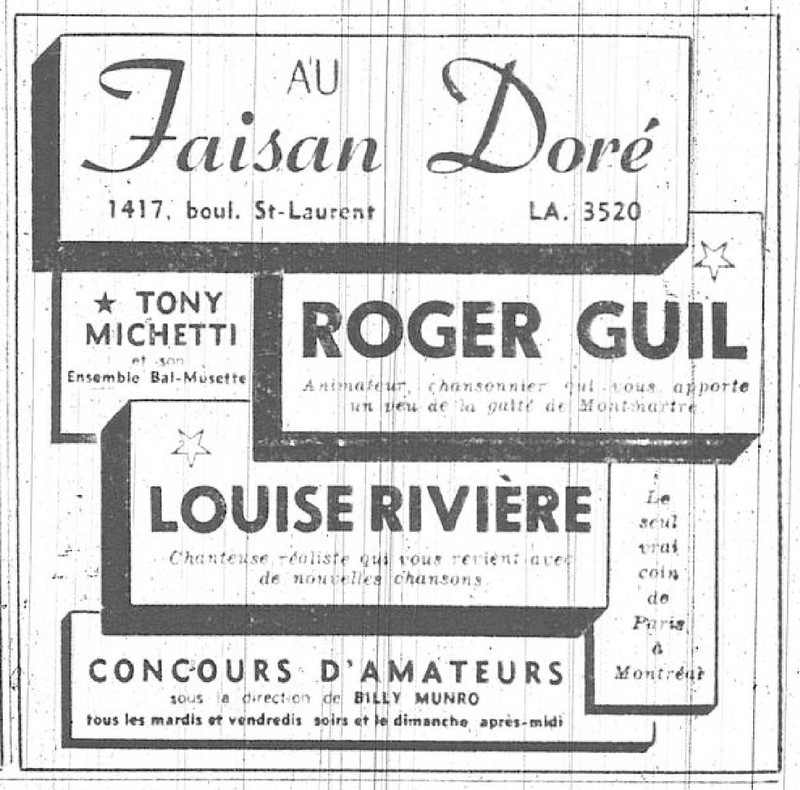
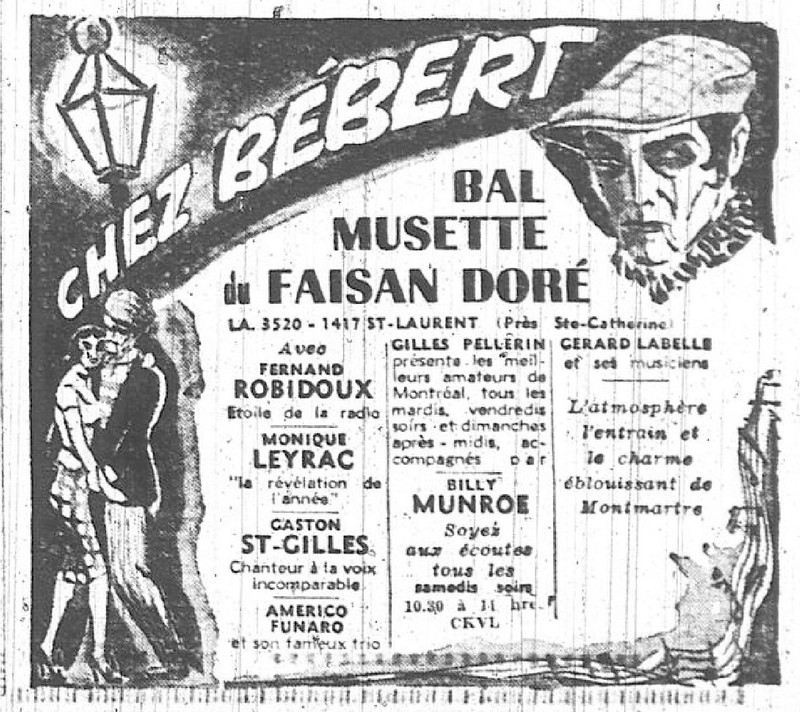
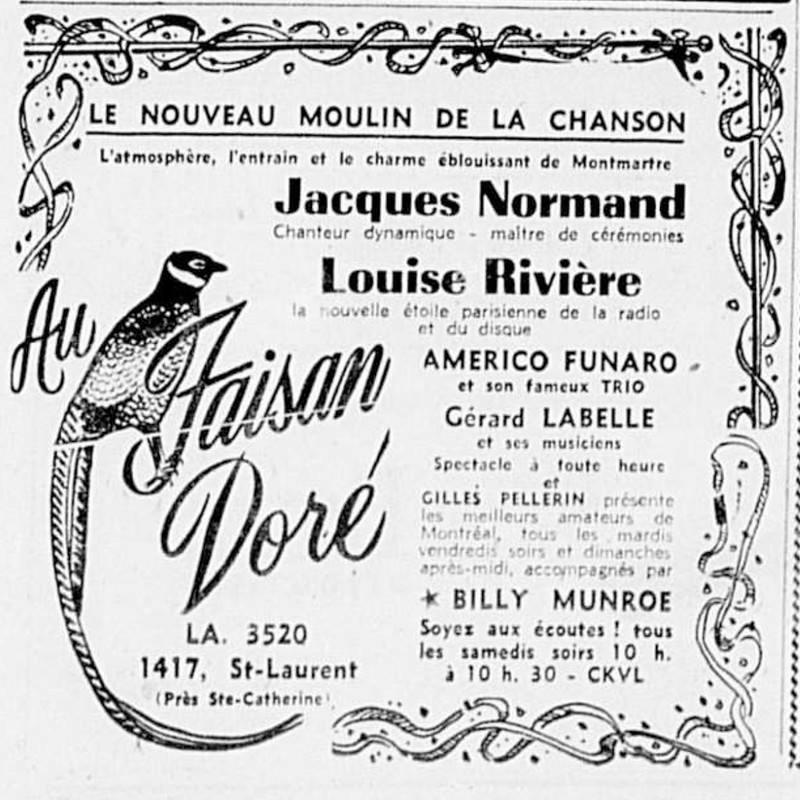
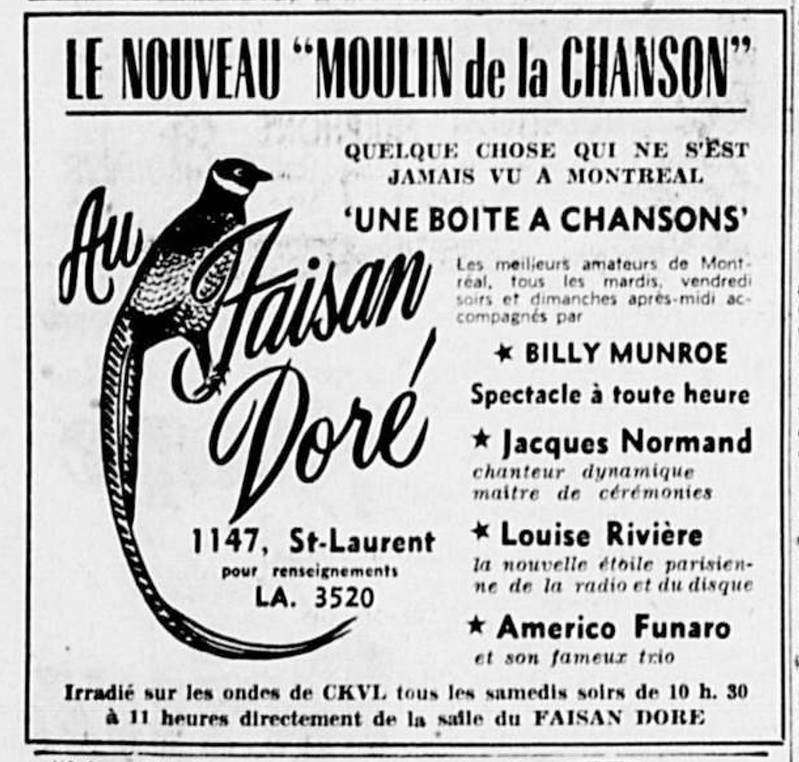
Opened in 1947 at 1417 Saint-Laurent Boulevard, on the second floor of a building already deeply connected to the history of cabarets on the “Main,” Au Faisan Doré became, within only a few years, one of the great centres of French-language song in Montréal. Under the direction of brothers Marius and Edmond Martin and host Jacques Normand, the cabaret developed into a true laboratory where emerging performers, singer-songwriters, comedians and European stars came together. Pierre Roche and Charles Aznavour achieved significant success there, while Monique Leyrac, Raymond Lévesque and several other local artists found an important springboard for their careers. Despite operating for only three years, until 1950, the Faisan Doré played a decisive role in the emergence of a new generation of performers and in the development of modern Québec chanson.
Overview
Located at 1417 Saint-Laurent Boulevard, the Café Val d’Or opened in 1938 on the second floor of a building already associated with the Main’s nightlife. It succeeds a series of emblematic clubs – the Frolics, Connie’s Inn, and the Casino de Parée – which helped make this stretch of Saint-Laurent one of the primary music-hall strongholds of the 1930s.12
At first, Val d’Or fully aligned with the major cabaret era, defined by programming dominated by English-language performers. From 1942 onward, the arrival of a mainly francophone and French-born administration, led by brothers Marius and Edmond Martin, slowly altered the venue’s tone: hosting was now in French, while most acts remained in English.1 This tension between two languages marked the cabaret’s evolution until its transformation into Au Faisan Doré in 1947.
Under its new name, the Faisan Doré became a cornerstone for the rise of a modern French-language Québécois chanson. Thanks to the artistic vision of emcee Jacques Normand and the intuition of Edmond Martin, the cabaret hosted and launched numerous artists who would define the 1950s–1970s while also serving as a bridge between Main-era cabarets and the future revival of chanson, television, and European tours.135
1. The site — from Frolics to Café Val d’Or
Before Val d’Or opened, the second floor of 1417 Saint-Laurent Boulevard was home, beginning in 1929, to a succession of cabarets that fueled the Main’s “golden age.” The Frolics is often cited as the first major cabaret of Saint-Laurent Boulevard, featuring revues, dance numbers, and variety acts.12 It was followed by Connie’s Inn (1933–1935) and the Casino de Parée (1935–1937), continuing the entertainment tradition in a setting evoking New-York-style nightlife.
Historians André-G. Bourassa and Jean-Marc Larrue situate this “lot” within a larger network of nightspots, restaurants, cinemas, and gambling houses where tourists, night-owls, industrialists, politicians, and members of Montreal’s underworld crossed paths.1 The arrival of the Café Val d’Or at the end of the 1930s does not mark a rupture, but rather the reconfiguration of a space already devoted to spectacle.
2. The Café Val d’Or (1938–1947)
The Café Val d’Or opened in 1938 in a landscape inherited from the Frolics years. Like most Montreal cabarets of the time, it offered two week-night shows and three on Saturday, combining comedy, popular song, circus acts, exotic dancers, and guest performers.15 Its manager was Wilfrid Breton, and the venue attracted a mixed clientele: Main regulars, tourists, workers, notables, and a small population of petty criminals.9
The Val d’Or’s financial backing came from business networks surrounding the Montreal underworld. Brothers Marius and Edmond Martin, Marseille-born, were among the co-owners. Alongside Armand Courville, a well-known underworld figure, they also operated the Café Royal, at 97 Sainte-Catherine Street West, the present-day location of Foufounes Électriques.1111213 Edmond Martin, described as a jovial man with a “heart of gold,” dreamed of creating a French-language cabaret where French would be at the center of the performance.
In 1940s Montreal, cabarets were often regarded as strongholds of the underworld. Most presented English-language acts and recycled jokes from one venue to another. To round out the programming, a singer from the Hit Parade or a crooner would be brought in, followed by a circus act purchased “by catalogue” from the United States.5
By the end of the war, the venue was frequently described as a western-style cabaret, with large bottles of beer displayed on tables and evenings ending in general brawls. A portion of the clientele were workers recently arrived from the countryside, unfamiliar with city customs, while a few small-time Italian racketeers—claiming ties to Vincent Cotroni—set their own rules.513
3. Jacques Normand at Val d’Or
It is in this context that Jacques Normand, still at the beginning of his career, becomes cabaret emcee at Café Val d’Or around 1945.5 In his recollections, he describes the rough atmosphere: bottles “ruling” on tables ready to crash over heads, and a clientele as eager for fist-fights as for entertainment. Most regulars were “good-natured folks,” but the presence of a few underworld personalities ensured constant tension.
To convince Normand to accept the position, Edmond Martin offered him a true “blank check” of artistic freedom. The humorist hesitated, more wary of the audience than the owners. To reassure him, Martin arranged a meeting with the venue’s true power: Vincent “Vic” Cotroni, owner of numerous Montreal clubs and a great lover of stage arts.513
Cotroni greeted the emcee courteously, promising that “after Val d’Or, there will be many others,” if results were satisfactory. He saw himself as a friend of artists, ready to give a chance to those he trusted.
On stage, Normand faced hostility, sometimes being targeted with homophobic insults when performing Charles Trenet songs—considered too refined for this notoriously masculine cabaret.56 For him, singing Trenet in Montreal in the mid-1940s required courage and became almost a form of resistance.
Impressed by his talent, Vincent Cotroni sent Normand to try his luck in New York, as a singer-emcee at the famous Bal Tabarin, a club located at the corner of 47th Street and Broadway, run by Corsicans and Sicilians. Cotroni presented him as “Jacques Normand from Paris” to enhance his marketability. But the New-York scene was no more indulgent than the Main; the experience ended quickly and the emcee returned the following year, continuing his career at CKVL radio.56
4. From the closure of Val d’Or to the opening of the Faisan Doré
In 1947, the Martin brothers found themselves unable to renew the liquor license for Val d’Or. Rumors claimed the establishment may have served minors or failed to contribute to the “right” political channels, at a time when cabarets were regularly subject to administrative controls influenced by political concerns.112
Accustomed to navigating municipal regulatory loopholes, the brothers devised a workaround: closing Val d’Or officially, then reopening the same venue under a new name with a license issued to a “restaurant” instead of a cabaret. In practice, the venue remained more of a nightclub than an eatery; its legal identity was simply the key to obtaining the license.1213
Thus appeared Au Faisan Doré, inheriting Val d’Or’s space while seeking to deeply transform its clientele and artistic positioning. For Normand, the problem was not the décor or the acts, but the habit of certain patrons to treat the room as a venue for rowdy release. The shift to a French-language cabaret, open to emerging artists and audience participation, was a risky yet promising gamble.15
5. The Faisan Doré (1947–1950), laboratory of chanson
5.1. A project of “educating the public”
At the Faisan Doré, Jacques Normand envisioned a “well-run room” where the performance would no longer be a mere chain of acts, but a true space of experimentation for French-language music. He wanted to give new Québécois talents a chance while inviting the audience to take part from their seats—and occasionally on stage.5
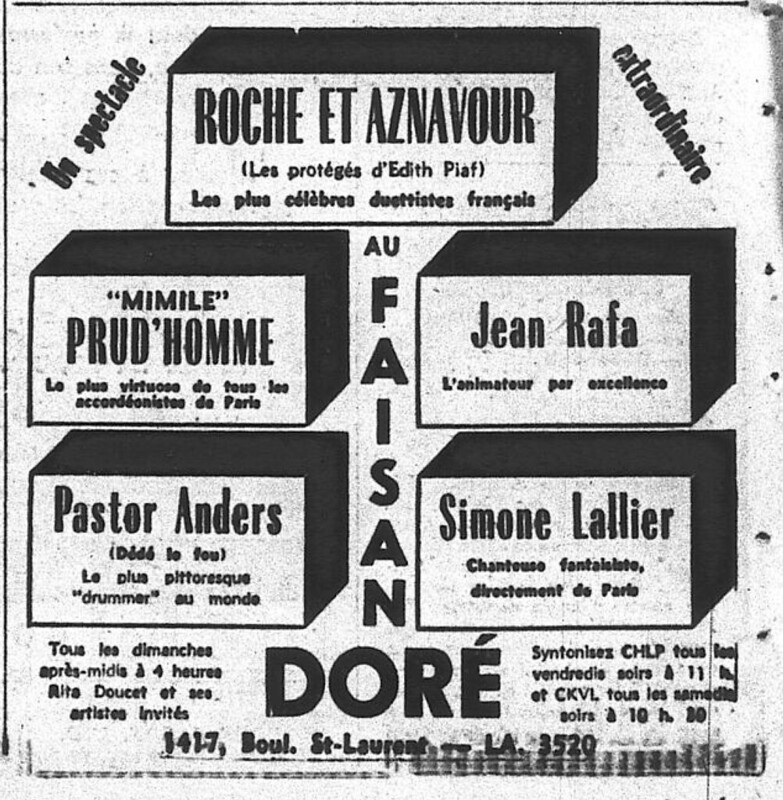
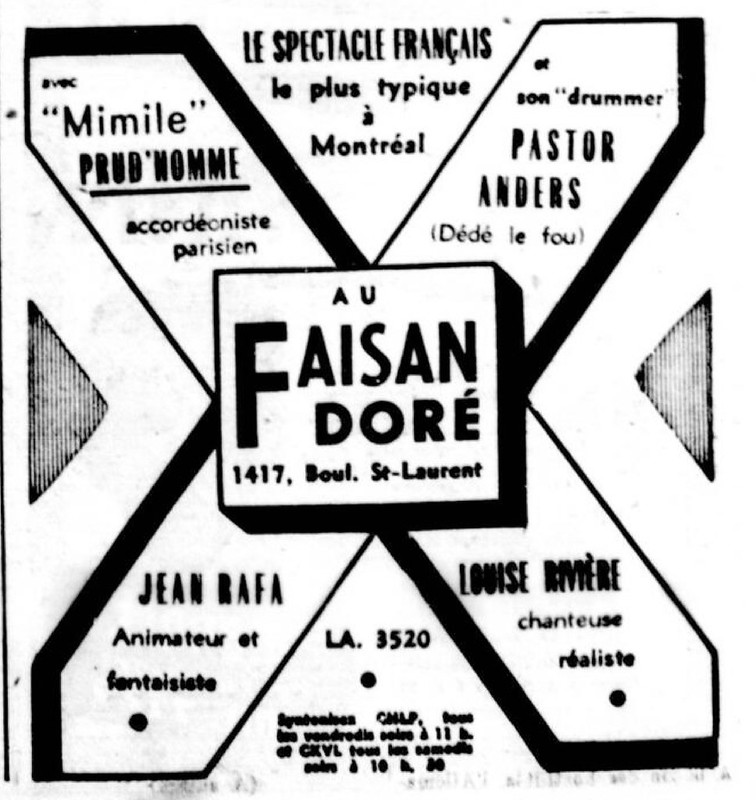
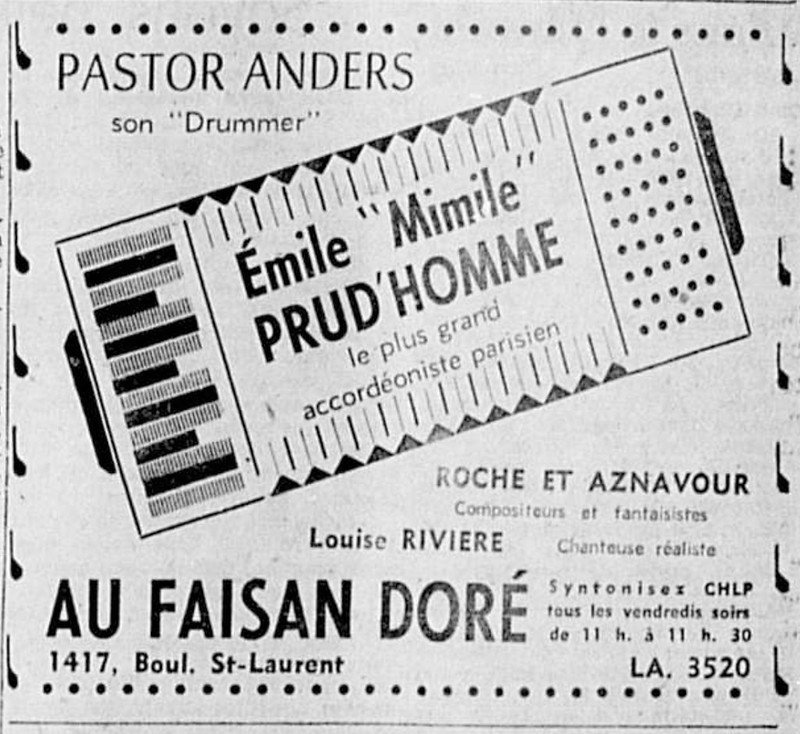
Edmond Martin supported this project, aiming for a more demanding clientele and limiting access to unruly patrons. To establish the tone, he brought in accordion master Émile Prud’homme, along with singer-emcee Jean Rafa.57 Soon after arriving, Rafa fell ill with meningitis and was hospitalized; the cabaret promised to keep him on staff until his medical debt was repaid—an illustration of the troupe’s solidarity.
For artists arriving from Europe, post-war Montreal felt like a “Klondike”: money flowed freely while France was still in austerity. The Faisan Doré, rebuilt and enlarged by Edmond Martin, could host about six hundred people, and reportedly sold up to 2,400 large beers per night.
5.2. Roche & Aznavour, protégés of Édith Piaf
Always seeking new talent for the Faisan Doré, Normand read classified ads and show listings attentively. One day, he noticed an ad for two “famous Parisian chansonniers” performing at a cabaret The Latin Quarter on de la Montagne Street. Intrigued, he attended between his own shows.
On stage: Pierre Roche (29) and Charles Aznavour (24). Their performance left Normand stunned: intense, modern, refined. Backstage, he learned that Roche and Aznavour were protégés of Édith Piaf.5
Normand praised the Faisan Doré and invited them to join. Contractually tied to the Quartier Latin, they explained they could not leave immediately. Normand waited. Two weeks later, Roche and Aznavour arrived at the Faisan Doré, where the Martin brothers welcomed them “as princes” and offered advantageous terms. They rapidly became the stars of what was now considered one of the city’s most sought-after cabarets.53
5.3. Jacques Canetti, Félix Leclerc and the Faisan Doré
Another decisive scene took place one night after a show. French producer Jacques Canetti, key figure of chanson d’auteur, waited for Jean Rafa and Jacques Normand outside the venue. He said he had come in search of new talent and asked whether they had names to suggest.5
Normand answered immediately: Félix Leclerc. With only hours before Canetti’s flight back to Paris, a CKVL radio producer helped arrange a late-night meeting. From that encounter came the decision to invite Leclerc to perform in France—soon followed by international acclaim. In that lineage, the Faisan Doré appears as the junction point linking the Main to Parisian venues and European music circuits.5
5.4. A springboard for a generation of artists
The Faisan Doré became a crucible for a generation of artists who would shape Quebec culture from the 1950s to the 1970s. Monique Leyrac received her first major break there; the cabaret also showcased Denise Filiatrault, Aglaé, Colette Bonheur, and two young boys destined to succeed: Fernand Gignac and a shy waiter named Raymond Lévesque.345
On Sunday afternoons, amateur contests gave beginners stage time. Gilles Pellerin announced performers, Billy Monroe accompanied them on piano, and a jury—including Normand, Jean Rafa, Pierre Roche, and Charles Aznavour—awarded prizes. Young Fernand Gignac, age 14, won with Maître Pierre, but could only perform during the first evening show due to laws barring minors from cabarets after 10 pm.5
Over time, the Faisan Doré was described as a remarkable crucible from which emerged a cohort of talents later visible on radio, television, and theatre.347
5.5. Atmosphere and sociability
The cabaret’s varied programming—songs, sketches, circus acts, audience interventions—allowed spectators to return night after night without boredom. Shows often ended in collective medleys, where artists and patrons sang together in warm camaraderie.5
After closing time, the troupe and some patrons often moved to a spaghetti house to continue the night until dawn. Normand recalled returning home around 10 a.m. after a succession of shows, after-parties, and improvised encounters.5
6. Legacy — from the Main to Québécois chanson
After years of prosperity, Jacques Normand began to tire of limitations imposed by the Martin brothers, whom he described as “well-intentioned, but unfamiliar with the trade.” He was courted by the Café Continental, led by Jack Horn, who offered better conditions and a professional environment more suited to his ambitions.510
When Normand left Au Faisan Doré, the cabaret lost its star emcee and could not recover the same momentum. Convinced that the venue’s success relied primarily on Normand, the Martin brothers preferred to shutter the venue rather than attempt a revival with a replacement.5 As often on the Main, the vacancy was short-lived: by 1951, the prestigious Café Montmartre opened in the same space, continuing the site’s long theatrical lineage.8
Normand went on to lead the Saint-Germain-des-Prés cabaret on Sainte-Catherine Street, one of the most celebrated francophone cabarets of the 1950s, where he reunited with several artists first launched at the Faisan Doré.10 Many of this generation later moved to television, including programs such as Music-hall and Les Couche-tard, contributing to Québec-wide mass cultural diffusion.
For historians of the Main, these two consecutive cabarets represent a turning point: they embody both the end of one world—cabarets under strong underworld influence, dominated by American standards—and the beginning of another, marked by a French-language Québécois cultural affirmation that would find its own stages and audiences in the 1950s–60s.13
7. Notes & sources
-
ANDRÉ-G. BOURASSA & JEAN-MARC LARRUE,
Les nuits de la Main. Histoire des spectacles sur le boulevard Saint-Laurent, Montréal, 1993.
Usage MCPA : mise en contexte du boulevard Saint-Laurent comme axe majeur du divertissement montréalais ; identification de l’immeuble du 1417, boulevard Saint-Laurent et de ses cabarets successifs (Frolics, Connie’s Inn, Casino de Parée, Café Val d’Or, Faisan Doré, Café Montmartre) ; analyse du rôle de ces salles dans l’essor des cabarets francophones. -
THE GAZETTE, 26 janvier 1963, p. 119–124 —
article « The Frolics started Main’s golden era ».
Usage MCPA : description du cabaret Frolics comme précurseur des grands clubs de la Main ; mention de la succession Frolics / Connie’s Inn / Casino de Parée au 1417, boulevard Saint-Laurent. -
LA PRESSE, 26 septembre 2008 —
article « La Main : un berceau artistique ».
Usage MCPA : réflexion sur le boulevard Saint-Laurent comme berceau de la vie artistique montréalaise ; rappel de l’importance des cabarets de la Main dans la carrière d’artistes comme Charles Aznavour, Monique Leyrac ou Raymond Lévesque. -
DOMINIQUE MICHEL, Y a des moments si merveilleux, Montréal, (date et éditeur).
Usage MCPA : souvenirs de la comédienne et chanteuse sur les cabarets montréalais, dont le rôle du Faisan Doré comme tremplin pour une nouvelle génération d’humoristes et de chanteuses. -
ROBERT GAUTHIER, Jacques Normand, l’enfant terrible, Montréal, Éditions de l’Homme, 1998.
Usage MCPA : source principale pour le récit autobiographique de Jacques Normand au Café Val d’Or et au Faisan Doré ; anecdotes sur l’atmosphère du cabaret, la clientèle, les relations avec Vincent Cotroni, le séjour au Bal Tabarin à New York, l’arrivée de Pierre Roche et Charles Aznavour, la visite de Jacques Canetti et la rencontre décisive avec Félix Leclerc. -
LA PRESSE, 8 novembre 1997 —
article « Jacques Normand : Où est passé l’esprit ? ».
Usage MCPA : rappel de la carrière de Jacques Normand ; allusions à ses débuts dans les cabarets, aux résistances rencontrées lorsqu’il interprétait des chansons de Charles Trenet et à son rôle dans la mutation des spectacles montréalais. -
LE PETIT JOURNAL, 11 novembre 1971 —
article « Il voulait être le Napoléon du Music-Hall ».
Usage MCPA : portrait de Jean Rafa et évocation de son passage au Faisan Doré avec Émile Prud’homme ; description de l’atmosphère du cabaret, de sa capacité d’accueil et des consommations vendues par soir. -
THE GAZETTE, 22 janvier 1951 —
annonce « Cafe Montmartre opening January 24th ».
Usage MCPA : confirmation de l’ouverture du Café Montmartre en 1951 au 1417, boulevard Saint-Laurent, dans les anciens locaux du Faisan Doré. -
LE PETIT JOURNAL, 18 novembre 1945 —
article « Au cabaret Val d’Or ».
Usage MCPA : mention du Café Val d’Or, de son gérant Wilfrid Breton et de la programmation de variétés durant la période d’après-guerre. -
WIKIPÉDIA, entrée « Saint-Germain-des-Prés (Montréal) ».
Usage MCPA : rappel du rôle de Jacques Normand comme directeur artistique et animateur du cabaret Saint-Germain-des-Prés après son passage au Faisan Doré ; continuité entre les cabarets de la Main et ceux de la rue Sainte-Catherine. -
LE DEVOIR, 10 décembre 1942 —
rubrique « Nouvelles raisons sociales » (mention du Café Royal).
Usage MCPA : identification du Café Royal, au 97, rue Sainte-Catherine Ouest, et de ses exploitants, dont les frères Marius et Edmond Martin ; mise en lien avec le Café Val d’Or et le Faisan Doré. -
LE CANADA, 20 novembre 1945 —
chronique judiciaire « Le ministère public ».
Usage MCPA : contexte sur les poursuites et les sanctions administratives visant certains cabarets montréalais, notamment liés au service d’alcool à des mineurs ; éclairage sur les difficultés rencontrées par les frères Martin pour renouveler leur permis de débit de boissons. -
THE GAZETTE, 4 décembre 1942 —
article « Bandit raids cafe ».
Usage MCPA : exemple d’un raid de bandits dans un café de Montréal associé au milieu de la Main ; illustration des liens entre certains cabarets et la petite criminalité locale, en parallèle avec le récit de la présence de Vincent Cotroni et d’Armand Courville au Val d’Or. -
THE GAZETTE, 14 février 1948 —
rubrique « Town and Country ».
Usage MCPA : notule mondaine mentionnant le Faisan Doré parmi les cabarets en vue de Montréal, fréquentés par une clientèle mêlant artistes, touristes et notables ; contribution à la datation de la période d’activité du cabaret (1947–1950).