Hôtel Nelson (Montreal)
Heir to the 19th-century Hôtel Jacques-Cartier, the Hôtel Nelson was relaunched in the early 1970s as a cultural meeting place in the heart of a rapidly transforming Old Montreal. With L’Évêché, established in 1971 in the Salle Bonsecours, it became from 1972 to 1982 a major hub for chanson, folk, progressive rock, and punk.
1. From Jacques-Cartier to Nelson
Located at 417–425 Place Jacques-Cartier in Old Montreal, the Hôtel Nelson is part of an urban continuity in which hospitality, commerce, and places of sociability have overlapped since the mid-19th century. From that period onward, the address has been associated with a major hotel establishment — the Hôtel Jacques-Cartier — regularly presented in the press as one of the finest French-Canadian hotels in Montreal, ideally located at the heart of Place Jacques-Cartier, then described as the city’s true business center. 1
A detailed article published in L’Union nationale in July 1866 offers an especially eloquent portrait of the establishment. Owned by Mr. Béliveau and built by Amable Cyprien Prévost, the hotel is described as a large four-and-a-half-storey building stretching along a long façade on the east side of the square. Its architecture is characterized as “simple and imposing,” offering a magnificent view from the public space, while the interior — deemed equal to the exterior — stands out for the quality of its furnishings, the layout of its rooms, and its overall comfort. 94
The same article emphasizes the features of a first-class hotel: reception lounges, a dining room on the second floor, and approximately 50 rooms furnished in a “comfortable, clean, and perfectly suitable” manner. The table and wines are explicitly praised, and the maître d’hôtel, Mr. Béliveau, is presented as one of the most accomplished hoteliers in Canada, reinforcing the image of an establishment catering to a demanding national and international clientele. 94
This strategic position — just steps from the steamship docks of the Richelieu Company — directly connects the Hôtel Jacques-Cartier to the commercial circuits of the port and to the flows of travelers, merchants, and businessmen that structured 19th-century Old Montreal. Place Jacques-Cartier is described as an open and lively space, in contrast with the surrounding narrow streets, contributing fully to the hotel’s prestige and attractiveness. 94
Data from the City of Montreal’s Built Heritage Inventory help clarify the building’s architectural evolution. Built in 1865 by merchant Amable Cyprien Prévost on land acquired as early as 1856, the building originally featured an imposing four-and-a-half-storey volume topped with a mansard roof and constructed in Montreal grey stone (limestone). It was likely connected during the same period to an older rear annex built around 1857, forming a coherent hotel and commercial complex at the heart of Place Jacques-Cartier. 96
From the outset, the building housed shops on the ground floor (grocery store and pharmacy) and the Hôtel Jacques-Cartier on the upper floors. It largely retained this mixed-use function until the late 20th century, except during the period 1875–1880, when it housed the offices of the Grand Trunk Railway Company. The property remained in the hands of the Prévost family until 1927, after which it passed to the Benoît family, who operated it as a hotel for several decades. 96
The chronology of its names, as documented in the Lovell’s Montreal City Directories, reflects these transitions. The establishment was called the Hôtel Jacques-Cartier from 1866 to 1917, became the Hôtel Roy, owned by Joseph Roy, from 1918 to 1927, then reverted to Hôtel Jacques-Cartier from 1928 to 1941, before definitively adopting the name Hôtel Nelson starting in 1941. 3
Contrary to an interpretation long associated with the statue in Place Jacques-Cartier, the name Hôtel Nelson does not refer to the British admiral, but rather to Wolfred Nelson, physician, Patriote, and mayor of Montreal in 1854. This name symbolically anchors the establishment in Montreal’s political and civic history while situating the building within the memorial continuity of Old Montreal. 96
A century later, this prestigious past served as the backdrop for the site’s revival. In November 1971, La Patrie published a report recalling that the establishment originally welcomed foreign merchants, particularly Europeans, who arrived by ship with their trunks and stayed for extended periods — placing the hotel in direct continuity with 19th-century commercial practices. 3
In this account, the hotel appears as an “old” place reinvested by a new generation. La Patrie emphasizes the determination to transform the hotel on Place Jacques-Cartier into a meeting place for young people, while stressing that it would not be “sold to the Americans.” This shift — from a traditional hotel to a social, nightlife, and soon-to-be cultural venue — directly foreshadows the rise of the Nelson as a central actor in Old Montreal’s musical and nightlife scene during the 1970s. 3
“A new life animates the old Hôtel Nelson.”
2. 1971–1972: Cultural revival, Salle Bonsecours → L’Évêché
In the fall of 1971, several press articles explicitly announced that the Hôtel Nelson was entering a phase of active transformation, both in terms of interior design and artistic programming. Even before the official opening of the new chanson venue, the establishment was described as a place “in motion,” where renovations, management changes, and new cultural ambitions converged. 4
The La Patrie report (18 November 1971) clarifies the profile and logic of this revival. Pierre Benoît (described as 29 years old) is presented as the architect of the relaunch, following experience within the Hilton network. The article notes that he worked at Hilton hotels in Montreal, Dorval, and Vancouver, after studying business administration. His return to Montreal is framed as both a rooted choice (“being at home, with one’s own people”) and an assumed succession, announced to his father in a letter “last spring.” 3
Along the same lines, La Patrie stresses the generational and entrepreneurial aspect of the project: “three young men” leave “brilliant positions” to revive the hotel in Old Montreal “because they believe in the neighborhood” and want to “be their own bosses.” They have already transformed the 72 rooms, giving them “character.” The article also notes a revealing detail about the new clientele: the rooms are occupied by many students, “mostly young musicians,” in what is described as a “very friendly” atmosphere. 3
The report also lists the planned projects and intended uses, placing the revival beyond a simple performance venue. “There is no shortage of plans.” The opening of “a venue for Raymond Lévesque” appears as a first milestone, immediately followed by other ambitions: a skating rink “this winter” in the inner courtyard, as well as plans for a restaurant, terrace, and wine cellar. This development program describes a hotel destined to become a living environment and a lasting social hub, where cultural offerings merge with spaces for meeting and sociability. 3
As early as 9 October 1971, the specialized press mentioned the arrival of a new venue manager and announced renovations affecting decor, ambiance, and staff, with the stated goal of bringing “real music” to Old Montreal. Shows were offered free of charge on Friday and Saturday evenings, clearly signaling an intention to reposition the hotel as an accessible cultural venue. 5
By late October, Raymond Lévesque, a Montreal singer-songwriter and central figure of Quebec chanson, was already publicly associated with the Hôtel Nelson. An article in Petit Journal announced his final show before a new stage in his career, presented at the hotel on 30 October 1971. The text specifies that this transition was carried out in collaboration with Pierre Benoît and Bill Prickett, administrators of the Nelson, confirming that Lévesque’s move to Old Montreal was fully embraced. 6
The days leading up to the opening of the new chanson venue were marked by intense media activity. A press conference held at the Hôtel Nelson was covered by both French- and English-language media, announcing the opening of a new chanson venue in the heart of Old Montreal. Among those interviewed were Raymond Lévesque and other figures associated with the establishment, attesting to the structured and coordinated nature of the project. 7
Notices published in early November 1971 clarified a crucial point to avoid confusion: Lévesque was “moving” to the Nelson in the Salle Bonsecours, an internal space of the hotel that would become a performance hall. At the same time, the project was announced as a new chanson venue set to open on 12 November 1971, with its first revue, titled “Law and Order”, scheduled to open on 18 November. In other words, Salle Bonsecours initially referred to the physical space, while L’Évêché designated the chanson venue installed there and publicly named, closely tied from the outset to the revues and stage identity of Raymond Lévesque. 13,14
In several profiles published between November 1971 and January 1972, Raymond Lévesque explicitly presented Old Montreal — and the Hôtel Nelson in particular — as a place conducive to free, satirical, and engaged expression. He expressed the desire to make the neighborhood resemble the atmosphere of Montmartre, where songs, monologues, and writings could circulate in an intimate setting, away from large institutional venues. 8
This cultural vision, carried by Lévesque but made possible by the transformation of the Nelson, fits within a broader context of the reappropriation of Old Montreal by a young, artistic clientele. Like other emerging establishments around Place Jacques-Cartier, the Hôtel Nelson became one of the anchor points of a new nightlife and cultural life in the early 1970s. 9
By the end of 1971, popular press highlighted the scale of the success of the shows presented at the Hôtel Nelson. A report in Photo-Journal described a venue “packed,” to the point that a public relations officer had to turn people away due to lack of space. The text explicitly compared this triumph to the earlier success Raymond Lévesque had enjoyed at La Butte à Mathieu, suggesting that the Place Jacques-Cartier repositioning was not only bold but fully effective. 12
Alongside chanson and satirical revues, the Hôtel Nelson expanded its cultural mission. In the winter of 1971–1972, the press noted evenings dedicated to free jazz, notably with weekly performances by the Quatuor de Jazz libre du Québec. This programming helped establish the Nelson as a meeting place and a hub of artistic circulation in the heart of the neighborhood. 16
In early 1972, programming became more defined: Télé-radiomonde reported that Raymond Lévesque, “recently settled at L’Évêché,” a venue located inside the Hôtel Nelson, would present his second revue on 10 January 1972. Titled “Québec sait fausser”, it featured the impersonator Denis Gobeil alongside Lévesque and was conceived as a satire of the political and artistic world. The article specified that it was to run for two months. 10
In October 1972, La Presse’s “B. Spec” column illustrated how L’Évêché was conceived as a cold-season engine: the article mentions the opening “of the doors of L’Évêché” and describes a formula in which, on Thursdays, Fridays, Saturdays, and Sundays, emerging chansonniers performed at 9 p.m., followed around 10 p.m. by Raymond Lévesque himself. The same text even mentions the idea of a contest and a potential “Raymond Lévesque Award”, signaling the strong association between the venue and Lévesque’s artistic identity. 18
Sources from 1972 also show that the hotel’s internal spaces could host special events linked to Lévesque’s presence. A brief announcement mentions a dinner-show scheduled for 3 August, during which a $500 scholarship would be awarded to Raymond Lévesque by the Groupe des peintres québécois. Importantly for terminology, this notice still uses the expression Salle Bonsecours, even though the public name L’Évêché was already circulating — highlighting the coexistence in the press of the architectural designation (Salle Bonsecours) and the cultural designation (L’Évêché). 15
In the same summer sequence, Télé-radiomonde published an illustrated report on a celebration held at L’Évêché, described as taking place at the Hôtel Nelson, and presented as a significant moment in Lévesque’s public life. This coverage documents the Nelson not only as a performance venue but also as a site of sociability and recognition surrounding Quebec chanson and monologue in the early 1970s. 17
In this perspective, the Salle Bonsecours appears as a pivotal space: documented since the late 1950s as a dining and banquet hall, it provided a functional precedent that helps explain how the hotel could, in the early 1970s, support performances, launches, and reception-style events. From 1971–1972 onward, however, the name L’Évêché served to publicly designate the space as a chanson venue — and this name remained strongly associated with Raymond Lévesque in the hotel’s media image. 11,13,14,18
The name L’Évêché is generally understood as a nod to Raymond Lévesque, who shaped the venue’s identity, tone, and reputation at the time. 19
3. 1974: Harmonium announced, Beau Dommage called in at the last minute
Part of the Nelson’s memory (and of L’Évêché) has crystallized around an episode that has become almost foundational, later recounted retrospectively in the press: in 1974, Harmonium was expected at L’Évêché, but a show was cancelled due to illness. To avoid a “gap” in the program, the team called at the last minute another group that was still relatively little known: Beau Dommage. 20
“Four months after the release of its first LP, Harmonium already benefits from a particularly solid core of fans, gathered at L’Évêché of the Hôtel Nelson for a series of shows. However, at the last minute, the performance of June 26, 1974 has to be cancelled due to health problems affecting one of the group’s members. The audience has no idea that a young band still without a record contract is about to take the stage as a replacement. While the instruments are being set up, Michel Rivard takes the floor, both to apologize on Harmonium’s behalf and to introduce Beau Dommage.”
The story emphasizes the momentum effect: the replacement happens “on the fly,” and then another cancellation forces a second replacement; meanwhile, the crowd at the door grows, creating the impression of a group “launched” by circumstance — a moment in which rumor, the crowd, and the venue work together. In this reading, L’Évêché appears as a launch mechanism: a human-scale room, an attentive audience, immediate word-of-mouth, and the ability for an unforeseen event to become a turning point. 20
In the memorial narrative, the episode does more than connect two groups: it anchors the Nelson in a story of hand-offs (one group “expected,” another “called in”), and in a story of risk (cancellation, urgency, the unexpected), where a venue becomes the concrete tool that turns a setback into an accelerator. 20
4. Around L’Évêché: residencies, nights, artists (1972–1974)
Beyond Raymond Lévesque’s revues, press coverage and retrospective references make it possible to document L’Évêché (Hôtel Nelson) as a place of residencies, launches, and extended stays: artists settle in, formats are refined, and the Nelson serves as an anchor point in the heart of Old Montreal.
4.1. Offenbach: an album launch at the Nelson (July 20, 1972)
Among the clearest milestones, sources recall that the launch of the album Offenbach Soap Opera took place on July 20, 1972 at the Hôtel Nelson. 25
A retrospective source in La Presse (1993) looks back on the period and reinforces the idea that the Nelson was then part of a live-scene ecosystem: a place of passage, socializing, and media attention, where certain events (including the launch) take on the value of markers. 26
4.2. Caramel Mou: a long residency (492 performances)
One article traces the trajectory of Caramel Mou and evokes a period when, after an experience at L’Imprévu, the group lands eight months at L’Évêché (Hôtel Nelson), for a total of 492 performances in the same venue — a rare figure that illustrates the pace and endurance of the “boîte à chanson” format at that time. 21
4.3. A farewell evening announced for Raymond Lévesque (early 1974)
At the end of 1973, a short item announces that Daniel Rousseau, presented as Raymond Lévesque’s impresario, is preparing a farewell evening at the Hôtel Nelson (scheduled “in early January”), ahead of a departure for Paris. The text also mentions the participation of guest artists (including Pauline Julien and Claude Michaud) and places the Paris project in the world of chanson clubs. 22
4.4. Alan Gerber at L’Évêché: returns and a “show” at the Nelson (October 1974)
In the fall of 1974, the press announces Alan Gerber “at L’Évêché”: a week of shows at the Nelson, along with a reminder of his earlier relationship with the place (time in Montreal, returns, recordings, and bilingual circulation). 23
4.5. Lewis Furey: a series of shows at L’Évêché (1972–1973)
In an article about the film Fantastica (1980), a biographical reminder indicates that it was notably thanks to a series of shows at L’Évêché (Hôtel Nelson) in 1972–1973 that Lewis Furey gained recognition as a singer-songwriter “overnight.” This type of later mention documents how the Nelson remained, years afterward, an explanatory landmark in artistic trajectories. 24
4.6. Harmonium at the Hôtel Nelson — residency and critical recognition (June 1974)
In late June 1974, Harmonium settled in at L’Évêché of the Hôtel Nelson for a sustained run of performances, marking one of its first Montreal residencies in the intimate setting of Old Montreal. Concert records attest to several consecutive nights, sometimes with two performances per evening, from June 24 to 28, 1974.
This extended presence came at a pivotal moment for the trio, then rising rapidly after the unexpected success of its first LP. While several Montreal record labels had initially turned down the project, Harmonium benefited from favorable word-of-mouth and growing public interest, drawn to a musical approach built on atmosphere, gentleness, and sonic cohesion.
In Le Devoir, critic Yves Taschereau described Harmonium as a band “to watch,” highlighting the distinctive character of its stage approach: a low-key show, focused on creating a mood rather than on virtuosity or direct address to the audience. Serge Fiori’s vocals, often restrained, contribute to this contemplative aesthetic, in which the lyrics primarily serve to support a musical atmosphere.
The English-language press was more reserved. In The Gazette, Bill Mann acknowledged that the band drew a sold-out house, but criticized Harmonium for a certain sonic uniformity and a tendency toward introspection, evoking music that “neither shocks nor excites.” This contrasted reception nonetheless testifies to the group’s real impact on Montreal audiences, well beyond the critical sphere alone.
At L’Évêché, the stage setup remained minimal: Harmonium performed seated, in a deliberately relaxed posture, encouraging attentive listening and a sense of closeness. The occasional addition of visual elements and opening-stage interventions — notably mime-type performances — fit the venue’s experimental logic without distracting from the musical core of the show.
In retrospect, this June 1974 residency at the Hôtel Nelson appears as a structuring moment: it confirms L’Évêché’s ability to host emerging projects over time and to offer a space conducive to listening, while helping to establish Harmonium as one of the new focal points of Quebec’s 1970s chanson scene.
5. Beau Dommage at the Hôtel Nelson: the stage as a revealer (1974–1975)
In late 1974, the Hôtel Nelson, through its performance space L’Évêché, plays a central role in the public emergence of Beau Dommage. Contemporary press archives show that the Nelson is not merely a stopover, but a space of revelation, where a still little-known band gains media, professional, and symbolic recognition.
An article in L’Œil régional (December 18, 1974) describes the immediate effect the group has: “one song, two songs, and then a third—there it is, you’re hooked.” The text emphasizes Beau Dommage’s collective dimension—“four guys and a girl”— and the accuracy of their writing, presented as deeply rooted in everyday Montreal life. This enthusiastic reception unfolds in a specific context: Beau Dommage is then advertised at L’Évêché of the Hôtel Nelson from December 17 to 29, 1974, confirming that the venue serves as a direct point of contact between the group and a broader audience.
The same column notes that the industry is already in motion: radio stations are heavily airing the band’s songs, and the LP has just been released on the Capitol label. In this setup, L’Évêché appears as a hinge space, linking live performance, media exposure, and the circulation of recordings.
This function is explicitly confirmed by Pop Jeunesse (January 11, 1975), which describes the launch of Beau Dommage’s first album as a structured media event: “a press cocktail,” “a record launch,” “the revelation of a group.” The article specifies that Beau Dommage “presented a few compositions to the press” on the stage of the Hôtel Nelson, indicating that the venue is used as a professional showcase, designed for journalists, programmers, and industry players.
Pop Jeunesse also stresses the very nature of the group: five city troubadours singing Montreal—its streets, neighborhoods, and everyday life. The text underscores that “the album and the songs form a single whole,” and that the group’s strength lies in that coherence, perceived and publicly validated during its appearances at the Nelson.
A photograph dated December 9, 1974 precisely documents this foundational moment: Pierre Bertrand, Robert Léger, Pierre Huet, Marie-Michèle Desrosiers, Réal Desrosiers, and Michel Rivard are shown gathered for the launch of the first album, explicitly held at the Hôtel Nelson. The image confirms that the place is not only a stage, but also a symbolic setting for the group’s official entry into the public sphere.
Through these contemporary sources, the Hôtel Nelson thus appears as a mechanism of legitimation: a place where a band moves from the status of a local discovery to that of a recognized actor in Quebec’s musical landscape. L’Évêché enables encounters between artists, media, and industry, turning live performance into a foundational event.
In Beau Dommage’s case, the Nelson is neither a neutral backdrop nor a simple tour stop. It is the place where “the angel passed by,” to borrow the columnist’s words, and where “a music was born”—at the crossroads of the stage, the record, and public recognition. 43,44,45
5.1 Octobre at the Hôtel Nelson — electric poetry and urban conscience (1975)
In the mid-1970s, the band Octobre established itself as one of the most distinctive groups on the Montreal scene, and the Hôtel Nelson became one of its anchor venues. Straddling chanson, rock, jazz, and spoken word, Octobre developed an aesthetic that was deeply urban, poetic, and political, in direct tune with the intellectual and nocturnal atmosphere of Old Montreal at the time.
Led by Pierre Flynn, alongside notably Jean Dorais, Mario Légaré, and Pierre Hébert, Octobre rejected easy formats. The group explored open structures, blended acoustic guitars with rhythms drawn from blues and jazz, and favored dense—often dark—texts, marked by existential anxiety, social critique, and an openly literary sensibility. In this context, the Hôtel Nelson appears as an ideal space: a place for listening, proximity, and intellectual resonance.
In October 1975, Octobre held the launch of its third LP, Survivance, during a press conference staged in the smoky atmosphere of the Hôtel Nelson. The album, entirely composed by Pierre Flynn, confirms the group’s serious and introspective direction. Several figures from the cultural scene, including Robert Charlebois, attended the event, underlining the recognition Octobre had gained within Quebec’s musical landscape. 98
The press also noted that, a few days earlier, Octobre had broken attendance records during its run of shows at the Hôtel Nelson, testifying to a strong bond between the group and the venue. The performances were described as intense, sometimes uncomfortable, but always inhabited, with Octobre refusing complacency both musically and lyrically. 98
In retrospect, Pierre Flynn would describe Octobre as a band incapable of “going backwards,” refusing nostalgia and repetition. This posture helps explain why the Octobre experience at the Nelson fits less into the continuity of early Beau Dommage than into a permanent tension between creation, lucidity, and disenchantment. 99
At the Hôtel Nelson, Octobre thus embodies another facet of Quebec’s 1970s scene: a literary, nervous, and uneasy music that watches the city, its margins, and its contradictions. By hosting the group, the Nelson confirms its role as a venue able to absorb not only popular chanson, but also its most demanding and most radical forms.
6. Francine Loyer — a discreet architect of L’Évêché (1973–1977)
Among the key figures associated with the Hôtel Nelson in the mid-1970s, Francine Loyer holds a decisive place, long underestimated in institutional narratives. Described variously as show coordinator, artistic director, or booker, she is nonetheless portrayed by the press as the person who structures, animates, and professionalizes the programming of L’Évêché after the founding period associated with Raymond Lévesque. 27,28,29
As early as 1973, Francine Loyer is identified as a daily presence at the Nelson, in direct contact with artists, managers, journalists, and record-label representatives. Several sources emphasize that she handles the bookings for the venue, manages schedules, negotiates fees, and supports artists within a logic of career development rather than simple one-off presentation. 30,31
A profile published in The Montreal Star in September 1976 explicitly calls L’Évêché a “showcase club” comparable to Los Angeles’s Troubadour or New York’s Bottom Line, and specifies that Francine Loyer “handles bookings”. The text stresses the Nelson’s strategic role as a North American launch station for artists seeking to move beyond the local circuit, and notes that the audience regularly includes industry people, media, and label representatives. 32
“L’Évêché functions as a true showcase room for new talent, comparable to Los Angeles’s Troubadour or New York’s Bottom Line — and Francine Loyer handles the bookings.”
In spring 1976, a The Gazette column broadens the picture: Francine Loyer also appears there as a manager / agent (in the sense of representation) for bands associated with the Quebec rock scene of the moment, in a context where managers are trying to help local groups break beyond the provincial circuit. 33
“If a band can only play in French, what can it do after a few tours around the province? A lot of groups end up breaking up because they simply have nowhere to go.”
This perspective—helping artists circulate beyond the “local circuit”—sheds light on the hub function that sources attribute to L’Évêché. In a retrospective article devoted to Offenbach, the Avant de m’en aller column evokes the Nelson environment as a space of mediation, where musicians, networks, and industry actors cross paths. 26
Her influence, however, extends beyond L’Évêché alone. A La Presse article (1983) devoted to Nanette Workman explicitly states that Francine Loyer handles her career, and situates that work within a logic of support—“at her own pace”—beyond promotional artifice. 34
After L’Évêché, Francine Loyer is also associated with the establishment and programming of the O’National, a new Montreal performance venue announced in late 1976. This move helps document a continuity: from an “incubator” stage at the Nelson to another structuring venue, at a moment when the network of performance spaces is being reshaped. 35
Her influence spans far beyond a single genre. Under Francine Loyer, L’Évêché’s programming alternates rock, folk, chanson, jazz, and even classical music, as shown by the “classical Mondays” mentioned in Le Devoir in the fall of 1977. This openness helps turn the venue into a laboratory of forms, rather than a specialized club. 31
Several reviews also stress that Francine Loyer’s arrival marks an identity shift for L’Évêché: from a “spoken-word stage” associated with satirical revues, the venue gradually becomes a rock and pop stage, frequented by a younger audience, without entirely breaking with its chansonniers heritage. A La Presse article notes that “since her arrival, the room has changed its face.” 29
In November 1975, youth-oriented press already highlights the intensity of a “packed” season around the Hôtel Nelson, confirming its role as a meeting point for Quebec musicians as winter approaches—within a perspective where the place is seen as active, visible, and plugged into Montreal’s promotional networks. 36
After her time at the Nelson, Francine Loyer would continue a notable career within Quebec’s musical ecosystem—particularly as a lyricist and arts manager— but sources agree in situating at L’Évêché of the Hôtel Nelson one of her foundational roles: that of a mediator between emerging artists, performance venues, and the industry, at a pivotal moment in Montreal’s musical history.
In this light, Francine Loyer appears as one of the Nelson’s invisible linchpins: less associated with an image or a stage name, but essential to the transformation of the hotel into a true cultural incubator in the mid-1970s.
7. 1974: “The coolest place”… then a monitored venue — parties, police, and counterculture
In 1974, the Hôtel Nelson appears in the press as a revealing point of friction in Old Montreal: on one hand, a district where public gatherings are increasingly regulated; on the other, a nightlife territory where the action sometimes shifts inside venues rather than out on the square. In a La Presse report on the “incidents in Old Montreal,” the journalist notes that although the area had “organized nothing” (aside from barricades), music could still be heard — that of the Ville-Emard Blues Band, described as playing “inside the interior premises” of the Hôtel Nelson. The contrast is emphasized: on Place Jacques-Cartier, there was “no music,” only “the murmur” and the noise of revelers. 37
At the same time, the magazine Mainmise (October 1974) offers a perspective from the underground scene: the Hôtel Nelson is described as a venue once known for its strong appeal (“one of the coolest places in Montreal”), but now subject to increased police attention. The article explicitly links drug use to control measures, stating that “since the beginning of September,” it was “no longer” possible to consume there, and situates this shift in a context where a Montreal police unit had been assigned to deal with this “drug problem.” 38
“Since the beginning of September, it has no longer been possible to consume at the Hôtel Nelson (… it used to be one of the coolest places in Montreal).”
These two perspectives — the mainstream press on one side, countercultural media on the other — do not tell the same story, but they converge on one point: in 1974, the Nelson can be read both as a sonic refuge (music “inside” when public space is under tension) and as a closely watched venue, where the nightlife atmosphere of Old Montreal intersects with issues of surveillance and repression linked to substance use. 37,38
A 1975 newspaper article notes that L’Évêché, at the Hôtel Nelson, had undergone a renewal by focusing first on sound quality, with professional sound systems designed for music and listening comfort rather than mere visual decor. Conceived as an intimate, open, and technically refined space, L’Évêché thus affirmed its ambition to become a key venue for a new generation of Quebec musicians and audiences. 82
8. Wilma Ghezzi — director, booking agent, and co-producer (1977–1978)
From 1977 onward, multiple sources converge in identifying Wilma Ghezzi as one of the key figures at L’Évêché (Hôtel Nelson) during its “showcase / show-biz” phase. She is alternately described as a director and a booking agent, and quickly appears at the center of a broader production framework linking L’Évêché and El Casino. 48,49,50
8.1. “Wilma runs the place”: visible leadership at L’Évêché (Fall 1977)
In the fall of 1977, Pop jeunesse rock explicitly presents Wilma Ghezzi as the person who “runs” L’Évêché, in a feature comparing the season openings of three venues (L’Évêché, L’Outremont, L’Imprévu). The caption of a photograph even identifies her as the “current director of L’Évêché,” signaling a role publicly assumed at a time when the venue was expanding its reach and programming. 48
8.2. A “counterpart” to the Nelson: cooperation with L’Imprévu’s team (October 1977)
A Cityscape column in The Montreal Star sheds light on the booking mechanics in Old Montreal: André Tremblay, artistic director of the Hôtel Iroquois (L’Imprévu), recounts having contacted Wilma Ghezzi, described as his “newly arrived counterpart at the Nelson.” The exchange led to a pragmatic agreement: sharing artist selections (up-and-coming acts vs. established names) and even collaborating on advertising — an indication of a local market where competition was paired with occasional alliances. 49
“…he introduced himself to Wilma Ghezzi… ‘we even collaborate on advertising.’”
8.3. “Booking agent” (at least since 1975–1977): integration into the show-biz network
Another English-language reference (The Montreal Star, December 1977) places Wilma Ghezzi within a longer timeline: she is described as the Nelson club’s booking agent “for two years.” This suggests that her involvement in the Nelson’s bookings may date back to around 1975, or at least that by 1977 she was perceived as a well-established professional in that role. 50
8.4. Luna Arts Inc., El Casino + L’Évêché: a concert-producing machine (Winter 1978)
In early 1978, The Montreal Star reports that Wilma Ghezzi and Claude Lusignan became partners in Luna Arts Inc., a structure associated with significant production capacity: the company had reportedly contracted 240 shows “between now and June” at El Casino, and 624 more shows at the “Nelson’s eveche club.” 51
In Pop jeunesse rock (January 1978), Wilma Ghezzi is also described as co-responsible (with Claude Lusignan) for producing shows at L’Évêché and El Casino, in a context where the “407 group” (office/team) served as an organizational hub. The page also presents a profile of Wilma Ghezzi (career path, media experience, networks), situating her within a structured programming strategy. 52,53
8.5. “The woman behind L’Évêché”: public image and programming (Spring 1978)
The profile titled “The woman behind L’Évêché” (May 1978) formalized this visibility: Wilma Ghezzi appears as the venue’s main spokesperson, associated with a program blending Quebec artists, comedy, and visiting headliners. The article also documents, in clear terms, L’Évêché’s “show-biz” orientation in the late 1970s, when the establishment functioned as both a performance platform and a marketing tool (press, events, multi-date runs). 54
Taken together, these sources add an essential layer to the Nelson’s history: after the founding phase associated with Raymond Lévesque, L’Évêché, under Wilma Ghezzi (and her partners), entered a model of intensive operation — bookings, inter-venue agreements, high-volume production — in which the Old Montreal venue acted as a hub connecting artists, media, management teams, and the broader concert circuit. 49,51,54
9. Tout chaud, tout show — musical revues, François Guy, and the emergence of Marjo (1975–1977)
At the end of 1975, the L’Évêché venue, housed inside the Hôtel Nelson, established itself as a true laboratory for hybrid forms, at the crossroads of musical performance, theatre, and revue-style entertainment. It was in this context that creator and director François Guy launched the revue series Tout chaud, tout show, which would leave a lasting mark on the Montreal scene. 49
Premiering on December 30, 1975, the revue inaugurated the 1976 winter season with an ambitious formula: sung numbers, sketches, visual humour, stage poetry, and live musicians followed one another in a deliberately fragmented aesthetic. The press emphasized the project’s boldness and the venue’s renewed vitality, describing the programming as “hot,” inventive, and resolutely contemporary. 49
François Guy surrounded himself with an expanded team of musicians, performers, and singers, transforming L’Évêché into a space of training, experimentation, and artistic discovery. The Hôtel Nelson thus became a strategic crossroads for a new generation of artists.
9.1 Marjo at L’Évêché — a formative debut
Among the performers engaged in Tout chaud, tout show was Marjolène Morin, then still unknown to the general public. In 1975, she was recruited by François Guy as a backing singer and performer in two revues staged at L’Évêché, Tout chaud, tout show followed by L’Île en ville. This experience marked her first major professional exposure on a recognized Montreal stage. 52
Retrospective accounts emphasize that it was precisely at the Hôtel Nelson, through contact with François Guy and this vibrant scene, that Marjo underwent a decisive artistic shift. Initially a backing vocalist, she was encouraged to sing more prominently, beginning a trajectory that would lead her, a few years later, to become the emblematic voice of the band Corbeau. 53
François Guy’s revues thus played a structuring role: they served as an artistic incubator, offering young performers — especially women — a space for visibility, learning, and stage affirmation.
9.2 Aut’Chose at L’Évêché — poetry in a state of shock
At L’Évêché in the Hôtel Nelson, Aut’Chose, led by Lucien Francoeur, emerged as a true performance phenomenon. The frontman’s poetic aggression electrified audiences who came “face-to-face” with this raw, embodied spoken word. 92
Francoeur does not “sing” in the traditional sense: he shouts, howls, hammers out rhythms, and theatricalizes his texts, supported by strong musicians, including a particularly notable pianist, amplifying the performance’s sonic and visual impact. 92
9.3 The Hôtel Nelson as a cultural incubator
Through Tout chaud, tout show and Aut’Chose’s performances, the Hôtel Nelson confirmed a role already emerging in the early 1970s: that of a cultural crossroads where singer-songwriters, revue creators, and emerging figures of Quebec rock intersected. L’Évêché became fully embedded in the post-Expo renewal of Montreal’s live performance scene.
9.4 1977 — The Hôtel Nelson at the heart of musical tensions
In 1977, the Hôtel Nelson appeared in the press as a site where tensions within Montreal’s professional music community crystallized.
An article dated December 17, 1977 in The Montreal Star, entitled “Rebellion in the ranks of the Guild”, described a climate of protest pitting artists, independent venues, and the musicians’ union against one another.
The report directly mentions Nelson’s Èvêché Club, at the center of a conflict involving the attempted cancellation of a concert by the British band The Vibrators, demanded by the Montreal Federation of Musicians.
“You can’t tell me that I’m not doing my part for Quebec musicians. L’Évêché has respected all the rules. The Vibrators played in Toronto and Ottawa without any problems. Then, on Friday, we received a telegram from the Guild saying: ‘Stop the show.’ I wasn’t going to stop the show. I support Quebec musicians — everyone knows that — but I can’t book Offenbach for two months straight. Not because they’re not good, but because you have to present something different from time to time.”
This episode confirms L’Évêché’s role as a key performance venue, but also as a space of confrontation between independent creation, union logic, and international openness in the late 1970s. 55
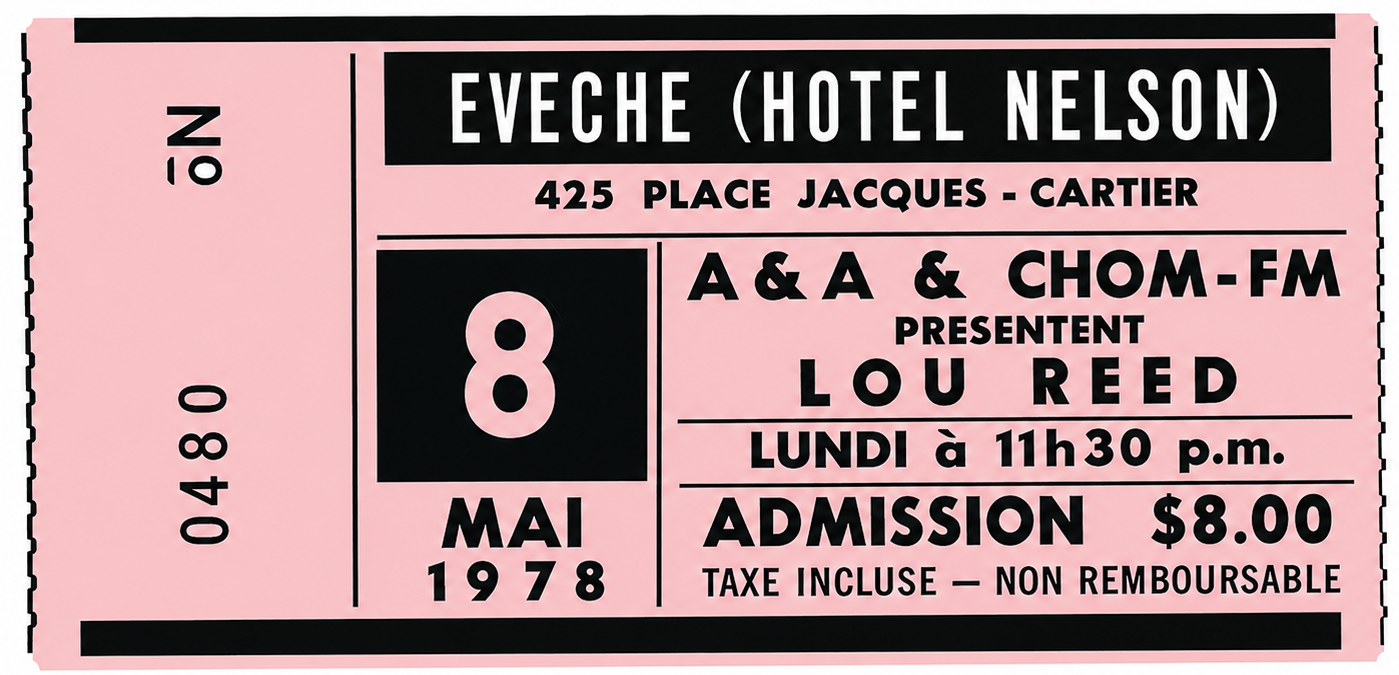
10. Lou Reed at L’Évêché — a legendary stop in the heart of Old Montreal (May 1978)
In May 1978, L’Évêché at the Hôtel Nelson hosted one of the most striking episodes in its history: two consecutive nights with Lou Reed, a central figure of New York rock and former leader of the Velvet Underground. Against the trend of arena tours and large venues, Reed deliberately chose the intimacy of L’Évêché for his first Montreal stop following the release of Street Hassle. 56
The press immediately highlighted the exceptional and unexpected nature of this decision. In Le Devoir, Nathalie Petrowski described an overheated, packed room filled with a mixed crowd — underground regulars, the curious, devoted Reed fans — drawn by what already seemed to be an event outside the commercial circuit. Reed was not there to “promote” in the traditional sense, but to test the direct relationship between his music and an audience gathered at very close range to the stage. 57
Pop jeunesse rock spoke of “two nights at L’Évêché” and emphasized the palpable tension in the room: delays, feverish anticipation, tightly packed crowds from the moment the doors opened, followed by an understated stage entrance. Reed appeared closed-off, focused, almost hostile, yet quickly imposed a hypnotic atmosphere, alternating abrasive songs with heavy silences. 58
“Lou Reed is fundamentally a rude guy. He walks onstage as if he were going to take a bath, avoids greeting the crowd while eyeing them with his shifty gaze like someone he doesn’t trust at all… Despite the resolutely mean and perverse nature of the approach, Reed somehow manages to make us grasp the authenticity of the open wound he sings about…”
In Québec rock, Marc Desjardins placed these concerts within a broader reading of Lou Reed’s Montreal appearance, describing L’Évêché as perfectly suited to his universe: a raw, dark, urban space, resonating directly with the New York Bowery and Lower East Side clubs. The article evokes a performance oscillating between contained violence, dry irony, and moments of grace, deliberately dividing the audience. 59
The Montreal Star, for its part, emphasized the physical intensity of the experience, noting that Reed performed at L’Évêché as he could not in a large hall: extreme proximity, crushing volume, direct stares, and a total absence of concessions. The journalist reported that Reed explicitly stated his preference for this type of venue over “too clean” halls, confirming L’Évêché’s status as a legendary club for demanding international artists. 60
These two evenings definitively established L’Évêché / Hôtel Nelson as a Montreal anchor point for international rock in the late 1970s. Lou Reed’s visit — unpredictable, divisive, uncompromising — embodied the venue’s DNA: a space ready to welcome major artists outside dominant formats, and to fully embrace artistic risk.
In retrospect, Lou Reed’s concerts at L’Évêché are among the moments most often cited when discussing the Nelson’s ability to connect Montreal with the great cultural capitals of rock, without ever abandoning its human scale.
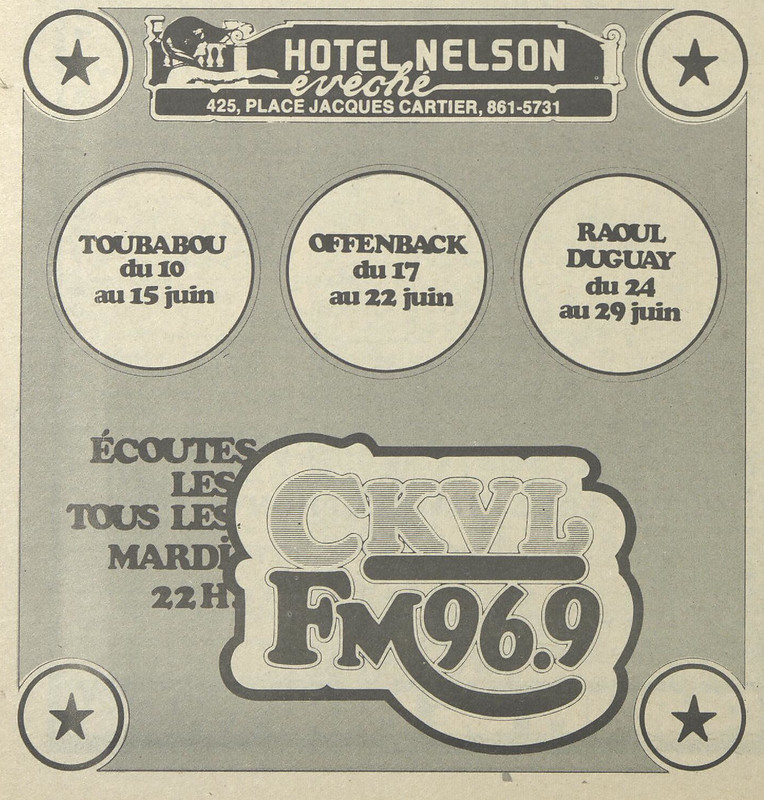
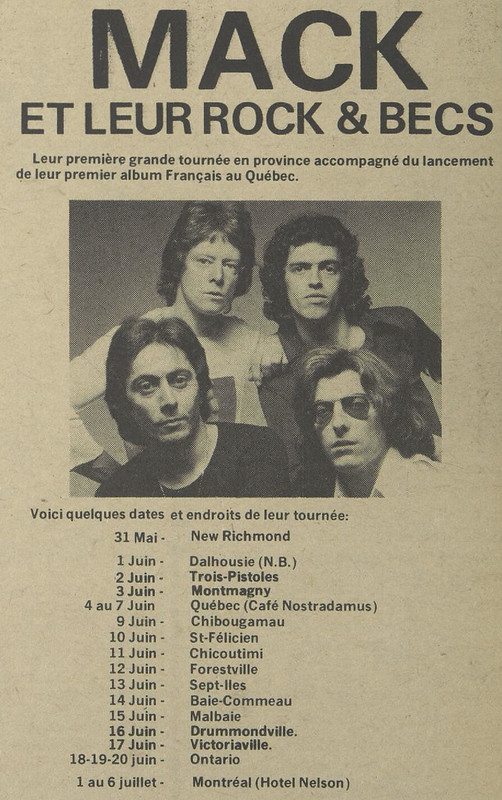
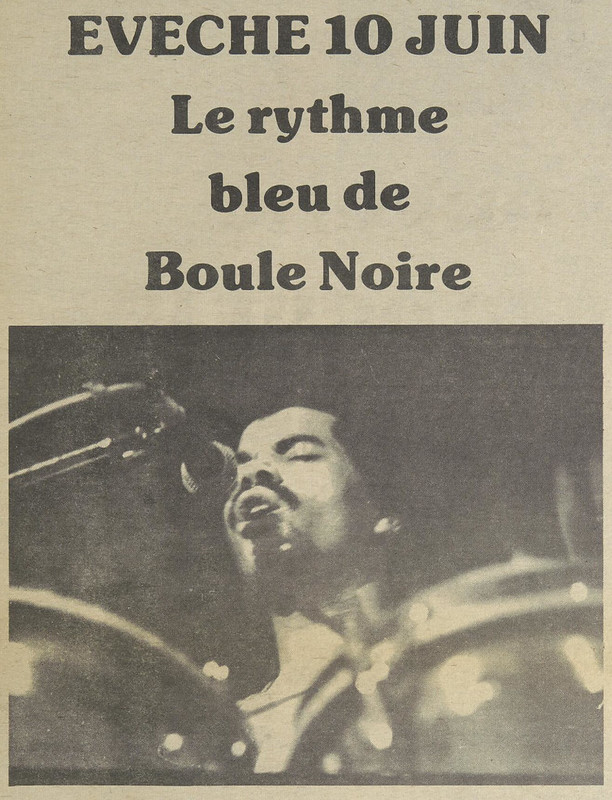
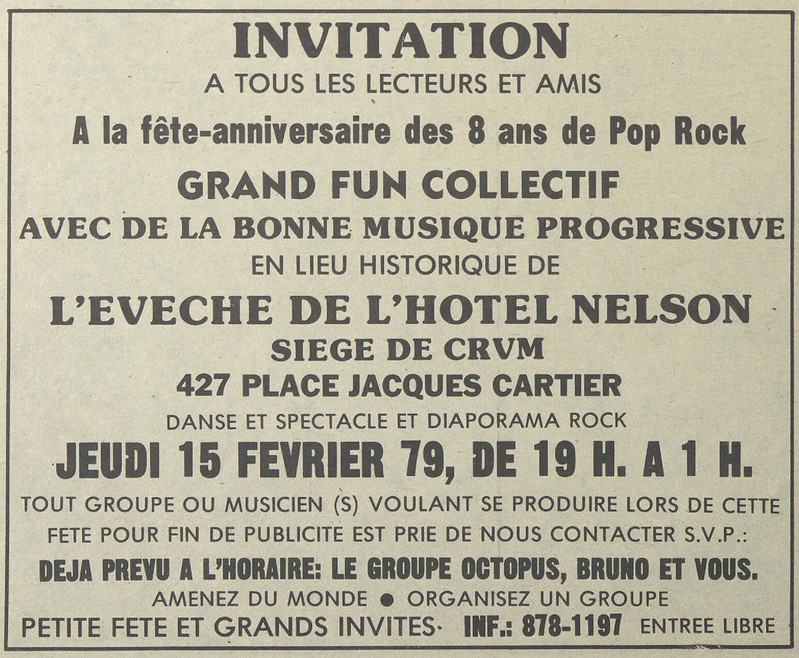
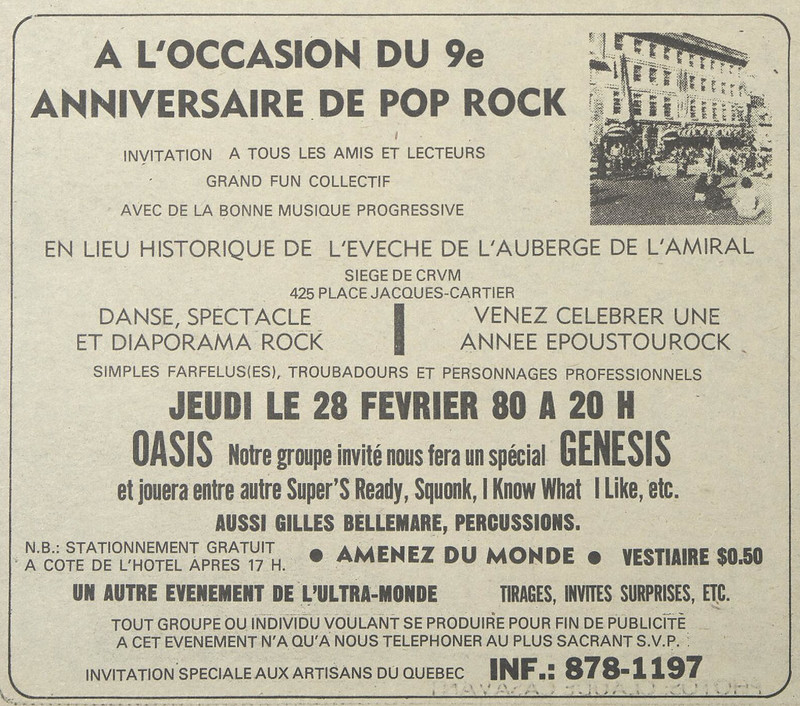
RAYMOND LÉVESQUE, OFFENBACH, HARMONIUM, BEAU DOMMAGE, ALAN GERBER, LEWIS FUREY, QUINCHAMALI, LES MOANSTONE, RANDY BISHOP, JESSE WINCHESTER, DIONNE-BRÉGENT, BACK DOOR BLUES BAND, OCTOBRE, VILLE-ÉMARD BLUES BAND, JIM & BERTRAND, CONTRACTION, ELLEN MCILWAINE, BRUCE MILLER, MANEIGE, RAOUL DUGUAY, MACK, RENÉE CLAUDE, IAN TYSON, RAY MATERICK, TOUBABOU, LE MATCH, CARAMEL MOU, PLUME LATRAVERSE, TONY ROMAN, POLLEN, AUT'CHOSE, MORSE CODE, ZACHARY RICHARD, SLOCHE, CAPITAINE NÔ, MICHEL PAGLIARO, CANO, PAUL ET PAUL, CONVENTUM, DIONYSOS, ET CETERA, ROBERT PAQUETTE, LE TEMPS, BARDE, RED MITCHELL, LUCIEN FRANCOEUR, WALTER ROSSI, GILBERT MONTAGNE, NANETTE WORKMAN, TOM JACQUES RIVEST, DIANE TELL, LOU REED, MAMA BÉA, JACQUES BLAIS, FRANCIS CABREL, GILLES VALLIQUETTE, DAVID BLUE, CORBEAU, GASTON MANDEVILLE, JIM CORCORAN, ROGER WALLS, JIM ZELLER, KAREN YOUNG, BOULE NOIRE.
11. Punk, Old Montreal, and the Nelson Grill — a scene on the margins (1977–1980)
By the late 1970s, the Hôtel Nelson could no longer be reduced to L’Évêché as its main performance room. Its dining space, the Nelson Grill—and more specifically the small lounge stage— became a nerve center of musical sociability in Old Montreal. Unlike structured venues, the Grill functioned as an open, noisy space, porous to the street, conducive to the emergence of practices associated with punk, raw rock, and alternative music, on the margins of institutional circuits. 61
In a long feature published in Québec Rock in the summer of 1979, Old Montreal is described as a true “musical mania”, where punk, rock, folk, disco, blues, jazz, and classical music coexist. The Nelson Grill is explicitly mentioned as a place where one can hear rock and punk, sometimes seven days a week, in a relaxed, unpredictable atmosphere directly connected to Place Jacques-Cartier. 62
The same article notes that the Grill became an informal rallying point for young musicians, punks, visiting artists, and night owls, at a time when Montreal’s scene was searching for spaces outside the norm and outside official recognition. The Nelson Grill is described there as a gateway to the “new wave”, rougher, more spontaneous, and freed from the codes of traditional live entertainment. 63
Several testimonies gathered in Québec Rock go so far as to explicitly characterize the place as the “Nelson Grill as a punk club.” Without rigid programming, the room functioned as a space of exchange: you met new faces there, shared ideas, and improvised. The Grill thus extended L’Évêché’s logic, but in a more everyday, more abrasive version, deeply rooted in the street. 64
The crystallization of this scene is inseparable from a key figure: John von Aichinger, nicknamed “Spike”, a charismatic personality and true ambassador of cool. From a family of Austrian origin whose lineage traces back to the 9th century and said to be related to Ludwig III of Bavaria, Spike is described by contemporaries as a “prince of punk.” The nickname was given to him by Dave Rosenberg, of the Montreal punk group The Chromosomes. 65
Spike was the one who opened up and animated the Nelson Grill’s small punk stage. By his own account, the transformation was not immediate: he first had to clear out the old clientele, mainly made up of bikers, before he could organize a first show. Once the space had been won, he presented three shows a week, every week, until June 1978. 66
“It wasn’t an ‘official’ venue, or a career project: it was a refuge. The Nelson Grill gave Montreal punk a place to exist before it even knew what it was going to become.”
Although Spike managed the Nelson Grill stage for only about three months, those few weeks proved foundational for Montreal’s punk scene. The Grill became a place where you could go out, meet people, experiment, and grow as a punk artist. Several actors from the first wave agree that without this space, Montreal punk might have been stifled at birth. 67
This effervescence belongs to a broader movement, documented retrospectively, in which as early as 1977, improvised venues in Old Montreal welcomed punk crowds and local groups such as The Chromosomes, in an atmosphere of beer, aggressive music, and rejection of dominant norms. This informal soil directly prepared the emergence of places like the Nelson Grill. 68
DANGER, THE VIBRATORS, ARSON, SCREAMERS, THE UNKNOWNS, THE NORMALS, THE CHROMOSOMES, THE EIGHTY'S, ULTERIOR MOTIVE, THE BLANKS, ANTI-NOWHERE LEAGUE, UK SUBS, THE 222's, THE VILETONES, ELECTRIC VOMIT, HEAVEN 17, THE MODS, ALAN LORD & THE BLUE GENES, LORNE RANGER, MEN WITHOUT HATS.
Thus, the Nelson Grill was not a simple hotel annex, but an essential link between the chanson scene, experimental rock, and the first wave of Montreal punk. It embodies the Nelson’s capacity to evolve with its time, welcoming cultural practices that few institutions fully embraced then — and in doing so, it contributed in a lasting way to transforming Montreal’s musical and social scene.
12. Crisis, adjustments, and transformations — the Nelson under strain (1978–1980)
From 1978 onward, the Nelson Hotel entered a period of acute economic instability that directly affected its main hubs of cultural activity, notably L’Évêché and the Nelson Grill. The press reported persistent financial difficulties, linked to the costly operation of sustained artistic programming in a context of irregular attendance, especially on weekdays. 69
In an article published by Montréal-Matin on 19 May 1978, the hotel’s co-owners openly acknowledge that L’Évêché’s model—built on high artist fees—is no longer viable without public subsidies. With no response from the Ministry of Cultural Affairs, closure is considered. 70
To avoid shutting down, management announced a change of formula beginning in mid-June 1978: L’Évêché was to become a dancing venue, open into the early hours, with expanded musical programming and a symbolic cover charge. This repositioning aimed to capture peak nights, notably Fridays and Saturdays, and to keep the hotel a nightlife hub on Place Jacques-Cartier. 71
In this transitional context, the Nelson Grill took on increased importance. Already identified by the press as an informal presentation space, it was refurbished in the late 1970s to host concerts, musical entertainment, and radio recordings. In 1980, Radio-Canada FM recorded several performances there, confirming its role as a multipurpose cultural space within the hotel. 72
At the same time, the press noted that the Nelson’s difficulties belonged to a broader context of real-estate crisis and reluctance by financial institutions to invest in Old Montreal’s historic district. Despite the venue’s attendance and notoriety, the combined operation of the hotel, performance rooms, and food services was no longer sufficient to prevent the accumulation of a debt estimated at about $800,000. 73
1979 — the “hostel” pivot and institutional intervention
In this critical context, 1979 marked a strategic turning point. The establishment explicitly repositioned itself as a hostel—sometimes described as Auberge de l’Amiral or Hostel Nelson—offering low-cost rooms and presenting itself as a place of passage and meeting, especially for young travelers, musicians, and cultural-scene participants. 7576
This new orientation came with a major financial restructuring. The owners sold to the Heritage Canada Foundation the neighboring house on Place Jacques-Cartier for $200,000 in order to enable its heritage restoration. In a second step, they obtained from the Federal Development Bank a $200,000 loan, repayable over sixteen years—an intervention presented at the time as a significant breakthrough for financing built heritage in Old Montreal. 77
To ensure continuity of operations, the management of the rooms was entrusted to a private non-profit corporation, administered according to the methods of international youth hostels. Revenues generated by this activity were intended to support restoration of the building and improve services offered to travelers, while maintaining minimal cultural activity at the heart of the hotel.
These years of crisis and readjustment marked a pivotal moment in the Nelson’s history. Without erasing the cultural legacy of previous decades, they signaled the end of an intense experimental period in which chanson, folk, jazz, rock, and punk coexisted in a fragile balance between artistic creation and economic survival.
13. Le Transit — attempting to carry on the Nelson legacy (1980–early 1980s)
In the fall of 1980, continuing the economic readjustments that began at the end of the previous decade, the Hôtel Nelson introduced a new cultural formula under the name Le Transit. Presented in the press as the venue meant to take over from the Nelson of the 1970s, Le Transit did not reflect a change of ownership, but rather a symbolic and functional reconfiguration of the existing offer. 74
As Nathalie Petrowski wrote, the Nelson — “the one that immortalized Montreal nights in the mid-1970s in the last strongholds of Place Jacques-Cartier” — was reborn under a new name, meant to reassure those who feared the disappearance of a place that had become mythical. Major renovations, estimated at nearly $50,000, transformed the former Nelson Grill, now without its bar, into an intermediate-capacity venue of about 300 seats, equipped with a stage and a full sound and lighting system. 74
Transit’s programming was entrusted to André-Bernard Tremblay, formerly in charge of L’Imprévu, which he left in order to devote himself fully to launching the new project. A recognized figure in the performing arts milieu, Tremblay established himself over the course of the 1970s as a central player in presenting emerging artists, combining roles in public relations, artist management, and artistic direction. At L’Imprévu, where he served as artistic director starting in February 1976, he helped make the venue a true springboard for new talent, a role for which he received a special jury mention at the “Annuelles” of the program L’heure de pointe. 100
Unlike the Nelson’s boom years, Le Transit no longer bet on major stars, but on emerging artists, from Quebec and abroad, through an approach that was deliberately more flexible and economically realistic. The model relied on modest ticket prices — generally between $3 and $5 —, reduced fees, and a choice left to performers between a fixed amount or a split of the door receipts. This formula explicitly aimed to avoid the financial spirals that had led to the closure of several Montreal venues, notably El Casino and Le Pretzel Enchaîné. 74
Management nevertheless acknowledged the venture’s fragility: without “big names” able to fill a room on their own, Transit’s survival remained uncertain. The months following the opening were described as decisive, the place potentially becoming either “the fleeting, transitory passage of a useless venue,” or the answer to a genuine cultural need in Old Montreal. 74
In that sense, the very name Transit functioned as a program: a place of passage, trial, and recomposition, fully embracing the risk of failure as much as the possibility of becoming “the hall everyone has been waiting for, for a long time.” More than a rupture, Le Transit thus appeared as an attempt at stabilization, extending the Nelson’s history not through nostalgia, but through a clear-eyed reinvention in response to the economic and cultural realities of the early 1980s.
Beyond its programming, the Hôtel Nelson belongs to a specific moment of informal re-appropriation of Old Montreal by a youth in search of alternative spaces. In a district still lightly institutionalized, marked by vacant buildings, streets with little evening activity, and a wide margin of tolerance, the Nelson contributed to a nightlife that was spontaneous, experimental, and unplanned.
Going to the Nelson in the 1970s also meant going “elsewhere”: leaving the commercial downtown, crossing an Old Montreal still in transition, and occupying places where music, sociability, and improvisation coexisted without strict institutional framing. This dynamic places the Nelson not as an exception, but as one of the active nodes of a cultural ecosystem then taking shape.
The gradual disappearance of this spirit at the end of the 1970s — under the combined effects of economic constraints, heritage policies, and touristic rebranding — helps explain the highly memorial aura now associated with the Nelson. More than a simple performance venue, it embodies for an entire generation a moment of cultural freedom that has since passed.
13.1 Francis Cabrel at the Hôtel Nelson: L’Évêché or Le Transit?
On December 14 and 15, 1981, Francis Cabrel stopped in Montreal for a series of performances at the Hôtel Nelson, as part of the show Pour quelques chansons, presented as a meeting “between Quebec and France,” bringing together Cabrel with Pierre Bertrand (ex-Beau Dommage) and Gilles Valiquette, with the participation of Luc Gilbert. 83,84,85.
Contemporary sources, however, are not unanimous about the exact room that hosted these performances. Several articles and announcements explicitly place the show at L’Évêché, described as a venue reopened especially for the occasion, on the eve of its announced closure at the end of December. 83,86,87. Other texts, published later, instead refer to Cabrel’s appearance at Le Transit, a neighboring venue within the same hotel complex. 88,90.
This ambiguity can be explained by the specific context of the Hôtel Nelson at the end of 1981. L’Évêché and Le Transit coexisted as distinct yet complementary spaces, sometimes used flexibly or interchangeably in media discourse. It is also possible that certain parts of the project — rehearsals, informal meetings, or extensions of the show — took place at Le Transit, contributing to confusion in later sources.
In any case, the texts converge on one essential point: Francis Cabrel’s stop at the Hôtel Nelson was a triggering moment for the collective Bertrand–Valiquette formula. Several articles from 1982 recall that the very positive reactions generated by this encounter led directly to the launch of their joint show at Le Transit the following spring. 88,89,90.
Epilogue — the last known concert at the Hôtel Nelson
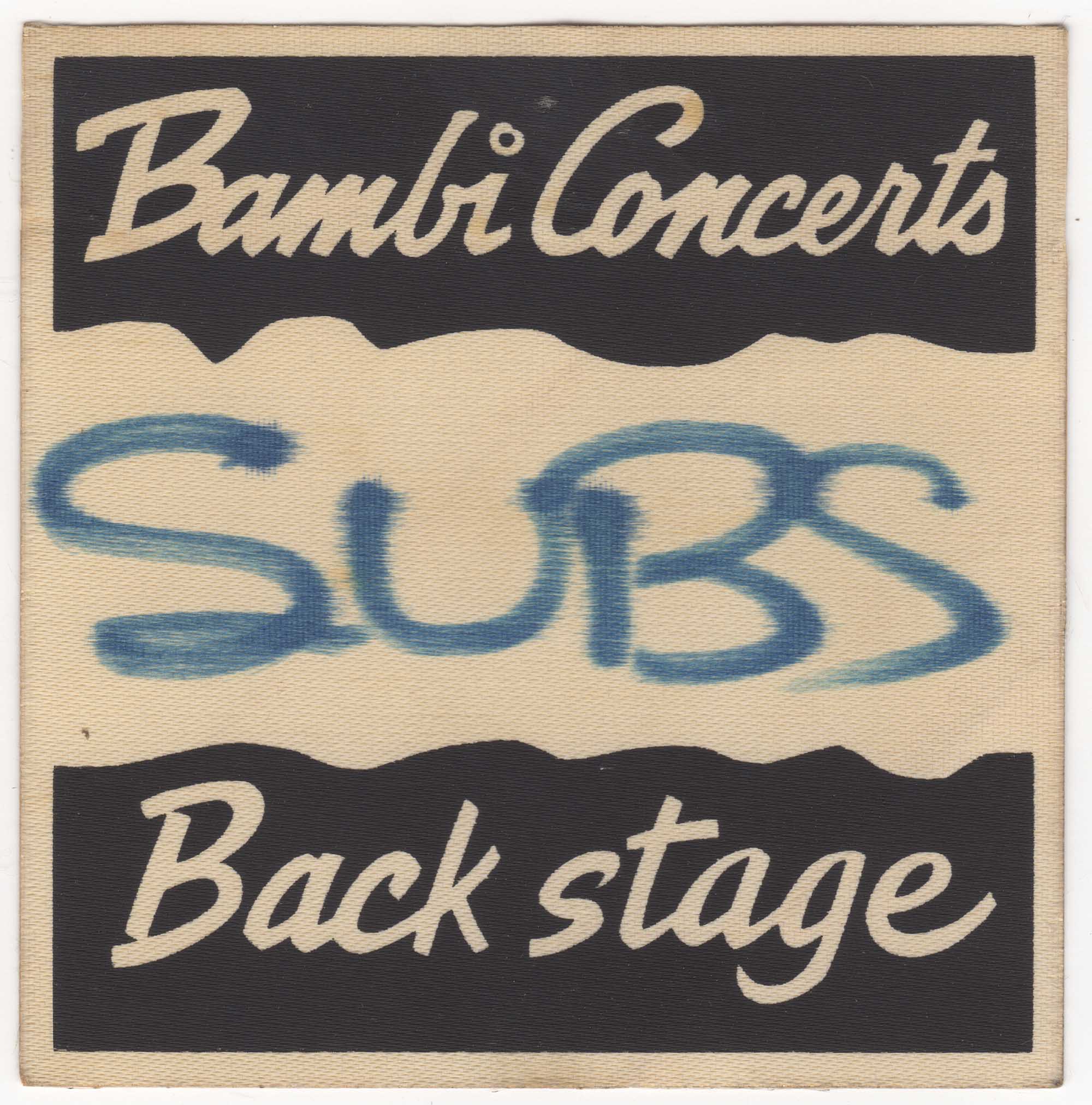
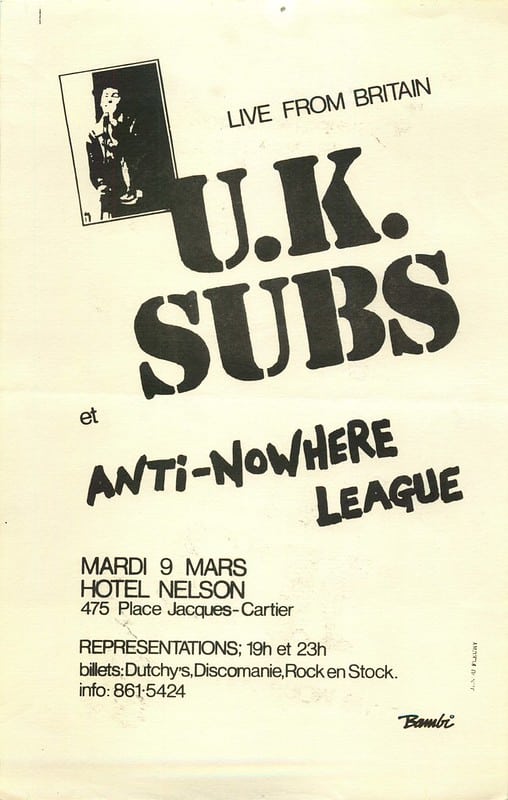
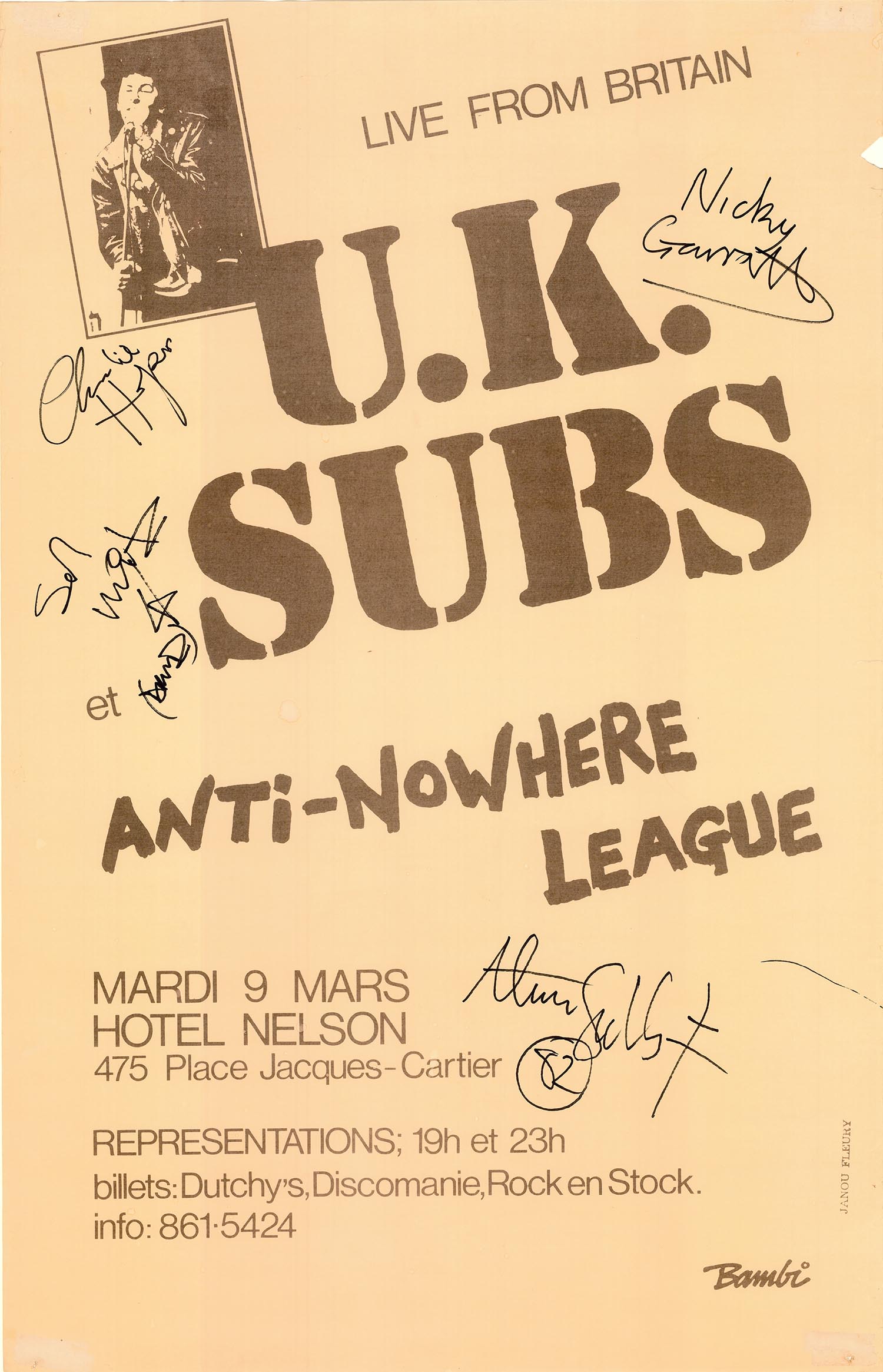
Based on the sources currently identified, the concert by UK Subs, with Anti-Nowhere League, presented on March 9, 1982 at the Hôtel Nelson, appears to be the last documented concert held at the establishment before the definitive end of its musical programming. This late date — after the last known activities of L’Évêché, the Nelson Grill, and Le Transit — symbolically marks the end of a cycle for the Nelson, which in just a few years shifted from a flagship venue for chanson and Franco-Quebec encounters to an occasional stop for British punk tours. 91.
14. From the Nelson to the Jardin Nelson — heritagization and continuity (1980s to today)
From the early 1980s onward, the Hôtel Nelson gradually stopped being an active engine of musical creation and entered a dynamic of commercial stabilization and heritage enhancement in Old Montreal. This transition fits within a broader movement of urban requalification around Place Jacques-Cartier, in which nocturnal cultural uses gradually gave way to tourism, residential functions, and restaurant activity. 78
The spaces once devoted to music presentation — L’Évêché, the Nelson Grill, then Le Transit — did not disappear abruptly, but were repurposed according to a logic of economic sustainability. Music, central in the 1970s, gradually became an ambient element, subordinate to the gastronomic experience, the square’s daytime animation, and the sector’s touristic appeal. 78
This shift was accompanied by a process of active heritagization of the built environment. At the end of the 1970s, specialized actors, including Heritage Canada, intervened directly in the restoration and enhancement of buildings adjacent to the Hôtel Nelson, helping transform a former hub of cultural dissemination into a coherent heritage ensemble. 97
A key milestone in this transformation was the integration of the Maison Parthenais-Perrault II, also known as the Maison-Cartier (407–413, Place Jacques-Cartier), a building constructed in 1812 and very early occupied by inn and tavern functions. Acquired in 1979 by Heritage Canada, restored in 1980 and then resold in 1981 to interests linked to the Hôtel Nelson, the house became a heritage restaurant before being integrated, at the turn of the 21st century, into the Jardin Nelson complex. 97
This shop-house, designated in 1982 as the Maison-Cartier National Historic Site, is one of the architectural and symbolic pillars of today’s Jardin Nelson. It testifies to a remarkable continuity of use: for more than two centuries, the site has remained a place of hospitality, sociability, and public consumption, despite profound changes in its cultural functions. 97
In this context, the Jardin Nelson name became firmly established as an emblematic terrace-restaurant of Old Montreal. While the place retains a lively, convivial atmosphere, it no longer offers a structured musical program comparable to what, in the 1970s, made the Nelson’s reputation as a cultural incubator. 79
This evolution marks a functional rupture, but not a symbolic disappearance. Jardin Nelson occupies a composite site, formed through the aggregation of older buildings — hotel, shop-house, tavern — whose uses succeeded one another without entirely erasing the site’s memory.
From a historical perspective, the Nelson illustrates a recurring phenomenon in Old Montreal: former creative venues becoming, over time, heritagized spaces, where cultural history survives more through archives, the built environment, and narrative than through artistic practice itself. 78
Thus, the shift from the Nelson to Jardin Nelson should not be read as an ending, but as a change of use. After having been a first-class hotel, a boîte à chanson, a rock room, a punk stopover, a jazz space, and a laboratory for hybrid forms, the site became a heritage sociability venue, embedded in today’s tourism economy, while still carrying a major cultural legacy for the musical history of Montreal.
Notes & sources
-
LA MINERVE, February 9, 1866 — notice “To let” (Hotel Jacques Cartier).
Description: advertises a “large and splendid hotel” on the north side of Place Jacques-Cartier; mentions 50 rooms, two reception salons, wine cellars, pantry, icehouse; indicates a location “near the steamship wharves” and “in the business district”; hotel steam-heated; contact: Amable Prévost (268–270 St-Paul Street). -
L’UNION NATIONALE, July 26, 1866 — article “L’Hôtel Jacques-Cartier”.
Description: describes Mr. Béliveau’s hotel on Place Jacques-Cartier as a large four-storey building, attributes its construction to Amable Prévost; mentions salons, the layout of the apartments, a dining room (on the second floor) and about 50 rooms; emphasizes its status as a “first-class” establishment. -
LA PATRIE, November 18, 1971 — Claude-Lyse Gagnon, “Une vie nouvelle anime le vieil hôtel Nelson” (illustrated feature).
Description: presents the Nelson as a hotel “after 130 years of history”; emphasizes the revival led by Pierre Benoit (3rd generation) and the desire to make the venue a meeting place for young people; photo caption: “will not be sold to the Americans.” -
LE POLYSCOPE, November 30, 1971 — “Nouveauté à l’Hôtel Nelson : L’Évêché”.
Description: article detailing the recent opening of the new venue, the programming plans, the transformation of the space, and the cultural ambitions associated with the establishment. -
TÉLÉ-RADIOMONDE, October 9, 1971 — “Ça va barder à l’Hôtel Nelson”.
Description: announces the arrival of a new venue manager, renovations affecting décor and atmosphere, and a regular music program with no admission fee. -
LE PETIT JOURNAL, October 28, 1971, Entertainment section.
Description: announces Raymond Lévesque’s last show before his long-term move to Old Montréal; explicit mention of the Hôtel Nelson and of the collaboration with Pierre Benoit and Bill Prickett. -
THE MONTREAL STAR, November 30, 1971, p. 20.
Description: announces a press conference held at the Hôtel Nelson on the occasion of the opening of a new chanson club, L’Évêché; mentions interviewees. -
LA TRIBUNE, January 22, 1972, Variétés section.
Description: profile of Raymond Lévesque explicitly evoking his desire to make Old Montréal a district with the atmosphere of Montmartre and his base at the Hôtel Nelson. -
MONTRÉAL-MATIN, November 14–21, 1971; PHOTO-JOURNAL, November 21, 1971.
Description: reports and photographs attesting to the intense cultural activity at the Hôtel Nelson at the time of the opening of L’Évêché, and to its patronage by numerous artists. -
TÉLÉ-RADIOMONDE, January 22, 1972 — “‘Québec sait fausser’ avec Raymond Lévesque”.
Description: specifies that Lévesque has “recently taken up residence” at L’Évêché, a club located within the Hôtel Nelson; announces the second revue (presented on January 10, 1972), titled “Québec sait fausser”, featuring impressionist Denis Gobeil; indicates a run of about two months and describes the revue as a satire of the political and artistic worlds. -
MONTRÉAL-MATIN, August 1, 1958 — advertisement “À la salle Bonsecours”.
Description: commercial notice presenting the Salle Bonsecours as a place for meals and banquets inside the Hôtel Nelson (425 Place Jacques-Cartier); attests to the existence and use of the hall well before the cultural reconversion of the 1970s. -
PHOTO-JOURNAL, December 26, 1971 — “Un triomphe pour Raymond Lévesque à l’hôtel Nelson”.
Description: article highlighting the exceptional success of the shows presented at the Hôtel Nelson; mentions a hall “packed to the rafters,” people turned away for lack of space, and an explicit comparison with Lévesque’s earlier successes at La Butte à Mathieu. -
PHOTO-JOURNAL, November 7, 1971 — “Raymond Lévesque à l’hôtel Nelson” (notice/announcement).
Description: indicates that Lévesque is setting up at the Nelson and thus “moves his belongings” into the hotel’s Salle Bonsecours; mentions an opening announced for November 12, 1971 and cites Pierre Benoit and Bill Prickett as administrators of the hotel. -
QUÉBEC-PRESSE, November 7, 1971 — notice announcing the opening of a new club at the Hôtel Nelson.
Description: announces the creation of a new chanson club in Old Montréal, located at the Hôtel Nelson; specifies that the first revue is titled “Law and Order” and is to “open” as of November 18, 1971. -
QUÉBEC-PRESSE, July 30, 1972 — brief announcing an event at the Hôtel Nelson.
Description: announces that during a dinner-show scheduled for August 3, a $500 scholarship is to be awarded to Raymond Lévesque; specifies that the event is to take place in the Hôtel Nelson’s Salle Bonsecours. -
PHOTO-JOURNAL, December 12, 1971 — cultural column (brief).
Description: mentions expanded programming at the Hôtel Nelson; refers to performances by the Quatuor de Jazz libre du Québec (evenings announced as regular). -
TÉLÉ-RADIOMONDE, August 19, 1972 — illustrated feature devoted to Raymond Lévesque.
Description: coverage of an event held at L’Évêché at the Hôtel Nelson during the summer of 1972, documenting the reception/celebration dimension associated with Lévesque’s presence in Old Montréal. -
LA PRESSE, October 19, 1972, column “Variétés / La semaine” (B. Spec) — article featuring an inset “Au Nelson; moitié jeunes, moitié Lévesque”.
Description: notes that the Hôtel Nelson “opened the doors of L’Évêché” for the cold season; describes a schedule (Thursdays, Fridays, Saturdays and Sundays) with beginner chansonniers at 9 p.m. and Raymond Lévesque around 10 p.m.; evokes the idea of a contest and a possible “Raymond Lévesque Prize”. - Internal working note (interpretation / etymology) — the attribution “L’Évêché = a nod to Raymond Lévesque” is kept here as an interpretation consistent with the close association between the venue and Lévesque (press coverage, programming, “Raymond Lévesque Prize” project), but would benefit from being supported by a source explicitly explaining the origin of the name.
-
LA PRESSE, May 17, 2005, Arts et spectacles section — Marie-Christine Blais, “Un beau ‘Beau D’Hommage’” (article + photo).
Description: retrospective article (2005) placing the launch of the Beau Dommage tribute album at the Hôtel Nelson (then known as Les Jardins du Nelson); recalls the episode “Harmonium announced” then cancellation due to illness,” and the “last-minute” replacement by a then little-known group, Beau Dommage, contributing to its breakthrough; the photo caption identifies several members/associates (including Michel Hinton, Pierre Bertrand, Réal Desrosiers, Robert Léger, Marie-Michèle Desrosiers, Michel Rivard, Pierre Huet). -
POP JEUNESSE, December 15, 1973 — article (Caramel Mou).
Description: notes that after a stop at L’Imprévu, Caramel Mou obtains a residency at L’Évêché (Hôtel Nelson) for eight months; gives a total of 492 performances at the same venue. -
MONTRÉAL-MATIN, December 26, 1973 — short item (a Nelson evening announced).
Description: announces that a farewell evening for Raymond Lévesque is being prepared at the Hôtel Nelson (“in early January”), under the impetus of Daniel Rousseau (impresario); mentions invited artists (including Pauline Julien and Claude Michaud) and a departure for Paris. -
LE DEVOIR, October 16, 1974 — article (Alan Gerber at L’Évêché).
Description: announces Alan Gerber “at L’Évêché” (Hôtel Nelson) for one week (through October 20); recalls his previous visits to Montréal and mentions recording and bilingual broadcast activities. -
LE SOLEIL, November 22, 1980 — Louis-Guy Lemieux, article on Fantastica (Carole Laure / Lewis Furey).
Description: biographical note indicating that in 1972–1973, a series of shows by Lewis Furey at L’Évêché (Hôtel Nelson) helped establish him as a singer-songwriter. -
LA GAZETTE DE LA MAURICIE, September 2023, music column — Michelle Dunn,
“Denis Boulet, l’étincelle du groupe Offenbach”.
Description: mentions (modern source / 2023) the launch of Offenbach Soap Opera on July 20, 1972 at the Hôtel Nelson (Montréal). -
LA PRESSE, April 6, 1993, section B, “National information” — Mario Roy,
“Avant de m’en aller” (column / retrospective account around Gerry Boulet and the Offenbach period).
Description: retrospective source (1993) looking back on the period and on the role of the Nelson as a venue and a point of circulation, including the context surrounding the launch of Offenbach Soap Opera. -
MONTRÉAL-MATIN, August 6, 1976, Madeleine Fournier,
“Le Pancho sera plus jeune”.
Description: announces the arrival of Francine Loyer as the new director of the chanson club Le Pancho; specifies that she previously made “more than popular” L’Évêché at the Hôtel Nelson, confirming her central role in the venue’s programming and artistic management. -
LE DEVOIR, May 31, 1975, p. 15,
“Clubs de nuit, clubs d’ennui…”.
Description: column mentioning Francine Loyer among the key figures associated with Old Montréal nightspots; situates her activity at L’Évêché in a context of renewal of venues and of professionalization of the scene. -
LA PRESSE, December 13, 1976, Pierre Beaulieu,
review “Jeanne d’Arc Charlebois c’est plus que La Bolduc”.
Description: observes that L’Évêché at the Hôtel Nelson has “changed since its founding”; mentions Francine Loyer as being responsible for the shows, associated with the venue’s shift from a spoken-word stage to a rock and pop music stage. -
LE DEVOIR, September 1, 1977, p. 8–9,
Nathalie Petrowski,
“À l’Évêché — Le party commence…”.
Description: article explicitly stating that Francine Loyer is responsible for relaunching the venue; describes her role in programming, artistic strategy, and the repositioning of L’Évêché as a major music stage. -
LE DEVOIR, September 1, 1977, p. 9,
Variétés section — inset “Évêché”.
Description: announces the fall programming at L’Évêché, including rock, folk and “L’Évêché’s classical Mondays”; testifies to the venue’s stylistic openness under the direction of Francine Loyer. -
THE MONTREAL STAR, September 18, 1976, Brian Moore,
Cityscape column.
Description: describes L’Évêché as a “showcase club for new talent”; specifies that Francine Loyer “handles bookings” for the Hôtel Nelson’s venue; emphasizes her strategic role (scouting, circulation, patronage by industry/media). -
THE GAZETTE, May 22, 1976, p. 39 — Juan Rodriguez, “Rock & Pop” column,
“Truce in Quebec rock rivalry should help everyone”.
Description: mentions Francine Loyer in a context of management / representation of groups; reports comments on the limits of a strictly provincial circuit and obstacles to circulation beyond Québec. -
LA PRESSE, February 16, 1983, Jean Beaunoyer,
“Nanette Workman libre!” (Arts & entertainment / Variétés).
Description: states that another woman, Francine Loyer, looks after Nanette Workman’s career; places this support within a “at her own pace” career-trajectory logic. -
LA PRESSE, December 2, 1976 — article announcing the opening / launch of
O’National (new performance venue).
Description: links Francine Loyer to the programming / start-up team of the venue, in continuity with know-how acquired at L’Évêché (Hôtel Nelson). -
POP JEUNESSE ROCK, November 22, 1975, Marie Lefebvre,
column “Un automne bien chargé” — inset/entry “HOTEL NELSON”.
Description: presents the Hôtel Nelson as a meeting place for Québec musicians (a very active season), and highlights the intensity of programming / artist circulation; mentions an upcoming winter expected to be “busy.” -
LA PRESSE, June 24, 1974, section A — Richard Chartier, “Seule ombre aux Fêtes, les incidents du Vieux-Montréal”.
Description: passage mentioning the Ville-Emard Blues Band “in the interior enclosure of the Hôtel Nelson.” -
MAINMISE, October 1974, p. 41 (BAnQ display: p. 43/68) — Romain Rolland Vallée, “La dope : une nouvelle loi !”.
Description: passage indicating that, “since the beginning of September,” one can “no longer consume” at the Hôtel Nelson, described as “one of the coolest places in Montréal”; links atmosphere, practices, and police control. -
L’ŒIL RÉGIONAL, December 18, 1974, Loisirs / Spectacles section — Thérèse David,
“‘Beau Dommage’ en chansons c’est le coup de foudre”.
Description: enthusiastic column devoted to Beau Dommage; describes the group’s immediate effect on audiences; explicitly states that Beau Dommage will be at L’Évêché at the Hôtel Nelson from December 17 to 29; stresses the group’s coherence, ongoing radio airplay, and the recent release of the LP on the Capitol label. -
POP JEUNESSE, January 11, 1975, p. 23,
“Beau Dommage”.
Description: illustrated article presenting Beau Dommage on the occasion of a press cocktail and album launch; specifies that the group performs its compositions on the Hôtel Nelson stage; describes the band as a Montréal revelation and highlights the event’s media and professional function. -
Press photograph, December 9, 1974.
Description: photograph showing Pierre Bertrand, Robert Léger, Pierre Huet, Marie-Michèle Desrosiers, Réal Desrosiers and Michel Rivard, identified as the launch of Beau Dommage’s first album at the Hôtel Nelson (Montréal); iconographic document confirming the Nelson’s role as a site of official launch and public legitimation. -
POP JEUNESSE ROCK, October 29, 1977 — Marc Desjardins, “Un automne en or — L’Évêché / L’Outremont / L’Imprévu” (photos: Cécile Lemire).
Description: presents L’Évêché (Hôtel Nelson) and states: “It is Wilma Ghezzi who now directs the fortunes of L’Évêché”; photo caption: “Wilma Ghezzi, current director of L’Évêché.” -
THE MONTREAL STAR, October 22, 1977, Cityscape column (page 145) — article mentioning cooperation between L’Imprévu (Hôtel Iroquois) and L’Évêché (Hôtel Nelson).
Description: André Tremblay (Hôtel Iroquois) says he met Wilma Ghezzi, his counterpart at the Nelson; mentions collaboration on advertising and a logic of sharing bookings. -
THE MONTREAL STAR, December 17, 1977 — Matt Radz, article (musicians’ conflict/organization; mention of L’Évêché).
Description: describes Wilma Ghezzi as the booking agent for the Hôtel Nelson club “for the past two years” (duration indicated). -
THE MONTREAL STAR, January 10, 1978 (page 19) — brief announcing partnerships and show volumes.
Description: “Wilma Ghezzi and Claude Lusignan” become partners in Luna Arts Inc.; mentions a contract for 240 shows (El Casino) and 624 others at “Nelson’s eveche club.” -
POP JEUNESSE ROCK, January 28, 1978 — Jacques Landry, “Bonne chance au groupe du 407!” (feature).
Description: links Claude Lusignan and Wilma Ghezzi to Luna Arts Inc. and to the production of shows at L’Évêché and El Casino; biographical elements and show-biz context. -
POP JEUNESSE ROCK, January 28, 1978 — Jacques Landry, “Super-Jam Session ’78” (page 18).
Description: photograph/caption “Le groupe du 407” (Wilma Ghezzi, Claude Lusignan, Diane St-Amand) and mention of hundreds of shows presented at L’Évêché / El Casino (wording to be quoted precisely if needed). -
POP JEUNESSE ROCK, May 6, 1978 — Jacques Landry, “La femme derrière l’Évêché” (profile + programming).
Description: interview/presentation of Wilma Ghezzi as a central figure at L’Évêché; documents her public image, artistic line, and a dated program (spring 1978). -
VIE ET CULTURE, December 29, 1975, p. 19 —
“Un Évêché ‘tout chaud’ commence l’hiver 1976” (illustrated article).
Description: announces the launch of the revue Tout chaud, tout show at L’Évêché (Hôtel Nelson) starting on December 30, 1975; presents François Guy as the revue’s designer; describes the format (musical revue, humor, songs, musicians onstage); identifies the main performers and frames the production as the opening of the winter 1976 season. -
MONTRÉAL-MATIN, August 8, 1976, section 2 —
notice “Circociel”.
Description: notes the extended run of François Guy at L’Évêché at the Hôtel Nelson “until the end of August”; describes the revue as a collective production combining singing, poetry, humor, and visual numbers; confirms the continuity of the collaboration between Guy and the venue. -
QUÉBEC ROCK, June 1980, p. 34 — profile of Marjolène Morin (Marjo).
Description: illustrated biographical piece stating that in 1976, Marjo lived with François Guy and took part in Tout chaud, tout show at L’Évêché; notes that Guy encouraged her to sing publicly; frames this experience as her official entry into Montréal’s rock scene. Photo credit: Pierre Dury. -
LA TRIBUNE, November 19, 2005, section 9 —
“Le parcours d’une rockeuse” (Marjo timeline).
Description: recalls that in 1975, Marjo was hired as a backing singer in two revues staged by François Guy, including Tout chaud, tout show; presents this participation as a foundational step preceding her joining the band Corbeau. -
Cross-referenced press + retrospective source (1975–2005).
Description: taken together, contemporary articles (1975–1976) and retrospective accounts (1980, 2005) converge in identifying L’Évêché at the Hôtel Nelson as a site of early stage emergence for Marjo, and François Guy as a transitional figure between the musical revue and Montréal rock at the end of the 1970s. -
LA PRESSE, Montréal, February 16, 1983, Arts et spectacles section, p. G-2 —
Jean Beaunoyer, “Nanette Workman libre!”.
The article explicitly mentions that Francine Loyer handled Nanette Workman’s career as she pursued it “at her own pace,” confirming Loyer’s role as an artistic manager and strategic adviser beyond simple promotion or booking work. -
The Montreal Star, Montréal, December 17, 1977, p. 38 —
Matt Radz, “Rebellion in the ranks of the Guild”.
Article evoking internal tensions within the Montreal Musicians’ Guild, mentioning in particular the involvement of Beau Dommage and other figures on Montréal’s late-1970s music scene, in a context where several musicians, producers, and managers connected to Old Montréal venues — including the ecosystem of L’Évêché at the Hôtel Nelson — were questioning existing union structures. - The Montreal Star, May 9, 1978, p. 26 — Matt Radz, “Lou Reed never surpassed”. Detailed review of Lou Reed’s concert at L’Évêché, emphasizing the physical intensity of the performance, the closeness to the audience, and the venue’s fit with the artist’s underground aesthetic.
- Le Devoir, May 9, 1978, p. 17 — Nathalie Petrowski, “Affreux, Sale et Méchant”. Critical analysis of Lou Reed’s appearance at L’Évêché, describing an overheated room, a tightly packed crowd, and a deliberately abrasive set, at odds with traditional promotional codes.
- Pop jeunesse rock, June 3, 1978, p. 4 — “Deux soirs à l’Évêché : Lou Reed ?”. Report on Lou Reed’s two consecutive concerts at the Hôtel Nelson, highlighting the feverish anticipation, the packed crowd, and the exceptional nature of the event in Old Montréal.
- Québec rock, June 1978, p. 17–18 — Marc Desjardins, “Lou Reed — plutôt les mets chinois que l’héroïne”. A contextual reading of Lou Reed’s Montréal stay, positioning L’Évêché as a space resonating directly with Lower East Side New York clubs and the artist’s urban aesthetic.
- The Montreal Star, May 9, 1978 — supplementary article on the critical reception of Lou Reed’s concerts at L’Évêché, noting the artist’s stated preference for small venues and his rejection of large-scale formats.
-
Press context and cross-checked testimonies, late 1970s — recurring mentions of the Nelson Grill as an informal space of musical sociability in Old Montréal.
Description: describes a non-institutional venue, open to the street, fostering encounters, spontaneous performances, and alternative musical practices, notably associated with punk and raw rock. -
QUÉBEC ROCK, June 1979 — feature “La punk-rock-folk-disco-blues-jazz-classique-omanie du Vieux Montréal”.
Description: depicts Old Montréal as a polymorphous musical space; explicitly mentions the Nelson Grill as a place where one can hear rock and punk, sometimes seven days a week, in a laid-back atmosphere directly plugged into Place Jacques-Cartier. -
QUÉBEC ROCK, June 1979 — same feature.
Description: presents the Nelson Grill as an informal rallying point for young musicians, punks, and night people; describes it as a gateway to the “new wave”, more spontaneous and free of official circuits. -
QUÉBEC ROCK, June 1979 — internal testimonies and descriptions.
Description: explicitly evokes the “Nelson Grill as a punk club”; highlights the lack of formal programming and the venue’s role as a space for exchange, encounters, and improvised performances, extending L’Évêché’s logic in a more everyday and raw form. -
Alan Lord, High Friends in Low Places, p. 22.
Description: profile of John von Aichinger, nicknamed “Spike”; notes his Austrian family origins, an aristocratic lineage dating back to the 9th century, and kinship with Ludwig III of Bavaria; states that the nickname “Spike” was given to him by Dave Rosenberg (The Chromosomes). -
Alan Lord, High Friends in Low Places, p. 22.
Description: Spike’s direct account of taking over the Nelson Grill; describes the gradual pushing-out of the previous clientele (mainly bikers) and the organization of three shows a week, every week, until June 1978. -
Alan Lord, High Friends in Low Places, p. 22.
Description: analysis of the Nelson Grill’s decisive impact on Montréal’s first punk wave; describes the venue as a crucial space for meeting, exchange, and artistic growth; suggests that without the Nelson Grill, the Montréal punk scene might have been stifled at birth. -
MAISONNEUVE, January 24, 2012 — Sam Sutherland, “Anarchy in the QC”.
Description: retrospective look at Montréal’s punk scene beginning in 1977; describes makeshift Old Montréal venues and shows in bars and non-traditional spaces; mentions bands such as The Chromosomes and a cultural climate that set the stage for the emergence of places like the Nelson Grill. -
Montréal-Matin, May 19, 1978 — Monique Mathieu,
“L’Évêché changera de formule”.
Description: article reporting L’Évêché’s financial difficulties; notes the lack of profitability of a show-centered formula, the absence of grants from the Ministère des Affaires culturelles, and the possibility of closure. -
Montréal-Matin, May 19, 1978 — quotations from Pierre Benoît, co-owner of the Hôtel Nelson.
Description: acknowledges that “artists cost too much”; confirms unsuccessful approaches to the Ministère des Affaires culturelles and the financial dead end of L’Évêché’s initial formula. -
Montréal-Matin, May 19, 1978 — statements by Jean Pilote, director of the Hôtel Nelson.
Description: announces a change of formula starting mid-June 1978; conversion of L’Évêché into a dance venue, admission set at $1, extended restaurant hours and increased late-night animation on Place Jacques-Cartier. -
La Presse, October 30, 1980,
Arts et spectacles section.
Description: mentions recordings by Radio-Canada FM of jazz performances in a new room fitted out in the former Nelson Grill, confirming its role as a music-presenting space. -
The Montreal Star, May 13, 1978 — Patricia Lowe,
“Hotel Nelson in trouble: Debt clouds future of landmark hotel”.
Description: analysis of the Nelson’s financial situation; discusses debts, mortgages, urban development projects, and uncertainty about the future of this historic Old Montréal hotel. -
Le Devoir, September 23, 1980 — Nathalie Petrowski,
“Le Transit prend la relève du Nelson”.
Description: announces the opening of the Transit at the Hôtel Nelson; describes major renovations to the former Nelson Grill, the creation of a 300-seat room, the appointment of André Bernard Tremblay as artistic director, the focus on emerging artists, and the economic strategies put in place to ensure the venue’s survival. -
Pop Rock, June 16, 1979 — institutional advertisement,
“Une auberge est née” (Auberge Le Nelson).
Description: presents the Hôtel Nelson as an inn and meeting place for musicians; mentions L’Évêché converted into a dance hall, Maison Cartier, low-cost lodging, and the venue’s cultural rootedness in Old Montréal. -
The Montreal Star, May 9, 1979 — Patricia Lowe,
“Cartier square inn now Hostel Nelson”.
Description: describes the Nelson’s conversion into a youth hostel as a solution to a prolonged financial crisis; mentions debts, real-estate restructuring, support from Heritage Canada, and the retention of cultural spaces within a hybrid model. - LE SOLEIL, May 26, 1979, Section E — “L’hôtel Nelson, auberge de jeunesse”. Article on the Hôtel Nelson’s financial situation in the late 1970s and its repositioning as a hostel in Old Montréal. The text documents the accumulation of a debt estimated at about $800,000, the transfer of a neighboring building to the Heritage Canada Foundation for $200,000, as well as a $200,000 loan granted by the Federal Business Development Bank, repayable over sixteen years. The article specifies that the operation of the rooms is entrusted to a private non-profit company, administered according to the methods of international youth hostels, and that the revenues generated are to be used for the restoration of the building and the improvement of services for travelers.
-
CITY OF MONTRÉAL, 1980s–1990s — Old Montréal planning and enhancement documents.
Description: describes the shift in the Place Jacques-Cartier sector toward tourist, residential, and commercial functions; underscores the gradual decline of nighttime cultural uses in favor of restaurants, terraces, and daytime animation; broader context of the heritage framing of historic buildings. -
JARDIN NELSON — official website and promotional documentation (various consultations).
Description: presents the establishment as an iconic restaurant and terrace in Old Montréal; highlights architecture, the interior garden, and ambiance, with no reference to structured musical programming; confirms the site’s change of use after the 1980s. -
CITY OF MONTRÉAL ARCHIVES — photographic and descriptive files,
Place Jacques-Cartier, 1980s–2000s.
Description: visual documentation of the transformation of façades, terraces, and commercial uses around the square; shows the Nelson/Jardin Nelson’s progressive integration into an urban landscape oriented toward cultural tourism. -
BAnQ — press clippings, 1980s–1990s,
“Old Montréal” and “Place Jacques-Cartier” files.
Description: articles evoking the end of performance venues in the area, the rise of tourist-oriented restaurants and bars, and the conversion of places once associated with music creation into spaces of cultural consumption. -
Le Devoir, July 4, 1992 — Vie et culture section,
“Le son d’abord à l’Évêché”.
Description: article on the renovation of the club L’Évêché at the Hôtel Nelson, emphasizing attention to sound reinforcement and acoustic technique (JBL speakers, Yamaha console, equalization, compressor), and the desire to make the venue a simple, comfortable space for a new generation of musicians and Québec song. The piece also describes shows scheduled through the fall and installations planned to improve the listening experience. -
Le Devoir, December 14, 1981 — Nathalie Petrowski,
“Rencontre de deux chansons”.
Description: article announcing and contextualizing the show Pour quelques chansons, bringing together Francis Cabrel, Pierre Bertrand, and Gilles Valiquette on the stage of L’Évêché at the Hôtel Nelson. The text emphasizes the spirit of Franco-Québécois encounter, the venue’s temporary reopening before its announced closure, and the intention to favor artistic exchange rather than a promotional logic. -
La Presse (Montréal), December 12, 1981 — “Cinéma, théâtres, restaurants” section.
Description: brief announcing Francis Cabrel’s appearance “on December 14 and 15” at L’Évêché at the Hôtel Nelson, presenting him as a rising figure in the “new French chanson,” and noting that he would share the bill with Québec artists. -
La Presse (Montréal), December 15, 1981 — Section A.
Description: promotional inset “Beaubec présente — Du Québec et de France” announcing the show Pour quelques chansons… at L’Évêché at the Hôtel Nelson, bringing together Pierre Bertrand and Francis Cabrel, with participation by Luc Gilbert and Gilles Valiquette. -
La Presse (Montréal), December 16, 1981 — Arts et spectacles section,
Pierre Beaulieu, “Un show collectif plaisant, chaleureux et sans prétention”.
Description: review of the show presented at L’Évêché at the Hôtel Nelson, describing a collective, song-centered format in which Francis Cabrel is identified as the headliner, alongside Pierre Bertrand and Gilles Valiquette, with Luc Gilbert accompanying. -
La Presse (Montréal), December 19, 1981 — Arts et spectacles section,
Denis Lavoie, “Une belle voix et de bons textes”.
Description: critical profile of Francis Cabrel recalling his recent appearance at L’Évêché at the Hôtel Nelson (Monday and Tuesday), the positive reception from Montréal audiences, and the shared bill with Gilles Valiquette and Pierre Bertrand. -
La Presse (Montréal), April 3, 1982 — Spectacles section, p. C10,
Denis Lavoie, “Un show à deux — Pierre Bertrand et Gilles Valiquette”.
Description: article announcing the Bertrand–Valiquette duo’s appearance at the Hôtel Nelson’s Transit, recalling that their first public collaboration took place during Francis Cabrel’s visit to L’Évêché, with reactions judged very positive. -
Québec Rock, May 1982 — Gazette rock column,
“HAPPY HOUR : Un cinq à sept avec Bertrand-Valiquette”.
Description: piece looking back on the genesis of the Bertrand–Valiquette project, explicitly evoking Francis Cabrel “within our walls” and the one-off reopening of L’Évêché at the Hôtel Nelson as the triggering moment for that collaboration. -
La Presse (Montréal), April 16, 1982 — Section A,
“Au Transit de l’Hôtel Nelson — Bertrand et Valiquette font du piano-bar ?”.
Description: critical commentary on the Bertrand–Valiquette formula presented at the Hôtel Nelson’s Transit, referring back to the earlier collective show given at L’Évêché during Francis Cabrel’s visit. -
The Gazette (Montréal), Saturday, February 20, 1982 — advertising box,
“Live from Britain — U.K. Subs”.
Description: announcement of a concert by U.K. Subs with Anti-Nowhere League, presented on March 9, 1982 at the Hôtel Nelson (475 Place Jacques-Cartier). In the absence of later sources attesting to musical activity after that date, this event constitutes, to date, the last documented concert held at the Hôtel Nelson before the definitive end of its live-programming activity. -
LE DEVOIR, February 26, 1976, Varieties section — Christine L’Heureux,
“Malade d’Aut’Chose!”.
MCPA usage: review/column describing the performance of Lucien Francoeur and Aut’Chose at L’Évêché of the Hôtel Nelson, emphasizing the show’s theatrical dimension, its poetic aggressiveness, the expressive use of the voice (spoken/shouted rather than sung), and the overall quality of the group (notably the pianist). -
LE DEVOIR, February 26, 1976, Varieties section — Christine L’Heureux,
“Malade d’Aut’Chose!”.
MCPA use: review/column describing the performance of Lucien Francoeur and Aut’Chose at L’Évêché of the Hotel Nelson, emphasizing the show’s theatrical dimension, its poetic aggressiveness, the voice used in an expressive manner (more spoken/shouted than sung), and the quality of the band (notably the pianist). -
Jean-François Brassard, C’est ben gravé dans ma mémoire,
Montreal, Éditions Les Malins, p. 92.
Notice: retrospective account recalling the series of Harmonium concerts at L’Évêché of the Hotel Nelson in June 1974, the cancellation of the June 26 show for health reasons, and the improvised intervention by Michel Rivard to introduce Beau Dommage, then a band without a recording contract, called in at the last minute to replace Harmonium. -
L’UNION NATIONALE, July 26, 1866 — article
“The Hotel Jacques-Cartier”.
Notice: in-depth article presenting the Hotel Jacques-Cartier, owned by Mr. Béliveau and built by Amable Prévost, as one of the finest French-Canadian establishments in Montreal. The text describes a large four-storey building on the east side of Place Jacques-Cartier, with “simple and imposing” architecture offering a “magnificent view.” The interior is deemed equal to the exterior, with reception salons, a dining room on the second floor, approximately 50 comfortably furnished rooms, and a table and wines that “leave nothing to be desired.” The article stresses the hotel’s strategic location, near the steamship wharves of the Richelieu Company, and its role at the heart of Place Jacques-Cartier, then described as the center of Canadian business. -
LE SPECTATEUR, May 10, 1895 —
“Reopening of the Hotel Jacques-Cartier”.
MCPA use: article announcing the reopening of the Hotel Jacques-Cartier, located on Place Jacques-Cartier, after roughly a year of closure devoted to major renovation work. The text highlights the complete modernization of the establishment, now ranked among first-class hotels, the richness of its furnishings, the scale of its dining room, and a stated capacity of approximately 250 boarders. It also mentions its owner, Thomas E. Shallow, an experienced hotelier who had previously managed the Victoria and the St-Louis in Quebec City, and presents the hotel as one of the most fashionable and frequented establishments in the metropolis at the end of the 19th century. -
CITY OF MONTREAL — Built Heritage Inventory,
record “Hotel Nelson,” building no.
0040-66-4289-00, Place Jacques-Cartier.
MCPA use: architectural data, chronology of owners, building functions, major transformations (1865–1986), and a toponymic clarification indicating that the name Hotel Nelson refers to Wolfred Nelson, patriot and mayor of Montreal in 1854, and not to Admiral Horatio Nelson. -
CITY OF MONTRÉAL — Built Heritage Inventory,
record “Maison Parthenais-Perrault II”
(also known as Maison-Cartier),
407–413, Place Jacques-Cartier.
MCPA use: historical, architectural, and functional data documenting a building constructed in 1812, very early occupied as an inn and tavern, and later known notably as the Hôtel Saint-Louis (1890–1915). The building was acquired in 1953 by Berthold Benoît, owner of the Hôtel Nelson, resold in 1974 to Hôtel Nelson Inc., and then transferred in 1979 to Heritage Canada, which completed its restoration in 1980. Designated in 1982 as the Maison-Cartier National Historic Site, the property was repurchased in 1981 by Pierre Benoît and successively housed restaurant uses, before being integrated, at the turn of the 21st century, into the Jardin Nelson complex. The record confirms the continuity of use of the site as a place of hospitality, sociability, and public consumption since the early 19th century and sheds light on the process of heritage-making that accompanied the transformation of the Place Jacques-Cartier area.