Windsor Hotel (Montreal)
A major downtown railway-era and society hotel, the Windsor Hotel (opened in 1878, closed in 1981) is generally regarded as Canada’s first “grand hotel”. For decades, it promoted itself as “the best in all the Dominion”, embodying a showcase of anglophone business Montreal, as well as the world of balls, banquets, and a distinctly “American-style” culture of hospitality. The hotel is also the birthplace of the National Hockey League (NHL), founded on November 26, 1917, during a meeting held within its walls. Its history further intersects with the arts: beginning in 1890, spaces referred to as Windsor Hall / Salle Windsor hosted concerts, assemblies, and public events, in architectural and functional forms that varied significantly from one period to another.
1. Overview
In Montreal’s press, the Windsor Hotel appears as an anticipated response to what was framed as a serious problem: the city’s inability to offer sufficient and appropriate accommodations for wealthy travellers and leisure visitors. The establishment is identified by its English name, Windsor Hotel; the form “hôtel Windsor” reflects a translation-based usage.[1]
2. Origins of the Windsor Hotel project (1875)
The Windsor’s emergence in Montreal’s public sphere is directly tied to an explicit debate about the insufficiency of hotel accommodations in the city. This issue is not raised retrospectively, but stated clearly and argued in a letter published in The Gazette in the summer of 1875.[1]
In this text entitled Hotel Accommodation, a correspondent signing Business in Earnest argues that complaints reported in the press about Montreal are not sensationalism, but stem from a real shortage of hotel lodging—both in quantity and in quality. The author claims Montreal then had no establishment matching the “class or style” sought by pleasure and leisure travellers, who were accustomed to standards of comfort and luxury beyond what existing hotels could provide.[1]
The correspondent adds that this situation had concrete consequences in recent travel seasons, stating that during 1873 and 1874, travellers supposedly left Montreal because they could not find suitable accommodations. This is presented as a fact already “well known,” following earlier correspondence published in The Gazette during the preceding week.[1]
The choice of site was, at the time, a bold gamble. The selected land, near the former Catholic cemetery laid out at Dominion Square, was perceived as outlying compared with the activity centres of Old Montreal and the business district. Contemporary observers questioned the wisdom of placing a luxury hotel at the north-west corner of Dorchester and Windsor streets (today René-Lévesque Boulevard and Peel Street), recently opened through the former cemetery.[31]
Despite doubts expressed in the press and by some observers, the Windsor Hotel Company brought together influential and firmly established businessmen. In addition to its president, Andrew Allan (brother of Sir Hugh Allan), the company included Sir William C. Macdonald and Harry Gault, later founder of the Sun Life Insurance Company. This composition points to the financial capacity and network of influence mobilized to carry out a project seen as risky at its launch.[31]
Within this press-framed context of hotel shortage, the Windsor Hotel project is named explicitly for the first time. The author expresses hope that construction of the proposed hotel on Dorchester Street would begin without delay. He argues that if work started immediately, foundations could be laid quickly, allowing building operations to commence the following spring and the establishment to be completed in time to welcome visitors in the summer of 1877.[1]
This public position was followed a few weeks later by an official notice published in the name of the Windsor Hotel Company. Dated September 29, 1875, the short text announces that the company’s directors are ready to conclude agreements with contractors interested in building the hotel. The notice states that “the work will proceed forthwith”, signalling a move from public argument to an operational phase of the project.[2]
The announcement is signed by Franc O. Wood, secretary of the Windsor Hotel Company, confirming the formal existence of the entity responsible for the project and the declared intention to proceed without delay. Together, these documents constitute the earliest printed attestations of the Windsor as a concrete project, prior to any architectural description or official opening.[2]
3. Construction and opening of the Windsor Hotel (1877–1878)
After the 1875 announcements confirming the project’s imminent launch, the Windsor Hotel entered a concrete phase of realization between 1875 and 1878. The building was designed by architect G. H. Worthing for the Windsor Hotel Company, a consortium formed by six Montreal businessmen, among them photographer and entrepreneur William Notman. The project was capitalized at $500,000, a considerable sum at the time and a marker of the venture’s ambition.[24]
The urban and economic context largely explains this ambition. In the mid-1870s, Montreal was Canada’s largest city and the leading commercial and financial centre of the young Dominion. The consortium sought to erect a luxury hotel capable of symbolizing prosperity, modernity, and the city’s metropolitan status, while responding to the shortage of high-end lodging repeatedly denounced in the press.[1]
During 1877, Montreal newspapers began referring to the building not merely as a project, but as an advanced construction site, identified as a future major hotel in the Dominion Square sector and on Dorchester Street. An article published in The Montreal Star in March 1877 explicitly mentions the Windsor among the city’s major constructions, attesting to real progress and to public recognition of the project.[3]
At the end of January 1878, the press announces the hotel’s imminent opening. A notice published in The Daily Witness specifies that the Windsor Hotel will officially open on Monday, January 28, 1878, indicating it was ready to receive travellers and businessmen immediately.[4]
On the same day, Le Journal de Québec relayed the information, confirming the opening and demonstrating the provincial resonance of the event. This circulation beyond Montreal underscores the symbolic importance attributed from the outset to the Windsor as a new hotel showcase for urban, commercial Canada.[5]
Reports published at the opening stress the hotel’s immediately operational character: the Windsor is presented as “open for business”, without a formal inaugural ceremony, emphasizing practical function and the capacity to meet the city’s lodging needs without delay.[4]
From the beginning, the Windsor is closely associated with railway networks and modern mobility. Advertisements mention porters and omnibus vehicles linking the hotel and railway stations. From 1889, out-of-town visitors could access the area via Windsor Station, designed by New York architect Bruce Price, reinforcing the Windsor’s role as a prestigious railway hotel at the heart of downtown.[24]
The opening of January 28, 1878 thus marks the culmination of a process begun years earlier, moving from public debate about a lack of accommodations to the effective opening of an establishment intended to embody modernity, economic power, and metropolitan ambition. From that date, the Windsor became a central actor in the city’s urban, commercial, and social life.[5]
A retrospective source published in La Presse recalls that the Windsor opened on January 28, 1878, confirming in hindsight the absence of an inauguration ceremony and emphasizing the project’s pragmatic and immediately functional character, designed to respond to pressing demand rather than to stage a single society event.[31]
Despite the scale of the initial investment—estimated retrospectively at about $16 million, a considerable sum for the period—the Windsor experienced a difficult start. An article in La Presse even cites the label “white elephant” to describe the hotel’s early perception. In this context, G. H. Worthington, the hotel’s first operator, quickly relinquished management back to its owners not long after opening.[31]
4. The Windsor Hotel as a Montreal “grand hotel”
In retrospective texts published by The Gazette over the twentieth century, the Windsor Hotel is presented not only as a hotel, but as a symbolic, almost idealized construction of Montreal modernity. Edgar Andrew Collard, a city columnist and historian, summarizes this perception by writing that the Windsor “originated in a dream,” emphasizing the project’s deliberately ambitious and exceptional character from the outset.[6]
In this reading, the Windsor immediately distinguished itself from earlier Montreal hotels by its location, chosen away from the traditional quay and old-port area. The shift toward Dominion Square is described as a strategic move, aimed at creating a new hotel axis aligned with urban expansion, major arteries, and developing districts.[6]
Descriptions of the building emphasize its scale and the effect produced by its massing. Collard evokes a structure designed to exceed local standards, to the point of comparison with major North American and European hotels. This pursuit of grandeur is presented as intentional: the Windsor was to be “not only the grandest in Montreal, but equal to any in North America,” as reported in the column.[6]
A long illustrated feature published in La Presse in 1988 stresses the Windsor’s exceptional architectural dimension, describing its volumes, materials, and interior organization in detail. The text highlights the central atrium as the structuring element of the hotel experience, around which circulation, lounges, and reception spaces were arranged. This confirms that the Windsor’s monumentality was not only a matter of façade, but also of an interior design meant to impress and to organize society life.[31]
Interior spaces are described as fully participating in this ambition: lounges, dining rooms, and reception spaces designed to impress visitors and Montreal society alike. The Windsor appears as a place where hospitality becomes spectacle, and where architecture serves as the stage for high-society life.[6]
This social role is reinforced by repeated superlatives in journalistic accounts. The Windsor is described as a gathering place for political, economic, and cultural elites, hosting events later labelled “historic” by the press. These retrospective narratives contribute to a collective memory in which the Windsor occupies a central position.[7]
Centennial articles published in 1978 further reinforce this image. The Windsor is explicitly described as a hotel that “hosted royalty, prime ministers and business leaders,” a phrase encapsulating the prestigious vocation attributed to the establishment across its lifetime.[8]
Through these texts, the Windsor appears less as a simple building than as an institution. The repetition of narratives, anecdotes, and descriptions helps forge a durable image of an urban “palace,” often referred to retrospectively as the “Palace of Canada”, an expression used to summarize its symbolic status in the city’s history.[6]
5. Social uses and high-society life at the Windsor Hotel
From its earliest decades, the Windsor Hotel appears in sources as a place meant to exceed the simple function of lodging. Surviving documents show that the hotel was quickly integrated into Montreal’s social and high-society life, particularly as a venue for receptions, banquets, and gatherings linked to major public and tourist events.[9]
The social and ceremonial function of the Windsor Hotel is attested from the earliest years of the establishment’s operation. An illustrated double-page spread published in The Gazette on November 30, 1878, on the occasion of the reception for the Governor General Lord Lorne and Princess Louise, explicitly identifies the Windsor as the venue for the “Grand Ball.” This portrayal is corroborated by an account published the same day in the Montreal Daily Star, which explicitly names the presence of Canadian Prime Minister Sir John A. Macdonald among the assembled dignitaries. Taken together, these sources confirm that, from the moment of its opening, the hotel possessed reception spaces capable of hosting large-scale official events, placing the Windsor at the very center of Montreal’s political and social life, prior to the formalization of the musical spaces later known as Windsor Hall. [25][46]
The official program of the 1887 Montreal Winter Carnival provides direct evidence of this use. The Windsor is explicitly listed as a venue for official carnival activities, including dinners and formal receptions. Its presence in the program confirms that by this date the hotel was recognized as an appropriate setting for prestigious events involving both local society and international visitors.[9]
The Windsor’s selection as a gathering place for the Winter Carnival—an event designed to attract visitors in the winter season—suggests that the hotel played an active role in projecting Montreal as a worldly and hospitable destination.[9]
By the end of the nineteenth century, the Windsor Hotel also became a privileged stopover for major international literary figures touring North America. Several leading writers stayed there during conferences, public readings, or transatlantic travel, placing the hotel within a cultural geography that extended beyond society hospitality.
The best documented case is Mark Twain, who stayed at the Windsor in December 1881 during a lecture tour. A major reception was held in his honour, bringing together representatives of Montreal’s political, journalistic, and intellectual circles. His remarks, widely reported by the press, helped fix the association between the Windsor and a culture of public speech and critical observation. Later columns repeated the quip attributed to Twain that Montreal was “the first city where you can’t throw a brick without breaking a church window.”[27]
Oscar Wilde stayed at the Windsor during his Montreal visit in May 1882, as part of a lecture tour on aesthetics and the decorative arts. The Gazette’s Personal Intelligence columns explicitly note his presence at the hotel, confirming the Windsor’s role as a lodging and sociability hub for internationally known intellectuals and lecturers.[26][28]
Rudyard Kipling’s visit in 1892 follows the same pattern. Arriving in Montreal with his wife during an extended North American trip, Kipling stayed at the Windsor; the press highlighted both his growing fame and his desire to avoid public curiosity. Articles mention reception attempts by Montreal literary circles and the memory of his stay, which Kipling himself reportedly called a “pleasant stay.”[29]
This representational function reached a major symbolic level in the twentieth century. In May 1939, the Windsor Hotel appears among locations associated with the royal visit of King George VI and Queen Elizabeth to Montreal. Contemporary press coverage underscores the hotel’s place in the welcoming and ceremonial apparatus, confirming the persistence of its status as an emblematic site of imperial and high-society prestige, more than sixty years after opening.[30]
Taken together, these stays show that the Windsor was not merely lodging infrastructure, but a cultural crossroads where lectures, receptions, public speeches, and media memory converged. The repeated documentation of these moments by contemporary press and later retrospectives helped embed the Windsor in Montreal’s intellectual and social history.
The importance of Scottish societies in the Windsor’s social life is confirmed by the St. Andrew’s Ball, organized on November 29, 1878 by the St-Andrew’s Society of Montreal. This event, often cited in commemorative narratives, was explicitly recalled at the hotel’s centennial in 1978, highlighting the symbolic continuity between the Windsor’s founding uses and its institutional memory.[31]
Alongside contemporary evidence, an abundant retrospective literature published in The Gazette during the 1970s portrays the Windsor as a key locus of Montreal high society, recalling balls, society dinners, and major evenings that marked several generations.[10]
A clear distinction must nevertheless be maintained between contemporary sources, which factually document Windsor uses, and retrospective texts, which belong more to memory and historical narration. Together, however, they situate the Windsor as a long-term actor in Montreal social life, well beyond its initial hotel function.[10]
6. Windsor Hall / Salle Windsor: the musical dimension and a terminological ambiguity
From the end of the nineteenth century onward, the Windsor Hotel is associated in contemporary sources with spaces explicitly intended for cultural and musical uses, referred to as “Windsor Hall” or Salle Windsor. A close reading of the documentation shows, however, that this label does not refer to a single stable entity, but to distinct architectural and functional realities depending on the period.[11]
A detailed article published in The Montreal Star on February 1, 1890 is a major contemporary source for understanding the initial vocation of Windsor Hall. The text announces the imminent opening of an independent concert hall adjacent to the Windsor Hotel complex, described as a modern space with exceptional acoustic qualities, intended primarily for art-music concerts and high-level cultural events.[22]
With a capacity of about 1,300 seats, the hall is described as wide and deep, with a stage suited to large ensembles, and designed according to architectural principles favouring sound projection. It is distinct from the Windsor’s lounges and reception rooms, while remaining closely linked to the hotel through its siting and urban context.[22]
Between 1890 and the turn of the twentieth century, this autonomous Windsor Hall became one of Montreal’s principal concert venues. It hosted the Montreal Philharmonic Society (1890–1899), the first Montreal Symphony Orchestra (1894–1903), and numerous choral societies and visiting orchestras. Artists and ensembles appearing there included internationally known performers such as Emma Albani, Ignacy Jan Paderewski, Eugène Ysaÿe, Josef Hofmann, and the Metropolitan Opera orchestra conducted by Anton Seidl.[23]
The disappearance of this autonomous hall is generally placed in 1906, when it is described as having been demolished. This chronology must be nuanced in light of sources published the same year, which suggest not a total disappearance of the musical function, but rather a spatial reconfiguration within the Windsor Hotel itself.[11]
An article entitled “A New Windsor Hall”, published in The Montreal Star on February 6, 1906, documents the existence of a Windsor Hall located inside the Windsor Hotel, described as being “in the centre of the hotel.” It notes that this space—operated for several years by a certain Mr. Shaw— was to be rebuilt at the site of the main dining room damaged by the January 1906 fire, creating a multipurpose hall for concerts, assemblies, conventions, and balls.[20]
Subsequently, concerts were indeed held in the Windsor Hotel ballroom, which also carried the name Windsor Hall. This space, also known as the Ladies Ordinary of the Windsor, regularly hosted musical activities in the early twentieth century. These included concerts by the Dubois String Quartet, which performed there consistently between 1915 and 1927, demonstrating the continuity of the “Windsor Hall” label within the hotel long after the autonomous concert hall’s disappearance.[23]
Taken together, these sources show that the term “Windsor Hall” successively designated two distinct realities: first, an autonomous concert hall built in 1890; later, a musical and event space integrated within the Windsor Hotel. This evolution explains the terminological ambiguities found in secondary sources and requires a contextualized reading of “Windsor Hall” references in Montreal historiography.
Founding of the National Hockey League at the Windsor Hotel (1917)
The Windsor Hotel played a decisive role in the history of Canadian professional sport by serving as the founding venue of the National Hockey League (NHL). On November 26, 1917, representatives of professional hockey clubs met at the Windsor Hotel in Montreal to deliberate on the creation of a new league intended to replace the unstable and competing structures of the preceding years. [48]
Contemporary press coverage, in both French and English, reports that this decisive assembly took place within the Windsor Hotel, confirming the hotel’s role as a privileged setting for high-level institutional, political, and economic meetings. An article published in Le Devoir explicitly states that the meeting was held that evening at the Windsor Hotel, where the final decisions regarding the formation of the new league and the appointment of its officials were to be made. [48]
This meeting constitutes the official founding act of the NHL, which would gradually become one of the most influential professional sports leagues in North America. The choice of the Windsor Hotel as the founding venue was not incidental: it reflects a well-established tradition that positioned the hotel as a hub of Montreal sociability, where business leaders, political decision-makers, institutional figures, and key actors in cultural and sporting life regularly intersected.
By hosting the birth of the NHL, the Windsor thus reinforced its status as a structuring site of Montreal modernity in the early twentieth century, far exceeding its purely hotel function to become a space in which lasting institutions of Canadian public life were defined. [48]
7. Fires, transformations, and survivals of the Windsor Hotel
The Windsor Hotel’s history is marked by a series of fires that constitute major material ruptures in the evolution of the complex. The most significant occurred in January 1906, when a fire broke out in the hotel’s kitchen and quickly spread to the upper floors.[21]
A contemporary article published in The Gazette on January 13, 1906 calls the event a disastrous fire and estimates losses at about $300,000, a substantial sum at the time. The fire caused the hotel’s immediate closure, underscoring the extent of the damage and the impossibility of normal operations.[21]
A retrospective article published in La Presse specifies the devastating character of the December 1957 fire. The blaze, which started on the evening of December 10, 1957, began on the third floor on the south side due to a short circuit, and devastated the hotel’s entire southern portion. The scale of damage forced an extended closure and led to a partial reconstruction of the complex.[31]
Detailed descriptions of the damage reveal the Windsor’s architectural and functional complexity. Affected areas included the main dining room, the Ladies’ Ordinary, corridors, halls, and upper floors, where ceilings collapsed under the combined effect of fire and water used to extinguish it. Reports also mention flooded halls, emphasizing how water damage significantly worsened the impact.[21]
The fire also caused serious injuries: manager W. S. Weldon and an employee named Walter Demers were badly hurt when portions of ceiling collapsed, illustrating the violence of the event and its immediate human consequences.[21]
These details complement the account provided by the illustrated Montreal Daily Star article, which stresses the building’s internal circulation —rotunda, lounges, stairs, corridors, rooms—and the way this interconnection facilitated the spread of fire and water through the structure.[19]
The January 1906 fire did not erase the Windsor entirely, but acted as a turning point of reconfiguration. By early February 1906, the press reported plans to rebuild certain volumes, notably the main dining room, with the explicit goal of integrating a new multipurpose Windsor Hall within the hotel’s core.[20]
A second major fire in 1957 destroyed large sections of the original structure. Retrospective accounts emphasize that this event accelerated the complex’s fragmentation and marked an irreversible turning point in its architectural integrity.[13]
Despite successive ruptures, the site retained forms of functional and symbolic survival. Certain parts remained associated with reception and event uses, while the “Windsor” name preserved strong memorial weight in the press and historiography even after hotel operations ended in 1981.[14]
Following the successive fires and transformations, the demolition of the south wing (former wing) of the Windsor Hotel is undertaken in 1959, as part of a large-scale redevelopment project in the Dominion Square area. Montreal newspapers at the time describe the work carried out by demolition crews as a decisive step in the material erasure of the historic grand hotel, whose walls had long served as an urban and memorial landmark. [47]
Several articles published in The Gazette in 1959 confirm that the demolition specifically targets the former south wing of the Windsor, in order to clear the site for the construction of the modern complex known as Windsor Plaza and for buildings intended for banking and commercial use. In this context, certain symbolic elements— notably the royal balcony associated with vice-regal visits—are explicitly preserved and reinstalled, reflecting a desire to retain material fragments of the site’s memory despite the disappearance of the main building. [47]
8. Location, site stratification, and urban legacy
The Windsor Hotel was built on a strategic downtown site at the edge of Dominion Square (today Place du Canada), near Peel and Dorchester streets. From its opening in 1878, the press emphasized this location as a key advantage, linking the hotel to modern traveller mobility and to the expansion of the urban core.[15]
The site’s stratification unfolded gradually over decades. By the end of the nineteenth century, the complex’s association with spaces called Windsor Hall helped anchor music, concerts, and gatherings within the grand hotel’s event economy, alongside banquets, receptions, and high-society uses. Documentation shows, however, that the label can refer to distinct realities depending on the period and must be interpreted with caution.[11][20]
This stratification is reinforced by the fact that the structure surviving today is not the original hotel but the Windsor annex. Retrospective sources specify that the original hotel occupied the southern two-thirds of the block, while the annex corresponds to the portion preserved and repurposed—clarifying later references to Windsor Hall and the site’s functional recomposition.[31]
Twentieth-century fires—especially those of 1906 and 1957—intensified this discontinuous stratification. The disappearance of major sections led to a recomposed site in which loss, partial rebuilding, and nominal survivals coexist. The end of hotel operations in 1981 marks another major threshold: the Windsor ceased to be a hotel in the strict sense, yet its name remained attached to surviving spaces and to distinct uses related to receptions, events, and institutional memory.[13][14]
In urban memory, the Windsor functions as a layered site: a place where functions, volumes, and meanings accumulate rather than replace one another in a linear sequence. Commemorative narratives frequently evoke the Windsor as an emblem of a Montreal era of grand hotels, balls, and society gatherings now largely erased from the built landscape.[13]
For the history of entertainment and sociability venues in Montreal, the Windsor occupies a distinctive place: without being exclusively dedicated to culture, it served as a contact point between hospitality, music, social reception, and modern urbanity. This plurality of uses, supported by sources, justifies its inclusion within an expanded reading of Montreal’s gathering-place heritage.[11]
A late-twentieth-century retrospective synthesis captures this trajectory succinctly by noting that “of the majestic hotel on Peel Street, only the annex remains, recently recycled as an office building”—a line that condenses the Windsor’s passage from monumental hotel institution to layered urban vestige charged with memory.[31]
9. Le Vaisseau d’Or: restaurant, political sociability, and the Drapeau myth
Opened in the summer of 1969 inside the Windsor Hotel, Le Vaisseau d’Or was the restaurant founded and operated by Montreal mayor Jean Drapeau.[39] Presented as a prestige venue combining haute cuisine and concert music, the restaurant stood out for its rigorous staging: silence required, written orders, and a predominantly Baroque musical program, in an atmosphere inspired by European society salons.[40] From its opening, the press emphasized the venue’s elitist character and the ambiguity of Drapeau’s dual position—both sitting mayor and private restaurateur operating inside a major downtown hotel.[41] Very quickly, Le Vaisseau d’Or became the centre of a prolonged conflict with Windsor management, with disputes over unpaid rent, the legal status of the initial agreement, and ownership of the furnishings.[42] Between 1970 and 1971, the situation escalated into court seizures, police interventions, and widely publicized physical altercations involving the mayor, hotel security, and movers.[43] The restaurant’s forced closure and the failure of settlement attempts marked the end of Le Vaisseau d’Or at the Windsor—an emblematic episode of tensions between political power, private initiative, and hotel governance in Montreal at the end of the 1960s.[44]
10. Cultural shifts and end-of-cycle (1978–1981)
In the late 1970s, the Windsor Hotel underwent an explicit attempt at cultural repositioning, revealing tensions between its historic image as a society grand hotel and the rapid transformations of Montreal nightlife. The press noted that the establishment sought to shed an image tied to an aging clientele—described as the staid old Windsor— in order to attract a younger, trendier generation.[33]
This strategy notably took shape through the hosting of events connected to emerging countercultures. In April 1978, a The Gazette article explicitly mentions a punk night at the Windsor—perceived as symbolically striking in a place historically associated with balls, banquets, and official receptions. This brief openness to marginal cultural forms marked a clear rupture with the hotel’s traditional uses.[33]
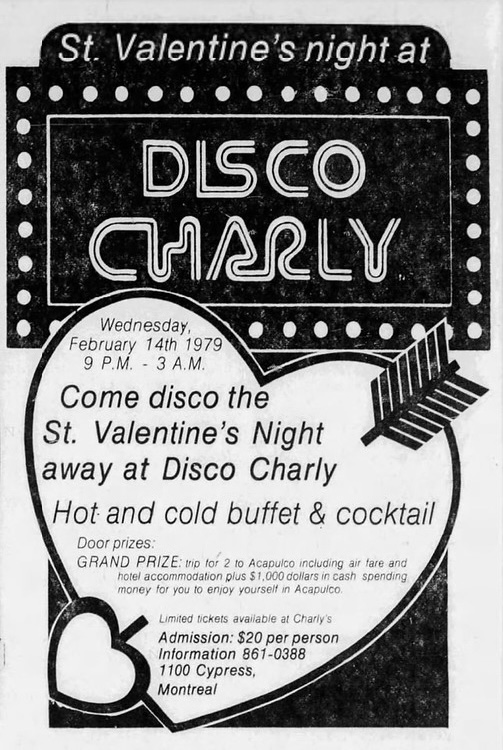
In the wake of this attempt at rejuvenation, the hotel launched Disco Charly, a nightclub set up in its lower-level spaces. Opened in the spring of 1978, the venue was described as fully aligned with the aesthetics and economy of the disco boom at its Montreal peak. The press detailed the concept, musical programming, and target audience, confirming the Windsor’s desire to join the contemporary nightlife circuit.[35]
Disco Charly is regularly mentioned in analyses of Montreal’s late-1970s disco industry. A major feature published in December 1978 places the Windsor’s nightclub among establishments benefiting from a context of high investment, heavy attendance, and strong short-term profitability, illustrating the hotel’s temporary integration into a booming cultural economy.[34]
Sources indicate that Disco Charly remained active at least through 1979, hosting themed nights and public events, including Valentine’s celebrations. These notices attest to sustained but relatively brief operation, confirming the experimental character of this shift in the Windsor’s long history.[36]
In July 1980, the Windsor’s nightclub is mentioned in The Gazette under the name Sunset Disco, on the occasion of its reopening on Cypress Street—indicating a renaming of the former Disco Charly amid a late attempt to relaunch the disco concept.[45] In parallel with these cultural renewal efforts, the hotel’s economic situation remained fragile: in the early 1980s, the press reported plans for sale and redevelopment of the complex, and in June 1981, negotiations were noted with a Calgary-based real-estate group, suggesting a possible temporary closure followed by major reconversion.[37]
These projects did not lead to a lasting revival. In the summer of 1981, the official announcement of the Windsor Hotel’s permanent closure was made public. The cessation of operations, set for October 31, 1981, resulted in the dismissal of about 150 employees and ended more than a century of continuous hotel operation in downtown Montreal.[38]
This final phase highlights the striking contrast between the Windsor’s long history—an institution of imperial, high-society, and cultural prestige—and late attempts at reinvention through ephemeral cultural forms such as punk and disco. The relative failure of these strategies underscores the limits of adapting a nineteenth-century grand hotel to the economic and cultural logics of the late twentieth century, and prepares the site’s transition toward a status of layered urban remnant and memory.
11. Encyclopedic conclusion and historical status
The Windsor Hotel occupies a major place in Montreal’s urban and cultural history, not only as a prestigious hotel, but as a structuring apparatus of sociability at the heart of the modern downtown. From the late nineteenth century, it asserted itself as a site where hospitality, business life, society reception, and the symbolic representation of the city intersected.
The site’s enduring association with spaces called Windsor Hall places the Windsor within an expanded history of concert and gathering venues in Montreal. This association—marked by changing uses and shifting terminology—requires critical reading of sources, yet confirms the Windsor’s role as a contact point between music, event life, and urban sociability.[11][20][23]
The successive fires and architectural transformations that punctuate the Windsor’s history do not erase its symbolic function; instead, they contribute to constructing a site defined by discontinuity, loss, and recomposition. This fragmented trajectory distinguishes the Windsor from specialized performance halls, while reinforcing its status as a hybrid place—hotel, reception venue, and occasional setting for musical practice.
The end of hotel operations in 1981 did not end the Windsor’s cultural existence. The persistence of the name, the survival of associated spaces, and continuing references in press and historiography testify to the memorial force acquired over more than a century.[14]
In this perspective, the Windsor is best understood as a layered site, whose functions, forms, and meanings accumulated rather than being replaced in a linear sequence. Its trajectory illustrates transformations of downtown Montreal and fully justifies its inclusion in an encyclopedic reading of the history of entertainment venues, sociability spaces, and hospitality in Montreal.
12. Notes & sources
- The Gazette, August 27, 1875 — “Hotel Accommodation,” letter to the editor, signed Business in Earnest. Discussion of the insufficiency of hotel accommodations in Montreal; explicit mention of the proposed Windsor Hotel on Dorchester Street; reference to the travel seasons of 1873 and 1874; and a projected construction and opening timetable.
- The Gazette, September 29, 1875 — notice “Windsor Hotel Company.” Announcement stating that the directors are ready to deal with contractors for the hotel’s construction; declaration that the work will “proceed forthwith.” Signed: Franc O. Wood, secretary.
- The Montreal Star, March 8, 1877 — mention of the Windsor Hotel in the context of major construction projects in Montreal, attesting to the project’s progress and its public identification as a hotel under development.
- The Daily Witness, January 31, 1878 — notice announcing the opening of the Windsor Hotel on Monday, January 28, 1878; mention that the establishment is “open for business,” available immediately to travellers, and supported by porter and omnibus logistics.
- Le Journal de Québec, January 28, 1878 — notice announcing the opening of the Windsor Hotel in Montreal, confirming the event and underscoring its importance beyond the Montreal press.
- The Gazette, column Of Many Things…, article “‘Grand hotel this!’,” by Edgar Andrew Collard. Retrospective text describing the Windsor Hotel’s origins, its siting at Dominion Square, its architectural and symbolic ambitions, and its standing among major North American hotels.
- The Gazette, historical articles and retrospective columns evoking the Windsor as a venue for significant political, high-society, and social events, emphasizing its role in Montreal public life.
- The Gazette, “Windsor Hotel celebrates 100th anniversary,” by E. J. Gordon, 1978 — centennial article describing the Windsor as host to royalty, heads of government, and business figures, and recalling its historical status.
- Montreal Winter Carnival, 1887 — Official Programme. Printed document explicitly listing the Windsor Hotel as a site for official carnival activities (dinners, receptions), attesting to its function as a high-society and institutional venue in the late nineteenth century.
- The Gazette, 1970s — retrospective articles, notably in the Of Many Things… column, portraying the Windsor Hotel as a major hub of Montreal high society, recalling balls, receptions, and landmark evenings. These texts belong to memory and historical narration and are used here as reception/representation sources.
- The Canadian Encyclopedia, article “Salle Windsor / Windsor Hall” — entry describing the hall’s opening in 1890, its capacity of about 1,300 seats, its location at the corner of Peel and Dorchester streets, its function as a concert hall, its demolition in 1906, and the later reuse of the name to designate a ballroom inside the Windsor Hotel.
- The Montreal Daily Star, January 13, 1906 — illustrated article “Fire Creates Havoc in the Chief Apartments of the Windsor Hotel,” describing the January 1906 fire, the extent of the damage, and the effects of the water used to fight the blaze.
- The Gazette, retrospective articles (1970s) recalling the major 1957 fire, the destruction of large portions of the original Windsor structure, and the transformation of the site in the second half of the twentieth century.
- The Gazette, historical articles and commemorative notices indicating the end of hotel operations at the Windsor Hotel in 1981, and the persistence of the name and surviving spaces after that date.
- The Gazette, January 28–29, 1878 — advertisements and opening-day articles for the Windsor Hotel, explicitly mentioning its location near Dominion Square, its proximity to railway stations, and the provision of porters and omnibus service for travellers.
-
McCord Stewart Museum — Notman Photographic Archives.
“Dominion Square and Windsor Hotel, Montreal, QC, about 1890”,
albumen print — Wm. Notman & Son (1882–1919). Signed: “Wm. Notman & Son, Photo., Montreal”
(within the image).
Date: about 1890. Process: silver salts on paper mounted on paper (albumen process). Dimensions: 18.3 × 23.8 cm.
Object number: VIEW-1946.1. Division: Photography – Notman Photographic Archives. Collection: McCord. Status: Not on view. Credit: purchase (Maclean’s magazine fonds; Maxwell Cummings Family Foundation; Empire-Universal Films Ltd.). -
McCord Stewart Museum — Notman Photographic Archives.
“Lobby and staircase, Windsor Hotel, Montreal, QC”,
albumen print — Wm. Notman & Son (1882–1919). Unsigned.
Date: about 1890. Process: silver salts on paper mounted on paper (albumen process). Dimensions: 18.2 × 22.9 cm.
Object number: VIEW-2519.1. Division: Photography – Notman Photographic Archives. Collection: McCord. Status: Not on view. Credit: purchase (Maclean’s magazine fonds; Maxwell Cummings Family Foundation; Empire-Universal Films Ltd.). -
McCord Stewart Museum — Notman Photographic Archives.
“Concert Hall, Windsor Hotel, Montreal, QC, about 1895”,
albumen print — Wm. Notman & Son (1882–1919). Signed: “Wm. Notman & Son, Photo., Montreal”
(within the image).
Date: about 1895. Process: silver salts on paper mounted on paper (albumen process). Dimensions: 20.3 × 25.4 cm.
Object number: VIEW-2565.1. Division: Photography – Notman Photographic Archives. Collection: McCord. Status: Not on view. Credit: purchase (Maclean’s magazine fonds; Maxwell Cummings Family Foundation; Empire-Universal Films Ltd.). - The Montreal Daily Star, Saturday, January 13, 1906, p. 18 — “Fire Creates Havoc in the Chief Apartments of the Windsor Hotel.” Heavily illustrated contemporary article reporting the January 1906 fire at the Windsor Hotel. The text and images document the establishment’s internal structure (rotunda, drawing room, main dining room, bar, corridors, rooms, kitchen), vertical and horizontal circulation, and the extent of damage caused by fire and water. A diagram published in the article pinpoints the fire’s exact point of origin. An exterior view explicitly situates the building in relation to Dominion Square, confirming its place in the downtown Montreal urban landscape in the early twentieth century.
- The Montreal Star, February 6, 1906 — “A New Windsor Hall.” Article describing negotiations between the Windsor Hotel Company and the manager of Windsor Hall to create a new hall located in the centre of the Windsor Hotel, on the site of the main dining room damaged by the January 1906 fire. The text specifies that the hall is designed for assemblies, conventions, high-level concerts, and balls, attesting to the existence and reconfiguration of an in-hotel Windsor Hall in the early twentieth century.
- The Gazette, Saturday, January 13, 1906 — “Disastrous Fire Breaks Out in Windsor Hotel Kitchen.” Contemporary press report on the January 1906 Windsor Hotel fire. The text states that the blaze began in the kitchen, caused losses estimated at $300,000, led to the hotel’s temporary closure, and resulted in collapsing ceilings. Damaged areas included the main dining room, the Ladies’ Ordinary, corridors, and halls—several flooded by the water used to fight the fire. The article also notes injuries suffered by hotel manager W. S. Weldon and employee Walter Demers when interior structures collapsed.
- The Montreal Star, February 1, 1890 — Musical Matters column, article “The New Music Hall.” Contemporary article announcing the opening of Windsor Hall as a new concert hall in Montreal. The text describes the hall as a musical facility specifically designed to meet the needs of Montreal’s musical life, emphasizing its acoustic and architectural qualities and identifying it explicitly as a venue meant to host symphonic and choral concerts and major musical events. This source is direct evidence of Windsor Hall’s musical function from its opening in 1890.
- The Canadian Encyclopedia, article “Windsor Hall / Salle Windsor” — entry detailing Windsor Hall’s musical activity from 1890 through the early twentieth century, including concerts by the Montreal Philharmonic Society, the first Montreal Symphony Orchestra, the Montreal Oratorio Society, and many international artists and ensembles. The entry also notes later concerts held in the Windsor Hotel ballroom—also called Windsor Hall or the Ladies’ Ordinary—including performances by the Dubois String Quartet between 1915 and 1927.
- Windsor Hotel, Alterations (9/1909–11/1909) — Montreal, QC, Canada. Classification: Commercial, Hotel [alterations: concert hall, marquee at side entry, entertainment board]. Client: Windsor Hotel. Architects: Edward & W. S. Maxwell. Description: The Windsor Hotel was originally designed by architect G. H. Worthing and opened in 1878. Victorian in style, it initially had 278 rooms. In 1906, New York architects Hardenberg & Gilbert added a new wing on Cypress Street, increasing capacity to about 750 rooms. In 1909, according to plans prepared by Edward & W. S. Maxwell, the building underwent alterations to the concert hall, including the addition of new doors on either side of the main entrance and the installation of a new floor. The project also provided for a new marquee above the side entrance facing Dominion Square.
- The Gazette, November 30, 1878 — “Lorne and Louise at Montreal — Grand Ball at the Windsor.” Illustrated double-page spread devoted to the official reception of Governor General Lord Lorne and Princess Louise in Montreal. The Windsor is presented as the site of the “Grand Ball,” attesting that, in the very year it opened, it already served as a major venue for balls, high-society receptions, and political representation—prior to the later appearance of spaces subsequently known as Windsor Hall.
- The Gazette (Montreal), Personal Intelligence columns, May 1882 — Repeated notices indicating Oscar Wilde as a resident of the Windsor Hotel during his Montreal stay, including: “Oscar Wilde is at the Windsor.” These notices confirm that the Windsor served at the time as lodging for international cultural figures visiting the city. The articles specify that Wilde’s public lectures took place in other Montreal venues (notably Queen’s Hall), clearly distinguishing the Windsor as a site of residence and sociability rather than a performance venue in this case.
- Mark Twain at the Windsor Hotel — The Gazette, November 28, 1881; retrospective articles in The Gazette, December 6, 1969 and December 2, 1978. Mark Twain’s stay in Montreal, reception at the Windsor Hotel, and quotations associated with his visit.
- Oscar Wilde in Montreal — The Gazette, May 15 and 22, 1882; The Montreal Star, May 15, 1882. Articles relating to Oscar Wilde’s North American tour and his presence at the Windsor Hotel.
- Rudyard Kipling at the Windsor Hotel — The Gazette, July 19, 20, and 26, 1892; The Montreal Star, July 19, 1892. Articles describing the arrival of Rudyard Kipling and his wife, his deliberate isolation, and receptions proposed by Montreal literary circles.
- The Gazette, May 19, 1939; The Montreal Star, May 19, 1939 — Articles concerning the visit of King George VI and Queen Elizabeth to Montreal. The texts mention the Windsor Hotel as one of the locations associated with the welcoming and ceremonial arrangements, confirming the persistence of its symbolic and high-society status in the twentieth century.
- La Presse, Sunday, January 31, 1988 — “L’hôtel Windsor,” by Guy Pinard, in the Rendez-vous 92 series (Montreal’s 350th anniversary). Illustrated feature tracing the Windsor Hotel’s architectural and institutional history; specifying the opening without a formal inauguration in January 1878; describing the interior organization in detail (notably the central atrium), dimensions, materials, and transformations of the complex; and offering a memorial synthesis of the hotel’s gradual disappearance and the survival of its annex as an office building.
- The Gazette, 1978–1981 — Set of articles documenting the Windsor Hotel’s late-1970s attempt at nightlife and cultural repositioning. See in particular: “Punk hustler” (March 11, 1978), which mentions a punk-rock event held at the Windsor Hotel; “The staid old Windsor Hotel is trying to shuck its senior citizens image” (April 20, 1978), explicitly describing the hotel’s efforts to attract a younger clientele; several Nightspots columns (1978–1979) announcing and commenting on the opening and activities of Disco Charly at the Windsor; and retrospective pieces from the late 1970s and early 1980s placing Disco Charly and the Windsor within the context of Montreal’s disco boom and the establishment’s late transformations.
- The Gazette, April 1978 — Article noting an attempt at cultural repositioning of the Windsor Hotel and its desire to break from the image of the “staid old Windsor.” The text explicitly mentions a punk night held in the hotel’s spaces, presented as symbolically striking in a place historically associated with balls, banquets, and high-society receptions. This source documents the Windsor’s brief opening to countercultural forms in the late 1970s.
- The Gazette, December 2, 1978 — “High chic and high profits energize Montreal’s discos,” by Julia Maskoulis. Analytical feature on Montreal’s disco economy. The text places Disco Charly, operated at the Windsor Hotel, among venues benefiting from major investments and high profits, illustrating the Windsor’s temporary integration into late-1970s nightlife and festive industry.
- The Gazette, spring 1978 — Articles announcing the opening of Disco Charly at the Windsor Hotel. The texts describe the nightclub’s layout, its aesthetic and musical positioning, and the clientele targeted, confirming the hotel’s explicit intention to align itself with Montreal’s then-dominant disco trend.
- The Gazette, February 1979 — Notices for nights and events held at Disco Charly, including Valentine’s Day celebrations. These items confirm that the nightclub’s activities continued at least into 1979, attesting to sustained operation, although over a relatively limited span.
- The Gazette, June 1981 — Articles reporting real-estate negotiations concerning the Windsor Hotel, involving a Calgary-based group. The texts mention plans for sale, temporary closure, and reconversion of the complex, signalling growing uncertainty about the hotel’s future in the early 1980s.
- The Gazette, summer–fall 1981 — Articles announcing the Windsor Hotel’s permanent closure, effective October 31, 1981. The press specifies that the end of operations led to the dismissal of about 150 employees and ended more than a century of continuous hotel operation. These texts constitute the last contemporary mentions of the Windsor as an operating hotel.
- The Montreal Star, September 8, 1969 — “Soup slurpers not welcome,” Charles Lazarus. Announcement of the opening of Le Vaisseau d’Or at the Windsor Hotel and description of the concept.
- The Montreal Star, September 8, 1969; Le Devoir, January 14, 1971. Descriptions of the atmosphere, musical programming, and the protocol imposed on patrons.
- The Montreal Star, September 8, 1969. Journalistic analysis of Jean Drapeau’s dual role as mayor and restaurateur.
- The Gazette, April 28, 1971; The Montreal Star, November 12, 1971. Conflict between the Windsor Hotel and Le Vaisseau d’Or concerning rent and agreements.
- The Gazette, November 12, 1971 — “Mayor, hotelmen fight at restaurant”; “Drapeau locks himself inside.” Seizures, police interventions, and physical altercations at the Windsor.
- The Montreal Star, May 14, 1971 — “Drapeau accepts defeat.” Announcement of the end of Le Vaisseau d’Or at the Windsor Hotel.
- The Gazette, July 17, 1980, p. 17 — Society column (“Clubscene: Quebec”) mentioning the reopening of the Sunset Disco on Cypress Street, “at the side of the Windsor Hotel.” This notice documents the nightclub’s name change from the venue previously known as Disco Charly, in the context of a late attempt to revive the disco concept at the Windsor.
- The Montreal Daily Star, “The Vice-Regal Visit – A Right Royal Welcome,” November 30, 1878, p. 1. Detailed account of the vice-regal reception held at the Windsor Hotel, explicitly mentioning the presence of Canadian Prime Minister Sir John A. Macdonald among the invited dignitaries, thereby confirming the Windsor’s role as a central venue of political and ceremonial sociability in Montreal at the end of the 19th century.
- The Gazette, July to September 1959 — a series of articles devoted to the demolition of the south wing of the Windsor Hotel and the redevelopment of the Dominion Square site. See in particular: “Royal Balcony Preserved” (July 2, 1959), along with articles on the demolition work and the preparation of the site for the Windsor Plaza project, as well as columns referring to the gradual disappearance of the former hotel and the selective preservation of symbolic elements. These sources document the Windsor’s final transition from a historic hotel institution to an urban vestige integrated into the modernist cityscape of the late 1950s.
- Le Devoir, « L’assemblée est remise à ce soir », 26 November 1917, p. 6; and The Gazette, 26 November 1917. Contemporary press reports documenting the meeting held at the Windsor Hotel on 26 November 1917, during which the National Hockey League (NHL) was formally established. These articles confirm that representatives of professional hockey clubs convened at the Windsor to decide on the creation of a new league, marking the founding moment of the NHL in Montreal. The sources situate the Windsor Hotel as a key institutional setting in the early organizational history of professional ice hockey in Canada.