Rockhead’s Paradise
Founded in 1928 by Rufus Nathaniel Rockhead at 1252 Saint-Antoine Street West, at the corner of Mountain Street, the establishment first opened as the Mountain Tavern before the name Rockhead’s Paradise was officially registered in 1936. A tavern, cabaret, cocktail lounge and dance venue, the Paradise became one of the major institutions of Montréal jazz and an essential social gathering place for Montréal’s Black community. During its golden age in the 1940s, it presented revues, singers, dancers and orchestras while serving as a meeting place and training ground for several generations of musicians. Legendary figures of American jazz, including Louis Armstrong, Billie Holiday and Ella Fitzgerald, were also among the visiting artists associated with its history. After more than half a century of activity and numerous transformations, Rockhead’s Paradise closed permanently in 1980, leaving a fundamental legacy in the musical and cultural history of Montréal.
Origins: Rufus Rockhead before the Paradise
Rufus Nathaniel Rockhead was born around 1896 in Maroon Town, Jamaica, within a community descended from the Maroons, former enslaved people who resisted British colonial authority. Like many Caribbean migrants of the early 20th century, he entered North America via Halifax before settling in Montreal.
On January 29, 1918, Rockhead enlisted in the Canadian Army and served in France during the First World War with the 1st Depot Battalion of the 1st Quebec Regiment. He received the British War Medal and the Victory Medal and was discharged on March 19, 1919.
Back in Montreal, he first worked as a shoeshine boy, then as a sleeping-car porter for the Canadian Pacific Railway. This occupation, one of the few open to Black men at the time, required regular travel on the Montreal–Chicago route. During American Prohibition, Rockhead capitalized on these journeys by participating in cross-border alcohol trafficking, allowing him to accumulate the capital necessary to realize his entrepreneurial ambitions.
1928–1935: The Mountain Tavern and early years
In 1928, Rufus Rockhead acquired a three-storey building at the corner of Saint-Antoine Street West and Mountain Street. He opened a tavern there under the name Mountain Tavern. Obtaining a liquor license proved extremely difficult: a municipal commissioner reportedly told him that licenses were not granted “to people of color.” After eleven months of applications, Rockhead nevertheless became the first Black citizen of Montreal to receive a tavern license.
By the early 1930s, the building adopted a vertical structure: a tavern and lunch counter on the ground floor, a dance hall and cabaret on the upper levels, and a small 15-room hotel. This layout allowed the venue to gradually evolve into a nighttime entertainment space.
The first press mentions appear in the early 1930s, often as regulatory notices. In October 1934, La Presse listed the Mountain Tavern among establishments fined for permitting dancing on Sundays, indicating that the venue was already active as a musical and social space.
Additional evidence of the corner’s commercial life and of the name “Mountain Tavern” also appears in the anglophone press in the mid-1930s (micro-mentions/advertisements), confirming the use of the toponym prior to the stabilization of the label “Rockhead’s Paradise.”
1936: The official birth of Rockhead’s Paradise
The year 1936 marks a decisive turning point. On September 10, Le Devoir published the official registration of the business name “Rockhead’s Paradise Reg’d.” at 1252 Saint-Antoine Street West, under the ownership of Rufus Nathaniel Rockhead. This is the first formal appearance of the name in the archives.
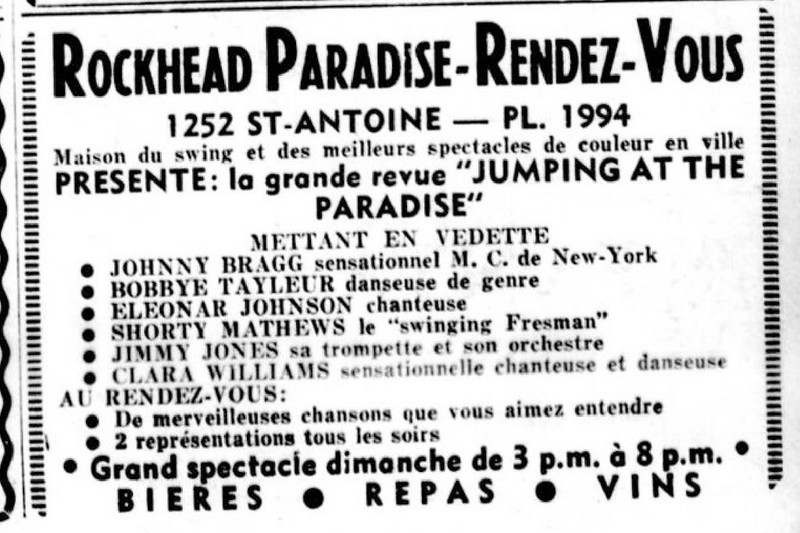
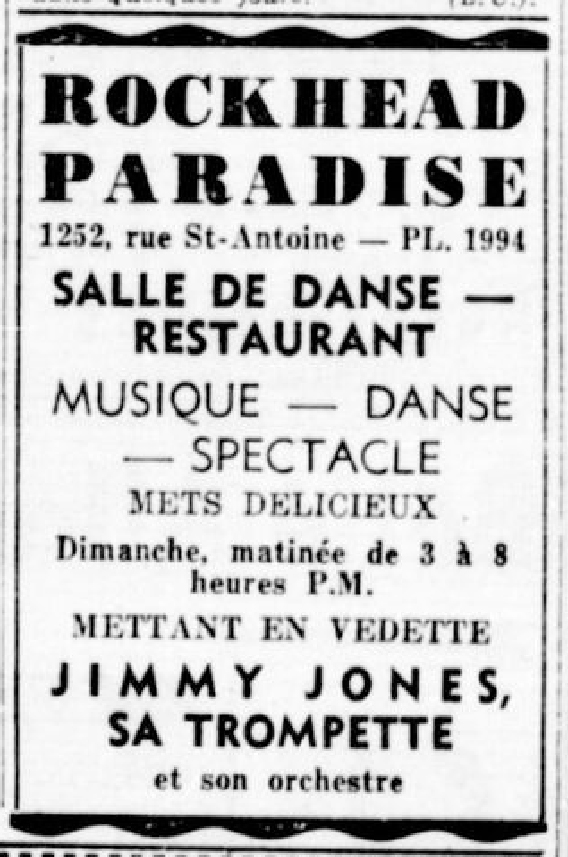
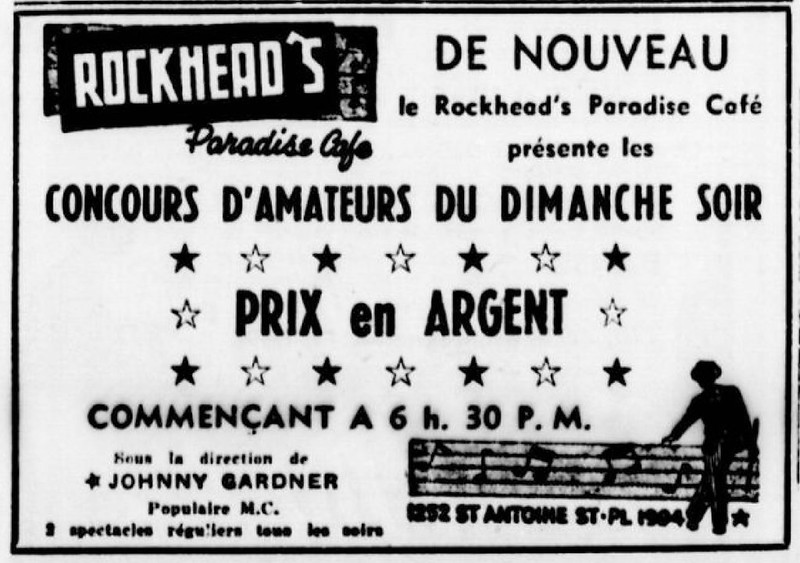
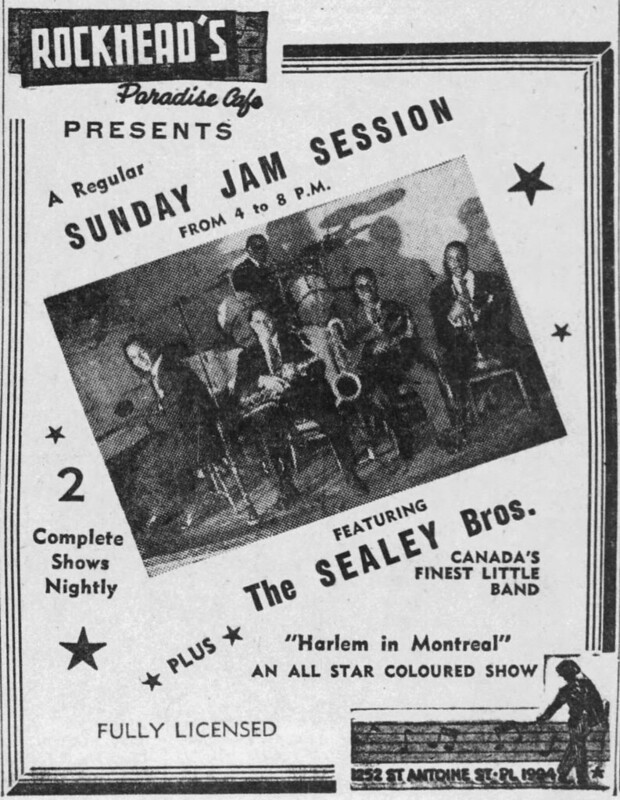
At the same time, a series of advertisements published in Le Petit Journal introduced the club to a broader audience. The slogan “Harlem in Montreal” promised exoticism, dancing, and jazz. The ads mention a house orchestra, amateur contests, Sunday dance matinees, and a regular schedule of musical evenings.
According to several historians, it is from this period onward that Rockhead’s Paradise truly became a performance venue, rather than simply a tavern with music.
Judicial and regulatory archives complete the picture: injunctions, disputes, repertoire oversight, and more broadly the way Montreal nightlife leaves behind “administrative” traces as revealing as concert advertisements.
The 1940s: The golden age
The 1940s represent the apex of Rockhead’s Paradise. The Second World War transformed Montreal into an entertainment hub for soldiers, tourists, and transient workers. The club presented full-scale revues: dancers, singers, acrobats, tap dancers, choreographed numbers, as well as the Rockhead-ettes chorus line.
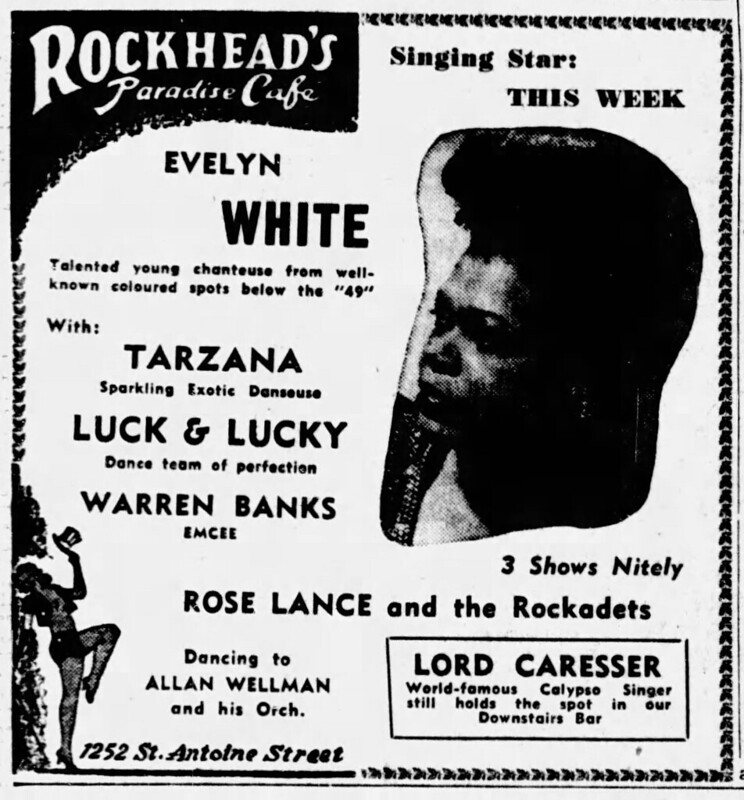
The house orchestra, often associated with bandleader Allan Wellman, provided musical continuity. At the same time, the club employed and trained many Montreal musicians, including Linton Garner, the Sealey Brothers, and young instrumentalists who would go on to significant careers.
Rockhead’s Paradise also became a stopover for major American artists. Louis Armstrong, Billie Holiday, Ella Fitzgerald, Fats Waller, Dizzy Gillespie, Nina Simone, Lead Belly, and Sammy Davis Jr. are mentioned as visitors, often after their official engagements elsewhere in the city. These visits frequently took the form of informal jam sessions with the house band— and just as often, simple late-night stops: one came to play, but also to see, to greet friends, to listen, to breathe a little after the stage.
The 1950s: Expansion, tensions, and closure
In 1951, Rockhead made major investments in his establishment. The club was expanded, air conditioning installed, and the upper floor transformed into a cocktail lounge. An advertisement in The Gazette announced “three shows nightly” in the Upstairs Cabaret.
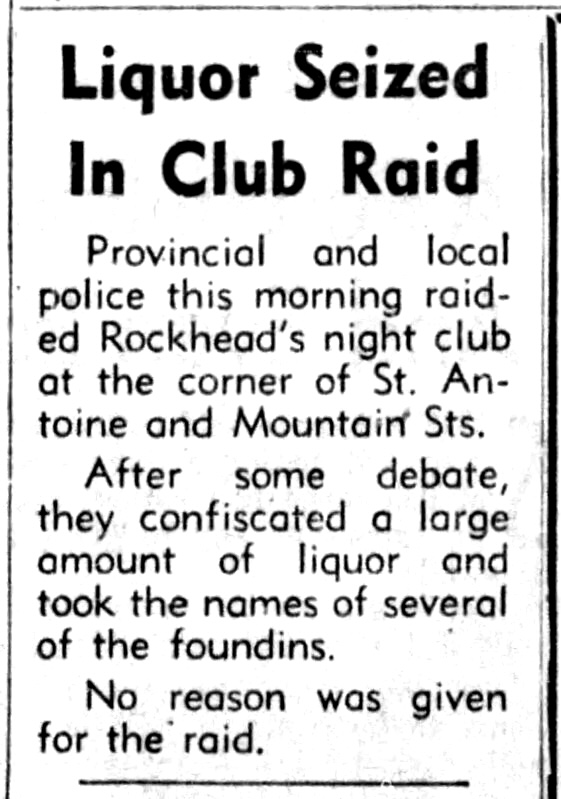
This period was also marked by increased scrutiny from authorities. Between 1953 and 1954, newspaper articles reported fines, liquor seizures, and ultimately the revocation of the liquor license. According to several sources, Rockhead’s refusal to make a political contribution may have hastened the club’s administrative closure. Rockhead’s Paradise was padlocked, with its furniture and installations left in place.
At this stage, the daily press becomes a kind of logbook: court briefs, raids, fines, rumors of license reinstatement, and administrative decisions— fragments that sketch a “parallel history” of the Paradise told through regulation.
1960–1980: Reopening, decline, and succession
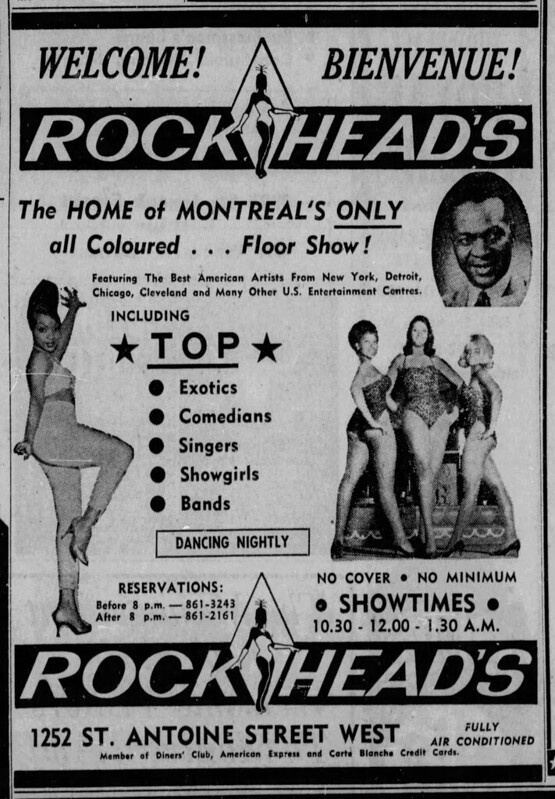
After several years of inactivity, Rockhead’s Paradise reopened in the early 1960s. The press announced the reopening in 1962, but the context had profoundly changed. Montreal nightlife had shifted downtown, television altered leisure habits, and the Little Burgundy neighborhood underwent accelerated urban decline.
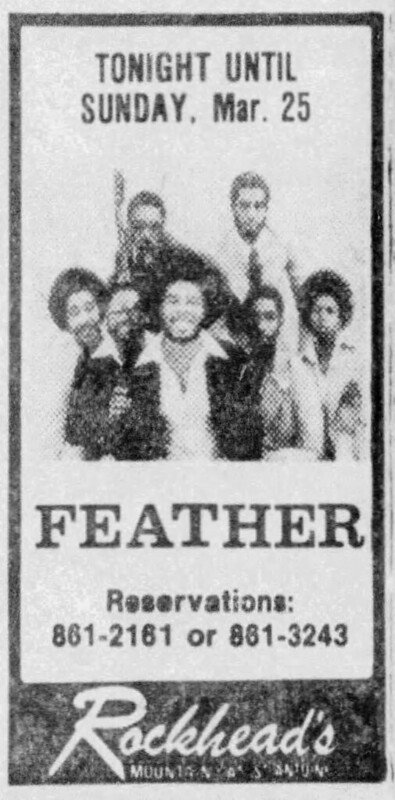
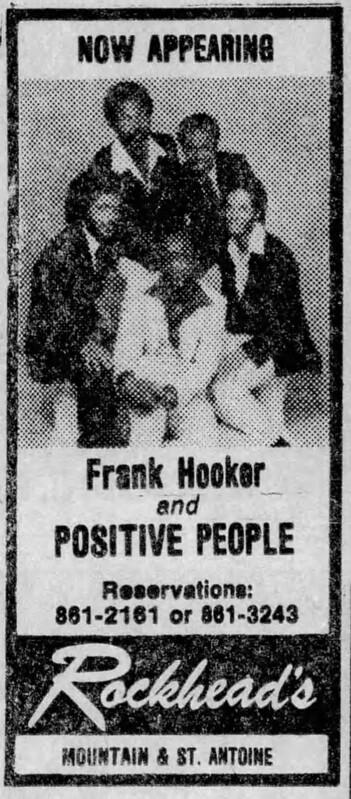
Despite this, the club experienced periods of renewed attendance, particularly through North American Black tourism. In the 1970s, programming shifted more toward soul, rhythm and blues, and popular music, under the direction of Kenneth Rockhead, the founder’s son.
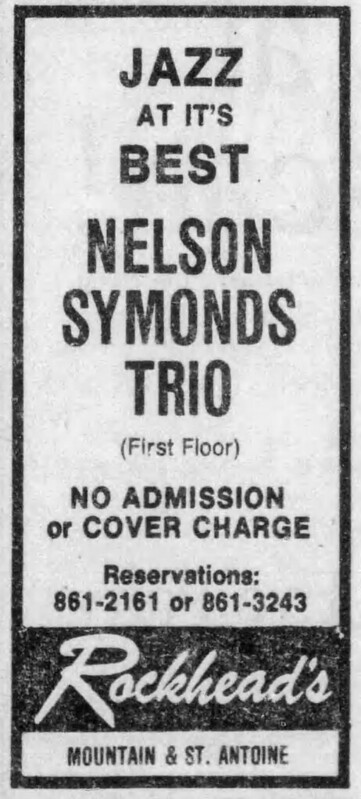
Some press references (briefs, portraits, retrospectives) also mention figures linked to the Montreal jazz scene and to the “jazz corner” ecosystem, including Norman Marshall Villeneuve and Nelson Symonds, to be situated within the constellation of musicians, bandleaders, and arrangers active around the Saint-Antoine corridor and neighboring clubs.
In 1978, Rufus Rockhead suffered a stroke. In 1980, the club was sold to Guyanese entrepreneur Rouè Doudou Boicel, founder of the Rising Sun Celebrity Jazz Club. This sale marked the definitive end of Rockhead’s Paradise as an autonomous entity.
1980: Rockhead’s Paradise under Rouè “Doudou” Boicel
The acquisition of the building and operating assets by Rouè “Doudou” Boicel in 1980 opened a final, brief but significant chapter in the site’s history. Boicel is described as an entrepreneur and jazz advocate, already active on the Montreal scene: in 1975 he founded the Rising Sun Celebrity Jazz Club. By purchasing Rockhead’s Paradise, he sought to relocate this institution into a building laden with exceptional musical memory, and to extend the jazz spirit of the Saint-Antoine / Mountain intersection.
Under the new administration, the address became, in symbolic continuity, a space dedicated to jazz and blues: an attempted revival based on the site’s historical prestige, the attraction of visiting musicians, and the belief that a club could survive through the power of its name, even as the neighborhood and nighttime economy had changed.
However, transmitted sources indicate that Rockhead’s Paradise carried a significant level of debt, inherited from its final years of operation. This financial reality limited both the duration and scope of the revival: Boicel eventually had to return the Rising Sun to its original location on Sainte-Catherine Street West, bringing the Saint-Antoine episode to an end.
Legacy
Rufus Rockhead died on September 23, 1981 at the Veterans’ Hospital in Sainte-Anne-de-Bellevue. In 1989, the City of Montreal honored his legacy by naming a street in Little Burgundy Rufus-Rockhead Street.
Beyond the now-vanished building, Rockhead’s Paradise remains a fundamental landmark in Montreal’s cultural history: a place where American and Canadian jazz trajectories intersected, where local musicians learned their craft, and where music served as a tool of resistance, pride, and transmission.
Sources
-
Canadian Encyclopedia (The Canadian Encyclopedia) — “Rockhead’s Paradise”.
Overview source for: Rufus Rockhead’s biography (Jamaica → Halifax → Montreal), military service (1918–1919), work as a CPR porter (Montreal–Chicago), the Prohibition context and business capital, administrative barriers tied to racism, opening (1930 as a beer/wine club in the overview), cocktail permit (1935 in the overview), golden age (1930s–1950s), decline (1960s–1980), management by Kenneth, sale (1980) to Rouè “Doudou” Boicel, the Rising Sun episode, death (1981), Rufus-Rockhead Street (1989), and a reminder of the club’s importance as a social and musical space. -
Le Devoir, September 10, 1936 — “Nouvelles raisons sociales” (registration).
Key administrative record: first formal appearance of the name “Rockhead’s Paradise Reg’d.” linked to the address (1252 Saint-Antoine St. W.) and the owner (Rufus Nathaniel Rockhead). Used as a documentary milestone for the stabilization of the name in archival records. -
Le Petit Journal (February–March 1936) — “Harlem à Montréal” advertisements.
Advertising corpus: promise of dancing and jazz, amateur contests, dance matinees, a house orchestra (e.g., Kid Winfield), and staging of the club as a destination. Issues provided: February 2, 1936; February 9, 1936; February 16, 1936; plus other variants (e.g., March 22, 1936; October 4, 1936) mentioned in the transmitted file. -
Le Petit Journal, July 26, 1942 — “grand reopening” / Harlem on Parade.
Evidence of a structured wartime revue/cabaret format: the club presents itself as “Rockhead Paradise Cafe” and announces a named production (Harlem on Parade), shedding light on the period’s imagery and promotional vocabulary. -
The Gazette, October 31, 1936 — injunction (repertoire / performance of popular songs).
Regulatory/judicial record used here as evidence of the club’s public visibility, and as a trace of the legal oversight surrounding musical activity and programming. -
La Presse, October 20, 1934 — regulatory brief (Sunday dancing).
Mountain Tavern/Paradise mentioned in a list of establishments penalized: a useful document for dating social and dance activity as early as the early 1930s. -
Montreal Star, March 15, 1935 — micro-mention “Mountain Tavern” (Saint-Antoine).
Evidence of the commercial presence of the name “Mountain Tavern” before the stabilization of the label “Rockhead’s Paradise.” -
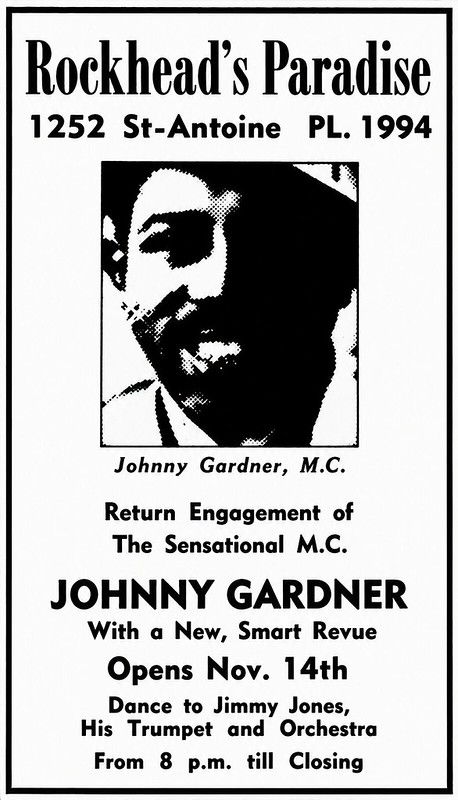
The Gazette (1941) — “Johnny Gardner” (November 13, 1941).
Item transmitted in the file: used to document the ecosystem of musicians/bandleaders and the circulation of names tied to the scene. (To be integrated into artist/programming notes once the exact quotation is formatted in the MCPA entry.) -
List/reference of cabaret operators — The Montreal Daily Star, November 17, 1948.
Context document: identifies the regulatory environment and nightlife actors (owners/managers), useful for situating Rockhead’s within the landscape of permits and venues along the Saint-Antoine axis. -
The Gazette (1951) — “Lord Caresser” advertisement (November 30, 1951).
Postwar promotional piece: vocabulary such as “enlarged cocktail lounge,” “Upstairs Cabaret,” and “three shows nightly”; used to document an expansion phase and the upstairs show model. -
The Gazette (1953–1954) — judicial and administrative briefs.
Transmitted corpus: fines, raids, liquor seizures, closure, licensing (including: fine/raid April 1953; fine March 1953; “liquor seized” August 1959 as an echo of continued surveillance; license deprivation August 1954; and other mentions such as a 1956 “rumor of license reinstatement”). Taken together, these items support the section on policing and licensing tensions. -
The Gazette, June 16, 1962 — “Rockhead’s reopens”.
Record of revival/reopening and repositioning of the club within a transformed nightlife landscape. -
Advertisements/mentions (1960s–1970s) — The Gazette (e.g., February 17, 1968; April 2, 1970; July 27, 1961).
Transmitted corpus: programming reference points and media continuity of the name “Rockhead’s” in the anglophone press. Useful for anchoring the reopening period and the survival of the brand. -
End-of-run markers — The Gazette (1979; 1980; 1987; 1991).
Set of transmitted mentions: traces of activity, public image, or memory (depending on the items), allowing the end of operations, the persistence of the name, and its transformation into an urban remembrance to be charted. -
Memory revivals — The Gazette (Alan Hustak, February 22, 1997) and Le Devoir (Serge Truffaut, February 7, 1997).
Major retrospective texts: rereading of the “jazz corner” and the Saint-Antoine corridor, narrative framing of urban disappearance and the area’s nocturnal memory. -
Commemoration — The Gazette (2012): “Rockhead’s Last Jam”.
Living-memory source: an organized tribute, a reminder of the club’s formative role, and mentions of artists/jazzmen tied to its legacy (including, in the transmitted file, Norman Marshall Villeneuve, Oliver Jones, and other participants cited in the event overview). -
The Gazette (2019) — memory portrait (e.g., the “History Through Our Eyes” series).
Public-history/commemoration piece: contributes to contemporary transmission of the Rockhead’s legend and to fixing key reference points (address, social role, historical importance). -
Jazz context in Montreal — La Presse (June 9, 1984); La Presse (June 1, 1987: Nelson Symonds / Oscar Peterson); La Presse (March 4, 2013).
Set transmitted for context: discourse on musicians, Montreal’s reputation among American jazzmen, and narratives of lineage/informal “schooling” around the corridor and historic clubs. -
Context works (leads transmitted in the file):
Nancy Marrelli, The Golden Age of Montreal Night Clubs 1925–1955 (2004); John Gilmore, Swinging in Paradise; Dorothy W. Williams, The Road to Now (1997); as well as the internal context block “Little Burgundy: cradle of Montreal jazz” (internal bibliography and BAnQ references).
These references help situate Rockhead’s within an ecosystem (neighboring clubs, social conditions, community institutions) and enrich the musician “context” section (including Linton Garner, the Sealey Brothers, Allan Wellman, Norman Marshall Villeneuve, Nelson Symonds) as precise excerpts are integrated into MCPA format. -
Rouè “Doudou” Boicel and the Rising Sun — overview source: Canadian Encyclopedia.
Base for: founding of the Rising Sun (1975), purchase of Rockhead’s (1980), jazz/blues repositioning, debt constraints and return to Sainte-Catherine Street West. Provides the framework for the “Boicel” section.