Ruby Foo’s (Montréal)
Immense restaurant sino-américain et complexe hôtelier du boulevard Décarie, le Ruby Foo’s (1945–1984 pour le restaurant, puis hôtel jusqu’à aujourd’hui) fut l’un des établissements les plus vastes, modernes et fréquentés de Montréal. Né comme grand restaurant « oriental » avec deux salles à dîner, trois lounges et un stationnement de 300 voitures, il devient en 1962 un motor hotel spectaculaire, combinant restaurant, bars, piscine, salles de banquet et hébergement sur le thème du « Far East ».
1. Fondation & ouverture (1945)
Le Ruby Foo’s Incorporated est constitué en corporation le 5 mars 1945 en vertu de la Loi des compagnies du Québec. Les lettres patentes, publiées dans la Gazette officielle du Québec du 7 juillet 1945, nomment comme fondateurs Henry Manella (restaurant manager), Hyman Manella (gérant) et Sarah Cohen (comptable), tous domiciliés à Montréal. L’objet de la compagnie est de « promouvoir, établir, conduire, entretenir un restaurant, un café, un “grill” » et d’acquérir ou louer des restaurants et salles à manger publics au Québec et ailleurs en Amérique du Nord. Le capital autorisé est de 20 000 $, divisé en 2 000 actions de 10 $ chacune. [3]
L’établissement ouvre officiellement ses portes au 7815, boulevard Décarie le 25 mai 1945. Une brève de The Gazette du 26 mai 1945 annonce « Ruby Foo on Décarie is new restaurant », tandis qu’une pleine page publicitaire du 28 mai 1945 proclame « NOW OPEN – RUBY FOO’S on Decarie Boulevard », « Featuring the finest Chinese and American dishes », avec illustration du bâtiment de style pavillon, déjà doté d’un vaste stationnement pavé. [2], [4]
Les premiers comptes rendus soulignent que Ruby Foo’s est « l’un des restaurants les plus élaborés du genre au Canada » et qu’il pourrait bien devenir « l’un des grands restaurants orientaux du pays ». Le décor, la cuisine et la taille de l’établissement le distinguent immédiatement dans le paysage montréalais de l’après-guerre. [5]
2. Décor, cuisine & fonctionnement
Dès l’ouverture, Ruby Foo’s est conçu comme un restaurant à très grande capacité, avec deux vastes salles à dîner, trois lounges/cocktail bars et un stationnement pavé pouvant accueillir environ 300 automobiles — un argument martelé dans les publicités de 1946–1949 (« Il n’y a jamais de problème de stationnement chez Ruby Foo’s », « Parc pavé »). [1], [12]
Les murs de la salle principale sont décorés de murales chinoises insérées dans les cloisons : motifs orientaux, lanternes, tentures et plafonds en soie rayée ou à effet matelassé (« quilted ceiling ») créent une atmosphère que la presse décrit comme « luxuriously oriental » tout en étant de bon goût et « discrètement et efficacement éclairée ». [2], [5]
La cuisine est organisée autour de trois sections distinctes :
- Cuisine chinoise dirigée par le chef Peter Wei, avec une brigade de cuisiniers chinois « spécialement importés » pour offrir tous les plats alors connus de la cuisine sino-américaine (chop suey, chow mein, plats « aux noms étranges » mais succulents). [5], [7]
- Cuisine américaine, sous la responsabilité du chef Albert Rubinato, préparant steaks, fruits de mer et plats occidentaux pour une clientèle moins aventureuse. [6], [7]
- Cuisine des salades, confiée au chef Peter Melcetic, chargée de l’immense volume de salades et accompagnements. [7]
Dans une chronique de 1949, Don D’Amico rappelle que Ruby Foo’s est « le plus grand restaurant de Montréal », avec une activité constante dans ses cuisines et un service allant jusqu’à 3 h du matin. On y sert les déjeuners, le thé de l’après-midi, le souper et les soirées tardives, avec musique et divertissement dans les lounges. [7]
3. Litige autour du nom « Ruby Foo » (1946)
En juillet 1946, le quotidien Montréal-Matin rapporte qu’une requête en injonction est déposée contre Ruby Foo’s Inc. à Montréal par les propriétaires du Ruby Foo’s Den, célèbre restaurant de Boston et New York. Ruby Dare (épouse de William Wong) et Flora Pike, propriétaires de Ruby Foo’s Den, soutiennent que leur établissement, ouvert à Boston en 1932, jouit de droits exclusifs sur le nom « Ruby Foo » dans les Amériques. Ils craignent qu’un restaurant portant ce nom sur Décarie crée la confusion et fasse croire à une filiale de leurs entreprises américaines, ce qui pourrait « décevoir le public et causer un dommage considérable au véritable Ruby Foo ». [8]
Ce litige illustre le lien — mais aussi la distinction — entre le Ruby Foo’s montréalais et les Ruby Foo’s Den américains. À Montréal, malgré cette contestation, le nom est maintenu et s’impose dans l’imaginaire local comme celui du grand restaurant sino-américain de Décarie.
4. Lounges & revues : Starlight Roof, Upper Lounge, Black Sheep Bar
Dès la fin des années 1940, Ruby Foo’s développe une vie de lounges et de revues qui rapproche l’établissement du cabaret, sans qu’il soit jamais qualifié formellement de night-club. Les annonces et chroniques documentent plusieurs espaces distincts :
- Upper Lounge : en 1947, une publicité de The Gazette annonce la comédienne-chanteuse américaine NAN BLAKSTONE (« naughty-happy », chansons « différentes ») pour une série de spectacles se terminant le 31 août, avec la mention « spend each night with the gayest crowd ». Elle est suivie par le duo comique OWEN & PARKER, qualifié d’« unusual comedy team ». [9]
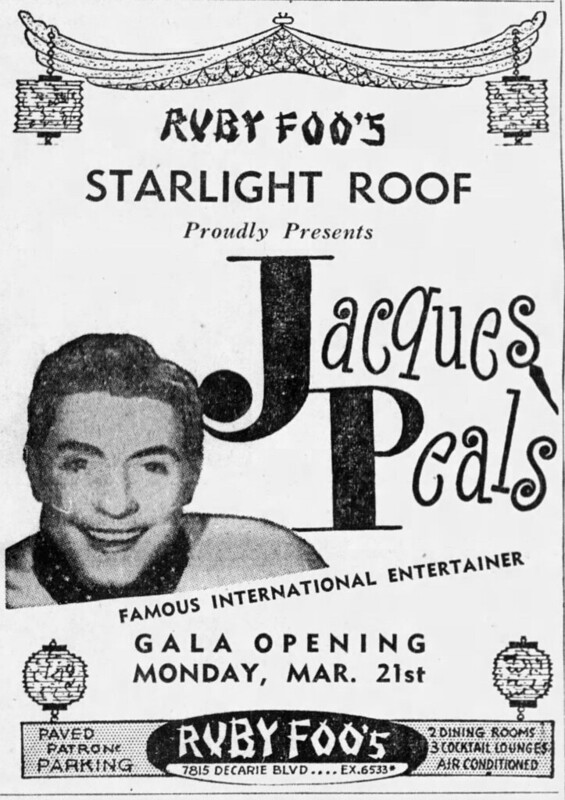
- Starlight Roof : au début des années 1950, Ruby Foo’s met de l’avant une salle de spectacle baptisée The Starlight Roof, située à l’étage. Une annonce de 1951 présente une « COMPLETE NEW REVUE » avec THE GREAT GALLEZ (magicien européen), WILLMER WEELA (song stylist), JOSKA DE BARBARY (violoniste) accompagné au piano par FRED TOLDY, ainsi que JACK BARKER. Le spectacle est annoncé comme un divertissement continu, avec revues complètes à 22 h, minuit et 2 h, sans droit d’entrée (« NO COVER »). [10]
- En janvier 1951, LUCIENNE BOYER, grande vedette française de « Parlez-moi d’amour », est annoncée au Starlight Roof comme « THE QUEEN OF THEM ALL », avec le pantomimiste REX OWEN, le violoniste JOSKA DE BARBARY et le pianiste LEN BERGER. [11]
- En 1951, la chronique « D’une boîte à l’autre » du Photo-Journal signale également la présence de la chanteuse américaine BETTY RILEY, vedette Decca, « au Ruby Foo’s », confirmant le statut du restaurant comme halte privilégiée pour les artistes étrangers. [13]
- Black Sheep Bar : au début des années 1960, un encart annonce l’ouverture du Black Sheep Bar at Ruby Foo’s, avec le pianiste-chanteur CHARLIE HOWARD (« sophisticated piano and song stylings », « the ultimate intimate », de 20 h 30 à 2 h, sans cover ni minimum). Ce lounge vient s’ajouter au réseau de bars et salas du complexe. [14]
Ces publicités montrent que Ruby Foo’s, sans être un cabaret dans le sens traditionnel, développe une véritable programmation d’artistes — chanteurs, magiciens, comiques, violonistes — qui renforce son statut de rendez-vous nocturne de la ville.
5. Clientèle, critiques & vedettes
Dès la fin des années 1940, les chroniques de Don D’Amico dans Montréal-Matin présentent Ruby Foo’s comme un passage obligé pour les artistes de spectacle. En 1949, il note que « toutes les vedettes du cinéma, du théâtre ou de la radio » de passage à Montréal s’y rendent et souligne le rôle des musiciens Paul Wilbur (diffusé à la radio), Fay De Witt et surtout JOSKA DE BARBARY (violoniste) avec le pianiste LEN BERGER, qui assurent l’ambiance musicale. [7]
Dans une rubrique « Where to Dine in Montreal » de 1946, le Montreal Daily Star décrit Ruby Foo’s comme servant le « finest Chinese menu, steaks and seafood », entièrement climatisé, avec permis d’alcool complet et divertissement. [6]
En 1966, la critique gastronomique Helen Rochester consacre une longue chronique à Ruby Foo’s dans le Montreal Star. Elle affirme que le restaurant compte environ 1 100 places – « le plus grand restaurant du Canada » – et enregistre un chiffre d’affaires annuel estimé à 4 millions de dollars, ce qui en ferait l’une des entreprises de restauration les plus prospères du pays. Malgré son décor qu’elle juge parfois « gaudy American overlaid with Chinese », elle loue l’efficacité du service, la qualité de la nourriture (notamment les plats de bœuf, les fruits de mer et le fameux chariot de desserts) et le mélange de clientèle allant des familles aux groupes de banquets, en passant par les touristes. [17]
6. Le Ruby Foo’s Motor Hotel (1962)
Au début des années 1960, le succès du restaurant conduit à la construction d’un vaste Ruby Foo’s Motor Hotel sur le terrain adjacent. Une édition spéciale publicitaire du Montreal Star, datée du 9 avril 1962, annonce l’« OFFICIAL OPENING » du nouveau complexe : un ensemble moderne de type motel de luxe avec bâtiments à deux étages, piscine, jardins, salons et stationnement étendu. [16]
Un article intitulé « Far East Comes Alive in New Motor Hotel » décrit le complexe comme un centre intégré de restauration, loisirs et hébergement. Les chambres climatisées sont dotées de télévision, téléphone direct, literie de qualité, suites familiales et chambres exécutives. L’article souligne que Ruby Foo’s, déjà un « landmark » connu pour sa cuisine sino-américaine, étend désormais son influence en devenant un point de rencontre pour voyageurs d’affaires, touristes et résidents, avec des tarifs compétitifs par rapport aux autres formes d’hôtellerie. [15]
Sur le plan corporatif, Helen Rochester note qu’au milieu des années 1960, le restaurant et l’hôtel sont passés sous le contrôle d’un syndicat dirigé par Irwin Leopold, puis intégrés à un groupe plus vaste, Canadian Dredge and Dock / Patino Mining, ce qui témoigne de l’ampleur des investissements liés à ce complexe et de sa place dans l’économie des services à Montréal. [17]
7. Le Chambord & l’ère des banquets (années 1960)
En 1964, une grande publicité du Montreal Star vante les mérites des banquets au Ruby Foo’s : « Why banquets are unforgettable at Ruby Foo’s ». L’établissement y est décrit comme un lieu de choix pour réunions, mariages et événements de clubs, offrant une cuisine orientale, continentale et américaine, une vaste sélection de vins et spiritueux, un service impeccable et des installations de danse, le tout sous la supervision d’une « catering hostess », Miss Carlson. Le slogan « NEVER A PARKING PROBLEM » réaffirme l’importance du stationnement dans l’identité du lieu. [18]
En 1968, Ruby Foo’s inaugure un nouveau restaurant de haut luxe à l’intérieur du complexe, Le Chambord. Une annonce de The Gazette invite les clients à découvrir le « world of Louis XVI », un décor français raffiné avec lampes, musiciens ambulants et cuisine française exclusive. On y propose notamment le Suprême de faisan du Grand Duc et les Caille flambées Chambord, préparés par des maîtres cuisiniers continentaux et servis dans une ambiance de grande table européenne. Le Chambord est présenté comme une expérience gastronomique unique pour les Montréalais. [19]
8. Fermeture du restaurant & évolution de l’hôtel
Après près de quarante ans d’exploitation continue, le restaurant Ruby Foo’s ferme définitivement en 1984, laissant place à un projet de nouveau complexe hôtelier sur le même site. L’Hôtel Ruby Foo’s, entièrement reconstruit et modernisé, est inauguré en grande pompe le 25 novembre 1988. [21]
Au fil des décennies suivantes, l’hôtel fait l’objet d’investissements majeurs, notamment en collaboration avec la firme d’architectes Lemay Michaud, spécialisée dans les hôtels-boutiques. Devenu un établissement quatre étoiles comptant 198 chambres Deluxe, environ 6 000 pi² d’espaces de réunion, deux restaurants et un barbier, l’Hôtel Ruby Foo’s remporte à plusieurs reprises le prix du Choix du consommateur dans la catégorie « hôtel indépendant ». [21]
Si le grand restaurant sino-américain n’existe plus, le nom Ruby Foo’s demeure associé à l’hôtellerie et à la restauration à Montréal, perpétuant la mémoire du gigantesque établissement de Décarie qui, pendant des décennies, a servi de décor aux soirées, banquets et sorties familiales de générations de Montréalais.
9. Chronologie synthétique
- 5 mars 1945 – Lettres patentes de Ruby Foo’s Incorporated (Manella & Cohen), capital 20 000 $. [3]
- 25 mai 1945 – Ouverture officielle du Ruby Foo’s au 7815 Décarie ; articles et publicités dans The Gazette, Le Canada, The Montreal Star. [2], [4], [5]
- 1946 – Rubrique « Where to Dine in Montreal » : Ruby Foo’s est listé pour son menu chinois, ses steaks et fruits de mer, sa climatisation et son divertissement. [6]
- 25 juillet 1946 – Article sur la demande d’injonction du Ruby Foo’s Den (Boston/New York) contre Ruby Foo’s Inc. de Montréal, au sujet des droits sur le nom « Ruby Foo ». [8]
- 8 nov. 1949 – Don D’Amico décrit Ruby Foo’s comme « le plus grand restaurant de Montréal », avec cuisines sous la direction de Peter Wei et Albert Rubinato ; animation par Joska De Barbary et Len Berger. [7]
- 1er mars 1949 – Publicité dans Montréal-Matin vantant le stationnement pavé pouvant accueillir 300 voitures. [12]
- 1947 – Publicité pour NAN BLAKSTONE au Upper Lounge de Ruby Foo’s ; elle est remplacée par le duo comique OWEN & PARKER. [9]
- 1951 – Annonces pour la revue du Starlight Roof (Great Gallez, Willmer Weela, Joska De Barbary, Fred Toldy, Jack Barker) et pour la venue de Lucienne Boyer avec Rex Owen, Len Berger. [10], [11]
- 12 avril 1951 – Rubrique « D’une boîte à l’autre » mentionnant la chanteuse Betty Riley au Ruby Foo’s. [13]
- 9 avril 1962 – Ouverture officielle du Ruby Foo’s Motor Hotel, annoncée dans un supplément publicitaire du Montreal Star. [15], [16]
- 1964 – Publicité « Why banquets are unforgettable at Ruby Foo’s » : mise de l’avant des banquets, des salles de danse et de la spécialisation en événements. [18]
- 1966 – Helen Rochester publie une longue critique dans le Montreal Star, présentant Ruby Foo’s comme le plus grand restaurant du Canada, avec un chiffre d’affaires d’environ 4 M $. [17]
- 1968 – Inauguration de Le Chambord, restaurant de cuisine française de luxe à l’intérieur du complexe Ruby Foo’s. [19]
- Années 1970–1980 – Période de déclin relatif du grand restaurant, tandis que l’activité hôtelière se maintient.
- 1984 – Fermeture définitive du restaurant Ruby Foo’s. [21]
- 25 novembre 1988 – Inauguration d’un nouveau complexe hôtelier Ruby Foo’s entièrement reconstruit. [21]
10. Sources
- Publicités sur le stationnement, Montréal-Matin, 1er mars 1949 (« Il n’y a jamais de problème de stationnement chez Ruby Foo’s »).
- « Ruby Foo on Decarie is new restaurant », The Gazette, 26 mai 1945.
- « Ruby Foo’s Incorporated », avis bilingue, Gazette officielle du Québec, 7 juillet 1945.
- « Ruby Foo, un chic restaurant », Le Canada, 28 mai 1945 (description du décor, des murales chinoises et de l’atmosphère).
- « Oriental Influence in New Restaurant », The Montreal Daily Star, 28 mai 1945.
- « Where to Dine in Montreal », rubrique restaurants, The Montreal Daily Star, 5 octobre 1946 (fiche Ruby Foo’s).
- Don D’Amico, « Du soir au matin – Ruby Foo’s, le plus grand restaurant de Montréal », Montréal-Matin, 8 novembre 1949.
- « Ruby Foo’s Den demande une injonction contre Ruby Foo », Montréal-Matin, 25 juillet 1946.
- Publicité « Nan Blakstone – Upper Lounge of Ruby Foo’s », The Gazette, 21 août 1947.
- Publicité « Ruby Foo’s Starlight Roof – Complete New Revue », The Gazette, 20 août 1951.
- Publicité « Lucienne Boyer – The Starlight Roof at Ruby Foo’s », The Gazette, 17 janvier 1951.
- Publicité de stationnement, Montréal-Matin, 1er mars 1949.
- « D’une boîte à l’autre », Photo-Journal, 12 avril 1951 (mention de Betty Riley au Ruby Foo’s).
- Publicité « Opening Tonight – The Black Sheep Bar at Ruby Foo’s », The Gazette, 16 octobre 1961.
- « Far East Comes Alive in New Motor Hotel », The Montreal Star, 9 avril 1962.
- Supplément publicitaire « Ruby Foo’s Motor Hotel – Official Opening April 9, 1962 », couverture du Montreal Star, 9 avril 1962.
- Helen Rochester, « Dining Out? (Ruby Foo’s) », The Montreal Star, 4 juin 1966.
- Publicité « Why Banquets Are Unforgettable at Ruby Foo’s », The Montreal Star, 10 novembre 1964.
- Publicité « The NEW Le Chambord at Ruby Foo’s », The Gazette, 26 mars 1968.
- Diverses annonces « Where to Dine », critiques et encarts publicitaires, The Gazette, Montréal-Matin, Le Canada, The Montreal Star, 1945–1968.
- « À propos de l’Hôtel Ruby Foo’s », page officielle de l’hôtel (historique, rénovations, prix et caractéristiques), consultée via hotelrubyfoos.com.
- « Ruby Foo’s », photo inbox via Archives de la ville de Montréal https://archivesdemontreal.com/ .