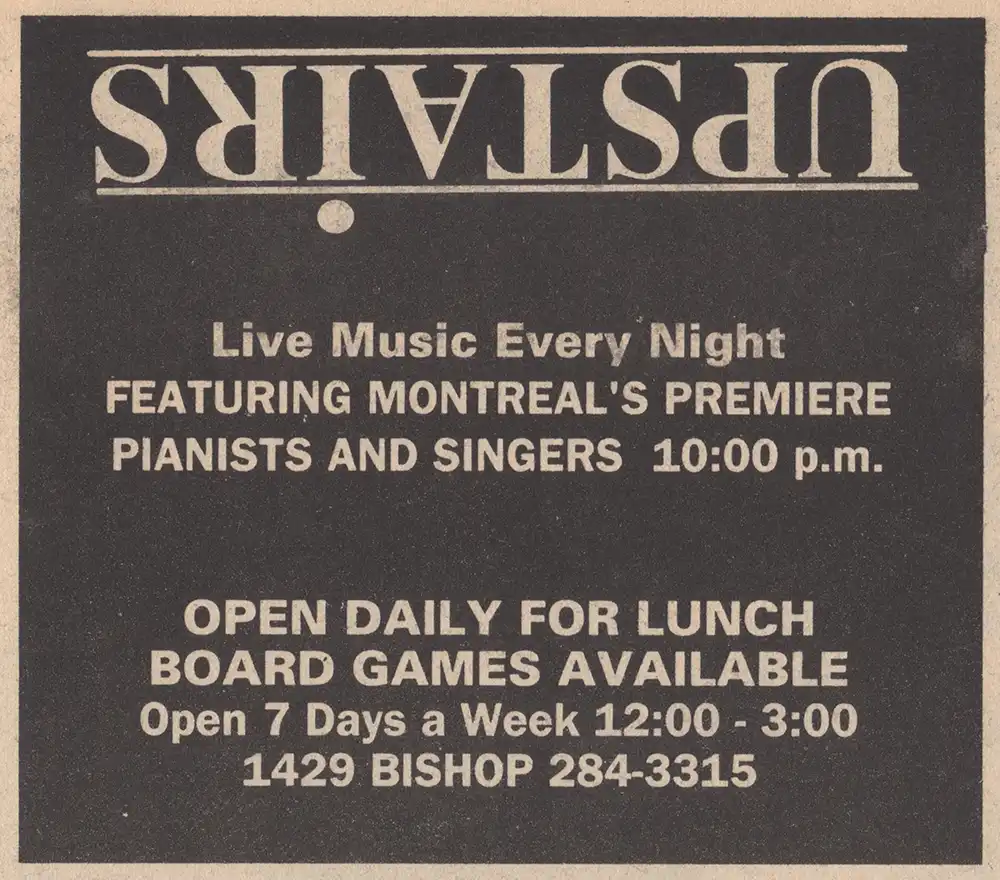
Upstairs Jazz Bar & Grill
Founded in the spring of 1986 by Christopher “Chris” Gore, Upstairs evolved from a small bohemian bar where jazz, board games and late-night jam sessions came together into one of Montreal's enduring jazz institutions. After three moves and four incarnations, the club settled in 1994 at 1254 MacKay Street. Taken over the following year by Joël and Sydney Giberovitch, it gradually developed into a true listening room, recognizable by its upside-down sign and deeply rooted in Montreal's jazz community.
1. Overview
In a city whose jazz history has been shaped by a succession of cabarets, bars, hotels and small venues that have often disappeared, Upstairs Jazz Bar & Grill represents a remarkable continuity. Since 1986, the name has survived four addresses, several generations of musicians and a profound transformation of Montreal nightlife.
The club's history can be divided into two major periods. The first is that of Chris Gore, who imagined a relaxed, bohemian place where jazz, food, drinks, games and conversation could mix freely. The second begins in 1995 with Joël and Sydney Giberovitch, who took over the establishment and gradually transformed it into a club devoted to attentive listening.
Yet one fundamental continuity connects these two visions: from its earliest jam sessions on Bishop Street to its concerts on MacKay Street, Upstairs has remained above all a musicians' place.
2. 1986: Above the Charles Darwin
The first incarnation of Upstairs opened in the spring of 1986 at 1187 Bishop Street. Its founder was Christopher “Chris” Gore.
The small establishment was literally located above the Charles Darwin pub. Its name therefore came almost naturally: Upstairs.
The place was modest. It did not yet attempt to reproduce the model of the great jazz clubs. Instead, it was a quiet little bar where people could drink, eat inexpensively, play board games and hear musicians perform.
That simplicity quickly became part of its charm. Musicians began gathering there, and jam sessions stretched late into the night. Within a few months, what had started as a small bar had become a regular meeting place for part of Montreal's jazz community.
3. Games, Jazz and Smoky Nights
The first Upstairs belonged entirely to its era. Games of chess, backgammon, Scrabble and Trivial Pursuit were as much a part of the place as the music.
Young musicians were given some of their first Friday and Saturday night engagements. Pianists might perform with an ashtray sitting directly on the piano, while cigarette smoke regularly filled the small room.
Food and drinks were affordable and, importantly, Chris Gore was reluctant to impose a cover charge. For students, musicians, artists and regulars with little money, Upstairs became a place where one could spend much of the evening without spending very much.
A Refuge for Musicians
Before becoming a recognized listening room, Upstairs was first and foremost a meeting place. People played chess, ate, talked, listened to jazz and, when the evening allowed, musicians continued playing long after the scheduled program had ended.
4. The First Move
Barely six months after opening, Upstairs already had to find a new home.
Montreal pianist Al Paterson remembers a problem that was both mundane and decisive: Upstairs had no washrooms of its own. Customers had to go downstairs to the Charles Darwin.
Going Down... and Not Coming Back Up
“Upstairs had no washrooms. You had to go downstairs to Darwin's. When customers went down and discovered the lively atmosphere, they stayed there instead of coming back upstairs.”
Chris Gore remembers the situation somewhat differently. According to him, Upstairs eventually began attracting enough customers to become an irritation to the business below.
The Founder's Version
“Eventually we started attracting more customers than Darwin's, so they cancelled our lease. I then moved Upstairs a little farther down the street, into a charming little basement at 1429 Bishop Street.”
5. The Story of the Upside-Down Sign
The second incarnation opened at 1429 Bishop Street, north of Sainte-Catherine Street. Upstairs now operated as both a restaurant and a bar while retaining the informal spirit of its beginnings.
But a problem immediately became apparent: the new Upstairs was now located in a basement. Its name therefore indicated exactly the opposite of its physical location.
According to Al Paterson, passersby would see the “Upstairs” sign, instinctively look toward the upper floors, search for a staircase and sometimes simply walk away.
Why Is the Sign Upside Down?
One evening, Al Paterson suggested to Chris Gore that he simply turn the sign upside down to indicate that “Upstairs” was now downstairs. Gore initially thought the idea was crazy. A few days later, he tried it. The inverted sign remained and became one of the club's most recognizable symbols.
6. 1990: The Third Upstairs
In 1990, Upstairs moved again, only a few doors away, to 1421 Bishop Street.
This third incarnation largely continued the same formula. Jazz and social interaction remained at the centre of the experience, and the establishment had by then developed a regular clientele.
Business was healthy, but operating conditions became increasingly difficult. According to the accounts collected, the landlord demanded an excessively high rent, while the permit for the premises did not include a full bar licence.
7. Chris Gore and the Bohemian Paradise
To understand the original Upstairs, it is necessary to understand Chris Gore's philosophy. Gore did not primarily see himself as a businessman. He wanted to create a place where people felt welcome, whether they spent a great deal or merely bought something small to eat or drink.
He was also reluctant to make a cover charge an essential condition of entry and did not impose a strict silence policy during performances.
His ideal was closer to a “bohemian paradise” than to a business structured around profitability. That freedom attracted students, musicians and members of the local intelligentsia.
It also had its limits. Over time, Gore's generous and informal vision became difficult to sustain financially. Yet it left the club something more enduring: a culture of hospitality and closeness to musicians that survived the change in ownership.
8. 1994: The Move to MacKay Street
In 1994, Chris Gore finally found a location offering two essential advantages: reasonable rent and a full bar licence.
The fourth incarnation of Upstairs opened at 1254 MacKay Street. This would become its lasting home.
Located in a semi-basement, the room already possessed several characteristics that would contribute to its identity: stone and brick walls, dark woodwork, a long narrow room and a bar facing directly toward the performance area.
Over time, album covers by Miles Davis, John Coltrane and Louis Armstrong appeared on the walls. Ragtime-inspired sculptures, photographs and musical memorabilia gradually completed the décor.
The stage remained small enough that the separation between performers and audience was almost nonexistent. Between sets, musicians moved through the room and naturally spoke with members of the audience.
9. 1995: Joël and Sydney Giberovitch
Only a short distance from Upstairs, a young Joël Giberovitch worked first as a dishwasher and later as a waiter at El Coyote, his father Sydney's Mexican restaurant on Bishop Street.
In 1995, a business opportunity appeared. Joël was 23 years old and studying political science at Concordia University. Together with his father Sydney Giberovitch, he took over Chris Gore's lease on Upstairs.
Joël left his final year of university and invested the money he had saved into the establishment. Instead of using those savings for a trip, he bought the inventory required to fill the bar and refrigerators.
The place he inherited was still fairly modest. Joël would later describe it as a kind of student piano bar serving hamburgers and cheese sandwiches.
1986 Is Not 1995
Chris Gore founded Upstairs in 1986. Joël and Sydney Giberovitch took over the club in 1995. The distinction is essential: 1995 marks the beginning of a new period in the history of Upstairs, not the birth of the venue.
10. New York and the Transformation of the Club
Joël Giberovitch did not grow up as a jazz specialist. By listening night after night to the musicians performing in his own establishment, he gradually developed a genuine appreciation for the music.
While trying to define what Upstairs could become, he travelled to New York and visited several clubs that represented major models at the time: the Village Vanguard, Blue Note, Iridium, Smalls and Bradley's.
He returned to Montreal with a much clearer vision: Upstairs should become a genuine jazz club in which music, food, service and atmosphere formed different parts of a single experience.
The stage was moved toward the front and a series of renovations began. Musicians such as guitarists Nelson Symonds and Sonny Greenwich were invited to perform.
Bassist Brian Hurley also played an important role in Joël's jazz education by recommending musicians to book. Word spread quickly: the jazz community gradually realized that something was changing at Upstairs.
11. A True Listening Room
The transformation involved more than programming. Joël upgraded the sound system and gradually changed the way the audience experienced performances.
One of the most important decisions was the introduction of a silence policy during performances. The idea was simple: when a musician stepped onto the stage, the music was no longer background sound for conversation. It became the primary reason for being in the room.
This philosophy helped distinguish Upstairs from a restaurant where jazz happened to be playing. It became a genuine listening club.
The establishment also adopted the name Upstairs Jazz Bar & Grill rather than simply Upstairs Jazz Club, better reflecting the balance sought between music, food and social life.
12. Juan Barros: Food Around the Music
Food also became an important part of this transformation. Joël brought in Chilean chef Juan Barros, who had previously worked with his father Sydney.
Barros developed a kitchen that allowed the audience to turn a concert into a complete evening out without allowing the restaurant side of the business to overshadow the venue's central purpose.
Music at the Centre
At Upstairs, food, wine, service and décor complete the experience. But the organization of the venue rests on one simple principle: everything revolves around the music.
13. A School Outside the Classroom
Upstairs also developed a special relationship with Montreal's university community, particularly with the music department at McGill University.
Students could perform there as part of their training under the supervision of professors. They temporarily left the classroom and found themselves in front of a real audience under the conditions of a professional jazz club.
This relationship contributed to one of Upstairs' most important functions: creating a bridge between generations. Students could share the room with established musicians, veterans of the local scene and international artists passing through Montreal.
14. Len Dobbin: Headquarters
Few people embodied the connection between Upstairs and Montreal's jazz community as strongly as Len Dobbin.
A writer, broadcaster and passionate jazz advocate, Dobbin effectively made Upstairs his headquarters. He regularly occupied the same seat at the foot of the bar, attended soundchecks, met musicians and shared his enormous knowledge of the scene with Joël Giberovitch.
His influence went far beyond that of a regular customer. His network and reputation allowed Joël to reach musicians he might not otherwise have been able to contact.
A Living Jazz Encyclopedia
Joël recalled that sometimes simply telling a musician that he was a friend of Len immediately gave him credibility. Dobbin was not interested in benefiting from the scene: his purpose was simply to support the music and the people who made it.
In 2009, Len Dobbin was sitting in his usual place at Upstairs when he suffered the stroke that would ultimately claim his life.
His memory remains deeply connected to the venue. Photographs, newspaper clippings and other reminders continue to evoke his role in the history of both the club and Montreal jazz.
15. A Home for Musicians
Over the decades, Upstairs became an important stage for Montreal musicians, both established performers and artists at the beginning of their careers.
Ranee Lee, Oliver Jones, François Bourassa, Lorraine Desmarais, Christine Jensen, Jim Doxas, Chet Doxas, Jean Derome, Joel Miller and Guillaume Martineau are among the many artists associated with its history.
International musicians including Sheila Jordan, Kurt Rosenwinkel, Mark Turner, Larry Grenadier, David Liebman, Houston Person, Mark Murphy, Jim Black, Greg Osby, Nate Smith, Bill Stewart and Antonio Sanchez also helped give the club a reputation extending well beyond Montreal.
Upstairs has hosted album launches, live recordings, improvised encounters and jam sessions. It therefore became not simply a place where jazz was presented, but a place where the scene itself continued to develop.
16. 2015: The Steinway Model B
In 2015, twenty years after Joël and Sydney Giberovitch took over the club, Upstairs marked the occasion by acquiring an instrument worthy of its musical ambitions: a Steinway Model B.
This 6-foot-11-inch (211 cm) grand piano is particularly prized by professional pianists and quickly became a central feature of the room.
Its arrival symbolized just how far the club had come from the days when pianists played in a smoke-filled room with an ashtray sitting on the piano at the original Upstairs.
17. Legacy
The history of Upstairs is one of transformation without erasure. Joël Giberovitch's club is no longer exactly the small bohemian refuge imagined by Chris Gore in 1986, but something of that original vision remains.
Upstairs is still a place where musicians know one another, where artists speak with audience members between sets and where different generations of the jazz community can meet in the same room.
Chris Gore himself described the club he had created as a “diamond in the rough” that, through the work of many people, was eventually polished and developed. The image captures its evolution particularly well.
In a city where so many historic clubs have disappeared, Upstairs' longevity gives it a special significance today. It provides a living connection between Montreal's jazz scene of the 1980s and that of the present day.
A Memory Still Alive
The history of Upstairs cannot be reduced to the artists who appeared on its stage. It also belongs to the musicians who learned their craft there, the regulars who spent their evenings in the room, the employees who kept it running and the people who, from Chris Gore to Joël Giberovitch, allowed the venue to endure across the decades.
18. Timeline
Spring 1986 — Christopher “Chris” Gore opens the first Upstairs at 1187 Bishop Street, above the Charles Darwin pub.
1986 — Upstairs quickly becomes a gathering place for musicians; board games, concerts and late-night jam sessions characterize its early years.
Late 1986 — The club leaves its first location and moves into a basement at 1429 Bishop Street.
Late 1980s — The sign is turned upside down to indicate that “Upstairs” is now downstairs. The inverted sign becomes the club's emblem.
1990 — The third incarnation opens at 1421 Bishop Street.
1994 — Upstairs moves to its fourth and current location at 1254 MacKay Street.
1995 — Joël Giberovitch, then 23 years old, and his father Sydney take over Chris Gore's lease.
1990s — After studying major New York jazz clubs, Joël gradually transforms Upstairs into a true jazz club and listening room.
1990s — Juan Barros joins the establishment and contributes to the culinary identity of the Jazz Bar & Grill.
2009 — Len Dobbin, a major figure in Montreal's jazz community and an emblematic Upstairs regular, dies following a stroke.
2015 — To mark twenty years of the Giberovitch era, Upstairs acquires a Steinway Model B.
Today — Upstairs continues its programming at 1254 MacKay Street and remains one of Montreal's emblematic jazz venues.
19. Notes & Sources
- THE GAZETTE — HELEN ROCHESTER. “Jazz music and board games on menu downstairs at Upstairs”, December 20, 1986.
- AL PATERSON. Comments published in the Facebook group Woodys, Bishop street and other great Montreal moments, August 8, 2022.
- MCPA INTERVIEW — AL PATERSON. Interview with JF Hayeur, June 2024.
- CHRIS GORE. Comments published in the Facebook group Woodys, Bishop street and other great Montreal moments, November 6, 2021.
- THE GAZETTE. “Jazz”, September 28, 1990.
- THE GAZETTE — ARTHUR KAPTAINIS. “Straight ahead for jazz”, September 13, 2003.
- THE GAZETTE — PETER HADEKEL. “Two decades at the top”, November 10, 2015.
- THE GAZETTE — IRWIN BLOCK. “Upstairs celebrates 10 years of jazz”, September 14, 2005.
- THE GAZETTE — MIKE BOONE. “It don't mean a thing if it ain't got that swing”, July 13, 2009.
- THE GAZETTE — IRWIN BLOCK. “Dobbin dedicated his life to music, jazz and musicians”, July 10, 2009.
- MCPA INTERVIEW / COMMENTS — CHRIS GORE. Exchanges with JF Hayeur, July 7, 2024.