Alberta Lounge
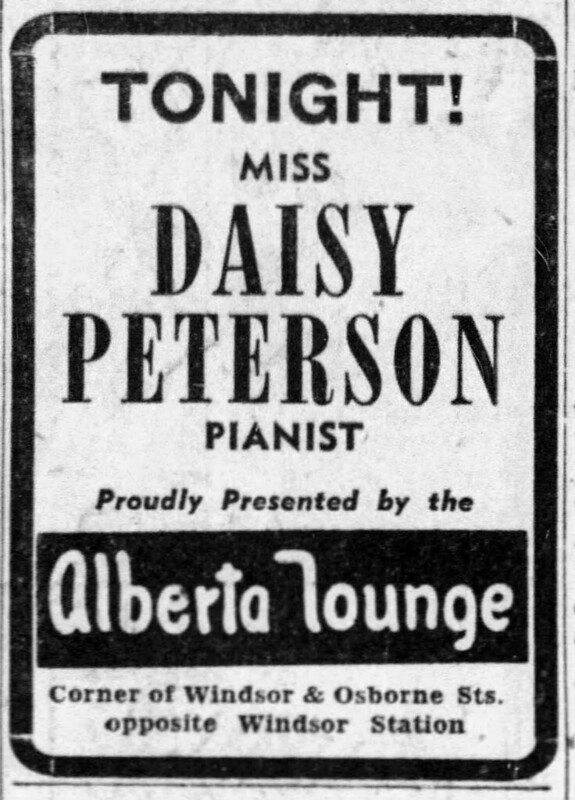
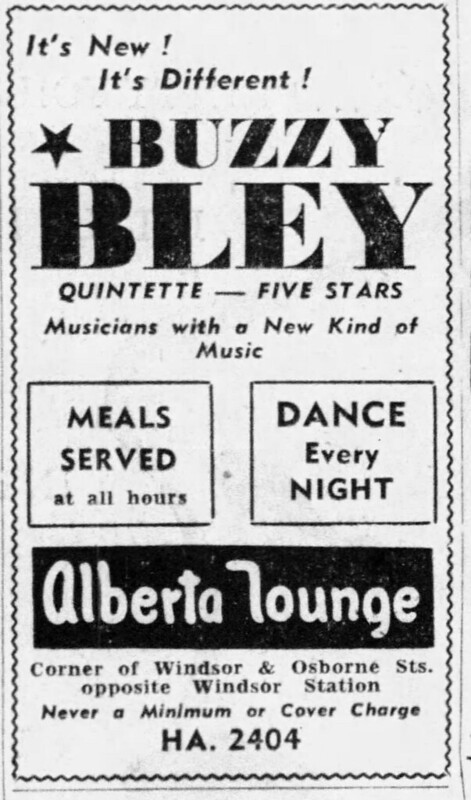
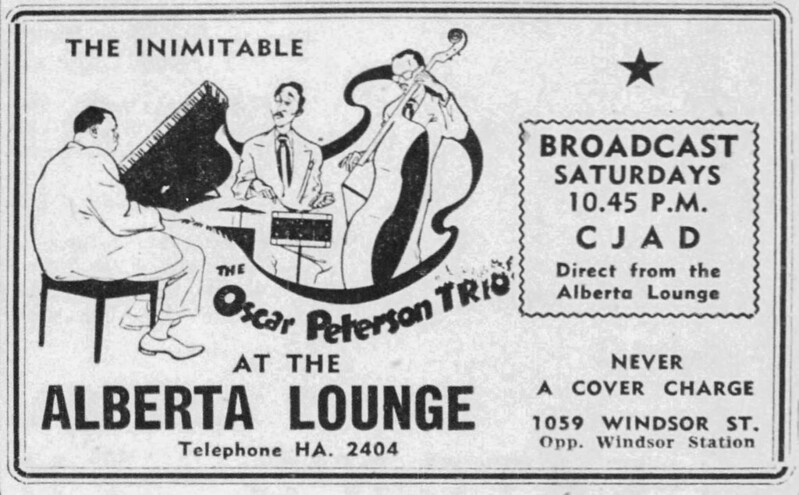
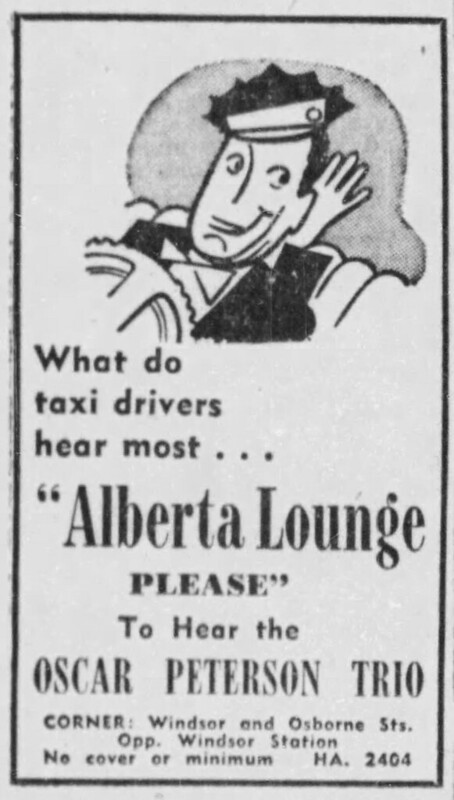
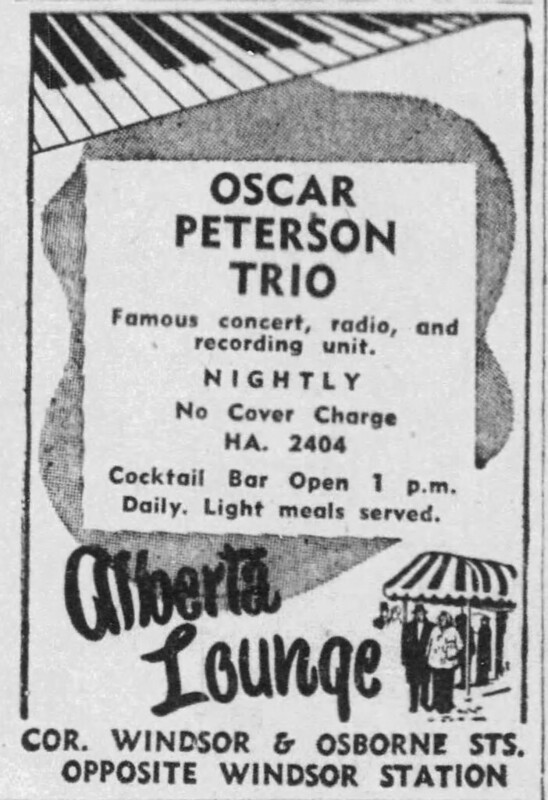
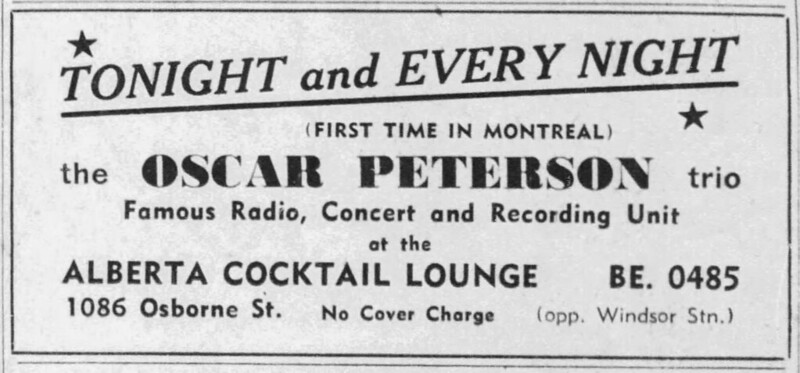
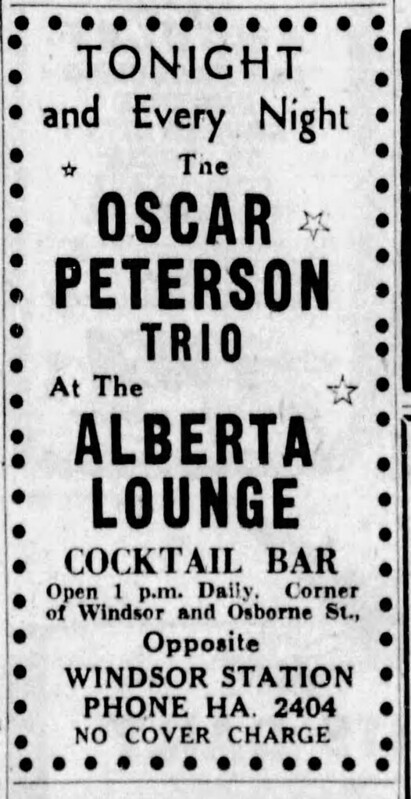
Opened in 1947 by Maurice Gauthier at the corner of Windsor and Osborne streets, near Windsor Station, the Alberta Lounge distinguished itself from Montréal’s larger cabarets through its intimate and refined atmosphere, conceived as a true lounge. Its history remains inseparable from that of the young pianist Oscar Peterson, who established his principal Montréal residency there between 1947 and 1949. Performances by his trio, also broadcast weekly on CJAD, allowed his music to reach audiences far beyond the walls of the club. In 1949, American impresario Norman Granz heard Peterson performing live from the Alberta Lounge on the radio while riding in a taxi and asked the driver to return downtown so that he could hear him in person. This encounter contributed directly to the launch of Peterson’s international career, and a few months later he performed at Carnegie Hall with Jazz at the Philharmonic. Young Montréal pianist Paul Bley was among those who subsequently succeeded him at the piano. Active until 1959, the Alberta Lounge remains a small club that played an immense role in the history of Montréal jazz.
1. Overview
The history of the Stanley Hotel, the Hotel Alberta, and the Alberta Lounge unfolds within the same area of downtown Montreal, immediately adjacent to Windsor Station. It spans nearly seventy years of urban and commercial change, from the era of late nineteenth-century travellers’ hotels to the golden age of Montreal jazz clubs after the Second World War.
The documentation reveals a clear geographical continuity around Windsor and Osborne streets, but it does not yet allow us to state with certainty that the Stanley Hotel, Hotel Alberta, and Alberta Lounge occupied exactly the same building throughout their histories. Addresses reported in newspapers vary over the years: 1059 Windsor, 1086 Osborne, and, in 1959, 1157 Windsor. It is therefore more prudent to speak of continuity within the same area and of related operations than of a formally demonstrated architectural continuity. [5], [10]
2. The Stanley Hotel and A. Béliveau
The documented history of the Stanley Hotel dates back at least to the late nineteenth century. An obituary published in 1903 states that hotelier A. Béliveau had operated the establishment for fourteen years, placing the beginning of his tenure at around 1889. [1]
The press described Béliveau as a well-known figure in Montreal’s hotel trade. When he died on November 21, 1903, he left behind a widow, four sons, and two daughters. His death opened a new chapter in the Stanley’s commercial history, with the establishment thereafter operated by his estate. [1]
3. The Béliveau Estate and the Stanley Hotel Company
After A. Béliveau’s death, his widow continued to operate the establishment. In 1905, a newspaper crime report mentioned a theft from the proprietor’s room at the Stanley Hotel, evidence that the establishment remained fully active at the time. [2]
On January 3, 1907, La Patrie announced that the “Stanley Hotel has changed hands.” Mrs. Béliveau sold the business to the Stanley Hotel Company, formed by A. Panneton and A. Cousineau. The transaction amounted to $45,000 and included the furnishings and the liquor licence. The building itself was then owned by Thomas Gauthier. [3]
January 3, 1907
A $45,000 transaction
The sale covered the Stanley Hotel business, its furnishings, and its liquor licence. The building itself was not included in the transaction and remained the property of Thomas Gauthier.
4. The 1910 Licence Commission
On December 29, 1910, the Stanley Hotel was among several Montreal establishments examined by the Licence Commission. The Metropole and the Blue Bell were also cited in this inquiry into the conduct of hotels holding liquor licences. [4]
According to the account published in Le Devoir, police officers said they had observed women entering and leaving the hotel for several months, either alone or accompanied by men. The owners’ lawyer argued that a hotelier could not judge the private lives of guests, while the commissioners emphasized the responsibilities that came with holding a liquor licence. [4]
This hearing is a documented episode in the Stanley’s history, but the sources gathered so far do not establish a direct link between the inquiry and the later appearance of the name Hotel Alberta. Any causal connection between the two must therefore remain hypothetical.
5. From the Stanley Hotel to the Hotel Alberta
Over the following decades, the name Hotel Alberta appears in the same area, opposite Windsor Station. Directories and address records place the establishment around Windsor and Osborne streets, where considerable hotel activity was concentrated because of railway traffic.
The evidence gathered so far suggests continuity between the Stanley and the Hotel Alberta, but this must be stated cautiously. The available documentation is not yet sufficient to determine whether the Hotel Alberta was simply a renamed Stanley, a transformation of an existing building, or a neighbouring business on the same block.
Evolution of the Stanley / Alberta area
6. Opening of the Alberta Lounge in 1947
The Alberta Lounge opened in 1947 at the corner of Windsor and Osborne streets. An advertisement in The Gazette dated November 12, 1947, places the lounge at 1086 Osborne Street. [5]
Owner and founder Maurice Gauthier sought to create an establishment distinct from traditional cabarets. In an article published in Le Canada on December 12, 1947, the venue was described as an intimate, comfortable, and richly decorated lounge. [6]
7. An Intimate and Luxurious Lounge
The Alberta Lounge stood out for its interior design. Rather than a large dance hall or a cabaret built around elaborate stage shows, it had the appearance of a true lounge. Luxurious armchairs surrounded small tables, while the walls were decorated with photographs depicting landscapes from the province of Alberta. [6]
The venue’s identity rested as much on its refined atmosphere as on its music. Maurice Gauthier quickly turned the establishment into a recognized destination by hiring the young pianist Oscar Peterson, who was already attracting considerable attention on the Montreal scene.
December 1947
A lounge designed as a true salon
Comfortable armchairs, small tables, and photographs of Alberta landscapes: the décor was an integral part of the establishment’s identity.
8. Oscar Peterson at the Alberta Lounge
In 1947, Oscar Peterson left Johnny Holmes’s orchestra and began a new stage of his career with his own trio. The Alberta Lounge became his principal Montreal residency for approximately two years.
The success was immediate. In 1948, Montréal-Matin described Peterson as Montreal’s “king of boogie-woogie” and reported that large crowds came to the Alberta Lounge each night to hear him. [7]
Between 1947 and 1949, the trio’s weekly performances were also broadcast on CJAD. These broadcasts gave the young pianist an audience far beyond the walls of the lounge and played a decisive role in the next stage of his career. [7], [8]
9. Norman Granz: The Taxi Ride That Changed a Career
The most famous episode in the history of the Alberta Lounge took place in 1949. American impresario Norman Granz, creator of Jazz at the Philharmonic and future founder of Verve Records, was riding in a taxi on his way to the airport when he heard a pianist on the radio whose playing immediately caught his attention.
Granz asked the driver what record was playing. The driver replied that it was not a record at all: the music was being performed live from the Alberta Lounge. Granz then turned back toward downtown to hear Peterson in person. [8]
“Stop the taxi! We’re going back downtown!”
Granz later recalled that several American musicians had already told him about the young Montreal pianist. Peterson, for his part, reportedly recognized the impresario by his suede shoes, having heard that Granz wore them constantly. The two men spoke, and Granz persuaded Peterson to appear in a Jazz at the Philharmonic concert at Carnegie Hall in New York in September 1949. [8]
The program included Charlie Parker and Lester Young, among others, but the young Montreal pianist’s performance made a powerful impression. The appearance became one of the major turning points in his international career.
1949
The taxi ride that changed a career
Norman Granz hears Oscar Peterson performing live from the Alberta Lounge on CJAD while travelling to the airport. He asks the driver to turn around. A few months later, Peterson takes the stage at Carnegie Hall.
10. After Peterson: Paul Bley
As Peterson’s American engagements became increasingly important, the Alberta Lounge needed to find a successor at the piano. One of the musicians called upon to take his place was another young Montrealer destined for an international career: PAUL BLEY.
In 1949, Bley fulfilled Peterson’s engagement at the Alberta Lounge. The job was one of the first important steps in his professional career before his move to New York and his later association with some of the most adventurous currents in modern jazz.
11. The 1959 Tragedy and Closure
The history of the Alberta Lounge ended tragically in 1959. During an evening held to mark the 30th birthday of Bertha Boiteaux, who worked at the bar, a jealous man opened fire inside the establishment. He shot and killed a romantic rival, wounded two women, and then turned the gun on himself. [9]
Contemporary press reports mention a coroner’s inquest and identify the establishment as the Alberta Lounge, then located at 1157 Windsor Street. The bar was also raided by police and lost its liquor licence. [10]
After twelve years of operation, this sequence of events brought about the establishment’s closure. The end of the lounge also coincided with a period of profound urban transformation in the Osborne Street area.
12. The Disappearance of Osborne Street
The small Osborne Street, which crossed Windsor Street near the station, itself disappeared from Montreal’s urban landscape in the late 1950s as redevelopment began to reshape this part of downtown.
Expropriation, demolition, and redevelopment projects profoundly altered the urban fabric around Windsor Station. A street that had once been home to hotels, bars, and entertainment venues gradually disappeared from maps, making the precise location of some former businesses more difficult to reconstruct today.
Windsor Street was later incorporated into Peel Street, while the immediate area was profoundly transformed by new towers, hotel complexes, and, later, development around the Bell Centre.
13. Historical Significance
The Alberta Lounge holds a distinctive place in Montreal jazz history. It was not simply another club from the golden age of the city’s cabarets: its importance lies above all in the concrete role it played in the career of Oscar Peterson.
The lounge provided the pianist with a regular residency, a loyal audience, and, above all, radio exposure that allowed his playing to reach far beyond the club’s walls. It was through one of these broadcasts that Norman Granz heard him in 1949, an event that directly contributed to Peterson’s introduction to American audiences.
The history of the site is also remarkable for its chronological depth. The area connects the era of late nineteenth-century travellers’ hotels with that of the postwar jazz clubs. The disappearance of the Alberta Lounge and Osborne Street is also a reminder of how much of Montreal’s musical history now lies beneath a completely reshaped downtown.
In Montreal music history
A small club with an enormous role
1889 — A. Béliveau operates the Stanley Hotel
1907 — taken over by the Stanley Hotel Company
1910s–1940s — the Hotel Alberta is present in the area
1947 — Maurice Gauthier opens the Alberta Lounge
1947–1949 — Oscar Peterson residency and broadcasts on CJAD
1949 — Norman Granz discovers Peterson
1949 — Paul Bley succeeds Peterson
1959 — tragedy, loss of the liquor licence, and closure
14. Notes & Sources
-
“The Late Mr. A. Béliveau – Proprietor of the Stanley Hotel Died Yesterday Morning”,
Le Journal, November 21, 1903.
Obituary of A. Béliveau stating that he had been proprietor of the Stanley Hotel for fourteen years. -
News brief / crime report,
Le Bulletin : politique, littérature, nouvelles, September 10, 1905.
Account of a theft at the Stanley Hotel. -
“The Stanley Hotel Sold”,
La Patrie, January 3, 1907.
Announcement of the sale of the business by Mrs. Béliveau to the Stanley Hotel Company, formed by A. Panneton and A. Cousineau, for $45,000. The article specifies that the building was owned by Thomas Gauthier. -
“The Licence Commission – Inquiry into the Metropole, the Stanley and the Blue Bell”,
Le Devoir, December 29, 1910.
Account of hearings concerning, among other establishments, the Stanley Hotel. -
The Gazette, November 12, 1947 — Alberta Lounge address:
1086 Osborne Street.
The Gazette, January 7, 1949 — Hotel Alberta address: 1059 Windsor Street. -
“The Alberta Lounge, an Intimate and Luxurious Lounge”,
Le Canada, December 12, 1947.
Profile of Maurice Gauthier and description of the lounge’s décor and atmosphere. -
Don D’Amico,
“Oscar Peterson at the Alberta Lounge”,
Montréal-Matin, July 13, 1948.
Article on Peterson’s popularity at the Alberta Lounge and his reputation as Montreal’s “king of boogie-woogie.” -
« Oscar Peterson still fabulous »,
The Gazette, February 17, 1973.
Interview in which Norman Granz recounts hearing Peterson on the radio in a taxi, asking the driver to return downtown, and making his way to the Alberta Lounge. -
Coolopolis,
« Osborne St: So awesome they had to destroy it », 2012.
Account of the history of Osborne Street and the tragic end of the Alberta Lounge. -
La Presse, September 2, 1959.
Articles on the murder-suicide at the Alberta Lounge, mentioning the address 1157 Windsor Street and the coroner’s inquest. -
Lovell’s Directory and fire insurance plans.
Useful sources for locating the Hotel Alberta and Alberta Lounge and reconstructing the Windsor–Osborne area.