Café de l’Est
Established in the early 1940s at 4558 Notre-Dame Street East, the Café de l’Est became one of Montréal’s leading French-language cabarets for several decades. Located away from the main downtown nightclub district, this large venue, capable of accommodating approximately 600 people, attracted a loyal clientele as well as major Québec and international performers. During the 1940s, its programming played an important role in introducing Montréal audiences to several artists from France, including Charles Trenet and Les Compagnons de la Chanson, while Jacques Normand was also among the performers associated with the venue. Song, comedy, burlesque, orchestras and variety entertainment all appeared on its stage, and the Café de l’Est also served as a springboard for several generations of Québec performers. For more than three decades, it remained one of the principal centres of popular entertainment in Montréal’s east end.
1. Overview
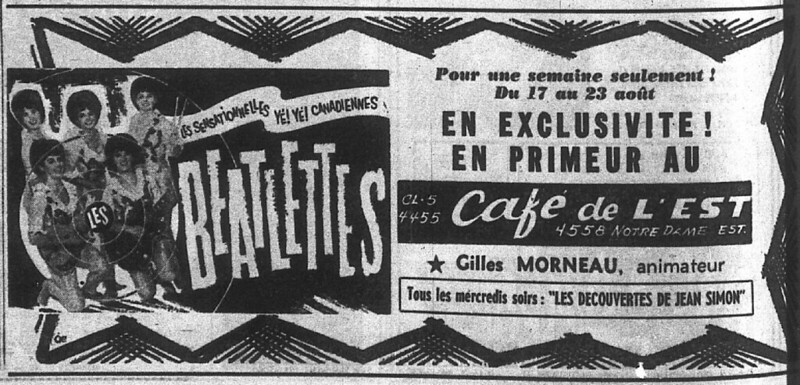
A long-standing precursor to the nightclubs of Montreal’s francophone districts, the Café de l’Est was for several decades one of the most important entertainment venues in the eastern part of the metropolis. This spacious cabaret ranked among the largest establishments of its kind in Montreal [3]. According to Mrs. Daniel of the Grimaldi-Daniel agency, “all the artists worked at the Café de l’Est… except the Cyniques and Yvon Deschamps.” She also recalled that the performer who drew the largest crowds was Olivier Guimond, followed closely by César et les Romains, les Beatlettes and Michèle Richard, described as “the most professional of them all” [4].
The opening of the Café de l’Est took place during the great era of Montreal cabarets, a period when most shows presented in the city’s clubs were still performed in English [5]. In the aftermath of the Second World War, most of the major cabarets were concentrated in the western part of downtown. In this context, the Café de l’Est stood out as an exception, being one of the first well-known nightspots located in a predominantly francophone neighbourhood. The establishment quickly became a favored venue for song, comedy and variety entertainment aimed at a French-speaking audience.
Owning a cabaret at that time could resemble possessing a veritable gold mine: the rooms were packed almost every night and Montreal’s nightlife was experiencing its greatest era. This prosperity nevertheless required considerable investment to present large-scale shows and attract local or international stars [6].
The site at 4558 Notre-Dame Street East has an earlier history, however, as several establishments occupied the location before the emergence of the modern cabaret in the mid-1940s. Social clubs and cafés were already mentioned in the press as early as the 1930s, reflecting the role of the site in the social life of the Maisonneuve district. The cabaret Café de l’Est truly flourished beginning in 1944, notably under the direction of Léo L’Archevêque, who gradually transformed it into one of the major institutions of nightlife in eastern Montreal. Modified around the early 1970s to adapt to changing forms of nightlife entertainment, the building ultimately disappeared after an arson fire in 1998 [69].
2. Club de l’Est and Club Social Démocrate (1930-1941)
A Montreal fire insurance plan dated 1924 indicates that the lot corresponding to the future site of the Café de l’Est was then occupied by tennis courts. The plan also shows the presence of a small pavilion identified as a Club House, suggesting the existence of an organized sporting facility at this location before the appearance of the first social clubs in the early 1930s [87].
In 1930, the site at 4558 Notre-Dame Street East became a gathering place for the local community with the creation of the Club de l’Est. The official incorporation of “Club de L’Est, Incorporé” was announced in the Quebec Official Gazette of May 10, 1930, following letters patent issued on April 22, 1930 establishing a social club intended for its members and their guests [88].
The club quickly served as a meeting place for various political and social organizations in the Maisonneuve district. Meetings of the Maisonneuve and Rosemont Liberal Club were reported there in the press in 1932 and 1934 [48].
By the mid-1930s the establishment had already become an important social venue in eastern Montreal. Public meetings, lectures and various community activities were held there. In 1936, for example, the press reported the official presentation of the charter of the Maisonneuve branch of the Canadian Legion during a dinner held at the Club de l’Est, attended by about 150 guests [49].
In March 1937 the establishment changed status when the creation of the corporation Club Social Démocrate was announced in the Quebec Official Gazette. Founded by Alex Jodoin, Wellie Mondou and Denis Jodoin, the organization aimed to operate a social club with dining rooms, entertainment spaces and other facilities intended for members and their guests. The new corporation appears to have taken over from the Club de l’Est while continuing the operation of a social club at the same address [46].
In an article published in June 1939, The Gazette reported that Alex Jodoin, operator of the Club Social Démocrate, was fined 25 dollars — about $543 in 2026 value — as well as court costs following an investigation by the Quebec Liquor Commission into alcohol sales conditions in several Montreal clubs. This episode illustrates the frequent tensions between private club operators and the provincial authorities responsible for regulating the distribution of alcoholic beverages in Montreal in the late 1930s [47].
At the beginning of the 1940s, the first mentions of the Café de l’Est appeared in the press. A brief notice published in Le Petit Journal in December 1941 announced that the establishment on Notre-Dame Street East had just come under new management. The article specified that M. A. Trudeau had been appointed manager of the café, described as one of the “most elegant” places in the district. The press also noted that visitors could expect courteous service and efficient organization, while the New Year’s Eve celebration promised to be particularly memorable for regular patrons. This reference demonstrates that the café was already well established in the social life of the neighbourhood before its development as a major cabaret in the mid-1940s [1].
3. Café Yvon Robert (1941-1944)
A notice published in the Quebec Official Gazette on August 1st, 1942 reveals that the company Café de l’Est Limitée, incorporated on November 27, 1941, then changed its corporate name to Le Café Yvon Robert Ltée Ltd.. The official document, dated July 9, 1942 at the office of the Attorney General of Quebec, thus confirms the association of the famous Quebec wrestler Yvon Robert with the company operating the establishment in the early 1940s [27].
The name “Café Yvon Robert” is directly associated with the famous Quebec wrestler Yvon Robert, a major figure in professional wrestling in Canada in the mid- 20th century. An article published in Le Petit Journal in 1971 recalls that Robert was one of the most popular athletes of his era, winning several world championships and drawing considerable crowds to arenas across North America [38]. In Montreal, some observers at the time even claimed that his popularity rivaled that of the legendary hockey player Maurice “Rocket” Richard [92].
Yvon Robert (1914–1971)
Born in Montreal on October 8, 1914, Yvon Robert is considered one of the greatest professional wrestlers in Quebec history. Trained notably at the Palestre Nationale, he began his career in the 1930s and quickly became one of the major stars of wrestling in North America. Over a career spanning more than twenty years, he won the world championship of the National Wrestling Association several times and drew large crowds to arenas in Canada, the United States, and Europe. In Montreal, his matches notably filled the Forum and other amphitheatres in the city [92].
Alongside his sporting career, Robert was involved in several business ventures. The press reports that he worked notably as a real estate agent and company director, while also taking part in various business projects in the metropolis, including an investment in the operation of a gold mine with a group of Montreal businessmen [91].
He was also associated with the operation of several Montreal entertainment venues. Among them was the Café Yvon Robert at 4558 Notre-Dame Street East, an establishment that would later become the Café de l’Est. His name is also linked to other sites of Montreal nightlife, including the El Morocco cabaret, the Café La Bohème, the Yvon Robert Lounge, the Dream Lounge, the Larry Moquin Hotel and the establishment Chez Maurice, reflecting his involvement in Montreal’s entertainment and restaurant industry in the mid- 20th century. A 1956 column also noted that the wrestler was involved in numerous business ventures, including restaurants, cabarets, and even the financing of a women’s magazine titled American Beauty [16] [27] [89] [91] [93] [94].
“Like many wrestlers, Yvon Robert wrestled three, four and even five times a week in packed amphitheatres.”
An advertisement published in Le Monde ouvrier on March 11, 1944 announces the operation of Café Yvon Robert Ltée at 4558 Notre-Dame Street East, presented as “the chicest café in the East.” The advertisement states that the establishment offered meals, beer, wines, spirits and dancing, a formula typical of Montreal cafés and cabarets of the period. It also specifies the company’s management, with Yvon Robert as president, Maurice Robert as vice-president and Armand Robert as secretary-manager, confirming the wrestler’s direct involvement in the operation of the establishment [89].
Although the Café de l’Est was already mentioned in the press in the early 1940s, it was not truly until 1944 that the establishment began to flourish as a cabaret when businessman Albert Fortin took over its management. The venue was soon taken over by Léo L’Archevêque, who developed its entertainment programming and gradually made it one of the major institutions of nightlife in eastern Montreal [69].
4. Café de l’Est: Paul Létang, Léo L’Archevêque and the team (1946–1949)
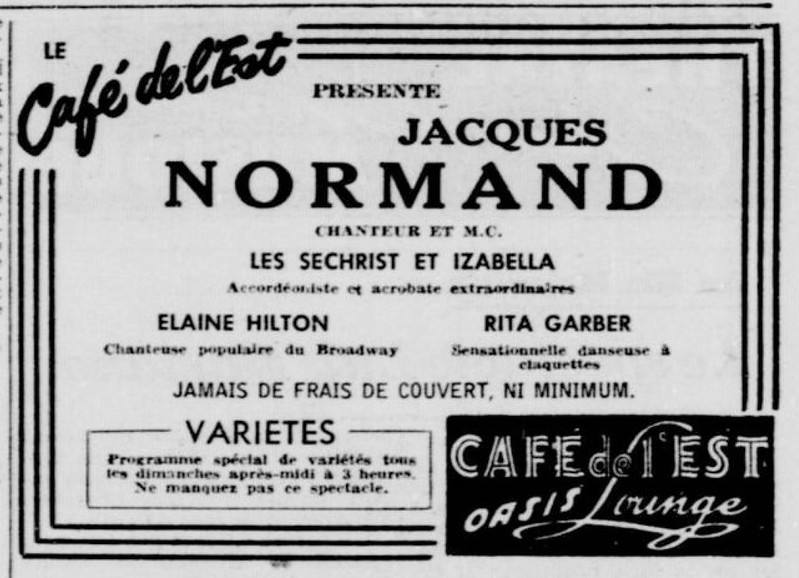
In October 1946, an advertisement published in Le Petit Journal announced the “grand autumn reopening” of the renovated Café de l’Est, presented as a “chic cabaret in the East.” The advertisement also highlighted the opening of it’s Oasis bar, described as “the most beautiful bar in Montreal.” The week’s program included the Franco-American tenor Paul Cadieux, the acrobat and juggler Cay Baird, the dancers Noades Sisters and master of ceremonies Guy Robert, with two performances each evening accompanied by the orchestra of F. Bordeleau and his “Eastern Gentlemen”. The establishment was then operated by Léo L’Archevêque, proprietor, and located on Notre-Dame Street East at the corner of Bennett [51].
The popular manager of the Café de l’Est was Paul Létang.
Paul Létang
Paul Létang was a cabaret impresario and administrator active in Montreal during the 1940s, recognized as one of the first promoters to regularly introduce French stars into Montreal cabarets. As manager of the Café de l’Est, he helped make the venue an important stage for French chanson touring in North America.
Mr. Létang already had more than 38 years of service in Montreal nightclubs, which made him something of a dean among cabaret managers in the city — much as Carol Grauer of the Samovar would later become. Around 1910, Paul Létang began his career as a simple cabaret waiter. This beginning gradually led him to occupy managerial positions in several important establishments. He worked successively at the Restor, the Café Parisien, the Queen’s, the St-Régis and the Blue Bird, all well-known cabarets of the period. His organizational skills and professional experience made him highly sought after by nightclub owners. A few years later he founded the Club des Millionnaires on Saint-Denis Street. He left this club in 1934 to manage the Montparnasse, before moving to the Hollywood and later returning to the Club des Millionnaires.
In 1937, he became manager of the Café Versailles, a chic French-style cabaret located on Sainte-Catherine Street and popular among gourmets and entertainment enthusiasts. The establishment enjoyed an excellent reputation in Montreal nightlife. Many major personalities from the artistic world were received there during lavish receptions organized by Létang. Whenever a star passed through Montreal, they were often invited to the Versailles. Artists such as Lily Pons, Lucienne Boyer, Gaby Morlay, Paulette Mauve, Jean Clément, Jean Sablon and Tino Rossi were welcomed at particularly notable soirées [7].
Under his direction, the stage of the Café de l’Est hosted several popular artists from France, including Lys Gauty, Charles Trenet, Adrien Adrius, Les Compagnons de la Chanson and Lilly Fayol. The Montreal press described him as the man who had “done the most in our city for the advancement of French entertainment in our cabarets.”
In 1949, following a change in the administration of the Café de l’Est, Paul Létang left the management of the venue and announced his departure for Paris, bringing to an end a significant period in the cabaret’s programming [56].
When he managed the Versailles, Mr. Létang had among his employees a certain Léo L’Archevêque. The latter would later become the capable owner of the Café de l’Est on Notre-Dame Street East, where Paul Létang would serve as manager-administrator. Under the auspices of L’Archevêque, and thanks to the wide latitude granted to him, the establishment developed and attracted a distinguished clientele. The cabaret was frequented by a refined crowd and stood out for the quality of its performances. Mr. Létang was also assisted in his duties by the devoted Hector Pellerin, who likewise placed his energy and experience at the service of the house [7].
Hector Pellerin
Hector Pellerin (1887–1953), born in Montreal, was one of the earliest popular singers to achieve widespread success in French-speaking North America. Trained in piano and organ under the musicians Alexis Contant and J.-Daniel Dussault, he nevertheless chose to devote himself to popular music rather than classical repertoire. He began his career as a cinema pianist at the Ouimetoscope in Montreal, accompanying silent films at the beginning of the 20th century.
Between 1916 and 1928, Pellerin recorded more than 140 pieces on wax cylinders and 78-rpm records. Possessing a baritone voice, he became one of the most popular singers among French-Canadian and Franco-American audiences. The rise of radio during the 1920s contributed greatly to the spread of his songs in homes throughout Canada and the French-speaking United States.
After 1928, Pellerin reduced his recording activities and turned increasingly toward stage performances and radio. He sang regularly on the Montreal station CKAC between 1933 and 1943 and took part in numerous shows and cabarets. In 1934, he founded the cabaret Versailles in Montreal, which hosted several international stars of French chanson, including Lucienne Boyer, Jean Sablon and Tino Rossi.
Until the late 1940s, Hector Pellerin also worked as a master of ceremonies in several Montreal cabarets, where he encountered many of the major figures of French-language entertainment of the era, including Jacques Normand, Olivier Guimond Sr., Manda Parent, Paul Desmarteaux, Jean Grimaldi, Arthur Pétrie, Juliette Pétrie and Rose Ouellette.
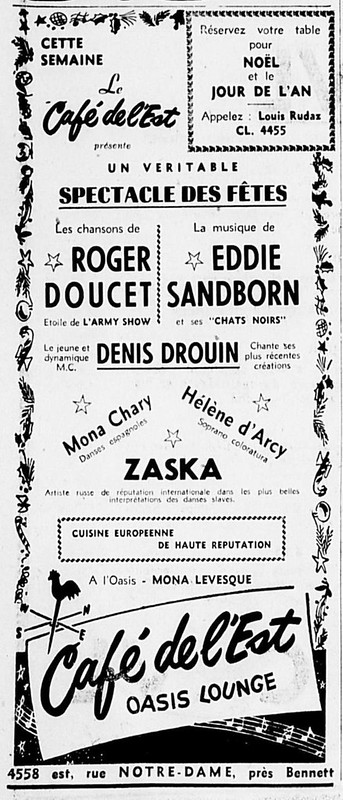
During the second half of the 1940s, the Café de l’Est appeared regularly in the Montreal press. An article published in The Gazette in August 1947 described the cabaret as one of the most renowned establishments in Montreal’s francophone district. Located east of downtown, the club attracted a loyal clientele as well as visitors from other parts of the city. The variety program was hosted by master of ceremonies Armand Marion, accompanied by the orchestra of Eddie Sanborne. The establishment also included a space known as the Oasis Lounge, where singer and pianist Virginia Fair performed, while dance music was provided by Eddie Sanborn and His Black Cat Orchestra. Located at the intersection of Notre-Dame Street East and Bennett Avenue, the cabaret was known for its elaborate floor shows, the quality of its service and its food and beverage offerings in an atmosphere both elegant and convivial. The article also highlighted the presence of a large free parking lot for customers, indicating that the establishment was already attracting a motorized clientele [28] [52].
With its large hall seating between 500 and 600 people, the Café de l’Est could host the most popular performers. “There was not yet a Place des Arts,” explains writer and historian Philippe Laframboise, “and St-Denis Street was mostly devoted to cinemas. Large venues were rare and the Café de l’Est was inviting” [4].
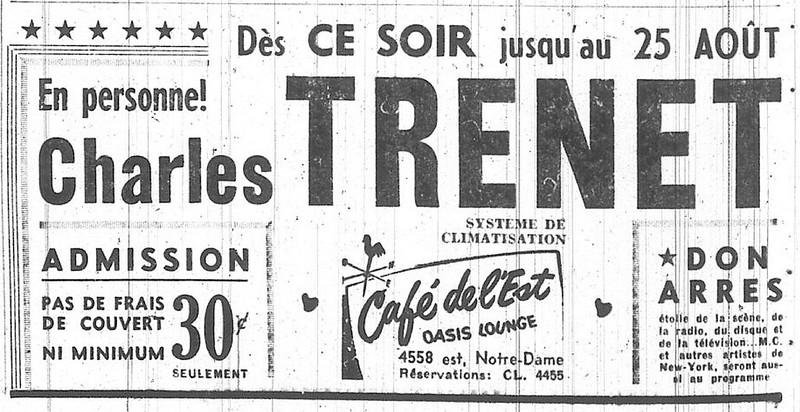
Charles Trenet presented his singing act at the Café de l’Est. Les Compagnons de la Chanson were also invited to perform there. It should be understood that French chanson was still in its early stages in the highly anglophone city of Montreal. It was not until 1948 that the first cabaret devoted primarily to French-language entertainment opened in downtown Montreal. This was the Faisan Doré, hosted by Jacques Normand, which introduced the duo Charles Aznavour and Pierre Roche, Monique Leyrac, Paul Berval and several others. The Faisan Doré became legendary but lasted only two years. It was then that audiences discovered the Café de l’Est, located in eastern Montreal, which welcomed the great figures of French and Quebec chanson [4].
By the end of the 1940s, the activities of Montreal nightclubs were still governed by the restrictions of the Lord’s Day Act, a law inherited from the Protestant tradition prohibiting certain forms of entertainment on Sundays. In May 1948, however, a ruling by the Municipal Court confirmed that dancing in nightclubs on Sundays did not constitute a violation of this law. The decision led to the dismissal of charges brought against several Montreal establishments, including the Café de l’Est on Notre-Dame Street East. The case illustrates the gradual evolution of social attitudes and the growing importance of dance clubs in Montreal nightlife in the post-war years [32].
About 400 people gathered at the Café de l’Est, described as the “French centre,” to pay tribute to Hector Pellerin on the occasion of his 61st birthday and the 40th anniversary of his artistic career. The evening, organized by Mrs. Edmond Beau-Soleil with the collaboration of Léo L’Archevêque and Paul Létang, respectively the owner and manager of the establishment, was a great success. During the celebration, a substantial purse was presented to Pellerin, who emotionally thanked his friends and the management of the Café de l’Est and also mentioned the 95th birthday of his mother. At the audience’s request, he then performed a song. The musical program also featured Denis Drouin, Murielle Millard and Ed Sandborn’s orchestra, with an additional address by Me Gérard Delage, president of the Union des Artistes. Among the many personalities present were Janine Sutto, Marjolaine Hébert, Denise Pelletier, Juliette Pétrie, Ovila Légaré, Odette Oligny, Huguette Oligny and Juliette Huot, as well as the star performer appearing at the Café de l’Est, Adrien Andrius [54].
An article published in La Patrie in November 1948 announced the arrival of Les Compagnons de la Chanson at the Café de l’Est, presented in the press as the “French centre” of Montreal cabarets. The management of the establishment stated that it pursued a policy of offering its clientele “the greatest artists from France.” After the appearance of stars such as Lys Gauty, Armand Mestral and Adrien Adrius, the arrival of the French vocal ensemble was considered an exceptional event in Montreal’s nightclub scene. The newspaper notably emphasized that it was the first time that such a large vocal group — the Compagnons de la Chanson numbering nine singers — performed in a cabaret of this type in the metropolis [44].
Les Compagnons de la Chanson
Les Compagnons de la Chanson were a French vocal ensemble founded in Lyon in 1941 by Louis Liébard. The group, composed of nine singers, became known for its tight harmonies, a style inspired both by choral tradition and popular song, as well as for its dynamic stage presence. In the years following the Second World War, the ensemble achieved international success, particularly through its collaboration with Édith Piaf, with whom it recorded the famous song “Les Trois Cloches” in 1946.
During the 1940s and 1950s, the ensemble undertook numerous tours in Europe and North America, contributing significantly to the international popularity of French chanson. Their repertoire combined traditional songs, original compositions and adaptations, performed with a vocal precision that became their trademark. Les Compagnons de la Chanson remained active for several decades and are considered among the most famous French-language vocal groups of the 20th century.
By the end of the 1940s, the Café de l’Est had established itself as one of Montreal’s main venues devoted to French chanson. An article published in La Patrie in December 1948 reported the success enjoyed by Les Compagnons de la Chanson, whose engagement was extended due to strong public attendance. The cabaret, then directed by Léo L’Archevêque with Paul Létang as manager, also announced the forthcoming appearance of Charles Trenet. Other French stars were expected in the following months, including Yves Montand, Marie Bizet, Geo Ulmer and Lily Fayol, confirming the establishment’s determination to present in Montreal the leading figures of French chanson [68].
In 1948, the reputation of the Café de l’Est even extended beyond Canada’s borders. An article published in Le Petit Journal reported that the international magazine Variety, published in New York, devoted a full advertising page to the singer Édith Piaf and Les Compagnons de la Chanson. Among the establishments where these artists were appearing, three venues were prominently mentioned: Ciro’s in Hollywood, the Versailles in New York, and the Café de l’Est in Montreal. The article emphasized that, thanks to its policy of presenting the greatest French stars to Montreal audiences, the cabaret had become known as the “French centre” of Montreal and now enjoyed international recognition [53].
At the end of December 1948, the Café de l’Est announced the arrival of the French singer Charles Trenet, described as the “idol of Paris” and “the greatest Parisian entertainer.” The notice published in Le Petit Journal emphasized that it was the first time that Trenet headlined in a Montreal nightclub, demonstrating the importance the Notre-Dame Street East cabaret had acquired within the circuit of French chanson. The article also stated that Les Compagnons de la Chanson remained on stage at the Café de l’Est until the Sunday evening preceding Trenet’s debut, confirming the continuity of high-level French programming at the end of 1948 [55].
5. Safe robbery (1949) and sale of the club
A spectacular burglary was committed at the Café de l’Est, located at 4558 Notre-Dame Street East, in the early morning of January 10, 1949. Safecrackers broke into the establishment after closing by entering through a window in the second-floor restroom, on the side facing the St. Lawrence River, in order to avoid being seen from the street. At that moment, only the night watchman, Nicolas Cameron, remained in the cabaret. Quickly overpowered, he was beaten, gagged, and tightly bound before being left on the floor of an artists’ dressing room. The burglars then proceeded to the manager’s office, where the cabaret’s safe was located, containing several days’ receipts, the employees’ payroll, and the payment for the French singer Charles Trenet, who was then performing at the Café de l’Est. According to manager Paul Létang, who had left the premises around five in the morning, the safe contained at least $10,000. Unable to open the safe on site, the thieves ultimately decided to remove the entire vault — a massive object weighing about 1,400 pounds. After removing the safe from the establishment, they even returned inside the cabaret to steal around fifty bottles of liquor before fleeing the scene. The Montreal municipal police, under the direction of sergeant-detective Léopold Guérin, then opened an investigation into this daring burglary. The loot was estimated at nearly $10,000, equivalent to about $137,000 Canadian in present-day value — a considerable sum for a Montreal cabaret of that era [9].
The following is a partial list of the staff of the Café de l’Est in 1949: Fernand Daoust, Yvon Sénécal, Johnny Petrelli, Albert Chasseurs, waiters; Young Marquette, head waiter; at the bar: Roger Pépin and Elphège Guay [8].
In the spring of 1949, a change in the administration of the Café de l’Est led to the departure of its manager, Paul Létang, an important figure in Montreal’s postwar cabaret scene. The press described him as one of the principal promoters of French entertainment in Montreal, having helped introduce several French stars to Montreal audiences, including Lys Gauty, Charles Trenet, Adrien Adrius, Les Compagnons de la Chanson and Lilly Fayol. Following his departure from the management of the cabaret, Létang announced that he would soon leave for Paris, where he planned to take a well-deserved rest [56].
In the summer of 1949, the Café de l’Est also welcomed the famous French singer Charles Trenet. A column devoted to Montreal nightlife, published in Montréal-Matin, announced a series of performances presented from August 17 to 25, 1949 at the Notre-Dame Street East cabaret, confirming that the establishment was already hosting internationally renowned performers by the end of the 1940s [34].
By the end of the 1940s, the Café de l’Est appeared regularly in columns devoted to Montreal nightlife. A section published in Montréal-Matin in September 1949 notably announced that the establishment had just hired the host and cabaret performer Jacques Normand. This reference confirms that the Café de l’Est was already part of the network of cabarets and nightclubs in the city at the end of the decade [33].
By the end of the 1940s, the Café de l’Est offered a varied program combining music, dance and cabaret acts. A nightlife column published in Montréal-Matin in December 1949 announced an all-female show presented on the stage of the establishment, featuring the violinist Sally Lee, the acrobatic dancer Louise Lindon and other performers, accompanied by the orchestra of Jules Lebel. This mention confirms the diversity of the performances presented at the cabaret at the end of the decade [11].
6. Montreal, cabaret capital (1950s)
In December 1950, the Café de l’Est was under the direction of Jos Beaudry and Roger Parenteau, who announced their intention to make the venue one of the most popular cabarets in Montreal. The program then included singing, dance and variety acts, notably featuring the King Sisters, the star Billie Cutler, and master of ceremonies Denis Drouin. Evenings were hosted by the orchestra of Eddie Sanborn, and dancing took place every night, while weekly contests — including one to crown a “Queen of Montreal” — were organized to attract clientele. The advertisement also emphasized that the establishment charged neither cover fee, minimum consumption nor admission fee, a strategy intended to make the cabaret accessible to a broader public. It also mentioned the absence of parking problems for patrons, indicating that the establishment was already seeking to attract a motorized clientele from eastern Montreal [10].
Joseph “Jos” Beaudry
Joseph “Jos” Beaudry was one of the most important operators of taverns and drinking establishments in Montreal in the mid-20th century. After working for several years as a labourer and supervisor at the Dow Brewery, he entered the tavern business in the early 1940s. According to the press, he opened his first tavern around 1943, the Taverne Villeray, located at the corner of Saint-Denis and Villeray Streets, an establishment that marked the beginning of a long career in the bar and tavern trade in Montreal [12] [95].
Over the decades, Beaudry developed an extensive network of establishments. He would own or manage nearly thirty bars, taverns and cabarets in the Montreal region, and claimed to have managed as many as twenty-two drinking establishments simultaneously. Among the venues associated with his name were Le Montmartre, the Café de l’Est, La Havana, the Pigalle as well as several other popular bars and clubs of the metropolis [12] [95].
Beaudry thus played a notable role in the development of the network of taverns and cabarets that animated Montreal’s nightlife from the 1940s through the 1970s. His establishments, frequented by a working-class and popular clientele, formed part of the landscape of bars and entertainment venues that characterized Montreal during that era.
In recognition of his long career in the drinking establishment industry, Beaudry received in the 1980s the symbolic title of “tavern keeper of the century”, awarded by the Association of Tavern and Brewery Owners of Quebec [12].
At the beginning of the 1950s, Montreal was widely recognized as one of North America’s major capitals of cabaret and entertainment. In an article published in 1954, journalist Roland Côté stated that the metropolis ranked among the most important cities of the “show business” industry on the continent, behind New York and Las Vegas. Numerous international stars performed there regularly, attracting large audiences to the city’s cabarets and nightclubs. Establishments such as Chez Parée, the Casino Bellevue, the Continental, the St-Germain-des-Prés, the Sans-Souci and the Ritz Café were among the emblematic venues of this period, illustrating the vitality of Montreal nightlife during the golden age of cabarets [13].
Week after week, the Café de l'Est maintained its reputation for well-produced shows and a program featuring many major French stars. People came to this establishment for its careful service, its excellent food and drinks, and its pleasantly informal atmosphere. The orchestra of Eddie Sanborn and his Black Cat Orchestra provided lively music for dancing. The Oasis Lounge, a more intimate bar located beside the main hall, offered a certain degree of discretion and entertainment [3].
An article published in La Patrie in August 1950 reported the holding of a contest entitled “Miss Café de l’Est”, organized in the main hall of the cabaret. The winner, Jeannine Laferrière, was elected thanks to her interpretations of the songs Granada and Je t’ai donné mon cœur. The jury included Maurice Gauvin of Radio-Canada, Léon Lachance of CKVL, André Manseau of United Distillers and photographer Jos. Bélisle. The winner received a prize of $100, a two-week engagement at the Café de l’Est, as well as an audition on television and on CKVL. The contest attracted such a large crowd that several spectators could not find seats in the hall, demonstrating the already considerable popularity of the establishment in the early 1950s [42].
In 1953, the press reported that Roger Parenteau, a former operator associated with the Café de l’Est, continued his career in the Montreal cabaret scene. An article published in Le Petit Journal reported that he acquired the Café Palm, located on Bleury Street, where he introduced important changes in décor and programming. The establishment presented regular shows as well as several special weekly activities, including a dance contest, a musical quiz, and evenings devoted to “local talents.” The featured revue included the dancer Susie Joyal, the singer Florence Audibert, the comedian and musician Ravelin, and the singer Ernie Doucet, accompanied by Jean-Claude Hémond and his orchestra [57].
In November 1953, the Café de l’Est hosted an unprecedented event in the history of Montreal cabarets: the famous comedian La Poune — Rose Ouellette — agreed for the first time to perform her comic act on the stage of a nightclub. An iconic star of Montreal burlesque theatre, she appeared at the Café de l’Est alongside her partner Juliette Pétrie. Following the success of the show, the establishment extended the engagement for a second week. The program also included the dancers Vallinos, the singer and master of ceremonies Gilles Morneau, while dance music was provided by Stan Wood and his orchestra, with Chuck at the organ [58].
During the 1950s, several performers from Quebec burlesque and vaudeville appeared regularly in the major cabarets of the metropolis. The actress Juliette Pétrie, associated with the troupe of Rose Ouellette (La Poune), appeared on the stages of the Casa Loma and the Café de l’Est, two important venues in the circuit of popular entertainment in Montreal during that era [80].
By the mid-1950s, the Café de l’Est clearly formed part of the recognized network of Montreal nightclubs. An article published in Le Devoir on May 20, 1955 reported that a delegation of nightclub owners met with Mayor Jean Drapeau to discuss municipal regulations affecting the operation of these establishments. Among the venues mentioned were the Café de l’Est, the Rigoletto, the Café de Paris, the Figaro, the Can-Can, the Chevalier, the Palmarès, the Rainbow and the Casino Français [14].
This reference is important because it shows that the Café de l’Est was not an isolated establishment, but rather one of the clubs integrated into the broader landscape of Montreal nightlife. Although many of the cabarets mentioned in the article were mainly associated with downtown and the circuit of major nightclubs, the presence of the Café de l’Est in this list confirms its importance within the city’s nightclub scene. The establishment thus appears as one of the representatives of the network of neighbourhood cabarets, particularly active in eastern Montreal during the golden age of nightlife entertainment [14].
The meeting with the mayor also took place in a context in which municipal authorities were seeking to more strictly regulate the opening hours and operating conditions of nightclubs. The fact that the owners of the Café de l’Est and other cabarets considered it necessary to intervene directly with the municipal administration shows how important these issues had become for the Montreal entertainment industry by the mid-1950s [14].
An article published in La Presse in July 1955 reported several incidents that had occurred in Montreal nightclubs. The report mentioned acts of vandalism at the All-American Bar and Grill, located on Dorchester Street West and owned by Dominique Mandance, future owner of the Café de l’Est. The article referred to a climate of tensions between rival groups frequenting certain cabarets in the city, a phenomenon that concerned Montreal police authorities at the time [63].
By the mid-1950s, the Café de l’Est was also part of the social and professional network linking several bars, hotels and cabarets of the metropolis. A sports column in Montréal-Matin mentioned the establishment among the teams participating in a bowling league organized by the Association sportive des Waiters, alongside clubs such as the Casa Loma Lounge, the York Hotel, the Figaro and the Eldorado. This reference illustrates the existence of social and sporting activities bringing together employees of the restaurant and cabaret industries in Montreal during that period [82].
Several jazz musicians also participated in the musical life of Montreal cabarets during the 1950s and 1960s. The Quebec drummer, bandleader and composer Bernard Primeau, an important figure in Montreal jazz and future founder of the Bernard Primeau Jazz Ensemble, recalled his early years in the circuit of popular entertainment, where he accompanied various singers and variety performers. At the beginning of his career, he performed in several cabarets of the metropolis, including the Café de l’Est and the Casa Loma, two major establishments of Montreal nightlife which then hosted orchestras, singers and variety shows [79][81].
7. Dominique Mandanice and the Quebec rising generation (1960s)
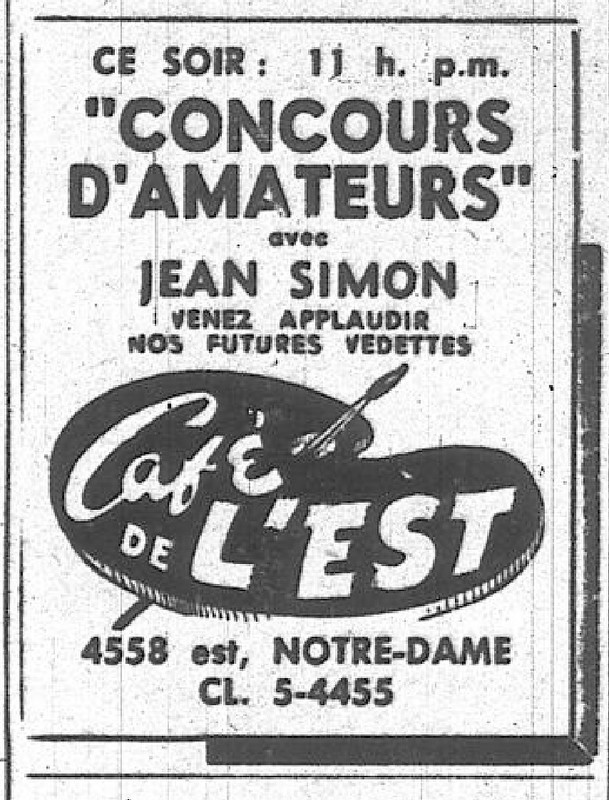
Around the early 1960s, impresario Jean Simon organized a series of amateur talent contests in several Montreal cabarets known as Les Découvertes de Jean Simon. Presented weekly in different establishments across the city, these programs introduced more than 18,000 new talents to the public in just over four years. Many participants later became popular performers in chanson and entertainment, including Michel Louvain, Pierre Sénécal, Michel Gingras, Sonia Del Rio and Claude Vincent [97].
Some finals and special evenings of these contests were held notably at the Café de l’Est. At the age of 14, Ginette Reno took part in these amateur competitions, including « Les Découvertes de Jean Simon », presented at the Montreal cabaret, where she placed first [25].
In 1960, the establishment was officially incorporated under the name of Café de l’Est Inc.. A notice published in the Quebec Official Gazette announced that letters patent, dated June 14, 1960, created the company for the purpose of operating hotels, taverns, inns and restaurants. The corporation was formed by the lawyers François Boisclair and Jean-Louis Lamoureux, as well as Hélène La Barre, secretary. The authorized capital included 1,000 common shares and 350 preferred shares of $100 each, while the company’s initial capital was set at $8,500. The company’s head office was established in Montreal [59].
At the beginning of the 1960s, the Montreal cabaret industry had to adapt to new provincial rules governing the sale and consumption of alcohol in nightlife establishments. An article published in La Presse in April 1961 reported that several club owners were observing a significant drop in attendance following the coming into force of this new regulation. Among them, Dominique Mandance, owner of the Café de l’Est, stated that attendance at the establishment had decreased by about 25 to 30%. The report also specified that many Montreal cabarets were grouped within the Association métropolitaine des cafés licenciés, an organization formed to represent the interests of the nightclub industry in the Montreal region [62].
In 1961, the company Café de l’Est Inc. obtained supplementary letters patent that modified certain provisions of its charter and considerably increased its share capital. The additional capital was then divided into 1,600 preferred shares of $100, and the minimum amount with which the company would continue its operations was fixed at $200,000. This significant increase in capital suggests a financial reorganization or a new investment in the operation of the establishment [60].
In 1961, the Café de l’Est remained active in the Montreal cabaret circuit and continued to present popular performers. A short item published in Radiomonde reported that comedian Olivier Guimond, having fallen ill during an evening at the cabaret, was replaced at short notice by Claude Blanchard. The article also specified that the latter had just signed a two-year exclusive contract with the Café de l’Est, a sign that the establishment was then seeking to secure certain artists for extended engagements [61].
By the mid-1960s, the rise of youth culture and the growing influence of television helped transform the programming of Montreal cabarets. The program Jeunesse d’Aujourd’hui, broadcast from 1962 onward on Télé-Métropole, popularized a new generation of singers and groups among teenage audiences. Several of these performers — including Pierre Lalonde, Joël Denis, Donald Lautrec, Michèle Richard and Ginette Reno — then appeared on the bills of the city’s cabarets. Establishments such as the Café de l’Est thus adapted their programming in order to present these stars emerging from television and the yé-yé movement, allowing the public to see on stage the artists they had discovered on the small screen [78].
The yé-yé movement
The yé-yé movement refers to a wave of popular music that emerged in the early 1960s in Europe and North America, inspired in particular by rock ’n’ roll and Anglo-American pop culture. The expression “yé-yé” derives from the English word yeah, popularized in the songs of the Beatles and other groups of the British Invasion.
In France, the movement was carried by artists such as Johnny Hallyday, Françoise Hardy, Sylvie Vartan and Sheila, while in Quebec it took shape in the mid-1960s with the emergence of a new generation of singers and popular groups.
In Quebec, artists such as Les Baronets, Donald Lautrec, Pierre Lalonde, Michèle Richard, Ginette Reno and Les Classels embodied this new musical culture aimed at a young audience. The movement was widely disseminated by radio and television, notably by the program Jeunesse d’Aujourd’hui, which helped popularize these artists among Quebec youth.
This evolution directly influenced the programming of Montreal cabarets. Performance venues such as the Café de l’Est gradually adapted their shows in order to present these new stars of French-language pop music, marking the transition between traditional music hall and the youth culture that dominated the musical scene during the second half of the 1960s.
“At the very beginning,” explained André Normand, an artist manager and booker for some thirty years, “there was no local industry and there was therefore a shortage of Quebec singers. So they mostly hired Americans, Earl Grant and Les Jayeurs, artists who were paid fees that today seem ridiculous. Then came the French, Piaf, Chevalier, Aznavour… The halls were packed every night. Those were the good days, the finest hours of Montreal nightlife.”
At the beginning of the 1960s, Montreal cabarets such as the Café de l’Est played an essential role in the emergence of a new generation of Quebec artists. Before gaining access to major institutional venues such as Place des Arts, inaugurated in 1963, several singers, comedians and popular groups learned their trade in the cabaret circuit of the metropolis. An article published in La Presse in January 1964 highlighted this development by asserting that the Canadian music hall, long marginalized by official programs dominated by classical music, was now gaining recognition. The report mentioned several artists who had made their beginnings in Montreal cabarets — including those of the Café de l’Est and the Casa Loma — among them Robert Demontigny, Joël Denis, Donald Lautrec, Ginette Reno, Michèle Richard, Jenny Rock, Jacques Desrosiers, Denyse Filiatrault and Dominique Michel, illustrating the fundamental role of the cabaret network in the rise of popular Quebec song during this period [76].
The interview given by Juliette Pétrie in 1963 clearly shows that venues such as the Café de l’Est formed part of a genuine professional circuit of music hall and popular entertainment in Montreal. Recalling a career pursued at a pace of seven nights a week and forty to forty-five weeks a year, Pétrie reminds us that burlesque and variety artists worked almost continuously in places such as the Théâtre National, the Casa Loma and the Café de l’Est. This reference confirms that the Café de l’Est was not merely a neighbourhood cabaret, but rather a venue integrated into Montreal’s professional entertainment network, where artists could return regularly and earn their living from their craft [83].
By the mid-1960s, Dominique Mandance, owner of the Café de l’Est, was actively involved in promoting new musical groups. A short item published in Télé-radiomonde in 1965 reported that he was launching the group “Jules César et ses Romains”, whose originality rested in particular on costumes inspired by Antiquity. Mandance is said to have invested more than $5,000 to outfit the musicians, a sign of his interest in the development of new artists in the Quebec entertainment industry [67].
By the mid-1960s, the programming of the Café de l’Est also reflected the rapid rise of popular Quebec song. A short item published in Télé-radiomonde in July 1965 indicated that the establishment now presented primarily the most in-demand Canadian artists. Among those announced on the bill were Michel Louvain, Donald Lautrec, Pierre Lalonde, the revue La Revue dans le vent, as well as the groups Les Classels and Les Baronets, illustrating the growing importance of local artists in the programming of Montreal cabarets during the yé-yé period [74].
In a report published in Le Droit on March 5, 1966, journalist Nicole Charest describes the rise of the yé-yé phenomenon in Quebec in the mid-1960s, as many groups of young musicians emerged to respond to the enthusiasm of teenage audiences. The article presents several popular bands of the period, including LES EXCENTRIQUES, LES GENDARMES, LES MISÉRABLES, LES JAGUARS and CÉSAR ET SES ROMAINS, and emphasizes the importance of their presence in cabarets and performance venues. The text also mentions the impresario and manager Dominique Mandanice, associated with some of these groups and active in their promotion. These bands often adopted spectacular costumes and stage presentations inspired by British rock, while record companies and clubs benefited from a rapidly expanding market. In this context, Montreal cabarets — including the Café de l’Est — participated in this transformation of the music scene by offering a platform to the new stars of youth music.
8. Decline of the cabarets, Expo 67 and transformations (1967–1969)
By the mid-1960s, Montreal cabaret owners were debating the future of their industry, confronted with the rising cost of live entertainment and the growing competition of television and discotheques. In an article published in Télé-radiomonde in 1967, several venue owners commented on the situation in the industry. Among them, Dominique Mandance, owner of the Café de l’Est, felt that the idea of a crisis in the cabaret industry was being exaggerated and stated that business continued to function well in several Montreal entertainment venues [64].
“There is no crisis. Business is going very well in the cabaret industry. It’s only the discotheques that are making life hard for us, but that’s temporary.”
In a brief item published in Télé-radiomonde in February 1967, William Savard, then co-owner of the Café de l’Est, expressed optimism about the future of the cabaret. He stated that the establishment would continue its usual formula by presenting a program focused on French-Canadian entertainment, an orientation that then characterized several Montreal cabarets [66].
By the mid-1960s, the stage of the Café de l’Est was fully part of the rise of the Quebec yé-yé movement. Popular groups such as Les Baronets appeared regularly on the cabaret’s bill, attracting a young audience eager to discover the new stars of French-language song. An article published in Le Petit Journal in March 1967 notably mentioned the trio’s return to the stage, at a time when they were highly visible in the Montreal cabaret circuit, illustrating the popularity of such groups in the metropolis’s performance venues during that period [75].
By the mid-1960s, several observers of the artistic scene were questioning the rapid evolution of the entertainment industry. A survey published in Télé-radiomonde in June 1967 gathered the testimony of numerous artists and figures from the Quebec scene, including Denyse Filiatrault, Muriel Millard, Ginette Reno, Michel Richard, Claude Sorel and George Dor. All emphasized the growing difficulties facing young singers, in a context where television, recording, and the multiplication of new faces were profoundly changing the conditions of an artistic career. Several felt that the popularity of stars had now become more short-lived than in the past and insisted on the importance of hard work and discipline for anyone hoping to last in the profession [85].
“Today, stars are manufactured somewhat like consumer products. They are launched quickly, but they often disappear just as fast as they appeared.”
In 1969, people began to speak of the end of the cabarets [18]. It can be said that Expo 67 profoundly transformed the landscape of Montreal entertainment and contributed to the decline of these establishments. Artists were becoming increasingly expensive and could now work in television. The decline of the cabarets was not explained solely by the popularity of television, however, but also by other factors. The appearance of go-go dancers, drug use, and the violence that followed frightened part of the clientele, who gradually stopped going to cabarets [4].
“There is a question of fashion, of trend in all this,” said the singer, actor and comedian Jacques Desrosiers. “Something works for years, then suddenly tastes change. People blame the artists, saying they charge too much, that they no longer draw crowds, but one should rather blame fashion. Fashion and Expo 67. Expo drove people out of Montreal toward the islands” [18].
By the end of the 1960s, the Café de l’Est remained an active venue in Montreal nightlife. An article published in Télé-Radiomonde in December 1967 notably reported the success of the duo formed by the singers Tony Roman and Nanette, who performed before an audience of about 400 spectators. The artists sang accompanied by a ten-piece orchestra, confirming that the establishment continued to offer a traditional cabaret formula combining popular song and live orchestra [35].
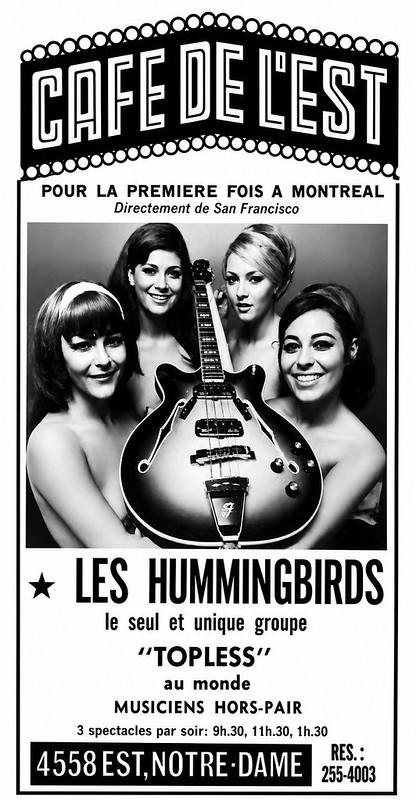
By the end of the 1960s, the Café de l’Est continued to experiment with show formats intended to attract a curious clientele. In the summer of 1969, the establishment presented exclusively the American group The Hummingbirds, described in the press as the only touring group of “topless” singer-musicians at the time. Originally from San Francisco, the four artists presented for nearly two weeks a show combining popular music and bold staging. The report emphasized that the cabaret hall on Notre-Dame Street East was filled for the three daily performances, a sign of the attraction generated by this unusual formula. According to the group’s spokeswoman, Mary, the topless element was not intended as provocation but rather as a form of artistic expression. The article also mentioned that the group, formed about a year earlier, was then touring the United States and Canada and notably performed popular hits of the time, including songs by the Beatles [30].
During the 1960s, the impresario Dominique Mandanice also helped launch the careers of several Quebec artists, including César et les Romains, Les Gendarmes, Les Baronets and Michèle Richard [15][16][17].
9. 1970–1973: new rooms, amateur contests and violence
At the end of the 1960s, several observers noted that the era of the great Montreal cabarets was gradually coming to an end. An article published in La Presse in April 1970 looked back nostalgically on the Montreal “before Drapeau,” a period when the metropolis’s nightlife was dominated by music-hall clubs and large cabaret venues. Establishments such as the El Morocco, the Esquire Show Bar, the Faisan Doré, the Salle Normandie at the Mont-Royal Hotel, and the Café St-Jacques had welcomed the great stars of song and popular entertainment. In this changing landscape, the Casa Loma and the Café de l’Est appeared as the last witnesses of an era when cabarets were one of the principal venues for French-language music hall in Montreal. Located in the eastern part of the city, the Café de l’Est thus remained one of the rare establishments still active in this circuit which, for more than three decades, had seen the great stars of song and variety pass through, including the French singer Charles Trenet. The report nevertheless emphasized that urban transformations, changing public taste, and competition from other forms of entertainment were now contributing to the gradual decline of this model of live show [77].
At the turn of 1971, the Café de l’Est was forced to profoundly modify its programming in order to adapt to the crisis then affecting the Montreal cabaret world and to the decline in attendance at traditional nightclubs. After more than twenty-five years of presenting song stars, owner Dominique Mandanice announced that the establishment would gradually stop hiring “big names” in order to adopt a formula more oriented toward dancing. The cabaret would thus rely on a continuous dancing formula hosted by popular orchestras, in which two groups alternated in providing a “singing-and-dancing set,” allowing the public to come on stage and take part in the activities. The article emphasized that this change marked an important transformation for this cabaret on Notre-Dame East, once considered a pillar of the Montreal entertainment world, but now obliged to adapt to changing public tastes [20] [21].
In the same context of reorganization, Mandanice made several changes to the establishment. The Café de l’Est then comprised three distinct rooms: L’Intro, located on the ground floor and able to accommodate about 125 people, a bar-cocktail lounge with a capacity of about 67 people, and the large performance hall, which could hold nearly 245 spectators. It was also during this period that male waiters were replaced by pretty waitresses, while the programming shifted toward a formula closer to the discotheque [19] [20] [21].
At the beginning of the 1970s, the Café de l’Est was also among the establishments visited by municipal inspectors as part of a journalistic investigation into the safety standards of Montreal cabarets. The report, published in La Presse in September 1972, confirmed the interior organization of the building and described these three distinct spaces, whose total capacity reached about 437 seats, corresponding to the typical size of medium-scale Montreal cabarets of the period.
The photographs accompanying the article also offered a rare glimpse of the interior architecture of the main hall. They show a vast rectangular space with a raised gallery resting on several columns, a configuration characteristic of former performance halls or theatres converted into cabarets in the mid-20th century. As in many postwar Montreal establishments, the ground floor was arranged with tables and chairs, allowing patrons to watch the performances while consuming drinks and meals. This layout reflects the classic cabaret formula, very common in Montreal before the gradual decline of this type of venue during the 1960s and 1970s [19].
At the beginning of the 1970s, the main attraction at the Café de l’Est became a show that some described as an “amateur contest” and others as a genuine “freak show.” The formula was devised by the host Pierre Stéphanne, a former singer in search of success, who quickly managed to make a name for himself in several Montreal nightspots. Presented notably on Tuesday evenings under the title Give Me My Chance, these nights attracted a curious crowd who came to witness a series of often unusual acts featuring Elvis Presley impersonators, amateur singers, and atypical performers. Among them was the dancer Rosa Rose, presented as a former Playboy Club “bunny,” who appeared made up as a “wild feline” in a number combining dance and performance. According to owner Dominique Mandanice, Tuesday used to be the worst night of the week, whereas receipts now ended up exceeding those of Saturday and the hall was full, sometimes forcing the staff to turn customers away at the door. The clientele also changed: one now saw more young people with long hair and girls in maxi-coats, a symbol of a new generation imposing its musical tastes and its atmosphere. Stéphanne himself explained that the success of the concept came almost by accident: during one evening, a mistake led him to invite the most awkward contestants in an amateur competition, which triggered public enthusiasm and gave birth to a formula that would quickly fill the room. An article published in Télé-Radiomonde in June 1971 confirmed the immense popularity of these shows, describing a noisy hall, often packed to capacity on these Tuesday evenings, which had become one of the cabaret’s main attractions at the time [22] [40].
“Before Pierre Stéphanne came to present his contest Give Me My Chance, Tuesday was my worst night of the week. Today, my Tuesday evening receipts exceed those of Saturday night. Our clientele has multiplied tenfold and we sometimes have to turn people away at the door.”
A report published in Montréal-Matin in November 1971 described the particular atmosphere then prevailing at the Café de l’Est during the amateur contest presented every Tuesday evening. The journalist evoked a real Montreal “underground” where Elvis Presley impersonators, amateur singers, and extravagant performers such as Johnny the Guner or Rosa Rose, “the tattooed rose,” followed one another on stage. The event, described in turn as an amateur contest and a “freak show,” attracted a young and noisy crowd and even aroused the curiosity of personalities from the artistic community such as Robert Charlebois, Mouffe, and Guy Latraverse [26].
“The Café de l’Est amateur contest sometimes resembles an endurance test worthy of the Olympic Games. The crowd shouts, applauds or boos, while Elvis impersonators, improbable singers and extravagant characters take turns on stage.”
A report published in Télé-radiomonde in October 1971 documents the official inauguration of the Intro-Bar Piano Bar, fitted out above the Café de l’Est. The event attracted a crowd of personalities from Montreal’s artistic community, to such an extent that the magazine noted that “all artistic Montreal” had gathered there. Among the stars present were François Bernard, Johnny Farago, Georges Guétary, Tex Lecor, Renée Martel, Claude Blanchard, Huguette Rayno, and Léo Rivet. The evening also included comic and musical numbers, including a sketch performed by Gilles Latulippe, Léo Rivet and Claude Blanchard that sent the room into fits of laughter. The magazine emphasized that this “super-show” constituted one of the biggest gatherings of stars ever presented in a Montreal cabaret, confirming the central place then occupied by the Café de l’Est in the city’s nightlife and artistic life at the beginning of the 1970s [41].
This period nevertheless remained marked by certain violent episodes. In June 1973, the singer Jean Nichol was savagely beaten by four thugs as he was leaving the Café de l’Est. The attackers notably struck him in the face with ashtrays. The exact reason for the attack remains unknown, but it would seem that the incident was provoked by the interest shown by a young woman toward the singer [23].
At the beginning of the 1970s, Dominique Mandance, owner of the Café de l’Est, extended his activities beyond the cabaret world. An article published in Télé-radiomonde in December 1972 reported that he acquired 50% of the shares of the record company Ciné, controlled by the firm Brofilms Ltée. Already active in the record industry since the foundation of the Citation label in 1965, Mandance thus took part in the management of popular artists on the Quebec scene such as Jacques Boulanger, Dominique Michel, and Michel Louvain [65].
An article published in Montréal-Matin in June 1973 described an important transformation in the vocation of the Café de l’Est. Formerly considered a “temple of established stars” of the Montreal cabaret, the venue gradually became a testing ground for new artists. The journalist observed that the cabaret seemed “to be turning into a laboratory for the small world of Quebec show business,” where singers and comedians came to try out their acts before the public. At the time of the report, the stage notably welcomed the young singer Pierre Broussard, nicknamed “La Pagoda,” who presented a show of about forty-five minutes composed mainly of American songs accompanied by a pop orchestra. The atmosphere described by the journalist — the clinking of glasses, a large crowd, and the presence of artistic personalities such as Jean Beaulne, Jacques Lepage, and Nicole Cloutier — illustrates the evolution of the cabaret into a space for discovery and artistic experimentation at the beginning of the 1970s [43].
In an interview published in June 1973, the singer Michèle Richard notably looked back on her recent appearance at the venue, where she said she had enjoyed considerable success. According to her, the shows presented at the cabaret drew exceptional attendance and “broke all attendance records,” confirming the establishment’s enduring popularity in eastern Montreal. The singer also explained that this kind of engagement allowed her to test new songs and maintain direct contact with the public before recording discs intended for the country and popular music market. This statement nicely illustrates the role of the Café de l’Est as a privileged stage for Quebec artists at a time when cabarets still constituted a central place in nightlife and live entertainment in Montreal [45].
“Formerly the temple of established stars, the Café de l’Est now seems to be turning into a laboratory for the small world of Quebec show business.” [43]
A photograph of the Café de l’Est taken in 1974 and published in La Presse in August 2000 recalls that this cabaret on Notre-Dame Street East, still active in the mid-1970s, had served as a genuine launching pad for several Quebec artists and constituted an important stage in the circuit of popular entertainment in Montreal. The image shows the facade of the establishment topped by a large sign announcing “Shows – beer – wines,” as well as a perpendicular sign bearing the name of the cabaret and indicating the main entrance accessible by a central staircase. The photograph also illustrates the relatively modest character of the building, integrated into a row of neighbourhood structures, while confirming the place’s cabaret-performance vocation in the 1970s [29].
10. 1980–1998: Xanadu and later bars
For many years, the Café de l’Est was one of the most frequented cabarets in the east end of Montreal, during a period when the era of music halls and large variety venues was in full swing. The hall on Notre-Dame Street East attracted a loyal clientele who came to attend performances by singers, comedians, and orchestras that energized Montreal’s nightlife for several decades. As elsewhere in the city, however, the popularity of such establishments began to decline in the 1960s, notably with the arrival of television, the growth of the recording industry, and changing public tastes. The large revue-style shows featuring orchestras, masters of ceremony, and guest stars — which had made venues such as the Café de l’Est famous during the golden age of Montreal nightlife — gradually became less aligned with the habits of a new generation.
By the early 1970s, the rise of disco culture gradually transformed the landscape of Montreal nightlife. Discotheques, recorded music, and disc jockeys slowly replaced orchestras and variety shows, further weakening the traditional cabaret model. In this context, the Café de l’Est ultimately turned an important page in its history in the fall of 1980. On October 10, 1980, the establishment closed its doors under its historic name and reopened with a new identity, becoming the Xanadu Disco Club (1980–1990). Presented as a “super discotheque,” the new venue now offered evenings hosted by disc jockey Alain Montpetit, as well as weekly shows on Friday nights.
This transformation symbolically marked the transition from one era to another. For more than three decades, the Café de l’Est had animated the east end of Montreal with the sound of orchestras and cabaret revues. With the opening of Xanadu, the stage where singers, comedians, and musicians had once appeared gave way to an illuminated dance floor, integrating the venue into the discotheque culture that then dominated Montreal nightlife and marking the definitive end of the cabaret era at this address [2].
11. Bar L’Énergie and the end of the building
After the closure of the Café de l’Est, the building at 4558 Notre-Dame Street East underwent several transformations. It successively became the Xanadu Disco Club (1980–1990), the Turbo Disco Club (1990–1992), La Panthère de Nuit (1992–1993), and later the L’Énergie bar (1994–1998), establishments associated with sympathizers of the Rockers, who were affiliated with the Hells Angels [4][24][96].
In the 1990s, the former Café de l’Est building, then operating under the name bar L’Énergie, became associated with the biker milieu and found itself involved in the context of the biker war that shook Montreal. In March 1995, a homemade bomb composed of several kilos of dynamite exploded in front of the entrance of the bar located at 4558 Notre-Dame Street East, hurling debris over more than fifty metres and damaging neighbouring buildings and vehicles. The establishment was then described by the press as a place frequented by supporters of the Hells Angels, in the context of the violent conflict opposing that group to the rival Rock Machine clan [73].
A few years later, in March 1997, a major raid carried out by about 120 police officers from the Communauté urbaine de Montréal targeted the establishment. The operation led to the arrest of 17 people and the seizure of narcotics as well as a firearm. The bar was then described as a place frequented by sympathizers of the Rockers group, affiliated with the Hells Angels [71]. Following these events and a series of bomb attacks targeting the establishment, the Régie des alcools, des courses et des jeux revoked the bar’s liquor licence, citing concerns related to public safety [72].
A status report from the Registraire des entreprises du Québec confirms that in the mid-1990s, the former Café de l’Est site was operated under various business names linked to 9042-2841 QUÉBEC INC., including Bar L’Énergie, Club L’Énergie and Planète Énergie. The file, associated with the address 4550 Notre-Dame Street East, shows that these names were officially declared in 1997, before the company was struck off ex officio in 1999 [84].
The final chapter in the history of the building ended spectacularly at the close of the 20th century. On the night of December 8, 1998, an arson fire completely destroyed the building at 4558 Notre-Dame Street East, then occupied by bar L’Énergie. Already weakened by several bomb attacks during the preceding years, the building was reduced to ruins within a few hours, and municipal authorities quickly ordered the demolition of the last remains of the structure [70].
An article published in La Presse following the fire recalled the historical importance of this cabaret in Montreal nightlife. For several decades, the hall on Notre-Dame Street East could accommodate nearly 600 spectators and was one of the principal stages of the cabaret and popular-song circuit, where many artists performed, including the French singer Charles Trenet. At a time when large performance venues were still rare in Montreal, the Café de l’Est represented a privileged place for French-language song and variety entertainment. The 1998 fire thus brought a definitive end to the physical existence of an establishment that had marked the cultural and nighttime life of eastern Montreal for several decades [4].
As historian Philippe Laframboise has pointed out, the disappearance of the building also illustrates the fragility of the memory of Montreal entertainment venues. “Quebec does not have a preservationist spirit,” he observes when speaking of the disappearance of the Café de l’Est, once one of the largest and most spacious nightclubs in the metropolis.
12. Conclusion
For more than three decades, the Café de l’Est occupied a singular place in Montreal nightlife. Located away from downtown and the major cabarets of Sainte-Catherine Street, the establishment on Notre-Dame Street East succeeded in attracting a loyal clientele as well as several stars of the Quebec and international scene. In a district undergoing rapid transformation, it served in turn as a popular cabaret, a variety venue, and a gathering place for lovers of music, dance and live entertainment.
Over the years, its stage welcomed singers, comedians, orchestras and artists from very different backgrounds, helping to make the site a true cultural crossroads in eastern Montreal. Long before the appearance of the major institutional halls, generations of artists were able to meet their public there, in an atmosphere that was at once festive and intimate, characteristic of the great postwar cabarets.
Although the building has now disappeared, carried away by urban transformations and the passage of time, the memory of the Café de l’Est remains very much alive in the archives, photographs and testimonies of those who frequented this legendary venue. Like many establishments that shaped Montreal nightlife in the 20th century, it embodies an era when the city vibrated to the rhythm of orchestras, revues and cabaret performances.
Across the decades, the Café de l’Est thus left a lasting mark on the cultural history of the metropolis. For an entire generation of Montrealers, its name still evokes the lights of the stage, the murmur of conversations around the tables, and the effervescence of a cabaret where, for the span of an evening, music and live performance came together to create a unique moment in the city’s memory [31].
Notes & Sources
-
LE PETIT JOURNAL, December 28, 1941.
“The Café de l’Est under new management.”
Brief notice announcing that the Café de l’Est has recently come under new management and that M. A. Trudeau has been appointed manager of this establishment, described as one of the “most stylish” places in this part of Montreal. The article notes that visitors will appreciate the courtesy and quality of service expected from good management and also mentions that the New Year’s Eve celebration promises to be memorable for the café’s regular patrons. -
TÉLÉ-RADIOMONDE, October 26, 1980.
Article announcing the transformation of the former cabaret Café de l’Est into the Xanadu discotheque. The text recalls that for many years the establishment presented major stars of the Quebec stage before the popularity of cabarets declined with the arrival of disco culture. The club, located at 4559 Notre-Dame Street East, officially opened on October 10, 1980 under its new identity. -
THE GAZETTE, January 29, 1949, p. 21.
“Cafe de l’Est.” Short article describing the Café de l’Est as one of the principal nightlife venues of Montreal’s “French Quarter.” The text emphasizes the establishment’s policy of presenting major French stars, including singer Charles Trenet, then appearing there. The article also mentions the orchestra Eddie Sanborn and his Black Cat Orchestra, which provided music for the shows and dancing, and describes the cabaret as one of the largest and most elaborate in the district, known for the quality of its service, cuisine, and drinks. -
LA PRESSE, December 12, 1998.
Jean Beaunoyer, “Only memories remain of the Café de l’Est.”
Article published after the fire that destroyed the Café de l’Est building on Notre-Dame Street East. The text recounts the historical importance of this Montreal cabaret, which for several decades was one of the major stages for popular song and live entertainment in Quebec. The article recalls that the hall, which could accommodate about 600 spectators, presented many renowned artists, including Charles Trenet, and long served as one of the city’s main nightclubs. It also notes that before its disappearance the venue had been transformed into a discotheque under the name L’Énergie, marking the end of the era of the great Montreal cabarets. -
André-Gilles Bourassa and Jean-Marc Larrue, Les nuits de la Main : Cent ans de spectacles sur le boulevard Saint-Laurent (1891-1991), Montreal, VLB éditeur, 1993, p. 124.
Reference work devoted to the history of entertainment and nightlife in Montreal. The authors describe the role of cabarets, cafés and entertainment halls in the development of the performing arts scene in Montreal during the 20th century, providing useful historical context for understanding the importance of the Café de l’Est and similar establishments in the metropolis’s nightlife culture. -
LA PRESSE, January 19, 1980, section B, “Arts et spectacles,” p. B1.
Pierre Beaulieu, “The golden age of Montreal nights.”
Article recounting the history of Montreal cabarets and nightlife during the 1940s, 1950s, and 1960s. The text notably mentions the Café de l’Est, described as one of the first famous nightspots on the francophone side of the city, at a time when many major cabarets were concentrated in western Montreal. The article also recalls the presence of many international and Quebec stars in the metropolis’s cabarets during the golden age of Montreal music hall. -
LE PETIT JOURNAL, August 22, 1948.
“Paul Létang has spent 38 years of his life in nightclubs.”
Article devoted to the career of cabaret manager Paul Létang, then associated with the Café de l’Est on Notre-Dame Street East in Montreal. The text traces his career in the nightclub industry since the beginning of the 20th century, notably at the Versailles, the Club des Millionnaires, and in several cabarets in Montreal, Paris, and Hollywood. The article notes that under Létang’s direction the Café de l’Est presented several important shows since the 1940s, including that of singer Jean Lumière in September 1946, which drew a large crowd and many figures from the artistic and diplomatic worlds. -
MONTRÉAL-MATIN, May 24, 1949.
“Here and there.”
Brief item mentioning the staff of the Café de l’Est in Montreal. The article notably names several members of the establishment’s team: Fernand Daoust, Yvon Sénéchal, Johnny Petrelli, and Albert Chasseur as waiters, Young Marquette as head waiter, and Roger Pépin and Elphège Guay at the bar. The brief also notes that Hector Pellerin, pianist and master of ceremonies, recently declined several offers in order to take a temporary rest. -
LA PATRIE, January 10, 1949.
Article reporting a major theft committed at the Café de l’Est, located at 4558 Notre-Dame Street East. Safecrackers entered the establishment early in the morning after closing, overpowered and tied up the night watchman, then removed the cabaret’s safe containing about $10,000. The text specifies that manager Paul Létang and owner Léo L’Archevêque had left the premises around five in the morning. The safe, weighing about 1,400 pounds, contained several days of receipts as well as the pay of the employees and of French singer Charles Trenet, then appearing at the Café de l’Est. -
MONTRÉAL-MATIN, December 19, 1950, p. 10.
Announcement presenting the new owners of the Café de l’Est, Jean-Paul Beaudry and Roger Parenteau, who wished to make the establishment one of Montreal’s most popular cabarets. The article mentions the presence on the bill of the King Sisters, stars of song and dance, Billie Cutler, as well as master of ceremonies Denis Drouin. The dancing evenings are hosted by Eddie Sanborn and his orchestra. The text also specifies that there is neither an admission fee nor a minimum charge and announces the organization of a weekly contest aimed at crowning a “Queen of Montreal.” -
MONTRÉAL-MATIN, December 5, 1949.
Don D’Amico, “From evening to morning.”
Column devoted to Montreal nightlife mentioning that an all-female show is presented at the Café de l’Est, located at 4558 Notre-Dame Street East. The program notably includes the artists Sally Lee (violinist), Louise Lindon (acrobatic dancer), and Sally Lee, accompanied by the orchestra directed by Jules Lebel. The article notes that the cabaret, operated by William Savard and Jos Beaudry, had become one of the city’s popular establishments thanks to changes made to its programming. -
LA PRESSE, December 13, 1984.
Article titled “Jos Beaudry is the ‘tavern keeper of the century’,” published in La Presse. The text traces the career of Jos Beaudry, an important Montreal tavern and nightclub operator, who claimed to have owned or operated up to 30 establishments during his career and to have managed as many as 22 drinking establishments simultaneously. Among the venues associated with his activities were Le Montmartre, the Café de l’Est, the Havana, and the Pigalle. The article also mentions that he was named “tavern keeper of the century” by the Association des propriétaires de tavernes et brasseries du Québec. -
LE PETIT JOURNAL, January 3, 1954.
“If you’re no tambue… Montreal continues to be one of the ‘Show Business’ capitals of America,” by Roland Côté.
Article stating that Montreal remained, in the early 1950s, one of North America’s principal cities for live entertainment and cabaret, ranking behind New York and Las Vegas. The text mentions several important Montreal venues of the period, including Chez Parée, the Casino Bellevue, the Continental, the St-Germain-des-Prés, the Sans-Souci, and the Ritz Café, illustrating the scale of Montreal nightlife in the early 1950s. -
LE DEVOIR, May 20, 1955.
“Nightclub owners at Mr. Drapeau’s,” by Louis Robillard.
Article recounting a meeting between representatives of Montreal nightclubs and Mayor Jean Drapeau. Operators of establishments such as the Café de l’Est, the Rigoletto, the Café de Paris, the Figaro, the Can-Can, the Chevalier, the Palmarès, the Rainbow, and the Casino Français discuss with the mayor municipal regulations concerning opening hours and the operation of nightclubs in Montreal. -
TÉLÉ-RADIOMONDE, June 17, 1967.
“Robert Demontigny, Jacques Desrosiers and Joël Denis sued.”
Article reporting a lawsuit brought by impresario Gilles Talbot against the artists Robert Demontigny and Jacques Desrosiers for breach of contract. The text specifies that the two artists had left their engagement in order to sign a new contract with Dominique Mandanici, then manager of the Café de l’Est, who had just launched the group César et les Romains as well as the Beatlettes. -
MONTRÉAL-MATIN, May 5, 1973.
“Gary Ball mentally and ‘emotionally’ exhausted,” by François Bérubé.
Account of a hearing of the Commission d’enquête sur le crime organisé au Québec. The article reports that Gary Ball, called to testify, temporarily refused to continue his testimony, citing his state of mental and emotional fatigue. The text notably refers to the operation of the Dream Lounge cabaret, said to have been acquired by wrestler Yvon Robert, and mentions testimony related to the administration and owners associated with that establishment in the context of the inquiry into activities in the Montreal cabaret world and their possible links with organized crime. -
PHOTO-JOURNAL, January 28, 1973.
“Michel Pascal stirred great enthusiasm.”
Article recounting the launch, at the Intro-Bar of the Café de l’Est, of singer Michel Pascal’s new 45 rpm record, “Parce que…,” as well as the Montreal premiere of his show accompanied by six musicians. The event took place in the presence of several personalities from the artistic world, including Julie Arel, Mariette Lévesque, and Mimi Hétu. The text also mentions Dominique Mandanici, owner of the Café de l’Est, who emphasizes the enthusiasm of the public and the artistic milieu for the singer’s performance. -
LA PRESSE, April 17, 1969, Spec section.
“To scare a cabaret owner, say: ‘3416’!,” by Yves Leclerc.
Article devoted to the municipal regulation nicknamed “3416,” used by Montreal authorities to exert pressure on cabaret and nightclub owners. The text explains that this regulation notably allowed the City to suspend or withdraw an establishment’s operating permit when certain infractions were found. The article also refers to police raids and the various forms of administrative surveillance to which Montreal cabarets were subjected during the 1960s, illustrating the climate of regulation and control surrounding the nightlife industry in Montreal. -
LA PRESSE, September 15, 1972.
Ingrid Saumart, “Cabarets meet the standards, but is safety really guaranteed?”
Report devoted to safety standards in Montreal cabarets after the Blue Bird fire. During the visit to the Café de l’Est, inspectors describe the interior organization of the establishment, which then comprised three rooms: L’Intro, located on the ground floor and able to accommodate about 125 people, a cocktail lounge with a capacity of about 67 people, and the main performance hall, able to receive about 245 spectators. The article also notes that the establishment possessed several emergency exits in accordance with the municipal regulations of the time. -
NO MORE “BIG” SONG STARS.
Montreal newspaper article, 1971.
Report announcing a change in policy at the Café de l’Est. Owner Dominique Mandanice explains that, faced with the crisis affecting cabarets, the establishment is abandoning the presentation of song stars in order to adopt a formula centered on continuous dancing with orchestras. The article emphasizes that this cabaret on Notre-Dame Street East, long considered a pillar of the Montreal entertainment world, must therefore adapt its programming in order to ensure its survival. Personalities such as Michel Pagliaro, Karo, Dany Aubé, and Claude Poirier are also mentioned among those who came to encourage Mandanice during this change of formula. -
TÉLÉ-RADIOMONDE, January 2, 1971.
“The Café de l’Est will no longer present ‘big’ song stars.”
Article announcing a programming change at the famous Montreal cabaret. The owner, Mr. Mandanice, explains that because of declining attendance in cabarets, the establishment will stop hiring song stars in order to adopt a formula closer to a discotheque, with orchestras and dancing for the public. -
LA PRESSE, February 10, 1972, Spec section.
“Spec by night – Blessed are the poor in spirit?,” by Pierre Vincent.
Article devoted to the shows and amateur contests presented at the Café de l’Est on Tuesday evenings. The text describes the contest Give Me My Chance, hosted by Pierre Stéphanne, which attracts a large crowd and allows amateur performers to appear on stage. The owner of the establishment, Dominique Mandanici, explains that these evenings had become one of the cabaret’s principal attractions, drawing a younger clientele and filling the hall every week. -
TÉLÉ-RADIOMONDE, June 16, 1973.
“Jean Nichol beaten by 4 men.”
Brief item recounting an altercation that occurred outside the Café de l’Est, where Quebec singer Jean Nichol was allegedly attacked by four individuals. According to the article, the artist suffered several facial injuries, notably after being struck with an ashtray. The exact circumstances of the incident remain unknown, but the publication raises the possibility that a dispute related to the attention of an admirer triggered the altercation. -
LE DEVOIR, March 19, 1997, section A.
“The bikers are at it again.”
News brief reporting a resurgence of biker-related violence in Quebec. The article states that a powerful bomb was defused by police in front of the L’Énergie discotheque in eastern Montreal, an establishment associated with the Rockers, a group considered sympathetic to the Hells Angels. The police intervention led to the evacuation of local residents. That same night, a car explosion also damaged a garage specializing in motorcycle repair, likewise associated with the Rockers. -
THE CANADIAN ENCYCLOPEDIA, “Ginette Reno,” consulted online.
Biographical entry devoted to Quebec singer and actress Ginette Reno (born Ginette Raynault), a major figure in Quebec song born in Montreal on April 28, 1946. The article traces her career, begun at a very young age in Montreal cabarets in the early 1960s after winning the contest Les Découvertes de Jean Simon, which opened the doors of several establishments in the metropolis to her, including the Café de l’Est. Reno later became one of Quebec’s most popular performers, with a career marked by many successful albums, international tours, and numerous artistic distinctions [link]. -
MONTRÉAL-MATIN, November 14, 1971, pp. 10-11.
François Piazza, “Rises in the east” and Denis Tremblay, “At the end of it all: The underground.” Report published in the “Dimanche-Vedettes” section describing the atmosphere of the amateur contests presented at the Café de l’Est in the early 1970s. The articles recount a typical Tuesday evening marked by eccentric acts and an “underground” atmosphere, with the participation of amateur performers such as Johnny the Guner, Rosa Rose (“the tattooed rose”), and Gaétan Richard (“Mr. Twist”). The report also mentions the presence of several figures from the Montreal artistic scene among the spectators, including Robert Charlebois, Mouffe, Guy Latraverse, and Seda Aznavour. Photos: Francyne Laurin. -
QUEBEC OFFICIAL GAZETTE, August 1, 1942, vol. 74, no. 31, p. 2305.
Official notice announcing the change of name of the company “Café de l’Est Limitée”, incorporated on November 27, 1941, to “Le Café Yvon Robert Ltée Ltd.” Document dated July 9, 1942 at the office of the Attorney General of Quebec and signed by P. Frenette, Assistant Attorney General. -
THE GAZETTE, August 2, 1947.
“Café de l’Est.” Short article describing the program of the cabaret located at the corner of Notre-Dame East and Bennett. The text mentions master of ceremonies Armand Marion, Eddie Sanborne’s orchestra, the presence of the Oasis Lounge hosted by Virginia Fair, as well as a large parking lot for patrons. -
LA PRESSE, André Cédilot, August 19, 2000.
“Artists and the criminal world.” Illustrated article published in the Plus section. The caption of a photograph of the Café de l’Est taken in 1974 mentions that the establishment served as a launching pad for several Quebec artists. -
TÉLÉ-RADIOMONDE, August 30, 1969.
“The only group of ‘topless’ singer-musicians visiting Montreal.”
Article announcing the presentation at the Café de l’Est of the American group The Hummingbirds, an all-female ensemble from San Francisco composed of four singer-musicians. The report explains that their show, presented for about two weeks at the cabaret on Notre-Dame Street East, attracts a large crowd and fills the room for the three daily performances. According to spokesperson Mary, the topless aspect is not intended to provoke but rather constitutes a form of artistic expression. The article also mentions that the group, formed about a year earlier, is then touring across the United States and Canada and notably performs popular hits, including songs by the Beatles. -
LA PRESSE, June 18, 1984.
Raymond Bernatchez, “The golden age… before television.”
Article devoted to the golden age of Montreal cabarets and their gradual decline with the arrival of television. The text recalls that several Quebec artists made their debut in these establishments, notably singer Renée Claude, who performed at the Café de l’Est. The article also mentions that the establishment, located on Sainte-Catherine Street, also operated the Casa Loma cabaret, illustrating the role of the Café de l’Est in the network of popular performance venues in Montreal in the mid-20th century. -
THE GAZETTE, May 22, 1948.
“Dancing on Sundays in Night Clubs Legal.”
Article reporting a court decision confirming that dancing in Montreal nightclubs on Sundays does not constitute a violation of the Lord’s Day Act. The judgment led to the withdrawal of proceedings brought against several establishments in the city, including the Café de l’Est on Notre-Dame Street East, illustrating the debates surrounding entertainment activities in nightclubs at the end of the 1940s. -
MONTRÉAL-MATIN, September 21, 1949.
Don D’Amico, “From evening to morning.”
Column devoted to Montreal nightlife mentioning that the Café de l’Est, located at 4558 Notre-Dame Street East, has just hired host and cabaret performer Jacques Normand. This reference confirms that the establishment was already presenting shows and participating in the circuit of Montreal cabarets and nightclubs at the end of the 1940s. -
MONTRÉAL-MATIN, August 16, 1949.
Don D’Amico, “Stars and Cabarets.”
The column announces the presence of French singer Charles Trenet at the Café de l’Est, 4558 Notre-Dame Street East, for a series of performances from August 17 to 25, 1949. The article emphasizes the importance of the artist, already famous on the international scene, and indicates that his appearance constitutes a significant event in the programming of the Montreal cabaret at the end of the 1940s. -
TÉLÉ-RADIOMONDE, December 9, 1967.
“Tony Roman and Nanette triumph at the Café de l’Est.”
Article recounting the success of the singing duo Tony Roman and Nanette during a show presented at the Café de l’Est before about 400 spectators. The artists sang accompanied by an orchestra of about ten musicians before leaving for the United States, where they were to take part in the Pat Boone Show broadcast on the NBC network. -
LE MONDE OUVRIER, October 17, 1942.
Advertisement announcing the establishment Café Yvon Robert Ltée, located at 4558 Notre-Dame Street East in Montreal. The ad presents the place as “the chicest café in the East” and mentions offerings including meals, beer, wines, spirits, and dancing. This advertisement constitutes an early record of the operation of a café-cabaret at this address before the appearance of the Café de l’Est. -
LE CANADA, August 7, 1934.
Advertisement mentioning the establishment Club de l’Est Inc., located at 4558 Notre-Dame Street East in Montreal. The advertisement indicates that the club is managed by J. Henri Lappe, manager, and Jos. Tremblay, secretary. This reference constitutes one of the earliest known records of an entertainment establishment operating at this address before the appearance of the Café de l’Est. -
LE PETIT JOURNAL, July 18, 1971, Sports section.
Charles Mayer, “All of Canada has just lost one of its greatest athletes.”
Article retracing the career of Quebec wrestler Yvon Robert, considered one of the great figures of Canadian professional wrestling in the 20th century and several times world heavyweight champion. -
ARCHIVES NATIONALES À MONTRÉAL — Fonds La Presse, photograph by Jean-Yves Létourneau, October 8, 1974.
Photograph showing the façade of the Café de l’Est on Notre-Dame Street East in the Hochelaga-Maisonneuve district. The image forms part of a photographic file devoted to the district and to various social and political activities of the period.
Archival notice:
P833,S5,D1974-0420,
fonds La Presse,
Archives nationales à Montréal. -
TÉLÉ-RADIOMONDE, June 26, 1971, p. 27.
Article titled “An ‘incredible but true’ show at the Café de l’Est every Tuesday.” The report describes the popular amateur contests organized at the Café de l’Est, presented as one of the liveliest activities at the cabaret in the early 1970s. These evenings attract a large crowd and feature a wide variety of participants: Elvis Presley impersonators, singers, comedians, and variety performers. The article notably mentions organizer Pierre Stéphane and emphasizes that the room is often packed during these weekly contests, testifying to the cabaret’s enduring vitality at that time. -
TÉLÉ-RADIOMONDE, October 9, 1971.
Photographic report devoted to the inauguration of the Intro-Bar Piano Bar, located above the Café de l’Est. The article notes that “all of artistic Montreal” gathered for the opening of this new performance space. Among the personalities present were François Bernard, Johnny Farago, Georges Guétary, Tex Lecor, Renée Martel, Claude Blanchard, Huguette Rayno, and Léo Rivet. The evening also included comic and musical performances, including a sketch presented by Gilles Latulippe, Léo Rivet, and Claude Blanchard, which sent the room into fits of laughter. The report emphasizes the importance of this social and artistic event, presented as one of the most notable gatherings of stars in a Montreal cabaret in the early 1970s. -
LA PATRIE, August 29, 1950.
Article announcing the election of Jeannine Laferrière to the title of “Miss Café de l’Est.” The contest, held in the hall of the Café de l’Est, rewards the young singer for her performances of the songs Granada and Je t’ai donné mon cœur. The jury notably includes Maurice Gauvin of Radio-Canada, Léon Lachance of CKVL, André Manseau of United Distillers, and photographer Jos. Bélisle, associated with the Bellevue Casino and the Folies Bergère. The winner receives a prize of $100, a two-week engagement at the Café de l’Est, as well as an audition on television and on CKVL. The article also notes that attendance is so high that several people are unable to find a seat in the hall during the final evening. -
MONTRÉAL-MATIN, June 17, 1973, section 2.
Article by Roch Poisson devoted to singer Pierre Broussard, nicknamed “La Pagoda,” who presents a show at the Café de l’Est. The report describes the establishment as a place that regularly welcomes new stars and mentions a performance of about forty-five minutes composed mainly of American songs, accompanied by a pop orchestra. The article also highlights the presence of several personalities from the Montreal artistic scene who came to attend the show, confirming that the cabaret remained an active venue in Montreal nightlife in the early 1970s. -
LA PATRIE, November 15, 1948.
Article announcing the arrival of the French ensemble Les Compagnons de la Chanson at the Café de l’Est, described in the press as the “French Centre” of Montreal cabarets. The text emphasizes management’s policy of presenting the great stars of France to its clientele, notably mentioning the appearances of Lys Gauty, Armand Mestral, and Adrien Adrius. The presence of the group, composed of nine singers, is presented as an exceptional event in Montreal’s nightclub scene. -
TÉLÉ-RADIOMONDE, June 16, 1973.
Article devoted to Quebec singer Michèle Richard and her engagement to South American model Alfredo Bencomo. In the interview, the singer also discusses her career and mentions her recent appearance at the Café de l’Est, where her shows are said to have attracted exceptional attendance. She states that the performances presented there “broke all attendance records,” confirming the popularity of the Montreal cabaret in the early 1970s. The article also notes that the artist continues to perform there before large audiences while preparing new recordings intended notably for the country and popular music markets. -
GAZETTE OFFICIELLE DU QUÉBEC, April 10, 1937.
Notice of incorporation of the Club Social Démocrate, founded on March 24, 1937 in Montreal by Alex Jodoin, merchant, Wellie Mondou, manager, and Denis Jodoin, clerk. The company was created to operate a social club including dining rooms, entertainment rooms, and other facilities intended for members and their guests. This organization constitutes one of the known establishments that preceded the opening of the Café de l’Est at this address. -
THE GAZETTE, June 21, 1939, p. 11.
Article reporting that Alex Jodoin, operator of the Club Social Démocrate located at 4558 Notre-Dame Street East, was sentenced to a fine of $25 and court costs for violating certain provisions of the regulations of the Quebec Liquor Commission concerning the sale of alcohol in private clubs. -
THE MONTREAL STAR, March 17, 1932, p. 21; October 18, 1934, p. 32.
Articles mentioning meetings of the Liberal Club of Maisonneuve and Rosemont held at 4558 Notre-Dame Street East, in Montreal. -
THE GAZETTE, June 23, 1936, p. 11.
Article reporting the presentation of the charter of the Maisonneuve branch of the Canadian Legion during a dinner held at the Club de l’Est, 4558 Notre-Dame Street East, before about 150 guests. -
THE MONTREAL STAR, November 30, 1937, p. 3; June 12, 1937, p. 33.
Mentions of the Social Democratic Club located at 4558 Notre-Dame Street East, where various meetings and community activities were held during the second half of the 1930s. -
LE PETIT JOURNAL, October 6, 1946.
Advertisement announcing the “Grand Autumn Opening” of the renovated Café de l’Est, described as “a chic cabaret in the East,” as well as the opening of the L’Oasis bar, presented as “the most beautiful bar in Montreal.” The advertisement notably mentions the participation of Paul Cadieux, Franco-American tenor, acrobat Cay Baird, the Noades Sisters, dancers, and Guy Robert, master of ceremonies, with two performances a night accompanied by F. Bordeleau and his ‘Eastern Gentlemen’. The advertisement also indicates that the establishment is operated by Léo L’Archevêque, proprietor, and located on Notre-Dame Street East, corner of Bennett, in Montreal. -
THE GAZETTE, December 20, 1947, p. 21.
Article from the “Tourists Cabaret Guide” describing the Café de l’Est as one of the most spacious establishments of its kind in Montreal. The text emphasizes the regular presentation of floor shows, the quality of service, the dance music provided by Eddie Sanborn and His Black Cat Orchestra, as well as the presence of the Oasis Lounge, a more intimate bar adjacent to the main hall. Also mentioned are the cabaret’s location at the corner of Bennett Avenue and Notre-Dame Street East and the presence of free parking for patrons. -
LE PETIT JOURNAL, December 5, 1948, p. 41.
Article reporting that an advertising page published in the international magazine Variety, produced in New York, is devoted to singer Édith Piaf and Les Compagnons de la Chanson. Among the photographs appearing in this advertisement are the names of three establishments where these artists are performing: Ciro’s in Hollywood, Versailles in New York, and the Café de l’Est in Montreal. The text emphasizes that, thanks to its policy of presenting the greatest stars of France to Montrealers, the Café de l’Est, described as the “French centre of Montreal,” now enjoys international recognition. -
LE PETIT JOURNAL, November 7, 1948, p. 40.
Article titled “Hector Pellerin celebrated by his friends” reporting that about 400 people gathered at the Café de l’Est, described as the “French centre” of Montreal, to celebrate the 60th birthday and the 40th anniversary of the career of actor and singer Hector Pellerin. The evening, organized notably by Madame Edmond Beau-Soleil, includes a musical program with Léo L’Archevêque, owner of the Café de l’Est, Paul Létang, manager of the establishment, as well as artists such as Denis Drouin, Murielle Millard, and the orchestra of Ed Sandborn. The event gathered several personalities from the Montreal artistic scene and ended with a sung performance by Pellerin himself. -
LE PETIT JOURNAL, December 26, 1948, p. 34.
Photograph and notice announcing the arrival of French singer Charles Trenet at the Café de l’Est, presented as the “French centre of Montreal.” The article specifies that Trenet, described as “the idol of Paris” and “the greatest Parisian entertainer,” was to begin his performances the following Monday at the Montreal cabaret. This was the first time the artist was announced as headliner in a Montreal nightclub. The notice also indicates that Les Compagnons de la Chanson would continue their performances at the Café de l’Est until the Sunday evening preceding Trenet’s arrival. -
LE PETIT JOURNAL, May 1, 1949.
Article announcing the departure of Paul Létang from the management of the Café de l’Est following a change in the administration of the establishment. The text emphasizes that Létang was considered one of the pioneers of presenting French shows in Montreal cabarets. Under his direction, the Café de l’Est is said to have welcomed several stars from France, including Lys Gauty, Charles Trenet, Adrien Adrius, Les Compagnons de la Chanson, and Lilly Fayol. The article also mentions that Paul Létang is to leave Montreal for Paris, where he planned to take a well-deserved rest. -
LE PETIT JOURNAL, March 8, 1953, p. 52.
Article titled “The Palm café gets a new look” mentioning that Roger Parenteau, formerly associated with the Café de l’Est, acquired the Café Palm on Bleury Street and undertook to modernize the establishment. The text describes the cabaret’s new programming, which includes daily shows, dance contests, a musical quiz, and evenings of “our own local talent.” -
LA PATRIE, November 16, 1953, p. 14.
Brief item announcing the presence of comedian Rose Ouellette, known as La Poune, at the Café de l’Est. The article emphasizes that, for the first time in the history of Montreal cabarets, the burlesque star agreed to present her comic act on the stage of a nightclub. Following her success, the establishment extended her engagement for a second week with her partner Juliette Pétrie. The show also includes the participation of the dancers Vallinos, singer and master of ceremonies Gilles Morneau, while dance music is provided by Stan Wood and his orchestra, with Chuck at the organ. -
GAZETTE OFFICIELLE DU QUÉBEC, August 13, 1960, no. 33, p. 12553.
Notice announcing the incorporation of the company Café de l’Est Inc. under Part I of the Quebec Companies Act. The letters patent, dated June 14, 1960, incorporate François Boisclair and Jean-Louis Lamoureux, lawyers of Montreal, as well as Hélène La Barre, secretary, of Longueuil. The company is created for the purpose of operating hotels, taverns, inns, and restaurants under the name “Café de l’Est Inc.” The authorized capital includes 1,000 common shares without par value and 350 preferred shares of $100 each. The initial amount for operations is fixed at $8,500, and the company’s head office is established in Montreal, judicial district of Montreal. -
GAZETTE OFFICIELLE DU QUÉBEC, September 16, 1961, no. 37, p. 12738.
Notice announcing the issuance of supplementary letters patent to the company Café de l’Est Inc., dated July 17, 1961. The document indicates that certain provisions of the original letters patent are amended and that the company’s capital is increased. The additional share capital is then divided into 1,600 preferred shares of $100 each, and the amount with which the company continues its operations is fixed at at least $200,000. The notice is published by the office of the Secretary of the Province of Quebec. -
RADIOMONDE, November 25, 1961, p. 19.
Brief note indicating that comedian Olivier Guimond, having fallen ill during a performance at the Café de l’Est, is replaced at short notice by Claude Blanchard. The notice specifies that Blanchard has just signed a two-year exclusive contract with the establishment. -
LA PRESSE, April 17, 1961, pp. 3 and 42.
Article titled “They toasted until midnight last night…” dealing with the effects of a new provincial law governing alcohol consumption in Montreal nightclubs. According to the report, several establishments signaled a significant drop in attendance following the coming into force of the measure. Dominique Mandance, owner of the Café de l’Est, stated that the clientele of the establishment had decreased by about 25 to 30%. The continuation of the article, published on page 42 under the title “The clubs”, explains that several Montreal cabarets are members of the Association métropolitaine des cafés licenciés, an organization representing about 192 establishments and charged with defending the interests of the nightclub industry in the Montreal region. -
LA PRESSE, July 21, 1955, p. 3.
Article titled “New incidents in 2 Montreal nightclubs” reporting acts of vandalism that occurred in several Montreal establishments. The text notably mentions that a group of individuals caused major damage in the All American café on Dorchester Street West, smashing mirrors, glasses, and bottles of alcohol. The owner of the establishment, Dominique Mandance, told police that he did not know the nine individuals involved in the incident. The article also refers to other disturbances that occurred the same night in clubs on Sainte-Catherine Street, illustrating the tense climate then prevailing in certain Montreal nightlife establishments. -
TÉLÉ-RADIOMONDE, February 11, 1967, p. 8.
Article titled “Shows cost too much, cabaret owners say” devoted to the economic difficulties encountered by Montreal cabarets in the 1960s. Several venue owners comment on rising artist fees, competition from television, and changing public habits. Dominique Mandance, owner of the Café de l’Est, states for his part that he sees no real crisis in the cabaret industry and maintains that the field remains active despite transformations in the entertainment market. -
TÉLÉ-RADIOMONDE, December 30, 1972, p. 25.
Article titled “Big stars sold off at 50%” announcing that Montreal businessman Dominique Mandance, owner of the Café de l’Est, acquired 50% of the shares of the record company Ciné, controlled by the firm Brofilms Ltée. The article specifies that this company notably manages the artists Jacques Boulanger, Dominique Michel, Michel Louvain, Mariette Lévesque, Michel Pascal, and Daniel Richer. It also recalls that Mandance had founded the Citation record company in 1965, which had helped launch several artists, including César et les Romains and Les Gendarmes. -
TÉLÉ-RADIOMONDE, February 18, 1967, p. 9.
Brief item titled “As usual” mentioning that William Savard, co-owner of the Café de l’Est, believed the current season would be favorable for the establishment. He specified that the cabaret would continue to offer, “as usual,” a program composed mainly of French-Canadian shows. -
TÉLÉ-RADIOMONDE, May 1, 1965, p. 20.
Brief item mentioning that Dominique Mandance, owner of the Café de l’Est and manager of the group Les Beatlettes, has just launched a new musical ensemble titled “Jules César et ses Romains”. The article specifies that Mandance is said to have invested more than $5,000 to equip the musicians with period costumes and instruments. The group was notably to perform at the Coronet Hotel in Quebec City and in Shawinigan, and their first 45 rpm record appeared on the CHOC label. -
LA PATRIE, December 10, 1948, p. 15.
Article titled “At the Café de l’Est” reporting the success achieved by the ensemble Les Compagnons de la Chanson at the Café de l’Est, described as the “French Centre of Montreal.” In response to public enthusiasm, the management decided to extend their engagement for a fourth week. The article also announces the forthcoming appearance of Charles Trenet and mentions that other French stars, including Yves Montand, Marie Bizet, Geo Ulmer, and Lily Fayol, are under contract with the establishment. The cabaret was then operated by Léo L’Archevêque, with Paul Létang as manager. -
SOCIÉTÉ D’HISTOIRE MERCIER–HOCHELAGA-MAISONNEUVE.
“The Café de l’Est,” historical column published on the Histoire MHM website. Text recounting the history of the Café de l’Est, a cabaret located at 4558 Notre-Dame Street East, from the first occupations of the site in the 1930s — then known as the Club de l’Est, then Club social démocrate, and Café Yvon Robert — to the founding of the Café de l’Est in 1944 by Albert Fortin, its development under the direction of Léo L’Archevêque, its role in the dissemination of francophone song in Montreal, and its gradual transformation in the 1970s before the arson fire that destroyed the building in 1998.
Available online: https://histoiremhm.org/chronique?id=346 -
LA PRESSE, December 9, 1998, section A.
“A biker hangout razed by flames,” article by Marcel Laroche reporting the arson fire that destroyed bar L’Énergie, located at 4558 Notre-Dame Street East in the Hochelaga-Maisonneuve district. The building, formerly known as the Café de l’Est, is described as a place frequented by sympathizers of the Rockers, associated with the Hells Angels. The article recalls that the establishment had been the target of several bomb attacks in the 1990s and that the fire of December 8, 1998 completely devastated the building, leading to the demolition of the last remains of the structure. -
LA PRESSE, March 23, 1997, section A.
“Bar L’Énergie gets a visit from 120 police officers,” article by Raymond Gervais recounting a major police operation carried out around 1:30 a.m. at bar L’Énergie, located at 4558 Notre-Dame Street East in Montreal. About 120 police officers from the Communauté urbaine de Montréal raided the establishment, frequented by supporters of the biker group the Rockers, affiliated with the Hells Angels. The intervention led to the arrest of 17 people, as well as the seizure of cocaine, ecstasy tablets, and a restricted firearm. -
LA PRESSE, March 26, 1997, section A.
“Dangerous bars,” brief note reporting that the Régie des alcools, des courses et des jeux revoked the licences of Bar L’Énergie, located at 4558 Notre-Dame Street East in Montreal, as well as those of the Monte-Carlo Café Expresso & Bar in Lachine. The decision followed a series of bomb attacks targeting these establishments during the preceding weeks. The Régie cited risks to public safety and also ordered an inquiry before any new licence applications for these places. -
LA PRESSE, February 23, 1995, section A.
“The biker war continues,” article by Marcel Laroche reporting the explosion of a homemade device in front of bar L’Énergie, located at 4558 Notre-Dame Street East in the Hochelaga-Maisonneuve district. The explosion occurred around 11 p.m. on March 17 and sent debris more than 50 metres around the building. The establishment, described as a place frequented by sympathizers of the Hells Angels, had already been the target of attacks in the context of the war opposing the Hells Angels and the Rock Machine in the mid-1990s. -
TÉLÉ-RADIOMONDE, July 3, 1965.
Brief item announcing that the Café de l’Est now presents mainly Canadian artists among the most in demand. The article notably mentions upcoming performances by Michel Louvain, Donald Lautrec, Pierre Lalonde, the revue La Revue dans le vent, as well as the groups Les Classels and Les Baronets. -
LE PETIT JOURNAL, March 19, 1967.
“Les Baronets at the decisive hour,” article by Colette Chabot.
Report devoted to the return of the Quebec group Les Baronets to the stage after a period of internal tensions. The article notably refers to their engagements in the Montreal cabaret circuit, including the Café de l’Est, where the group performed regularly during the 1960s, illustrating the popularity of the Quebec yé-yé movement and the importance of cabarets as venues for the dissemination of these new popular music groups. -
LA PRESSE, January 11, 1964, supplement.
“Beethoven, Mozart, make way, here we come!,” article by Jean O’Neil. Report devoted to the rise of the Canadian music hall presented at Place des Arts. The article emphasizes the growing popularity of Quebec artists from the Montreal cabaret circuit, several of whom had performed in venues such as the Café de l’Est and the Casa Loma. Among the artists mentioned are Robert Demontigny, Joël Denis, Donald Lautrec, Tony Massarelli, Ginette Reno, Michèle Richard, Jenny Rock, Jacques Desrosiers, Denyse Filiatrault, and Dominique Michel. -
LA PRESSE, April 16, 1970, “Spec by Night” section.
“An evening in the Montreal of before Drapeau.”
Article looking back nostalgically on Montreal nightlife in the 1940s and 1950s, a period when cabarets and music-hall clubs dominated entertainment in the metropolis. The text recalls the importance of establishments such as the Casa Loma, the Café de l’Est, the El Morocco, the Esquire Show Bar, the Faisan Doré, the Normandie of the Mont-Royal Hotel, and the Café St-Jacques, which welcomed the great stars of music hall and popular song. The article emphasizes that the Café de l’Est, located in eastern Montreal, then remained one of the survivors of that era when French song stars — including Charles Trenet — regularly performed in the city’s cabarets. The report also describes the transformation of Montreal nightlife at the end of the 1960s, marked by the gradual disappearance of several cabarets and by changing cultural habits among the public. -
TÉLÉ-RADIOMONDE, June 16, 1962.
“They will represent the youth of today.”
Article announcing the creation of the television program Jeunesse d’Aujourd’hui, broadcast on Télé-Métropole (channel 10). Designed by director Jean-Claude Leblanc, the program is hosted by Pierre Lalonde and Joël Denis and aims to present the culture and tastes of Quebec youth, notably popular music and emerging stars. The program also planned interviews and informational segments for teenage audiences, marking one of the first television efforts to reflect youth culture in Quebec in the early 1960s. -
LA PRESSE, July 10, 2005, “Lectures – Arts et spectacles” section.
“Bernard Primeau,” article by Anne Richer.
Profile of Quebec drummer, bandleader, and composer Bernard Primeau, founder of the Montreal Jazz Ensemble. The article traces his career in Canadian jazz and refers to his beginnings in the Montreal cabaret circuit. Primeau notably mentions having accompanied singers in venues such as the Casa Loma and the Café de l’Est at the end of the 1950s, recalling the important role of these establishments in Montreal’s nightlife and musical life at that time. -
LA TRIBUNE, March 15, 1995, section 3, “Arts et spectacles.”
“Actress Juliette Pétrie dies at 95.”
Article announcing the death of Quebec actress Juliette Pétrie. The text traces her career in Quebec burlesque theatre and vaudeville, notably within the troupe of Rose Ouellette (La Poune). The article recalls that during the 1950s, at the height of Montreal’s clubs, Juliette Pétrie performed with La Poune in several cabarets of the metropolis, including the Casa Loma, the Café de l’Est, and Jean Grimaldi’s cabaret, illustrating the importance of these venues in the circuit of burlesque and popular entertainment in Montreal. -
LA PRESSE, October 10, 2006, “Arts et spectacles” section.
“Bernard Primeau dies,” article by Daniel Lemay.
Obituary devoted to Quebec drummer, bandleader, and composer Bernard Primeau (1939-2006), an important figure in Montreal jazz and founder of the Bernard Primeau Jazz Ensemble. The article retraces his career, his collaborations with several Quebec artists, and his role in the dissemination of jazz in Canada. The text also recalls that in the early years of his career Primeau performed in several Montreal cabarets, notably at the Café de l’Est and the Casa Loma, two important venues in the circuit of live entertainment and nightlife in Montreal during the 1950s and 1960s. -
MONTRÉAL-MATIN, October 27, 1955.
“P. Sauvé stands out with a triple of 570.”
Sports article reporting the results of a bowling league of the Association sportive des Waiters. The text mentions several teams associated with Montreal bars and cabarets, including the Café de l’Est, the Casa Loma Lounge, the York Hotel, the Figaro, and the Eldorado. This reference illustrates the existence of sports leagues bringing together employees and establishments from the restaurant and cabaret industry in Montreal in the 1950s. -
TÉLÉ-RADIOMONDE, September 14, 1963.
“Juliette Pétrie celebrates her forty years in Music Hall,” interview conducted by Claude-Lyse Gagnon.
Article devoted to the career of comedian and music-hall performer Juliette Pétrie, then marking forty years on stage. The text traces her path in burlesque and Quebec popular theatre and mentions several places where she performed, including the Théâtre National, the Café de l’Est, and the Casa Loma, illustrating the role of these venues in the entertainment and music-hall circuit in Montreal in the mid-20th century. -
REGISTRAIRE DES ENTREPRISES DU QUÉBEC, company status report from the enterprise register, consulted March 9, 2026.
File relating to 9042-2841 QUÉBEC INC. (NEQ 1146217865), company constituted on November 30, 1996 and registered on October 10, 1996, with declared address at 4550 Notre-Dame Street East, Montreal. The file indicates that the company used several names linked to the operation of the site, notably Bar L’Énergie, Bar Planète Énergie, Club L’Énergie, Club Planète Énergie, Planète Énergie, and Restaurant Planète Énergie, all declared on February 26, 1997. The company has been struck off ex officio since May 8, 1999 following the failure to file two consecutive annual updating declarations. The file also mentions Vincemt Aubry as majority shareholder and president of the company. -
TÉLÉ-RADIOMONDE, June 17, 1967, pp. 8-9.
“Is our era killing stars?” — inquiry published in Télé-radiomonde examining the transformations of the entertainment and song industry in Quebec at the end of the 1960s. The article gathers testimony from several artists and figures from the field, including Denyse Filiatrault, Muriel Millard, Ginette Reno, Michel Richard, Claude Sorel, George Dor, and host Michel Desrochers. The participants notably discuss the difficulty for young artists of breaking through in a context of increased competition, the growing influence of television, and the importance of work and discipline for maintaining a lasting career in show business. -
LE DROIT, March 5, 1966, section 3, Perspectives, pp. 2-5.
“Yé-yé,” article by Nicole Charest, photos by Paul Gélinas.
Report devoted to the phenomenon of Quebec yé-yé groups in the mid-1960s. The article describes the rapid rise of these young groups inspired by Anglo-American and British pop music, but adapted to the francophone market. Several groups are presented and photographed, including LES EXCENTRIQUES, LES GENDARMES, LES MISÉRABLES, LES JAGUARS, and CÉSAR ET SES ROMAINS. The text emphasizes the importance of the phenomenon among youth, the use of spectacular costumes and staging inspired by rock and visual performance, as well as the size of the record market in Canada in the 1960s. The article notably mentions the significant sales of CÉSAR ET SES ROMAINS, who are said to have sold several tens of thousands of records in a short time. -
Insurance Plan of the City of Montreal, Quebec, Canada, vol. VI, sheet 361, 1924.
Fire insurance plan indicating lot 2515 at the corner of Notre-Dame Street East and Bennett, where the site of the Café de l’Est is located today. The plan clearly identifies the presence of “Tennis Courts” on the property, testifying to a recreational use of the site before the establishment of the first social clubs and cafés at this address in the 1930s. -
GAZETTE OFFICIELLE DU QUÉBEC, May 10, 1930, no. 19, pp. 1657-1658.
Notice of incorporation of “Club de L’Est, Incorporé”. The document indicates that letters patent dated April 22, 1930 officially constituted the corporation, founded by Joseph-Jean Chamberland and Michel Chamberland, lawyers, as well as Georges Beaudry, notary, all of Montreal. The corporation was created in order to establish and operate a club intended for the use of its members and their guests, offering the privileges and conveniences generally associated with a social club. The statutes notably authorize the acquisition of real property, the operation of entertainment halls, restaurants, and other facilities intended for members. -
LE MONDE OUVRIER (THE LABOR WORLD), March 11, 1944.
Advertisement for the CAFÉ YVON ROBERT Ltée, presented as “the chicest café in the East.” The ad indicates that the establishment, located at 4558 Notre-Dame Street East (between Aird and Bennett Streets), offers meals, beer, wines, dancing, and spirits of all kinds. Management is attributed to Yvon Robert, president, with Maurice Robert as vice-president and Armand Robert as secretary-manager. -
LE DEVOIR, July 15, 1971, p. 15.
Marc Thibeault, “The day Yvon Robert shattered a young journalist’s illusions.”
Article published following the death of famous Quebec wrestler Yvon Robert at the age of 56. The text looks back on the career of the man who was one of the great attractions of professional wrestling in Canada for more than twenty-five years, winning several world championships and drawing huge crowds to arenas. The journalist also recounts a memorable meeting with Robert in the 1930s at the Mont-Royal Arena, illustrating the mixture of spectacle and competition that characterized professional wrestling at the time. -
LE DROIT, February 27, 1948.
“Yvon Robert in the mines.”
Brief item mentioning the business activities of famous Quebec wrestler Yvon Robert. The article states that Robert, then becoming a real-estate agent, was also the owner of a cabaret and a director of a private company. The text reports that he joined a syndicate of Montreal businessmen in order to acquire the Southvue gold mine, located in the same region as the Golyue mine, illustrating the wrestler’s involvement in various business ventures at the end of the 1940s. -
LA PRESSE, July 13, 1971, p. B3.
André Trudelle, “Quebec loses a great champion in Yvon Robert.”
Article published the day after the death of Montreal wrestler Yvon Robert, who died at the age of 56 following a heart attack. The text retraces the major stages of his career, recalling that he won the National Wrestling Association world championship several times and was one of the greatest attractions in professional wrestling in Canada. The article also emphasizes Robert’s immense popularity in Montreal, where his bouts drew huge crowds, notably at the Forum and at Delorimier Stadium [92]. -
DIMANCHE-MATIN, May 6, 1956, p. 18.
Jacques Francoeur, “Involved everywhere, even if it shocks you.”
Column mentioning the many business activities of Montreal wrestler Yvon Robert. The author states that Robert was involved in various sectors, notably in restaurants, cabarets, and other commercial enterprises, illustrating the champion’s broad presence in the worlds of business and entertainment in Montreal in the mid-20th century. -
LE PETIT JOURNAL, November 13, 1949.
Brief item indicating that Montreal wrestler Yvon Robert and wrestling promoter Eddie Quinn had just acquired the cabaret Chez Maurice. The note specifies that it was then being considered that the establishment might eventually take the name “El Morocco”, in memory of a Montreal cabaret of the same name that had existed previously. -
COOLOPOLIS, “Tavern king Joseph Beaudry’s bloody Montreal drinking empire,” Coolopolis blog, 2017.
Article retracing the career of Joseph “Jos” Beaudry, an important Montreal tavern operator active for more than forty years. The text indicates that Beaudry is said to have owned or controlled more than thirty licensed establishments in the Montreal region, including several bars and taverns associated with the metropolis’s nightlife. The article also mentions that Beaudry began in the industry after working at the Dow Brewery, before opening his first tavern in the Villeray district in the early 1940s. -
LE DEVOIR, May 29, 1992, Section A.
“Notice of application for a liquor permit”, Régie des permis d’alcool du Québec.
Public notice announcing several liquor permit applications published by the Régie des permis d’alcool du Québec. Among them appears an application concerning the Disco Club Turbo, located at 4558 Notre-Dame Street East in Montréal, for the issuance of a terrace bar permit. This notice confirms the operation of an establishment under this name at this address in the early 1990s. -
RADIOMONDE, September 3, 1960.
“Another star of tomorrow?”.
Article devoted to amateur talent contests organized by Jean Simon in Montréal cabarets, known as Les Découvertes de Jean Simon. The text indicates that these programs, presented weekly in various establishments across the city, introduced more than 18,000 new talents to the Montréal public over a period of four and a half years. Several of them later became popular performers, including Michel Louvain, Pierre Sénécal, Michel Gingras, Sonia Del Rio and Claude Vincent. The article also mentions the recent final of the contest held at the Café de l’Est, where the dancer and acrobat Margot Turner impressed the jury [97].
Available online: collections.banq.qc.ca/ark:/52327/4759628 .