Café Saint-Jacques (Montréal)
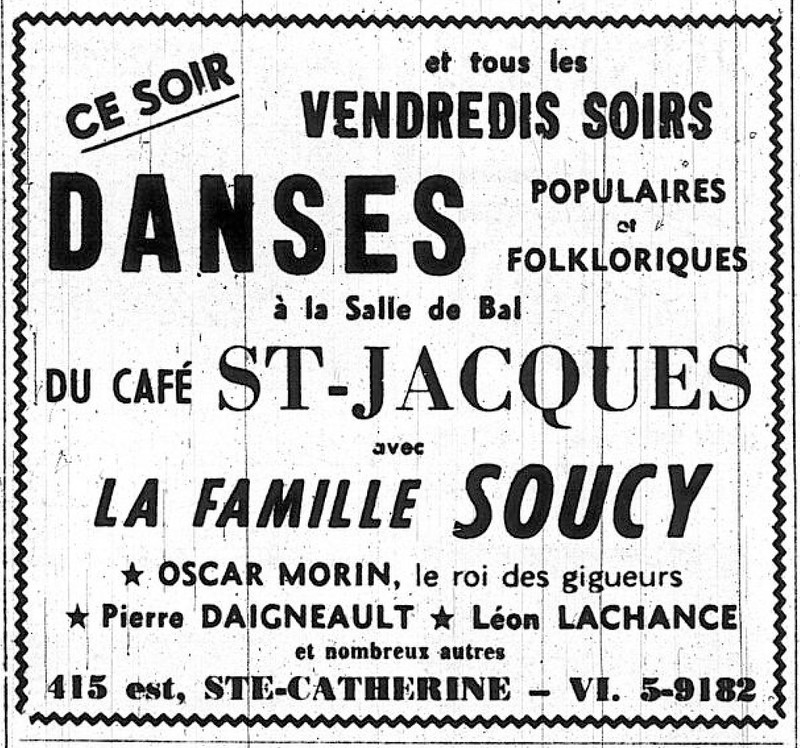
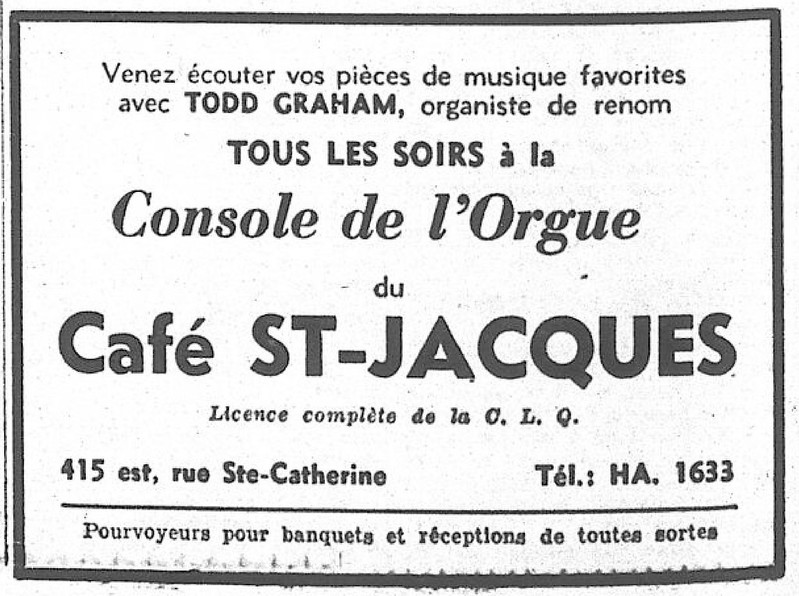
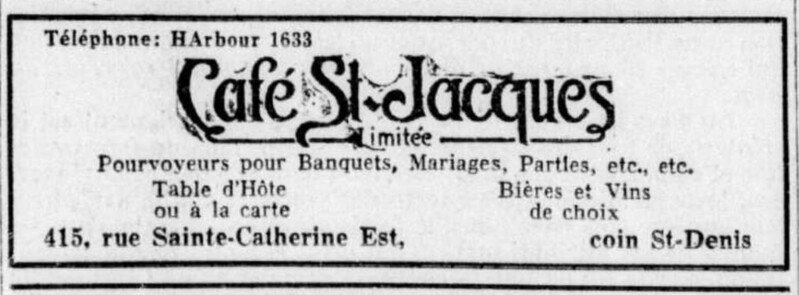
Café Saint-Jacques, an emblematic cabaret located at 415 Sainte-Catherine Street East in Montreal, at the corner of Saint-Denis Street, was in operation from 1924 [1] to 1974 [2].
1. A key venue for Québécois chanson
The venue played a key role in the emergence of Québécois chanson, becoming an essential platform for the first French-speaking singer-songwriters, before Place des Arts opened in 1963.
2. The 1929 expansion
In 1929, Eugène Dancoste, owner of Café Saint-Jacques, decided to expand his restaurant founded five years earlier. He chose the large rooms of the former Saint-Jacques school, an ideal site for his project. After renovation work, the former classrooms were quickly transformed into a room that could accommodate up to 400 guests. The décor, entrusted to a renowned artist, stood out for its originality and refinement. Dimmed lights illuminated 60 tables adorned with fresh flowers in silver vases. The third floor housed a sumptuous ballroom and concert hall, lit by 12 large windows, that could hold 600 people. A stage located to the north completed the space, reputed for its exceptional acoustics [3].
3. A popular gathering place
Café Saint-Jacques quickly became a very popular gathering place [3]. In 1943, François Pilon purchased the establishment [4]. “I started working there as a busboy in 1927, at the age of 14,” he recalled [5]. “When I acquired the place, it was still a restaurant—and a good one. But with the advent of cabarets at the end of the war, I turned it into a cabaret. It stayed that way for about 25 years, with several additions: a boîte à chansons, an upstairs room, and the Chez Francoy’s steak house in the basement” [6].
4. An unmatched range of entertainment
Café Saint-Jacques offered so many activities that one could enter at 5 p.m. and not leave until 2 a.m. without exhausting all the options [7].
For 20 years, CKVL based its operations there, drawing visitors with singers’ performances, amateur shows, and various contests [7]. In 1949, the “Lounge Marine” room was inaugurated, adding a new dimension to the establishment [13].
5. A “school of showbiz”
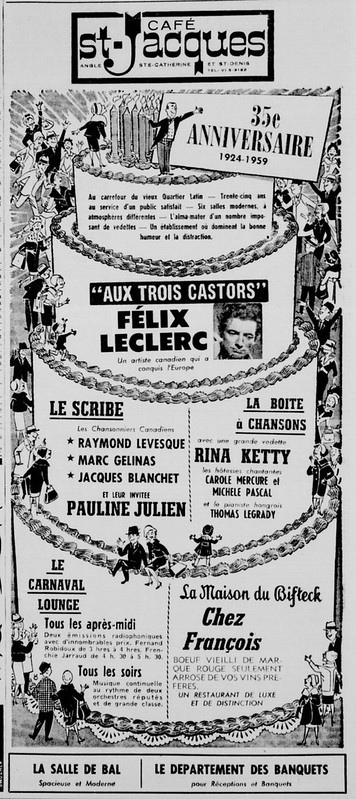
This cabaret, a true “school of showbiz,” hosted iconic figures such as Jacques Normand, Doris Lussier, André Ruffiange, Jean Morin, the Scribes, Roger Baulu, Muriel Millard, Claude Séguin, Frenchie Jarraud, Marcel Giguère, and Jean Rafa. Joël Denis made his debut there, while Gilles Pellerin immortalized classics like La mère à Roland and C’est comme une manière de… [7].
Félix Leclerc sang there, Monique Leyrac appeared as an actress, and European artists such as Les Quatre Barbus, Varel et Bailly, Marie Dubas with her famous Charlotte prie Notre-Dame, Francinet (Fernandel’s brother), and Line Renaud also took the stage. This Québécois cabaret—where bawdy humour, risqué jokes, and sometimes vulgar numbers were part of the show—was above all a place for entertainment and laughter [7].
6. The golden years under François Pilon
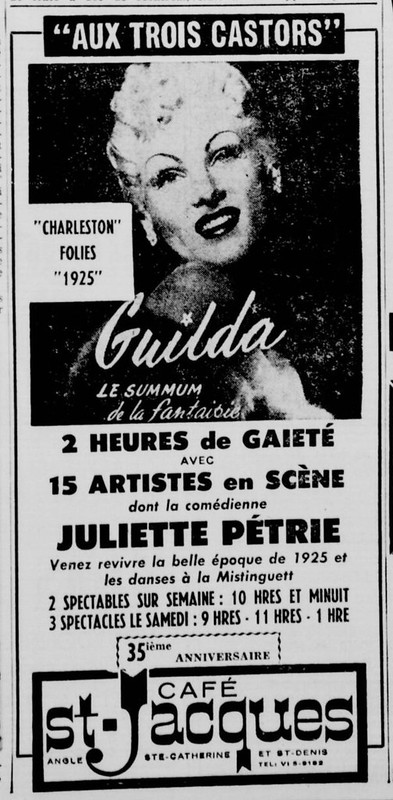
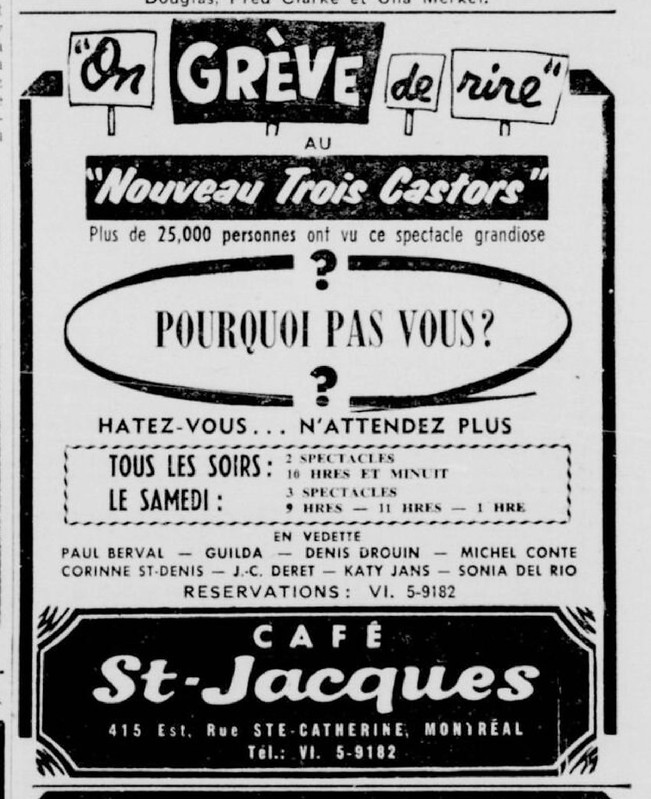
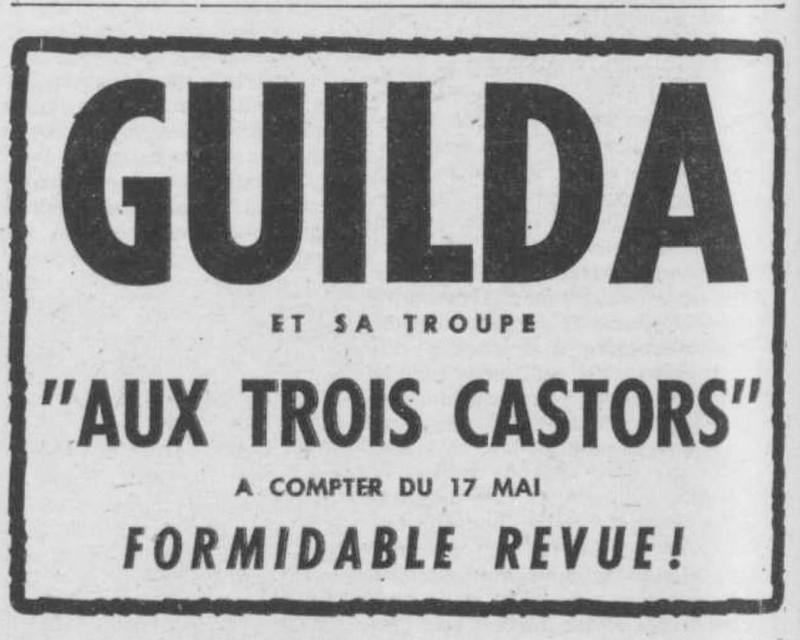
Certain shows, such as the major revues of Muriel Millard and Jacques Normand presented in the legendary Trois Castors room, were particularly expensive. Among Québécois performers, Père Gédéon held the record for longevity on stage. Café Saint-Jacques enjoyed its glory years starting in 1950, over two decades, under the direction of François Pilon, who helped launch nearly all of Montreal’s stars of the era. It was in this room that artists like Jacques Normand, Charles Aznavour, and Monique Aubé saw their careers take off [8].
Other notable figures—Willie Lamothe, Fernand Robidoux, Clairette Oddera, Tex Lecor, Claude Valade, Ginette Ravel, Léon Lachance, and André Roc—also energized the walls of Café Saint-Jacques [7].
7. Themed rooms and innovations
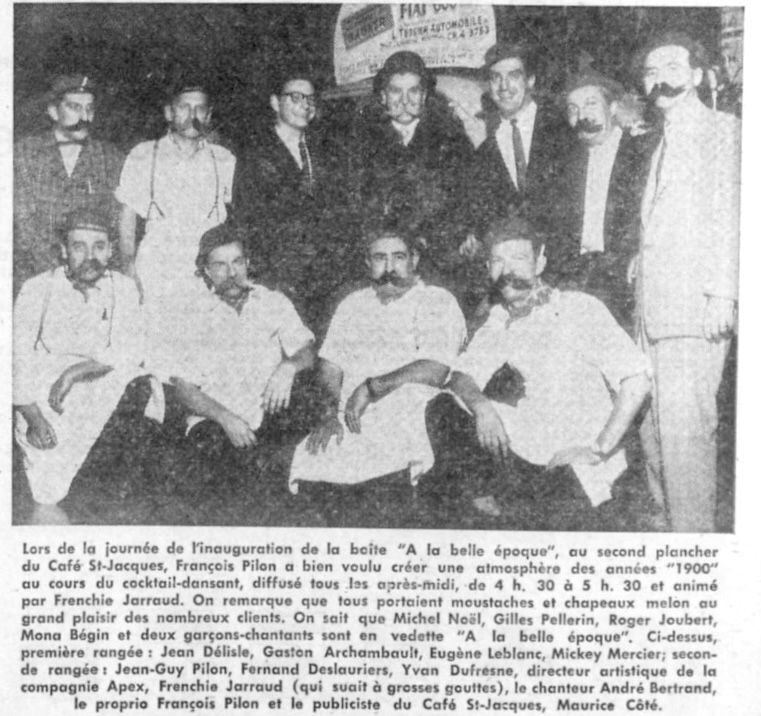
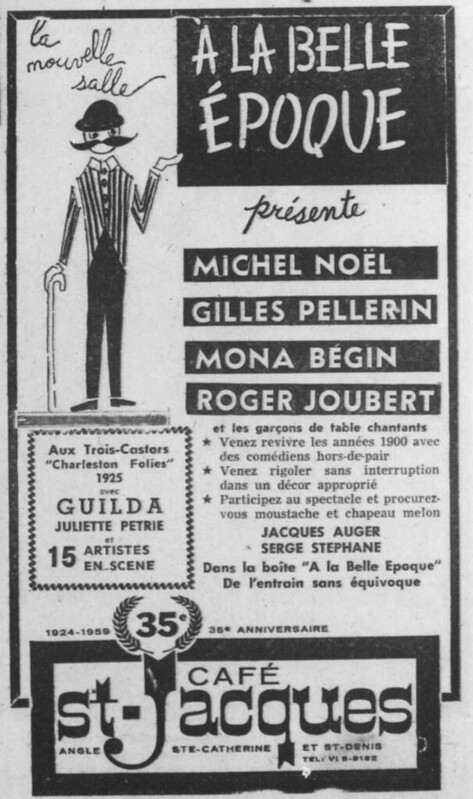
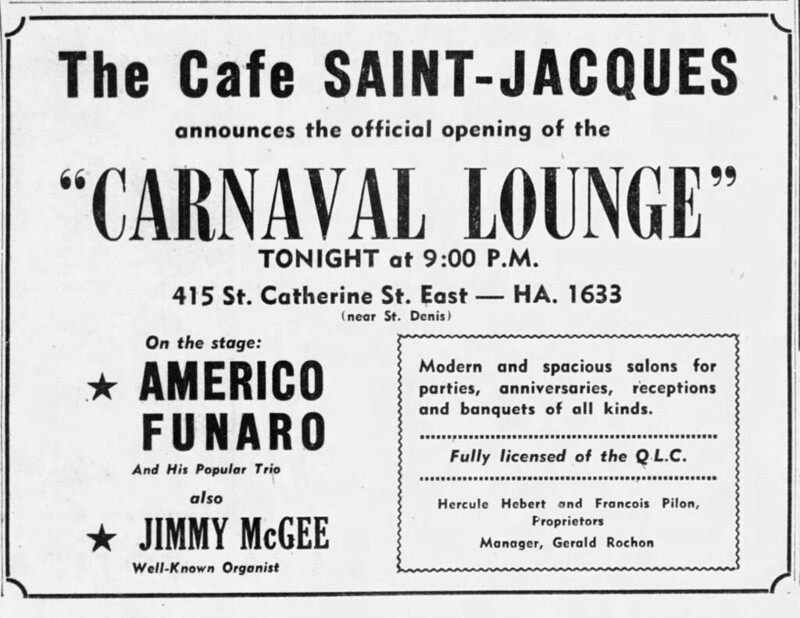
On the first floor, the dance room at Café Saint-Jacques had a unique feature: every table was equipped with a telephone, allowing patrons to invite each other to dance that way. This room, nicknamed “Princesse,” took its name from the telephones marketed at the time by the Bell company [7]. Over the years, Café Saint-Jacques also housed various themed rooms, such as the Carnaval Lounge, La Belle Époque, the Far-West Salon, the Scribe, the Kazoo Bar, and the Latin-ambience room El Bohio. François Pilon did not hesitate to innovate, exploring new ideas to draw crowds.
8. Decline and the 1974 fire
In 1974, shortly before closing, Café Saint-Jacques was no longer the thriving establishment it had once been. The rise of discotheques had reduced its popularity. François Pilon decided to sell the building and moved to Florida. Unfortunately, the building was devastated by a fire on December 9, 1974 [9] and demolished the following year to make way for UQAM’s Judith-Jasmin Pavilion.
9. François Pilon’s legacy
François Pilon, who owned Café Saint-Jacques for 40 years, died on December 15, 1988, at the age of 75 [10]. He left behind a legacy marked by his philanthropic commitment, notably as the founder of the François Pilon Chapter of the Fondation du Cœur du Québec, where he worked for 12 years. He is also remembered for his determined fight to create a French Quarter in Montreal’s East End, as founding president of the Association du Quartier Français de Montréal [11][12].
Notes & sources
- Le Café Saint-Jacques s’est agrandit, La Presse, 16 février 1929 p.69
- Former nightclub destroyed by fire, The Montreal Star, 9 décembre 1974
- Le Café Saint-Jacques s’est agrandit, La Presse, 16 février 1929 p.69
- Once bus boy now owner, The Gazette, 30 mars 1971
- Man with ideas, joie-de-vivre, Montreal Star, 12 octobre 1971
- Le vrai Café St-Jacques, c’était hier, La Presse, 17 décembre 1970
- Regard nostalgique sur le plus grand des cabarets montréalais, La Presse, 10 décembre 1974
- François Pilon, un pionnier toujours jeune, Le Petit Journal, 2 mars 1969
- Former nightclub destroyed by fire, The Montreal Star, 9 décembre 1974
- Obituary François Pilon, The Gazette, 17 décembre 1988
- François Pilon un pionnier toujours jeune, Le Petit Journal, 2 mars 1969
- Nouveau président du Quartier Français, Le Devoir, 28 juillet 1962
- Suivez la foule ce soir, Montréal-matin, 21 septembre 1949