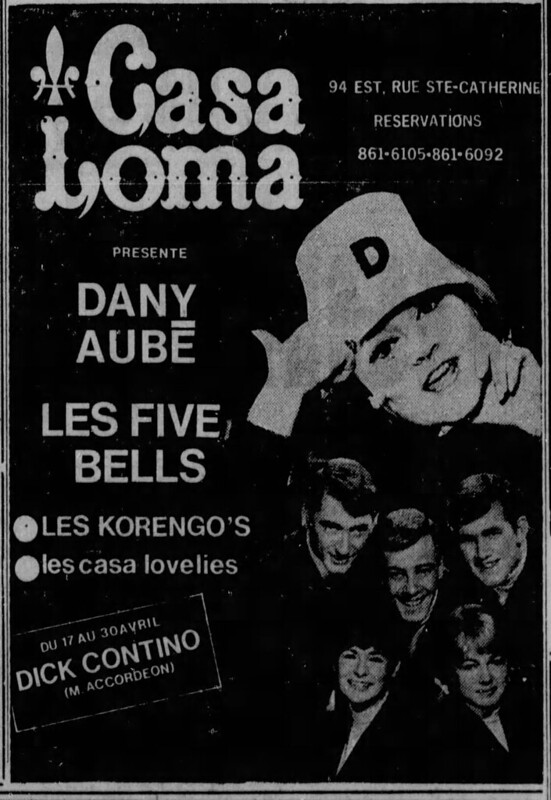
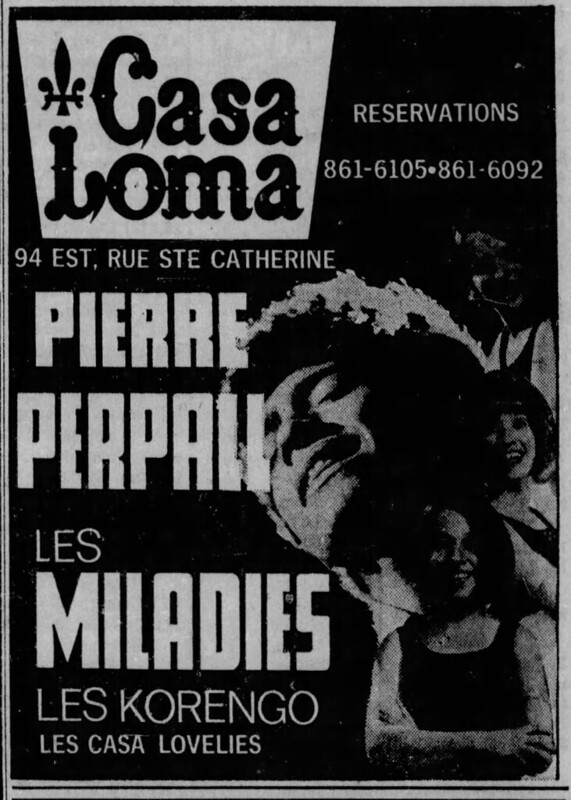
Opened in February 1951 at
94 Sainte-Catherine Street East, in the heart of
Montréal’s Red Light district,
Casa Loma became one of the important cabarets
of Montréal nightlife. For nearly two decades, the establishment
presented revues, singers, comedy and major Québec entertainers,
while also playing a remarkable role in the history of
jazz in Montréal. In the early 1960s, its upstairs
room welcomed such legendary musicians as Miles Davis,
John Coltrane, Dizzy Gillespie, Chet Baker and Duke Ellington,
making Casa Loma one of the city's notable jazz venues.
⏱ Reading time: 20 minutes
1. Overview
Opened on February 15, 1951 at 94 Sainte-Catherine Street East,
in the heart of Montreal’s Red Light district, the Casa Loma immediately
took its place within the grand tradition of the city’s cabarets, at a time when Montreal ranked among the
leading North American capitals of nightlife entertainment
[1][2].
In this district, densely filled with theatres, jazz clubs, restaurants, and variety venues,
its opening was not merely an addition to the existing landscape, but the assertion of an ambitious project
aimed at rivaling the great stages of downtown.
An advertisement published in Le Canada on February 14, 1951 announces the opening of the Casa Loma Cafe at 94 Sainte-Catherine Street East the following day, thereby confirming the establishment’s inauguration date in mid-February 1951 as well as its initial positioning as a café-show venue[1].
Founded by Harry Holmok — already at the head of the
Bellevue Casino — and by his associate
Thomas Steppan, operator of the upstairs
Café Trinidad[1][3],
the Casa Loma was part of the continuity of a site already
firmly rooted in Montreal’s entertainment landscape.
Since the beginning of the 20th century, this space — linked to the activities of the
Beauvais family — had gone through several phases of operation,
from the Café Regal of the 1910s, marked by sustained police surveillance,
to the Club Palais in the early 1920s, then the
Club Hollywood in the early 1930s, before becoming the American Grill,
an active and well-frequented establishment into the 1940s. The arrival of the
Trinidad upstairs in the postwar period extended this festive vocation
and directly prepared the ground for the arrival of the Casa Loma.
In this context, Casa Loma did not represent a rupture, but rather
the culmination of the site’s gradual evolution. It adopted and adapted
a proven formula inspired by major international cabarets:
dinner-and-show, continuous programming, an alternation of
variety acts, headline performers, and a house orchestra.
This organization made it possible to attract a diverse clientele — tourists,
businessmen, nightlife regulars — while ensuring a constant renewal
of artistic offerings, thereby consolidating the site as a major hub
of Montreal’s Red Light district.
Photo : Yvon Bellemare et Marcel Houle, 1964, Archives de la Ville de Montréal, VM94,SY,SS1,SSS13,S1-063
From the outset, Casa Loma also stood out for its design as a
multi-level entertainment complex.
The ground floor housed a lounge serving as a
reception and transition area, while the main room, located in the
basement, presented the major revues and shows.
On the upper floor, successively arranged as a dance hall, a folk cabaret,
and then a jazz club, the programming adapted to new musical trends
and changes in audience tastes
[94].
This vertical organization, still relatively rare in Montreal in the early 1950s,
gave the establishment an operational flexibility that contributed directly to its longevity.
Black-and-white architectural reproduction of the front façade of the Casa Loma building, illustrating in simplified form its commercial elevation, its regular openings, and its recessed central entrance.
The venue’s artistic ambition was evident from its very first weeks of operation.
The décor designed by Jean Hébert, inspired by a South American aesthetic,
the ballets directed by Mrs. Kamarova, and the arrangements by
George Komaroff reflect an explicit desire to place the cabaret
within an international entertainment circuit, capable of hosting
both local stars and foreign performers
[1][3].
This ambition was quickly accompanied by a phase of experimentation in the organization of spaces and performance formats.
As early as June 1951, the Trinidad room, located above the
Café Casa Loma, was used to present
cabaret-theatre style productions, as evidenced by an advertisement announcing the play
Le Baiser dans la nuit[156].
A few days later, an article in La Patrie officially confirmed the transformation of the venue into a
French cabaret-theatre, illustrating the first attempts to adapt this format in Montreal
[155].
An advertisement published in Le Petit Journal on June 17, 1951 announces the presentation of the show Le Baiser dans la nuit at the Trinidad, above the Café Casa Loma, confirming the presence of a francophone cabaret-theatre format in the area as early as 1951 [156].
Over the course of the 1950s and 1960s, Casa Loma thus became a central venue in Montreal’s cultural life,
assuming a dual role:
a platform for French-Canadian stars
and a stopping point for international tours, particularly in the field of jazz.
This duality — between local roots and international openness — constitutes one of the venue’s
distinctive features and explains much of its success.
But this success unfolded in a more complex environment.
Located in the heart of the Red Light district, Casa Loma evolved in a milieu shaped by issues of
public morality, networks of influence, and the presence of organized crime.
Like many establishments of its time, it was part of an ecosystem in which
artists, impresarios, investors, and more shadowy figures intersected, revealing the tensions inherent
in the golden age of Montreal cabarets.
From its spectacular opening in 1951 to its closure in 1971,
Casa Loma accompanied the major transformations of Montreal nightlife:
the rise of cabaret culture, the emergence of Quebec stars, the arrival of modern jazz, competition from television,
changing public tastes, and the gradual decline of the Red Light district.
Its history thus goes beyond that of a single establishment, reflecting the evolution of a broader cultural
and economic system — that of urban entertainment in the mid-20th century.
Photographic report by Yves Beauchamp devoted to the Casa Loma, a nightclub on Sainte-Catherine Street, produced on April 19, 1966 and preserved in the Fonds La Presse at the Archives nationales in Montreal[29].
2. Site History and Management
Evolution of entertainment venues at 92–94 Sainte-Catherine Street East, Montreal
1913–1915
Café Regal
1917–1920
Dance Hall
1920
Oriental Garden
1920–1921
Parisian Garden
1921–1924
Club Palais
1931–1935
Club Hollywood
1936–1939
American Grill
1941–1945
Café Américain
1947–1952
Café Trinidad
1952–1971
Casa Loma
1973–2003
Salle Ozanam
2004–2020
Club 281
While the major revues of the Casa Loma unfolded primarily in the basement, located at 94 Sainte-Catherine Street East, another story — older and more continuous — played out upstairs. The second floor of the complex, corresponding first to 62 and later to 92 Sainte-Catherine Street East following a municipal renumbering intended to standardize downtown addresses at the turn of the 20th century, forms the true thread of entertainment on this site. Long before the arrival of the Café Trinidad in 1947, this space had already welcomed, beginning in the 1910s, a succession of establishments combining dining, music, and dance, initiating a festive vocation that would develop over the decades.
The Café Regal, active in the early 1910s at 62 Sainte-Catherine Street East, was presented as a modern establishment combining dining, refined service, and musical entertainment, reflecting the earliest forms of nightlife sociability on the site [227].
The earliest traces go back to the Café Regal in 1913, founded by Jos Gravel, former owner of the Grand Café Parisien at the corner of Saint-Dominique and Sainte-Catherine streets, an establishment that columnist Al Palmer considered the first true nightclub in Montreal [227]. Presented as a modern venue combining dining, refined service, and musical entertainment, the Regal quickly came up against regulatory constraints and temperance campaigns: its licence was refused and then revoked, before an attempt was made to reopen under new management [228]. This instability culminated in 1918, when the establishment, by then transformed into the Dance Hall, was the subject of a police raid that interrupted music and dancing in front of several hundred people, confirming both the popularity of the venue and the close surveillance exercised by the authorities [229].
This transition from restaurant to dance hall marked a turning point: the second floor gradually established itself as a space devoted to entertainment, despite a context of strict regulation. At the turn of the 1920s, this vocation continued with the Oriental Garden, the Parisian Garden, and then the Club Palais, whose activity is confirmed by directories and the press, in an environment marked by fires, legal disputes, and police interventions [190][192][186]. This phase reflects an operation that was still fragile, yet already firmly rooted in Montreal nightlife.
An advertisement announces the reopening of Club Palais Inc. at 62 Sainte-Catherine Street East, confirming the operation of the venue in the early 1920s[225].
The site then entered a new phase with the Club Hollywood, inaugurated in 1931 at 92 Sainte-Catherine Street East. Presented as a modern cabaret inspired by the major North American centres, it combined orchestra, live entertainment, and stage attractions, and was part of the musical circuits of the period, notably with the presence of the Canadian Ambassadors[195]. This period was nevertheless marked by legal conflicts and a major fire in 1932, which also affected the ground-floor businesses, including the Beauvais Hardware Company, illustrating the coexistence of commercial and nightlife activity within the building [196].
An advertisement presents the Club Hollywood as a dinner-dance venue with live entertainment [213].
In the mid-1930s, the establishment was taken over under the identity of the American Grill, confirming the continuity of the venue’s operation within Montreal’s nightlife landscape [208]. This phase continued into the early 1940s with the Café Américain, before the arrival of the Café Trinidad in 1947, which restored to the site a structured cabaret-theatre vocation.
At the same time, the ground floor long remained anchored in a separate commercial function. Alongside the Beauvais and later Martin hardware stores, specialized businesses such as the shop of milliner Albert Wexler, located at 66 Sainte-Catherine Street East, testify to the vitality of retail trade in this sector in the early 1920s[230]. This coexistence between commercial activity and entertainment venues helped define the site’s mixed identity.
A 1939 fire insurance plan locates the American Grill at the corner of
Sainte-Catherine Street, between Du Berger and De Bullion Streets, confirming the site’s occupation
prior to its transformation during the 1950s [235].
Cadieux Street (later renamed De Bullion Street) had a reputation that was,
to say the least, distinctive. When American actress Mae West began writing, in
1926, a play centered on the world of prostitution, she chose to set its action in
Montreal — more precisely on “Caidoux” Street. This choice was far from incidental.
“Caidoux” in fact referred to Cadieux Street, the former name of what is now
De Bullion Street, at the heart of Montreal’s Red Light district.
The people who lived there, as well as those who frequented it, gave the street a particularly
distinctive character. After Mae West was arrested on Broadway due to the
allegedly obscene content of her play Sex, the City of Montreal decided to rename
the street “De Bullion” in 1927. In the early 20th century, nearly every doorway
along De Bullion Street housed a brothel: at least 26 south of Sainte-Catherine Street,
and at least as many — if not more — to the north
[236].
This long continuity was profoundly transformed in the early 1950s. Founded in 1951 by Harry Holmok, the Casa Loma initially occupied the ground floor and basement of 94 Sainte-Catherine Street East, in a space that had until then been occupied by commercial businesses. The following year, after the takeover of the establishment by Andy Cobetto, a decisive step was taken with the integration of the second floor — then occupied by the Café Trinidad — into the rest of the complex. This merging of levels marked the first true unification of the site into a coherent entertainment complex, now linking spaces for performances, dancing, and dining. Already shaped by several decades of festive activity, the second floor remained at the heart of this new organization, extending a well-established tradition of nightlife sociability in downtown Montreal.
3. The beginning of the golden age
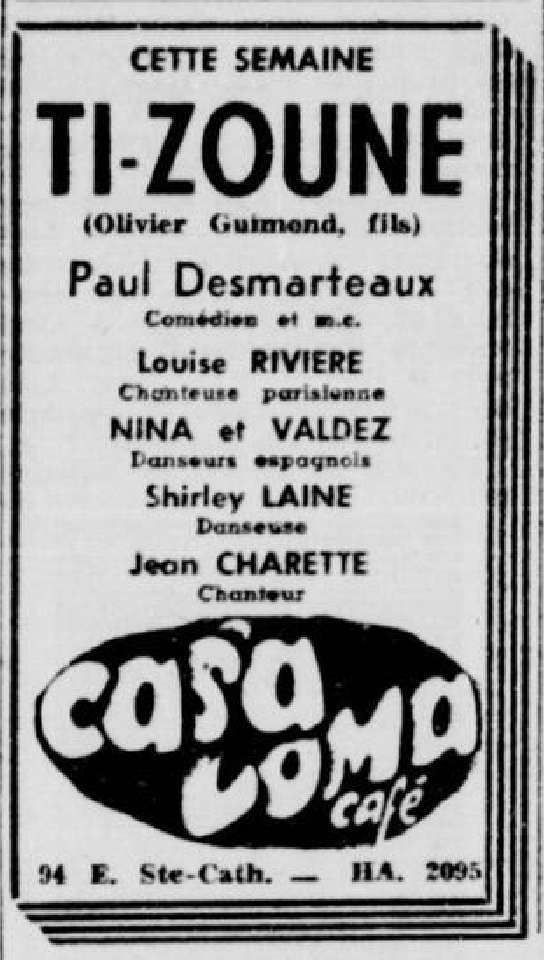
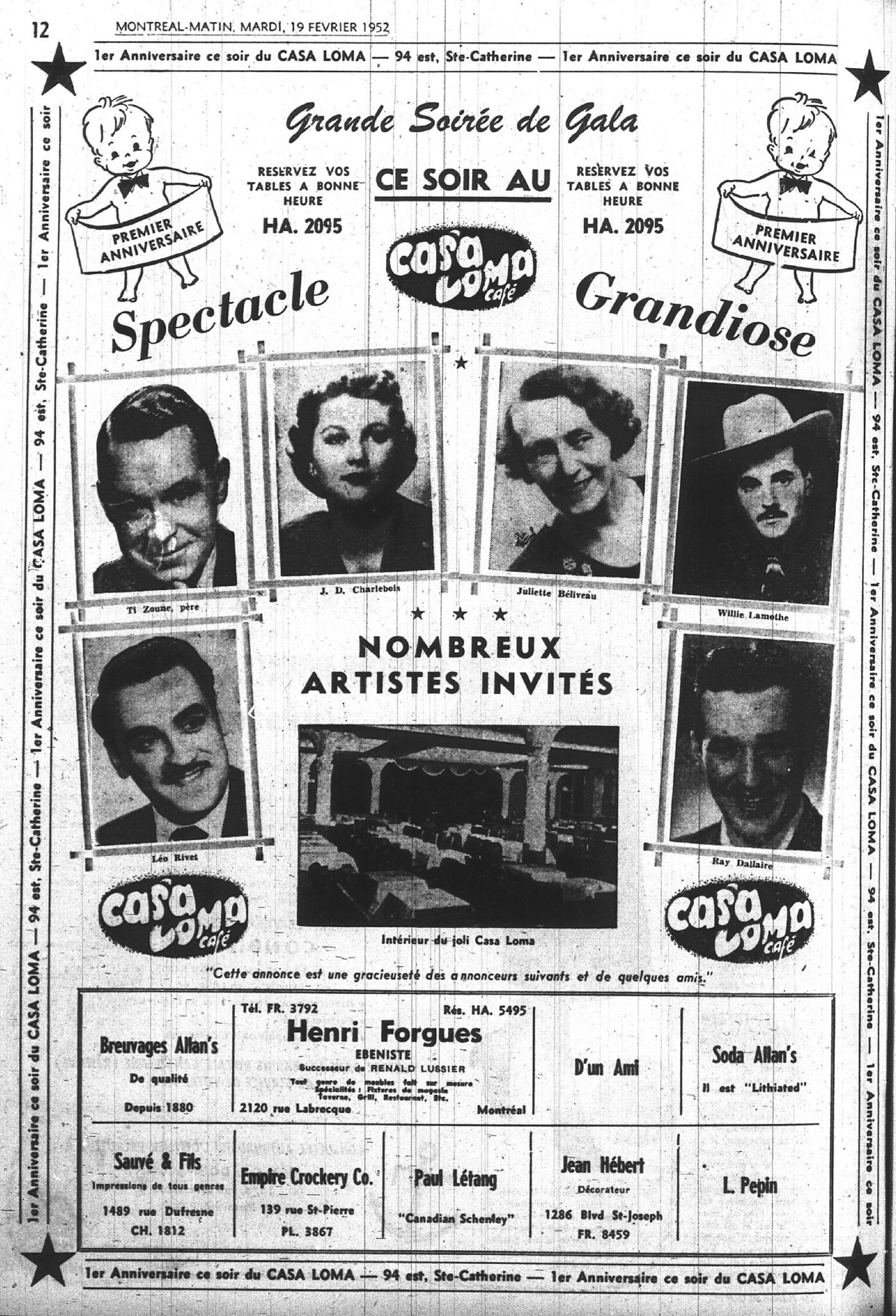
The celebration of the Café Casa Loma’s first anniversary, in February 1952, testifies to the establishment’s rapid success and its positioning as a leading cabaret in the heart of Montreal’s Red Light district. An article in Montréal-Matin highlights the quality of the shows, the richness of the décor, and the cordial atmosphere that prevailed there, while also emphasizing the role of maître d’hôtel Roland Lachance and manager Ralph Cobetto in this success [182]. On the same day, an advertisement published in La Patrie announces a grand gala evening bringing together several major figures of the Quebec stage, including Ti-Zoune, Juliette Béliveau, and Willie Lamothe[91]. Together, these sources illustrate the Casa Loma’s ambition, from its earliest years, to combine prestige, artistic diversity, and popular appeal.
The celebration of the Café Casa Loma’s first anniversary in February 1952, marked by a grand gala evening featuring popular performers, confirms its rapid success and its status as a leading cabaret [182][91].
Behind the opening of the Casa Loma there was initially a discreet legal structure. A notice published in the Gazette officielle du Québec confirms the incorporation of Casa Loma Café Inc. on November 28, 1951, authorizing the operation of an establishment of the café, restaurant, or cabaret type in Montreal [185]. Yet neither Harry Holmok — the dominant figure behind the Casino Bellevue — nor Andy Cobetto, the venue’s future driving force, appear in the act of incorporation. As was often the case in Montreal nightlife at the time, the legal front rested on lawyers and straw men, leaving the project’s real operators in the shadows.
In May 1952, the Casa Loma officially passed into the hands of a clearly identified group of operators:
Andy Cobetto, Henri Forgues, and
Angelo Bisante, the latter already active in the milieu,
notably as former owner of the Casino de Parée and the
American Spaghetti House[6][51].
On May 18, 1952, La Patrie confirmed the transaction,
formalizing the Casa Loma’s passage from a relatively opaque corporate structure
to an operation openly assumed by key figures in Montreal’s cabaret network
[104].
At the same time, Thomas Steppan withdrew from the Trinidad, the upstairs room, revealing a complete reconfiguration of the complex. This moment marked a real turning point: the Casa Loma ceased to be a simple corporate project and became an integrated instrument of Montreal nightlife, at the intersection of commercial interests, artistic circuits, and the networks of operation that then structured the major clubs on Sainte-Catherine Street.
On March 20, 1953, The Montreal Star reported the death of Thomas Steppan, aged 57. According to the article, Steppan collapsed shortly before 2 a.m. while witnessing a violent altercation involving several men and his own son. An autopsy concluded that he had died of natural causes, caused by a heart attack [93].
4. From Corporate Façade to Nightlife Machine (1951–1953)
In the early 1950s, under the direction of Andy Cobetto
and Henri Forgues, the Casa Loma adopted
a structured artistic formula that would ensure its longevity for two decades.
As early as 1952, the establishment relied on a stable model combining
four acts per program — typically three variety acts
(often American) and one headliner, always French-Canadian.
With its 560 seats, the venue represented a significant challenge to fill,
especially at a time when Quebec artists were relatively unknown
and rarely featured as headliners.
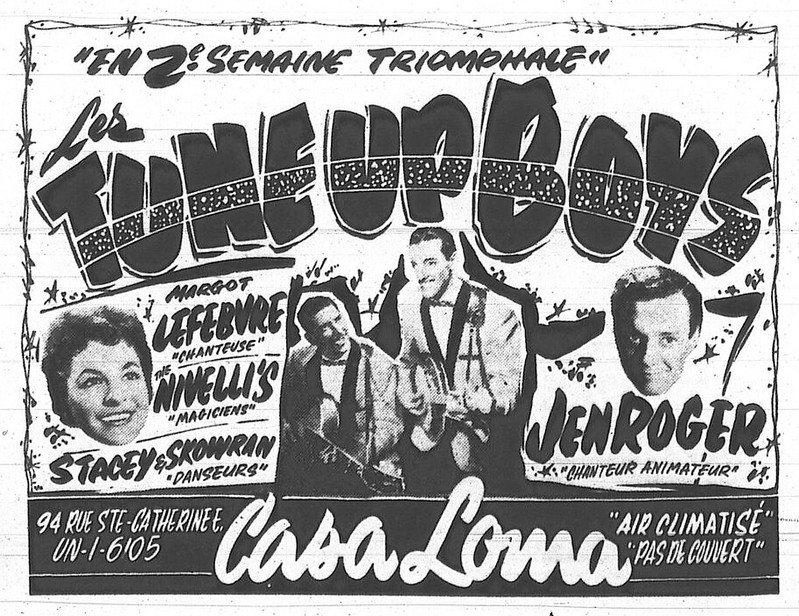
An advertisement announcing the “farewell performances” of the Tune-Up Boys at the Casa Loma Cafe, 94 Sainte-Catherine Street East, features Jimmy Kirby, Roland Legault, Marianne and Carlos Miranda, as well as Marcel Doré and Tony Romandini, illustrating the cabaret’s variety programming in the early 1950s [154].
The Tune-Up Boys, who inaugurated this new policy of
Canadian headliners, enjoyed considerable success, remaining on the bill
for 28 consecutive weeks
[6].
This formula — four acts structured around a national star —
became the cabaret’s signature.
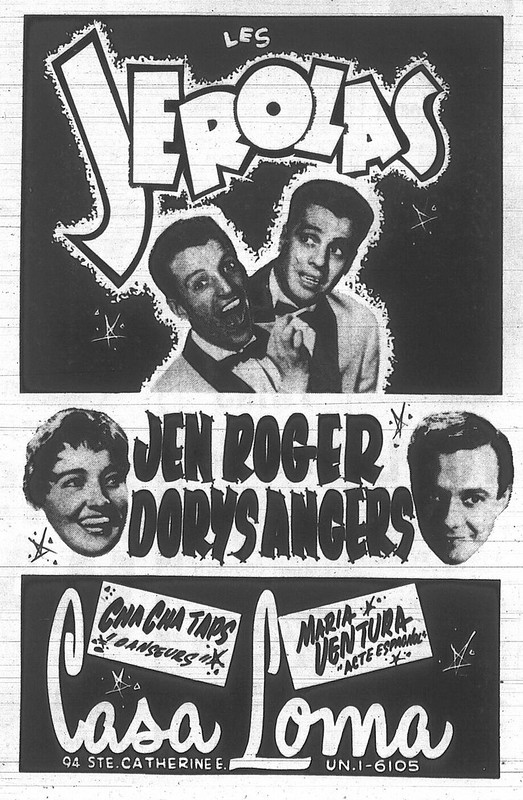
In 1954, Jen Roger became the official master of ceremonies
at Casa Loma and actively contributed to showcasing local talent.
“I brought all the great Quebec stars onto the stage. At the time, Casa Loma was seen as the equivalent of Place des Arts.”
[7][48][55].
Also in 1954, Jean Simon presented his contests
“Jean Simon’s Discoveries” and
“Stars of Tomorrow” for several years,
notably launching the careers of
Jean Lapointe,
Michel Louvain,
Ginette Reno,
Mona Bégin,
Lauréanne Lemay,
Pierre Sénécal, and
Claude Vincent[6][123].
On June 10, 1956, Le Petit Journal published a major
advertisement announcing “The most dazzling revue by Guilda”
at the Casa Loma, 94 Sainte-Catherine Street East.
The ad featured Guilda and her troupe in a revue program
described as “the height of fantasy.”
An advertisement published in Le Petit Journal on June 3, 1956 announces Guilda’s revue at the Casa Loma, illustrating the importance of variety shows in the cabaret’s programming in the mid-1950s [164].
This publication confirms not only the importance of variety shows in the cabaret’s programming in the mid-1950s,
but also highlights the public visibility granted to gender performance on the major stages of Montreal’s Red Light district.
In the social context of the time, when trans identities and non-conforming gender expressions remained marginalized,
the presence of an artist such as Guilda in an established downtown venue illustrates the existence of cultural spaces
allowing a form of representation — even if framed — of gender diversity in Montreal nightlife
[114].
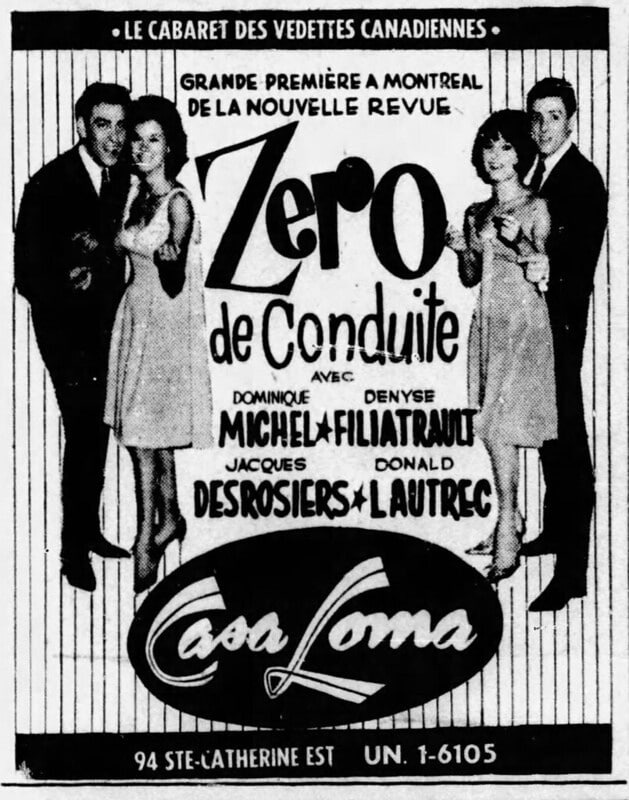
The policy of promoting Canadian stars remained in place for nearly a decade. Among the most popular performers
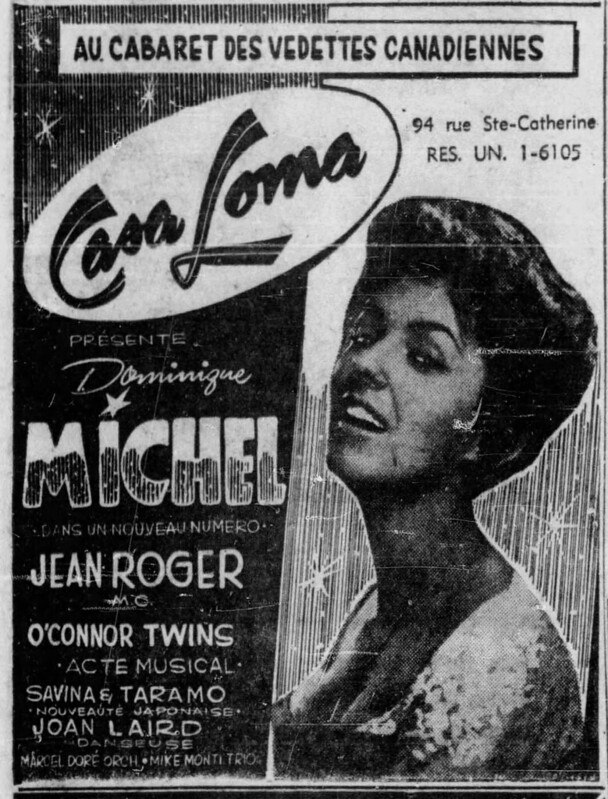
were Dominique Michel and
Denise Filiatrault (attendance records),
Monique Cadieux,
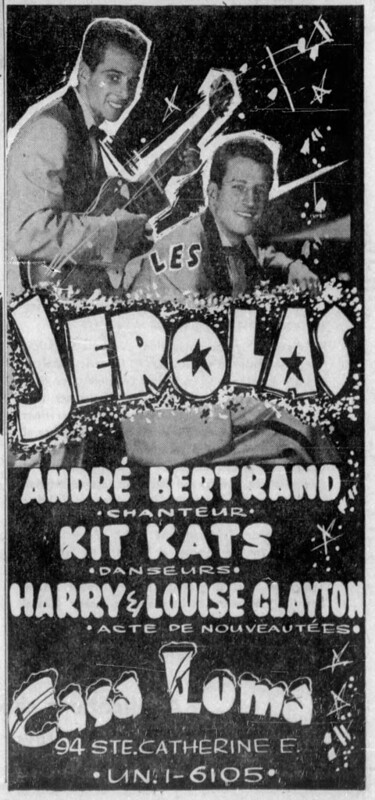
Les Jérolas,
Ti-Gus and Ti-Mousse,
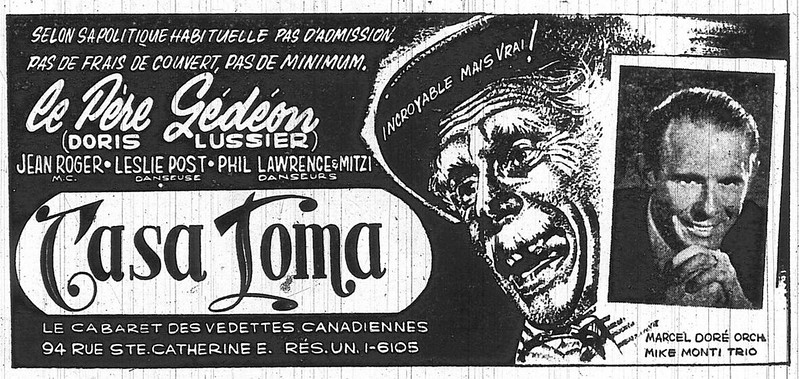
Le Père Gédéon,
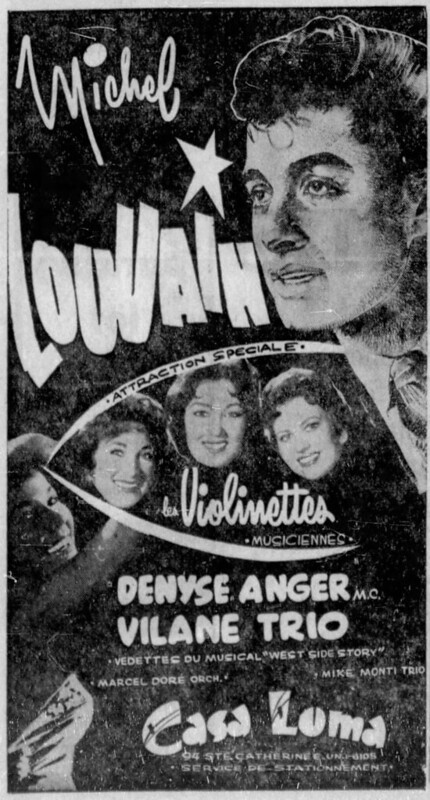
Michel Louvain,
and the team of Pique-Atout[6].
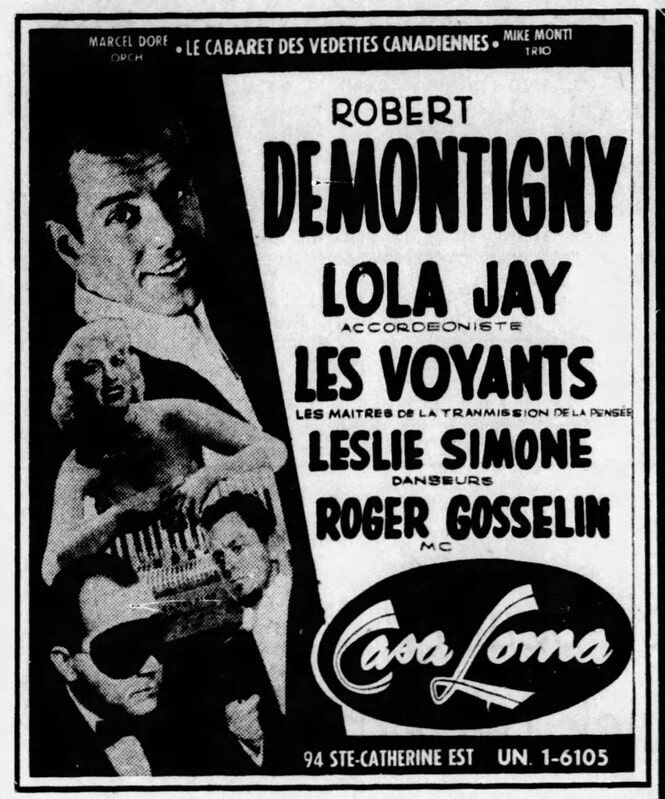
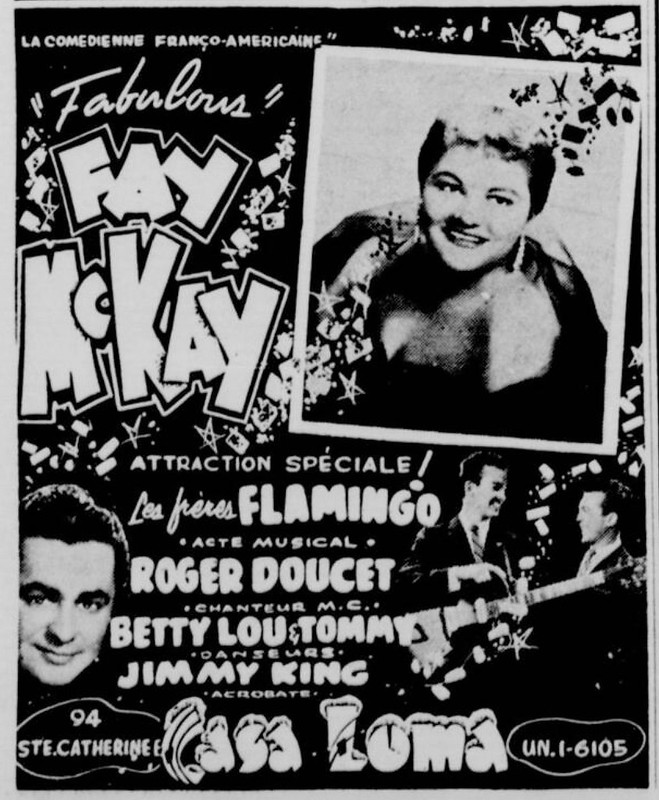
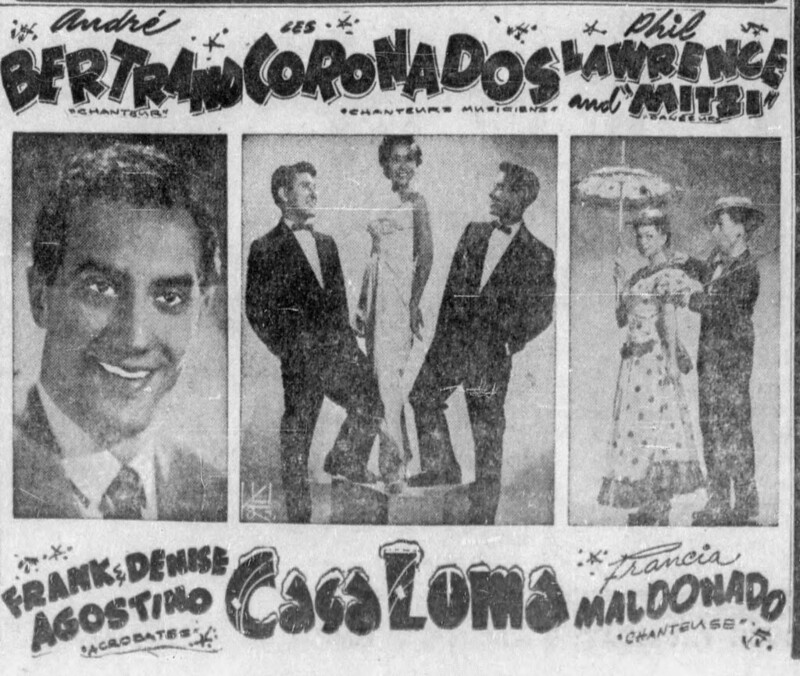
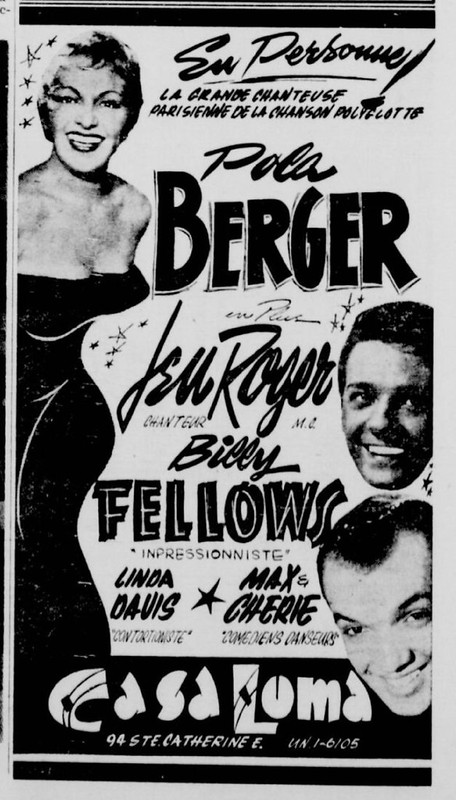
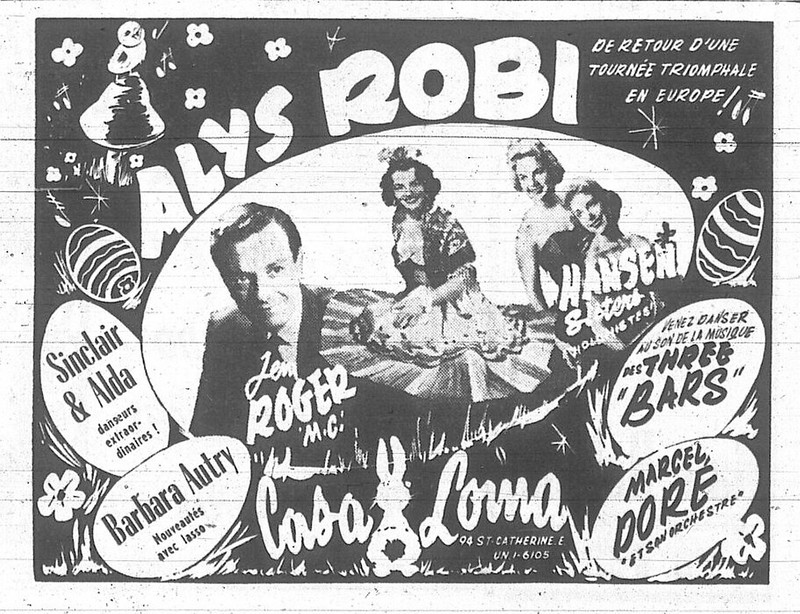
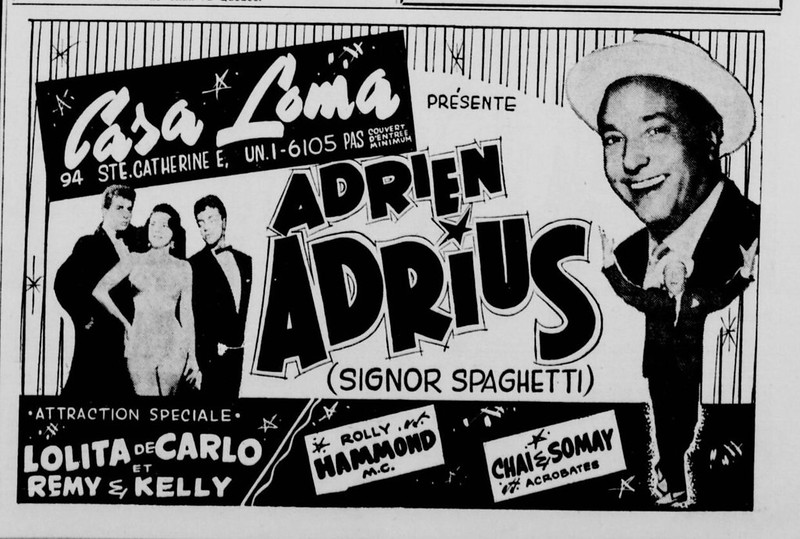
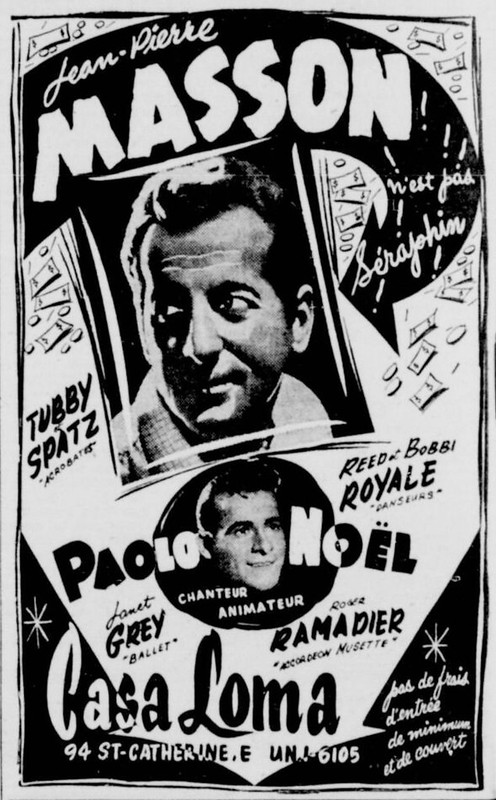
Montage of Casa Loma advertisements from the 1950s–1960s featuring Canadian stars, MCs, dancers, and orchestras in a cabaret-show format.
On September 13, 1959, Le Petit Journal published an article on
Jean Simon titled
“He made more than 12,000 people sing!”.
The report highlights his key role as host, master of ceremonies, and talent scout at the
Casa Loma. It reveals that he organized contests
and mentored thousands of amateurs, helping bring more than 12,000 people onto the stage over the years.
The article emphasizes his rigorous methods, organizational skills, and commitment
to offering a real platform to young Quebec artists, confirming Casa Loma’s role
as a talent incubator at the end of the 1950s
[108].
Jean Simon, Dimanche-Matin, September 18, 1960.
“My greatest pleasure is seeing a young person step onto the stage for the first time and feeling that they have something. When the audience reacts, you know you’ve discovered a talent.”
An article published in La Patrie du dimanche on March 12, 1961,
highlights the success of the show presented at the Café Casa Loma,
then headlined by the comedy duo Ti-Gus et Ti-Mousse, whose
popularity stemmed in part from their ability to entertain both French- and
English-speaking audiences [178]. Formed in the
early 1950s by Réal Béland (Ti-Gus) and
Denise Émond (Ti-Mousse), the pair quickly established
themselves as one of Quebec's most popular comedy acts, performing extensively
in cabarets before achieving widespread success on television. Their position
as the featured attraction at the Casa Loma reflects the reputation they had
already earned by the early 1960s and their significant role in the
development of Montreal's cabaret entertainment scene
[237]. The article also emphasizes the variety
of the program, combining comedy, dance, and music, with performances by the
Becker Bros., singer Ginette Ravel, and the
orchestras led by Marcel Doré and
Mike Monti, offering audiences a well-rounded and accessible
entertainment experience.
The album An Evening at Casa Loma with Ti-Gus and Ti-Mousse, released by Columbia in the early 1960s, reflects the direct connection between the cabaret and record production [234].
This formula, typical of the “cabaret of Canadian stars,” illustrates Casa Loma’s positioning in the early 1960s
as a popular entertainment venue capable of attracting a diverse clientele within the context of Montreal’s Red Light district.
In the early 1960s, the Café Casa Loma also established itself
as a key venue for performers emerging from mass media, particularly Quebec television.
The character of Père Gédéon, portrayed by Doris Lussier,
achieved notable success there, as confirmed by several contemporary sources.
An article published in Le Devoir highlights his transition from the small screen to the cabaret stage,
where he performed regularly before live audiences [181],
while another, published in Radiomonde, emphasizes the extent of his popularity,
mentioning evenings requiring up to four performances to meet demand
[180]. These accounts illustrate Casa Loma’s role
as a bridge between emerging cultural industries and the nightlife stage.
Recording of Jacques Desrosiers captured at the Casa Loma in 1960, illustrating the practice of live recording in Montreal cabarets and the release of these performances on record [234].
An interview published in Télé-Radiomonde on September 29, 1962
describes the Casa Loma as “a nightclub packed every night.”
Andy Cobetto and Henri Forgues outline their philosophy:
constant presence among customers, structured programming built around variety
(dance, song, comedy), and a priority given to Canadian artists,
considered closer to the audience. This stability, combined with substantial fees —
over one million dollars paid since opening according to La Presse —
explains the loyalty of a large audience in the early 1960s
[54][6].
“Mr. Cobetto, the owner, was a charming man who truly liked artists, and his wife Andrée Cobetto was a client at my mother’s hair salon. We had distinguished visitors at Casa Loma. I found a photo of Charles Trenet holding me in his arms. If I hadn’t seen the photo, I would have forgotten his visit.”
5. Second-Floor Spaces: Roseland → Chez Isidore → Upstairs at Casa Loma
On December 15, 1961, The Montreal Star announced the opening
of the Roseland Ball Room, located at 92 St. Catherine Street East,
on the upper floor of the same building as the Casa Loma.
The advertisement featured the “dancing stars” of the film
Hey, Let’s Twist! as well as the Peppermint Twisters,
illustrating the rise of twist culture and dance halls
aimed at a younger audience in the early 1960s.
This occupancy confirms the functional stratification
of the complex: while Casa Loma continued its tradition
of cabaret and stage entertainment, the upper floor hosted
programming oriented toward popular dancing
and new musical trends
[92][9][50].
An advertisement published in The Montreal Star on December 16, 1961 announces the opening of the Roseland Ball Room, 92 Sainte-Catherine Street East, with stars from the film Hey, Let’s Twist!, including The Peppermint Twisters and Al Nichols and his band, testifying to the arrival of the twist phenomenon in Montreal in the early 1960s [50].
One night in 1962, Jean Simon encouraged a young singer named Serge Laprade to take part in his amateur contest at the Casa Loma. “That year,”
Serge recalled, “I was starting out alongside Ginette Reno. We both took part in the same amateur contest at Casa Loma, and I won the
competition. Today, when Ginette remembers that episode, she says to me: ‘Do you remember, Serge…? And to think that you were the one who won.’
We laugh about it a lot together, especially when thinking about which of us has the bigger voice!” Ginette Reno had taken first place in
Jean Simon’s contest two years earlier, at the Café de l’Est[52].
An advertisement published in the Montreal press announces the second-floor venue under the name “La boîte chez Isidore”, confirming its separate operation in the early 1960s [16].
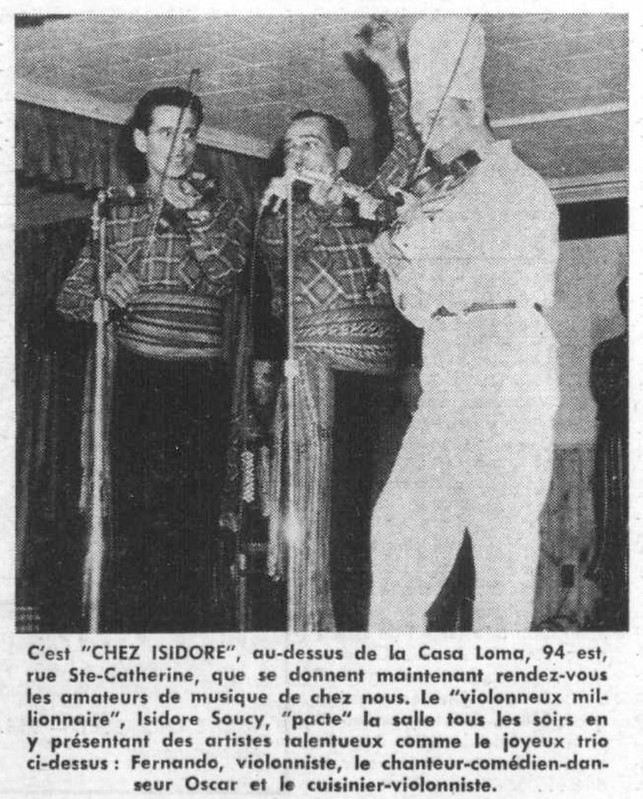
In 1962, Andy Cobetto transformed the second-floor room to present the performances of the Soucy family, a Quebec musical group made up of a single family working in the traditional repertoire. The father, Isidore Soucy, already well known, was its central figure. The room was named: “Chez Isidore.” The cabaret was in a typically Canadian style. The décor was simple: a great deal of carved wood, natural birch, and greenery
[11][12].
In addition to dancing and singing with the Soucy family, patrons could enjoy typically Canadian dishes: cretons, head cheese, foie gras pâté, pig’s feet stew, and farlouche pies
[13].
The Soucy family filled the room every night by inviting talented guest artists
[14].
Six weeks later, Isidore Soucy died at the age of 63
[15].
The upstairs room was advertised in newspapers under the name “Upstairs at Casa Loma”
[16][63].
On January 12, 1963, Télé-radiomonde announced
the return of Jacques Normand to the
Casa Loma, confirming the continuity
of the model of major comic headliners and popular revue
in the early 1960s. The article notes
that Normand succeeded Guilda, illustrating
the strategic alternation between variety shows,
flamboyant figures, and established artists in order to maintain
the cabaret’s commercial appeal
[144].
Photograph showing Alys Robi celebrating her 25-year career at Casa Loma, surrounded by figures from the milieu including Andy Cobetto, Henri Forgues, and collaborators.
On April 13, 1963, Télé-Radiomonde reported that a collective tribute was paid to
Alys Robi at the Casa Loma, where more than a thousand admirers —
including many artists — gathered to salute the singer’s career
[105].
This event took place in the context of her gradual return to the public stage
after several years of eclipse following her institutionalization at the end of the 1940s.
A pioneering figure in Quebec song with international reach, Robi had left a strong mark
on the collective imagination before her career was abruptly interrupted.
The event thus appears as a gesture of artistic and symbolic rehabilitation.
By hosting such a gathering, the Casa Loma confirmed its status
as a place of social consecration in the early 1960s, capable of bringing together
Montreal’s artistic elite around a major figure in Quebec’s cultural memory.
On May 4, 1963, Télé-radiomonde reported the difficult debut
of Pauline Julien at the Casa Loma, describing a
resounding flop during her first performances. The column insists
on the mismatch between the singer’s repertoire and the audience’s expectations,
reminding readers that Casa Loma “is not a boîte à chansons.”
This remark highlights the cabaret’s vocation: a venue for large-scale performance and
popular entertainment, oriented more toward revue, variety, and
stage performance than toward intimate or politically engaged song.
The episode thus illustrates the tension, in the early 1960s, between the
rise of Quebec singer-songwriters and the commercial model of the
traditional downtown cabaret
[143].
Although Montreal cabarets enjoyed great popularity, the atmosphere was not always pleasant for performers, who worked long hours each night without necessarily being well paid [233].
Jean Lapointe, famous for his comedy duo Les Jérolas, which caused a sensation in Montreal cabarets, recalled: “On weekends, we did three shows: two of 45 minutes and one of 10 minutes. We were always forced to shorten the last one because the later the evening got, the drunker the audience became. At that stage, they were shouting and no longer paying attention.” [233]
Indeed, audiences were extremely difficult to control, as Dominique Michel recalled, having begun her career at the age of 19 at the Café Montmartre. “We could never get them to be quiet! Working in cabarets was not pleasant at all. People drank, smoked, and talked nonstop,” she explained. “I don’t remember taking any pleasure in cabarets, but we were forced to work there to earn a living.” [233]
For women, the working atmosphere could become particularly difficult, even unbearable, as recounted by Renée Martel, who said she “hated every minute” of the 15 years she spent working in cabarets. “Most of the audience — almost exclusively men — had no respect for the women who worked in cabarets. Men came to have a drink, but if I, as a woman, went out into the room between shows, I was sure to be groped, and that’s not even counting when the boss tried something beforehand,” said the country singer bitterly, adding that after one performance, she decided to quit cabarets altogether [233].
According to Denise Filiatrault, succeeding in the entertainment world required ambition. “To break through, you had to go through the cabarets; you had to persevere despite the deplorable atmosphere. Everything changed with the advent of television; it offered another way to make a living,” she said, pleased to have been able to leave the cabaret world [233].
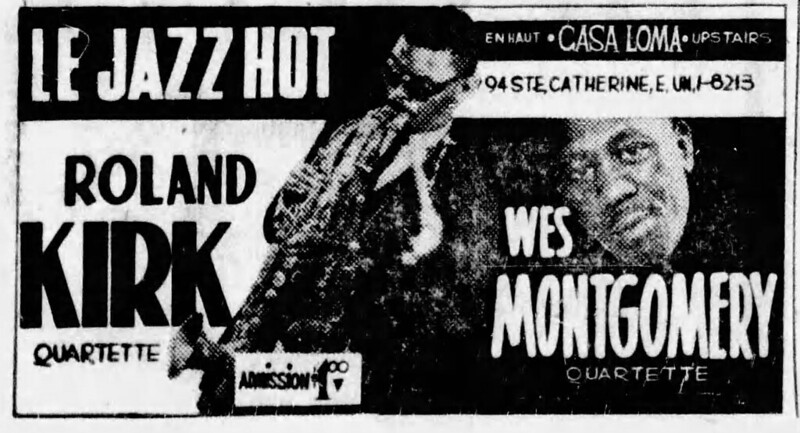
6. Jazz Hot (1963–1965): Programs & Impact
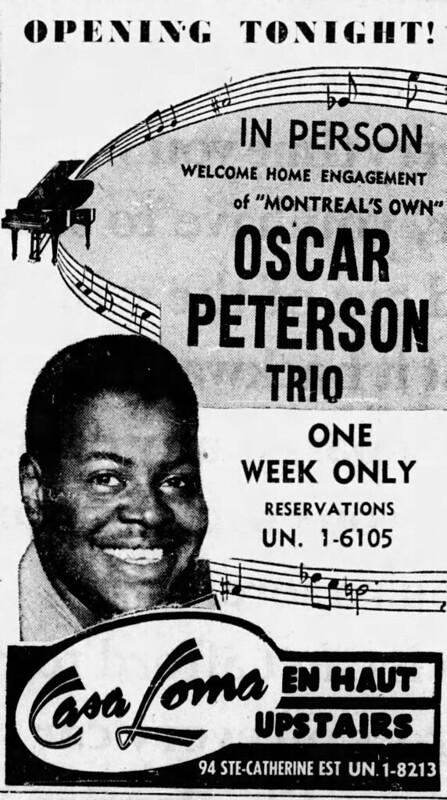
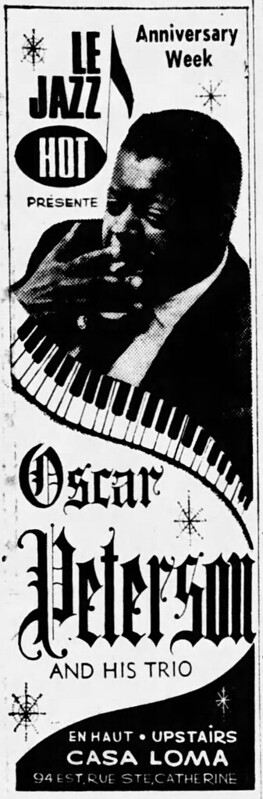
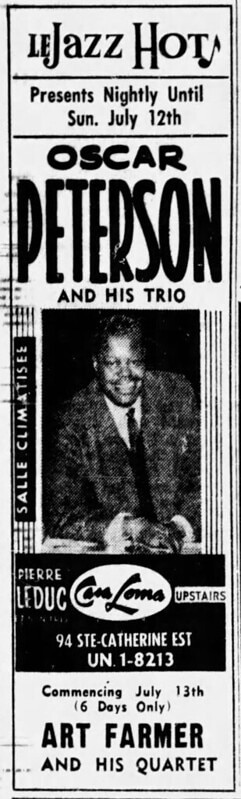
In 1963, jazz occupied an increasingly important place in the metropolis. Andy Cobetto invited the Oscar Peterson Trio to perform upstairs at the Casa Loma, where they met with remarkable success. Encouraged by this reception, Cobetto decided to continue in that direction and bring in other major names in jazz
[17].
An advertisement published in The Gazette on December 2, 1963 announces the arrival of the OSCAR PETERSON TRIO at Casa Loma Upstairs for a one-week “welcome home engagement” [232].
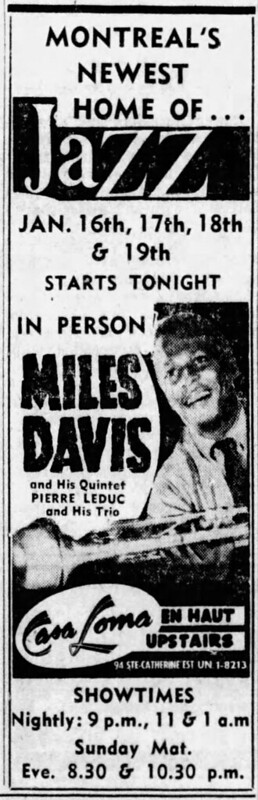
On January 18 and 20, 1964, the English- and French-language press
confirmed the appearance of Miles Davis upstairs at the
Casa Loma. On January 18, The Gazette
reported on his performance in the “Upstairs Room” of the
Casa Loma Cafe, emphasizing management’s
deliberate policy of presenting “big name jazz.”
The critic stressed the attentive listening of Montreal audiences
and described an introspective performance, dominated by Davis’s
muted and nuanced playing, while also mentioning the sophistication
of the venue’s sound system — evidence of the investments made
to position the room among the major centres of modern jazz
in Montreal [98].
Two days later, Le Devoir published, under the byline
of Réal Pelletier, a review entitled
« Miles Davis et la Casa-Loma-En Haut », the designation
explicitly used to identify the upstairs room.
The author contrasts the intimate atmosphere of the club on
Sainte-Catherine Street with the solemnity of
Place des Arts, arguing that the quintet
achieved greater cohesion and intensity there.
This double media coverage confirms both
the structured jazz use of the upstairs room as early as January 1964
and the public use of the name “Casa-Loma-En Haut”
in the French-language press
[100].
From February 17 to 23, 1964, the “upstairs room” of the
Casa Loma hosted the quartet of
John Coltrane, then at the height of his so-called
“classic” period, with McCoy Tyner on piano,
Jimmy Garrison on bass, and
Elvin Jones on drums.
Coltrane had already performed in Montreal the previous year, notably
at La Tête de l’Art in 1963, but his appearance at Casa Loma
confirmed the lasting establishment of modern jazz in downtown venues.
Far removed from the sole register of popular cabaret or folklore that had marked
certain phases of its programming, Casa Loma then became a venue
for international avant-garde jazz.
In the journal Parti pris, Patrick Straram described these evenings as
a musical experience of exceptional intensity, emphasizing the
expressive power of the quartet and the almost insurrectionary impact
of this music on Montreal audiences.
This episode confirms the role of the second floor as a distinct space,
capable of hosting major artists and placing itself within the
boldest currents of 1960s jazz.
In February 1964, The Gazette announced that Casa Loma
was presenting, for the first time in Montreal, the tenor saxophonist
Sonny Rollins, a major figure in modern jazz.
The notice emphasized the venue’s “new policy”
and placed the room within the North American circuit
of contemporary jazz, alongside artists
such as Miles Davis and John Coltrane
[90].
An article in Quartier latin (March 10, 1964) explicitly describes the transformation of the second floor of the Casa Loma into a jazz club, abandoning “continuous dancing” in favour of programming centred on the great names of international jazz. Publicist Jacques Fontaine explains that the success of the Oscar Peterson Trio convinced Andy Cobetto to continue the experiment
[62].
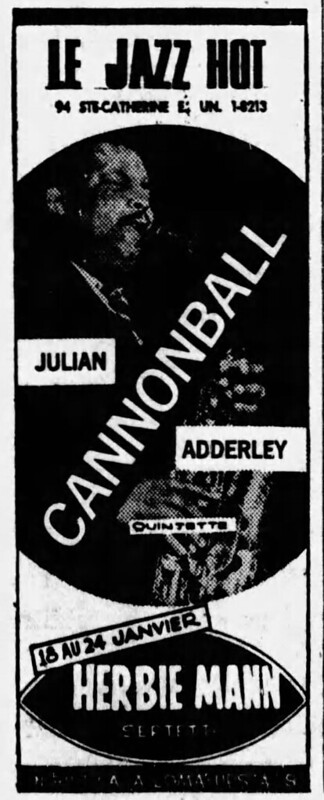
An advertisement published in The Gazette on March 23, 1964 announces the performance of Julian “Cannonball” Adderley and his sextet at the Jazz Hot, located upstairs at the Casa Loma, illustrating the cabaret’s place in Montreal’s modern jazz circuit in the mid-1960s [158].
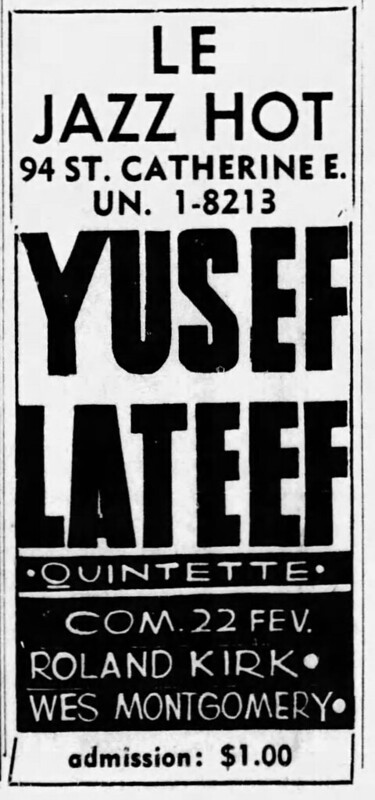
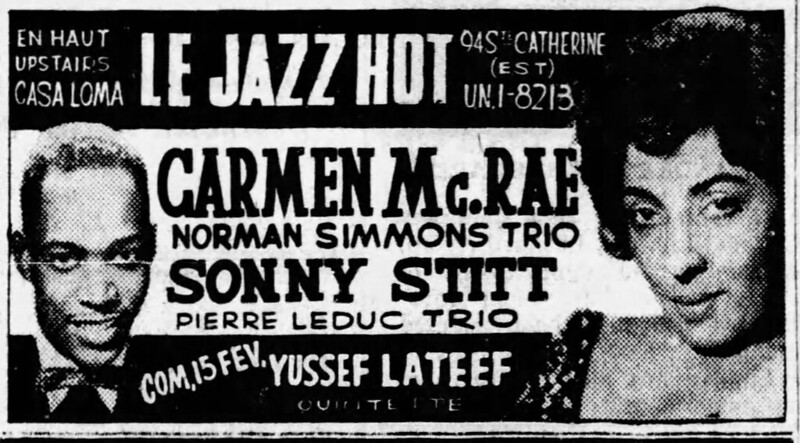
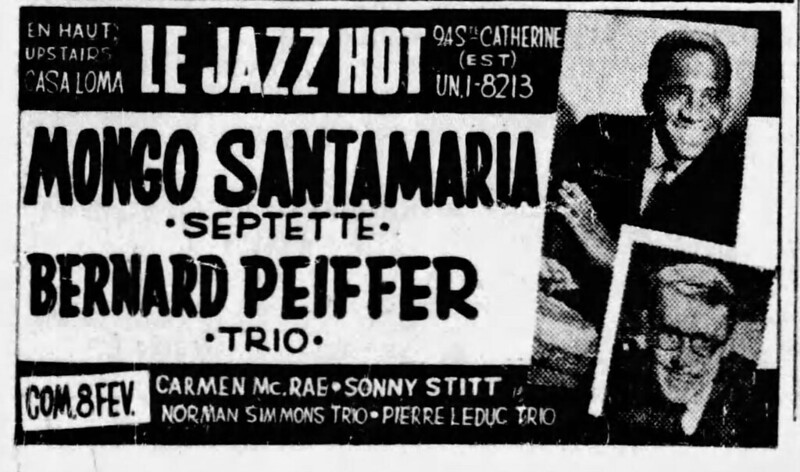
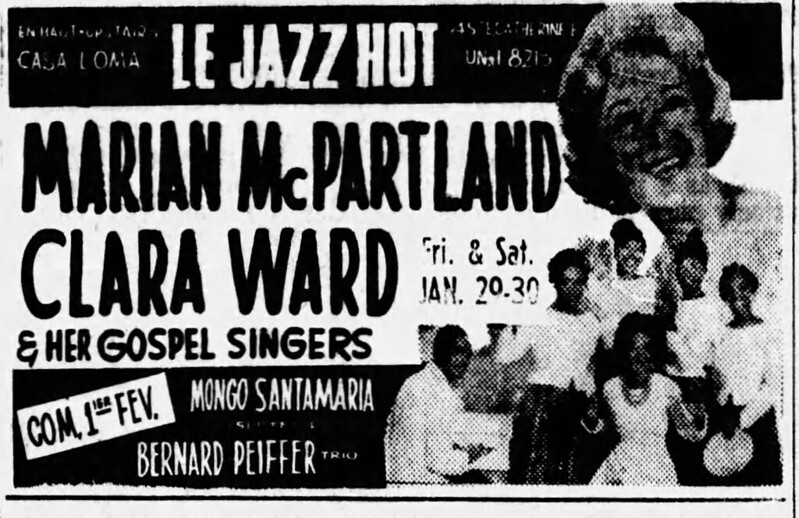
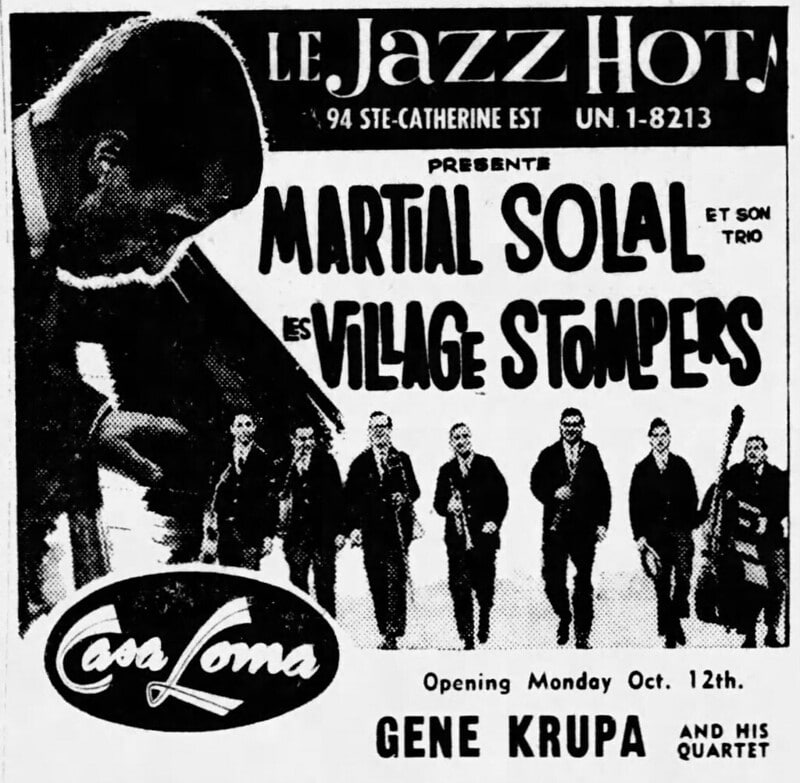
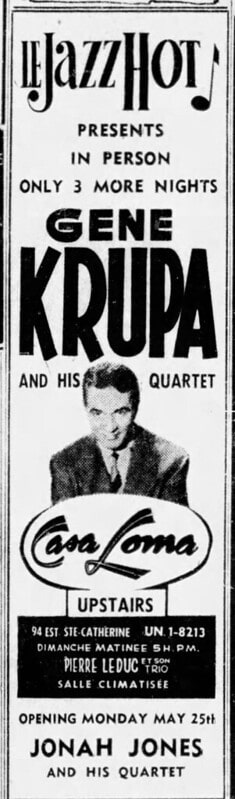
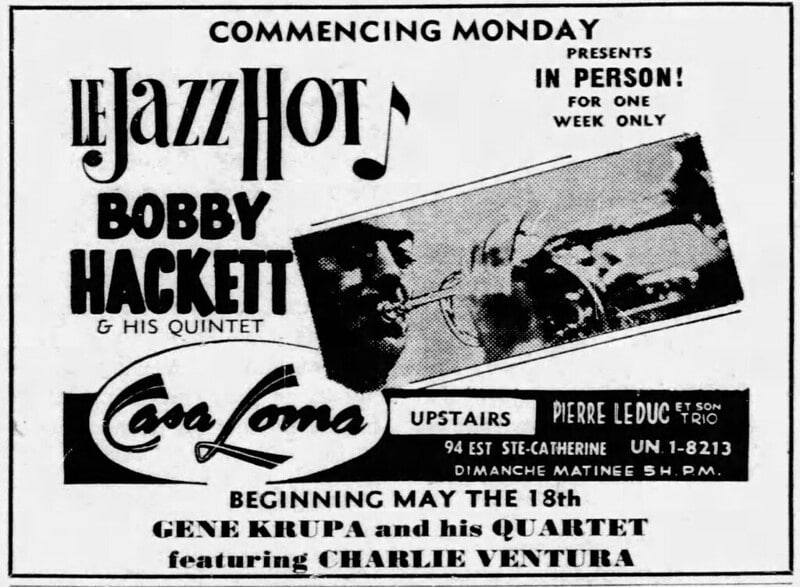
The first concert presented under the banner Le Jazz Hot was that of the American saxophonist Cannonball Adderley, on March 23, 1964
[18][19].
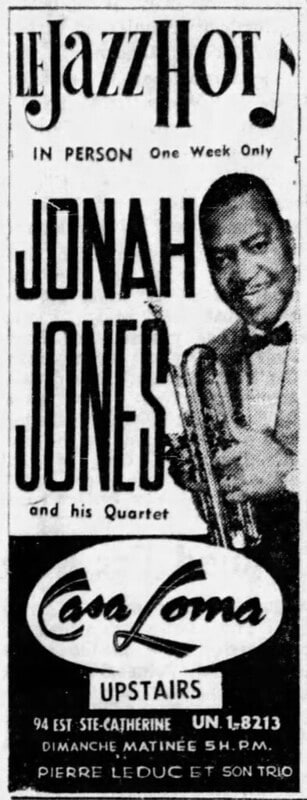
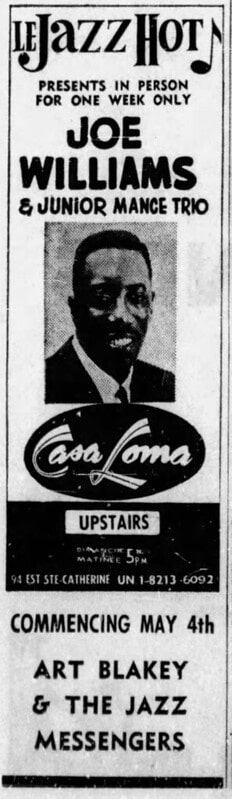
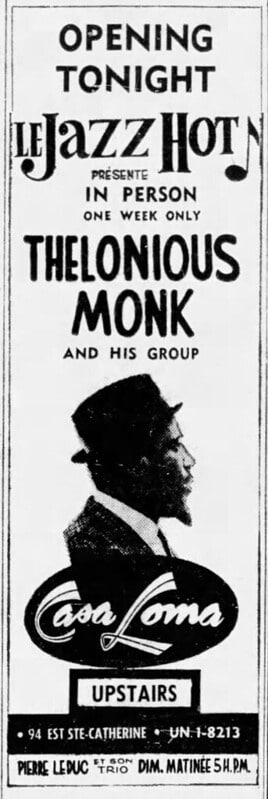
The room, located upstairs at the Casa Loma, had by then been renovated and equipped with high-quality sound and lighting systems. This new jazz club emerged within a context of recomposition on the Montreal scene, as La Tête de l’Art on Metcalfe Street declined. Less than two weeks after opening, Andy Cobetto recruited pianist Pierre Leduc, until then associated with La Tête de l’Art, to lead the house trio. Six or seven nights a week, music was offered without interruption. Very quickly, Jazz Hot welcomed the major figures of modern jazz: John Coltrane, Miles Davis, Bill Evans, Thelonious Monk, Sonny Rollins, Coleman Hawkins, Art Blakey, Duke Ellington, and Lionel Hampton[20].
Among all the jazz giants who passed through Jazz Hot, it was Coltrane who left the deepest impression on bassist and composer Michel Donato. That same year, Donato also had the chance to meet Thelonious Monk and spend a few moments with him — and share a joint — in his car, so small that he still marveled at the fact that the giant could fit inside it. Donato recalled: “I rode with Monk in my Beetle. We tore down Hôtel-de-Ville Street at full speed. Can you imagine… I could have killed him!”
[53].
“Casa Loma,” explained Montreal musician Pierre Leduc, “was the most important experience of my life. I played every night before an audience. And above all, I had the opportunity to listen to the greatest jazzmen in the world. I learned a great deal.” Communication between Leduc and the great stars who passed before his eyes took place almost exclusively through music. According to him, John Coltrane was, of them all, the one who gave him the most. Yet they never spoke. Not a word. There was a fusion of spirit
[21].
On May 2, 1964, The Montreal Star devoted a lengthy feature to the venue, described as a space of about 500 seats with acoustics favourable to live performance. Journalist Alan Pearson highlighted the central role of Andy Cobetto in assembling an ambitious international program, while emphasizing the fragile balance of the economic model, in which the revenues from revue shows presented downstairs indirectly helped support the jazz offering upstairs
[96].
An advertisement published in The Gazette on May 23, 1964 also presents “Le Jazz Hot” as a “Casa Loma series,” which suggests that at first the name designated primarily a thematic concert series before establishing itself as the room’s distinct identity
[58].
On May 23, 1964, The Gazette reviewed the
performance of the legendary drummer Gene Krupa
at Le Jazz Hot, upstairs at the
Casa Loma. Critic E. T. McAuley
emphasized the maturity and precision of Krupa’s playing,
whose style had mellowed without losing its mastery.
Accompanied by Charlie Ventura,
Ronnie Ball, and
Eddie DeHarrs,
the quartet was presented as highly recommended.
This coverage confirms Jazz Hot’s ability
to attract, in the spring of 1964, major figures
of American jazz
[101].
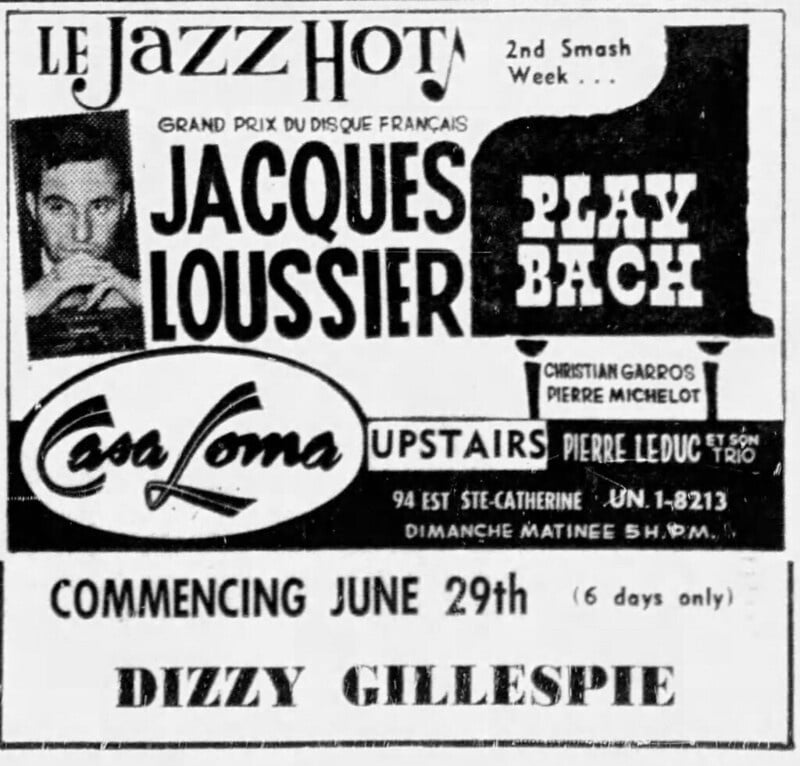
On June 4, 1964, The Gazette confirmed the appearance of the
Jimmy Smith Trio at Le Jazz Hot,
the room operated upstairs at the Casa Loma.
E. T. McAuley’s column emphasized the impact of the famous
organist on Montreal audiences and noted that
Andy Cobetto announced the upcoming return
of Dizzy Gillespie. This mention demonstrates
the regularity of major bookings
and confirms Jazz Hot’s place in the North American
modern jazz circuit in 1964
[99].
In June 1964, The Gazette reviewed the performance of the
Chet Baker Quintet at Jazz Hot, upstairs at the
Casa Loma Cafe, emphasizing the growing popularity of the
international jazz series presented by the establishment.
The critic described a solidly swinging ensemble,
praised Baker’s flugelhorn playing — clear, precise, and
perfectly integrated with that of his musicians — and mentioned
the presence of tenor saxophonist Phil Urso,
pianist Hal Galper, bassist
Jymie Merritt, and drummer Charlie Rice[86].
On July 4, 1964, The Montreal Star published a feature
devoted to the performance of Dizzy Gillespie
“At The Casa Loma.” Described as the “Clown Prince of Jazz,”
Gillespie is presented as a charismatic performer,
alternating instrumental virtuosity with direct interaction
with the audience. The article emphasizes the energy of the
performance and places the musician within the network of
New York jazz, recalling his collaborations with
Thelonious Monk,
Charlie Parker, and
John Coltrane.
This coverage confirms the continued presence of major figures
of bebop and modern jazz at the
Casa Loma during the summer of 1964
[102].
On August 14, 1964, The Gazette confirmed the vitality
of the summer programming at Le Jazz Hot.
Pianist Wynton Kelly was announced there with
Jimmy Cobb and Paul Chambers,
while Lee Gagnon and his orchestra
also occupied the stage. The article mentions the participation
of trombonist and arranger Vic Vogel,
signalling the integration of Montreal musicians
into a program dominated by international
figures
[97].
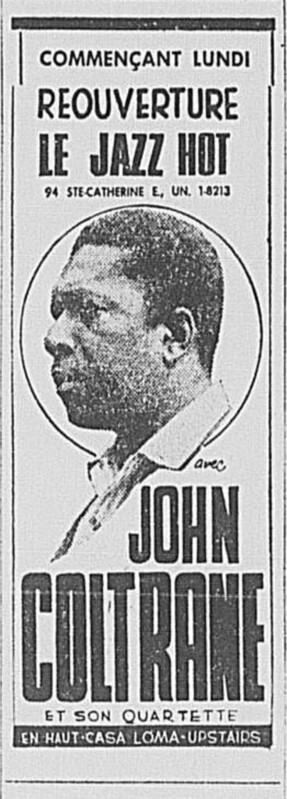
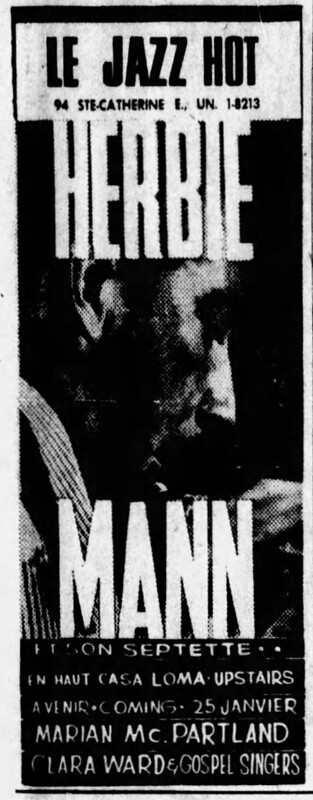
On January 6, 1965, The Gazette reported on the opening
of the jazz season at Le Jazz Hot (Casa Loma) with the
performance of the John Coltrane Quartet.
Coltrane was accompanied by McCoy Tyner,
Jimmy Garrison, and Elvin Jones,
and the program also included Cannonball Adderley,
Herbie Mann, and Monga Santa Maria,
under the direction of Andy Cobetto[95].
An advertisement published in The Gazette on January 4, 1965 announces the reopening of the Jazz Hot upstairs at the Casa Loma with John Coltrane and his quartet, confirming the cabaret’s place in Montreal’s modern jazz circuit in the mid-1960s [159].
Some American ensembles performed at Jazz Hot for two weeks, and at times the room presented a double bill with two guest groups. While the Montreal jazz community responded enthusiastically, attendance gradually declined as ticket prices rose in order to cover the touring costs of American musicians. This ambitious programming ultimately weakened the cabaret’s financial balance
[20].
A retrospective feature published in La Presse Plus in June 1984 recalls that the rise of Montreal jazz in the 1950s and early 1960s was due in large part to the welcoming of American stars and the vitality of the city’s clubs. However, the gradual increase in fees, the transformation of audiences, and the growing specialization of jazz weakened this model by the turn of the 1970s. This perspective helps explain the difficulties encountered by venues such as the Casa Loma in the second half of the 1960s
[56].
La Presse also devoted a profile to impresario Roy Cooper, recalling his decisive role in bringing the great figures of jazz to Montreal in the postwar period. The article explicitly mentions the Jazz Hot, upstairs at the Casa Loma, as one of the venues through which the headliners of the international circuit passed. Cooper is presented there as one of the people who enabled the room to host major artists such as Dizzy Gillespie, Miles Davis, and Duke Ellington, thereby placing Casa Loma within the North American network of major jazz tours. This later testimony confirms the structuring role of Jazz Hot within Montreal’s musical ecosystem in the 1960s
[92].
Performance by Duke Ellington at the Casa Loma, illustrating the presence of major international jazz artists in the cabaret’s programming in mid-20th-century Montreal.
On April 20, 1965, The Montreal Star published a feature devoted to the performance of Duke Ellington at the Jazz Hot of the Casa Loma, confirming the cabaret’s central role in the international jazz circuit
[103].
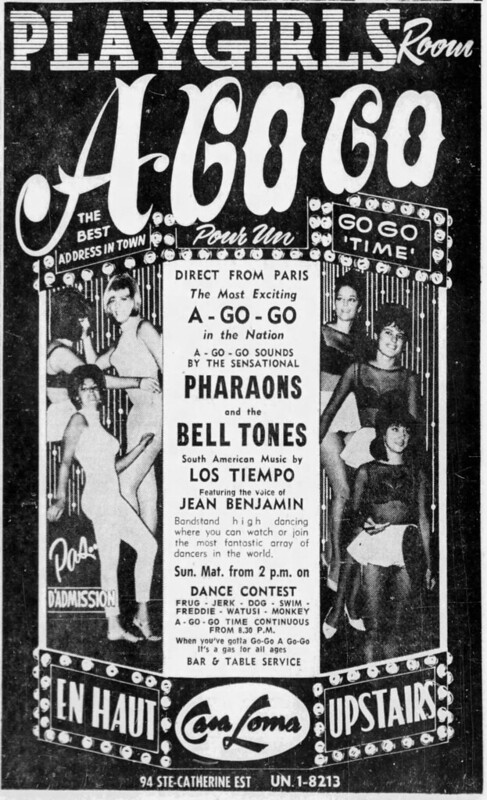
The second-floor room, known as Jazz Hot, became once again, on August 2, 1965, a French-style cabaret — identified in the press as the “upstairs” room of the Casa Loma — with a performance by singer Théo Sarapo, husband of Édith Piaf[22], before adopting a few months later a yé-yé formula under the name Playgirls Room.
7. The 1960s: Television, Laws & Changes
During the 1960s, many things changed at the Casa Loma, but the overall policy remained essentially the same. First, headliners were no longer booked for more than one week. This was tied to television: they were seen so often that it became difficult for them to hold the bill for long in a cabaret. At the same time, amateur contests disappeared. At first, the Casa Loma was the only cabaret to organize them, but then all the others followed suit, and they became less popular. Another reason lay in the Sunday law, which prohibited the presentation of shows before 6 p.m. and required customers to eat with their alcoholic drinks. Unfortunately, this had the effect of driving away a large part of the Sunday crowds, even though, as Cobetto maintained, French Canadians liked to go out on Sunday evenings. Otherwise, nothing changed: still four acts, still one Canadian headliner. This is what allowed the Casa Loma to endure while other cabarets were forced to close their doors. Most of those establishments launched themselves into all sorts of ventures and constantly changed their policy, which had the effect of alienating a public that might have become regular patrons but, never knowing what to expect, preferred to stay away
[6].
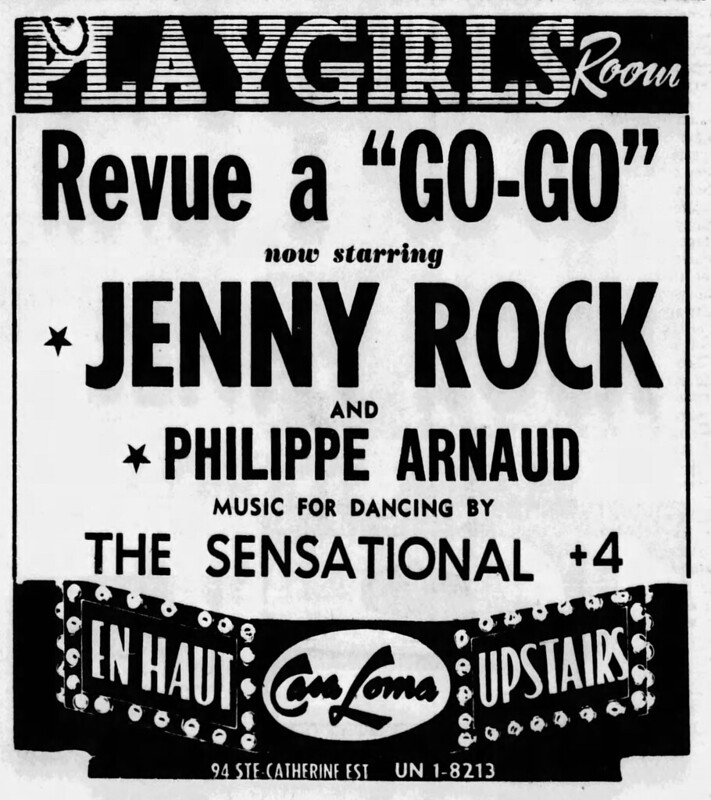
An advertisement published in The Gazette on October 1, 1965 announces the Playgirls Room upstairs at the Casa Loma, illustrating the venue’s adaptation to a-go-go culture and new forms of nightlife entertainment in the mid-1960s [160].
In September 1965, the Casa Loma officially announced its return to a policy centred on Canadian stars. An article in Télé-Radiomonde states that the new season, inaugurated on September 27 with Les Cyniques, marked the abandonment of large-scale spectacular revues in favour of programming focused on local artists. Andy Cobetto and Henri Forgues presented this choice as a return to a formula that had made the cabaret famous
[66].
In the fall of 1965, the room on the upper floor of the Casa Loma officially adopted the name Playgirls Room, marking a deliberate repositioning toward a go-go and “sexy” formula. Press coverage from September and October describes a space animated by Beatles-style orchestras and South American ensembles, where “playgirls” and waitresses in suggestive outfits welcomed a male clientele, transforming the venue into a veritable “go-go temple”
[152][151][23][24][25].
A photograph published in Dimanche-Matin during the police raids of September 21, 1969 confirms the layout of the Casa Loma, showing that the Playgirls, identified as a nightclub “above the Café Casa Loma,” occupied the upper floor, while the floor shows were presented in the basement[110].
On April 17, 1966, Dimanche-Matin explicitly mentions Fernand Lefebvre as operator of the Playgirls, “upstairs at the Casa Loma.” The show, hosted by Philippe Arnaud and featuring Jenny Rock, confirms the go-go orientation of the upper room and Lefebvre’s direct involvement in its operation by the mid-1960s
[112].
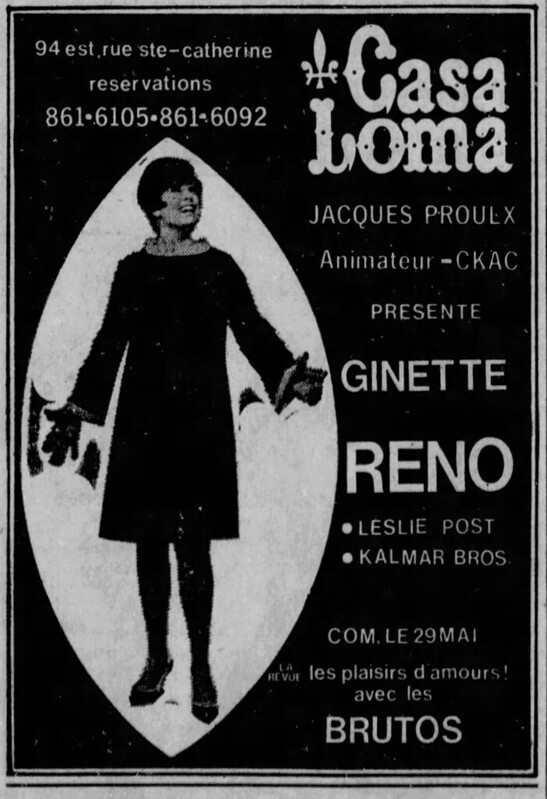
An advertisement published in The Gazette on May 22, 1967 announces the appearance of Ginette Reno at the Casa Loma, illustrating the growing importance of Quebec stars in the cabaret’s programming in the late 1960s [170].
On February 4, 1967, it was opening night at the Casa Loma. Many performers, including Tony Roman, Les Milady’s, Jacques Michel, Jean Claveau, and Jenny Rock, gathered to greet Ginette Reno before her set. At a small table near the stage, Mr. and Mrs. Raynault had come to applaud their daughter. Ginette performed La Dernière Valse, popularized by Mireille Mathieu, the French-language version of The Last Waltz, propelling it to the top of the best-selling charts. Accompanied by the orchestra of Georges Tremblay, Ginette once again gave proof of her immense talent and exceptional nature. She was compared to Judy Garland. At the end of her set, it was delirium; the audience shouted its enthusiasm. From then on, she no longer needed her first name. She was, quite simply, the Reno
[49].
In 1967, Dominique Michel, Doris Lussier, Guy Provost, as well as a dozen other people, were among the new owners of the building housing the Casa Loma, but they had nothing to do with the operation of the cabaret. Cobetto and Forgues remained in charge
[26].
An advertisement published in The Gazette on March 6, 1967 announces the appearance of the comedy group Les Cyniques at the Café Casa Loma, testifying to the integration of contemporary Quebec humour into its programming in the late 1960s [177].
On March 11, 1967, Télé-radiomonde published the article
“The scandalous ‘Cyniques’ triumph at Casa Loma,”
presenting the quartet as one of the most popular groups of the moment
in Quebec. Booked for fifteen days at the Casa Loma,
Les Cyniques are described as bold and irreverent, attracting
large crowds thanks to their biting satire of political,
religious, and bourgeois institutions. The report emphasizes that their caustic,
provocative, and engaged humour reflected the social climate of the late 1960s and
confirmed their status as stars capable of filling a Montreal cabaret
[145].
In January 1968, Andy Cobetto admitted: “I no longer know what to offer the public.” A press release announced that the Casa Loma would return to its policy of entirely Canadian shows. “There aren’t many big guns left, people who fill a house, and those people prefer to go to Place des Arts or the Comédie-Canadienne,” explained Cobetto. “Once they’ve appeared there, how do you expect me to book them? It’s impossible for me to get them. If four or five thousand people have seen them in recital, those people won’t come back to see them in a cabaret. During the summer of 1967, we did good business because we were the only cabaret offering an international revue. But since the end of Expo 67, it has been disastrous. November and December (1967) were the worst months I’ve known in 18 years. In the big room, the shows cost a great deal. You had to pay the musicians, the American stars, a master of ceremonies, variety acts. So if a headliner asked us for a prohibitive fee and the house was empty, we couldn’t even think of breaking even”
[27].
On January 24, 1968, Andy Cobetto, after managing the Casa Loma for more than 18 years, transferred his lease to Joe Di Maulo and Fernand Lefebvre. The latter was already operating the Playgirls room upstairs
[28][29][30].
9. 1969–1971: Symbolic Decline
In September 1969, the newspaper Dimanche-Matin reported
a series of police raids targeting several Montreal discotheques,
including the Playgirls,
explicitly described as being located “above the Casa Loma café”
at 92 Sainte-Catherine Street East.
This mention confirms not only the operation of the upstairs room
in the late 1960s, but also its conversion
into a discotheque, in a context marked by increased surveillance
of nightlife establishments
[110].
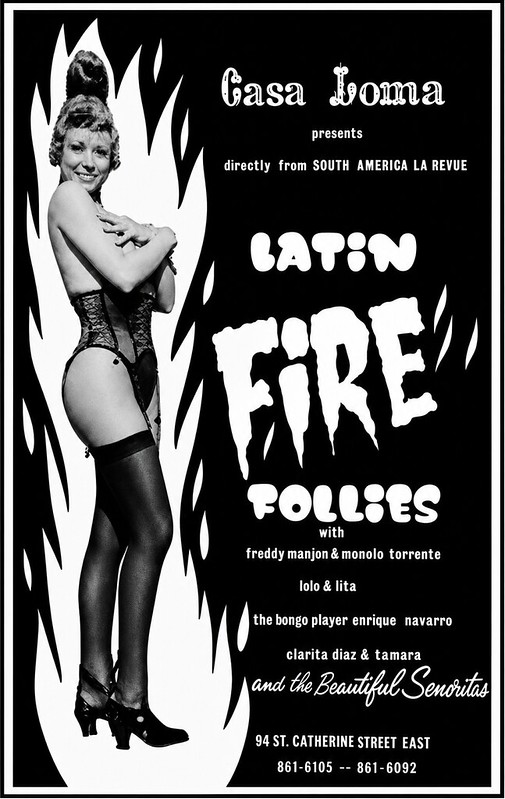
An advertisement published in The Gazette on March 30, 1970 announces the burlesque show Baubles, Bangles & Beads at the Casa Loma, starring dancer Angélique alongside Jay Lee, Michel Dary and “the girls” [184].
At the turn of the 1970s, the Casa Loma added a piano bar
called Bar Jacques Antonin, named after the musician and former teacher
from the Lac-Saint-Jean region. Established in Montreal, Jacques Antonin
performed there regularly, to the point that the space officially adopted his name,
testifying to his reputation and his central role in the establishment’s musical
entertainment[150].
In the early 1970s, the Casa Loma
operated under liquor permits held by
Fernand Lefebvre, as mentioned
in the press during the proceedings of the
Commission of Inquiry on Organized Crime (CECO).
This reference confirms
his administrative and legal role in the operation
of the establishment during this period
[111].
An advertisement published in The Gazette on June 12, 1970 announces the revue Touch of Venus! starring Marilyn Apollo at the Casa Loma, illustrating the cabaret’s evolution toward more sensual and commercial entertainment at the end of the 1960s [166].
On May 23, 1970, The Gazette described the Casa Loma
as a kind of “Las Vegas North,” presenting a bright,
fast-paced, choreographed show. The article specifies that the club,
then operated by Fern Lefebvre, could seat
about 450 spectators and had adopted a production formula
inspired by the great American stages. The report also notes,
however, that the uncertain economic climate and increased police
surveillance were affecting downtown nightlife establishments,
illustrating the transformations of Montreal nightlife
on the eve of the 1970s
[129].
In May 1970, the Casa Loma heavily promoted its star
Marilyn Apollo, presented in the press as an imitator of
Marilyn Monroe. La Patrie described a blonde performer
with a deliberately styled image inspired by “Playboy” aesthetics,
whose performances attracted a varied clientele, including many American
and European tourists drawn by the cabaret’s bright, spectacular atmosphere[148].
A few days earlier, La Presse emphasized that Casa Loma’s management
took special care of its star attraction, who generated significant revenue and
seemed well on her way to replacing Lili St-Cyr in the hearts
of Montreal fans of “sexy” entertainment[149].
An advertisement published in The Montreal Star on December 5, 1970 announces the Pamplemousse Disco-Club at 94 Sainte-Catherine Street East, illustrating the transformation of the former Casa Loma into a disco establishment at the end of the 1960s [183].
In 1970, the targets of the Morality Squad cried injustice and persecution: “The police,” they said, “should not stick their big
feet into the flowerbeds of Art.” The police replied: “We do not judge, we observe. We are not the ones who invent the law, we
only enforce it.” Fernand Lefebvre, the new owner, stated that: “At the Casa Loma, we do not present indecent shows, but it is
certain that we could go further without being indecent. And, between ourselves, it is entirely possible that it will go a good deal
further in the future”
[31].
In December 1970, several hundred young people attended the opening of the new “Pamplemousse” discotheque above the Casa Loma. The group Jude Three
got the whole crowd dancing and grooving
[32][33].
8.1 — A Fragile Establishment (1970–early 1971)
A year before the triple murder of March 12, 1971, the Casa Loma
already appeared to be an establishment on borrowed time within the
Montreal nightlife landscape. In a column published on
April 16, 1970 in La Presse,
under the heading Spec by night,
the journalist painted a nostalgic portrait of Montreal
“before Drapeau,” evoking the gradual disappearance
of the great cabarets and the transformation of downtown
since the moralization campaigns of the Pax Plante era
and the administration of Jean Drapeau
[89].
In this context, the Casa Loma was described as
“still there,” trying, against all odds,
to continue presenting shows of a certain quality,
but for a clientele that was no longer comparable
to that of previous decades. Once surrounded by a constellation
of prestigious nightclubs, the establishment now found itself
isolated in a transformed environment, marked by the decline
of the classic cabaret model and the rise of new forms
of nightlife entertainment.
This journalistic mention, published less than a year
before the tragic events of March 1971,
testifies to an establishment already weakened on both
symbolic and economic levels. The Casa Loma was no longer
one of the beacons of Montreal nightlife,
but rather one of the last remnants of a bygone era—
a survivor in a changing world
[89].
In 1971, the Casa Loma complex included
a strip club in the basement, a discotheque upstairs, and a bar
on the ground floor called the Jacques Antonin.
8.2 — The Triple Murder of March 12, 1971
On March 12, 1971, around 5 a.m.,
a few people were still drinking at the bar after normal
closing hours. The stripper Paulette Gingras,
19 years old, was having a last drink with her companion
Jean-Claude Rioux. The young woman said that after
dancing until three o’clock in the main room of the
Casa Loma, she had joined her lover at the bar.
Also at their table was Jean-Marc Morin,
32 years old, presented as a hothead.
Morin then approached a customer named Jacques Verrier,
who, according to him, owed him $500. Morin reportedly shouted
at Verrier. Verrier’s friend, bartender
André Vaillancourt, reportedly asked Morin
to lower his voice. Instead, Morin allegedly drew his revolver
and shot Verrier and Vaillancourt, each with a bullet to the head
[2][34].
A photographic file produced by Réal St-Jean for the newspaper La Presse documents, among other things, the murders that occurred at the Casa Loma on March 12, 1971, testifying to the media importance of the event [167].
This is one of the reported versions of the events;
other variants also circulated in the press
[2][34].
Confusion followed. Morin fled, soon followed
by the other patrons
[2].
Two men were dead, but the matter did not end there.
At another table sat a trio angry with
Rioux, who was blamed for having brought a murderer
into their bar. This group included Joseph Di Maulo,
28 years old, manager of the
Pamplemousse discotheque at the Casa Loma and an
important figure in the local Calabrian mafia; Joseph Tozzi,
45 years old, who ran the entire
Casa Loma complex; and Julio Ciamarro,
28 years old, a friend who managed the
Caesar’s Palace restaurant on Hutchison Street.
As the patrons fled, the trio allegedly held Rioux back,
and he was found dead with his throat slit 25 minutes later.
Thus, even though Rioux had had nothing to do with Morin’s shooting,
he was allegedly killed as punishment for having shared the same table
with him, after Morin had fled
[34].
Police were not called to the scene. It was an officer patrolling
Sainte-Catherine Street who noticed that the front door
had been smashed in; the police then discovered the bodies of the three men
[2][35].
A photographic file produced by Réal St-Jean for the newspaper La Presse documents, among other things, the murders that occurred at the Casa Loma on March 12, 1971, testifying to the media importance of the event [167].
Morin was arrested at his home, but only after police
shot him in the leg as he attempted to flee
[34].
Detectives arrested two of the three Italians linked to the killings,
Tozzi and Ciamarro.
Di Maulo, the third suspect, was actively sought
[36].
He surrendered to police upon returning from a short vacation in
Florida[37].
The coroner’s investigation also revealed that Joe Di Maulo,
missing since the murders of March 12,
could be a key witness. The coroner publicly indicated a desire
to hear him, while the inquiry was adjourned until April 27[69].
Di Maulo, Tozzi, and Ciamarro
were tried for the murder of Rioux.
To ensure their defense, they retained leading lawyers,
including Raymond Daoust — founder of the newspaper
Photo-Police and a lawyer associated with figures from the mafia milieu —,
Sidney Leithman, also known for having represented
mafia members and who would himself later be shot dead,
as well as Léo-René Maranda, lawyer for
Vincent Cotroni, considered the unquestioned founder
and boss of the Montreal mafia for nearly thirty years
[34].
8.3 — April 1971: Charges
On April 6, 1971, after several days of hearings,
coroner Laurin Lapointe concluded that there was sufficient
evidence to recommend the prosecution of Joseph Di Maulo,
Joseph Tozzi, and Julio Ciamarro in relation
to the triple murder that occurred at the Casa Loma on
the previous March 12[86].
The following day, the authorities proceeded with formal charges.
Jean-Marc Morin, Julio Ciamarro,
Joseph Di Maulo, and Joseph Tozzi
appeared in criminal court on murder charges
relating to the events of March 12, 1971 at the
Casa Loma[87].
8.4 — September to November 1971: Trial, closure, and verdict
On September 14, 1971, Montréal-Matin announced that the
Casa Loma, presented as one of the most prestigious nightclubs
in Montreal nightlife for more than fifteen years,
was voluntarily ceasing operations. The owners declared that they
would give up their permit at the end of the month, thereby sealing
the establishment’s permanent closure. The article recalls that the cabaret
had experienced its last great era with the super-revues of
Guilda[80].
A photograph published in La Presse on September 15, 1971 shows a police intervention linked to the Casa Loma, illustrating the judicial issues surrounding certain Red Light establishments in Montreal in the early 1970s, while across the street one can see the Café Pal’s, today occupied by the bar Les Foufounes Électriques[184].
That same day, the trial experienced an interlude described as “Felliniesque,”
as the judge, accompanied by the Crown prosecutor, defense counsel,
the three accused, the twelve jurors, police officers,
journalists, and photographers, went to the Casa Loma,
where Jean-Claude Rioux had had his throat slit. This judicial visit,
through the three floors of the immense nightclub, lasted
three hours. Outside, a thousand onlookers
crowded together, visibly fascinated. Inside, the heat was
intense, suffocating, almost unbearable. The court went there
to visit the crime scene, but the journalists also discovered
the entire machinery of the cabaret: the furnace room,
the set-construction workshops, the refrigeration rooms,
the stars’ dressing rooms, the wardrobes, the bars, the performance halls,
the stages, backstage areas, wings, large and small staircases,
rooms stuffed with brassieres, fake jewelry, old scenery,
and even pigeon cages. In short, all the glittering mechanics
of a great nightclub. In sum, it was written, Fellini
would have felt at home in the basement of the Casa Loma.
Di Maulo, for his part, appeared relaxed: he joked
and asked the overly zealous photographers to “think of his children.”
His co-accused, by contrast, seemed more strained
[38].
A photographic file by Antoine Désilets documents the court’s visit to the Casa Loma on September 15, 1971, offering a rare visual testimony of the premises in the context of the judicial proceedings related to the triple murder [168].
On September 21, 1971, the court began hearing the technical evidence
concerning the murder of Jean-Claude “Ti-Caille” Rioux.
The prosecution established that the victim, found in the
Jacques Antonin cocktail lounge, had been transported to Saint-Luc Hospital
around 5:30 a.m. and succumbed to his injuries
fifteen minutes later. Testimony from
Dr. Michel Talbot, Dr. Raymond Mineau,
the medical examiner who performed the autopsy, and the chemist from the
forensic laboratory was to complete this phase of the trial before the hearing
of key witnesses
[74].
A photographic file by Antoine Désilets documents the court’s visit to the Casa Loma on September 15, 1971, offering a rare visual testimony of the premises in the context of the judicial proceedings related to the triple murder [168].
On September 22, 1971, the continuation of the trial revealed several
inconsistencies and tensions in the testimony heard up to that point.
Under the evocative title “a storm in a broken glass…,”
the press highlighted the divergences between certain statements
and the material evidence presented in court, particularly concerning
the chronology of the gunshots and the versions provided
by Yvon Métras. These contradictions began to weaken
the clarity of the narrative surrounding the events of March 12, 1971[76].
A photographic file by Antoine Désilets documents the court’s visit to the Casa Loma on September 15, 1971, offering a rare visual testimony of the premises in the context of the judicial proceedings related to the triple murder [168].
The closure of the Casa Loma thus occurred in a context
where the establishment was profoundly associated with the judicial reverberations
of the triple murder, symbolically marking the end of an era for
Montreal’s great cabarets.
In an account published on October 1, 1971,
La Presse reported the testimony of Paulette Gingras,
present behind the bar of the Jacques Antonin cocktail lounge
at the moment when Jacques Verrier and André Vaillancourt
were shot. According to this version, the double murder unfolded
in less than four seconds. The article also specifies
that Gingras left the premises after the gunshots and only contacted
the authorities a few days later. That same day,
her cross-examination occupied a central place in the hearings:
the defense emphasized that she had not immediately alerted
the police and challenged the consistency of her statements regarding
the presence of the accused in the Jacques Antonin
cocktail lounge. This stage of the trial marked a turning point,
as the credibility of the principal eyewitness was now directly
called into question
[64][78].
An article in La Presse of October 8, 1971 recounts in detail
the cross-examination conducted by Me Léo-René Maranda,
which highlighted contradictions in the various statements
made by Paulette Gingras. Presented as the Crown’s star witness,
the young dancer saw her credibility seriously shaken
in the eyes of the jurors, a determining factor in the outcome of the trial
[68].
On October 15 and 16, 1971, La Presse reported the testimony
of Yvon Métras, 32 years old, an employee of the
Casa Loma at the time of the events, called as a Crown witness
in the trial relating to the triple murder of March 12.
His examination began before the Court of Assizes on
October 15. The following day, the former “busboy” stated that he had
been present in the Jacques Antonin cocktail lounge at the time of the shots
and formally identified Joseph Di Maulo and
Joseph Tozzi among the persons present at the scene.
He described the arrangement of the tables, the movements of the accused,
and the sequence of shots that claimed the lives of
Jean-Claude “Ti-Caille” Rioux,
Jacques Verrier, and André Vaillancourt,
thus providing direct testimony on the unfolding of the events
[73][75].
However, as early as October 20, La Presse reported that
Métras had been declared a “hostile witness” and extensively
cross-examined, before ultimately being released by the court
[70]. In the following days, the newspaper emphasized
the contradictions and successive revisions in his statements —
the witness, nicknamed “Tiny Bull” or “Mister Bull,”
notably admitting that he had remained silent for several months “out of fear”
[71][72].
These inconsistencies gradually weakened the prosecution’s case.
On October 29, the defense continued
its cross-examination, seeking to demonstrate the flaws in his account
and to call into question his version of the knife attack that occurred
in the Jacques Antonin cocktail lounge. The reconstruction
of the movements and actions carried out during the triple murder thus became
a central issue, as the witness’s credibility was increasingly challenged
before the jury [79].
On November 27, 1971, after several days of deliberation,
the jury delivered its verdict in the Casa Loma triple murder case.
Joseph Di Maulo,
Julio Ciamarro, and Joseph Tozzi
were found guilty of the murder of Jean-Claude
“Ti-Caille” Rioux[81].
The same day, Le Devoir confirmed that the three accused
were sentenced to life imprisonment, the mandatory penalty
for murder at the time [82].
The judge then pronounced sentence in these terms:
“Giuseppe Di Maulo, Joseph Tozzi, and Julio Ciamarro,
you have just been found guilty of murder by your peers.
I must apply the mandatory sentence prescribed by law,
life imprisonment.” This decision brought to an end one of the
most publicized and controversial criminal trials
of the period [39].
An article published in Montréal-Matin on November 27, 1971 confirms the life sentences handed to Jos Di Maulo, Julio Ciamarro, and Joseph Tozzi for the murder of Jean-Claude Rioux at the Casa Loma [39].
Two months later, Paulette Gingras, the 19-year-old
striptease dancer, called once again to testify, reversed herself at the trial
of Jean-Marc Morin, accused of the murder
of André Vaillancourt. She told the court that it was
not Morin who had killed Vaillancourt, but rather Rioux.
The “hothead” was acquitted. He would also be acquitted, six months later,
of the charge that he had killed Verrier, who owed him
$500[2].
The Court of Appeal ordered that a new trial be held for
Di Maulo, Tozzi, and Ciamarro[2].
The case ended in the most unexpected and dramatic fashion imaginable
[40].
The judge himself recommended that the jury acquit the three defendants.
He based his decision chiefly on the fact that the two Crown witnesses
were “unsound.” He obviously emphasized the multiple changes in the accounts
of the two witnesses:
the stripper Paulette Gingras and the night watchman
Stanley Bull. In court, applause broke out
immediately. People cried, embraced, and threw themselves
into one another’s arms [40].
In the fall of 1971, the popular press symbolically sealed
the end of Montreal’s great cabarets. Under the title
“Cabarets are dead: long live discotheques!”,
Photo-Journal pointed out that the Casa Loma and the
Mocambo were now closed, while new
discotheques dominated the nightlife scene. The article illustrates the rapid
transformation of entertainment habits and enshrines the disappearance of a
cabaret model that had marked the 1950s and 1960s
[77].
8.5 — 1972–1973: Acquittal and symbolic significance
In November 1972, in the context of the legal aftermath of the
murder case that had occurred at the Casa Loma, the press highlighted
the composition of the jury called to hear the case, made up of three women
and nine men. Female presence was then presented
as unusual in a criminal matter of such importance
[83].
An article published in La Presse on February 1, 1973 announces the acquittal of Jos Di Maulo, Joseph Tozzi, and Julio Ciamarro during the second trial related to the murder of Jean-Claude “Ti-Caille” Rioux at the Casa Loma, following a verdict recommended by the judge due to contradictions in the testimony [40].
On February 2, 1973, La Presse announced that the three accused
had been acquitted in the murder case of
Jean-Claude “Ti-Caille” Rioux. After nearly
two years of proceedings — during which they had spent
approximately 23 months behind bars —, this judicial reversal
overturned the life sentences handed down in November 1971
and definitively closed the criminal chapter of the
Casa Loma case [84].
Champagne flowed freely that evening at a celebration where
Joseph Di Maulo, Joseph Tozzi, and
Julio Ciamarro were feted at the Auberge Saint-Gabriel,
right next to the Palais de justice. Among the celebrants
were several investigators from the police homicide squad, according to the photographer for the newspaper Photo-PolicePierre Schneider[34].
The hypothesis of a mere “circumstantial accident” is not sufficient,
however, to explain the scope of the events of March 12, 1971.
If the initial altercation appears to have arisen from a personal conflict that escalated,
the subsequent reaction and the context in which it occurred reveal
an environment where commercial interests, networks of influence,
and figures associated with organized crime in Montreal intersected. The Casa Loma,
already weakened by the decline of the classic cabaret model and the rapid
mutation of nightlife habits, then became the stage for a drama that acted
less as the sole cause of its disappearance than as a brutal catalyst
for a process of decline already underway. The triple murder did not create the end
of the Casa Loma: it precipitated its symbolic dimension.
8.6 — 1975: Commission of Inquiry on Organized Crime
On December 11, 1975, The Montreal Star led its front page
with a lengthy account of the hearings of the Commission of Inquiry on Organized Crime
in Quebec. Under the headline “Old city called crime centre”, the journalist
Norman Provencher summarized the testimony of detective-sergeant
Claude Legault (Montreal Urban Community Police),
a specialist in Montreal criminal networks. He stated that,
since the beginning of the 1960s, the center of gravity of organized crime
had gradually shifted from Old Montreal toward the
Sainte-Catherine East – Saint-Laurent – Papineau axis,
an area characterized by a high concentration of cabarets,
dance clubs, and show bars.
The Montreal context of the time was also marked by the revelations of the Commission of Inquiry on Organized Crime, whose report published in 1976 brought to light the extent of criminal networks active in nightlife and entertainment circles [171].
Legault recalled that at the beginning of the 1960s, the area between
Atwater and Papineau “teemed with underworld characters,”
meaning it swarmed with figures linked to illegal gambling,
prostitution, loan-sharking, and protection rackets.
The territory had first been structured by the
Cotroni–Violi organization, which divided the zone into two sectors,
east and west of Bleury Street.
However, around the middle of the decade, members of the
Dubois clan, based in Saint-Henri, began
systematically infiltrating downtown nightlife establishments.
According to the testimony cited by the newspaper, this infiltration did not occur
through spectacular takeovers, but by gradual implantation:
the Dubois obtained strategic positions inside the clubs —
bartenders, doormen, suppliers, or security managers —
allowing them to monitor financial flows, transactions,
and the circulation of people. The Casa Loma
(94 Sainte-Catherine Street East) was explicitly named as
one of the infiltrated establishments. The policeman described it as
a “classy” club — therefore frequented by a respectable clientele —,
but “nonetheless a Mafia hangout,” a revealing formulation
of the establishment’s double face: a worldly showcase
and a strategic crossroads of criminal influence.
The article drew a direct link between this gradual penetration
and the internal tensions of the Italo-Montreal criminal milieu.
It recalled that the Dubois’ infiltration of this
“Italian” territory reached its climax in March 1971,
with the murder of three men at the Casa Loma.
Detective Legault stated that these murders stemmed
from a dispute involving Joe Di Maulo,
the club’s doorman, and Yvon Bélzile, the maître d’hôtel.
The newspaper presented these homicides as a turning point:
after the shooting, downtown became increasingly identified
as “Dubois territory.”
The testimony also mentioned the establishment of a new racket model.
Club owners and employees were allegedly forced to pay
between $10 and $25 a week in order to keep their jobs
or avoid reprisals. This practice no longer targeted only
the proprietors, but extended to employees themselves, testifying
to a refinement of territorial control mechanisms.
The newspaper’s inside page (“Youth sold drugs”)
provided a complementary perspective. A 16-year-old teenager,
identified only as Michel, claimed to have sold
stolen goods and narcotics for the Dubois clan
for several years. He described the resale of hashish
and mescaline in “west-end night spots” controlled by the clan,
as well as a system of “authorization” allowing one to operate in certain establishments.
He also described the existence of a network of loans, burglaries,
and financial transactions involving banks intimidated
by the Dubois’ reputation.
This double report — criminal and economic — thus places the
Casa Loma within a much broader map
than that of the simple cabaret. In 1975, four years after
its closure, the establishment was no longer evoked for its revues,
singers, or prestige, but as a strategic node
in the reconfiguration of Montreal criminal power
in the 1960s and 1970s. In the decade’s media memory,
the Casa Loma became a symbolic landmark of the transition
between the old Cotroni–Violi system and the rise
of the Dubois, embodying the porosity between nightlife,
territorial control, and the underground economy in the
Montreal Red Light[128].
Fifty years later, it is still not fully known
what happened during that night of March 12, 1971,
the last night of the most famous nightclub in the Montreal legend of crime
[2].
Andy Cobetto died on December 15, 1993
at the age of 85, following complications related
to Alzheimer’s disease [41].
Joseph Di Maulo, who became one of the province’s most influential mafiosi,
was murdered near his sumptuous residence in
Blainville on November 5, 2012[42][43][44][45].
9. Conclusion
Until the early 1960s, Montreal nightclubs experienced remarkable prosperity.
The cabaret business model relied on significant investments — between $100,000 and
$150,000 around 1950 — but remained viable as long as local artists’ fees stayed moderate.
A Quebec star could still earn between $50 and $70 per week
[46].
The situation gradually shifted at the turn of the 1960s. The growing popularity of certain
singers led to a dramatic inflation in performance fees. Michel Louvain, for example, could command
up to $1,500 per week, an unthinkable sum a decade earlier
[47].
For operators, the financial balance became precarious: they now had to fill the venue every night
to absorb costs comparable to those of major cultural institutions.
At the same time, the unstoppable rise of television transformed social habits.
Audiences, once loyal to cabarets, discovered a free and accessible cultural offer at home.
Artists, now omnipresent on the small screen, lost in exclusivity what they gained in visibility.
The cabaret thus ceased to be the primary venue of consecration.
The Casa Loma perfectly illustrates this transition. First a major showcase for French-Canadian stars,
then an ambitious laboratory for international jazz with the Jazz Hot, it embodies both the golden age
and the twilight of the great Montreal cabaret. Its decline was not caused by a single event,
but by a structural transformation: shifting tastes, economic pressure, media competition,
and a reconfiguration of the cultural landscape.
When the Casa Loma closed its doors in 1971, it was an entire model of urban entertainment
that disappeared. With it vanished an era in which the cabaret stood as one of the beating hearts
of Montreal nightlife.
10. Legacy & memory
In light of the assembled sources, the Casa Loma appears as a major landmark
in postwar Montreal entertainment, both for its initial prestige in 1951
and for its role as a showcase for French-Canadian stars, as well as for its attempts
to adapt to market transformations — television, regulation, cost fluctuations —
throughout the 1960s[3][6][27].
The regulatory climate of the 1950s and 1960s also contributed
to the transformation of Montreal cabarets. A series published in
La Presse in 1993 recalls that the municipal administration
significantly tightened surveillance of nightclubs,
multiplied permit suspensions, and strictly enforced
regulations on alcohol and opening hours.
This climate of moral regulation accelerated the reconfiguration
of Montreal’s nightlife landscape
[67].
The Jazz Hot episode, documented both by the press and by jazz historiography,
illustrates the cultural ambition of a cabaret seeking to remain competitive
by bringing in top-tier artists, while also revealing the economic fragility
of sustaining an international programming schedule
[20][56].
As early as March 15, 1971, just three days after the triple murder,
a column in Montréal-Matin explicitly referred to the “general decline of the cabaret industry”
in Montreal, associating the Casa Loma with the end of a cycle
in postwar Montreal nightlife
[61].
The sequence of 1971 — during which the establishment became the center of a major criminal case —
marks, in the available sources, the abrupt end of a cycle and
the disappearance of a model of Montreal nightlife of which the Casa Loma was one of the most enduring faces
[2][40].
More than a decade after its closure, the Casa Loma remained present in Montreal’s journalistic memory.
In 1983, a retrospective column in La Presse
described it as a “high place of nightlife of the past,” placing it among the
driving forces of Montreal nights in the 1950s and 1960s[60].
This later evocation confirms that the Casa Loma was not only a successful establishment,
but also a structuring cultural landmark of an era marked by the golden age of
cabarets. Associated with the figure of Andy Cobetto and a generation
of rising French-Canadian artists, the venue now symbolizes
a period in which nightlife played a central role in Montreal’s artistic life.
At a time when cabarets have gradually given way to discotheques,
multi-purpose venues, and new models of entertainment, the memory
of the Casa Loma contributes to the construction of a heritage narrative of Montreal nightlife.
Its name thus remains associated with the “golden age” of nightclubs along
Sainte-Catherine Street East, a lineage that also includes, much later, the Club 281,
located at 94 Sainte-Catherine Street East from 2004 to 2020,
testifying to the continuity of festive and nocturnal uses of this site over more than a century.
The album Live at Casa Loma by Ginette Reno, recorded at the cabaret and released by Apex in 1966, stands as a major audio document of her early career on the Montreal stage [234].
The nights at the Casa Loma were immortalized on record, as evidenced by recordings made at or associated with the venue by Jacques Desrosiers, Ti-Gus and Ti-Mousse—including the album An Evening at Casa Loma—as well as Ginette Reno, confirming the cabaret’s role as a space for capturing and disseminating live performance [234].
11. Biographical notices
Biographical notice - Founder
Harry Gustov Holmok (December 25, 1898 – September 2, 1959)
Born in Transylvania on December 25, 1898 (then Austro-Hungarian territory, now in Romania),
Harry Gustav Holmok would become one of the dominant figures in Montreal’s cabaret industry.
A veteran of the First World War — having served successively in the Austro-Hungarian,
Romanian, and Russian White Guard forces — he survived several European fronts before emigrating to Canada in 1922.
Upon his arrival, he worked as a lumberjack in northern Quebec, notably in the Lac Saint-Jean region,
where he improved his French and English (he mastered eight languages). Back in Montreal,
he first worked as a cabinetmaker, then became a general contractor,
taking part in the construction of several buildings in the metropolis.
From the Viennas to the Bellevues
In the early 1930s, Holmok turned to the entertainment industry.
In 1934, he built his own club at the corner of
Saint-Denis and De Montigny streets (now De Maisonneuve), the
Vienna Grill. He then opened a second Vienna on
Sainte-Catherine East, and later renamed the Cabaret Montmartre — not to be confused with the Café Montmartre on Saint-Laurent Boulevard — as the
Bellevue Grill, thus beginning a series of establishments
that would make his reputation.
A reference published in Le Devoir in 1939 confirms
that he was already quite active in Montreal’s club scene at that time,
notably through the American Club, in association with
Joseph Krassler[33].
At the turn of the 1940s, Holmok took an interest in the large hall at
375 Ontario Street West, then known as the Auditorium Ballroom.
As early as 1943, he acquired a group of strategic properties along this stretch of Ontario Street West — including in particular numbers 371 to 375 —, as reported by The Gazette[84]. This real-estate operation marked a decisive stage in his project: it allowed him to consolidate his hold on the site and to envision its large-scale transformation.
He then became involved in the management and gradual reconfiguration of the venue, which became the Roseland Ballroom in 1946, before being converted on April 21, 1949 into the Bellevue Casino.
The Bellevue Casino: the peak of an empire
Operated with his partner and brother-in-law Jack Suz,
the Bellevue Casino was then considered the most important theatre-restaurant in Canada.
Spread over three floors, the establishment could accommodate more than 700 seated patrons
and permanently employed nearly 100 people.
The shows represented a weekly investment of $8,000 to $10,000 — equivalent to $110,000 to $135,000 in 2026 dollars —,
attracting up to 2,000 customers on Saturday nights.
Nicknamed by the American press “Canada’s Mr. Ziegfeld”,
Holmok relied on lavish productions, choreographed revues, and international stars.
The artistic direction, entrusted in particular to Natalie Kamarova,
contributed greatly to the venue’s prestige.
Its popular slogan summed up his commercial philosophy:
“Fifty cents to get in, fifty cents for a beer.”
Casa Loma and the decline of the great cabarets
In 1951, Holmok joined forces with Thomas Steppan
to open the Casa Loma on Sainte-Catherine East,
though he gave it up the following year.
From the mid-1950s onward,
new municipal regulations restricting liquor sales,
combined with urban transformations and expropriations,
weakened the economic model of the great cabarets.
The Bellevue Casino itself would undergo a partial expropriation
before its closure and demolition in 1962.
Harry Gustav Holmok died on September 2, 1959 at his home in Dorval,
following a heart attack.
His career illustrates the rise, the peak, and the decline of Montreal’s great cabarets,
of which he was one of the principal architects during the golden age of entertainment in the metropolis.
Biographical notice - Founder
Thomas Steppan (1895–1953)
Thomas Steppan was the owner of the
Café Trinidad, an establishment located on
Sainte-Catherine East, above the site that would later become
the Casa Loma cabaret.
His operation predates the official opening of that entertainment venue,
placing his name in the earlier history of the site.
On March 20, 1953, following an altercation that occurred in his establishment,
Steppan witnessed a fight involving his son and several other individuals.
He suffered a medical collapse and died the same evening at the age of 57.
An autopsy concluded that the death was due to a
heart attack, therefore to natural causes.
Biographical notice
ANDREW J. « ANDY » COBETTO (1908–1993)
Andrew J. “Andy” Cobetto was a Montreal operator associated with the world of downtown cabarets and
nightlife establishments in the mid-20th century. A figure of postwar nightlife,
he belonged to a generation of Italian-Montreal entrepreneurs active in the management of clubs,
performance venues, and entertainment establishments that helped shape
the nighttime economy of Sainte-Catherine East.
He is notably associated with the operation of the CASA LOMA complex, a large nightclub
renowned for its lavish floor shows. A column published in The Gazette
in August 1968 recalls that he had operated the CASA LOMA for 17 years,
situating his career in continuity with the great popular downtown entertainment halls.
At the same period, Cobetto is mentioned in connection with the Jamaica Restaurant
installed on the site of Man and His World, a transition presented in the press
as a movement away from the great urban cabaret toward a more open and tropical atmosphere [127].
Andy Cobetto died in Montreal on December 15, 1993 at the age of 85
[41].
Biographical notice
HENRI FORGUES (1912–1971)
Henri Forgues was an operator and co-owner associated with the
CASA LOMA cabaret in Montreal at the turn of the 1960s.
His name appears in the press of the period as one of the managers
involved in the administration and operation of the establishment,
then presented as one of the busiest clubs in the
Sainte-Catherine East sector.
According to an obituary notice published in La Presse (March 1, 1971),
he died on February 26, 1971 in Montreal at the age of 58.
He is identified there as a former owner of the
Café Casa Loma.
Husband of MARIE-ROSE CAYER, he left behind two daughters,
as well as several members of his family.
His career remains associated with a period of intense activity
at the CASA LOMA, in the dynamic context
of Montreal cabarets in the 1950s and 1960s.
Biographical notice
ANGELO BISANTE (1895–1961)
Angelo Bisante was an Italian-Montreal entrepreneur
associated with the development of the restaurant and nightlife
sector on Sainte-Catherine East during the 1940s and 1950s.
On June 13, 1941, with his brother Dandy Bisante, he founded
the American Spaghetti House at 64 Sainte-Catherine Street East,
at the corner of Berger. Open 24 hours a day, the establishment quickly became
a popular institution, especially among patrons of the neighboring
cabarets, including the Casa Loma.
Fifteen years after its opening, the restaurant employed
about 160 people and operated a fleet of trucks
for home delivery — a practice that was then innovative
in Montreal
[1].
Bisante gradually acquired most of the properties
on the south side of Sainte-Catherine Street, between Berger
and Saint-Dominique, thus consolidating an important
commercial group. Before opening the restaurant,
he had sold the Casino de Parée, a nightclub
located at the corner of Saint-Laurent and Sainte-Catherine.
He later returned to the cabaret sector
by acquiring the Casa Loma together with
Henri Forgues and Andy Cobetto.
Journalistic sources also describe
Bisante as an active philanthropist, receiving
several hundred orphans annually
at his restaurant.
Alongside his commercial activities,
his name appears in documentation relating
to Montreal’s underworld in the 1940s and 1950s.
Articles and testimony published in the context
of the Caron inquiry — led by Pacifique “Pax” Plante
and Jean Drapeau into police corruption —
mention his association with the network of gambling dens,
“blind pigs,” brothels, and bookmakers.
His wife, Lucie Delicato Bisante,
is described as the operator of a brothel
on Saint-Laurent Boulevard
[2][3][4].
On February 24, 1959, a fire destroyed
the American Spaghetti House and caused the death
of two firefighters when the roof collapsed.
An attempt to revive the business failed, partly
because of Bisante’s declining health.
Angelo Bisante died in December 1961
at the age of 66
[5].
His wife, Lucie Delicato Bisante,
died on March 6, 1966 at the age of 60
[6].
Angelo Bisante’s career illustrates
the characteristic interweaving of postwar
Montreal nightlife, where commercial expansion,
popular sociability, and the grey areas of the
underworld coexisted within the same
urban space.
Biographical notice
ROY COOPER (1908–1996)
Roy Cooper was one of the major figures of Montreal show business
in the 20th century. Active for more than seven decades,
he was described in the press as the “dean of Canadian impresarios”
and as a true legend of entertainment in Montreal.
Born in Montreal and then trained in the American vaudeville circuit,
notably in New York and the Catskills, Cooper developed
a vast professional network linking the Quebec metropolis
to the major North American artistic centers.
As early as the 1930s, his name appeared in the programming
of downtown cabarets, including the LIDO (Stanley Street),
before the rise of the great postwar clubs.
Over the course of his career, he helped bring
major international artists to Montreal, including
LOUIS ARMSTRONG, BILLIE HOLIDAY,
COUNT BASIE, DUKE ELLINGTON,
SAMMY DAVIS JR., TONY BENNETT,
and EDITH PIAF. His name is also associated
with attempts to book ELVIS PRESLEY,
illustrating the extent of his network.
In the 1950s and 1960s, Cooper played a structuring role
in the circulation of jazz artists in Montreal.
Retrospective sources place his influence
in the development of the circuit that included the
JAZZ HOT at the CASA LOMA,
helping to inscribe the city within the
North American network of major tours.
Respected for his professionalism and his ability to maintain
lasting relationships with artists,
Cooper embodied the transition between the golden age of cabarets,
the rise of major international productions,
and the transformations of Montreal’s nightlife landscape
from the 1960s onward.
Biographical notice
JEN ROGER (Jean-Roger Marcotte, June 24, 1928 – December 13, 2016)
Born in Montreal on June 24, 1928, Jean-Roger Marcotte,
known by the stage name Jen Roger,
was one of the most emblematic masters of ceremonies
of the golden age of Montreal cabarets[120].
He began his career in 1949 after being discovered at the
Trinidad, a cabaret located on the upper floor of the
CASA LOMA. His first contract was signed at the
Chez Émile cabaret in Quebec City, before he became master of ceremonies
at the Mocambo, then house M.C. at the CASA LOMA
for nearly nine years[119].
Casa Loma and recording successes
At the Casa Loma, Jen Roger introduced Quebec’s major stars
and helped shape cabaret evenings at a time
when the venue was considered Montreal’s equivalent of Place des Arts
before its time[118].
At the same time, he launched a recording career marked by
several popular hits, including Toi ma richesse,
Sous les ponts de Paris, and
Le miracle de Sainte-Anne-de-Beaupré,
the latter becoming one of the major successes of Quebec records
in the late 1950s[118].
Radio and television
He became an announcer and host at CKVL,
then at CKAC from 1956 onward,
hosting in particular Sur la grande route
and Music-Hall de Jen Roger[119].
In 1957, his song Gondolier won a first prize in Europe.
In 1967, he was named Mr. Radio-Television
and that same year received the Prix Orange[119].
As host of variety programs such as
Les découvertes de Jen Roger,
he notably helped launch the career of the young
René Simard[119].
Final years
In 1977, he settled in Florida, where he remained until 1982,
while occasionally continuing his artistic activities[120].
He returned to the stage in 1997 with the show
Souvenirs de la Casa Loma, reviving the memory
of the flourishing era of Montreal cabarets[120].
In total, his discography includes more than 80 forty-fives
and 16 albums[119].
In June 2011, he received the Medal of the National Assembly of Quebec
for his body of work[120].
Jen Roger passed away on December 13, 2016, in Montreal, at the age of 88[120],
leaving behind the lasting image of a master of ceremonies who embodied
the spirit of Montreal cabarets in the 1950s and 1960s.
Biographical notice
JEAN SIMON (Roland Charrette, 1933 – April 14, 2003)
Born under the name Roland Charrette,
Jean Simon began his artistic career as a singer
in Montreal cabarets in the early 1950s[123].
In 1954, he adopted the stage name Jean Simon
at the CASA LOMA, where he launched his famous
“Découvertes”[123].
The “Découvertes” and the cabaret circuit
For more than 15 years at the Casa Loma,
he put in place a structured system of auditions and amateur evenings
that became a true springboard for emerging artists[123].
According to a 1972 report, he had been active for nearly 19 years
as a talent scout and show organizer,
claiming to have seen some 40,000 candidates
pass through his contests and finals held notably
at the Café Provincial and the Café du Nord[122].
Over the course of his career, which spanned more than 33 years,
he traveled through more than a hundred cabarets in Montreal and the surrounding region,
discovering thousands of amateur artists[121].
Talent scout and impresario
Jean Simon was at the origin of the careers of many Quebec stars,
including Ginette Reno,
Anne Renée,
Shirley Théroux,
Serge Laprade,
Jacques Michel,
Martine St-Clair,
Martin Stevens,
France Castel,
Pierre Sénécal, and
Les Baronets[121].
In 1987, he ended his activities as a talent scout
to become the impresario of Rose Ouellette (La Poune)
and the publicist of Muriel Millard[123].
Death
Jean Simon died on April 14, 2003 in Montreal,
at the age of 70, following a stroke
at Notre-Dame Hospital[123].
His career remains associated with the golden age of Montreal cabarets
and with the structuring of the “discoveries” circuit
that left a lasting mark on the Quebec artistic scene.
PAOLO NOËL (1929-2022)
Born in Montreal on March 4, 1929, PAOLO NOËL
emerged as early as the late 1940s as one of the notable figures
of the Montreal cabaret scene. In 1948, a well-received imitation of
Tino Rossi enabled him to win a radio contest
on CKAC, officially launching his career
[124][125].
In 1949, he began performing on stage and joined the traveling troupe
of Jean Grimaldi, while also recording his first records.
In the 1950s, he became a highly visible crooner,
recording hits such as Vierge Marie,
La chanson du petit voilier, and
Le plus beau tango du monde[124].
He hosted programs on radio (CKVL) and television
(Music-hall on Radio-Canada), then on Télé-Métropole
(Toast et café, Les tannants de chez nous)
[124].
In 1957, he served as master of ceremonies at the
CASA LOMA, at 94 Sainte-Catherine Street East
[126].
Present on the charts during the 1960s
(J’avais 20 ans, L’amour est bleu),
he continued his career in cabarets in Quebec
and in Florida. From the 1970s onward,
he also performed novelty songs
that enjoyed great popular success
[124].
At the same time, Paolo Noël pursued an acting career,
notably in the series Omertà – La loi du silence (1999),
in which he played the hitman Tony Potenza,
a role he reprised in film in 2012
[124][125].
He also published three autobiographical volumes.
He died on April 17, 2022 at the age of 93.
Articles in La Presse and The Gazette
underline his lasting influence on the Quebec cabaret
and television scene
[124][125].
Biographical notice
GIUSEPPE « JOS » DI MAULO (1944–2012)
Giuseppe « Jos » Di Maulo (1944–2012) is a figure associated
with the Italian-Montreal criminal milieu of the second half of the
20th century. From a family originating in Molise (Italy),
he appears in journalistic documentation beginning in the
late 1960s.
In March 1971, his name was publicly linked to the case of the triple
murder that occurred at the Casa Loma complex, where he was described
as manager of the Pamplemousse discotheque.
Initially found guilty of the murder of Jean-Claude Rioux
in November 1971, he was later acquitted following
a new trial in 1973.
Over the following decades, several journalistic investigations
presented him as an influential actor
within the Calabrian faction of organized crime
in Montreal. He is notably described as having maintained
relations with members of the Cotroni clan,
including Vincenzo « Vic » Cotroni and Frank Cotroni.
Family ties between the two networks are also
mentioned in the press
[113].
In the 2000s, his name was associated with the internal
reconfigurations of Montreal’s criminal milieu following the decline
of the Rizzuto family. Analyses published after his death
emphasized his long-standing role within the Calabrian network
and his positioning in the dynamics of influence
between different factions.
Giuseppe Di Maulo was assassinated on November 5, 2012,
in front of his residence in Blainville. His death formed part of
a series of violent events tied to power struggles
within Quebec organized crime at the beginning of the 21st century.
Biographical notice
VINCENT « VIC » COTRONI (1910–1984)
Born in 1910 in Mammola, Calabria, Vincenzo « Vic » Cotroni immigrated to Canada in the mid-1920s and
settled in Montreal, where he would become one of the best-known figures of organized crime in Montreal
[130].
His name is particularly associated with the world of cabarets, night restaurants,
and gambling houses downtown between the 1940s and 1970s
[131].
In partnership with ARMAND COURVILLE, a former professional wrestler,
he was linked to several emblematic establishments,
including the Café Royal (97 Sainte-Catherine Street East, 1942-1948),
the Café Val d’Or (1417 Saint-Laurent Boulevard),
as well as the cabaret Au Faisan Doré,
often presented as the first great French-language cabaret in Quebec
[142].
The Café Vic (1953-1957) and its successor, the Café Pal,
at the same address, also appear in the journalistic
and judicial sources of the period
[132][133].
Overview studies on organized crime in Montreal describe
nightclubs as strategic places serving both
as commercial showcases, spheres of influence, and sometimes
financial “fronts.” From this perspective,
several downtown establishments — including the
CASA LOMA — are mentioned as evolving
within the sphere of influence of networks linked to the Cotroni organization,
whether through direct ownership, management by front men,
or indirect control
[131][140].
Over the decades, Cotroni’s name appeared regularly
in the Canadian and American press.
Articles mention police investigations,
judicial proceedings, and allegations concerning
his role within a Montreal criminal hierarchy
[134][135].
He appeared before the Commission of Inquiry into Organized Crime
(CECO) in 1975, a notable episode in the institutional struggle
against organized crime in Quebec
[136].
Alongside activities linked to cabarets,
Cotroni and his associates are mentioned in various commercial
interests, notably in the food sector,
including Reggio Foods[139].
The figure of Cotroni nevertheless remains ambivalent in these accounts:
some testimonies describe him as a man fascinated by
the world of entertainment and close to artists,
while police and journalistic analyses
place him within the structure of a large-scale
criminal organization
[142].
Vincent Cotroni died on November 16, 1984, in Montreal.
Media coverage of his funeral highlights
the character’s symbolic importance in the history
of 20th-century Montreal nightlife
[138].
MARILYN APOLLO
12 juin, 1970
Source: The Gazette, 12 juin 1970, Division Postmedia Network Inc.
ANGELIQUE JAY LEE MICHEL DARY LES GIRLS
30 mars, 1970
Source: The Gazette, 30 mars 1970
LATIN FIRE FOLLIES FREDDY MANJON MONOLO TORRENTE LOLO & LITA ENRIQUE NAVARRO CLARITA DIAZ TAMARA
20 juin, 1969
Source: The Gazette, 20 juin 1969, division Postmedia Network Inc.
JOHNNY FARAGO PATRICK ZABÉ
25 mars, 1968
Source: The Gazette, 25 mars 1968, Postmedia Network Inc.
Lieu: Casa Loma
GINETTE RENO
15 mai, 1967
Source: The Gazette, 22 mai 1967, division Postmedia Network Inc.
Lieu: Casa Loma
LES JÉROLAS
1 mai, 1967
Source: The Gazette, 1 mai 1967, division Postmedia Network Inc.
Lieu: Casa Loma
DANY AUBÉ LES FIVE BELLS
10 avril, 1967
Source: The Gazette, 10 avril 1967, division Postmedia Network Inc.
Lieu: Casa Loma
PIERRE PERPALL LES MILADIES
3 avril, 1967
Source: The Gazette, 3 avril 1967, division Postmedia Network Inc.
Lieu: Casa Loma
LES CYNIQUES
6 mars, 1967
Source: The Gazette, 6 mars 1967, division Postmedia Network Inc.
Lieu: Casa Loma
MARTHE FLEURANT DANIEL GIRAUD NANETTE WORKMAN TONY ROMAN
20 février, 1967
Source: The Gazette, 20 février 1967, division Postmedia Network Inc.
Lieu: Casa Loma
GILLES LETARTE PIERRET BEAUCHAMP
13 février, 1967
Source: The Gazette, 13 février 1967, division Postmedia Network Inc.
Lieu: Casa Loma
JENNY ROCK
18 avril, 1966
Source: The Gazette, 18 avril 1966, Postmedia Network Inc.
PLAYGIRLS À GO-GO PHARAONS BELL TONES LOS TIEMPO JEAN BENJAMIN
1 octobre, 1965
Source: The Gazette, 1 octobre 1965, division Postmedia Network Inc.
COCCINELLE
3 avril, 1965
Collection: Martin Dozois
ROLAND KIRK WES MONTGOMERY
22 février, 1965
Source: The Gazette, 22 février 1965, Postmedia Network Inc.
YUSEF LATEEF
15 février, 1965
Source: The Gazette, 15 février 1965, Postmedia Network Inc.
CARMEN MCRAE SONNY STITT
8 février, 1965
Source: The Gazette, 8 février 1965, Postmedia Network Inc.
MONGO SANTAMARIA
1 février, 1965
Source: The Gazette, 1 février 1965, Postmedia Network Inc.
MARIAN MCPARTLAND
25 janvier, 1965
Source: The Gazette, 25 janvier 1965, Postmedia Network Inc.
CANNONBALL ADDERLEY
11 janvier, 1965
Source: The Gazette, 11 janvier 1965, Postmedia Network Inc.
JOHN COLTRANE
4 janvier, 1965
Source: La Presse, 4 janvier 1965, BAnQ
HERBIE MANN
1 janvier, 1965
Source: The Gazette, 18 janvier 1975, Postmedia Network Inc.
MONIQUE GAUBE
28 Décembre, 1964
Source: The Gazette 28 décembre 1964
ZOOT SIMS
14 Décembre, 1964
Source: The Gazette 14 décembre 1964
OSCAR PETERSON
7 Décembre, 1964
Source: The Gazette, 7 décembre 1964, Postmedia Network Inc.



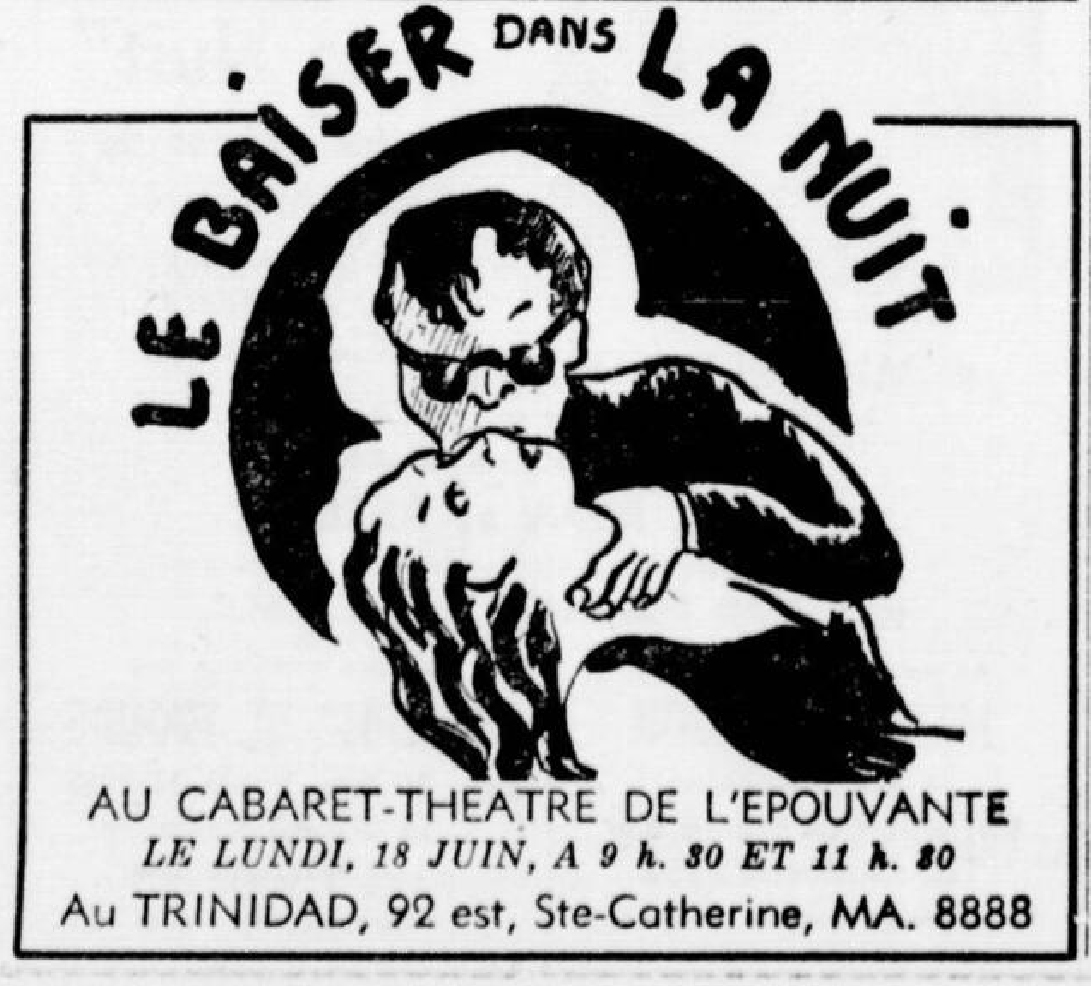


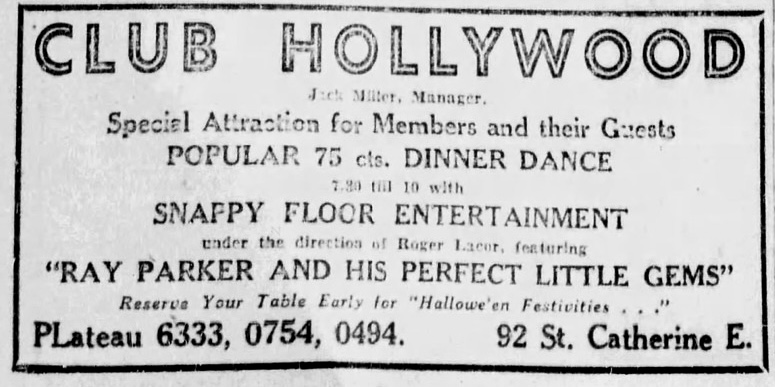


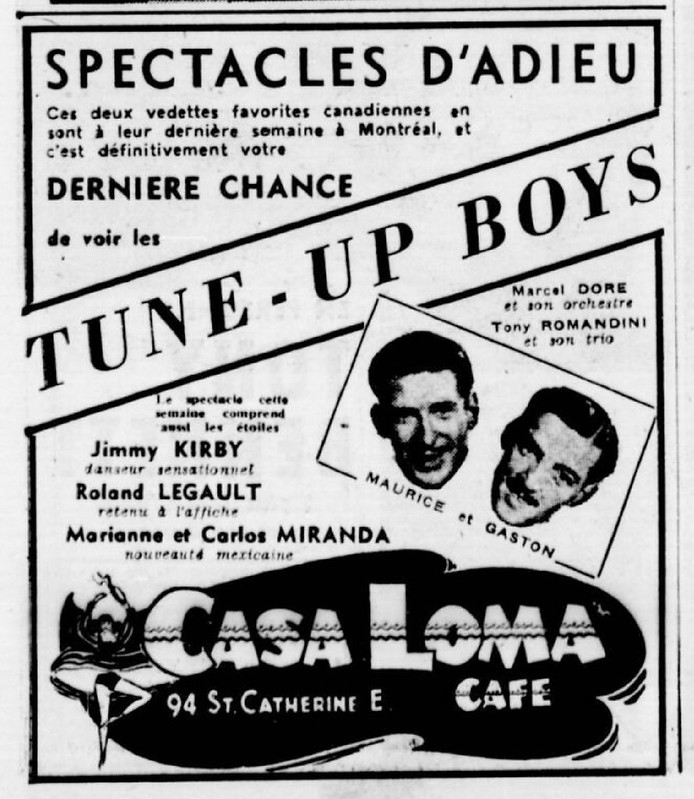


 Jean Simon, Dimanche-Matin, September 18, 1960.