Chez Bozo (Montreal)
Chez Bozo was a Montreal boîte à chansons founded in 1959, located on the upper floor of the Restaurant Lutèce, at 1208 Crescent Street, in downtown west Montreal. The venue played a structuring role in the emergence and dissemination of modern Québécois song in the late 1950s, particularly around the informal collective known as the Bozos. It is also documented as a hybrid space, occasionally hosting jazz evenings and jam sessions, as well as a site for the material memory of performance through its famous wall of artists’ handprints.
Context and establishment
In the late 1950s, Montreal experienced a profound transformation in its nightlife and cultural practices. On the margins of traditional cabarets, a network of small venues emerged focused on attentive listening to song, where text, interpretation, and proximity between artists and audiences became central.
Crescent Street, already known for its concentration of restaurants and entertainment venues, became one of the preferred corridors for the establishment of these new boîtes à chansons. Chez Bozo fit squarely within this movement, occupying the upper floor of Restaurant Lutèce, following a model that combined dining and performance common in downtown Montreal at the time.
1959: Opening of Chez Bozo
The opening of Chez Bozo was announced in the spring of 1959 in the Montreal press. Articles described a new chansonniers’ venue, explicitly dedicated to French-Canadian singer-songwriters, in an intimate format that broke with large cabaret revues.
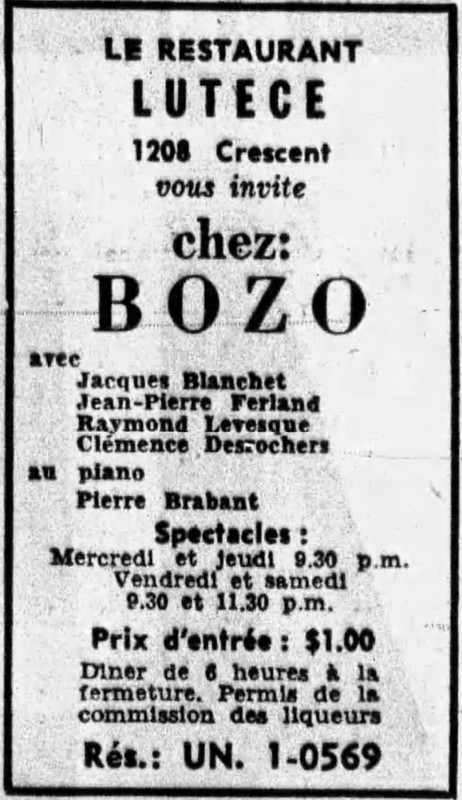
Chez Bozo functioned as the central stage for the informal collective known as the Bozos, founded in Montreal in 1959. Its most frequently cited core included Hervé Brousseau, Clémence DesRochers, Jean-Pierre Ferland, Claude Léveillée, and Raymond Lévesque. The venue also welcomed Jacques Blanchet and other contemporary chansonniers, with regular accompaniment by pianist Pierre Brabant.
Advertisements published between May 1959 and January 1960 mention regular performances, mainly from Thursday to Sunday, with multiple shows per evening and a modest admission price (around one dollar).
The venue and its layout
Reports published at the time of the opening describe Chez Bozo as a small venue with a capacity of approximately 90 seats. The layout was deliberately minimal: a small stage, an upright piano, closely spaced tables, and sober décor, encouraging listening and intimacy.
The walls quickly became surfaces of expression and memory, hosting drawings, signatures, and above all handprints left by performers, transforming the venue into a living material archive of Montreal’s chanson scene.
The Bozos and chanson programming
The programming emphasized original works, in a format that encouraged experimentation, sung speech, and attentive listening, laying the foundations of modern Québécois song.
The Bozos were part of the chansonnier movement that emerged in Quebec in the mid-1950s. Following in the footsteps of Félix Leclerc, these artists promoted a poetically expressive Québécois song that was original, emancipated, and self-assured, presented without artifice in an intimate atmosphere. They regarded song as a full-fledged art form, not merely as entertainment.
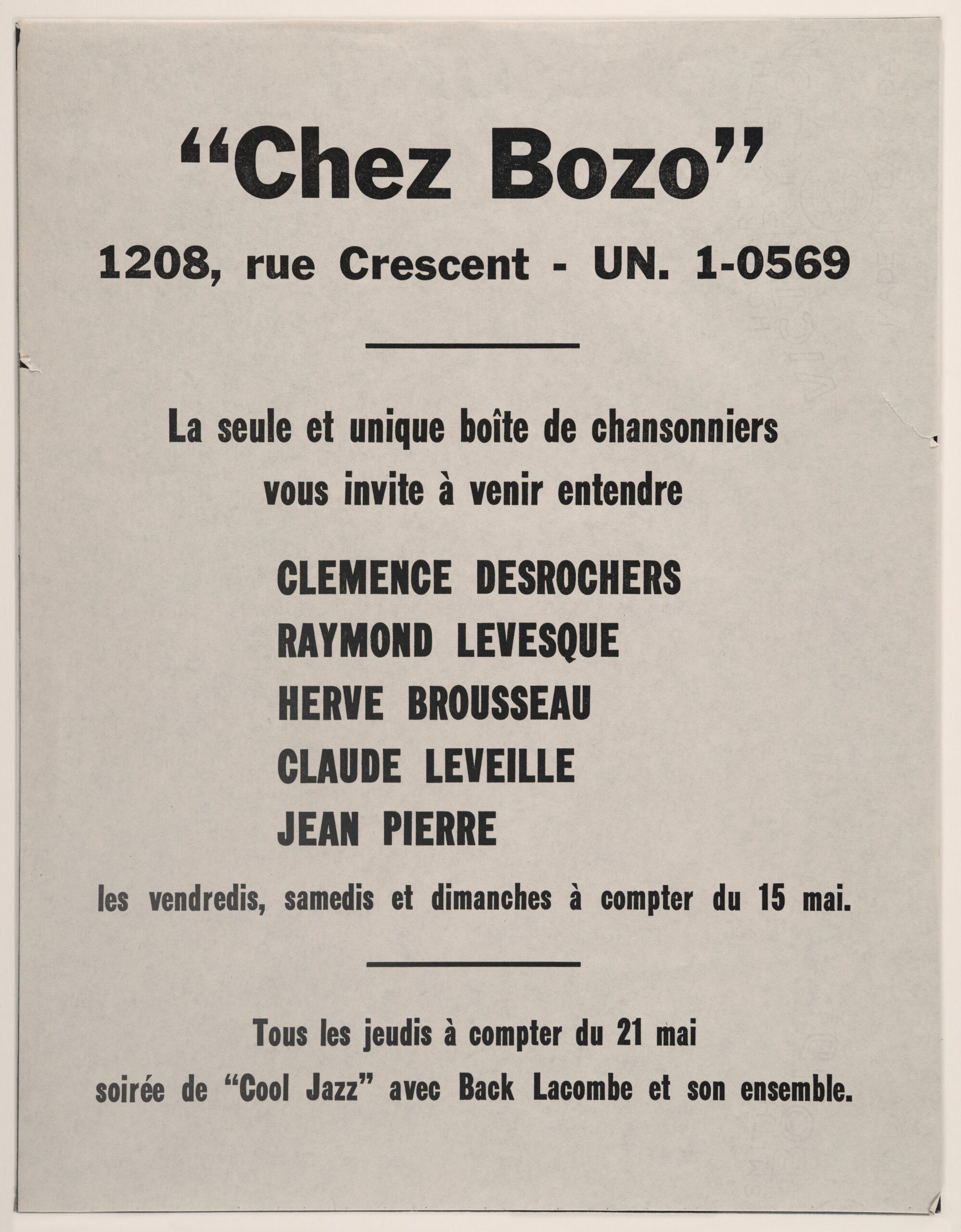
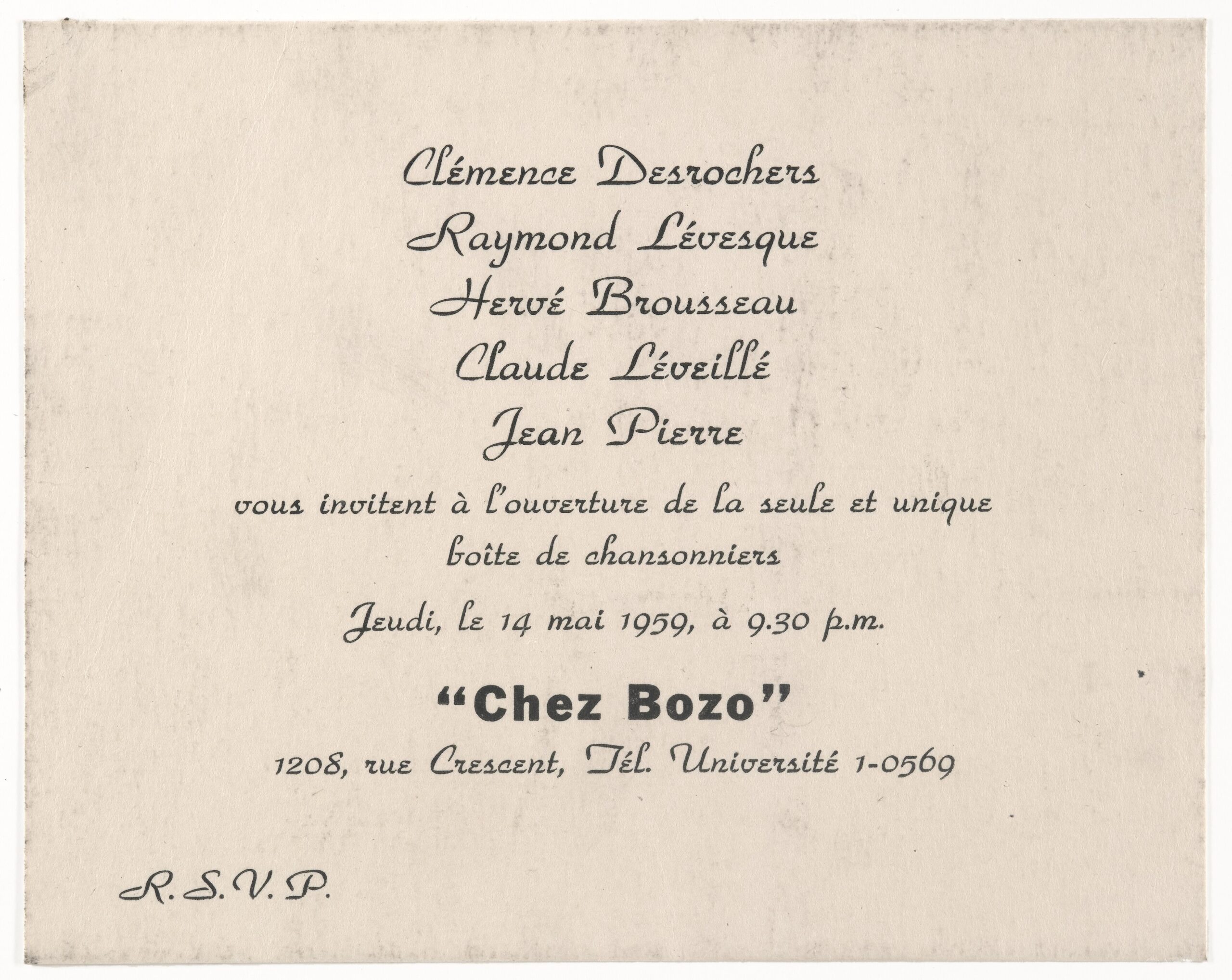
Following the strike by directors at Radio-Canada’s French-language network (December 29, 1958 – March 7, 1959), and the benefit tour organized in support of the strikers, Jean-Pierre Ferland and Hervé Brousseau conceived the idea of joining forces to perform in a venue devoted exclusively to song. They convinced Claude Léveillée, followed by Clémence DesRochers and Raymond Lévesque, to join them.
The collective was named The Bozos, in homage to Félix Leclerc and his famous song. They rented the upper floor of Restaurant Lutèce, owned by Raymond Gaechter, at 1208 Crescent Street. Named Chez Bozo, the 90-seat venue was laid out and decorated by the artists themselves, who purchased the furniture and an upright piano. At Brousseau’s suggestion, they hired pianist André Gagnon as accompanist.
The Bozos performed in a media preview on May 14, 1959. They gave their first public performance the following day. The success was immediate and critical reception generous. Chez Bozo attracted both youth audiences and Montreal’s artistic community. French stars also crossed the threshold of the small venue, including Edith Piaf.
Despite the enthusiasm, financial disputes with the venue’s owner led the Bozos to leave their home in late June 1959. The group subsequently performed at the Théâtre Français, the Baril d’Huîtres in Quebec City, and at the theatre of the Poudrière on Île Sainte-Hélène. Hervé Brousseau was then replaced by Jacques Blanchet.
In the fall of 1959, the Bozos opened the season at Chez son père, then returned to the bill at Chez Bozo at the end of October. They welcomed a new pianist-accompanist, Pierre Brabant. The venue attracted other distinguished visitors, including Yves Montand and Simone Signoret in December 1959.
At the beginning of 1960, the Bozos were still performing on the second floor of Restaurant Lutèce. Paul de Margerie was now the pianist-accompanist. The group then performed at the Café André. Jacques Desrosiers replaced Raymond Lévesque, while Jean-Claude Deret joined the collective on a temporary basis.
During the summer of 1960, the Bozos undertook a tour of boîtes à chansons, including the famous Butte à Mathieu, in Val-David. Its founder, Gilles Mathieu, had previously attended a performance at Chez Bozo. Fascinated, he chose to import its model north of Montreal.
From the fall of 1960 onward, the Bozos gradually devoted themselves to their individual careers. They reunited one final time at the request of Radio-Canada to host a series of summer broadcasts in 1962.
When the Bozos officially disbanded at the end of that tour, Quebec was in the midst of cultural ferment. Under their influence, the chansonnier became firmly established as the dominant figure on the Québécois music scene, and boîtes à chansons multiplied across Quebec.
Chez Bozo as a transatlantic crossroads: Edith Piaf and the path to Paris (1959–1960)
In the summer of 1959, several Montreal press articles explicitly identified Chez Bozo as the place where Edith Piaf discovered and closely observed the new generation of Québécois chansonniers. Far from a mere social visit, the texts describe an attentive, repeated, and decisive presence, placing the venue within a network of artistic circulation between Montreal and Paris.
An article in Le Petit Journal dated June 21, 1959 states that Piaf, charmed by Canadian chansonniers, chose to actively support Claude Léveillée, whom she brought to Paris, guaranteeing him professional visibility, recordings, and access to French publishing networks. The text explicitly situates this discovery within the context of evenings at Chez Bozo, presented as the site where the decisive encounter took place.
A few days earlier, another report in Le Petit Journal (June 14, 1959) documents an exceptional evening at Chez Bozo, bringing together Clémence DesRochers, Jean-Pierre Ferland, Claude Léveillée, and Edith Piaf herself, who attended incognito. The article describes an atmosphere of attentive listening, in which Piaf commented, encouraged, and publicly validated the international potential of these artists.
These contemporary sources make it possible to state that Chez Bozo was not merely a local stage, but a transatlantic crossroads, where the passage of emerging Québécois song toward the Parisian scene was concretely effected. The venue thus played a structuring role in the internationalization of modern Québécois song, not through retrospective discourse, but through documented facts as early as 1959–1960.
Jazz, jam sessions, and hybrid uses
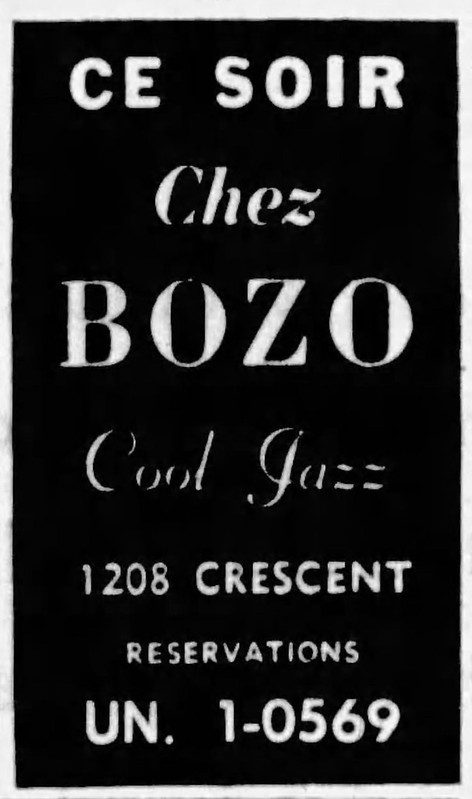
Although primarily identified as a boîte à chansons, Chez Bozo also hosted events related to jazz. Some advertisements from 1959 explicitly used the term “Cool Jazz,” signaling stylistic openness beyond the strict chanson repertoire.
In January 1960, the Montreal Jazz Society organized weekly jam sessions at Chez Bozo, notably featuring guitarist René Thomas and guest musicians, confirming the venue’s polyvalent use and its integration into Montreal’s jazz network.
The handprint wall and material memory
Chez Bozo is historically associated with a ritual consisting of leaving handprints and signatures on the venue’s walls, a practice documented as early as 1959. This wall quickly became a symbol of the venue and of the community spirit of the chanson scene.
A report published in 2025 in La Presse and relayed by CTV News Montreal indicates that this handprint wall, long presumed lost, was rediscovered during renovation work in a building linked to the former site. The identified handprints reportedly include those of several major figures of Québécois song and of international artists who frequented Chez Bozo in the late 1950s and early 1960s.
Cultural legacy
Chez Bozo occupies a central place in the history of Montreal’s boîtes à chansons. Through its intimate format, its focus on the singer-songwriter, and its role as an artistic laboratory, the venue helped structure a new culture of song in Quebec.
Its legacy extends beyond its brief period of activity: it is inseparable from the emergence of major figures in Québécois song and from the creation of a material memory of performance, of which the handprint wall now constitutes one of the rare tangible remnants.
Notes & sources
-
LE DEVOIR, May 15, 1959 — announcement
“Opening of Chez Bozo” (1208 Crescent Street, upstairs at Restaurant Lutèce).
MCPA use: dating of the opening, identification of the address, explicit association with Restaurant Lutèce, and definition of the venue as a “boîte à chansonniers.” -
LA PRESSE, May 16, 1959 — opening feature (description of the venue).
MCPA use: description of the layout, intimate atmosphere, and capacity (≈ 90 seats), decorative elements, and staging of the “boîte à chansons” model. -
LE DEVOIR, June 3, 1959 — article
“Five Chansonniers at Chez Bozo.”
MCPA use: documentation of the chanson-oriented programming and the positioning of the venue in the emergence of modern Québécois song (format, artists, reception). -
LE DEVOIR, May 28, 1959 — advertisement
“This Evening at Chez Bozo — Cool Jazz” (1208 Crescent).
MCPA use: evidence of hybrid use (jazz) as early as 1959, beyond the strict chanson repertoire; advertising vocabulary (“Cool Jazz”) and musical positioning. -
LE DEVOIR, October 29, 1959 — performance announcement
(Clémence DesRochers, Raymond Lévesque, Hervé Brousseau, Jean-Pierre Ferland, Jacques Blanchet;
piano: Pierre Brabant).
MCPA use: confirmation of the resumption/continuity of the bill in fall 1959, composition of the core group of artists, and identification of the accompanist at the piano. -
LE DEVOIR, December 3, 1959 — advertisement
(schedules and reservations: UN. 1-0569).
MCPA use: documentation of operating hours, booking practices, and practical modalities of the venue (period of activity, frequency of performances). -
LE DEVOIR, January 19, 1960 — article
“Jam Sessions at Chez Bozo” (Montreal Jazz Society; René Thomas).
MCPA use: direct evidence of weekly jam sessions and of Chez Bozo’s integration into Montreal’s jazz network; identification of organizers and an associated musician. -
LE PETIT JOURNAL, June 14, 1959 — article
“Clémence DesRochers’ Success in Paris Is Assured (Edith Piaf).”
MCPA use: contemporary documentation of Chez Bozo as a venue observed by Edith Piaf and as a space of validation and visibility within a Montreal–Paris circulation context. -
LE PETIT JOURNAL, June 21, 1959 — article
“Edith Piaf Takes Claude Léveillée from Us!.”
MCPA use: contemporary source on the Piaf–Léveillée episode and the “passage to Paris,” explicitly anchored in the context of evenings at Chez Bozo (1959). -
LE DROIT, January 22, 1960 — article
“The Bozos at Music-Hall.”
MCPA use: contextualization of the collective’s activity at the turn of 1960 and identification of programming movements outside Chez Bozo (transition and diffusion phase). -
CTV NEWS MONTRÉAL, 2025 — report
“Mural displaying handprints of artists who performed at Chez Bozo has been found”
(date to be specified).
MCPA use: contemporary documentation of the rediscovery of the handprint wall associated with Chez Bozo, its state of preservation, the context of renovation work, and media identification of the artifact. -
LA PRESSE, December 17, 2025 — article
“The Bozos’ Treasure Rediscovered After 65 Years.”
MCPA use: journalistic synthesis on the rediscovery of the handprint wall; inventory elements, identification of artists, and heritage recontextualization of the artifact. -
BIBLIOTHÈQUE ET ARCHIVES NATIONALES DU QUÉBEC (BAnQ), 1959–1960 —
iconographic corpus (digitized advertisements and articles: Le Devoir, La Presse).
MCPA use: visual evidence (ads, notices, articles) for precise dating of activity, programming, schedules, and address (1208 Crescent / Restaurant Lutèce). -
GIRARD, Mario, 2023 —
Clémence: Once Again, Montreal, La Presse, 312 p.
MCPA use: biographical and historiographical context on Clémence DesRochers, and narrative markers situating Chez Bozo within the trajectory of chansonniers in 1959–1960. -
TÉZINE, Anne-Marie, 2002 —
“From Quebec to France: Georges Dor, Jacques Canetti and the Challenge of a Career in Paris,”
Interdisciplinary Journal of Canadian Studies in France, vol. 93, pp. 59–77.
MCPA use: analytical framework on Quebec–France cultural circulation and networks (publishers/impresarios), useful for contextualizing the “passage to Paris” axis associated with Chez Bozo. -
TROTTIER, Danick, 2014 —
“The Memorial Evocation of Quebec’s Boîtes à Chansons: When the Canon Becomes an Accomplice of Nostalgia,”
Journal of Popular Music Studies, vol. 11, no. 1, pp. 99–113.
MCPA use: historiographical and methodological contribution on the memory of boîtes à chansons, useful for framing retrospective narratives and processes of heritage-making (including the handprint wall).