Chronicles of a Scene — Montreal 1990–2020
Rockweiler — Local Catalyst
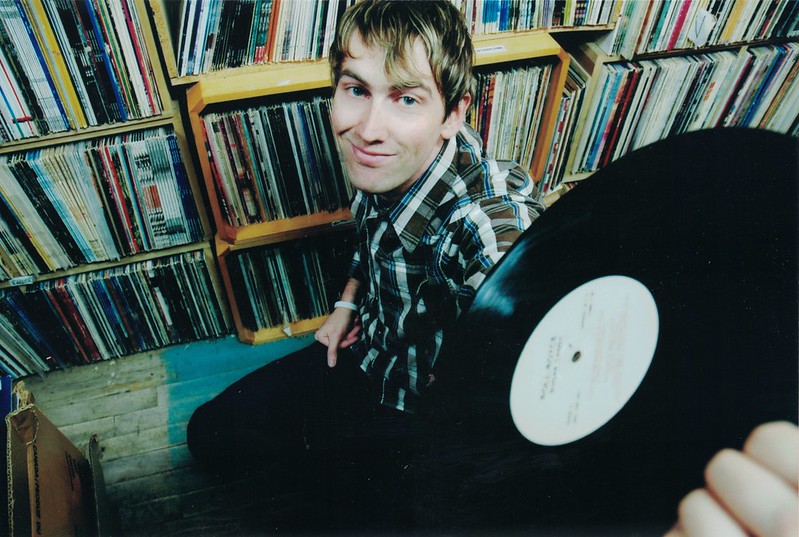
In the mid-1990s, Musique Rockweiler became one of the driving forces of the emerging punk scene in Montreal’s North Shore. For Jean-François Hayeur, who was working there as a record clerk, the shop was far more than a simple retail space: it was a laboratory, a meeting point, a springboard.
It was there that he personally booked the band GOB in Saint-Eustache, bringing one of Canada’s key skate-punk groups to the region. The concert was held in a small room next to the store: a modest library. Tables and chairs were pushed aside to make room for the music, turning the space — for one night — into a genuine improvised concert hall.
The event left a strong impression: for many young people, it was the first time a national-level band of that stature had played in their town.
This initiative illustrates Jean-François’ direct involvement in developing the regional scene.
Punk Videos — Camera in Hand
In the mid-1990s, as the North American punk and hardcore scene was expanding rapidly, Montreal stood out as a particularly fertile and enthusiastic stop for emerging bands. At the heart of this dynamic was the discreet but essential work of Jean-François, a young self-taught videographer armed with a handycam — still a rare object in 1993.
Filming his high school friends — skaters, snowboarders and musicians — quickly led him to document their shows, notably those of Enough, a local hardcore band from Saint-Eustache, and Foreground, a hardcore group from Terrebonne. Almost by accident, he captured a foundational moment: on June 14, 1994, Enough and Foreground opened for No Use For A Name at the Woodstock venue in Montreal. This show marked the first performance in Montreal by a band on the Fat Wreck Chords label, a cornerstone of what would become a special relationship between the city and the Californian punk scene. JF filmed the concert.
Promoter Paget Williams (Greenland Productions) quickly noticed the quality and passion in his footage. He invited him to film other shows he produced, notably Lagwagon at the Woodstock venue on October 4, 1994. Then, just one month later, on November 15, 1994, came a decisive moment: JF managed to film NOFX at the Spectrum, in full — onstage and backstage — after being personally escorted to the door by Fat Mike, the band’s leader, who insisted that the young videographer be allowed to work freely despite security’s reluctance.
The trust placed in him by the artists laid the groundwork for a unique system: Jean-François became the unofficial videographer of the Californian punk/hardcore scene whenever they passed through Montreal. His footage would resurface years later in several documentaries.
What made his role even more singular was the way he treated these archives. After each tour, when the bands came back to town, JF would hand them a VHS copy of their previous performance. Often he even prepared a VHS compilation gathering several concerts he had filmed since their last visit — a free gesture, driven by passion, that then circulated among musicians, crew members and friends.
In many cases, bands asked for more than one copy so they could bring them back to their families or friends in California. Many reported that their Montreal crowd was the most intense of the entire tour — more enthusiastic than in Toronto, New York or even their hometown. These videos became a living testament to the strength of the Montreal audience, which the musicians proudly showed to their loved ones.
- The bands asked to be filmed.
- Promoters like Paget Williams encouraged JF to keep going.
- The videos circulated on tour buses between cities and tours.
It was an entirely organic ecosystem, with no commerce and no formal network. Jean-François never sold or traded these tapes. Their only value lay in cultural transmission: they documented, they connected, they travelled. They built bridges.
Through this practice, JF helped — without even realizing it at the time — to shape Montreal’s image as a welcoming, passionate, responsive, vibrant punk city. His video archives, a raw insider’s gaze, became an invisible but fundamental part of that myth.
Later, bands would testify that Montreal was a special stop on the road — a place where the crowd reacted intensely, where the venues crackled with energy, where they felt at home. The hundreds of JF’s VHS tapes, passed from hand to hand on tour buses, without fanfare, played a major role in that perception.
Filming his friends became filming the bands he admired. And filming the bands became a structuring gesture for a scene that only existed through the actions of those who lived it. This articulation — skateboarding, friendship, punk, video, trust — lies at the heart of Jean-François’ trajectory, long before he became a music programmer, archivist or cultural historian.
Punk Empire — The Videozine
As the months went by and more and more footage piled up — concerts, spontaneous interviews, tour snippets —, Jean-François began to glimpse a creative potential that went beyond simply handing VHS tapes back to the bands. The idea gradually took hold: what if he turned this documentary material into a video magazine, a “videozine,” a DIY object true to the punk spirit, bringing together on a single tape live performances, conversations, backstage moments and testimonies? Thus PUNK EMPIRE was born.
Alongside his filming, Jean-François maintained a special relationship with several of his favourite artists: he regularly wrote them letters and postcards, keeping alive an intimate correspondence tradition. Among these exchanges, one of the most striking remains his relationship with his role model Ian MacKaye (Fugazi, Minor Threat), whom he met in person and has corresponded with from 1995 right up to today. This epistolary relationship — rare, humble, faithful — deepened his understanding of the scene, the DIY ethic, and the deeply human dimension behind the music he documented.
The project, ahead of its time, required one essential condition: finding interlocutors capable of interviewing bands in both English and French — naturally, directly, without filters. JF recruited two accomplices: Matt Pearlman and Andy Mak, both fully bilingual, passionate about music and comfortable in front of the camera. Their contribution proved decisive: they became the faces of the project, giving structure and coherence to the interviews. With them, PUNK EMPIRE moved from a simple idea to an actual production.
A first studio editing session was organized. The goal: to assemble roughly an hour-long tape mixing live performances, clips shot in Montreal venues, interviews conducted by Matt and Andy, and a selection of music videos. For this last element, JF drew on the emergence of the independent label 2112 Records, founded by Paget Williams (Greenland Productions), with whom he already had a relationship of trust. The videozine therefore included music videos by artists associated with 2112 — notably Men O Steel, Reset, Ten Days Late, Shades of Culture, along with other local bands on the rise.
At that time, MusiquePlus did broadcast Claude Rajotte’s alternative show, but television coverage remained limited for emerging punk, hardcore, indie, skatepunk or alternative rap scenes. Réjean Laplanche’s show 1-2-3 Punk would only appear later; for the moment, no Montreal media outlet truly reflected the punk energy of the time. PUNK EMPIRE stepped in to fill that gap, with whatever means were available — typically punk.
In total, 500 VHS copies were produced. The spirit of the project was never commercial:
- 450 tapes were distributed for free, mainly at concerts;
- around fifty were sold for $5 — a symbolic price — to recoup part of the costs.
The feedback was positive: the bands appreciated the visibility, fans recognized themselves in this raw, unfiltered, authentic artefact. But the production costs — particularly studio editing at a time when home digital editing was still out of reach — were prohibitive.
JF and his team nonetheless had enough material for a Volume 2: the footage existed, the content was there, and the bands were on board. But the money was not.
Without grants, without institutional support, without a commercial mechanism to reinvest, production stopped. PUNK EMPIRE, Vol. 2 would never see the light of day on VHS. The project remains a milestone, however: visionary, fully independent, it documents a flourishing scene at a time when the media were only marginally interested in it. It bears witness to a desire to transmit, to connect, to archive — a profoundly DIY gesture, driven by passion, friendship and the conviction that these stories deserved to be preserved.
At that time, Jean-François himself was living in a 2112 punk house on Prud’homme Street in NDG, a door away from Paget Williams (Greenland Productions) and Orion Curiel (Shades of Culture). One of his roommates, Curtis Creager — former bassist of SNFU — once showed him how to cook a proper spaghetti sauce, all while they blasted reggae throughout the apartment. Living in a punk building definitely had its perks!
On October 27, 1995, Green Day played a sold-out show at the Montreal Forum. The concert was organized by his neighbor Paget Williams (Greenland Productions). Jean-François had hoped to film the show, but since the evening was a co-production with Donald K. Donald, Paget ultimately could not grant him permission. He therefore arrived at the Forum’s staff entrance without his video camera. There, almost by chance, he ran into two friends from the Dawson College student radio station, Dominique Pampin and Thibault Duchesne, who already knew the band. A few moments later, bassist Mike Dirnt appeared and handed out backstage passes — including one to Jean-François. That is how the three of them ended up in Green Day’s dressing room. Shortly afterward, Billie Joe Armstrong and Tré Cool came in as well and shared a few drinks with them. The atmosphere was relaxed, almost surreal for a 19-year-old.
At one point Billie Joe said, “Do you want to see something funny?” Everyone agreed. He then led them through the backstage corridors of the Forum to the area behind the stage. The concert had not yet started and the arena — already nearly full — was buzzing with anticipation. Billie Joe asked one of them to walk onto the stage: “Go on… raise your arms!” Their friend did exactly that. Instantly, the crowd erupted in cheers, convinced the show was beginning. But it was only a prank. The band watched the scene laughing before disappearing back into the backstage area. At the time, seeing a punk band fill a hockey arena was still highly unusual: the last time a band of that kind had played the Forum had been The Clash in the early 1980s. That night the venue was packed, The Riverdales opened the show, and Jean-François found himself at the heart of this moment in history — witnessing the peak of 1990s punk rock from inside the band’s dressing room.
C’Dément — The Crossroads
At the same time, in the heart of Montreal’s 1990s music scene, C’Dément established itself as one of the city’s most dynamic and influential record stores. The business was run by Roger Beï, a formidable businessman from Lyon, who also owned Librairie La Bourse. Thanks to this direct link between Montreal and France, C’Dément became a transatlantic crossroads where international new releases and cutting-edge local productions circulated side by side.
It was in this context that Jean-François joined the team. He introduced a consignment system for CDs, allowing local bands to offer their music in the store without paying listing fees — a direct boost to independent artists. Thanks to the store’s very high ceilings, he displayed these consignment CDs all over the walls, creating a spectacular effect that immediately caught customers’ eyes and showcased the local scene. He also set up in-store concert ticket sales, placing C’Dément at the heart of the live ecosystem. That’s why the name “C’Dément” appears on so many posters.
Passionate about the punk and alternative scene, he sold impressive quantities of punk records. Sent to France three times, he helped open CD Corner (Paris) in 1999.
In Paris, he literally lived above the CD Corner shop, in a micro-apartment as tiny as the boutique itself, accessible only by a narrow spiral staircase hidden in the back room. To watch television at night, he had to go back down into the darkened shop — and during one of those descents, he suddenly found himself face-to-face, or rather window-to-window, with singer Jacques Higelin, who was pressing his partner’s breasts up against the storefront window, unaware that beyond the reflection in which they admired themselves, someone was watching from just a few centimetres away.
During his stay in Paris, Jean-François also became friends with a young Parisian punk, as passionate as he was. The young man came to eat lunch at the shop almost every day so they could talk about music, fanzines and concerts. Proud of his own fanzine, he even took him on a visit of the Sorbonne, where he studied. Later, JF would learn that this young friend had died suddenly of meningitis — a tragic and cruel loss, as he was far too young to die.
At the turn of the year 2000, Jean-François rang in the new millennium at the foot of the Eiffel Tower with his colleague and roommate Yan, his brother Lionel and their friends. The Iron Lady, lit by a spectacular shimmer to mark the arrival of the new millennium, pulsed with golden and bluish light, as if breathing in time with the ecstatic crowd. All around them, the ground was completely carpeted with empty champagne bottles: it was impossible to take a step without crushing one under his shoes. A surreal and typically Parisian scene — joyful uproar, shouts of celebration, the scent of partying, and above them all, the hypnotic flicker of the Eiffel Tower dominating the winter night like a lighthouse of the new millennium.
During his stay in Paris, Jean-François moved “tons” of releases from the labels Stomp and Indica, directly contributing to the reach of the Montreal scene in Europe. Thus, the history of C’Dément — and CD Corner — is inseparable from his involvement: consignment for local artists, in-store ticketing, the growth of punk sales, exporting Stomp/Indica, and the Montreal–Paris bridge. Several coworkers from that era would go on to become key figures in the cultural landscape: Philippe B (award-winning singer-songwriter), Chuck Comeau (Simple Plan), Vincent Lemieux (co-founder of MUTEK), Gary Tremblay (future owner of jazz club Diese Onze) and Jean-Sébastien Raymond (future owner of the bookstore Volume), among others.
Sam the Record Man — Between Two Worlds
After C’Dément, Jean-François literally crossed the street to join Sam the Record Man. Versatile, he worked in every department (rock, jazz, classical, world, francophone), but the chain was in decline, caught between the digital shift and competition from big-box stores.
It was especially in the jazz department, during slower moments, that he deepened his knowledge of the genre: he read practically the entire Penguin Guide to Jazz, a monumental reference work. Those hours spent among the shelves gave him a solid grasp of jazz history, essential discographies and the great masters of the genre.
In this tense climate, Jean-François remained a motivated record clerk, passionate about music and committed to his job. By contrast, several Sam the Record Man employees were demoralized: their stagnant working conditions and a salary that had not changed in years — reflecting an already struggling record market — fuelled a widespread sense of weariness. On sunny days, it was common for colleagues to “call in sick,” and Jean-François often found himself filling in at the last minute in other departments to keep things running.
Despite everything, he suggested improvements — including a now-famous memo: “How to Renovate an Entire Department with a Single Screwdriver.” His enthusiasm stood in stark contrast to the prevailing fatigue, but Jean-François could clearly see that the end was near for Sam the Record Man: the market was changing, sales were falling, and the old energy was gone. Sensing the decline, he chose to continue his music path at Musigo.
Musigo — Consignment as an Answer
After Rockweiler, C’Dément and Sam the Record Man, Jean-François joined Musigo, a new banner born from the rebranding of the former Polyson stores — a chain historically rooted in the regions, whose offering mainly targeted the general public. But downtown Montreal, this DNA clashed with a more cutting-edge musical environment shaped by alternative weeklies Voir, Ici, Mirror and Hour.
One of the major problems was the back catalogue: Musigo bought huge quantities of mainstream titles (Céline Dion, Diana Krall) and even pyramids of Elton John’s single Candle in the Wind — a profitable strategy in the regions, but completely out of step with a downtown clientele hungry for new releases, emerging artists and independent productions.
Despite Jean-François’ repeated recommendations, the albums featured in the alternative press never made it onto Musigo’s shelves. Frustrated, he decided to build a parallel solution.
At the Faubourg Sainte-Catherine branch, he set up, with no prior model, a vinyl consignment system. He contacted his friends on the local scene — Stomp Records, Soundcentral, Beatnick, Tabou, L’Oblique, etc. — and proposed a new kind of partnership: they would place their records in the store in exchange for visibility and distribution. In return, Musigo gained a rich, constantly renewed alternative inventory.
The records were placed in full view, in a dedicated display, along with the business cards of the participating stores. Sales were immediately strong — irrefutable proof that the downtown clientele was receptive to an independent offer. Each week, JF went back to see the record shop owners with an envelope full of cash, picked up new stock and replenished the shelves.
This system inaugurated a form of coalition between independent record stores and a commercial chain: sharing information about new releases, circulating stock, mutual support and cross-promotion. The success was such that he proposed to Stomp that the model be expanded across the entire Musigo chain in Quebec — and they agreed.
Also working in the backstore was the owner’s son, Gregory Paquet, who regularly strummed his guitar. JF gently encouraged him to get more involved in the store rather than playing in the back — but fate had other plans: Paquet would go on to form The Stills, whose debut album, Logic Will Break Your Heart, became a Montreal indie classic of the early 2000s.
Another young employee who passed through Musigo before finding success was artist Waahli, future member of Nomadic Massive. Even then, he was already honing his sense of rhythm and musical identity, well before emerging on the Montreal hip-hop scene.
But in the early 2000s, the industry collapsed: Napster, Audiogalaxy, KaZaA, the arrival of the mp3. The record store model fell apart, and Musigo went bankrupt.
As closure loomed, Jean-François rushed to return all the consigned inventory to its owners — before the bankruptcy trustee could seize it — a final rescue gesture to protect the independent shops involved.
“The beginning of a grey cloud over the record industry — the digital era.”: the digital transition marked the end of a world where the record store was a cultural crossroads, a social hub, a place of discovery.
Beatnick — The Vinyl Revival
Spotted by Nick Catalano, a true “godfather of vinyl” — a sort of Indiana Jones of records —, Jean-François quickly became his right-hand man. He accompanied the vinyl revival by introducing contemporary artists (Radiohead, Franz Ferdinand, Arcade Fire, The White Stripes…). In 2003, The Gazette used his photo to illustrate the return of vinyl.
In the back store, with Nick, he took part in the rise of online sales: nearly 40,000 records listed (Gemm, eBay, then Discogs), while Spike and Jimmy handled the front of the store. He became a jazz specialist, personally selecting the titles displayed on the shop walls and advising customers, helping shape the taste of many collectors.
His role, however, went beyond the four walls of the shop. Alongside Nick, he helped run the Salon du Disque, an event bringing together collectors, sellers and enthusiasts. Together, they travelled from Montreal to Ottawa — car packed with crates of records — to sell their stock at regional fairs: a form of itinerant prospecting, at the crossroads of business, adventure and musical archaeology.
Driven by the idea of opening his own shop, he went back to study management at HEC Montréal, a prestigious French-language business school and one of the oldest and most respected management schools in Canada. But the broader context — the collapse of the record industry, the rise of digital — pushed him, after graduation, towards technology, paving the way for his move to TouchTunes.
TouchTunes — Programming at Scale
After several years in the record store world — Rockweiler, C’Dément, Sam the Record Man, Musigo, Beatnick — Jean-François took the leap into music technology by joining TouchTunes, a company specializing in digital jukeboxes deployed in bars and restaurants.
He joined an exceptional team of programmers in the music department, which he quickly came to see as the most stimulating environment in the company. It marked the beginning of a real career. When he arrived, the musical selection on the jukeboxes was still relatively limited, dominated by commercial Best Of or Greatest Hits compilations.
Keen to enrich the catalogue, he wanted programming to cater both to mainstream tastes and to the most discerning listeners. He dreamed of a jukebox where you could just as easily hear pop classics as discover punk, metal, jazz, blues, soul, progressive or psychedelic rock.
In reality, the process of integrating new music was demanding: each work had to go through a long cycle of selection, rights clearance, technical processing and validation before being made available on some 40,000 jukeboxes across Canada, the United States and Mexico. As part of his role, he had to monitor the charts — especially Billboard — in order to prioritize key tracks and ensure that no major trend slipped past him.
Driven by passion, he used his lunch breaks to broaden the catalogue, quietly adding thousands of essential titles from punk, metal, jazz, blues, soul and progressive rock. He spent six years at his computer fine-tuning the selection, convinced that the jukebox could and should reflect a musical diversity richer than what radio sales alone dictated.
This editorial work came down to deciding which works deserved to be introduced, kept, or removed from the network: a delicate balance between commercial efficiency, cultural diversity and local relevance. If a customer heard Californian punk in a Hollister store in Texas, Southern Soul in a Detroit bar or Eminem in a TGI Fridays in Boston, there was a good chance it was thanks to him — or his fault !
However, TouchTunes went through a period of internal change: the constantly evolving company increasingly favoured financial imperatives and R&D over the depth of its music catalogue. Management shifted, priorities moved, positions were eliminated. In this context, the music curation work he carried out with such passion remained largely under the radar, without receiving its due recognition — despite the music department director calling him TouchTunes’ “unsung hero.”
This period of disillusion led him to reflect on his professional future. Rather than settling into discomfort, he chose a bold reorientation. In 2011, he went back to school to study film and television production at Institut Grasset. For him, this return to the classroom was a way to reconnect his musical experience, his eye for images, and his desire to tell stories differently.
His time at TouchTunes thus marked a turning point: a transition between the world of records and that of digital technology, while paving the way for his future work in production, visual documentation and cultural archiving.
Institut Grasset — Returning to Video
First love: video. It was after being invited to document, in the Eastern Townships, the studio recording of the acoustic project of the American singer — a true legend — Dave Smalley, that he decided to return to film school. Back at Institut Grasset, he carried a precise dream — becoming a live-concert video director — and gathered the strongest members of his cohort to form a team that would become All Access Productions. Classroom training stimulated him little, so he created parallel projects and brought his classmates with him into the field.
Their first major achievement: filming Sam Roberts Band at Métropolis. The result, a professional multi-cam, impressed their teacher the very next day and was uploaded to the band’s official channel. A series of notable shoots followed: Vulgaires Machins, Marie-Pierre Arthur, The Joy Formidable, Milo Greene, Teenage Bottlerocket, and an official series for Simple Plan that would surpass 3 million views on YouTube.
In his team, one essential ally: Louka Boutin, a technical wizard with whom everything seemed possible. The following year, Louka was already in Cannes for his own projects. For their final-year project, they shot a short film in New York on Rhapsody in Blue, featuring a cameo by Peter Hale, former assistant to Allen Ginsberg.
The film, favoured to win first prize at the end-of-year gala, would never be judged — the gala was cancelled after tensions between teachers and students. Despite these achievements and this whirlwind journey, making a living from video proved difficult.
Craig Morrison — Roots of Rock & Invisible R&B
In parallel, Jean-François took private courses on the roots of rock & roll with ethnomusicologist Craig Morrison, within a small circle of enthusiasts gathered at the home of Steven Morris, a former NFB director.
Many of the participants in these sessions would later become key figures in Montreal’s cultural community. Over time, Morrison and Morris became close friends of his family.
Thanks to Craig Morrison’s erudition and remarkable network, Jean-François met important figures in rock history, including Robbie Krieger (The Doors), Micky Dolenz (The Monkees), as well as members of Herman’s Hermits, among other influential musicians.
He then continued his artistic collaboration with Morrison by filming several editions of Roots of Rock & Roll at the Oscar Peterson Concert Hall, helping document this annual event, which had become essential.
It was in this context that the figure of Vann “Piano Man” Walls resurfaced, a legendary pianist associated with Atlantic Records and considered one of the architects of the modern R&B sound. Living in Montreal since the 1960s, Walls had been forgotten — to the point where many believed he was dead.
Morrison found him again after an appearance at the Montreal International Jazz Festival alongside Dr. John, then invited him to one of his classes, bringing his story back to life.
Fascinated by this rediscovery, Steven Morris set out to devote a documentary to him — a project that would ultimately span nearly 20 years. During one of the interviews, Walls mentioned that he hoped to record one last album as a bandleader. Morris responded by booking studio time, and over the course of two days, Walls teamed up with Montreal’s Stephen Barry Band to record what would become his final CD, In the Evening. Released in 1997 and produced by Morris and René Moisan, the album earned a Juno Award nomination in the “Best Blues Album” category. That same year, Walls was also honoured with a Pioneer Award from the Rhythm and Blues Foundation. Jean-François accompanied Morris at the end of this adventure, notably by documenting the film’s world premiere at the Festival du Nouveau Cinéma in Montreal as well as its American premiere at a festival in Memphis.
This formative experience immersed him in a project where archiving, the social history of music and documentary cinema intersected — an essential precursor to his current approach to Montreal’s cultural memory.
SODRAC & Upstairs — Jazz as a Springboard
Fresh out of Institut Grasset, Jean-François steps into the world of copyright at SODRAC, becoming a licensing agent behind the scenes of major television productions. He watches, almost from the wings, as music rights are cleared for shows like Star Académie — moments when performers hope to sing a Céline Dion classic penned by Luc Plamondon. It is a promising start, but life shifts abruptly: the one-year contract ends as his father passes away. The experience shakes him to the core. He pauses, withdraws, and lets the noise of the industry fade into silence. Into that silence steps jazz.
At the Upstairs Jazz Bar & Grill, dim stage lights and the glow of brass instruments become a refuge. Nights spent listening to Barry Harris, Jimmy Cobb, and Harold Mabern ignite something deeper — a pull, a new direction. This room, with its close tables and hushed reverence for improvisation, becomes the centre of his world.
During this period, another door opens. Jean-François films and edits videos for Vânia Aguiar, shooting beauty segments inside the Ogilvie department store. Through her network, he interviews Québec celebrities — Mitsou, Anne Dorval, Virginie Coossa, Patricia Paquin, JP Wauthier, Geneviève Borne — and international models like Karlie Kloss and Sean O’Pry. These encounters lead to a moment that feels almost cinematic: thanks to Coossa, Claude Meunier — “Pôpa” himself from La p’tite vie — arrives at the hospital to visit his father in palliative care. Two weeks before his passing, in a quiet room filled with machines and soft light, his father jokes that he is “a big fan of his wife, Virginie Coossa.” Meunier fires back, with perfect comic timing: “ME TOO!” Laughter cracks the grief for a moment. It is a scene he will never forget — a reminder that kindness sometimes walks into your life like an unexpected cameo.
Back at Upstairs, owner Joël Giberovitch and Chef Juan Barros notice his dedication. Jean-François soon handles the club’s social media, photography, video, and marketing. The pace is relentless — roughly 364 concerts a year — yet each evening feels alive, charged, necessary. He also guides young musicians, helping them shape their presence both onstage and online.
The heartbeat of his journey becomes the Monday night jam sessions, led by drummer Jim Doxas. These nights are magical — a mix of youthful hunger and veteran mastery, sparks flying in real time. He attends every Monday for five straight years, camera in hand, capturing more than 5,000 photographs of fleeting musical alchemy. For him, these nights are not routine — they are revelation.
It is here that he first sees Gentiane MG. Onstage, surrounded by seasoned players, she steps into the music with a calm fire — a hypnotic touch, a voice on the piano that both listens and leads. He knows instantly: she is special.
When Joël asks who should inaugurate the new Tuesday Piano Trio series, he answers without hesitation: Gentiane MG. He helps her shape the foundations of her career — building her website, taking photos, offering guidance, finding an agent. A year or two later, when she is named Radio-Canada Jazz Revelation, it feels less like a surprise than the world catching up.
Upstairs becomes a crossroads for legends. When Benny Golson performs two unforgettable nights, Jean-François translates a review from La Presse for him in person. Golson then signs the iconic framed reproduction of A Great Day in Harlem — a gift Jean-François donates to the club, where it hangs permanently.
He meets saxophonist Azar Lawrence, who once played with the post-Coltrane ensemble. Listening to his stories feels like touching the edges of jazz history. During the concert, Lawrence dedicates a searing performance of Afro-Blue to him. The moment lands like a spotlight — unexpected, overwhelming, unforgettable.
There are others: Jimmy Heath, Albert “Tootie” Heath, Bob Cranshaw; and the honour of introducing Dr. Lonnie Smith onstage, his turban glowing under the lights like a crown.
Even the vinyl records lining the club’s walls come from his personal collection. For a time, he curates them himself — changing them with the seasons, the moods, the stories. The vinyl-record menus too are shaped by his selections. In small ways and large ones, the spirit of the room carries his fingerprints.
Sunwing — Changing Horizons
Exhausted, yet still inhabited by the conviction that life could be reinvented, Jean-François chose to turn a page. His separation from his wife Sarah, though painful, opened up a new space, an unexpected breath. At Sunwing, he became a flight attendant, embracing a job that carried him above the clouds, where the light felt softer and the future once again seemed possible.
He had met Sarah at Beatnick ten years earlier, among record bins and passionate conversations. Their love was nourished by music, curiosity and fertile differences. She, from an Arab Muslim family; he, raised in a Christian tradition he had transformed into a free inner quest. Guided by Krishnamurti, he moved forward with this simple yet vast idea: “Be a light unto yourself.”
Out of love and openness, he approached her world with care. He learned Arabic, read the Qur’an, travelled across Saudi Arabia, visited the mosques of old Riyadh and followed the slow rhythm of the desert, on camelback, under a flawless sky. This journey was not an escape, but an exploration of human beauty, an experience of peace and profound kinship.
Together, they created a space for musical encounters: THE DIY CHANNEL. Their attentive camera gave a voice to key figures such as CJ Ramone, member of the iconic band The Ramones, and James Lowe, singer of the cult garage band The Electric Prunes. In Toronto, they shared a rare backstage evening with Brian Wilson’s band, crossing paths with Mike Love and Al Jardine, all members of The Beach Boys, and watching the stage alongside Jeff Beck, in a vibrant moment of artistic communion. These were precious, suspended instants, bathed in music and friendship.
Life, true to its complexity, later revealed shadows where they had perceived only light. But Jean-François chose above all to hold on to the trace of beauty, the sincerity of those moments when art had gathered souls from multiple horizons.
Sarah left for New York, carried by her own momentum. Their separation was not a violent break, but a gentle parting, tinged with gratitude. Jean-François came to understand that some stories do not exist in order to last, but to light the way.
Sunwing became synonymous with taking off. He flew over the turquoise waters of the Caribbean, felt the warmth of the islands, discovered the kindness of elsewhere. Each destination brought a bit of clarity, a bit of calm, a quiet kind of healing.
Yet beyond those sea horizons, a deeper longing was taking shape: for grounding, for continuity, for a stable movement that connects rather than scatters.
And in the silence between two flights, a new path began to emerge: the rails.
VIA Rail Canada — Finding Balance
At VIA Rail, he started out as a service attendant and then became a Service Manager: comfort, safety, crew management. His unusual schedule — made possible by weekdays off and quiet evenings in hotels during layovers — allowed him to build the Montreal Concert Poster Archive (MCPA): posters, tickets, photos, stories, from every era.
His work recalls that of the National Canadian rail porters of the 1930s, many of whom were also Montreal jazzmen, criss-crossing the country to serve passengers while keeping the music alive. In that spirit, he moved through the train like a musician who must constantly improvise in the face of the unexpected.
Like a jazz musician mid-performance, he had to manage a wide range of situations: medical emergencies, police interventions, collisions with vehicles on the tracks, major delays and journeys extending beyond 12 hours. Each trip became a balancing act where listening, adaptability and creativity mattered just as much as procedure. This reality led him to forge unique bonds with crew and passengers alike, in an atmosphere where each journey wrote its own score.
And every so often, the journey offered an unexpected twist: a celebrity taking the train, a familiar face glimpsed between cars. He never hesitated to walk over and say hello, especially when the traveler was an artist or musician. Many were disarmed — even delighted — to discover that the man now guiding them safely across the province had once lived inside the music world they knew so well. Their conversations, spontaneous and unguarded, became small, shining moments along the rails, reminders that lives sometimes echo each other in the most improbable places.
Those rest periods and quiet hotel evenings became for him a kind of nomadic workshop, ideal for research, writing, and bringing Montreal’s cultural history to light.
Marie-Claude — Home and Legacy
It was during his VIA years that he met Marie-Claude Felton, Ph.D., a historian specializing in the history of the book, in a café in Old Montreal. She holds a doctorate in history and two post-doctorates, with studies carried out notably in Paris, at Harvard, McGill and Oxford. She has also sung as a chorister in several symphonic ensembles, including the Harvard Choir and the Orchestre Métropolitain choir, under the direction of Yannick Nézet-Séguin — an immensely rewarding experience.
Their meeting came just after his return from a trip to Detroit, where he had visited the Motown studios. Standing in that mythical place — steeped in stories, music and humanity — filled him with a positive energy. He sensed, vaguely but strongly, that a happy change was on its way. A few days later, fate stepped in: he met Marie-Claude.
At that time, she had just returned from Seattle and was about to leave for Prague. During their first conversations, he introduced her to the music of Chet Baker: she was immediately charmed — an intimate language they began to share.
Between them, it was love at first sight — intellectually, humanly, emotionally. They immediately felt that they had a great deal to offer one another: passions, knowledge, curiosity, sensitivity, attentiveness. They quickly married and became parents to two adorable children, affirming a simple truth: what matters is not what happens to you, but what you do with what happens to you.
Jean-François would never have imagined that life could become at once so simple and so deeply fulfilling. Together, they learned to reveal one another: he introduced Marie-Claude to jazz clubs, to those dimly lit rooms where a saxophone’s breath melds with the night; she opened the doors of the classical world to him — ballets, theatres and museums where time seems to pause in front of the works.
Among their most beautiful memories, a trip to London and Paris stands out as a shared peak: together they visited the Château de Versailles, the Eiffel Tower, Notre-Dame-de-Paris, the Louvre Museum, le Café de Flore, Le Procope, Victor Hugo’s house, and wandered through the city like one leafs through a beloved book. Both had already lived or studied in Paris at different times in their lives, so this stay felt like a series of reunions — with the city, but above all with themselves.
Marie-Claude plays a decisive role in the maturation of the Montreal Concert Poster Archive (MCPA): she rereads, comments on and enriches many texts, bringing historical rigour, precision, structure and a rare literary sensitivity. Her intellectual and emotional support has become one of the project’s foundations. An extraordinary woman.
The MCPA has thus taken on an intimate dimension: a legacy for their children — to know where you come from, what shapes a life, and how collective memory nourishes personal memory.
Life is beautiful ! Keep the faith ! Live your life as if it’s the best book you’ve ever read !
Memory Rediscovered
In 2026, more than thirty years after he first began documenting Montreal’s punk scene with a handheld video camera, Jean-François saw part of his archives reach an entirely new audience.
That year, Simple Plan released a documentary on Amazon Prime Video chronicling the band’s journey from local basement shows to international success. Several sequences filmed by Jean-François during the 1990s were incorporated throughout the documentary to illustrate the early years of groups such as Reset and Roach, the direct predecessors of Simple Plan.
Invited by Chuck Comeau to attend the Montreal premiere at the Scotiabank Theatre, he reunited with longtime friends, musicians, and collaborators who had shared those formative years. The evening was marked by a mixture of nostalgia, pride, and gratitude.
For someone who had spent years filming concerts without imagining what those recordings might one day represent, seeing his footage projected onto a movie screen was a deeply moving experience.
The occasion served as a powerful reminder of the importance of preserving cultural memory. A poster carefully saved, a photograph tucked away, or an old videotape may seem insignificant at the time. Yet decades later, these fragments of the past can become essential pieces in telling a collective story.