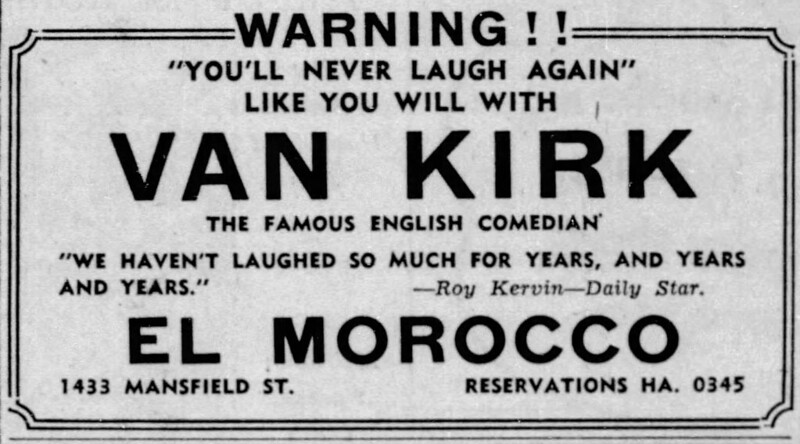
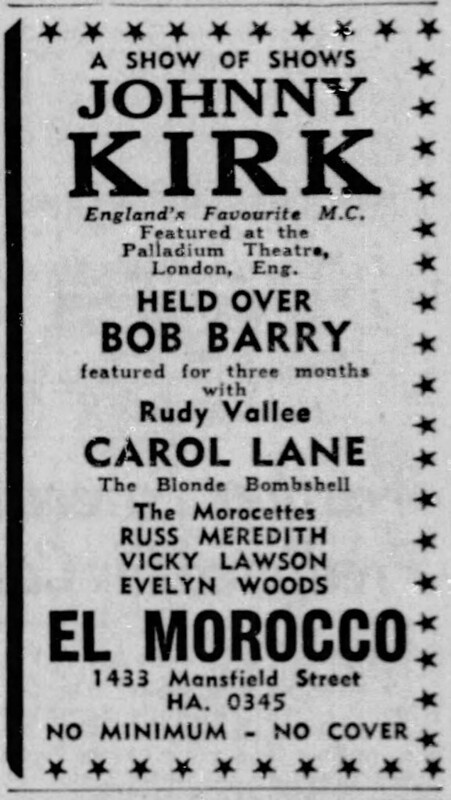
El Morocco
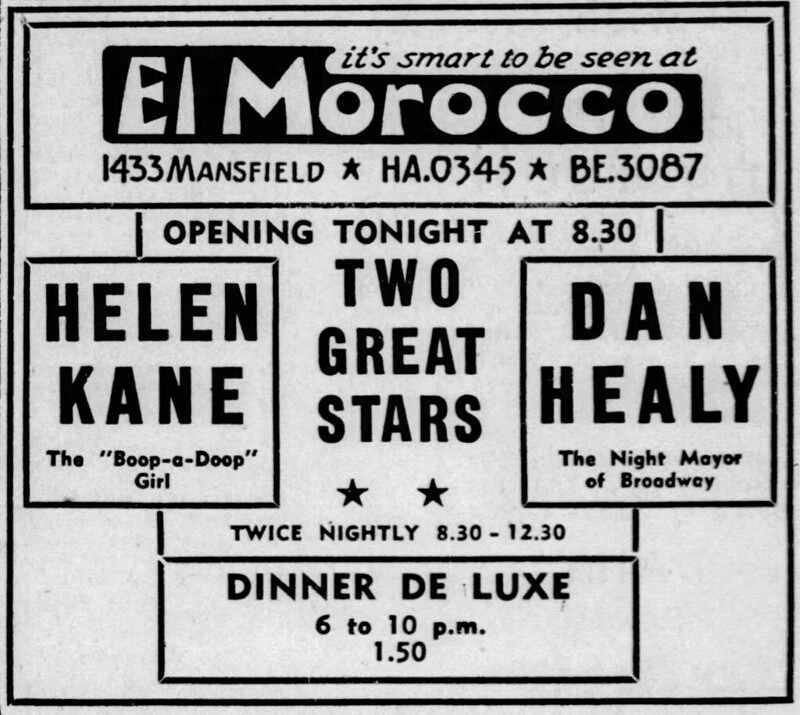
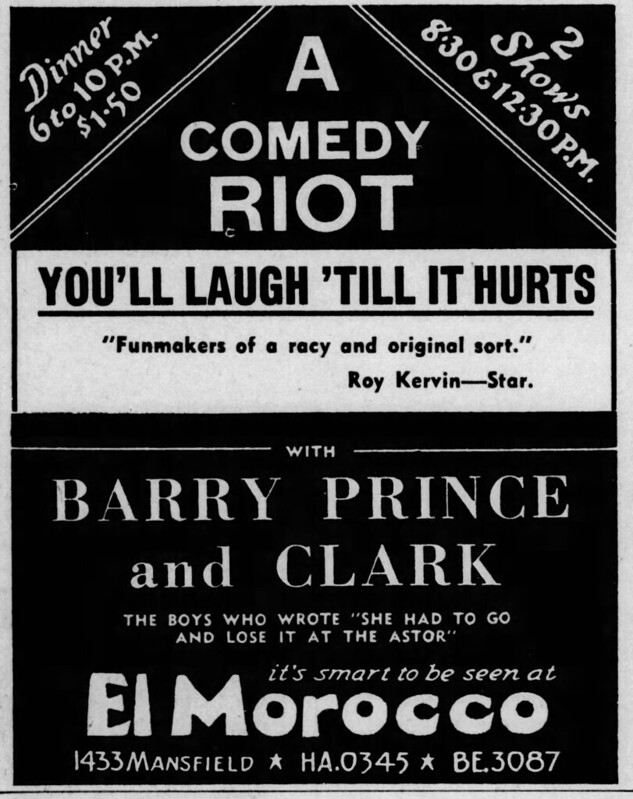
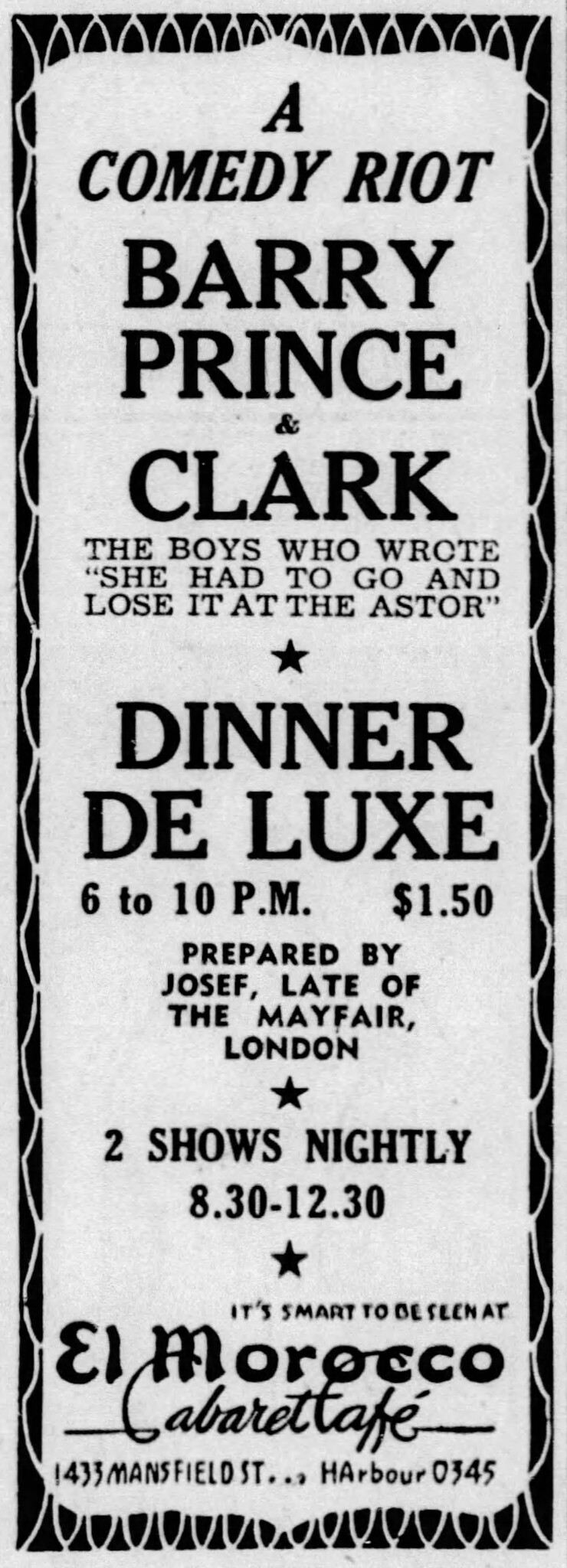
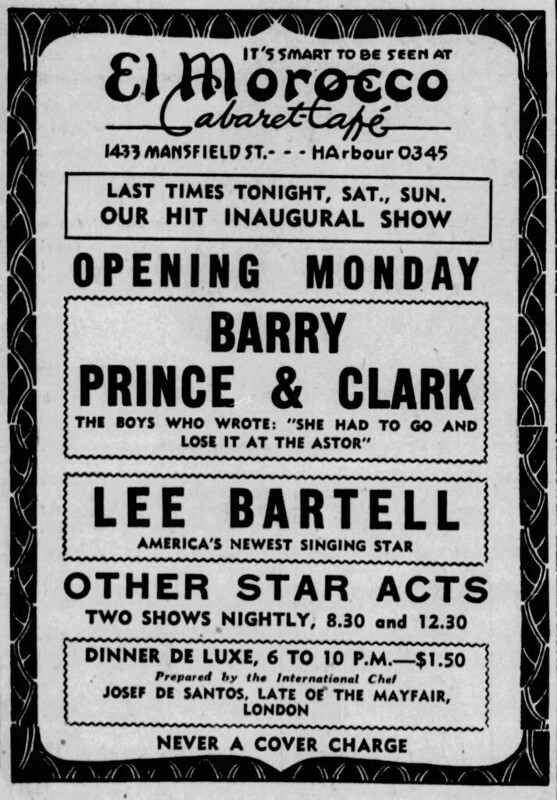
The El Morocco was one of Montreal’s most famous cabaret supper clubs, active from 1940 to 1967. Over the course of its history, the establishment occupied three different downtown locations — on Mansfield, Metcalfe and Lambert-Closse streets — and offered a full dinner-and-show format combining music, dance and variety entertainment in an elegant setting inspired by the great North American nightclubs. Renowned for its spectacular revues, house orchestras and appearances by international stars, the club hosted performers such as Édith Piaf, Tony Bennett and Eartha Kitt, attracting a clientele made up of celebrities, athletes and figures from the entertainment world. The establishment was thus an integral part of Montreal’s cabaret culture and nightlife in the mid-20th century. As columnist Al Palmer wrote: « With the possible exception of the Frolics, no other night club will be remembered as long, nor as fondly, as will El Morocco. »
1. Overview
The El Morocco was one of the cabarets associated with the golden age of Montreal nightclubs in the mid-20th century. Located in downtown Montreal, the establishment was part of the network of nightclubs that animated the city’s nightlife during the 1940s, 1950s and 1960s.
Over the years, the cabaret was operated or managed by several figures from Montreal’s entertainment scene, including Arthur Davidson, followed by a group of associates that included wrestler Yvon Robert and promoter Eddie Quinn. Later on, the establishment was also associated with cabaret entrepreneurs and directors such as Peter Van der North, Ron Cash and Norm Silver, who were involved at different times in its operation and programming.
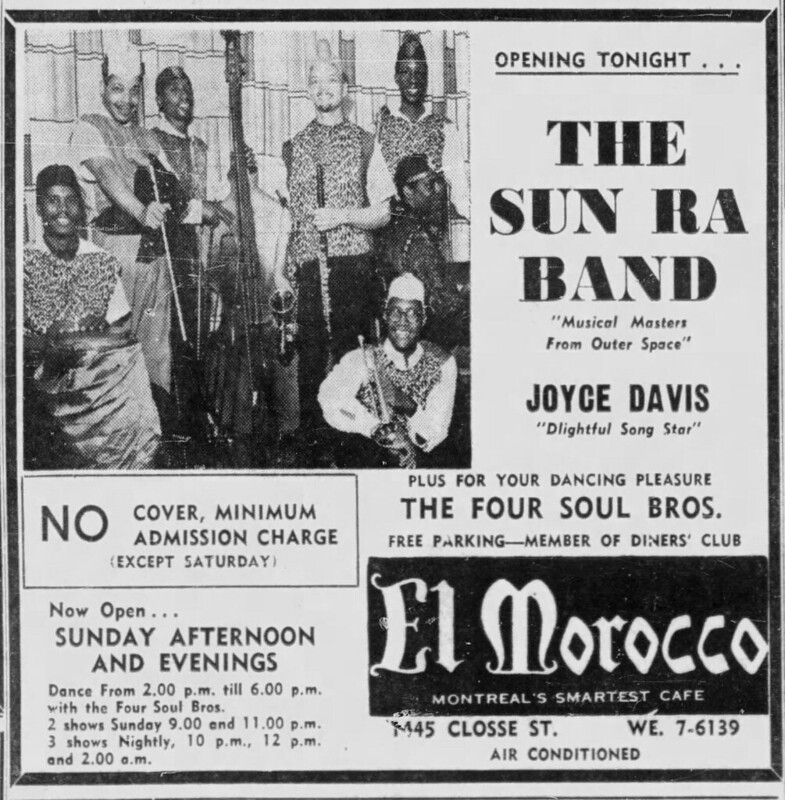
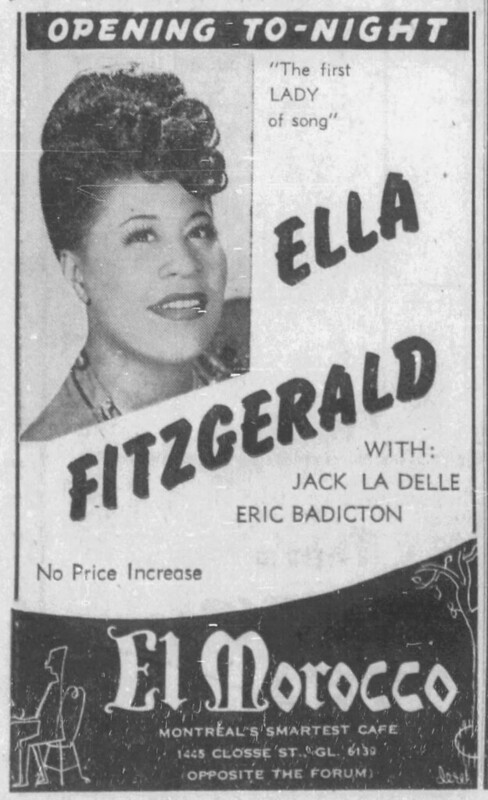
Throughout its history, the El Morocco presented a program combining variety shows, dance orchestras and international performers, reflecting the cosmopolitan character of Montreal nightlife at the time. Artists who appeared there included Édith Piaf, Alys Robi, Tony Bennett, Dean Martin, Ella Fitzgerald, Sarah Vaughan, The Platters, Connie Francis, Cab Calloway, Eartha Kitt, Joséphine Baker and the Sun Ra Arkestra.
In his book Montreal Confidential, author Al Palmer describes the El Morocco as one of Montreal’s most famous nightclubs, frequented by a clientele of celebrities from the worlds of sports and entertainment. According to him, the cabaret stood out for « the prettiest singers, the funniest comedians, the thickest steaks and the strongest drinks » [1].
The three locations of El Morocco
2. 127 Mansfield Street, Private Residence (1879–1912)
Long before the arrival of commercial and entertainment establishments in this area of downtown, the address at 127 Mansfield Street — now associated with 1431 Mansfield Street — appears in newspaper archives as early as the late 19th century as a private residence. An advertisement published in The Montreal Star on October 11, 1879, for instance, offers a room with board in a “private family” located at 127 Mansfield Street, confirming that the building already existed at that time and was used as a dwelling [81].
In the decades that followed, newspaper listings indicate that the property was regularly used as a boarding house. Several classified ads published between the 1890s and 1910s mention rooms or apartments for rent at 127 Mansfield Street, often described as furnished rooms with or without board, located just a few doors from Ste-Catherine Street [82]. These references suggest a fairly substantial townhouse, with multiple rooms and partially devoted to residential rental use.
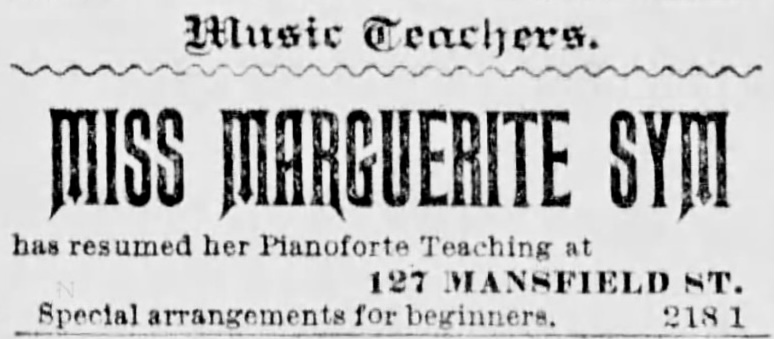
Some advertisements also point to cultural or educational activities associated with this address. In the late 1880s, Miss Marguerite Sym announced in the press that she was resuming her piano teaching at 127 Mansfield Street, where she offered pianoforte lessons to her students [83]. Later, in the early 20th century, advertisements indicate that Miss R. Baker-Edwards also used this address to offer classes in physical culture and literature for young women, illustrating how certain downtown residences could serve as private teaching spaces [84].
A society notice published in The Montreal Star on July 5, 1905, also reports that a wedding was held at the residence of James Patterson, located at 127 Mansfield Street. This confirms that Patterson was already occupying the house in the early 20th century [85].
A few years later, an advertisement published in The Gazette on April 5, 1912, announces that James Patterson, a maker of custom boots and shoes, had moved his business to 127 Mansfield Street, at his residence [80]. This marks a transition toward a commercial use, in a sector that was then undergoing rapid transformation, gradually shifting from a residential neighborhood to an area of shops, restaurants, and, a few decades later, cafés and cabarets.
3. James Patterson, Boot and Shoe Manufacturer (1912–1927)
Before becoming an area associated with cafés, cabarets, and performance venues, the stretch at 1431–1433 Mansfield Street was first part of the commercial history of uptown Montreal. An advertisement published in The Gazette on April 5, 1912, confirms that merchant James Patterson, a manufacturer of custom boots and shoes, had transferred his business to 127 Mansfield Street, just off Ste-Catherine Street [80]. The advertisement presents Patterson as a merchant established for nearly thirty years in the area of Notre-Dame Street near McGill Street, before relocating uptown. This move reflects the gradual northward expansion of commerce in downtown Montreal in the early 20th century, as the Ste-Catherine Street corridor emerged as one of the city’s primary retail axes.
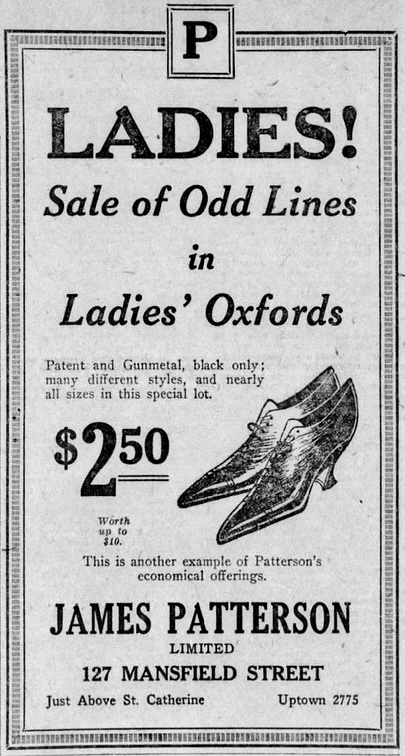
Commercial archives and obituaries published in 1927 recall that James Patterson, considered one of Montreal’s oldest shoe merchants, had operated one of his early stores in the uptown area, on Mansfield Street [78] [79]. Born in New Glasgow (Quebec), Patterson had served for nine years in the mounted police before entering retail, first on Wellington Street, then on Notre-Dame Street near McGill, before moving his business to his residence uptown, in a district then undergoing rapid commercial development [79].
The address of Patterson’s business, formerly numbered 127 Mansfield Street, now corresponds to 1431 Mansfield Street, located immediately below 1433 Mansfield Street [78] [80]. This proximity clearly illustrates the evolution of the area: in the 1910s and 1920s, the location was still firmly part of the uptown retail landscape, with shoe stores, clothing shops, and other businesses. It was only during the 1930s that these premises began to be converted into cafés, restaurants, and cabarets — a transformation that would eventually lead to the opening of clubs such as The Embassy and later El Morocco.
4. Peate Musical (1927)
Located just north of Ste-Catherine Street, 1431–1433 Mansfield Street is a three-storey commercial building whose layout made it possible to accommodate several distinct activities. This configuration explains why different businesses occupied the upper floors over time.
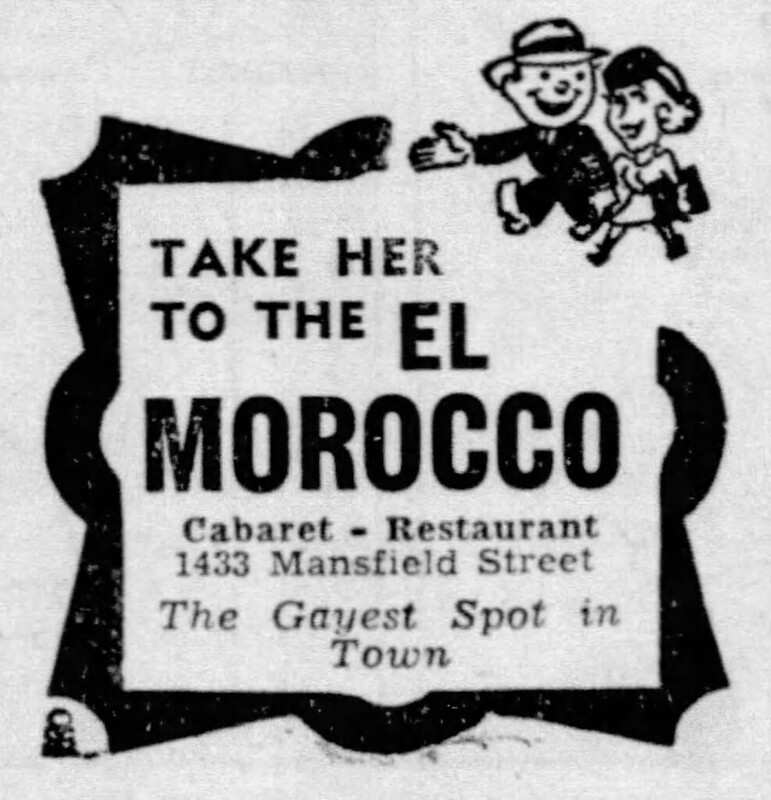
The upper floors of 1433 Mansfield Street were notably associated with several entertainment venues, including the cabarets Golden Dome, St-Moritz, and The Embassy during the 1930s, the cabaret El Morocco starting in 1940, the Café Cavendish in the 1950s and 1960s, and later the exotic cabaret Silver Slipper during the 1960s.
The ground floor of 1431 Mansfield Street, however, remained occupied for many years by the music store Peate Musical Instrument Shop, until 1967, when the establishment disappeared following a fire.
Peate Musical Supplies Ltd.
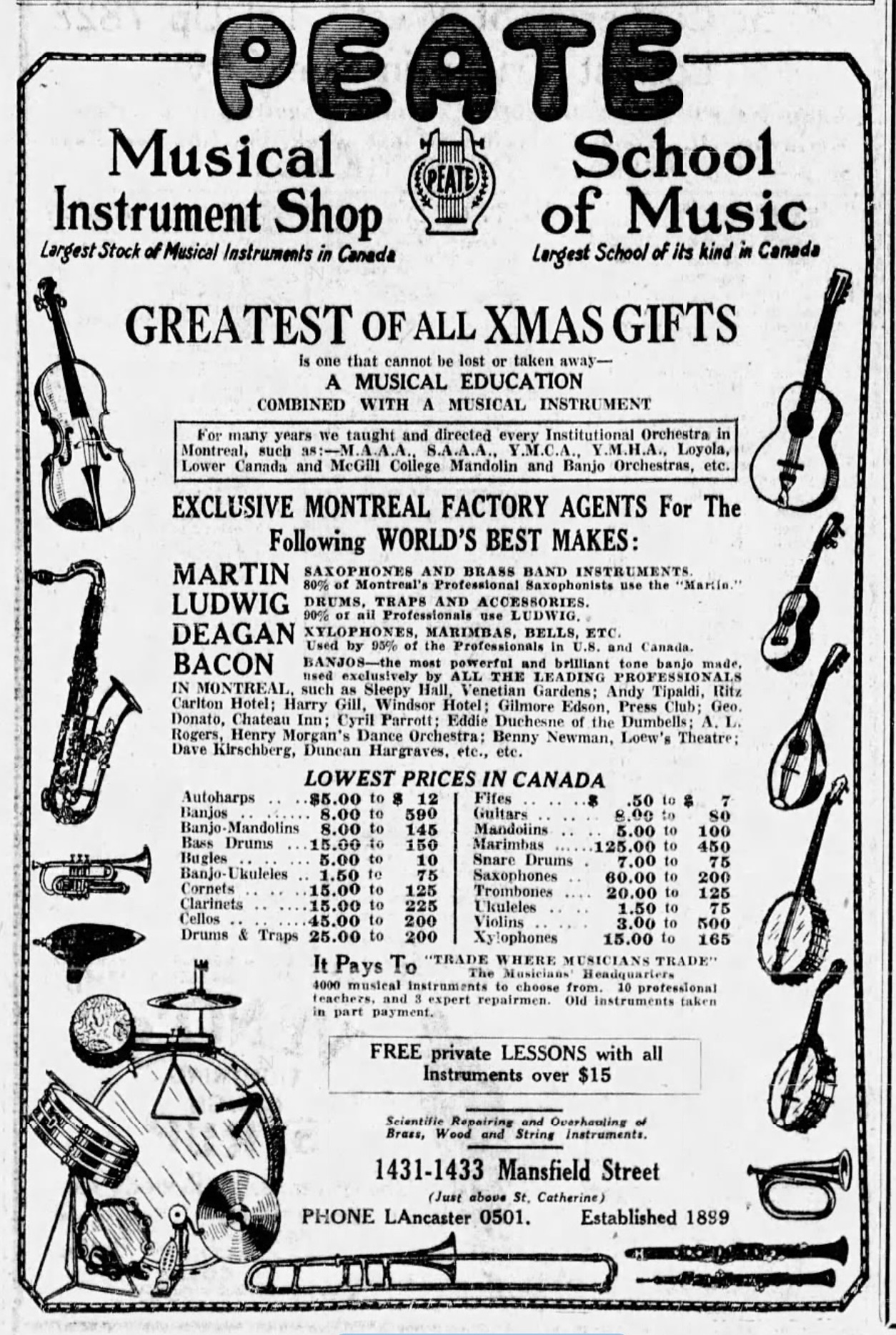
In December 1927, the Peate Musical Instrument Shop and the Peate School of Music were located at 1431–1433 Mansfield Street [34]. The establishment was then described as having one of the largest inventories of instruments in Canada, as well as “the largest music school of its kind in the country.” It advertised the sale of instruments from renowned brands — including Martin, Ludwig, Deagan, and Bacon — along with private lessons and repair services.
The Montreal-based company Peate Musical Supplies Ltd. was a family business founded in 1899 by George Peate, a mandolinist originally from Utica, New York [35]. Over the decades, the Peate firm became one of the most important instrument distributors in Canada, offering a wide variety of instruments imported from Europe, Japan, and the United States, and supplying instruments to schools and orchestras.
George A. Peate initially began by teaching mandolin in Montreal before selling instruments to his students, at a time when mandolin orchestras enjoyed great popularity in the city [36]. He notably led the mandolin orchestra of the Montreal Amateur Athletic Association during the 1913–1914 season. The company remained in family hands for several generations and, by the late 20th century, was headed by Richard Peate, president of Peate Musical Supplies Ltd., and remained active in the distribution of musical instruments and supplies across Canada.
5. British Spiritualist Church (1928–1931)
Before becoming a place associated with Montreal nightlife, the second floor of 1433 Mansfield Street was part of the building occupied by Peate’s Music Store, located at 1431–1433 Mansfield Street. At the time, this music store occupied the three floors of the building. Its Music Hall, located on the second floor, served as a meeting hall and venue for public activities. An advertisement published in The Montreal Star in 1928 indicates that the British Spiritualist Church held its meetings there, including religious services and gatherings led by mediums [39][40][41].
These meetings took place in a context in which spiritualism enjoyed a certain popularity in Montreal, while also provoking debate in the press. Two letters published in The Montreal Star in the early 1930s clearly illustrate these discussions. In the first, Dorothy Davis Stein adopts a critical position and denounces abuses associated with certain mediums and paid spiritualist meetings held in Montreal. She particularly criticizes private consultations and paid public demonstrations, which she considers deceptive, and calls on the authorities to investigate these practices [43].
In another letter published shortly afterward, C. Williams, president of the British Spiritualist Church, defends spiritualism against those he considers to be false mediums. He explains that legitimate spiritualist meetings may require a modest contribution to cover the cost of renting a hall, while condemning individuals who exploit the public under the guise of spiritualism [42]. Taken together, these texts show that spiritualism, well established in the city in the early 1930s, aroused curiosity, support, and controversy alike [42] [43].
Taken as a whole, these sources suggest that 1433 Mansfield Street was then used as a meeting or lecture hall — notably in a space known as Peate’s Music Hall — before being transformed a few years later into an entertainment venue.
6. Golden Dome (1930–1933)
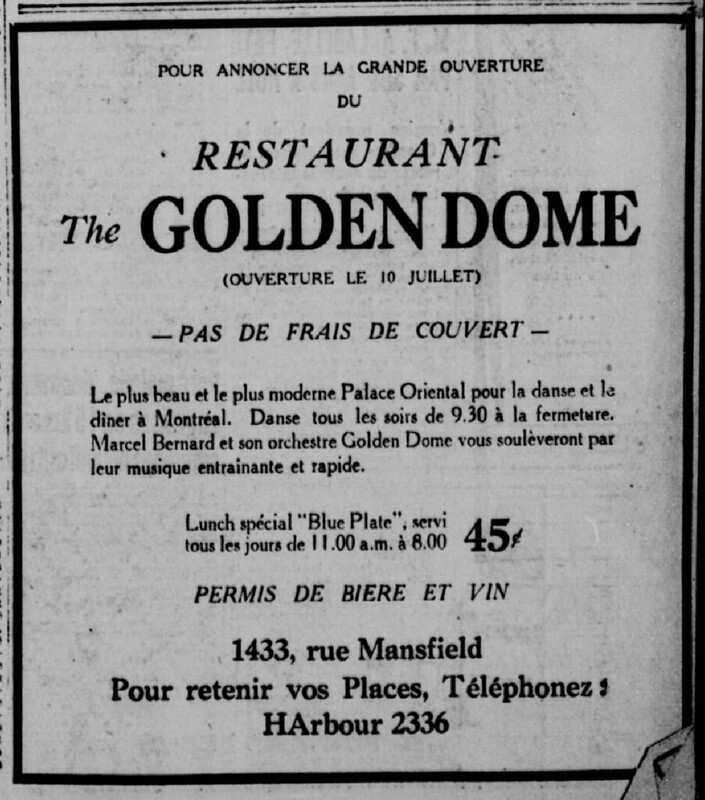
An advertisement published in La Patrie in July 1930 announces the opening of The Golden Dome restaurant and dance hall at 1433 Mansfield Street. Presented as one of the city’s most modern establishments, the venue is described as an “Oriental Palace” devoted to dining and dancing. Music was provided by Marcel Bernard and his Golden Dome Orchestra, while dancing began each evening at 9:30 p.m.. The advertisement also highlights the absence of a cover charge, a special “Blue Plate” meal served daily for 45 cents, and the presence of a beer and wine licence [44]. A legal notice published the following year indicates that the establishment was operated by Frank Woo and Westley Woo [45].
In October 1933, the press reported that the Golden Dome Café was among the establishments whose beer and wine licence was revoked during a monitoring campaign conducted by the Liquor Commission against certain Montreal cabarets and restaurants [46].
7. Café St-Moritz (1933)
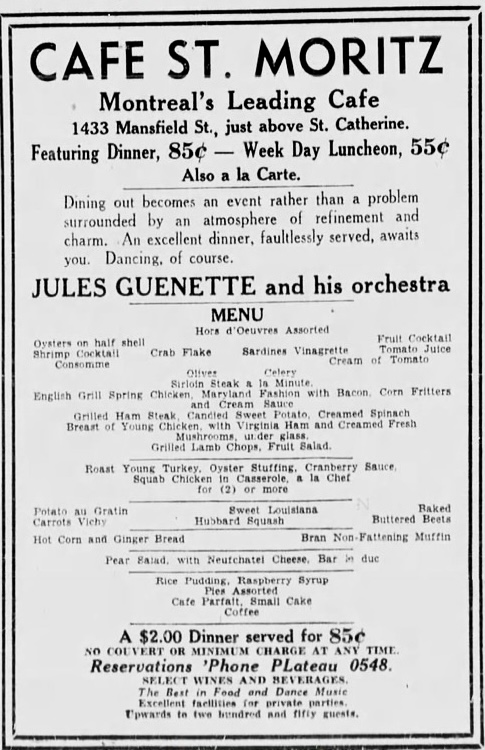
A month later, an advertisement published in The Montreal Star in November 1933 announces the existence of the Café St. Moritz at 1433 Mansfield Street, presented in the ad as one of Montreal’s important cafés. The establishment offered a formula combining dining and dancing, with dinner served for 85 cents and a weekday luncheon for 55 cents. Music was provided by Jules Guenette and his orchestra, and the advertisement emphasizes the absence of a cover charge or minimum, as well as the availability of wines and beverages [47]. Although the advertisement uses the typical promotional tone of the period, it confirms that by the early 1930s, 1433 Mansfield Street already housed a café-restaurant offering meals, music, and dancing, just a few months before the opening of The Embassy at the same address.
The rapid transition between the Golden Dome and the Café St. Moritz was not unusual in the context of Montreal cabarets in the 1930s. Establishments of this type frequently changed operators or names, often as a result of financial difficulties or liquor-licence problems, while retaining the same facilities intended for dining, dancing, and shows.
8. The Embassy (1934-1939)
After successively housing several cafés and dance halls in the early 1930s, 1433 Mansfield Street continued its role as a place of entertainment when a new cabaret called The Embassy opened there in 1934.
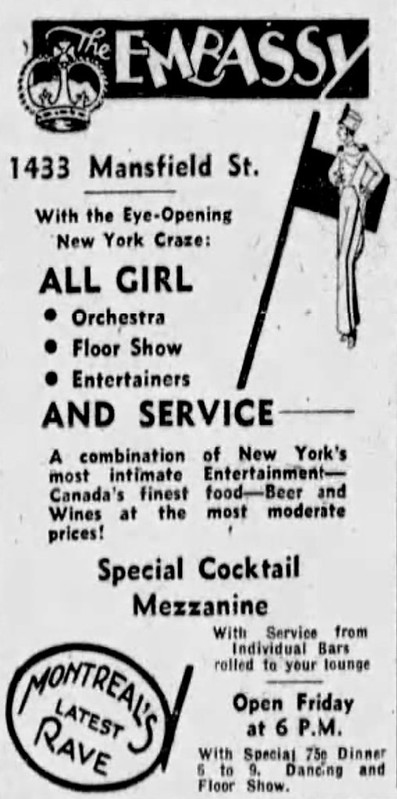
An article published in The Montreal Star announces in February 1934 the opening of this new cabaret in downtown Montreal. Located at 1433 Mansfield Street, the establishment is presented as the city’s newest cabaret and was to welcome the public as early as that Friday of the same week. The program offered a full evening formula including a dinner dance early in the evening, accompanied by an all-female orchestra, followed later at night by the introduction of a variety show (floor show) [33].
An advertisement published in The Montreal Star of February 9, 1934 also presents The Embassy as a cabaret-restaurant offering meals, drinks, and entertainment [32]. The ad describes a venue inspired by the classic model of North American nightclubs of the period, promising a comfortable, fashionable atmosphere, beer, wine, and cocktails, as well as a show program including an orchestra, a floor show, and various entertainers [32].
The Embassy appears to have adopted a complete evening formula: dinner was served from 6 p.m. to 9 p.m., with a menu advertised at 75 cents, while the shows were presented three times each night, at 7:30 p.m., 11:30 p.m., and 1:30 a.m.. The advertisement also emphasizes the absence of an admission charge or mandatory minimum — “No Cover or Minimum” — a common business strategy used to attract customers to Montreal cabarets of the period [32].
Another interesting detail is the mention of a “Special Cocktail Mezzanine”, suggesting that the establishment had a relatively elaborate layout, possibly with a main room and a mezzanine area devoted to drinking and relaxation [32].
The continuity of the cabaret’s operation is confirmed by several sources. In May 1939, an advertisement published in Le Soleil indicates that the cabaret “Embassy”, still located at 1433 Mansfield Street, was offered for rent “fully furnished”, suggesting that the premises still retained their cabaret infrastructure on the eve of the opening of El Morocco [31].
Finally, a court report published in Le Canada in January 1941 indicates that an establishment called the Embassy Terrace Cabaret had operated at this same address between May 1, 1937 and April 30, 1939 [30]. Taken together, these documents make it possible to trace the presence of the cabaret The Embassy at 1433 Mansfield Street during the second half of the 1930s, before it was replaced by El Morocco in 1940.
9. El Morocco #1 (1940–1942)
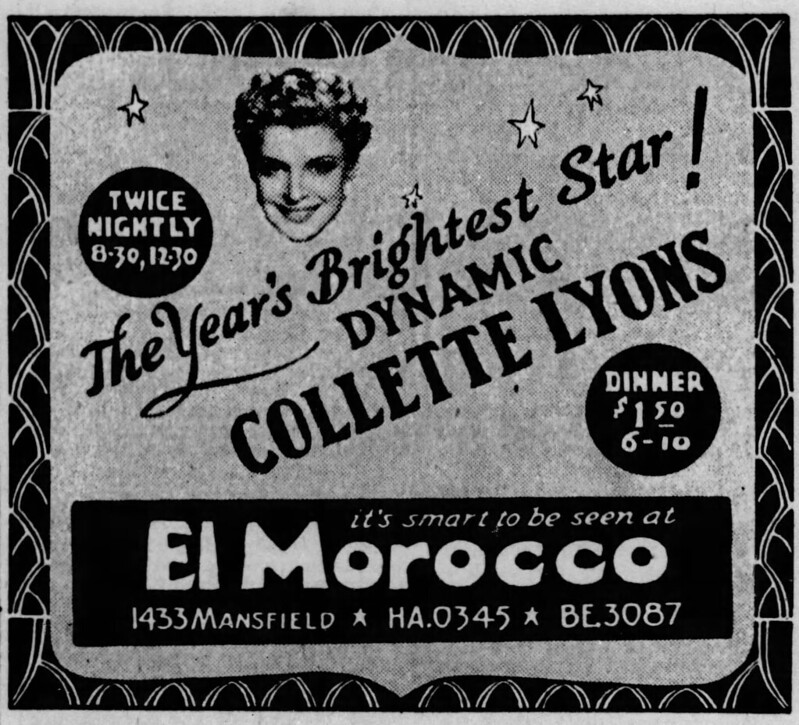
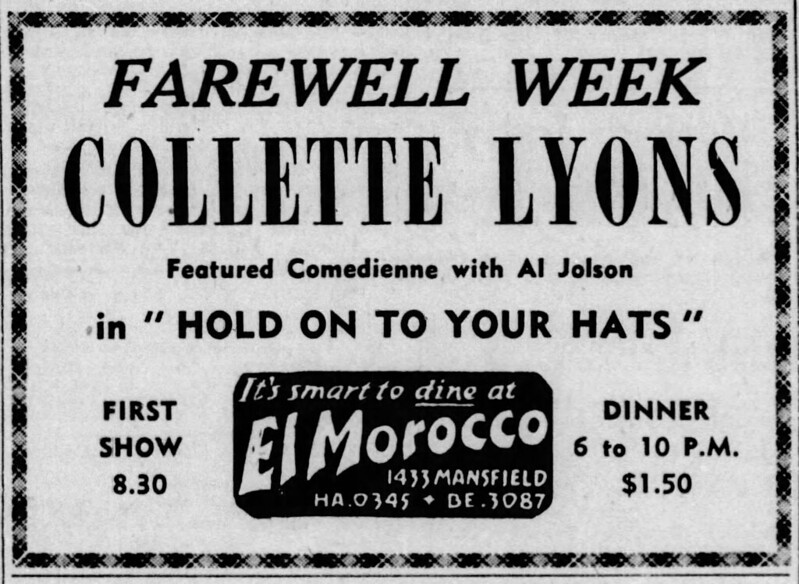
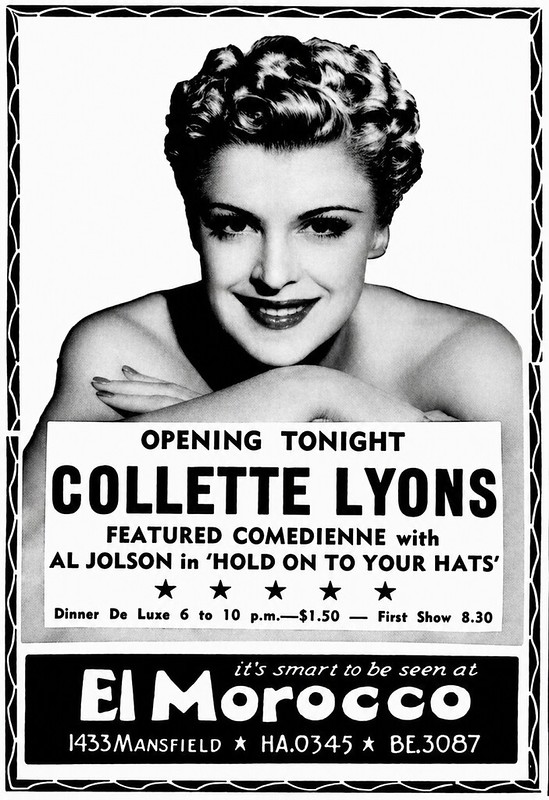
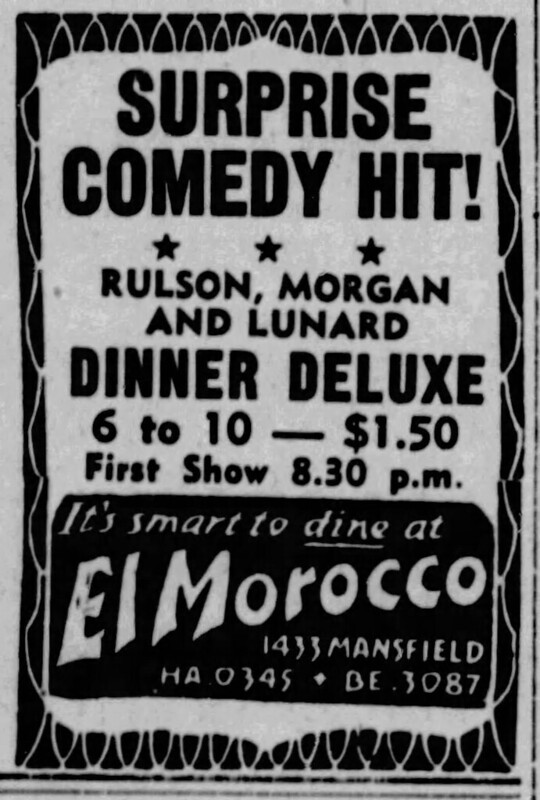
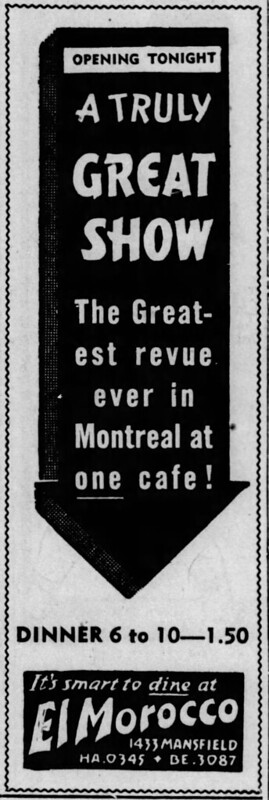
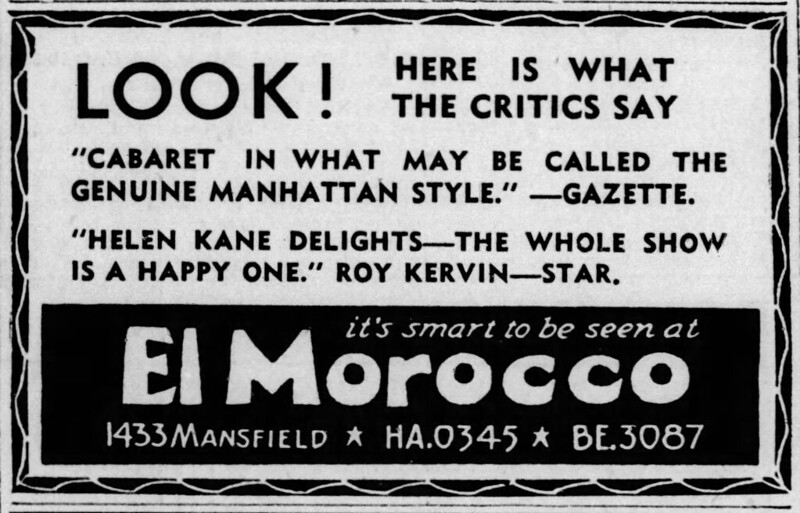
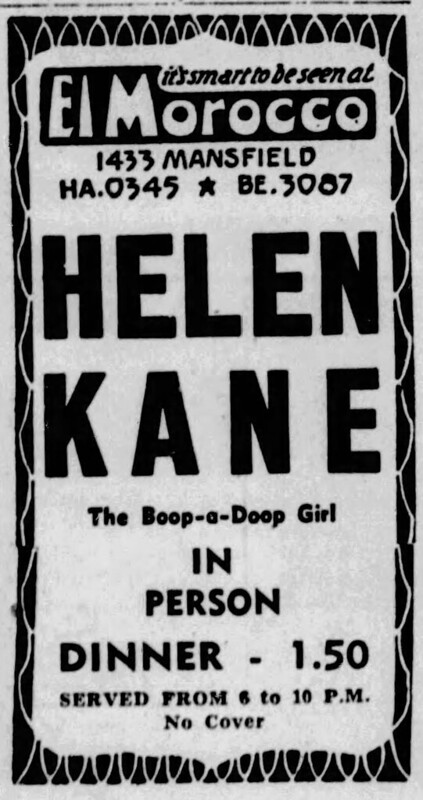
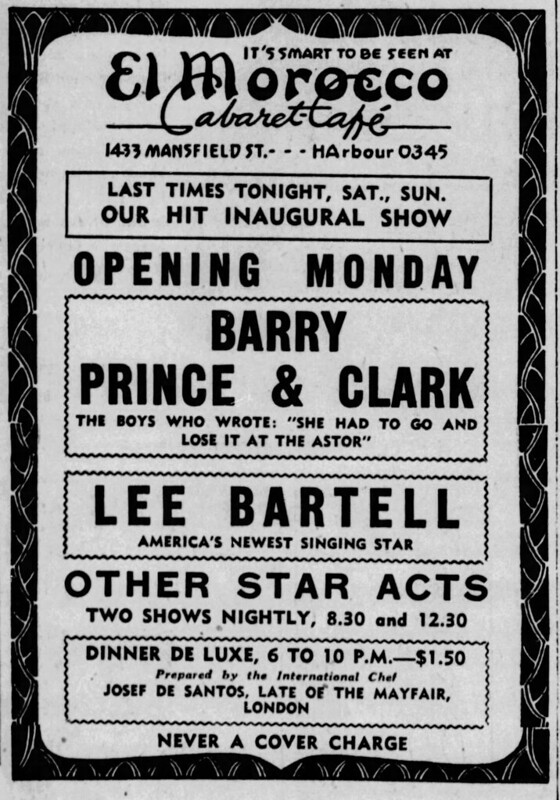
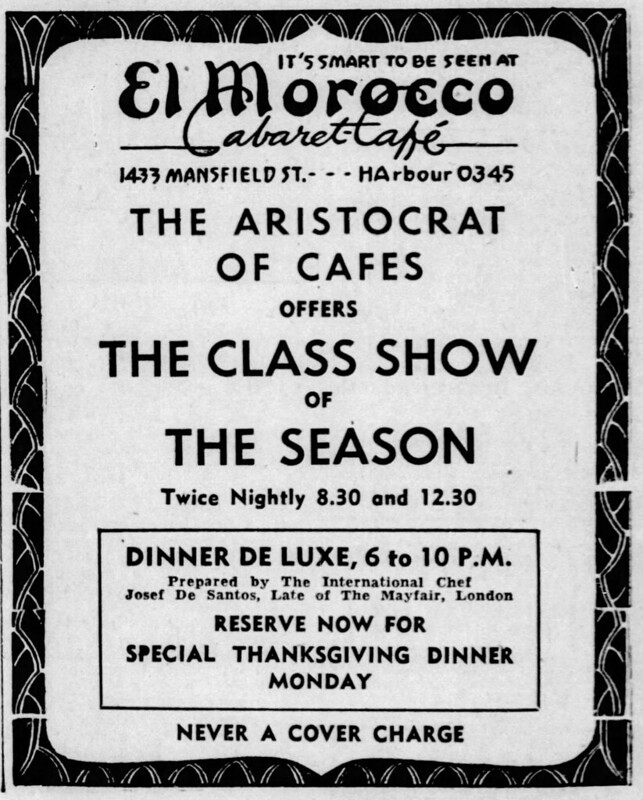
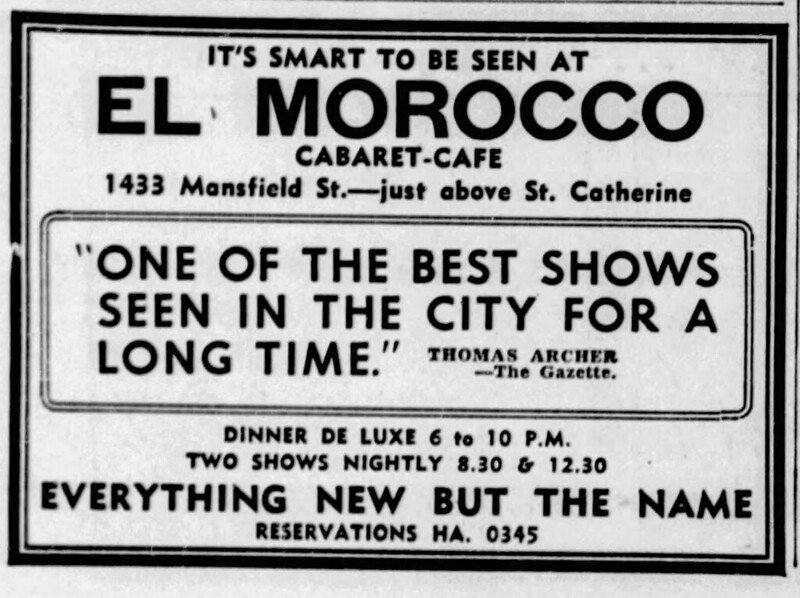
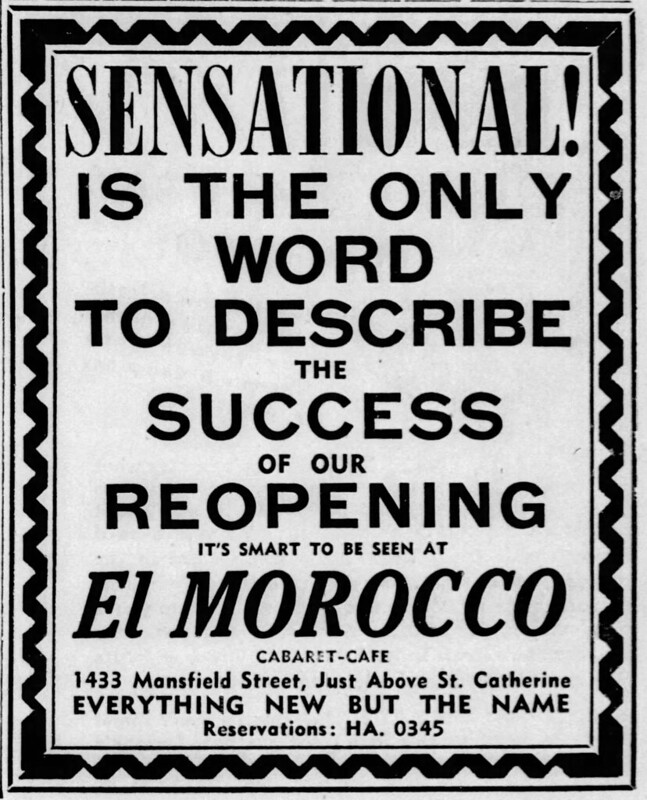
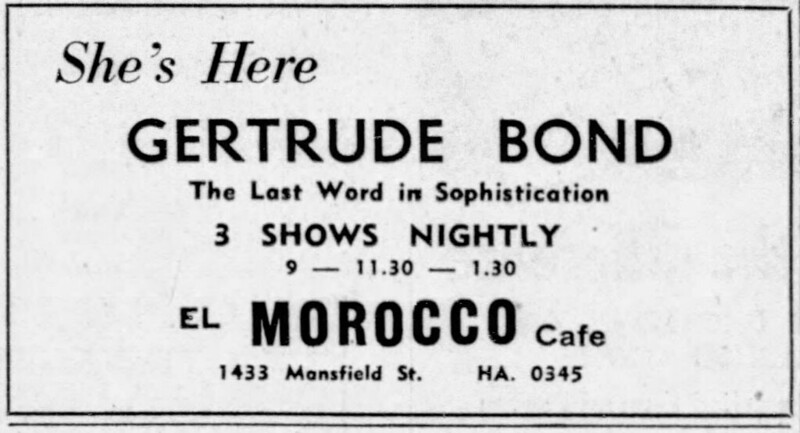
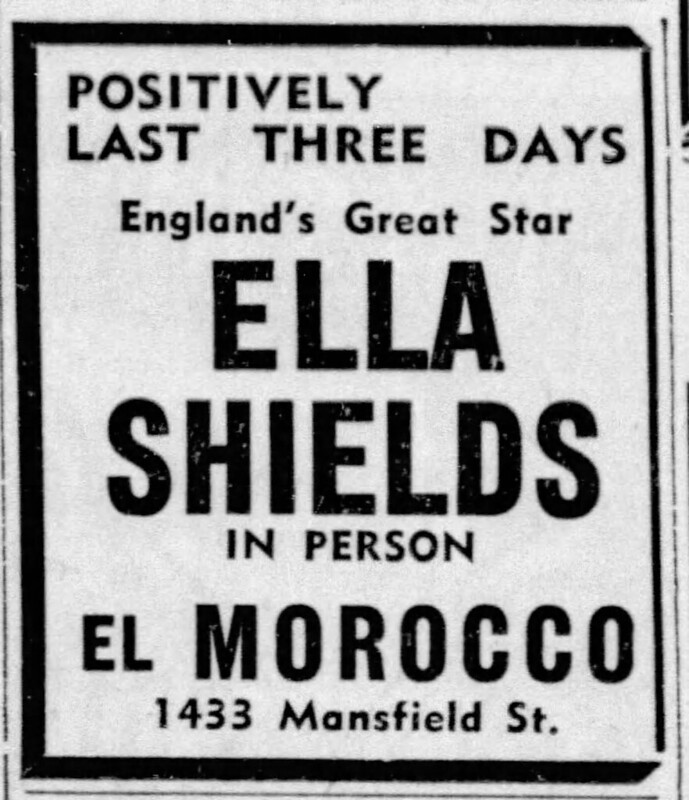
The first known trace of the EL MOROCCO cabaret appears in an advertisement published in The Gazette on May 3, 1940, announcing its Grand Opening Tonight at 1433 Mansfield Street (2nd floor). The ad presents the venue as a cabaret featuring a “Smart New York Floor Show,” two dance floors, and the orchestra of Jimmy Dunlap, with a “No Minimum — No Cover” policy, typical of the opening strategies used to attract customers to Montreal clubs of the period [1].

By early summer 1940, the Morocco was already being mentioned in the entertainment columns of The Gazette, where the establishment was advertised as presenting a “Revue,” confirming that the cabaret was then offering a variety show typical of Montreal nightclubs of the period [29].
An article published in La Presse on July 18, 1941, also mentions the El Morocco cabaret located at 1433 Mansfield Street. The Croydon Corporation, Limited, owner of the establishment, was fined $200 by Judge Gustave Marin for providing false information to the Minimum Wage Commission regarding wages paid to its employees — an amount that would represent roughly $4,000 today [5].
The El Morocco cabaret is more specifically associated with Montreal owner Arthur Davidson, an active figure in the city’s café and nightclub scene in the mid-20th century. Davidson founded the first incarnation of El Morocco on Mansfield Street before moving the establishment to new premises, contributing to the club’s development within Montreal nightlife [68].
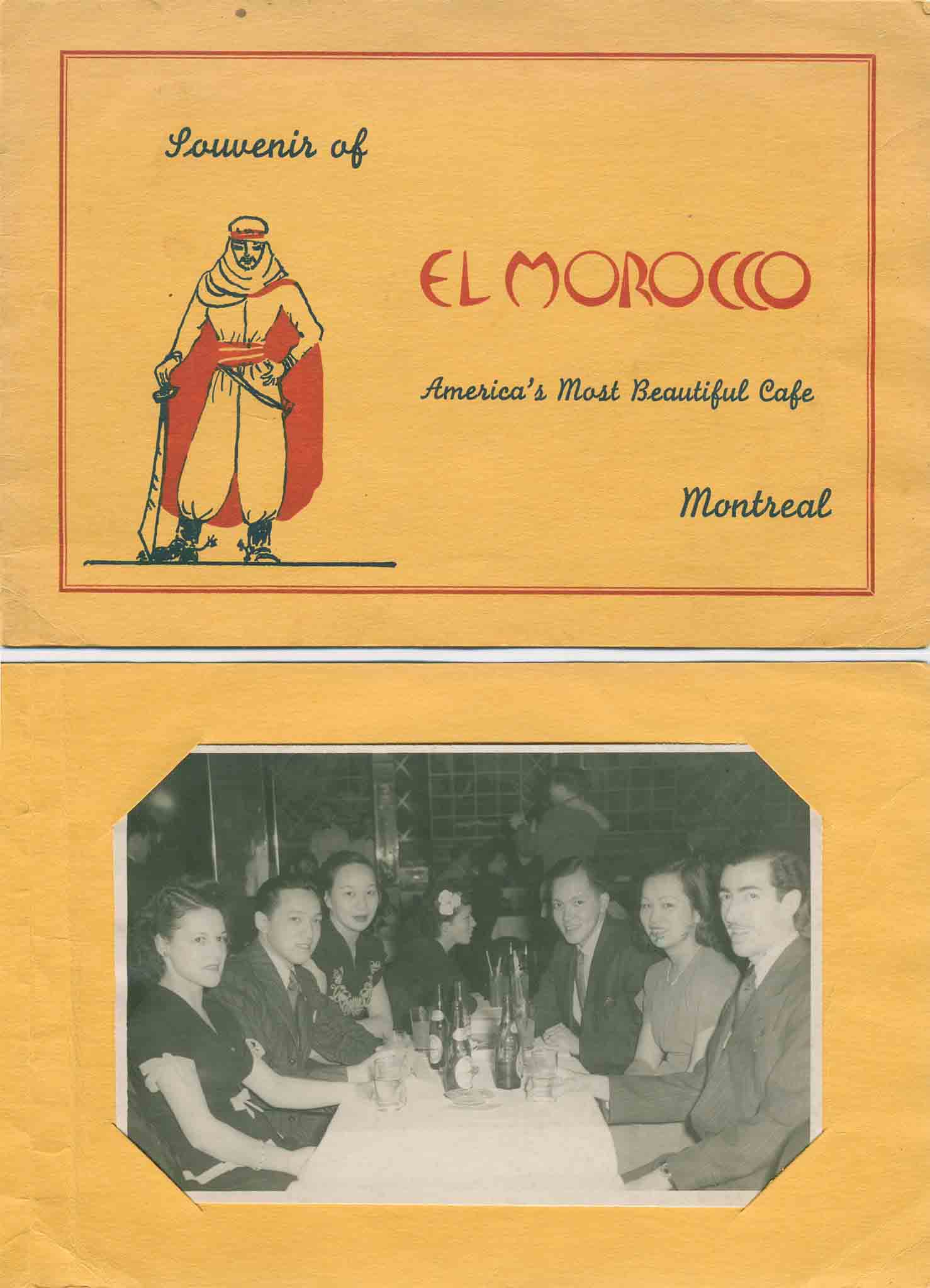
Arthur Davidson
Arthur Davidson was a café, cabaret, and entertainment-venue owner active in Montreal nightlife during the 1930s and 1940s. He is notably associated with the El Morocco cabaret, whose first establishment he is said to have founded on Mansfield Street before the club was moved to other downtown addresses [68].
During his career, Davidson was also involved in the world of illegal gambling establishments gravitating around the city’s cafés and nightclubs. Testimony gathered during the morality inquiry conducted in Montreal in the early 1950s describes several gambling houses (“barbotte”) associated with his name, notably at downtown addresses such as 1222 University Street, 357 Sherbrooke Street West, and 537 Côte-Sainte-Catherine West. Witnesses indicated that Davidson generally operated one establishment at a time, with operations periodically moved to new addresses [69] [70] [71].
Despite these controversial activities, notices published in the press at the time of his death describe Davidson as a well-known Montreal figure. He was notably recognized in certain civic and military circles for his generosity, having repeatedly provided shows and entertainment for soldiers in barracks and hospitals in the region.
Born in Côte-Saint-Paul, son of John Davidson, a pioneer of the district, Arthur Davidson died on February 28, 1946, in Outremont at the age of 43, after several months of illness. Notices published in the press then emphasized his place in Montreal nightlife as well as his reputation for generosity toward artists and military personnel [68] [86].
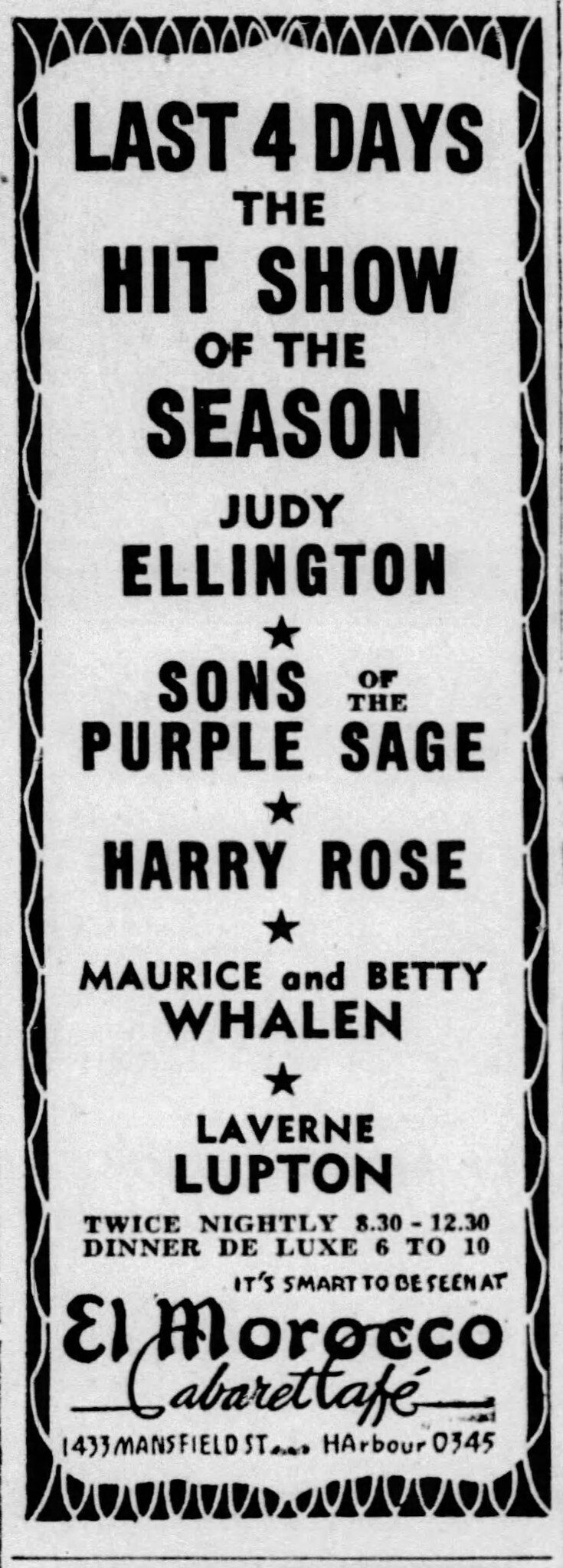
An article published in Le Petit Journal on September 28, 1941, presents the El Morocco as one of Montreal’s most modern and comfortable cabarets. Broadway comedian Harry Rose was hired as master of ceremonies and hosted the shows with his humorous repartee. The program notably included singer Judy Ellington, as well as several dance numbers performed by the Moroccomaid, young artists from New York. The performances were accompanied by two orchestras, that of Lou Clayton and that of Peter Barry, the latter performing notably Cuban-style rumba rhythms [6].
Court documents published in 1941 indicate that the premises at 1433 Mansfield Street had already housed an establishment called the Embassy Terrace Cabaret in the late 1930s, confirming that the address already had a cabaret function before the opening of El Morocco in 1940 [30].
10. El Morocco #2 (1942–1949)
In March 1942, Arthur Davidson’s El Morocco cabaret moved to 1410 Metcalfe Street (2nd floor), in Montreal, and was immediately presented as “one of the most modern in America” and “the chicest cabaret in Montreal” [3]. The establishment, which could accommodate about 300 patrons, stood out in particular for its interior decoration designed by Georges Mitchell, a Chicago artist who had already created plans for renowned cabarets such as the Colony Club (in New York) and Chez Paree (in Chicago) [48]. The club’s décor was conceived in a modern, streamlined style dominated by vivid, contrasting colours. The walls of the main room were covered in dark red leather, a decorative motif that continued into the entrance of the establishment. Above these leather surfaces, some wall sections were entirely covered in mirrors, producing an effect of brightness and space that enhanced the room’s lighting. The lowered ceilings were fitted with glass panels behind which pinkish lights glowed, creating a subdued and luxurious atmosphere.
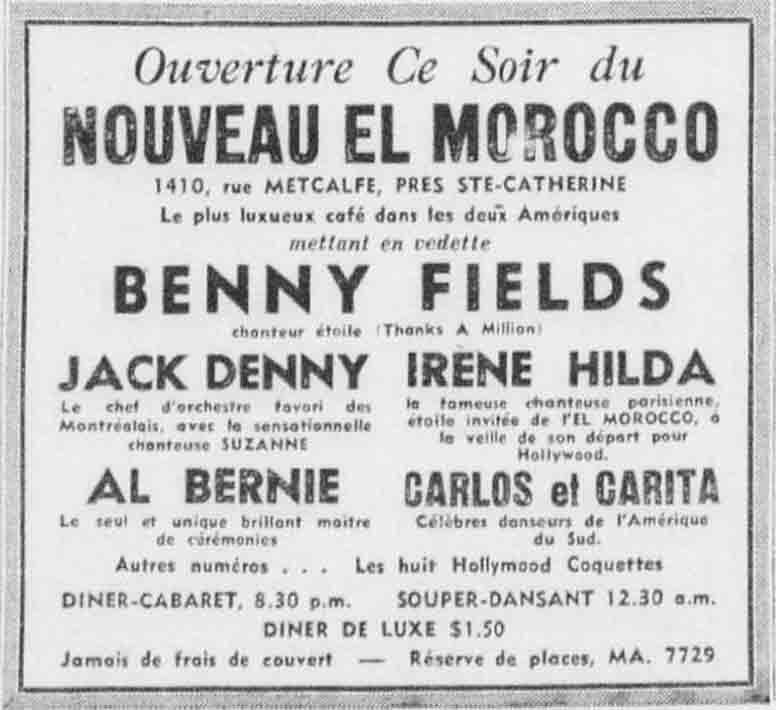
The Wedgewood Lounge, an adjoining salon, was decorated in shades of blue and provided a quieter, more restful space. It was separated from the dining room by a glass partition, allowing patrons to watch the show while remaining in a distinct area. A speaker installed in the ceiling also made it possible to hear what was happening in the showroom from this lounge. In the dining room, the walls were covered with a fluorescent material and large colourful murals diffusing a soft light behind a pale wood finish. The decorative palette combined red, yellow, blue, and green tones, while the modern lighting was designed to highlight the performances presented on the floor. The entire cabaret was air-conditioned and fitted out in a modern style marked both by a certain restraint and by a sense of spectacle and elegance typical of the great North American cabarets of the period.
Through its layout — a lounge separated by a glass partition, luminous ceilings, mirrored walls, and leather décor — the cabaret clearly belonged to the tradition of North American supper clubs, a model popularized in the 1930s by the great nightclubs of Chicago and New York.
The opening night of March 12, 1942, featured a variety show starring Benny Field, nicknamed “Your Minstrel Boy,” one of the most popular vaudeville performers in the United States. The program also included French singer Irène Hilda, who would soon leave Canada for Hollywood, South American dancers Carlos and Carlita, as well as Robinson and Martin, specialists in fantasy dancing. The orchestra led by Jack Denny accompanied the evening, while Al Bernie served as master of ceremonies for the inaugural show. The audience also heard singer Suzanne, just back from an engagement at Chicago’s Colony Club, confirming the promoters’ ambition to make El Morocco a luxurious and modern entertainment centre meant to enhance the prestige of Montreal nightlife during the war years.
An article published in Le Canada on March 15, 1947, reports that a “syndicate” led by Montreal wrestler Yvon Robert had just purchased the El Morocco nightclub. In the business language of the period, this term referred to a group of partners or investors brought together to operate an establishment. The new owners announced the temporary closure of the cabaret in order to carry out renovations, with reopening scheduled for April 5, 1947 [9].
Wrestler Yvon Robert’s involvement in the management of El Morocco reflects a frequent trend in Montreal during the 1940s, when several figures from the sports world invested in the city’s cabarets and restaurants. Professional wrestling was then drawing large crowds, and stars like Robert became public personalities capable of promoting this kind of establishment to Montreal audiences [9].
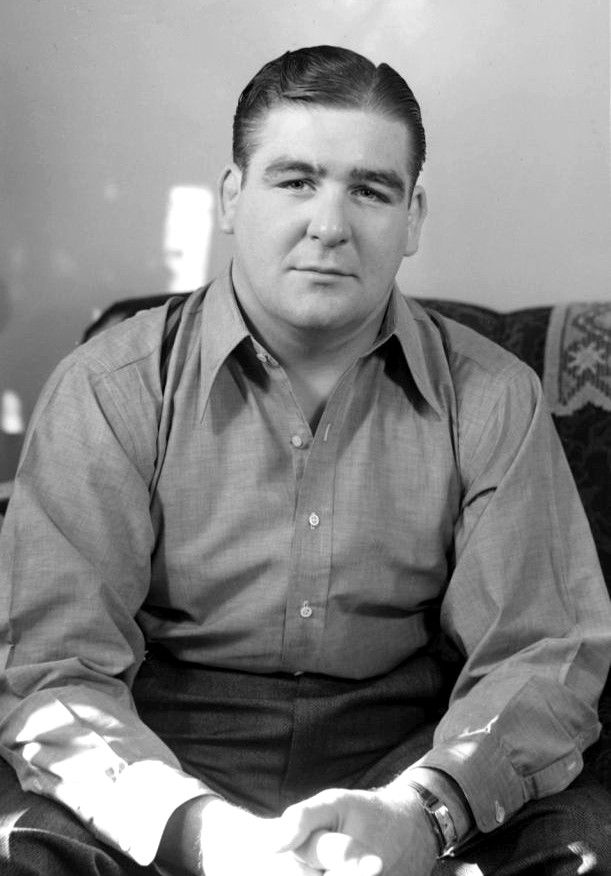
Yvon Robert (1914–1971)
Born in Montreal on October 8, 1914, Yvon Robert is considered one of the greatest professional wrestlers in Quebec history. Trained notably at the Palestre Nationale, he began his career in the 1930s and quickly became one of the major stars of wrestling in North America. Over a career spanning more than twenty years, he won the National Wrestling Association world championship several times and drew considerable crowds in arenas across Canada, the United States, and Europe. In Montreal, his matches notably filled the Forum and other city arenas [52].
Alongside his sporting career, Robert was involved in several business activities. The press reported that he also acted as a real estate agent and company director, while participating in various business ventures in the metropolis, including an investment in the operation of a gold mine with a group of Montreal businessmen [53].
He was also associated with the operation of several Montreal entertainment venues. Among them was the Café Yvon Robert at 4558 Notre-Dame Street East, an establishment that would later become the Café de l’Est. His name is also linked to other sites in Montreal nightlife, including the El Morocco cabaret, Café La Bohème, the Yvon Robert Lounge, the Dream Lounge, the Larry Moquin Hotel, and the establishment Chez Maurice, reflecting his involvement in Montreal’s entertainment and restaurant industry in the mid-20th century. A 1956 column also noted that the wrestler was involved in many commercial projects, notably in restaurants, cabarets, and even in the financing of a women’s magazine entitled American Beauty [54] [55] [56] [57].
El Morocco under Yvon Robert
In early April 1947, in the context of the revival of Montreal nightlife after the Second World War, an advertisement announced the opening gala of the new El Morocco, presented on April 5, 1947, at 1410 Metcalfe Street. The evening was held under the aegis of Quebec wrestler Yvon Robert, presented as the host of the event [10][11]. The ad promised “the greatest musical revue ever presented in Montreal” and featured a variety program including monologist Al Bernie, singer Norma Hutton accompanied by her Melody Men, dancers Myrtill and Pacaud — from New York’s Radio City Music Hall — as well as baritone André Francourt. The revue also included the Peter Barry Trio and a large chorus line of dancers. The establishment was then presented as a modern and fashionable cabaret, equipped with an air-conditioned room, no cover charge, and a “Celebrities’ Foyer” intended to become a new gathering place in Montreal nightlife.
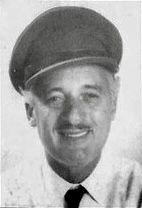
Peter Barry
Peter Barry (1915–2008) was a bandleader and musician active in Montreal nightlife during the golden age of big bands and cabarets in the 1940s and 1950s. Born in Toronto under the name Samuel Herbert Greisman, he arrived in Montreal during the Great Depression and obtained his first engagements as a drummer in nightclubs on Stanley Street, at the heart of the cabaret district [98].
After the Second World War, Barry founded his own orchestra, which became one of the most active ensembles in Montreal clubs. His group performed in several major downtown establishments, notably at El Morocco, Chez Maurice, and various nightclubs frequented by the fashionable clientele of the period. His sophisticated and adaptable repertoire enabled him to animate both cabaret evenings and major social and high-society events in the city [97].
In the 1950s, Barry led an orchestra at El Morocco, notably with singer Norma Hutton, and also accompanied Frank Sinatra during a show presented at Chez Parée in 1953 [98]. His music, designed to appeal to the clientele of clubs and dance halls, helped define the musical atmosphere of Montreal cabarets during the big-band era.
After the decline of the big-band era in the early 1960s, Barry turned to club ownership. In 1966, he opened the Cock ’n’ Bull, an English-style pub on Ste-Catherine Street West, where he notably organized talent nights during the 1970s. He was also briefly the owner of an establishment called Alligator, also located on Ste-Catherine Street [97] [98].
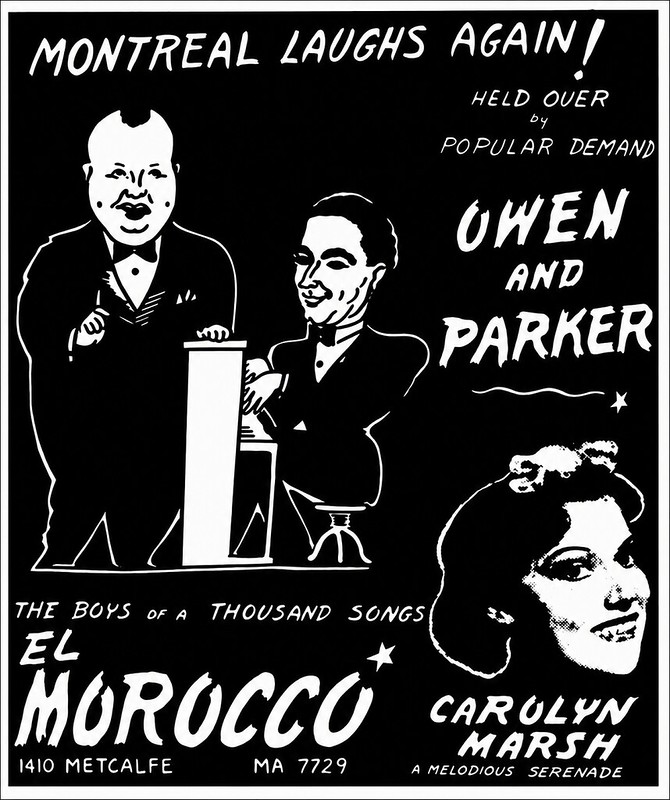
In Montreal Confidential, author Al Palmer describes El Morocco as one of the most famous nightclubs in Montreal history, located at the northwest corner of Metcalfe and Ste-Catherine streets. Originally opened by Arthur Davidson, who is said to have initially considered installing a gambling room on the top floor, the establishment later passed into the hands of a group of partners including Quebec wrestler Yvon Robert and promoter Eddie Quinn. Under their direction, the cabaret attracted numerous celebrities and quickly became a renowned gathering place for personalities from the worlds of sports, entertainment, and public life in Canada and the United States [1].
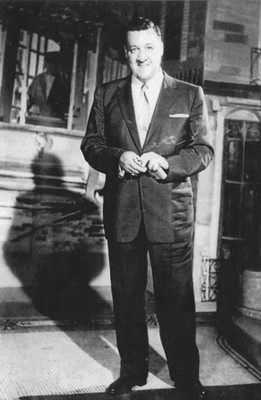
Eddie Quinn
Eddie Quinn (born in Waltham, Massachusetts) was a sports promoter and businessman active in Montreal nightlife and entertainment in the mid-20th century. Having arrived in the metropolis in 1939 at the invitation of Montreal Canadiens general manager Tommy Gorman, Quinn quickly became one of the most notable figures in the city’s professional wrestling and boxing scene.
A charismatic promoter and flamboyant personality, he organized many wrestling and boxing galas at the Montreal Forum during the 1940s and 1950s, drawing large crowds and helping popularize these sports among Montreal audiences. His sense of showmanship and his ability to promote events helped establish Montreal as one of the important centres of professional wrestling in North America during this period.
Alongside his sporting activities, Quinn was also associated with the El Morocco nightclub, located on Lambert-Closse Street behind the Montreal Forum. During the 1950s, the establishment became a place frequented by athletes, artists, and various figures from the entertainment world, reflecting the characteristic blend of sport and nightlife surrounding Montreal’s major cabarets of the era [72].
A colourful figure in Montreal life, Eddie Quinn remains associated with the golden age of professional wrestling and sports entertainment in the metropolis, where his promotions and his activities in cabarets helped shape the lively atmosphere of downtown during the 1940s and 1950s.
Palmer evokes the club’s distinctive atmosphere, where it was not uncommon to encounter famous figures such as boxers Jack Dempsey and Jack Sharkey, or bandleader Max Waxman. The venue was renowned for its ambitious shows, its chorus girls, its comedians and orchestras, as well as for the quality of its food and drinks, the author summing up the club’s reputation with the phrase: “The El had the prettiest chorus girls, the funniest comics, the thickest steaks and the strongest drinks” [1].
The club staff also included several well-known figures from Montreal’s restaurant and entertainment worlds, including former NHL player Jimmie Orlando, who served as manager, and René Campeau, the maître d’hôtel. According to Palmer, El Morocco’s reputation also rested on the quality of its staff and on the variety of artists who performed there, including several popular comedians of the period.
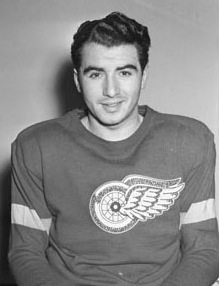
Jimmie Orlando
Jimmie Orlando (born in Montreal in 1917) was a hockey player and Montreal entrepreneur active in sports and business circles during the 1930s and 1940s. Of Italian origin, he learned hockey in west Montreal and made his debut with junior teams associated with the Montreal Forum. In 1933, he played for the Victoria Junior, then for the Victoria Senior team led by Frank Carlin. The following year, he played with the Canadien Senior alongside Babe Tapin [67].
Spotted by scout Jim Brodeur, Orlando then signed a contract with the Detroit Red Wings organization. After a tryout with the team in 1935, he continued his career with various professional and semi-professional clubs, notably in the American league and in teams affiliated with Detroit. His career was, however, marked by several team changes and by the Second World War, during which he was called up by the Canadian Army [67].
After the war, Orlando returned to civilian life and continued his activities in senior hockey. He notably played for the Valleyfield Braves led by Lucien Leduc. Alongside his sporting career, he also held the position of manager of Café El Morocco, illustrating the frequent links between the world of sports and that of cabarets in postwar Montreal [67].
Later, Orlando turned to business and became the owner of his own establishment, Aldo’s Café Restaurant, located on Mountain Street. This acquisition came after the closure of El Morocco, whose site was to be replaced by a new construction. Between professional hockey and the management of entertainment venues, Jimmie Orlando’s trajectory testifies to the closeness between sporting circles and Montreal nightlife in the mid-20th century [67].
In his book City Unique: Montreal Days and Nights in the 1940s and ’50s, historian and journalist William Weintraub describes El Morocco as one of Montreal’s most famous nightclubs during the 1940s and 1950s. The establishment was part of the lively cabaret district around Ste-Catherine Street, where several nightclubs and dance halls frequented by the city’s fashionable clientele were concentrated. Like many North American supper clubs of the period, El Morocco combined a restaurant, bar, dance floor, and variety show within a single room. Patrons sat at small tables arranged in front of the stage while waiters moved among the guests, who could dine and drink cocktails during the performances. The house orchestra accompanied the floor shows, made up of a succession of acts mixing singers, dancers, comedians, variety artists, and a line of chorus girls.
Weintraub describes the lively atmosphere of these evenings, when spectators could spend several hours watching the revue while eating and drinking. The room included long bars, a dance floor, and a performance area where the acts presented by the orchestra and guest artists followed one another. The shows were often inspired by the model of nightclubs in New York and Chicago, with elaborate productions and artists engaged for temporary runs. Customers came as much for the show as for the fashionable atmosphere of the place, where meals, cocktails, and drinks were served late into the night.
The cabaret also attracted a clientele made up of well-known figures from the worlds of sports, entertainment, and business. Weintraub notably mentions the presence of boxing champions Jack Dempsey and Jack Sharkey, who were among the club’s famous visitors. Burlesque dancer Lili St. Cyr, very popular in Montreal during the 1940s and 1950s, also frequented the city’s nightclubs after her performances and regularly went to El Morocco. According to Weintraub, these establishments represented one of the symbols of Montreal nightlife during this period, when cabarets, orchestras, and variety shows made Montreal one of the entertainment capitals of North America [51].
Weintraub also emphasizes that evenings in this kind of nightclub often stretched over several hours: patrons arrived for dinner, watched the different numbers of the revue, then got up to dance between show segments while the orchestra continued to play. This alternation between dining, show, and dancing constituted one of the typical characteristics of North American supper clubs of the period [51].
Weintraub also points out that Montreal then occupied an important place on the North American nightclub circuit. Many singers, dancers, and variety performers from New York, Chicago, or other major American cities stopped in Montreal cabarets during their tours. This constant circulation of artists helped maintain a high level of entertainment in the city’s establishments and explains why clubs such as El Morocco could present productions comparable to those of the great American nightclubs [51].
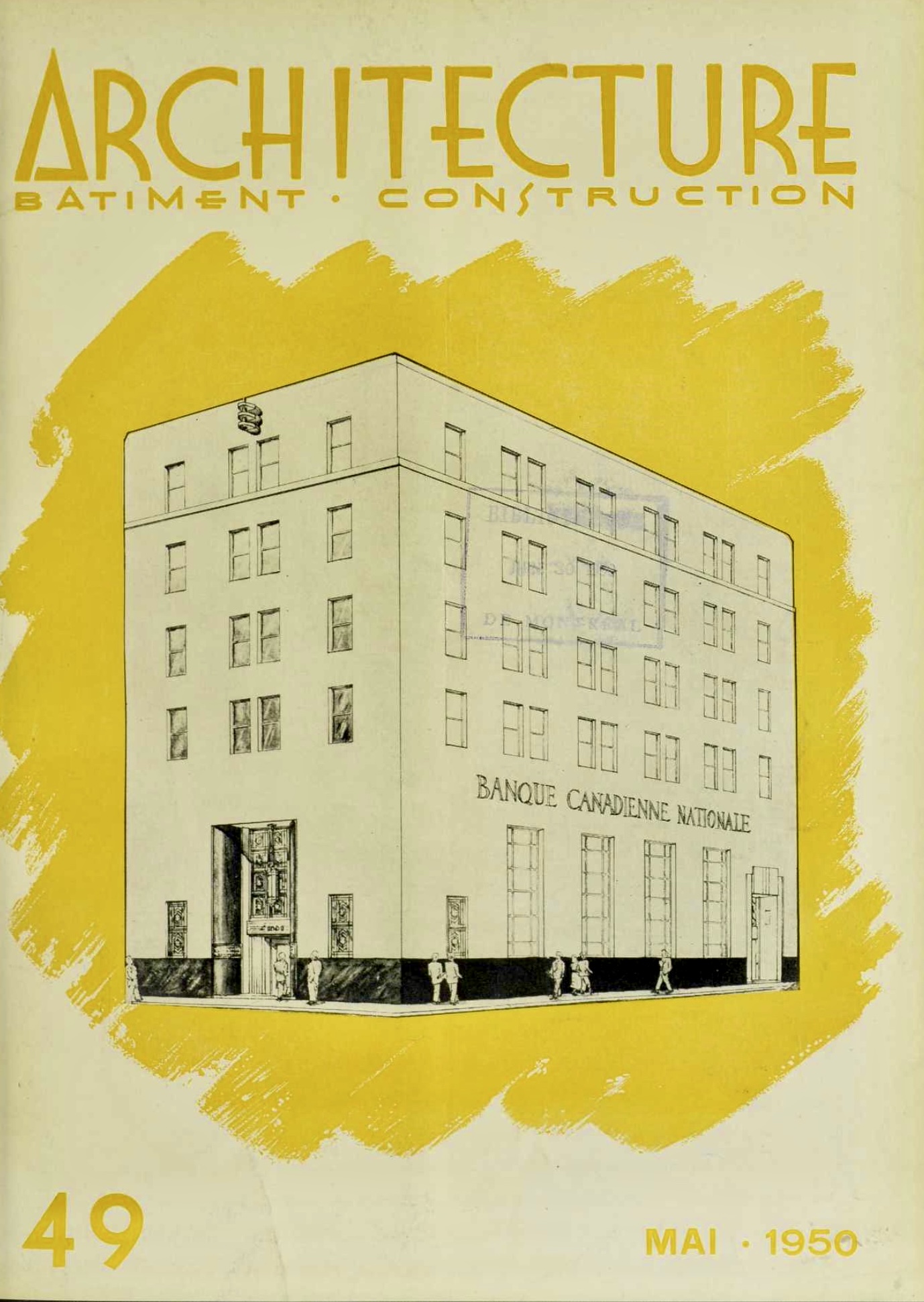
El Morocco also stood out for certain philanthropic activities: its owners occasionally organized performances in veterans’ hospitals and supported various charitable works. Despite its popularity, however, the establishment operated for only a few years. In the spring of 1949, the lease expired and the building located at the corner of Ste-Catherine and Metcalfe streets, in Montreal’s business district, was demolished to make way for a new building for the Banque Canadienne Nationale [1] [12]. The building housed several businesses on the ground floor, while the cabaret occupied the upper level. The project called for the erection of a five-storey bank building, extending from Ste-Catherine Street to Place Mont-Royal, with a bank branch at sidewalk level and offices on the upper floors.
According to Al Palmer, the final days of El Morocco were marked by an atmosphere both festive and melancholic. During the farewell evening preceding the demolition of the building in 1949, the party continued until morning, even as the crews assigned to dismantle the building began their work. Palmer specifies that Rocky Goldberg, who was in charge of the backstage bar, and Hickey, who handled the projector for the shows, refused to leave the premises until they were convinced that a new El Morocco would soon reopen elsewhere. This anecdote vividly illustrates the staff’s attachment to the establishment at the time of its closure [1].
The disappearance of El Morocco thus fits into the broad movement of downtown Montreal modernization in the postwar period, when several commercial buildings and entertainment venues on Ste-Catherine Street and nearby arteries were demolished or transformed to make way for new construction. Like many other cabarets of the era, the establishment vanished at the very moment when Montreal’s urban landscape and nightlife were beginning to enter a new phase of their evolution.
1410 Metcalfe Street — Evolution of the site (1926–1950)
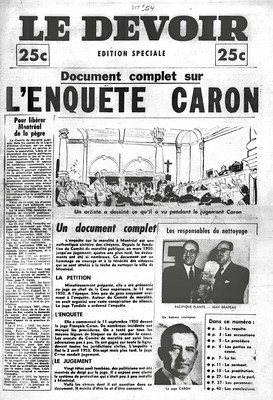
The Morality Inquiry in Montreal
In the early 1950s, Montreal nightlife came under close scrutiny from municipal authorities and the press. As part of what was then called the morality inquiry, numerous testimonies were gathered concerning the entertainment industry, cabarets, and night establishments in the metropolis. These public debates reflected the concerns of part of public opinion regarding the proliferation of clubs, their alleged links to certain criminal circles, and the growing influence of nightclub culture in Montreal society.
An article published in Le Devoir in November 1952 notably discusses the business activities of entertainment entrepreneur Eddie Quinn, an active figure in Montreal’s cabaret scene. The text addresses his business relationships with different actors of the nightlife world and places these activities within the broader context of the entertainment economy in Montreal [66].
These discussions illustrate the particular climate in which Montreal cabarets of the period operated. Despite the controversies and public inquiries, the major nightclubs continued to attract large crowds and to present shows featuring singers, dancers, orchestras, and international stars. In the field of cabaret, Montreal continued to be considered, during the year 1953, one of the most important cities in America: New York and Las Vegas then occupied the top two positions, while Montreal ranked third [99].
11. El Morocco #3 (1954–1967)
Five years after disappearing from the Montreal scene, the El Morocco cabaret reappeared in 1954, this time on Lambert-Closse Street, behind the Montreal Forum. An advertisement published in Le Petit Journal notably announced the opening of the season on May 1, presented as that of the “most fabulous cabaret in Canada” [4]. The ad featured, for the first time in Montreal, singer and variety performer Pat Morrissey, accompanied by comedian-singer Jerry Coe, as well as Maury Kaye and his “Moroccans.”
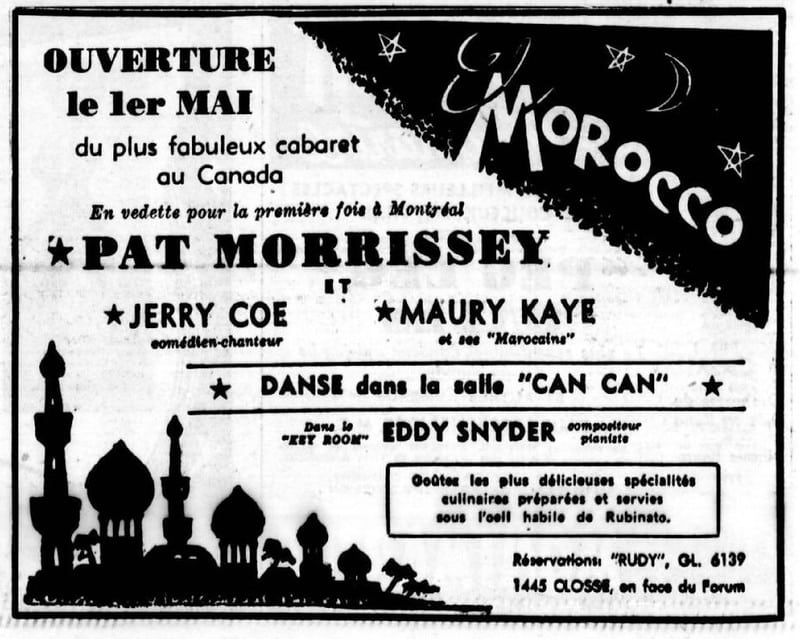
The advertisement also suggests the cabaret’s complex layout, which appears to have included several distinct spaces devoted to entertainment and dancing. Guests were notably invited to dance in the “Can Can” room, while another space, called the “Kit Room”, featured the performances of pianist and composer Eddy Snyder. This organization into different rooms corresponds to the model of major North American cabarets of the period, where restaurant, variety show, and dance floor existed side by side.
The ad also emphasizes the gastronomic aspect of the establishment, inviting patrons to sample “the most delicious culinary specialties” prepared and served under the direction of Rubinato. Reservations could be made through “Rudy” at 1445 Mountain (Closse) Street, across from the Montreal Forum, which confirms the importance of this downtown sector in the geography of Montreal’s major cabarets of the era.
The advertisement itself uses graphic imagery strongly inspired by the Orient. The illustration presents a stylized silhouette composed of minarets, domes, and palm trees, evoking an imaginary Eastern city, above which appear a crescent moon and stars. This nocturnal setting reinforces the atmosphere of mystery and exoticism associated with the cabaret’s name, El Morocco. This type of Orientalist imagery was then very common in the promotion of North American nightclubs and supper clubs, where references to palaces, gardens, or imagined Middle Eastern cities were used to evoke luxury, escapism, and the sophistication of nightlife.
The graphic design also adopts a spectacular typography: the name El Morocco appears diagonally in a dark shape recalling a night sky, while the artists’ names — notably Pat Morrissey — are printed in very large letters intended to capture the reader’s attention immediately. Altogether, it forms a dynamic advertisement combining entertainment, dancing, and gastronomy, clearly illustrating the image the cabaret sought to project in the 1950s: that of a luxurious, cosmopolitan, and decidedly modern establishment.
The management of El Morocco was handled by Peter Van Der North, an active figure in Montreal’s entertainment scene. A column published in The Gazette in 1954 indicates that he was to return from Florida in time for the opening of the cabaret and his neighboring establishment, the Key Club, suggesting the existence of a small entertainment complex in this area near the Forum [62] [64].

The El Morocco nightclub, located on Lambert-Closse Street behind the Montreal Forum, was part of the same entertainment ecosystem as the major sporting events presented in the neighboring arena. As co-owner of the club, promoter Eddie Quinn organized many wrestling and boxing galas at the Forum that attracted large crowds during the 1940s and 1950s. The nightclub thus served as a meeting place for athletes, promoters, and artists passing through the city, creating a close link between the world of professional sports and Montreal nightlife. Popular performers such as Billy Daniels and Eartha Kitt notably appeared in shows presented at the club, contributing to its reputation as one of the fashionable spots in the Forum district during the golden age of Montreal cabarets [73].
The club’s programming reflected the cosmopolitan character of Montreal nightlife at the time. A column published in Le Petit Journal in 1954 notably mentions the presence of singer Jerry Coe, retained for several consecutive weeks, alongside Helen Philips and John Alden. Van Der North stated that he wished to periodically invite French singers, in order to appeal to both French- and English-speaking clientele [63].
The same column also reports that an agreement reached between the Variety Artists’ Guild and the Musicians’ Union now allowed cabaret owners to hire comedy and dance stars under contract. Van Der North welcomed this development, which enabled him to structure the club’s programming more effectively. The article notably mentions the presence of the Hawaiian show by Johnny Pineapple [65].
A column from the same period also underlines the cabaret’s popularity among a varied clientele. The Hawaiian revue of Johnny Pineapple enjoyed notable success there, and the club became a meeting place frequented by many sportsmen from the metropolis [13].
In Une histoire du jazz à Montréal, historian John Gilmore also evokes the role of El Morocco in the ecosystem of the city’s jazz and entertainment clubs. In the early 1950s, the establishment was one of the important nightclubs of uptown Montreal and employed a house orchestra led by pianist and bandleader Maury Kaye, a musician who would become one of the notable figures of the city’s musical scene [50].
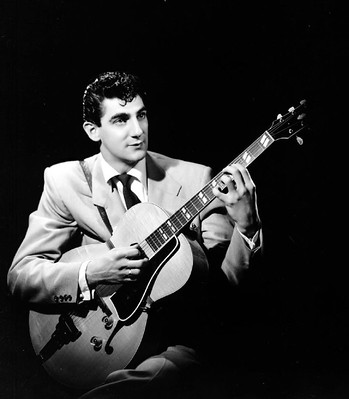
Maury Kaye
Montreal pianist and bandleader Maury Kaye (born Morris David Kronick) was one of the important figures of Montreal’s jazz scene during the 1950s. In Une histoire du jazz à Montréal, historian John Gilmore recalls that the El Morocco nightclub was then one of the main nightclubs of uptown Montreal, and that Kaye directed the club’s house orchestra there [50].
Born in Montreal on March 29, 1932, Kaye received classical musical training in his youth, notably at the McGill University Conservatory. Drawn early to popular music, he formed a small dance orchestra while still a teenager, which enabled him to obtain his first engagements in the city’s clubs. By the age of nineteen, now known as Maury Kaye, he was already leading his own ensemble and working in several Montreal dance orchestras [50].
In the early 1950s, he became a bandleader in several downtown nightclubs before taking over the house ensemble at El Morocco. His orchestra gradually developed, expanding from a trio into a larger group that could include up to seven musicians or more on major evenings. During these years, Kaye built a solid reputation as an arranger, accompanist, and musical director, working with several international artists passing through Montreal, including Josephine Baker, Tony Bennett, Sammy Davis Jr., Edith Piaf, and Mel Tormé [16].
According to Gilmore, the musician was also distinguished by his great versatility. In addition to piano, he mastered several instruments, including trumpet, valve trombone, and French horn. Among the musicians who were part of his groups were notably trumpeter Guido Basso, alto saxophonist Bob Roby, and bassist Fred McHugh, forming one of the strongest club ensembles on the Montreal scene [50].
During the following years, Kaye continued to lead various groups and collaborate with many musicians from the local and international scene. Testimonies published after his death mention, among other things, his collaborations with artists such as Pepper Adams, P.J. Perry, Bob Mover, and singer Barbara Reney, as well as his early engagements at the Esquire Showbar. Several musicians also recalled the enthusiasm shown by Sammy Davis Jr. toward one of his orchestras [22].
Considered by some commentators to be an “unknown giant” of Canadian jazz, Maury Kaye also pursued a parallel career as a teacher, arranger, and composer. Hospitalized from 1981 onward because of respiratory problems, he continued to play and write music until shortly before his death, which occurred in Montreal on February 5, 1983, at the age of fifty [16][76].
As in many nightclubs of the period, the musicians at El Morocco performed every night dressed in formal attire — what musicians called a B-flat suit. The club owner specifically required the orchestra to wear a dark blue suit with a red tie, in order to maintain an elegant and professional image. Gilmore also recounts an anecdote illustrating the almost obsessive attention paid by management to the musicians’ appearance: when the spotlights lit the stage, one could sometimes glimpse the brightly colored socks worn by the members of the orchestra, which irritated the owner to the point that a small ramp and a curtain were installed in front of the stage to hide their feet from the audience’s view [50].
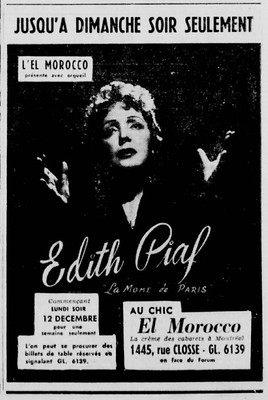
Édith Piaf (1955–1956)
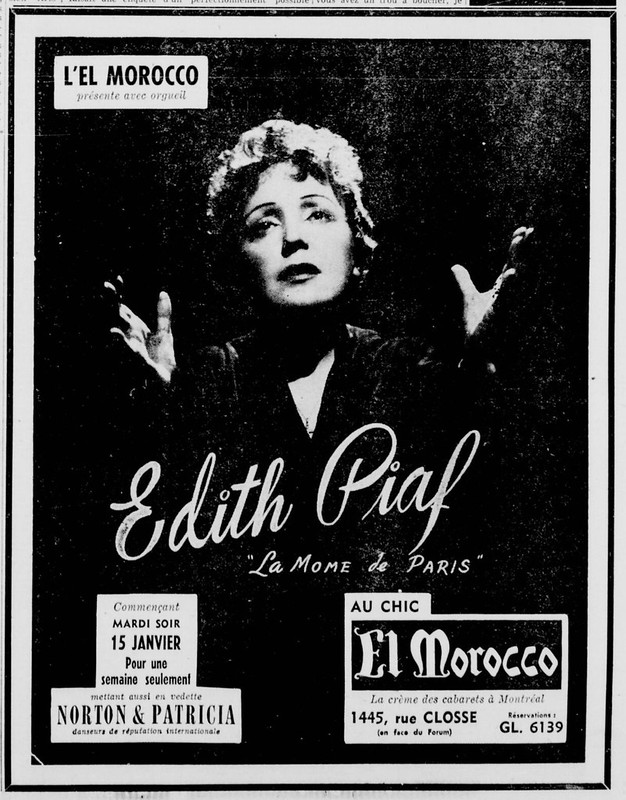
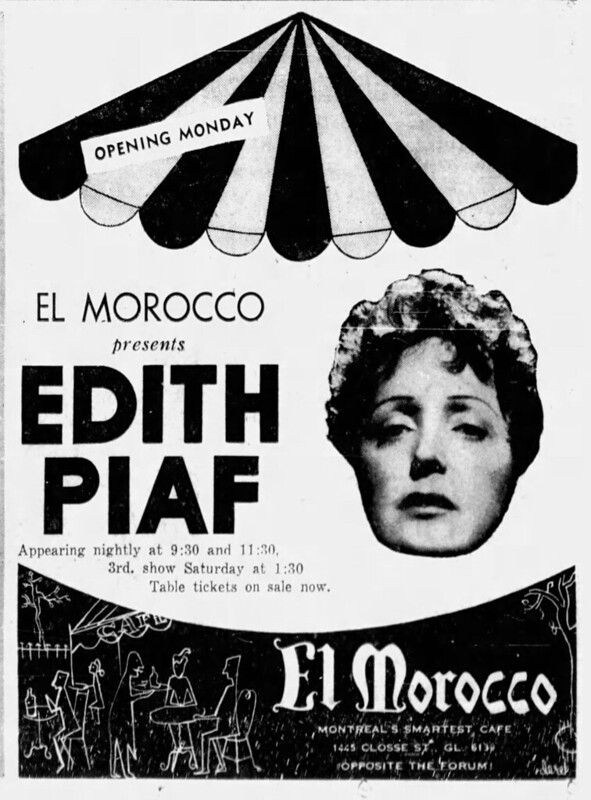
In the mid-1950s, the cabaret also became an important performance venue capable of attracting international stars. An advertisement published in the newspapers notably announced the appearance of the famous French singer Édith Piaf, who performed at the club with two shows per night, plus an additional Saturday performance [14].
An article in The Gazette underlined the enthusiasm of Montreal audiences for this artist, already considered one of the great figures of the international cabaret world. The music for the show was provided by Maury Kaye’s orchestra, a group associated with the club during this period [58].
The arrival of Édith Piaf aroused considerable interest in the press. A column in the Photo-Journal reports that the club manager, Peter Van der North, put in place a new table reservation system to meet the strong demand from the public wishing to attend the French singer’s performances, whose Montreal engagement was to last only one week [59].
An article published in Le Droit in January 1956 offers a detailed account of the atmosphere prevailing at the El Morocco cabaret during the celebrated performer’s appearance. Journalist Victor Vicq recounts going to the club to attend one of her performances and obtain an interview. When he arrived, all the tables in the room were occupied by an audience eager to hear the singer. When the cabaret lights went down and the spotlights came on, Piaf entered the stage wearing a simple black dress and a small shawl, her appearance immediately greeted by a long ovation.
For nearly an hour, the singer performed several of her songs before an attentive and silent room, where the audience seemed suspended on every word she sang. The journalist emphasizes the expressive power of her voice and the dramatic intensity of her interpretation, which transformed the cabaret stage into a true theatre of emotion. After several encores and long applause, Piaf left the stage to the crowd’s acclamations [75].
The report also describes the backstage side of the singer’s visit to the club. After the first performance, the maître d’hôtel led the journalist to the basement of the establishment, where Piaf was resting before returning to the stage for the next show. When she finally appeared, she greeted the visitors simply and shook the journalist’s hand. He notes the singer’s small stature — barely more than four feet — but also the intense presence she radiated.
On stage, Piaf performed several songs that had established her international reputation, including “Les trois cloches”, “La vie en rose”, “Johnny, tu n’es pas un ange”, “Bravo pour le clown”, and “Les gars de la marine”. The performance ended with prolonged applause and several encores, confirming the singer’s immense popularity with Montreal audiences [75].
By the late 1950s, Peter Van Der North remained a well-known personality in Montreal’s entertainment world. A column published in Radiomonde et Télémonde notes, with a touch of irony, that the director of El Morocco did not hesitate to call on French-language journalists when he wanted publicity for a show, but that it became much more difficult to obtain reservations when certain stars — such as Eartha Kitt — were already drawing crowds [60]. Another source also indicates that Van Der North was then acting as a judge on the television show Pick the Stars, while continuing his parallel role as promoter and talent scout in his cabaret [61]. These accounts confirm the importance of El Morocco in Montreal nightlife during the 1950s, when local artists, North American stars, and international performers followed one another in a programming typical of the great cabarets of the era.
A turning point emerged, however, in the early 1960s. An article published in The Gazette in January 1964 reveals that the establishment had by then passed under the direction of a new owner, Ron Cash. He was photographed beside Angelo Varvaro at the moment of signing a series of contracts totaling $50,000, or about $206,000 in 2026 dollars [26]. The investment was aimed at securing a series of international stars — including Al Martino, Joe E. Lewis, Arthur Lee Simpkins, Jack Carter, and Lili St. Cyr — in the hope of repositioning the club in the Montreal entertainment market.
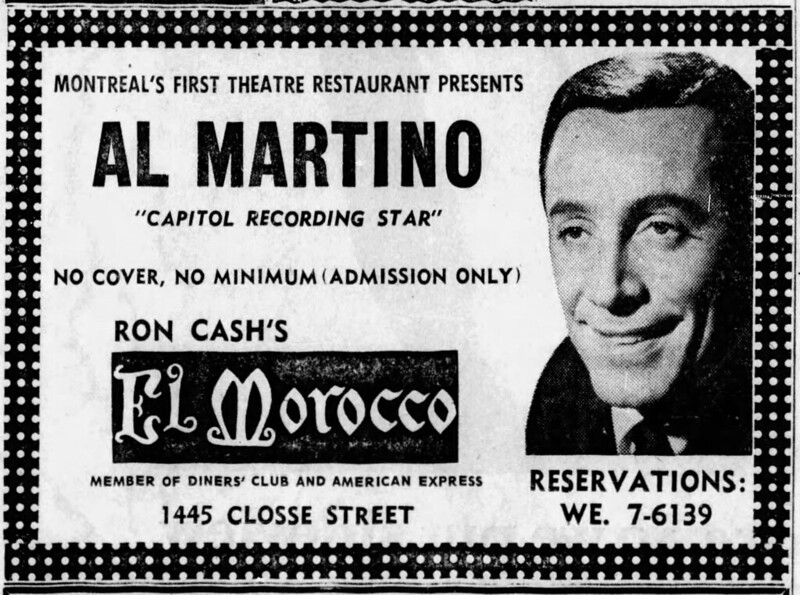
The advertisement then described the cabaret as “Montreal’s First Theatre Restaurant” [26], a sign of a major transformation in its operating model. Whereas the El Morocco of the 1940s and 1950s had been based on the classic nightclub formula — house orchestra, revues, dancing, and guest stars — the club now adopted a dinner-theatre format, placing greater emphasis on the presentation of structured stage productions and clearly identified headliners. This repositioning reflects the broader evolution of Montreal cabarets in the early 1960s, as several establishments sought to adapt to new patterns in entertainment consumption.
The advertisement also emphasized the presence of Hollywood actress Yvonne De Carlo, as well as a policy of reduced prices on food and drinks [26]. This emphasis on both star power, the food offering, and an aggressive business strategy suggests that the cabaret was already trying to respond to a more difficult context. At that time, Montreal’s major nightclubs were in fact feeling the combined effects of television, rising production costs, and changing public tastes.
In this context, Ron Cash was also experimenting with new forms of entertainment in the Montreal Forum sector. A column published in The Gazette in February 1964 thus mentions the opening on Closse Street of a small establishment called the Casbah, described as a “miniature pleasure dome” presenting an Oriental-inspired show. The revue notably included harem dancers accompanied by musicians George Sawaya and Gordon Boutzar, while the evening’s featured performer was dancer Jamira, an artist trained in classical ballet who incorporated certain elements of that discipline into her so-called “semi-Oriental” dances. According to the column, Jamira had left Budapest during the Hungarian uprising of 1956 before continuing her career in Europe and then North America [27].
Despite these attempts at diversification, the establishment soon faced a major crisis. At the beginning of the summer of 1964, an article in La Presse announced that the Régie des alcools du Québec had suspended the cabaret’s liquor licence because of unpaid taxes and duties owed to the provincial government [17]. The debt reportedly amounted to nearly $29,700, or about $299,000 in 2026 dollars. Despite these financial difficulties, the newspaper still described El Morocco as the largest cabaret in Montreal, proof that the establishment still occupied an important place in the city’s nightlife [17].
That same year, an article published in The Montreal Star following the death of sports promoter Eddie Quinn recalled the central role he had played in Montreal’s entertainment industry. The text notably emphasizes that Quinn had been one of the main promoters of wrestling and boxing at the Montreal Forum and that he had been partnered with Léo Dandurand in the establishment of the El Morocco nightclub on Metcalfe Street [74].
After a closure of about one year, the cabaret finally reopened in the fall of 1965 under new management. An article in La Presse announced the presentation of a major variety show entitled “Festival de gaieté”, bringing together about twenty performers — mainly dancers and models (“showgirls”) — as well as a mime and a singer. The production was accompanied by the orchestra led by Montreal musician Lee Gagnon [18]. The new management also announced that it wished to favour a group-show format rather than the “one star show” system [18].
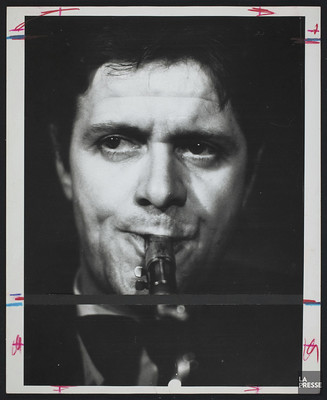
Lee Gagnon
Lee Gagnon (born September 2, 1934, in Amqui, Quebec) was a saxophonist, arranger, composer, and bandleader associated with the Canadian jazz scene and Quebec television during the 1960s and 1970s. Trained at the Conservatoire de musique et d’art dramatique de la province de Québec, where he studied saxophone and clarinet, he later pursued studies in harmony and counterpoint at the music faculty of the Université de Montréal [109] [110].
His name began circulating more widely in Montreal in the early 1960s, notably following his performances at the 1962 Montreal Festival. Over the following years, he led the Lee Gagnon Jazz Ensemble and multiplied concerts, radio broadcasts, and public appearances, which contributed to making him one of the most visible Canadian jazz musicians of his generation [107] [109].
Like many jazz musicians active in Montreal in the mid-20th century, Gagnon evolved in a musical environment closely linked to the culture of cabarets and variety orchestras. During this period, Montreal’s major nightclubs — such as El Morocco, Casa Loma, and the Jazzthèque — were important venues for jazz musicians before many of them later turned to radio and television.
Alongside his activities as a musician, Gagnon also established himself as a composer and arranger for television and the stage. He notably served as bandleader for the program Zoom en liberté and collaborated on several variety productions. In the early 1970s, his compositions were also performed on television by popular artists such as Nicole Martin, Céline Lomez, and Ginette Reno, on the program Tempo broadcast by Radio-Canada [107] [108].
Recognized as a saxophonist, bandleader, and composer, Lee Gagnon thus occupies a notable place in the history of Canadian jazz and in the evolution of popular music in Quebec during the second half of the XXe century [108] [110].
In 1966, the El Morocco cabaret attempted yet another transformation. According to an article in La Presse, the establishment was completely renovated in order to offer a cabaret-theatre formula combining restaurant, performance, and musical comedy. The announced programming included several productions inspired by the great Broadway stages, including My Fair Lady, West Side Story, Guys and Dolls, and Gypsy, staged by New York producer Tommy Finnam III [20].
However, a column published in The Gazette in the fall of 1966 reports that this new formula did not meet with the hoped-for success. Journalist Peter Diome writes that the cabaret-theatre experiment proved to be “a gamble that didn’t pay off,” and that a production of West Side Story announced for “the last three days” ultimately stayed on the bill for only two days [105].
A few weeks later, an advertisement announces the arrival at El Morocco of a new show presented as a Montreal exclusive: “Abstract Nudes A Go-Go” [106]. The revue featured dancers performing inside cylindrical cages in a go-go show atmosphere, accompanied by a discotheque and dancing evenings. This advertisement reflects the evolution of the cabaret toward a more spectacular and provocative programming, symptomatic of the transformation of Montreal nightlife in the late 1960s.
1445 Lambert-Closse Street — Evolution of the site (1953– )
12. Chez Guilda (1967)
At the beginning of 1967, the El Morocco cabaret changed hands when Montreal artist Guilda acquired the establishment with several shareholders. According to an article in Télé-Radiomonde, the music-hall star wanted to turn the club into a true headquarters for her shows and to present variety revues there on a regular basis [21]. The official opening under this new management was announced for March 25, 1967, the date on which the venue was to be relaunched under the name Chez Guilda.
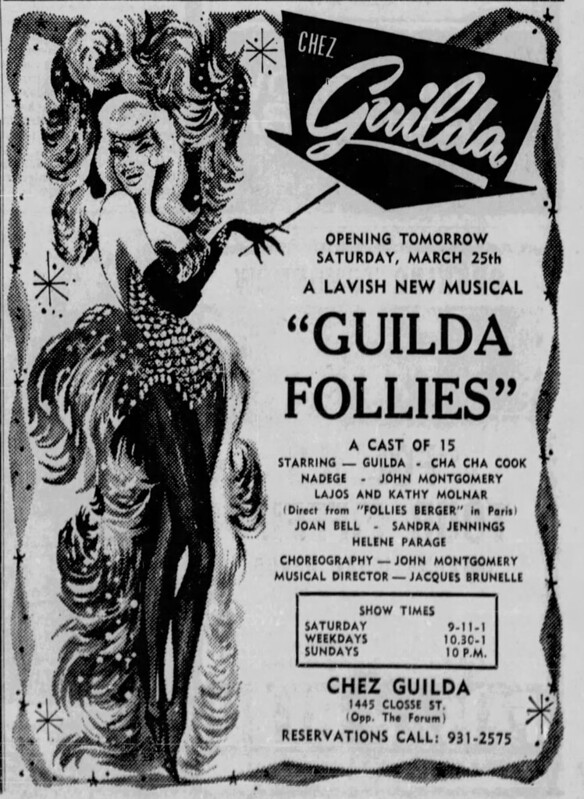
An advertisement published in The Gazette confirms the opening of the show “Guilda Follies”, presented as a lavish musical revue inspired by the famous Folies Bergère of Paris. The show starred Guilda alongside a cast of about fifteen performers, including Cha Cha Cook, Nadege, John Montgomery, Lajos, and Kathy Molnar. The choreography was by John Montgomery, while the musical direction was entrusted to Jacques Brunelle [101].
With this new formula, the establishment attempted to reconnect with the tradition of the great cabaret revues that had long characterized the nightlife of the Montreal Forum district. Guilda’s arrival thus marked a new stage in the evolution of the venue, which over the decades would go through several successive incarnations in keeping with changing trends in Montreal entertainment.
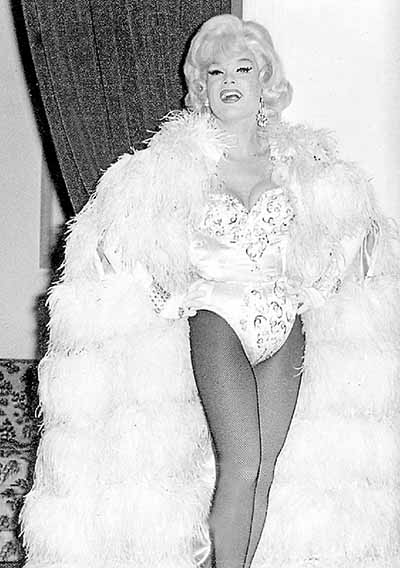
Guilda
Guilda (1924–2012), born Jean Guida de Mortellaro, was a French-born cabaret artist and female impersonator who became one of the most striking figures of Quebec nightlife during the second half of the 20th century. After beginning his career in Europe in the aftermath of the Second World War, he settled in North America in the early 1950s and quickly found success in Montreal cabarets, where his shows combining music hall, impersonation, and burlesque revue attracted a wide audience [102].
Inspired by great stars of cinema and song — notably Marlene Dietrich, Rita Hayworth, and Édith Piaf — Guilda stood out through spectacular numbers combining costumes, feathers, wigs, and choreography. His glamorous and theatrical stage persona belonged to the tradition of international music hall while adapting itself to the culture of Montreal cabarets, where variety revues and nighttime performances were then enjoying immense popularity [103].
Over the decades, Guilda became one of the great attractions of the Quebec cabaret scene. His shows, presented in several Montreal establishments and elsewhere in the province, helped popularize the art of female impersonation among an audience much broader than that of specialized circles. Several observers later emphasized that his career had played an important role in the evolution of how cross-dressing performers were perceived in Quebec popular culture [102] [103].
Beyond his artistic success, Guilda remains associated with the history of Montreal cabarets, of which he embodies one of the most emblematic figures. His career extended over several decades, making him a privileged witness to the golden age of the metropolis’s nightclubs and to the evolution of variety entertainment in Quebec.
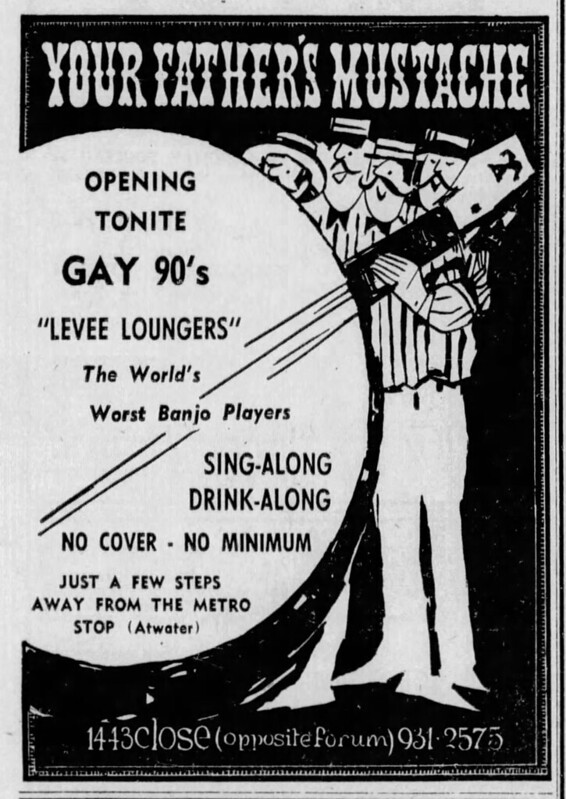
13. Your Father’s Mustache (1967-1987)
By the end of the 1960s, several cabarets that had once been emblematic of Montreal nightlife were gradually disappearing. In an article published in The Gazette in 1970, journalist Dane Lanken recalls that establishments such as the Tic-Toc, the Bellevue Casino, and the former El Morocco cabaret had closed their doors, symbolizing the end of the era of the great variety clubs that had dominated the city’s nightlife during the 1940s and 1950s [19]. The article also notes that the El Morocco building, located near the Montreal Forum, was acquired toward the end of the 1960s by Montreal club owner Norm Silver, notably associated with the Mustache Club, illustrating the transformation of the neighborhood and the shift from one generation of cabarets to a new culture of clubs and performance venues oriented toward rock music and the contemporary popular scene [19].
When it opened on July 14, 1967, Your Father’s Mustache adopted a formula inspired by the nostalgic atmosphere of the “Gay Nineties,” with sing-along and drink-along evenings animated by musicians playing banjo and inviting the audience to sing along with them [87]. The club’s initial success quickly led to the opening of a second branch on October 19, 1967, located at the Motel Metropole on Metropolitan Boulevard East [88].
An article published in The Gazette in 1969 also evokes the role of McGill University law graduate Bob Cooper, who took part during the summer of Expo 67 in the opening and operation of an establishment on Closse Street known as Norm Silver’s Mustache. The club quickly became popular for its honky-tonk atmosphere and its participatory evenings where customers sang and drank together [90].
In the early 1970s, Norm Silver’s Mustache also became a gathering place for musicians from the local scene. An article published in The Montreal Star in 1972 describes the Sunday afternoon jam sessions open to singers, songwriters, and instrumentalists of various styles — from folk and blues to country and rock [91]. Another article the same year presents the Club Mustache as a place frequented by a young clientele attracted by its relaxed atmosphere and rock programming [92].
Owner Norm Silver also observed that the lowering of Quebec’s legal drinking age from 20 to 18 in June 1971 had contributed to increased attendance at the club [92].
An article published in The Gazette in 1974 emphasizes the vitality of Montreal’s bar music scene and notably mentions Norm Silver’s Mustache, where emerging bands performed regularly [95].
That same year, a feature in The Montreal Star describes the internal workings of Your Father’s Mustache and the role of its doormen and security staff, some of them former military men or athletes responsible for maintaining order in a very busy establishment [94].
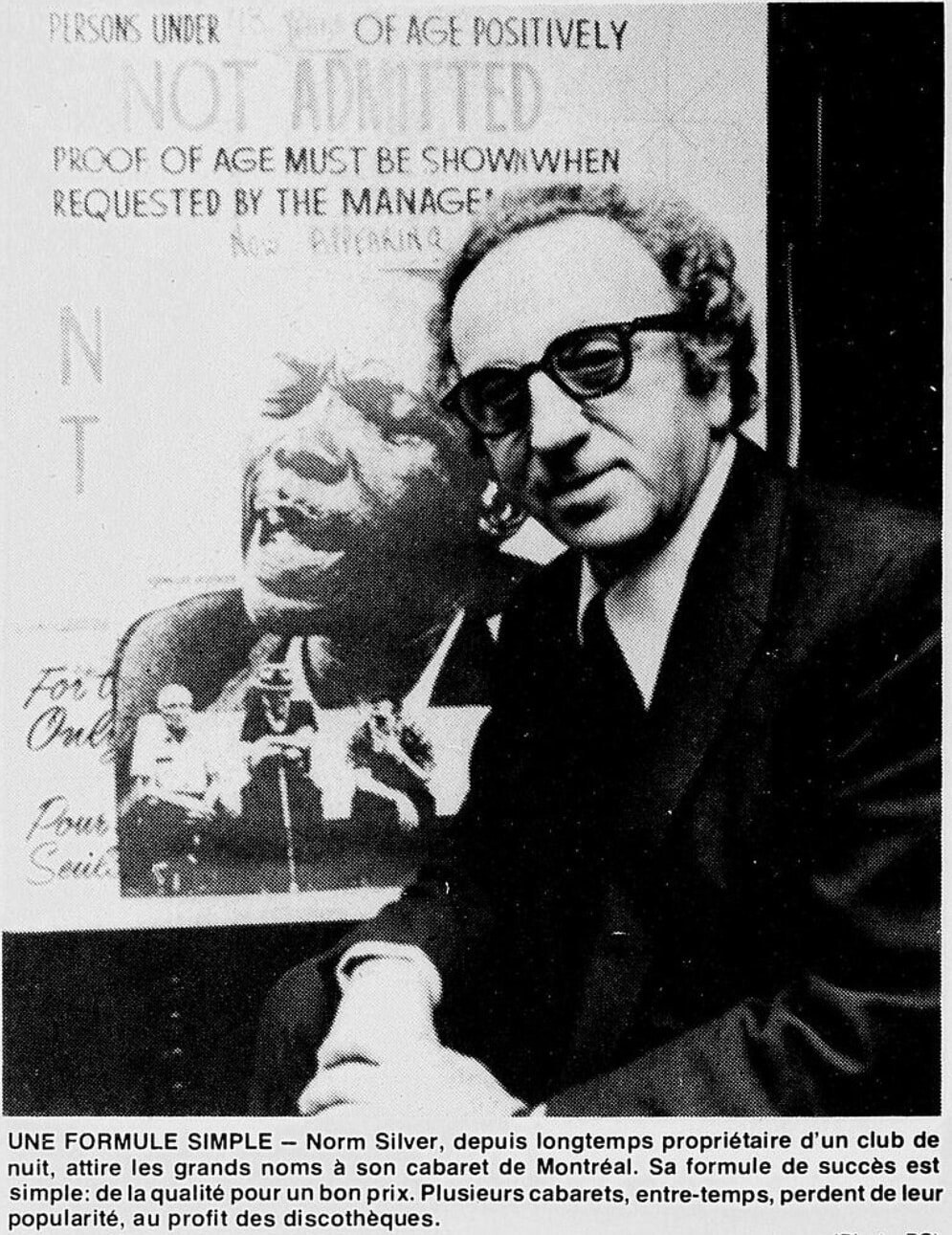
Norm Silver
Norm Silver was one of the notable figures of postwar Montreal nightlife. Active as a club operator and music programmer during the 1950s to 1970s, he played an important role in the evolution of downtown nightclubs and in the diffusion of new forms of popular music in the metropolis.
Silver is especially associated with the Esquire Show Bar, located on Stanley Street in the Montreal Forum district. Opened in 1940, this cabaret became under his direction one of the emblematic venues of the neighborhood, renowned for its eclectic musical programming combining jazz, blues, rhythm and blues, and popular music. Over the years, many international stars performed there, including Little Richard, Count Basie, Buddy Rich, Chubby Checker, Bo Diddley, and Wilson Pickett, illustrating the club’s role in the North American entertainment circuit [96].
By the late 1960s, as the traditional cabaret model began to decline, Silver also took part in the emergence of new forms of music clubs. He was associated with the launch of Norm Silver’s Mustache on Closse Street, an establishment inspired by honky-tonk bars and music pubs where audience participation — notably through sing-along evenings and jam sessions — became a central part of the experience [91] [92].
An obituary published in 1980 finally recalled the role of Montreal impresario Norm Silver in the city’s nightclub industry, notably through his work at the Esquire Show Bar and his involvement in several clubs in the Montreal Forum sector [23].
This transition between the old cabarets and the new clubs formed part of a broader evolution in the Montreal music scene. According to an article in La Presse published in 2014, the origins of Quebec heavy metal go back to the late 1970s and early 1980s. Researcher Félix B. Desfossés notably mentions the Mustache bar among the places associated with the beginnings of this emerging music scene.
14. Transformation
During the 1940s to 1960s, the area around the Montreal Forum — notably Ste-Catherine, Stanley, and Lambert-Closse streets — formed one of the main centres of Montreal nightlife. Several major cabarets attracted both local and international clientele there, including El Morocco, Tic Toc, Chez Parée, and the Esquire Show Bar. These establishments presented variety shows, orchestras, and renowned performers, helping make this district a major entertainment centre in the metropolis.
Beginning in the mid-1960s, however, the gradual decline of the large-cabaret model — caused notably by changing public tastes, the growing popularity of television, and the transformation of the entertainment industry — led to the closure or conversion of several of these venues. In a column published in The Gazette in July 1968, journalist Al Palmer observed that the great floor shows that had dominated Montreal nightclubs since the late 1920s — with their stars, comedians, and lines of dancers — now seemed to belong to the past [89].

Palmer recalls that Montreal had once occupied an important place on the North American entertainment circuit, thanks to impresarios and operators such as Phil Maurice, Carol Grauer, and Harry Holmok, who had helped make the city a major entertainment centre. Several performers who would later become stars of television and film — including Dean Martin, Jackie Gleason, Jerry Lewis, and the duo Rowan and Martin — had passed through Montreal nightclubs at the beginning of their careers [89].
By the late 1960s, however, public taste was shifting toward simpler and more informal forms of entertainment. Palmer notably points to the growing popularity of venues inspired by the atmosphere of British or Irish pubs, where participatory music, sing-alongs, and a relaxed atmosphere replaced large cabaret productions. The success of Your Father’s Mustache, operated by Norm Silver, clearly illustrates this evolution, with its sing-along and drink-along evenings accompanied by banjo and honky-tonk piano [89].
By the turn of the 1980s, most of the district’s former nightclubs already belonged to the past. An article published in The Gazette in 1990 recalls that the establishments associated with the Lambert-Closse district, long animated by impresarios such as Norman Silver, had once helped make this sector one of the centres of Montreal nightlife before disappearing with the downtown area’s urban transformation [24].
The rehabilitation of certain historic buildings in the district nonetheless testifies to the cultural importance these places held in the history of Montreal nightlife, recalling the major role cabarets played in the evolution of entertainment and show business in Montreal in the mid-20th century.
15. Conclusion
Segregation and discrimination in Montreal clubs
Although Canada never adopted racial segregation laws comparable to those of the southern United States, several testimonies and historical sources indicate that forms of discrimination existed in certain Montreal entertainment establishments in the mid-20th century. Black musicians were sometimes confronted with informal restrictions regarding access to certain clubs, hotels, or restaurants, despite their presence on the city’s stages [28] [100].
Montreal jazz pianist Oscar Peterson, who grew up in the Little Burgundy neighborhood, himself spoke of the obstacles faced by Black artists during this period. Although Montreal was an important centre of North American jazz, the social reality of the time remained marked by discriminatory practices in certain public places and in the entertainment industry [28] [100].
Despite these difficulties, the city also saw the emergence of clubs where musicians of different backgrounds could perform and meet, helping make Montreal one of the major centres of jazz in Canada in the mid-20th century.
Notes & sources
-
PALMER, Al. Montreal Confidential.
Montreal: Véhicule Press, 2009, pp. 55-58.
Chapter “The Fabulous El.” The author describes El Morocco, located at the northwest corner of Metcalfe and St. Catherine streets, as one of Montreal’s most famous nightclubs. Originally opened by Arthur Davidson, the establishment was later operated by a group of associates that notably included wrestler Yvon Robert and promoter Eddie Quinn. The text evokes the cabaret’s reputation, frequented by celebrities such as Jack Dempsey and Jack Sharkey, as well as its shows featuring comedians and chorus girls. Palmer also emphasizes the club’s philanthropic role and recounts the closing of the building in 1949, when it was demolished to make way for a bank. Illustration from the Al Palmer fonds, Concordia University Archives (scrapbook, July 23, 1955). -
THE GAZETTE, May 3, 1940, p. 3.
Advertisement announcing the opening of the EL MOROCCO cabaret, located at 1433 Mansfield Street in Montreal. The ad mentions a “Grand Opening Tonight” and presents the establishment as a cabaret offering a “Smart New York Floor Show” with two dance floors and the orchestra of Jimmy Dunlap. The advertisement also mentions beer, cocktails, wine, and meals, and specifies the “No Minimum — No Cover” policy, a formula intended to attract customers when the club opened. -
LE CANADA, March 1942.
Article announcing the inauguration of the El Morocco cabaret, presented as “one of the most modern in America” and “the chicest cabaret in Montreal.” The establishment opened its doors that evening and offered a variety show featuring several performers, including Benny Field, an American vaudeville star, French singer Irène Hilda, as well as South American dancers Carlos and Carlita, Robinson and Martin. The text also mentions the return to Montreal of Jack Benny and his orchestra. The club’s interior decoration is attributed to Georges Mitchell, a Chicago artist who had also worked on cabarets such as the Colony Club and Chez Paree. -
LE PETIT JOURNAL, May 9, 1954.
Advertisement for the El Morocco cabaret announcing the May 1 opening of the “most fabulous cabaret in Canada.” The ad features singer and variety performer Pat Morrissey, announced as appearing “for the first time in Montreal,” accompanied by comedian-singer Jerry Coe and Maury Kaye and his “Moroccans.” The advertisement also mentions a dance room called the “Can Can”, while pianist and composer Eddy Snyder performs in the “Kit Room”. The text also emphasizes the establishment’s gastronomic dimension, inviting customers to sample culinary specialties prepared under the direction of Rubinato. Reservations could be made through “Rudy” at 1445 Mountain (Closse) Street, across from the Montreal Forum. -
LA PRESSE, July 18, 1941.
“A cabaret sentenced to a $200 fine.” — The Croydon Corporation, Limited, owner of the El Morocco cabaret, located at 1433 Mansfield Street, was sentenced by Judge Gustave Marin to a fine of $200 plus costs for having provided false information to the Minimum Wage Commission regarding the wage rates paid to its employees. -
LE PETIT JOURNAL, September 28, 1941.
“A master of comedy at the El Morocco café-cabaret.” — The article announces the presence of Broadway comedian Harry Rose, engaged as master of ceremonies at the El Morocco café-cabaret. The text stresses that the establishment, recently renovated, is considered one of the most modern and comfortable places in Montreal. The program includes singer Judy Ellington, as well as several variety and dance numbers presented by the Moroccomaid, young dancers from New York. The evening is accompanied by two orchestras, that of Lou Clayton and that of Peter Barry, the latter performing notably Cuban-inspired rumba rhythms. -
WIKIPEDIA, “El Morocco.”
Article describing the Montreal cabaret El Morocco, located at 1445 Lambert-Closse Street, near the Montreal Forum. The establishment is presented as one of the city’s most prestigious and frequented cabarets during the 1940s and 1950s. Figures associated with the club notably include wrestling and boxing promoter Eddie Quinn, co-owner of the cabaret, as well as manager Jimmy Orlando. The article also mentions that several celebrities visiting Montreal frequented the establishment, including professional athletes and entertainment stars source. - La Casa Nostra, RCMP, March 26, 1965.
-
LE CANADA, March 15, 1947.
“At El Morocco,” column “Sur tout et de tout.” — The article reports that a syndicate led by Montreal wrestler Yvon Robert had just purchased the El Morocco nightclub. The new owners announced the temporary closing of the establishment in order to carry out renovations. The popular nightclub was to reopen a few weeks later, with reopening scheduled for April 5, 1947. -
LA PATRIE, April 3, 1947.
Advertisement for the opening gala of the new El Morocco, presented on Saturday, April 5, 1947 at 1410 Metcalfe Street. The event was organized by Quebec wrestler Yvon Robert, presented as the host of the evening. The opening show announced “the greatest musical revue yet presented in Montreal” and notably featured American comedian and commentator Al Bernie, singer Norma Hutton accompanied by her Melody Men, dancers Myrtill and Pacaud from New York’s Radio City Music Hall, as well as Canadian artist André Francourt. The ad also mentions the presence of the Peter Barry Trio and a large troupe of dancers. The cabaret is presented as a new fashionable place in Montreal nightlife, including a “Celebrities’ Foyer”, described as a new meeting space intended for customers and stars. -
MONTRÉAL-MATIN, April 10, 1947.
“Excellent beginnings for the new El Morocco.” — Review of the first evenings at El Morocco, recently taken over by Quebec wrestler Yvon Robert. The article stresses that the establishment compares favorably with some of the best American clubs and describes an elegant and modern décor, with a luxurious bar, an intimate atmosphere, and a spacious dance floor. The opening show notably includes comedian Al Bernie, whose humorous monologues string together punchlines and provoke much laughter, the dance duo Myrtill and Pacaud, whose choreographic number is described as original and spectacular, as well as baritone André Francourt. Singer Norma Hutton is also mentioned as a charming hostess, fulfilling her role with ease and distinction, while Jane Mackie and the El Morocco dancers complete the variety program presented at the club. -
LA PRESSE, May 4, 1949.
“B.C.N. building on the site of ‘El Morocco’.” — Article announcing the demolition of a building located at the corner of Ste-Catherine and Metcalfe streets to allow for the construction of a new building for the Banque Canadienne Nationale. The building had until then housed several businesses, including the El Morocco café located upstairs. The article specifies that six commercial establishments located on the ground floor would also be displaced, as part of a broad movement of modernization along downtown Montreal’s commercial arteries in the postwar period. -
LE PETIT JOURNAL, November 14, 1954, p. ?.
“The stars’ nightclub.” Column devoted to current events in Montreal cabarets and performance venues. The article notably mentions that the Hawaiian revue of Johnny Pineapple was then enjoying success at the El Morocco café. The text emphasizes that the establishment had for some time become the preferred meeting place of many sportsmen of the metropolis, illustrating the club’s popularity in mid-1950s Montreal nightlife. -
THE GAZETTE, December 9, 1955, p. 14.
Advertisement announcing the presentation of French singer Edith Piaf at El Morocco, located at 1445 Closse Street, across from the Montreal Forum. The ad specifies that the artist was to perform every evening at 9:30 p.m. and 11:30 p.m., with a third show on Saturday at 1:30 a.m.. This advertisement illustrates the club’s international programming in the 1950s and confirms that the El Morocco on Closse Street was then hosting major stars of song and entertainment [14]. -
THE GAZETTE, January 15, 1957.
Advertisement announcing the appearance of French singer ÉDITH PIAF at the EL MOROCCO cabaret, located at 1445 Closse Street, across from the Montreal Forum. The ad specifies that the star performed every evening at 9:30 p.m. and 11:30 p.m., with a third performance on Saturday at 1:30 a.m.. The club presents itself in the advertisement as “Montreal’s Smartest Café.” -
THE GAZETTE, February 5, 1983, p. D-4.
“Montreal jazz pianist Maury Kaye dies at 50.”
Obituary of Montreal pianist and bandleader Maury Kaye (born Morris Kronick), described as one of Canada’s great bebop pianists, jazz composers, and arrangers. The article recalls that he was especially known as bandleader of the show band at Montreal’s El Morocco nightclub during the 1950s, where he notably accompanied artists such as Josephine Baker, Tony Bennett, Sammy Davis Jr., Edith Piaf, and Mel Tormé. Classically trained, Kaye also led his own ensembles and taught piano. Hospitalized since 1981 for respiratory problems, he continued to play and compose until shortly before his death at the Montreal Chest Hospital. -
LA PRESSE, June 2, 1964.
“The RAQ suspends El Morocco cabaret’s permit.”
Article reporting that the Régie des alcools du Québec suspended the liquor licence of the El Morocco cabaret, located at 1445 Closse Street, after the establishment refused to pay certain sums owed to the provincial government, notably the 6% hospital tax. The debt reportedly amounted to about $29,700, including $28,000 linked to this tax and $1,700 in provincial tax. The article also states that a bankruptcy petition was filed against the cabaret and that its directors submitted their financial statement, thus preventing the continuation of the establishment’s activities. -
LA PRESSE, November 17, 1965.
“El Morocco reopens tomorrow night.”
Article announcing the reopening of the El Morocco cabaret, located near the Montreal Forum, after a closure of about one year linked notably to the renewal of its permit with the Régie des alcools. Under new management, the establishment reopened with a variety show entitled Festival de gaieté, bringing together about twenty artists, mainly dancers and models (“showgirls”), as well as a mime and a singer. The show, presented as bilingual, was accompanied by an orchestra led by Montreal musician Lee Gagnon. The article specifies that the venue planned to be open seven nights a week, with three shows on Saturday, one on Sunday, and two on the other nights. -
THE GAZETTE, June 27, 1970, p. 40.
“Rock ’n’ roll and mustaches,” article by Dane Lanken devoted to the evolution of Montreal nightlife and the transition between the old cabarets and the new rock clubs of the late 1960s. The text evokes the gradual disappearance of several famous establishments in the metropolis, including the Tic-Toc, the Bellevue Casino, and El Morocco. The author mentions that the latter, once a very popular cabaret located near the Montreal Forum, had then been closed for several years and now belonged to Norm Silver, owner of the Mustache Club, who acquired it when it closed around the end of the 1960s. -
LA PRESSE, September 13, 1966.
“El Morocco becomes a cabaret-theatre.”
Article announcing the transformation of the El Morocco cabaret into a restaurant-cabaret-theatre. The fully renovated establishment planned to offer, under one roof, the possibility of having an aperitif, dining, and attending a Broadway musical comedy. The programming was to be handled by New York producer, director, and choreographer Tommy Finnam III, with shows inspired by popular productions such as My Fair Lady, West Side Story, Guys and Dolls, and Gypsy. Each production was to remain on the bill for about fifteen days. The new season was to begin on September 27, 1966 with My Fair Lady. The article specifies that there would be one performance every evening from Tuesday to Sunday, with two performances on Friday and Saturday, as well as a musical variety revue presented on certain evenings after the musical comedy. -
TÉLÉ-RADIOMONDE, March 4, 1967.
“Guilda buys El Morocco.”
Article announcing that Montreal artist Guilda (Jean Guida de Mortellaro), famous female impersonator and music-hall star, acquired the El Morocco cabaret with several shareholders. The establishment was to become the new base for Guilda’s shows, where he planned to present music-hall revues on a regular basis. According to the article, the official opening of the cabaret under this new management was scheduled for March 25, 1967. The text also notes that the news was attracting attention in Montreal’s entertainment circles, with many artists and regular cabaret patrons already welcoming the resumption of activities. -
THE GAZETTE, February 10, 1983.
LEN DOBBIN, “Friends bid farewell to great Maury Kaye.”
Article paying tribute to Montreal pianist and bandleader Maury Kaye (born Morris Kronick), who died at the age of 50. The text highlights Kaye’s importance within Montreal’s jazz community and recalls that during the 1950s he led orchestras at the El Morocco and the Bellevue Casino, bringing together many of the city’s finest musicians. The article notably mentions the enthusiasm of Sammy Davis Jr. toward one of these ensembles. It also recalls the diversity of his career, including collaborations with artists such as Pepper Adams, P.J. Perry, Bob Mover, and singer Barbara Reney, as well as his early musical experiences at the Esquire Showbar in the 1950s. The tribute also evokes his classical training, his work as a composer and arranger, and the respect he commanded within Montreal’s musical community. -
THE RECORD, March 18, 1980.
“Norm Silver dead at 69.”
Obituary devoted to Montreal impresario Norm Silver, an influential figure in the city’s nightclub and entertainment scene. The article recalls that Silver entered the nightclub industry in the 1940s, notably by transforming the Esquire Show Bar into a venue recognized for presenting contemporary music artists. The text also emphasizes his important role in promoting several generations of musicians and in shaping Montreal nightlife in the mid-20th century. -
THE GAZETTE, September 1, 1990, p. 94.
“A pocket of sanity on Lambert Closse St.,” article by Aline Gubbay devoted to an architectural rehabilitation project on Lambert-Closse Street, on the site of a former Montreal nightclub. The text recalls that this location had been, for several decades, an important entertainment venue, notably associated with impresario Norman Silver, whose clubs — including the Mustache Club — animated Montreal nightlife for many years. The article notes that the brick building, dating from the late 19th century, was restored in the 1980s in order to preserve its historic character while adapting it to new uses. This rehabilitation is presented as an example of successful integration between architectural heritage and urban development in downtown Montreal. -
LA PRESSE, March 3, 2014, p. 5 (Arts).
“Survivors wanted,” by Jean-Christophe Laurence.
Article devoted to the origins of Quebec metal and to the efforts of journalist Félix B. Desfossés to document this still understudied music scene. The text mentions several pioneering bands from the late 1970s and early 1980s, including Voivod, Oblivion, Ourguts, D.B.C., Gorguts, and Damnatia. It notably highlights the role of the Montreal band D.D.T., formed in 1979, considered one of the first heavy metal bands in Quebec. -
THE GAZETTE, January 14, 1964.
“Ron Cash Signs Contracts for $50,000.”
Article announcing that Ron Cash, new owner of the El Morocco, signed a series of contracts totaling $50,000 in order to bring several international stars to the Montreal nightclub. The photograph shows Cash alongside Angelo Varvaro following the signing of the agreements. The announced lineup includes Al Martino (January 24–31), Joe E. Lewis (February 8–15), Arthur Lee Simpkins (February 16–22), Jack Carter (April 4–11), and Lili St. Cyr (scheduled April 18–25). The article also mentions the presence of Hollywood actress Yvonne De Carlo among the performers appearing at the cabaret, presented as “Montreal’s First Theatre Restaurant.” -
THE GAZETTE, February 14, 1964, p. 30.
HAROLD WHITEHEAD, “Night Beat.”
Column describing a new entertainment concept introduced by Ron Cash on Closse Street, near the El Morocco. The author mentions the opening of a small venue called the Casbah, described as a “miniature pleasure dome,” featuring an oriental-inspired show with harem dancers and Arabic music performed by George Sawaya and percussionist Gordon Boutzar. The main act features dancer Jamira, described as an artist with classical ballet training who incorporates elements of that discipline into her so-called “semi-oriental” dances. The article also notes that Jamira, of Hungarian origin, left Budapest for Vienna during the 1956 Hungarian uprising before continuing her career in North America. The column situates this show within the broader context of new forms of entertainment offered in Montreal nightclubs in the early 1960s. -
RED BULL MUSIC ACADEMY DAILY, 2016.
“Montreal Jazz Feature” — article devoted to the history of jazz and nightlife in Montreal, published on the editorial platform of the Red Bull Music Academy. The text revisits the historical importance of the city as a major jazz centre in North America and mentions several clubs and venues that shaped Montreal’s music scene in the mid-20th century, a period often associated with the golden age of cabarets and nightclubs in the city read the article. -
THE GAZETTE, June 8, 1940, p. 5.
Montreal cabaret listings simply indicating “MOROCCO — Revue.” This mention confirms that the Morocco cabaret was presenting a variety revue at the time, a format typical of shows offered in Montreal nightclubs of the era. The establishment is listed alongside other downtown cabarets, including the Normandie Roof, the Tic Toc, the Esquire, and the Samovar. -
LE CANADA, January 10, 1941.
Article concerning the legal validity of permits issued by the Liquor Commission and recounting a dispute involving George Peate and Mr. Dettner. The text indicates that Dettner previously operated an establishment called the Embassy Terrace Cabaret at 1433 Mansfield Street in Montreal, between May 1, 1937 and April 30, 1939. This mention confirms that the address that would later house the El Morocco cabaret already hosted an entertainment venue in the late 1930s. -
LE SOLEIL, May 13, 1939.
Advertisement indicating that the cabaret and nightclub “Embassy”, located at 1433 Mansfield Street in Montreal, is offered for rent “fully furnished.” The ad, placed by Mr. Peate, confirms the existence of a cabaret at this address in the late 1930s, prior to the opening of El Morocco the following year. -
THE MONTREAL STAR, February 9, 1934, p. 15.
Advertisement announcing the opening of the cabaret-restaurant The Embassy, located at 1433 Mansfield Street in Montreal. The ad presents the establishment as a venue offering dining, cocktails, and entertainment, with orchestra, floor show, and daily performances. It also mentions a dinner served from 6 to 9 p.m. for 75 cents and specifies “No Cover or Minimum.” This source confirms the existence of a cabaret at this address as early as the mid-1930s, well before the opening of El Morocco in 1940. -
THE MONTREAL STAR, February 6, 1934, p. 8.
Article announcing the imminent opening of the cabaret The Embassy, presented as Montreal’s newest cabaret. The establishment is set to open on the Friday of that week at 1433 Mansfield Street. The program includes an all-female orchestra, an early evening “dinner dance,” and a later-night floor show, illustrating the typical format of North American cabarets in the 1930s. -
THE MONTREAL STAR, December 13, 1927, p. 17.
Advertisement for the PEATE MUSICAL INSTRUMENT SHOP and the PEATE SCHOOL OF MUSIC, located at 1431-1433 Mansfield Street, just above Sainte-Catherine Street. The ad presents the establishment as having one of the largest inventories of instruments in Canada and “the largest school of its kind in the country.” It also states that the Peate company acted as Montreal agent for several renowned instrument brands, including Martin, Ludwig, Deagan, and Bacon, while offering private lessons and repair services for wind, string, and percussion instruments. -
THE GAZETTE, February 20, 1984, p. 30.
Article titled “This family has made music for 85 years” devoted to the Montreal company Peate Musical Supplies Ltd.. The text recalls that the company was founded in 1899 by George Peate, a mandolinist from Utica, New York, and remained a family business for several generations. It highlights that the firm became one of Canada’s largest distributors of musical instruments, offering hundreds of models from Europe, Japan, and the United States, and supplying instruments to schools and orchestras. In 1984, the company was headed by Richard Peate, president of Peate Musical Supplies Ltd. -
THE GAZETTE, August 16, 1999, pp. 49-50.
Article titled “A bit of pluck” retracing the history of Peate Musical Supplies Ltd. on the occasion of its centennial. The text recalls that the company was founded in 1899 by George A. Peate, a mandolinist from Utica, New York, who began by teaching mandolin in Montreal before selling instruments to his students. It also mentions the popularity of mandolin orchestras in the early 20th century, including that of the Montreal Amateur Athletic Association, directed by George Peate. The article notes that the company, still run by the Peate family at the end of the 20th century under Richard Peate, became a major Canadian distributor of musical instruments and supplies. -
LA PRESSE, November 9, 1967.
Article titled “Flames raged for five hours in the heart of Montreal” reporting on a major fire in a commercial building located at 1431 and 1433 Mansfield Street, between Sainte-Catherine and Maisonneuve. The fire, which reportedly began in the basement, quickly spread to the ground floor, where the Peate Musical Co. store was located, as well as to upper floors occupied by the Silver Slipper cabaret. Approximately 150 firefighters were mobilized to fight the blaze for several hours. Several people were affected by smoke, including employees of the music store and firefighters, but no serious injuries were reported. -
LA PRESSE, November 21, 1967.
Brief published in the “Burglaries” section reporting that an establishment recently damaged by fire was the target of a theft. The owners of Peate Musical, located at 1431 Mansfield Street, next to the Silver Slipper cabaret at 1433 Mansfield, reported that burglars forced open the boarded-up storefront and stole several instruments, including seven amplifiers and guitars, valued at more than $5,900. -
THE MONTREAL STAR, August 4, 1928.
Notice indicating that the British Spiritualist Church held public meetings at 1433 Mansfield Street in Montreal. Meetings took place Sunday evenings at 7:30 p.m., with spiritual messages delivered by medium Mrs. Jean Tank, as well as a public meeting on Thursday evenings. This mention shows that the address served as a religious or associative meeting hall in the late 1920s, well before the opening of the The Embassy cabaret in 1934. -
THE MONTREAL STAR, August 2, 1930.
Notice from the British Spiritualist Church stating that meetings were held at 1433 Mansfield Street, “over Peate’s Music Store.” Public services took place Sunday evenings at 7:30 p.m. and included lectures and “spiritual messages” delivered by various mediums, including Mrs. Lees, Mrs. Ritchie, and Mr. Williams. Public meetings were also held on Thursday evenings. This confirms that the building hosted spiritualist gatherings in the late 1920s and early 1930s, before its conversion into a cabaret. -
THE MONTREAL STAR, March 21, 1931.
Notice from the British Spiritualist Church indicating that meetings were held at 1433 Mansfield Street, in Peate’s Music Hall. The notice mentions a public service on Sunday evening at 7:30 p.m., with a lecture by Mr. C. A. Williams, as well as a spiritual circle and psychometry activities led by Mrs. Hudson. This source confirms that the building still hosted spiritualist meetings in the early 1930s, before its transformation into a cabaret. -
THE MONTREAL STAR, September 12, 1931.
Letter published under the title “Fake Mediums Disowned” in which C. Williams, president of the British Spiritualist Church, criticizes “fake mediums” who exploit the public under the guise of spiritualism. Williams explains that legitimate spiritualist meetings sometimes require the rental of a hall and that modest fees may be charged to cover these costs. This letter confirms the activity of the spiritualist group in Montreal in the early 1930s, whose meetings were notably held at 1433 Mansfield Street. -
THE MONTREAL STAR, September 4, 1931.
Letter published under the title “Duping the Public” in which Dorothy Davis Stein criticizes the practices of certain mediums that she considers fraudulent. The author refers to the existence of paid spiritualist meetings in Montreal and calls on the authorities to investigate these activities. This text illustrates the debates and controversies surrounding the spiritualist movement in the city in the early 1930s, a period during which groups such as the British Spiritualist Church also held public meetings. -
LA PATRIE, July 9, 1930.
“To announce the grand opening of The Golden Dome restaurant” — advertisement announcing the opening of The Golden Dome restaurant and dance hall at 1433 Mansfield Street. The ad presents the establishment as a modern “Oriental Palace” devoted to dining and dancing in Montreal. Music was provided by Marcel Bernard and his Golden Dome Orchestra, and dancing was offered every evening starting at 9:30 p.m.. The advertisement also highlights the absence of a cover charge, a “Blue Plate” menu served daily for 45 cents, as well as the presence of a beer and wine licence. -
LA PRESSE, June 30, 1931.
Judicial notice published by the Superior Court of the District of Montreal concerning Z. Limoges and C. Frank Woo & Westley Woo, operators of the Golden Dome Restaurant at 1433 Mansfield Street. The document announces that following a judgment rendered on the eleventh day of July 1931, the business and property associated with the establishment — including dining-room fixtures, furniture, etc. — were to be sold by authority of the court in order to satisfy the defendants’ creditors. -
LA PRESSE, October 30, 1933.
“The sale of liquor closely monitored.”
Article indicating that the police of the Liquor Commission continued its campaign against certain cabarets and restaurants that were not respecting the regulations governing the sale of beer and wine. The text specifies that several permits were revoked, including that of the Golden Dome Café, listed among the establishments targeted by these disciplinary measures. -
THE MONTREAL STAR, November 7, 1933.
Advertisement for the Cafe St. Moritz, located at 1433 Mansfield Street, presented as one of Montreal’s important cafés. The ad promotes a formula combining dining and entertainment, with dinner served for 85 cents and weekday lunch for 55 cents, along with a full menu including appetizers, main courses, and desserts. Music was provided by Jules Guenette and his orchestra, and the establishment emphasized the absence of a cover charge or minimum. The advertisement also mentions the availability of wines and drinks, as well as facilities for private receptions. -
THE MONTREAL STAR, March 7, 1942, p. 22.
Article titled “New Club To Open” announcing the forthcoming opening of the El Morocco cabaret, presented as one of the most spectacular nightclubs in Montreal. The establishment was to open on March 12, 1942 and could accommodate at least 300 people. The text describes a modern décor composed of colorful fluorescent-finish murals, red leather at the entrance, mirror-covered walls on the upper levels, and glass ceilings producing lighting effects. An adjoining lounge was decorated in blue tones, and the entire establishment was air-conditioned. The article also announces that Jack Denny would lead the club’s orchestra, while Al Bernie would serve as master of ceremonies at the opening show. -
MARRELLI, Nancy. Stepping Out: The Golden Age of Montreal Night Clubs.
Montreal: Véhicule Press, 2004, p. 72.
Short passage devoted to El Morocco, described as one of Montreal’s most important nightclubs during the golden age of cabarets. The author notes that the club, which shared its name with the famous New York El Morocco, featured floor shows, a line of chorus girls, and performances by popular artists, accompanied in the 1950s by the orchestra led by Maury Kaye. Marrelli also specifies that the name El Morocco was used for three distinct establishments in Montreal, the first of which was located at 1433 Mansfield Street, in a building that had previously housed several clubs and cabarets, including the Washington Club, the Embassy, the Golden Dome, the Cavendish, and the Silver Slipper. -
GILMORE, John. Une histoire du jazz à Montréal.
Montreal: Lux Éditeur, 2009, pp. 225-227.
The author discusses the role of El Morocco in Montreal nightlife and notably mentions the orchestra led by pianist and bandleader Maury Kaye, an important figure in Montreal’s musical milieu in the 1950s. Gilmore describes Kaye’s group as one of the city’s most renowned nightclub house bands, bringing together several local jazz musicians. The text also emphasizes the disciplined and professional character of the orchestra, whose members performed every evening in formal attire and accompanied the shows presented at the club. Finally, the author recalls that the El Morocco on Mansfield Street was the first Montreal establishment to bear that name, before other clubs called El Morocco later opened in Montreal, notably near the Forum [50]. -
WEINTRAUB, William, City Unique: Montreal Days and Nights in the 1940s and ’50s,
Montreal, McClelland & Stewart, 1996 (2nd printing), pp. 120-123, 126-127.
The author describes El Morocco as one of Montreal’s most famous nightclubs during the 1940s. According to Weintraub, the club was renowned for its chorus girls, its variety shows, and its floor shows presented on stage before a room filled with small tables where customers had meals and cocktails during the performances. The establishment also had long bars and a dance floor where the house orchestra accompanied the acts. Weintraub emphasizes that the cabaret attracted a fashionable clientele and many celebrities from the worlds of sports and entertainment, including boxers Jack Dempsey and Jack Sharkey, as well as the famous dancer Lili St. Cyr, who regularly frequented the establishment during her stays in Montreal. -
LA PRESSE, July 13, 1971, p. B3.
André Trudelle, “Quebec loses a great champion in Yvon Robert.”
Article published the day after the death of Montreal wrestler Yvon Robert, who died at the age of 56 following a heart attack. The text retraces the major stages of his career, recalling that he won the world championship of the National Wrestling Association several times and was one of the greatest attractions in professional wrestling in Canada. The article also emphasizes Robert’s immense popularity in Montreal, where his matches drew considerable crowds, notably at the Forum and at Delorimier Stadium [92]. -
LE DROIT, February 27, 1948.
“Yvon Robert in the mines.”
Brief item mentioning the business activities of the famous Quebec wrestler Yvon Robert. The article indicates that Robert, who had by then become a real estate agent, was also the owner of a cabaret and director of a private company. The text reports that he joined a syndicate of Montreal businessmen with the aim of acquiring the Southvue gold mine, located in the same region as the Golyue mine, illustrating the wrestler’s involvement in various commercial ventures in the late 1940s. -
LE MONDE OUVRIER (THE LABOR WORLD), March 11, 1944.
Advertisement for CAFÉ YVON ROBERT Ltée, presented as “the chicest café in the East.” The ad indicates that the establishment, located at 4558 Notre-Dame Street East (between Aird and Bennett streets), offered meals, beer, wines, dancing, and all kinds of spirits. Management is attributed to Yvon Robert, president, with Maurice Robert as vice-president and Armand Robert as secretary-manager. -
LE DROIT, February 27, 1948.
“Yvon Robert in the mines.”
Brief item mentioning the business activities of the famous Quebec wrestler Yvon Robert. The article indicates that Robert, who had by then become a real estate agent, was also the owner of a cabaret and director of a private company. The text reports that he joined a syndicate of Montreal businessmen with the aim of acquiring the Southvue gold mine, located in the same region as the Golyue mine, illustrating the wrestler’s involvement in various commercial ventures in the late 1940s. -
DIMANCHE-MATIN, May 6, 1956, p. 18.
Jacques Francoeur, “Involved everywhere even if it shocks you.”
Column mentioning the many business activities of Montreal wrestler Yvon Robert. The author states that Robert was involved in various sectors, notably in restaurants, cabarets, and other commercial enterprises, illustrating the champion’s broad presence in the worlds of business and entertainment in Montreal in the mid-20th century. -
LE PETIT JOURNAL, November 13, 1949.
Brief item indicating that Montreal wrestler Yvon Robert and wrestling promoter Eddie Quinn had just acquired the cabaret Chez Maurice. The note specifies that it was then being considered that the establishment might eventually take the name “El Morocco”, in memory of a Montreal cabaret of the same name that had existed earlier. -
THE GAZETTE, December 14, 1955, p. 18.
“Edith Piaf Heard At El Morocco.” Article devoted to the performance of French singer Edith Piaf at Montreal’s El Morocco. The text emphasizes that the artist, already recognized as one of the greatest stars of the international cabaret scene, was then giving a rare engagement in the city. The article describes the enthusiastic reception from Montreal audiences and highlights the emotional intensity of her interpretation. It also mentions that the music for the performance was provided by Maury Kaye’s orchestra, a group associated with the club during this period [58]. -
PHOTO-JOURNAL, December 17, 1955.
“La ronde de minuit.” Brief item devoted to current events in Montreal cabarets. The article mentions that the director of El Morocco, Peter Van der North, put in place a new table reservation system for the engagement of French singer Edith Piaf. Admirers of the star, nicknamed the “waif of Paris,” could thus present themselves directly at the club to buy their tickets and secure a seat. The column also specifies that Piaf’s presence in Montreal was to last only one week. -
RADIOMONDE ET TÉLÉMONDE, January 25, 1958.
Column referring to the director of El Morocco, Peter Van der North. The author points out, with a touch of irony, that Van der North readily calls upon French-language journalists when he wishes to obtain publicity for a show whose success is not assured. However, when an artist is already drawing crowds — the article notably mentions the engagement of singer Eartha Kitt — the director becomes difficult to reach and access to reservations may prove complicated, the club then being sold out [60]. -
LE PETIT JOURNAL, December 30, 1956.
Brief item mentioning Peter Van Der North, owner and director of El Morocco. The article indicates that he was then acting as a judge on the television program Pick the Stars. The column also highlights his flair for show business and his role in the discovery and promotion of several artists at El Morocco. The text also refers to an article in the American magazine Variety devoted to the popularity of dancers in Montreal cabarets and recalls, in the same context, a morality raid that had targeted the New Orleans café [61]. -
LE PETIT JOURNAL, January 24, 1954.
“La boîte à vedettes.” Column devoted to current events in Montreal cabarets. The article announces the forthcoming opening of Café Chez Van, located near the Montreal Forum, whose owners were Eddie Quinn and Peter Van Der North, also associated with El Morocco. The text specifies that the new establishment was to become a favorite meeting place for sportsmen and was being presented as one of the most luxurious venues in the city [62]. -
LE PETIT JOURNAL, May 16, 1954.
“La boîte à vedettes.” Column devoted to current events in Montreal cabarets and performance venues. The article notably mentions that singer Jerry Coe was continuing his engagement for a third week at El Morocco, where one could also see singer Helen Philips and John Alden. The text also specifies that Peter Van Der North, owner of the establishment, wished from time to time to invite French singers in order to give his cabaret an international character and appeal both to Montreal’s French-speaking and English-speaking clientele. -
THE GAZETTE, April 16, 1954.
“Person to Person.” Society brief indicating that Peter Van Der North was to return from Florida the following week in time for the opening of El Morocco and his neighboring establishment, the Key Club. This mention confirms that Van Der North was then directing the fortunes of the cabaret and preparing the seasonal reopening of these two places in Montreal nightlife. -
LE PETIT JOURNAL, November 21, 1954.
“La boîte à vedettes.” Column devoted to current events in Montreal cabarets. The article mentions artist Johnny Pineapple and his Hawaiian-inspired revue presented at El Morocco. The text also reports a statement by Peter Van Der North, owner of the cabaret, asserting that venue owners could now hire comedy and dance stars under contract, following an agreement reached between the Variety Artists’ Guild and the Musicians’ Union. This agreement marks an important moment for the organization of shows in Montreal cabarets in the mid-1950s. -
LE DEVOIR, November 13, 1952.
“Mr. Quinn did not know the ‘red light’ in 1936” — article published in the context of the morality inquiry conducted in Montreal in the early 1950s. The text notably evokes the business activities of Eddie Quinn, a figure in Montreal’s cabaret and entertainment scene, and addresses his business relations in the entertainment sector. The article also mentions his links with various figures in the city’s nightlife milieu and places these activities within the broader context of the cabaret industry and Montreal nightlife of the period. -
GAZETTE DE VALLEYFIELD, January 19, 1950, p. 15.
“Jimmie Orlando is one of....” Article retracing the career of Montreal hockey player Jimmie Orlando (born in 1917), former player for the Victoria Junior, the Victoria Senior, and the Canadien Senior, scouted by the Detroit Red Wings organization. After the Second World War, he notably played for the Valleyfield Braves before becoming manager of Café El Morocco in Montreal and later owner of Aldo’s Café Restaurant on Mountain Street. -
THE GAZETTE, March 1, 1946, p. 14.
“Arthur Davidson Dies; Prominent Cafe Owner.”
Obituary of Arthur Davidson, a well-known figure in Montreal nightlife and owner of Montreal El Morocco. The article recalls that he had founded the original café on Mansfield Street, before moving the establishment to new premises. -
THE GAZETTE, October 27, 1950, p. 3.
“Boxman Said Usually Man Nabbed Though Barbotte Owner Present.”
Article concerning the morality inquiry in Montreal. A witness asserts that Arthur Davidson operated a gambling establishment (“barbotte”) and mentions several addresses associated with these activities, notably 1222 University Street. -
LE DEVOIR, October 26, 1950, p. 1.
“Ls-Philippe Plante, long-time croupier for Davidson, begins to testify.” Article reporting testimony presented before the morality inquiry commission in Montreal, where several witnesses described gambling activities associated with Arthur Davidson. -
LE DEVOIR, October 7, 1950, p. 1.
“Croupier Litwick gives a ‘lesson’ on barbotte.”
Article describing testimony presented to the morality inquiry commission. The text mentions 1222 University Street as being part of the “domain of Arthur Davidson and Max Shapiro.” -
THE GAZETTE, November 19, 2010, p. 25.
“Promoter Quinn was one of a kind,” by Red Fisher.
Article devoted to Montreal sports promoter Eddie Quinn. The text recalls that several personalities from the world of show business and entertainment frequented the El Morocco nightclub, located on Closse Street opposite the Montreal Forum, an establishment associated with Quinn during the 1950s. -
THE GAZETTE, April 16, 2005, p. 58.
“Promoter Quinn was unforgettable,” by Red Fisher.
Retrospective article devoted to Montreal promoter Eddie Quinn, a major figure in the world of professional wrestling and boxing in Montreal for more than two decades. The text recalls that Quinn, established in Montreal from 1939, was long associated with the wrestling and boxing galas presented at the Montreal Forum. The article also evokes his activities in Montreal nightlife, mentioning the El Morocco nightclub, located on Closse Street opposite the Forum, of which Quinn was owner during the 1950s. Several artists and entertainment personalities — including Billy Daniels and Eartha Kitt — were notably presented there. -
THE MONTREAL STAR, December 15, 1964, p. 57.
“The Death of Eddie Quinn.”
Article announcing the sudden death of Montreal sports promoter Eddie Quinn, a major figure in professional wrestling and boxing in Montreal over several decades. The text recalls that Quinn was one of the principal promoters of the galas presented at the Montreal Forum and that he was associated with several figures in the sporting milieu, including Roland Beaudry and Léo Dandurand. The article also specifies that Quinn and Dandurand were partners in the establishment of the El Morocco nightclub located on Metcalfe Street. -
LE DROIT, January 28, 1956, section 2, p. 10.
“Édith Piaf,” article by Victor Vicq.
Interview with French singer Édith Piaf conducted during her stay in Montreal. The text mentions that the artist was then performing at the El Morocco cabaret, described as one of the city’s popular cabaret-restaurants, where she was presenting a series of shows during her Montreal engagement. -
BIBLIOTHÈQUE ET ARCHIVES NATIONALES DU QUÉBEC (BAnQ).
“The Maury Kaye Quartet, jazz music group,” photograph by Gaby (Gabriel Desmarais), [ca. 1951].
Photograph showing the Maury Kaye Quartet, with Montreal pianist Maury Kaye (born Morris David Kronick). The image documents one of the ensembles led by Kaye in the early 1950s, a period during which he established himself as one of the active musicians on Montreal’s jazz scene.
Subjects: Musical groups; Jazz.
Reference: P795, S1, D1262.
Collection: Gabriel Desmarais (Gaby) fonds.
Repository: Archives nationales à Montréal, Bibliothèque et Archives nationales du Québec (BAnQ).
Available online: https://collections.banq.qc.ca/ark:/52327/2856148 . -
THE GAZETTE, January 14, 1964.
“Ron Cash Signs Contracts for $50,000.”
Article announcing that Ron Cash, new owner of El Morocco, signed a series of contracts totaling $50,000 in order to bring several international stars to the Montreal nightclub. The photograph shows Cash alongside Angelo Varvaro after the agreements were signed. The announced lineup includes Al Martino (January 24 to 31), Joe E. Lewis (February 8 to 15), Arthur Lee Simpkins (February 16 to 22), Jack Carter (April 4 to 11), and Lili St. Cyr (scheduled April 18 to 25). The article also mentions the presence of Hollywood actress Yvonne De Carlo among the performers appearing at the cabaret, presented as “Montreal’s First Theatre Restaurant.” -
THE MONTREAL STAR, May 2, 1927, p. 3.
“Old Merchant Dies in 74th Year.”
Obituary devoted to Montreal merchant James Patterson, born in New Glasgow (P.Q.) and deceased at the age of 74. A former member of the Royal North-West Mounted Police, Patterson later entered the retail trade and opened a boot and shoe store on Wellington Street before expanding his activities toward downtown. The article specifies that he notably operated a business on Mansfield Street, in the expanding commercial sector of uptown Montreal. Commercial records indicate that his store was located at 1431 Mansfield Street (formerly 127 Mansfield), in the immediate vicinity of the site where several cafés and cabarets would later be established, including those at 1433 Mansfield Street. The article also recalls that Patterson remained associated with the company James Patterson Reg., one of whose stores was located on Ste-Catherine Street West. -
THE GAZETTE, May 3, 1927, p. 7.
“James Patterson Dead.”
Obituary devoted to Montreal merchant James Patterson, described as one of the city’s oldest shoe merchants. Born in New Glasgow (Quebec), Patterson served for nine years in the Royal Canadian Mounted Police in his youth before entering business. He first opened a boot and shoe store on Wellington Street, then operated for several years a business on Notre-Dame Street, near McGill. He later moved his store to Mansfield Street, in the rapidly expanding commercial sector of uptown Montreal. Patterson was also associated with the company James Patterson Reg., one of whose stores was located on Ste-Catherine Street West. The article also mentions that he was past master of the Prince Consort Lodge, A.F. & A.M. -
THE GAZETTE, April 5, 1912, p. 3.
Advertisement by James Patterson, manufacturer of custom boots and shoes. The ad indicates that Patterson, established for nearly thirty years near the corner of Notre-Dame and McGill streets, had just moved his business to 127 Mansfield Street, “two doors from Ste-Catherine Street.” This address corresponds today to 1431 Mansfield Street, immediately adjacent to 1433 Mansfield Street, where several cafés, cabarets, and nightclubs would later settle in downtown Montreal. -
THE MONTREAL STAR, October 11, 1879, p. 1.
Rental notice mentioning a room with board in a “private family” located at 127 Mansfield Street. This classified ad is one of the earliest known occurrences of this address in the Montreal press and confirms the existence of the building in the late 19th century, when it was used as a private residence offering rooms with board. -
THE MONTREAL STAR, various advertisements published between
1891 and 1910.
Several classified rental notices mention rooms or apartments for rent at 127 Mansfield Street, often described as furnished rooms with or without board, located a few doors from Ste-Catherine Street. These ads suggest that the building was then functioning as a boarding house or rental residence in what was still a largely residential sector of uptown Montreal. -
THE MONTREAL STAR, September 15, 1888, p. 4;
September 18, 1889, p. 1.
Advertisements published by Miss Marguerite Sym indicating that she was resuming her teaching of the pianoforte at 127 Mansfield Street. The notices specify that she offered piano lessons and accepted beginners, illustrating the use of certain downtown residences as places of private music instruction in the late 19th century. -
THE MONTREAL STAR, September 24, 1906, p. 10;
September 30, 1907, p. 12; October 8, 1908, p. 3;
September 24, 1908, p. 9.
Advertisements published by Miss R. Baker-Edwards mentioning 127 Mansfield Street as a contact address. There she offered classes in physical culture and literature for young women, reflecting the use of the residence as a place of private instruction in the early 20th century. -
THE MONTREAL STAR, July 5, 1905, p. 5.
Society article reporting a wedding celebrated at the residence of James Patterson, located at 127 Mansfield Street. The notice states that the ceremony took place at Patterson’s home, confirming that he was already occupying this address in the early 20th century, several years before the official installation of his custom boot and shoe business there. -
LE CANADA, March 1, 1946.
“Mr. A. Davidson died yesterday” — obituary mentioning Arthur Davidson, founder and owner of the El Morocco café. The article indicates that he had opened the first establishment bearing that name on Mansfield Street before moving it a few years later to another location. Davidson is also described as a well-known figure in Montreal, involved in military circles and recognized for his generosity toward soldiers and artists, to whom he regularly offered entertainment in barracks and hospitals. -
THE GAZETTE, July 14, 1967, p. 22.
Advertisement announcing the opening of the club Your Father’s Mustache, located at 1413 Lambert-Closse Street, opposite the Montreal Forum. The ad presents a show inspired by the atmosphere of the “Gay Nineties” with the group Levee Loungers, described as “The World’s Worst Banjo Players,” and promotes a participatory sing-along and drink-along formula. The advertisement also specifies that there is no cover charge or minimum and highlights the proximity of the establishment to Atwater metro station. -
THE GAZETTE, October 20, 1967.
Advertisement announcing the opening of a second branch of Your Father’s Mustache at the Motel Metropole, located on Metropolitan Boulevard East. The ad promotes the establishment’s signature formula — “come-a-long, sing-a-long and drink-a-long” — led by Johnny Di Mario and his Dixieland orchestra. This advertisement confirms the rapid expansion of the Your Father’s Mustache concept in Montreal shortly after the opening of the first establishment near the Montreal Forum [87]. -
THE GAZETTE, July 8, 1968.
“Our Town — Transition,” column by Al Palmer devoted to the evolution of Montreal nightlife. Palmer evokes the gradual disappearance of the great cabaret shows — with their orchestras, comedians, and lines of dancers — that had dominated Montreal nightclubs from the 1920s to the 1950s. He stresses that the trend in the late 1960s was turning instead toward pub atmospheres and more informal forms of entertainment, notably citing the success of the banjo-accompanied sing-along style in establishments such as Norm Silver’s Your Father’s Mustache. -
THE GAZETTE, June 2, 1969, p. 13.
“Graduate leaves mark on law school,” article by David Stein devoted to Bob Cooper, graduate of the law faculty of McGill University. The text notably evokes his role in the opening, during the summer of Expo 67, of the club Norm Silver’s Mustache on Closse Street, an establishment that became popular for its honky-tonk atmosphere and its participatory evenings. The article also highlights Cooper’s remarkable academic career and his sociological research on housing conditions in Montreal. -
THE MONTREAL STAR, March 18, 1972, p. 29.
“Jam in the Mustache,” column by Dick MacDonald describing the Sunday afternoon jam sessions at Norm Silver’s Mustache, located on Closse Street opposite the Montreal Forum. These open gatherings brought together singers, songwriters, and musicians from the local scene in an informal atmosphere mixing folk, blues, country, and rock. -
THE MONTREAL STAR, August 8, 1972, p. D-1.
“Alcohol is at the centre for ‘new generation’,” article by Brian McKenna dealing with alcohol consumption habits among young adults in the early 1970s. The text notably mentions the Club Mustache, operated by Norm Silver on Closse Street opposite the Montreal Forum, presented as a venue frequented by a young clientele drawn by the club’s rock music and relaxed atmosphere. -
THE MONTREAL STAR, April 22, 1972, p. 36.
“No bar like the Show Bar,” article by Juan Rodriguez devoted to Norm Silver and the history of the Esquire Show Bar, a cabaret located on Stanley Street in Montreal. The text retraces the evolution of the establishment since the 1930s and emphasizes Silver’s role in its musical programming, notably the presentation of blues, jazz, and rhythm and blues artists, while also evoking the transformations of Montreal’s nightclub milieu from the 1960s onward. -
THE MONTREAL STAR, April 6, 1974, p. E-1.
“Meet ‘The Mauler’ and his mates,” article by Josh Freed devoted to the doormen and bouncers working at Your Father’s Mustache, a club located on Closse Street near the Montreal Forum. The text describes the bar’s atmosphere and the security work carried out by these employees, some of whom were former athletes or military men, responsible for maintaining order in this popular establishment of Montreal nightlife [94]. -
THE GAZETTE, March 27, 1974, p. 21.
“Local bars flourish with talent,” article by Bill Mann devoted to the vitality of the Montreal club music scene in the early 1970s. The text mentions Norm Silver’s Mustache, on Closse Street near the Montreal Forum, where emerging groups were performing regularly. The article also notes that the club’s owner, Norm Silver, was then recovering from a recent heart operation, while the musical programming of the establishment continued [95]. -
THE MONTREAL STAR, March 10, 1979, p. D-16.
“The Esquire Showbar remembered,” article by Dane Lanken revisiting the history of the Esquire Show Bar, a Montreal cabaret opened in 1937 and long associated with operator Norm Silver. The text evokes the role of the club in presenting jazz, blues, and rhythm and blues artists, as well as its importance in the nightlife of the Montreal Forum sector. The article also recalls the many stars who performed there over the decades, including Jimi Hendrix, Count Basie, Buddy Rich, Chubby Checker, Bo Diddley, and Édith Piaf. -
THE GAZETTE, May 18, 1997, p. 42.
“Club serenades,” by William Weintraub.
Article evoking Montreal nightlife in the 1940s and the role of bandleader Peter Barry, whose trio and orchestra performed in several of the city’s nightclubs, notably at El Morocco, Chez Maurice, and in other downtown cabarets. Weintraub emphasizes that Barry’s group was particularly appreciated by the affluent clientele of Montreal clubs, thanks to its sophisticated musical repertoire and its ability to create the atmosphere sought in the fashionable establishments of the period. -
THE GAZETTE, August 10, 2008, p. 12.
“Bandleader shone during Montreal’s big-band era,” by Alan Hustak.
Obituary of Montreal bandleader Peter Barry (1915–2008), an important figure in the dance orchestra scene during the 1940s and 1950s. Born Samuel Herbert Greisman in Toronto, Barry arrived in Montreal during the Depression and began his career as a drummer in clubs on Stanley Street before forming his own orchestra after the Second World War. His group performed in several prestigious Montreal nightclubs and venues, including El Morocco, where he led an orchestra in the 1950s with singer Norma Hutton. Barry also accompanied Frank Sinatra during a performance at Chez Parée in 1953 and remains one of the bandleaders associated with the big-band era in Montreal nightlife. -
LE PETIT JOURNAL, January 3, 1954, p. 30.
“If you are a night owl… Montreal continues to be one of the capitals of show business in America,” by Roland Côté.
Article devoted to the vitality of Montreal nightlife in the early 1950s. The author states that, in the field of cabaret, Montreal remained one of the most important cities in America, ranking behind New York and Las Vegas. The text evokes several downtown establishments — notably Chez Parée, the Casino Bellevue, the Continental, the Ritz Café, and the Normandie Roof — where many international stars were then performing, including Dorothy Lamour, Lena Horne, Billy Daniels, Peggy Lee, Sophie Tucker, and Nelson Eddy, illustrating Montreal’s importance in the North American entertainment circuit at that time. -
CBC ARTS, February 7, 2022.
“Growing up in a segregated Montreal set the tone for Oscar Peterson's complex relationship to Canada,” article by Huda Hassan devoted to jazz pianist Oscar Peterson. The text discusses his childhood in the Little Burgundy neighborhood, the historic centre of Montreal’s Black community, where several jazz musicians grew up. The article also recalls that, despite the absence of official segregation laws in Canada, Black musicians often faced discriminatory practices in certain Montreal clubs and entertainment establishments in the mid-20th century [100]. -
THE GAZETTE, March 24, 1967.
Advertisement announcing the opening of the cabaret Chez Guilda, located at 1445 Closse Street, opposite the Montreal Forum. The ad presents the show “Guilda Follies”, described as a new musical revue starring artist Guilda accompanied by a cast of about fifteen performers, including Cha Cha Cook, Nadege, John Montgomery, Lajos, and Kathy Molnar. The advertisement specifies that the production was inspired by the Follies Bergère of Paris and that the choreography was by John Montgomery, while the musical direction was entrusted to Jacques Brunelle. The ad indicates several daily performances and notes that the establishment accepted telephone reservations. -
LA PRESSE, June 29, 2012, Arts section, p. 10.
“Jean Guilda (1924-2012) – A pioneer of sexual diversity,” article by Sylvie St-Jacques published following the death of Jean Guilda. The text retraces the career of this cabaret artist, born Jean Guida de Mortellaro, who became, from the 1950s onward, a notable figure of music hall and Quebec cabarets. Known for his female impersonation performances inspired notably by Marilyn Monroe, Guilda established himself as a popular star of Montreal nightlife at a time when expressions of sexual diversity were rarely visible in public space. The article also highlights his role as a cultural and social pioneer, with several observers considering that his performances helped normalize and make more acceptable the presence of gender-nonconforming artists in Quebec entertainment. -
LE DEVOIR, June 29, 2012, Week-End Culture section.
“Farewell Guilda!,” article by Catherine Lalonde.
This text, published following the death of Jean Guilda (Jean Guida de Mortellaro, 1924-2012), retraces the career of the female impersonator who marked Quebec cabaret nights for several decades. Born in France, Guilda began his career in Europe before establishing himself in Quebec from the 1950s onward, notably in Montreal cabarets where his shows inspired by music hall and burlesque tradition attracted a wide audience. Known for his impersonations of stars such as Marlene Dietrich, Rita Hayworth, and Édith Piaf, he became an emblematic figure of the nightlife scene and of female impersonation entertainment in Quebec. The article also highlights Guilda’s cultural importance in the history of Montreal cabarets and his role in the evolution of the perception of cross-dressing performers in Quebec popular culture. -
Marie-Claude Felton fonds.
Photograph showing Edmond Felton behind the bar of the El Morocco cabaret in Montreal. The image is generally dated to the period 1945-1949, during the last years of activity of the establishment in its second incarnation. The photograph, preserved in the family archives of Marie-Claude Felton, constitutes a rare visual testimony of the interior of the cabaret and of its staff in the late 1940s. -
THE GAZETTE, October 25, 1966, p. 16.
PETER DIOME, “Quintet At Casa Loma; El Morocco Plans A Change.” Column devoted to current events in Montreal nightclubs. The article notably mentions the difficulties encountered by the cabaret El Morocco, located at 1445 Closse Street opposite the Montreal Forum, with its recent theatre-cabaret formula. According to the author, this artistic direction proved to be “a gamble that didn’t pay off.” An advertisement announcing the presentation of West Side Story for “the last three days” ultimately remained on the bill for only two days. The text indicates that owner Norm Silver was then considering a change of direction in order to return the establishment to a more traditional variety nightclub formula. -
THE GAZETTE, November 30, 1966, p. 23.
Advertisement announcing the presentation at the El Morocco cabaret of the show “Abstract Nudes A Go-Go”, described as “The World’s Newest Sense-Sation.” The ad presents a go-go show featuring dancers performing inside cylindrical structures, accompanied by a discotheque and dancing evenings. The cabaret is located at 1445 Closse Street, opposite the Montreal Forum, and the advertisement invites spectators to discover this show presented as a Montreal premiere, with the slogan “You Gotta See It To Believe It!”. -
LE DROIT, June 26, 1970, section 2, p. 2.
“‘Zoom en liberté’ presents Lee Gagnon.” Article devoted to Montreal musician Lee Gagnon, bandleader of the television program Zoom en liberté. The text retraces his path in the Montreal jazz milieu and recalls his early interest in great musicians such as Duke Ellington, Tommy Dorsey, Benny Goodman, Dizzy Gillespie, and Oscar Peterson. It also highlights his participation in the Montreal Jazz Festival and his collaboration with several Quebec television variety programs. The article finally announces a broadcast of the program on June 28, showcasing Gagnon’s work as a bandleader and arranger. -
LE COURRIER DE LA NOUVELLE-ÉCOSSE, April 4, 1974, p. 13.
“Lee Gagnon will be honoured,” article by Nicole Martin. The text announces an episode of the television series Tempo, broadcast as part of Beaux Dimanches on the French-language network of Radio-Canada, devoted to the music of composer and jazz musician Lee Gagnon. The program features singers Nicole Martin, Céline Lomez, and Ginette Reno, performing songs composed by Gagnon. Originally from Matane, Gagnon is presented as one of Canada’s renowned jazz musicians. The article also highlights his work as a composer for television, cinema, and the stage, notably the music for the ballet Jérémie, as well as his participation in productions combining jazz, song, and contemporary musical forms. -
THE GAZETTE, August 7, 1967, p. 13.
“Lee Gagnon Jazz Group.” Brief announcing a series of concerts by the Lee Gagnon Jazz Ensemble presented from August 8 to 11, 1967 at the Canada Pavilion Theatre, as part of shows lasting about four hours beginning at 2:30 p.m.. The article describes Lee Gagnon as one of Canada’s leading jazz musicians, whose saxophone playing became known in Montreal during the 1962 Montreal Festival. Originally from Quebec, Gagnon studied at the Conservatory of Music and Dramatic Art of the Province of Quebec, where he trained in saxophone and clarinet, before specializing in harmony and counterpoint at the music faculty of the Université de Montréal. -
THE CANADIAN ENCYCLOPEDIA, “Lee Gagnon,”
Historica Canada, online:
https://thecanadianencyclopedia.ca/fr/article/gagnon-lee.
Biographical entry devoted to Quebec musician and composer Lee Gagnon (born September 2, 1934, in Amqui, Quebec). A tenor and alto saxophonist, flutist, arranger, and composer, Gagnon established himself as an important figure in Canadian jazz. Trained notably at the Conservatoire de musique and at the music faculty of the Université de Montréal, he pursued an active career as a bandleader, composer, and arranger, while also participating in many radio and television programs as well as various concerts and jazz festivals in Canada. -
BIBLIOTHÈQUE ET ARCHIVES NATIONALES DU QUÉBEC (BAnQ).
DESILETS, Antoine, “Lee Gagnon, musician,” photograph, 1967. La Presse fonds, archival reference P833,S2,D2130, preserved at the Archives nationales à Montréal. The file includes several negatives and photographic prints depicting musician and bandleader Lee Gagnon during the year 1967, a period when he was active on the Montreal jazz scene and in various musical and television productions [107] [109]. Online: https://collections.banq.qc.ca/ark:/52327/4049669. -
BANQ NUMÉRIQUE. Al Palmer, born Alan Douglas Palmer, journalist. Photograph by Photo Gaby (Gabriel Desmarais), 1953.
Archival reference: P795, S1, D1525. Gabriel Desmarais (Gaby) fonds. Repository: Archives nationales à Montréal.
Online: https://collections.banq.qc.ca/ark:/52327/2857317