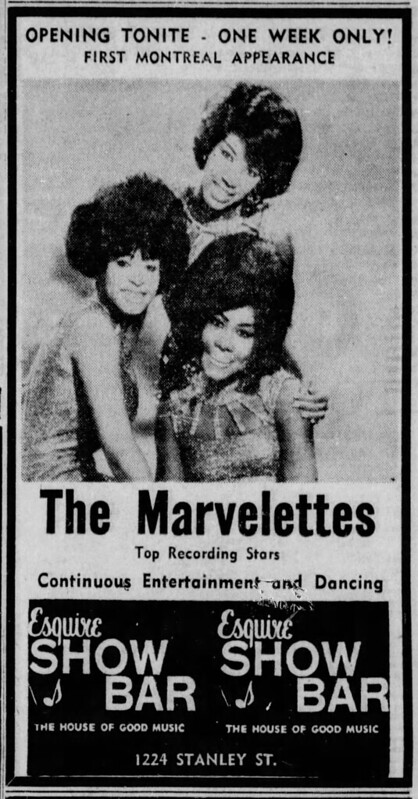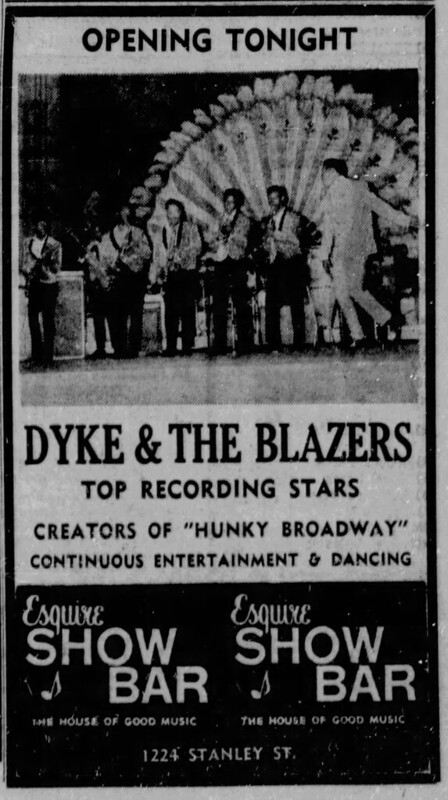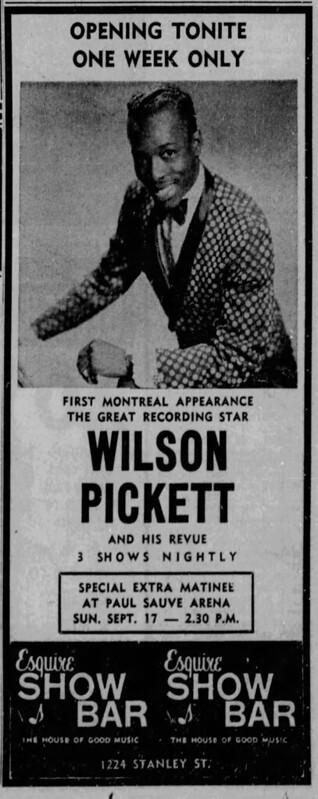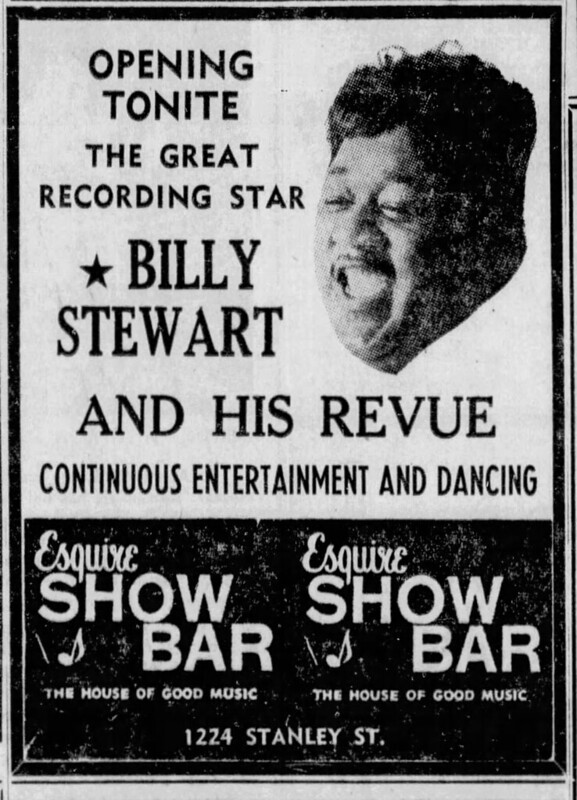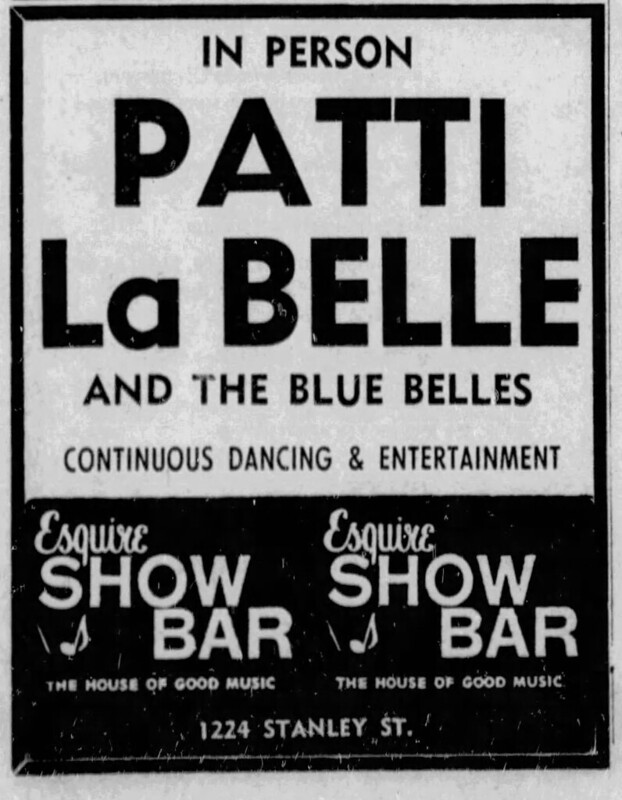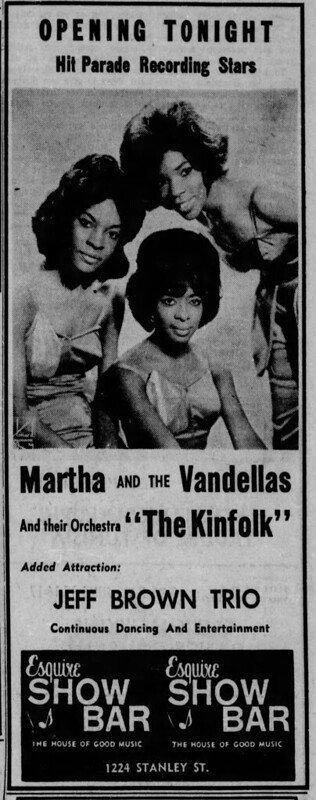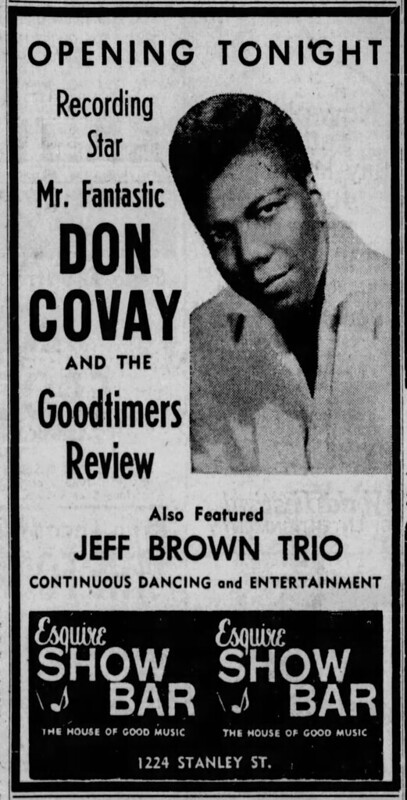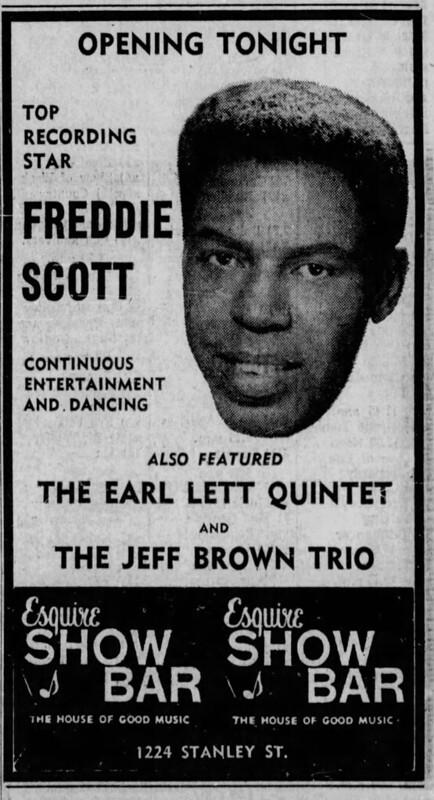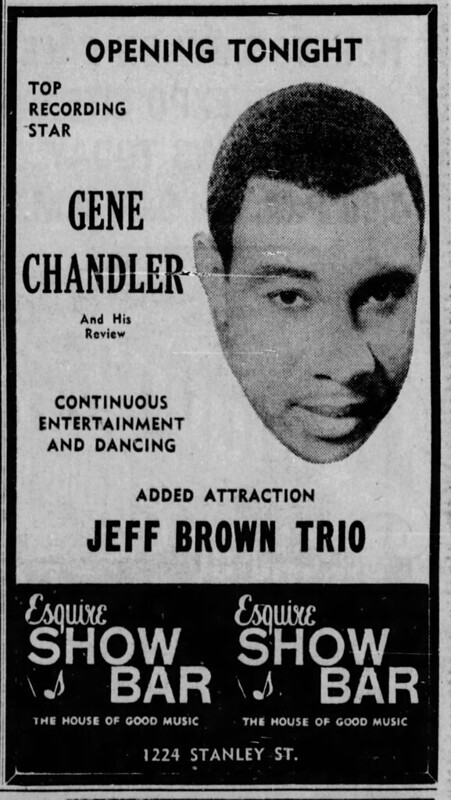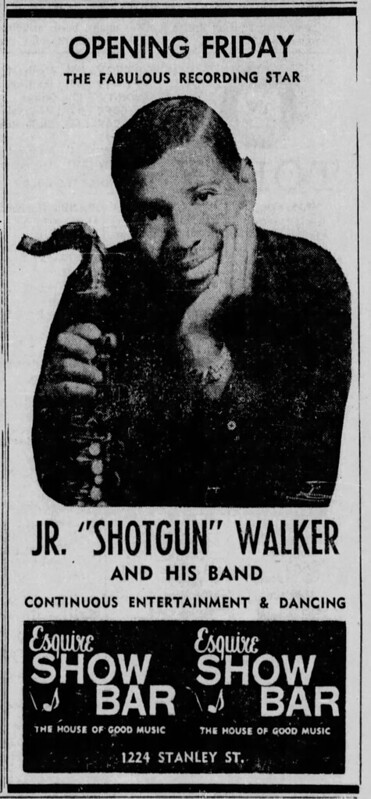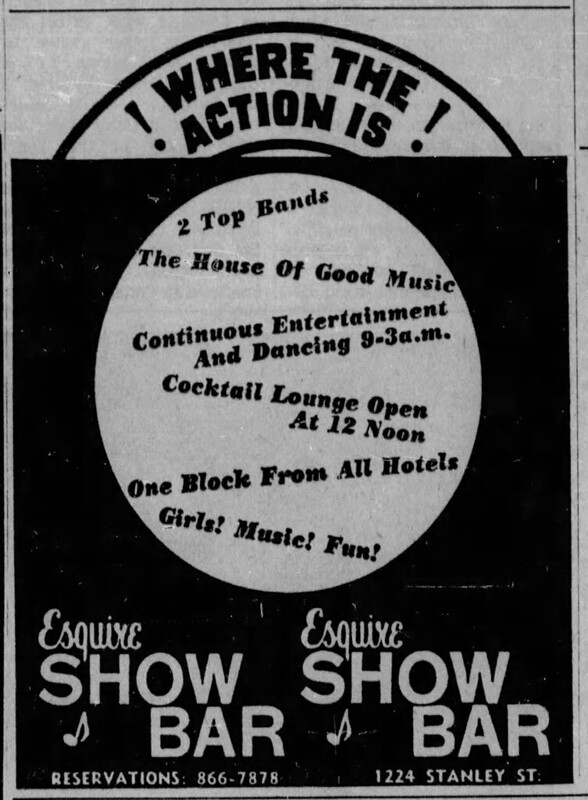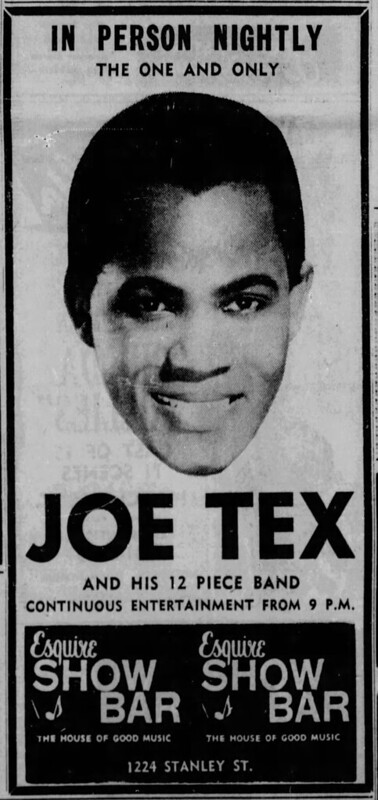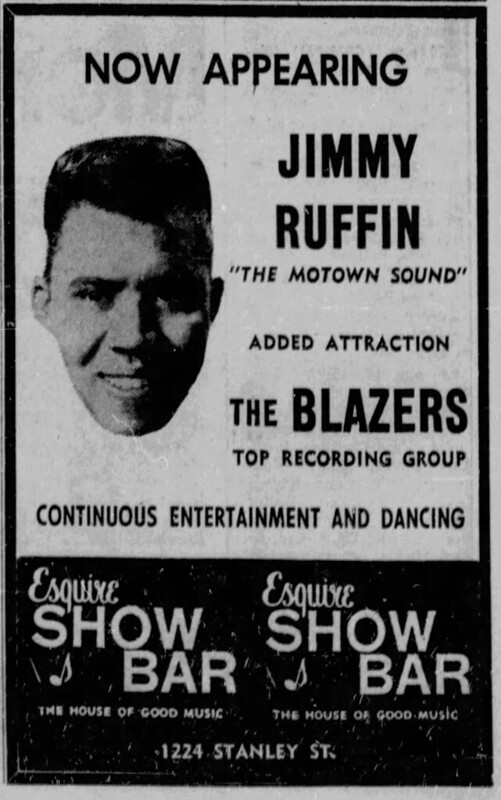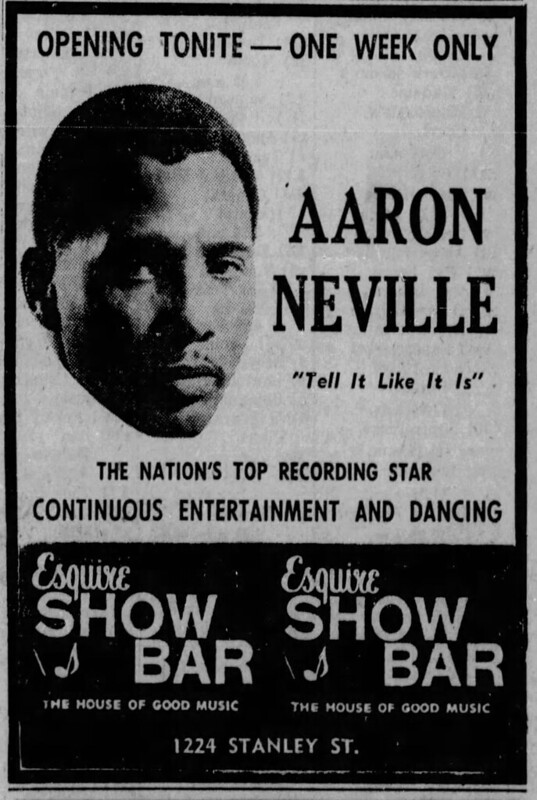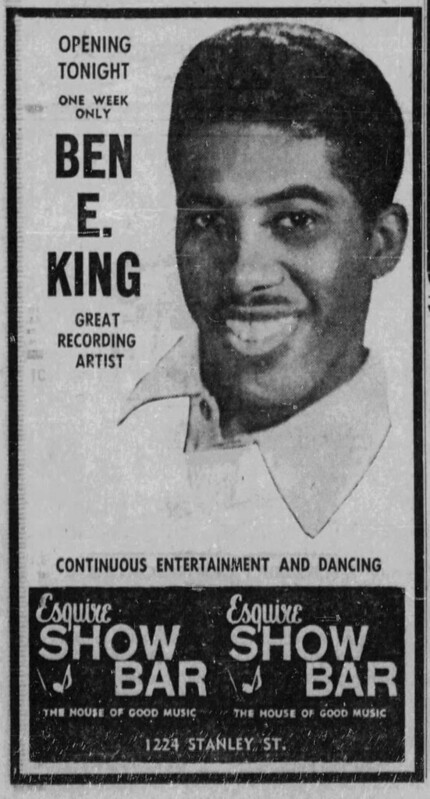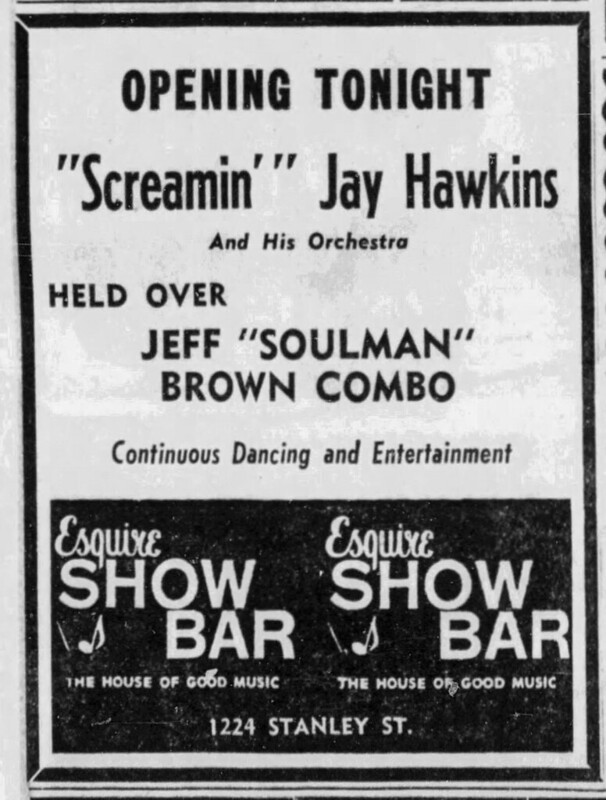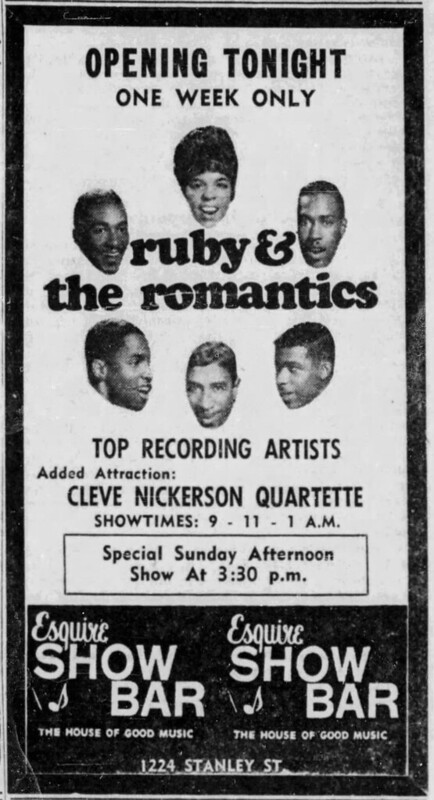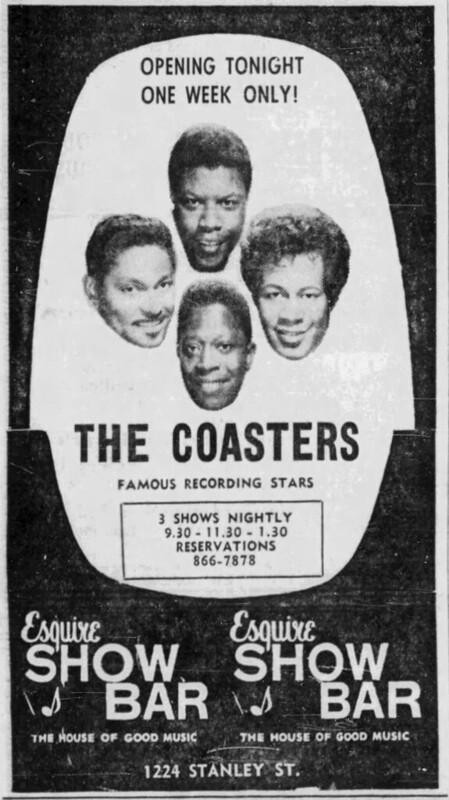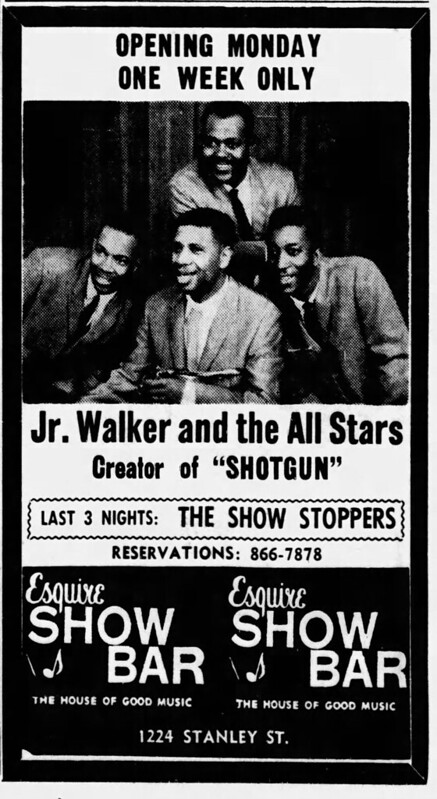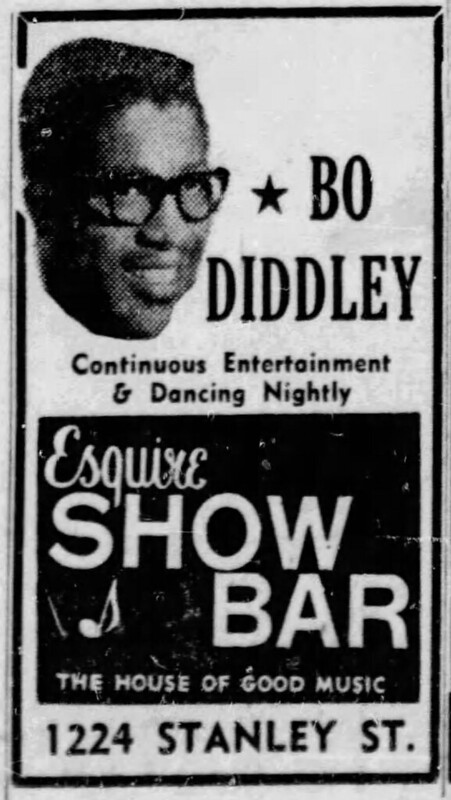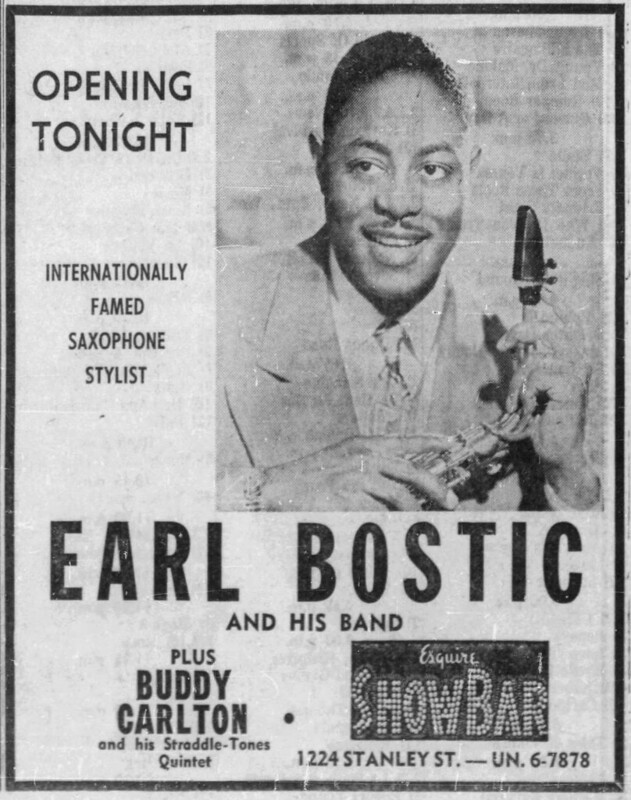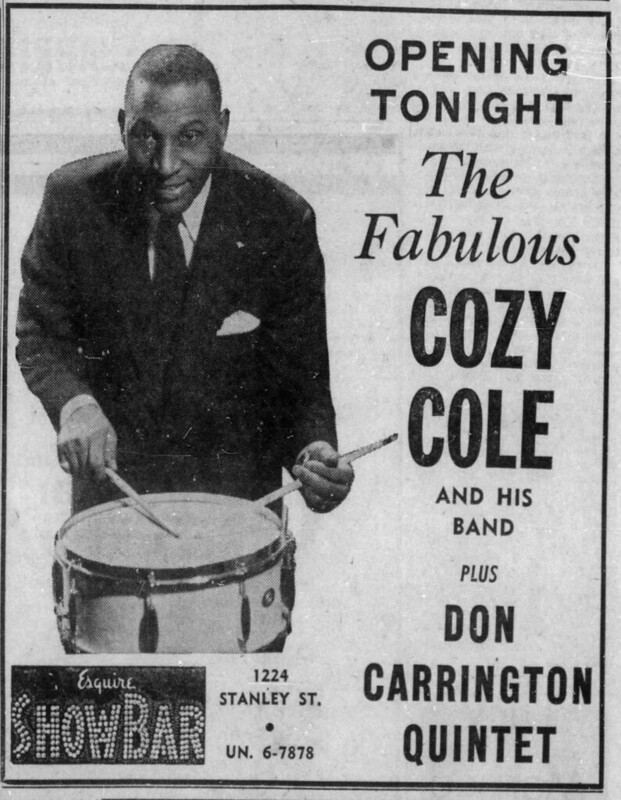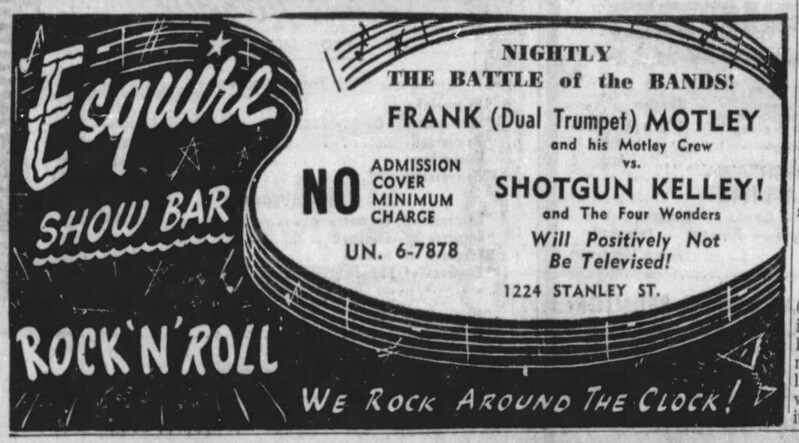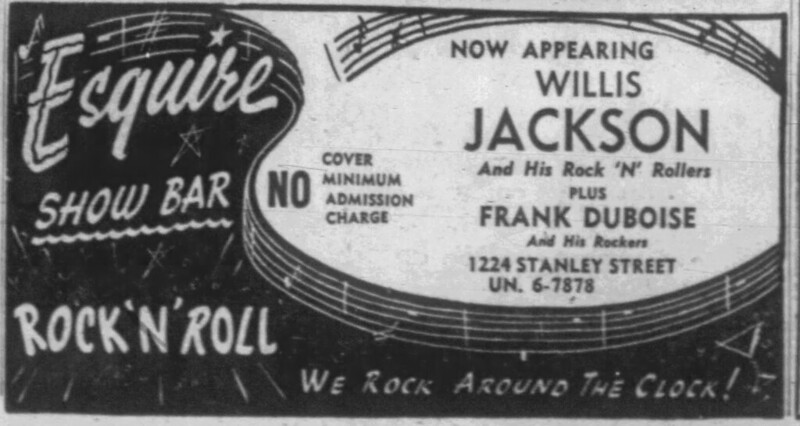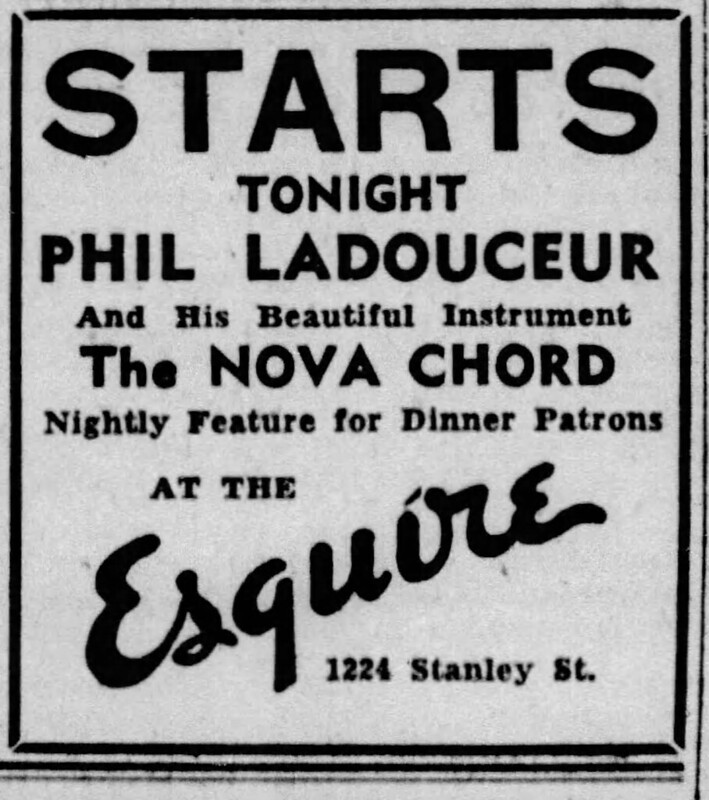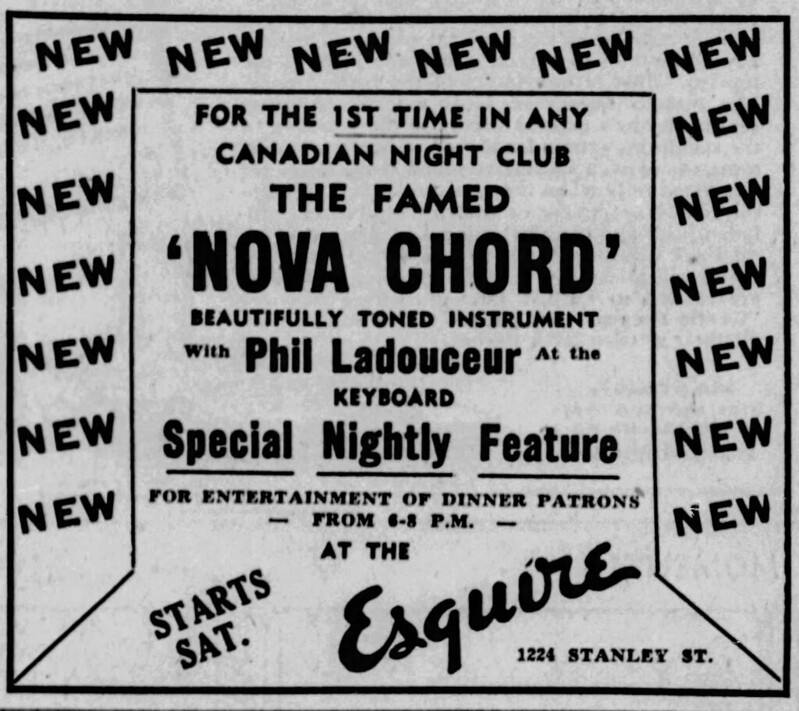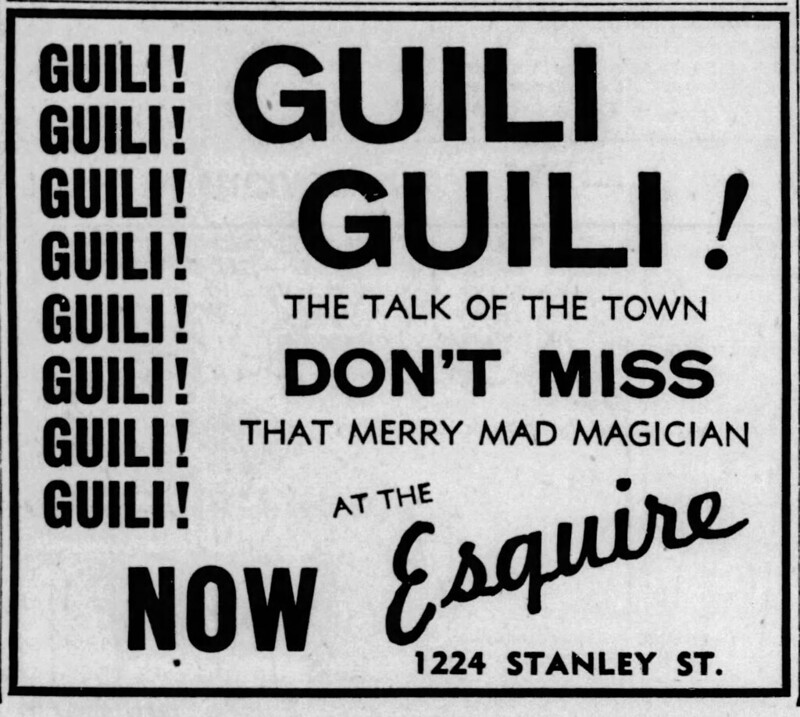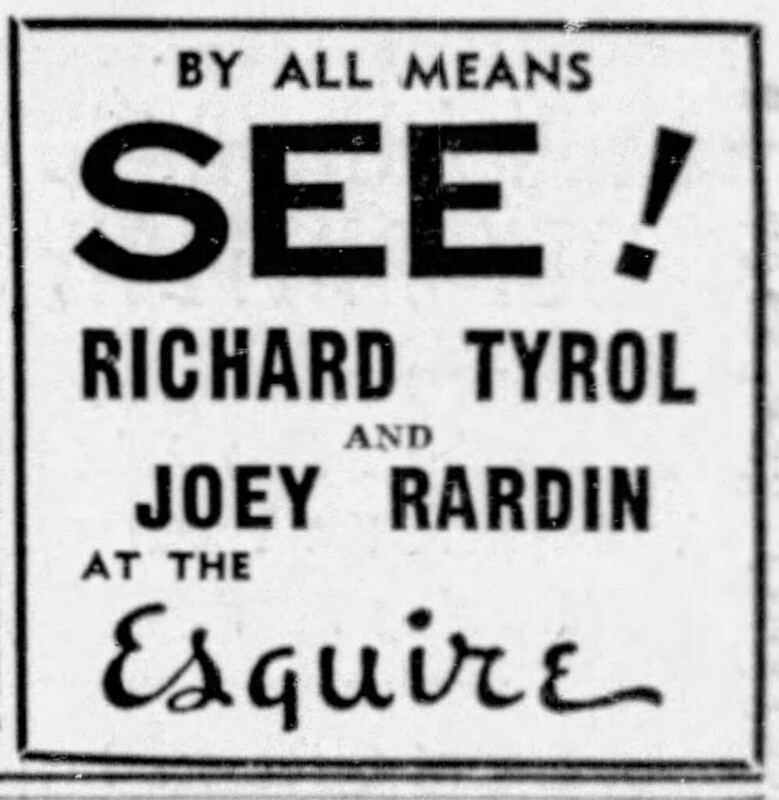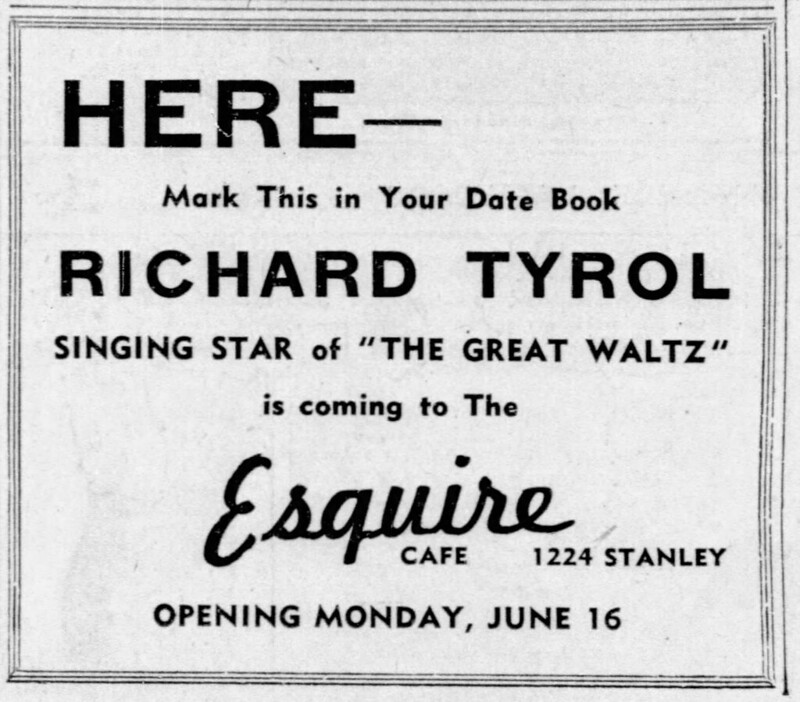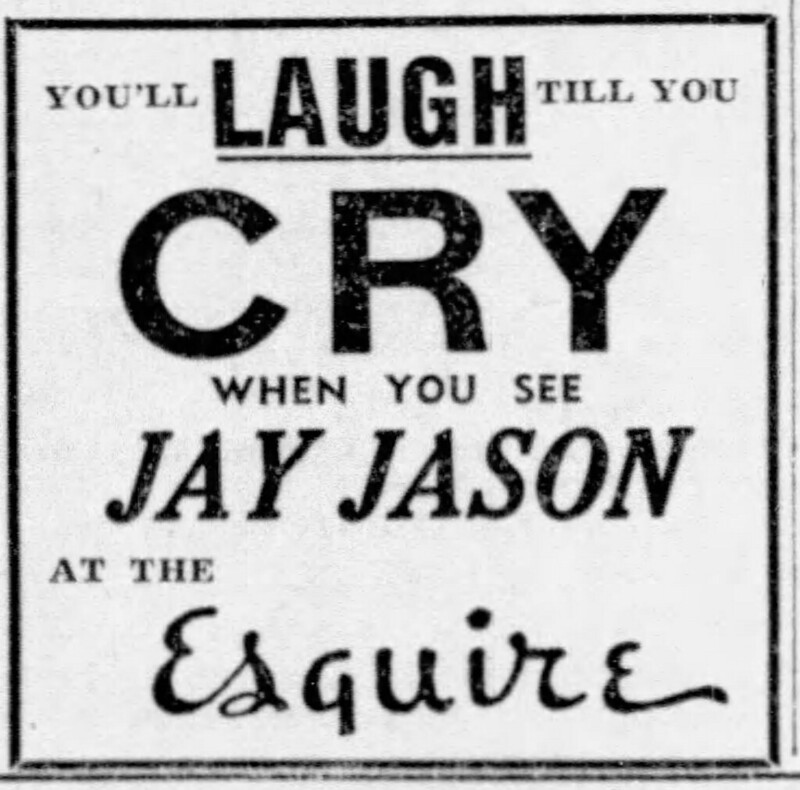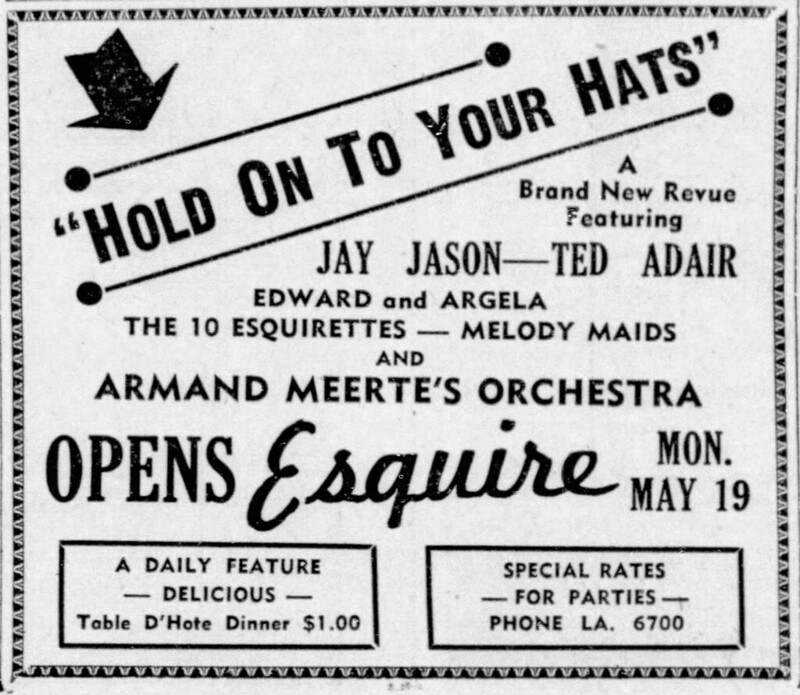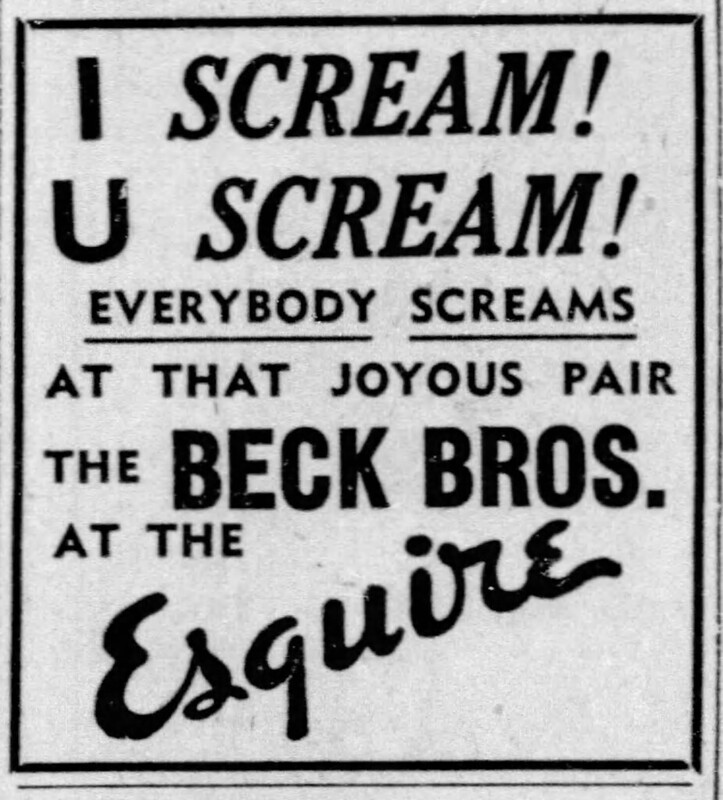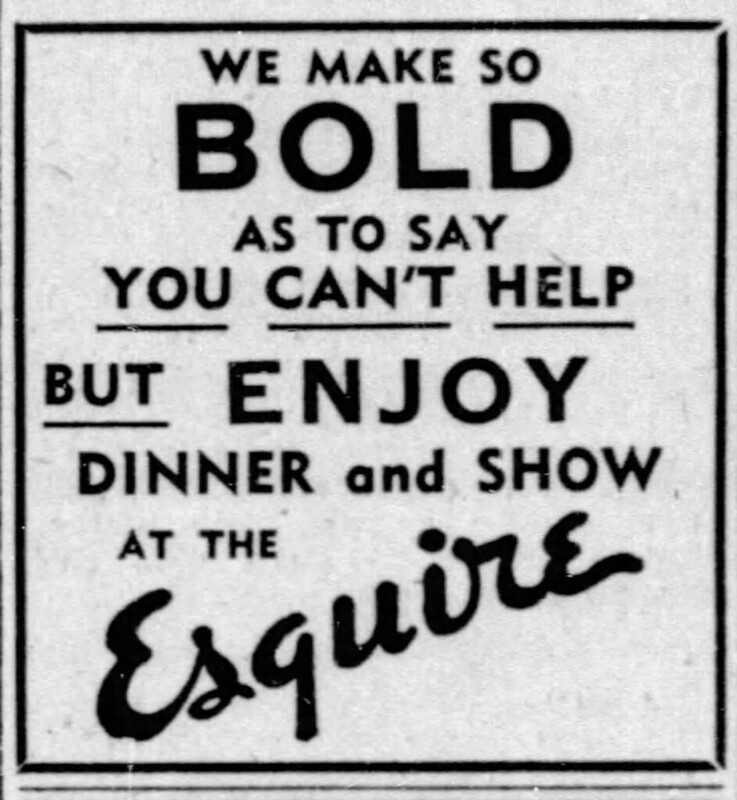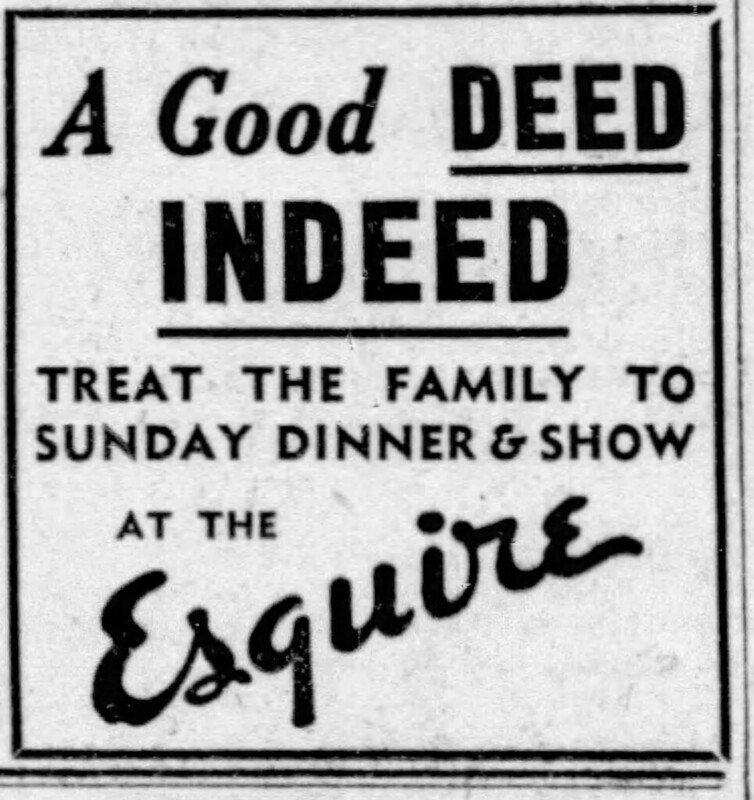
Esquire Show Bar
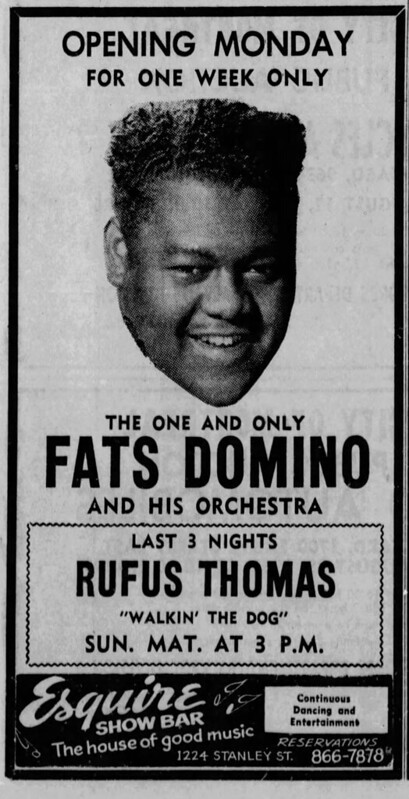
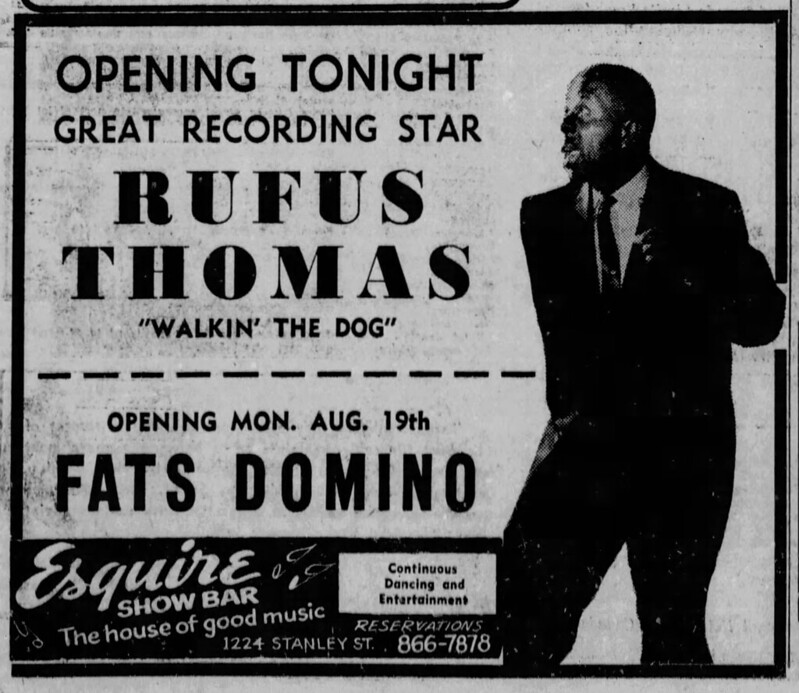
Opened on May 3, 1940 at 1224 Stanley Street, the Esquire Show Bar became one of Montréal’s leading nightlife and music venues for more than three decades. Initially rooted in the tradition of cabaret and variety revues, the establishment adopted a continuous entertainment format in 1951 and subsequently followed the major transformations of North American popular music: jazz, rock ’n’ roll, rhythm and blues, soul and blues all took their turn on its celebrated stage. Under the direction of Norm Silver, and with Sam Cleaver, a figure closely associated with the venue’s identity and musical history, the Esquire became a true crossroads between Montréal and the major North American touring circuits. Its stage welcomed such artists as Duke Ellington, Little Richard, Fats Domino and Wilson Pickett, while also providing an important showcase for Montréal musicians and performers. Robert Charlebois notably made memorable appearances there in the late 1960s. Through its remarkable longevity and musical diversity, the Esquire remains one of the essential venues in the history of jazz, rhythm and blues, soul and rock in Montréal.
⏱ Reading time: 15 minutes
1. Overview
Opened on May 3, 1940 at 1224 Stanley Street, the Esquire Show Bar stood for over three decades as one of the central venues of Montreal nightlife, becoming a true temple of jazz and rock and a pioneering establishment in presenting rock & roll performances in the city. Founded by Welshman Sam Cleaver, the venue initially embodied, throughout the 1940s, the tradition of major downtown cabarets: revues, chanson, entertainment, and the supper club formula, at a time when Montreal ranked among the great North American entertainment capitals.
In the aftermath of World War II, the venue’s history shifted with the arrival of Norm Silver, who became the main architect of its evolution. In the early 1950s, the Esquire underwent a profound transformation: gradual abandonment of the traditional cabaret model, introduction of the show bar concept, and adoption of continuous entertainment without intermission. Inspired by New York venues, this format gave it a new and lasting identity that would define the decades to come. The Esquire stands among the last witnesses of the golden age of cabarets, having hosted stars such as Patti Page, Jerry Lewis, Dean Martin, and Eddie Fisher, before evolving toward programming centered more on jazz and rock ’n’ roll.

Under Silver’s direction, the Esquire became, in the 1950s, 1960s and early 1970s, an essential stage for jazz, rhythm and blues, and rock ’n’ roll. From Duke Ellington to Bo Diddley, from Muddy Waters to Wilson Pickett, as well as Fats Domino, Little Richard, and Robert Charlebois, the club hosted a remarkable succession of artists, fully integrated into North American touring circuits while also serving as a launching pad for a new local generation. A true “Montreal Apollo,” it became a major hub for the diffusion of African American music in the city and a key meeting point between international artists and the Montreal scene, making the Esquire a formative space for many local musicians [80].
This trajectory, however, unfolded within a more complex context. From the 1940s onward, the Esquire operated in an environment where cabarets, municipal regulation, and informal networks intersected. Beginning in the 1960s, administrative pressures intensified, marking a turning point in the venue’s history. On May 5, 1972, a police intervention led to the seizure of the liquor license and bar inventory, depriving the establishment of its primary source of revenue.
Despite an attempt to continue operations without alcohol for several months, the experiment failed. On December 10, 1972, after more than three decades of activity, the Esquire Show Bar closed its doors permanently. Its disappearance marked the end of an era—the era of Montreal’s great cabarets, where artistic proximity, social diversity, and musical intensity converged, at a turning point when discotheques and new forms of entertainment began redefining the city’s nightlife.
2. From residential street to entertainment hub: the transformation of Stanley Street and 1220–1226
Laid out in 1845 and named in honor of Edward Smith-Stanley, Stanley Street evolved from a residential setting into a major axis of Montreal entertainment. By the late 1920s, it stood out for its cabarets and social venues, including the Silver Slipper, the Kit Kat, the Palais d’Or, and the Regent Tavern. This vocation was confirmed with emblematic establishments such as the Stanley Grill, the Lido, the Villa Maurice, the Tic Toc, and the Esquire, at the heart of the rise of dinner-and-show culture in the 1940s–1950s. After the decline of the great cabarets, the street entered a new phase from the 1950s–1960s, notably with the cabaret Chez Parée, before reaching a new peak in the 1970s with the Lime Light discotheque, at the center of the Peel–Stanley “Gay Ghetto.” This evolution unfolded in a context of strong social tensions, culminating in the 1977 police raids on the Truxx bar [49][50].
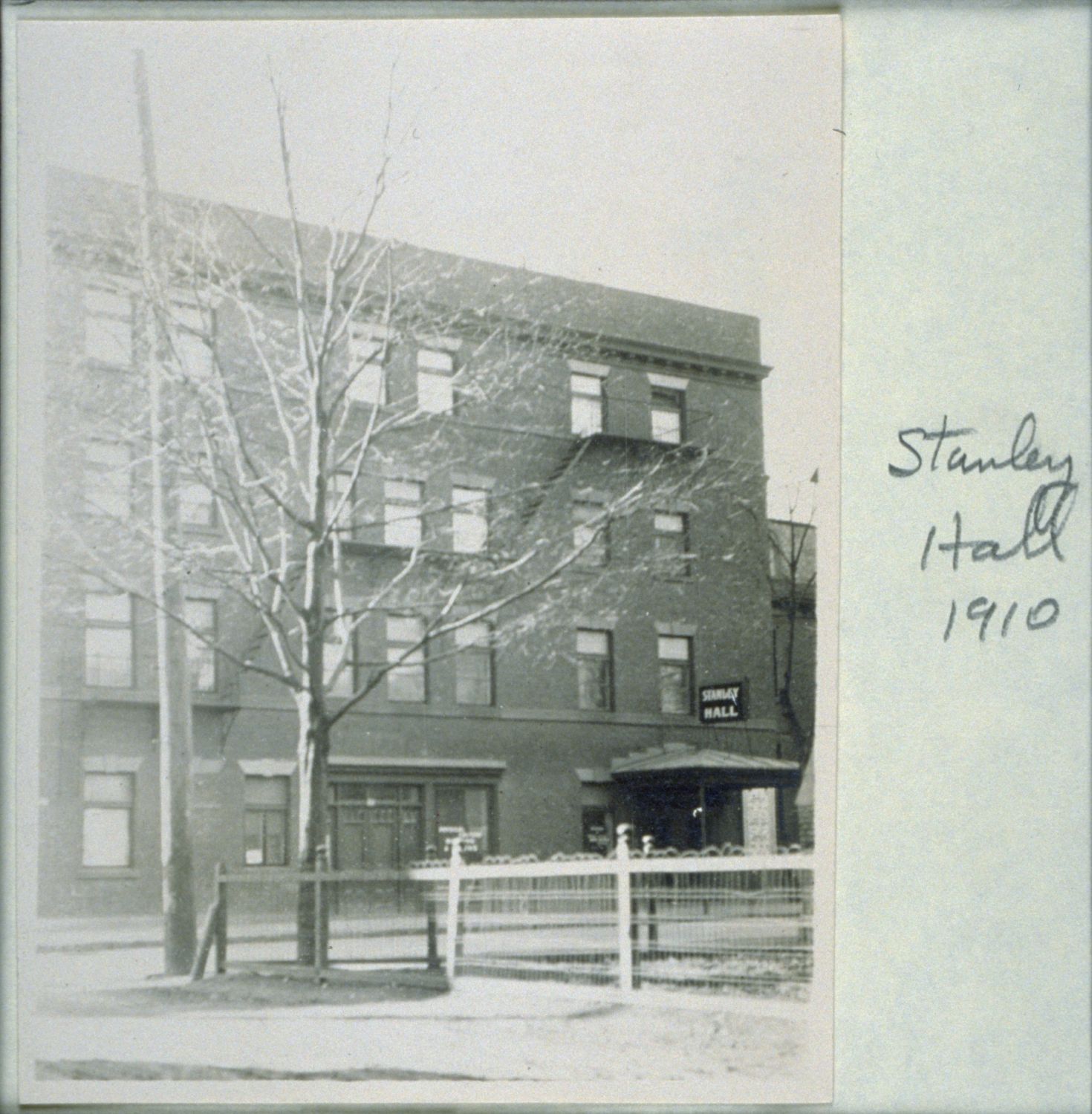
The building that housed the Esquire Show Bar (1220–1224–1226 Stanley Street) fully reflects this dynamic and shows remarkable continuity in its entertainment-related uses. While the club occupied 1224 from 1940, the upper floor previously housed Stanley Hall, a dance hall founded by Frank Norman, a key figure in dance instruction in Montreal. Active in the early 20th century (approx. 1908–1928), the venue served both for lessons and performances, continuing the tradition of late 19th-century dance schools, before being replaced around 1928 by the Palais d’Or, active until 1962, and later by the Café Lorelei. This layering of spaces—dance school, ballroom, then cabaret—illustrates the gradual evolution of entertainment forms within a single building, where different cultural practices coexisted at times across multiple levels [56], [59].
Evolution of entertainment venues at 1224 Stanley Street, Montreal
3. The Esquire: from cabaret revues to continuous entertainment
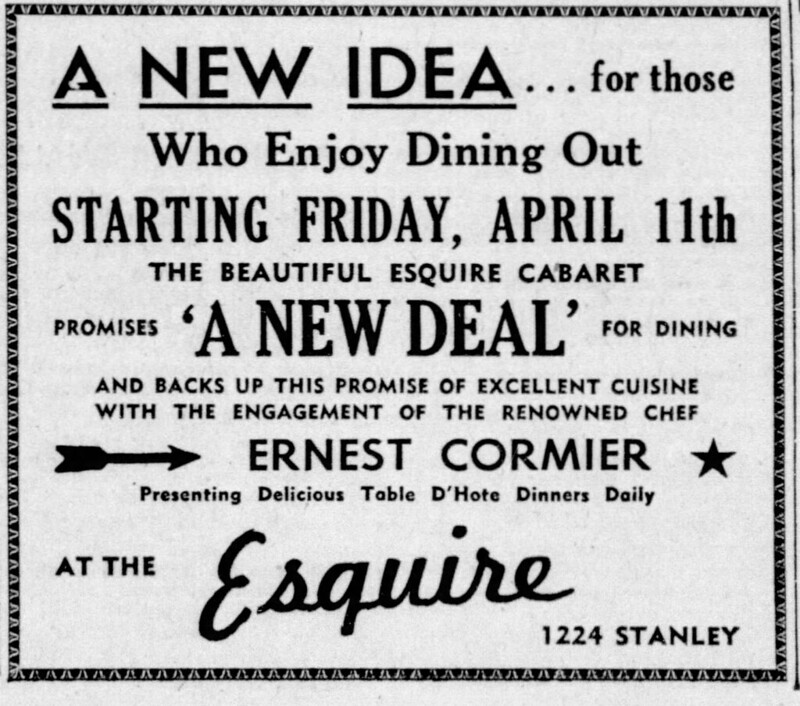
Even before the official opening of the Esquire Show Bar in 1940, the establishment of its legal framework reflected a carefully structured business model. The incorporation of Esquire Club Inc. in 1937, by Sam Cleaver, Herbert E. Bell, and F. Scott Plunkett, reveals a hybrid model—both private club and commercial establishment—allowing it to offer entertainment, dining, and services to members, while also retaining the possibility of operating under a liquor license. This corporate structure, typical of nightlife venues of the era, made it possible to navigate between regulatory constraints and the economic realities of Montreal nightlife, while ensuring a certain flexibility in venue operations and the management of social and recreational activities [70].
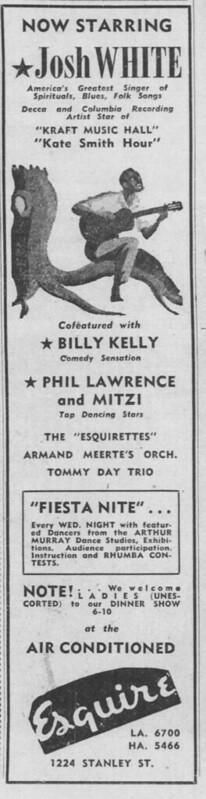
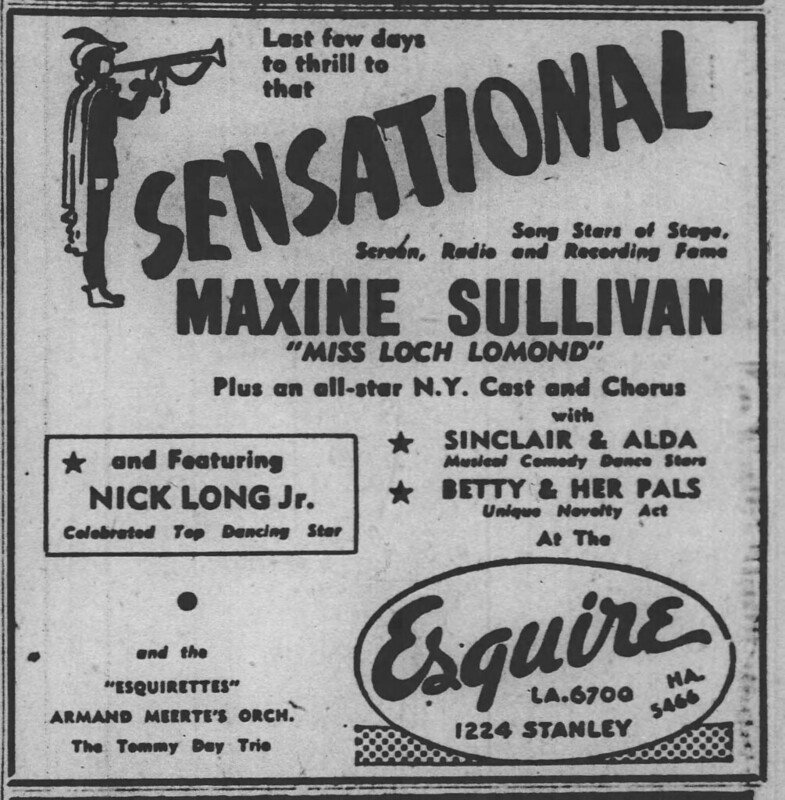
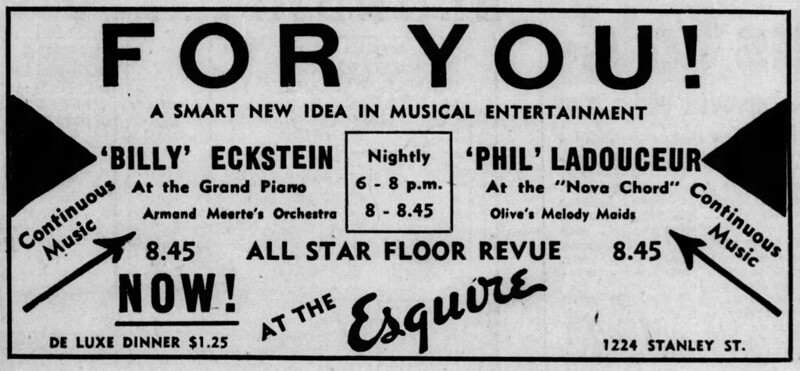
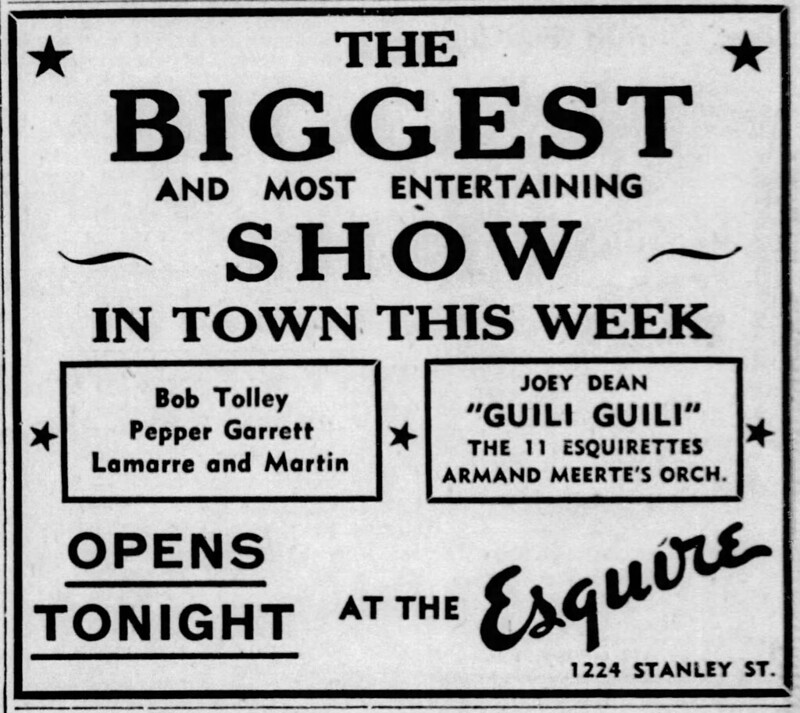
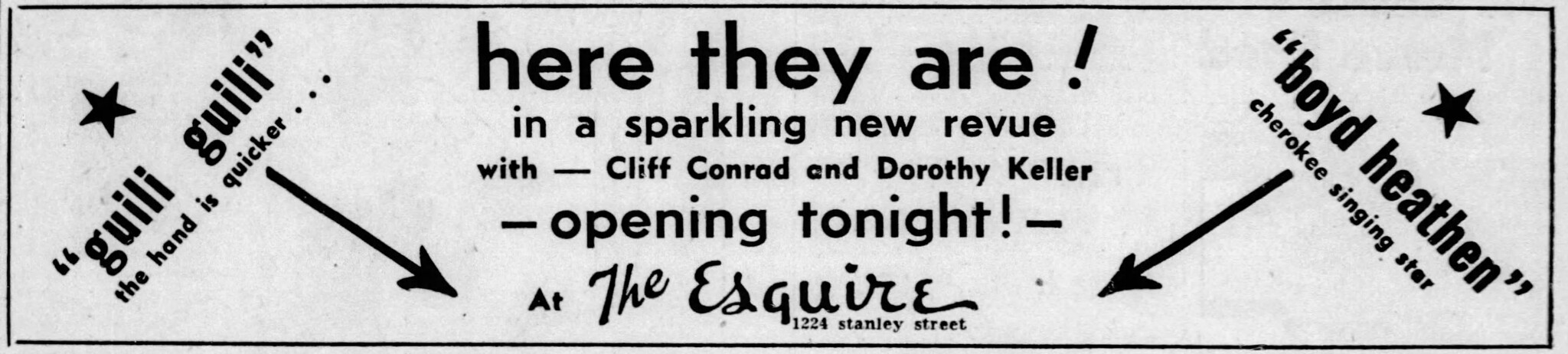
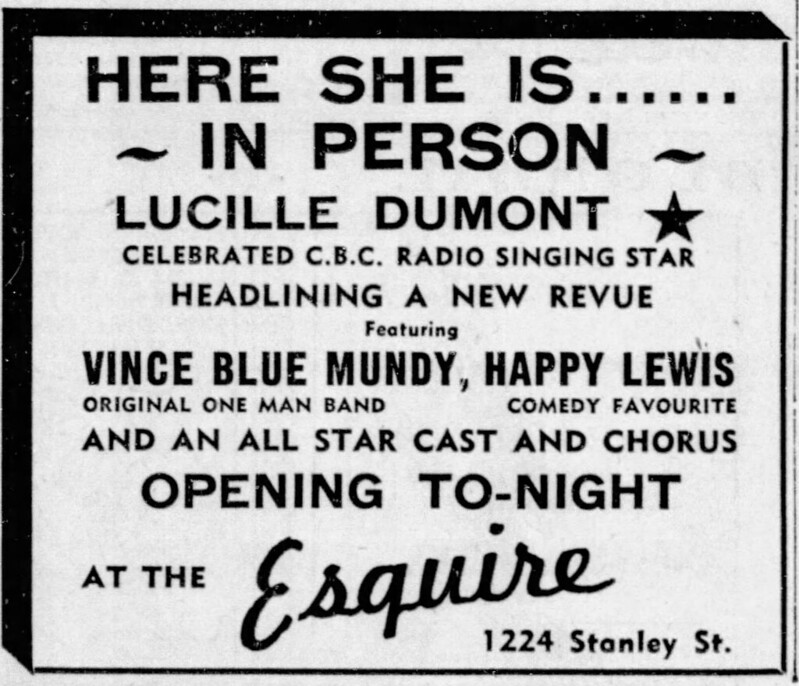
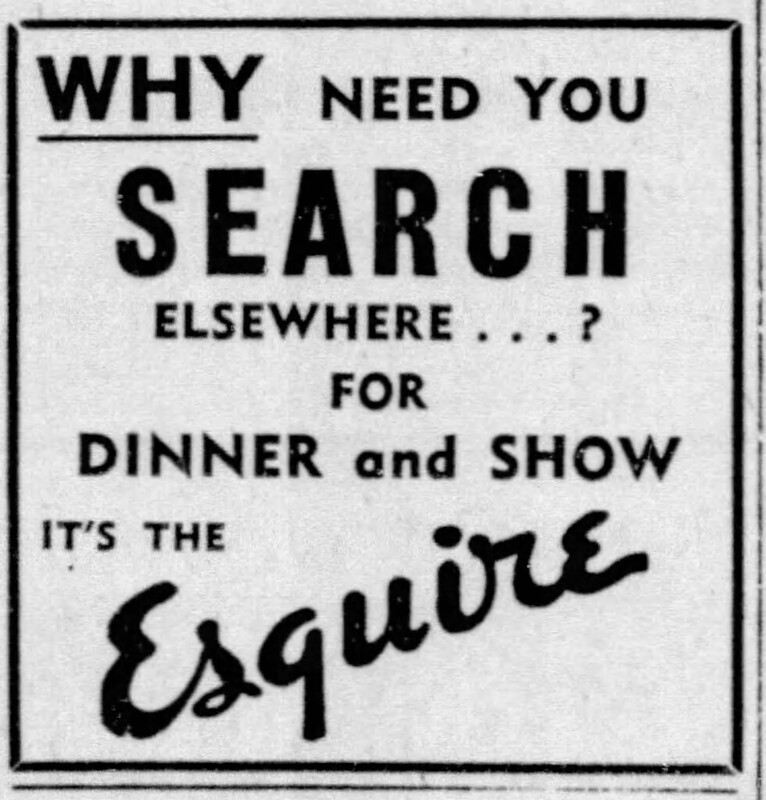
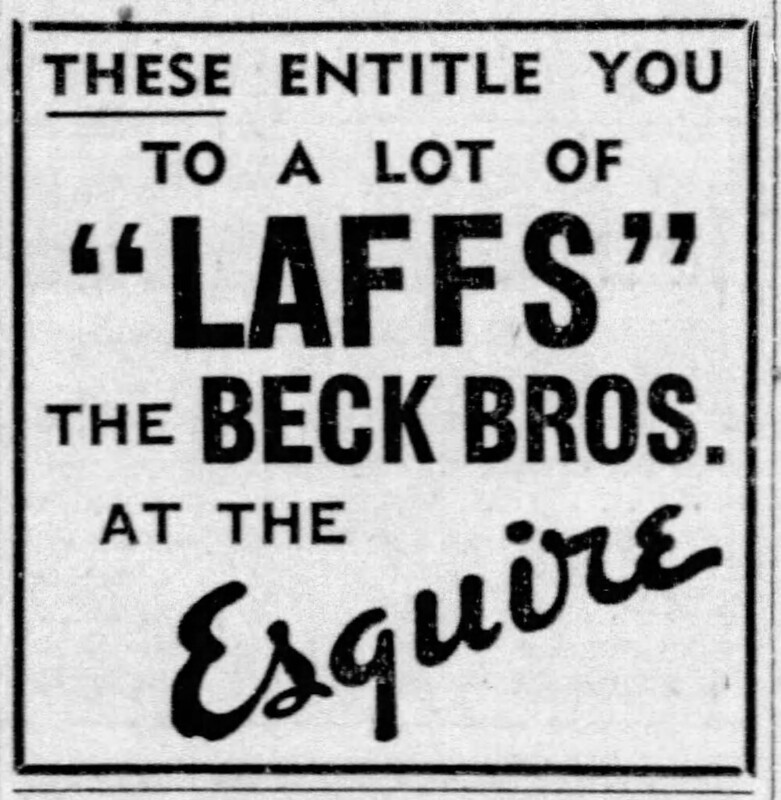
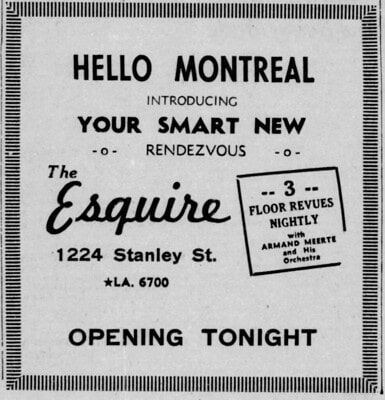
The Esquire cabaret opened on May 3, 1940 at 1224 Stanley Street, succeeding the Dominion Club. Founded by Welshman Sam Cleaver, already active in Montreal nightlife—notably at the Palais d’Or and with interests in the Stanley Grill and the Tic-Toc—the establishment immediately aligned itself with the tradition of the era’s elegant cabarets. An advertisement in The Gazette highlights a typical format featuring three “floor revues” per night accompanied by Armand Meerte and his orchestra, confirming its positioning as a major downtown entertainment venue [1], [3].
Sam Cleaver’s activities even before the opening of the Esquire testify to his established presence in Montreal nightlife. In 1939, he is identified as the operator of the Embassy Terrace Club (1433 Mansfield Street), where he was penalized for violating liquor regulations, illustrating both his experience and the strict regulatory environment in which Montreal clubs operated in the late 1930s [42].
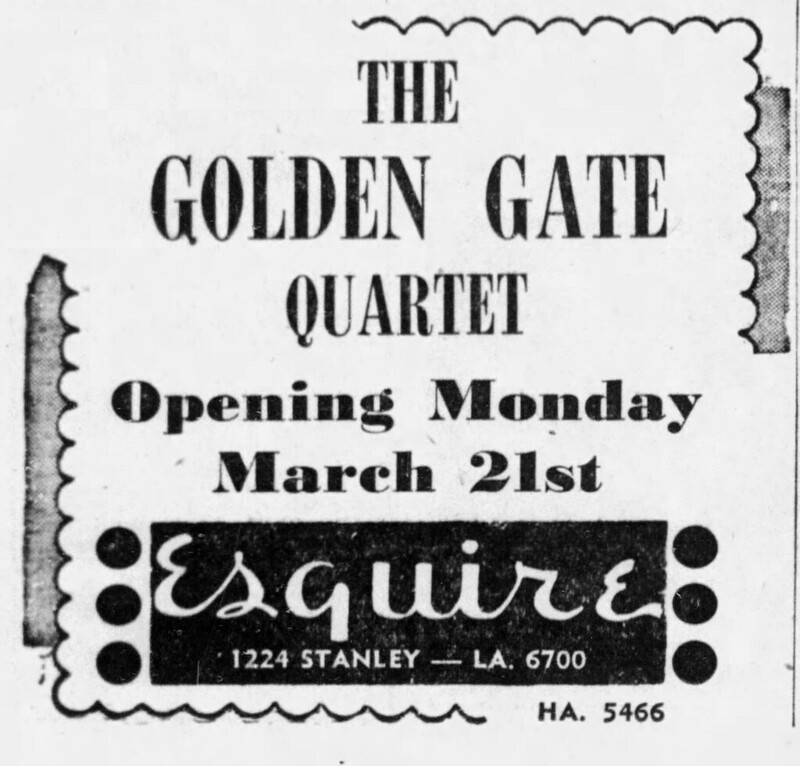
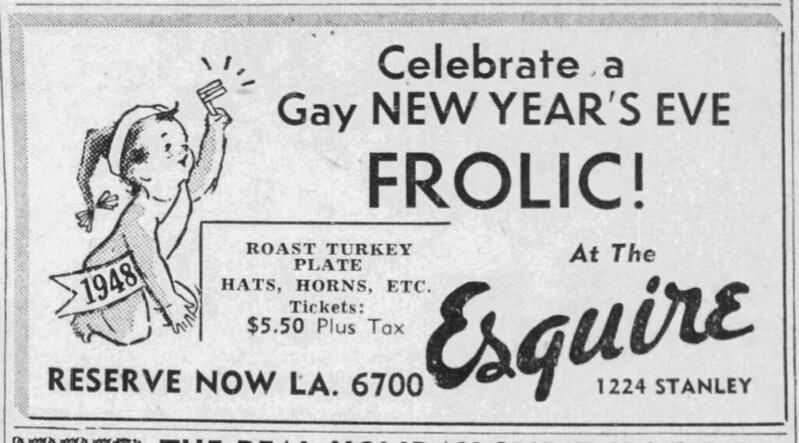
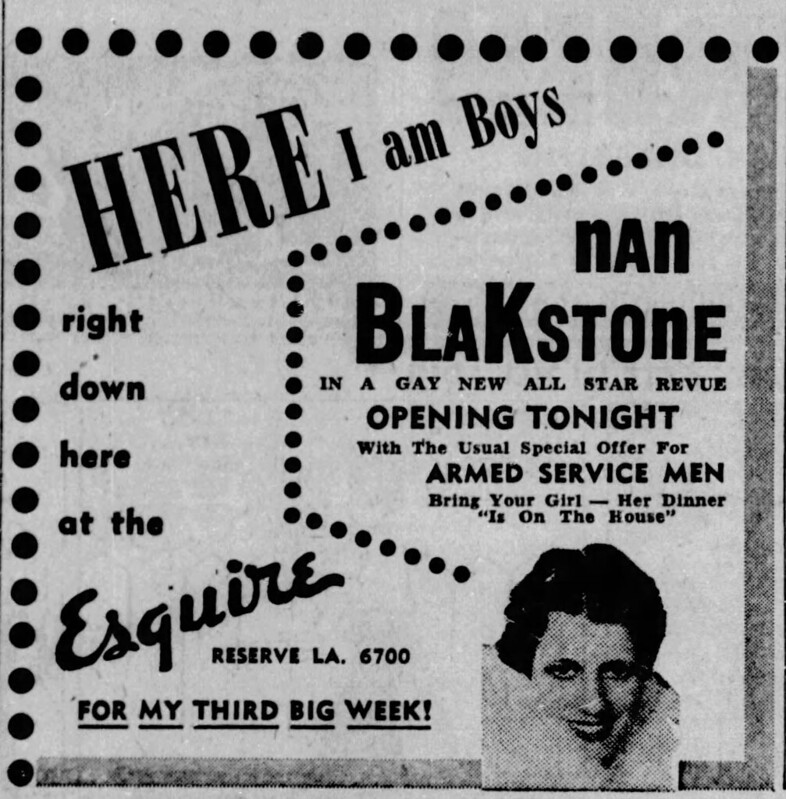
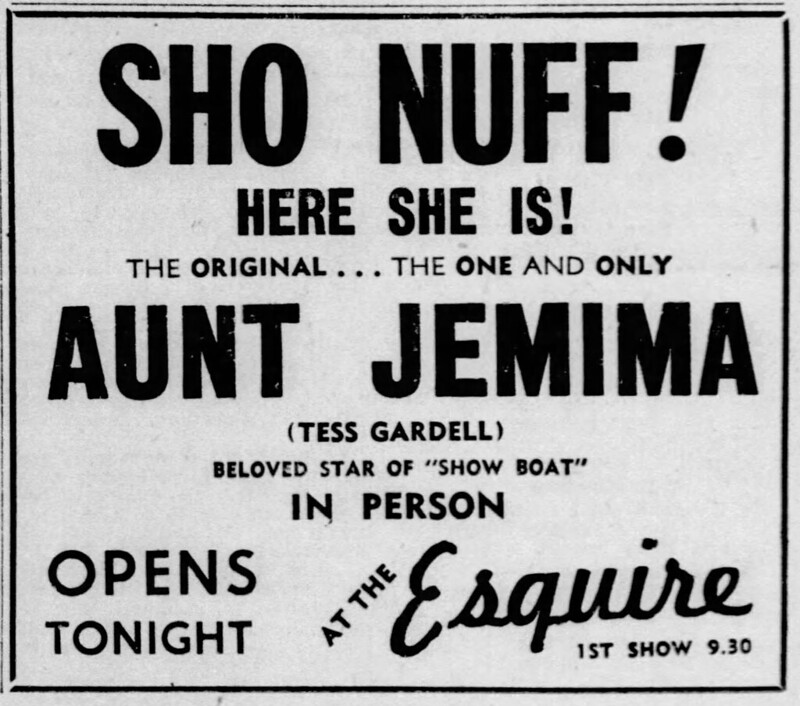
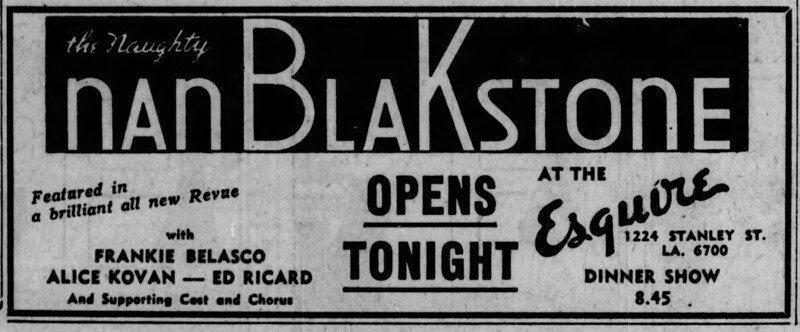
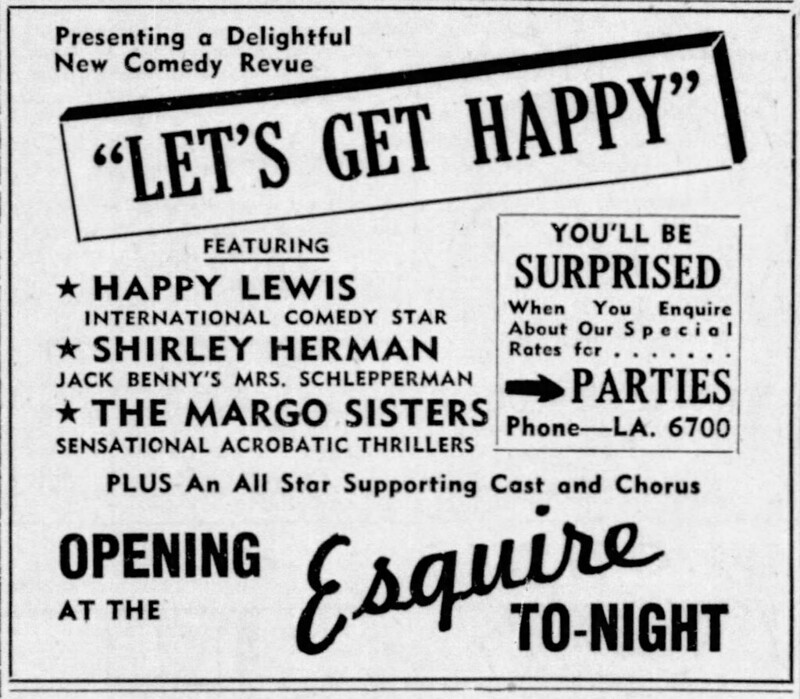
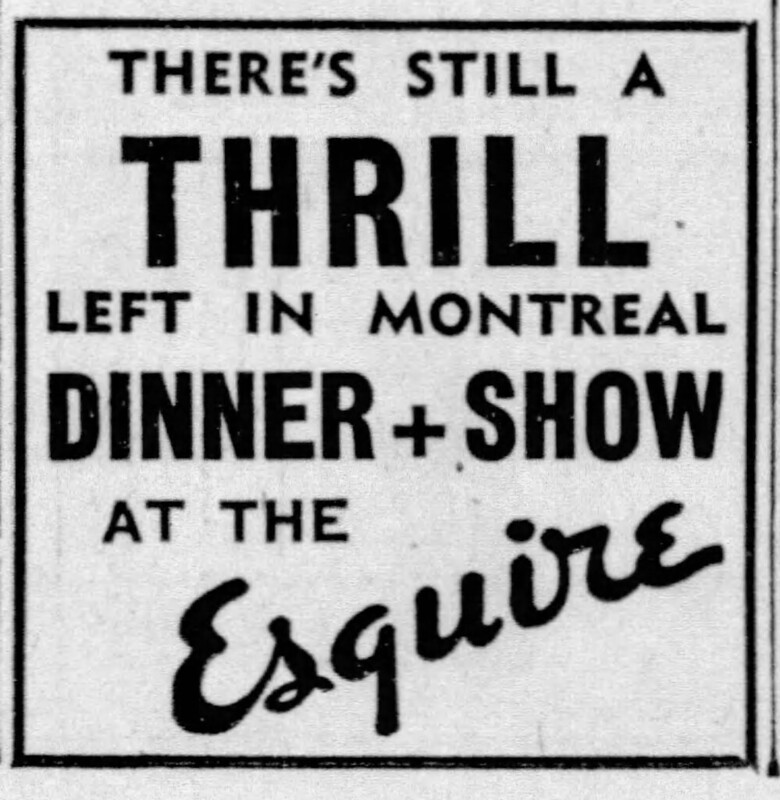
During the 1940s, the Esquire operated as a conventional supper club—with master of ceremonies, singers, dancers, comedians, and variety acts—attracting a diverse clientele and, during the Second World War, a significant contingent of military personnel and their guests. The establishment quickly became one of the busiest clubs downtown, at the heart of a nightlife scene where atmosphere, sociability, and spectacle took precedence over musical performance alone [2], [22].
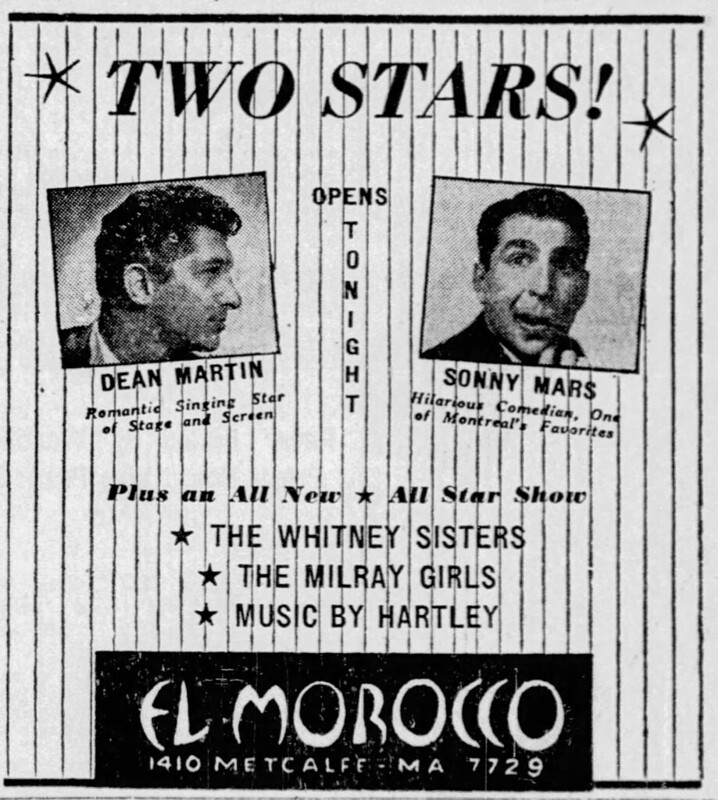
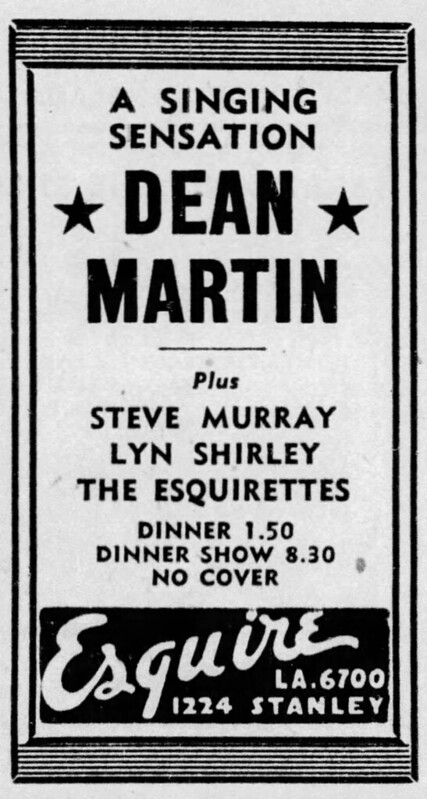
In 1945, Dean Martin performed at the Esquire Show Bar before a large crowd, standing out for a voice described as “light and smooth” and for a relaxed stage presence characteristic of the modern crooner, within the framework of a typical dinner-show revue [87]. Paid $250 a week, he was at that point only one singer among many on the club circuit, with Montreal being just another stop. “Later, he would sing at the El Morocco, and earlier at the Tic Toc, where he filled the room every night for six weeks (except Sundays), but at the time he took what he could get.” [22]
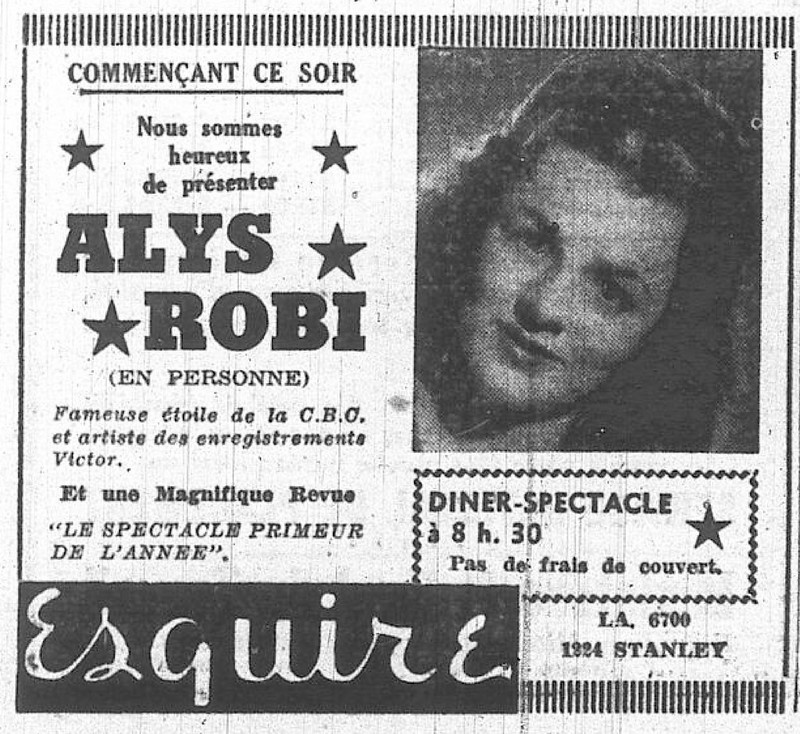
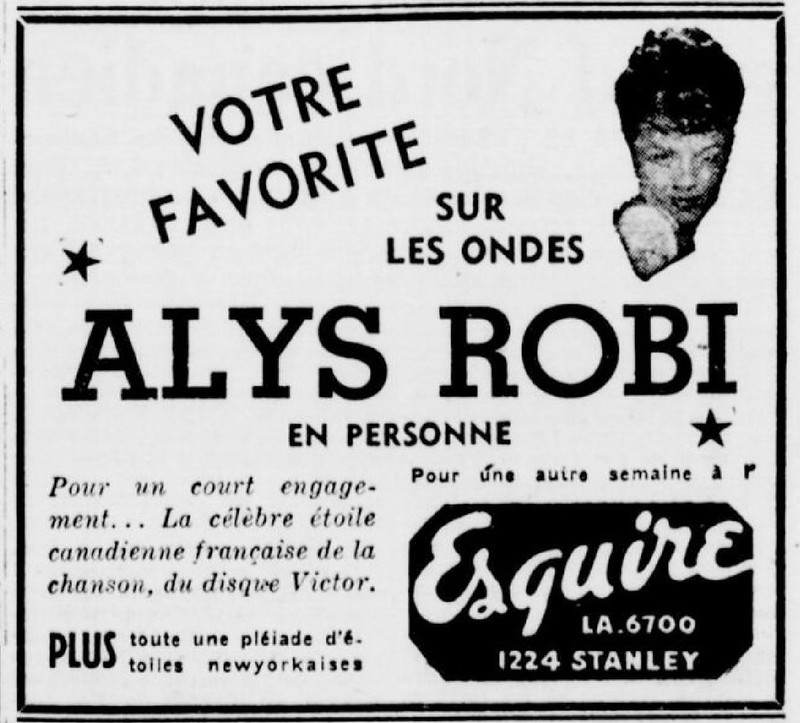
An advertisement published in Montréal-Matin on November 5, 1945 attests to the activity of the Esquire, located at 1224 Stanley Street, by featuring singer Alys Robi “in person,” then identified as a CBC star and an artist associated with Victor recordings. The ad highlights a dinner-show format offered at 8:30 p.m., with no cover charge, combining dining and entertainment within the same venue. It also emphasizes the quality of the revue being presented, described as the “premiere show of the year,” thereby underlining the venue’s ambition to position itself among the major establishments on Montreal’s postwar entertainment scene. Through this programming and integrated format, the Esquire already appears as a structuring force in nightlife, where music, spectacle, and sociability came together [27].
At the same time, several sources place the Esquire within a network connected to the “underworld.” An article in The Montreal Daily Star dated November 17, 1948 mentions Sam Cleaver, operator of the Esquire Cafe (1224 Stanley Street), among cabaret owners convicted under the Lord’s Day Act [4]. The investigations of Pax Plante and the Caron Commission also associate him with Montreal bookmaking and with a network involving Harry Feldman, Louis Dettner, and Max Shapiro, revealing links between cabarets and illegal gambling [38]–[45], [48].
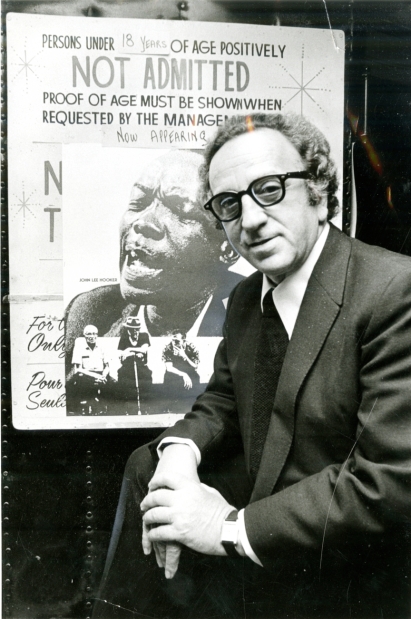
In the aftermath of the war, Norm Silver, a young entrepreneur who was also co-owner of the fashionable Miss Montreal restaurant on Décarie Boulevard, joined the operation of the club. Approached by Cleaver in the mid-1940s, he gradually emerged as the principal architect of its evolution [2], [40].
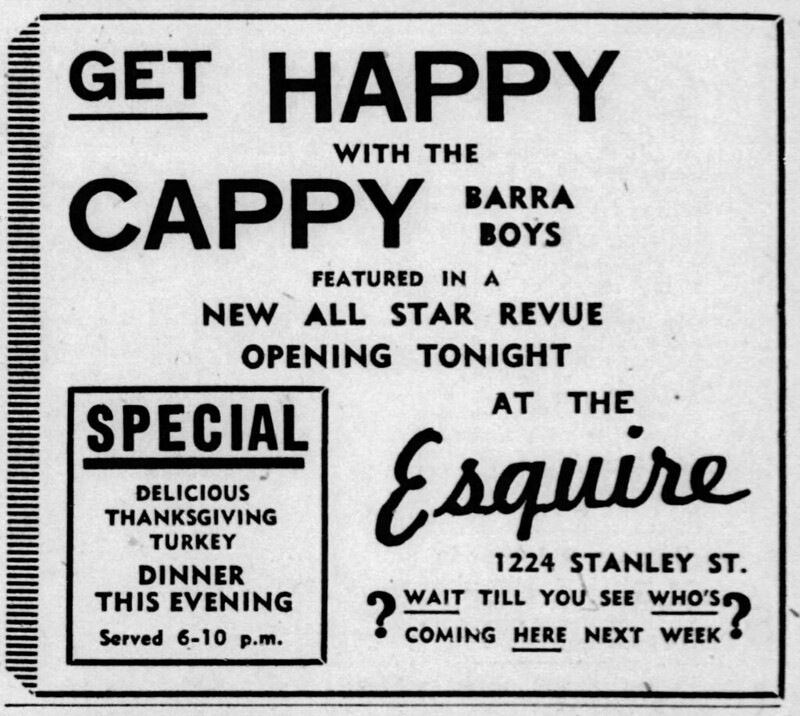
In the early 1950s, Silver and Cleaver temporarily closed the establishment in order to rethink its concept and introduced a formula inspired by New York newsreel theatres: continuous entertainment, without intermission, in which a show of about two hours would begin again immediately once it ended [3]–[5].
This transformation was made official with the relaunch of the Esquire Showbar on March 24, 1951, presented as an innovation in Canada (“show without a stop”). The program combined music, dance, comedy, and continuous entertainment, with performers such as the Frank Petty Trio, Benny Meroff, Alan Stone, the Carter Sisters, and Kathleen McLaughlin, accompanied by Will Skinner’s orchestra and hosted by disc jockey Lee Hamilton [23].
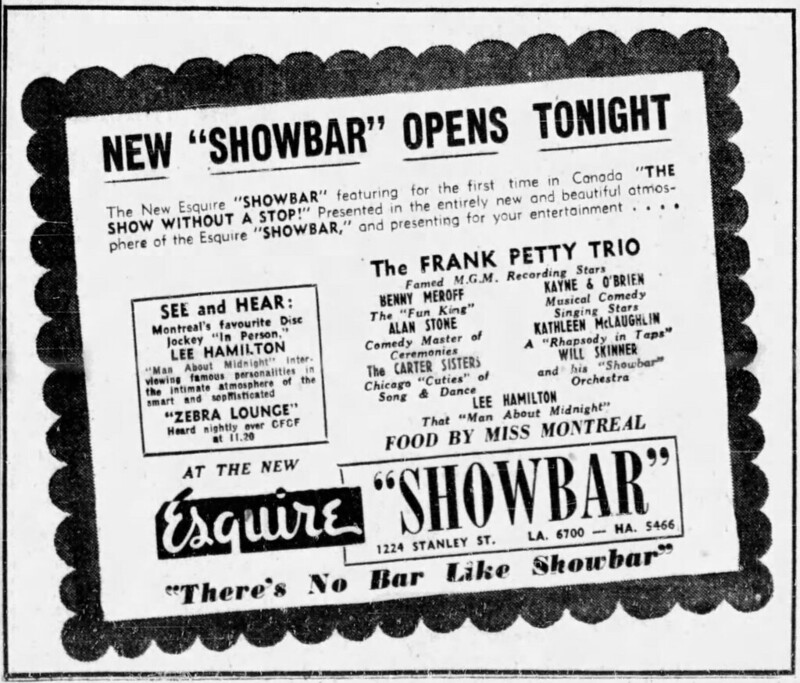
“We made a few trips to get ideas about what we could do with the place,” Silver recalled. “What we found was the idea of a show bar: continuous entertainment, without intermission, a two-hour show that starts over as soon as it ends—like the ‘newsreel theatres’ in New York.”
In its early years, the Esquire still aligned with the Montreal cabaret tradition, combining dining, dancing, and a variety of performances. However, the foundations of its transformation were already in place, foreshadowing the deeper changes that would define the following decade.
4. The Esquire Show Bar: from dinner-show to rock ’n’ roll
The real turning point came in the early 1950s, when the Esquire gradually moved away from the traditional cabaret model to adopt a radically different format: that of the continuous show. This shift redefined not only how the venue operated, but also the very experience of its audience.
Physically, the venue adopted a distinctive signature: a long bar surrounding a raised stage, a décor featuring white plaster palm trees, and a large stage inspired by a Boston club. The kitchen used the menu from the Miss Montreal restaurant, also operated by Norman Silver, known for its quality and affordable prices. With the adoption of continuous entertainment, dancing gradually lost its importance, giving way to an experience centered on stage performance.
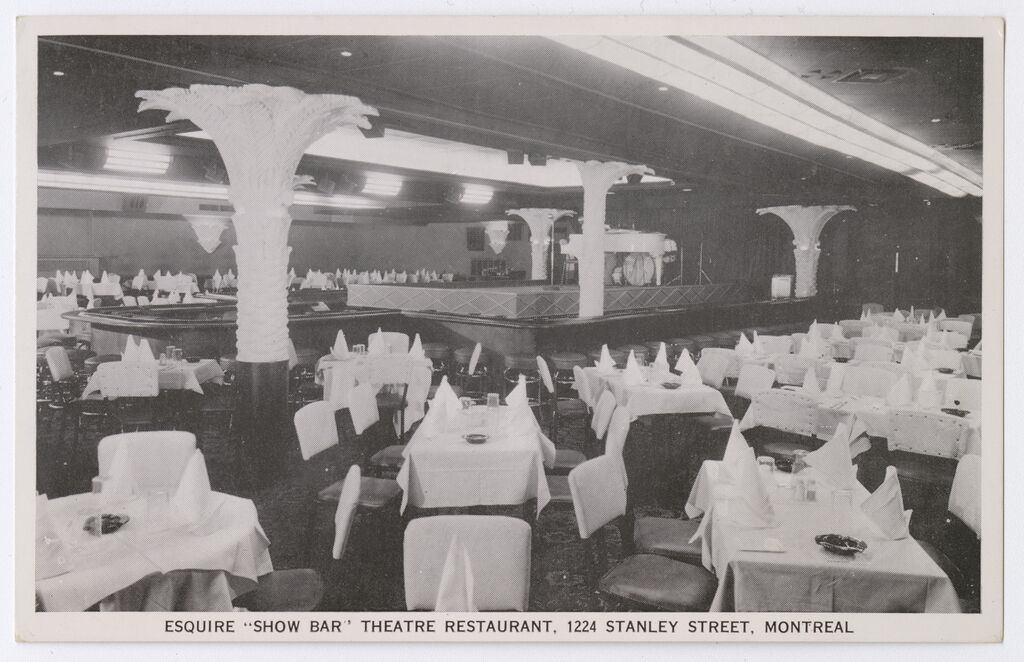
“We adopted the white plaster palm trees and borrowed the idea of the large stage from a club in Boston. The menu came from Miss Montreal. It worked immediately. With continuous shows, there was no dancing, and that was a blessing for many men who didn’t like to dance and whose wives had asked them to go out. Those men later came to congratulate me. We always used two comedians as masters of ceremonies, which kept us constantly looking for comics. One day in New York, I saw a very funny guy. I had Roy Cooper—who always handled the Esquire’s bookings—bring him in. He worked for us several times at $250 a week. It was Shecky Green. Today, he earns about $50,000 a week in Las Vegas.”
Sources from the 1950s also confirm that Cleaver remained a closely watched figure. A Gazette article in 1952 mentions that certain parts of the Esquire Club were being operated without a license, drawing the attention of authorities [43]. Later investigations in the 1970s, notably those of the Quebec Police Commission, placed these activities within a structured system linking cabarets, betting networks, and organized crime figures, including Vic Cotroni and other influential actors [46], [47].
Overall, the Esquire was a lively place for several years. It was so lively, in fact, that Silver and his partner took over a second establishment, the Wonderbar-Sans Souci, located on the site of the former Chez Maurice cabaret—above the Dinty Moore’s restaurant, at 1244 Sainte-Catherine Street West. Today, that former second floor is occupied by an Urban Outfitters store. The venue had its great moments, the most notable being the week when Édith Piaf performed there in 1952.
“That was our biggest success,” Silver recalled, “and we also had some major stars. Business was going so well that it was making the New York columns. I remember: it was in December, during a week of extreme cold, but people still came. The room seated more than 400 people and was sold out from the first show every night, and nearly so for the second. There were so many people that we had to station two men at the door to check reservations. One night, a man arrived and asked, ‘Do you have reservations for Monsieur Lemaire?’ The men checked the list and said no. The man left, then came back five minutes later saying, ‘Are you going to refuse entry to the mayor of Montreal?’ It was Camillien Houde. Of course, we couldn’t do that, but the only seats left were a few at the front, occupied by some of Montreal’s biggest ‘gamblers.’ I went over to them and said, ‘Guys, can you help us out?’ and they said yes. So the mayor of Montreal sat with those ‘gamblers,’ and everyone had a good time listening to Édith Piaf. I know the mayor had a good time, because afterward he sent $10 to the chef”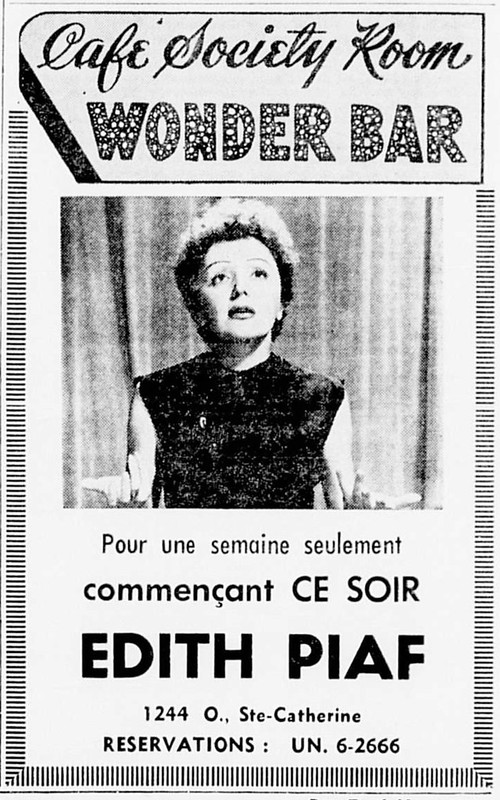 In December 1952, Édith Piaf performed at the Wonder Bar, testifying to the venue’s importance on the circuit of major international stars in Montreal [97].
And so the stars came and went, and night after night, the Esquire and the Sans Souci were packed. Then television arrived and lifestyles changed. People stayed home, and the clubs gradually emptied out. The Sans Souci was sold, and Silver returned to Miss Montreal, opening the Esquire only on weekends for variety shows.
The Esquire then went through a period of uncertainty, sometimes opening only on weekends. Things then stagnated for a few years. “The reason everything started to decline was the arrival of television. The novelty of television kept people at home, and many clubs went bankrupt,” according to Silver [22].
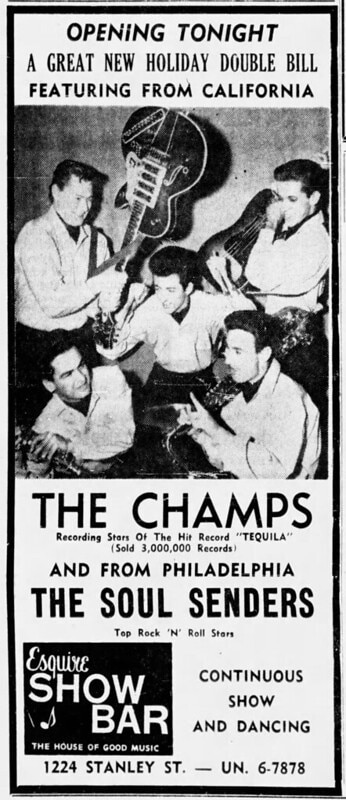
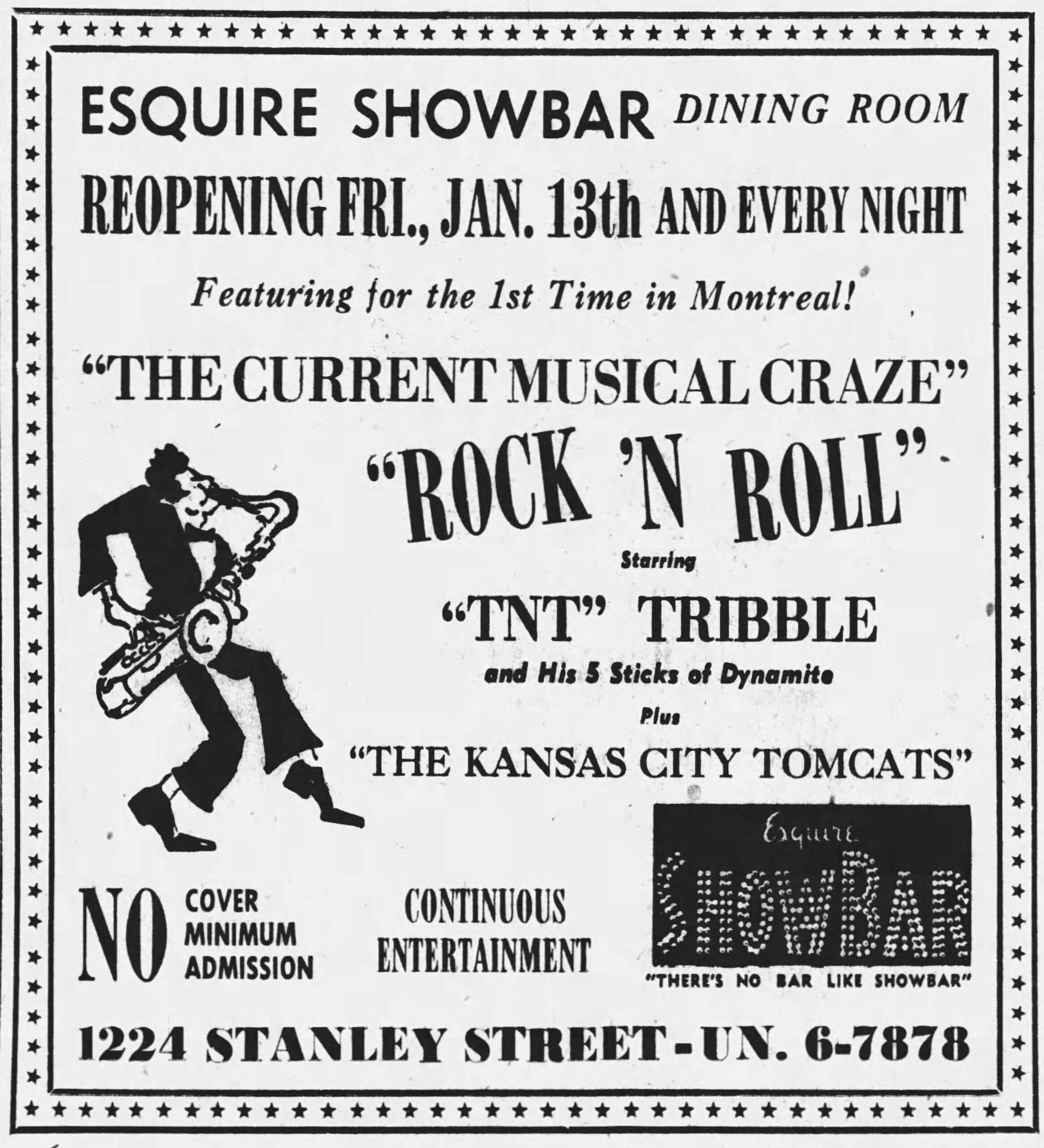
In 1956, Norm Silver relaunched the establishment by embracing a new trend: rock ’n’ roll. Attuned to young people’s enthusiasm for this music, he introduced live bands, helping make the Esquire one of the first Montreal venues to present the genre live. The arrival of TNT Tribble & His Five Sticks of Dynamite, alongside groups such as The Kansas City Tomcats, marked a decisive turning point: the press described an electrifying atmosphere in which the audience, swept up by the rhythm, actively participated in the show, revealing the emergence of a new relationship to music and entertainment [74]. From that point on, the Esquire no longer merely reflected trends—it helped shape them.
“I heard young people talking about it at Miss Montreal,” Silver recalled, “and I was always listening to it on the car radio. I liked it. There was something there. It was exciting music. And of course, it appealed to young people, which represented a new market for clubs. Older people were staying home to watch television. So I decided to try it at the Esquire—and that’s how I introduced rock’n’roll shows to Montreal. At first, Mr. Cleaver was a little reluctant, but I convinced him to try it for a month and, as you know, we never looked back, never had any reason to change the formula. They said it would last six months, but rock’n’roll is still here today.”
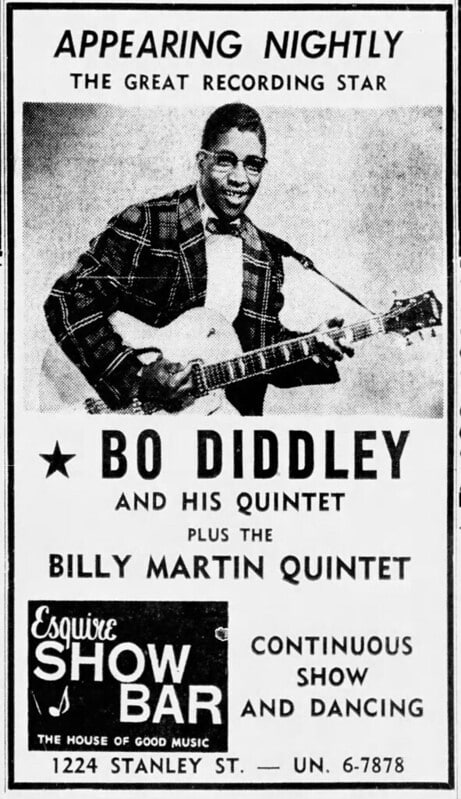
In an advertisement published on the occasion of Bo Diddley’s concert series in 1957, the Esquire Show Bar is explicitly presented as an establishment that had “pioneered rock ’n’ roll presentation in Montreal,” thus underscoring its precursor role in establishing the genre on the local scene [89]. “It was real rock’n’roll,” Silver said. “No big loudspeakers, just good musicians playing real music.”
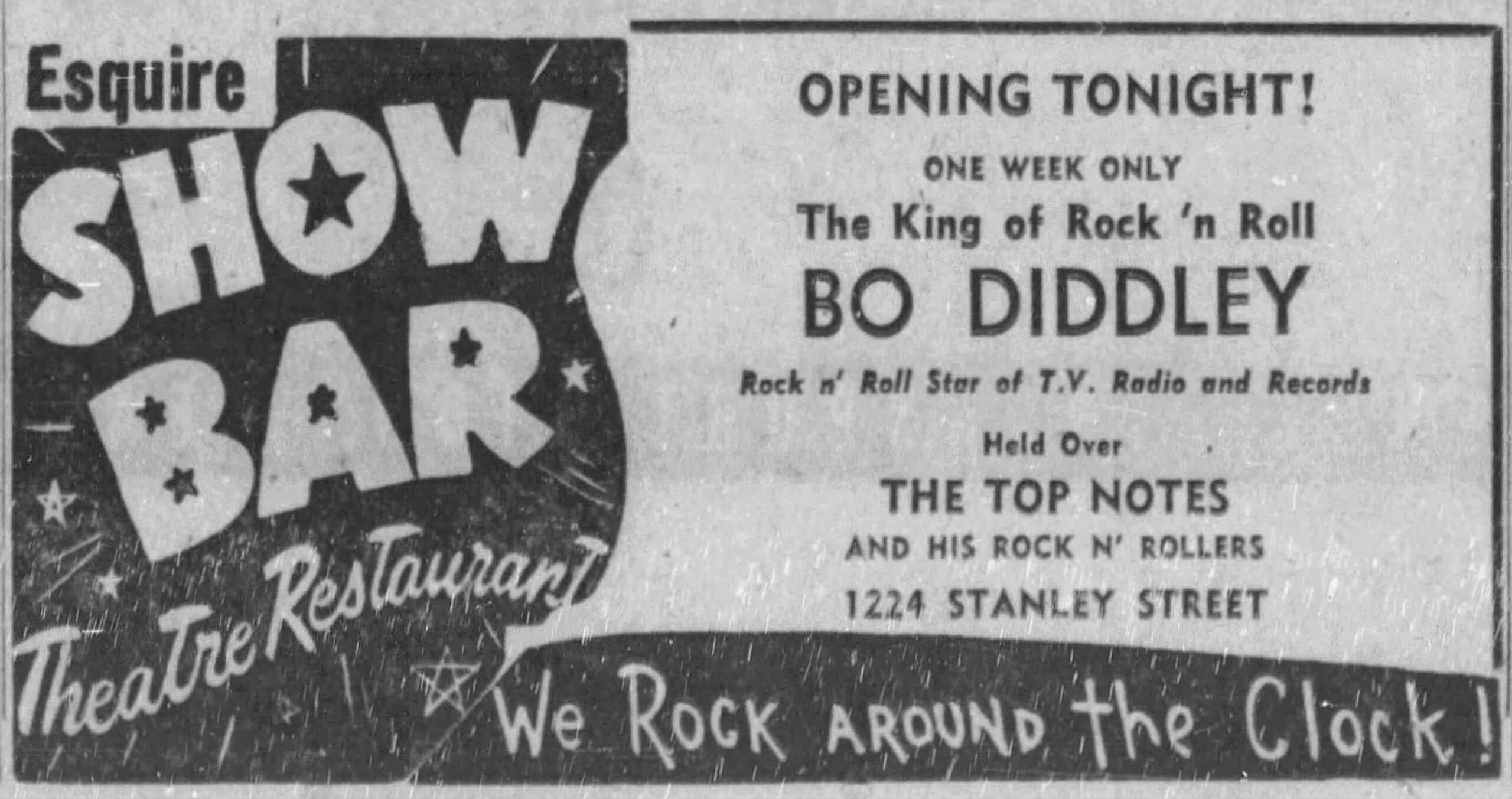
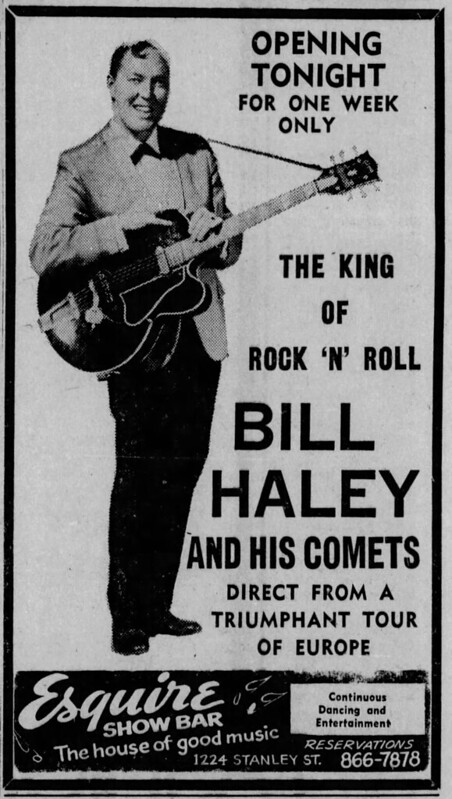
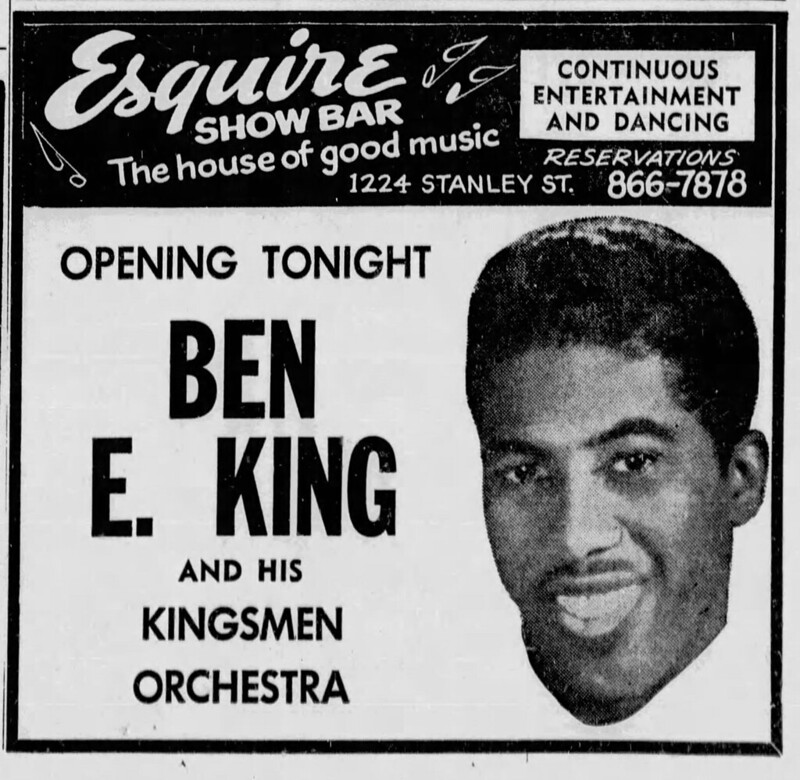
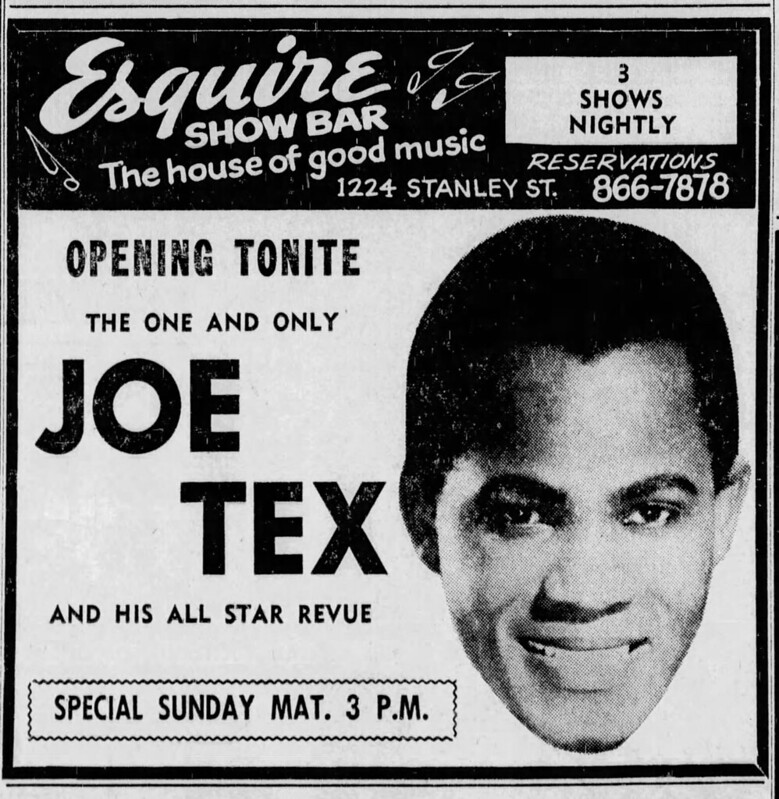
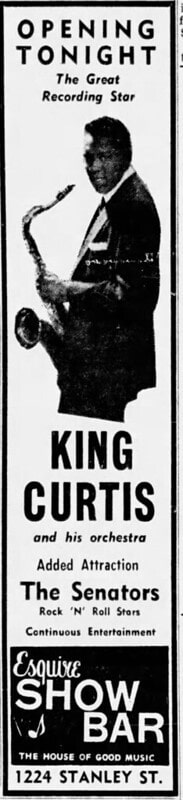
Frank Motley was a regular, with his groups The Dual Trumpets and Motley Crew. This stage then welcomed Fats Domino—a giant of early rock & roll—as well as Shotgun Kelly, Mudcat Grant, and Little Richard, who is credited with the famous falsetto “wooooo,” later echoed by the Beatles, not to mention Dave “Baby” Cortez and his “Happy” organ. Bill Haley & the Comets also performed there, along with Jr. Walker & the All-Stars, followed by a series of notable groups such as The Coasters, The Drifters, The Sidewinders, The Untouchables, and The Fendermen—the latter among the first to incorporate go-go dancers in cages into their performances. The rhythm never stopped: while the music continued, Mike Stephens hosted interviews with the stars on the program Club 800, welcoming in particular Joe Tex, Ben E. King, Bill Doggett, Chubby Checker, and Bill Stewart. King Curtis, the great saxophonist, also passed through—later murdered in New York—“one of the nicest guys in the business.” He even performed there alongside a still-unknown young guitarist: Jimi Hendrix, according to Silver.
At the turn of the 1950s, Montreal’s entertainment industry was changing rapidly: rock competed with jazz and reshaped programming, while striptease became a central attraction, with a more explicit staging of the body. This double shift—musical and aesthetic—redefined the role of musicians and dancers and foreshadowed the decline of the classic cabaret model [57]. This evolution was reflected in the gradual abandonment of the traditional cabaret in favor of continuous musical programming, sometimes from 9 p.m. to 3 a.m., where groups followed one another without interruption [2], [22]. At the same time, the club developed significant media visibility. The program Man About Midnight, broadcast five nights a week on CFCF (11:30 p.m. – 1 a.m.), hosted by Lee Hamilton with Russ Taylor, welcomed personalities from all walks of life and contributed to the venue’s visibility, in a format comparable to a radio version of the “Johnny Carson Show.”
5. The Esquire in the 1960s: between a golden age and the first signs of decline
Building on this new format, the Esquire entered its most influential period. The 1960s marked the club’s peak, as it became a major hub for African American music in Montreal and a meeting point between local and international scenes.
In the early 1960s, several observers described Montreal nightlife as being in decline. A report in La Patrie Magazine (September 1962) portrayed a city “asleep” after midnight: deserted streets, lifeless cabarets, and repetitive shows dominated by standardized formulas. The investigation emphasized disappointed tourists, the weakness of the artistic offering, and an industry weakened by competition and lack of investment. Despite a few exceptions such as the Casa Loma, Montreal appeared at that time as a “metropolis of boredom” in transition [58].

In 1962, a then-unknown Bob Dylan attended a Bo Diddley performance and, between his engagements farther up Stanley Street at the Pot Pourri, wandered onto the Esquire stage for a few notes, astonishing the audience [3].
In the early 1960s, Norm Silver held two-thirds of the establishment, while the remaining third belonged to Gordon McVey, Sam Cleaver’s son-in-law. The latter’s importance in the venue’s history was further underscored by an obituary published in The Montreal Star on July 15, 1964, which presented Samuel Cleaver as one of the notable figures of Montreal nightlife. Sam Cleaver, founder of the Esquire, was proud of his establishment and its influence. He maintained that the Esquire represented a unique model in the landscape of Montreal clubs [3] [8].
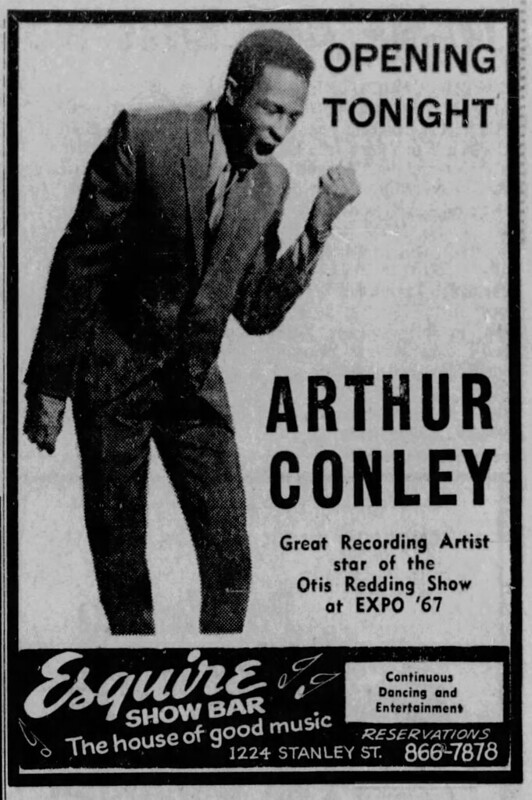
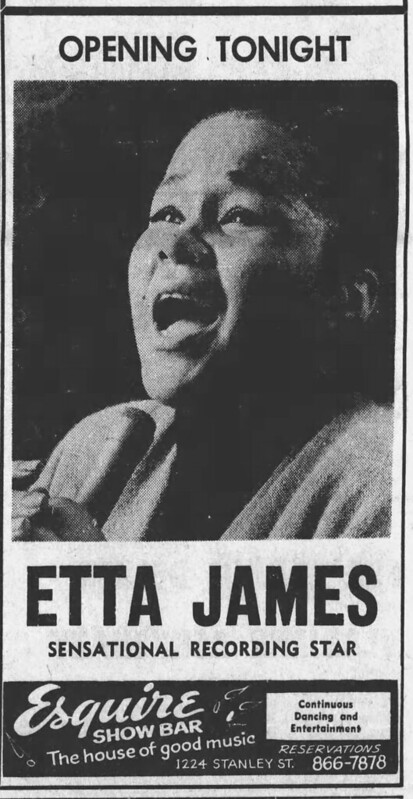
Even so, this period marked the club’s peak. A retrospective article published in La Presse returned to the pivotal year of 1967 and presented the Esquire Show Bar as a true “Mecca of r’n’b,” where major figures of African American music—from Wilson Pickett to Etta James—followed one another before a largely anglophone audience. The Esquire then became an essential stage, welcoming an impressive diversity of artists: Duke Ellington, Count Basie, The Coasters, The Drifters, Joe Tex, Ben E. King, Chubby Checker, Solomon Burke, Screamin’ Jay Hawkins, The Isley Brothers, and Wilson Pickett, the latter breaking attendance records.
Some groups returned repeatedly. They knew they could get good pay and a degree of security in an uncertain environment. And the fans came every night as well, by bus, sometimes from the suburbs, risking the last night connections for a musical adventure. Organist Ken Pearson remembered many nights spent playing until dawn, from 9 p.m. to 5 a.m. “It was like a village,” he said. “The atmosphere of the stars.” Even today, he still marvels at the major figures he saw there. “There was always a feeling of celebration,” he added [3].
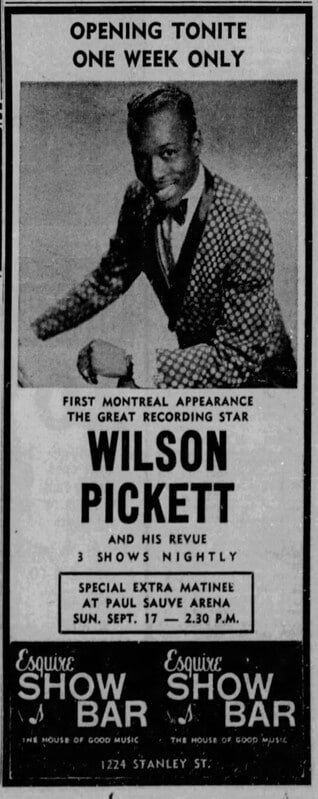
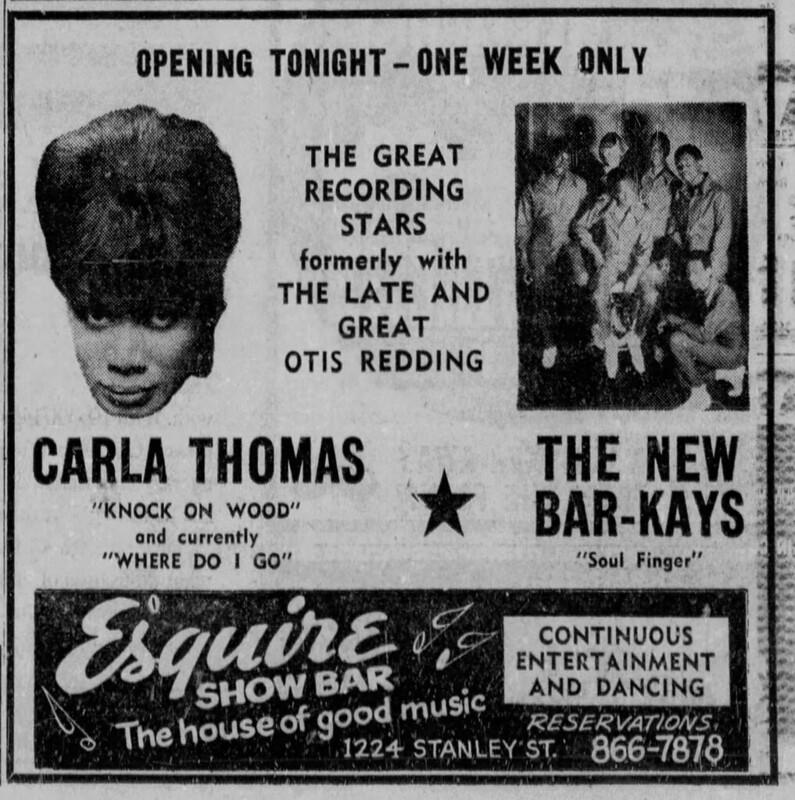
In 1967, Wilson Pickett’s appearance at the Esquire Show Bar confirmed the club’s status as a major stop on North American tours. The artist performed there to sold-out crowds before an enthusiastic audience, to the point that Norm Silver had to consider larger venues, notably the Paul-Sauvé Arena, where a show was organized on September 17, 1967 so that younger fans—excluded from cabarets—could attend [84]. This success extended to television, where Pickett appeared on Jeunesse d’Aujourd’hui, confirming the scale of his popularity with Quebec audiences [81], [82].
The impact of these performances, however, extended beyond the moment itself. Among the spectators marked by Pickett’s appearance was Dan Aykroyd, who, long before creating the cult film The Blues Brothers (1980), discovered in Montreal—at the Esquire Show Bar as well as at Expo 67—the power of live rhythm and blues. These formative experiences, defined by raw energy and striking authenticity, would permanently nourish his artistic vision and help shape the aesthetic and spirit of the Blues Brothers, thus indirectly inscribing the Esquire into the genesis of that major cultural phenomenon [83].
In 1967, Norm Silver acquired the former El Morocco cabaret and transformed it into Your Father’s Mustache, an establishment inspired by Prohibition-era speakeasies. The experience there was carefully staged: upstairs, a wall-mounted crank telephone allowed visitors to signal their arrival; a trapdoor would then open and a voice would ask who had sent them, to which the answer had to be “Mike” in order to gain entry. Once inside, the illusion was complete—drinks served in cups, retro décor, and a hushed atmosphere—recreating the clandestine ritual of bars from the 1920s–1930s [91].
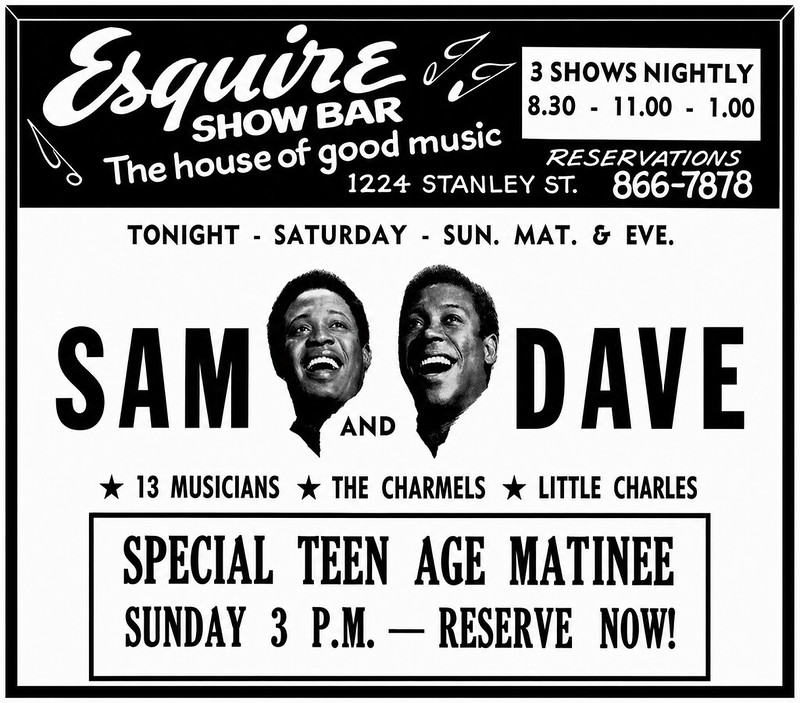
In the late 1960s, the Esquire Show Bar broadened its audience by opening the club to teenagers every Sunday afternoon, a time slot made possible by the absence of alcohol service, thus bypassing the legal and moral restrictions surrounding consumption and minors’ access. This formula allowed the venue to reach a younger clientele while continuing to spread rhythm and blues to a new generation [90].

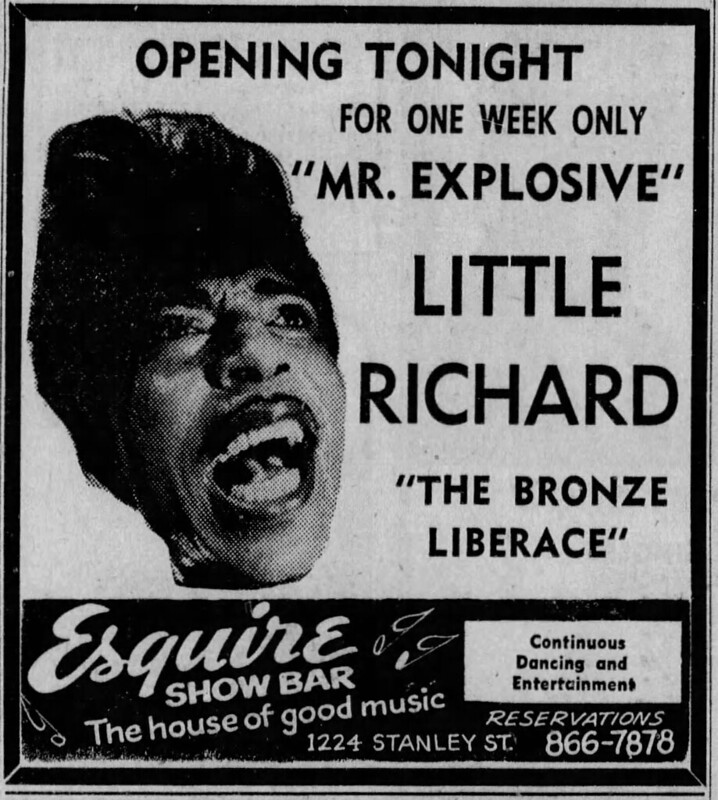
In the late 1960s, the Esquire Show Bar established itself not only as a major stage for international performers, but also as a genuine meeting place for Montreal’s artistic community. During Little Richard’s engagement, whose performances struck audiences through a deliberately eccentric stage persona—wig, penciled eyebrows and moustache, red-orange velvet trousers, and poses inspired by Marilyn Monroe, while still maintaining a resolutely rock repertoire—several figures from the local scene, including Guy Cloutier, Jenny Rock, Les Baronets, and Patrick Zabé, were in attendance, testifying to the club’s attraction for entertainment professionals. The event was described at the time as a true “family outing,” illustrating the Esquire’s role as a privileged meeting point between local artists and international stars [76][78].
In 1968, shortly before the merger of Sir George Williams University with Loyola College to form Concordia University, Norm Silver, the central figure behind the Esquire Show Bar, arranged for Ben E. King and his group to appear as part of a student blood drive. According to Edward Rosenthal’s testimony, the appearance of the singer of Stand by Me provoked immediate enthusiasm—“the students went crazy”—and allowed the event to break participation records, illustrating both Silver’s influence and the impact of Esquire artists on the Montreal scene [88].

In 1969, changing musical tastes led to a return of the big bands, making the Esquire Show Bar a regular stop for touring ensembles, while also serving as a laboratory for a new generation of Quebec artists. In this context, Robert Charlebois performed there during his psychedelic period and emerged as one of the first francophone artists to break through in a world dominated by North American circuits; an article in La Presse published in 1969 by René Homier-Roy emphasized the power and originality of his performance, described as a physical and controlled act, driven by expressive gestures and a hybrid musical language blending rock, chanson, and North American influences, embodying a major cultural transition between cabaret traditions and the emergence of modern Quebec rock [30][31].
A retrospective article in Photo-Vedettes reinforces this interpretation by placing this run within “the biggest line-up in the entire history of the Esquire.” The text notes that he “brought the house down,” with Silver even declaring: “That kid is the greatest thing that ever happened to the Show Bar.” In 1972, on the return flight from Paris, Charlebois told Jean-Pierre Ferland that, if he were to undertake a tour, the venue that would attract him the most would be the Esquire Show Bar, confirming the club’s singular prestige among artists themselves and its role as a decisive crossroads between international stars and the emerging Quebec scene [67], [77].
“It was like a revolution. People were dancing on the bar. The air was smoky. It was my psychedelic period. It was a week of pleasure, a very good memory.”
A few weeks later, an article published in La Presse on July 10, 1969, signed by Paul Henry and entitled “Duke Ellington at the Esquire: ‘That’s jazz, man’”, testifies to the appearance of Duke Ellington and his orchestra in a context of marked public enthusiasm. The text emphasizes the exceptional quality of the ensemble, made up of loyal musicians such as Johnny Hodges, Harry Carney, Paul Gonsalves, and Cootie Williams, whose cohesion contributed to the power of the Ellington sound, while also underscoring the venue’s ability to attract large crowds and confirm its status as a major jazz stage in Montreal [28].
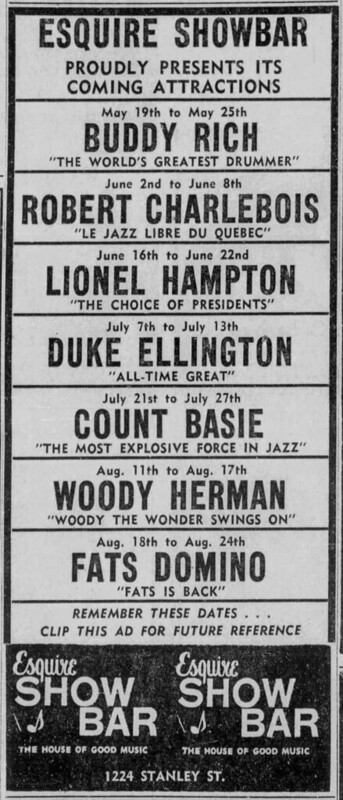
But toward the end of the decade, the club went through more difficult periods. A loyal clientele of soul fans and tourists continued to frequent the Show Bar during the summer season, but winters were much harder. At times, a group such as The Parliaments (later Funkadelic) played before an audience made up largely of the club staff.
The Esquire’s waiters were then an integral part of the show, just like the white palm trees or Norm Silver himself: they watched the room attentively and refilled glasses as soon as they were empty. Billy Kotsos, maître d’hôtel for 26 years, was already in place before Silver’s arrival, and some even claimed that Dean Martin used to give him money before becoming famous.
When the room was empty, the Esquire seemed dark and gloomy; but as soon as the crowd arrived, the venue’s unique atmosphere came back to life. People came there to hear blues and modern jazz: some found the music too intense, but the regulars knew exactly what they were looking for. Despite the transformations of the scene, the Esquire remained true to itself. “The ceiling may cave in,” Silver and his partner Gordon McVey said, “we won’t change a thing”—the Esquire had to remain the Esquire. Silver, in a loose-fitting suit, cigar clenched between his teeth, watched the crowd with satisfaction, chatted with customers, and constantly tried to keep them coming back [22].
6. The Esquire in the 1970s: artistic prestige and the end of a myth
Despite its prominence, the Esquire could not escape the transformations of the nightlife landscape. By the late 1960s, new forms of entertainment were emerging, while regulatory and economic pressures gradually weakened the show bar model.
At the turn of the 1970s, an article published in La Presse on January 8, 1970, in the “Spec by night” column, offered a nuanced assessment of the Esquire Show Bar. Despite a décor considered aging and a layout sometimes unfavorable to visibility, notably because of a low stage, the club remained one of the few Montreal establishments to offer continuous high-level musical programming, confirming its lasting reputation among music lovers [29].
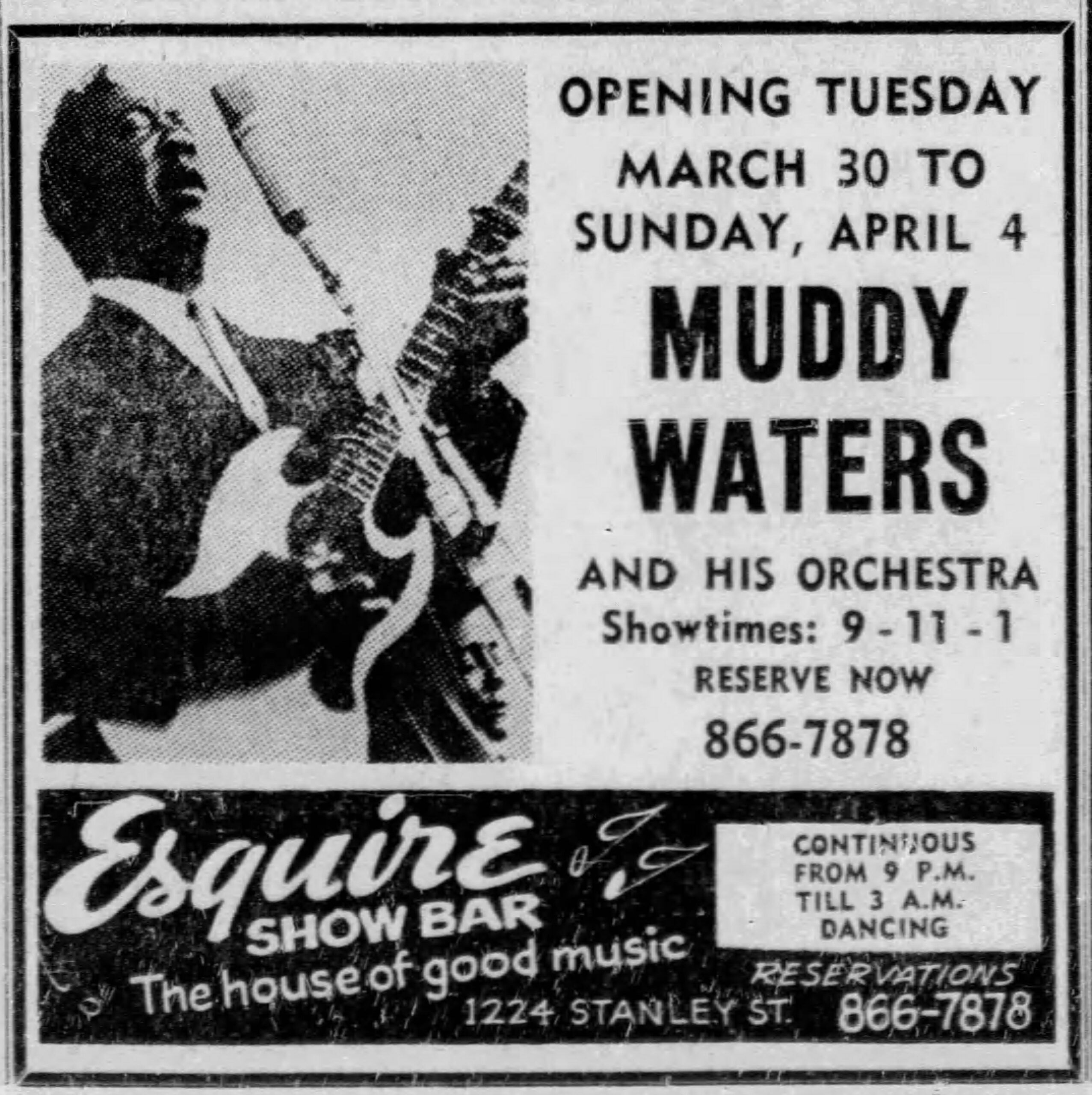
This reputation was reinforced in the early 1970s by the steady presence of major blues and jazz artists. A Gazette article from March 31, 1971, by Dane Lanken, describes Muddy Waters’ performance as a display of raw authenticity and power, supported by Sammy Lawhorn, Pinetop Perkins, and others—confirming the Esquire Show Bar as a key venue for blues and rhythm and blues in Montreal [26]. The programming reflects this status, featuring artists such as Howlin’ Wolf, John Lee Hooker, Buddy Guy, and Junior Wells, alongside major jazz figures including Herbie Hancock, Charlie Mingus, Stan Getz, and Pharoah Sanders.
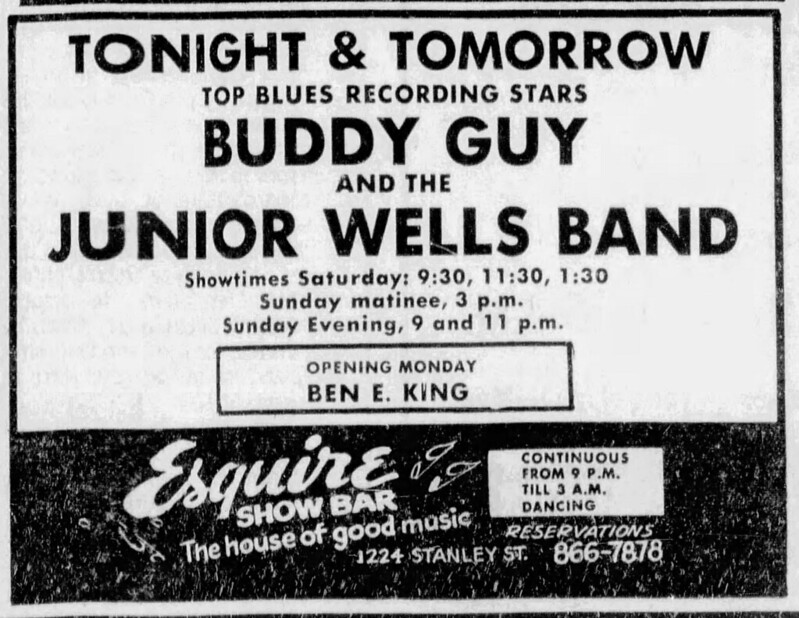
By 1971, the Esquire stood apart in Montreal nightlife for its dense, fluid layout, where bar, tables, and stage merged into a single space. As noted in the Gazette, this configuration fostered constant movement and interaction—musicians and audience in close proximity, immersed in uninterrupted music under the show bar format. A night with Buddy Guy and Junior Wells exemplified this energy: physical, improvised performances spilling beyond the stage, with a tightly packed audience fully engaged. While Stanley Street could appear quiet outside, the Esquire itself functioned as a vibrant nighttime hub [92].
After years of uncertainty, the situation shifted abruptly on May 5, 1972, when police raided the Esquire Show Bar, seizing its liquor license and stock. The operation, widely reported, targeted the cabaret at 1224 Stanley Street and led to the revocation of permits, including those linked to Clément Stanislas Pranno [75]. Norm Silver briefly attempted to continue without alcohol, but the model proved unsustainable. The liquor board’s decision ultimately sealed the club’s fate.
“Why?” Silver shrugs. “Who knows? It all started in 1963, when the city executive committee decided to revoke the licenses of about twenty clubs in Montreal, including the Esquire. They claimed it was contrary to public morals. Every year, they sent us a bill for our license, cashed our cheque, but never sent us the license. With only a receipt, we still managed to get our provincial liquor permit. This situation lasted nine years. We finally took the matter to the court of appeal because we wanted to settle the issue in court, but the city never did. Then the liquor board stepped in, saying we couldn’t have a liquor permit without the city’s, and the police came and removed every bottle from the club. The following year, we applied for a new license from the city, but it was refused. That’s how they shut us down, without explanation and without charges.”
Articles published in the aftermath of the intervention confirm the scale of the operation: more than 1,000 cases of beer and about 600 bottles of hard liquor were confiscated, along with the revocation of the bar and dining room permits. Authorities cited operation without a municipal license, failure to comply with operating conditions, and allegations linking the venue to prostitution-related activities, in a context marked by more than 75 arrests between 1968 and 1971 [11], [16].
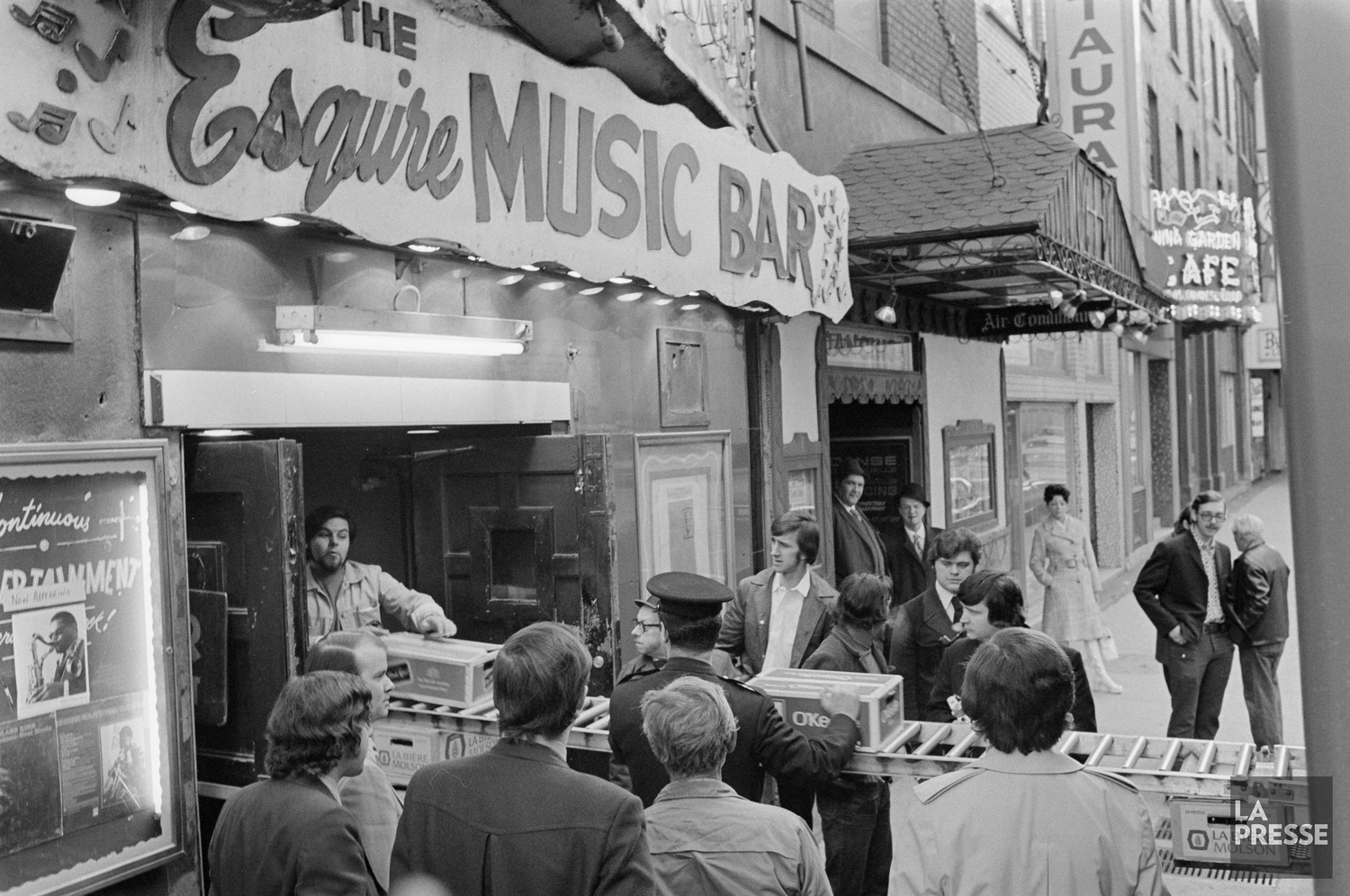
Despite this blow, the club remained briefly active. Articles from May and June 1972 testify to programming that was still ambitious—with Larry Coryell, Howlin’ Wolf, and Charlie Mingus—in a room still frequented, though deprived of alcohol. Silver tried to keep things going by offering evenings without a license, “with one arm tied behind his back,” but the viability of the model quickly collapsed [12], [35], [36], [37].
In the fall of 1972, the Esquire nevertheless continued to host top-tier artists such as Stan Getz, in an atmosphere still marked by the closeness between musicians and audience. This artistic vitality contrasted with the venue’s administrative precariousness, now deprived of its principal economic lever [32].
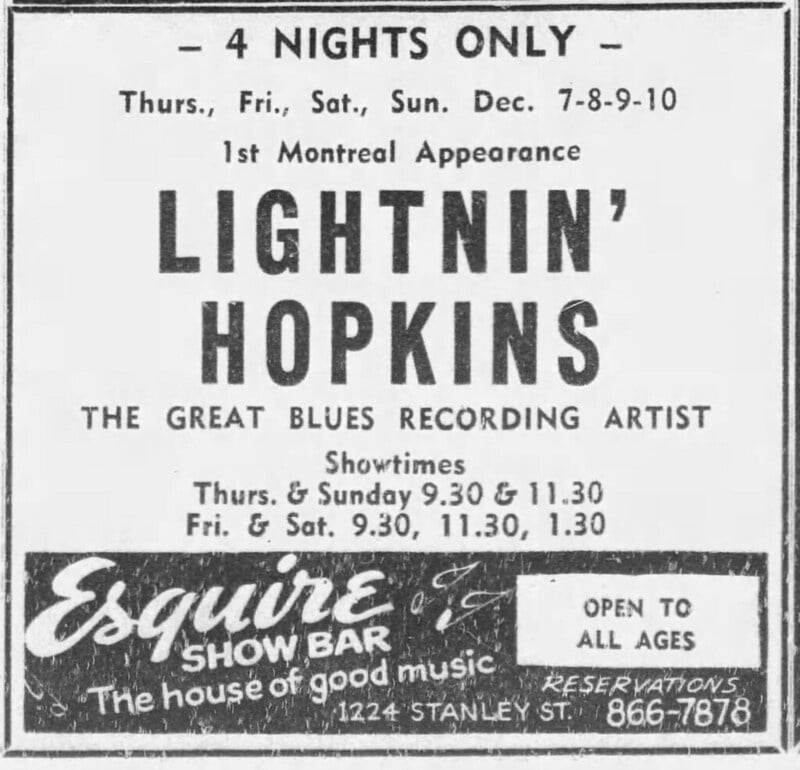
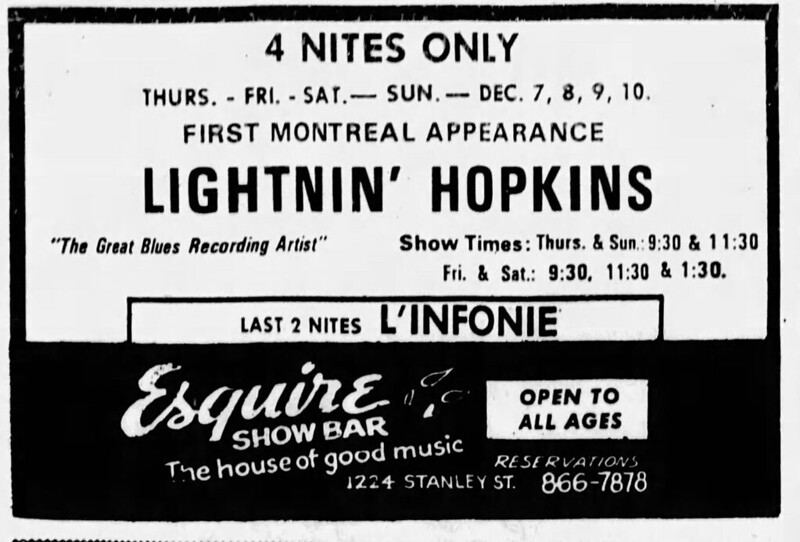
The club’s final days were marked by the appearance of bluesman Lightnin’ Hopkins, in December 1972, whose performances took on the value of a farewell in a weakened establishment. On December 10, 1972, the Esquire Show Bar closed its doors permanently, bringing more than three decades of activity to an end [6].
At the same time, Norm Silver continued his activities at Norm Silver’s Moustache, which evolved from Dixieland to psychedelic rock and then to hard rock, becoming an important venue on Montreal’s heavy music scene by the 1980s [3], [9].
The closure of the Esquire Show Bar occurred amid growing tensions with authorities. In Le Devoir, the Quebec Liquor Permit Control Commission described the club as a “meeting place for prostitutes,” citing years of surveillance and arrests linked to solicitation activities [71].
Although its municipal permit had been revoked in 1963, the club continued operating under a provincial liquor license, benefiting from a degree of tolerance. A Court of Appeal ruling in the early 1970s failed to resolve the situation, ultimately reinforcing the decision to shut it down [72].
Norm Silver denied tolerating such activities, arguing they were difficult to control and that authorities offered no support: “It would cost me more to hire a policeman than to run my club” [2].
“I don’t care so much about losing money,” said Mr. Silver, “but this situation is deeply humiliating. I have spent a long time in this city and built a reputation here.”
Retrospective analyses place the closure of the Esquire Show Bar within a broader transformation of Montreal nightlife. A Pop jeunesse article (January 20, 1973) highlights the paradox of its disappearance at the height of its popularity, noting its 33-year history, international reputation, and role as a key gathering place for jazz, blues, and rock audiences, as well as a formative venue for Robert Charlebois. The loss of the liquor license ultimately forced its closure [68].
More broadly, the Esquire’s disappearance reflects the decline of cabaret-show venues amid the rise of discotheques, rising costs, and regulatory pressures [18], [19], [21]. Later accounts emphasize its cultural importance and lasting legacy as a major crossroads for live music in Montreal [2], [3].
Despite its closure in 1972, administrative efforts continued into 1973, with Norman Silver still seeking permits under Esquire Club Inc., suggesting attempts to revive or regularize the venue [73].
The Esquire’s disappearance came to symbolize the end of an era—Montreal’s great cabarets—marking the transition toward new forms of nightlife and live performance.
7. Milord: the short-lived revival of a mythical venue
In the spring of 1977, the former Esquire Show Bar at 1224 Stanley Street was relaunched under the name Milord, marking an explicit attempt to breathe new life into an emblematic Montreal nightlife venue while adapting it to the musical realities of the late 1970s. The official opening was announced at the end of April under new management, which presented the club as the heir to an establishment once associated with some of the biggest names in show business. Beginning in the second week of April, the venue offered a regular weekday concert schedule at 9 p.m. and 11:30 p.m., with tickets ranging from $2 to $4, slightly more expensive on weekends, while drinks were listed at $1.25 for beer and $2 for spirits [54].

The programming lineup reflects a clear desire to reposition the Milord as an eclectic venue at the crossroads of rock, jazz, and contemporary music. The opening series was marked by the presence of Offenbach from April 12 to 17, 1977, followed by George Duke and Billy Cobham, the Scarlet Rivera Band—the violinist associated with Bob Dylan—and then Arthur Prysock. In May, the program continued with Miroslav Vitous, Gary Burton, and Eberhard Weber, Bim, Rough Trade, and Boule Noire, revealing the venue’s ambition to combine international artists and the local scene in a context of strong cultural competition [54].
At first, the club was presented as being run by Arthur Dalfen, also known as the manager of the Maples Inn in Pointe-Claire. He stated that he wanted to preserve the Esquire tradition while modernizing its offering: the Milord kept the stage and part of the basic layout of the former cabaret, but reoriented its programming toward a mix of rock, pop, and jazz aimed at a younger clientele. The article emphasizes that the upstairs room could accommodate about 700 people, while an additional space made it possible to combine concerts, dancing, and recorded music. The project thus presented itself as a transition from the classic cabaret model to that of a concert club suited to post-cabaret tastes [9].
The reopening of the Milord took on particular symbolic value on April 12, 1977, when Offenbach inaugurated the venue on the occasion of the launch of its new LP. The account reported by Mario Roy shows how much the place remained charged with memory: arriving early, Gerry Boulet rediscovered a décor still largely intact, with its decorative columns, lighting rails, and several features inherited from the Esquire Show Bar, while upstairs a discotheque sound system was being installed and a few employees bustled about cleaning the room and stocking the refrigerators behind the bar. Sitting in the middle of the room, Boulet scanned the space and even recognized some graffiti dating back to the Expo 67 era. As the evening progressed, the crowd gathered, mixing the band’s entourage, people from the music industry, and regulars from the rock scene, making the night not only an official opening but also a moment of symbolic reappropriation of a prestigious venue by a new generation of Quebec musicians [51].
In the weeks that followed, the presence of Offenbach strongly helped define the Milord’s musical identity. A review published in May 1977 emphasized the band’s return to French and highlighted the power of its stage performance in this Stanley Street venue. The first concert showcased several new songs, including “Victoire d’amour”, “Le blues me guette”, “La voix que j’ai”, “Le condamné à mort”, and “Dominus Vobiscum”. The article stresses the band’s more direct, heavier sound, more deeply rooted in rock and blues, as well as the central role of Gerry Boulet, whose singing and organ dominated the performance, supported by Michel Lamothe and Roger Belval. The stage, raised by a few steps and located right in the heart of the bar, fostered immediate proximity with the audience and helped make the Milord an important anchor point for Quebec rock at a moment of strong affirmation [53].
A few weeks after this revival, however, the club entered a new phase of repositioning. In mid-June 1977, management passed into the hands of Gary Eisenkraft, a well-known figure in the Montreal scene and founder of the New Penelope. His arrival marked a change in strategy: rather than relying primarily on international headliners, Eisenkraft intended to make the Milord a showcase for local talent, in the spirit of the clubs where he had previously helped launch artists such as Gordon Lightfoot, Richie Havens, and Mother of Invention. The article notes that some recent experiments—notably the booking of Scarlett Rivera—had not achieved the hoped-for results, whereas local groups such as Offenbach had drawn audiences more successfully. Eisenkraft therefore favored an approach based on word of mouth and discovery, while lowering ticket prices to about $2 on weekdays and $2.50 on weekends, and hosting contemporary groups such as Fussy Cussy. The Milord thus appeared as a fragile laboratory, caught between the memory of the cabaret and adaptation to the modern rock concert market [52].
Despite ambitious programming, repeated revival efforts, and a genuine desire to make the venue an active hub of Montreal’s music scene, the Milord experience remained brief. Less than a year after reopening, the establishment had already disappeared from the landscape. In January 1978, Le Devoir referred to it in the past tense among a series of recently vanished places, alongside the Black Bottom, the New Penelope, and the Esquire, in a context of rapid reconfiguration of Montreal nightlife [55]. This early closure can partly be explained by the difficulty of reconciling eclectic programming, economic profitability, and changing audiences. The Milord thus appears as an aborted transitional project, revealing the tensions running through the Montreal scene on the eve of the 1980s: the decline of the cabaret model, the rise of rock, the fragmentation of audiences, and growing competition among discotheques, clubs, and large concert halls.
8. Les Filles d’Ève: from cabaret to strip club
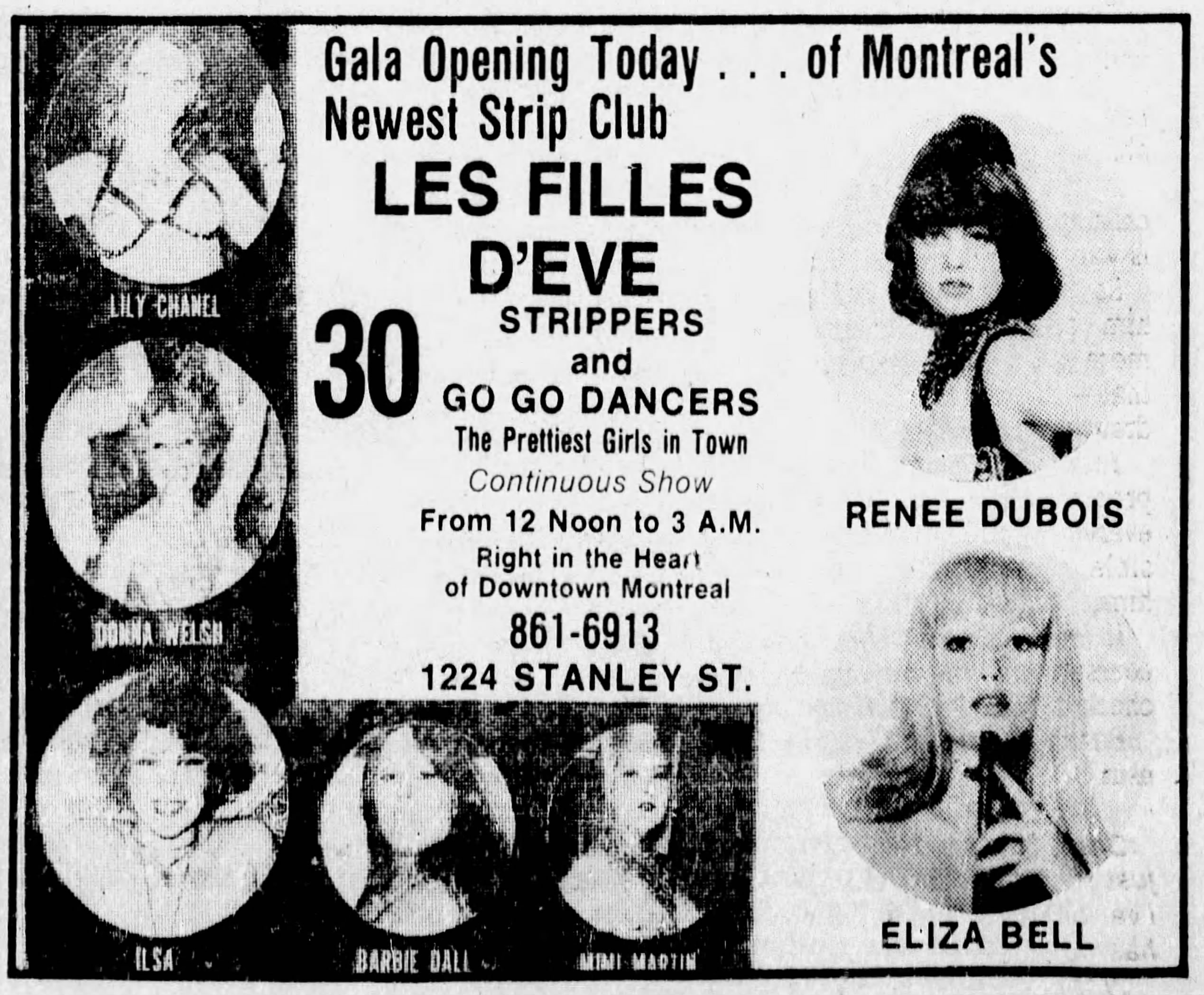
On May 1, 1978, 1224 Stanley Street saw the opening of Les Filles d’Eve, presented as Montreal’s “newest strip club.” Offering continuous entertainment from noon to 3 a.m. with 30 dancers and go-go dancers, the establishment illustrates the shift toward a more commercial and eroticized form of entertainment on Stanley Street in the late 1970s [5].
9. The 1980s: the end of an era
On March 17, 1980, Norm Silver, the central figure behind the Esquire Show Bar and a major player in Montreal nightlife for more than three decades, died at the age of 69. Recognized for having transformed the Esquire into a genuine international showcase for jazz, rhythm and blues, and rock, he left behind a lasting legacy, having helped make the club one of the most influential venues on Montreal’s 20th-century music scene [7].
10. Legacy: memory and influence of the Esquire Show Bar
An article published in La Presse on June 14, 2008, by Marie-Christine Blais, revisits the Esquire Show Bar through its iconic horseshoe-shaped stage, recalling its status as a key nightlife venue at 1224 Stanley Street. Built around a model of continuous entertainment, the Esquire embodied a hybrid space where music, drinking, and sociability merged without interruption [69].
Its intimate layout fostered a rare closeness between artists and audience, creating a fully immersive atmosphere. With a diverse program mixing international stars and local talent, the club became a major cultural crossroads and an important training ground for artists such as Robert Charlebois.
Operating within a restrictive regulatory framework, the Esquire faced increasing pressure from the 1960s onward, reflecting broader tensions in the governance of Montreal nightlife [73].
Despite its closure in 1972, its legacy endured. In 2008, Esquire Show Bar — La Revue at the Théâtre Corona paid tribute to its musical spirit, reaffirming its place as a defining venue in Montreal’s cultural history [80].
More than a cabaret, the Esquire remains a symbol of a vibrant era—where the continuity of the show became the very form of the venue.
11. Biographical Notes
Biographical Note
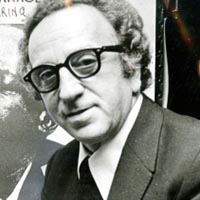
NORM SILVER (c. 1911–1980)
Norm Silver was one of the most influential impresarios and nightclub operators in 20th-century Montreal. A central figure in the city’s nightlife, he is best known for his association with the ESQUIRE SHOW BAR, the legendary Stanley Street venue he helped transform, beginning in the early 1950s, into a true “house of good music.” For more than twenty years, Silver established an ambitious and eclectic programming that made the venue a major stage for jazz, blues, rock ’n’ roll, rhythm and blues, and soul. Under his direction, the Esquire hosted an impressive succession of renowned artists, including DUKE ELLINGTON, COUNT BASIE, WOODY HERMAN, LIONEL HAMPTON, BO DIDDLEY, FATS DOMINO, LITTLE RICHARD, BILL HALEY AND THE COMETS, WILSON PICKETT, SAM AND DAVE, MUDDY WATERS, HOWLIN’ WOLF, JOHN LEE HOOKER, HERBIE HANCOCK, and RAHSAAN ROLAND KIRK[3].
Born into a Jewish Montreal family and raised in the DUFFERIN PARK area, Silver was first an accomplished athlete. A student at BARON BYNG HIGH SCHOOL, class of 1928, he played and coached YMHA teams in baseball and basketball, leading some to municipal and provincial championships. After his studies, he briefly entered the business world, working at GREENSHIELDS, where he recorded New York Stock Exchange transactions during the crash of 1929. Like many Montrealers affected by the GREAT DEPRESSION, he later turned to various hustles and jobs—from betting houses to sports-related promotional ventures—to make a living[3].
During the SECOND WORLD WAR, Silver was assigned to the headquarters of the military camp in SAINT-JEAN, while also participating in the sale of Victory Bonds in Montreal clubs. After the war, he moved more decisively into the restaurant and entertainment business. He collaborated with HENRY MANELLA and JACK BLATT, notably in developing venues that became iconic, such as RUBY FOO’S and especially MISS MONTREAL, a large drive-in built on Décarie Boulevard starting in 1947, which became a popular postwar institution[3].
It was, however, through the ESQUIRE that Norm Silver left a lasting mark on Montreal’s cultural history. At a time when the club—founded in the late 1930s by SAM CLEAVER—was going through a difficult period, Silver took over and introduced major innovations, including the concept of continuous performance, inspired by New York newsreel theatres: a two-hour program that repeated without interruption, allowing patrons to enter at any time. He also redefined the venue’s identity, shifting it from the traditional supper club model to that of a modern show bar, more dynamic and musically focused. This formula proved immediately successful and helped establish the Esquire as a distinctive institution in Montreal’s nightlife[22].
A visionary, Silver also quickly recognized the commercial and cultural potential of rock ’n’ roll. As early as 1956, while many club owners remained wary of the new genre, he chose to introduce it on the Esquire stage. He later claimed to have been among the first to present live rock ’n’ roll in Montreal, featuring groups such as TNT TRIBBLE AND THE FIVE STICKS OF DYNAMITE and the KANSAS CITY TOMCATS, who performed in continuous rotation under the house format. Over the course of the 1960s, he adapted the programming to emerging trends, incorporating rhythm and blues and later soul, while keeping the club at the forefront of popular musical movements[3][22].
Silver was also a hands-on operator, highly present within his establishment. His tiny office, located near the Esquire’s coat check and cluttered with cigar boxes, press clippings, and archives, was part of the venue’s atmosphere. Always dressed in a loose-fitting suit, with a cigar close at hand, he booked artists, observed the clientele, spoke with regulars, and constantly sought to understand evolving public tastes. His credo was simple: “music is music,” regardless of its origin or label[22].
The closure of the ESQUIRE SHOW BAR in 1972, following conflicts with the City of Montreal and liquor licensing authorities, was a severe blow. Silver saw the club not merely as a business, but as a true cultural institution that should have been supported rather than opposed. Despite this closure, he remained active in the field, focusing increasingly on the MUSTACHE CLUB on Closse Street, which he had acquired a few years earlier under the name NORM SILVER’S MUSTACHE[2][3].
Norm Silver passed away in 1980, at the age of 69, at the ROYAL VICTORIA HOSPITAL, after a long illness. Until his final weeks, he continued booking artists. His death marked the end of an era—that of a cosmopolitan, vibrant, and music-driven Montreal nightlife of which he had been one of the principal architects. He is remembered as a warm, generous, and intuitive man, deeply devoted to live music, who helped make the ESQUIRE SHOW BAR one of the great landmarks of 20th-century Montreal entertainment[93].
Biographical Note

ROY COOPER (1908–1996)
Roy Cooper was one of the major figures of 20th-century Montreal show business. Active for more than seven decades, he was described in the press as the “dean of Canadian impresarios” and as a true legend of entertainment in Montreal.
Born in Montreal and trained within the American vaudeville circuit, notably in New York and the Catskills, Cooper developed an extensive professional network linking the Quebec metropolis to major North American artistic centers. As early as the 1930s, his name appeared in the programming of downtown cabarets, including the LIDO on Stanley Street, before the rise of the major postwar venues.
Over the course of his career, he was involved in bringing leading international artists to Montreal, including LOUIS ARMSTRONG, BILLIE HOLIDAY, COUNT BASIE, DUKE ELLINGTON, SAMMY DAVIS JR., TONY BENNETT, and EDITH PIAF. His name is also associated with attempts to book ELVIS PRESLEY, illustrating the scope of his network.
In the 1950s and 1960s, Cooper played a structuring role in the circulation of jazz artists in Montreal. Retrospective sources place his influence within the development of a circuit that included the ESQUIRE SHOW BAR and the JAZZ HOT at the CASA LOMA, helping to establish the city within the North American touring network.
Respected for his professionalism and his ability to maintain long-term relationships with artists, Cooper embodied the transition between the golden age of cabarets, the rise of large-scale international productions, and the transformation of Montreal’s nightlife landscape beginning in the 1960s.
Notes & sources
-
THE GAZETTE, May 3, 1940 — opening advertisement for the Esquire at 1224 Stanley Street.
Description: presents the establishment as a new Montreal meeting place; highlights “floor revues” offered three times nightly with Armand Meerte and his orchestra; emphasizes the immediate opening (“Opening Tonight”). -
THE MONTREAL STAR, December 16, 1972, “Going, going...?” — feature article devoted to the closure of the Esquire Show Bar and its conflict-ridden relationship with municipal authorities.
Description: revisits the club’s status as one of Montreal’s principal venues for blues and jazz, having hosted artists such as Muddy Waters, Howlin’ Wolf, John Lee Hooker, Herbie Hancock, and Pharoah Sanders; describes the closure of the Show Bar following the revocation of its liquor license in May 1972, citing in particular allegations related to prostitution and operating without a municipal permit; specifies that several arrests were made over the years, often as the result of undercover police operations; emphasizes the position of manager Norm Silver, who disputed these accusations and argued that the problems were more the result of a lack of institutional support and insufficient policing; mentions the partial continuation of activities without alcohol, with musical programming still active but facing declining attendance; highlights the importance of the Esquire as an interclass meeting place and as a major platform for African American music in Montreal; finally stresses the financial, legal, and administrative difficulties that led to the establishment’s permanent closure, despite its reputation and cultural influence. -
THE MONTREAL STAR, March 10, 1979, Dane Lanken, “The Esquire Showbar remembered” — retrospective article devoted to the history and influence of the Esquire Show Bar.
Description: traces the evolution of the club from its opening in 1937 to its closure in the early 1970s; emphasizes its role as a leading venue for jazz, blues, and rhythm and blues in Montreal, having hosted artists such as Duke Ellington, Count Basie, Buddy Rich, Herbie Hancock, Aretha Franklin, Chubby Checker, and Jimi Hendrix; highlights the leadership of Norm Silver, its importance as an interclass meeting space, and its contribution to introducing African American music to Montreal audiences; evokes the transformation of the neighborhood, regulatory pressures, and changing consumer habits that led to its decline and disappearance. -
THE MONTREAL DAILY STAR, November 17, 1948, “Sunday Shows Result in Fines” — article concerning the enforcement of the Lord’s Day Act in Montreal.
Description: reports on fines imposed on fifteen operators of cabarets, dance halls, and businesses for presenting shows or allowing dancing on Sundays; mentions in particular Sam Cleaver of the Esquire Cafe (1224 Stanley Street), involved in several violations; illustrates the strict regulatory framework governing entertainment activities in Montreal in the late 1940s. -
THE GAZETTE, May 1, 1978, p. 26 — advertisement announcing the opening of
Les Filles d’Eve at 1224 Stanley Street.
Description: presents the club as Montreal’s “newest strip club,” featuring 30 dancers and go-go dancers in continuous performance from noon to 3 a.m.; mentions in particular Renée Dubois and Eliza Bell. -
THE MONTREAL STAR, December 8, 1972, Juan Rodriguez, “Lightnin’ Hopkins began blues fire” — article covering a series of performances by Lightnin’ Hopkins at the Esquire Show Bar.
Description: emphasizes the presence of the Texas bluesman during a four-day engagement, presented as his first visit to Montreal; describes the performance as a memorable moment characterized by an intimate, expressive, and minimalist approach to the blues; mentions the participation of the group The Eclipse, as well as their role as backing musicians; stresses the Esquire’s ability to host major artists in an intimate atmosphere; finally evokes the uncertain context of the club, whose future appeared compromised following the recent revocation of its liquor license. -
THE RECORD, March 18, 1980 — “Norm Silver dead at 69” — obituary of Norm Silver, impresario and former director of the Esquire Show Bar.
Description: presents Silver as a major figure on the Montreal music scene who helped make the Esquire an international-caliber venue; highlights his role in transforming the club from a traditional supper club into a leading showcase for contemporary music; mentions his entry into the nightclub world in the 1940s and his influence on several generations of musicians; finally stresses his importance as a promoter who left a lasting mark on Montreal’s nightlife and cultural life. -
THE MONTREAL STAR, July 15, 1964 — obituary of Samuel Cleaver, owner of the Esquire Show Bar.
Description: retraces the career of Cleaver, an important figure in Montreal nightlife associated with the Esquire since the late 1930s; presents the club as one of the last witnesses of the golden age of cabarets, having hosted artists such as Patti Page, Jerry Lewis, Dean Martin, and Eddie Fisher; highlights the evolution of the venue from revues and variety entertainment to jazz, then rock and roll; also evokes biographical elements, including his British origins, athletic activities, and role within the Montreal scene. -
THE GAZETTE, April 9, 1977, p. 42 — article by Juan Rodriguez,
“New Milord concert club aims to keep Esquire tradition.”
Description: announces the transformation of the former Esquire Show Bar into the Milord, a concert club oriented toward rock, pop, and jazz, aiming to preserve the tradition of the venue while adapting to a new clientele and contemporary musical trends. -
THE GAZETTE, August 13, 1973, Dave Billington, “The Esquire Show Bar — we need it back” — article arguing in favor of the reopening of the Esquire Show Bar.
Description: evokes the club’s recent closure following police interventions and regulatory pressures, notably the seizure of alcohol and difficulties related to obtaining a permit; highlights the venue’s reputation as a major jazz and blues space in Montreal; puts forward criticism directed at municipal authorities and the Liquor Commission; stresses the cultural value of the Esquire, presented as a unique venue fostering interaction between artists and audiences; mentions efforts undertaken to reopen the establishment, as well as support expressed by journalists, music lovers, and figures from the cultural community. -
THE GAZETTE, May 6, 1972 — “Police shutter Esquire Show Bar” — article announcing the closure of the Esquire Show Bar by the authorities.
Description: reports on the police raid that led to the seizure of more than 1,000 cases of beer and 600 bottles of hard liquor, as well as the confiscation of operating permits; specifies that the closure was authorized by the Quebec Liquor Permit Control Commission; lists the grounds invoked, including operation without a municipal permit, activities associated with prostitution, and failure to comply with conditions attached to the bar and dining-room licenses; also mentions that other establishments in the same building were affected; finally notes that at least 75 arrests were made between 1968 and 1971, helping justify the authorities’ decision. -
THE MONTREAL STAR, May 9, 1972, Juan Rodriguez, “Coryell playing fine music at troubled Esquire Bar” — article devoted to a performance by Larry Coryell at the Esquire Show Bar, in a context of crisis for the establishment.
Description: describes the jazz guitarist Larry Coryell’s performance, praised for its sensitivity and technical mastery; emphasizes the continued quality of the musical programming despite the club’s difficulties; evokes the recent police raid, the revocation of the liquor license, and the accusations brought against the establishment, notably the absence of food service and activities linked to prostitution; recalls the Esquire’s role as a major venue for jazz and blues, having hosted artists such as Muddy Waters, Rahsaan Roland Kirk, and John Lee Hooker; highlights manager Norm Silver’s determination to defend the club’s reputation; finally stresses the support of the public and the cultural community, some even considering action to keep the venue operating. -
THE GAZETTE, September 28, 1992, Bill Brownstein, “Gary Silver has roots in local rock legend” — article retracing the career of musician Gary Silver and the legacy of his father Norm Silver, former owner of the Esquire Show Bar.
Description: presents Gary Silver as a guitarist and singer active on the New York and Montreal scenes; emphasizes the decisive influence of his father, associated with the Esquire, described as a major rhythm and blues and rock venue in Montreal in the 1950s and 1960s; recalls appearances by artists such as Bo Diddley, Chuck Berry, The Rolling Stones, Little Richard, Wilson Pickett, and Jimi Hendrix; evokes the closure of the club in 1972 and Gary Silver’s unsuccessful attempt to launch his career there; highlights Norm Silver’s reputation as an influential promoter and respected figure within the Montreal music community. -
THE GAZETTE, June 16, 2008, Bernard Perusse, “Soul brought to stage” — article announcing the revival of the Esquire Show Bar in revue form at the Corona Theatre.
Description: presents the show The Revue, conceived by Skipper Dean, Sylvie Desgroselliers, and Michael Dozier, as a contemporary reinterpretation of the Esquire’s musical legacy; recalls the club’s historical role as a leading venue for rhythm and blues, soul, and jazz in the 1950s and 1960s, with artists such as Jackie Wilson, James Brown, Sam and Dave, Otis Redding, Fats Domino, Wilson Pickett, Bo Diddley, Little Richard, Ben E. King, and Jimi Hendrix; highlights the desire to recreate the atmosphere of the club through a stage format inspired by the original revues; sheds light on the intergenerational transmission of this musical memory, as well as the Esquire’s enduring importance in Montreal’s cultural imagination. -
THE GAZETTE, March 22, 1980, Juan Rodriguez, “Lament for a Music Man” — tribute article to Norm Silver, former director of the Esquire Show Bar.
Description: paints a portrait of Norm Silver as a central figure in Montreal nightlife, associated with the Esquire for more than 30 years; retraces his role in the club’s programming, highlighting jazz, rhythm and blues, and rock and roll; recalls the major artists who passed through the stage, including Fats Domino, Little Richard, Sam Cooke, Bo Diddley, Wilson Pickett, Joe Tex, Junior Walker, and Martha and the Vandellas; evokes the closure of the club in 1972 following regulatory pressures and conflicts with the authorities; emphasizes Silver’s lasting influence on the Montreal music scene and the disappearance of the Esquire as a major loss for urban culture. -
THE MONTREAL STAR, May 6, 1972 — “Police close down Esquire Show Bar” — article announcing the closure of the Esquire Show Bar by the authorities.
Description: reports the seizure of approximately $10,000 worth of alcohol and the revocation of permits for several establishments linked to the Esquire; specifies that the intervention was authorized by the Quebec Liquor Permit Control Commission following hearings held the previous year; mentions infractions such as operating without a municipal permit and failing to comply with operating conditions; evokes accusations linking the venue to prostitution-related activities, disputed by Norm Silver; underscores the contradiction between these accusations and the club’s reputation as a major showcase for jazz and blues in North America; finally indicates a history of arrests and convictions resulting from undercover police operations. -
LA PRESSE, June 18, 1984, “The Ritz Carlton is the only survivor from the era of the ‘grand hotels’,” in the feature “La Presse: 100 years of Montreal life” — retrospective article on the evolution of hotel life and nightlife in Montreal.
Description: retraces the golden age of Montreal’s grand hotels and entertainment venues from the turn of the 20th century through the 1950s; evokes cabarets, restaurants, and clubs as central spaces in social and cultural life; highlights the role of the Casino Bellevue, the Casa Loma, and other establishments in the development of urban entertainment; sheds light on the gradual transformation of nightlife practices with the arrival of television and changing economic and cultural conditions; finally recalls the importance of venues such as the Esquire Show Bar, mentioned for its jazz and rhythm and blues programming and for hosting major artists such as Fats Domino, Little Richard, Robert Charlebois, and Johnny Hallyday, before its closure in 1972. -
LE QUOTIDIEN DU SAGUENAY–LAC-SAINT-JEAN, July 27, 1977, “Discotheques have eliminated cabaret shows” — article on the decline of cabarets in favor of discotheques.
Description: analyzes the transformation of Montreal nightlife in the 1970s, marked by the rise of discotheques and the gradual disappearance of cabaret shows; evokes rising booking fees, the decline in the number of artists, and economic constraints as factors of decline; highlights difficulties related to permits, taxation, and operating costs; mentions the role of Norm Silver and the Esquire Show Bar, presented as a former major venue for American music that closed in 1972; emphasizes the shift in cultural practices toward models centered on dancing and consumption rather than live performance. -
LE DROIT, August 9, 1977 — “Cabarets: in the background” — article on the decline of cabarets in the face of the rise of discotheques.
Description: analyzes the transformation of Montreal and Canadian nightlife in the 1970s, marked by declining attendance at cabaret shows and the rise of discotheques; evokes rising booking fees, shrinking audiences, and constraints related to permits and operating costs; cites Norm Silver and the Esquire Show Bar as an example of a former leading venue that had attracted major figures of American music in the 1950s before closing in 1972; finally stresses the shift in cultural practices toward more profitable models centered on dancing and consumption. -
LA PRESSE, June 14, 2008, Marie-Christine Blais, “The famous horseshoe-shaped stage…” — retrospective article devoted to the Esquire Show Bar and its memory in Montreal culture.
Description: evokes the Esquire as one of Montreal’s legendary venues until its closure in the early 1970s; describes its distinctive layout, notably its horseshoe-shaped stage that fostered proximity between artists and audiences; highlights its central role in the dissemination of jazz, rhythm and blues, and rock, with artists such as John Lee Hooker, Otis Redding, Wilson Pickett, Patti LaBelle, and George Benson; reports testimony from artists and musicians, including Robert Charlebois and Jimmy Dooley, on the venue’s unique atmosphere; sheds light on the continuity between the Esquire and later projects such as the Moustache cabaret; finally stresses the club’s enduring place in Montreal’s collective imagination. -
LA TRIBUNE, July 28, 1977 — “The golden age of cabarets is drawing to a close” — article on the decline of cabarets in Montreal and Quebec.
Description: analyzes the gradual disappearance of cabaret shows in favor of discotheques, attributed to rising booking fees, declining attendance, and economic constraints; evokes difficulties related to the linguistic duality of the Montreal market; highlights the impact of municipal permits and regulatory policies; cites the Esquire Show Bar, owned by Norm Silver, as an example of a former leading venue that had attracted major figures of American music in the 1950s before closing in 1972; emphasizes the transition toward a nightlife culture centered on dancing and recorded music. -
THE MONTREAL STAR, April 22, 1972, Juan Rodriguez, “No bar like the Show Bar” — article devoted to the Esquire Show Bar and its importance on the Montreal music scene.
Description: paints a portrait of the Esquire as an emblematic jazz, rhythm and blues, and rock venue in Montreal; retraces its origins under Sam Cleaver in the late 1930s and its evolution into a leading concert venue; emphasizes the role of Norm Silver, who transformed the club into a showcase for major artists such as Muddy Waters, Buddy Guy, Bo Diddley, Junior Wells, The Modern Jazz Quartet, Herbie Hancock, and Roland Kirk; highlights the venue’s unique character, notably its continuous operation (“continuous performance”) and its immersive atmosphere; finally stresses its international reputation and its ability to attract a diverse audience despite the growing difficulties of the early 1970s. -
THE GAZETTE, March 24, 1951 — “New ‘Showbar’ Opens Tonight” — advertising announcement for the opening of the Esquire Showbar at 1224 Stanley Street.
Description: announces the launch of a new continuous-show concept (“show without a stop”) presented as a Canadian first; highlights a varied program mixing music, comedy, singing, and dancing, including the Frank Petty Trio, Benny Meroff, Alan Stone, the Carter Sisters, and Kathleen McLaughlin; emphasizes the presence of the orchestra led by Will Skinner as well as disc jockey Lee Hamilton; stresses the venue’s renewed atmosphere and immersive experience; also includes dining elements (“Food by Miss Montreal”) and the promotional slogan “There’s No Bar Like Showbar.” -
LA PRESSE PLUS, June 9, 1984, Maurizia Binda, “Montreal, capital of a rather conservative jazz” — article on the Montreal jazz scene and its transformations.
Description: offers a critical portrait of Montreal as a jazz center while emphasizing a certain conservatism in programming; describes the diversity of venues—clubs, bars, and alternative stages—and their clienteles; evokes establishments such as Biddle’s, the Bijou, and other venues in Old Montreal and downtown; highlights the coexistence of traditional jazz, fusion, and new trends; also underscores the economic and structural difficulties affecting musicians and venues; finally situates this reality within a broader evolution of Montreal nightlife, marked by the transformation of musical circuits since the 1960s and 1970s. -
LA PRESSE PLUS, June 9, 1984, “From the golden age of the 1950s to the fatal 1970s” — retrospective article on the evolution of jazz and nightlife in Montreal.
Description: retraces the passage from the golden age of Montreal jazz in the 1950s, marked by a strong presence of international artists and vibrant cabaret life, to the gradual decline of the 1970s; evokes the impact of economic transformations, municipal policies, and cultural changes on performance venues; highlights the role of festivals, new musical trends, and changes in the industry; sheds light on the transition from a model centered on cabarets and live entertainment to more fragmented and institutionalized forms; finally situates this evolution within a broader reflection on the place of jazz in Montreal and its adaptation to contemporary realities. -
THE GAZETTE, March 31, 1971, Dane Lanken, “Muddy at the Esquire — the blues of a lifetime” — article on Muddy Waters’s performance at the Esquire Show Bar.
Description: reports on Muddy Waters’s presence in Montreal and emphasizes his status as a major blues figure; describes a stripped-down, unadorned performance centered on musical authenticity and emotional intensity; highlights members of his group, including Sammy Lawhorn, James Madison, Pinetop Perkins, Paul Oscher, and Willie Smith; evokes Waters’s influence on several generations of artists and the impact of his signature compositions; finally stresses the role of the Esquire Show Bar as a privileged venue for the great figures of blues and rhythm and blues in the early 1970s. -
MONTRÉAL-MATIN, November 5, 1945 — advertising announcement for the Esquire at 1224 Stanley Street.
Description: announces the appearance of singer Alys Robi “in person,” described as a CBC star and Victor recording artist; highlights a dinner-show format at 8:30 p.m. with no cover charge; emphasizes the importance of the revue on offer, described as the “premiere show of the year”; attests to the Esquire’s positioning as a leading entertainment venue in the immediate postwar period, combining dining and live performance. -
LA PRESSE, July 10, 1969, Paul Henry, “Duke Ellington at the Esquire: ‘That’s jazz, man’” — article on Duke Ellington’s performance at the Esquire Show Bar.
Description: reports on Duke Ellington’s appearance in Montreal and highlights his status as a major jazz figure; emphasizes the quality of his orchestra and the loyalty of his musicians, including Johnny Hodges, Harry Carney, Paul Gonsalves, and Cootie Williams; evokes audience enthusiasm and the popularity of the Esquire, capable of selling out and turning spectators away; presents Ellington’s reflections on the evolution of music, notably in the face of the “jazz revival” and the rise of popular music; finally stresses the importance of the Esquire as a stage hosting the great international figures of jazz in the late 1960s. -
LA PRESSE, January 8, 1970, “Spec by night” column — “At the Esquire Show Bar, quality and a few flaws.”
Description: review of the Esquire Show Bar emphasizing the consistency of its high-level musical programming despite certain material limitations; describes a venue faithful to the North American cabaret tradition, where quality shows followed one another without interruption; evokes an aging décor, a low stage, and imperfect sightlines, but insists on the atmosphere, the professionalism of the artists, and the overall experience, judged satisfying for music lovers. -
LA PRESSE, May 13, 1995, Arts and Entertainment section — “1967: the year of the Ex…plosion musicale,” by Marie-Christine Blais.
Description: looks back on the cultural impact of Expo 67 and the rise of soul and rhythm and blues in Montreal; identifies the Esquire Show Bar (1224 Stanley Street) as the “Mecca of r’n’b” in 1967; emphasizes predominantly African American programming (Joe Tex, Wilson Pickett, The Supremes, among others) and recalls Robert Charlebois’s significant early appearances on this stage, notably as the first francophone to perform there, in a context of transition toward rock. -
LA PRESSE, June 3, 1969, “Variétés” column — “Charlebois at the Esquire: like wanting to go back again,” by René Homier-Roy.
Description: review of Robert Charlebois’s show at the Esquire Show Bar; emphasizes a physical, intense, and controlled performance marked by a strong stage presence and great expressive freedom; insists on Charlebois’s artistic evolution, now fully affirmed in a hybrid musical language blending rock, chanson, and North American influences; also evokes audience reception and the significance of the venue as a springboard for a new generation of Quebec artists. -
POP JEUNESSE, October 21, 1972 — “Stan Getz at the Esquire.”
Description: report on saxophonist Stan Getz’s performance at the Esquire Show Bar; highlights an immersive musical experience described as “a delight for the ear”; emphasizes the exceptional quality of Getz’s playing, oscillating between power and sensitivity, as well as the virtuosity of his group; insists on the intimacy of the venue and on the Esquire’s place as a must-visit destination for jazz, blues, and rhythm and blues lovers in Montreal. -
POP JEUNESSE, February 19, 1972 — “At the Esquire: the ‘avant-garde jazz’ of Pharoah Sanders,” by Paul Henry.
Description: report on saxophonist Pharoah Sanders’s performance at the Esquire Show Bar; highlights an experimental approach to jazz marked by the use of multiple percussion instruments, shifting rhythms, and collective improvisations; emphasizes the intensity and spiritual dimension of the performance, as well as Sanders’s ability to transform the atmosphere of the concert; insists on the role of the Esquire as a venue for the most advanced forms of contemporary jazz. -
POP JEUNESSE, February 5, 1972 — “What is the Modern Jazz Quartet?”
Description: educational article devoted to the Modern Jazz Quartet, published on the occasion of its appearance at the Esquire Show Bar; aims to explain to the general public the foundations of modern jazz, its instruments, and its structures; describes the in-room experience, the interaction between musicians and audience, as well as the complexity and rigor of the style; highlights the role of the Esquire as a venue for the dissemination of and initiation into jazz for a new generation of listeners. -
THE GAZETTE, May 30, 1972, p. 34 — Bill Mann, “The Wolf is Howlin’ at the Esquire.”
Description: article devoted to Howlin’ Wolf’s performance at the Esquire Show Bar; describes the atmosphere of a nearly full room despite the absence of a liquor license; mentions the presence of owner Norm Silver and emphasizes the continuity of blues and jazz programming (including Charlie Mingus, announced for the following week); insists on the role of the Esquire as an active and influential stage in the early 1970s, despite regulatory constraints. -
THE GAZETTE, June 6, 1972, p. 18 — Bill Mann, “Mingus plays jazz.”
Description: review of Charlie Mingus’s concert at the Esquire Show Bar; emphasizes a full house despite a difficult context; describes an uneven performance nevertheless marked by the musician’s virtuosity; confirms the continued presence of major jazz artists at the Esquire during the club’s final weeks of activity. -
THE GAZETTE, May 25, 1972, p. 33 — Dane Lanken, “The old rock sounds return.”
Description: article describing a temporary turn toward rock at the Esquire Show Bar, while also confirming the imminent return of jazz and blues programming with Howlin’ Wolf and Charlie Mingus; mentions the suspension of the liquor license by Quebec authorities and the resulting economic difficulties; includes a statement by owner Norm Silver on the need to operate “with one arm tied behind his back.” -
LE DEVOIR, December 14, 1949, p. 1 — Me Pax Plante, “A mixed operation: Cabarets - Bookies.”
Description: article denouncing the links between the cabaret milieu and illegal gambling networks in Montreal; identifies Sam Cleaver as a financier linked to 1212 Peel Street and president of Esquire Club Inc. (1224 Stanley Street), establishing a direct link between the operation of the cabaret and bookmaking activities; forms part of the context of investigations into the Montreal underworld in the late 1940s. -
LE DEVOIR, December 30, 1949, p. 1 — Me Pax Plante, “Would you like lottery tickets?”
Description: article continuing the investigation into illegal lottery networks in Montreal; once again associates Sam Cleaver with gambling operations, notably linked to 1212 Peel Street, while recalling his connections with other downtown establishments, including the Esquire; illustrates the scope and structure of clandestine gambling activities in the late 1940s. -
THE GAZETTE, June 27, 1970, p. 40 — Dane Lanken, “Rock 'n' roll and mustaches.”
Description: article retracing the evolution of the Esquire Show Bar under the direction of Norm Silver; mentions that Sam Cleaver, owner of the club in the 1940s, is said to have approached Silver about taking over the establishment; emphasizes the introduction of a continuous music format and the turn toward rock ’n’ roll beginning in the mid-1950s; evokes the Esquire’s enduring reputation as a major stage in Montreal. -
LE DEVOIR, April 6, 1951, p. 5 — “At the morality inquiry” (continued).
Description: report on the inquiry into public morality in Montreal; mentions Sam Cleaver as owner of the Esquire Club on Stanley Street, while also indicating that he is said to have been involved in the management of the club until 1939, after which Harry Feldman and Louis Moe allegedly took over; also associates the network with Vic Cottroni; confirms the overlap between cabarets, gambling, and figures from Montreal’s criminal milieu. -
THE GAZETTE, April 22, 1939 — article “Liquor Rules Broken — Embassy Terrace Proprietor Fined by Judge.”
Description: identifies Sam Cleaver as operator of the Embassy Terrace Club (1433 Mansfield Street), found guilty of selling alcohol in violation of Quebec Liquor Commission regulations; $50 fine and temporary closure of the establishment. -
THE GAZETTE, November 14, 1952 — article “Police Chief’s Opinion Preferred To Press on Vice, Says Quinn.”
Description: mentions Sam Cleaver in the context of an inquiry into vice in Montreal; indicates that he is said to have been met after the acquisition of a building on Peel Street and recalls his involvement in the Esquire Club (1224 Stanley Street), part of whose facilities were allegedly operated without permits, illustrating his ties to establishments under official scrutiny. -
LE DEVOIR, February 18, 1950, p. 1 — Me Pax Plante, “Here are the real culprits” (series Under the reign of the underworld).
Description: identifies Sam Cleaver among figures linked to a network of cabarets, gambling, and illicit activities in Montreal; the text notably mentions his association with Esquire Club Inc. (1224 Stanley Street) and his links with other operators active in several downtown establishments, in the context of an inquiry into public morality and corruption. -
LE DEVOIR, April 5, 1951, p. 1 — “At the morality inquiry.”
Description: in the context of hearings presided over by Judge François Caron, the testimony of Harry Feldman mentions Louis Detner and Sam Cleaver as associates linked to the Esquire Club; the document also refers to the Tic-Toc (which later became Chez Parée) and to common interests in several downtown establishments, illustrating the interconnections among cabarets, gambling houses, and networks of exploitation. -
THE MONTREAL STAR, February 7, 1973, p. 1 and p. 3 — Richard Daignault and Paul Dubois, “Witnesses stall crime probe” and “Probe slows to crawl.”
Description: in the context of the Quebec Police Commission’s investigation into organized crime, retrospective testimony identifies Sam Cleaver among figures active in Montreal’s underworld during the 1950s, alongside Harry Feldman, Harry Ship, and other operators linked to gambling houses and cabarets; these elements confirm the existence of a structured network linking nightlife establishments and criminal activities. -
LE DEVOIR, February 7, 1973 — “The untouchables of the 1950s are still there,” article by Jean-Pierre Charbonneau on the Pax Plante investigation.
Description: identifies several figures of Montreal organized crime active since the 1940s–1950s, including Sam Cleaver, alongside Harry Feldman, Louis Ship, and Vic Cotroni; describes a structured network combining cabarets, gambling houses, and bookmaking activities, benefiting from protection and relative impunity within the “milieu.” -
LE DEVOIR, March 28, 1951 — “At the morality inquiry” (continuation from page 1), article linked to the Caron Commission hearings on vice in Montreal.
Description: mentions Sam Cleaver among operators associated with gambling houses and betting operations alongside Harry Feldman, Max Shapiro, and Meyer Dick; indicates that several of these figures made fortunes from such activities before turning to the operation of restaurants and nightclubs, illustrating the structural ties between the world of clandestine gambling and nightlife establishments. -
Robert N. Wilkins, “Montreal’s Stanley Street, down through the years,” September 28, 2016.
Description: Stanley Street was laid out in 1845 and named in honor of Edward Smith-Stanley, British Secretary of State for the Colonies; by the turn of the 20th century, it had become an axis marked by religious institutions, then an entertainment and cabaret hub beginning in the 1920s–1930s. [49] -
Haunted Montreal, “Haunted Montreal Blog #22 – 1248 Stanley Street,” February 2017.
Description: located in the heart of downtown, the building at 1248 Stanley Street is part of the area’s nightlife history, notably as an epicenter of the Peel–Stanley “Gay Ghetto” in the 1970s, with bars such as Le Mystique and Truxx; the 1977 police raids mark a turning point in civil rights struggles, while the site retains a reputation associated with various violent events and accounts of hauntings. [50] -
ROY, Mario, Gerry Boulet: avant de m’en aller, Montreal, Art Global, 2005, p. 238–239.
Description: describes the reopening of the Milord on April 12, 1977 with Offenbach; evokes the arrival of Gerry Boulet in a venue still marked by the décor of the former Esquire Show Bar, as well as the atmosphere and symbolic importance of the event. -
THE GAZETTE, June 15, 1977, p. — article by Juan Rodriguez,
“Pink Floyd sales boom.”
Description: mentions the takeover of the Milord by Gary Eisenkraft, his artistic direction focused on local talent, adjustments to programming and pricing, as well as the difficulties encountered by the club in its first weeks of operation. -
POP ROCK, May 14, 1977 — “Offenbach: a return in French.”
Description: review of Offenbach’s performance at the Milord, highlighting the band’s return to French, the presentation of new songs from their LP, and the power of their live performance within the club setting. -
POP ROCK, April 30, 1977 — “The Milord opens its doors.”
Description: announces the opening of the Milord at 1224 Stanley Street, formerly the Esquire Show Bar; specifies hours, admission prices and drinks, as well as the detailed April–May 1977 lineup including Offenbach, George Duke, Billy Cobham, Scarlet Rivera, Arthur Prysock, Miroslav Vitous, Gary Burton, Rough Trade, and Boule Noire. -
LE DEVOIR, January 27, 1978, p. 22 — Nathalie Petrowski,
“From a rehearsal space to an international program.”
Description: mentions the Milord among several venues that had already disappeared from the recent Montreal scene, reflecting the club’s rapid closure after its 1977 reopening and the broader transformation of the nightlife landscape. -
THE GAZETTE, September 25, 1930, p. 11 — “Stanley Hall Sale Recalls History.”
Description: article published on the occasion of the sale of the Stanley Hall, a former dance hall located on Stanley Street at the end of Cypress Street. The text recalls that the building had been constructed more than thirty years earlier by dance master Frank Norman, an influential figure in Montreal’s cultural life, and that it was his third hall after the Drummond Hall and an earlier Stanley Hall at the corner of Stanley and Sainte-Catherine streets. The article highlights Norman’s role in dance instruction in Montreal and Ottawa, notably under the patronage of Lord and Lady Aberdeen, as well as the involvement of his brothers Charles and Fred Norman, active in teaching and organizing classes across Eastern Canada. It also evokes the annual performances presented by students, sometimes moved to larger venues, as well as the social importance of a clientele drawn from affluent circles. Having retired before his death in 1930, Norman left behind a venue already well established in Montreal’s cultural life, testifying to the site’s long history prior to its association with the cabarets and entertainment venues of Stanley Street. -
John Gilmore, A History of Jazz in Montreal, Montreal, Lux Éditeur, 2009, p. 272–273.
Analysis: Gilmore describes the transformation of Montreal nightclubs in the 1950s, marked by the rise of rock, which competed with jazz and led to a reorientation of programming. At the same time, striptease became a central attraction, extending burlesque traditions but with a more explicit staging of the body. This dual shift—musical and aesthetic—altered the roles of musicians and dancers, now described as “exotic,” and foreshadowed the decline of the classic cabaret model. -
LA PATRIE MAGAZINE, week of September 13–19, 1962, Claude Lavergne, “Montreal at night: the metropolis of boredom” and “Montreal ‘by night’: tourists’ disappointment” — report on Montreal nightlife in the early 1960s.
Description: describes a marked decline in nightlife activity, characterized by deserted streets, poorly attended cabarets, and standardized shows; highlights tourists’ disappointment and identifies structural problems such as increased competition, the multiplication of permits, and lack of investment, despite a few exceptions such as the Casa Loma. -
ALBUMS MASSICOTTE, 1910 — photograph of Stanley Street preserved at Bibliothèque et Archives nationales du Québec.
Description: view of the Stanley Hall at 1226 Stanley Street, showing the building façade in the early 20th century and documenting its use as a dance hall prior to its transformation into the Palais d’Or in 1928; record 0002735257.
Online: BAnQ — Digital Collections. -
BIBLIOTHÈQUE ET ARCHIVES NATIONALES DU QUÉBEC, [19--?], “Esquire ‘Show-Bar’ Theatre Restaurant, 1224 Stanley Street, Montreal” — postcard.
Description: visual document illustrating the Esquire Show Bar and its visual identity; copy preserved in the Pierre Monette Collection, record 0002631471.
Online: BAnQ — Digital Collections. -
LA PRESSE, May 5, 1972, photograph by Pierre McCann — report on the closure of the Esquire Music Bar.
Description: images showing the façade of the establishment and the seizure of beer crates during an intervention by authorities; La Presse fonds, reference P833,S5,D1972-0194, Bibliothèque et Archives nationales du Québec.
Online: BAnQ — Digital Collections. -
ESQUIRE SHOW BAR, 1969, “Esquire Show Bar Presents” — promotional poster.
Description: document announcing a lineup including Robert Charlebois (June 2–8) and Lionel Hampton (June 16–22), illustrating the coexistence of Quebec artists and international jazz stars within the club. -
THE MONTREAL STAR, April 9, 1977, “Offenbach at the Milord” — advertisement.
Description: announces the opening of the Milord (former Esquire Show Bar) at 1224 Stanley Street, with a series of shows by Offenbach from April 12 to 17, 1977. -
THE GAZETTE, December 4, 1972, “Lightnin’ Hopkins” — advertisement.
Description: advertisement announcing the first Montreal appearance of Lightnin’ Hopkins at the Esquire Show Bar (1224 Stanley Street), from December 7 to 10, with multiple performances per night. -
THE GAZETTE, March 29, 1971, “Muddy Waters” — advertisement.
Description: announces a series of shows by Muddy Waters and his Orchestra at the Esquire Show Bar (1224 Stanley Street), from March 30 to April 4, 1971. -
THE GAZETTE, January 10, 1956, “Esquire Showbar Dining Room — Reopening Fri., Jan. 13th” — advertisement.
Description: advertisement announcing the reopening of the Esquire Show Bar (1224 Stanley Street) with programming centered on rock ’n’ roll, including “TNT” Tribble and His 5 Sticks of Dynamite and the Kansas City Tomcats, with continuous entertainment and no minimum admission charge. -
PHOTO-VEDETTES, June 14, 1975, “Pop jeunesse rock” — magazine article.
Description: retrospective text on Robert Charlebois mentioning his appearance at the Esquire Show Bar in a lineup that also included Duke Ellington, Woody Herman, Lionel Hampton, and Fats Domino; includes remarks by Norm Silver on the artist’s impact. -
POP JEUNESSE, January 20, 1973, “Why the Esquire closed its doors” — magazine article.
Description: revisits the closure of the Esquire Show Bar, highlighting its international reputation, its frequentation by artists and celebrities, and its formative role for Robert Charlebois; specifies that the closure is linked to the loss of its liquor license. -
LA PRESSE, June 14, 2008, Marie-Christine Blais, “The famous horseshoe-shaped stage…” — retrospective article.
Description: analyzes the interior architecture of the Esquire Show Bar, its continuous performance format, and its importance in Montreal nightlife; includes testimonies, notably from Robert Charlebois. -
GAZETTE OFFICIELLE DU QUÉBEC, October 16, 1937 (no. 42) — publication of the letters patent incorporating Esquire Club Inc..
Description: incorporation granted on September 21, 1937 by the Lieutenant-Governor of Quebec under the Companies Act (R.S.Q. 1925), at the initiative of Sam Cleaver (merchant), Herbert E. Bell (accountant), and F. Scott Plunkett (advertising artist), all residing in Montreal. The company’s purpose is broadly defined, typical of private clubs of the period: promoting sociability among members, organizing entertainment and recreational activities, providing a meeting place with privileges and amenities, acquiring and managing property for such purposes, and offering food, refreshments, and lodging services. The text explicitly provides for the possibility of obtaining a permit to sell beer, wine, and other alcoholic beverages “if permitted by law,” under the company name. It also authorizes the issuance of financial instruments (notes, bills of exchange), indicating a fully commercial corporate structure. Real estate holdings are capped at $50,000, and the head office is located in the city and district of Montreal.
This incorporation, nearly three years prior to the opening of the Esquire Show Bar in 1940, suggests the establishment of a legal and financial framework in advance of operating a club-cabaret venue, at a time when the distinction between private club and public venue allowed operators to navigate regulatory constraints surrounding alcohol and entertainment. -
LE DEVOIR, May 6, 1972 — “Esquire Show Bar Closed,” by Jean-Pierre Charbonneau.
Description: article reporting the closure of the Esquire Show Bar following a ruling by the Quebec Liquor Permit Control Commission, which described the establishment as a “meeting place for prostitutes.” The text refers to ongoing municipal pressure since the 1960s, as well as the use of the venue for solicitation and the presence of underworld figures, including Issac Washington. It mentions numerous arrests between 1967 and 1971 and concludes that it was impossible for the operators to ignore such activities, thereby justifying the closure. -
THE MONTREAL STAR, 1972 — “City loses appeal against night club.”
Description: article reporting the decision of the Quebec Court of Appeal rejecting the City of Montreal’s attempt to continue legal proceedings against Esquire Club Inc.. The ruling notes that the club’s municipal permit had been revoked in 1963, yet the establishment continued operating for several years, notably by renewing its liquor license with the provincial commission, with a form of implicit tolerance from municipal authorities. -
THE GAZETTE, 1973 — notice from the Quebec Liquor Permit Control Commission.
Description: official publication listing permit applications, including Norman Silver (Esquire Club Inc., 1224 Stanley Street), authorized for two cabarets. This document confirms the continuation of administrative procedures related to the establishment in the early 1970s, despite legal proceedings and municipal pressures aimed at limiting or halting its operations. -
LE PETIT JOURNAL, January 22, 1956 — “It’s jumping with TNT Tribble!,” by Roland Côté.
Description: article describing the introduction of rock ’n’ roll at the Esquire Show Bar with TNT Tribble and his Five Sticks of Dynamite, highlighting the audience’s enthusiasm and the club’s electrifying atmosphere. The text emphasizes the innovative and contagious nature of this music, presented as a break from traditional jazz, and documents one of the earliest moments of rock ’n’ roll’s emergence in a Montreal cabaret context. -
LA PRESSE, May 6, 1972, section A — report on the closure of the Esquire Music Bar.
Description: article documenting the police intervention at 1224 Stanley Street following a decision by the Quebec Liquor Permit Control Commission. The text describes the closure of the establishment and the seizure of permits, including those held by Clément Stanislas Pranno, as well as the removal of beer crates under official supervision. The article notes that the Esquire, in operation since 1940, had been subject to administrative pressure for several years, in a context of allegations involving activities deemed incompatible with the operation of a cabaret. -
TÉLÉ-RADIOMONDE, October 12, 1968 — brief on the performance of Little Richard at the Esquire Show Bar.
Description: mentions the presence of several artists who came to attend the performance, including Guy Cloutier, Jenny Rock, Les Baronets, and Patrick Zabé, describing the event as a true “family outing” within the Montreal artistic community. -
LA PRESSE, March 2, 1972, section C (Perspective pop) —
“The Esquire Show Bar: Noblesse oblige,” by Georges-Hébert Germain.
Description: article tracing the history and positioning of the Esquire Show Bar as a major venue for blues, jazz, and rock in Montreal. The text emphasizes its role as a meeting place between musicians and audiences, its ability to present leading international artists, and its adaptation to changes in the music market, notably through the integration of rock ’n’ roll and the shift toward more contemporary programming. -
LE PETIT JOURNAL, September 29, 1968 — brief on Little Richard’s performances at the Esquire Show Bar.
Description: describes a performance marked by eccentric staging (wig, makeup, gestures inspired by Marilyn Monroe), while emphasizing that the artist remained faithful to a rock repertoire; highlights audience enthusiasm and strong attendance, comparable to that of Joe Tex. -
THE GAZETTE, September 23, 1968 — advertisement announcing the appearance of Little Richard at the Esquire Show Bar (1224 Stanley Street).
Description: presents the artist as “Mr. Explosive” and “The Bronze Liberace,” emphasizing his flamboyant and spectacular style; announces a week-long series of performances in a venue promoted as “the house of good music,” highlighting continuous entertainment and dancing. -
LE DEVOIR, June 17, 2008 — Sylvain Cormier, “Esquire Show Bar — The Revue: Return to Montreal’s Apollo.”
Description: retrospective article positioning the Esquire Show Bar as a Montreal equivalent of the Apollo Theater, recalling its central role in the dissemination of rhythm and blues, soul, blues, and rock ’n’ roll; mentions appearances by major figures such as Little Richard, Bo Diddley, and James Brown, as well as its importance as a meeting place and training ground for Montreal’s music scene. -
THE MONTREAL STAR, September 15, 1967, p. 24 — Dean Jones, “Pickett gets a bigger stage,” column “Sounds Like Montreal.”
Description: highlights the sustained presence of Wilson Pickett at the Esquire Show Bar, where he performed over several nights before large crowds, notably performing “In the Midnight Hour” and “Mustang Sally.” The article stresses his exceptional popularity, to the point that owner Norm Silver considered moving some performances to larger venues such as the Paul-Sauvé Arena. The lineup also includes local rhythm and blues groups, illustrating the Esquire’s role as a platform connecting international artists and the Montreal scene. The text conveys the intensity of audience reception and the club’s status as a key venue in the urban music circuit of the late 1960s. -
LE COURRIER DE BERTHIER, September 21, 1967 — “Gossip” column.
Description: notes that Wilson Pickett drew full houses at the Esquire Show Bar and was also very well received during his appearance on the television program Jeunesse d’Aujourd’hui, confirming his strong popularity in Quebec. -
LA PRESSE, November 9, 2009, Arts and Entertainment section — “Dan Aykroyd celebrates the blues at the Métropolis,” by Alain de Repentigny.
Description: in this interview, Dan Aykroyd reflects on his formative years and the decisive influence of Montreal in his discovery of rhythm and blues. He mentions having seen Wilson Pickett at the Esquire Show Bar as well as at Expo 67, formative experiences that shaped his passion for African American music. The testimony highlights the Esquire’s role as a key venue for hearing major r’n’b and blues artists as early as the 1960s, well before their broader recognition, confirming its status as an essential crossroads between the Montreal scene and North American touring circuits. -
THE GAZETTE, August 26, 1967, p. 24 — “The Scene” column.
Description: announces the appearance of Wilson Pickett at the Esquire Show Bar for the week of September 11 and highlights audience enthusiasm, particularly among younger crowds. Due to expected attendance and cabaret age restrictions, an additional performance was scheduled at the Paul-Sauvé Arena on September 17, 1967, allowing a broader audience to attend. -
THE GAZETTE, September 11, 1967 — advertisement for the Esquire Show Bar.
Description: announces the first Montreal appearance of Wilson Pickett, presented as “The Great Recording Star,” with three shows per night at the club. The ad also confirms a special matinee at the Paul-Sauvé Arena on September 17, 1967, illustrating strong demand and the expansion of the audience beyond the cabaret setting. -
MONTRÉAL-MATIN, November 5, 1945 — advertisement for the Esquire (1224 Stanley Street) featuring Alys Robi.
Description: advertisement announcing “starting tonight” the singer Alys Robi, a CBC star and Victor recording artist, in a revue described as “the premiere show of the year.” The ad highlights the dinner-show format (8:30 p.m., no cover charge), illustrating the Esquire’s varied programming and appeal in the immediate postwar period. -
THE GAZETTE, April 11, 1945 — “Dean Martin Here As Esquire Star.”
Description: article reporting the performance of singer Dean Martin at the Esquire Show Bar, emphasizing audience turnout and the crooner’s popularity, then compared to leading figures such as Frank Sinatra. The text also describes the full cabaret program, including master of ceremonies, dancers, and orchestra, illustrating the elaborate dinner-show format of the period. -
CONCORDIA UNIVERSITY NEWS, April 20, 2022 — article on Edward Rosenthal.
Description: notes that Norm Silver, owner of the Esquire Show Bar, organized the appearance of Ben E. King and his group in Montreal, illustrating the club’s central role in the circulation of soul and rhythm and blues artists on the North American circuit [88]. -
THE GAZETTE, April 20, 1957 — advertisement for the Esquire Show Bar.
Description: announces the appearance of Bo Diddley, presented as the “King of Rock ’n’ Roll,” for a limited one-week run at 1224 Stanley Street; highlights the Esquire’s pioneering role in presenting rock ’n’ roll in Montreal, as well as its continuous entertainment format and dining offering. -
THE GAZETTE, February 3, 1968 — “The Teen Beat” column by Dave Bist.
Description: indicates that the Esquire Show Bar opened its doors to teenagers every Sunday afternoon, confirming its role in bringing rhythm and blues to a younger audience [90]. -
THE GAZETTE, July 12, 1969 — Al Palmer, “Out after dark: Montreal still lives in the speakeasy days.”
Description: article describing the persistence of a nightlife culture inspired by speakeasies in Montreal; highlights Norm Silver and his establishment Your Father’s Mustache, set up in the former El Morocco cabaret acquired in 1967, recreating a 1920s–1930s atmosphere within the late-1960s Montreal nightlife scene. -
THE GAZETTE, April 10, 1971, p. 37 — Herbert Aronoff,
“Some nights, there’s a special magic on Stanley St..”
Description: immersive report on the Esquire Show Bar, describing an evening with Buddy Guy and Junior Wells; highlights the dense atmosphere of the club, the close interaction between artists and audience, and the principle of continuous music characteristic of the show bar, embedded in the nightlife of Stanley Street. -
THE GAZETTE, March 18, 1980 — obituary “Impresario Norm Silver, 69, brought the stars to Montreal.”
Description: traces the career of Norm Silver, promoter of the Esquire Show Bar, which he transformed in the 1940s–1950s into a major showcase for contemporary music in Montreal; highlights the club’s exceptional programming (from Duke Ellington and Count Basie to Bill Haley, Little Richard, and Fats Domino), its transition to rhythm and blues and soul in the mid-1960s (Sam and Dave, Wilson Pickett, Martha and the Vandellas), as well as its role in the revival of jazz in Montreal (including Rahsaan Roland Kirk); also mentions the emergence of local artists such as Robert Charlebois and the closure of the Esquire following interventions by the liquor board and the City of Montreal; finally notes Silver’s later involvement with the Mustache Club on Closse Street and his continued activity until the end of his life. -
THE GAZETTE, April 8, 1957 — advertisement announcing the opening (“Opening Tonight!”) of a one-week run featuring BO DIDDLEY, presented as “The King of Rock ’n’ Roll” and a star of television, radio, and records.
Description: the ad positions the Esquire Show Bar Theatre Restaurant (1224 Stanley Street) as a central venue for rock ’n’ roll in Montreal, with the support act The Top Notes and His Rock ’n’ Rollers; slogan “We Rock Around the Clock!” emphasizing the club’s continuous musical identity. -
THE GAZETTE, May 16, 1969 — advertisement presenting the summer lineup of the Esquire Showbar (“Proudly presents its coming attractions”).
Description: announces a series of major jazz and rhythm and blues artists, including Buddy Rich, Robert Charlebois (“Le jazz libre du Québec”), Lionel Hampton, Duke Ellington, Count Basie, Woody Herman, and Fats Domino; highlights the positioning of the Esquire Show Bar as “The House of Good Music” and confirms its role as an international stage in the heart of Montreal (1224 Stanley Street). -
Photograph — Buddy Rich, March 4, 1969.
Creator: Pierre McCann.
Type: photograph.
Description: file documenting Buddy Rich performing at the Esquire Show Bar.
Detailed record: P833,S5,D1969-0133.
Collection: La Presse fonds.
Repository: National Archives in Montreal (BAnQ), online access. -
LE CANADA, December 9, 1952 — advertisement announcing a one-week engagement featuring EDITH PIAF (“For one week only, starting tonight”).
Description: announces the appearance of Édith Piaf at the Café Society Room — Wonder Bar (1244 West Sainte-Catherine Street), illustrating the importance of Montreal’s cabaret circuit in hosting international stars in the early 1950s; highlights the dinner-show format and the venue’s positioning as a major site of urban entertainment. -
THE GAZETTE, September 3, 1962 — advertisement announcing the first Montreal appearance (“Opening Tonight — First Montreal Appearance!”) of THE CRYSTALS, artists from Philles Records.
Description: announces a series of performances at the Esquire Show Bar (1224 Stanley Street), featuring Milt Buckner and his trio, along with the orchestra of J. C. Davis; highlights the “continuous show and dancing” format and positions the club as “The House of Good Music,” confirming its central role in the dissemination of rhythm and blues in Montreal in the early 1960s. -
THE MONTREAL STAR, April 10, 1971 — advertisement announcing “Tonight & Tomorrow” featuring Buddy Guy and the Junior Wells Band.
Description: the ad presents a series of performances at the Esquire Show Bar (1224 Stanley Street), with multiple shows on Saturday (9:30 p.m., 11:30 p.m., 1:30 a.m.) and Sunday (matinee at 3 p.m., evening shows at 9 p.m. and 11 p.m.), as well as the announcement of Ben E. King opening the following week; highlights the club’s positioning as “the house of good music” and emphasizes the continuous entertainment until 3 a.m., characteristic of the show bar.