Gayety Theatre (Montreal)
Opened on August 26, 1912 at the corner of Sainte-Catherine and Saint-Urbain streets, the Gayety Theatre immediately established itself as a new showcase for burlesque in Montreal. Described in the press as an avant-garde venue—notably thanks to its post-free structure ensuring clear sightlines, but also for its illuminated marquee that turned the façade into an urban attraction—it drew such large crowds on opening night that hundreds were turned away at the door. Transformation : Théâtre Gayety (1912) → Théâtre des Arts (1930) → Mayfair (1932) → Gayety (1942) → Radio Cité (1953) → Comédie-Canadienne (1958) → TNM (1972)
1. A new theatre for Sainte-Catherine Street
In the early 1910s, Montreal saw a spectacular acceleration of its nightlife. Sainte-Catherine Street became the corridor where theatres, cinemas, café-concerts, and variety houses clustered—an alignment of signs, marquees, and illuminated façades that gradually transformed downtown into a true entertainment district. In this expanding landscape, competition was not only about programming: it was also about novelty, comfort, visibility, and the ability to draw crowds willing to line up. 1
The summer of 1912 crystallized that moment of effervescence. The press announced the simultaneous opening of several new venues downtown—a sign that an investment cycle was underway and that Montreal aimed to match major North American cities on the terrain of entertainment. Built at the corner of Sainte-Catherine and Saint-Urbain, the Gayety Theatre inserted itself into an already dense sector, yet sought to stand out through a clear identity: the home of burlesque, asserted as such even before opening night. 41
« A new theatre opens Monday — the Gayety. »
The very choice of the name “Gayety” was no accident: it echoed a North American tradition of venues associated with variety, burlesque, and popular theatre. Through that label, the venue immediately placed itself within a geography of entertainment that extended beyond Montreal. A 1912 advertisement for the Columbia Amusement Company explicitly mentions “Montreal (Gayety, Canada)”, revealing the theatre as a touring stop within a network linking Canadian and American cities—a system in which productions are designed to circulate, settle in for a few days, then move on to the next stage. 2021
In that model, the Gayety was not merely an address: it was a platform in a continental entertainment market. Audiences expected shows “built for the road”: fast pacing, successive tableaux, an alternation of comedy, song, and dance, and visual efficiency. The phrase often used by historians—“the golden age of commercial theatre”— takes on its full meaning here: burlesque and variety became an industry, with circuits, sales strategies, target audiences, and codes of respectability. 121
The press also emphasized the “proper” nature of the offering: the shows were presented as suitable for women and families, reflecting a well-known strategy among popular-theatre operators at the turn of the century. The goal was to make burlesque socially “respectable,” broaden the clientele, and stabilize attendance beyond a core audience of regulars. Yet that ambition coexisted, from the outset, with a reality: burlesque remained a monitored genre—commented on, debated, and liable to spark friction.
Finally, the Gayety positioned itself through technology. Even before the curtain rose, the theatre was described as a cantilever venue, post-free inside—a promise of unobstructed sightlines framed as an argument of modernity and as a very practical way to improve the audience experience—therefore the value of the ticket. In other words: the Gayety’s modernity was not only in its programming, but in the way it announced, as early as 1912, a new economy of looking. 2
2. Architecture, safety, and modernity
In 1912, the Gayety presented itself not merely as a new theatre, but as a proof of modernity. The press emphasized a detail that summed up the building’s ambition: a post-free auditorium—a so-called cantilever theatre. No columns cut through sightlines: everywhere, the gaze should be able to reach the stage without obstruction. At a time when many venues still sacrificed visual comfort to structure, that promise became a selling point as tangible as it was symbolic: seeing better meant receiving the show better—and it also justified the crowds. 3
The announced capacity—about 1,600 seats, distributed across orchestra, balcony, and gallery—immediately placed the Gayety among the major popular houses. But what mattered in promotional discourse was not only the number: it was the sensation of proximity. The press noted that even the back rows maintained an acceptable relationship with the stage, as though the architecture sought to reduce the distance between crowd and performance. 6
A historical overview attributes the design to Ross & MacFarlane and situates the project within a logic of commercial theatre: a house approaching 2,000 seats in the original configuration, a relatively compact stage—well-suited to touring productions—and a construction meant to last. In other words: a building designed to move standardized shows efficiently, week after week, in an economy where keeping the calendar regularly filled mattered as much as the marquee. 21
Touring productions—revues, burlesque, vaudeville—were shows built to travel: companies, acts, and formats circulated along a circuit, settled in for a few days, then moved on. In that system, the theatre became a hosting machine: it had to enable quick turnarounds, provide reliable working conditions, and guarantee audiences a consistent “level” of entertainment. The Gayety thus positioned itself as a local link in a North American network where logistics and efficiency were integral to the culture of show business.
This modernity came with a second pillar, ubiquitous in the 1912 descriptions: safety. The theatre was described as fireproof, with multiple exits, clear stairways, and routes designed to facilitate evacuation. That vocabulary was not neutral: at the turn of the century, North American theatre fires had shaped public opinion and made audiences more attentive to concrete features— corridors, doors, clearances, materials. In that context, safety became a matter of reputation: to reassure was to attract. 3
The architectural discourse was therefore also a discourse of trust. By multiplying assurances—“fireproof” construction, smoother internal circulation, better-distributed exits—the Gayety sought to distinguish itself from venues perceived as outdated, cramped, or dangerous. Modernity read here as a set of practical promises: see better, enter more easily, get out faster if needed.
Finally, the press lingered on backstage spaces: dressing rooms described as comfortable, well-lit, and sanitary, and facilities designed for functionality. That attention to artists’ working conditions belonged to the same narrative of modernity: a well-equipped theatre could attract companies and sustain a demanding pace of performances. 3
Electric lighting completed the picture. Rather than relying on a single grand chandelier, the Gayety multiplied light sources, using illumination both as décor and as signature. Inside, it served comfort and display; outside, it inscribed the theatre into the city as a visible presence—almost an attraction in itself. The Gayety was not only a room: it was a façade that announced the show before the doors even opened. 3
3. An opening under the sign of crowding
On August 26, 1912, the Gayety Theatre officially opened its doors to Montreal audiences. The event quickly exceeded the scale of a simple premiere: the press described a massive crowd, hundreds turned away for lack of seats, and Saint-Urbain Street remaining lively late into the evening. From its very first performance, the Gayety positioned itself as a venue capable of generating a true urban phenomenon, in which the spectacle spilled from the interior into public space. 5
Opening night was marked by carefully staged organization. The theatre was directed by Clark Brown, while day-to-day operations were handled by J. F. Arnold. After the performance, a reception on the stage was held for guests, turning the auditorium into a site of social display as much as entertainment. The theatre was not only presenting a show—it was staging its own inauguration. 5
The program chosen to launch the Gayety clearly belonged to the tradition of North American burlesque. The show World of Pleasure offered a succession of acts mixing comedy, songs, dances, costumes, and visual tableaux. Reviewers emphasized the abundance of scenic elements: audiences came not for a single sustained plot, but for a fast-paced experience, made of quick transitions and visual effects designed to keep attention moving. 7
Success was immediate. In the weeks that followed, other productions such as The Blue Rose were praised as among the best burlesque offerings of the season. Houses were full, enthusiasm was evident, and the press helped install the idea that the Gayety had already become a burlesque landmark in Montreal. 8
Some engagements drew exceptional crowds, notably with the appearance of Al. Reeves around Thanksgiving. Articles mention attendance beyond normal capacity, suggesting that the Gayety was capturing attention beyond a narrow circle of regulars. The theatre became a place where one wanted “to be seen,” as much as to see the show. 9
The French-language press also relayed the enthusiasm. La Patrie described a packed Saint-Urbain Street, a sold-out house, and a success called nearly unprecedented. The show The Plain Clothes Man was cited as one of the period’s highlights. From the outset, the Gayety thus appears as a venue capable of bringing together French- and English-speaking publics around a shared imaginary of popular entertainment. 16
Beyond the content of the shows, it was the social dynamic of the opening that drew attention. Extended box-office hours, popular prices— including reduced rates for certain customers—and heavy demand created an impression of a “rush” to the Gayety. The theatre quickly became a meeting point downtown, where people came as much to take part in the buzz as to attend the performance. 17
Within a few weeks, the Gayety had established itself in Montreal’s landscape as a new success machine. The opening was not only a commercial triumph: it marked the theatre’s entry into an entertainment economy in which attendance, visibility, and reputation were built simultaneously—inside the auditorium and out on the street.
4. Burlesque, stars, and popular entertainment
From its earliest seasons, the Gayety Theatre adopted a formula typical of North American burlesque: a fast succession of acts mixing comic sketches, songs, dances, female ensembles, and spectacular tableaux. This fragmented structure aimed to hold the audience’s attention and provide continuous entertainment built on abundance, variety, and visual impact. 7
The burlesque presented at the Gayety belonged to a tradition inherited from vaudeville and the music hall, where comic bits, popular songs, choreographed dances, acrobatics, magic, and impersonations could share the same bill. That diversity made it possible to attract a broad public, from workers to members of the urban petite bourgeoisie, for whom the theatre became a place to relax, laugh, and escape. 21
Ambitious, spectacular productions (1912–1913)
In the fall of 1912, the revue World of Pleasure was described as an energetic show rich in humor, songs, and dances, in which costumes and ornamentation fully contributed to audience pleasure. The press emphasized the production’s visual quality and the abundance of numbers, confirming the Gayety’s intention to rank among the city’s leading popular entertainment houses. 7
French-language notices from late August 1912 linked World of Pleasure to producers Gordon & North and announced its arrival at the Gayety on Monday, September 2, with a large cast and a chorus of about thirty performers. 18
At a time when many productions relied on small troupes, an ensemble of some thirty artists represented a substantial force, suggesting ambitious staging, a strong visual presence onstage, and a succession of tableaux designed to impress and to position the show as a major urban event.
In the fall of 1912, the revue The Blue Rose was advertised as one of the best burlesque productions presented in town, helping establish the Gayety’s reputation as a house capable of attracting standout offerings from the North American circuit. 8
Stars, crowds, and the show-business economy
The Gayety also relied on headline names to draw crowds. Around Thanksgiving 1912, the appearance of Al. Reeves with his “beauty show” produced exceptional demand—enough that attendance exceeded the theatre’s normal capacity. 9
Such episodes highlight the central role of stardom in the burlesque economy: performers’ notoriety became an attendance engine, turning certain engagements into social events in which the show extended into the street, around the box office and the illuminated façades.
The holiday season of 1912 also brought the revue Girls of the Gay White Way, foregrounding a chorus line and comedians within a logic of abundance and spectacle typical of end-of-year revues. 10
The audience and the in-theatre experience
While the Gayety drew large crowds, the spectator experience was not always ideal for everyone. From the earliest seasons, some accounts mention noisy audiences (talking, whistling, humming), a reminder that the theatre was also a social space in which norms of public behavior were negotiated. 80
The Gayety within vaudeville and burlesque networks
Over the long term, a historical synthesis notes that the Gayety’s programming belonged to the world of variety: songs, dances, acrobatics, feats of skill, magic, impersonations, comic sketches, and monologues. That diversity matched a programming logic designed for rapid sequencing of attractions and audience loyalty. 21
The theatre was part of a vast touring network linking Montreal to major American cities. Productions were built in New York or Chicago and adapted to different urban markets, enabling the Gayety to offer regular, “turnkey” programming while remaining competitive with other Sainte-Catherine Street venues.
This integration into North American circuits helped shape the Gayety’s identity as a “home of burlesque,” rooted in Montreal culture while connected to broader trends in popular entertainment.
5. Controversies, censorship, and public reactions
The Gayety Theatre’s popular success did not prevent the rapid emergence of moral, political, and religious tensions. From its earliest years, the venue became a site of confrontation between modern entertainment, national sensibilities, and norms of public respectability.
1912: patriotism, symbols, and early friction
In November 1912, certain pro-American scenes triggered hostile reactions in the house: the U.S. flag was booed, and tableaux evoking war were poorly received by part of the audience. 11
« The American flag was hooted, and certain scenes dealing with war were not received favorably by the audience. »
The episode reveals that the Gayety was not only a place of entertainment, but also a symbolic political space, where national sensibilities and international tensions could surface through the reception of popular culture.
The Sunday question: religious morality and regulation
That same year, the Gayety was prosecuted for operating on Sunday, a day then reserved for religious rest. The manager had to appear in court for violating municipal regulations. 12
The conflict illustrates the enduring weight of Catholic and Protestant morality in the regulation of public leisure in early twentieth-century Montreal. The theatre, as a space of pleasure and gathering, became a site of friction between modern cultural practices and religious prescriptions.
Light, modernity, and legal disputes
Even the Gayety’s exterior illumination became controversial. In August 1912, an inventor attempted to block the theatre’s lighting system, invoking a patent claim on the technology being used. 13
The court ultimately authorized use of the system in exchange for a financial guarantee, allowing the Gayety to keep its illuminated signage. 14
The episode shows that the theatre’s urban visibility—through light, façade, and advertising—was already an economic and legal issue at the heart of competition between venues.
The audience as an actor in the conflict
Controversies did not come only from authorities. The audience also played an active role in shaping the Gayety’s moral reputation: booing, complaints, interventions by management, and ongoing negotiations over what was acceptable onstage and in the auditorium. 80
1929–1930: official censorship
By the late 1920s, moral pressure intensified. In December 1929, the Gayety temporarily closed in order to adopt an “entirely new policy,” a sign of attempted repositioning in response to criticism. 47
A few days later, the courts struck more directly: director Albert Gauthier was found guilty of presenting three shows deemed immoral and was ordered to pay a total of $150 in fines. 48
In November 1930, municipal authorities revoked the Gayety’s license. The press publicly detailed the censorship mechanisms that led to the decision. The theatre then ceased its burlesque operations at that time. 51 52 53
This closure marked a key moment in Montreal theatre history: it symbolized authorities’ determination to repress burlesque, now perceived as a threat to public order and “good morals.”
Strip-tease, stardom, and new prosecutions (1940s–1950s)
After a period of transformation (Mayfair, Théâtre des Arts), the building regained a burlesque vocation in the 1940s. This time, however, the genre evolved toward bolder forms associated with glamour strip-tease.
Montreal dancer Lili St-Cyr turned stripping into theatrical performance, combining humor, stagecraft, elaborate costumes, and control of dramatic rhythm. Her enormous popularity earned the Gayety the nickname “The House That Lili Built”. 58
This heightened visibility also brought new prosecutions. In 1951, Gayety director Tom Conway and Lili St-Cyr were taken to court for offences against public morals. 42
These trials show that, despite shifting tastes, the policing of morality remained active and that the boundaries of “acceptable” entertainment continued to be tightly monitored.
Morality, power, and the place’s transformation
The recurring controversies around the Gayety were not mere one-off scandals: they belonged to a durable system of cultural control, at the intersection of municipal authorities, courts, censors, religious leaders, and the media.
Each wave of censorship had concrete consequences: closures, name changes, artistic shifts, and economic repositionings. The building thus became a mirror of Montreal debates over artistic freedom, modernity, sexuality, and the place of entertainment in public space.
Through these conflicts, the Gayety appears not only as a theatre, but as a symbolic battleground where the cultural values of twentieth-century Montreal were negotiated.
6. Power, management, and moral control: the Gayety as a cultural battleground
The history of the Gayety Theatre cannot be understood only through its shows, but through the power relations that structured its operation: managers, owners, censors, police, magistrates, producers, and stars all helped define what the public could—or could not—see on stage.
From the 1910s onward, the Gayety was integrated into North American networks of touring burlesque, where productions circulated between New York, Chicago, Toronto, and Montreal. This organization relied on management figures able to coordinate programming, finances, publicity, and negotiations with authorities.
Fred Crow: management as a signature (1913–1916)
In January 1913, the press announced the arrival of Fred Crow as the new manager of the Gayety Theatre. 25
By the summer of 1913, The Gazette connected the success of the 1913–1914 season to his role as resident manager, praising a “clean,” well-mounted burlesque formula combining current music, a female troupe, and polished staging. 26
A few weeks later, a show was even promoted as a “Fred Crow show”, suggesting that management itself had become a commercial brand. 27
Between 1915 and 1916, Crow was described as Montreal manager for United Theatres Ltd., supervising several venues including the Gayety and the Orpheum, revealing coordinated management at the scale of the city. 2829
Tom Conway: continuity of power (1914–1953)
As early as 1914, Tom Conway appears as assistant manager of the Gayety in a court case involving the expulsion of a spectator. 36
In 1916, during a fire on Saint-Laurent Boulevard, The Montreal Star mentioned him as the Gayety’s manager, highlighting his role in evacuating the venue. 35
In the 1920s, Conway became a central figure in the burlesque circuit. In 1926, the Gayety was operated by the Mutual Burlesque Association under his direction. 37
In December 1929, the Gayety temporarily closed to adopt a “new policy.” 47
Shortly afterward, director Albert Gauthier was convicted for presenting three shows deemed immoral and ordered to pay $150 in fines. 48
In January 1930, Conway was announced as the Gayety’s new owner, after sixteen years as treasurer and then manager. 38
In November 1930, municipal authorities revoked the Gayety’s operating license, bringing its burlesque programming (in the form then deemed problematic) to an end. The theatre closed temporarily before undergoing further transformations and later reopening under different names. 51 52 53
7. Transformations and the building’s new life
The trajectory of the Gayety Theatre after its official closure in November 1930 is one of the most revealing examples of how Montreal performance venues were forced to reinvent themselves over the twentieth century. Under the combined effect of moral censorship, the economic crisis, the rise of talkies, growing language politics, and the institutional reorganization of culture, the building underwent a series of metamorphoses that went far beyond simple commercial logic. It became a true urban laboratory in which the functions of entertainment, theatre, and cultural memory were repeatedly redefined.
Post-Gayety history should therefore not be read as an arbitrary sequence of name changes, but as a process of symbolic requalification: from a space of popular (and transgressive) pleasures, the building was gradually transformed into a site of cultural legitimation and, ultimately, a heritage institution.
1930–1931: Théâtre des Arts — moralization, francization, and the economic crisis
After the Gayety’s license was revoked, promoters sought to rehabilitate the building’s image by breaking explicitly with the burlesque legacy. The name Théâtre des Arts functioned as an ideological marker: it signaled a desire to raise programming toward a sphere perceived as more noble, educational, and morally acceptable to authorities.
This requalification unfolded during the Great Depression, when cultural enterprises had to balance artistic ambition and financial survival. The arrival of a French stock company with L’Épervier (December 1930), starring Lou Tellegen under the direction of Eugene Robidoux, served a double aim: strengthening French theatre downtown and offering programming perceived as morally respectable. 616263
Economic fragility quickly caught up with the project. In December 1930, the Montreal Star announced the temporary closure of the Théâtre des Arts for a “financial readjustment,” revealing the structural limits of repertory theatre during a crisis. 64
In March 1931, censorship resurfaced: Aurore, l’Enfant Martyre was banned by the Executive Committee on the recommendation of censor J. P. Filion. Even under an “artistic” banner, the building remained subject to moral-control mechanisms. 65
The armed robbery of May 1931, targeting a cashier, also reminds us that operating a theatre was a material enterprise exposed to social realities: cash management, security, and police intervention. 68
1932–1941: The Mayfair — the triumph of talkies and mass culture
In October 1932, the building’s vocation shifted radically: it became the Mayfair Theatre, fully dedicated to talking pictures. 70
This transformation belonged to a broader mutation of cultural practices. Urban audiences embraced sound film, perceived as more modern, more accessible, and technologically spectacular. Variety theatres lost centrality to movie houses, which diffused a standardized mass culture dominated by Hollywood.
1942–1953: Return to the Gayety — glamour strip-tease and moral surveillance
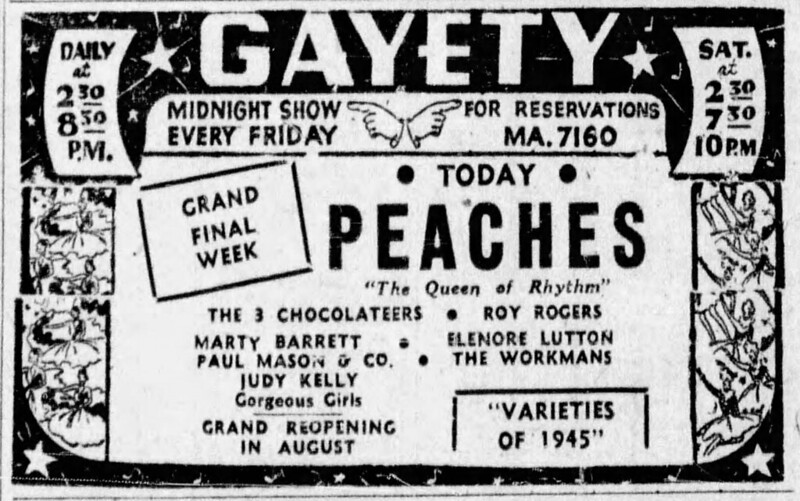
The return of the name Gayety in April 1942 marked an attempt to reconnect with the site’s historic identity, but within a context reshaped by World War II and shifting social mores. 40 Burlesque was reinvented here as glamour strip-tease: a theatricalized sensuality grounded in staging, humor, narrative, luxurious costumes, and careful control of dramatic rhythm.
A central figure of this period, Montreal star Lili St-Cyr turned stripping into a true stage performance, playing with the audience, props, and cabaret codes to elevate strip-tease to the level of spectacle. Her success was such that the theatre was nicknamed “The House That Lili Built”, underscoring the determining role of stardom in the Gayety’s economy. 58
That popularity did not prevent heightened moral surveillance. In 1951, director Tom Conway and Lili St-Cyr were prosecuted for offences against public morals, illustrating the enduring tensions between artistic freedom, show-business profitability, and social norms in postwar Quebec. 42
1953: sale, legal pressures, and a relaunch attempt
In March 1953, the Gayety was sold for $300,000 to Louis Oscar Gagnon and Émile Guay, with plans for a complete renovation. 85
In April 1953, the theatre reopened with Gypsy Rose Lee, attempting to relaunch burlesque through the prestige of an international star. 84
This sequence underscores the constant tension between profitability, artistic freedom, and moral control that marked the Gayety’s history.
However, the policing of morality remained active. In 1951, Tom Conway and Lili St-Cyr were prosecuted for offences against public morals, illustrating the persistence of normative frameworks in Quebec before the Quiet Revolution. 42
1953: sale, relaunch, and the end of a model
In March 1953, the sale of the Gayety for $300,000 marked a major economic turning point. The new owners announced renovations, without clearly specifying the future mode of operation. 85
The reopening with Gypsy Rose Lee on April 28, 1953 belonged to a nostalgic logic: reviving the imagery of classic burlesque to seduce an audience already turning toward television and new urban leisure forms. 84
1953–1957: Radio-Cité — francizing popular entertainment
With the acquisition by Jean Grimaldi and Michael Custom, the building became Radio-Cité. 22
1958–1972: La Comédie-Canadienne — from burlesque to a cultural institution
The opening of the Comédie-Canadienne in 1958 marked a major symbolic rupture in the building’s history on Sainte-Catherine Street. After several decades associated with burlesque, vaudeville, strip-tease, and moral controversy, the former Gayety became the site of an explicitly cultural, national, and respectabilizing project led by Gratien Gélinas.
Inaugurated on February 22, 1958 with L’Alouette by Jean Anouilh, the Comédie-Canadienne immediately projected elevated aesthetic ambitions.
Financial difficulties nevertheless persisted. After the mixed success of the musical Hair, the venue was converted into a permanent cinema in 1971. In 1972, the sale of the building to the Théâtre du Nouveau Monde (TNM) sparked controversy.
1972–today: Théâtre du Nouveau Monde — from burlesque to living heritage
The acquisition of the former Gayety building by the Théâtre du Nouveau Monde (TNM) in 1972 marked the culmination of a long trajectory of cultural repositioning.
The building nevertheless continued to reveal its material fragility: after multiple renovation campaigns, a major fire in 2022 occurred during an expansion project, highlighting the ongoing challenges of conserving a century-old structure.
Today, the TNM embodies the radical transformation of a place: from a burlesque theatre monitored by the morals police, it has become a temple of repertory theatre, a bearer of memory, creation, and cultural transmission. The Sainte-Catherine building thus tells, in itself, more than a century of performance history in Montreal.
8. Conclusion — The Gayety as a mirror of Montreal
The history of the Gayety Theatre goes far beyond that of a single venue. Since its opening in 1912, the building has passed through more than a century of cultural, social, moral, and economic transformations—at each step reflecting the mutations of Montreal itself.
Burlesque, vaudeville, French theatre, cinema, Radio-Cité, Comédie-Canadienne, Théâtre du Nouveau Monde: each incarnation corresponds to a specific moment in the urban and cultural history of the metropolis.
Through popular successes, trials, censorship, relaunch attempts, and reconversions, the Gayety appears as a privileged observatory of tensions between pleasure and respectability, between mass culture and institution, between commerce and heritage.
9. Notes and sources
-
The Montreal Star, March 29, 1912.
MCPA use: announcement identifying the Gayety Theatre as Montreal’s future home of burlesque, confirming its positioning even before opening as a central node in North American burlesque circuits and its role in reshaping popular entertainment offerings on Sainte-Catherine Street. -
The Montreal Star, August 17, 1912.
MCPA use: description of the Gayety building as a cantilever, post-free theatre at the corner of Sainte-Catherine and Saint-Urbain, highlighting architectural innovation aimed at providing unobstructed sightlines for the entire audience. -
The Montreal Star, August 23, 1912.
MCPA use: detailed presentation of the Gayety’s facilities: fireproof structure, multiple emergency exits, safe stairways, modern dressing rooms, decorative electric lighting, and amenities designed for safety and comfort for audiences and performers. -
The Gazette, August 24, 1912.
MCPA use: notice of the simultaneous opening of three theatres (His Majesty’s, Princess, Gayety), situating the Gayety within a context of intense theatrical activity in downtown Montreal. -
The Gazette, August 27, 1912.
MCPA use: account of the August 26, 1912 opening: massive attendance, hundreds turned away, direction by Clark Brown and management by J. F. Arnold, with a reception held on stage after the performance. -
The Gazette, August 27, 1912.
MCPA use: confirmation of capacity (about 1,600 seats: orchestra, balcony, gallery) and description of the visual proximity between spectators and the stage. -
The Montreal Star, September 3, 1912.
MCPA use: review of World of Pleasure, highlighting humor, songs, dances, costumes, and the abundance of numbers typical of burlesque. -
The Montreal Star, November 2, 1912.
MCPA use: notice/review of The Blue Rose, described as one of the season’s best burlesque productions, reinforcing the Gayety’s artistic reputation. -
The Montreal Star, October 29, 1912.
MCPA use: article on Al. Reeves’s Thanksgiving engagement, indicating exceptional crowds with attendance beyond the theatre’s normal capacity. -
The Gazette, December 21, 1912.
MCPA use: advertisement for Girls of the Gay White Way, an end-of-year revue foregrounding a female troupe, comedians, and a spectacular aesthetic. -
The Gazette, November 12, 1912.
MCPA use: report describing audience booing of pro-American scenes and the U.S. flag, revealing political and cultural tensions within the auditorium. -
The Gazette, November 13, 1912.
MCPA use: court case concerning Sunday opening at the Gayety, illustrating conflicts between municipal regulation and theatre operation. -
The Gazette, August 22, 1912.
MCPA use: dispute regarding the installation of the Gayety’s illumination system, with an inventor claiming a patent on the technology used. -
The Gazette, August 26, 1912.
MCPA use: court decision allowing use of the lighting system on condition of a financial deposit, enabling the Gayety to keep its illuminated signage. -
Archival image, Gayety Theatre façade, circa 1912–1915.
MCPA use: heritage illustration showing the Gayety’s exterior architecture and its integration into the urban landscape of Sainte-Catherine Street. -
La Patrie, August 27, 1912.
MCPA use: French-language description of the opening: Saint-Urbain Street packed, house full, success described as nearly unprecedented, mention of The Plain Clothes Man. -
Le Canada, August 24, 1912.
MCPA use: notice on box-office hours (9:30 a.m. to 9:30 p.m.), advance sales, and popular pricing policy including a ladies’ rate (10 cents). -
Le Canada, August 31, 1912.
MCPA use: announcement of World of Pleasure arriving September 2, 1912, linked to producers Gordon & North, with a chorus of about thirty performers. -
La Patrie, August 27, 1912.
MCPA use: wording emphasizing that the Gayety’s illumination was, in itself, a major visual attraction for Montreal audiences. -
Omaha Daily Bee, August 25, 1912.
MCPA use: promotional insert listing Montreal (Gayety, Canada) among touring cities, showing the theatre’s integration into North American circuits. -
Théâtre du Nouveau Monde, inauguration brochure (1997), p. 8.
MCPA use: historical synthesis: construction in 1912 (architects Ross & MacFarlane), commercial/vaudeville vocation, decorative redesign by Emmanuel Briffa in the 1920s, transformation into Théâtre des Arts and later the Mayfair cinema. -
Théâtre du Nouveau Monde, inauguration brochure (1997), p. 9.
MCPA use: milestones: burlesque/strip-tease phase, closure in 1953, conversion to Radio City by Jean Grimaldi, renovation by Gratien Gélinas with André Blouin, acquisition by the TNM in 1972. -
Théâtre du Nouveau Monde, inauguration brochure (1997), p. 12.
MCPA use: description of the piazzetta, marquee, and the “theatrical ritual” of entry, including the highlighting of the old Gayety brick wall. -
Théâtre du Nouveau Monde, inauguration brochure (1997), p. 13.
MCPA use: details on the complete reconstruction of the stage, addition of trapdoors, improved clearances, and the integration of raw materials. -
Le Canard, January 19, 1913.
MCPA use: announcement of Fred Crow’s arrival as the new manager of the Gayety Theatre. -
The Gazette, summer 1913.
MCPA use: review linking the opening of the 1913–1914 season to Fred Crow, praising a clean, well-delivered burlesque formula, with matinees and evening shows. -
The Gazette, September 23, 1913.
MCPA use: reference to a production framed as a “Fred Crow” offering, showing management as a promotional signature. -
Le Canard, August 22, 1915.
MCPA use: humorous mention of Fred Crow’s appointment as Montreal manager of United Theatres Ltd. -
La Presse, August 12, 1916.
MCPA use: article evoking three theatres (including the Gayety and the Orpheum) under Fred Crow’s direction, indicating coordinated management. -
The Standard, September 4, 1915.
MCPA use: photo caption presenting Fred Crow as manager of the Orpheum and Montreal representative of Canadian United Theatres Limited. -
Le Canard, September 1, 1918.
MCPA use: mention of Tom Conway as former manager of the Gayety. -
Le Canard, February 22, 1919.
MCPA use: ironic comment on Fred Crow’s adaptation to French-Canadian audiences at the Théâtre Saint-Denis. -
Le Canada, June 14, 1919.
MCPA use: article describing the restored financial stability of the Théâtre Saint-Denis under Fred Crow. -
The Quebec Chronicle, June 7, 1918.
MCPA use: mention of “Tommy Conway” as manager of the Gayety Theatre in Montreal. -
The Montreal Star, March 28, 1916, p. 4.
MCPA use: fire report mentioning Tom Conway, manager of the Gayety, who raised the alarm and facilitated evacuation. -
The Montreal Star, December 11, 1914, p. 17.
MCPA use: court report citing Conway as assistant manager in a spectator-expulsion case. -
The Gazette, August 21, 1926, p. 5.
MCPA use: notice of the Gayety’s reopening under the Mutual Burlesque Association directed by Tom Conway. -
The Montreal Star, January 30, 1930, p. 14.
MCPA use: Tom Conway announced as the Gayety’s new owner, after sixteen years as treasurer and then manager. -
L’Autorité, February 2, 1930.
MCPA use: notice of the Gayety’s reopening under Tom Conway, returning from New York. -
The Gazette, April 18, 1942, p. 10.
MCPA use: notice of the return of the Gayety name with a vaudeville program. -
The Montreal Star, September 23, 1924, p. 22.
MCPA use: mention of Tom Conway as an organizer of wrestling events through the International Pastime and Athletic Club. -
Le Devoir, June 27, 1951, p. 1.
MCPA use: report on the trial involving dancer Lili St-Cyr’s Gayety shows; Tom Conway, the venue’s director, is accused of permitting performances deemed offensive to public morals, illustrating the persistence of tension between burlesque and public morality. -
Le Canada, June 26, 1951, p. 5.
MCPA use: column describing Tom Conway as director of the Gayety, his substantial income, and his ties to American producers, confirming his central role in North American popular-entertainment networks. -
John Gilmore, Une histoire du jazz à Montréal, Lux Éditeur, p. 34.
MCPA use: mention of singer and dancer Florence Mills on the Gayety stage (1918) and America’s Greatest Coloured Jazz Band in October 1920, attesting to the theatre’s importance in disseminating Black music in Montreal. -
John Gilmore, Une histoire du jazz à Montréal, Lux Éditeur.
MCPA use: 1925–1926 markers: the Gayety regularly presented Black artists and jazz orchestras; mentions of the Seven Syncopators, clarinetist George McClennon, and a 70-performer revue—half of whom were Black—featuring Lena Wilson and Joe Jordan with his Ten Sharps and Flats.
Note: page number not visible in the provided excerpt. -
John Gilmore, Une histoire du jazz à Montréal, Lux Éditeur, p. 65.
MCPA use: general context on Montreal venues associated with Black music (Palais d’Or, Monte Carlo Club), used to situate the Gayety within a broader cultural ecosystem. -
The Gazette, December 14, 1929, p. 10 —
« Gayety Theatre Closes / Will Reopen December 28 With Entirely New Policy ».
MCPA use: notice of the Gayety’s temporary closure for renovations and the adoption of an “entirely new policy,” marking an attempted repositioning. -
La Presse, December 21, 1929, p. 33 —
« Total de 150$ d’amende pour le théâtre Gayety ».
MCPA use: Albert Gauthier, director-manager, found guilty of permitting three performances deemed immoral; total of $150 in fines. -
The Montreal Star, January 30, 1930, p. 14 —
« Tom Conway Announced As The New Proprietor Of The Gayety Theatre ».
MCPA use: Tom Conway presented as new owner; reopening announced for February 9, 1930. -
The Gazette, January 30, 1930, p. 12 —
« New Gayety Lessee ».
MCPA use: Conway described as the new lessee, taking over the lease from Consolidated Theatres after a stay in New York. -
The Montreal Star, November 5, 1930, p. 3 —
« Executive To Close Gayety ».
MCPA use: official decision to close the theatre and revoke its license. -
The Montreal Star, November 7, 1930, p. 6 —
« Theatre Censor States Method By Which Local Theatre Was Condemned ».
MCPA use: explanation of the censorship process that led to the Gayety’s closure. -
The Montreal Star, November 13, 1930, p. 3 —
« Gayety Theatre Closes Its Doors ».
MCPA use: confirmation of the closure; no show given on November 12, 1930. -
The Gazette, November 28, 1930, p. 21 —
« Card Is Announced For Fights Monday ».
MCPA use: announcement of a boxing card at the Gayety with main bout Arthur Giroux vs Tommy Palacio. -
La Patrie, January 8, 1931 — Édouard Baudry,
« Que va devenir le Théâtre des Arts? ».
MCPA use: analysis of the transition Gayety → Théâtre des Arts; the episode described as having “lasted barely fifteen days.” -
Al Palmer, Montreal Confidential, p. 61.
MCPA use: historical markers on theatre in Montreal (1774, Theatre Royal St. Paul 1825, Theatre Royal Côté 1852, mentions of Dickens and Edmund Kean). -
Al Palmer, Montreal Confidential, p. 62.
MCPA use: account of Montreal vaudeville (Imperial, Loew’s, Arthur Schalek), decline due to night clubs; the Gayety presented as the “big house” of vaudeville. -
Al Palmer, Montreal Confidential, p. 62–63.
MCPA use: nickname “The House That Lili Built”; fascination with Lili St-Cyr, difficulty obtaining tickets, mention of her legal name (Marie Van Schaak), and discussion of a statue. -
Al Palmer, Montreal Confidential, p. 64 (illustration).
MCPA use: caption stating “No other stripper has been as highly paid,” emphasizing Lili St-Cyr’s economic notoriety. -
Al Palmer, Montreal Confidential, p. 63.
MCPA use: burlesque marker: Theatre Royal (Côté & Craig / Viger) in 1908, mention of Jack Johnson and a police raid. -
The Gazette, December 13, 1930, p. 11 —
« French Stock Company Makes Debut Sunday Night At Theatre des Arts ».
MCPA use: notice of Théâtre des Arts opening; mentions Eugene Robidoux (manager) and Lou Tellegen (leading man). -
The Gazette, December 15, 1930, p. 6 —
« Theatre des Arts Has Fine Premiere ».
MCPA use: review of the premiere of L’Épervier; sold-out house and praised performances. -
The Montreal Star, December 15, 1930, p. 14 —
« New Theatre Des Arts Opened by Lou Tellegen ».
MCPA use: official opening of Théâtre des Arts; discourse on the need for a French theatre in Montreal. -
The Montreal Star, December 29, 1930, p. 20 —
« Theatre Des Arts Closed Pending A Readjustment ».
MCPA use: temporary closure for financial reasons; tickets refunded. -
The Montreal Star, March 16, 1931, p. 3 —
« Censor Places Ban On French Play ».
MCPA use: ban of Aurore, l’Enfant Martyre at Théâtre des Arts. -
The Gazette, May 4, 1931, p. 6 —
« Musical Show at Theatre des Arts ».
MCPA use: review of Irving C. Miller’s Runnin’ Wild. -
The Gazette, May 8, 1931, p. 6 —
« Keep Shufflin’, All-Colored Show, Opens Tomorrow ».
MCPA use: notice of an “all-colored” show at Théâtre des Arts, explicitly noting “formerly the Gayety.” -
Le Devoir, May 18, 1931, p. 2 — « Caissière volée ».
MCPA use: news item reporting an armed robbery at Théâtre des Arts. -
The Gazette, September 1, 1931, p. 8 —
« French Stock Is Pleasing Offering ».
MCPA use: review of Vingt Ans, Madame and mention of Émile Potdevin as artistic director. -
The Montreal Star, October 29, 1932, p. 19 —
« Gayety Theatre, Now The Mayfair, To Open As Movie House ».
MCPA use: notice of the Gayety’s conversion into the Mayfair cinema; mentions Joe Lightstone and the installation of sound film. -
Francine Grimaldi, Hier, aujourd’hui et demain, interview with Yves Parent, YouTube video.
MCPA use: testimony on Jean Grimaldi’s role in establishing a French-language theatre west of Saint-Laurent Boulevard, acquiring the former Gayety and converting it into Théâtre Radio-Cité. -
Gazette officielle du Québec, December 6, 1919, no. 49.
MCPA use: legal publication confirming the corporate existence and statutes of Montreal Gayety Corporation Limited. -
Gazette officielle du Québec, September 8, 1923, no. 36.
MCPA use: update of corporate information regarding the Montreal Gayety Corporation. -
Gazette officielle du Québec, October 23, 1926, no. 43.
MCPA use: legal modifications related to the management and operation of the Gayety. -
Gazette officielle du Québec, March 25, 1944, no. 12.
MCPA use: administrative confirmation of the Gayety’s legal continuity during the 1940s. -
Photographic archives, assorted fonds.
MCPA use: visual documentation of the Gayety’s façade and interior across different periods. -
Municipal files, Montreal.
MCPA use: information on permits, renovations, and successive uses of the building. -
Various press clippings (1930–1932).
MCPA use: documentation of the transition period Théâtre des Arts / Mayfair. -
Promotional sources, burlesque circuits.
MCPA use: confirmation of the Gayety’s integration into touring networks. -
Secondary historical testimonies.
MCPA use: narrative supplements on atmosphere, reception, and social uses of the Gayety (audience behavior, discipline, public perception), used here for contextualization. -
Press articles, 1940s–1950s.
MCPA use: markers on the end of classic burlesque and the venue’s transformation. -
Quebec cultural archives.
MCPA use: contextualization of the Gayety within Montreal performance history. -
MCPA synthesis (2025–2026).
MCPA use: compilation, cross-checking, and validation of sources for the final Gayety Theatre (Montreal) profile. -
The Gazette, April 28, 1953, p. 15 — « Gayety Is Re-opened With Gypsy Rose Lee ».
MCPA use: marker of the Gayety’s reopening in spring 1953, staged as an “event” relaunch led by star Gypsy Rose Lee (strip-tease/burlesque). The article emphasizes the nostalgic character of the comeback (burlesque presented as a genre “thought to be in the past”) and the crowd (a heavily attended opening night), useful for documenting a late phase in which the venue sought to reactivate the burlesque economy through the prestige of a headliner. -
The Montreal Star, March 11, 1953, p. 3 — « Theatre Sold For $300,000 » / « New Gayety Owners Plan Alterations ».
MCPA use: confirmation of the Gayety’s sale for $300,000 and identification of the new owners (Louis Oscar Gagnon and Émile Guay). The notice specifies that the transaction, recorded at the Registrar’s Office, was certified by notary J. Theo Legault, Jr., and mentions a chain of transfer (from Gayety Amusements Limited to Hervé Thuot, administrator, then to the buyers). The source also notes that a complete renovation was being considered, while observing the absence of a firm announcement about the type of operation/shows planned—an essential marker for documenting the economic shift and reconfiguration of the venue on the eve of its last major burlesque episodes.