Lime Light (Montreal)
From 1973 to 2001, Lime Light established itself as one of Montreal’s most influential discotheques and a true Canadian epicentre of disco. Located at 1254 Stanley Street downtown, the club became a North American reference point in terms of sound, lighting, DJ programming and the staging of nightlife. Often compared to New York’s Studio 54, it drew a mixed clientele – gay/straight, francophone/anglophone – and welcomed an impressive roster of international artists onto its dance floor.
1. Overview
Opened on 7 September 1973, Lime Light emerged at a time when Montreal was becoming, in the eyes of the North American and European press, a true “second disco capital” behind New York. Located on Stanley Street, in a downtown still marked by cabarets and performance halls, the discotheque quickly became a magnet for both local and international clientele.47
Lime Light’s reputation rested on a combination of factors rarely found in a single venue: a distortion-free sound system, a sophisticated lighting design, musical programming ahead of what was played on the radio, and a culture of the star DJ that placed the booth at the centre of the nightlife experience.12 From the mid-1970s onward, the discotheque was regularly compared to New York’s Studio 54 and presented as one of the emblematic clubs of the North American disco scene.47
“Going to a discotheque in the 1970s was like going to church for the previous generation. You couldn’t miss it.”
Over time, Lime Light also became a site of memory: numerous accounts from former patrons, DJs, musicians and columnists locate the “golden age” of Montreal disco in the nights spent on its dance floor.31017 The establishment thus functioned as a laboratory where new ways of listening, dancing and living the night took shape, influencing clubs elsewhere in Quebec and beyond for years to come.
2. The site — Stanley Street, the building and the lineup
Lime Light was firmly rooted in the geography of Stanley Street, a downtown Montreal artery located near major hotels, restaurants and boutiques. The discotheque occupied an upper floor of a three-storey commercial building, already tied to nightlife before 1973 and destined to host, in other eras, other well-known entertainment venues.5
Testimonies emphasize the queue that regularly formed on the sidewalk from early evening onward, especially on Fridays and Saturdays. The façade, with its illuminated sign and staircase leading up to the club, became an iconic image of 1970s disco Montreal: a continuous flow of dressed-up patrons, groups of friends, couples and curious night owls, all drawn by the promise of an exceptional sound and visual experience.312
A long 1980 interview in the magazine Québec Rock recalls that Lime Light’s premises were originally “disused” spaces that had previously housed the clubs Stanley Grill, Lido, Tic Toc, Chez Paré and the Hawaïen Lounge. Yvon Lafrance and his partner François Mireault contacted the building’s owners to rent a floor and set up a simple “dance floor” where only soft drinks were served at first, before gradually opening, within the same complex, other rooms – le Jardin, Hollywood and Bud’s – described as very popular with Montreal’s gay community.47
Lime Light’s interior borrowed certain codes from the major international discotheques of the time: a large central dance floor, moving light shows, mirrors, mezzanines and circulation spaces that allowed patrons to watch the crowd. This spatial layout also helped make the club a place where one came as much to see and be seen as to dance, in a logic of mutual spectacle.
3. The experience — sound, light and mixed clientele
From the outset, Lime Light was conceived as a club centred on the emotion generated by music, sound and light. Its founder, Yvon Lafrance, said he dreamed of a venue in which the quality of the sound system and lighting would make it possible to create something that could not be found elsewhere: an immersive space where body and listening would be constantly engaged, beyond the simple consumption of commercial “hits”.1
“The idea was to create a cutting-edge club, with distortion-free sound, carefully designed lighting and music that you didn’t hear in more commercial venues: disco close to what would become house, designed to trigger an emotional reaction to the sound, the light show and the dance floor.”
One of the aspects most often emphasized in memories and media reports is the social and identity-based mix of the clientele. The club welcomed both celebrities, artists, international designers and ordinary people. Straight and gay patrons shared the dance floor, without the venue being presented as reserved for any particular group.1312 This coexistence reinforced Lime Light’s image as a space of freedom and controlled transgression, with “emotion” acting as the common thread.
Circulation between tables, the bar, the dance floor and the DJ booth structured a true nocturnal ritual: arriving at the beginning of the evening to “take the pulse” of the room, building intensity through the DJ’s sequences, then gradually winding down towards closing time, often late. For many regulars, the discotheque became a second nocturnal home, where friendships, romantic relationships and artistic collaborations were forged. The society columns of the Montreal Star describe nights when models, television stars, musicians and “beautiful people” ended their evenings at Lime Light after shoots, fashion shows or premieres.2223242526
4. Programming, DJs and guest artists
Lime Light’s sonic signature is inseparable from the work of its resident DJs, especially Robert Ouimet, active through most of the club’s disco period. Along with DJs Fernand Gagné, Michel Simard, and later Gil Riberdy and others, he developed a mixing approach based on building long sequences, seeking out 12-inch versions and paying close attention to the crowd’s reaction.23 Certain charts and specialized articles credited him during this period with titles such as best DJ in North America, underlining Lime Light’s influence beyond Montreal.341
The discotheque also stood out for hosting numerous international artists performing live, often in addition to DJ programming. Among the most frequently cited names are: JAMES BROWN, GLORIA GAYNOR, THE TRAMMPS, GRACE JONES, BOULE NOIRE, DAVID BOWIE, RICK JAMES, VAN McCOY, as well as bands like B.T. EXPRESS and MANHATTAN TRANSFER, along with many other key figures of international disco, soul, funk and pop.121011313536
“On weekends, there must have been between 3,000 and 4,000 people. Grace Jones would stop by regularly. One night, when Gloria Gaynor was performing, I arrived at the discotheque with, on one side, David Bowie, and on the other, Iggy Pop, coming back from the Forum. I even saw Robert Bourassa arrive with his bodyguards.”
Activities of the production company associated with the discotheque extended beyond the club’s walls. In the spring of 1977, the daily Montréal-matin announced that Productions Lime Light were “expanding their field of activity” by presenting at the Centre Paul-Sauvé a concert featuring the SALS0UL ORCHESTRA and BOULE NOIRE. The article noted that the Philadelphia orchestra, led by Vincent Montana Jr., had sold around 65,000 albums in the Montreal area over the previous winter, and that the mixing and sound reinforcement for the concert were entrusted to Centre Audio Acoustique in Longueuil, while Georges Thurston presented Boule Noire with a new lineup.46
The visit of Gloria Gaynor, crowned “queen of disco”, to Lime Light in March 1977 was the subject of a long feature by Nathalie Petrowski in Le Devoir, where she described the show staged “under neurotic lights” in the discotheque and how disco fit into a new mass culture.1330 A few weeks later, another article in the same paper situated James Brown’s performance within that same nocturnal geography, confirming Lime Light’s role as a prime stage for major African American stars.1110
In December 1981, Grace Jones presented a “one-man show” at Lime Light, described by Nathalie Petrowski as a performance blending stylized sadism, robotic coldness and flamboyant theatricality in a decor saturated with lights and smoke, in front of a packed crowd.20 This article attests to the more experimental and performative turn of some of the club’s evenings in the early 1980s.
In a 1979 article, also in Le Devoir, journalist Nathalie Petrowski noted that Montreal producer Gino Soccio tested his new tracks and gauged their potential directly on the Lime Light dance floor, among the dancers, before releasing them to the international market.1536 The discotheque thus appears as a real listening laboratory for the local disco scene.
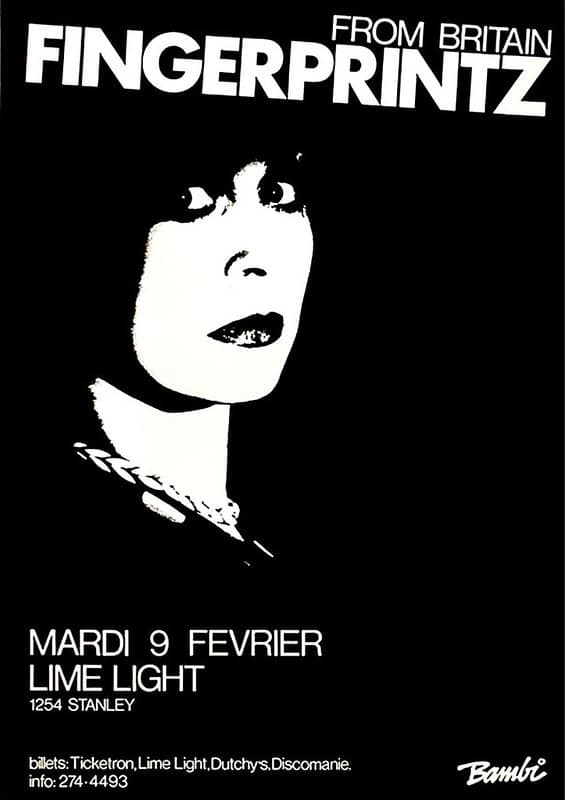
In the early 1980s, programming opened up more broadly to new wave and colder sounds. In February 1982, a review of a concert by British band Fingerprintz at Lime Light described the room transformed into a “prison of stainless steel and mirrors”, populated by “mutants” dressed in black, illustrating the venue’s shift towards a different nighttime aesthetic, less euphoric and more mechanical.143133
5. Influence and legacy — from the “disco capital” to Funkytown
In a long 1977 feature entitled “Want to boogie? You’re in the right place”, music columnist Juan Rodriguez presented Lime Light as one of Montreal’s main disco temples, stressing the quality of the sound, the sophistication of the lighting system and the eclectic nature of the clientele. A sidebar listed the city’s discotheques and confirmed the club’s address at 1254 Stanley St., in the heart of a district in full nocturnal bloom.122829
Lime Light’s media presence went beyond the print press. In January 1979, a column in The Gazette highlighted the success of a radio show produced live from Lime Light: station CJFM broadcast disco music from the club every Saturday night. The show was such a hit that a competing station, CKGM, launched a disco program at the same time, illustrating Lime Light’s influence on Montreal’s radio landscape.1027
“What people don’t realize is that mixing disco is very difficult. It’s music played by real musicians. Today’s techno is made with machines — it’s something else entirely.”
On a more sociological note, several articles in Le Devoir at the end of the 1970s (including the series “Disco Music: la fin des enragés!”) described nights at Lime Light as one of the most visible expressions of the new disco culture: a universe of lights, costumes and continuous dancing where Montreal’s youth came seeking both escape and a form of collective participation.161819 In a 1979 report to the Montreal Urban Community Council, the Negro Community Centre also mentioned “Limelight Disco” among the venues frequented by young Black people where incidents with the police had taken place, reminding us that these entertainment spaces were also at the heart of broader social and political tensions.21
In a retrospective piece published in 2003, host and actress Danielle Ouimet looked back on the disco years and placed Lime Light at the centre of her memories, describing the electric atmosphere of the evenings, the frenzy of the dance floor and the way the club crystallized an era made of music, glitter and endless parties.17 Around the turn of the 2000s, other nostalgic columns in the Montreal Gazette revived this memory, whether through fashion features retracing disco aesthetics or articles on the revival of that universe in tribute shows and cinema.3738 In 2013, another Gazette article also recalled James Brown’s appearance at Lime Light, this time through journalist Juan Rodriguez’s eyes, who evoked a memorable tête-à-tête with the singer “in a Montreal club” in the late 1970s.10
Lime Light’s legacy extends beyond the history of the venue itself. The discotheque is explicitly referenced in the film Funkytown (2011), whose plot takes place in a fictional club, Starlight, directly inspired by Lime Light and filmed partly around the building that once housed it.937 Tribute shows such as Disco Fever Expérience, documentaries, articles and commemorative websites continue to keep the club’s memory alive, along with that of the generation that danced there.845
Musically, the mixing and programming practices developed at Lime Light had a lasting impact on Montreal’s DJ culture. Several subsequent clubs and events claim a direct lineage from this discotheque, whether through their choice of repertoire, their focus on sound and lighting quality, or their emphasis on the DJ as an author figure.
6. Chapter — Yvon Lafrance, François Mireault, Robert Ouimet and the team
6.1. A founder in search of an “emotional” club
Accounts devoted to Yvon Lafrance depict an entrepreneur shaped by his travel experiences and by observing foreign clubs, particularly in the United States and Europe. Discovering discotheques in which recorded music, amplified sound and lighting formed a coherent whole played a decisive role in his decision to create, in Montreal, a venue entirely designed around these parameters.1
In his recollections, Lafrance insisted on his refusal simply to copy existing models: his ambition was to offer a venue that was cutting-edge, where music selection would differ from commercial radio, where the sound system would reveal the detail of then-emerging disco productions and where lighting design would amplify, rather than mask, the DJ’s work.
In an interview published in Québec Rock in September 1980, Lafrance summed up the scale his project had reached: an initial investment of about $6,000, made with his partner François Mireault, had generated revenue of about $350,000 in the first year, rising to nearly $3 million seven years later, including about $1.5 million from Lime Light alone.47 The same interview emphasized his determination to “run a respectable house” (no drug sales, close yet independent cooperation with the police) and noted that Lafrance then owned or co-owned several establishments on Stanley Street.
6.2. François Mireault and the structuring of the business
The name François Mireault appears as that of a partner co-owner involved in structuring the business, managing it and developing the discotheque.2 Together, Lafrance and Mireault established a model in which the discotheque was conceived not only as a place of entertainment but also as a brand whose image had to be maintained over time through the quality of the experience offered.
Lafrance’s profile as a businessman is fleshed out in the same feature: by the early 1980s he claimed to employ around a hundred people in his five clubs, took very little vacation, and reinvested a large share of his profits in real estate, notably in multi-unit apartment buildings and in an island of 5 million square feet in Laval where he envisioned building bungalows for middle-income families.47
6.3. Claude Chalifoux, technical direction and sound
From 1977 onward, Claude Chalifoux became a partner in the management of Lime Light, playing a central role in everything related to technical direction and sound. Accounts link his name closely to constant upgrades of the installation: consoles, amplifiers, loudspeakers and lighting systems were continually adjusted and modernized to keep the club on par with the best international discotheques.8 This work helped make Lime Light a frequently cited reference in terms of sound quality.
The Québec Rock article described in detail one of Lime Light’s major transformations at the turn of the 1980s: a renovation of the third floor, valued at about $250,000, turning it into a true “dancing”, with a tiered dance floor, new decor and complete replacement of the sound system. The latter then totalled about 12,000 watts RMS on the low frequencies and as much on the high frequencies, powering some 120 GAUSS loudspeakers and 20 BGW amplifiers, for a dance area of about 6,000 square feet. Lafrance claimed to be convinced that Lime Light thus had, in Canada, one of the most powerful sound systems of any discotheque.47
6.4. Robert Ouimet — resident DJ and sonic architect
A central figure in Lime Light’s history, DJ Robert Ouimet is frequently presented as one of the main architects of the Montreal disco scene. Biographical sources recall that he was named best DJ in North America by Rolling Stone in the mid-1970s, then DJ of the year by Billboard, in recognition of his work as selector and remixer at a time when DJ culture was becoming a major issue for the record industry.41
A Montreal native, Ouimet began his career at club Love before making his mark at Lime Light, where he worked the turntables for much of the 1970–1980 period. His ability to blend disco novelties, American soul, European imports and early tracks foreshadowing house music is often cited as a key element of the club’s reputation: he allowed Montreal audiences to discover, in near real time, the evolving currents of international dance music.2341
In a series of interviews published in 1980 in the magazine Pop Rock, Ouimet explained how he brought back from London and New York the new wave and punk records he felt could work with the dance floor’s energy. Under his musical direction, Lime Light thus became a venue where new wave and certain post-punk currents gradually mingled with disco, foreshadowing the stylistic shifts of the early 1980s.4243
“I never rehearsed my mixes. I was instinctive. I think my greatest strength was knowing how to feel a crowd. I knew that at 10 p.m. it was the commercial crowd, at 1 a.m. the cool ones arrived, and at 3 a.m. the thrill-seekers showed up.”
The press in the 1990s and 2000s continued to identify him as a DJ pioneer in Quebec. A La Presse article noted in 1997 the temporary reopening of Lime Light “dressed up” in its former disco finery, with Robert Ouimet back at the decks: ten years after the club’s closure, his name alone still evoked a golden age and attracted new audiences.44 More recently, the documentary series D.I.S.C.O. and retrospective articles have revisited his role, describing him as “one of the most influential DJs on the planet”, whose imprint is intimately tied to Lime Light and the development of dance culture in Montreal.4145
Beyond the discotheque, Ouimet remained active as a remixer, music programmer and radio host, carrying with him the memory of Lime Light and its disco nights. His passing in 2022 prompted numerous tributes that stressed this double legacy: that of an innovator in mixing and that of a builder of Montreal nightlife, whose career largely overlaps with the history of the Stanley Street club.41
6.5. DJs, staff and working community
Around the owners and partners gravitated a larger team: DJs, bar staff, door staff, technicians, security personnel. The names of Robert Ouimet, Fernand Gagné, Michel Simard and Gil Riberdy come up frequently when talking about the DJ booth,23 as do those of nightlife hosts and hostesses who contributed to staging the venue. This working community helped transform the discotheque into a cultural ecosystem, rather than just an entertainment business.
7. Closure of the Lime Light (1990)
The final phase of Lime Light’s history was marked by a tense social climate on Stanley Street, where several bars and discotheques operated side by side. In the night of 9 April 1990, a 25-year-old Black man, identified as Presley Leslie, was shot and killed by officers of the CUM (Montreal Urban Community police) at the door of the Thunderdome, another discotheque on Stanley Street, at closing time.4647 The death of this patron, which occurred in the context of a police intervention following an altercation inside the bar, caused a strong public outcry in Montreal and drew media attention to safety issues around downtown discotheques.
The incident led to a public inquiry, during which not only the circumstances of the shooting were examined, but also the broader environment of Stanley Street bars: presence of crime, drug trafficking, weapons and recurrent tensions between part of the clientele and law enforcement. According to an article in Le Devoir dated 30 June 1990, organizations representing the young Black clientele that frequented both Thunderdome and Lime Light argued for the closure of the establishments, claiming that the climate was such that this clientele “no longer dared to go there” because of the high level of violence and criminality.48
Following this inquiry and community pressure, the Régie des permis d’alcool du Québec revoked the liquor licences of both establishments. The same Le Devoir article noted that the Thunderdome and Lime Light bars, “located on Stanley Street in Montreal”, definitively closed their doors on 17 June 1990, a little over two months after the 9 April events.48 The text also recalled that Lime Light had been operating on Stanley Street since 1973, while Thunderdome had opened in 1986.
This administrative closure marked the end of a cycle: after nearly 17 years of operation, the discotheque that had symbolized the rise of disco in Montreal disappeared without an official farewell night, swept away in a political and social context in which public safety and racial tensions took precedence over the venue’s festive memory. The name “Lime Light” nonetheless continued to circulate, both in nostalgic recollections and in certain later corporate structures, but the historic Stanley Street discotheque definitively ceased operations in June 1990, closing a major chapter in Montreal nightlife.33940
8. “The Limelight lives again” — Reopening in 1997
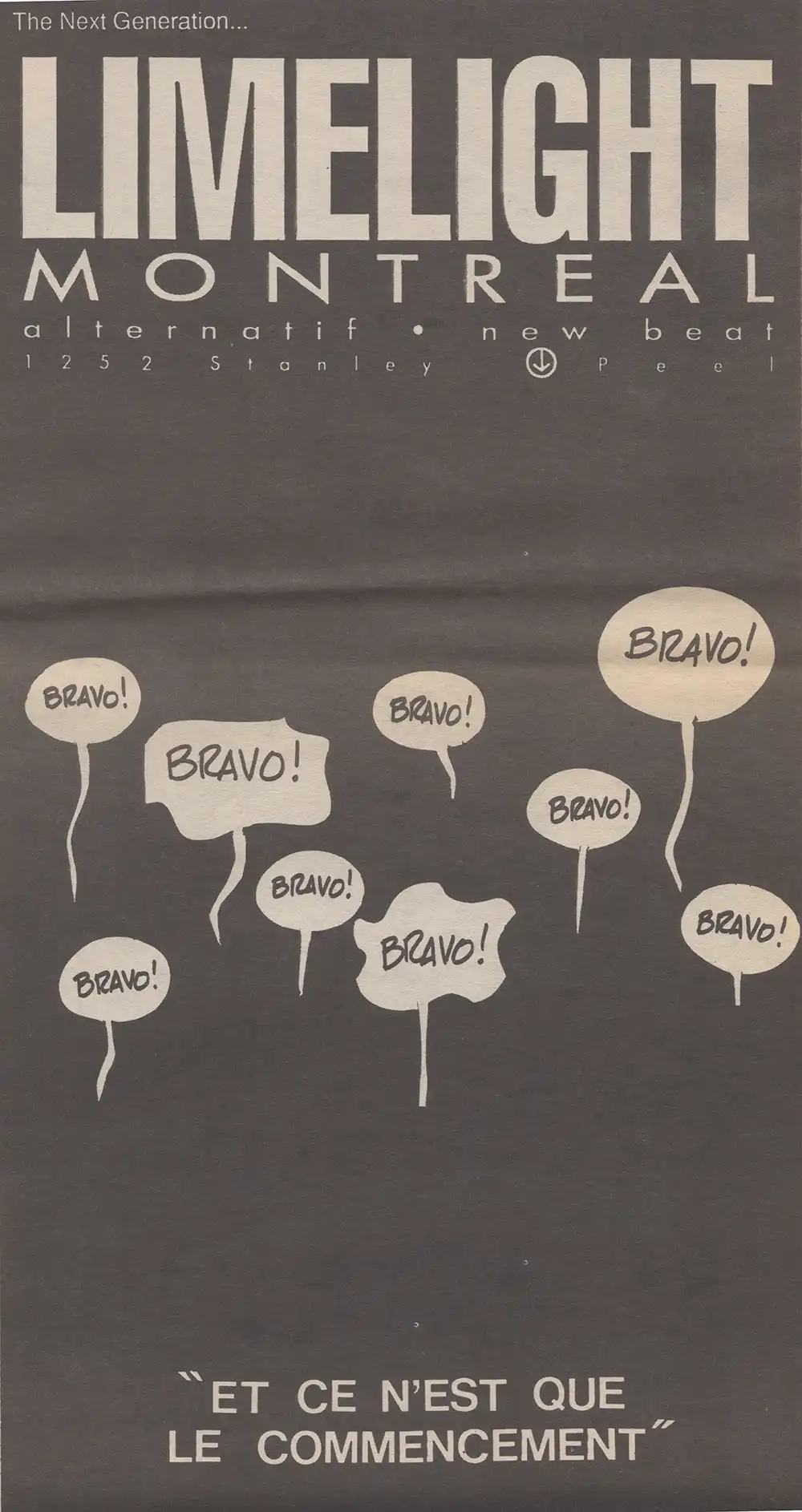
After seven years during which its name appeared mainly in the memories of its former patrons, Lime Light returned to Montreal’s news in the spring of 1997. Although the 1990 administrative closure had ended the historic discotheque’s operations, the Stanley Street address retained such cultural and marketing value that the name was reactivated by a new group of owners.
On 13 April 1997, La Presse ran a short piece in its “Books” section entitled “Le Limelight revit” (“The Limelight lives again”), announcing that the famous discotheque had “just received a facelift that cost nearly a million dollars to its new managers” and that the official opening would take place on 24 April 1997.49
This rebirth sought to reposition the Lime Light name as a trendy, upscale venue aligned with North American mega-club codes of the 1990s: a stated capacity of “up to 2,000 dancers”, a complete redesign of the room, a new sound system and the addition of a premium area: the Cigar Room, presented as a cozy relaxation space “in front of a fireplace”, signalling Montreal nightclubs’ shift towards a post-1995 VIP culture.
The musical entertainment for the opening night was announced with enthusiasm: the Boogie Wonder Band, a retro disco-funk outfit emblematic of the Montreal scene, was tasked with reactivating in the venue the festive memory of the previous decades.
This reopening did not constitute a return of the original Lime Light: the entity operating in 1997 stemmed from a new management, a new capital investment and a distinct conceptual project. Although the name remained, it was now nostalgia and the brand’s heritage value that ensured continuity.
A business corporation called LES INVESTISSEMENTS LIME LIGHT INC. was incorporated under the Canada Business Corporations Act and registered in Quebec (NEQ 1146589750), with a registered office at 1254 Stanley Street. Chaired by Roger Desautels III and including Marc-André Desautels and Dany Koury among its shareholders and directors, the company was described as an investment corporation not carrying on any activity at the time of its latest filings, before being struck off the register in 2006 for failure to file annual updates.39 This legal entity attests to the continued existence of the “Lime Light” name as a brand and commercial asset long after the discotheque’s active years.
In the early 2000s, another business corporation, GROUPE D’INVESTISSEMENT BAR B.I.G. INC. (English version: B.I.G. BAR INVESTMENT GROUP INC.), was also incorporated under the Canada Business Corporations Act and registered in Quebec (NEQ 1160122553), with a registered office at 1254 Stanley Street. Described as a “holding & management company”, with no employees reported, this holding company’s majority shareholder and director was Fabrizio Lonardo. Between 2001 and 2019 it registered several business names related to nightlife, including BAR LIME LIGHT, BAR LIME LITE, LE CLUB LIME LIGHT, LE CLUB LIME LITE and “LA BOOM-MONTRÉAL”, before itself being struck off in 2019 for failure to file annual update declarations.40 This second corporate structure extended the legal use of the toponym “Lime Light” and illustrates the way the symbolic heritage of the former discotheque continued to be mobilized in the downtown bar and club sector long after the original establishment had closed.
9. Notes & sources
-
LIMELIGHTMONTREAL.COM — tribute site “Le Limelight de Montréal”.
MCPA use: basic information on the discotheque (founding on 7 September 1973 by Yvon Lafrance, emphasis on the club’s emblematic nature, mention of a diverse clientele and of a concept that served as an international reference in terms of decor, musical style and lighting). -
WIKIPEDIA, article “Lime Light” (consulted).
MCPA use: confirmation of the address (1254 Stanley Street), of the club’s role in the North American disco scene, of the founders (Yvon Lafrance, François Mireault), of the names of several associated DJs (Robert Ouimet, Gil Riberdy) and of the list of international artists who performed at Lime Light. -
MONTRÉAL CONCERT POSTER ARCHIVE, file “Lime Light (Montréal)”.
MCPA use: dating of the main period of activity (1973–1990), clarification of Lime Light’s role as an epicentre of Canadian disco culture, additional information on capacity, mixed clientele, the “Friendship Card” and the status of Robert Ouimet as a key DJ (1973–1981). -
RICHARD BURNETT, “Montréal, disco’s Second City”, mtl.org (consulted).
MCPA use: contextualization of Lime Light within the notion of a “second disco capital”, description of the discotheque’s role in downtown nightlife and mention of the gradual decline beginning in the early 1980s, notably after Yvon Lafrance’s departure. -
CANUCKISTAN MUSIC, note on the 12" Montreal Sound (consulted).
MCPA use: description of Lime Light as ground zero of the Montreal disco scene, mention of the start of activity in September 1973, clarification of its location (upper floor at 1254 Stanley Street) and of its diverse clientele (gay/straight, francophone/anglophone), as well as of the role of DJs (Robert Ouimet, George Cucuzzella). -
R.N. WILKINS, blog post “Montreal’s Stanley Street, down through the years” (consulted).
MCPA use: contextual elements on the Stanley Street building that housed Lime Light, mention of the club as a “celebrated” 1970s discotheque, list of international artists associated with the venue (including David Bowie, Gloria Gaynor, Grace Jones, Boule Noire, Van McCoy). -
DISCO BLOGS AND COLUMNS (various texts, notably on the “disco capital”
and the expression “Montreal’s Studio 54”).
MCPA use: recurrent characterization of Lime Light as an emblematic club of the Montreal disco scene, often compared to New York’s Studio 54 and presented as a reference in DJ culture. -
ESPACE ST-DENIS, presentation of the show “Disco Fever Expérience”
(tribute to Lime Light).
MCPA use: mention of Lime Light’s opening by Yvon Lafrance on 7 September 1973, recall of its status as “the most popular discotheque in Montreal and Quebec”, and reference to Claude Chalifoux as partner in charge of technical direction and sound from 1977. -
FUNKYTOWN (film by Daniel Roby, 2011) — articles and critical dossiers.
MCPA use: identification of the fictional club Starlight as a transposition of Lime Light, mention of filming around the Stanley Street building, use of the film as a secondary source for the discotheque’s memory and for the imagined world of Montreal disco. -
THE GAZETTE, 16 January 1979, p. 58 — news item on CJFM’s disco show.
Note: mentions that a Saturday night disco show broadcast live from Limelight was such a success that a competing station (CKGM) launched a similar program titled Studio 98; illustrates the importance of the club as a broadcast venue. -
LE DEVOIR, 4 May 1977, p. 12 — article “James Brown: un des derniers grands”.
Note: report on James Brown in Montreal; associates his presence with the disco wave and the effervescence of local clubs, notably situating his performance within the network of major city discotheques including Lime Light. -
THE GAZETTE, 21 May 1977, p. 39 — feature by Juan Rodriguez
“Want to boogie? You’re in the right place”.
Note: survey of Montreal disco clubs; describes Lime Light as one of the main dance temples, stressing the quality of its sound and lighting, and publishes an inset “Where they are and what they’re like” listing discotheques, with Lime Light’s address and characteristics. -
LE DEVOIR, 17 March 1977, p. 15 — Nathalie Petrowski,
“Quand le monde se transforme en disco”.
Note: review of Gloria Gaynor’s concert, the “queen of disco”, presented at Lime Light under “neurotic lights”; reflection on the nature of disco, its worldwide spread and the role of major discotheques as temples of the genre. -
LE DEVOIR, 11 February 1982, p. 8 — Nathalie Petrowski,
“Fingerprintz: vagues froides sur beat noir”.
Note: review of a concert by British band Fingerprintz at Lime Light in a setting described as a “prison of stainless steel, mirrors and padded walls”; illustrates the club’s shift towards new wave sonorities and a colder aesthetic in the early 1980s. -
LE DEVOIR, 16 May 1979, p. 16 — Nathalie Petrowski,
“Gino Soccio, pour quelques “disco-dollars” de plus…”.
Note: profile of Montreal producer Gino Soccio; notes that some tracks were tested on the Lime Light dance floor before release, with the club serving as a laboratory for gauging disco audiences’ reactions. -
LE DEVOIR, 25 June 1977, p. 25 — Asala Boyomo,
“Disco Music: la fin des enragés!”.
Note: in-depth article on disco culture in Montreal; discusses discotheque-going, notably at Lime Light, presented as a venue where young people sought a world of colour, light and nonstop dancing, in contrast with earlier rock aesthetics. -
LE DEVOIR, 22 August 2003, p. 18 — Danielle Ouimet,
“Le Montréal disco”.
Note: memoir piece where the author looks back on the disco years and her personal memories of Lime Light (atmosphere, clientele, music, excess); contributes to building a retrospective narrative in which the club appears as a lasting symbol of 1970s Montreal nightlife. -
LE DEVOIR, 8 March 1975, p. 23 — René Picard,
“Du CDP au Lime Light: soirée et nuit “dansantes””.
MCPA use: describes an evening stretching from an event organized by the Centre des danseurs populaires (CDP) to the Lime Light dance floors; first detailed mention of the club in the French-language press, underlining continuity between ballroom dancing and new disco culture. -
LE DEVOIR, 12 July 1980, p. 18 — Angèle Dagenais,
“La sixième vie du Limelight”.
MCPA use: profile of Lime Light in the context of the Festival Barbeau; emphasizes the club’s multiple transformations, its role in fashion and nightlife and the central place of the DJ in evening entertainment. -
LE DEVOIR, 11 December 1981, p. 21 — Nathalie Petrowski,
“Grace Jones du côté du sadisme et de la frigidité”.
MCPA use: review of Grace Jones’ “one-man show” at Lime Light; describes the performance as a mixture of theatre, stylized sexual provocation and robotic coldness in a disco-spectacle environment. -
LE DEVOIR, 9 July 1979, p. 5 — Yvan Jackson,
“La communauté noire de Montréal et la police”.
MCPA use: brief from the Negro Community Centre on relations between young Black people and the police; mentions “Limelight Disco” among the venues where incidents occurred, placing the discotheque within a context of social and political tension. -
THE MONTREAL STAR, 16 September 1974, p. 22 —
“In Concert and Limelight — two places for unwinding”.
MCPA use: photo feature on Lime Light and In Concert’s clientele, illustrating the nocturnal sociability of young adults in the mid-1970s. -
THE MONTREAL STAR, 18 July 1975, p. 24 —
“Models let it all hang out”.
MCPA use: column relating a models’ party that ended at Lime Light; shows the club’s role as an after-party venue for fashion events and society evenings. -
THE MONTREAL STAR, 25 April 1975, p. 26 — column
“etcetera, etcetera… by J.J.” (Ferland kept lingering with bevy of curtain calls).
MCPA use: notes Lime Light as a venue frequented by artists and the performing arts community after theatre and concert performances. -
THE MONTREAL STAR, 23 April 1977, p. 29 — Thomas Schnurmacher,
“Just entre-nous”.
MCPA use: mentions the owners of “Limelight disco” in a society column, confirming the club’s notoriety in the English-language press. -
THE MONTREAL STAR, 4 March 1978, p. 54 — Thomas Schnurmacher, society column.
MCPA use: alludes to a new discotheque and to “Limelight disco’s” being frequented by celebrities and cultural figures. -
THE MONTREAL STAR, 1 April 1978, p. 58 — radio schedule.
Note: lists the show “9:00 pm CJFM, Live from the Limelight, disco music”; confirms that live radio broadcasts from the discotheque took place at the end of the 1970s. -
THE GAZETTE, 22 March 1974, p. 21 — Bonnie Buxton,
“Of Discos and Clubs”.
MCPA use: overview of Montreal’s main discotheques; situates Lime Light among the new fashionable venues from the mid-1970s onward. -
THE GAZETTE, 13 November 1979, p. 46 — Iona Monahan,
“Sane to spacey: Fashion fever continues”.
MCPA use: fashion piece mentioning Lime Light as the setting for fashion shows and style happenings, reinforcing the club’s association with the fashion world. -
THE GAZETTE, 15 March 1977, p. 44 —
“Disco stylist in town”.
MCPA use: announces the upcoming appearance of Gloria Gaynor, “disco stylist”, at the Limelight Club; supplements Le Devoir’s information on the show. -
THE GAZETTE, 12 April 1980, p. 44 — Juan Rodriguez,
“Punk rock debut draws fans out in their finest”.
MCPA use: review of a concert by bands 999 and The Dickies at the downtown Limelight disco; illustrates the club’s opening to punk and new wave. -
THE GAZETTE, 17 April 1979, p. 58 —
“Lots of biggest stars head for Montreal”.
MCPA use: mentions Lime Light among venues hosting certain international stars, alongside major concert halls. -
THE GAZETTE, 12 June 1980, p. 77 — nightlife column.
MCPA use: notes that “Limelight disco on Stanley St.” was then playing about 5% new wave, the rest remaining disco; documents the evolution of the club’s musical repertoire. -
THE GAZETTE, 19 September 1980, p. 29 — Thomas Schnurmacher,
column “Fabric sculpture to blanket Loyola campus” (nightlife section).
MCPA use: mentions new acts presented at “Limelight disco on Stanley Street”, confirming the club’s sustained activity at the turn of the 1980s. -
THE GAZETTE, 25 March 1981, p. 13 — “Clubscene” section.
MCPA use: announces a five-night engagement by B.T. Express at Lime Light, as well as upcoming shows by Manhattan Transfer and James Brown; specifies the club’s programming in the early 1980s. -
THE GAZETTE, 2 May 1981, p. 64 — Thomas Schnurmacher,
“Dead fish scene has Brigitte Bardot steaming”.
MCPA use: brief noting that producer Gino Soccio attended Geraldine Hunt’s show at “Limelight disco on Stanley St.”, confirming the club’s role in promoting Montreal disco artists. -
THE GAZETTE, 15 June 2009, p. 22 — Brendan Kelly,
“Disco’s stayin’ alive”.
MCPA use: column on the shooting of the film Funkytown and the recreation of Lime Light’s universe; recalls that Montreal was, in the author’s words, “the epicentre of disco” in Canada. -
THE GAZETTE, 28 April 2009, p. 35 — Eva Friede,
“Disco File – Fashion flashback”.
MCPA use: fashion piece revisiting disco aesthetics; cites Lime Light among the emblematic clubs associated with this era in Montreal. -
REGISTRE DES ENTREPRISES DU QUÉBEC, file NEQ 1146589750 —
“LES INVESTISSEMENTS LIME LIGHT INC.” (information as of 25 December 2025).
MCPA use: documents the incorporation, on 19 February 1997, of a federal business corporation registered in Quebec and domiciled at 1254 Stanley Street; notes its status as an “investment corporation not carrying on any activity”, the shareholders (Roger Desautels III, Marc-André Desautels, Dany Koury) and the roles of the directors, as well as its being struck off the register in 2006 for failure to file annual returns. -
REGISTRE DES ENTREPRISES DU QUÉBEC, file NEQ 1160122553 —
“GROUPE D’INVESTISSEMENT BAR B.I.G. INC.” / “B.I.G. BAR INVESTMENT GROUP INC.”
(information as of 25 December 2025).
MCPA use: attests to the incorporation, on 14 March 2001, of a holding company (“holding & management company”) domiciled at 1254 Stanley Street, with no employees reported, whose majority shareholder is Fabrizio Lonardo; lists the business names used in Quebec between 2001 and 2019, including BAR LIME LIGHT, BAR LIME LITE, LE CLUB LIME LIGHT, LE CLUB LIME LITE and “LA BOOM-MONTRÉAL”, before the business was struck off in 2019 for failure to file annual update declarations. -
LE DEVOIR, 23 April 2022, p. 10 — Philippe Renaud,
“Robert Ouimet, roi de la vie nocturne montréalaise, est décédé”.
MCPA use: obituary of Robert Ouimet; recalls his residencies at Love and Lime Light, his recognition by Rolling Stone and Billboard, his role in spreading new dance music and his lasting influence on Montreal nightlife. -
POP ROCK, 5 April 1980, p. 15 — François St-Pierre (Yogi),
“New Wave 80?”.
MCPA use: interview with Robert Ouimet and Richard Joly on the introduction of new wave in Montreal; Ouimet describes his trips to London and the integration of new currents into Lime Light’s programming. -
POP ROCK, 19 April 1980, p. 15 — François St-Pierre (Yogi),
“New Wave 80”.
MCPA use: continuation of the interview with Robert Ouimet; specifies the role of Lime Light in spreading new wave and discusses Montreal audiences’ reactions to these new sounds. -
LA PRESSE, 24 April 1997, “Sortir” section, p. 4 — Nora Ben Saadoun,
“Nouveau-nés”.
MCPA use: announces the temporary reopening of Lime Light at 1254 Stanley Street, ten years after its closure, for an evening during which “the disco ball starts spinning again” with DJ Robert Ouimet and the Boogie Wonder Band; emphasizes his status as a DJ who instigated disco. -
LE NOUVELLISTE, 7 May 2022, section 2, p. 10 — Richard Therrien,
“D.I.S.C.O., comme une brassée à spin”.
MCPA use: TV column on the documentary series D.I.S.C.O.; presents Lime Light as a mythical discotheque and highlights the roles of Robert Ouimet and Quebec producers in building the disco scene, while mentioning the abundance of archives and testimonies used in the series. -
MONTRÉAL-MATIN, 25 April 1977, p. 21 — article ““Salsoul” et Boule Noire à Paul-Sauvé”.
MCPA use: announces a show produced by Productions Lime Light at the Centre Paul-Sauvé, featuring the Salsoul Orchestra and Quebec band Boule Noire (Georges Thurston); mentions Yvon Lafrance as promoter, recalls that the Salsoul Orchestra sold around 65,000 albums in the Montreal area during the previous winter, notes that the Philadelphia orchestra was led by Vincent Montana Jr. and that mixing and reinforcement for the concert were handled by Centre Audio Acoustique in Longueuil. -
QUÉBEC ROCK, September 1980, p. 34 — Paul Haince,
“L’homme derrière le Lime Light: comment faire 3 millions avec 6 000 $ en poche”.
MCPA use: long interview with Yvon Lafrance on the history and management of the Lime Light complex; notes that the initial investment of about $6,000, made with François Mireault, generated about $350,000 in revenue in the first year and nearly $3 million seven years later (including $1.5 million from Lime Light alone); describes the Stanley Street building as a former club (Chez Paré, then Hawaïen Lounge) that was disused when Lafrance and Mireault arrived; details the gradual opening of other rooms in the complex (le Jardin, Hollywood, Bud’s) frequented by the gay community, the employment of about a hundred people, real estate investments (apartment buildings, an island of 5 million square feet in Laval), his stated desire to maintain “good moral standards” (no drug sales, cooperation with the police), plans for Lime Light franchises (including one in Quebec City, at the former le Bijou cinema, which rented the name and a standards manual for about $20,000 a year) and renovation work on the club’s third floor (investment of about $250,000, creation of a 6,000-square-foot “dancing” with a sound system of about 12,000 watts RMS on the lows and as much on the highs, with 120 GAUSS loudspeakers and 20 BGW amplifiers, complemented by a new lighting system valued at about $120,000). -
LA PRESSE, 10 April 1990, A section, p. 1 — Gilles St-Jean,
“Un Noir tué par la police au cours d’une fusillade au “Thunderdome””.
MCPA use: front-page story reporting the death of Presley Leslie, 25, at the door of the Thunderdome on Stanley Street following an intervention by the Montreal Urban Community police; specifies the location (downtown discotheque), the time of the event and the context of an altercation inside the establishment. -
LA PRESSE, 10 April 1990, A section, p. 2 — Bruno Bisson,
“Les policiers n’avaient pas le choix, dit le propriétaire”.
MCPA use: continuation of the Thunderdome shooting coverage; testimony from owner Raynald Fradette, description of the premises and capacity of the discotheque, recall of previous problems with violence and frequentation, elements used to document the climate around Stanley Street bars in the early 1990s. -
LE DEVOIR, 30 June 1990, p. 2 — article
“Le Thunderdome et le Limelight ferment”.
MCPA use: main source for the definitive closure of the Thunderdome and Lime Light bars located on Stanley Street; states that the establishments closed on 17 June 1990 following the public inquiry into the death of Presley Leslie. The text reports comments by Jerri Bresier, spokesperson for AKAX, about young Black patrons who no longer dared frequent these bars because of the high rate of criminality (drugs, weapons) and the climate of violence, and recalls that Lime Light had been active since 1973, while Thunderdome had been operating since 1986. -
LA PRESSE, 13 April 1997, “B. Livres” section, p. 7 — brief
“Le Limelight revit”.
MCPA use: official announcement of Lime Light’s reopening on 24 April 1997, mention of an investment of nearly one million dollars, announced capacity of 2,000 dancers, addition of a Cigar Room, new management, entertainment provided by the Boogie Wonder Band. Source used to establish the post-1990 chronology and distinguish the historic operation (1973–1990) from later nominal relaunches. -
LA PRESSE, October 27, 2006, section “ B. Actuel: Sortir ”, p. A2–A8 — feature article
“ 30 Years of Disco — In the Time of ‘Love’ ” by Mario Girard.
MCPA Usage: firsthand testimony by Robert Ouimet (DJ of the Lime Light), including attendance figures (3000–4000 people on weekends), VIP sightings (Grace Jones, David Bowie, Iggy Pop, Robert Bourassa), and operational practices (weekly record-buying trips to New York, intuitive DJ mixing, time-based segmentation of audience types). Used to document the socio-cultural context of the Lime Light during Montreal’s disco golden age and to confirm the club’s emblematic influence (1973–1990) on the city’s nightlife identity.