Mount Royal Chalet (Montréal)
A grand civic pavilion perched atop Mount Royal, the Mount Royal Chalet (often called the “Grand Chalet”) was conceived in the early 1930s as a monumental lookout, reception hall, and symbolic gateway to Mount Royal Park. Launched in the midst of the Depression, its construction immediately sparked recurring debate about its purpose: a place of welcome and ceremonies, a restaurant, a museum, an interpretation centre—perhaps even a project “too large” and hard to make pay. Press archives make it possible to follow, almost day by day, this tension between prestige, public use and viability.1231419
1. Overview
The Mount Royal Chalet holds a paradoxical place in Montréal’s history. Visible from afar and tied to the city’s most famous panorama, it was, from the beginning, a building that was hard to define.
Retrospective texts describe it as impressive, sometimes even grandiose, yet problematic in function. Too large for a simple restaurant, too remote for conventional commercial operation, too symbolic to be treated as an ordinary facility, the Chalet quickly became an object of debate.67
Contemporary articles from 1931–1933 provide an essential counterpoint. They show the building before it became “heritage”: costed out, discussed, contested, caught in very concrete municipal trade-offs— should it be concessioned, managed, or abandoned? Then come the real uses: dancing, receptions, cabaret-dance— far from the ideal visions sketched on paper.234
From a distance, a 1973 piece adds another layer: lived experience. The Chalet appears as a walking-stop, an interior loaded with décor, a place one passes through as much for what it “tells” as for what it “shows.”14
MCPA reading — The Mount Royal Chalet is not only a building. It acts as a revealer of urban priorities: employment and prestige during the Depression, control of access to the park, strategies of animation, then, over time, a shift toward a heritage reading.
2. 1930–1931 — A major summit pavilion: cost, intent, and symbolism
At the turn of the 1930s, Montréal was entering a period of shock. The Depression set in, construction projects grew scarce, and every public work became both a political gesture and a symbolic wager.
It is in this context that the idea emerges of a major pavilion on Mount Royal’s summit. In the summer of 1931, Le Devoir states it plainly: “The Mount Royal Chalet will cost $238,500.” The headline functions as a signal: the project leaves the realm of intentions and enters that of budgeted decisions— debatable, public, accountable.1
Later retrospectives would reframe the worksite as a “relief” project, meant to create jobs in a time of crisis. More than two hundred workers, a start date in February 1931, and an architecture designed to endure— all elements that give the building a social reach as well as a monumental one.6
“Mayor Camillien Houde commissioned the chalet as a relief project in 1930 during the Depression… ” 6
— Retrospective, The Gazette, 1991The architectural attribution to Aristide Beaugrand-Champagne, repeated in several later sources, places the Chalet within a broader vision: a building both rooted in a so-called “French-Canadian” aesthetic and charged with a symbolic mission at the city’s summit.679
3. 1930–1950s — The restaurant and the lookout: visions, abandonments, and returns
Late 1930. Even before the Chalet was finished, the City of Montréal was already imagining what Mount Royal’s summit ought to be: a place of reception, of viewing, of representation. In the press, the project takes shape as an open-air stage, meant to replace the old observatory.
Descriptions published in Le Devoir and La Presse evoke a major mountain restaurant, open year-round, able to serve the public as well as official receptions. The building is attributed to Aristide Beaugrand-Champagne, president of the planning commission.
The vision is precise—almost scenographic: cut stone, château style, red tile roof. Inside, a vast room— 60 feet by 100— designed to accommodate up to 1,000 people. The estimated cost is set at $210,000.28
This ambition goes well beyond a simple lookout. The summit becomes a projected civic set: to receive, to display, to represent the city. But this vision, however clear, quickly precedes a question that imposes itself: how do you operate, day to day, a place like this?
In the 1950s, the question resurfaces. Under Claude Robillard, the mountain again becomes a laboratory of ideas. Among the schemes considered was a high-end restaurant beneath the Kondiaronk lookout, with reception rooms, a performance stage, and a monumental arch integrated into the structure.
The project went beyond rough sketching: preliminary studies, models, detailed working documents. Yet, once again, the vision collided with reality. The restaurant never materialized, leaving the summit in a familiar tension between monumental ambition and feasibility.
MCPA reading — From the 1930 project to 1950s plans, the restaurant persists as an idea: always proposed, never realized, revealing the summit’s structural limits.
4. 1931–1932 — The restaurant controversy: concession, commission, or abandonment
Once the vision was articulated, administrative reality set in. By the fall of 1931, as construction progressed, the question was no longer what to build, but who would operate it.
The Montreal Star reported a controversy at city hall: should the restaurant be handed to a private concession or placed under a municipal commission? Behind the question lay a larger unease: was the Chalet a business, or a public service?
The proposed solutions betray uncertainty. Hoteliers would be willing to help on an occasional basis, without pay, for banquets or official receptions. Even the installation of hot and cold showers was floated, reminding readers that the building also had to serve as a refuge for park users.2
In 1932, the francophone press insisted: the Chalet falls under public service. When a storm surprises thousands of walkers, the City has an obligation to provide shelter.
The decision came in summer. The Gazette announced: “No Restaurant in Mountain Chalet.” The grand plan was abandoned, replaced by a simple lunch counter in the basement. The building’s core was left without a defined function.3
That decision sealed the Chalet’s fate. Monumental, impressive, but deprived of an economic engine, it entered Montréal’s history as a place whose vocation would remain permanently debated.
5. Architecture and fittings (what the press says)
The Mount Royal Chalet first strikes by its mass and by its position. But it is the interior spaces that crystallize opinion, oscillating between admiration and perplexity.
Retrospectives describe an interior designed to impress: a vast central hall, a monumental hammer-beam roof structure, carved oak elements, heavy chandeliers, polished marble finishes. The whole reads more like a ceremonial great hall than a place for ordinary consumption.7
“The enormous main hall is… impressive with its hammer-beam roof… ” 7
— The Gazette, 1999A 1973 article takes another angle: atmosphere. It describes an almost theatrical interior— so-called Oriental lamps, a roof evoked as “pagoda style,” naïve New France–inspired décor, carved beavers. The Chalet appears as staging as much as building, a set you pass through at the same time as the exterior landscape.14
Public perception — In 1973, the Chalet is no longer judged by its profitability, but by its ambience. It becomes a place one visits, observes, and recounts.
Sources also place the Chalet within a series of facilities imagined for Mount Royal: pavilions, lookouts, sometimes aborted projects. A 1986 chronicle recalls that its construction, begun in 1931, belongs to a long history of ambitious interventions on the mountain.8
Inside, the decorative program of the murals functions as an identity marker. Retrospectives evoke a set of works attributed to major artists, anchoring the Chalet in a reading that is both heritage and cultural.67
MCPA reading — The Chalet’s architecture reveals a contradiction: designed to endure and impress, it resists simple uses. That very resistance helps explain why the building becomes, over time, a symbol rather than a tool.
6. 1932 — Opening, early uses, and the recurring question: “what is it for?”
The Mount Royal Chalet’s opening did not look like an inauguration. No ribbon, no speeches, no founding moment. Retrospectives instead speak of a quiet commissioning, almost utilitarian: on January 30, 1932, the building welcomed its first visitors— cross-country skiers seeking shelter and respite at the summit.7
That winter scene clarifies the site’s initial logic. The Chalet first functioned as a refuge, a transitional space between exertion and rest. It echoes 1931 discussions about showers, cold, protection from bad weather.2
But very quickly, another question imposed itself. The building was large, expensive, spectacular. Could it really be reduced to a seasonal shelter?
In 1932, the francophone press formulated a decisive argument: the Chalet falls under public service. When crowds climb the mountain in fair weather, a storm can surprise them. The Chalet then becomes a space of collective protection— almost a municipal obligation.15
On the anglophone side, The Gazette struck a drier tone. The verdict was blunt: the restaurant project was abandoned, replaced by a simple lunch counter. The heart of the building— the great hall— was left without a precise function, open to every hypothesis, and therefore to every fragility.3
“No Restaurant in Mountain Chalet… Ambitious plan abandoned in favor of lunch counter in basement.” 3
— The Gazette, July 7, 1932That original hesitation marked the site’s history for a long time. From its earliest months, the Chalet appears as a building ahead of its use— too big to be banal, too expensive to be improvised.
7. 1933 — The Chalet as a dance hall: Kiwanis, cabaret-dance, and logistics
The following year, the Chalet shifted roles. On September 20, 1933, The Gazette reported an unprecedented event: a major dance evening held in the Mountain Chalet for a Kiwanis convention.4
A thousand guests. A great hall lit up. Verandas open over the city. The Chalet ceased to be a winter refuge and became, for one night, a true civic ballroom above Montréal.
The logistical details are telling. Cars were forbidden on the mountain. Taxis were organized from the top of Shakespeare Road. Circulation, access, the movement of bodies became part of the event itself.4
The music itself contributed to the staging. The band of the Black Watch — Royal Highlanders of Canada — provided the entertainment, adding a ceremonial, almost military dimension to the evening.4
Key moment — The 1933 Kiwanis evening demonstrates that the Chalet can function as a large-scale reception hall, capable of hosting crowds, orchestrating logistics, and producing a memorable event.
But this one-off success did not solve the underlying question. It showed what the Chalet could be, without saying what it should become.
8. 1934–1960 — Receptions, concerts, and revelations
In 1934, the Mount Royal Chalet crossed a decisive threshold. It ceased to be a building on trial and entered, officially, Montréal’s circuit of civic places of representation. A retrospective published decades later identifies July 21, 1934 as the date of the first major official reception held within its walls.6
The moment marks a symbolic shift. The Chalet becomes a place for receiving, for representing the City, where the panorama serves as backdrop to municipal diplomacy.
That protocol recognition solved nothing, however. The building remained monumental, expensive, hard to operate continuously. Prestige settled in, but the structural fragility remained.6
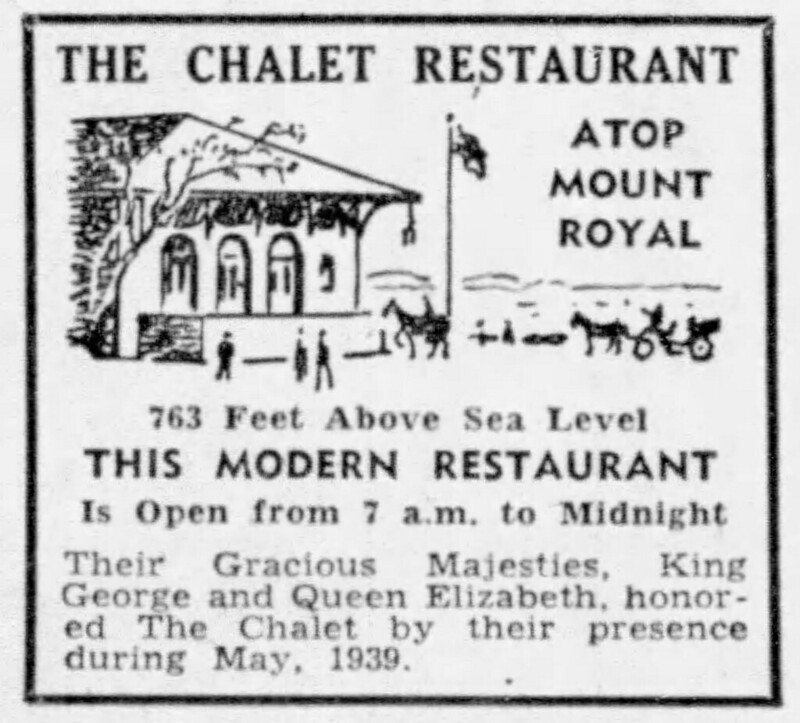
The most spectacular consecration came in 1939. During the official visit of Their Majesties King George VI and Queen Elizabeth, the Mountain Chalet appears among the official stops of the royal motorcade. According to the itinerary published by military headquarters, a private stop of about 29 minutes was scheduled at the summit of Mount Royal.25
In that instant, the Chalet reached a kind of symbolic apex. It joined the small circle of Montréal sites deemed worthy of high-level protocol use, alongside City Hall and the great ceremonial avenues.
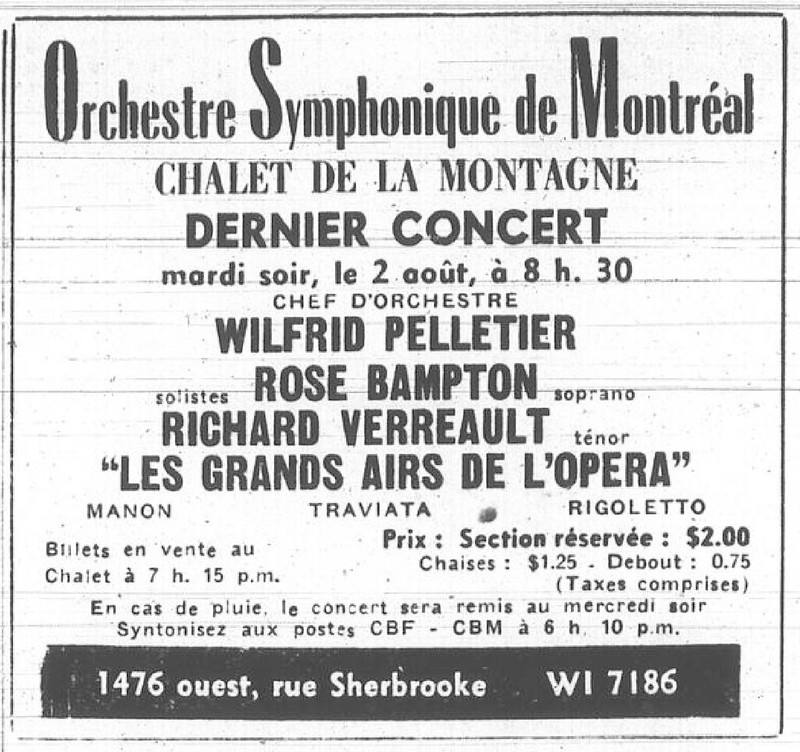
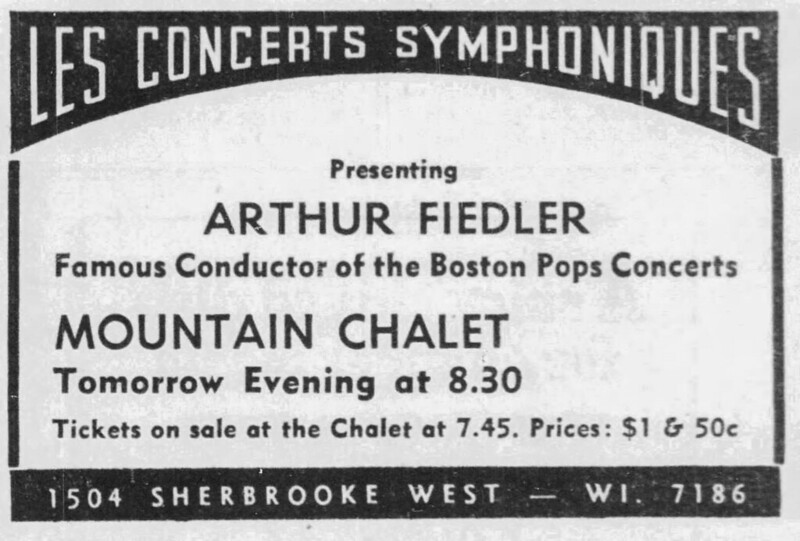
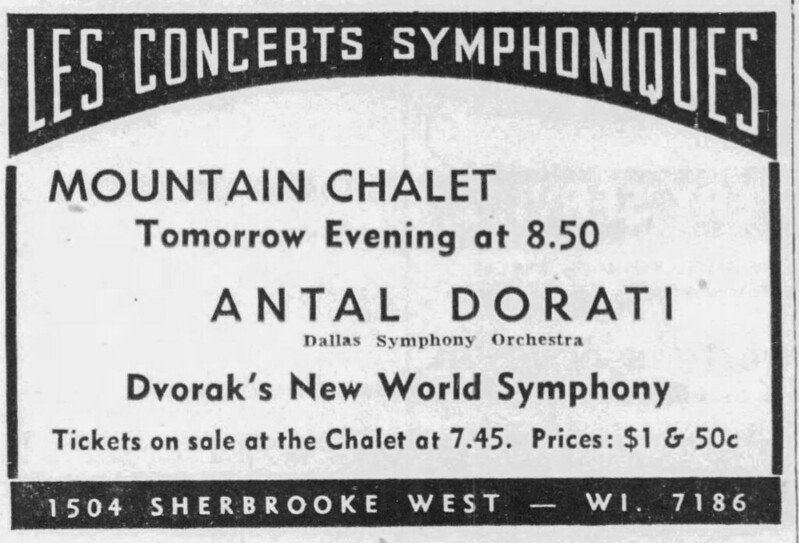
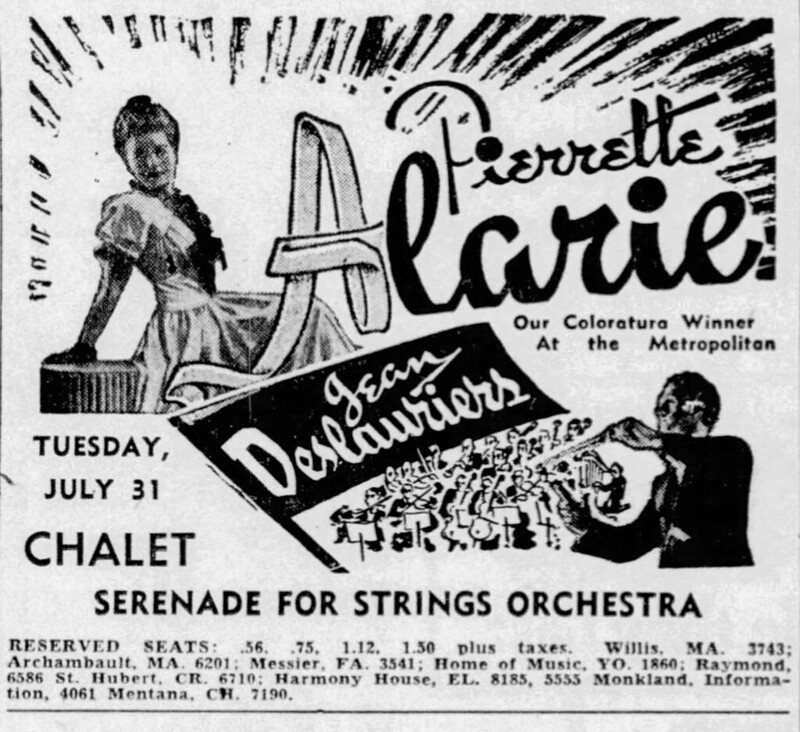
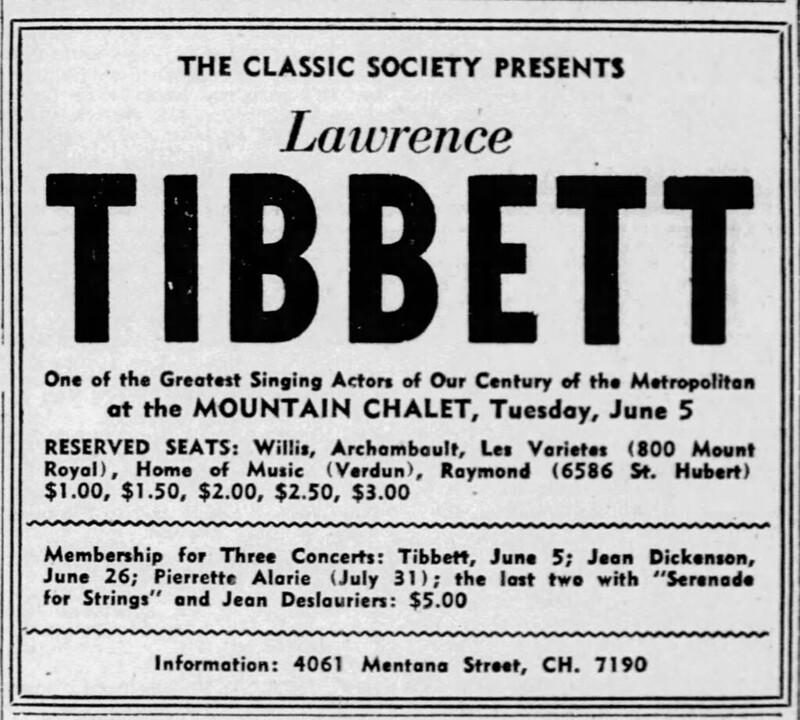
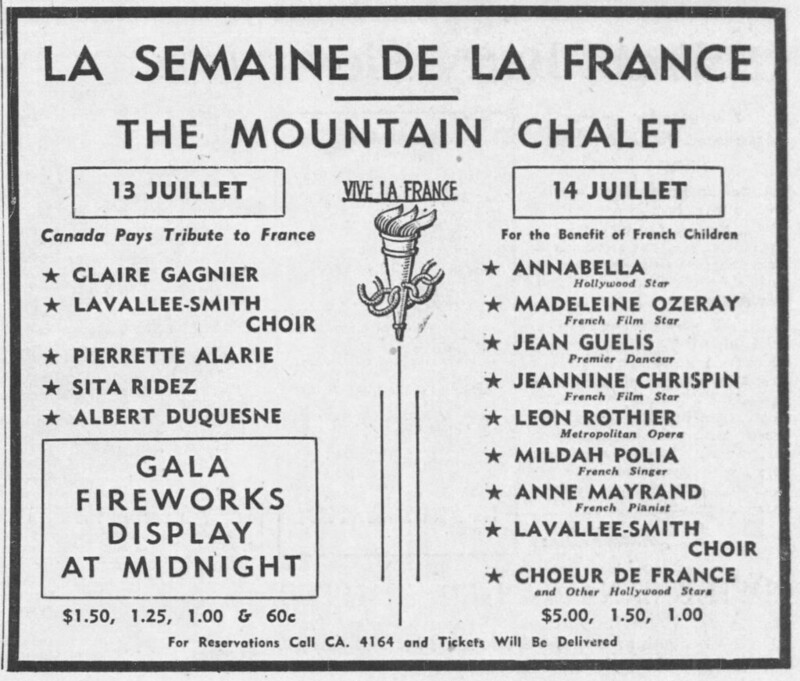
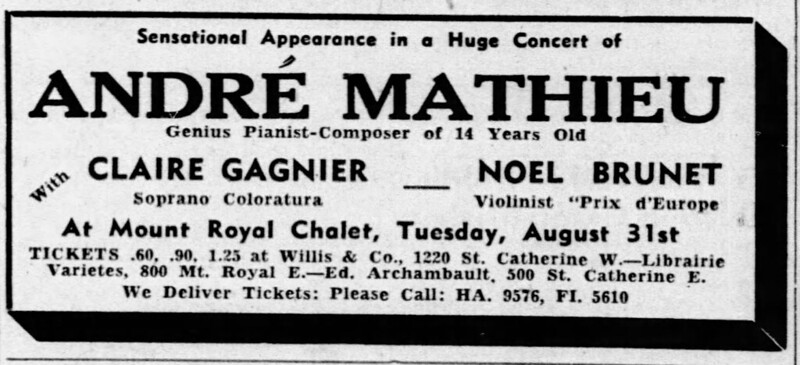
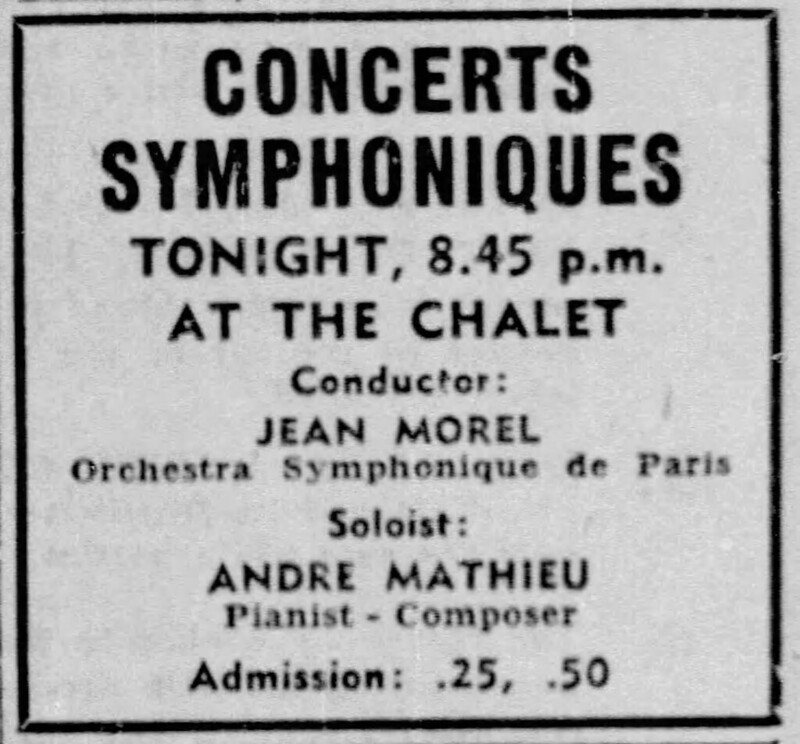
After the war, another role gradually asserted itself: a cultural open-air stage. In 1946, La Patrie announced a symphonic concert on Mount Royal, at the traffic circle or near the Chalet, confirming the area’s musical use.17
In 1947, Montréal-matin referred to the tenth anniversary of the Chalet’s summer seasons. The place now belonged to a tradition, associated with major figures such as Raoul Jobin, Wilfrid Pelletier, and the Société des Concerts Symphoniques.18
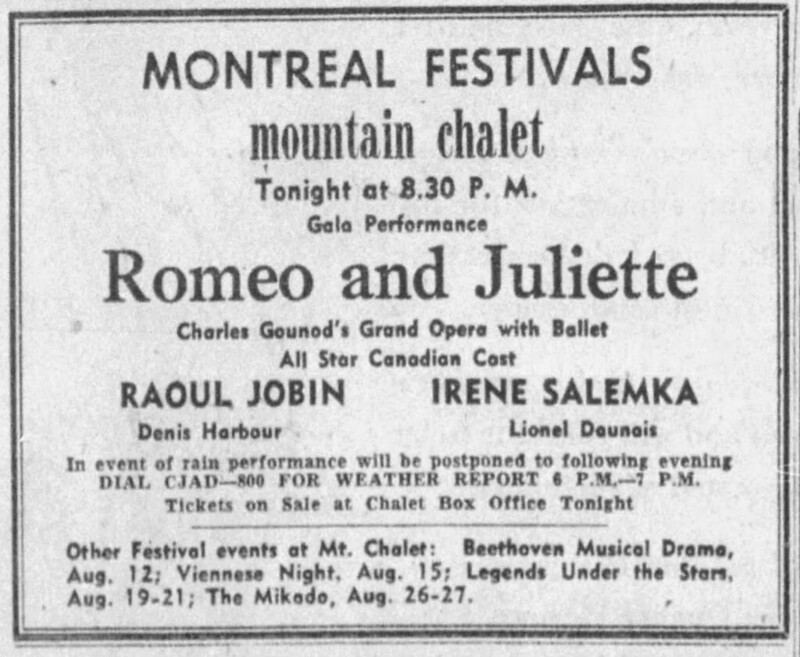
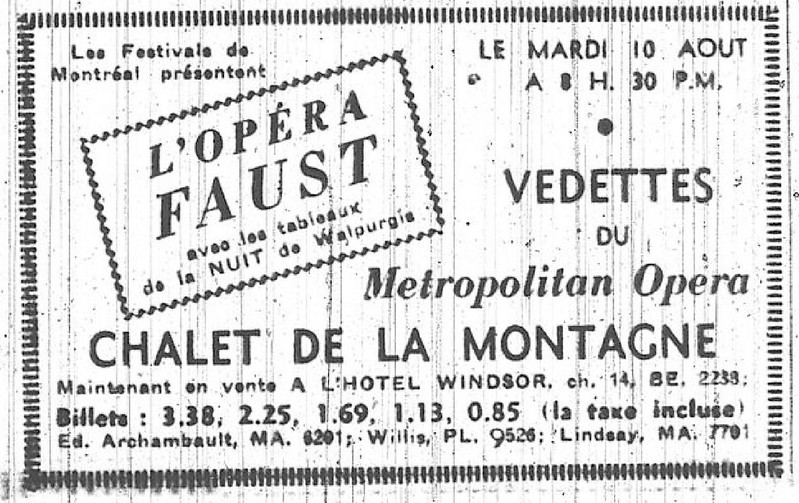
This trajectory culminated in the summer of 1952. The Mountain Chalet became one of the central hubs of the Montreal Festival. Symphonic concerts, Canadian premieres, opera, ballet: the site hosted programming on an unprecedented scale.2122
The most striking moment came on August 9, 1952. A presentation of Gounod’s Roméo et Juliette, conducted by Wilfrid Pelletier, was described as a major milestone in Montréal’s musical history. For the first time, a major opera production with an entirely Canadian cast took over the Mountain Chalet.23
Yet that apex also exposed the site’s limits. Critics mentioned acoustic challenges, technical constraints, and an imperfect fit for certain art forms. The Chalet could host large-scale spectacle, but not without compromise.23
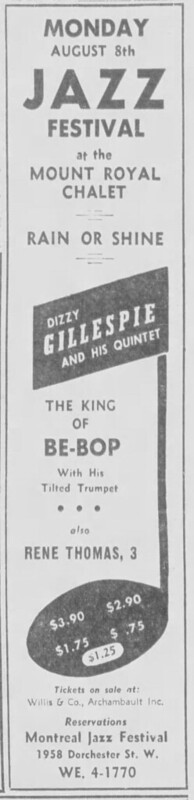
Those limits became explicit in 1960. Reviewing a Jazz Festival concert featuring Dizzy Gillespie, La Presse judged the Chalet setting ill-suited to jazz. Lack of intimacy, absence of proximity, and dispersed sound prevented the expected atmosphere from forming.27
The conclusion was blunt: what makes the Chalet “grand”— space, distance, panorama— becomes an obstacle for musics built on tension, exchange, and rhythmic density.
MCPA reading — The site’s paradox — The Mount Royal Chalet excels at prestige, ceremony, and large-scale formats, but reveals its limits whenever art demands proximity, warmth, and direct interaction.
9. Debates and re-readings: reinventing a symbol (1986–1999)
From the mid-1980s onward, the Mount Royal Chalet was no longer seen only through its occasional uses. It became a subject. An object of reflection, almost an urban case study.
In 1986, a Le Devoir column by Jean-Claude Marsan placed the Chalet within a long series of projects imagined for Mount Royal. The building was no longer isolated: it was inscribed in a history of ambitious interventions, sometimes fragile, often contested.8
This reading announced a shift. The question was no longer only what can we do with the Chalet?, but why does it exist in this form?
In 1991, The Gazette adopted a more blunt tone. The Chalet was described as a building deemed difficult to operate from the start, retrospectively labelled a “dud.” Not for lack of architectural quality, but because its very monumentality makes it resistant to simple uses and classic economic models.6
The same piece marks a turning point. It documents a major rehabilitation cycle, no longer meant to make the building “pay,” but to preserve it. The Chalet began to change status: from problematic facility, it became heritage to be assumed.6
MCPA reading — The 1986 and 1991 texts converge: they show that the “Chalet problem” is not circumstantial. It is structural, written from the start into the project’s outsized scale.
By the late 1990s, the re-reading softened. A 1999 article presented the Chalet as a walking destination, highlighting the monumental interior, the roof structure, the murals, and the panorama. The building was now told as an experience, not as a riddle to solve.7
This stabilization of heritage discourse was reinforced by specialized publications, which reaffirmed the attribution of the Chalet to Aristide Beaugrand-Champagne and anchored it in Montréal’s architectural history.9
10. Modern debates: reinventing a symbol (press/essays)
In 2005, the debate resurfaced, almost word for word. La Presse asked the question heard since 1931: “What would they do with the chalet?”19
Chefs, elected officials, cultural actors, community leaders were invited to imagine a new life for the building. Proposals ranged widely: local products, improved accessibility, a meeting place, cultural programming, simpler management.
Behind the diversity of ideas, one constant remained: the Chalet was seen as a place with potential never fully realized.
MCPA reading — The 2005 dossier does not create the debate: it reveals it. It extends a narrative thread begun in the early 1930s, when the City was already trying to justify the existence of a building too large to be ordinary.
11. Conclusion — A monument haunted by doubt
The Mount Royal Chalet is not a failure. Nor is it a simple success.
Since its conception, it has oscillated among three forces: civic prestige, occasional cultural use, and difficulty of operation. This tension is not accidental: it is constitutive of the place.
Too large to be intimate, too symbolic to be utilitarian, too exposed to be discreet, the Chalet resists obvious functions. It imposes itself as set, as stage, as viewpoint— rarely as solution.
And that may be where its real value lies. Not in what it does, but in what it forces one to think: the relationship between architecture, landscape, politics, and collective memory.
Final MCPA reading — The Mount Royal Chalet is a monument that has never stopped being questioned. That questioning, far from weakening it, is its most durable legacy.
12. Notes & sources
- Le Devoir, July 3, 1931, p. 8. Article announcing that the Mount Royal Chalet would cost $238,500, confirming that the project was formally on the municipal agenda by the summer of 1931 and providing an early budget estimate that would serve as a reference point for subsequent debates and re-evaluations.
- The Montreal Star, October 19, 1931, p. 3 — “Chalet Restaurant Starts Controversy”. Article reporting the municipal controversy over how the planned summit restaurant should be operated, pitting a private concession against municipal management, and revealing that even before opening there was structural hesitation about the Chalet’s commercial use.
- The Gazette, July 7, 1932, p. 6 — “No Restaurant in Mountain Chalet”. Report on a decision emerging from a conference bringing together elected officials and tourism stakeholders, announcing the official abandonment of the grand restaurant plan in favour of a simple basement lunch counter— a pivotal decision that helps explain the Chalet’s lasting fragility as an “economic vocation.”
- The Gazette, September 20, 1933, p. 1 — “Kiwanis Dance in Mountain Chalet”. Article describing the Chalet’s use as a reception and dance venue during a Kiwanis convention drawing roughly 1,000 people, documenting its early role as a civic event space and the logistical constraints linked to access on the mountain.
- The Gazette, July 7, 1932, p. 6. Adjacent column devoted to outdoor advertising on the same page as the Chalet article, offering no additional, specific information about the Chalet’s use or management.
- The Gazette, September 14, 1991, p. 102 — “Chalet was considered a dud when it was new in early ’30s”. Major retrospective tracing the Chalet’s construction (attributed to Aristide Beaugrand-Champagne), its cost, early uses, operational difficulties, and the rehabilitation work undertaken in the early 1990s, while characterizing the building as a monument long seen as difficult to make financially viable.
- The Gazette, October 2, 1999, p. 123. “Outings” feature describing the Chalet’s interior architecture (hammer-beam structure, marble, chandeliers) and its mural program, consolidating its status as a heritage site and cultural destination.
- Le Devoir, February 7, 1986, p. 9 — “Petite chronique du Mont Royal (2)”. Urban-history synthesis placing the Chalet’s construction within a broader sequence of Mount Royal projects and confirming the attribution to Aristide Beaugrand-Champagne.
- Décormag, March 1999. Article on Aristide Beaugrand-Champagne explicitly naming the Mountain Chalet among his works, providing external corroboration beyond the daily press.
- [Reserved]. Former “Current” note now replaced by note 19, devoted to La Presse’s 2005 dossier on possible reinventions of the Chalet.
- La Presse, June 3, 2001. Popular heritage article situating the Chalet within a Mount Royal visitor route and reaffirming its place in Montréal’s collective imagination.
- La Presse, June 23, 1991, Business section. Context piece on Mount Royal Park, useful for placing the Chalet within a broader system of municipal planning and infrastructure.
- The Gazette, February 4, 1996, p. 15. Winter/summer walk narrative describing the Chalet as a leisure landmark and route marker, complementing heritage retrospectives.
- The Montreal Star, July 28, 1973, p. 119. Walk-style article describing the Chalet’s ambience, interior architecture and décor, recalling its attribution to Beaugrand-Champagne and its link to the 1939 royal visit.
- L’Illustration, August 2, 1932. Article recounting the political controversy over the Chalet restaurant concession, mentioning bids and a proposed annual rent, and defending a public-service logic rather than a commercial one.
- L’Illustration, July 15, 1932. Editorial/satirical column reflecting the opinion climate around the Chalet and municipal decisions; to be interpreted with caution.
- La Patrie, June 26, 1946. Article announcing a symphonic concert on Mount Royal, at the traffic circle or near the Chalet, establishing the area as an open-air musical gathering site.
- Montréal-matin, June 21, 1947. Article noting the tenth anniversary of the Chalet’s summer seasons, confirming recurring musical programming associated with major figures such as Raoul Jobin and Wilfrid Pelletier.
- La Presse, October 19, 2005, Actuel section. Opinion dossier on the Chalet’s future uses, bringing together elected officials, chefs, and cultural actors, illustrating contemporary debates about its purpose and management.
- The Gazette, December 18, 1950, p. 31. Obituary of Aristide Beaugrand-Champagne providing key biographical markers to contextualize his role as the Chalet’s architect.
- The Gazette, August 2, 1952, p. 18. Articles announcing Montreal Festival events, confirming the Mountain Chalet’s use as an institutional concert venue hosting symphonic music, opera, and ballet within an official, structured program.
- The Gazette, July 19, 1952, p. 18. Article announcing the second summer concert conducted by Wilfrid Pelletier at the Mountain Chalet, confirming its regular use as a prestigious symphonic stage.
- The Gazette, August 9, 1952, p. 18. Review of Gounod’s Roméo et Juliette at the Mountain Chalet, described as a major milestone in Montréal’s musical history and the first large-scale opera production with an entirely Canadian cast presented at this site.
- The Gazette, August 4, 1952, p. 10. Article describing an intensive week of Montreal Festival programming at the Mountain Chalet—including youth shows, exhibitions, symphonic concerts, and opera—demonstrating its capacity to host large and varied audiences.
- The Montreal Star, April 19, 1939, p. 3. Article publishing the official itinerary of George VI and Queen Elizabeth’s royal visit, explicitly noting a protocol stop at the Mountain Chalet and confirming its symbolic civic status.
- The Montreal Star, August 2, 1952, p. 23; The Gazette, August 6 and 9, 1952. Combined announcements allowing reconstruction of the Mountain Chalet’s full programming during the 1952 Montreal Festival, including symphonic concerts, opera, ballet, and a North American premiere.
- La Presse, August 9, 1960. Review of a Jazz Festival concert at the Mountain Chalet featuring Dizzy Gillespie, emphasizing the site’s mismatch with jazz’s acoustic and interactional needs and documenting the venue’s structural limits for certain musical forms.
- Le Devoir, December 22, 1930. Article announcing the City’s project to replace the Mount Royal observatory with a major mountain restaurant designed by Aristide Beaugrand-Champagne, president of the planning commission. The text describes a cut-stone château-style building meant to be open year-round, to serve the public and provide a setting for the City’s official receptions, at an estimated cost of about $210,000. Published alongside La Presse details about the projected capacity of the great hall (up to 1,000 people), it is one of the earliest explicit formulations of the summit’s representative and ceremonial vocation—before the grand restaurant plan was abandoned and the building later redefined as a civic pavilion.