Venue Profile — Downtown
Rising Sun Celebrity Jazz Club
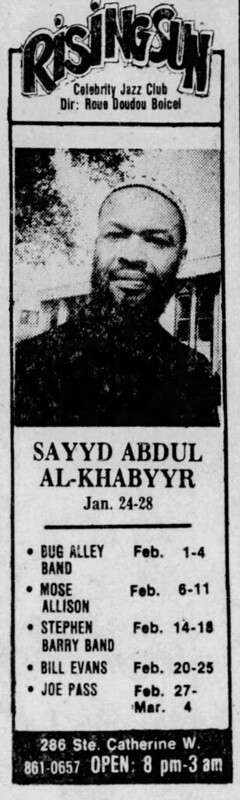
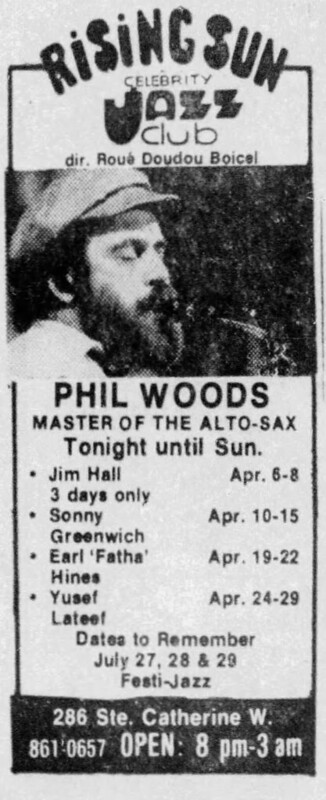
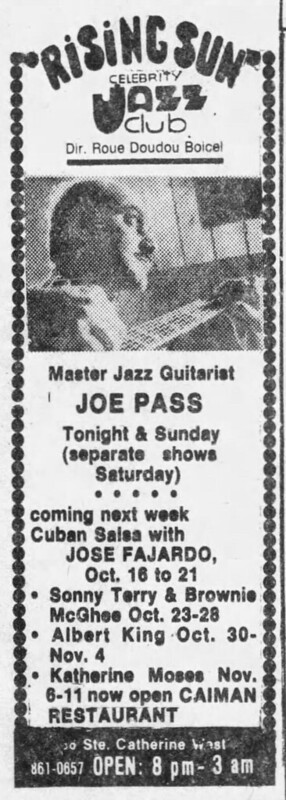
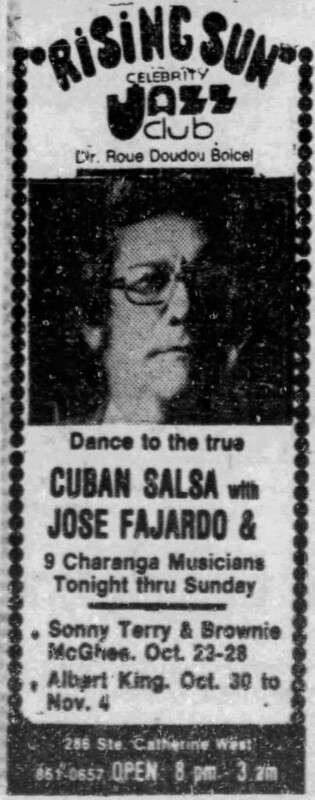
A legendary Montreal venue (1975–1991) founded by Rouè-Doudou Boicel, which attracted true legends of jazz and blues, while also occasionally opening its stage to reggae and punk/alternative currents. [1]
1. Introduction
From 1975 to 1991, impresario Rouè-Doudou Boicel made the Rising Sun one of Canada’s leading jazz and blues clubs, welcoming numerous international headliners while actively supporting the local scene[1].
Over the course of the 1970s, declining public interest in jazz led to the closure of many Montreal clubs. In this context, the Rising Sun, founded in the spring of 1975, quickly established itself as one of the city’s main venues for the music, as several establishments disappeared one after another[6]. Initially used as a rehearsal space for local musicians, the venue soon developed a regular program and became an important stop for touring artists.
Born in French Guiana, Rouè-Doudou Boicel left his homeland at the age of 23 before spending several years in Europe and settling in Quebec in 1970[1]. From a modest background, a painter, poet and former electrician, he developed early on a deeply human and social vision of culture. Soon after arriving in Montreal, he became involved with underprivileged youth by founding the Centre de Visosonie, active from 1971 to 1975, an organization that offered artistic activities to children and teenagers in the Centre-Sud district[1]. His interest in “visosonie” already reflected his desire to make music accessible to all by conceiving it as a global sensory experience, beyond traditional cultural frameworks.
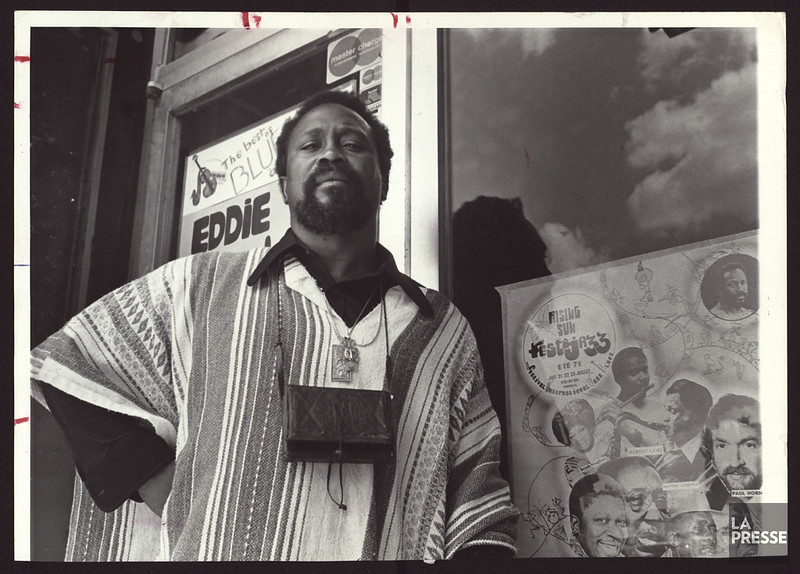
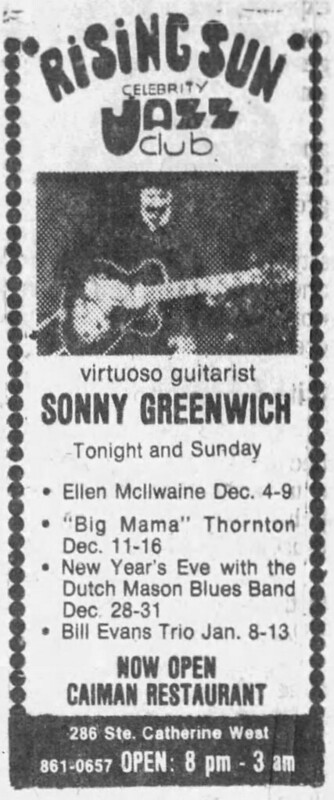
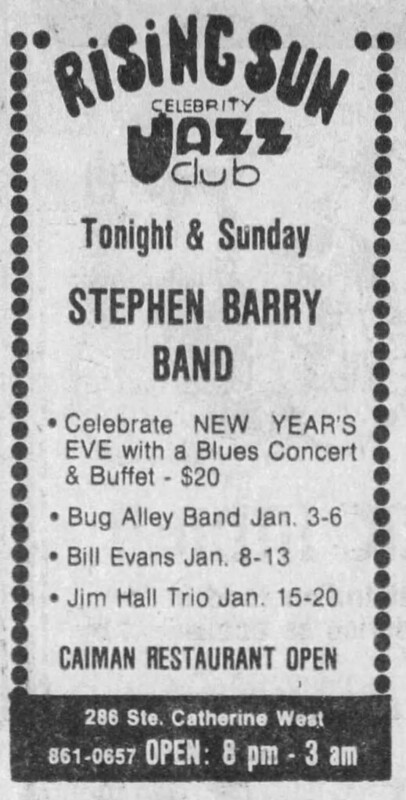
Convinced that jazz had not yet said its last word at a time when many considered the music to be in decline, he made it his mission to revive Montreal’s jazz scene. In 1975, he opened the Rising Sun at 286 Sainte-Catherine Street West, under the evocative slogan: “Jazz is not dead”[1]. The small, welcoming club quickly became an essential gathering place for jazz and blues lovers, before attracting renowned Canadian and American artists who made it a key stop on their tours[1]. Over the years, the venue welcomed some of the greatest figures in African-American jazz and blues, directly helping to turn Montreal into a recognized destination on the international circuits of these musics[1].
His approach remained deeply independent and hands-on. Aware of the economic realities of jazz, he recognized that running a club relied more on passion than on profit. He therefore developed an intuitive and pragmatic way of working, based on coherent programming, tight management and a constant ability to adapt. This combination of resourcefulness, intellectual curiosity and resilience allowed the Rising Sun to become a unique place in Montreal’s cultural landscape: a space where students, artists, outsiders, professionals, international musicians and a loyal audience crossed paths in a warm and deeply human atmosphere(26).
In 1978, he pushed his ambition even further by founding the Rising Sun Festijazz, presented on the stages of the Rising Sun and Place des Arts[1]. For three years, this international jazz and blues festival enjoyed significant success and brought several world stars to Montreal, including Ray Charles, Art Blakey, Taj Mahal, Muddy Waters, Buddy Guy, Sarah Vaughan, Dizzy Gillespie and Nina Simone[1]. Through this initiative, he sought not only to produce concerts, but also to offer new visibility to African-American musics and to demonstrate that Montreal could host the greatest figures in jazz and blues in a context respectful of their cultural heritage.
His contribution to Montreal’s cultural life was gradually recognized by several institutions. During the 20th Black History Month in 2011, he was named among twenty personalities who had left a social and cultural mark on Montreal and Quebec[1]. That same year, the borough of Côte-des-Neiges–Notre-Dame-de-Grâce named him a Grand Citizen in the Sports and Culture category. In 2013, the Black Coalition of Quebec awarded him the Mathieu Da Costa Prize for his contribution to Quebec society, before he received the Grand Prix Dynastie in 2018, recognizing the exceptional commitment of a member of Quebec’s Black community[1]. He was also honoured in New York, French Guiana, South Africa and Senegal, testifying to the lasting influence of his work well beyond Montreal.
2. Bar des Arts: 286 Sainte-Catherine West Before the Rising Sun
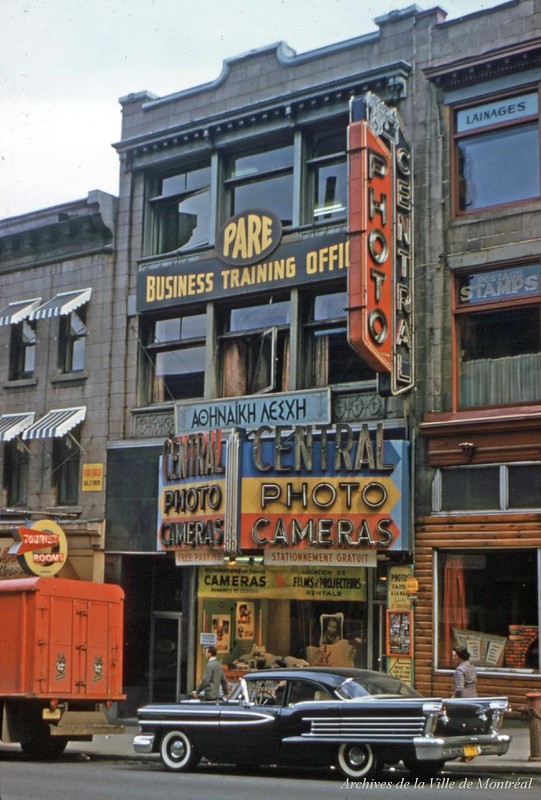
Long before it became the Rising Sun, 286 Sainte-Catherine Street West already had a long history tied to Montreal nightlife. Court documents published in Le Devoir in October 1954, as part of the Caron inquiry into commercialized gambling in Montreal, identified the address among several establishments associated with illegal betting networks and downtown gambling houses[67]. The texts notably mention the activities of bookmaker Harry Feldman, as well as several addresses on Sainte-Catherine Street West regarded by investigators as important sites of organized gambling[67]. These revelations testify to the shady and lively character of Montreal’s Red Light district well before jazz arrived at the Rising Sun.
In the early 1960s, the building housed the Bar des Arts, an establishment combining cabaret, nightlife and cultural activities. An article published in Le Devoir in March 1964 notably announced an evening during which poet Gaston Miron read several of his texts before a Montreal audience[67]. The newspaper also mentioned art exhibitions presented in a room called “Galerie Atys,” located directly inside the club’s premises[67]. The venue thus belonged to a hybrid environment where poetry, visual arts, cabaret and nightlife intersected.
Despite this cultural vocation, the Bar des Arts remained associated with a sometimes unstable atmosphere characteristic of certain downtown Montreal establishments in the late 1960s and early 1970s. In March 1968, The Gazette reported that a group of three individuals vandalized the establishment, destroying furniture and several bottles of alcohol, causing damage estimated at about $2,000[70]. A few years later, in February 1973, the club again made headlines following a shooting that occurred around 2:30 a.m.[68]. According to newspapers of the time, several shots were fired inside the cabaret before an armed man fled along Jeanne-Mance Street, firing toward police officers who had arrived at the scene[68]. Officers Jacques Cinq-Mars and Jean-Louis Hélie took part in the suspect’s arrest, while the investigation suggested a possible link with the Popeyes gang as well as with the murder of André Trudelle, shot in a taxi a few minutes later[69].
A column published in Le Polyscope in February 1973 also confirms that the Bar des Arts was then hosting topless shows, describing an establishment where “a bunch of people were watching the little topless girl” before customers went up to the third floor for a beer[71]. This testimony illustrates the nightlife atmosphere of the area surrounding Place des Arts in the early 1970s, at a time when this portion of Sainte-Catherine Street West remained strongly associated with Montreal’s Red Light cabarets, bars and performance venues.
When Doudou Boicel finally took over the premises in 1974 in order to found the Rising Sun, the place still bore the traces of this turbulent past. The establishment then required major cleaning and renovation work in order to transform the former cabaret into a venue devoted to jazz and blues[8]. This transformation marked an important break in the building’s history and announced the birth of one of the most emblematic venues in Montreal’s jazz scene.
“On our first visit, when the owner handed us the keys to the Bar des Arts,” Doudou explains, “the atmosphere in that nude dancers’ club was quite surprising. We did not expect to find such a sordid place. We found awful, morbid catacombs. The place reeked of a scam. We cleaned it up fairly quickly, disinfected the premises, changed the carpet and built a new stage. Yolande and Ève, who worked at my vegetarian restaurant, Casa Doudou, came to help us.”
3. 1975: Jazz Is Not Dead
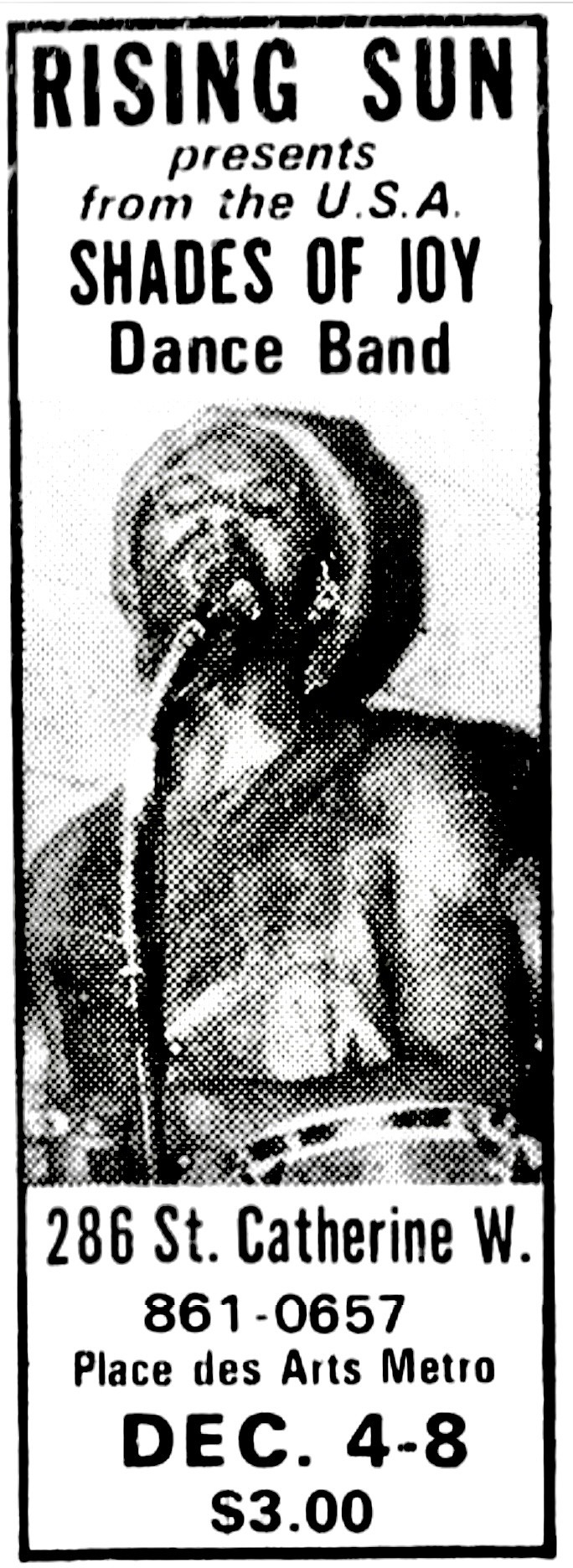
Before the emergence of the Rising Sun, jazz in Montreal was going through a marked period of decline. In the early 1970s, the musical landscape was dominated by rock, disco and pop music, pushing jazz to the margins. Radio stations gave it little airtime, and local musicians had few opportunities to perform, forcing many of them to turn to studio work or advertising in order to survive. This situation contrasted with previous decades, when establishments such as the Casa Loma, the Penthouse, the Café Saint-Michel and the Tête de l’Art had played an active role in the city’s musical life[8]. The Rising Sun thus appeared at a critical moment when several clubs were closing their doors, including Norm Silver’s Esquire Show Bar, Harry Milrot’s In Concert and Charles Burke’s Black Bottom. Rockhead’s Paradise, once one of the city’s most popular venues, remained active, but was then mainly focused on rhythm & blues and local jazz[2].
In this context of waning interest, the idea of reviving jazz took the form of a deliberate, almost militant undertaking. “Jazz is not dead,” proclaimed the spirit of a crusade aimed at bringing musicians together and recreating a space for performance. This ambition, however, came up against complex social and cultural realities, including the division of musical circles along linguistic communities and distinct networks. It was within these circles that young English-speaking Montreal musicians were identified, often gathered around informal places where they could play and meet[8]. Among these places, the Rainbow Bar & Grill at 1430 Stanley Street occupied an important position. Heir to a tradition of bars open to a marginal and diverse clientele, the establishment acted as a point of convergence for amateur and semi-professional musicians. A variety of styles were presented there — jazz, blues, folk and bluegrass — in an informal setting where different social backgrounds and cultural origins intersected. This parallel scene testified to an underground vitality, outside the dominant commercial circuits[8].
The emergence of the Rising Sun cannot be separated from the Montreal context of the 1970s, marked by the presence of criminal activity in the bar and nightclub sector. Certain networks linked to organized crime then exerted influence over the operation of these establishments, complicating the process of obtaining the necessary permits and increasing the risks associated with any new venture. Municipal and provincial authorities, aware of this situation, introduced stricter control mechanisms, making the administrative process particularly demanding[8]. In this climate, obtaining a liquor licence was a decisive step. The process involved exchanges with lawyers, officials and the permit control commission, in an sometimes opaque procedure marked by dubious financial demands and unexpected obstacles. The need to comply with multiple requirements — operating permit, liquor sales permit and municipal approvals — demanded constant discipline and perseverance. The founding of the club was therefore not simply an artistic initiative, but a genuine administrative and financial undertaking[8].
From the outset, the Rising Sun set itself the mission of restoring jazz’s visibility and legitimacy in the city. This ambition took shape in a context where the music seemed to have been abandoned by institutions and the media, but where an audience and a community of musicians nevertheless remained ready to keep it alive. The establishment was thus part of a revival dynamic based both on individual commitment and on the rebuilding of an artistic network[8]. The club’s success gradually helped revive Montreal’s jazz scene. Several new establishments then appeared, including L’Air du Temps, Chez Pancho, Le Milord, Café Mojo, Ivan Symonds’s Jazz Bar, Le Bijou, Le Monte-Carlo, Biddle’s, Le Pretzel Enchainé and Le Mustache. The media gradually began speaking about jazz in Montreal again, a sign that the music was regaining a more visible place in the city’s cultural life[2].
The creation of the Rising Sun therefore appears as both a cultural and entrepreneurial initiative, born in an unfavourable environment but driven by a strong conviction: that jazz, far from having disappeared, remained a living force capable of bringing artists and audiences together around a shared place.
4. 1976: Montreal Discovers the Rising Sun
In the spring of 1976, the Rising Sun, also known as the Soleil Levant, quickly established itself as a rising venue on Sainte-Catherine Street West. With a capacity of about 150 seats, the club was already attracting a large audience, to the point of surprising its founder, Doudou Boicel, who soon began considering an expansion of the facilities. This early popularity marked a pivotal moment in which public success and structural ambitions converged, consolidating the club’s place within Montreal’s jazz scene[13].
By April, the Rising Sun was described as a distinctive space, both intimate and warm, where jazz was heard in a subdued atmosphere accompanied by Caribbean specialties. This hybrid identity — at the crossroads of club, cultural venue and community meeting place — was confirmed with the holding of a first festival bringing together local musicians and New York ensembles, including the Multi-Stimulus Music Society. The club thus became part of an alternative performance network, complementary to institutions such as McGill University, where a dynamic jazz scene was also developing. Far from being a genre in decline, Montreal jazz in 1976 appeared to be in full transformation, nourished by both academic circles and independent clubs[9][10].
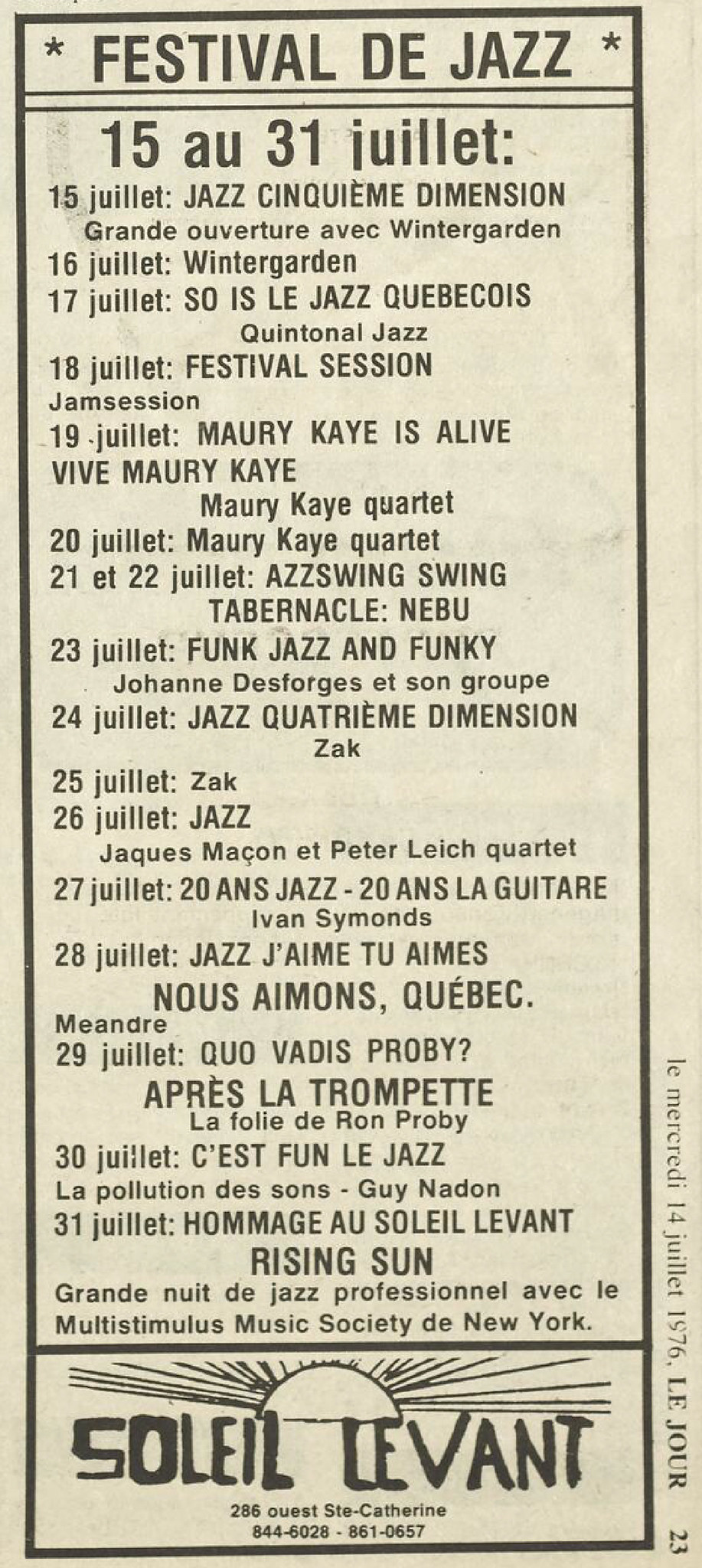
In the summer of 1976, the Rising Sun reinforced its position with a major jazz festival presented from July 15 to 31. The event took place alongside the Montreal Olympic Games (July 17 to August 1, 1976), when the city welcomed hundreds of thousands of visitors from around the world. Against this backdrop of exceptional cultural and international activity, the festival's eclectic and ambitious program brought together a wide range of local and international artists, further establishing the club as an important venue for jazz performance, exchange, and innovation in Montreal. This momentum continued into the fall, as the Rising Sun attracted leading figures of the international jazz scene, marking a decisive step toward broader recognition.[11][12]
The appearance of Rahsaan Roland Kirk in September 1976 represented one of the first major turning points. Presented as the club’s first major headliner, he drew full houses and imposed an intense, immersive musical experience. The Rising Sun, located on the second floor of 286 Sainte-Catherine Street West, stood out for its sober decor and its closeness to the audience, encouraging direct interaction between musicians and listeners. Despite his physical limitations, Kirk displayed exceptional energy there, transforming each performance into a collective ritual in which improvisation, commitment and emotion merged. His appearance, whose memory extended into 1977 within the venue’s history, made a lasting contribution to shaping the club’s identity[14][15][22].
In October 1976, the arrival of Art Blakey and the Jazz Messengers marked a decisive stage. The Rising Sun then fully entered the international jazz circuit. This encounter acted as a true professional test for Boicel, who was confronted with the demands of the New York scene and a sometimes tense management style embodied by road manager Jim Greene. Despite these frictions, Blakey’s presence helped structure and professionalize the club’s practices, as it gained maturity and credibility. This appearance was not limited to a series of concerts: it redefined the venue’s standards and confirmed its integration into North American touring networks[16][24].
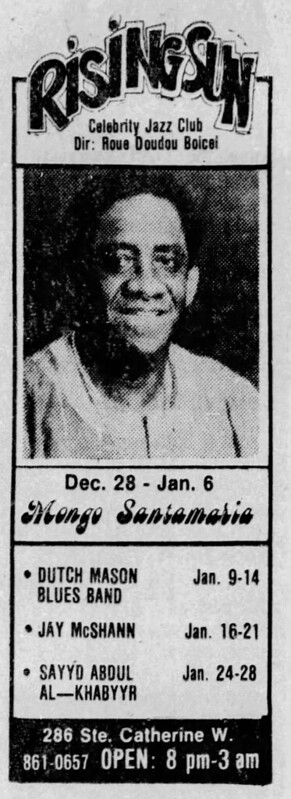
The following months confirmed this rise in stature. In November, Yusef Lateef’s quartet, featuring drummer Albert “Tootie” Heath, drew enthusiastic crowds with rich music blending Eastern influences, blues and modern improvisation. In December, the Rising Sun successively welcomed Elvin Jones, whose intense and evolving music extended the legacy of John Coltrane, followed by Cuban percussionist Mongo Santamaria, whose Afro-jazz set the room ablaze in a festive and multicultural atmosphere. Finally, singer Koko Taylor asserted the power of Chicago blues, further broadening the club’s musical palette[18][19][20][21].
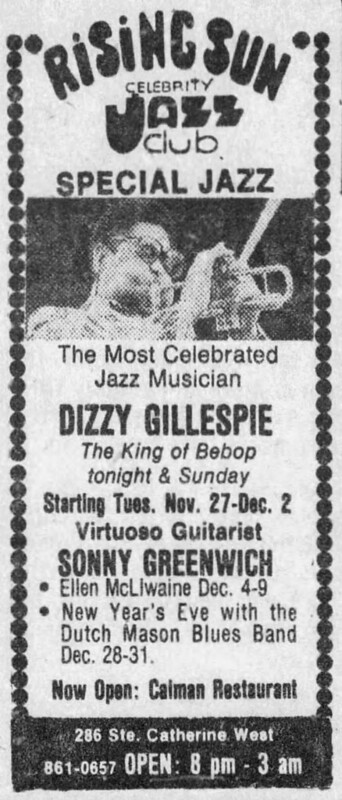
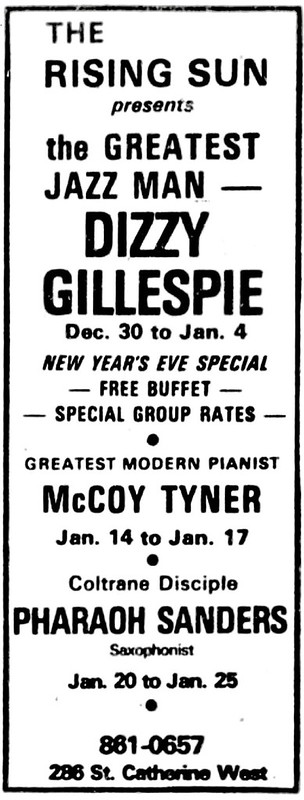
The high point of this pivotal year came on December 31, 1976, when Dizzy Gillespie performed at the Rising Sun for the New Year’s celebrations. A major figure of bebop, he drew a considerable crowd and turned the evening into a landmark event. Beyond this performance, the relationship between Gillespie and Boicel was rooted in a deeper dynamic. Discovered by Boicel in his adolescence in French Guiana, the trumpeter became over time a loyal ally of the club, returning to play regularly and supporting its development through difficult moments. This relationship helped stabilize the Rising Sun and strengthen its international profile, making Gillespie not only a legendary guest, but a key figure in the venue’s history[17][23].
Thus, 1976 marked a decisive transition for the Rising Sun: from an emerging club rooted in a dynamic local scene, it became within a few months a true hub of international jazz in Montreal, capable of attracting, welcoming and retaining the greatest figures of the genre.
“My meeting with the young promoter Sheldon Kagan allowed me to discover a group of students of Jewish origin while they were playing at the Windsor Hotel for an evening organized by Sheldon. The group was called Wintergarden: it was the first jazz-fusion orchestra to perform at the Rising Sun.”
5. 1977: The Rising Sun Becomes an Institution
In 1977, the Rising Sun definitively established itself as one of Montreal’s main jazz hubs, in a sense taking over the space left vacant by the disappearance of the In Concert club, whose closure had illustrated the growing difficulty of presenting major artists in an increasingly fragile economic context[28]. Located at 286 Sainte-Catherine Street West, the club immediately stood apart from the city’s more institutional venues through its raw, intimate and deeply human character[48][49]. A colourful staircase led to a long, narrow room with black walls and ceilings, dominated by a box of mirrors suspended above the stage, while other mirrors reflected an audience seated on mismatched chairs[48][49]. Background music accompanied the arrival of customers, creating an atmosphere somewhere between a Montreal jazz club and a South Seas lounge[48]. Despite the simplicity of the decor and certain technical limitations, the Rising Sun developed a unique, warm and unpretentious charm, where the immediate proximity between artists and audience transformed concerts into immersive and communal experiences[48]. Spectators, often elegantly dressed and passionate about jazz, came above all for the exceptional quality of the music and the attentive listening the venue encouraged[49]. The almost reverent silence that prevailed during performances helped make the club a true sanctuary of listening, a direct reflection of the personality of its founder, Rouè-Doudou Boicel, who valued authenticity, human closeness and a passion for jazz over material prestige[49].

Born in Cayenne, trained in Europe and having spent time in Switzerland and Paris, where he studied art, Doudou Boicel first defined himself as a painter before working in various trades, including as an electrician, then turning to restaurants and club management[28]. Refusing to see jazz as a simple commercial product, he summed up his philosophy in a phrase that became famous: he did not think “business,” he thought jazz. In a field with thin margins and high costs, he relied on resourcefulness, human networks and solidarity among musicians, beginning by presenting local groups such as Wintergarden before attracting international figures such as Dizzy Gillespie and Art Blakey[28]. Often dressed in African robes and taking the microphone before shows to defend the survival of jazz in Montreal, Boicel gradually transformed the Rising Sun into a true site of cultural resistance: at once a refuge for musicians, a laboratory of listening and a stage open to the major North American circuits[28].
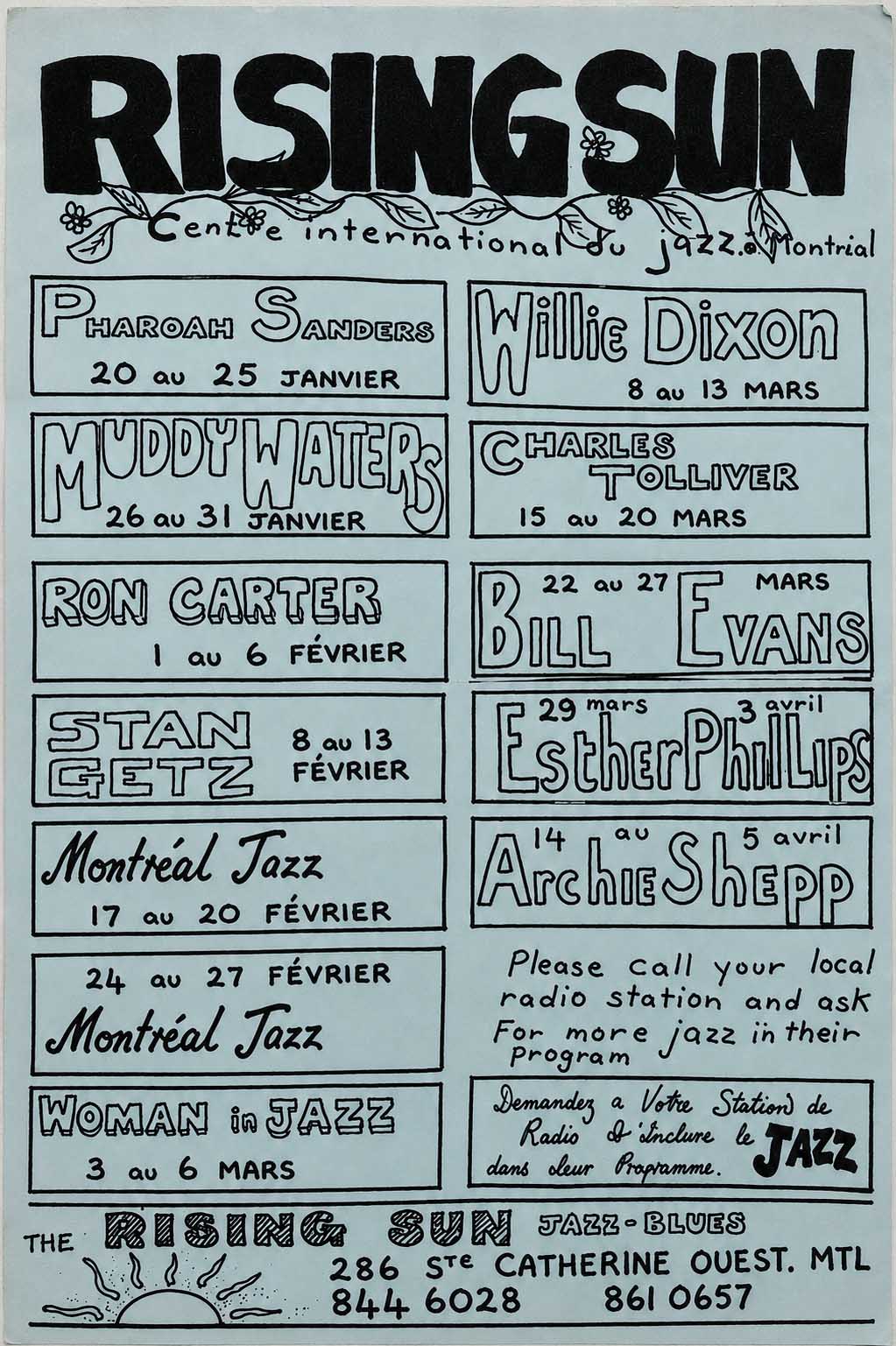
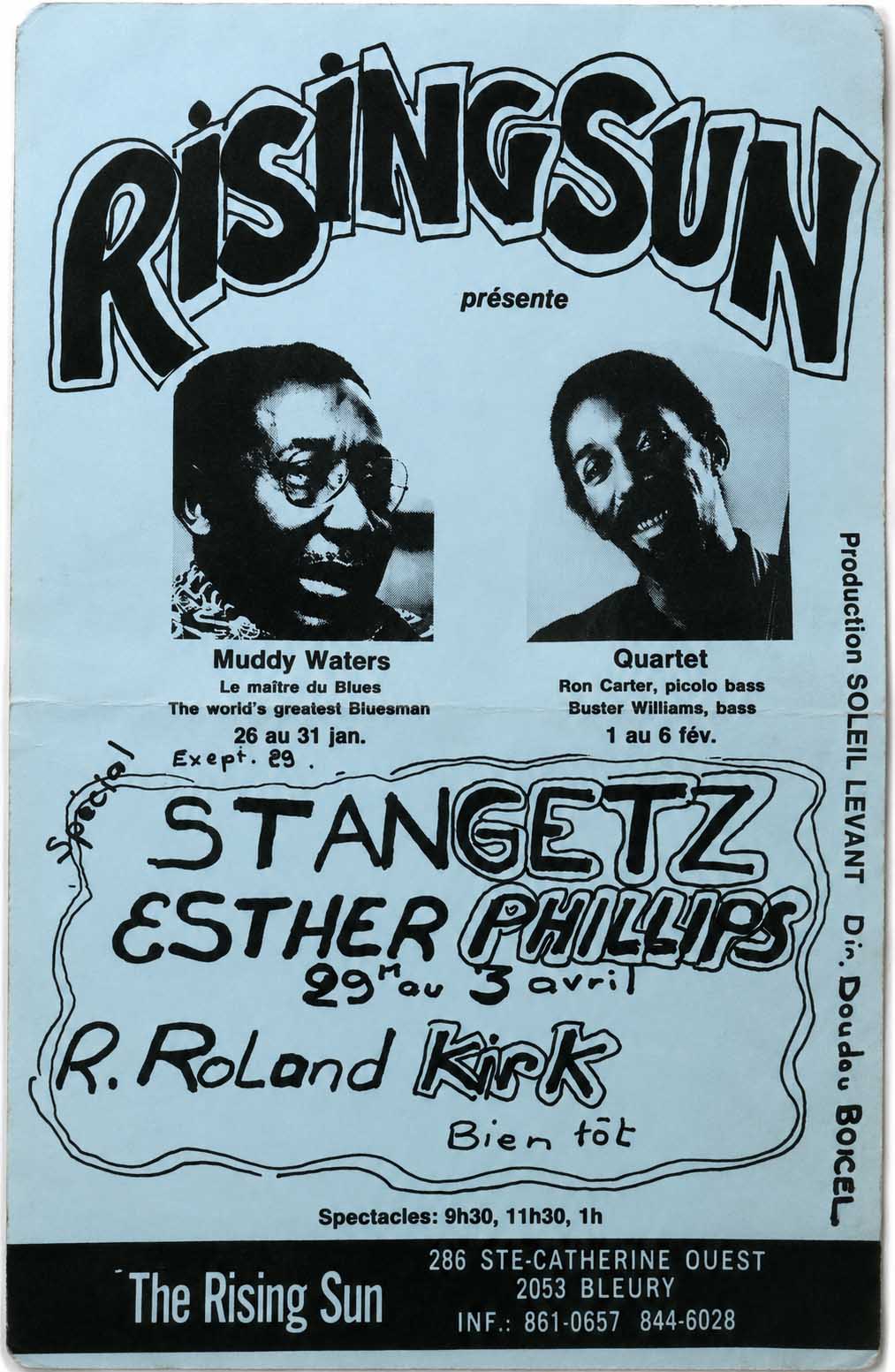
As early as January 1977, this ambition was confirmed with the appearance of Pharoah Sanders, a major figure of the post-Coltrane current. His engagement illustrated the club’s ability to welcome jazz in full transformation, moving between meditative lyricism, bursts of raw energy and returns to bebop or ballad forms[33]. A few days later, the Rising Sun shifted into the world of blues with Muddy Waters, whose sextet temporarily transformed the club into a true blues joint. Despite a noticeable fatigue linked to touring, Waters imposed a natural and powerful presence through classics such as Got My Mojo Working, Baby Please Don’t Go and Hoochie Coochie Man, confirming the Rising Sun’s role as a crossroads between jazz and blues[34].
In February, the club continued this momentum with Ron Carter, former pillar of Miles Davis’s quintet, who presented a renewed conception of the double bass, now used as a melodic and harmonic instrument in its own right[35]. Shortly afterward, Stan Getz, newly arrived from Copenhagen, delivered a performance praised for the maturity of his playing and the richness of his quartet, in which pianist Joanne Brackeen particularly stood out[36]. In Boicel’s account, however, that same stay took a more chaotic turn: Getz disappeared at intermission, was found in a nearby bar, then returned to finish his concert under precarious conditions before causing new concerns the following day[37]. The episode illustrates the sometimes unpredictable realities of the promoter’s profession, caught between artistic genius, human fragility and the need to protect both the audience and the club.
In March, the Rising Sun welcomed Willie Dixon, a central figure of Chicago blues and the author of a repertoire that became canonical, including Hoochie Coochie Man, Spoonful and Back Door Man[38]. On stage, Dixon alternated narration, singing and bass playing, transforming each piece into a living, shared experience. That same month, the Bill Evans Trio offered the club one of the season’s most refined moments. Critics highlighted the finesse of Evans’s playing, the virtuosity of bassist Eddie Gomez and some reservations about drummer Eliot Zigmund, considered at times too forceful for the trio’s delicate aesthetic[40]. Behind the scenes, Boicel recounts that Evans, worried from the moment he arrived, interrupted a performance by saying he could not play on the piano provided, forcing the owner to urgently find a new instrument[39]. Despite these tensions, the concerts revealed music of almost sacred intensity, illustrating the full duality of the Rising Sun: the absolute grace of the music confronted with the hard reality of the business.
In the spring, a column devoted to the habits of Montreal jazz audiences described the Rising Sun as a true “chameleon,” capable of crossing boundaries between audiences and musical styles[32]. In a landscape where each venue had its own public, the club stood out for its ability to bring together a young, diverse and culturally mixed crowd around programming that ranged from blues to contemporary jazz. This versatility was especially evident with John Lee Hooker, whose May appearance confirmed the Rising Sun’s drawing power among major blues figures[42]. Accompanied by the Coast to Coast Blues Band, Hooker imposed his hypnotic boogie until the conquered room rose to its feet, clapping hands and stomping feet. The same period also saw the appearance of Nat Adderley, whose quintet delivered energetic hard bop nourished by bebop, Latin music and jazz-rock[43].
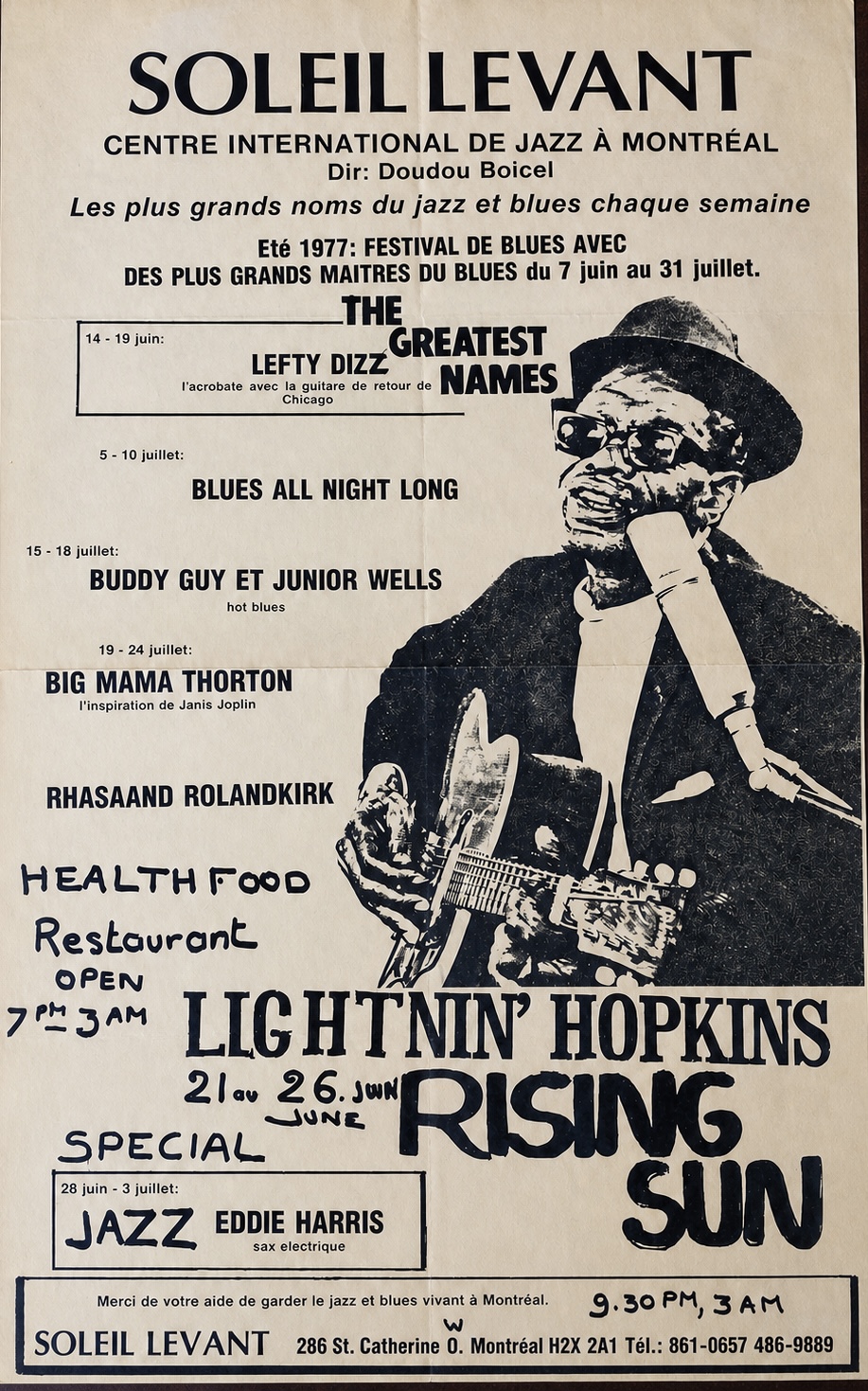
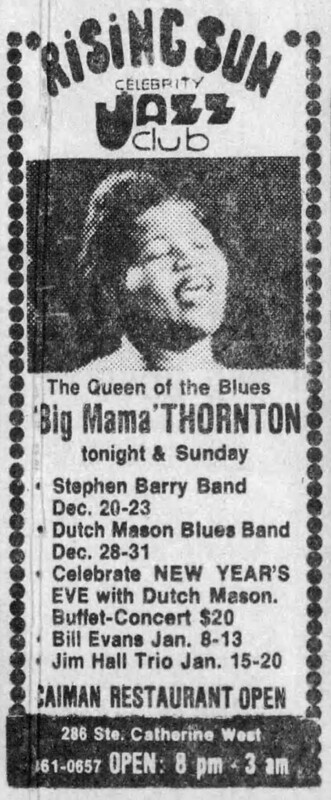
The summer of 1977 further strengthened the club’s blues dimension. In June, Lightnin’ Hopkins returned to Montreal after several years away. Although he was accompanied by musicians who had rehearsed little together, which at times affected the fluidity of the performance, his presence alone placed the Rising Sun in direct continuity with the deep roots of American blues[44]. In July, Big Mama Thornton in turn evoked the living memory of the blues, her voice remaining remarkably powerful after nearly forty years of career[41]. That same month, the Junior Wells–Buddy Guy Band delivered a performance praised for its energy and collective groove, embodying all the vitality of electric Chicago blues[45].
Alongside the club, the Rising Sun experience also extended through cuisine. The Café Créole, developed by Alex Boicel, Doudou Boicel’s son, added a family-oriented and artisanal dimension inspired by French Guiana[27]. Acras, spicy dishes and fresh ingredients fully contributed to the identity of the place, where music, gastronomy and hospitality met in the same spirit of sharing. In the fall, Boicel further clarified his vision: aware that a jazz club brings in little and costs a great deal, he insisted on the need to maintain strong programming, create an authentic atmosphere and build a loyal clientele while defending an inclusive conception of jazz[26]. His interest in “visosonie” reflected this desire to make music a global and accessible sensory experience. Despite financial difficulties, the Rising Sun was then attracting Michel Legrand, Mose Allison, Muddy Waters, B.B. King and Dexter Gordon, confirming its integration into the major jazz and blues circuits.
In November, Dexter Gordon in turn marked the season with broad, warm and sovereign playing, confirming the club’s place within a transatlantic network linking Montreal, New York and Europe[25]. That same fall, Eddie “Cleanhead” Vinson, a personal favourite of Boicel, perfectly embodied the hybrid spirit of the Rising Sun through a blues tinged with jazz sophistication, nourished by humour, sensuality and a repertoire that included Hold It Right There, Alimony Blues, Kidney Stew and Cherry Red[29].
The end of the year finally confirmed the remarkable aesthetic diversity of the Rising Sun. In December, Kenny Burrell, presented as Duke Ellington’s favourite guitarist, embodied a refined, subtle and deeply musical jazz based on economy of means and attention to the audience[46]. A few days later, Jimmy Smith recalled the revolutionary impact of the organ in modern jazz, combining technical virtuosity, blues intensity and direct interaction with a crowd gathered close to the stage[47]. Finally, at the very end of December, Bill Evans returned to the Soleil Levant, this time accompanied by Michel Donato and Philly Joe Jones. His impressionistic, fluid and introspective playing drew a full and attentive room, definitively confirming the Rising Sun as one of the most important spaces for Montreal jazz in the late 1970s, at the crossroads of artistic rigour, human proximity and living creation[30].
6. 1978: The Rising Sun at Its Peak
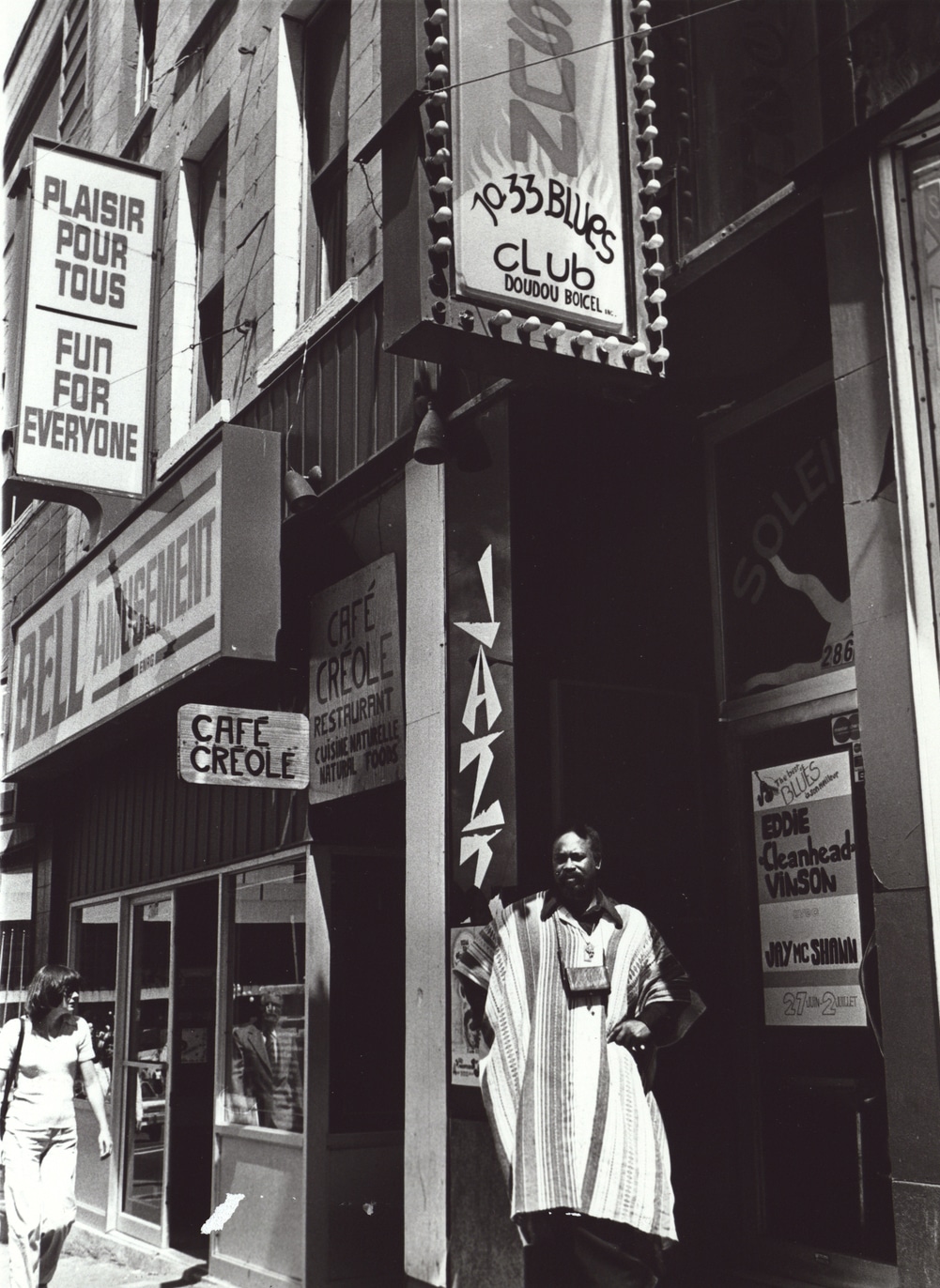
In 1978, the Rising Sun, also known as the Soleil Levant, reached the height of its cultural influence in Montreal. In just a few years, the establishment had grown from a modest rehearsal space frequented by local musicians into one of Canada’s main centres for African-American jazz and blues[53].
At that time, the Rising Sun attracted a remarkably diverse clientele bringing together students, artists, professionals, outsiders, rich and poor, francophones and anglophones alike[60]. Boicel nevertheless observed a revealing paradox: despite the strong Black identity of his programming, the audience remained mostly white[57]. More than a simple club, the Rising Sun thus became a place of encounter, solidarity and cultural recognition where jazz was presented as one of African-American culture’s major contributions to world heritage[57]. Despite limited resources, the club managed to maintain ambitious international programming, while fees for American artists often reached between US$4,000 and US$6,000 per week, not including transportation, lodging and taxes imposed on foreign musicians[53].
The idea of an international jazz and blues festival took shape after Boicel travelled to Vermont in 1977, where he attended an event featuring, among others, Rahsaan Roland Kirk, who had already appeared at the Rising Sun[60]. Convinced that Montreal could host an event of comparable scope, he set out to create a festival devoted to African-American music at Place des Arts[50]. In the spring of 1978, dressed in his colourful clothing, he personally handed out promotional flyers at the entrance to the Vermont festival in order to convince American audiences that jazz was very much alive in Montreal thanks to the Rising Sun[50]. Back in Quebec, he organized preparatory meetings at his Westmount home, approached banks, sponsors and the media, while negotiating directly with agents, producers and musicians in order to bring together several major figures of jazz and blues around the project[60].
Difficulties, however, soon emerged. Boicel first had to convince the directors of Place des Arts that a blues festival had its place in Salle Wilfrid-Pelletier, some fearing that it would amount to little more than a rock show[60]. The financial challenges were just as significant: to bring his project to completion, he practically mortgaged his Westmount house, took on major loans and continually negotiated new lines of credit[51]. He also denounced the lack of government support as well as the many administrative constraints imposed on foreign artists[50]. These tensions came to light in the spring and summer of 1978 when pianist Horace Silver was initially denied a work permit for a series of concerts planned at the Rising Sun from June 13 to 18[54]. Federal authorities then argued that the establishment had not made sufficient efforts to hire Canadian musicians[54]. The affair quickly took on a public dimension and also affected Rockhead’s Paradise, where American musicians accompanying the singer Jama were also blocked at the border[55]. After reviewing the file, the authorities eventually acknowledged certain errors in interpreting the regulations, allowing Horace Silver to obtain his work authorization[55].

Despite these obstacles, Boicel continued organizing the Rising Sun Festijazz, presented on July 21, 22 and 23, 1978 at Place des Arts[7]. Refusing to take unnecessary artistic risks, he favoured already established artists such as Sarah Vaughan, Muddy Waters, Dexter Gordon, Hubert Laws, B.B. King, John Lee Hooker, Willie Dixon and Paul Horn[50]. Several musicians even agreed to participate without receiving the financial advances usually required, proof of the respect Boicel enjoyed in the jazz and blues world[51]. For him, the festival represented far more than a series of concerts: it was a cultural and political gesture intended to offer new visibility to African-American music in Montreal[51].
The festival’s success quickly exceeded expectations. Presented over three evenings at Place des Arts, Festijazz drew between 11,000 and 15,000 spectators depending on the source, allowing Boicel to recover nearly $70,000 invested in the project and even to hope for a profit of around $100,000[52][58]. The blues performances prompted especially enthusiastic reactions: B.B. King impressed the audience with his guitar Lucille, Muddy Waters transformed the hall into a true temple of Chicago blues, while John Lee Hooker captivated spectators with his hypnotic playing and famous boogie[58]. Willie Dixon, for his part, served as a living memory of American blues[58]. On the jazz side, Sarah Vaughan, Dexter Gordon, Hubert Laws and Paul Horn also marked the festival, despite some technical problems related to the acoustics and lighting of Salle Wilfrid-Pelletier[61].
Boicel retained particularly emotional memories of the festival’s backstage moments. He recalled accompanying Sarah Vaughan to the airport before seeing her completely transformed once she stepped on stage[61]. He also described the magnetic presence of Dexter Gordon, especially during his interpretation of Round Midnight, which left the Montreal audience hanging on every note[61]. After certain concerts, the musicians gathered at the Hyatt Regency or in Montreal clubs such as Chez Régine, revealing a far more human and intimate dimension behind the great figures of international jazz[61].

One of the most legendary moments of Festijazz occurred after a concert at Place des Arts, when B.B. King, James Cotton, Big Mama Thornton, John Lee Hooker, Willie Dixon, Buddy Guy and Big Moose Walker arrived at the Rising Sun to improvise together until the early hours of the morning[64]. Boicel recalled that by then almost no customers remained in the club, but that the musicians were playing above all for the pleasure of sharing a moment among themselves[64]. The tapes of that historic evening were unfortunately lost in the 1990 Rising Sun fire[2].
Through the 1978 Festijazz, the Rising Sun definitively ceased to be merely a small marginal jazz club and became the core of a genuine Montreal cultural project with international reach[51]. For Boicel, the festival was above all a cultural, social and identity-based affirmation: a way of demonstrating that Montreal could welcome the greatest figures of African-American jazz and blues in a context respectful of their historical contribution to modern culture[57]. The popular success of Festijazz also confirmed the existence of a Montreal audience large and passionate enough to support an international event devoted to jazz and blues[52]. What had begun as a marginal refuge for jazz lovers then became a cultural platform capable of symbolically rivaling the great American and European festivals[52].
7. 1979: The Rising Sun at the Heart of Montreal’s Jazz Revival
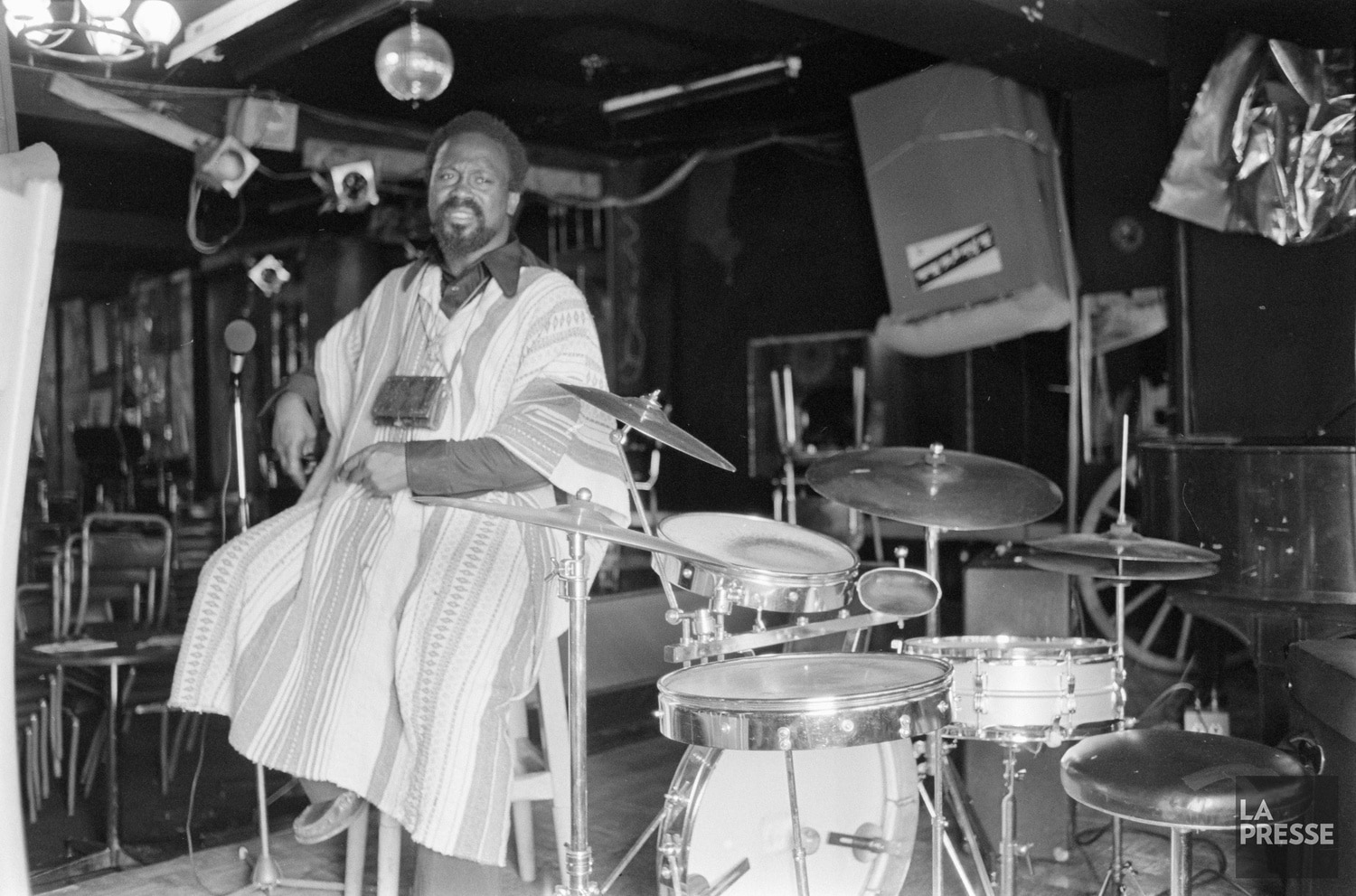
In 1979, several press articles testified to the exceptional vitality jazz was then experiencing in Montreal. In March, La Presse described a metropolis where clubs, festivals and performance venues devoted to jazz and blues were multiplying rapidly. The newspaper stated that Montreal then had more than 120 jazz orchestras and a dozen places where the music could be heard regularly, from small clubs to Place des Arts. In this context, Rouè-Doudou Boicel, owner of the Rising Sun, appeared as one of the main architects of this renaissance.[75]
The Rising Sun was then part of a network of venues transforming Montreal nightlife, alongside L’Air du Temps, Rockhead’s Paradise, the Jazz Bar and the cinema-café Cinéma Parallèle. The scene attracted fans of historic clubs as well as students, young musicians and a new francophone audience more open to jazz, blues and African-American music. Pianist Maury Kaye even observed that Quebec jazz musicians could now imagine making a living in Montreal, a situation he considered new for the local scene.[75]
In April, The Sherbrooke Record highlighted the role played by Alain Simard and André Ménard, then responsible for programming at El Casino, a venue neighbouring the Rising Sun on Sainte-Catherine Street West. The two promoters regularly presented major blues, jazz and rock artists there, including B.B. King, Dave Brubeck, Larry Coryell and John Mayall. This series of concerts and events in many ways formed the foundations of what would become, the following year, the first edition of the MONTREAL INTERNATIONAL JAZZ FESTIVAL. The proximity between the Rising Sun and El Casino thus reflects the extraordinary concentration of musical activity in this section of Sainte-Catherine Street West in the late 1970s.[76]

This effervescence culminated in the preparation of the second FestiJazz, organized by Doudou Boicel at Place des Arts on July 27, 28 and 29, 1979. In May, The Montreal Star announced an ambitious program spread over three evenings: B.B. King with the Dutch Mason Blues Band, John Lee Hooker, Lightnin’ Hopkins, Clifton Chenier, Big Mama Thornton, Eddie “Cleanhead” Vinson and Oscar Peterson, described as “Montreal’s gift to international jazz.” The article also emphasized Boicel’s already well-established reputation as a passionate organizer whose connections with artists allowed him to assemble an exceptional bill.[73]
A few days before the event, The Gazette published a long profile of Boicel by David Sherman. The journalist described the considerable financial and logistical challenges faced by the owner of the Rising Sun in keeping his festival afloat. Boicel had then been working for nearly two years to develop the concept of festi-jazz, following a first edition held the previous year. His partner, Rose Matthey, helped administer the festival in the evenings after her day job as a social worker, while Rising Sun employees travelled across Montreal, the Eastern Townships and even Vermont to put up nearly 1,000 promotional posters.[72]
“The Rising Sun posters created a poster-pasting industry that did not exist before in Montreal. Our competitors started making poorly designed posters. Others followed.”

Sherman’s article highlighted the artisanal, family-based and community-oriented nature of the project. Several artists agreed to reduce their fees or ask only for travel expenses in order to support the festival. Despite expenses exceeding $100,000, pressure from banks and increased competition from summer events since Expo 67, Boicel remained determined to maintain a festival devoted to jazz and blues in Montreal. The profile presented him as an idealistic, passionate figure respected by musicians, at the centre of a network in which the Rising Sun played an anchoring role.[72]
The day after the second Festijazz, The Gazette published an enthusiastic review of the three evenings presented at Place des Arts. David Sherman described the event as a landmark moment in Montreal’s cultural summer of 1979. Oscar Peterson was presented as the great triumph of the closing evening, capable of transforming the scale of the hall into an intimate experience through his virtuosity, harmonic mastery and ease between improvisation and precision. The journalist also emphasized the impact of his new African Suite.[74]

The review also gave significant attention to the great blues figures brought together by Boicel. Big Mama Thornton impressed with her stage energy, humour and presence, while B.B. King stirred nearly 3,000 spectators during his Friday night performance. John Lee Hooker and Lightnin’ Hopkins were described as festival highlights, one for his hypnotic and minimalist blues, the other for his expressive playing and improvisations. Clifton Chenier, Eddie “Cleanhead” Vinson and several other musicians helped give the event the atmosphere of a major celebration of American blues and rhythm and blues.[74]
Through these 1979 articles, the Rising Sun therefore appears as much more than a simple club: it became a crossroads where international musicians, independent promoters, journalists, jazz lovers, an emerging francophone audience and the nightlife scene of Sainte-Catherine Street West intersected. The second Festijazz confirmed Doudou Boicel’s place among the central figures of Montreal jazz and blues in the late 1970s, while placing the Rising Sun at the heart of a pivotal moment in Montreal’s musical history.


8. 1980: The Rising Sun Between Festijazz, Rockhead’s and Montreal Afro-Jazz
In 1980, Rouè-Doudou Boicel emerged as one of the most influential figures in jazz and blues in Montreal. In a long profile published by The Gazette, journalist Juan Rodriguez presented him both as owner of the Rising Sun, organizer of Festijazz and ambassador of African-American music. Based on Sainte-Catherine Street, Boicel dreamed of creating a true “jazz place” in Montreal inspired by the clubs of New York and Los Angeles, where the quality of the welcome mattered as much as the quality of the programming.[79]
The article described an establishment deeply marked by the Caribbean origins of its founder. Sculptures, handmade objects, rum bottles and autographed photographs made up a warm decor, while the team took part as much in producing the shows as in welcoming the artists. Boicel stated that he regularly devoted twenty-hour days to his club, convinced that hospitality remained at the heart of the success of a place devoted to jazz.[79]
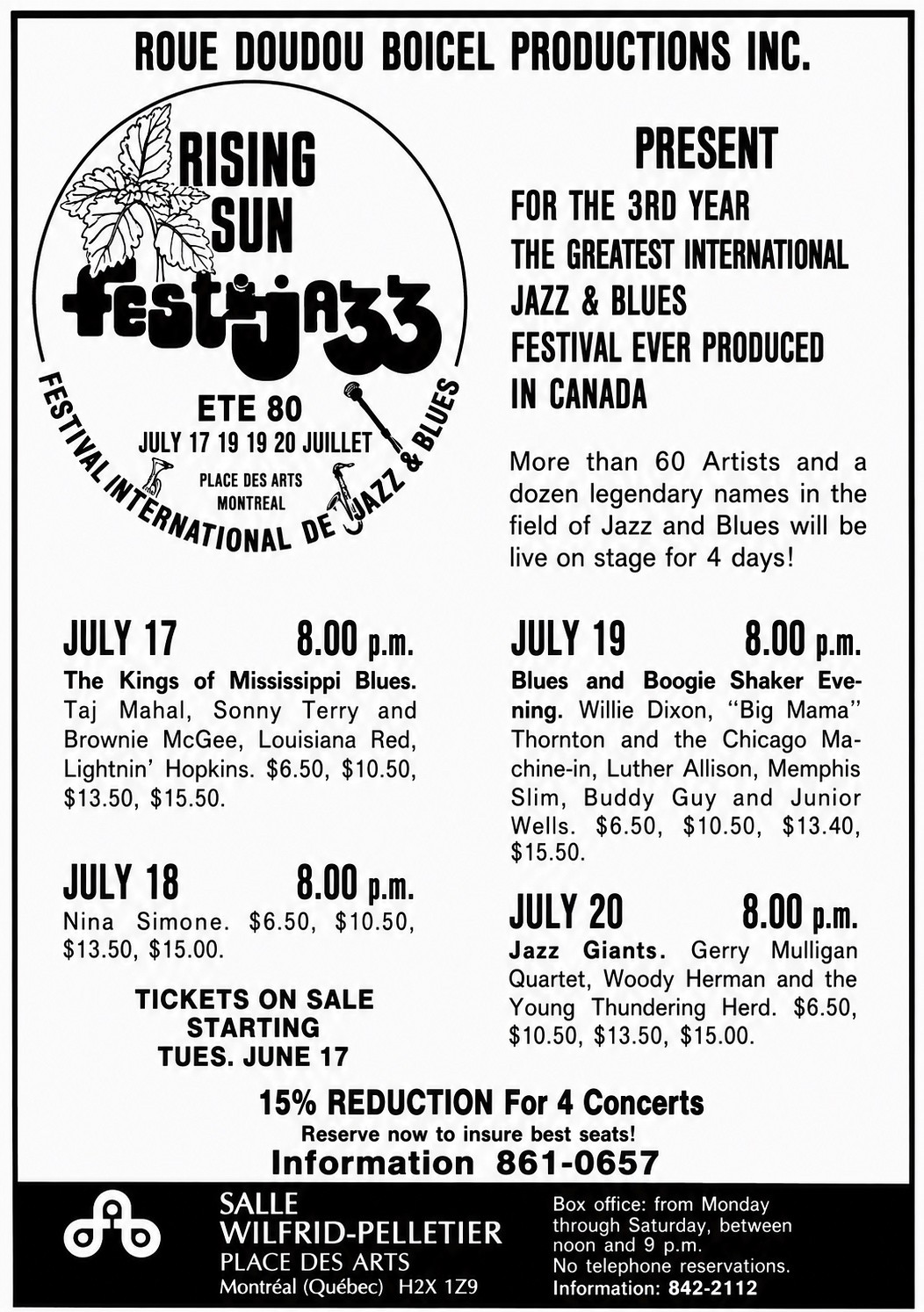
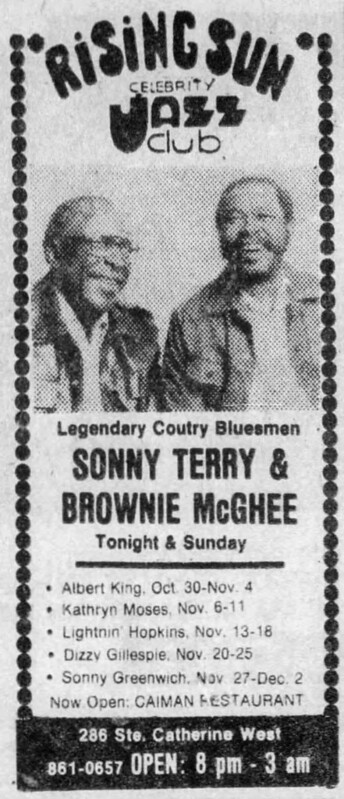
This philosophy was reflected in the development of Festijazz, then presented as the most important jazz and blues festival in Canada. The third edition, held in July 1980 at Place des Arts, brought together Nina Simone, Gerry Mulligan, Woody Herman, Taj Mahal, Sonny Terry, Brownie McGhee, Lightnin’ Hopkins, Buddy Guy, Junior Wells, Luther Allison and Big Mama Thornton, among others. The festival confirmed Boicel’s ability to attract some of the greatest figures of North American jazz and blues to Montreal.[79]
A few weeks later, Le Devoir published a more nuanced review of the festival. Despite some performances judged uneven, journalist Sylvaine Martin praised the exceptional presence of artists such as Sonny Terry, Brownie McGhee, Taj Mahal, Memphis Slim and Willie Dixon. The strongest moment, however, remained Nina Simone’s performance, whose interpretation of Ne me quitte pas was described as one of the festival’s great moments.[80]
During the summer, The Gazette also emphasized the dynamism of the Sainte-Catherine Street West area. At the Rising Sun, legendary singer Jon Hendricks presented a notable show with his wife Judith Hendricks, his daughter Michelle Hendricks and a young Bobby McFerrin, still unknown to the general public. A few steps away, the Club Montréal welcomed the young Bryan Adams, illustrating the musical diversity that characterized the neighbourhood at the time.[77]

The year also marked an important step in the expansion of Boicel’s activities. In October, he acquired the legendary Rockhead’s Paradise, located at 1252 Saint-Antoine Street, a historic Little Burgundy institution founded by Rufus Rockhead. His goal was to revive this landmark of Afro-Montreal entertainment while preserving its heritage. He was already considering presenting artists such as Nina Simone, Tito Puente, Eartha Kitt and Mongo Santamaria there, while also reserving a place for emerging local talent.[78]
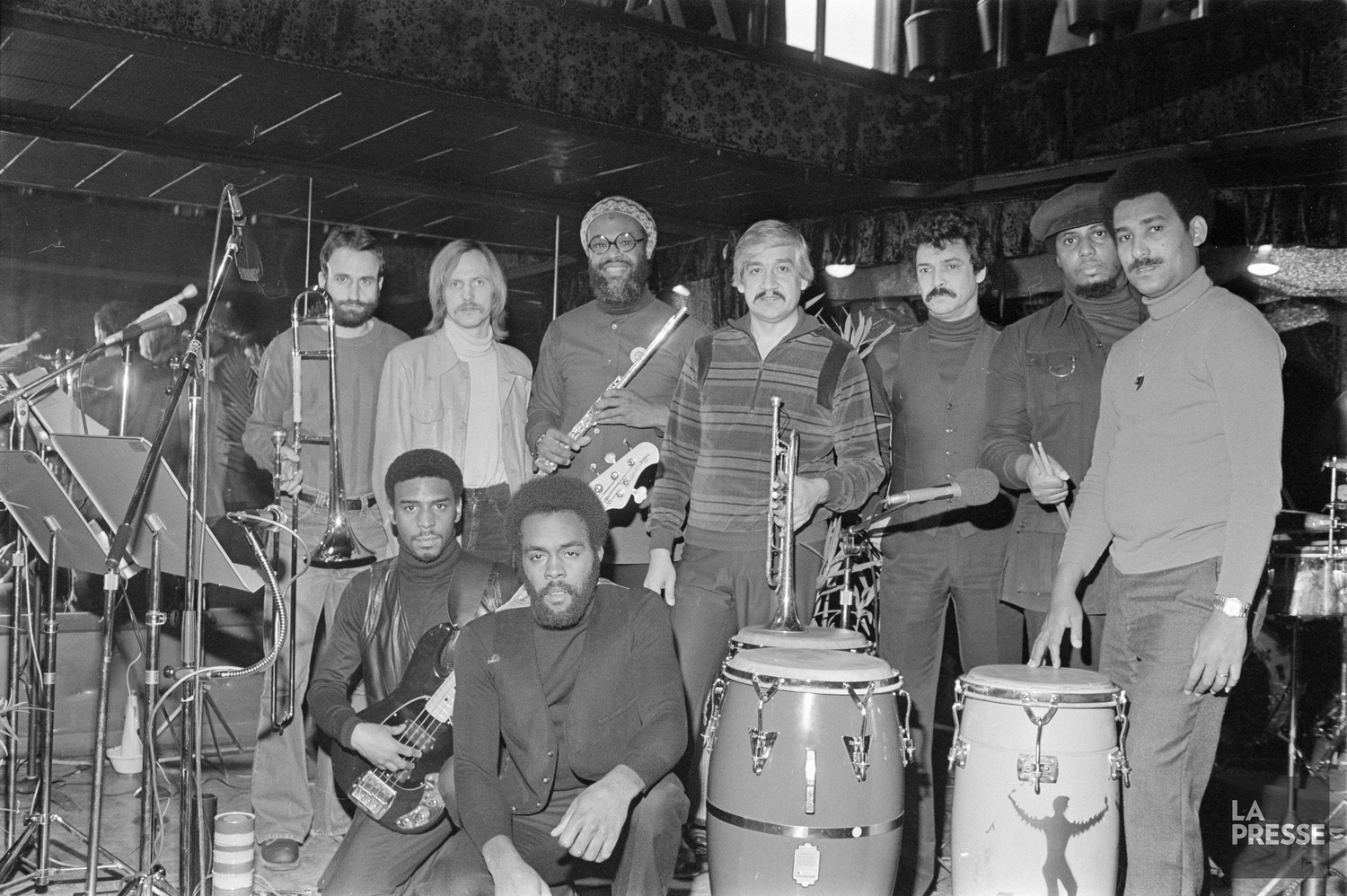
In December, La Presse announced the creation of the Rising Sun Afro Jazz Orchestra, a Montreal ensemble bringing together musicians from various cultural communities. Led in particular by Chilean trumpeter Victor Duran, the project fused salsa, soul, funk-jazz and Afro-Caribbean rhythms. Boicel thus wanted to demonstrate that Montreal could also produce its own Afro-jazz scene, rather than relying solely on invited artists from abroad.[81]
Between Festijazz, the programming of the Rising Sun, the acquisition of Rockhead’s Paradise and the creation of the Rising Sun Afro Jazz Orchestra, the year 1980 marked the height of Doudou Boicel’s influence. More than simply a club owner, he became one of the principal architects of the presentation of jazz, blues and Afro-diasporic music in Montreal.[79]
9. 1981: The Rising Sun in Transition Between Rockhead’s Paradise and the End of an Era
In 1981, the activities of Rouè-Doudou Boicel entered an important period of transition. While the Rising Sun, which had become one of the main jazz clubs on Sainte-Catherine Street West during the second half of the 1970s, began a gradual slowdown, the promoter devoted an increasing share of his energy to reviving the legendary Rockhead’s Paradise in Little Burgundy, which he renamed Doudou’s Rockhead Paradise. This shift is clearly reflected in several articles published during the year, which testify both to the prestige Boicel still enjoyed and to the challenges facing Montreal’s jazz scene in the early 1980s.[82]
“The success of Doudou’s Rockhead Paradise also attracted sharks, including Georges Durst, a powerful businessman and a sly fox. Georges owned a restaurant that presented comedy shows. He was in fact a pioneer in this art form, which became very popular. He also owned two other clubs, Le Bijou and Le Monte-Carlo, which were not successful. Georges always gave me a warm welcome. I could see him coming. The success of the Rising Sun did not leave him indifferent. He needed to find a new formula to get into jazz. He then told me about his project and made no secret of the fact that he was going to hire Charlie Biddle. The restaurant was named Biddle.”

A few months later, in September 1981, The Gazette announced the death of Rufus Nathaniel Rockhead, an emblematic figure of Montreal nightlife and founder of Rockhead’s Paradise. About 89 years old, this Jamaican entrepreneur who had settled in Montreal was recognized as the first Black person to legally obtain a liquor licence for an establishment in the city. His club, which became one of the main centres of jazz and cultural life for Montreal’s Black community, survived him as one of the most important venues in the history of Canadian entertainment.
In his article, Ian Mayer recalled that the establishment, located at the corner of Saint-Antoine and de la Montagne streets, had welcomed some of the greatest stars of jazz and African-American entertainment for more than half a century. The journalist also emphasized Rockhead’s social role within Montreal’s Black community, particularly by providing work to many neighbourhood residents in a context marked by racial discrimination. He also noted that following the stroke suffered by Rockhead in 1978, the cabaret had been sold to Boicel, who had since been attempting to restore its former vitality.[83]
In the fall, several articles also testified to the uncertainties surrounding the future of the Rising Sun. In November, La Presse reported that Boicel reversed his decision to close the club permanently in order to devote himself entirely to Rockhead’s Paradise. According to journalist Pierre Beaulieu, he ultimately chose to continue the activities of the Rising Sun while also pursuing the revival of the Little Burgundy cabaret. This decision illustrates his desire to preserve two important institutions of Montreal’s jazz scene despite the economic difficulties then affecting several performance venues.[84]
A few days later, a second article in La Presse nevertheless revealed some confusion around this possible reopening. Boicel publicly announced his intention to resume activities at the Rising Sun in order to present new jazz concerts there. However, Dominique Wilhelmy, owner of the premises now renamed Songe Tropical, said she had never been informed of such a project. Instead, she stated that she wanted to continue operating the establishment as a venue devoted to reggae music. This controversy illustrates the rapid transformations then affecting Sainte-Catherine Street West, where several clubs changed musical direction according to new trends and the economic difficulties of Montreal nightlife.[85]
Through these journalistic accounts, 1981 appears as a pivotal moment in the history of the Rising Sun. After playing a central role in the development of jazz and blues in Montreal during the 1970s, the club gradually began its decline while Boicel redeployed his activities around Rockhead’s Paradise. This transition also marked the end of an era for Sainte-Catherine Street West, where several historic establishments were then undergoing profound cultural and economic transformations.[85]
10. 1982: Financial Crisis, Return to Sainte-Catherine Street and the Survival of the Rising Sun
In 1982, the Rising Sun went through one of the most difficult periods in its history. In April, The Gazette announced the bankruptcy of the company Roue Dou Dou Boicel Productions, revealing the scale of the financial problems facing Rouè-Doudou Boicel after several years devoted to presenting concerts, organizing Festijazz and managing his Montreal jazz clubs. Since his arrival in Canada in the early 1970s, Boicel had nevertheless helped make the Rising Sun one of the main jazz centres on Sainte-Catherine Street West.[87]
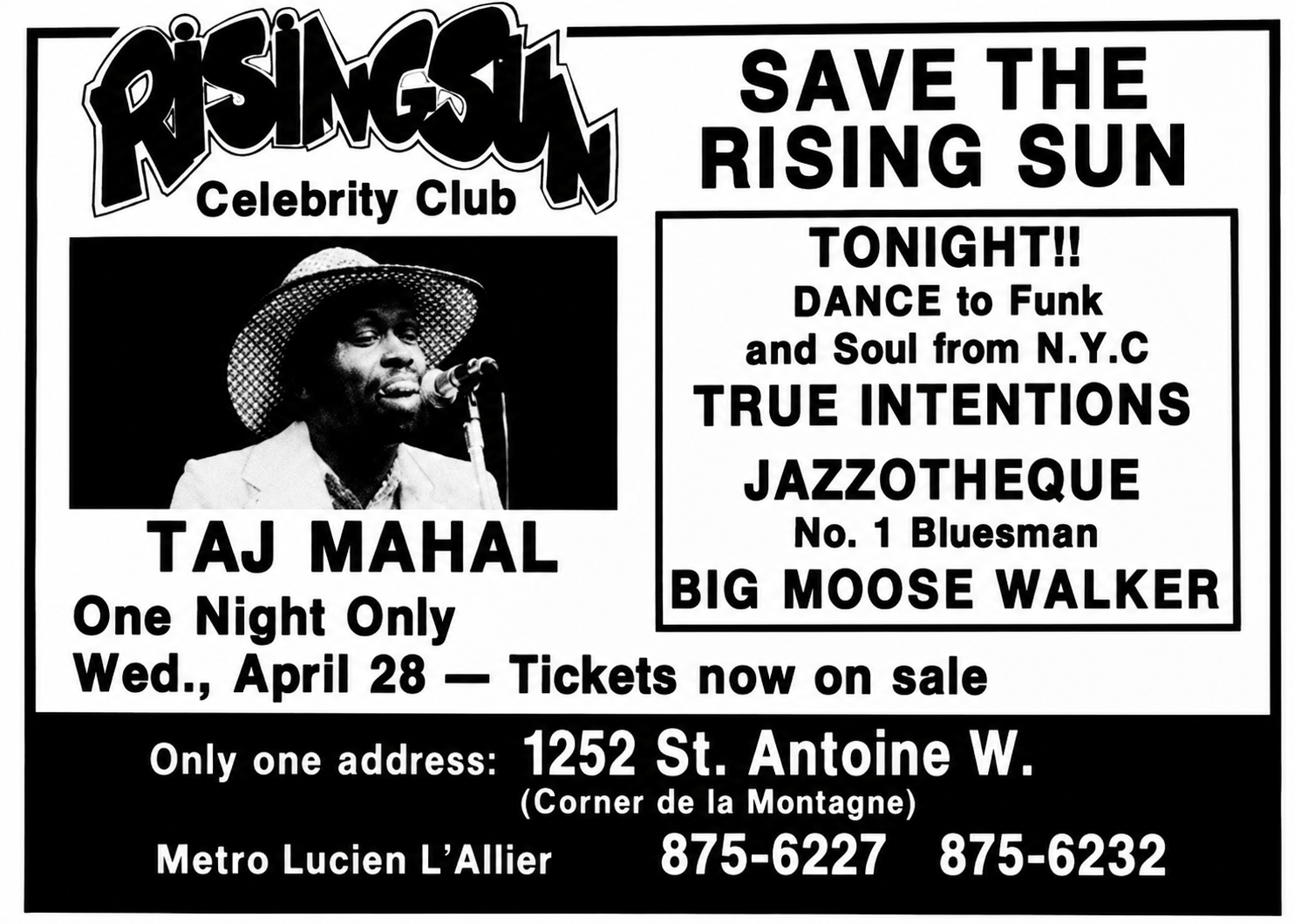
According to the newspaper, the difficulties intensified especially after the acquisition of Rockhead’s Paradise, bought about eighteen months earlier for nearly $200,000. Boicel had hoped to revive the famous cabaret founded by Rufus Rockhead and restore the jazz tradition of Little Burgundy, but the establishment failed to recover the attendance of its glory years. The transfer of the Rising Sun’s activities to Saint-Antoine Street also complicated the situation: located away from the main downtown nightlife circuits, the club attracted fewer customers than the former Sainte-Catherine Street location. Boicel briefly tried to diversify his programming with reggae shows before returning mainly to jazz. Despite the bankruptcy, several announced concerts, including some performances by Taj Mahal, were maintained.[87]
A few weeks later, in May, journalist Brenda Zosky Proulx devoted a long report to the situation of the Rising Sun and Rockhead’s Paradise. She described sparse audiences, a difficult economic climate and the gradual decline of several Montreal jazz clubs. Where the Rising Sun had once attracted large crowds on Sainte-Catherine Street West, only a few customers now occupied a room designed to hold several hundred people. Despite everything, Boicel remained determined to preserve a jazz tradition he considered threatened. The report also returned to the historical importance of Rockhead’s Paradise, long considered one of the main gathering places for Montreal’s Black community and a refuge at a time when several establishments still practised a form of informal segregation. The journalist nevertheless emphasized how much Little Burgundy had changed since the neighbourhood’s great years, as urban transformation, population displacement and the closure of numerous clubs had deeply weakened local nightlife.[86]
In July 1982, Boicel attempted a new start by reopening the former Sainte-Catherine Street West location under the name Rising Sun 1. This relaunch was based on the conviction that the public still associated the name Rising Sun with its original location rather than with the cabaret on Saint-Antoine Street. Some observers even considered the move to Rockhead’s Paradise a strategic mistake, since the area had become much less frequented than the main downtown club district. To mark this return to his roots, Boicel announced programming mixing jazz, blues and reggae, including performances by the Montreal group Indigo as well as the appearance of the famous Cajun accordionist Clifton Chenier and his Red Hot Louisiana Band.[88]
In his book L’histoire du Rising Sun et ses légendes jazz & blues, published in 2008, Boicel looked back at length on this period. He explained that he had to start almost from scratch after the difficulties linked to Rockhead’s Paradise, with the help of his collaborators and support from the Bank of Montreal. According to him, a large part of the clientele had never truly followed the club in its move to Saint-Antoine Street, notably because of the neighbourhood’s reputation at the time.[102]
Boicel nevertheless stated that the public gradually returned after the reopening of the Sainte-Catherine Street location and that the Rising Sun quickly regained its place among Montreal’s main jazz venues.[102]
11. 1983: Between Jazz Triumphs, Financial Tensions and Fragile Ambitions
In 1983, the Rising Sun enjoyed a particularly favourable start to the year. In January, The Gazette published an enthusiastic review of performances by the young trumpeter Wynton Marsalis, then only 21 years old. In the article titled “Marsalis hot for sold-out Rising Sun shows”, journalist Peter Hadekel described full houses rarely seen in the recent history of Rouè-Doudou Boicel’s club, with spectators overflowing into the stairway and onto Sainte-Catherine Street West to attend the quintet’s performances. Already named jazz musician of the year by DownBeat magazine, Marsalis impressed with playing that had become freer, more intense and more emotional. Hadekel also emphasized the exceptional quality of the musicians accompanying him, including Branford Marsalis, Kenny Kirkland, Phil Bowler and Jeff Watts, confirming the Rising Sun’s reputation as one of the main Montreal venues capable of welcoming the new major figures of international jazz.[89]
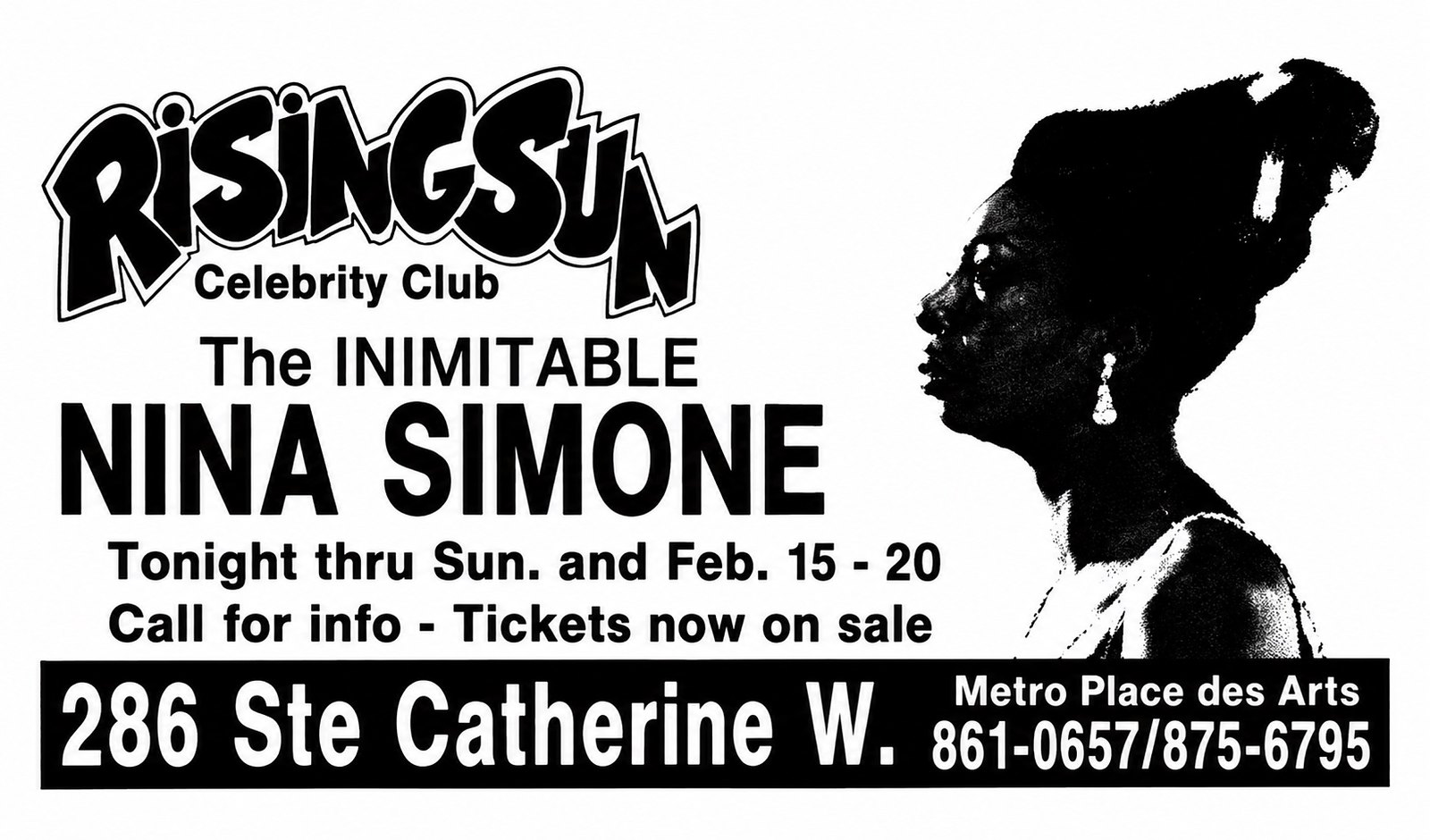
A few weeks later, the club again welcomed Nina Simone, one of the artists most closely associated with the Rising Sun since the late 1970s. In an article titled “Oh boy, Nina’s back in town”, journalist Thomas Schnurmacher described a relaxed and talkative artist, discussing her admiration for Jacques Brel and francophone Quebec as much as her personal life and the years she had spent in Europe. Welcomed at Boicel’s Creole restaurant before her performances, Simone then seemed to maintain a special relationship with Montreal and the club that had often hosted her.[90]
This visit, however, quickly turned into controversy. A few days later, The Gazette reported that the singer abruptly interrupted her series of shows after a single evening following a financial dispute with Boicel. According to journalist John Griffin, Simone immediately demanded the share of the box-office receipts owed to her under a contract providing for 80% of door revenues, while the promoter wished to wait until the full engagement had ended before making payment. The conflict led the singer to leave for Los Angeles and forced the Rising Sun to refund ticket holders for the cancelled performances. The incident illustrates the persistent financial difficulties still faced by several Montreal jazz clubs despite their ability to attract internationally renowned artists.[91]
These fragilities resurfaced a few months later. In June 1983, Le Devoir announced the cancellation of an important bebop concert presented as “Concert of the Century No. 2,” which Doudou Boicel was to organize at Place des Arts. The event was to bring together several major figures of American jazz, including Dizzy Gillespie, Freddie Hubbard, Benny Carter, Slide Hampton, John Lewis, Ray Brown and Mickey Roker. This cancellation testifies to the growing challenges faced by Montreal jazz producers in the early 1980s. It also contrasts with the artistic successes recorded at the Rising Sun, where Boicel nevertheless continued to attract some of the most important stars of world jazz while struggling to keep alive a scene that was becoming increasingly difficult to support financially.[92]
12. 1984: The Perseverance of Rouè-Doudou Boicel
In 1984, the Soleil Levant celebrated its tenth anniversary in a context marked by both perseverance and economic difficulty. Several newspapers then highlighted the exceptional trajectory of the club founded by Rouè-Doudou Boicel, recalling that in 1974 he had bought a former dancers’ bar without imagining that it would become one of Montreal’s most renowned jazz clubs. To mark this anniversary, Boicel brought back the slogan that had accompanied the club’s opening in 1975: “Jazz Is Not Dead”. Despite growing competition from venues such as the Spectrum and the Théâtre Saint-Denis, the Soleil Levant continued its mission by presenting a new series of concerts featuring, among others, Eddie “Cleanhead” Vinson, Joe Pass, Larry Coryell, Hank Jones and Dizzy Gillespie.[98][95]
The profiles published on this occasion in Le Devoir and La Presse described an aging establishment, still decorated with elements salvaged from the defunct Rockhead’s Paradise, but still driven by the passion of its founder. As debts accumulated and the Montreal International Jazz Festival, led by André Ménard and Alain Simard, now captured a significant share of media and public attention, the Soleil Levant remained one of the last Montreal venues devoted almost exclusively to jazz and blues.[94][97]
In August 1984, Le Devoir published a text signed by Rouè-Doudou Boicel following the death of blues singer Big Mama Thornton. Entitled “The Blues Is in Mourning”, this tribute traced Willie Mae Thornton’s path from her childhood in segregated Alabama to her rise among the great figures of American blues. Boicel recalled that the singer had performed at the Rising Sun for several weeks in 1983 and had even stayed at his home in Westmount for nearly two months. Taking the opportunity to denounce the music industry’s indifference toward several blues pioneers, he mentioned Lightnin’ Hopkins, Muddy Waters, Howlin’ Wolf, T-Bone Walker, Freddy King, John Lee Hooker, Sonny Terry, Brownie McGhee, Clifton Chenier and Buddy Guy, before concluding that Montreal blues lovers would keep “only happy memories” of the singer.[93]
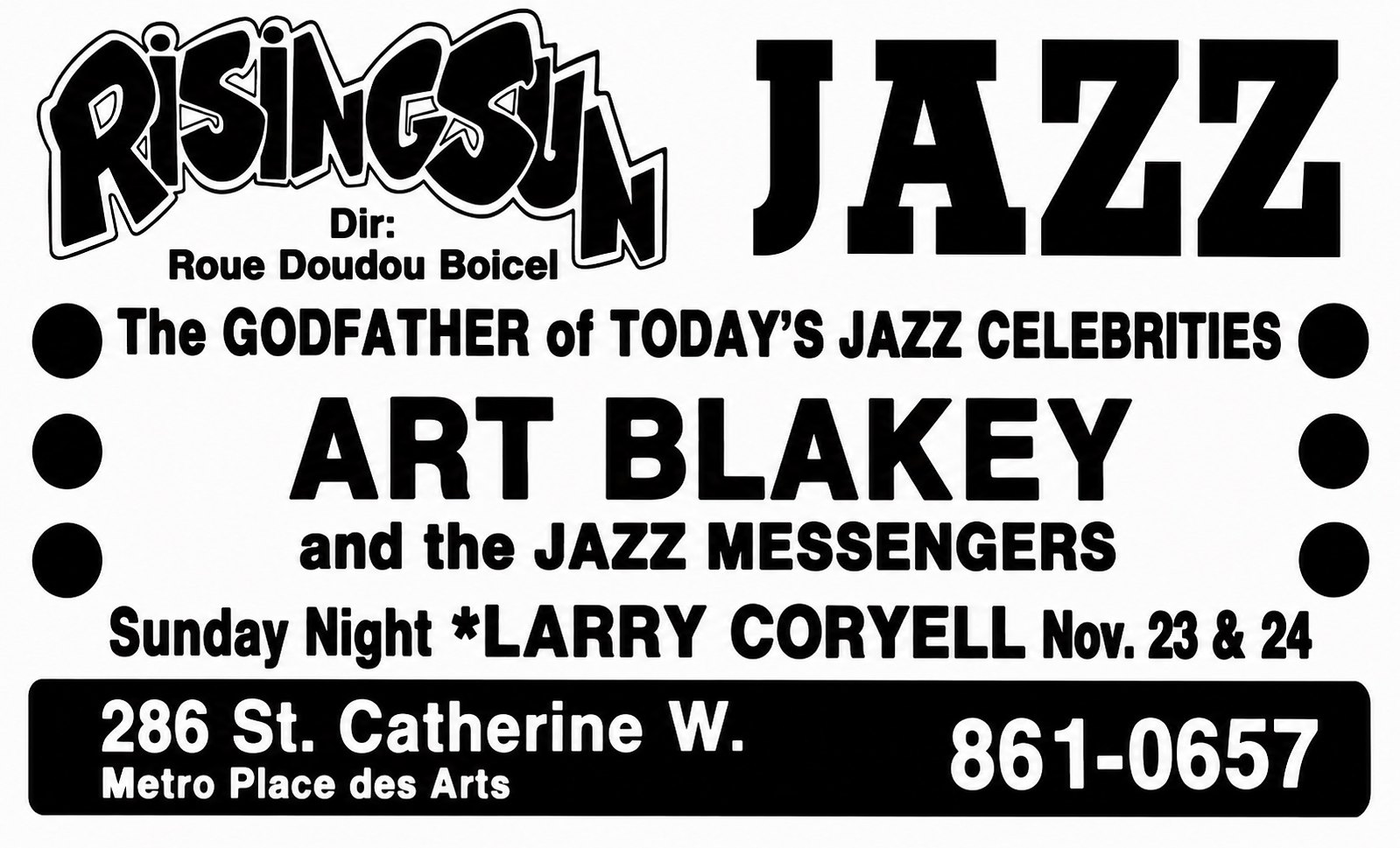
A few weeks later, in October, La Presse devoted an article to the return of legendary drummer Art Blakey to the Soleil Levant, then presented as Montreal’s oldest jazz club. Denis Lavoie recalled the fundamental role Blakey had played in the emergence of musicians who later became famous, such as Freddie Hubbard, Chuck Mangione and Wynton Marsalis, while also emphasizing the close ties between Blakey and Doudou Boicel, who said he had learned a great deal from the drummer during the club’s early days. A former collaborator of Miles Davis, John Coltrane, Thelonious Monk, Dizzy Gillespie, Wayne Shorter, McCoy Tyner and Bud Powell, Blakey still appeared driven by the same energy and the same desire to move jazz forward. His appearance at the Soleil Levant ultimately symbolized the philosophy that still animated Boicel ten years after the club’s opening: despite debts, competition and the transformations of the scene, jazz and blues remained very much alive.[96]
13. 1985: The Rising Sun Between Blues, Reggae and Montreal Hardcore

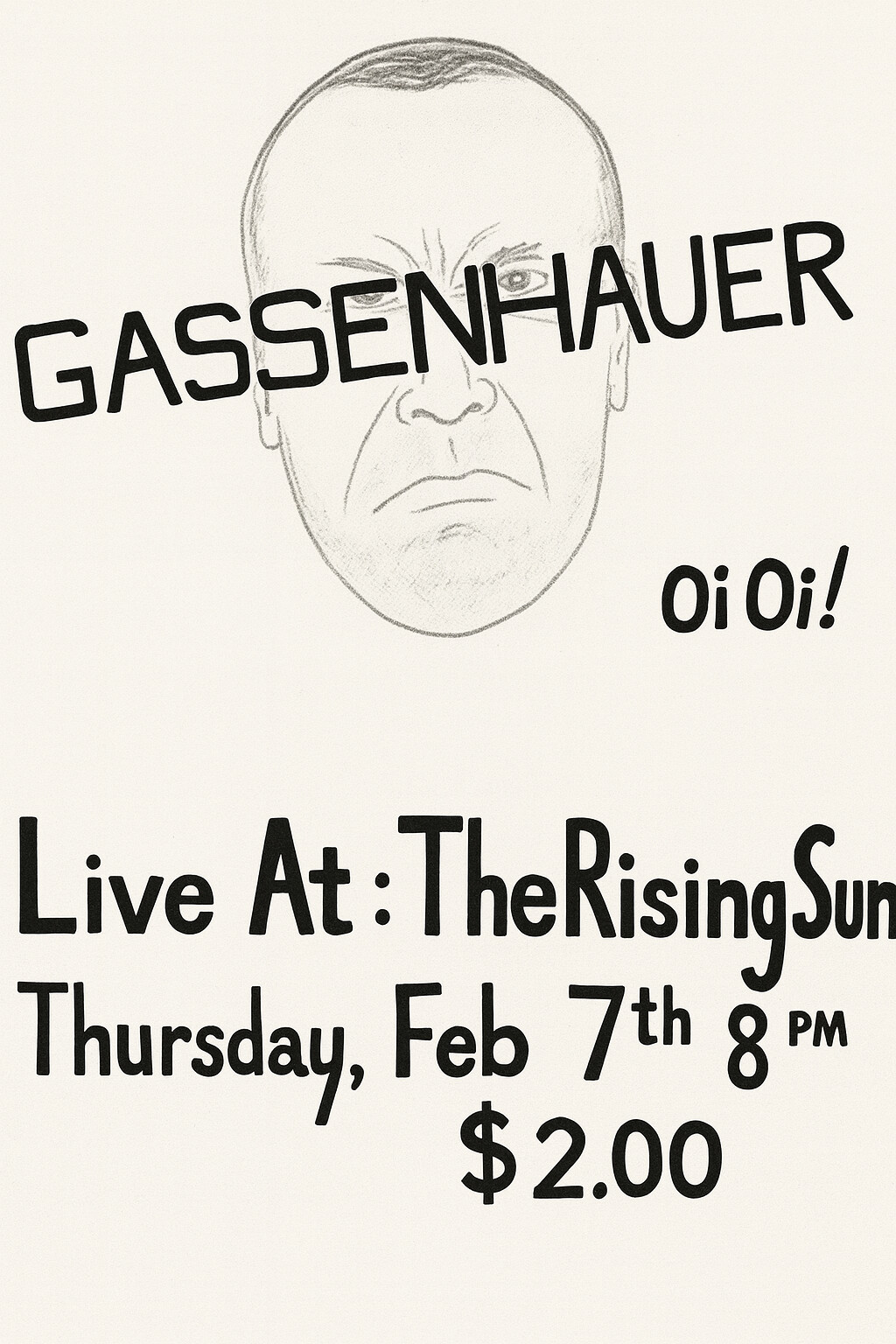
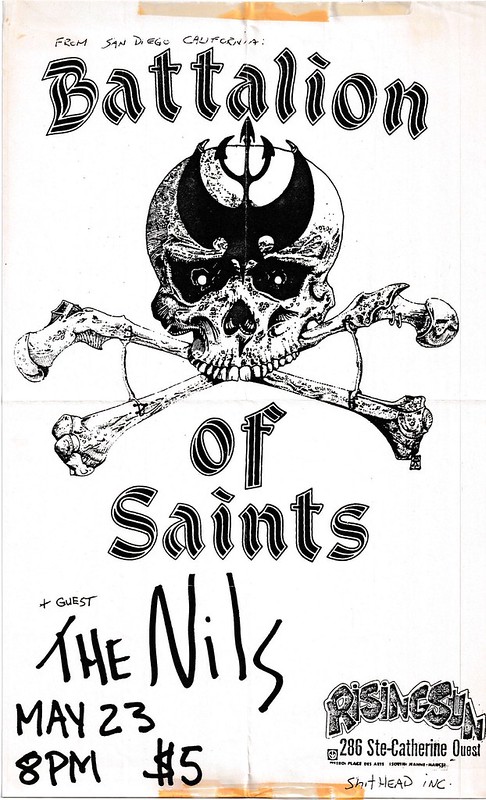
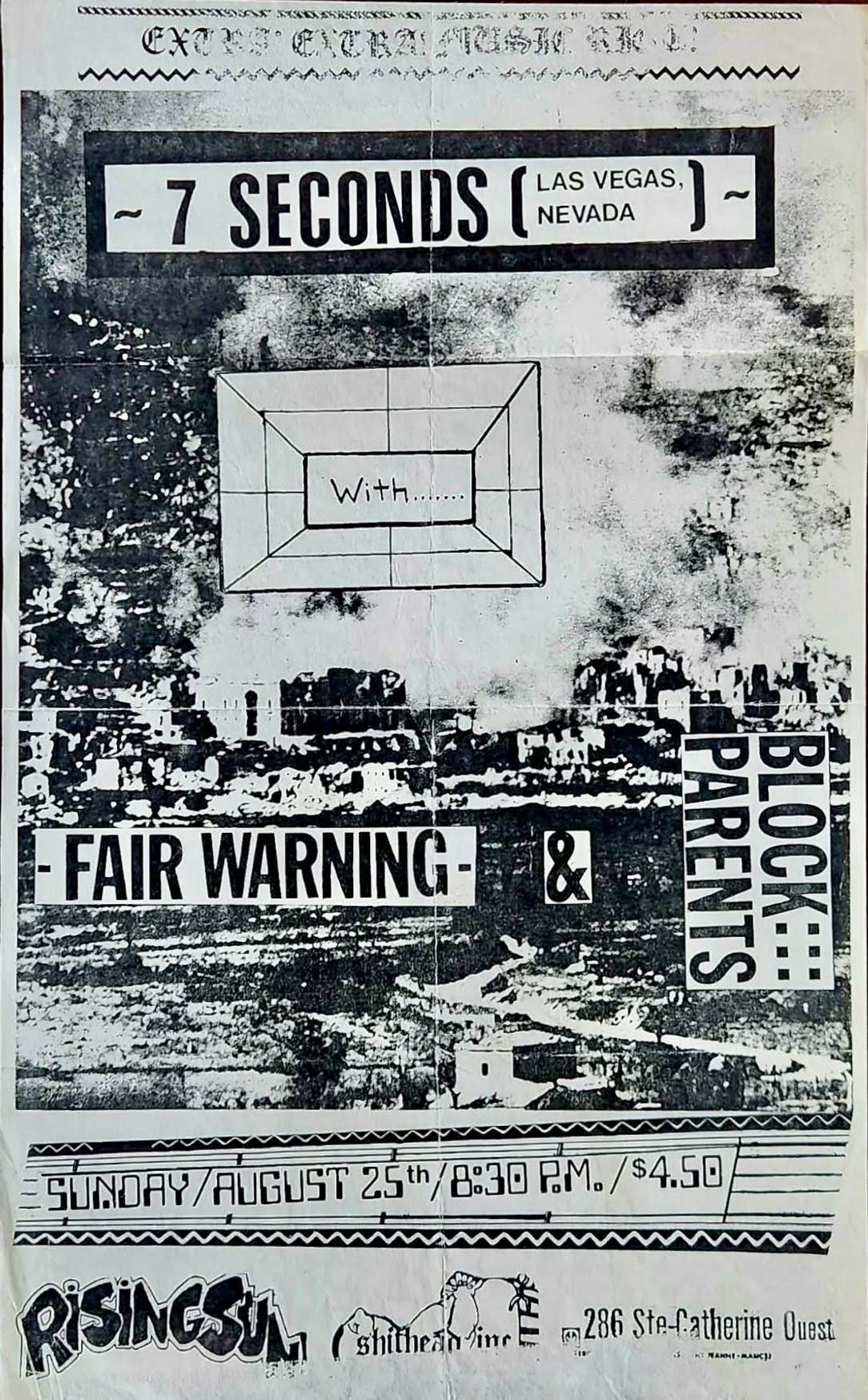
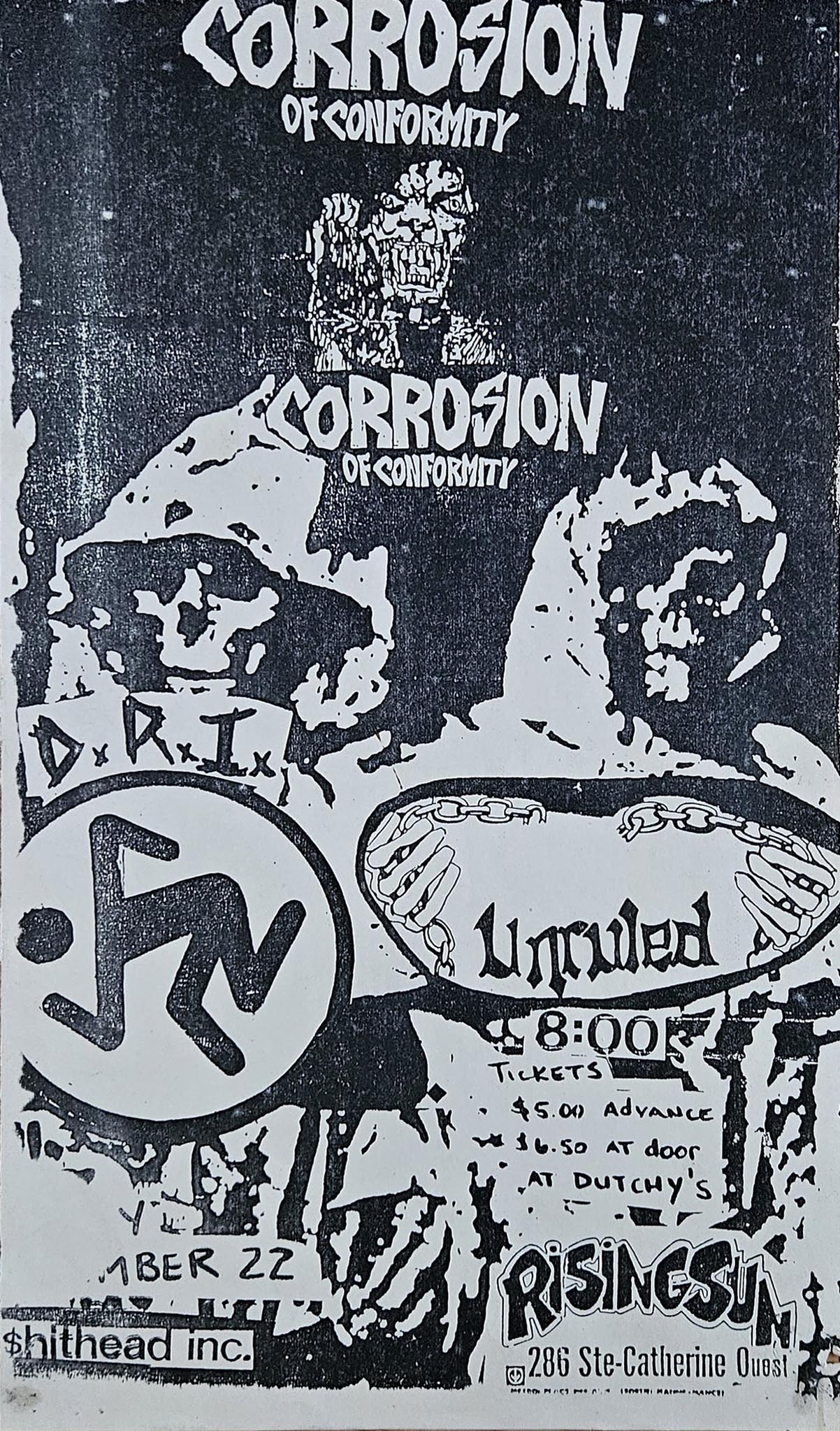
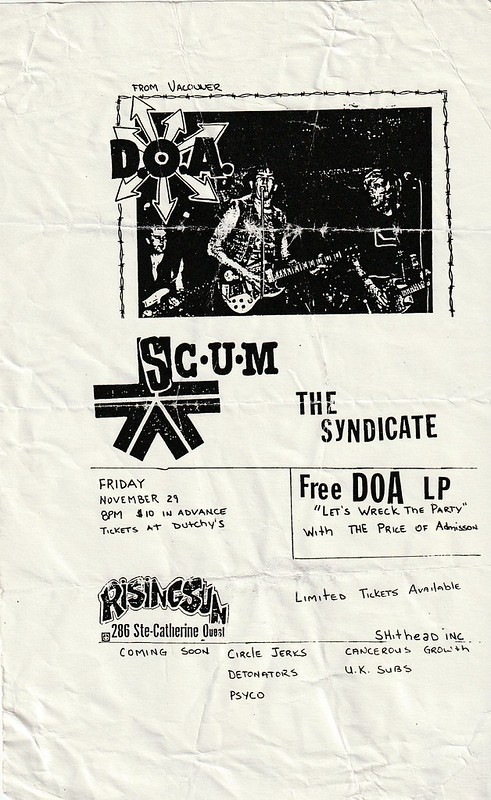
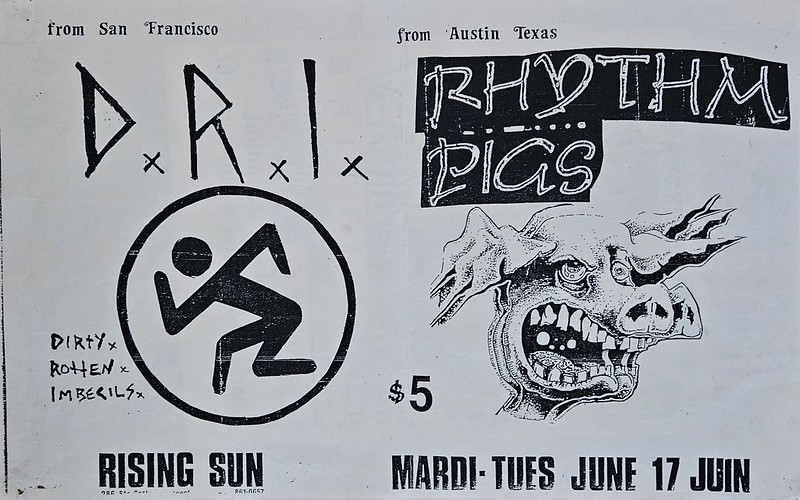
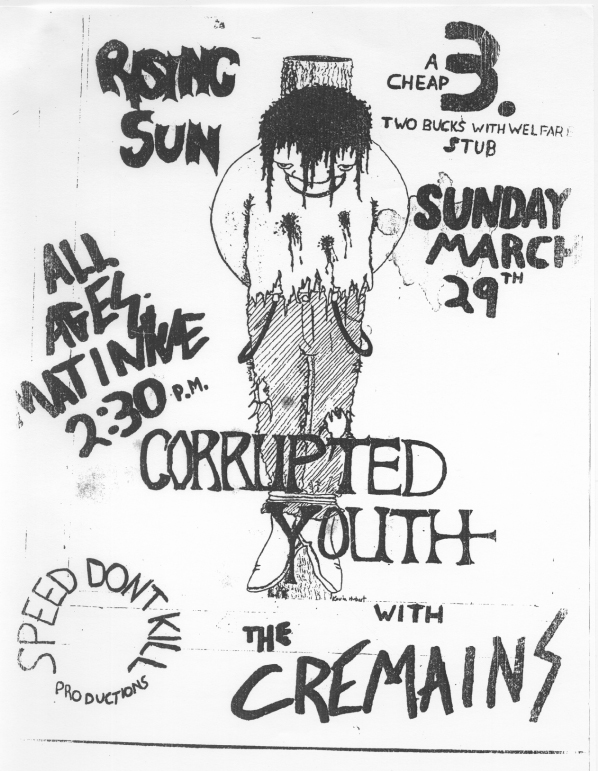
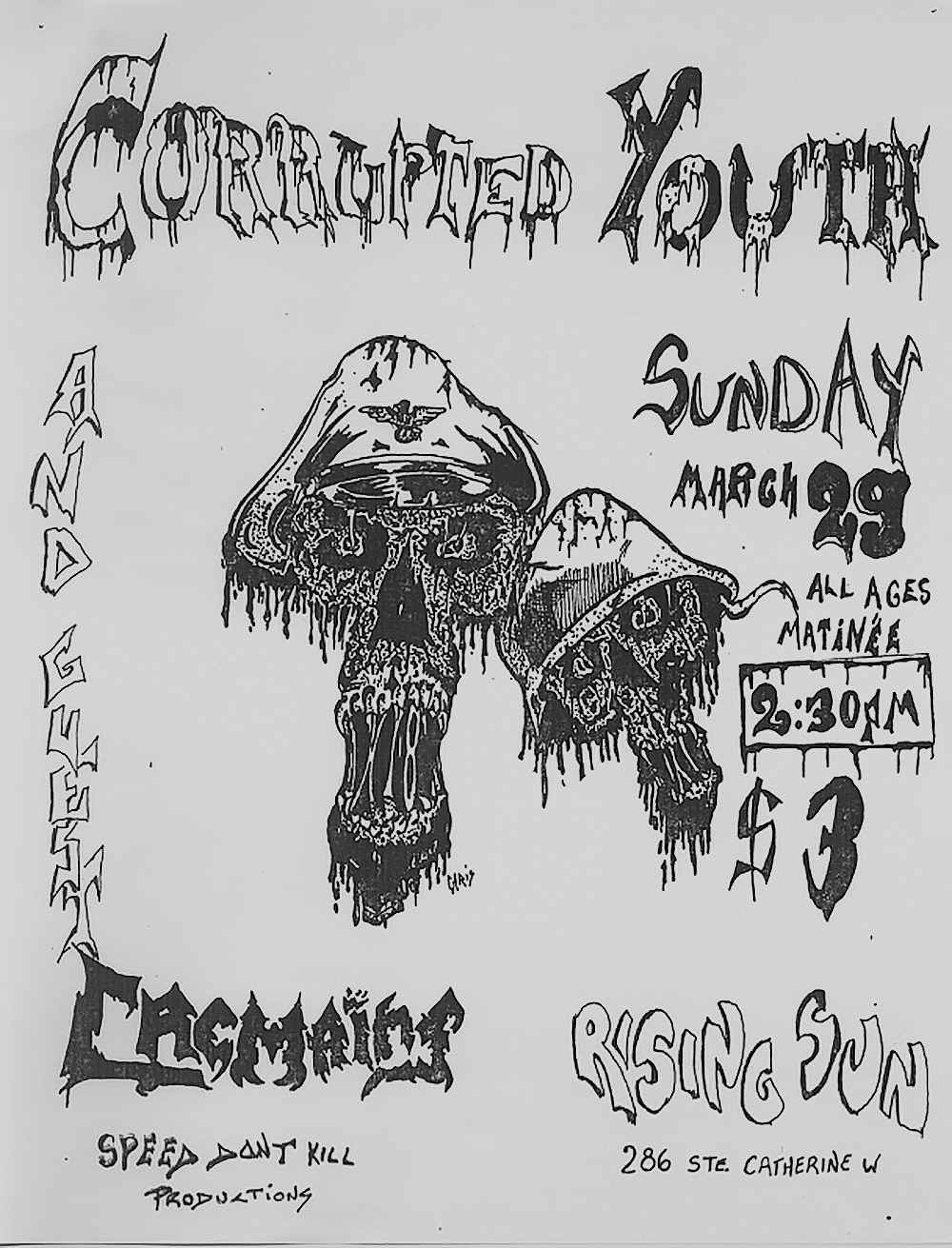
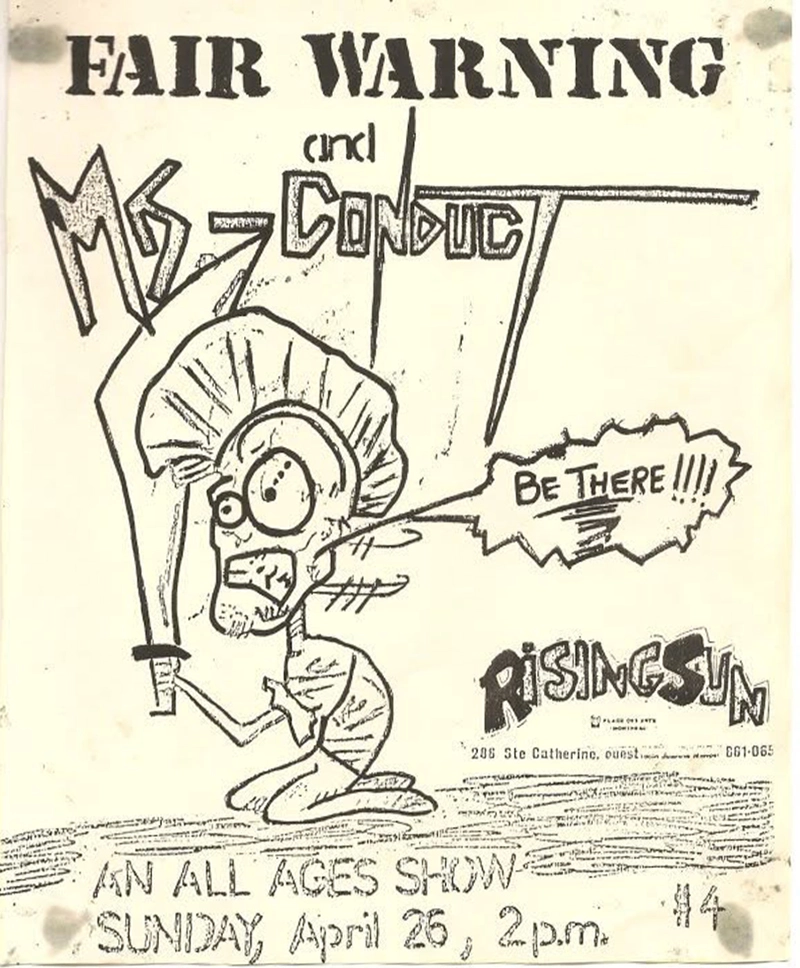
In 1985, the Rising Sun on Sainte-Catherine Street West continued its transformation into a venue with increasingly eclectic programming. In its “Best Bets” section, The Gazette noted the club’s musical diversity as early as January, announcing both Montreal punk-hardcore shows with Genetic Control and League of Dead Politicians and a reggae evening featuring Jah Cuttah.[101]
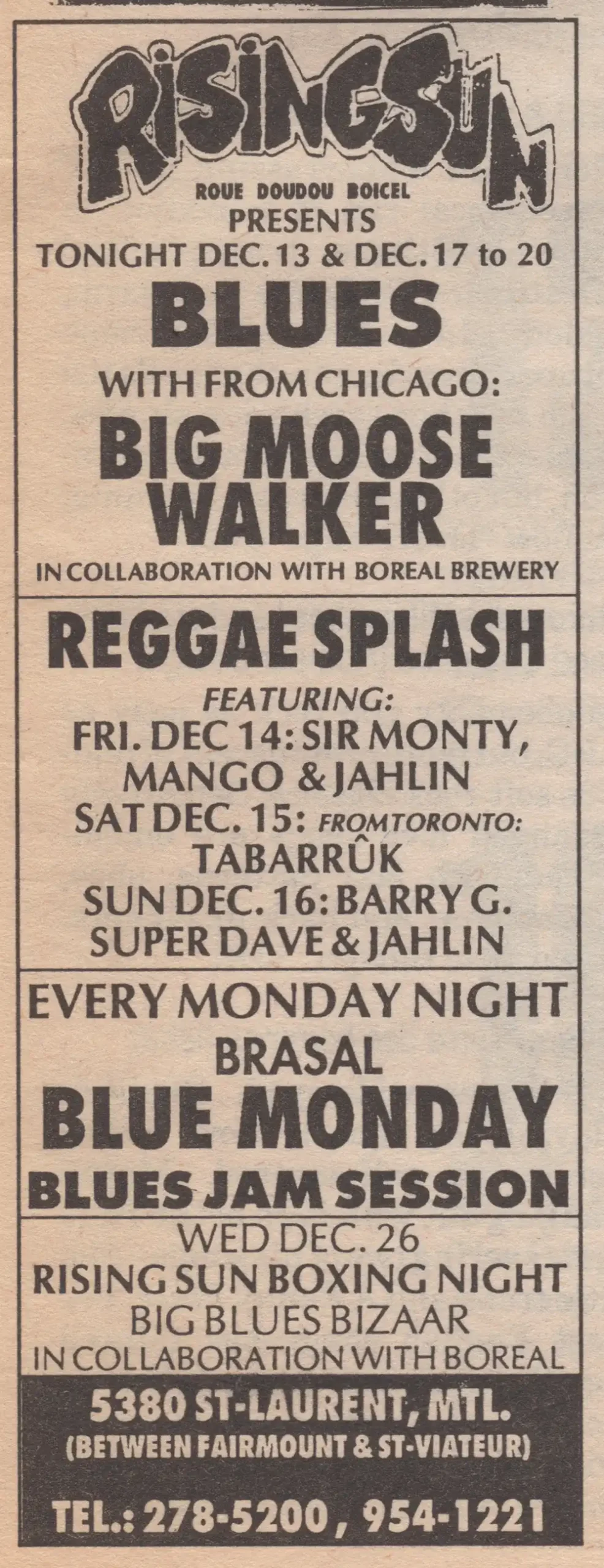
This evolution marked an important shift from the initial identity of the Rising Sun, long associated almost exclusively with African-American jazz and blues under the direction of Rouè-Doudou Boicel. Despite this diversification, the club nevertheless remained deeply linked to the Montreal blues scene. Still in January 1985, journalist Len Dobbin’s Jazz Notes column announced the appearance of blues singer and bassist “Big” Miller, accompanied by pianist Big Moose Walker. Presented as an important figure in North American blues, Clarence H. Miller was then associated with a long career that had notably crossed paths with Jay McShann and Jon Hendricks. The article also recalled his participation in the Canadian documentary Big and the Blues, produced by the National Film Board.[98]
The column also mentioned that Roué Doudou Boicel had just released the album The Great Blues Immortals, bringing together recordings made in Montreal with several figures of African-American blues and jazz, including Rahsaan Roland Kirk, Esther Phillips, Lightnin’ Hopkins and Big Mama Thornton, captured either at the Rising Sun or during the 1980 Festijazz at Place des Arts. Despite the financial difficulties of the early 1980s, the club therefore continued to act as a venue for musical presentation, record production and encounters between American artists and the Montreal scene.[98]

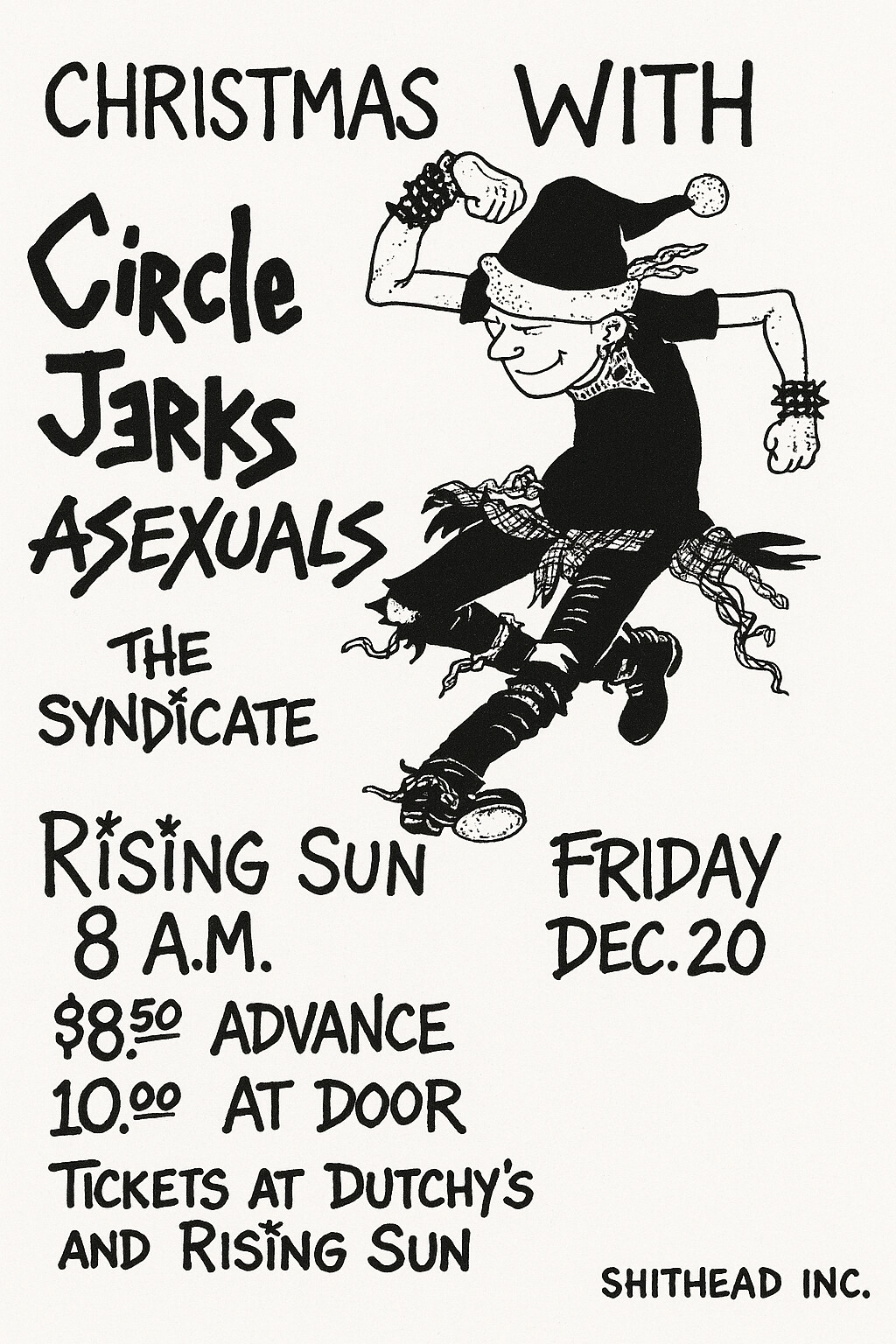
At the end of the year, the Rising Sun also welcomed Montreal’s rapidly growing hardcore punk scene. In December 1985, The Gazette published a review of the Circle Jerks concert presented at the club with Montreal bands Asexuals and Syndicate. In his article entitled “L.A. hardcore music comes to town”, journalist Michael Mirolla described the arrival in Montreal of California hardcore associated with Los Angeles’s radical punk movement. He notably emphasized the presence of Keith Morris, former singer of Black Flag and now leader of the Circle Jerks, as well as the extremely energetic atmosphere of the show presented before a packed room.[100]
Mirolla also noted that a significant portion of the audience had come from a Motörhead concert presented the same evening at the Spectrum, a sign of the growing connection between the hardcore punk and heavy metal scenes in the mid-1980s. The journalist also emphasized the important place occupied by local groups, especially Asexuals, then considered among Montreal’s most notable hardcore bands. Through these shows, the Rising Sun now appeared as a venue open to a multitude of musical styles, ranging from jazz and blues to reggae, punk and hardcore, reflecting the profound transformations of Montreal nightlife in the mid-1980s.[100]
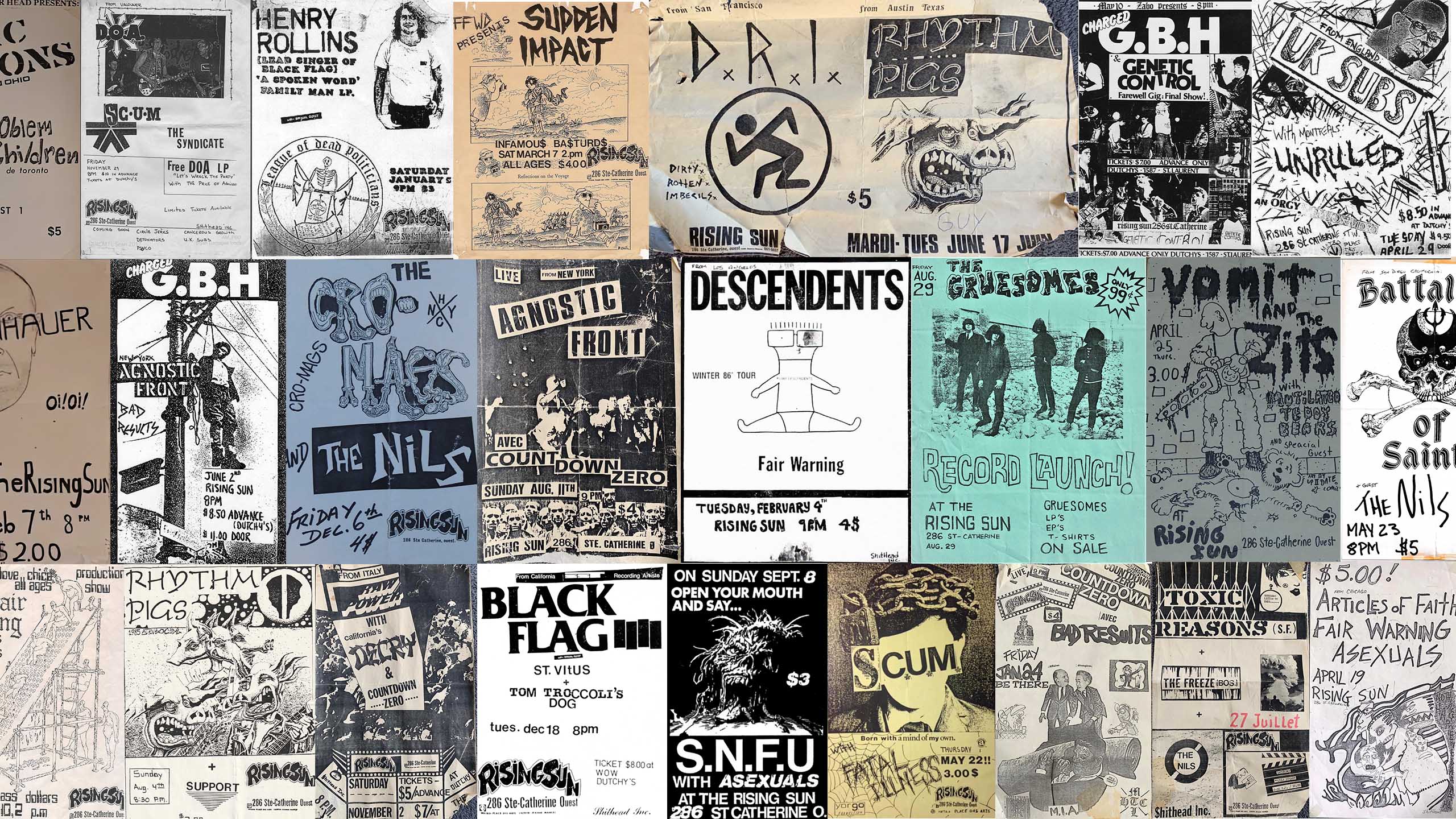
“Alternative music promoters approached me to produce shows. I hesitated to respond to their request. They assured me that they would make sure everything went well. I took the risk by renting the place to these young English-speaking promoters from Montreal. There were skinheads among the clientele. They all respected me. I had no problem with them. The music was an infernal cacophony. The young people in the room practised slam dancing. One evening, two promoters had organized a punk rock show with the English band GBH. There were about five hundred young people in the club, packed in like sardines. The young people were rowdy. They spat on the heads of people coming in. A police officer called me to warn me that an intervention was being prepared: ‘Doudou, empty the room to avoid a raid.’ I immediately did what the officer said. I spoke to the young people, who listened to me. They left without causing any problem. The police raid was narrowly avoided thanks to the good relations I had with the officers at that police station. I put an end to those kinds of demented and schizophrenic shows.” [103]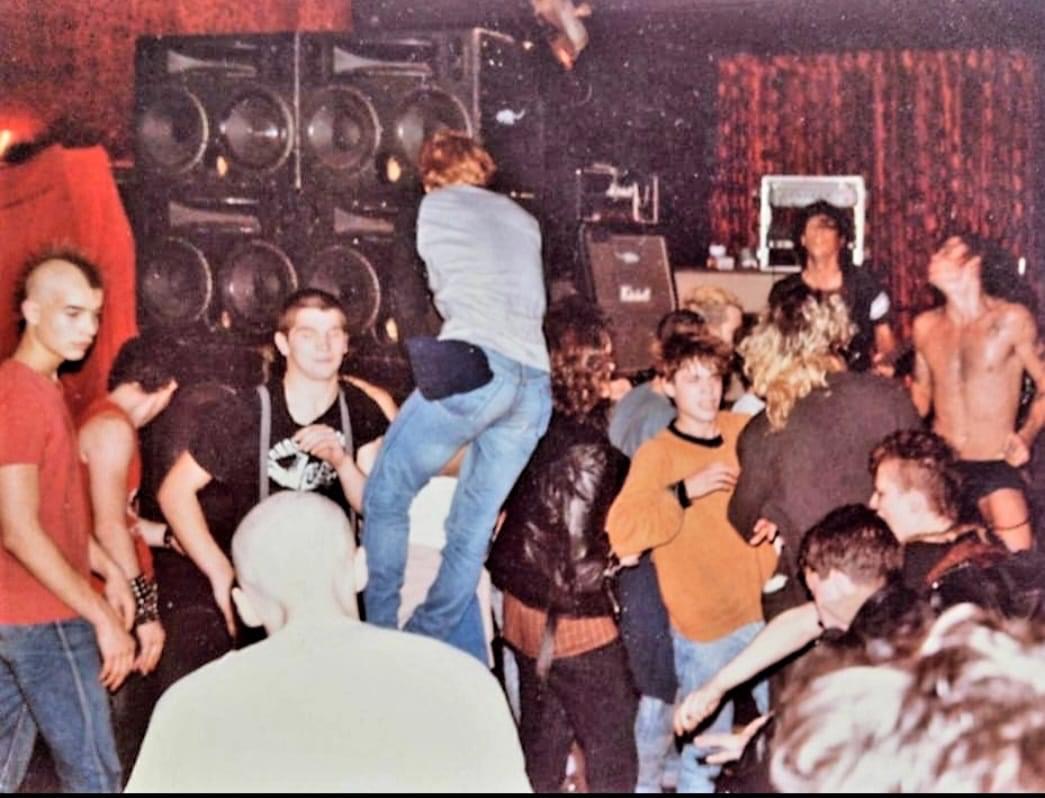 A photograph taken during a Black Flag concert at Montreal’s Rising Sun in 1984 shows the chaotic, highly charged atmosphere of the hardcore punk scene, with a dense crowd of punks in a mosh pit before an imposing wall of amplifiers in the raw intimacy of the club; photo credit remains to be determined.
14. 1986: Rouè-Doudou Boicel Defends the Rising Sun
In April 1986, The Gazette announced that Rouè-Doudou Boicel, owner of the Rising Sun on Sainte-Catherine Street West, had returned from a three-week trip to Haiti, where he had been invited to organize an international jazz festival in Port-au-Prince scheduled for February 1987. The article noted that Dizzy Gillespie was to open the festival, while B.B. King was also among the confirmed artists. The event was to bring together jazz, blues, reggae and salsa performances, once again illustrating Boicel’s desire to move beyond the Montreal framework and develop international music projects linked to African-American and Caribbean music.[104]
In October 1986, Le Devoir published an open letter by Doudou Boicel denouncing what he considered a campaign of discrimination by the Montreal Musicians’ Guild against the Rising Sun (Soleil Levant). The club owner stated that his establishment had been placed on a blacklist for allegedly hiring musicians who were not members of the American Federation of Musicians. Boicel argued, however, that several of the accusations were unfounded.[103]
In his letter, Boicel also accused the Guild of applying different rules to the Rising Sun than to other Montreal venues that also presented rock, punk, reggae, blues and jazz shows with non-member musicians. He recalled that the Rising Sun had played an important role in organizing the first international jazz festivals in Montreal in the late 1970s under the name Rising Sun Festi-Jazz. Through this position, Doudou Boicel presented himself as an independent defender of Montreal’s music scene in the face of institutional and union pressures within the cultural milieu of the time.[103]
15. 1987: Rufus Rockhead, Living Memory of Montreal Jazz
In May 1987, The Gazette announced a series of tribute performances devoted to Rufus Rockhead at the Rising Sun on Sainte-Catherine Street West. Organized by the Association pour la Promotion et la Diffusion de la Culture Noire du Québec, led by Rouè-Doudou Boicel, the event aimed to recall the historical importance of Rufus Nathaniel Rockhead, a Jamaican immigrant who became the founder of the legendary Rockhead’s Paradise and a major figure in Montreal cultural life[105]. Opened in the early 1930s at the corner of Saint-Antoine and de la Montagne streets, his cabaret stood for several decades as one of Montreal’s most famous Black venues[105].
In the article, Doudou Boicel argued that Rufus Rockhead and his cabaret should be recognized as an important part of Montreal heritage, on the same level as several of the city’s historic sites. The text also recalled that after the Quebec Liberals returned to power in the early 1960s, the club resumed its activities before being sold to Boicel in 1980. It then operated under the names Doudou’s Rockhead Paradise, then Rising Sun 2, before its permanent closure in 1982[105].
16. 1988: The Reign of Reggae at the Rising Sun
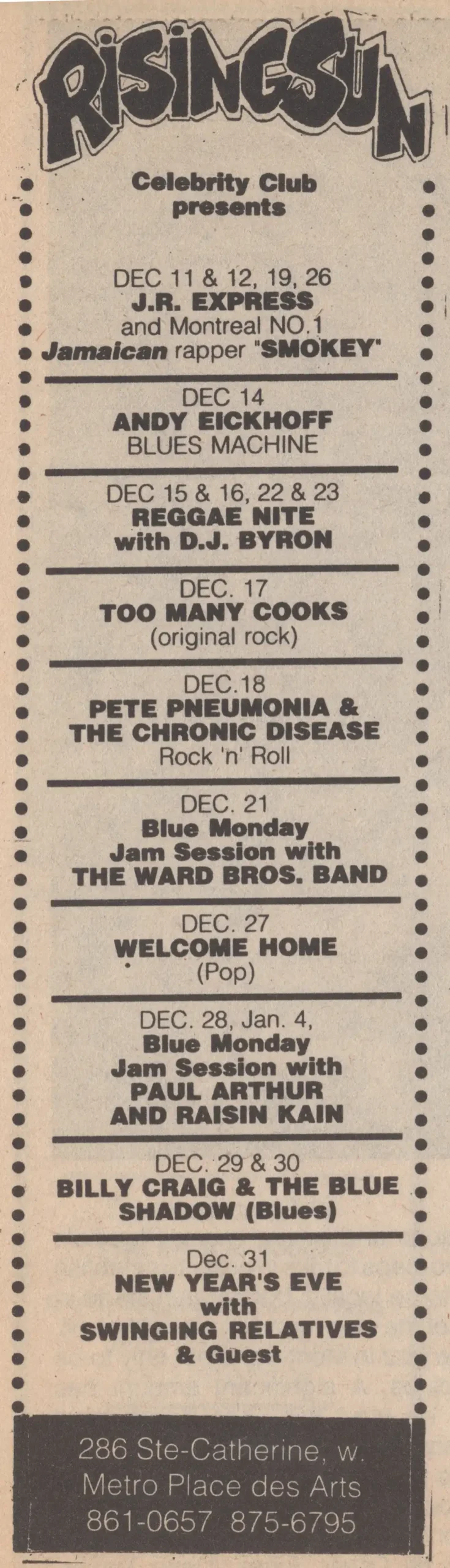
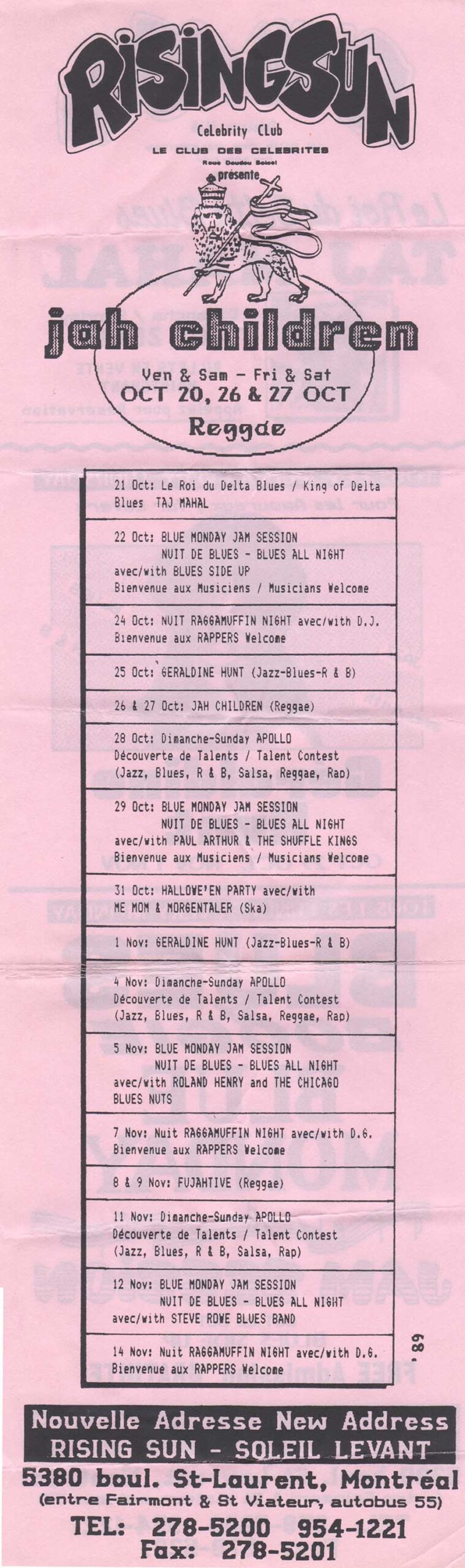
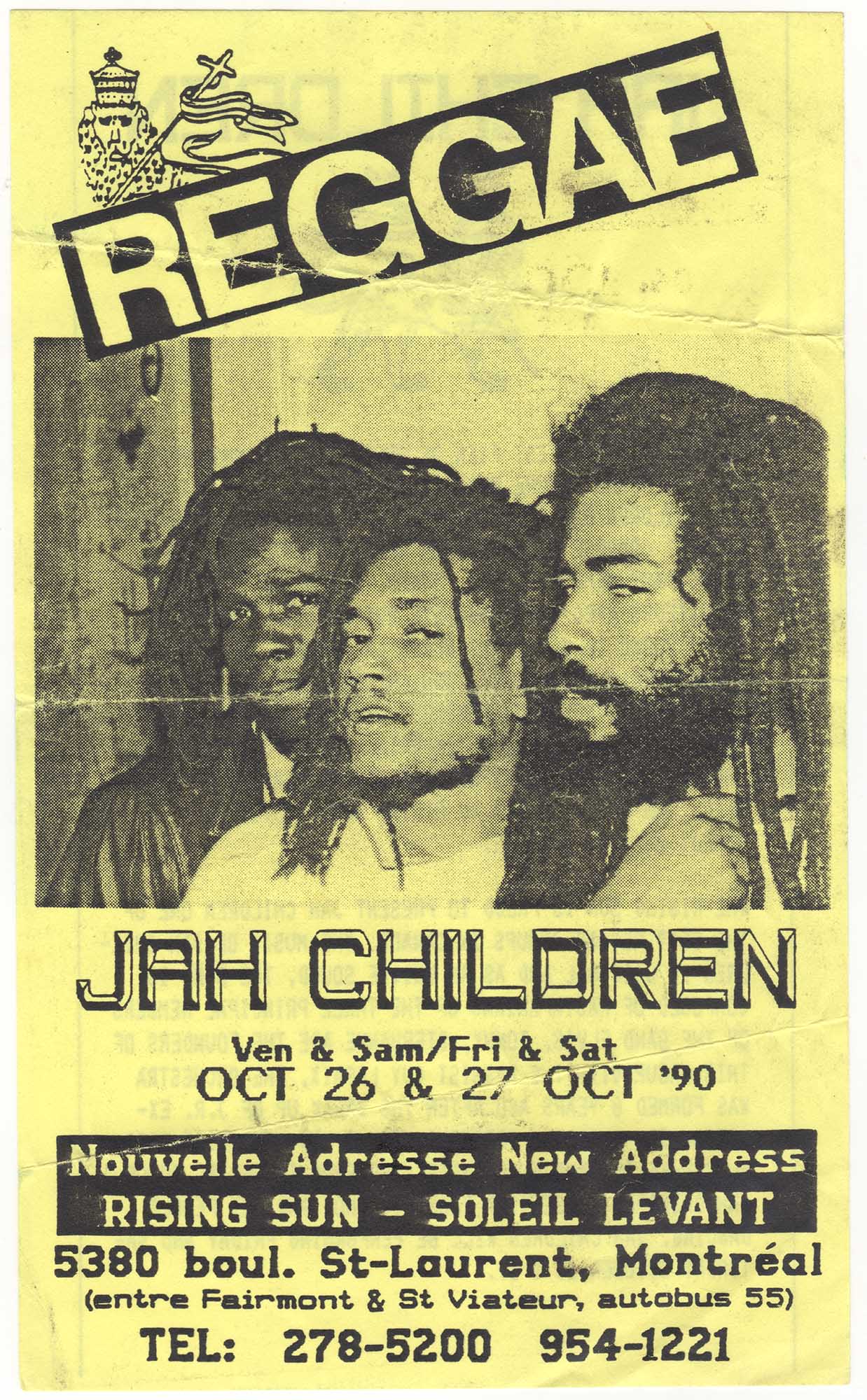
In 1988, the Rising Sun moved almost completely away from its original vocation as a jazz club to become one of Montreal’s main venues for reggae. The cultural columns of The Gazette repeatedly mentioned the regular presentation of reggae artists and groups at 286 Sainte-Catherine Street West, notably during a spring tribute festival to Bob Marley, as well as through the presence of ensembles such as Swinging Relatives, Urban Bushmen, Mike Anthony and the Sons of Light, Roots Movement, Mango 3 and Jah Children. On several occasions, journalists even described the club as a place where the Rising Sun “goes reggae”, underlining the dominant place this music now occupied in its programming. This reorientation reflected both the evolution of Montreal audiences’ tastes and Rouè-Doudou Boicel’s persistent desire to promote music from the Afro-Caribbean diaspora. Although a few blues and jazz concerts continued to be presented occasionally, 1988 clearly marked one of the periods most strongly associated with reggae in the history of the Rising Sun.
17. 1989: Rouè-Doudou Boicel’s Cultural Battle
In November 1989, The Gazette published an important profile of Rouè-Doudou Boicel, a key figure in Montreal’s jazz, blues and reggae scene since the mid-1970s. In the article entitled “Club owner boosts black culture”, journalist Paul Wells presented Boicel not only as the owner of the Rising Sun, but above all as a committed defender of Black culture in Montreal. From the opening lines, Boicel summarized his mission by declaring: “I am an African. It is my duty to protect this culture,” a statement that reflects the deeply cultural and identity-based dimension he associated with his work as a promoter and presenter[106].
The profile looked back at the opening of the Rising Sun in 1975, at a time when Montreal still had a nightlife strongly marked by jazz and blues clubs. Under Boicel’s direction, the establishment quickly became one of Montreal’s main venues devoted to African-American music. Several major international jazz and blues figures performed there during the second half of the 1970s and the early 1980s, to the point that musicians such as Art Blakey personally recommended the club to their American colleagues, aware of the importance of supporting a Black entrepreneur in Montreal’s cultural milieu[106].
Wells also highlighted Boicel’s role in creating the first editions of Montreal’s Festijazz. Presented at Place des Arts in 1978, 1979 and 1980, the event was one of the first large-scale attempts to give Montreal an international festival devoted to jazz and African-American music. Through his work as a promoter, Boicel helped bring internationally renowned artists to the city well before the arrival of the major festivals that would later contribute to Montreal’s cultural profile on the world stage[106].
Despite these successes, the 1980s proved difficult for Boicel and the Rising Sun. The article mentions, among other things, the sharp rise in interest rates at the beginning of the decade and the boycott imposed by the Musicians’ Guild starting in 1982, two factors that complicated the arrival of American artists and weakened the club’s finances. Boicel nevertheless refused to give up and continued presenting blues and reggae shows at his Sainte-Catherine Street West establishment[106].
The profile then took the form of a personal questionnaire that offered a better understanding of Boicel’s personality and convictions. Born in Cayenne, French Guiana, on July 10, 1938, he said he had studied at the École des Beaux-Arts in Paris and defined himself as much as a painter, writer and man of culture as a music promoter. He also stated that he had produced several films for Radio-Canada, including Une place au soleil, devoted to the realities of Black communities in Quebec[106].
His answers reveal the breadth of his artistic and intellectual interests. He said he appreciated Beethoven as much as Mozart, mentioning The Marriage of Figaro in particular, while also citing Béla Bartók and John Cage among the composers he admired. In literature, he mentioned Victor Hugo, whom he considered one of the great humanists, as well as Jacques Prévert and Oscar Wilde. He also expressed admiration for Black intellectual and political figures such as Malcolm X and LeRoi Jones (Amiri Baraka), whom he regarded as important thinkers of his time[106].
Finally, Boicel discussed his attachment to Montreal while also voicing certain criticisms of Quebec society at the time. Although he described Canada as a free country, he nevertheless felt that many attitudes remained narrow when it came to the realities of Black communities. He explained that he devoted his life to promoting Black culture “in all its dimensions” and to improving the economic and social situation of Black people. This statement effectively summarizes his conception of the Rising Sun, which he saw not only as a music club, but also as a cultural and identity-based space at the heart of Montreal[106].
The questionnaire also offers a rare glimpse into his daily life in the late 1980s. He mentioned living in Westmount, driving a Dodge van, preferring old stone buildings and particularly liking dogs. A film lover, he also cited French director Bertrand Tavernier. Taken together, his answers paint the portrait of a complex figure — intellectual, cultural activist, entrepreneur and passionate music lover — who continued, despite the difficulties, to defend the place of Black cultures in Montreal’s artistic life[106].
18. 1990: From the Ashes of the Rising Sun to Its Rebirth on Saint-Laurent Boulevard
In March 1990, the Rising Sun on Sainte-Catherine Street West was devastated by a violent fire that abruptly ended nearly fifteen years of activity at one of Montreal’s leading jazz, blues and reggae clubs. The Gazette described a four-alarm blaze mobilizing between 80 and 100 firefighters to prevent the flames from spreading to neighbouring buildings. No casualties were reported, but the damage was considerable: the establishment was almost entirely destroyed, and several businesses in the area suffered smoke and water damage[107].
The disaster represented far more than the loss of a business. Since its opening in 1975 under the direction of Rouè-Doudou Boicel, the Rising Sun had established itself as a major venue for African-American music in Montreal. The fire also destroyed an essential part of that memory: sound equipment, a record collection, a recent piano and, above all, numerous concert recordings that Boicel considered irreplaceable[107][113]. The tragedy became even more personal when his four-year-old daughter Aimuna was in the building when the fire broke out. After a few anxious minutes, Boicel found her safe and sound on the ground floor and left the scene with her in his arms. Although no immediate evidence of arson was found, he nevertheless suspected a deliberate act in a context he considered tense since his return to programming more centred on jazz[107][113].
The timing was particularly cruel, since the club seemed to be regaining momentum. A few days earlier, a concert by saxophonist Archie Shepp had drawn such a large crowd that several spectators had to be turned away at the door. Convinced that the Rising Sun still had a loyal audience, Boicel announced in the days following the disaster his intention to start again “as quickly as possible”[113]. In an article published shortly afterward, journalist Mark Lepage described him surrounded by posters and memorabilia, determined to rebuild despite the scale of the losses[110].
Lepage nevertheless emphasized that the fire came after several already difficult years, marked by conflicts with the Montreal Musicians’ Guild and financial problems that had weakened the establishment. For Boicel, the permanent disappearance of the Rising Sun would deprive many artists of an essential workspace and further reduce the visibility of Black music in Montreal nightlife. Rather than seeing it as an ending, however, he presented the ordeal as an opportunity for a new beginning[110].
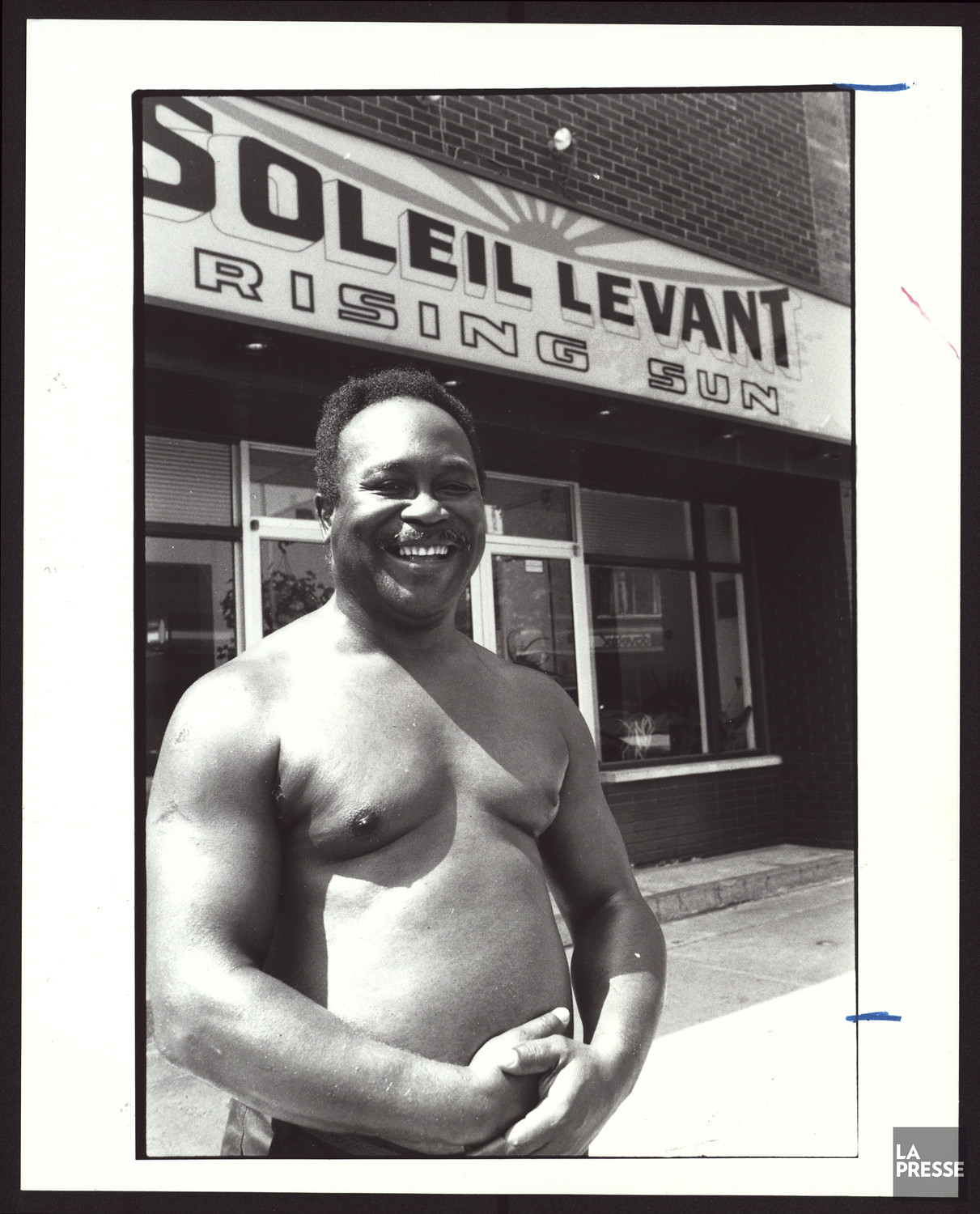
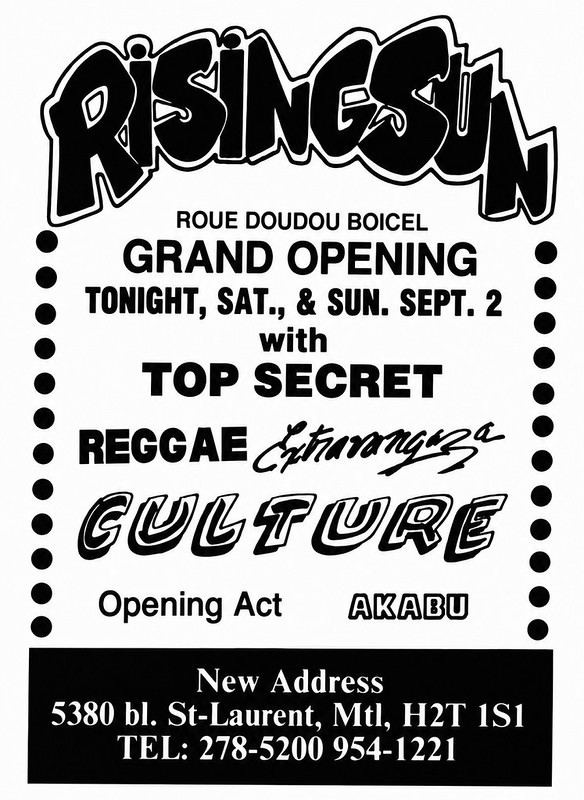
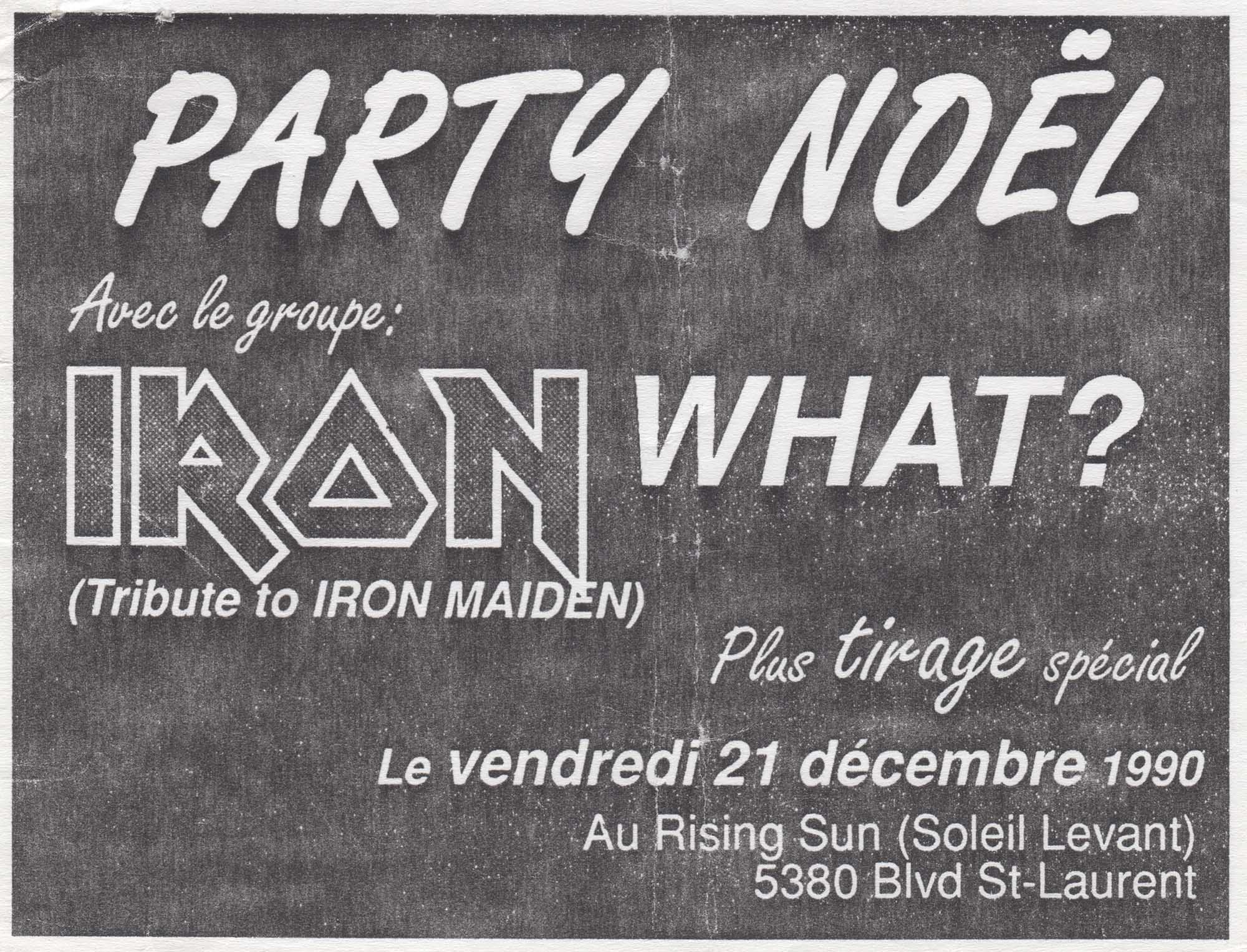
This relaunch took shape as early as the summer of 1990, when Le Devoir announced that the Soleil Levant had found a new home at 5380 Saint-Laurent Boulevard, in the former Le Milieu cinema. With approximately 538 seats, the new venue allowed Boicel to leave behind the cramped Sainte-Catherine Street premises and move into a space capable of hosting large-scale concerts, festivals, record launches and multidisciplinary events[109][112]. The choice of the Main was also strategic: at the turn of the 1990s, several former cinemas and theatres there were being reinvested by alternative venues, music bars and independent promoters. Boicel thus sought to reposition the Soleil Levant at the heart of a new Montreal cultural corridor[112].
The new venue also gave him the opportunity to broaden his mission. While keeping jazz, blues and reggae at the centre of its identity, he wanted to open the space to African music, South American music, funk, emerging Montreal rap, experimental performances, theatre productions and community events. He notably announced preparations for a reggae festival and emphasized the importance of offering a stage to Quebec, African-American, African, European and Caribbean artists[109][112].
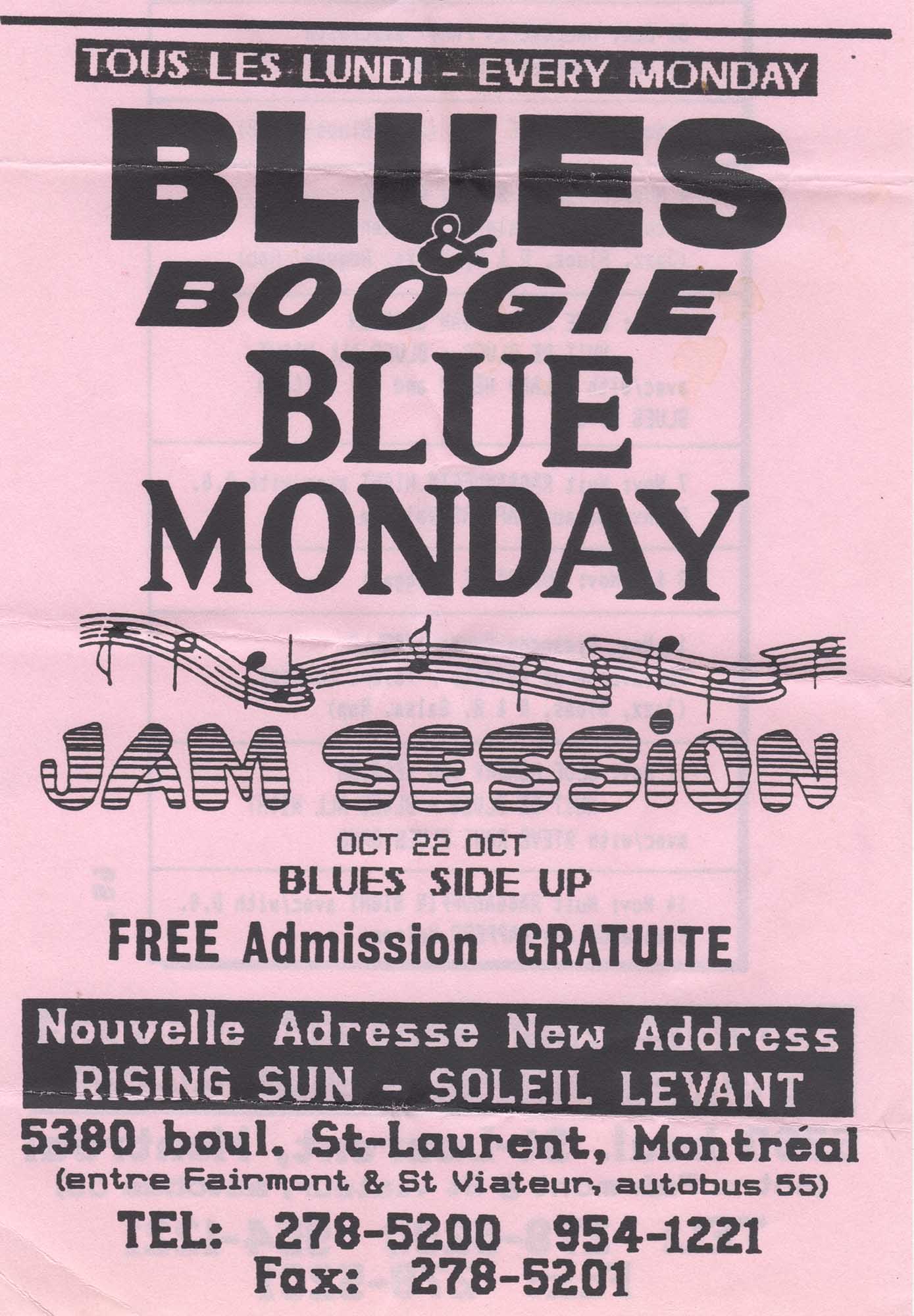
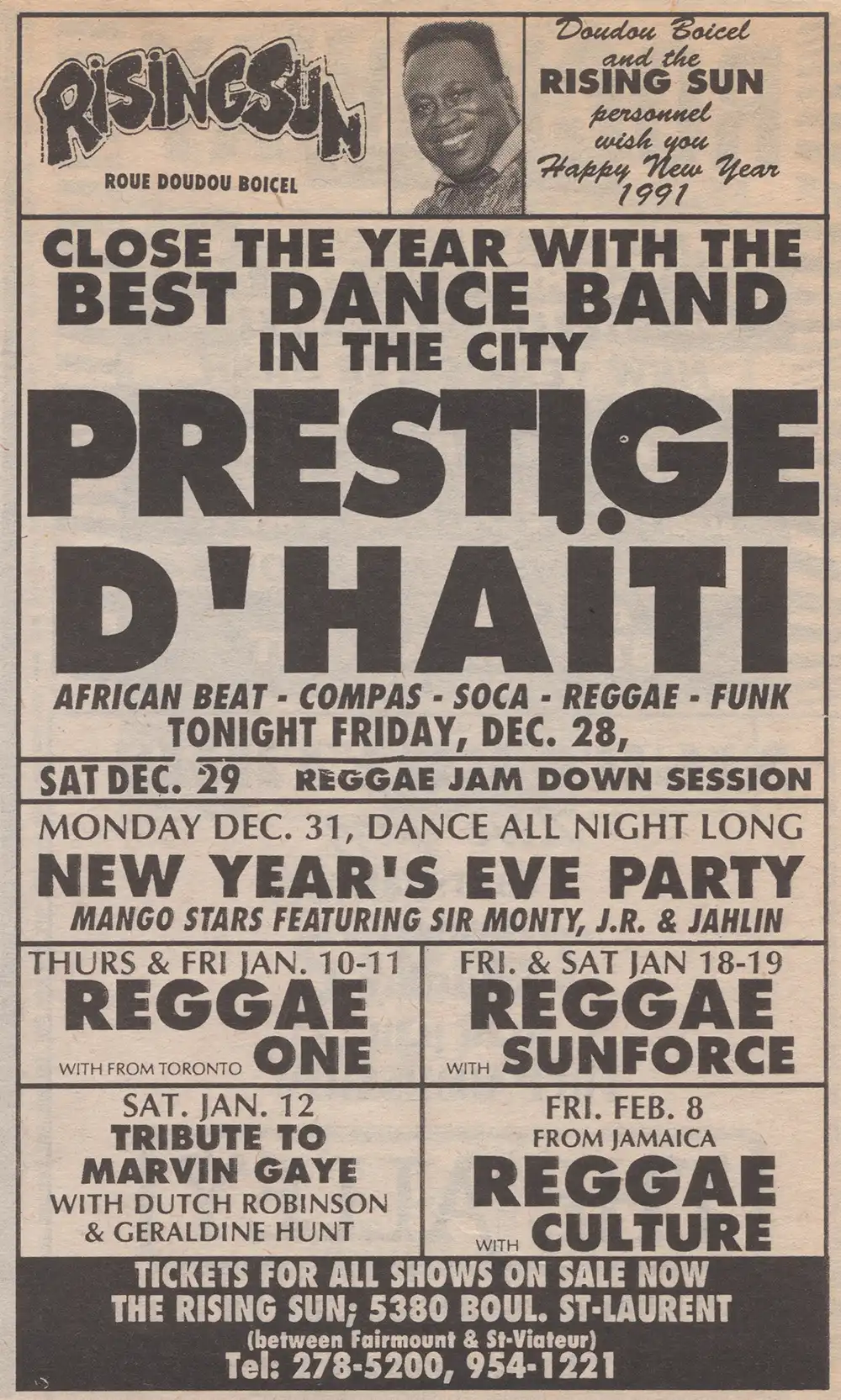
In September, The Gazette confirmed that this rebirth had become a reality. Located between Fairmount and Saint-Viateur streets, the new Rising Sun now occupied a venue of about 600 seats, nearly three times larger than the old location. Boicel acknowledged that the Sainte-Catherine Street club had become too small for his ambitions, even though this change of scale represented a significant financial risk[108]. To support this relaunch, he could rely on a vast network developed over fifteen years of programming, including the support of André Ménard, co-founder of the Montreal International Jazz Festival, as well as musicians such as Dizzy Gillespie, Buddy Guy and Taj Mahal[108]. The programming planned the return of Blue Monday evenings, reggae, rap, blues, funk and rhythm and blues concerts, as well as new, more experimental projects intended to encourage emerging Montreal talent[108].
A few days later, in his Jazz Notes column, Paul Wells announced the return of Dizzy Gillespie to Montreal for a series of benefit performances at the new Rising Sun. This highly symbolic gesture highlighted the solidarity of the music community toward Boicel, while also confirming the club’s desire to broaden its programming with projects such as the États Soniques series, devoted to improvised and avant-garde music[111].
Through this succession of events, 1990 appears as one of the most dramatic and decisive moments in the history of the Rising Sun. The fire destroyed the original venue, its archives and part of its material memory, but it also triggered an ambitious relaunch on Saint-Laurent Boulevard. From an intimate club devoted to jazz and blues, Rouè-Doudou Boicel’s project evolved into a larger venue open to reggae, funk, rap, experimental music and a wide diversity of cultural expressions. Despite losses, debts and uncertainties, the Rising Sun remained a symbol of cultural resilience at the heart of Montreal[107][108][109][110][111][112][113].
19. 1991: The Soleil Levant Between Memory, Resistance and Survival
In 1991, the Soleil Levant appeared at once as a place of memory, a space for cultural presentation and an institution weakened by the economic realities of the beginning of the decade. As early as February, La Presse placed Rouè-Doudou Boicel’s club within the celebrations of Black History Month, alongside other Montreal venues such as Balattou. The article highlighted the growing importance of Afro-Montreal initiatives and recalled that several Black artists, despite their major influence on Montreal’s cultural life, remained too little known to the wider Quebec public. Oscar Peterson, Oliver Jones, Normand Brathwaite, Boule Noire and Charlie Biddle were mentioned as essential figures in a musical heritage still insufficiently recognized[120].
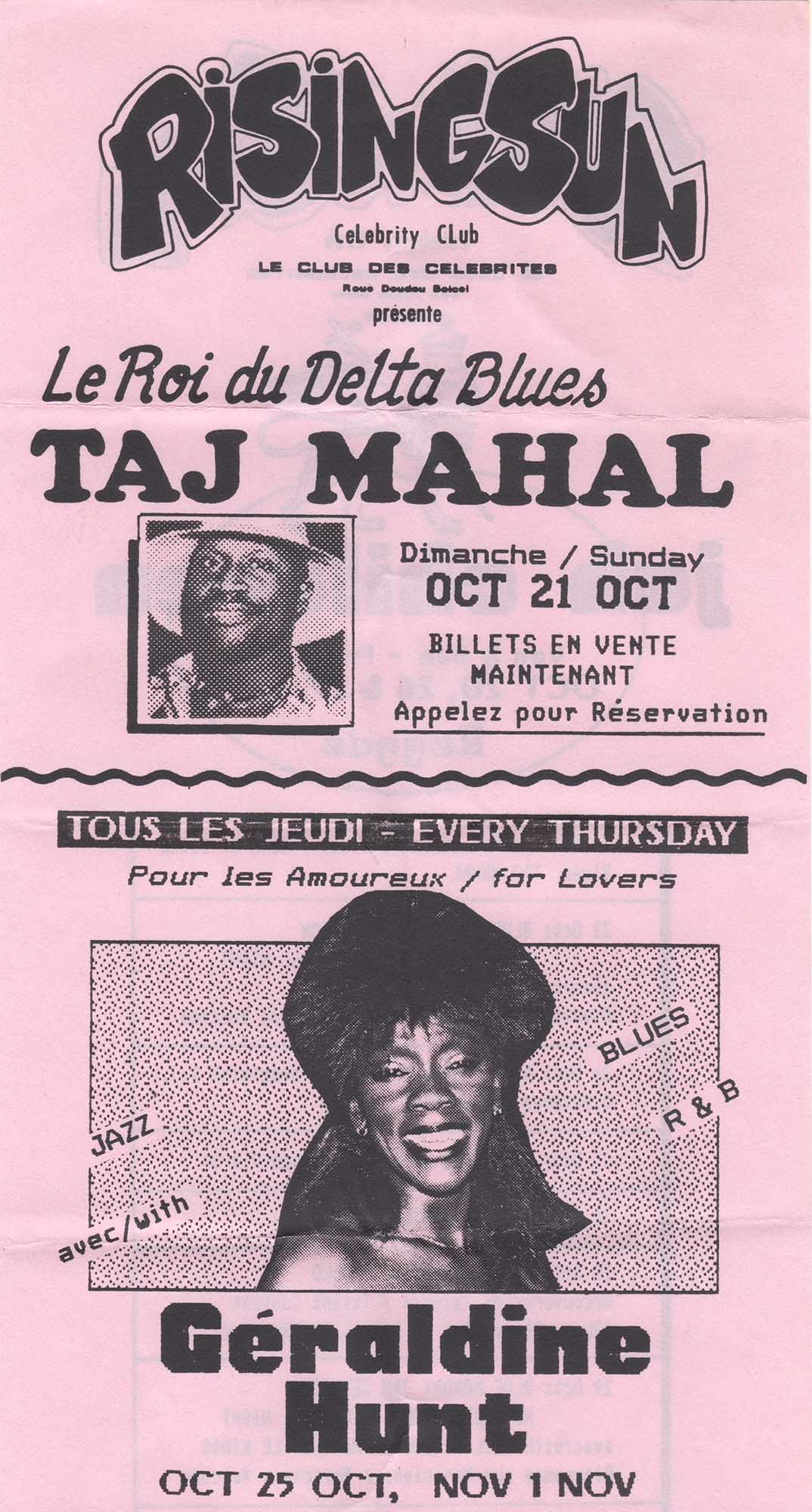
In this context, the Soleil Levant played a central role. Boicel stated there that Montreal possessed a rich Afro-Montreal culture and that municipal authorities were finally beginning to recognize its importance. The club’s special programming illustrated this desire for recognition with the Count Basie Orchestra, then directed by Frank Foster, a Dutch Robinson show devoted to Marvin Gaye, the announced presence of Geraldine Hunt and a tribute to Charlie Biddle, bassist and major cultural bridge-builder of the Afro-Quebec scene[120].
A few days later, The Gazette published a major feature entitled “Black Magic”, placing this news within a much longer history. The article presented Montreal as one of Canada’s great jazz centres in the 20th century, thanks in particular to the clubs of Little Burgundy and downtown, including Rockhead’s Paradise, the Café St-Michel and the Terminal Club. It also recalled that several Black musicians, both Canadian and African-American, found in Montreal a relatively open space for work, while still facing various forms of discrimination in hotels, clubs and performance circuits[115]. In this continuity, Rouè-Doudou Boicel and the Rising Sun were presented as heirs to a long history of presentation, cultural resistance and musical transmission. Relocated to Saint-Laurent Boulevard after the 1990 fire, the club continued to defend jazz, blues, reggae, Haitian music, zouk and the earliest forms of Montreal rap[115].
In March, this community dimension took a particularly moving form during a tribute concert organized at the Rising Sun in memory of guitarist Ivan Symonds, who had died a few days earlier on the same day as saxophonist B.T. Lundy. The Gazette described musicians arriving through the melting snow, instruments in hand, to honour one of their own in an atmosphere far more intimate than that of the major summer festivals. Before the concert, Boicel spoke briefly and invited children present in the room to light a candle in front of the stage in Symonds’s memory[116]. This moment of reflection revealed another reality of Montreal jazz: that of a fragile milieu, made up of musicians often forced to survive through scattered gigs, far from the visibility offered by the major summer events. Even before a modest audience, the Rising Sun remained a place of gathering and solidarity, where the memory of local musicians could be honoured by their peers[116].

But this cultural function was not enough to protect the club from financial difficulties. In the summer of 1991, less than a year after its reopening on Saint-Laurent Boulevard, the Soleil Levant went through a major crisis. La Presse reported the organization of benefit shows intended to support the establishment, then threatened with closure. Several Montreal artists agreed to perform free of charge, including Dutch Robinson, Willy Ray, Michelle Sweeney, Geraldine Hunt and Goldie Alexander, as well as local reggae groups such as J.R. Express, Jahlin and Roots Movement[119]. This mobilization testified to the music community’s attachment to Boicel’s club, perceived not only as a performance venue, but as a community space where jazz, blues, reggae, rhythm and blues and Afro-Montreal music intersected. The presence of the Petits Tambours du Mont-Royal, directed by Marc Séguin, as well as a blues evening with the Alain Charest Blues Band, also showed the breadth of the programming defended by the club despite the crisis[119].
A few days later, The Gazette confirmed the gravity of the situation: the Rising Sun had to close its doors temporarily, while Boicel sought to obtain financial assistance of about $150,000 from municipal, provincial and federal authorities. The debts then amounted to about $100,000, notably because of high rent, operating costs and the work required to adapt the former Théâtre Le Milieu to the needs of a concert hall[114]. La Presse in turn returned to this closure in an article entitled “Endetté, le Soleil Levant ferme ses portes”, emphasizing that the club, after sixteen years of existence, found itself strangled by the costs of its new location, the recession and the structural difficulties of the entertainment industry[117].
Boicel, however, vigorously defended the importance of the Soleil Levant, which he presented as one of the rare places where several Black Montreal musicians could work regularly. He recalled that over the years the venue had welcomed artists such as Muddy Waters, Willie Dixon, Buddy Guy, John Lee Hooker, Sonny Terry, Brownie McGhee, Lightnin’ Hopkins, Dizzy Gillespie, Rahsaan Roland Kirk, Art Blakey, McCoy Tyner, Yusef Lateef, Joe Pass and Archie Shepp, while also recalling its role in organizing a jazz festival at the end of the 1970s, before the arrival of the Montreal International Jazz Festival[117]. Despite the conflicts, financial losses and obstacles accumulated since the 1990 fire, he thus continued to present the Soleil Levant as an essential institution for the presentation of Black music in Montreal and for the development of the reggae, blues, R&B and Afro-Montreal scenes[117].
Finally, in December 1991, Boicel spoke publicly in La Presse through an open letter entitled “Montréal Blues: Depressing Reportage”. He criticized a series of Radio-Canada programs that he considered reductive and demoralizing for Montreal’s Black communities. According to him, the report too often associated Afro-Canadians with crime, poverty and marginalization, without sufficiently highlighting their professional, cultural and economic successes[118]. This position confirmed that his commitment extended far beyond the management of a club. By invoking figures such as Oliver Jones, Oscar Peterson and the Biddle family, Boicel insisted on the importance of offering young Afro-Montrealers positive role models and a fairer representation of their community. Through the Soleil Levant, but also through his public interventions, he thus pursued the same struggle: to have the richness, complexity and contribution of Black cultures to Montreal recognized[118].
20. 1992: The end of an era
Published in March 1992 in Le Devoir, the article “The Era of the New Rastas” examined the transformations of Montreal’s reggae scene and tropical discotheques in the early 1990s, while also returning to the difficult situation of the Rising Sun and its owner, Rouè-Doudou Boicel[121]. The report presented Boicel as one of the leading figures in the presentation of Black music in Montreal since the 1970s. Founder of the Rising Sun in 1975, he had helped make the club a major venue for jazz, blues and reggae, welcoming over the years international artists such as Muddy Waters, John Lee Hooker and Buddy Guy[121]. However, the economic realities of the early 1990s now made it much more difficult for an establishment devoted mainly to Black music to survive. After the fire that destroyed the Sainte-Catherine Street West location in 1990, Boicel relaunched the Rising Sun on Saint-Laurent Boulevard, but operating costs, taxes, municipal regulations and declining attendance quickly complicated this rebirth. According to him, major festivals and transformations in the entertainment market had also profoundly changed the place of jazz and blues in Montreal nightlife[121].
In this context, the article revealed that Boicel was attempting to reinvent himself by taking over the Club Sensation, located at 316 Sainte-Catherine Street West. Presented as a tropical discotheque more oriented toward reggae, dancehall and popular Afro-Caribbean music of the early 1990s, the venue embodied a new reality of Montreal nightlife, more centred on dancing, a festive atmosphere and a broader clientele[121]. Through this transition, Le Devoir showed how Boicel sought to adapt his approach to Montreal’s cultural and commercial transformations. Even though the Club Sensation moved away from the jazz and blues model historically associated with the Rising Sun, he continued to defend an important place for Black and Afro-Caribbean music in Montreal’s cultural landscape[121].
21. Distinctions & Legacy
Published in July 1996 in The Gazette, journalist Joe Fiorito’s article “The incandescent Doudou Boice” looked back on the career of Rouè-Doudou Boicel and his major role in the development of jazz, blues and Black music in Montreal since the 1970s. Originally from French Guiana and having arrived in Montreal after a period in Paris, Boicel quickly became an essential figure in the music scene thanks to the Rising Sun, which over the years welcomed some of the greatest figures in international jazz and blues, including Art Blakey, McCoy Tyner, Buddy Guy, Willie Dixon, Sonny Terry, Brownie McGhee, Lightnin’ Hopkins, B.B. King, Sarah Vaughan, Bill Evans, Dizzy Gillespie and John Lee Hooker. The club thus became one of the main crossroads for African-American music in Montreal[122].
Fiorito also returned to the creation of Festijazz in the late 1970s, an event presented at Place des Arts and now considered one of the precursors of the future Montreal International Jazz Festival. Despite the skepticism of several cultural players at the time, Boicel helped demonstrate that a major festival devoted to jazz could attract a large Montreal audience[122]. The journalist nevertheless recalled the many difficulties he faced over the years: high operating costs, tensions with certain cultural institutions, conflicts involving the Musicians’ Guild and chronic lack of funding. After acquiring the legendary Rockhead’s Paradise, relaunched under the Rising Sun name, Boicel accumulated debts and was ultimately dealt the severe blow of the 1990 fire. Despite one final attempt to relaunch on Saint-Laurent Boulevard, the club would never fully regain the stability of its best years[122].
Fiorito nevertheless described Boicel as a deeply respected figure in Montreal jazz circles, admired for his determination and his commitment to presenting Black music. He also emphasized the importance of the many recordings made at the Rising Sun, notably through the Rising Sun Collection series released by Justin Time Records, which preserves part of the club’s unique atmosphere and musical evenings[122]. In the final lines of the report, Boicel appears more personal and nostalgic. Living in Notre-Dame-de-Grâce, where he was then running a Creole restaurant, he said he continued to follow with affection the younger generations who had frequented the Rising Sun. Watching a child cross the room, he confided: “Some of my kids were raised in the Rising Sun. I miss those days.” He added that he would probably open another club if he still had the energy — and that it would likely still bear the name Rising Sun[122].
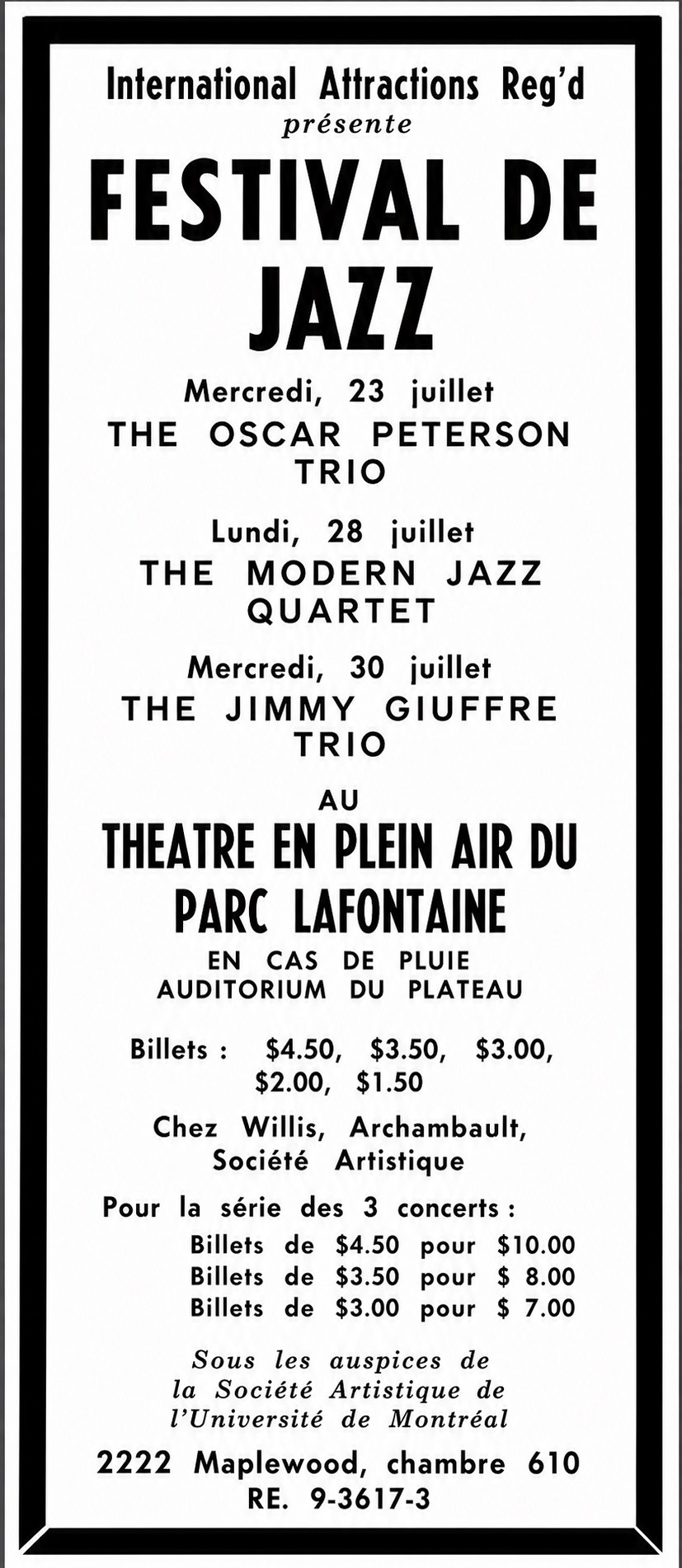
A few days after the publication of this profile, an open letter by Montreal columnist Jim Little qualified certain historical points surrounding Festijazz. Published in The Gazette, it recalled that Montreal had already hosted several major jazz events well before the late 1970s, notably the Jazz at the Philharmonic tours organized by Norman Granz as early as the 1940s, as well as various festivals presented during the 1950s and 1960s[123]. Internationally, it is generally recognized that the first international jazz festival was held in Nice, France, in 1948, with Louis Armstrong among the main headliners[133]. This clarification echoes, in particular, an article published in The Gazette in July 1958 about what was then presented as Montreal’s first jazz festival at Lafontaine Park, bringing together Oscar Peterson, the Modern Jazz Quartet and the Jimmy Giuffre Three[124]. However, while Rouè-Doudou Boicel’s Festijazz cannot be considered the first jazz festival in Montreal’s history, there is no doubt that it was the city’s first major international jazz and blues festival, held as early as 1978, two years before the creation of the Montreal International Jazz Festival, and bringing together at Place des Arts several of the most important North American jazz and blues figures in an event of unprecedented scale at the time[130]. Despite these historical clarifications, Little nevertheless recognized the importance of Boicel’s work in the development of Montreal jazz in the late 1970s and in demonstrating that a major event devoted to jazz could take root in Montreal over the long term[123].
In 2008, more than fifteen years after the closure of the Rising Sun, Boicel publicly revisited this adventure with the publication of the book L’Histoire du Rising Sun et ses légendes jazz & blues. In an article in Le Devoir, journalist Caroline Montpetit then presented the club as an important part of Montreal’s musical heritage and emphasized the major role played by Boicel in the presentation of Black music in Quebec[125]. Through his memories, he sought to preserve the memory of a place he considered a space of cultural transmission, artistic resistance and human encounters. He recalled that the Rising Sun was not only a performance venue, but also a meeting point between international artists, local musicians, students, intellectuals and passionate jazz and blues lovers[125].
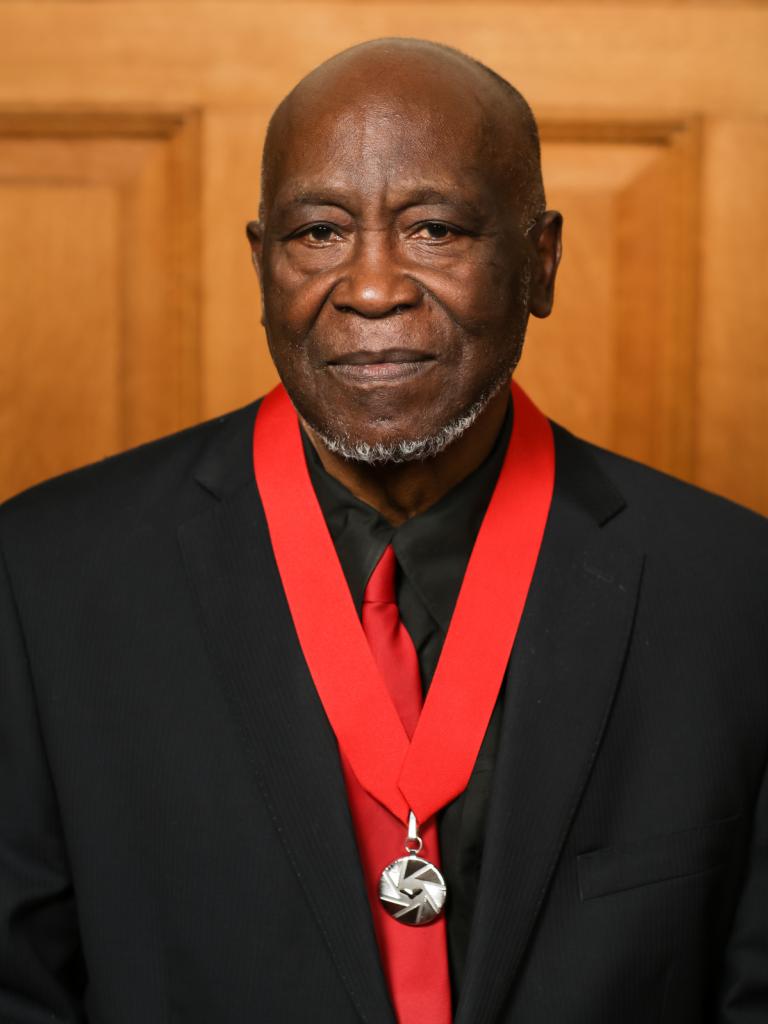
Even after its closure, the Rising Sun remained associated with an era when a small independent downtown club could still link Montreal, New York, Chicago and the great Black American musical traditions. Through his testimonies and the many distinctions he received over the years, Boicel recalled the importance of independent promoters in Montreal’s cultural history. Among the honours bestowed upon him were the 20th Black History Month in 2011, the title of Grand Citizen of the Côte-des-Neiges–Notre-Dame-de-Grâce borough that same year, the Mathieu Da Costa Prize in 2013, the Grand Prix Dynastie in 2018, as well as his appointment as Chevalier de l’Ordre de Montréal, the highest honorary distinction awarded by the City of Montreal. His work has also been recognized internationally, notably in New York, French Guiana, Senegal and South Africa[1].
12. Notes & Sources
- Ville de Montréal, “Rouè-Doudou Boicel,” Ordre de Montréal. Biographical notice published when Rouè-Doudou Boicel was admitted to the Ordre de Montréal in 2018. The text traces his path from French Guiana to Montreal, where he founded the Rising Sun in 1975 under the slogan “Jazz Is Not Dead.” The notice highlights his major role in the development of Montreal’s jazz, blues and African-American music scenes between 1975 and 1992, notably through the presentation of international artists such as Ray Charles, Art Blakey, Taj Mahal, Muddy Waters, Buddy Guy, Sarah Vaughan, Dizzy Gillespie and Nina Simone. It also recalls the creation of Rising Sun Festijazz in 1978, considered among the first international jazz and blues festivals in Montreal, as well as the many distinctions Boicel received for his cultural and social contribution to Montreal and to Quebec’s Black community.
- BOICEL, Doudou, L’histoire du Rising Sun et ses légendes du jazz & blues, Montreal, Les Éditions Michel Brûlé, 2008. Autobiographical and historical work devoted to the history of the Rising Sun and its founder. The book looks back on the club’s beginnings at the Bar des Arts, the renovations carried out with limited means, the first festivals organized as early as 1976, and the context of Montreal jazz clubs in the 1970s and 1980s. Boicel also discusses several major artists who appeared at the Rising Sun, including Art Blakey, B.B. King and Nina Simone, the 1990 fire that destroyed the Sainte-Catherine Street West location, and the venue’s occasional opening to the punk, hardcore and alternative scenes.
- DESFOSSÉS, Félix B. Research and public interventions on the history of Montreal’s hardcore, metal and alternative scenes of the 1980s. His work notably highlights the role of the Rising Sun as an important venue for punk, hardcore and crossover bands in Montreal, hosting several local and international groups in a context parallel to the jazz and blues circuits traditionally associated with the club.
- “Juifs d’ici : Gangsters juifs.” Historical notice on Harry Feldman and the context of “open city” Montreal in the mid-20th century. The text discusses illegal gambling, counterfeiting and police interventions connected to the area of 286 Sainte-Catherine Street West, the future site of the Rising Sun, illustrating the shady nightlife environment that characterized part of downtown Montreal at the time.
- KELLY, Brendan, The Gazette, July 21, 2017. Article “77 Montreal: an oral history of the local punk scene” on the history of Montreal’s punk scene. The text includes, among other things, testimony from Dan Webster of Panic Productions recalling the D.R.I. and Rhythm Pigs concert presented at the Rising Sun on June 17, 1986, illustrating the club’s importance in the development of Montreal’s hardcore and crossover scene during the 1980s.
- PÉAN, Stanley, Toute la ville en jazz, Montreal, Éditions Trait d’Union, 1999. Synthetic work devoted to the history of jazz in Montreal. Stanley Péan describes the gradual decline of public interest in jazz clubs during the 1970s and the closure of several historic venues, before presenting the opening of the Rising Sun in the spring of 1975 as an important moment in the revival of Montreal’s jazz scene. The book highlights the club’s initial role as a rehearsal space for local musicians before its rapid transformation into an internationally recognized jazz and blues venue. Péan also mentions the club’s location at 286 Sainte-Catherine Street West and Doudou Boicel’s involvement in the creation of the Montreal Festijazz in July 1978.
- BOICEL, Roué-Doudou, 2013, L’histoire du Rising Sun et ses légendes jazz & blues, Montreal, Michel Brûlé. Autobiographical and documentary work devoted to the Rising Sun and its founder. The book traces the rise of the club in late-1970s Montreal and its role as a major jazz and blues venue. The author brings together anecdotes, testimonies and photographs of many musicians who frequented the venue. The book also includes a passage detailing the creation of the Rising Sun Festijazz, presented at Place des Arts from July 21 to 23, 1978, described as one of Montreal’s first international jazz and blues festivals, born after Boicel’s trip to Vermont and meetings with artists such as Rahsaan Roland Kirk.
- BOICEL, Rouè-Doudou, L’histoire du Rising Sun et ses légendes jazz & blues, Montreal, Michel Brûlé, n.d., pp. 21–33. Passage devoted to the gradual decline of jazz in Montreal in the early 1970s amid the rise of rock and disco, as well as the survival of a more marginal scene in establishments such as the Rainbow Bar & Grill. The text also discusses the difficulty of obtaining liquor permits in a context marked by organized crime and administrative controls, before retracing the transformation of 286 Sainte-Catherine Street West — formerly the Bar des Arts — into the Rising Sun, around the slogan “Jazz Is Not Dead.”
- The Montreal Star, April 3, 1976, p. 168. Article “Doudou’s place” devoted to the Rising Sun at 286 Sainte-Catherine Street West and its owner Roué Doudou Boicel. The text describes the club’s atmosphere, its jazz programming and its Caribbean influences, notably through the serving of specialties such as rum madou and acras. The article also announces a festival organized in collaboration with New York’s Multi-Stimulus Music Society and musician Muneer Abdallah Fattah.
- Mainmise, May 1976, p. 15. Article “No, Jazz Is Not Dead!” devoted to the jazz festival presented at McGill University’s Pollack Hall on April 3 and 4, 1976. The text highlights the vitality of Montreal’s jazz scene, the participation of the McGill Jazz Band led by Nick Ayoub and several local ensembles, while emphasizing the emergence of a new generation of musicians and the importance of educational and independent initiatives in the survival of jazz in Montreal.
- Le Jour, July 14, 1976, p. 23. Advertisement-program announcing a festival presented from July 15 to 31, 1976, at the Rising Sun / Soleil Levant, 286 Sainte-Catherine Street West. The program includes artists and ensembles such as Wintergarden, Maury Kaye Quartet, Johanne Desforges, Zak, Jacques Maçon, Peter Leich Quartet, Ivan Symonds, Meandre, Ron Proby, Guy Nadon and the Multi-Stimulus Music Society of New York.
- The Gazette, September 4, 1976, p. 40. Article “Season of changes in local jazz scene” on the evolution of Montreal’s jazz scene. The text indicates that the Rising Sun had a particularly active summer, mentions Roué Doudou Boicel and the programming prospects for the new season, including several guest artists and the continuation of sustained jazz activity at the club.
- The Gazette, March 6, 1976, p. 45. “Jazzraps” column by Nighthawk. The article mentions the Rising Sun at 286 Sainte-Catherine Street West and its owner Roué Doudou Boicel, highlighting the club’s strong attendance, regular jazz programming and expansion plans, including the addition of a listening space upstairs.
- The Gazette, September 13, 1976, p. 38. Article “Kirk: A miraculous talent that can’t be destroyed” devoted to Rahsaan Roland Kirk’s performances at the Rising Sun. The text emphasizes the club’s strong attendance and presents Kirk as the first major international headliner hosted by the establishment.
- The Montreal Star, September 13, 1976, p. 53. Article “Kirk fits the mood at rising jazz club” describing the Rising Sun, its interior layout and its distinctive atmosphere, while covering Rahsaan Roland Kirk’s performances and emphasizing the musician’s role as the first major star associated with the club.
- The Gazette, October 7, 1976, p. 48. Review “Blakey’s message comes through clear” devoted to Art Blakey and the Jazz Messengers’ concerts at the Rising Sun. The article highlights the intensity of the performances, the enthusiastic reaction of the audience and the growing importance of the club within the international jazz touring circuit.
- The Gazette, January 3, 1977, p. 33. Article “Gillespie brings in New Year at a Dizzy-ing, jazzy pace” covering New Year’s celebrations at the Rising Sun with Dizzy Gillespie. The text describes the atmosphere of the club, the strong turnout and the trumpeter’s performance with his group.
- The Gazette, November 15, 1976, p. 38. Article “Lateef, quartet enjoy triumphant visit” recounting Yusef Lateef’s quartet residency at the Rising Sun. The text highlights strong attendance, the enthusiastic reception from the audience and the participation of drummer Albert “Tootie” Heath.
- The Gazette, December 1, 1976, p. 41. Article “Jones’ jazz jumps” devoted to drummer Elvin Jones’s performances at the Rising Sun. The text recalls, among other things, his historical role within John Coltrane’s quartet and emphasizes the quality of the concerts presented with his group.
- The Gazette, December 8, 1976, p. 44. Article “From Cuba with love comes Santamaria sound” covering Mongo Santamaria’s concerts at the Rising Sun. The text highlights the energy of the performances, the audience’s enthusiastic reception and the importance of Afro-Cuban influences in the club’s programming.
- The Gazette, December 16, 1976, p. 52. Review “If you want the blues, Koko’s got ’em” devoted to Koko Taylor and the Blues Machine’s performances at the Rising Sun. The article describes the singer’s vocal style, the repertoire presented and the favourable reception from the Montreal audience.
-
Roué Doudou Boicel, L’histoire du Rising Sun et ses légendes jazz & blues, Montreal, Michel Brûlé, pp. 53–57.
Note: autobiographical account of meetings with Rahsaan Roland Kirk, including his appearances at the Rising Sun in 1976 and memories associated with his performances, charisma, health and lasting impact on the club and its audience. -
Roué Doudou Boicel, L’histoire du Rising Sun et ses légendes jazz & blues, Montreal, Michel Brûlé, pp. 58–59.
Note: passage devoted to Dizzy Gillespie, evoking his personal relationship with Boicel, his performances at the Rising Sun, notably on New Year’s Eve, his role in supporting the club, and memories of later collaborations in Montreal, including the Charlie Parker tribute concert at Place des Arts. -
Roué Doudou Boicel, L’histoire du Rising Sun et ses légendes jazz & blues, Montreal, Michel Brûlé, pp. 50–51.
Note: testimony on Art Blakey and the Jazz Messengers’ first appearance at the Rising Sun, marking the club’s entry into the international circuit and a key stage in its professionalization. - The Montreal Star, November 11, 1977, p. 22. The article highlights Dexter Gordon’s appearance at the Rising Sun, received with almost religious attention by the Montreal audience. The saxophonist, then at the height of his artistic maturity, delivered a performance marked by sovereign control of tempo, broad phrasing and an imposing stage presence. His appearance confirmed the club’s ability to attract major figures in international jazz and to offer an intimate setting conducive to attentive listening, transforming each performance into an immersive experience.
- The Montreal Star, September 3, 1977, p. 39. In the article “Jazz is for everyone,” Roué Doudou Boicel describes the Rising Sun as a place devoted to making jazz accessible to all, relying on an inclusive atmosphere and open programming, bringing together local and international musicians in a spirit of sharing and cultural democratization.
- The Montreal Star, September 24, 1977, p. 34. Article describing the Café Créole adjacent to the Rising Sun, operated by Alex Boicel, son of Roué Doudou Boicel. The text highlights French Guianese Creole cuisine, notably acras, the artisanal approach of the place and the complementary role of this culinary offering in the club’s overall experience.
- The Montreal Star, January 8, 1977, pp. 138–139. Article “Jazz joints” describing the Rising Sun as a small, intimate club with a strong character, run by Roué Doudou Boicel, originally from Cayenne. The text highlights his atypical background as electrician, cook and artist, his desire to keep jazz alive in Montreal, and his active role in welcoming local and international musicians, often in a spirit of solidarity within the jazz milieu.
- The Montreal Star, November 23, 1977, p. 54. Article “Vinson offers jazz-blues-love” highlighting the regular presence of saxophonist Eddie “Cleanhead” Vinson at the Rising Sun, a favourite of Roué-Doudou Boicel, and emphasizing his style blending jazz and blues as well as the impact of his performances in the club’s intimate atmosphere.
- Le Devoir, December 30, 1977, p. 13. Article “Bill Evans: the master of impressionism” highlighting the pianist’s appearance at the Rising Sun / Soleil Levant with his trio, and emphasizing his unique style, both simple and complex, as well as the enthusiastic reception from the Montreal audience.
- Le Devoir, September 15, 1977, p. 14. Article “McCoy Tyner at the Soleil Levant: a sacred fire that devastates everything” highlighting the pianist’s appearance at the Rising Sun / Soleil Levant and describing the intensity of his playing, his legacy linked to John Coltrane and the spiritual and physical power of his performances.
- The Gazette, March 5, 1977, p. 32. Article “Jazz fans rarely switch club tastes” describing the Rising Sun as a “chameleon” venue of the Montreal jazz scene, attracting a young and diverse audience, and emphasizing its ability to bring together different publics depending on the musical styles presented, notably blues and contemporary jazz.
- The Gazette, January 22, 1977, p. 25. Article “Pianist shines in jazz quartet” on Pharoah Sanders’s performance at the Rising Sun. The text highlights the saxophonist’s unpredictable and intense character, while emphasizing the remarkable performance of the group’s pianist, considered the true revelation of the concert. The review also stresses the evolution of Sanders’s repertoire, blending bebop, ballads and post-Coltrane influences, confirming the Rising Sun’s role as a venue for modern, open and evolving jazz.
- The Gazette, January 27, 1977, p. 44. Article “Muddy Waters breathes life into the blues” describing Muddy Waters and his sextet’s appearance at the Rising Sun, transformed for the occasion into a true blues club, and emphasizing the intensity of his stage presence, his classic repertoire and the energy of his band.
- Le Devoir, February 4, 1977, p. 15. Article by Nathalie Petrowski, “Ron Carter: A new conception of the bass,” on the bassist’s appearance at the Soleil Levant with his quartet. The text highlights his innovative approach to the double bass, his refined and controlled playing, and his ability to move the instrument toward a more expressive and central role in contemporary jazz.
- The Gazette, February 9, 1977, p. 38. Article “Jazzman Getz just gets better” devoted to Stan Getz’s appearance at the Rising Sun with his quartet, highlighting the maturity of his playing, the remarkable contribution of pianist Joanne Brackeen and the musical cohesion of the group.
- Roué Doudou Boicel, L’histoire du Rising Sun et ses légendes jazz & blues, Montreal, Michel Brûlé, pp. 65–66. Account of Stan Getz’s appearance at the Rising Sun, marked by full houses but also by incidents related to his unpredictable behaviour, notably his temporary absence during the evening and his return to the stage in a state of intoxication, illustrating the complex realities of the promoter’s profession.
- The Montreal Star, March 11, 1977, p. 20. Article “Blues legend rocks Rising Sun” devoted to Willie Dixon’s appearance, presenting him as a major figure of the blues whose compositions, popularized by Muddy Waters, Howlin’ Wolf and several rock groups, strongly resonated with the audience. The text describes an energetic and communicative performance, supported by a solid ensemble, in which Dixon, as singer, bassist and storyteller, captivated a full house and transformed the Rising Sun into a true temple of the blues.
- Roué-Doudou Boicel, L’histoire du Rising Sun et ses légendes jazz & blues. Passage devoted to Bill Evans recounting his performances at the club, marked by full houses, almost religious listening, but also by tensions related to his dissatisfaction with the piano (“I can’t play with this fucking piano”), requiring Boicel’s urgent intervention to replace the instrument. The testimony highlights Evans’s duality, between musical genius and personal fragility, as well as the concrete challenges of hosting artists of this calibre.
- The Gazette, March 23, 1977, p. 31. Article “Pianist offers treats to any fan” devoted to the Bill Evans Trio at the Rising Sun. The review highlights the finesse of Evans’s playing, characterized by great delicacy, rich variations and an ability to bring familiar standards back to life. The article also emphasizes bassist Eddie Gomez’s performance, while noting some reservations about drummer Eliot Zigmund, considered too powerful for the trio’s nuanced aesthetic.
- The Gazette, July 20, 1977, p. 29. Article “Big ole Mama singing strong” by Vadney Haynes, devoted to Big Mama Thornton at the Rising Sun, highlighting the intact power of her voice after nearly forty years of career, her inhabited interpretation of “Rock Me Baby,” her role as author of “Hound Dog,” often associated with Elvis Presley, and the issue of recognition for original blues artists.
- The Montreal Star, May 10, 1977, p. 25. Article “John Lee Hooker: King of blues boogie in full-tilt form” by David Freeston, recounting John Lee Hooker’s performance at the Rising Sun, emphasizing his hypnotic boogie style, his imposing stage presence, the audience’s enthusiastic reaction and the accompaniment of the Coast to Coast Blues Band.
- The Gazette, May 12, 1977, p. 40. Article “His hard jazz has soft centre” by Dane Lanken, on trumpeter Nat Adderley’s performance at the Rising Sun, describing energetic and sharp-edged jazz blending bebop, Latin and rock, while highlighting the cohesion of the quintet and the rhythmic and harmonic richness of his playing.
- The Gazette, June 23, 1977, p. 46. Article “His voice, playing prove Hopkins knows the blues” by Vadney S. Haynes, on Lightnin’ Hopkins’s return to the Rising Sun, highlighting his status as a blues legend and the historical depth of his playing, while noting cohesion difficulties during opening night due to a lack of preparation by the band.
- The Montreal Star, July 18, 1977, p. 44. Article “Wells-Guy band keeps Chicago blues alive” by Matt Radz, describing the Junior Wells–Buddy Guy Band’s performance at the Rising Sun, highlighting a near-perfect performance, the evolution of Buddy Guy’s playing and the collective energy of the band in the Chicago blues tradition.
- The Gazette, December 9, 1977, p. 34. Article “Duke’s favorite guitarist is unaffected by success” by Nighthawk, devoted to Kenny Burrell at the Rising Sun, highlighting his subtle and refined style, his relationship with the audience and his musical approach marked by restraint and mastery.
- The Montreal Star, December 15, 1977, p. 27. Article “Jimmy Smith sets the pace” by Matt Radz, describing the famous organist’s performance at the Rising Sun, his major influence, his virtuosity and the intensity of his interaction with the Montreal audience.
- Pop Jeunesse Rock, November 12, 1977, p. 18. Article “Jazz: A clarification needed about Montreal’s only Jazz Club” defending the Soleil Levant / Rising Sun as Montreal’s main jazz club, while addressing tensions between promotion, the music press, economic constraints and recognition of Roué-Doudou Boicel’s work.
- La Tribune, December 19, 1977. Article “Soleil levant sur jazz” devoted to the Rising Sun and its founder Roué-Doudou Boicel. The text describes the club as a modest and not particularly elegant place, but one recognized for hosting some of the greatest jazz musicians in the world, including Dexter Gordon, Yusef Lateef, McCoy Tyner, John Lee Hooker, Stanley Turrentine, Mose Allison, Ron Carter, Art Blakey and Dizzy Gillespie. The article emphasizes the respectful atmosphere of the venue, the diversity of the Montreal audience that frequented it, and Boicel’s cultural vision, presenting jazz as music born from the African-American historical experience and based on human sharing rather than profit-seeking.
- Le Devoir, May 27, 1978. Article by Nathalie Petrowski entitled “Doudou Boicel: A First Jazz Festival in Montreal,” devoted to Roué-Doudou Boicel’s organization of the first international jazz festival in Montreal under the impetus of the Soleil Levant. The text retraces the steps taken by Boicel, the financial difficulties linked to the project and his desire to make Montreal an international jazz crossroads by bringing together artists such as Sarah Vaughan, Muddy Waters, Dexter Gordon, Hubert Laws and B.B. King.
- The Gazette, July 14, 1978. Article by David Sherman entitled “Doudou’s stars will jazz it up for black culture,” devoted to Roué-Doudou Boicel and the “Festijazz” festival presented at Place des Arts. The text describes Boicel as a figure committed to promoting Black culture in Montreal, while addressing the financial risks of the festival, his criticism of the music industry and the participation of major artists such as John Lee Hooker, Willie Dixon, Muddy Waters, Dexter Gordon, Hubert Laws, Sarah Vaughan and B.B. King.
- The Gazette, July 26, 1978. Article by David Sherman entitled “B.B. King tells SRO house to expect ’79 jazz festival,” devoted to the success of Festijazz 1978 organized by Roué-Doudou Boicel at Place des Arts. The text highlights the festival’s strong attendance, the presence of major blues figures such as B.B. King, Willie Dixon, Muddy Waters and John Lee Hooker, as well as hopes for the festival’s return in 1979 following the success of this first edition.
- Le Devoir, January 27, 1978, p. 22. Article by Nathalie Petrowski entitled “From a Rehearsal Room to an International Program,” devoted to the Soleil Levant and Roué-Doudou Boicel. The text traces the club’s evolution from a rehearsal space to an international stage hosting artists such as Roland Kirk and Art Blakey. The article also describes the marginal and psychedelic atmosphere of the venue, as well as Boicel’s artisanal philosophy, based on proximity to musicians, the promotion of jazz and perseverance despite financial difficulties.
- The Montreal Star, June 1, 1978, p. 5. Article by Trevor Rowe entitled “Musician denied entry to Canada,” devoted to the initial refusal to grant pianist Horace Silver a work permit for a series of concerts at the Rising Sun. The text highlights Roué-Doudou Boicel’s concerns about new immigration rules affecting American musicians and the possible consequences for the club’s international programming and the jazz and blues festival he was preparing at Place des Arts.
- The Montreal Star, June 3, 1978, p. 16. Article by Trevor Rowe entitled “Misinterpreted rules lead to permit denials,” devoted to problems surrounding the application of new Canadian immigration and work-permit rules for American musicians. The text returns in particular to the case of the Rising Sun and Roué-Doudou Boicel, who had learned that pianist Horace Silver would initially be unable to enter Canada because of mistaken interpretations of regulations and pressures related to the hiring of Canadian musicians. The article highlights tensions between jazz clubs, musicians’ unions and federal authorities, while specifying that the decision was ultimately reversed after the file was reviewed.
- The Gazette, July 20, 1978, p. 47. Article by David Sherman entitled “Boogie king is collecting old royalties,” devoted to John Lee Hooker during his visit to Montreal as part of Festijazz and his performance at the Rising Sun. The text looks back on the bluesman’s career, his many recordings made under different pseudonyms, and the legal battles surrounding royalties from his early records. The article also emphasizes Hooker’s attachment to club performances and closeness to the audience, while evoking the role of Roué-Doudou Boicel and the Rising Sun in promoting blues and Black culture in Montreal.
- La Presse, June 30, 1978, Arts and Entertainment section, p. 10. Article by Bruno Dostie entitled “Doudou Boicel Brings Back the Glory Days of Jazz,” devoted to Roué-Doudou Boicel, the Soleil Levant and the jazz and blues festival presented at Place des Arts in July 1978. The text highlights Boicel’s desire to promote jazz and African-American culture in Montreal, while emphasizing the presence of major artists such as Sarah Vaughan, Dizzy Gillespie, Dexter Gordon, John Lee Hooker, Muddy Waters and B.B. King. The article also stresses the cosmopolitan character of the Soleil Levant, the growing popularity of jazz and blues, and Boicel’s independent, artisanal approach.
- La Presse, July 25, 1978, section A, p. 9. Article by Bruno Dostie entitled “After the Success of the 1st Festijazz, a Second Is Already Being Prepared,” devoted to the success of the first Festijazz organized by Roué-Doudou Boicel at Place des Arts. The text notes that more than 15,000 people attended the festival, allowing Boicel to immediately consider an even more ambitious second edition. The article reviews the performances of B.B. King, Muddy Waters, John Lee Hooker, Sarah Vaughan and Dexter Gordon, while emphasizing Boicel’s desire to expand the event to other Montreal venues and continue developing jazz and blues in Montreal despite financial and organizational difficulties.
- La Presse, September 27, 2008, Arts and Entertainment section, p. 14. Article by Alain Brunet entitled “The Rising Sun: Doudou Remembers,” devoted to Roué-Doudou Boicel’s memories of the history of the Rising Sun and Festijazz. The text retraces the club’s role in the revival of Montreal jazz in the late 1970s, recalls the appearance of many major jazz and blues figures — including Art Blakey, McCoy Tyner, Sarah Vaughan, B.B. King, Bill Evans, Nina Simone, Oscar Peterson, Willie Dixon, Muddy Waters and John Lee Hooker — and stresses that Boicel considers himself the founder of Montreal’s first international jazz and blues festival. The article also highlights his criticism of the media and public institutions, which he accuses of minimizing or forgetting his role in this important period of Montreal cultural history.
- Roué-Doudou Boicel, L’Histoire du Rising Sun et ses légendes jazz & blues, Montreal, Michel Brûlé, 2008, pp. 159–164. In this chapter devoted to the organization of the 1978 Rising Sun Festijazz, Roué-Doudou Boicel recounts in detail the creation of Montreal’s first international jazz and blues festival, presented at Place des Arts on July 21, 22 and 23, 1978. He describes the steps taken to convince Place des Arts to host a blues and jazz festival, the financial difficulties encountered, his search for funding from banks, the absence of government support and the logistics surrounding the arrival and accommodation of American musicians. The text also reviews the festival’s programming — including B.B. King, John Lee Hooker, Muddy Waters, Willie Dixon, Sarah Vaughan, Dexter Gordon, Hubert Laws and Paul Horn — as well as the exceptional atmosphere of the concerts, marked by full houses, the enthusiasm of the Montreal audience and Boicel’s desire to promote African-American culture through jazz and blues.
- Roué-Doudou Boicel, L’Histoire du Rising Sun et ses légendes jazz & blues, Montreal, Michel Brûlé, 2008, pp. 165–169. In this section of the book, Roué-Doudou Boicel looks back on several concerts presented as part of the July 1978 Rising Sun Festijazz, notably those of Hubert Laws, Dexter Gordon, Sarah Vaughan and Paul Horn. The text combines musical descriptions, personal memories and anecdotes about the artists, while emphasizing the cultural and emotional importance of these performances for the Montreal audience. Boicel also evokes the festival’s backstage world, the technical difficulties encountered at Place des Arts, the social evenings surrounding the concerts and the human bonds developed with several great figures of American jazz.
- Roué-Doudou Boicel, L’Histoire du Rising Sun et ses légendes jazz & blues, Montreal, Michel Brûlé, 2008, pp. 171–172. In this section of the book, Roué-Doudou Boicel returns to B.B. King’s concerts presented as part of the July 1978 Rising Sun Festijazz at Place des Arts. He describes the historical impact of this performance, which he considers one of the first major blues concerts presented at Salle Wilfrid-Pelletier, as well as his personal encounters with the American musician. Boicel emphasizes B.B. King’s professionalism, elegance and generosity, while also evoking the improvised jam sessions held at the Rising Sun after the shows with several blues legends, including Willie Dixon, John Lee Hooker, James Cotton and Big Mama Thornton.
- Roué-Doudou Boicel, L’histoire du Rising Sun et ses légendes Jazz & Blues, Montreal, Michel Brûlé, 2006, pp. 152–157. Boicel recounts several personal memories related to John Lee Hooker, Lightnin’ Hopkins, Big Moose Walker and Clifton Chenier. He notably describes touring anecdotes, moments in hotels and backstage at the Rising Sun, as well as the friendships and trust he maintained with several great figures of American blues. These passages also illustrate the role of the Rising Sun as a place of welcome and encounter between Montreal and African-American musicians on the blues and zydeco circuits of the 1970s and 1980s.
- Roué-Doudou Boicel, L’histoire du Rising Sun et ses légendes Jazz & Blues, Montreal, Michel Brûlé, 2006, p. 158. Boicel recounts a memorable evening at the Rising Sun during which B.B. King, James Cotton, Big Moose Walker, Buddy Guy, Big Mama Thornton, John Lee Hooker and Willie Dixon gathered at the club after various concerts presented in Montreal. According to his testimony, the musicians then improvised a long jam session until dawn, transforming the Rising Sun into a privileged meeting place for great figures of American blues passing through the city.
-
Photograph of Roué-Doudou Boicel in front of the Rising Sun, accompanied by a poster for Rising Sun Festijazz ’78, Montreal, 1978–1990. This image illustrates Boicel’s central place in the development of African-American jazz and blues in Montreal in the late 1970s. Founder and director of the Soleil Levant, Boicel gradually transformed his Sainte-Catherine Street West club into a true international cultural crossroads, hosting major artists such as B.B. King, John Lee Hooker, Willie Dixon, Sarah Vaughan, Dexter Gordon and Muddy Waters. The poster visible in the photograph recalls the historical importance of the July 1978 Rising Sun Festijazz, considered one of the first major international jazz and blues festivals presented in Montreal before the creation of the Montreal International Jazz Festival in 1980. La Presse fonds, P833,S2,D557, Archives nationales à Montréal, Bibliothèque et Archives nationales du Québec (BAnQ).
Source: Bibliothèque et Archives nationales du Québec (BAnQ), La Presse fonds, P833,S2,D557, “Doudou Boicel,” 1978–1990. -
Photograph of the façade of the Paree Business Training Office and the Central Photo Cameras business on Sainte-Catherine Street in Montreal, circa 1950s–1960s. The image testifies to the strongly commercial and lively character of downtown Montreal at the time, marked by the coexistence of offices, specialized businesses, performance venues and neon signs that defined the urban landscape of the Red Light district and the Quartier des spectacles before the major transformations of later decades. Archives de la Ville de Montréal, VM097-Y-02-D003B-0164-31.
Source: Archives de la Ville de Montréal, Fonds Montréal (Québec). Urbanisme et habitation, VM097-Y-02-D003B-0164-31. - Le Devoir, October 16, 1954, pp. 35–36. Articles “Le jeu, érigé en système” and “Nombre effarant de maisons de jeu — Tenues ‘à la perfection’” from the Caron inquiry into commercialized gambling in Montreal, associating 286 Sainte-Catherine Street West with illegal betting networks and downtown gambling houses, notably around bookmaker Harry Feldman.
- The Gazette, February 5, 1973. Article “Officer hurt slightly while ducking bullets” reporting a shooting at the Bar des Arts, 286 Sainte-Catherine Street West, where shots were fired inside the club before an armed suspect fled toward Jeanne-Mance Street. Detective-Captain Jacques Cinq-Mars was slightly injured during the pursuit.
- Le Devoir, February 5, 1973. Article “Tué dans un taxi” establishing a possible link between a shooting at the Bar des Arts, 286 Sainte-Catherine Street West, and the murder of André Trudelle a few minutes later. The text also mentions the intervention of officers Jacques Cinq-Mars and Jean-Louis Hélie, as well as a possible link with the Popeyes gang.
- The Gazette, March 16, 1968. Brief “Thugs Rampage” reporting that a group of three individuals vandalized the Bar des Arts, located at 286 Sainte-Catherine Street West, causing about $2,000 in damage after breaking furniture and destroying several bottles of alcohol. No employees or customers were injured during the incident.
- Le Polyscope, February 12, 1973, p. 6. In a column on Montreal nightlife, the author mentions a visit to the Bar des Arts, at 286 Sainte-Catherine Street West, where “a bunch of people were watching the little topless girl,” confirming the presence of topless shows in the establishment in the early 1970s.
- The Gazette, July 21, 1979, p. 35. In an article entitled “His battle wins a berth for the blues”, journalist David Sherman profiles Roué Doudou Boicel, owner of the Rising Sun, on the occasion of Montreal’s second International Jazz and Blues Festival. The article highlights Boicel’s central role in organizing the festival, describes the Rising Sun as an important jazz and blues club on Sainte-Catherine Street West, and sheds light on his commitment to musicians and Montreal’s summer scene in the late 1970s.
- The Montreal Star, May 26, 1979, p. 136. In an article entitled “B.B. to John Lee plus Oscar”, the newspaper announces the programming of Montreal’s second International Jazz and Blues Festival organized by Roué Doudou Boicel, owner of the Rising Sun. The text presents the invited artists — including B.B. King, John Lee Hooker, Lightnin’ Hopkins, Clifton Chenier, Big Mama Thornton, Eddie “Cleanhead” Vinson and Oscar Peterson — as well as details surrounding the performances scheduled at Place des Arts in July 1979.
- The Gazette, July 30, 1979, p. 35. In an article entitled “A triumphant return as Oscar Peterson dazzles his audience”, journalist David Sherman looks in detail at Montreal’s second International Jazz and Blues Festival, organized by Roué Doudou Boicel and the Rising Sun. The text covers performances by Oscar Peterson, B.B. King, John Lee Hooker, Big Mama Thornton, Clifton Chenier, Eddie “Cleanhead” Vinson and Lightnin’ Hopkins, while emphasizing the popular and cultural success of the festival held at Place des Arts.
- La Presse, March 28, 1979, “Arts et spectacles” section, p. 15. In an article entitled “The Growing Reputation of Jazz”, the newspaper describes the rise of jazz and blues in Montreal in the late 1970s and highlights several important players in this scene, including Roué Doudou Boicel and the Rising Sun. The text emphasizes the multiplication of jazz clubs, the growing number of active musicians in the city and the organization of Boicel’s second jazz and blues festival at Place des Arts in July 1979.
- The Sherbrooke Record, April 11, 1979, p. 17. In an article entitled “A new era of jazz music engulfs Montreal”, the newspaper describes the effervescence of Montreal’s jazz scene in the late 1970s and emphasizes the growing importance of several local clubs and promoters. The text notably highlights Roué Doudou Boicel and the Rising Sun, presented as a central venue for jazz and blues on Sainte-Catherine Street West since its opening in 1975. The article also mentions the many international artists who played at the club — including Mose Allison, Bill Evans, Joe Pass, Milt Jackson, John Hammond, Jim Hall and Phil Woods — as well as the organization of Boicel’s second jazz and blues festival at Place des Arts in July 1979.
- The Gazette, July 31, 1980, p. 17. In an article entitled “Jazz fans given big treat”, journalist John Griffin compares the programming of the Rising Sun and Le Club Montréal, two neighbouring establishments on Sainte-Catherine Street West then representing distinct poles of Montreal nightlife. The text particularly highlights jazz singer Jon Hendricks’s performance at the Rising Sun, accompanied notably by Judith Hendricks, Michelle Hendricks and Bobby McFerrin, while emphasizing the intimate atmosphere of Roué Doudou Boicel’s club. The article also mentions a Bryan Adams show at Le Club Montréal, illustrating the musical diversity present on Sainte-Catherine Street West in the early 1980s.
- The Gazette, October 4, 1980. In an article entitled “Rockhead’s will reopen later this month”, journalist Irwin Block announces the acquisition of the legendary Rockhead’s Paradise by Roué Doudou Boicel, owner of the Rising Sun. The text describes plans to reopen the Little Burgundy cabaret, the artists being considered for programming — including Nina Simone, Tito Puente, Eartha Kitt and Mongo Santamaria — as well as Boicel’s desire to preserve the historical and cultural legacy of the venue.
- The Gazette, June 28, 1980. In an article entitled “Doudou delivers sweet sound of jazz”, journalist Juan Rodriguez presents a detailed profile of Roué Doudou Boicel, owner of the Rising Sun and organizer of Festijazz. The text describes the club’s atmosphere, Boicel’s Caribbean influence, his programming philosophy and the organization of Festijazz 1980, which featured Nina Simone, Taj Mahal, Lightnin’ Hopkins, Buddy Guy, Junior Wells and the Gerry Mulligan Quartet.
- Le Devoir, July 21, 1980, p. 6. In an article entitled “Le Festijazz de la PdA ne tient pas ses promesses”, journalist Sylvaine Martin critiques Montreal’s third Festijazz, organized by Roué Doudou Boicel, owner of the Rising Sun. The text reviews performances by several major figures of American blues and jazz, including Nina Simone, Taj Mahal, Buddy Guy, Junior Wells, Lightnin’ Hopkins, Willie Dixon, Sonny Terry and Brownie McGhee, while particularly emphasizing Nina Simone’s exceptional performance.
- La Presse, December 16, 1980, section A, p. 15. In an article entitled “New Afro-Jazz Orchestra”, journalist Denis Lavoie announces the creation of the Rising Sun Afro Jazz Orchestra by Roué Doudou Boicel, owner of the Rising Sun and Rockhead’s Paradise. The text describes the multicultural makeup of the group, its Afro-Cuban, soul and funk-jazz influences, and Boicel’s ambitions to develop a Montreal orchestra capable of reaching the American market.
- The Gazette, April 24, 1981, p. 50. In an article entitled “Jazz masters spin magic”, journalist John Griffin reviews a performance by guitarists Herb Ellis and Barney Kessel at Rockhead’s Paradise. The text mentions that the Rising Sun, described as a jazz “mecca” on Sainte-Catherine Street for several years, was then relatively dormant, as Roué Doudou Boicel concentrated his energies on restoring Rockhead’s Paradise. The article also mentions Jacques Masson on drums and Errol Walters on acoustic bass.
- The Gazette, September 24, 1981, p. 5. In an article entitled “Club owner Rufus Rockhead dies”, journalist Ian Mayer announces the death of Rufus Nathaniel Rockhead, founder of the legendary Rockhead’s Paradise in Little Burgundy. The text traces the career of the Jamaican owner, who for more than fifty years ran one of Montreal’s most famous Black clubs, frequented by both international celebrities and the local community. The article recalls that artists such as Oscar Peterson, Billie Holiday, Ella Fitzgerald, Pearl Bailey, Louis Armstrong and Redd Foxx performed or spent time at the cabaret over the decades. The journalist also highlights Rockhead’s social role in Montreal’s Black community, notably by providing work to many people in the neighbourhood. The text finally mentions that the club, closed after Rockhead’s stroke in 1978, had later been sold to Roué Doudou Boicel, owner of the Rising Sun.
- La Presse, November 12, 1981, p. A15. In an article entitled “A Closure That Surprised No One”, journalist Pierre Beaulieu explains that Roué Doudou Boicel ultimately gave up closing the Rising Sun in order to devote himself exclusively to Rockhead’s Paradise. The text specifies that the promoter now continued his activities in both establishments, presenting jazz shows in the former Rising Sun premises while working to revive the famous Little Burgundy cabaret. The article presents this decision in the context of the economic difficulties affecting several Montreal performance venues in the early 1980s.
- La Presse, November 14, 1981, p. E1. In a short article entitled “No Jazz at Songe Tropical”, the newspaper reports that Roué Doudou Boicel had announced his intention to reopen the Rising Sun on Sainte-Catherine Street West in order to present new jazz shows there. However, Dominique Wilhelmy, the new owner of the establishment now renamed Songe Tropical, stated that she had never been informed of such a project and that the venue would instead continue to present reggae music shows.
- The Gazette, May 22, 1982, p. D1. In an article entitled “‘Paradise’ is faded but it’s not all lost”, journalist Brenda Zosky Proulx presents a portrait of the decline of the Rising Sun and Rockhead’s Paradise, then managed by Roué Doudou Boicel. The text describes the financial difficulties affecting both establishments in the early 1980s, including debts, sparse audiences and the rapid transformations of Montreal nightlife. The article also recalls the historical importance of Rockhead’s Paradise under Rufus Rockhead as a major site of Black Montreal culture, frequented by artists such as Billie Holiday, Ella Fitzgerald, Pearl Bailey and Louis Armstrong. Despite the difficulties, Boicel was still trying to preserve jazz programming in a context where several clubs were gradually abandoning this type of music.
- The Gazette, April 12, 1982, p. 12. In an article entitled “Doudou Boicel firm files for bankruptcy”, the newspaper announces that Roue Dou Dou Boicel Productions had filed for bankruptcy after several years of activity at the heart of Montreal’s jazz scene. The text looks back on the career of Roué Doudou Boicel, associated with the Rising Sun, Festijazz and Rockhead’s Paradise, recalling that he presented artists such as Muddy Waters, Nina Simone, Taj Mahal, Sonny Terry, Brownie McGhee and Woody Herman in Montreal. The article also notes that the relaunch of Rockhead’s Paradise, acquired about eighteen months earlier, had not achieved the hoped-for success despite the promoter’s efforts.
- The Gazette, July 15, 1982. In a brief entitled “Original Rising Sun set to reopen tonight”, the newspaper announces the reopening of the original Rising Sun on Sainte-Catherine Street West under the name Rising Sun 1. The article explains that Roué Doudou Boicel wished to relaunch the original club with programming mixing jazz, blues and reggae after moving his activities to the former Rockhead’s Paradise. The text also notes that several observers considered the move to the more isolated Saint-Antoine Street area a strategic mistake.
- The Gazette, January 24, 1983, p. 23. In an article entitled “Marsalis hot for sold-out Rising Sun shows”, journalist Peter Hadekel describes the enthusiasm generated by young trumpeter Wynton Marsalis’s shows at the Rising Sun. The text notes that Roué Doudou Boicel’s club was then seeing one of the largest turnouts in its recent history, with spectators spilling out onto Sainte-Catherine Street West. Only 21 years old, Marsalis was already presented as one of the great revelations of contemporary American jazz after being named jazz musician of the year by DownBeat magazine. The article also highlights the exceptional quality of the group accompanying the trumpeter, including Branford Marsalis, Kenny Kirkland, Phil Bowler and Jeff Watts.
- The Gazette, February 10, 1983, p. 55. In an article entitled “Oh boy, Nina’s back in town”, journalist Thomas Schnurmacher announces Nina Simone’s return to the Rising Sun for a series of performances presented by Roué Doudou Boicel. The text describes the singer’s arrival in Montreal in a relaxed atmosphere and emphasizes the special relationship between Nina Simone and the Rising Sun, which over the years had become one of the venues most closely associated with her appearances in the city. Schnurmacher describes a calm and good-humoured artist, discussing music as well as Jacques Brel and francophone Quebec.
- The Gazette, February 17, 1983, p. 43. In a brief entitled “Angry Nina Simone cuts Montreal stint”, journalist John Griffin reports that Nina Simone abruptly ended her series of performances at the Rising Sun after only one evening. According to the article, the singer refused to continue the engagement until Roué Doudou Boicel paid her a sum she believed she was owed under her contract, which provided for 80% of door receipts. Griffin explains that Boicel refused to pay before all scheduled performances had ended, prompting Simone’s immediate departure for Los Angeles. The text also notes that the club had to refund spectators for the cancelled shows.
- Le Devoir, June 18, 1983, p. 31. In a brief published in the cultural section, the newspaper announces the cancellation of an important bebop concert planned at Place des Arts and organized by Doudou Boicel, owner of the jazz club Soleil Levant (Rising Sun). Presented as a true “Concert of the Century No. 2,” the event was to bring together several major figures of American jazz, including Dizzy Gillespie, Freddie Hubbard, Benny Carter, Slide Hampton, John Lewis, Ray Brown and Mickey Roker. This cancellation illustrates the growing difficulties surrounding certain Montreal jazz productions in the early 1980s, despite Roué Doudou Boicel’s still-significant ambitions.
- Le Devoir, August 11, 1984, p. 22. In a text entitled “The Blues Is in Mourning”, Roué Doudou Boicel pays tribute to Big Mama Thornton following her death. The owner of the Rising Sun recalls that the blues singer had performed at the club for several weeks in 1983 and had also stayed in Montreal for nearly two months. Boicel traces Willie Mae Thornton’s career, evoking her importance in the history of African-American blues as well as the social and racial injustices that marked the lives of several Black artists of her generation. The text also mentions several blues figures associated with the Rising Sun, including Lightnin’ Hopkins, Muddy Waters, Howlin’ Wolf, T-Bone Walker, John Lee Hooker, Sonny Terry, Brownie McGhee, Clifton Chenier and Buddy Guy.
- Le Devoir, February 13, 1984, p. 9. In the article “Jazz Dead or Alive?”, Nathalie Petrowski presents a portrait of the Soleil Levant and its owner Roué Doudou Boicel on the occasion of a series of performances by saxophonist Eddie “Cleanhead” Vinson. The text describes the aging atmosphere of the club on Sainte-Catherine Street West, its mirrors recovered from the defunct Rockhead Paradise and a nostalgic audience that had come to rediscover the atmosphere of Montreal jazz’s great years. The article also returns to Boicel’s financial difficulties after the failed relaunch of Rockhead Paradise and the growing competition from the Montreal Jazz Festival.
- La Presse, February 8, 1984, p. 1, Arts and Entertainment section. This column devoted to the return of jazz to the Soleil Levant highlights Doudou Boicel’s importance in the rebirth of jazz in Montreal since the mid-1970s. Presented as a friend of musicians and a craftsman of Montreal jazz, Boicel is associated with the appearance of many major jazz and blues figures and with the beginnings of the Montreal International Jazz Festival. The text announces a return to the club’s jazz and blues roots with performances by Eddie “Clean Head” Vinson, Joe Pass, Larry Coryell, Hank Jones and Dizzy Gillespie.
- La Presse, October 18, 1984, p. C2, Arts and Entertainment section. In an article entitled “New Things, as Always”, Denis Lavoie highlights the return of Art Blakey and the Jazz Messengers to the Soleil Levant. The text recalls the close ties between Blakey and Doudou Boicel since the club’s beginnings, as well as the drummer’s importance in the history of modern jazz as a mentor to several generations of musicians.
- La Presse, March 29, 1984, p. B3, Arts and Entertainment section. In an article devoted to saxophonist Archie Shepp, Denis Lavoie highlights the tenth anniversary of the Soleil Levant and the importance of Roué Doudou Boicel in presenting jazz and blues in Montreal since the mid-1970s. The text also mentions the upcoming appearance of Dizzy Gillespie and Boicel’s production of an LP drawn from a Charlie Parker tribute concert presented at Place des Arts.
- Pop Rock, February 4, 1984. In a text marking the tenth anniversary of the Rising Sun Celebrity Jazz Club, the article recalls that Roué Doudou Boicel had purchased the establishment in 1974, when it was still a former dancers’ bar on Sainte-Catherine Street West. The text notes that over the years, the Rising Sun became one of Montreal’s best-known jazz clubs, welcoming several major international stars in an intimate and warm atmosphere.
- The Gazette, January 17, 1985, p. 65. In his Jazz Notes column, Len Dobbin announces the presentation of blues singer and bassist “Big” Miller at the Rising Sun. The article traces the musician’s career, including work with Jay McShann and participation in Jon Hendricks’s Evolution of the Blues Song at the Monterey Jazz Festival in 1960. Dobbin also mentions that Roué Doudou Boicel had just released an album entitled The Great Blues Immortals, bringing together recordings made in Montreal with artists such as Rahsaan Roland Kirk, Esther Phillips, Lightnin’ Hopkins and Big Mama Thornton.
- The Gazette, December 23, 1985, p. 28. In an article entitled “L.A. hardcore music comes to town”, journalist Michael Mirolla covers a concert presented at the Rising Sun featuring California hardcore band Circle Jerks as well as local groups Asexuals and Syndicate. The text emphasizes the energetic atmosphere of the show and the presence of an audience mixing hardcore punk and heavy metal fans, as Montreal’s alternative scene was undergoing major change in the mid-1980s. The article also testifies to the gradual diversification of the Rising Sun’s programming, which now hosted punk and hardcore concerts in addition to jazz, blues and reggae.
- The Gazette, January 11, 1985, p. 40. In the “Best Bets” section, the newspaper highlights the eclectic programming of the Rising Sun on Sainte-Catherine Street West, which then hosted the punk-hardcore groups Genetic Control and League of Dead Politicians before presenting a reggae performance by Jah Cutter the following day. This brief item reflects the club’s musical diversification in the mid-1980s, as the Rising Sun now alternated between jazz, reggae, punk and hardcore.
- Roué Doudou Boicel, L’histoire du Rising Sun et ses légendes jazz & blues, Montreal, Éditions Michel Brûlé, 2008, pp. 207–208. In this autobiographical passage entitled “The Rising Sun on Sainte-Catherine Street Is Reborn”, Roué Doudou Boicel recounts the return of the Rising Sun to its former Sainte-Catherine Street West location after the difficult experience of Rockhead’s Paradise. He explains that he had to relaunch the club almost from scratch with the help of his collaborators and the support of the Bank of Montreal. The text also evokes the rapid return of Montreal audiences thanks to programming featuring artists such as Dizzy Gillespie, Taj Mahal, Sonny Terry, Brownie McGhee, Buddy Guy, Junior Wells, Nina Simone, Joe Pass, McCoy Tyner, Stanley Turrentine, Bill Evans and John Lee Hooker. Boicel also shares several anecdotes about the club’s regulars and his conflicts with the Montreal Musicians’ Guild in the early 1980s.
- Le Devoir, October 14, 1986, p. 9. In an open letter entitled “The Guild and the Rising Sun”, Roué Doudou Boicel accuses the Montreal Musicians’ Guild of discrimination against the Rising Sun (Soleil Levant) for having hired musicians who were not members of the American Federation of Musicians. He states that several accusations were unfounded and mentions artists and groups such as Jah Cuttah, The Absurds, Vomit and the Zits, Stephen Barry, Joe Pass and Joe Jammer Charlebois. The text also recalls the role of the Rising Sun in organizing the first international jazz festivals in Montreal under the name Rising Sun Festi-Jazz.
- The Gazette, April 30, 1986, p. 11. In a brief item devoted to Roué Doudou Boicel, the newspaper announces that the owner of the Rising Sun had returned from a three-week trip to Haiti, where he had been invited to organize an international jazz festival in Port-au-Prince scheduled for February 1987. The article notes that Dizzy Gillespie was to open the festival and that B.B. King was also among the confirmed artists. The event was to include jazz, blues, reggae and salsa performances.
- The Gazette, May 15, 1987, p. 8. In an article entitled “Rufus Rockhead honored at Rising Sun”, journalist Thomas Schnurmacher announces a series of tribute performances presented at the Rising Sun in memory of Rufus Rockhead, founder of the legendary Rockhead’s Paradise. Organized by the Association pour la Promotion et la Diffusion de la Culture Noire du Québec, directed by Roué Doudou Boicel, the event aimed to underline Rockhead’s heritage importance in Montreal’s cultural history. The text also recalls the many artists associated with the club over the decades, including Billie Holiday, Sarah Vaughan, Louis Armstrong, Pearl Bailey, Nina Simone, Eartha Kitt, Milt Jackson and Dizzy Gillespie.
- The Gazette, November 12, 1989, p. 1. In a profile entitled “Club owner boosts black culture”, journalist Paul Wells presents Roué Doudou Boicel as one of the important figures in the promotion of Black culture in Montreal. The article looks back on the opening of the Rising Sun in 1975 and on Boicel’s role in presenting jazz, blues and reggae on Sainte-Catherine Street West. The text also highlights his participation in the creation of the first editions of Montreal’s Festijazz between 1978 and 1980, while evoking his origins in French Guiana, his studies at the École des Beaux-Arts in Paris and his desire to promote Black culture “in all its dimensions.” [106]
- The Gazette, March 20, 1990, p. 3. Article entitled “Fierce fire guts Rising Sun” devoted to the major fire that almost completely destroyed the Rising Sun on Sainte-Catherine Street West after nearly fifteen years of activity. The text recalls the club’s historical importance in the presentation of jazz, blues and reggae in Montreal, mentioning artists such as Muddy Waters, James Cotton, Big Mama Thornton, John Lee Hooker, Bill Evans, Dizzy Gillespie and Joe Pass. The article also reports the major material losses suffered by Roué Doudou Boicel, including a vast collection of recordings made at the club since its opening, as well as suspicions of arson raised after a sold-out Archie Shepp concert.
- The Gazette, September 6, 1990, p. 3. In an article entitled “Boicel bounces back: Rising Sun emerges from ashes”, journalist Mark Lepage reports the reopening of the Rising Sun a few months after the fire that had destroyed the Sainte-Catherine Street West club in March 1990. The article describes how Roué Doudou Boicel relaunched the establishment in a new location at 5380 Saint-Laurent Boulevard, formerly the Théâtre Le Milieu. The text also highlights Boicel’s desire to broaden the Rising Sun’s programming by presenting jazz, blues, reggae, funk and emerging Montreal rap, with artists such as Dizzy Gillespie, Buddy Guy and Taj Mahal.
- Le Devoir, July 24, 1990, p. 7. In an article entitled “Le Soleil levant retrouve pignon sur la branchée rue Saint-Laurent”, journalist France Lafuste announces the reopening of the Soleil Levant a few months after the fire that destroyed the Sainte-Catherine Street West club in the spring of 1990. The text describes the installation of the new Soleil Levant at 5380 Saint-Laurent Boulevard, in the former Le Milieu cinema, a venue of nearly 600 seats located in the heart of an area then undergoing cultural and commercial transformation. The article looks back on the career of Roué Doudou Boicel and the importance of the club in presenting jazz, blues, reggae and African-American music in Montreal since the 1970s, mentioning artists such as B.B. King, Sarah Vaughan, Dexter Gordon, John Lee Hooker, Lightnin’ Hopkins and Archie Shepp. Boicel states his desire to preserve the reputation of the Soleil Levant while broadening its programming to experimental performances, cultural events and artists from various Montreal communities. The text also highlights the promoter’s economic ambitions, including plans to organize a reggae festival and launch a fundraising campaign to secure the club’s future.
- The Gazette, March 22, 1990, p. 47. In an article entitled “The Sun will rise again, Boicel vows”, journalist Mark Lepage reports Roué Doudou Boicel’s reactions a few days after the fire that destroyed the Rising Sun on Sainte-Catherine Street West. Despite major material losses and the destruction of irreplaceable sound archives containing recordings of artists such as Dizzy Gillespie, Nat Adderley, Lightnin’ Hopkins, Sonny Terry, Brownie McGhee, Buddy Guy, Junior Wells, McCoy Tyner and Mose Allison, Boicel states his intention to reopen the club quickly. The article also looks back on the historical importance of the Rising Sun in the development of jazz in Montreal since 1975 and on Boicel’s role in organizing Festijazz at Place des Arts between 1978 and 1980. Finally, the text highlights the financial and union-related difficulties faced by the promoter during the 1980s, while presenting the Rising Sun as an essential cultural institution for several Black Montreal musicians.
- The Gazette, September 14, 1990, p. 28. In his Jazz Notes column, journalist Paul Wells highlights the return of Dizzy Gillespie to Montreal for a series of benefit concerts presented at Roué Doudou Boicel’s new Rising Sun, now located at 5380 Saint-Laurent Boulevard after the fire that destroyed the original Sainte-Catherine Street club earlier that year. The article describes this relaunch as an ambitious attempt to transform the catastrophe into a new beginning for the famous Montreal jazz club. Wells also recalls the historical importance of the Rising Sun in Montreal’s jazz scene of the 1970s and 1980s, as well as the close ties between Gillespie and Boicel over several years. The text finally underlines the challenges linked to the new venue, much larger than the old location, while presenting the club as a place still essential to the presentation of jazz, blues, reggae and alternative music in Montreal.
- La Presse, July 29, 1990, p. C3, “C. Détente” section. In an article entitled “Le Soleil Levant se relève…”, the newspaper announces the reopening of the Soleil Levant a few months after the fire that destroyed the Sainte-Catherine Street West club in March 1990. Now located at 5380 Saint-Laurent Boulevard, in the former Le Milieu cinema, the new Soleil Levant is presented as a much larger venue capable of holding approximately 538 people. The article highlights Roué Doudou Boicel’s desire to relaunch the club by diversifying its programming with jazz, blues, reggae, African-American and Caribbean music, as well as experimental and community-oriented performances. The text also recalls the historical importance of the Soleil Levant in the presentation of Black music in Montreal since the 1970s, mentioning artists such as B.B. King, Sarah Vaughan, Dexter Gordon, John Lee Hooker, Lightnin’ Hopkins and Archie Shepp.
- La Presse, March 21, 1990, p. B4, “Informations nationales” section. In an article entitled “Boicel compte sur les amateurs de jazz pour relancer le Rising Sun”, journalist Denis Lavoie reports on the aftermath of the fire that destroyed the Rising Sun on Sainte-Catherine Street West after nearly fifteen years of activity. The text presents Roué Doudou Boicel already trying to organize the club’s relaunch despite the complete loss of the venue, numerous concert recordings, an important record collection, sound equipment and a piano. The article also notes that the Rising Sun was then experiencing a period of strong popularity, notably after an Archie Shepp concert that had drawn a considerable crowd a few days before the fire. Boicel states his desire to continue presenting jazz, blues and reggae performances with the help of the Montreal public and the music lovers who had frequented the club since the 1970s.
- The Gazette, July 31, 1991, p. 9. In an article entitled “Rising Sun closes, owner seeks grant”, journalist Mark Lepage reports the temporary closure of the Rising Sun on Saint-Laurent Boulevard less than a year after its reopening following the March 1990 fire. Facing significant debts estimated at about $100,000, Roué Doudou Boicel then sought financial assistance from municipal, provincial and federal governments to ensure the club’s survival. The article recalls the historical role of the Rising Sun in presenting jazz, blues and reggae in Montreal since 1975, mentioning artists such as Dizzy Gillespie, Nat Adderley, Lightnin’ Hopkins, McCoy Tyner, Buddy Guy, Mose Allison, Taj Mahal, Art Blakey, B.B. King and Chet Baker. The text also emphasizes that Boicel presented the Rising Sun as an important cultural institution for Montreal’s Black community and for several local musicians who had long found in the club an essential performance space.
- The Gazette, February 10, 1991, p. 39. In a special feature entitled “Black Magic”, journalist Susan Semenak traces the historical importance of Black musicians and Montreal clubs in the development of jazz in Canada during the 20th century. The article looks back on emblematic venues such as Rockhead’s Paradise, the Café St-Michel, the Terminal Club and the Rising Sun, while addressing the realities of racial discrimination faced by several Black Montreal artists over the decades. The text evokes major figures such as Oscar Peterson, Oliver Jones, Lou Hooper, Johnny Holmes, Louis Metcalf, Charlie Biddle and Gene Lees, as well as the importance of Little Burgundy’s Black communities in Montreal’s musical history. The article also underlines the role played by Roué Doudou Boicel in presenting Black music in Montreal since the 1970s through the Rising Sun, described as an important venue for jazz, blues, reggae, zouk, Haitian music and emerging Montreal rap. [115]
- The Gazette, March 25, 1991, p. 1. In an article entitled “Blues for Sunday”, the newspaper covers a tribute concert presented at the Rising Sun in memory of Montreal guitarist Ivan Symonds, who had died a few days earlier on the same day as saxophonist B.T. Lundy. Organized by Roué Doudou Boicel, the event brought together musicians, relatives and jazz lovers in an intimate atmosphere marked by musical performances and a symbolic ceremony in tribute to Symonds. The article also highlights the role of the Rising Sun as an important gathering place for Montreal’s jazz community in the early 1990s. [116]
- La Presse, July 30, 1991, Arts et spectacles section, p. C3. In an article entitled “Endetté, le Soleil Levant ferme ses portes”, journalist Alain Brunet announces the closure of the Soleil Levant after sixteen years of activity. The text explains that despite the club’s reopening on Saint-Laurent Boulevard after the 1990 fire, financial difficulties, high operating costs and the recession of the early 1990s gravely weakened the establishment. Roué Doudou Boicel then states that he needs significant financial assistance to avoid the club’s permanent disappearance. The article also looks back on the major role played by the Soleil Levant in presenting jazz, blues, reggae and Black music in Montreal since the 1970s, recalling the appearances of many international figures such as Muddy Waters, Buddy Guy, John Lee Hooker, Dizzy Gillespie, Rahsaan Roland Kirk, Art Blakey, McCoy Tyner, Yusef Lateef, Wynton Marsalis, Joe Pass and Archie Shepp. Finally, the text emphasizes the cultural importance of the Soleil Levant, presented as one of the few major Montreal clubs run by a Black promoter and as an important institution in the city’s musical life. [117]
- La Presse, December 3, 1991, Informations nationales section. In an open letter entitled “Montréal Blues: reportage déprimant”, Roué Doudou Boicel strongly criticizes the series of Radio-Canada programs Montréal Blues et la Parole aux Noirs, broadcast in November 1991. He reproaches the report for presenting a negative and stereotyped image of Afro-Montreal communities by mainly associating Black people with crime, poverty and social marginalization. Boicel instead argues that the program should have given greater prominence to the professional, cultural and economic achievements of Montreal’s Black communities. He mentions figures such as Oliver Jones, Oscar Peterson, Charlie Biddle, as well as several Afro-Canadian entrepreneurs and professionals. The letter also testifies to Boicel’s ongoing commitment to the cultural and social representation of Montreal’s Black communities in the early 1990s. [118]
- La Presse, July 26, 1991, p. C1, “Week-end” section. In an article entitled “Pour sauver le Soleil Levant”, the newspaper reports the organization of benefit shows intended to financially support Roué Doudou Boicel’s Soleil Levant, then threatened with closure. Several Montreal artists participated free of charge, including Dutch Robinson, Michelle Sweeney, Geraldine Hunt, Goldie Alexander, as well as several local reggae groups, testifying to the important role of the club in Montreal’s music scene in the early 1990s.
- La Presse, February 3, 1991, “Livres - Arts et spectacles - Galeries d’art” section. In an article entitled “Un mois de patrimoine musical noir”, the newspaper presents Montreal activities organized for Black History Month and highlights the role of Roué Doudou Boicel’s Soleil Levant in presenting African-American, Caribbean and African music in Montreal. The article notably mentions performances featuring the Count Basie Orchestra, Dutch Robinson, Geraldine Hunt and Charlie Biddle.
- Le Devoir, March 26, 1992, p. 14. In the article “L’ère des nouveaux rastas”, published in a series devoted to tropical discotheques, journalist Pascale Pontoreau evokes the difficult situation of Roué Doudou Boicel’s Rising Sun after the 1990 fire, its relocation to Saint-Laurent Boulevard and its temporary closure. The text looks back on the club’s historical importance in presenting jazz and blues in Montreal, while highlighting the economic, political and cultural challenges Boicel then faced in relaunching a venue devoted to Black music in a transformed Montreal market.
- The Gazette, July 11, 1996, p. 8. In the article “The incandescent Doudou Boice”, journalist Joe Fiorito presents a broad portrait of Roué Doudou Boicel and looks back on his major role in the development of jazz, blues and Black music in Montreal since the 1970s. The text traces the career of the founder of the Rising Sun, his involvement in organizing Festijazz at Place des Arts starting in 1978, and the many financial and institutional difficulties he faced despite his important influence on Montreal’s cultural scene.
- The Gazette, July 27, 1996, p. 26. In a letter published following the article “The incandescent Doudou Boice”, columnist and broadcaster Jim Little qualifies the idea that the Festijazz organized by Roué Doudou Boicel was Montreal’s first jazz festival. The text recalls the existence of festivals presented as early as the beginning of the 1960s at La Comédie Canadienne, Loew’s Theatre and Place des Arts, while recognizing that Boicel’s Festijazz, held between 1978 and 1980, preceded the Montreal International Jazz Festival and played an important role in the history of Montreal jazz.
- The Gazette, July 25, 1958, p. 8. In the article “Local Jazz Festival Success”, journalist Clayton Sinclair covers what is presented as the first Montreal jazz festival, organized at Lafontaine Park by the Artistic Society of the Students of the University of Montreal. The text notably highlights the performance of Montreal pianist Oscar Peterson, accompanied by bassist Ray Brown and guitarist Herb Ellis, as well as the growing importance of jazz in Montreal’s cultural life in the late 1950s.
- Le Devoir, September 27, 2008, p. 55. In the article “La vraie histoire du premier festival de jazz de Montréal”, journalist Caroline Montpetit looks back on the publication of Roué-Doudou Boicel’s book L’Histoire du Rising Sun et ses légendes jazz & blues. The text presents Boicel as one of the first promoters to organize an international jazz festival in Montreal with the Festijazz du Rising Sun in 1978, before the creation of the Montreal International Jazz Festival. The article also highlights the historical importance of the Rising Sun in presenting jazz, blues and Black music in Montreal, as well as the difficulties Boicel encountered with cultural institutions and funding bodies despite his major role in the city’s musical life.
- Pop Jeunesse Rock, January 22, 1977. This advertisement for the Rising Sun, presented as an “International Jazz Centre in Montreal,” announces a series of concerts featuring several major figures of jazz and blues, including McCoy Tyner, Ron Carter, Pharoah Sanders, Stan Getz and Muddy Waters, illustrating the international ambition of the programming developed by Roué Doudou Boicel at 286 Sainte-Catherine Street West.
- Le Jour, July 14, 1976, p. 23. This advertisement for the Soleil Levant announces the Rising Sun Festival, presented from July 15 to 31, 1976, at 286 Sainte-Catherine Street West. The program features several Montreal jazz artists and ensembles, including Wintergarden, Maury Kaye, Ivan Symonds, Guy Nadon and the Multistimulus Music Society of New York, testifying to Roué Doudou Boicel’s early initiatives to make the Soleil Levant an important jazz venue in Montreal.
- The Montreal Star, December 5, 1975, p. 39. This advertisement for the Rising Sun announces performances by the American group Shades of Joy Dance Band at 286 Sainte-Catherine Street West, illustrating the beginnings of the international programming developed by Roué Doudou Boicel within the Montreal club.
- The Gazette, December 31, 1976, p. 29. This advertisement for the Rising Sun announces a series of concerts featuring Dizzy Gillespie, McCoy Tyner and Pharoah Sanders, illustrating Rouè Doudou Boicel’s desire to position the Montreal club among the principal venues for international jazz in the late 1970s.
- The Gazette, June 7, 1980, p. 71. This advertisement announces the third edition of Rising Sun Festijazz, presented from July 17 to 21, 1980, at Salle Wilfrid-Pelletier of Place des Arts under the direction of Roué Doudou Boicel. The festival brought together more than sixty artists and several major figures of jazz, blues and Black music, including Taj Mahal, Sonny Terry, Brownie McGhee, Lightnin’ Hopkins, Nina Simone, Willie Dixon, Big Mama Thornton, Luther Allison, Memphis Slim, Buddy Guy, Junior Wells, Gerry Mulligan, Woody Herman and Miriam Makeba, illustrating the international scope reached by Festijazz in the late 1970s.
- Jean-Yves Létourneau, Rising Sun Afro Jazz Orchestra, photograph taken at Roué Doudou Boicel’s Rising Sun, December 10, 1980. The file notably concerns a jazz orchestra at the Rising Sun club, as well as the construction starts for Operation 10,000 Housing Units in Domaine Saint-Sulpice, a press conference by the Union des travailleurs accidentés de Montréal (UTAM), and a press conference for the show Les 3 L at Place des Arts. The documents also show Michel Louvain, Pierre Lalonde and Donald Lautrec. La Presse fonds, P833,S5,D1980-0492, Archives nationales à Montréal, Bibliothèque et Archives nationales du Québec (BAnQ).
- La Presse, July 22, 1958. This advertisement for the first Festival de jazz organized by the Société artistique des étudiants de l’Université de Montréal announces, among others, performances by the Oscar Peterson trio on July 23, the Modern Jazz Quartet on July 28 and the Jimmy Giuffre Three on July 30, illustrating the ambition and prestige of this pioneering event in the history of Montreal jazz.
- The Afro-American, March 20, 1948, p. 6. In the article “Armstrong Among First to Do Over-Ocean B’Cast”, journalist Andy Gurwitch covers the first Nice International Jazz Festival, held in France in February 1948. The text highlights the participation of Louis Armstrong, Earl Hines, Barney Bigard, Jack Teagarden, Sid Catlett and Velma Middleton, as well as Mezz Mezzrow and several European orchestras. The article describes the enthusiasm generated by the event, whose concerts were broadcast in several countries, and presents the Nice Festival as one of the first major international events devoted to jazz after the Second World War.