Wheel Club (Montreal, NDG)
A community institution in Notre-Dame-de-Grâce, the Wheel Club is the direct heir to Hillbilly Night, a country/bluegrass evening founded in 1966 by Bob “Bluegrass Bob” Fuller at the Blue Angel (Drummond Street). Since 1994–1995, this tradition has continued there every Monday, making the Wheel Club one of the last urban refuges of old-time country music in Canada.
General overview
The Wheel Club is a bar and live music venue located in the basement at 3373 Cavendish Boulevard, in the Notre-Dame-de-Grâce (NDG) neighbourhood. Originally a veterans’ social club, it became in the mid-1990s the new home of a musical tradition born downtown: Hillbilly Night, a weekly country/bluegrass evening founded in 1966 at the Blue Angel Café by Bob “Bluegrass Bob” Fuller. [1], [3]
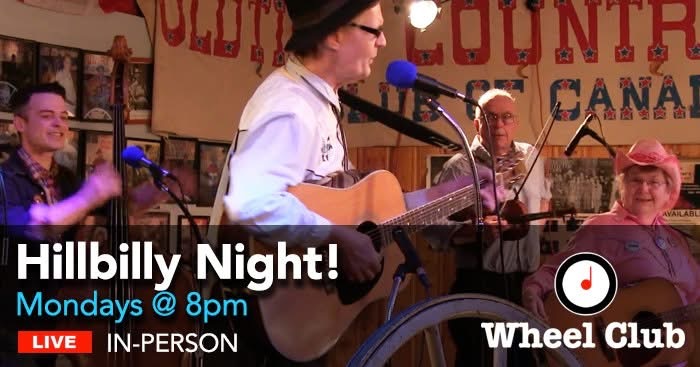
The Wheel Club stands out for its “time capsule” atmosphere: honey-brown wood paneling, black-and-white photos of Montreal, Rat Pack posters, vintage license plates, 1960s cardboard cut-outs, and a 1950s Wurlitzer jukebox. This environment, combined with programming centered on live music, makes it a rare intergenerational space where older musical traditions and newer local scenes coexist.
Since 2019, under the impetus of Clifford (“Cliff”) Schwartz, the Wheel Club has operated as a non-profit organization dedicated to artistic presentation and the preservation of Hillbilly Night, while opening its stage to a range of genres (rock, funk, ska, student jazz, karaoke, participatory choirs, etc.). [6], [7]
Origins (1966–1993)
The roots of the Wheel Club as an old-time country venue begin downtown at the Blue Angel Café, a small country club at 1228 Drummond Street. In 1966, Bob Fuller launched Hillbilly Night, a Monday evening intended to preserve country and bluegrass music from before the countrypolitan era. [3], [8]
The Blue Angel was described in the Montreal Gazette as a singular establishment: a modest bar almost entirely lined with 45-rpm records, posters, handwritten song lists, and country objects. Fuller installed a collection estimated at more than 100,000 records, likely one of the largest country collections in Canada. [9]
From the late 1960s onward, Hillbilly Night rested on clear principles:
- a pre-1965 (later pre-1969) country/bluegrass repertoire,
- strictly acoustic instruments (guitar, banjo, fiddle, mandolin, steel),
- no electric instruments and no drums,
- a preference for hillbilly, honky-tonk, bluegrass, and western swing.
Fuller conceived the evening as a crusade to defend “real music” against the commercialization of the Nashville Sound. The press nicknamed him the “Country Crusader”, and he summed up his motivation with the line: “I’m sitting here watching real music disappear. Someone has to protect it.” [10], [11]
Throughout the 1970s–1980s, Hillbilly Night became a key gathering in Montreal’s country scene. The Blue Angel drew a mixed crowd (regulars in stetsons, students, visiting musicians, American tourists), and the night gained a national reputation as one of the country’s oldest open-mic country events.
The late 1980s marked a turning point: rising rents, downtown change, and venue fatigue. A Gazette article from 1991 described the Blue Angel as an establishment that “is hanging on only by the music.” The club closed in 1993, after roughly 25 years of activity. [12]
For Fuller, Hillbilly Night could not disappear. He tried a transitional period at O’Leary’s, a pub on St-Jacques Street, but the acoustics and atmosphere were ill-suited to a strictly acoustic night. He then began searching for a new, lasting home.
Bob “Bluegrass Bob” Fuller — biography & founding role
Bob Fuller (1933–2018) was the founding figure of Hillbilly Night and, by extension, of the Wheel Club’s present-day identity. A musician, host, and compulsive record collector, he made the Blue Angel and later the Wheel Club places devoted to preserving old-time country music. [4], [15]
From the 1950s–1960s onward, he accumulated records systematically. In 1991, the Gazette estimated his collection at more than 100,000 titles, mainly country and bluegrass recordings from the 1930s–1950s. He was regularly consulted by other collectors, radio hosts, and musicians looking for rare versions. [16]
Fuller was also a charismatic master of ceremonies: at the Blue Angel and later the Wheel Club, he introduced performers, told anecdotes about the origins of songs, sometimes corrected keys or pronunciation, and patiently explained the logic behind his rules. The press described him as a “living encyclopedia of country music.” [17]
After the Blue Angel closed, he transplanted Hillbilly Night to the Wheel Club, with the support of Jeannie Arsenault and Dick Hearn. Until the end of his life, he maintained his aesthetic and historical principles, making Monday night a near-liturgical ritual for lovers of country roots music. He died in 2018, after more than 50 years devoted to this musical form.
Migration to the Wheel Club (1994–1995)
The migration of Hillbilly Night to the Wheel Club took place between 1994 and 1995. The Wheel Club, a veterans’ club in NDG, was then run by Dick Hearn, a retired Westmount firefighter. He agreed to host the evening in the club’s basement, offering a setting closer to the spirit of the Blue Angel: an intimate room, retro décor, neighbourhood clientele, and a friendly atmosphere. [13], [18]
Fuller, Jeannie Arsenault, and much of the regular crowd followed the move. Posters, certain objects, and above all the repertoire and rules of Hillbilly Night were transplanted intact. The Gazette would sum up the shift with the line: “The Blue Angel didn’t close — it moved to NDG.” [14]
Jeannie Arsenault — the memory of Hillbilly Night
Jeannie Arsenault, originally from the Maritimes, joined Hillbilly Night at the Blue Angel in 1974. First a regular singer, she gradually became the evening’s principal host, a role she kept until 2025. [5], [19]
In a CBC profile published in 2021, she said she had missed only ten Hillbilly Nights in 47 years, summarizing her relationship to music as follows: “Music is my life.” [20]
Jeannie ensured the continuity of Fuller’s rules, managed the musicians’ list, welcomed newcomers, and told Blue Angel stories to younger participants. After Fuller’s death, she embodied the living memory of the tradition. Her return to the stage at the first Hillbilly Night with an audience after the pandemic, in July 2021, symbolically marked the club’s “return to life.” She died in 2025, leaving a profound void in the NDG community. [21]
The Wheel Club under Dick Hearn (1995–2018)
From the mid-1990s onward, under the leadership of Dick Hearn, the Wheel Club became a hybrid venue: a veterans’ club expanded to include service workers (firefighters, police officers, paramedics, municipal employees), and an old-time country music room. A plaque from his fire station remains on the club wall, recalling that continuity. [18]
The décor contributes strongly to its identity: wood paneling, red-and-green string lights, posters of popular singers, photos of NDG and Montreal, Rat Pack posters, vintage plates, and a 1950s Wurlitzer jukebox. Two female cardboard silhouettes, found in a false ceiling during renovations, became a kind of decorative talisman. [22]
In this period (1995–2018), the Wheel Club was primarily known for Hillbilly Night, but it also hosted other smaller-scale events (dance nights, local band shows, neighbourhood events). The room is often described as a place where three or even four generations mix—something relatively unique in Montreal.
The Clifford Schwartz era & modernization (2019–)
Around 2019, the Wheel Club’s future seemed uncertain: management retirement, financial fragility, and doubts about whether activities could continue. A media report evoking the risk of closure drew the attention of Clifford “Cliff” Schwartz, a Montreal funk/R&B musician, composer for Radio-Canada/CBC, and collaborator with many artists. [23]
In May 2019, a Montreal Gazette report titled “Wheel Club Rises From Near-Ashes” described the Wheel Club as a venue that had nearly closed, before being revived by a new team and a gradual modernization of its facilities (sound system, lighting, diversified programming), while keeping Hillbilly Night as the club’s core identity. The article also mentions Montreal rocker and musicologist Craig Morrison, associated with the band Momentz, as an example of the musical opening carried out under the new leadership—linking the venue’s country heritage to the broader history of Montreal rock. [31]
Cliff offered his help and, with a team of volunteers, initiated a careful modernization of the club: improvements to the sound system and lighting, creation of a livestream control booth, reorganization of the décor without erasing historical elements, and formalization of the Wheel Club’s status as a non-profit organization. He sees himself more as a caretaker than a director, stating that the club “has a life of its own.” [24]
His philosophy can be summed up in one line: “Welcome the old, integrate the new.” He keeps Hillbilly Night as the historical heart of the program, while adding concerts of rock, funk, indie, ska, student jazz, retro tribute nights, karaoke, and participatory experiences such as Club Choir. [25]
Pandemic, livestream & international audience (2020–2021)
In 2020, the COVID-19 pandemic forced the venue to close to the public. Cliff then transformed the Wheel Club into a broadcast studio: four cameras, video control booth, optimized sound, and adjusted lighting. Hillbilly Night performances were recorded on Saturdays, then broadcast on Facebook on Mondays at 8 p.m. Online donations were shared with the musicians. [26]
These livestreams attracted viewers from several countries (United States, Europe, Australia, Japan), giving Hillbilly Night unexpected international visibility. CBC noted that some American viewers considered it one of the most authentic country nights on the continent. [27]
In July 2021, the first Hillbilly Night in front of a restricted audience (about 20 people) marked the gradual reopening. Jeannie Arsenault, then 77 years old, performed “Gonna Have a Good Time Tonight”, a moment captured by CBC and received as a symbol of resilience. [28]
Live broadcasting remains part of the club’s identity today, allowing a worldwide community to stay connected to the NDG scene.
The Wheel Club today (2022–2025)
In 2025, the Wheel Club presents itself as:
- a sanctuary of old-time country (weekly Hillbilly Night),
- a community arts hub for NDG (varied, accessible programming),
- a retro bar with near-museum décor,
- an intergenerational space welcoming multiple cohorts of regulars,
- a cultural beacon recognized beyond Montreal thanks to livestreams.
Its current programming combines:
- Hillbilly Night (Monday);
- Wednesday karaoke;
- local band shows (rock, indie, funk, ska, soul);
- student jazz (notably Vanier College);
- tribute nights and retro theme events;
- Club Choir and participatory events;
- album launches and special events.
The Wheel Club is often described by the media as “almost mythical”: a place where, on a Monday night, one can hear Hank Williams or the Carter Family played by Montrealers of three generations, in a neighbourhood room whose décor seems frozen in time. [29]
Timeline (1966–2025)
- 1966 — Hillbilly Night is founded at the Blue Angel (1228 Drummond) by Bob Fuller.
- 1974 — Jeannie Arsenault joins Hillbilly Night as a singer, then host.
- 1978 — Fuller is profiled in the Gazette, nicknamed the “Country Crusader.”
- 1991 — The Gazette describes the Blue Angel as a “living museum of records.”
- 1993 — The Blue Angel closes.
- 1993–1994 — Transitional period at O’Leary’s (St-Jacques).
- 1994–1995 — Hillbilly Night moves to the Wheel Club (3373 Cavendish).
- 1990s–2000s — Dick Hearn’s leadership; NDG identity consolidated.
- 2011–2016 — 45th then 50th anniversary of Hillbilly Night.
- 2018 — Death of Bob “Bluegrass Bob” Fuller.
- 2019 — Cliff Schwartz takes charge of the Wheel Club’s revival and modernization.
- 2020 — Livestream studio created; Hillbilly Night goes online.
- 2021 — Audience returns; Jeannie Arsenault brings Hillbilly Night back on stage; she dies in 2025.
- 2022–2025 — The Wheel Club operates as an NPO, with varied programming and regular livestreams.
Notes & sources
- Address: Wheel Club NDG official website & local directories.
- Origins as a veterans’ club: TheMain.com, article on the Wheel Club’s history.
- Founding of Hillbilly Night (1966, Blue Angel) and transfer to NDG: TheMain.com, Hillbilly Night archives.
- General biography of Bob Fuller: Montreal Gazette articles (1978, 1991, 1999) and testimonies.
- Jeannie Arsenault: CBC News profile (2021) & TheMain.com.
- Dick Hearn’s role & Cliff Schwartz’s arrival: TheMain.com, Wheel Club NDG.
- NPO status: Wheel Club NDG official website.
- Blue Angel origins & Hillbilly Night: Gazette, 1978–1991.
- Size of Fuller’s record collection: Gazette, 1991.
- Quote “I’m sitting here watching real music disappear…”: Gazette, 1999.
- Nickname “Country Crusader”: Gazette, 1978.
- Late portrait of the Blue Angel: Gazette, 1991.
- Migration to the Wheel Club: Hillbilly Night archives & TheMain.com.
- Line “The Blue Angel didn’t close — it moved to NDG”: repeated in articles and local testimonies.
- Biographical details on Fuller: reconstruction from several articles and testimonies.
- Number of records: Gazette estimate, 1991.
- Profiles of Fuller as a “living encyclopedia”: Gazette.
- Dick Hearn’s role, retired firefighter: TheMain.com.
- Jeannie’s arrival (1974): CBC + TheMain.com.
- Quote “I had only missed ten Hillbilly Nights in 47 years”: CBC News, July 25, 2021.
- Jeannie’s post-pandemic return and “Gonna Have a Good Time Tonight”: CBC 2021.
- Décor & retro elements (silhouettes, Wurlitzer, etc.): TheMain.com.
- Cliff Schwartz background: Wheel Club NDG official website & TheMain.com.
- Quote “I’m just the caretaker”: TheMain.com.
- Diversified programming & quotes about youth (Tower of Power, etc.): TheMain.com.
- Description of the livestream setup during the pandemic: Wheel Club NDG & CBC.
- International audience for livestreams: CBC News, 2021.
- CBC article on Hillbilly Night’s return with an audience (July 2021).
- Description of the club as “almost mythical”: CBC.
- Photographs of Bob Fuller and Jeannie Arsenault by John Kenney (Gazette Files)
-
MONTREAL GAZETTE, May 16, 2019 — “Wheel Club Rises From Near-Ashes,” Bill Brownstein.
Article on the Wheel Club’s revival in 2019 (near-closure, new management, modernization of equipment, diversification of programming while keeping Hillbilly Night). Photo: Dave Sidaway.