New Penelope (Montreal)
Active from 1966 to 1968, the New Penelope was one of the defining venues of Montreal's musical counterculture. Founded by Gary Eisenkraft, it bridged the folk coffeehouse culture of the early 1960s with the emergence of electric blues, rock and experimental music.
1. Overview
The New Penelope holds a distinctive place in the musical history of 1960s Montreal. Unlike the large cabarets and dance halls that had dominated part of the city's nightlife during previous decades, the New Penelope belonged to a new generation of smaller, independent venues closely associated with youth and the counterculture.
In only a few years, Gary Eisenkraft presented a remarkably diverse program there: folk, traditional and electric blues, rock, jazz and experimental music. Established performers appeared alongside younger musicians who would soon achieve international recognition.
The New Penelope was also an important meeting place. Musicians, students, artists, journalists and members of Montreal's counterculture crossed paths there at a time when the cultural habits of an entire generation were undergoing profound change.
2. Montreal's Coffeehouse Culture
The New Penelope did not emerge in a cultural vacuum. By the early 1960s, Montreal already had a significant coffeehouse scene, with small venues where audiences could hear folk singers, guitarists, blues musicians and singer-songwriters in a far more intimate setting than that offered by traditional cabarets.
Venues such as the Finjan and the Pot Pourri were part of this culture. Founded in 1961 by Shimon Ash and Haim Barr, the Finjan presented performers including Ian & Sylvia, Sonny Terry & Brownie McGhee, John Lee Hooker and numerous Canadian and international artists.
In June 1962, a young Bob Dylan performed at the Pot Pourri during his first known professional visit to Canada. Following that engagement, he also gave a lengthy informal performance at the Finjan, recorded by Jack Nissenson.
Before the New Penelope
The Finjan and the Pot Pourri were not institutional predecessors of the New Penelope. They nevertheless belonged to the same Montreal folk coffeehouse ecosystem in which Gary Eisenkraft began developing his own approach to music programming.
3. Gary Eisenkraft
At the centre of this story was Gary Eisenkraft, a passionate blues enthusiast and folk singer. His time performing and spending time in the coffeehouses of Greenwich Village in New York introduced him to a network of musicians and agents that would later prove important to his activities in Montreal.
Eisenkraft gradually drew upon these contacts to bring performers from the North American folk and blues circuits to Montreal. His importance lay less in the size of his venues than in his instincts as a programmer and his willingness to present music that still had relatively few outlets in the city.
4. From the Fifth Amendment to the Penelope
Before the New Penelope, Eisenkraft operated the Fifth Amendment, a coffeehouse that evolved from the Fifth Dimension and was located at 1455 Bleury Street. There he presented folk and blues performers drawn in part from American touring circuits.
In 1965, he continued the experiment with The Penelope on Bishop Street. This small basement venue could accommodate only about 55 people, although larger audiences sometimes squeezed into the room for performances.
The Penelope's success paradoxically became one of its problems: lines and crowds were difficult to manage in such a small space. Eisenkraft therefore began looking for a venue that would allow him to pursue his project on a larger scale.
Penelope or New Penelope?
The two names refer to two different stages. The Penelope was the small coffeehouse on Bishop Street. The New Penelope followed in 1966 on Stanley Street before relocating to Sherbrooke Street.
5. From the Blue Lantern to the New Penelope
The premises chosen by Eisenkraft at 1432 Stanley Street already had a musical history. In the autumn of 1965, they housed the Blue Lantern, a venue associated with Manny De Abravanel.
An article in the Montreal Star dated October 15, 1965 described the Blue Lantern as a new coffeehouse aimed in part at the college crowd. The establishment offered live music within the particularly active downtown club and coffeehouse environment of the period.
After the Blue Lantern ceased operating, Eisenkraft took over the premises. In May 1966, a new chapter began: the New Penelope.
6. The New Penelope on Stanley Street
The first New Penelope operated at 1432 Stanley Street from May to December 1966. This period represented an important evolution from Eisenkraft's earlier coffeehouses.
Folk music remained part of the program, but the venue increasingly embraced electric blues and rock. The rise of amplified groups also required a different relationship between the stage, the sound system and the audience. The New Penelope therefore began to move beyond the traditional acoustic coffeehouse model.
The Stanley Street phase lasted only a few months, but it established the identity of the New Penelope and prepared the way for its move into a larger space. By the end of 1966, Eisenkraft was preparing to relocate the club to Sherbrooke Street.
7. 378 Sherbrooke Street West
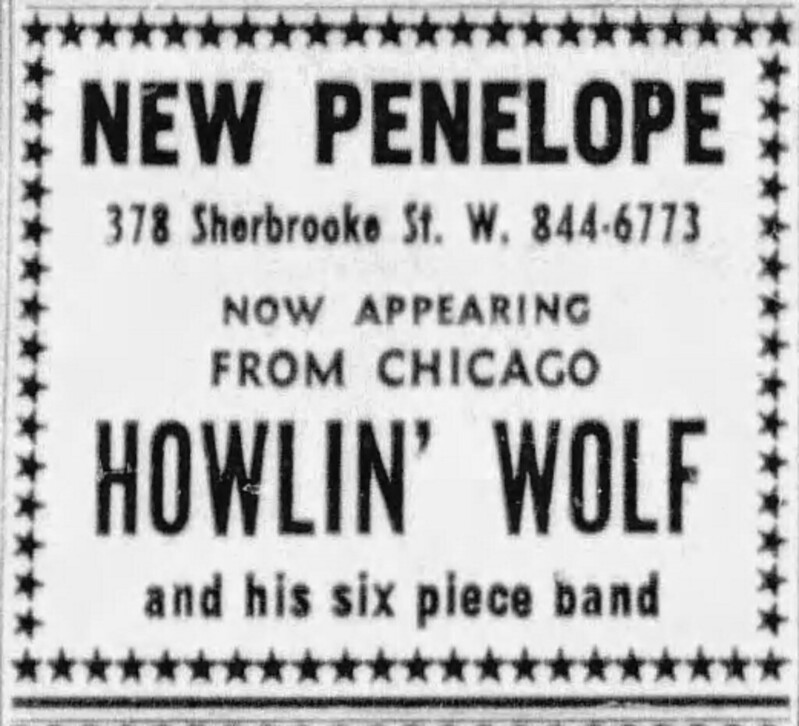
In January 1967, the New Penelope moved to 378 Sherbrooke Street West. This incarnation of the club would become its best known.
The new venue stood near Saint-Louis Square and the area that would become closely associated with Montreal's counterculture. Its greater capacity allowed Eisenkraft to present more prominent performers while maintaining the intimacy between musicians and audiences that had characterized his earlier venues.
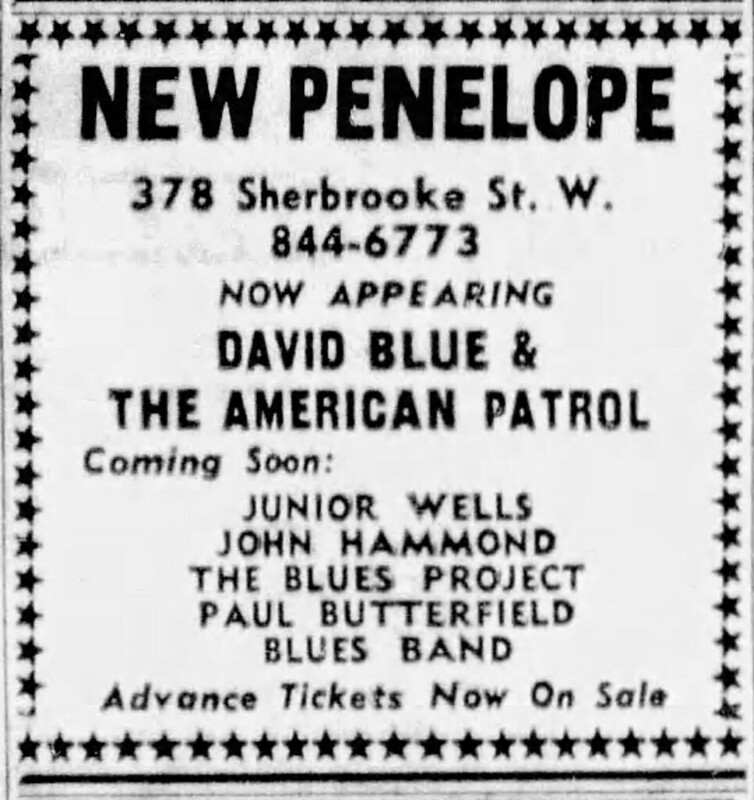
For nearly two years, the Sherbrooke Street New Penelope became an essential destination for audiences interested in music that was still rarely heard within Montreal's traditional commercial entertainment circuits.
8. François Dallegret and the Design
The design of the new premises was entrusted to artist and designer François Dallegret. Financial resources were limited and the project had to be completed quickly, but these constraints helped give the New Penelope a particularly distinctive visual identity.
Dallegret used metal scaffolding, wooden planks and industrial elements to create seating, staging and interior structures. The result was deliberately minimalist, raw and flexible.
This architecture perfectly reflected the identity of the club. Rather than reproducing the elaborate interiors of Montreal's older cabarets, the New Penelope adopted a functional and experimental aesthetic that corresponded with the underground culture of the late 1960s.
9. An Exceptional Program
The historical reputation of the New Penelope rests above all on its programming. Eisenkraft used his contacts and his knowledge of the folk and blues circuits to present an exceptional mixture of established and emerging performers in Montreal.
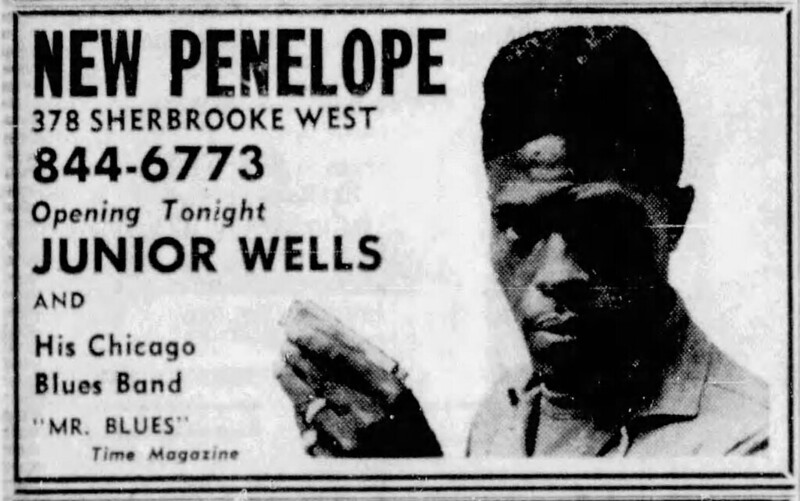
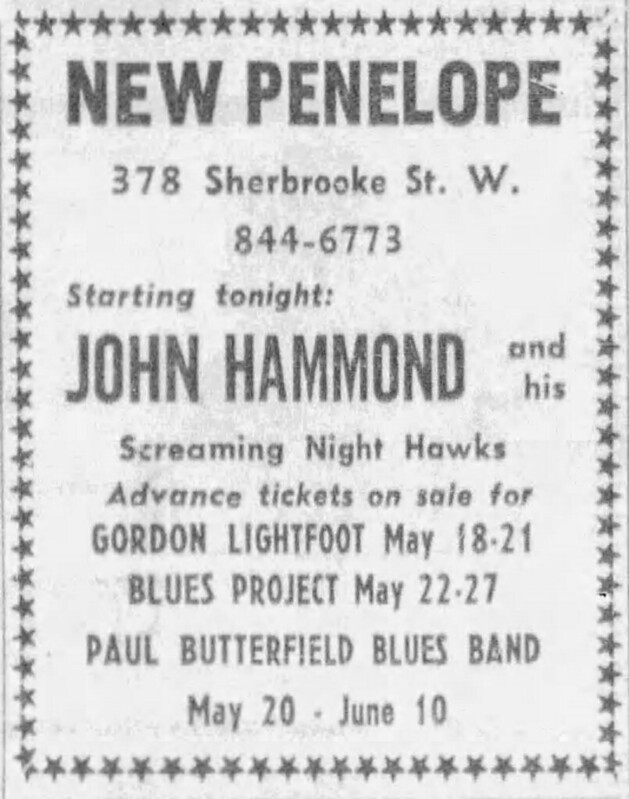
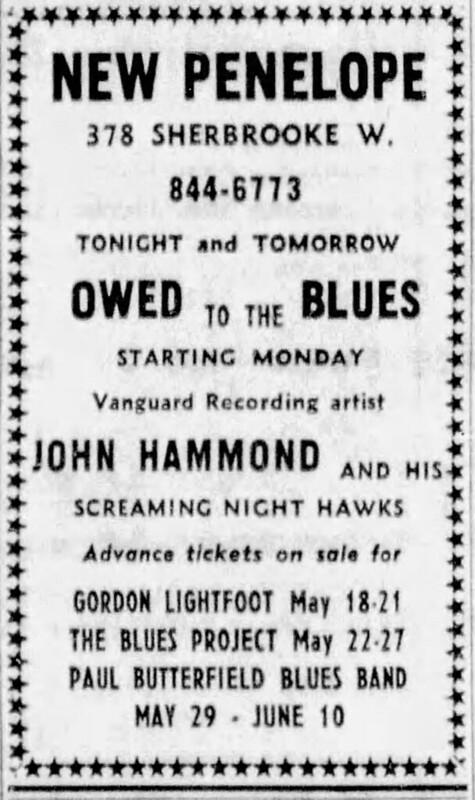
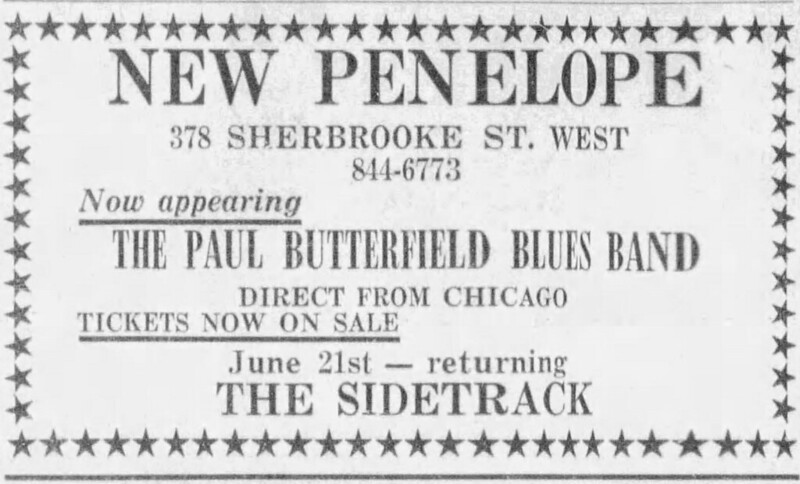
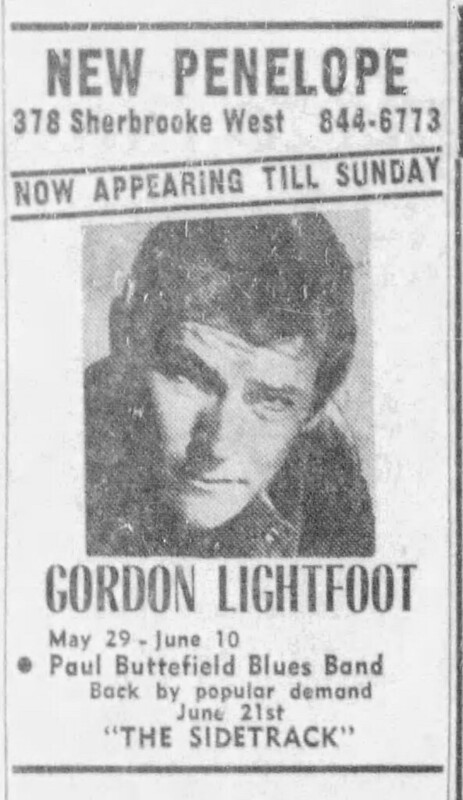
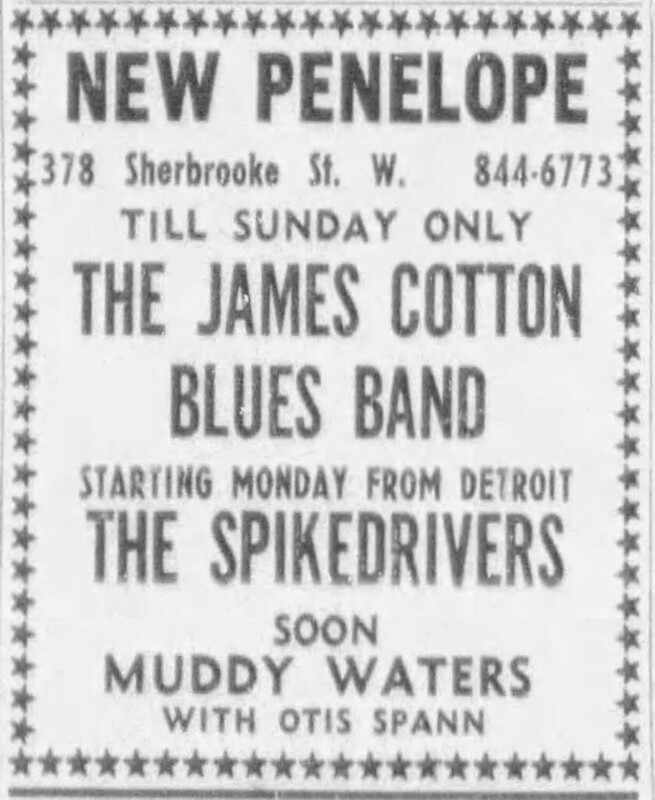
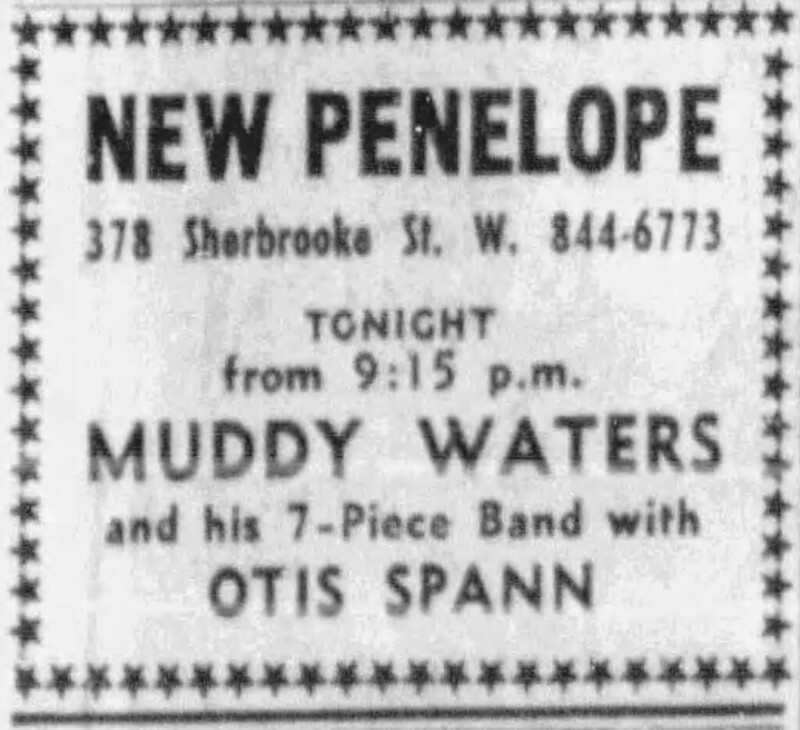
Artists and groups associated with the New Penelope include Muddy Waters, Junior Wells, James Cotton, Sonny Terry & Brownie McGhee, Paul Butterfield Blues Band, Gordon Lightfoot, Joni Mitchell, Jesse Winchester, Tim Hardin, Tim Buckley, Richie Havens, The Fugs and Frank Zappa & The Mothers of Invention.
This diversity was one of the venue's defining characteristics. Audiences could hear Chicago blues, folk singer-songwriters, folk-rock, experimental rock and more radical forms of jazz and improvised music within the same club.
10. Frank Zappa and the Mothers of Invention
One of the most celebrated episodes in the history of the New Penelope occurred at the beginning of 1967, when Frank Zappa & The Mothers of Invention effectively helped launch the club's Sherbrooke Street era with a two-week engagement.
The booking was characteristic of Eisenkraft's programming philosophy. The Mothers were then associated with the American rock avant-garde, and their extended engagement allowed Montreal audiences to experience the group in the intimate surroundings of a small club rather than in a large concert hall.
The residency remains one of the emblematic events in the history of the New Penelope and illustrates the club's ability to bring artists working at the intersection of rock, experimentation and counterculture to Montreal at an early stage.
11. A Hub of the Counterculture
The significance of the New Penelope extended well beyond its musical programming. During the late 1960s, Montreal was undergoing rapid cultural change. A new generation was challenging institutions, social habits and cultural forms inherited from the postwar period.
New publications appeared, including Logos, Pop-See-Cul, Take One and, somewhat later, Mainmise. FM radio was also becoming increasingly important, while record shops, bookstores, cafés and alternative businesses created a new cultural environment.
The New Penelope was fully part of this ecosystem. Its concerts circulated through alternative publications, and its audience also frequented nearby businesses such as Phantasmagoria and The Purple Unknown.
More Than a Concert Venue
The New Penelope was simultaneously a concert venue, coffeehouse and social centre for Montreal's counterculture. Its historical importance lies as much in the encounters that took place there as in the performers who appeared on its stage.
12. Financial Difficulties and Closure
The quality of the New Penelope's programming did not guarantee its financial stability. Regularly bringing major performers into a venue with a relatively modest capacity created a fragile economic model.
By 1968, the difficulties had become serious enough for initiatives to be launched in support of the club. A Society for the Protection of the New Penelope was established, and fundraising activities were organized.
Despite these efforts, the club was unable to secure its long-term survival. The New Penelope ceased operations in the autumn of 1968, ending an undertaking that had lasted only about two and a half years under that name.
13. Legacy
The brevity of the New Penelope's existence contrasts with the importance of its legacy. The club represents one of the places where Montreal's transition from the folk coffeehouse culture of the early 1960s to the new rock culture of the end of the decade can be observed particularly clearly.
It also considerably broadened the musical horizons of Montreal audiences by presenting American blues musicians, Canadian singer-songwriters, rock groups and experimental performers within the same venue.
In the history of Montreal performance spaces, the New Penelope therefore symbolizes the emergence of a new model: the small independent venue devoted to contemporary music, closely connected to an artistic community rather than to the traditional world of large commercial cabarets.
From Coffeehouse to Rock Venue
Gary Eisenkraft's trajectory — Fifth Amendment → Penelope → New Penelope — offers a particularly clear view of the evolution of part of Montreal's music scene within only a few years: from the acoustic folk culture of the coffeehouses to electric blues, rock and the musical experiments of the counterculture.
14. Timeline
15. Notes and Sources
- Peter Desbarats, “Coffee house culture from sea to sea,” The Daily Star, October 13, 1962. Documentation on Canadian coffeehouse culture and the Finjan.
- “Folk coffee house appeals to college set,” Montreal Star, October 15, 1965. Documentation on the Blue Lantern and Montreal's coffeehouse scene.
- Dane Lanken, “He was crazy but I was impressed,” The Gazette, January 12, 1974. Testimony concerning Bob Dylan, the Pot Pourri and the Finjan.
- ARCMTL, The New Penelope Café and its Era in Montreal. Historical research on Gary Eisenkraft, the origins of the New Penelope, its programming and Montreal's counterculture.
- Community Stories / Canadian Museum of History, The New Penelope Era in Montreal, 1965–1970. Virtual exhibition produced with ARCMTL.
- Archives and documentation concerning François Dallegret. Documentation on the design and construction of the Sherbrooke Street New Penelope.
- Press archives: The Gazette, Montreal Star, McGill Daily and Montreal alternative publications, 1964–1968.
- Montreal Concert Poster Archive (MCPA). Posters, advertisements and documentation relating to the New Penelope, the Blue Lantern and Montreal's 1960s music venues.