Blue Bird Café
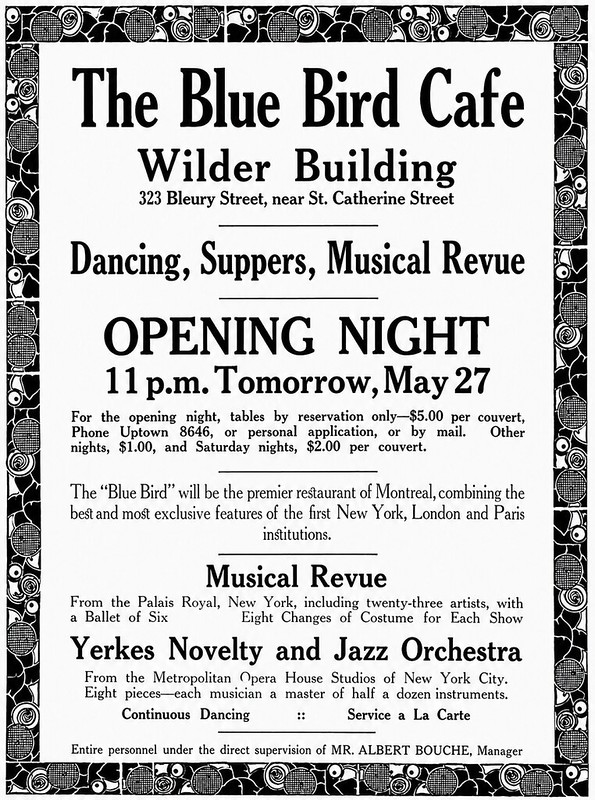
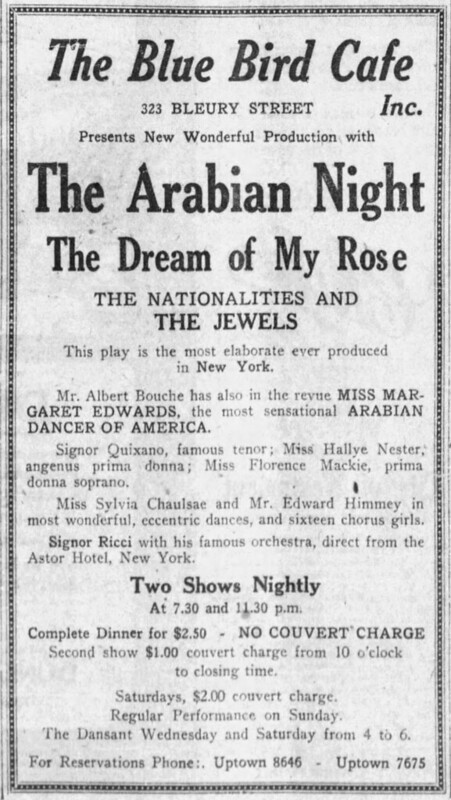
Opened on May 12, 1920 at 323 De Bleury Street — later 1435 — on the ground floor of the Wilder Building, the Blue Bird Café was among Montréal’s early large-scale cabarets explicitly conceived as luxury entertainment establishments. Inspired by the cabarets of New York, London and Paris, it brought dining, music, dancing, live entertainment and upscale service together under one roof. Its main room could accommodate approximately 600 people, and on May 27, 1920, a vast rooftop garden was added to the establishment. Despite its exceptional ambitions, the Blue Bird encountered financial difficulties and disappeared as early as 1921. Its brief existence nevertheless anticipated many of the characteristics that would define Montréal’s great cabarets of the following decades.
1. Overview
The Blue Bird Café occupies a distinctive place in the history of Montreal nightlife. Its existence covered only a brief period, from 1920 to 1921, yet its concept anticipated several features that would later become associated with Montreal’s major cabarets: dining, live music, dancing, entertainment and elaborate décor brought together under one roof.
From the moment it opened, the English-language press presented it as an exceptionally ambitious establishment for Montreal. The Blue Bird clearly sought to position itself within an international culture of nightlife inspired by major European and American cities.
Historical clarification
The expression “Montreal’s first luxury cabaret” should be understood as a description used in the press and advertising of 1920. Montreal already had cafés-concerts, musical restaurants, dance halls and other entertainment venues. What distinguished the Blue Bird was primarily the way it presented itself: as a modern, upscale establishment combining several functions under one roof.
2. The Wilder Building and De Bleury Street
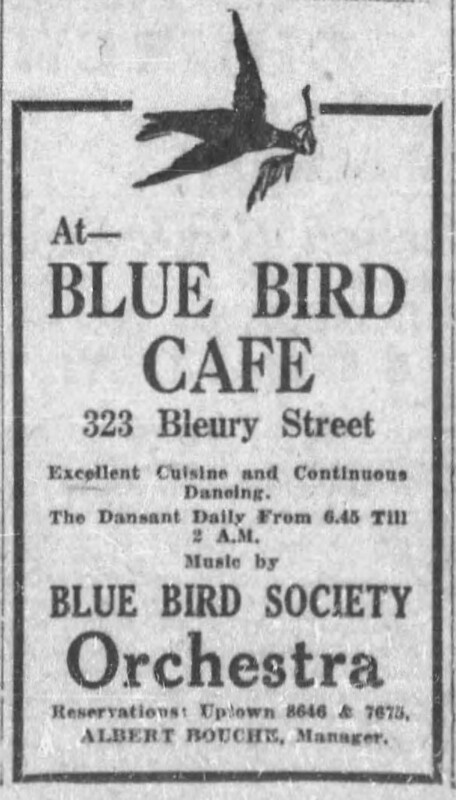
The Blue Bird occupied 323 De Bleury Street, an address later renumbered 1435 De Bleury Street. The establishment was located on the ground floor of the Wilder Building, a large ten-storey industrial building constructed in 1918.
Located immediately beside the Imperial Theatre, the Wilder stood in a downtown area where entertainment, commerce and performance venues were already increasingly concentrated.
The opening of an ambitious cabaret in a recently constructed building also reflected a transformation in Montreal nightlife. New entertainment establishments were no longer necessarily tied to older hotels or traditional theatres, but could become part of the new commercial architecture of the downtown core.
3. The Birth of the Blue Bird
The project was announced in the press as early as March 9, 1920, when a new “cafe cabaret and roof garden” was announced for the Wilder Building. A few weeks later, an advertisement in the Montreal Star set the opening date for May 12, 1920.
The Blue Bird officially opened on May 12 with a midnight cabaret. The concept was ambitious enough that the management immediately continued developing the establishment: two weeks later, a large rooftop terrace was inaugurated.

4. A “Luxury Cabaret”
The Blue Bird was clearly positioned as an upscale establishment. Advertisements published in 1920 claimed that it brought together the finest characteristics of the leading cabarets of New York, London and Paris.
This promotional language is revealing. Montreal was increasingly asserting itself as a modern and cosmopolitan metropolis, and the Blue Bird adopted the codes associated with the great entertainment capitals: elaborate service, dining, an orchestra, dancing, refined décor and fashionable socializing.
The Blue Bird was advertised as combining the “best and most exclusive features” of the leading cabarets of New York, London and Paris.
5. The Cabaret and Its Roof Garden
One of the Blue Bird’s most spectacular features was its roof garden. The terrace opened on May 27, 1920, two weeks after the cabaret itself.
The main room could accommodate approximately 600 people. The rooftop terrace added space for several hundred additional patrons, making the Blue Bird a remarkably large establishment for a Montreal cabaret of this period.
The roof garden concept, already popular in several large American cities, combined dining, music, dancing and nightlife with an open-air summer experience. It further reinforced the establishment’s desired image of modernity and sophistication.
6. Music, Dancing and Dining
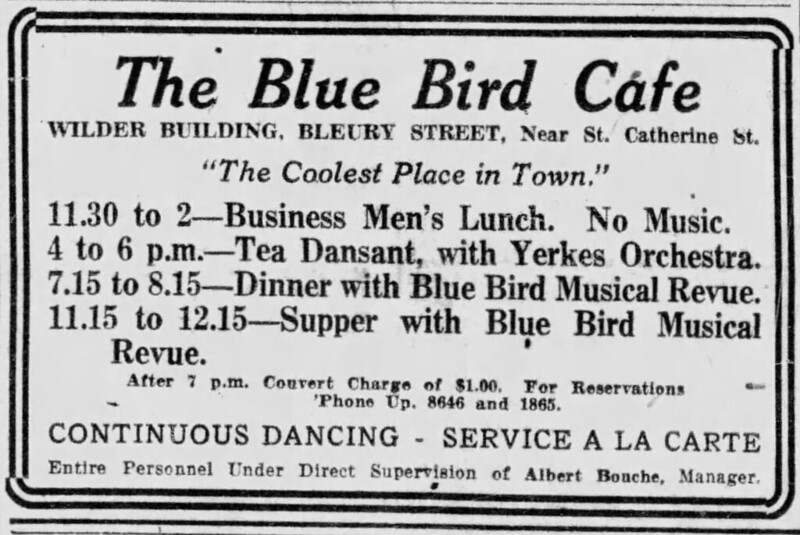
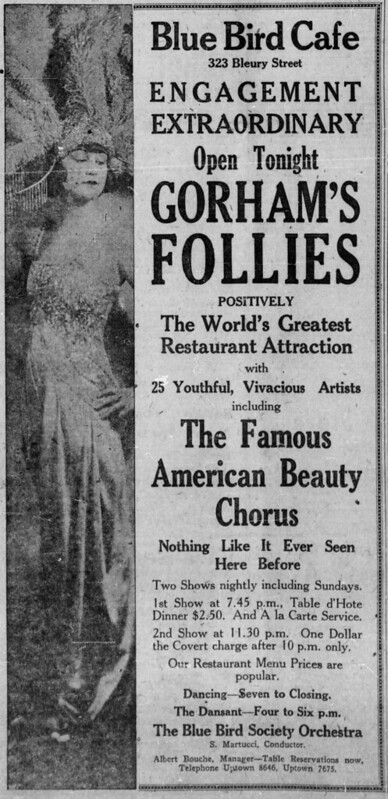
The Blue Bird was not a concert hall in the modern sense. It belonged instead to the tradition of the cafe-cabaret, where music, dancing and entertainment formed part of a broader social experience centred on dining and nightlife.
Patrons did not necessarily attend to see a single concert presented onstage. Rather, they spent part of the evening in an establishment where several forms of entertainment could follow one another.
The Blue Bird therefore participated in the emergence of a new way of going out in Montreal, one that would expand considerably throughout the 1920s, 1930s, 1940s and 1950s.
7. International Ambitions
The explicit references to cabarets in New York, London and Paris were not incidental. They reflected management’s ambition to present the Blue Bird as an establishment comparable to the nightlife venues of major international cities.
This strategy emerged at a time when Montreal, in the years following the First World War, was experiencing an acceleration of urban nightlife. New leisure activities, dancing, jazz, late-night restaurants and popular entertainment were gradually transforming the city’s social habits.
The Blue Bird appeared at the very beginning of a period during which Montreal would develop an increasingly important reputation for nightlife.
8. Organization and Staff
Staff supervision was entrusted to Albert Bouche, an American from Chicago. Contemporary advertisements emphasized his background and experience, probably to reinforce the image of an establishment operated according to the standards of leading American cabarets.
The emphasis placed on professional supervision illustrates management’s desire to distinguish the Blue Bird from ordinary restaurants and cafés. Service itself became part of the establishment’s spectacle and prestige.
9. A Short-Lived Venture
Despite the scale of its launch, the Blue Bird quickly encountered difficulties. In 1921, the press reported financial troubles and the establishment went bankrupt.
Its disappearance after less than a year of operation illustrates the economic fragility of large entertainment establishments. Décor, staff, musicians, dining operations and extensive premises generated considerable expenses, while patronage remained uncertain.
The Blue Bird’s financial failure does not diminish its historical interest. On the contrary, its brief existence provides a glimpse into a period of experimentation during which Montreal entrepreneurs were still searching for a formula capable of making the modern cabaret economically sustainable.
10. From the Blue Bird to the Claridge
On February 12, 1921, the establishment reopened under new management and under the name Claridge.
The transformation occurred very quickly after the Blue Bird’s difficulties, demonstrating that the failure of the original establishment did not lead to the abandonment of the address as an entertainment venue.
The Claridge was also short-lived. After losing its liquor licence, the establishment was forced to close on July 2, 1921.
One location, several establishments
It is more accurate to describe these businesses as a succession of establishments at the same address rather than as a single institutional lineage. The Blue Bird, Claridge, Rector’s and Piccadilly had distinct names and management, even though they successively occupied the same area of the Wilder Building.
11. Rector’s and Piccadilly
The address continued to be used for dining and entertainment during the following years. On July 31, 1922, an establishment called Rector’s opened there.
A few months later, Piccadilly was advertised in the press. An advertisement published in December 1922 announced the new rotisserie, confirming the rapid succession of concepts operated at the address.
This turnover illustrates both the commercial activity of the district and the difficulty of maintaining large dining and entertainment businesses in early 1920s Montreal.
12. An Address Devoted to Entertainment
The cultural history of the Wilder Building did not end with the establishments of the 1920s. Several decades later, the location once again became associated with an important form of Montreal nightlife.
During the 1990s, the address was notably associated with SONA, a club founded in 1996 by Montreal DJ Tiga that became one of the landmark venues of the city’s electronic music scene.
The Wilder Building was subsequently fully renovated and incorporated into Montreal’s Quartier des spectacles. It now houses several organizations devoted to dance, including Les Grands Ballets Canadiens de Montréal and the École de danse contemporaine de Montréal.
More than a century after the Blue Bird, the building therefore retains a strong cultural vocation, although the nature of the activities presented there has changed profoundly.
13. Historical Significance
The historical importance of the Blue Bird Café rests neither on its longevity nor on an exceptional list of famous performers. It lies instead in its positioning and in the entertainment model it attempted to introduce in Montreal.
The Blue Bird combined dining, music, dancing, entertainment, upscale service and a rooftop terrace within a single establishment. This formula anticipated several characteristics that would later become familiar features of Montreal cabarets.
Its history also reminds us that the rise of Montreal cabaret culture did not suddenly begin with the celebrated golden age of the 1940s and 1950s. As early as the beginning of the 1920s, entrepreneurs were already attempting to import and adapt international models of nightlife to Montreal.
A Precursor to the Modern Montreal Cabaret
The Blue Bird should not necessarily be described as Montreal’s “first cabaret.” Cafés-concerts, dance halls and other entertainment establishments existed before it. It does, however, represent a particularly early example of a Montreal cabaret deliberately conceived and advertised as a luxury establishment inspired by major international cities.
14. Timeline
15. Notes and Sources
- “Blue Bird Cafe Will Open May 12 with a Midnight Cabaret,” The Montreal Star, April 14, 1920.
- “The Blue Bird Cafe Opens Tonight at 11:00pm,” The Gazette, May 27, 1920.
- “New cafe cabaret and roof garden,” The Montreal Star, March 9, 1920.
- “Cafe’s Trouble,” The Gazette, July 5, 1921.
- “Stop! Think of it! Grand inauguration of the Dansant Today Formerly Blue Bird,” The Montreal Star, February 12, 1921.
- “Cafe’s Trouble,” The Gazette, July 5, 1921.
- “Rector’s will open July 31st,” The Gazette, July 31, 1922.
- “Piccadilly restaurant,” The Gazette, December 3, 1922.
- « À chaque époque sa discothèque mythique », Urbania, December 17, 2019.
- Quartier des spectacles, « Édifice Wilder – Espace danse ».