Le Patriote
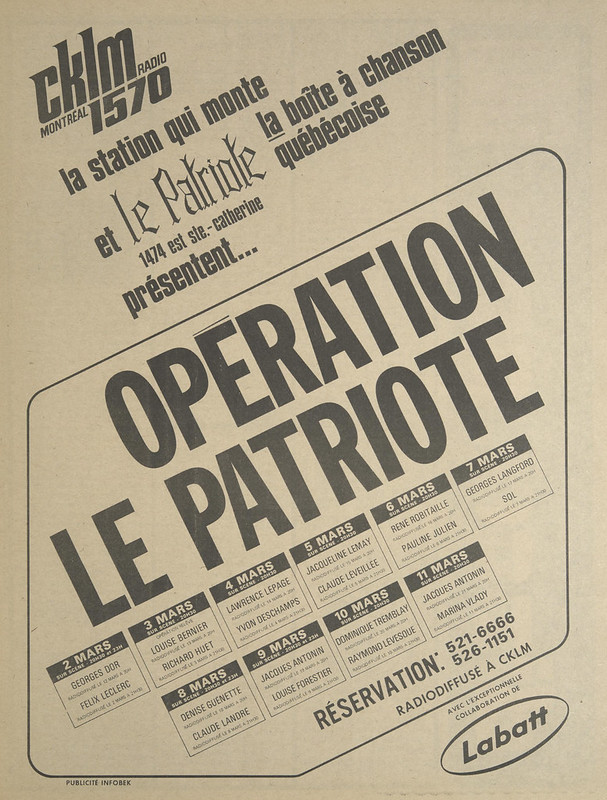
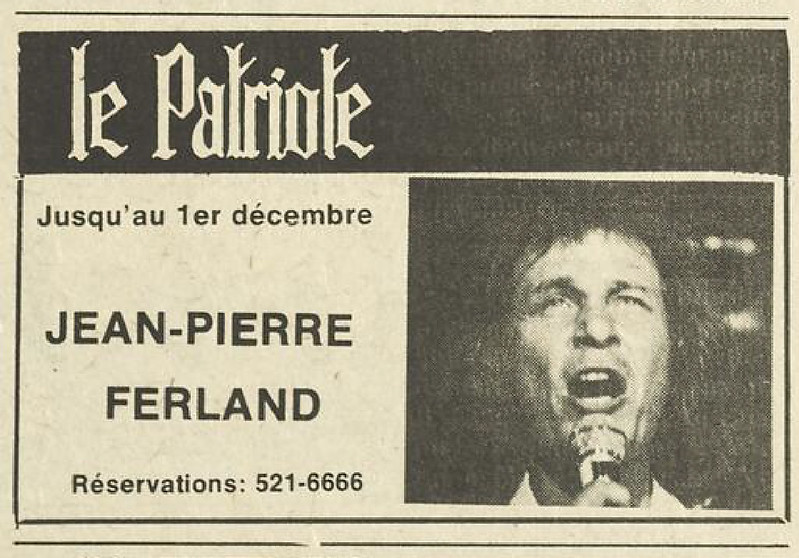
Officially opened on January 16, 1965 at 1474 Sainte-Catherine Street East by Yves Blais and Percival Bloomfield, Le Patriote became one of Montréal’s great boîtes à chansons and a true laboratory for a new generation of Québec songwriters and performers. Through an exceptionally active schedule and auditions open to emerging talent, the venue served as a springboard for an entire generation of singer-songwriters, including Claude Dubois, Louise Forestier, Diane Juster, Alain Lamontagne and Claude Landré. With the opening of Patriote-en-Haut in 1965, followed by Patriote à Clémence, associated with Clémence DesRochers, the establishment also became an important centre for theatre, comedy and creative performance. Active primarily from 1965 to 1980, and briefly revived in 1983, Le Patriote remains a symbol of an era when a new generation of Québec artists was finding its stages, its audiences and, gradually, its own cultural industry.
1. Overview
In the history of Quebec song, Le Patriote occupies a distinctive place. Opening in the mid-1960s, as the boîte à chansons phenomenon was flourishing throughout Quebec, the venue did more than present established performers: it participated directly in the discovery, development and professionalization of a new generation of performers and singer-songwriters.
Located at 1474 Sainte-Catherine Street East, in a section of Montreal that would later become part of the Gay Village, Le Patriote adopted a particularly ambitious formula: performances virtually every night, auditions designed to uncover new talent, and several performance spaces capable of presenting song, theatre, comedy and revues.
For approximately fifteen years, the establishment became one of the principal meeting points between the intimate tradition of the small boîte à chansons and Quebec’s rapidly expanding professional entertainment industry.
A Bridge Venue
Le Patriote can be understood as a bridge venue: between amateur and professional performance, between the small boîte à chansons and the major concert hall, and between song, theatre and comedy. For many performers, it provided a place to test new material, develop an audience and take an important step forward in their careers.
2. The Birth of Le Patriote
Le Patriote was founded by Yves Blais and Percival Bloomfield. A major opening gala was held on January 15, 16 and 17, 1965, bringing together some thirty Quebec artists and chansonniers.
The official opening is generally dated to January 16, 1965. From the beginning, the new venue displayed considerable ambition. Advertising promised quality entertainment, a large dance floor and performances seven nights a week. Admission was open to audiences aged sixteen and over.
Its location on Sainte-Catherine Street East also placed the establishment in the heart of a Montreal district filled with theatres, restaurants, taverns, cinemas and entertainment venues. Unlike the traditional cabarets, however, Le Patriote belonged firmly to the emerging world of the boîte à chansons, where intimacy between performer, song and audience formed the core of the experience.
3. A Boîte à Chansons Seven Nights a Week
One of Le Patriote’s most remarkable characteristics was the intensity of its programming. Before 1972, it was described as the only boîte in Quebec presenting singer-songwriters seven nights a week.
This regular schedule gave the venue a function quite different from that of a hall presenting occasional performances. Le Patriote became a genuine workplace for chansonniers. Performers could appear repeatedly, refine their songs before live audiences and gradually develop their stagecraft.
The main room, located on the second floor, accommodated approximately 300 people. Its rustic decor — including tables and fishing nets — reflected an aesthetic characteristic of many boîtes à chansons of the period: a deliberately simple environment in which the stage and the direct relationship between performer and audience remained central.
4. A Nursery for Quebec Song
Perhaps Le Patriote’s most important contribution was its policy of discovering new talent. Over the years, management reportedly auditioned more than 5,000 people, turning the venue into a genuine testing ground for emerging performers.
Among the artists identified in the sources as discoveries or early talents promoted by Yves Blais were Jacqueline Barrette, Claude Dubois, Louise Forestier, Diane Juster, Alain Lamontagne and Claude Landré.
Le Patriote therefore helped create a kind of professional ladder. Newcomers could audition, perform before their first audiences, share programs with more experienced artists and, in some cases, move into the professional circuits of Quebec song.
More Than a Performance Venue
Within this system, Le Patriote functioned simultaneously as a venue, audition space, stage laboratory and professional network. This role largely explains its importance in the history of Quebec song during the 1960s and 1970s.
5. The Patriote-en-Haut
Only a few months after opening, the establishment expanded. In May 1965, a new space accommodating approximately 170 people was created on the third floor. It became known as the Patriote-en-Haut.
Smaller than the main room, this space was used notably for experimental theatre. The presence of two performance rooms allowed Le Patriote to diversify its activities considerably and move beyond the strict confines of song.
Le Patriote consequently developed into a small cultural complex: chansonniers and variety performers could appear in the main room while the upper floor accommodated theatrical productions, more experimental performances and, eventually, important figures from Quebec comedy and theatre.
6. Le Patriote à Clémence
A new chapter began on November 1, 1968, when Clémence DesRochers, Marc Favreau and Gilbert Chénier took up residence in the third-floor room.
The space became particularly associated with Clémence DesRochers and came to be known as the Patriote à Clémence. This period, extending into the mid-1970s, helped establish Le Patriote as an important venue not only for song, but also for comedy writing, revues and Quebec theatre.
Clémence DesRochers developed a deeply personal form of performance there, shaped by observations of everyday life, popular characters and a new sensitivity to the social transformations taking place in Quebec.
7. Les Girls
Among the most significant productions associated with Le Patriote was Les Girls, a revue created by Clémence DesRochers.
The production featured Louise Latraverse, Diane Dufresne, Paule Bayard — famous as the voice of Bobinette — and Chantal Renaud. Described as one of Quebec’s earliest feminist revues, Les Girls enjoyed sufficient success to continue its run on tour.
The production perfectly illustrates Le Patriote’s function: providing a relatively intimate environment in which new forms of performance could emerge before reaching much larger audiences.
8. Programming Beyond Quebec Song
Although its identity remained closely connected to Quebec song, Le Patriote also welcomed numerous international performers. Sources mention Barbara, Gilbert Bécaud, Frida Boccara, Marie Laforêt, Nana Mouskouri, Serge Reggiani and Roger Whittaker, among others.
Theatre and variety personalities including Pierre Brasseur, Michel Simon, Eddie Constantine and Jacqueline Dulac also appear in accounts of the venue’s programming.
Le Patriote therefore stood at the intersection of several traditions: the Quebec boîte à chansons, French cabaret, popular theatre, comedy and variety entertainment. This diversity made it a far more versatile institution than the conventional image of a simple chansonnier club might suggest.
9. Le Patriote Beyond Montreal
The success of the Le Patriote name eventually extended beyond Montreal. During the late 1960s and early 1970s, the name became associated with other venues, notably in Sainte-Agathe-des-Monts and Hull.
Le Patriote in Sainte-Agathe would itself become an important institution in the history of Quebec entertainment. The history of the Sainte-Agathe building must, however, be distinguished from the history of the Le Patriote name: the venue existed before it began operating under that name.
Montreal and Sainte-Agathe: Connected but Distinct Histories
The Montreal Le Patriote was the starting point for the name. The Sainte-Agathe venue, however, had its own history before its association with Yves Blais and Percival Bloomfield. The two establishments are therefore better understood as related institutions rather than as a single venue that simply moved from one city to another.
10. Financial Difficulties and Closure
After operating throughout the 1960s and 1970s, Le Patriote encountered growing financial difficulties. The cultural landscape had also changed dramatically: the golden age of the boîte à chansons had faded, while Quebec performers now had access to much more developed networks of concert halls, festivals, record companies and media outlets.
In 1980, Le Patriote in Montreal closed because of financial difficulties. The closure marked the end of the venue’s principal era, after approximately fifteen years during which it had accompanied a fundamental transformation of Quebec popular culture.
11. Le Patriote à Lejeune
The Montreal story of Le Patriote nevertheless had one final chapter. On January 18, 1983, the establishment was revived under the name Le Patriote à Lejeune, associated with singer and entertainer André Lejeune.
The opening performance was entrusted to Claude Landré, an artist whose career was itself closely connected to Quebec’s chansonnier and comedy traditions.
The revival was short-lived. After approximately six months of activity, the venue closed again in June 1983. This time, the Montreal story of Le Patriote had truly come to an end.
12. Legacy
Le Patriote’s importance extends far beyond the list of performers who appeared there. Its history corresponds to a period during which Quebec song gradually evolved from a network of small, largely artisanal boîtes à chansons into a genuine cultural industry.
Within this transformation, Le Patriote occupied a privileged position. Its auditions, nightly programming and multiple performance spaces created an environment in which artists could learn their craft before live audiences. The venue therefore helped transform the boîte à chansons into a genuine institution for artistic development.
Le Patriote also reflected the broadening scope of Quebec’s performing arts. Song, theatre, comedy and revue shared the same institution at a time when the boundaries separating these disciplines remained particularly fluid.
Decades after its disappearance, the name Le Patriote therefore remains associated with a decisive period: an era when a new generation of Quebec artists found its stages, its audiences and, gradually, its own professional entertainment industry.
More than a boîte à chansons, Le Patriote was a place of apprenticeship: a stage where a generation could experiment, learn, become known and ultimately make the transition from emerging talent to professional artist.
13. Timeline
January 15–17, 1965 — Opening gala bringing together some thirty artists and chansonniers.
January 16, 1965 — Official opening of Le Patriote at 1474 Sainte-Catherine Street East in Montreal.
May 1965 — Opening of the Patriote-en-Haut, an approximately 170-seat room used notably for experimental theatre.
November 1, 1968 — Clémence DesRochers, Marc Favreau and Gilbert Chénier take up residence on the third floor.
1968–1974 — Period of the Patriote à Clémence.
Late 1960s — Expansion of the Le Patriote name beyond Montreal, notably to Sainte-Agathe and Hull.
1970s — Le Patriote continues presenting song, theatre, comedy and variety entertainment.
1980 — Le Patriote in Montreal closes because of financial difficulties.
January 18, 1983 — Reopening as Le Patriote à Lejeune; Claude Landré gives the opening performance.
June 1983 — Final closure of the Montreal venue.
14. Notes & Sources
-
MONTRÉAL-MATIN, January 15, 1965,
“Le Patriote.”
MCPA use: announcement of the January 15–17, 1965 opening gala; seven-night-a-week programming; admission for audiences aged 16 and over. -
LA PRESSE, June 23, 1983,
“Nouvelle revue de Raymond Lévesque.”
MCPA use: source concerning the closure of Le Patriote in 1983. -
THE CANADIAN ENCYCLOPEDIA,
“Le Patriote.”
MCPA use: address, periods of operation, seven-night-a-week programming before 1972, auditions, artists discovered or promoted, expansion of the Le Patriote name and financial difficulties. -
TÉLÉ-RADIOMONDE, October 19, 1968,
“Clémence Desrochers ouvre une troisième boîte.”
MCPA use: the arrival of Clémence DesRochers, Marc Favreau and Gilbert Chénier on the third floor beginning November 1, 1968. -
LA SEIGNEURIE, January 12, 1983,
“Le Patriote à Lejeune.”
MCPA use: reopening on January 18, 1983 under André Lejeune and Claude Landré’s opening performance. -
BILAN DU SIÈCLE / UNIVERSITÉ DE SHERBROOKE,
file devoted to Clémence DesRochers’s musical revue
Les Girls.
MCPA use: context, cast and historical significance of the production in Clémence DesRochers’s career.