Samovar
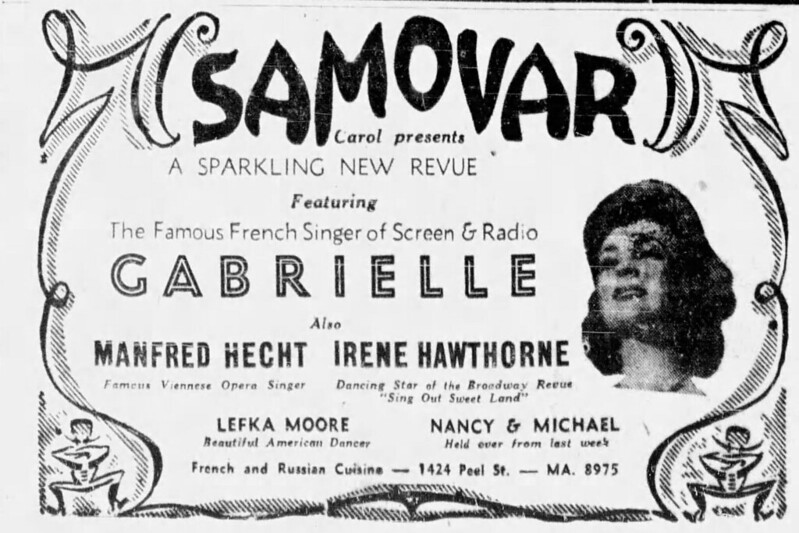
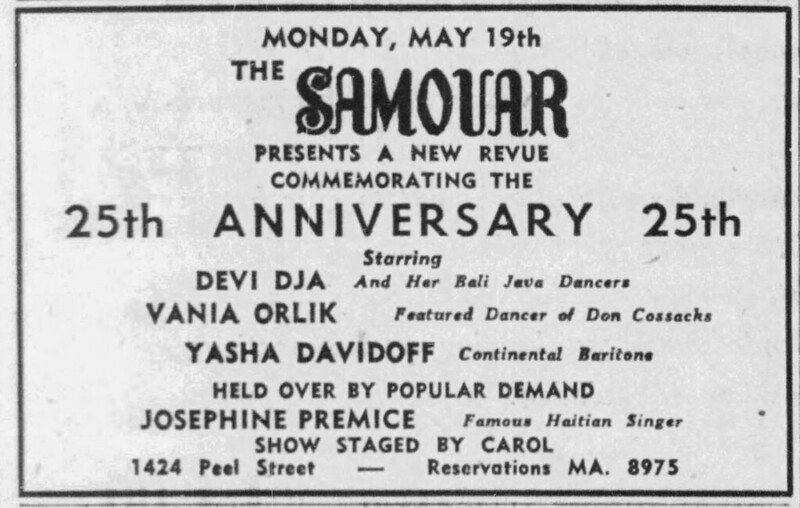
Founded on December 19, 1925 by Ema Goodstone at 395 Mackay Street, the Samovar Tea Room evolved from a modest tea room into one of the emblematic establishments of Montréal’s golden age of cabarets. Located on Peel Street beginning in 1929, the Samovar developed during the 1930s and 1940s into a celebrated restaurant-cabaret known for its French and Russian cuisine, atmosphere inspired by the former Russian Empire, Gypsy music and carefully staged entertainment. Its artistic identity was profoundly shaped by Carol Grauer, who served as master of ceremonies, manager, stage director and talent scout for nearly two decades. After almost a quarter-century of activity, the Samovar closed under that name in 1949 and became the Carrousel, leaving behind an important legacy in the evolution of Montréal nightlife.
1. Overview
Between 1925 and 1949, the Samovar was part of one of the most vibrant periods in Montreal nightlife. A restaurant, tea room, café and eventually a full-fledged cabaret, the establishment stood out for its strongly European identity, combining French and Russian cuisine, music, dancing and carefully staged entertainment.
During the 1930s and 1940s, its reputation extended far beyond that of a simple restaurant. In 1946, the newspaper Le Canada described it as an establishment that had presented some of the most artistic shows ever seen in a Montreal nightclub. [5]
The Samovar belonged to the generation of establishments that made Montreal, between the 1920s and 1940s, a renowned destination for late-night restaurants, cabarets and live entertainment.
2. The Samovar Tea Room
The Samovar Tea Room officially opened on December 19, 1925 at 395 Mackay Street. Founded by Ema Goodstone, the small establishment primarily served tea and other light refreshments. An advertisement published the day before its opening presented it as a place intended to offer patrons a true “refuge from the ordinary.” [1]
The name Samovar itself, borrowed from the large metal urn traditionally used in Russia to heat water for tea, already foreshadowed the visual and cultural identity that the establishment would develop more fully over the following years.
The first Samovar was still a small tea room, far removed from the spectacular cabaret it would later become on Peel Street.
3. The move to Peel Street
On December 14, 1929, the Samovar inaugurated new premises at 1422 Peel Street. The move marked an important transformation: the tea room became the Samovar café, with a far more ambitious combination of dining, music and entertainment. [2], [4]
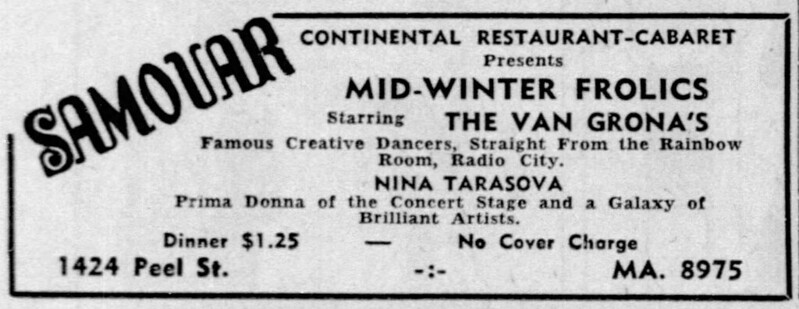
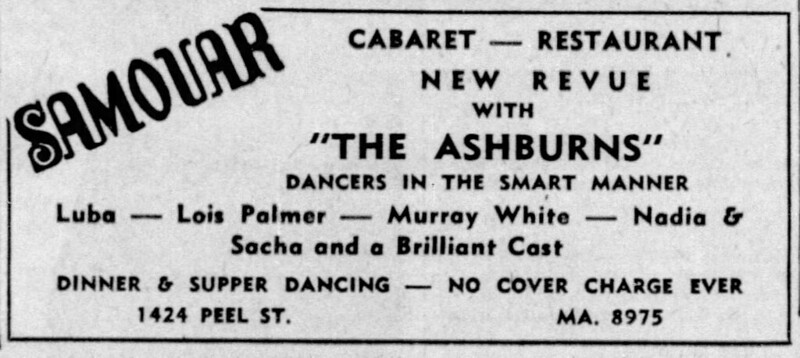
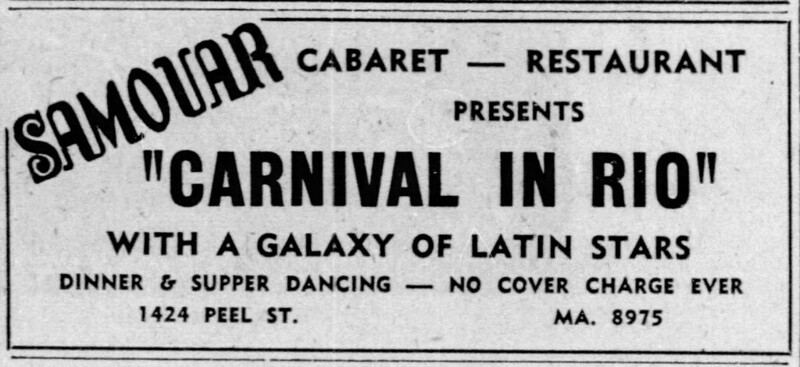
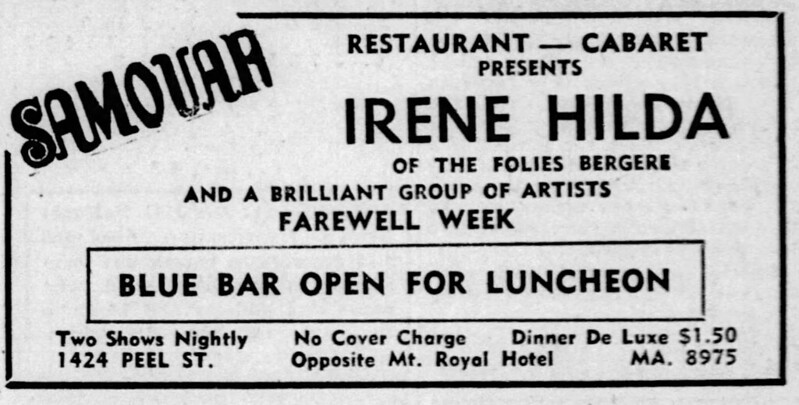
Beginning in 1936, advertisements placed the Samovar at 1424 Peel Street, on the top floor of the same building. This location corresponds to the period when the club reached full maturity as a nightlife establishment. [3]
1925: 395 Mackay Street
1929: 1422 Peel Street
1936: 1424 Peel Street, on the top floor of the same building
4. An atmosphere of the old Russian Empire
The new Samovar emphasized a sense of escape. Patrons were welcomed into an atmosphere evoking the old Russian Empire, with décor and an ambience designed to transport visitors far from everyday Montreal. Guests could enjoy a meal presented as exotic and dance to Gypsy music. [4]
This combination of dining, staging and music gave the Samovar a distinctive personality among the city’s many cabarets. The experience did not depend solely on the performers: the décor, service, cuisine and personality of the master of ceremonies all contributed to the show.
5. Carol Grauer, the soul of the Samovar
The central figure in the Samovar’s history is Carol Grauer, a Russo-Austrian performer born in Vienna. He first assumed the role of master of ceremonies at the Samovar on March 14, 1928. According to a profile published twenty years later in Le Petit Journal, several prominent guests attended that evening, including princes and the Grand Duchess of Luxembourg. [6]
Grauer quickly became much more than a presenter. He served simultaneously as manager, stage director and master of ceremonies, and also handled the establishment’s publicity until publicist Marc Thibault arrived in 1947. [6]
Contemporary profiles emphasize his immense popularity. Jovial, personable and recognizable for his imposing presence, Grauer made a point of personally thanking patrons who came to see his shows. In 1948, Le Canada described him as one of the great figures of the cabaret world in Canada and the United States. [7]
“The Samovar is him.”
6. From Viennese operettas to nightclub entertainment
Early in his career at the Samovar, Grauer presented a Viennese operetta specially adapted to the cabaret’s small stage every evening. The repertoire was essentially Viennese and featured European and American singers and dancers. [6]
These productions, however, were extremely demanding to stage and costly for management. Despite their success, the Samovar gradually abandoned this model and adopted programming closer to that of other Montreal nightclubs, with singing, dancing and variety acts succeeding one another throughout the evening. [6]
The Samovar initially distinguished itself through an unusual formula for a cabaret: presenting a genuine Viennese operetta each evening, condensed and adapted to the club’s limited space.
7. Grauer, talent scout and discoverer
Grauer personally selected many of the performers presented at the Samovar. Approximately every six weeks, he travelled to New York to hire singers, dancers and variety performers suited to the Montreal stage. [6]
The 1948 profile published by Le Petit Journal also credits him with discovering or launching several performers. It mentions Iva Withers, who would later find success on Broadway, the Kraft Sisters, and Irene Hilda, who was said to have made her North American debut on the Samovar floor thanks to Grauer. [6]
This recruiting activity directly connected the Samovar to the New York entertainment circuit and helped keep the cabaret’s programming fresh.
8. From Vienna to Montreal
Born in Vienna, Carol Grauer studied and began his stage career there. According to the 1948 profile, he studied with leading European masters, including the celebrated stage director Max Reinhardt, and pursued a career in operetta before coming to Canada. [6]
His European tours were said to have made him familiar with nine languages. During the First World War, according to the same profile, he served in an Austrian dragoon regiment, was wounded in combat, promoted to captain and decorated for bravery. [6]
Upon arriving in Canada, Grauer first worked for the Canadian Pacific Railway. A few months later, he joined the Samovar, where he would build most of his Montreal reputation. With his characteristic humour, he described himself as the “grandfather of Montreal masters of ceremonies.” [6]
Samovar timeline
9. Carol Grauer’s departure
In October 1948, Carol Grauer announced that his association with the Samovar was coming to an end. According to The Gazette, his departure followed a lengthy disagreement with the owner, who wanted to modernize the establishment’s décor. Grauer then submitted his resignation. [8]
His absence was immediately felt. After nearly two decades during which he had personified the cabaret in the eyes of the public, the Samovar remained a pleasant establishment, but contemporary commentary suggests that it had lost an essential part of its character.
Dès le mois suivant, Grauer devient maître de cérémonie de la salle Tzigane du Café Bucharest, au 3956, Saint-Laurent Boulevard. Son premier spectacle, le November 4, 1948, est accueilli par des applaudissements remarquables; la salle est remplie de fleurs envoyées par ses admirateurs. [9], [10]
10. From the Samovar to the Carrousel
Le départ de Grauer annonce la fin prochaine du Samovar sous sa forme historique. Quelques mois plus tard, l’établissement est vendu. Le March 24, 1949, les nouveaux propriétaires procèdent à l’ouverture officielle du Carrousel. [11]
This transformation brought nearly a quarter-century of activity under the Samovar name to an end. From the small Mackay Street tea room to the sophisticated Peel Street cabaret, the establishment had passed through several forms of Montreal dining and entertainment.
11. Historical significance and legacy
The Samovar perfectly illustrates the evolution of Montreal entertainment establishments during the interwar years. Born as a tea room in 1925, it gradually became a café, restaurant and then a nightclub capable of attracting both local patrons and tourists through a carefully crafted artistic identity.
Its significance also rests on the personality of Carol Grauer. For nearly twenty years, he did far more than host the evenings: he conceived the shows, recruited performers, supervised the stage, managed the club and participated in its promotion. In accounts from the late 1940s, the distinction between the man and the establishment seems almost to disappear.
The Peel Street building subsequently continued a long commercial history. Beginning in 1990, it was notably occupied by the Mexican restaurant Carlos & Pepes, across from Les Cours Mont-Royal, until the restaurant closed in 2021.
The Samovar remains an important witness to a Montreal in which dining, cabaret, music and live entertainment formed a single nightlife experience. Its history also restores Carol Grauer to his place as one of the notable, though now largely forgotten, figures of Montreal’s cabaret world.
12. Notes & sources
- The Samovar Tea Room, The Gazette, December 18, 1925.
- The New Samovar, The Gazette, December 13, 1929.
- Samovar, The Montreal Star, July 4, 1936.
- Grande ouverture Samovar, La Presse, December 14, 1929.
- Parlons cinéma, Le Canada, March 14, 1946.
- Sans Carol le Samovar ne serait pas ce qu’il est, Le Petit Journal, March 14, 1948.
- Silence on tourne, Le Canada, March 12, 1948.
- Sean Edwin’s Sound Track, The Gazette, October 16, 1948.
- Tzigane Room Has Premiere, The Montreal Star, November 4, 1948.
- Carol Grauer Opens New Bucharest Show, The Gazette, November 4, 1948.
- Tonight the Official Opening of the Carrousel, The Gazette, March 24, 1949.